
Showing 5 items matching "ink powder writing"
-
 Flagstaff Hill Maritime Museum and Village
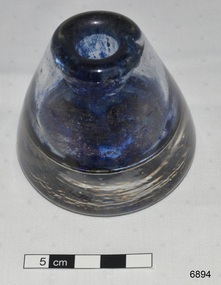
Container - Ink well, early to mid 20th century
... ink bottle...pen and ink writing...nib pen writing supplies...ink powder...Largs Bay Warrnambool Base Hospital Nhill Base Hospital Mira hospital Flying Doctor ink bottle pen and ink writing nib pen writing supplies ink powder writing ink mixing Ink well, thick clear glass, bell shaped, wide and heavy base. ...One of the daughters of Dr Angus and his wife Gladys told Flagstaff Hill Maritime Village that this glass ink well was used by her father in his office in the days when ink powder [usually supplied in paper packets] was mixed with warm water to make ink. The ink well was donated to Flagstaff Hill Maritime Village by the family of Doctor William Roy Angus, Surgeon and Oculist. It is part of the “W.R. Angus Collection” includes historical medical equipment, surgical instruments and material once belonging to Dr Edward Ryan and Dr Thomas Francis Ryan, (both of Nhill, Victoria) as well as Dr Angus’ own belongings. The Collection’s history spans the medical practices of the two Doctors Ryan, from 1885-1926 plus that of Dr Angus, up until 1969. ABOUT THE “W.R.ANGUS COLLECTION” Doctor William Roy Angus M.B., B.S., Adel., 1923, F.R.C.S. Edin.,1928 (also known as Dr Roy Angus) was born in Murrumbeena, Victoria in 1901 and lived until 1970. He qualified as a doctor in 1923 at University of Adelaide, was Resident Medical Officer at the Royal Adelaide Hospital in 1924 and for a period was house surgeon to Sir (then Mr.) Henry Simpson Newland. Dr Angus was briefly an Assistant to Dr Riddell of Kapunda, then commenced private practice at Curramulka, Yorke Peninsula, SA, where he was physician, surgeon and chemist. In 1926, he was appointed as new Medical Assistant to Dr Thomas Francis Ryan (T.F. Ryan, or Tom), in Nhill, Victoria, where his experiences included radiology and pharmacy. In 1927 he was Acting House Surgeon in Dr Tom Ryan’s absence. Dr Angus had become engaged to Gladys Forsyth and they decided he further his studies overseas in the UK in 1927. He studied at London University College Hospital and at Edinburgh Royal Infirmary and in 1928, was awarded FRCS (Fellow from the Royal College of Surgeons), Edinburgh. He worked his passage back to Australia as a Ship’s Surgeon on the on the Australian Commonwealth Line’s T.S.S. Largs Bay. Dr Angus married Gladys in 1929, in Ballarat. (They went on to have one son (Graham 1932, born in SA) and two daughters (Helen (died 12/07/1996) and Berenice (Berry), both born at Mira, Nhill ) According to Berry, her mother Gladys made a lot of their clothes. She was very talented and did some lovely embroidery including lingerie for her trousseau and beautifully handmade baby clothes. Dr Angus was a ‘flying doctor’ for the A.I.M. (Australian Inland Ministry) Aerial Medical Service in 1928 . Its first station was in the remote town of Oodnadatta, where Dr Angus was stationed. He was locum tenens there on North-South Railway at 21 Mile Camp. He took up this ‘flying doctor’ position in response to a call from Dr John Flynn; the organisation was later known as the Flying Doctor Service, then the Royal Flying Doctor Service. A lot of his work during this time involved dental surgery also. Between 1928-1932 he was surgeon at the Curramulka Hospital, Yorke Peninsula, South Australia. In 1933 Dr Angus returned to Nhill and purchased a share of the Nelson Street practice and Mira hospital (a 2 bed ward at the Nelson Street Practice) from Dr Les Middleton one of the Middleton Brothers, the current owners of what previously once Dr Tom Ryan’s practice. Dr Tom and his brother had worked as surgeons included eye surgery. Dr Tom Ryan performed many of his operations in the Mira private hospital on his premises. He had been House Surgeon at the Nhill Hospital 1902-1926. Dr Tom Ryan had one of the only two pieces of radiology equipment in Victoria during his practicing years – The Royal Melbourne Hospital had the other one. Over the years Dr Tom Ryan had gradually set up what was effectively a training school for country general-practitioner-surgeons. Each patient was carefully examined, including using the X-ray machine, and any surgery was discussed and planned with Dr Ryan’s assistants several days in advance. Dr Angus gained experience in using the X-ray machine there during his time as assistant to Dr Ryan. When Dr Angus bought into the Nelson Street premises in Nhill he was also appointed as the Nhill Hospital’s Honorary House Surgeon 1933-1938. His practitioner’s plate from his Nhill surgery is now mounted on the doorway to the Port Medical Office at Flagstaff Hill Maritime Village, Warrnambool. When Dr Angus took up practice in the Dr Edward and Dr Tom Ryan’s old premises he obtained their extensive collection of historical medical equipment and materials spanning 1884-1926. A large part of this collection is now on display at the Port Medical Office at Flagstaff Hill Maritime Village in Warrnambool. In 1939 Dr Angus and his family moved to Warrnambool where he purchased “Birchwood,” the 1852 home and medical practice of Dr John Hunter Henderson, at 214 Koroit Street. (This property was sold in1965 to the State Government and is now the site of the Warrnambool Police Station. and an ALDI sore is on the land that was once their tennis court). The Angus family was able to afford gardeners, cooks and maids; their home was a popular place for visiting dignitaries to stay whilst visiting Warrnambool. Dr Angus had his own silk worm farm at home in a Mulberry tree. His young daughter used his centrifuge for spinning the silk. Dr Angus was appointed on a part-time basis as Port Medical Officer (Health Officer) in Warrnambool and held this position until the 1940’s when the government no longer required the service of a Port Medical Officer in Warrnambool; he was thus Warrnambool’s last serving Port Medical Officer. (Masters of immigrant ships arriving in port reported incidents of diseases, illness and death and the Port Medical Officer made a decision on whether the ship required Quarantine and for how long, in this way preventing contagious illness from spreading from new immigrants to the residents already in the colony.) Dr Angus was a member of the Australian Medical Association, for 35 years and surgeon at the Warrnambool Base Hospital 1939-1942, He served with the Australian Department of Defence as a Surgeon Captain during WWII 1942-45, in Ballarat, Victoria, and in Bonegilla, N.S.W., completing his service just before the end of the war due to suffering from a heart attack. During his convalescence he carved an intricate and ‘most artistic’ chess set from the material that dentures were made from. He then studied ophthalmology at the Royal Melbourne Eye and Ear Hospital and created cosmetically superior artificial eyes by pioneering using the intrascleral cartilage. Angus received accolades from the Ophthalmological Society of Australasia for this work. He returned to Warrnambool to commence practice as an ophthalmologist, pioneering in artificial eye improvements. He was Honorary Consultant Ophthalmologist to Warrnambool Base Hospital for 31 years. He made monthly visits to Portland as a visiting surgeon, to perform eye surgery. He represented the Victorian South-West subdivision of the Australian Medical Association as its secretary between 1949 and 1956 and as chairman from 1956 to 1958. In 1968 Dr Angus was elected member of Spain’s Barraquer Institute of Barcelona after his research work in Intrasclearal cartilage grafting, becoming one of the few Australian ophthalmologists to receive this honour, and in the following year presented his final paper on Living Intrasclearal Cartilage Implants at the Inaugural Meeting of the Australian College of Ophthalmologists in Melbourne In his personal life Dr Angus was a Presbyterian and treated Sunday as a Sabbath, a day of rest. He would visit 3 or 4 country patients on a Sunday, taking his children along ‘for the ride’ and to visit with him. Sunday evenings he would play the pianola and sing Scottish songs to his family. One of Dr Angus’ patients was Margaret MacKenzie, author of a book on local shipwrecks that she’d seen as an eye witness from the late 1880’s in Peterborough, Victoria. In the early 1950’s Dr Angus, painted a picture of a shipwreck for the cover jacket of Margaret’s book, Shipwrecks and More Shipwrecks. She was blind in later life and her daughter wrote the actual book for her. Dr Angus and his wife Gladys were very involved in Warrnambool’s society with a strong interest in civic affairs. He had an interest in people and the community They were both involved in the creation of Flagstaff Hill, including the layout of the gardens. After his death (28th March 1970) his family requested his practitioner’s plate, medical instruments and some personal belongings be displayed in the Port Medical Office surgery at Flagstaff Hill Maritime Village, and be called the “W. R. Angus Collection”. The W.R. Angus Collection is significant for still being located at the site it is connected with, Doctor Angus being the last Port Medical Officer in Warrnambool. The collection of medical instruments and other equipment is culturally significant, being an historical example of medicine from late 19th to mid-20th century. Dr Angus assisted Dr Tom Ryan, a pioneer in the use of X-rays and in ocular surgery. Ink well, thick clear glass, bell shaped, wide and heavy base. Remnants of blue ink inside. Part of the W.R. Angus Collection. flagstaff hill, warrnambool, shipwrecked coast, flagstaff hill maritime museum, maritime museum, shipwreck coast, flagstaff hill maritime village, great ocean road, dr w r angus, dr ryan, surgical instrument, t.s.s. largs bay, warrnambool base hospital, nhill base hospital, mira hospital, flying doctor, ink bottle, pen and ink writing, nib pen writing supplies, ink powder writing, ink mixing -
 Mont De Lancey
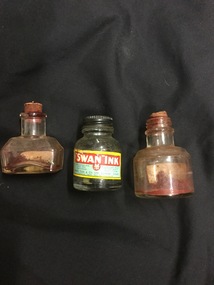
Glass bottles
... writing equipment 1. On label: "Red V.A.N.A - Vic. Auth. News. Acts. Ink" 2. On label: " "Swan" Ink for fountain and steel pens. A blue black ink of the finest quality. Contains 2 1/2 fluid ozs. Mabie, Todd & Co. London Sydney. Makers of "SWAN" pens, gold pens and ink" "Triple Filtered" on metal lid. 3. On label: "Caldwell Red Ink". 3 glass ink bottles: 1. Regular-shaped ink bottle containing red powder ...3 glass ink bottles: 1. Regular-shaped ink bottle containing red powder (1/2 teaspoon) with label and damaged cork stopper. 2. Regular-shaped ink bottle containing blue powder (1 teaspoon) with label and metal screw-on lid. 3. 9-faceted ink bottle, containing red powder (1/2 teaspoon) with label and cork stopper. 1. On label: "Red V.A.N.A - Vic. Auth. News. Acts. Ink" 2. On label: " "Swan" Ink for fountain and steel pens. A blue black ink of the finest quality. Contains 2 1/2 fluid ozs. Mabie, Todd & Co. London Sydney. Makers of "SWAN" pens, gold pens and ink" "Triple Filtered" on metal lid. 3. On label: "Caldwell Red Ink". bottles, containers, writing equipment -
 Emerald Museum & Nobelius Heritage Park
Equipment - Ink bottle, 1920s-1940s
... ink. Bottles were produced in a wide variety of shapes and colours, primarily dictated by product differentiation and aesthetic appeal in the growing retail market that emerged due to improvements in fountain pen design which made access to convenient writing implements cheaper but also more portable. Prior to innovations in fountain pen nibs and filling systems that made them cleaner and more reliable to use, writing may have been conducted at a writing desk which held an inkwell which was refilled from a larger bottle or (prior to the beginning of the Nineteenth Century) filled with ink reconstituted from powder form or dissolved from a tablet or cake of dry ink....ink. Bottles were produced in a wide variety of shapes and colours, primarily dictated by product differentiation and aesthetic appeal in the growing retail market that emerged due to improvements in fountain pen design which made access to convenient writing implements cheaper but also more portable. Prior to innovations in fountain pen nibs and filling systems that made them cleaner and more reliable to use, writing may have been conducted at a writing desk which held an inkwell which was refilled from a larger bottle or (prior to the beginning of the Nineteenth Century) filled with ink reconstituted from powder form or dissolved from a tablet or cake of dry ink. ...This item is an ink bottle used to store a quantity of ink ready for writing at a desk or table, with a small brush that could be used to stir the ink to prevent separation of the ink into components or sediment at the bottom of the bottle. The brush could also be used as a direct applicator if larger text was required. The bottle is thought to date from the mid-period of the Twentieth Century, and is likely to have been purchased full of ink rather than filled and refilled from a bulk bottle of household ink. Similarly, in this time period, the ink is likely to have been used to refill a fountain pen with an internal storage reservoir via an eye-dropper or converter mechanism rather than used by a writer who dipped their pen in the ink frequently as they wrote. Ink bottles were typically designed to have a broad, stable base that decreased the likelihood of the article tipping when a pen or converter was dipped into the ink. Bottles were produced in a wide variety of shapes and colours, primarily dictated by product differentiation and aesthetic appeal in the growing retail market that emerged due to improvements in fountain pen design which made access to convenient writing implements cheaper but also more portable. Prior to innovations in fountain pen nibs and filling systems that made them cleaner and more reliable to use, writing may have been conducted at a writing desk which held an inkwell which was refilled from a larger bottle or (prior to the beginning of the Nineteenth Century) filled with ink reconstituted from powder form or dissolved from a tablet or cake of dry ink. The item is significant for the insights it provides into the development of writing technologies generally and the application of these to writing practices used by schools and businesses and offices in Emerald and the surrounding region, including the commercial and economic practices required to support these activities. Oval shaped flat-bottomed clear glass bottle with tiered ripples on the upper surface slanting towards the juncture with the bottle's circular metal lid. The lid has a nub-shaped handle for the user to grasp. The inside of the lid contains a metal pipe on the end of which is a small brush for stirring the ink. This item is an ink bottle used to store a quantity of ink ready for writing at a desk or table, with a small brush that could be used to stir the ink to prevent separation of the ink into components that might cause sedimentation at the bottom of the bottle. The brush could also be used as a direct applicator if larger text was required. Base: VEMU 2001 / ISM-I52 or 1SM-152 / 3 / 1930s and 1940s, 1950s, ink, ink bottle, writing equipment, writing, schools, businesses, office equipment -
Emerald Museum & Nobelius Heritage Park
Equipment - Ink Bottle, Angus & Co, 1940s-1950s
... ink. Bottles were produced in a wide variety of shapes and colours, primarily dictated by product differentiation and aesthetic appeal in the growing retail market that emerged due to improvements in fountain pen design which made access to convenient writing implements cheaper but also more portable. Prior to innovations in fountain pen nibs and filling systems that made them cleaner and more reliable to use, writing may have been conducted at a writing desk which held an inkwell which was refilled from a larger bottle or (prior to the beginning of the Nineteenth Century) filled with ink reconstituted from powder form or dissolved from a tablet or cake of dry ink. ...ink. Bottles were produced in a wide variety of shapes and colours, primarily dictated by product differentiation and aesthetic appeal in the growing retail market that emerged due to improvements in fountain pen design which made access to convenient writing implements cheaper but also more portable. Prior to innovations in fountain pen nibs and filling systems that made them cleaner and more reliable to use, writing may have been conducted at a writing desk which held an inkwell which was refilled from a larger bottle or (prior to the beginning of the Nineteenth Century) filled with ink reconstituted from powder form or dissolved from a tablet or cake of dry ink. ...This item is an ink bottle used to store a quantity of ink ready for writing at a desk or table. The bottle is thought to date from the mid-period of the Twentieth Century, and is likely to have been purchased full of ink rather than filled and refilled from a bulk bottle of household ink. Similarly, in this time period, the ink is likely to have been used to refill a fountain pen with an internal storage reservoir via an eye-dropper or converter mechanism rather than used by a writer who dipped their pen in the ink frequently as they wrote. Ink bottles were typically designed to have a broad, stable base that decreased the likelihood of the article tipping when a pen or converter was dipped into the ink. Bottles were produced in a wide variety of shapes and colours, primarily dictated by product differentiation and aesthetic appeal in the growing retail market that emerged due to improvements in fountain pen design which made access to convenient writing implements cheaper but also more portable. Prior to innovations in fountain pen nibs and filling systems that made them cleaner and more reliable to use, writing may have been conducted at a writing desk which held an inkwell which was refilled from a larger bottle or (prior to the beginning of the Nineteenth Century) filled with ink reconstituted from powder form or dissolved from a tablet or cake of dry ink. Angus & Co. were a Melbourne-based company established in 1896 which manufactured ink, gums and pastes for domestic and industrial purposes, including manufacturing the bottles in which their products were sold. The business was initially located at 112 King Street, Melbourne, after Joseph Armstrong Angus and his wife Emma moved to Melbourne. The company shifted location several times, occupying sites in North Fitzroy and Northcote, including the ink manufacturing plant and bottle works. The item is significant for the insights it provides into the development of writing technologies generally and the application of these to writing practices used by schools and businesses and offices in Emerald and the surrounding region, including the commercial and economic practices required to support these activities. Round flat-bottomed clear glass bottle with a metal lid and an ink-manufacturer's label adhered to the outward-facing surface. The bottle is partially filled with black or dark blue ink. This item is an ink bottle used to store a quantity of ink ready for writing at a desk or table. The bottle is thought to date from the mid-period of the Twentieth Century and is likely to have been used to refill a fountain pen with an internal storage reservoir via an eye-dropper or converter mechanism rather than used by a writer who dipped their pen in the ink frequently as they wrote. The bottle is thought to date from the mid-period of the Twentieth Century, and is likely to have been purchased full of ink rather than filled and refilled from a bulk bottle of household ink. Similarly, in this time period, the ink is likely to have been used to refill a fountain pen with an internal storage reservoir via an eye-dropper or converter mechanism rather than used by a writer who dipped their pen in the ink frequently as they wrote. Obverse: ANGUS & CO. / PTY. LTD. / INDIAN INK / SUPERIOR WATERPROO / DRAWING IN / 1930s and 1940s, 1950s, ink, ink bottle, writing equipment, writing, schools, businesses, office equipment -
Emerald Museum & Nobelius Heritage Park
Equipment - Nib pen, Hinks, Wells & Co, 1890s-1920s
... Prior to innovations in fountain pen nibs and filling systems that made them cleaner and more reliable to use, such as internal storage reservoirs to hold a supply of ink within the body of the pen, writing was conducted at a writing desk containing an inkwell. This was refilled from a larger bottle or (prior to the beginning of the Nineteenth Century) filled with ink reconstituted from powder form or dissolved from a tablet or cake of dry ink....Prior to innovations in fountain pen nibs and filling systems that made them cleaner and more reliable to use, such as internal storage reservoirs to hold a supply of ink within the body of the pen, writing was conducted at a writing desk containing an inkwell. This was refilled from a larger bottle or (prior to the beginning of the Nineteenth Century) filled with ink reconstituted from powder form or dissolved from a tablet or cake of dry ink. ...This item is a nib pen which may have been used for correspondence or record-keeping in a home, business or school setting. The manufacturer, Hinks, Wells & Co. of Birmingham, England, was founded in 1836 and produced approximately 1.82 million pens a year by 1852. Prior to innovations in fountain pen nibs and filling systems that made them cleaner and more reliable to use, such as internal storage reservoirs to hold a supply of ink within the body of the pen, writing was conducted at a writing desk containing an inkwell. This was refilled from a larger bottle or (prior to the beginning of the Nineteenth Century) filled with ink reconstituted from powder form or dissolved from a tablet or cake of dry ink. The item is significant for the insights it provides into the development of writing technologies generally and the application of these to writing practices used by schools and businesses and offices in Emerald and the surrounding region. Varnished wooden shaft with metal bracket fixed to one end, into which a metal nib has been inserted. This item is a nib pen which may have been used to write in a home, school or business setting. The varnished barrel of the pen displays significant wear associated with use. The style of pen is designed to be dipped frequently into an inkwell as it does not have an internal reservoir to supply ink to the nib. Pens with internal reservoirs became common in the mid-twentieth Century which indicates this pen may have been used in the preceding decades. Nib: HINKSWE & CO. / STANDARD / MEDIUM / ENGL / Nib bracket: HINKSWELLS & CO. / BEST / ACCOMMODATION / BIRMINGHAM / 1890s-1940s, hinks wells & co, birmingham, england, office, schools, businesses, correspondence, equipment, writing equipment, pens, calligraphy, nib, administrative records
