
Showing 53 items matching "instruction leaflets"
-
 Glenelg Shire Council Cultural Collection
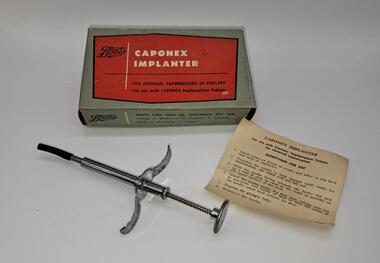
Equipment - Caponex Implanter, in original box with instruction leaflet, Unknown
... Caponex Implanter, in original box with instruction leaflet....Instruction Leaflet is small on yellowed paper with black text....LTD Follows with the locations in Australia of Boots. Instruction Leaflet: CAPONEX IMPLANTER for chemical caponisation of poultry for use with CAPONEX Implantation Tablets Directions for use (Directions to follow back and front)...Instruction Leaflet is small on yellowed paper with black text. ...A Caponex Implanter was used to chemically castrate roosters by inserting a caponex implantation tablet into the neck of the of male chickens to make them grow faster and become more docile. The caponisation of poultry has since been banned in Australia and UK as the chemical remained within the birds which proved to be toxic to human consumption.Evidence of expired practices. 'Boots' branded box containing Caponex Implanter and instruction leaflet. Small surgical applicator. Silver in colour, resembles a syringe with a finger flange and thumb rest on the plunger. Design is for the use of insertion of a tablet rather than fluid. Long black rubber tube on the end. In 'Boots' branded box with instruction leaflet. Box is light green and red with white bold block CAPONEX IMPLANTER, all other text is black. Instruction Leaflet is small on yellowed paper with black text.On the base of the thumb rest: CAPONEX Box front: Boots Logo, CAPONEX IMPLANTER for chemical caponisation of poultry for use with CAPONEX Implantation Tablets. Box Sides: BOOTS PURE DRUG CO. (AUSTRALIA) PTY. LTD Follows with the locations in Australia of Boots. Instruction Leaflet: CAPONEX IMPLANTER for chemical caponisation of poultry for use with CAPONEX Implantation Tablets Directions for use (Directions to follow back and front)poultry, caponex, caponisation -
 Mont De Lancey
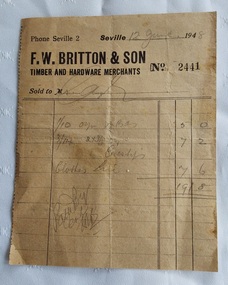
Pamphlet - Invoices and Guides, F.W. Britton & Son, Cherry Growing in Australia Fruit and Spraying Guide for the Home Gardener, 1948, 1950
... ...Instruction leaflets...Dockets Receipts Sales records Leaflets Information sheets Information booklets Instruction leaflets Fruit growing Fruit pests The Cherry Growing in Victoria booklet and Fruit Spraying Guide for the Home Gardener leaflet were useful for understanding how to grow the local produce in Victorian conditions at the time. 4. ...The Cherry Growing in Victoria booklet and Fruit Spraying Guide for the Home Gardener leaflet were useful for understanding how to grow the local produce in Victorian conditions at the time.Two guides or leaflets: 1. A Cherry Growing in Victoria Bulletin 67 from The Department of Agriculture, Victoria, Australia. Pp. 24. It has full details and photographs for cherry growing contributed by several writers. Advertisements for agriculture are inside the front and back covers. Price 3D. is printed towards the bottom of the front cover. 2. A very damaged four page leaflet titled, Fruit Spraying Guide for the Home Gardener compiled by two contributors, (Reprinted from The Journal of the Department of Agriculture, Victoria.) It has several tables for various fruits, diseases, symptoms and treatment. (It is reprinted from The Journal of the department of Agriculture, Victoria.) Two Invoices are included in this entry: 1. F.W. Britton & Son Timber and Hardware Merchants. Invoice No. 2441 12 June 1948 for three items sold. 2. An account Sales Note Barrow Bros. Commission Agency Proprietary Limited Produce & Dairy Produce merchants and Manufacturers in Melbourne. Four items were sold, plus cartage on 23.3.50.non-fictionThe Cherry Growing in Victoria booklet and Fruit Spraying Guide for the Home Gardener leaflet were useful for understanding how to grow the local produce in Victorian conditions at the time. dockets, receipts, sales records, leaflets, information sheets, information booklets, instruction leaflets, fruit growing, fruit pests -
 Hand Tool Preservation Association of Australia Inc
Polygraph instruction leaflet
... Polygraph instruction leaflet...Polygraph instruction leaflet...This item is part of the Thomas Caine Tool Collection, owned by The National Trust of Australia (Victoria) and curated by the Hand Tools Preservation Association of Australia. Polygraph instruction leaflet Polygraph instruction leaflet ...This item is part of the Thomas Caine Tool Collection, owned by The National Trust of Australia (Victoria) and curated by the Hand Tools Preservation Association of Australia.Polygraph instruction leaflet -
 Queenscliffe Historical Museum
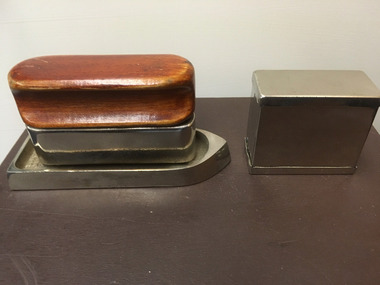
"Boudoir" Travelling Iron 14cm. Wooden handle. With instruction leaflet, c.1928
... Wooden handle. With instruction leaflet....14cm long with wooden handle. Includes instruction leaflet....Wooden handle. With instruction leaflet. ...14cm long with wooden handle. Includes instruction leaflet. -
 Vision Australia
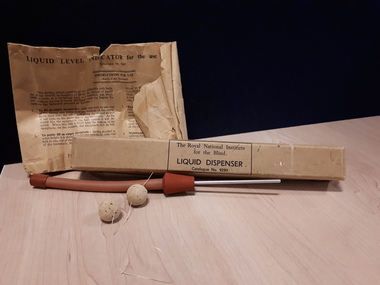
Functional object - Object, Liquid dispenser
... 2 slideable cork balls on nylon thread with instruction leaflet, inside cardboard box...Assistive devices Equipment Royal National Institute for the Blind Liquid dispenser Catalogue no. 9290 2 slideable cork balls on nylon thread with instruction leaflet, inside cardboard box Liquid dispenser Functional object Object Cyma Watch Co. ...This device, which consists of 2 slideable cork balls on nylon thread, is designed to gauge the height of liquid (hot or cold) in a receptacle such as a tumbler, jug, bowl without having to touch the liquid with the fingers. Print instructions are included with the instrument on how to operate the instrument, the instructions mention a braille copy is included, however this copy is missing. 2 slideable cork balls on nylon thread with instruction leaflet, inside cardboard boxRoyal National Institute for the Blind Liquid dispenser Catalogue no. 9290assistive devices, equipment -
 Whitehorse Historical Society Inc.
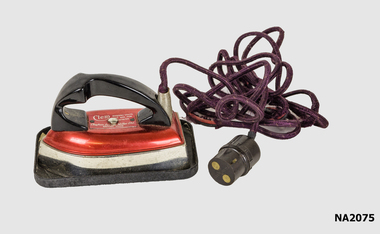
Domestic object - Iron - Travelling
... Travelling iron and stand - red top with black handle and electric cord. Instruction leaflet in stand....Travelling iron and stand - red top with black handle and electric cord. Instruction leaflet in stand. Domestic object Iron - Travelling ...Travelling iron and stand - red top with black handle and electric cord. Instruction leaflet in stand.Gem 200/250 Volts Pat App For 31678/45|Clayton, Lewis and Miller LTd British made.domestic items, irons -
 Ambulance Victoria Museum
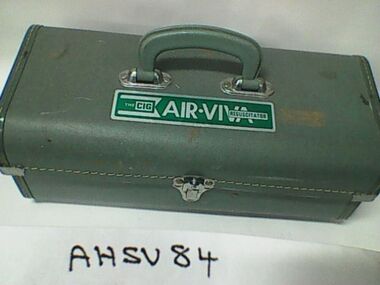
Resuscitator, Air Viva, The Commonwealth Industrial Gases Limited, Circa 1960
... Opens out and contains a resuscitation kit. Contains instruction leaflets....Opens out and contains a resuscitation kit. Contains instruction leaflets. Resuscitator, Air Viva The Commonwealth Industrial Gases Limited ...Issued to Ambulance stations during the 1990s and also used at public venues kike swimming polls as the item was easily used by personnel with limited training. Item was used taken in ambulances. Source Chas Martin (AHSV curator 29 Feb 2016).pale green fibre board box with carry handle. Opens out and contains a resuscitation kit. Contains instruction leaflets.THE CIG AIR VIVA RESUSCITATORresuscitation, air viva, cig -
 Montmorency–Eltham RSL Sub Branch
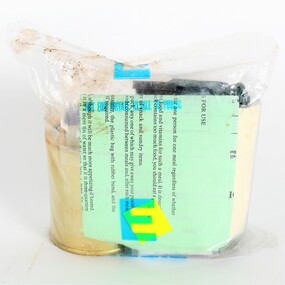
Functional object - Ration Pack (Small)
... Ginger Nut biscuits, small scourer, matches, Life savers, instruction leaflet...Ginger Nut biscuits, small scourer, matches, Life savers, instruction leaflet Functional object Ration Pack (Small) ...Current issuePlastic bag containing multple items eg. Ginger Nut biscuits, small scourer, matches, Life savers, instruction leafletration pack, matches -
Maldon Vintage Machinery Museum Inc
Slide Rules
... .1 to .4)Two SAA Conversion Slides supplied by Standards Association of Australia for converting imperial measurements to metric. .5) Plastic sleeve. .6) instruction leaflet....Engineering .1 to .4)Two SAA Conversion Slides supplied by Standards Association of Australia for converting imperial measurements to metric. .5) Plastic sleeve. .6) instruction leaflet. Slide Rules ....1 to .4)Two SAA Conversion Slides supplied by Standards Association of Australia for converting imperial measurements to metric. .5) Plastic sleeve. .6) instruction leaflet.engineering -
University of Melbourne, Burnley Campus Archives
Document, Instructions - Head Office 1/4
... File: Memoranda and leaflets , instructions for various procedures...File: Memoranda and leaflets , instructions for various procedures Instructions - Head Office 1/4 Document ...File: Memoranda and leaflets , instructions for various procedures -
 Vision Australia
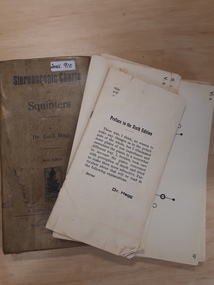
Education kit - Object, A. Francke, Stereoscopic charts for squinters [by] Dr. Emil Hegg
... A set of 70 (incomplete as full set believed to be 85 cards) black and white and colour stereoscopic charts, divided into series Includes geometric, pictorial and photographic examples of charts and Schlechteres Auge test. An instructional leaflet is also included. These featured images thought to strengthen the eye muscles....A set of 70 (incomplete as full set believed to be 85 cards) black and white and colour stereoscopic charts, divided into series Includes geometric, pictorial and photographic examples of charts and Schlechteres Auge test. An instructional leaflet is also included. These featured images thought to strengthen the eye muscles. ...A set of 70 (incomplete as full set believed to be 85 cards) black and white and colour stereoscopic charts, divided into series Includes geometric, pictorial and photographic examples of charts and Schlechteres Auge test. An instructional leaflet is also included. These featured images thought to strengthen the eye muscles.1 rectangular fawn cardboard box sleeve which contains specially printed cards with pictures and text6th editionequipment, emil hegg -
University of Melbourne, School of Chemistry
Leaflets
... Leaflets, Instruction Books, etc. for some of the material in the collection....Leaflets, Instruction Books, etc. for some of the material in the collection. ...Leaflets, Instruction Books, etc. for some of the material in the collection. -
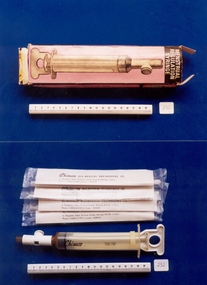 Royal Australian and New Zealand College of Obstetricians & Gynaecologists (RANZCOG)
Chimco Menstrual Regulation syringe kit, Chimco
... Consists of box [232.1] containing one plastic syringe [232.2], four canula in unopened sterile packets [232.3, 232.4, 232.5, 232.6] and manufacturer's instruction leaflet [232.7]. Syringe is a 50cc clear plastic syringe with plastic plunger. ...Consists of box [232.1] containing one plastic syringe [232.2], four canula in unopened sterile packets [232.3, 232.4, 232.5, 232.6] and manufacturer's instruction leaflet [232.7]. Syringe is a 50cc clear plastic syringe with plastic plunger. ...This item is used to assist in the regulation of menstrual periods, as well as for medical termination of pregnancy. Syringe kit, "Menstrual Regulation Syringe Kit". Made by Chimco. Consists of box [232.1] containing one plastic syringe [232.2], four canula in unopened sterile packets [232.3, 232.4, 232.5, 232.6] and manufacturer's instruction leaflet [232.7]. Syringe is a 50cc clear plastic syringe with plastic plunger. Syringe has a white plastic handle and tip with screw attachment, and a brown rubber underlay. Syringe and canula packets printed with the word 'Chimco'.abortion, obstetrics -
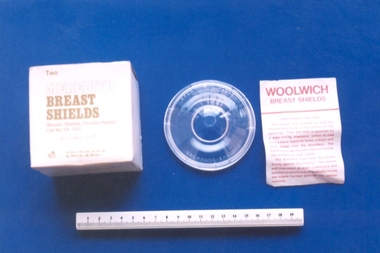 Royal Australian and New Zealand College of Obstetricians & Gynaecologists (RANZCOG)
Meredith nipple shields associated with Dr Ronald McKenzie Rome, Eschmann, England
... Box is cube shaped with olive green writing. Instruction leaflet is printed in red. Text imprinted on shields reads "OPEN [two way arrow] CLOSE"/"ESCHMANN ENGLAND". ...Box is cube shaped with olive green writing. Instruction leaflet is printed in red. Text imprinted on shields reads "OPEN [two way arrow] CLOSE"/"ESCHMANN ENGLAND". ...These were intended for use during pregancy, worn as an aid for the correction of inverted or depressed nipples. Nipple shields will help some babies attach to the breasts, that are otherwise unable to. Shields are made of a fine, silicone material that sits over the areola and nipple. (Source: Mater Mother's Hospital, 'Engorgement and Breast milk Oversupply')Two nipple shields with original cardboard box and leaflet. Each nipple shield is plastic and consists of two parts which are separated by turning the top part anti-clockwise. The bottom part of each shield has a central opening 3cm in diameter. Box is cube shaped with olive green writing. Instruction leaflet is printed in red. Text imprinted on shields reads "OPEN [two way arrow] CLOSE"/"ESCHMANN ENGLAND". Text on lid reads "Two/MEREDITH/BREAST/SHIELDS" with some specifications.breast feeding -
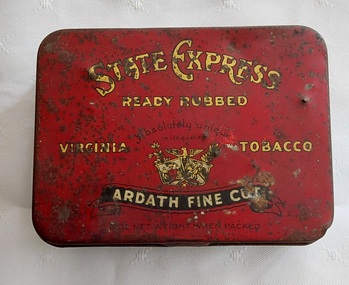 Mont De Lancey
Domestic object - Tin, State Express, 1. mid 20th century
... The tin contains a folded green paper instruction leaflet for the use of a Tilley Storm Lantern made in England with a black plastic branded Tilley Spare Part Dipstick used for measuring the fuel level. ...The tin contains a folded green paper instruction leaflet for the use of a Tilley Storm Lantern made in England with a black plastic branded Tilley Spare Part Dipstick used for measuring the fuel level. ...1. State Express Ready Rubbed, produced by the Ardath Tobacco Company (est. 1895 London), was a popular Virginia tobacco, notably manufactured in Australia during the mid-20th century. The tins were typically small to mid-sized, featuring the "State Express" and "Ardath Fine Cut" branding, with "Ready Rubbed" indicating it was pre-shredded tobacco. Used widely by Australian soldiers in WWII, these compact tins are highly collectible today, appearing through the 1960s. 2. The Tilley Storm Lantern,company started in the early 19th century, with William Henry Tilley manufacturing gas lamps in the 1830s. By 1919, the company pivoted to kerosene (paraffin) pressure lamps, using a pressurized system for lighting, which was improved with incandescent mantles. The company expanded rapidly, securing major contracts to supply lamps to railway companies for track work and inspections. Tilley lamps were extensively used by British armed forces during both World Wars. In WWII, they were essential for field operations, guiding aircraft (RAF), and providing light in blackout conditions. 1. A red rectangular, State Express cigarette tin with a hinged lid. The company logo and other details are printed in gold lettering on the lid as well as Ready Rubbed Virginia Tobacco Ardath Fine Cut. There is an insignia with two crossed heraldic flags and an eagle on top. This information is printed in black lettering on a gold background inside the lid. 2. The tin contains a folded green paper instruction leaflet for the use of a Tilley Storm Lantern made in England with a black plastic branded Tilley Spare Part Dipstick used for measuring the fuel level. There is also a broken thin black ring fitting.1. On the front of the lid: 'State Express Ready Rubbed Absolutely unique in its quality Virginia Tobacco Ardath Fine Cut'. There is an insignia with two crossed heraldic flags and an eagle on top. 2oz. Net Weight. When packed is at the bottom in black print. Inside the lid: 'Every tin of genuine Star Express Ready Rubbed Ardath Fine Cut has the name of Ardath printed on the paper lining' The insignia is also printed. 2. Included is a green folded pamphlet 'Hints on the use of your Tilley Storm Lantern (Regd.)' Information in the leaflet is quite detailed. The dipstick has 'The Tilley Lamp Co. Ltd. Dipstick for Models named on reverse. E.X.100.,P.L.53.,10.,T.L.13., R. T.L.106.,T.L.136.,X246.K.L.80.,LIFE BUOY. USE ONLY GENUINE 'TILLEY' SPARE PARTS'smoking equipment, cigarette containers, tobacco -
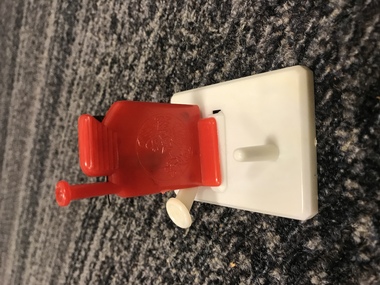 Vision Australia
Functional object - Object, Automatic needle threader with thread cutter
... Red plastic rectangle with one insert tubes and one white push tabs, a leaflet of instructions and a white stand to place the threader on...Assistive devices Hong Kong "Needle threader" in red on one side and an image of a female holding a needle threader on the reverse Red plastic rectangle with one insert tubes and one white push tabs, a leaflet of instructions and a white stand to place the threader on Automatic needle threader with thread cutter Functional object Object ...This device allows easy threading of needles with ease. Place the needle in the casing then wrap the thread across the groove. Press the button down gently but firmly and pull the thread that appears on the other side slowly until the shorter end appears, and the needle is threaded.Red plastic rectangle with one insert tubes and one white push tabs, a leaflet of instructions and a white stand to place the threader on"Needle threader" in red on one side and an image of a female holding a needle threader on the reverseassistive devices, hong kong -
 Federation University Historical Collection
Equipment - Scientific Instument, Globes, 20th Century
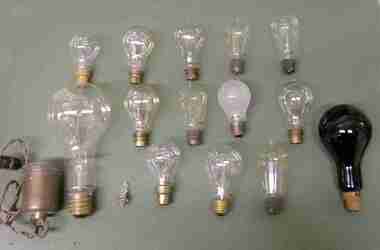
... (The disc is loose in 10) .11 a&b) Osram black glass, large standard shaped, 230-240 V 125 W, bayonet light bulb. .12) Philips tubular shaped projector lamp with instruction leaflet. .13) Philips tubular shaped projector lamp with instruction leaflet in original box. .14) EH JA 12 V 55 W small projector lamp. .15) Large special purpose, standard shaped, frosted bayonet light bulb. .16) Siemens, standard shaped, modern Edison screw light bulb. .17) Philips, standard shaped, modern Edison screw, frosted light bulb. .18) Crompton, gas filled 240 V 75 W, standard shaped, bayonet frosted light bulb in original box. .19) Crompton, gas filled 230 V 300 W. standard shaped, large modern Edison screw light bulb. .20) Probably an extension cord with a bayonet fitting at one end connected by a twisted cord of two fabric covered wires to a large socket. ...(The disc is loose in 10) .11 a&b) Osram black glass, large standard shaped, 230-240 V 125 W, bayonet light bulb. .12) Philips tubular shaped projector lamp with instruction leaflet. .13) Philips tubular shaped projector lamp with instruction leaflet in original box. .14) EH JA 12 V 55 W small projector lamp. .15) Large special purpose, standard shaped, frosted bayonet light bulb. .16) Siemens, standard shaped, modern Edison screw light bulb. .17) Philips, standard shaped, modern Edison screw, frosted light bulb. .18) Crompton, gas filled 240 V 75 W, standard shaped, bayonet frosted light bulb in original box. .19) Crompton, gas filled 230 V 300 W. standard shaped, large modern Edison screw light bulb. .20) Probably an extension cord with a bayonet fitting at one end connected by a twisted cord of two fabric covered wires to a large socket. ...Most were used in various capacities at Ballarat School of Mines or University of Ballarat.Assorted lamps including Edison Carbon filament light bulbs and other special purpose lamps, .1-3) Robertson, pear shaped 220 V 16, carbon filament? bayonet light bulb with 'nipple'. .4) Ediswan, standard shaped, 928, carbon filament? bayonet light bulb with 'nipple'. .5) (B in a circle) 280 V 32 oo1A, pear shaped, carbon filament? bayonet light bulb with 'nipple'. .6-7) Crompton? standard shaped, carbon filament? bayonet light bulb. Clear glass with an amber tint. .8) 230-240 V 40 W, pear shaped, wire filament bayonet light bulb. .9-10) Osram standard shaped, heavy spiral and disc electrodes, bayonet light bulb. (The disc is loose in 10) .11 a&b) Osram black glass, large standard shaped, 230-240 V 125 W, bayonet light bulb. .12) Philips tubular shaped projector lamp with instruction leaflet. .13) Philips tubular shaped projector lamp with instruction leaflet in original box. .14) EH JA 12 V 55 W small projector lamp. .15) Large special purpose, standard shaped, frosted bayonet light bulb. .16) Siemens, standard shaped, modern Edison screw light bulb. .17) Philips, standard shaped, modern Edison screw, frosted light bulb. .18) Crompton, gas filled 240 V 75 W, standard shaped, bayonet frosted light bulb in original box. .19) Crompton, gas filled 230 V 300 W. standard shaped, large modern Edison screw light bulb. .20) Probably an extension cord with a bayonet fitting at one end connected by a twisted cord of two fabric covered wires to a large socket. This socket has a copper Edison screw inner, surrounded by a ceramic tube and covered with a copper housing. The housing is cracked in two places.Some have makers brand and voltage and wattage stamped onto the glass.scientific instrument, ballarat school of mines, globes, edison, lamps, light bulbs, bayonet -
 Bendigo Historical Society Inc.
Document - BILL ASHMAN COLLECTION: SCALEBUOY TAP UNIT LEAFLETS
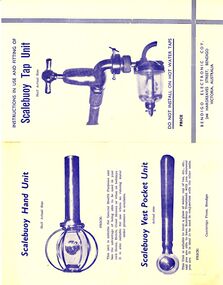
... Bundle of approximately 150 leaflets for instructions in use and fitting of Scalebuoy tap unit produced by the Bendigo Electronic Coy 244 Hargreaves Street Bendigo Victoria Australia, printed by Cambridge Press Bendigo....SCIENCES Instruments - general scalebuoy Bundle of approximately 150 leaflets for instructions in use and fitting of Scalebuoy tap unit produced by the Bendigo Electronic Coy 244 Hargreaves Street Bendigo Victoria Australia, printed by Cambridge Press Bendigo. ...Bundle of approximately 150 leaflets for instructions in use and fitting of Scalebuoy tap unit produced by the Bendigo Electronic Coy 244 Hargreaves Street Bendigo Victoria Australia, printed by Cambridge Press Bendigo.sciences, instruments - general, scalebuoy -
Alfred Hospital Nurses League - Nursing History Collection
Functional object - Boxed Nasogastric Oesophageal Tubing Adult and Intermediate sizes, DAVOL INC, Nasogastric Oesophageal Tubing
... Both contained in original cardboard box with pink leaflets instructions for use....Both contained in original cardboard box with pink leaflets instructions for use. Nasogastric Oesophageal Tubing Functional object Boxed Nasogastric Oesophageal Tubing Adult and Intermediate sizes DAVOL INC. ...Used to lavage the stomach and oesophagus and apply pressure by inflating the balloons to bleeding oesophageal varices. The technique used to place the tube is called Balloon Tamponade.Historically used in an emergency situation to control bleeding of oesophageal and gastric varices.Red rubber tubing catheter 1000 mm in length with two balloons one 35mm and one 40mm around tubing/proximal end bullet shaped/ drainage holes on tubing up to balloon/distal end has two spigoted balloon inflation portals and one gastric aspiration outlet. Both contained in original cardboard box with pink leaflets instructions for use.Tubing marked at 50mm intervals for 250 mmhaemorrhage, gastric, oesophagus, sengstaken-blakemore tube, balloon tamponade -
 Bendigo Historical Society Inc.
Document - BILL ASHMAN COLLECTION: CORRESPONDENCE
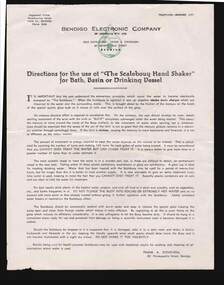
... Titled 'Directions for the use of 'The Scalebuoy hand Shaker' for Bath, Basin or Drinking Vessel. Leaflet gives instructions for the use of the Scalebuoy by Frank A. ...Titled 'Directions for the use of 'The Scalebuoy hand Shaker' for Bath, Basin or Drinking Vessel. Leaflet gives instructions for the use of the Scalebuoy by Frank A. ...Leaflet from the Bendigo Electronic Company of Australia Pty. Ltd. Titled 'Directions for the use of 'The Scalebuoy hand Shaker' for Bath, Basin or Drinking Vessel. Leaflet gives instructions for the use of the Scalebuoy by Frank A. Stevenson. On the back are pictures of the hand Shaker Scalebuoy and the Vest Pocket Scalebuoy.sciences, instruments - general, scalebuoy, bill ashman collection - correspondence, bendigo electronic company of australia pty ltd, frank a stevenson, the scalebuoy hand shaker -
 Royal District Nursing Service (now known as Bolton Clarke)
Photograph - Digital image, Barry Sutton, c.1930
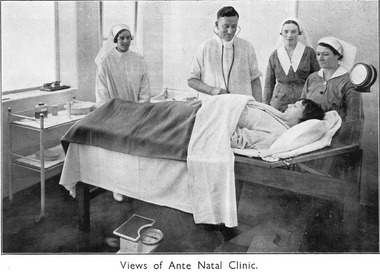
... In 1930 the Society were pioneers in opening an Ante-Natal Clinic at the Melbourne District Nursing Society (MDNS) After-Care Home, setting a high standard with equipment, keeping records and providing leaflets with instructions in how to keep healthy during pregnancy, what complications to look for, and what to do when labour commenced. ...In 1930 the Society were pioneers in opening an Ante-Natal Clinic at the Melbourne District Nursing Society (MDNS) After-Care Home, setting a high standard with equipment, keeping records and providing leaflets with instructions in how to keep healthy during pregnancy, what complications to look for, and what to do when labour commenced. ...In 1930 the Society were pioneers in opening an Ante-Natal Clinic at the Melbourne District Nursing Society (MDNS) After-Care Home, setting a high standard with equipment, keeping records and providing leaflets with instructions in how to keep healthy during pregnancy, what complications to look for, and what to do when labour commenced. This image was taken in the Ante-Natal Clinic and shows some of the equipment used at that time and the uniforms worn by Trained nurses (Sisters) in the 1930s. Melbourne District Nursing Society (MDNS) was founded in 1885 and only nurses who had trained in a Hospital Training School and were fully qualified were employed by the Society. It commenced with one Trained nurse (Nurse), and another employed six months later; both walking amid the slums of inner Melbourne administering nursing care to the sick poor. The Society decided to commence a Midwifery Service and Nurse Fowler, who had previously worked for the Society, was re-employed as their first Trained Midwife. She began home births in August 1893 giving some Ante Natal care, taking midwifery bundles and providing clothes for the babe and mother as needed. Following birth, she gave Post-natal care to the mother and babe twice a day for three days and then daily for a week, and longer if required. She resigned after twelve months and Nurse Wilkie was appointed to the position. As well as walking, the Nurses used Public transport in the limited areas it ran, though a taxi was used by the Nurses and Midwife in emergencies and at night. As the Society expanded it rented premises until it was able to purchase it's own Nurses Home at 39 Victoria Parade, Collingwood in 1914. The Society were pioneers in recognizing the need for premises where patients too ill to be in their own home, but not ill enough to go to hospital, was needed. Land was procured next to No. 39, and the Society built the After-Care Home at 45 Victoria Parade, for these patients, and for patients from Hospitals. It was opened in July 1926 and the name of the Society then became ‘Melbourne District Nursing Society and After-Care Home’ (‘Hospital’ from 1934) The Ante-Natal Clinic at the Melbourne District Nursing Society After-Care Home was opened on the 23rd of September 1930 and MDNS Midwifery patients were encouraged to attend. Prior to the opening of the clinic Ante-natal care was not considered important, but within a short time 100 percent of MDNS Midwifery patients were attending. During 1934 the Women’s Welfare Clinic, including at the time a very controversial Family Planning Clinic, the first of its kind in Australia, was opened to support women at risk following multiple and difficult pregnancies. The Clinic gave advice on birth-control and was attended by their own patients at first, but then accepted patients from Melbourne public hospitals until their own clinics were opened.Digital image showing a Doctor and three Melbourne District Nursing Society (MDNS) Sisters attending a patient in the Ante-Natal Clinic at the After Care Hospital. In the forefront is a set of scales standing on the floor, behind which is the lady lying on a wooden framed bed with the base slightly raised at the top end supporting a white pillow and the lady's head. The lady has short dark hair and her frock can be seen to her waist; the rest of her body is covered by a white sheet and dark coloured blanket. Behind her and to the right of the image, are two Sisters wearing dark coloured long sleeved uniforms which have a belt and white collar; they are both wearing white veils over their short dart hair. To their left is a Doctor who has short dart wavy hair and is looking down at the lady. He is wearing a long white gown and has a stethoscope in his ears with the other end held in his right hand. To his left is another Sister who is wearing a white veil over her dark curled hair, and is wearing a long white gown. In the rear between the Doctor and Sister a hand basin can be seen. On the far left of the picture a trolley with two cloth covered shelves can be seen; a basin and squat bottle sits on the top shelf and kidney dish on the lower one. Behind this, part of a window can be seen.after- care hospital, 45 victoria parade collingwood, melbourne district nursing society (1885-1957), ante-natal clinic, after-care home, mdns midwifery, rdns, royal district nursing service -
 Flagstaff Hill Maritime Museum and Village
Equipment - First Aid Case, Thomas Urquhart & Son Pty Ltd (Thos. Urquhart), 1930-1939
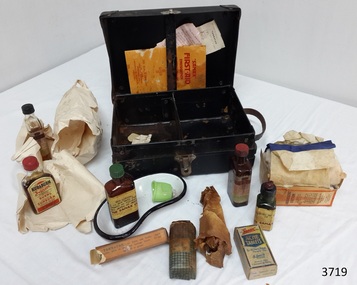
... instructions and diagrams on how to perform Artificial Respiration. There are advertisement for Sanax products throughout the booklet that include; - Sanax Ambulance Stretcher for timber mills, mines, ships and quarries - Saw dust masks (porous rubber) for workers in dust, paint or duco sprayers Inside cover lists Sanax’s Australian made products including - tablets and powders for headaches, neuralgia, influenza, colds - snuff for Catarrh that is “quite harmless” - First Aid Cases that come in a range of 42 patterns - sunburn preventatives and treatments - healing salve for carbuncles, pock, pimples, boils, varicose ulcers etc. - snake bite outfits and kits LEAFLETS included in First Aid Case: (1) Tannafax Tannic Acid Jelly. ...Manufactured by Sanax, Fitzroy, Melbourne, C. 1930-1939 Contents include "Sanax" First Aid instructions booklet, 2 leaflets, metal kidney dish enamelled in white with black trim on edge, green plastic or Bakelite eye bath, eye lotion, Tannafax tannic acid jelly, Sal Volitile, Kuraburn, Iodine, Argyrol, ACHE tablets, absorbent cotton in cardboard box, gauze bandage, and UNKNOWN wrapped bottle. ...Manufactured by Sanax, Fitzroy, Melbourne, C. 1930-1939 Contents include "Sanax" First Aid instructions booklet, 2 leaflets, metal kidney dish enamelled in white with black trim on edge, green plastic or Bakelite eye bath, eye lotion, Tannafax tannic acid jelly, Sal Volitile, Kuraburn, Iodine, Argyrol, ACHE tablets, absorbent cotton in cardboard box, gauze bandage, and UNKNOWN wrapped bottle. ...This small, portable 1930s Sanax First Aid Case has been strongly constructed, with corners reinforced with metal to take knocks and bumps, so it could be quickly transported to the site of an emergency. Having these supplies organised into a kit made them easily accessible and reduces time to take them to the site of the accident. It was possibly designed for use in factories because the booklet in the case states that the kit complies with “Part 1, Victorian Factories Regulations”. The text of the printed brand “Sanax First Aid Case” is right-way up when the case stands vertically on its hinged side. In modern times people are well aware of the importance of quick treatment when accident and injury occur. However, before the first commercial First Aid Kit was made by Johnson & Johnson in 1888, people had little knowledge about treating injuries and lacked information about suitable supplies to keep on hand for emergencies. They were often unaware of how to help in that critical time before the doctor or other assistance arrived, a particularly important time for the many people living in remote areas. A quote from Johnson’s & Johnson’s 1888 price list explains “It is a fact, which is everywhere being recognized, that many lives are lost and much suffering entailed in such accidents on account of the lack of the simple but necessary articles required to afford prompt assistance to the wounded.” One example of the value of First Aid assistance to community groups is shown in an article from the Weekly Times, 29th November 1930. It records a report from the Annuello Branch of the Younger Set (a Country Women’s Organisation), telling that on Armistice Day their president Mrs Jamieson, presented the Annuello School with the gift of a Sanax Red Cross First Aid outfit, which was accepted as being “of great practical use to the scholars.” (Annuello is a remote wheat growing area in the Mallee region of North Western Victoria, which became a soldier settlement area after World War I. There is a strain of wheat named ‘Annuello’ due to its suitability for that area. ) The Sanax Case in our Collection contains instructions, equipment and medical items suitable for use in emergency situations. The Case was one of 42 patterns available from Sanax that conformed to ‘Part 1, Victorian Factories Regulations’. It includes items made by Sanax Company and by Burroughs Wellcome & Co. (Australia) Ltd., Sydney, NSW. A quote at the back of the First Aid Emergency Instructions booklet says: “Sanax products are made in Australia by or under the supervision of qualified chemists, from the highest quality materials. They are dependable for the purposes written on labels.” BOOKLET included in First Aid Case: “SANAX” First-Aid Emergency Instructions has orange cover and white pages, joined in the centre by two staples. Booklet contains First Aid Instructions for general events listed in alphabetical order. It also contains an indexed sections headed “Poisoning, and what to do” written by S.A. Burrows, Ph.C., Vuc and N.Z. There are instructions and diagrams on how to perform Artificial Respiration. There are advertisement for Sanax products throughout the booklet that include; - Sanax Ambulance Stretcher for timber mills, mines, ships and quarries - Saw dust masks (porous rubber) for workers in dust, paint or duco sprayers Inside cover lists Sanax’s Australian made products including - tablets and powders for headaches, neuralgia, influenza, colds - snuff for Catarrh that is “quite harmless” - First Aid Cases that come in a range of 42 patterns - sunburn preventatives and treatments - healing salve for carbuncles, pock, pimples, boils, varicose ulcers etc. - snake bite outfits and kits LEAFLETS included in First Aid Case: (1) Tannafax Tannic Acid Jelly. Tannafax should be kept at hand in every home. It should be applied direct from the tube and used with neither oil nor grease. Where a large area has to be covered the clamped end may be torn or cut off to give a wider mouth to the tube. Collapsible tubes of different sizes. Made in Australia. Burroughs Wellcome & Co. (Australia) Ltd. (Incorporated in England). Sydney, NSW. Assorted Houses, London, New York, Montreal, Cape Town, Milan, Bombay, Shanghai, Buenos Aires. Copyright A. 1817, J. 9463 (2) Tabloid. The strong thing is the just - - . Tabloid marks the wor - - Burroughs Wellcome & Comp. The use of the word is to enab – the prescriber, dispenser and patient to get the right thing with one short word, instead of the firm’s long name. If another maker apply the word to his product, the act is unlawful. Tabloid is our trade mark and brand. If a vendor disregard it in dispensing or selling, the act is unlawful for the same reason. We prosecute both offenders rigorously, in the interest of prescribers, dispensers, patients and the owners of the trade mark. Please inform us of any instance of either offence. Burroughs Wellcome & Co. (Australia) Ltd. (Incorporated in England). Telephone Number - M 4184 (4 lines) All communications to G.P.O. Box No. 1185 DD. Copyright Sy. 20. & J 9894. Medicines and Equipment included in First Aid Case: - Absorbent Cotton, Sanax, for absorbing blood or drying a wound. As a swab for washing wounds; to place above a compress to keep the heat in: or as a pad to protect wounds or fractures. The Sanax Co. Manuf. Chemists, Melbourne. Regd. Office: 5 Brunswick St, Fitzroy. N.6. - ACHE tablets, Sanax, for all aches, pains, fevers etc. Dose: 2 to 3 tablets with a draught of water, every 3 hours. Children in proportion. For influenza or colds, take the bedtime dose with a hot lemon drink or toddy. Recommended for Headaches, Colds, Influenza, Fevers, Neuralgia, Rheumatism, Nerve Pains, Sleeplessness, and Seasickness. Three Sanax Ache tablets equals one Sanax Ache powder. Each tablet contains 1.75grs. each Phenacotinum and Acety acSzilcyl, and .75grs Ammon Brom. Etc.. Sanax brand specialties are prepared by highly qualified pharmaceutical chemists and may be accepted as safe and effective for the purpose indicated on the label. The Sanax Co. Melbourne - Eye lotion, Sanax, “in eye bath full strength or diluted with equal parts of water. Sanax Co. Brunswich St, Fitzroy, Melbourne. - Iodine, Sanax, POISON, with instructions for what to do if swallowed. - Kuraburn, Sanax, Applied to the burn and allowed to dry, the pain and heat instantly disappear, and blistering is prevented. If necessary, apply again in an hours. To safeguard against burning when sunbathing, apply before exposure to the sun. If already sunburnet, use Kuraburn as directions above. Safe and harmless. Sole makers, The Sanax Co. Brunswick St. - - Vic. - Sal Volatile, Sanax, - - stimulant for - - nervous aches - - or as smelling salts Dose - - - - Solution of A- - - 5%, . The Sanax Co. Brunswick St, Melbourne. - Tannafax, Burroughs Wellcome & Co. Australia Ltd. Sydney, N.S.W., 20gm. Approx., Tannic Acid Jelly, (Tannic Acid with 0.5% Phenol in a water-soluble base) for burns and scalds. A.N. 15050, p188, logo of a unicorn. Apply lightly, allow to dry, and bandage loosely. Do not apply oil or grease. - bottle wrapped in brown paper, unknown contents, paper adhered to bottle. - dish, kidney shaped, metal, white enamel with black rim - eye bath, green, plastic or Bakelite SANAX COMPANY The Sanax Company was at the address of 5 Brunswick Street, Fitzroy [Melbourne] at least as early as November 1924, as shown by its advertisement of Ache Powder in the Weekly Times, 8th November 1924. It was still at this address in September 1951, when it advertised First Aid outfits and components in the Post Master General’s section of the Commonwealth of Australia Gazette. REFERENCES: Annuello, Victoria; Wikipedia, https://en.wikipedia.org/wiki/Annuello,_Victoria Annuello Younger Set, Branch Activities and Local Reports, Country Women’s Organisations, Weekly Times, 29 November 1930, Trove http://trove.nla.gov.au/newspaper/article/224921009?searchTerm=%22sanax%22%20and%20%22melbourne%22&searchLimits=# Commonwealth of Australia Gazette, Issue 32, 24th April 1915, https://www.legislation.gov.au/file/1915GN32 [Johnson & Johnson Price List, September 1, 1888, p. 20. From our archives], Celebrating the 125th Birthday of the First Aid Kit , The Story of Johnson & Johnson, , http://www.kilmerhouse.com/2013/06/from-1888-to-2013-celebrating-the-125th-birthday-of-the-first-aid-kit/ Post Master General’s section of the Commonwealth of Australia Gazette, Issue No. 73, Thursday 27th September 1951 http://trove.nla.gov.au/newspaper/article/232185299?searchTerm=%22sanax%22%20and%20%22fitzroy%22&searchLimits= Sanax First Aid Emergency Instructions, by S.A. Burrows, publisher Sanax Ltd. Fitzroy, Victoria, 1930-1939 English, book, Illustrated edition, Trove http://trove.nla.gov.au/version/40948895 Access to emergency medical help in early settlement days of Victoria could take quite some time, especially in remote areas. From 1888 First Aid Kits and instructions became available for work sites, offices, community groups and individuals, helping to bridge the gap between the accident and the arrival of medical assistance. This portable Sanax First Aid Case is an example of portable medical equipment made in Melbourne, Australia, in the 1930’s and available to the public. It contains a range of items plus information to be used in a variety of injuries and emergencies in in factories, households, businesses and local communities, and instructions on their use. First Aid Case, portable, Sanax First Aid Case. First Aid kit in strong black cardboard carry case with metal reinforced corners, metal hinges on lid, metal catch and leather carry handle. Inside lid is a vertical strap with narrow gap behind it. Base is divided into two compartments. Manufactured by Sanax, Fitzroy, Melbourne, C. 1930-1939 Contents include "Sanax" First Aid instructions booklet, 2 leaflets, metal kidney dish enamelled in white with black trim on edge, green plastic or Bakelite eye bath, eye lotion, Tannafax tannic acid jelly, Sal Volitile, Kuraburn, Iodine, Argyrol, ACHE tablets, absorbent cotton in cardboard box, gauze bandage, and UNKNOWN wrapped bottle. Printed in gold on lid of case “SANAX” FIRST AID CASE. Most of the contents, as well as the case, show the “SANAX” brand. Some contents are inscribed Burroughs Wellcome & Co. (Australia) Ltd., flagstaff hill, warrnambool, shipwrecked coast, flagstaff hill maritime museum, maritime museum, shipwreck coast, flagstaff hill maritime village, great ocean road, first aid items, first aid kit, emergency first aid, medical emergency kit, home emergency kit, industrial emergency kit, sanax company fitzroy melbourne, burroughs wellcome & co. (australia) ltd, thos. urquhart & son pty. ltd. melbourne, sanax first aid case, sanax first-aid emergency instructions, part 1 victorian factories regulations, tabloid medical supplies -
 Flagstaff Hill Maritime Museum and Village
Domestic object - Food Mincer, John Harper & Co, Early - Mid 20th Century
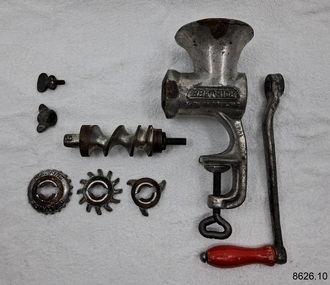
... No 3 Fine. Also a leaflet of instructions headed up: 'Harper No.3181 "Beatrice" Food Mincer. ...No 3 Fine. Also a leaflet of instructions headed up: 'Harper No.3181 "Beatrice" Food Mincer. ...A meat grinder, commonly known as the meat mincer, is used for chopping meat into fine pieces. Alternatively, it can be used for the mixing of raw or cooked meat, fish and vegetables. It is the best way to process meat, and is a widely used piece of equipment by butchers and in the home.. Butchers have been known to use either mincing knives or meat cleavers in the kitchen for years to produce a quantity of minced meat. This was a slow and laborious process. The advent of the meat mincer has not only made the mincing process easier but also faster. The meat mincer has slowly evolved over the years into what it is today. The first meat mixer or meat mincer was invented in the 19th century by a German inventor named Baron Karl Drais. Although some versions of the device date back to much earlier. The oldest form of meat mincer was hand cranked which forced meat through a metal plate with several small holes in it, which resulted in long and thin strands of the meat. The meat was fed into the funnel that was placed at the top of the mixer. This meat would pass through a hand cranked screw conveyor that would squash and mix the meat before passing it through the metal plate. Needless to say, this was again a slow and laborious procedure to follow to produce large quantity of meat. With passage of time, this hand cracked machine became powered by electricity. The meat mincer has a great adaptability and efficiency now. The huge variety in mincer plates allows a butcher to produce different types of minced meat in any shape desired. However, traditional manual meat mincers have not really changed a lot. They are manually operated and made of cast iron, as earlier. They are similar to the original mincer designs, dating back to the early 1900s. Some butchers still prefer using a variety of mincer knives. Adapted from: https://brennan-group.com/blogs/news/history-of-the-meat-mincer This meat mincer belonged to the family of Dr.William Roy Angus, Surgeon and Oculist. It was donated to Flagstaff Hill Maritime Village by his daughter, Bernice McDade. It is part of the “W.R. Angus Collection” that includes historical medical equipment, surgical instruments and material once belonging to Dr Edward Ryan and Dr Thomas Francis Ryan, (both of Nhill, Victoria) as well as Dr Angus’ own belongings. The Collection’s history spans the medical practices of the two Doctors Ryan, from 1885-1926 plus that of Dr Angus, up until 1969. ABOUT THE “W.R.ANGUS COLLECTION” Doctor William Roy Angus M.B., B.S., Adel., 1923, F.R.C.S. Edin.,1928 (also known as Dr Roy Angus) was born in Murrumbeena, Victoria in 1901 and lived until 1970. He qualified as a doctor in 1923 at University of Adelaide, was Resident Medical Officer at the Royal Adelaide Hospital in 1924 and for a period was house surgeon to Sir (then Mr.) Henry Simpson Newland. Dr Angus was briefly an Assistant to Dr Riddell of Kapunda, then commenced private practice at Curramulka, Yorke Peninsula, SA, where he was physician, surgeon and chemist. In 1926, he was appointed as new Medical Assistant to Dr Thomas Francis Ryan (T.F. Ryan, or Tom), in Nhill, Victoria, where his experiences included radiology and pharmacy. In 1927 he was Acting House Surgeon in Dr Tom Ryan’s absence. Dr Angus had become engaged to Gladys Forsyth and they decided he would take time to further his studies overseas in the UK in 1927. He studied at London University College Hospital and at Edinburgh Royal Infirmary and in 1928, was awarded FRCS (Fellow from the Royal College of Surgeons), Edinburgh. He worked his passage back to Australia as a Ship’s Surgeon on the on the Australian Commonwealth Line’s T.S.S. Largs Bay. Dr Angus married Gladys in 1929, in Ballarat. (They went on to have one son (Graham 1932, born in SA) and two daughters (Helen (died 12/07/1996) and Berenice (Berry), both born at Mira, Nhill ) Dr Angus was a ‘flying doctor’ for the A.I.M. (Australian Inland Ministry) Aerial Medical Service in 1928 . The organisation began in South Australia through the Presbyterian Church in that year, with its first station being in the remote town of Oodnadatta, where Dr Angus was stationed. He was locum tenens there on North-South Railway at 21 Mile Camp. He took up this ‘flying doctor’ position in response to a call from Dr John Flynn; the organisation was later known as the Flying Doctor Service, then the Royal Flying Doctor Service. A lot of his work during this time involved dental surgery also. Between 1928-1932 he was surgeon at the Curramulka Hospital, Yorke Peninsula, South Australia. In 1933 Dr Angus returned to Nhill where he’d previously worked as Medical Assistant and purchased a share of the Nelson Street practice and Mira hospital from Dr Les Middleton one of the Middleton Brothers, the current owners of what was once Dr Tom Ryan’s practice. Dr L Middleton was House Surgeon to the Nhill Hospital 1926-1933, when he resigned. [Dr Tom Ryan’s practice had originally belonged to his older brother Dr Edward Ryan, who came to Nhill in 1885. Dr Edward saw patients at his rooms, firstly in Victoria Street and in 1886 in Nelson Street, until 1901. The Nelson Street practice also had a 2 bed ward, called Mira Private Hospital ). Dr Edward Ryan was House Surgeon at the Nhill Hospital 1884-1902 . He also had occasions where he successfully performed veterinary surgery for the local farmers too. Dr Tom Ryan then purchased the practice from his brother in 1901. Both Dr Edward and Dr Tom Ryan work as surgeons included eye surgery. Dr Tom Ryan performed many of his operations in the Mira private hospital on his premises. He too was House Surgeon at the Nhill Hospital 1902-1926. Dr Tom Ryan had one of the only two pieces of radiology equipment in Victoria during his practicing years – The Royal Melbourne Hospital had the other one. Over the years Dr Tom Ryan gradually set up what was effectively a training school for country general-practitioner-surgeons. Each patient was carefully examined, including using the X-ray machine, and any surgery was discussed and planned with Dr Ryan’s assistants several days in advance. Dr Angus gained experience in using the X-ray machine there during his time as assistant to Dr Ryan. Dr Tom Ryan moved from Nhill in 1926. He became a Fellow of the Royal Australasian College of Surgeons in 1927, soon after its formation, a rare accolade for a doctor outside any of the major cities. He remained a bachelor and died suddenly on 7th Dec 1955, aged 91, at his home in Ararat. Scholarships and prizes are still awarded to medical students in the honour of Dr T.F. Ryan and his father, Dr Michael Ryan, and brother, John Patrick Ryan. ] When Dr Angus bought into the Nelson Street premises in Nhill he was also appointed as the Nhill Hospital’s Honorary House Surgeon 1933-1938. His practitioner’s plate from his Nhill surgery states “HOURS Daily, except Tuesdays, Fridays and Saturday afternoons, 9-10am, 2-4pm, 7-8pm. Sundays by appointment”. This plate is now mounted on the doorway to the Port Medical Office at Flagstaff Hill Maritime Village, Warrnambool. Dr Edward Ryan and Dr Tom Ryan had an extensive collection of historical medical equipment and materials spanning 1884-1926 and when Dr Angus took up practice in their old premises he obtained this collection, a large part of which is now on display at the Port Medical Office at Flagstaff Hill Maritime Village in Warrnambool. During his time in Nhill Dr Angus was involved in the merging of the Mira Hospital and Nhill Public Hospital into one public hospital and the property titles passed on to Nhill Hospital in 1939. In 1939 Dr Angus and his family moved to Warrnambool where he purchased “Birchwood,” the 1852 home and medical practice of Dr John Hunter Henderson, at 214 Koroit Street. (This property was sold in1965 to the State Government and is now the site of the Warrnambool Police Station. ). The Angus family was able to afford gardeners, cooks and maids; their home was a popular place for visiting dignitaries to stay whilst visiting Warrnambool. Dr Angus had his own silk worm farm at home in a Mulberry tree. His young daughter used his centrifuge for spinning the silk. Dr Angus was appointed on a part-time basis as Port Medical Officer (Health Officer) in Warrnambool and held this position until the 1940’s when the government no longer required the service of a Port Medical Officer in Warrnambool; he was thus Warrnambool’s last serving Port Medical Officer. (The duties of a Port Medical Officer were outlined by the Colonial Secretary on 21st June, 1839 under the terms of the Quarantine Act. Masters of immigrant ships arriving in port reported incidents of diseases, illness and death and the Port Medical Officer made a decision on whether the ship required Quarantine and for how long, in this way preventing contagious illness from spreading from new immigrants to the residents already in the colony.) Dr Angus was a member of the Australian Medical Association, for 35 years and surgeon at the Warrnambool Base Hospital 1939-1942, He served as a Surgeon Captain during WWII1942-45, in Ballarat, Victoria, and in Bonegilla, N.S.W., completing his service just before the end of the war due to suffering from a heart attack. During his convalescence he carved an intricate and ‘most artistic’ chess set from the material that dentures were made from. He then studied ophthalmology at the Royal Melbourne Eye and Ear Hospital and created cosmetically superior artificial eyes by pioneering using the intrascleral cartilage. Angus received accolades from the Ophthalmological Society of Australasia for this work. He returned to Warrnambool to commence practice as an ophthalmologist, pioneering in artificial eye improvements. He was Honorary Consultant Ophthalmologist to Warrnambool Base Hospital for 31 years. He made monthly visits to Portland as a visiting surgeon, to perform eye surgery. He represented the Victorian South-West subdivision of the Australian Medical Association as its secretary between 1949 and 1956 and as chairman from 1956 to 1958. In 1968 Dr Angus was elected member of Spain’s Barraquer Institute of Barcelona after his research work in Intrasclearal cartilage grafting, becoming one of the few Australian ophthalmologists to receive this honour, and in the following year presented his final paper on Living Intrasclearal Cartilage Implants at the Inaugural Meeting of the Australian College of Ophthalmologists in Melbourne In his personal life Dr Angus was a Presbyterian and treated Sunday as a Sabbath, a day of rest. He would visit 3 or 4 country patients on a Sunday, taking his children along ‘for the ride’ and to visit with him. Sunday evenings he would play the pianola and sing Scottish songs to his family. One of Dr Angus’ patients was Margaret MacKenzie, author of a book on local shipwrecks that she’d seen as an eye witness from the late 1880’s in Peterborough, Victoria. In the early 1950’s Dr Angus, painted a picture of a shipwreck for the cover jacket of Margaret’s book, Shipwrecks and More Shipwrecks. She was blind in later life and her daughter wrote the actual book for her. Dr Angus and his wife Gladys were very involved in Warrnambool’s society with a strong interest in civic affairs. Their interests included organisations such as Red Cross, Rostrum, Warrnambool and District Historical Society (founding members), Wine and Food Society, Steering Committee for Tertiary Education in Warrnambool, Local National Trust, Good Neighbour Council, Housing Commission Advisory Board, United Services Institute, Legion of Ex-Servicemen, Olympic Pool Committee, Food for Britain Organisation, Warrnambool Hospital, Anti-Cancer Council, Boys’ Club, Charitable Council, National Fitness Council and Air Raid Precautions Group. He was also a member of the Steam Preservation Society and derived much pleasure from a steam traction engine on his farm. He had an interest in people and the community He and his wife Gladys were both involved in the creation of Flagstaff Hill, including the layout of the gardens. After his death (28th March 1970) his family requested his practitioner’s plate, medical instruments and some personal belongings be displayed in the Port Medical Office surgery at Flagstaff Hill Maritime Village, and be called the “W. R. Angus Collection”.The English-made food mincer is an example of kitchenware available to households from the early 20th century. The W.R. Angus Collection is significant for still being located at the site it is connected with, Doctor Angus being the last Port Medical Officer in Warrnambool. The collection of medical instruments and other items and equipment is culturally significant, being an historical example of medicine from late 19th to mid-20th century. Dr Angus assisted Dr Tom Ryan, a pioneer in the use of X-rays and in ocular surgery.Metal food mincer labelled Harper No. 3181, Beatrice. Made in England. The object is part of the W.R. Angus Collection. Harper. No 3181. Beatrice. Made in England. No 3 Fine. Also a leaflet of instructions headed up: 'Harper No.3181 "Beatrice" Food Mincer. Instuctions for Use.'flagstaff hill maritime museum and village, great ocean road, shipwreck coast, mincer, grinder, meat, cooking, beatrice, made in england, harper, no. 3181, w.r. angus -
 Greensborough Historical Society
Sewing machine accessories, Singer Manufacturing Company, Singer Sewing Machine Discs, 1960c
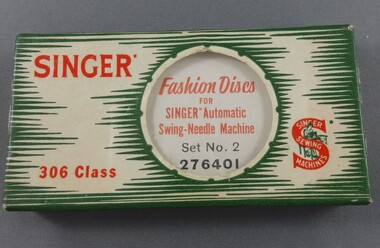
... Box containing four sewing machine cams and leaflet containing sewing patterns and instructions for use. Accessories to a Singer sewing machine....Shell, Solid scallop, Icicle and Banner Box containing four sewing machine cams and leaflet containing sewing patterns and instructions for use. Accessories to a Singer sewing machine. ...Commonly used removable cams from a Singer sewing machine of the 1960s. These cams enabled the home sewer to use fancy stitches in their work and were later superseded by integrated electronic controls.Box containing four sewing machine cams and leaflet containing sewing patterns and instructions for use. Accessories to a Singer sewing machine.Fashion discs for Singer Automatic swing-needle machine. Set no. 2, 276401, 306 class. Shell, Solid scallop, Icicle and Banner singer sewing machines -
 Glenelg Shire Council Cultural Collection
Functional object - Kodak Film Tank, Kodak, c. 1918
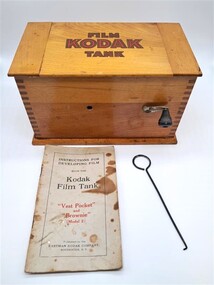
... The box also contains an instruction booklet. At the inside base of the box there is a paper leaflet pasted to the bottom. ...The box also contains an instruction booklet. At the inside base of the box there is a paper leaflet pasted to the bottom. ...This type of film developing tank was developed by Kodak in 1913. It was designed to allow the user to develop film in the daylight. The cylindrical tank inside the box with the dark apron surrounding it protected the film from the light. This model was 'Model 2' and Brownie size. The instruction booklet is dated to 1918.This objects helps to tell the story of photography as a hobby. It is an early example of a portable film developing which allowed the user to develop film in the daylight. It shows advancement in the technologies available to the hobby photographer.Rectangular timber box and lid. The lid has red lettering ' Kodak Film Tank'. The container part of the box has dovetail joints and a slight lip at the bottom where the base is larger than box. The box contains 2 metal turning handles, a cylindrical film tank and a metal tool which has a circular top end and a slight hook at the opposite end. The inside of the tank is painted black. The box also contains an instruction booklet. At the inside base of the box there is a paper leaflet pasted to the bottom. It has printed important and caution information on it as well as diagrams.Film / Kodak / Tankphotography, kodak, portland, glenelg shire, film, developing, film developing, hobbies, leisure, photographer -
 Kiewa Valley Historical Society
Lancette - S.E.C. - Medical
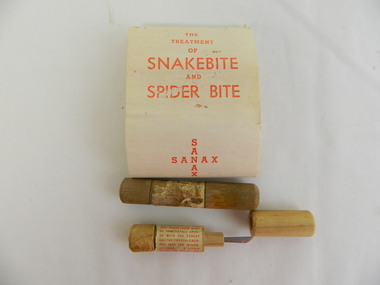
... Also in the box are instructions for Snakebite and Spider Bite. This leaflet is written in red on white paper and has more detail than the instructions on the lancets. ...Also in the box are instructions for Snakebite and Spider Bite. This leaflet is written in red on white paper and has more detail than the instructions on the lancets. ...Supplied to S.E.C. workers. This equipment was distributed to State Electricity workers working on the Kiewa Hydro Electric Scheme during the 1940's and 1950's.Historical: S.E.C. workers worked in remote areas where they didn't have easy access to medical facilities. Shows the development of snake bite treatment and spider bites.Cardboard brown box without lid for holding two wooden cylinders. Each cylinder can be pulled apart showing one end with a lancet which is used to cut the skin after a snake or spider bite. Each wooden container has instructions in very small red writing. Also in the box are instructions for Snakebite and Spider Bite. This leaflet is written in red on white paper and has more detail than the instructions on the lancets. It is made up of a front and back page opening up to the middle page.Pamphlet: 'The / Treatment / of / Snakebite / and / Spider Bite' and at the bottom 'Sanax'first aid, snakebite, spider bite, sanax company, state electricity commission of victoria, workers, medical -
 NMIT (Northern Melbourne Institute of TAFE)
Film Joiner: Premier 16/8 DeLuxe Model with Automatic Film Scraper
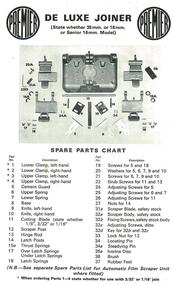
... In its original box, and includes a number of leaflets such as: Instructions for keeping the Premier De Luxe Film Joiner in proper adjustment and working order; Splicing instructions; Spares List; Automatic Film Scraper instructions; Heater unit...; After sales and Repair Service; and a Mark 3 blade....Photographic equipment Preston Technical College NMIT In its original box, and includes a number of leaflets such as: Instructions for keeping the Premier De Luxe Film Joiner in proper adjustment and working order; Splicing instructions; Spares List; Automatic Film Scraper instructions; Heater unit...; After sales and Repair Service; and a Mark 3 blade. ...In its original box, and includes a number of leaflets such as: Instructions for keeping the Premier De Luxe Film Joiner in proper adjustment and working order; Splicing instructions; Spares List; Automatic Film Scraper instructions; Heater unit...; After sales and Repair Service; and a Mark 3 blade.photographic equipment, preston technical college, nmit -
 Bendigo Historical Society Inc.
Document - BILL ASHMAN COLLECTION: SCALEBUOY TAP UNIT LEAFLETS
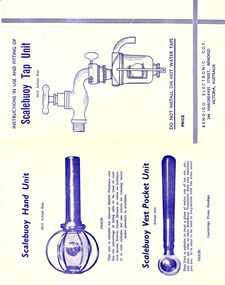
... 44 leaflets produced by the Bendigo Electronic Coy 244 Hargreaves Street Bendigo Victoria Australia, printed by Cambridge Press Bendigo with instructions in use and fitting of Scalebuoy Tap Unit....SCIENCES Instruments - general scalebuoy 44 leaflets produced by the Bendigo Electronic Coy 244 Hargreaves Street Bendigo Victoria Australia, printed by Cambridge Press Bendigo with instructions in use and fitting of Scalebuoy Tap Unit. ...44 leaflets produced by the Bendigo Electronic Coy 244 Hargreaves Street Bendigo Victoria Australia, printed by Cambridge Press Bendigo with instructions in use and fitting of Scalebuoy Tap Unit.sciences, instruments - general, scalebuoy -
 Bendigo Historical Society Inc.
Document - BILL ASHMAN COLLECTION: SCALEBUOY TAP UNIT LEAFLETS
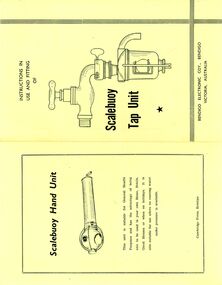
... 11 Leaflets produced by the Bendigo Electronic Coy Bendigo Victoria Australia, printed by Cambridge Press Bendigo with instructions in use and fitting of Scalebuoy Tap Unit....SCIENCES Instruments - general scalebuoy 11 Leaflets produced by the Bendigo Electronic Coy Bendigo Victoria Australia, printed by Cambridge Press Bendigo with instructions in use and fitting of Scalebuoy Tap Unit. ...11 Leaflets produced by the Bendigo Electronic Coy Bendigo Victoria Australia, printed by Cambridge Press Bendigo with instructions in use and fitting of Scalebuoy Tap Unit.sciences, instruments - general, scalebuoy -
 Bendigo Historical Society Inc.
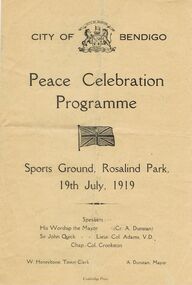
Document - LYDIA CHANCELLOR COLLECTION; PEACE CELEBRATION PROGRAMME
... Dunstan' Inside the leaflet is the actual programme and on the back cover are the Procession Instructions. ...Dunstan' Inside the leaflet is the actual programme and on the back cover are the Procession Instructions. ...Brown leaflet with black print. On the front cover are the words ' City of Bendigo Peace Celebration Programme. Sports Ground, Rosalind Park, 19th July, 1919. Speakers: His Worship the Mayor (Cr. A. Dunstan) Sir John Quick Lieut. Col. Adams, V.D., Chap. Col. Crookston. W. Honeybone, Town Clerk A. Dunstan' Inside the leaflet is the actual programme and on the back cover are the Procession Instructions. Cambridge Press.event, official, war, lydia chancellor, collection, w.w.ii, programme, event , celebration, program, peace, war
