
Showing 10 items matching "instrument fitter"
-
 Moorabbin Air Museum
Manual (Item) - Navigational Equipment - Instrument fitter - RAAF tech school
... Navigational Equipment - Instrument fitter - RAAF tech school...Navigational Equipment - Instrument fitter - RAAF tech school...Navigational Equipment - Instrument fitter - RAAF tech school Manual Navigational Equipment - Instrument fitter - RAAF tech school ... -
Moorabbin Air Museum
Manual (Item) - Fitters Course Notes - Instrument Fitter, Navigational Equipment - RAAF School Technical Training
... Fitters Course Notes - Instrument Fitter, Navigational Equipment - RAAF School Technical Training...Fitters Course Notes - Instrument Fitter, Navigational Equipment - RAAF School Technical Training...Fitters Course Notes - Instrument Fitter, Navigational Equipment - RAAF School Technical Training Manual Fitters Course Notes - Instrument Fitter, Navigational Equipment - RAAF School Technical Training ... -
 National Vietnam Veterans Museum (NVVM)
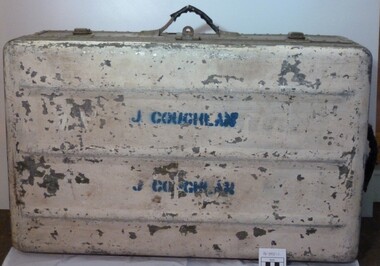
Equipment - Trunk, all metal rectangular shape with the name Coughlan on the top, 1963 (Approximate)
... ...Instrument Fitter...Case metal Metal Trunk Cpl John Desmond Coughlan A220788 Instrument Fitter No 9 Squadron Conspicuous Gallantry Medal J Coughlan J Coughlan Military case, aluminium, that seals to avoid moisture damage to contents in the tropics. it is an all metal rectangular shape with hinged lid that is lockable with small chains each side of the lid for easy foldback. ...Military case, aluminium, that seals to avoid moisture damage to contents in the tropics. it is an all metal rectangular shape with hinged lid that is lockable with small chains each side of the lid for easy foldback. J Coughlan J Coughlan case, metal, metal trunk, cpl john desmond coughlan, a220788, instrument fitter, no 9 squadron, conspicuous gallantry medal -
 National Vietnam Veterans Museum (NVVM)
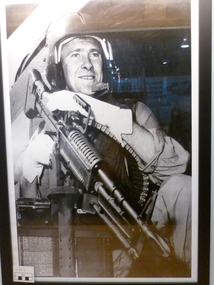
Photograph - Framed Black and White Photograph of Corporal John Desmond “Snow” Coughlan
... ...Instrument Fitter...Cpl John Desmond Coughlan Cpl John Desmond (Snow) Coughlan A220788 Royal Australian Air Force Instrument Fitter No 9 Squadron Conspicuous Gallantry Medal Photograph Handwritten signature - Snow Coughlan In a black frame there is a black and white photograph of Corporal John Desmond “Snow” Coughlan manning a machine gun in a helicopter. ...In a black frame there is a black and white photograph of Corporal John Desmond “Snow” Coughlan manning a machine gun in a helicopter. Handwritten signature - Snow Coughlan cpl john desmond coughlan, cpl john desmond (snow) coughlan, a220788, royal australian air force, instrument fitter, no 9 squadron, conspicuous gallantry medal, photograph -
National Vietnam Veterans Museum (NVVM)
Memorabilia - Tankard, Selangor Pewter Malaya, 1967 (Approximate)
... ...Instrument Fitter...Souvenir Mug drinking Ettamogah Club RAAF Vung Tau Instrument Fitter A220788 No 9 SQN Conspicuous Gallantry Medal Coughlan Snow Coughlan John Coughlan "Ettamogah Club" / RAAF Vung Tau, Vietnam/ Snow Coughlan 1967-1968 Engraved pewter drinking tankard. ...The No 9 Squadron, RAAF, Airmen's Club at RAAF Base Vung Tau, Vietnam was colloquially known as the Ettamogah Hotel. It was a place where Australian airmen gathered, and events like concerts by the ABC Showband were staged. Corporal John 'Snow' Coughlan served in No. 9 Squadron, Vietnam, from 25th April 1967 until 23rd April 1968. He was awarded the Conspicuous Gallantry Medal because he went to the assistance of American airmen twice after their gunship helicopters crashed into dense jungle inside enemy-held territory. On both occasions, Snow volunteered to be winched to the rescue of the badly injured crew despite flames and shooting. Engraved pewter drinking tankard. "Ettamogah Club" / RAAF Vung Tau, Vietnam/ Snow Coughlan 1967-1968 souvenir, mug, drinking, ettamogah club, raaf, vung tau, instrument fitter, a220788, no 9 sqn, conspicuous gallantry medal, coughlan, snow coughlan, john coughlan -
 Flagstaff Hill Maritime Museum and Village
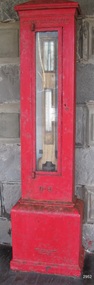
Instrument - Barometer, 1867
... fitter at Langlands and went on to work on the Wolesely Shearing machine. He also founded the Austin Motor Company in 1905. Around the 1890s Langlands Foundry Co. declined and was bought up by the Austral Otis Co. in about 1893. History for Grimoldi: John Baptist Grimoldi was born in London UK. His Father was Domeneck Grimoldi, who was born in Amsterdam with an Italian Father and Dutch mother. Domeneck was also a scientific instrument...fitter at Langlands and went on to work on the Wolesely Shearing machine. He also founded the Austin Motor Company in 1905. Around the 1890s Langlands Foundry Co. declined and was bought up by the Austral Otis Co. in about 1893. History for Grimoldi: John Baptist Grimoldi was born in London UK. His Father was Domeneck Grimoldi, who was born in Amsterdam with an Italian Father and Dutch mother. Domeneck was also a scientific instrument ...Langlands Company History: Langlands foundry was Melbourne's first foundry and iron shipbuilder established in 1842, only 8 years after the founding of the Victorian colony by two Scottish immigrants, Robert Langlands and Thomas Fulton, who had formed a partnership before emigrating (1813–1859). The business was known as the 'Langlands Foundry Co'. Henry Langlands (1794-1863), left Scotland in 1846 with his wife Christian, née Thoms, and five surviving children to join his brother Robert. By the time he arrived in early January of 1847 the partnership of Robert Langlands and Fulton had dissolved as Fulton had gone off to establish his own works. It was at this time that the two brothers took over ownership of Langlands foundry. Several years later Robert retired and Henry became sole the proprietor. The foundry was originally located on Flinders Lane between King and Spencer streets. Their sole machine tool, when they commenced as a business, was a small slide rest lathe turned by foot. In about 1865 they moved to the south side of the Yarra River, to the Yarra bank near the Spencer Street Bridge and then in about 1886 they moved to Grant Street, South Melbourne. The works employed as many as 350 workers manufacturing a wide range of marine, mining, civil engineering, railway and general manufacturing components including engines and boilers. The foundry prospered despite high wages and the lack of raw materials. It became known for high-quality products that competed successfully with any imported articles. By the time Henry retired, the foundry was one of the largest employers in Victoria and was responsible for casting the first bell and lamp-posts in the colony. The business was carried on by his sons after Henry's death. The company was responsible for fabricating the boiler for the first railway locomotive to operate in Australia, built-in 1854 by Robertson, Martin & Smith for the Melbourne and Hobson's Bay Railway Company. Also in the 1860s, they commenced manufacture of cast iron pipes for the Board of Works, which was then laying the first reticulated water supply system in Melbourne. Langlands was well known for its gold mining equipment, being the first company in Victoria to take up the manufacture of mining machinery, and it played an important role in equipping Victoria's and Australia's first mineral boom in the 1850s and 1860s. Langlands Foundry was an incubator for several engineers including Herbert Austin (1866–1941) who worked as a fitter at Langlands and went on to work on the Wolesely Shearing machine. He also founded the Austin Motor Company in 1905. Around the 1890s Langlands Foundry Co. declined and was bought up by the Austral Otis Co. in about 1893. History for Grimoldi: John Baptist Grimoldi was born in London UK. His Father was Domeneck Grimoldi, who was born in Amsterdam with an Italian Father and Dutch mother. Domeneck was also a scientific instrument maker. John B Grimoldi had served his apprenticeship to his older brother Henry Grimoldi in Brooke Street, Holburn, London and had emigrated from England to Australia to start his own meteorological and scientific instrument makers business at 81 Queens St Melbourne. He operated his business in 1862 until 1883 when it was brought by William Samuel and Charles Frederick, also well known scientific instrument makers who had emigrated to Melbourne in 1875. John Grimoldi became successful and made a number of high quality measuring instruments for the Meteorological Observatory in Melbourne. The barometer was installed at Warrnambool's old jetty and then the Breakwater as part of the Victorian Government's insistence that barometers be placed at all major Victorian ports. This coastal barometer is representative of barometers that were installed through this government scheme that began in 1866. The collecting of meteorological data was an important aspect of the Melbourne Observatory's work from its inception. Just as astronomy had an important practical role to play in navigation, timekeeping and surveying, so the meteorological service provided up to date weather information and forecasts that were essential for shipping and agriculture. As a result, instruments made by the early instrument makers of Australia was of significant importance to the development and safe trading of companies operating during the Victorian colonies early days. The provenance of this artefact is well documented and demonstrates, in particular, the importance of the barometer to the local fishermen and mariners of Warrnambool. This barometer is historically significant for its association with Langlands’ Foundry which pioneered technology in the developing colony by establishing the first ironworks in Melbourne founded in 1842. Also, it is significant for its connection to John B Grimoldi who made the barometer and thermometer housed in the cast iron case. Grimoldi, a successful meteorological and scientific instrument maker, arrived in the colony from England and established his business in 1862 becoming an instrument maker to the Melbourne Observatory. Additional significance is its completeness and for its rarity, as it is believed to be one of only two extant barometers of this type and in 1986 it was moved to Flagstaff Hill Maritime Village as part of its museum collection. Coast Barometer No. 8 is a tall, red painted cast iron pillar containing a vertical combined barometer and thermometer. Half way down in the cast iron framed glass door is a keyhole. Inside is a wooden case containing a mercury barometer at the top with a thermometer attached underneath, each with a separate glass window and a silver coloured metal backing plate. Just below the barometer, on the right-hand side, is a brass disc with a hole for a gauge key in the centre. The barometer has a silvered tin backing plate with a scale, in inches, of "27 to 31" on the right side and includes a Vernier with finer markings, which is set by turning the gauge key. The thermometer has a silvered tin backing plate with a scale on the left side of "30 to 140". Each of the scales has markings showing the units between the numbers. Inscription at the top front of the pillar reads "COAST BAROMETER" Inscribed on the bottom of the pillar is "No 8". and "LANGLANDS BROS & CO ENGINEERS MELBOURNE " The barometer backing plate is inscribed "COAST BAROMETER NO. 8, VICTORIA" and printed on the left of the scale, has "J GRIMOLDI" on the top and left of the scale, inscribed "Maker, MELBOURNE". There is an inscription on the bottom right-hand side of the thermometer scale, just above the 30 mark "FREEZING" Etched into the timber inside the case are the Roman numerals "VIII" (the number 8) flagstaff hill, warrnambool, maritime village, maritime museum, flagstaff hill maritime museum & village, shipwreck coast, great ocean road, warrnambool breakwater, coast barometer, coastal barometer, barometer, weather warning, ports and harbours, fishery barometer, sea coast barometer, austral otis co, coast barometer no. 8, henry grimoldi, henry langlands, john baptist grimoldi, langlands foundry co, meteorological instrument maker, robert langlands, scientific instrument maker, thermometer, thomas fulton -
 Ballarat Tramway Museum
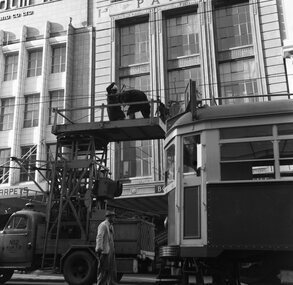
Print - Set of 2, Geoff Grant, 19/06/1955 12:00:00 AM
... fitters, overhead crews lining up the overhead at the Russell St. crossover in Bourke St. Has W6 988 in the photo, along with tower wagons 2 and 8. 1606.2 shows device laid between rails that allows the location of the overhead to be checked, relative the to the centre line of the track. Photo taken 19/6/1955. Numbered as 1606.1 and 1606.2. Dave Macartney 12/1/2001 identified Doug Lees in black coat and hat looking at instrument...fitters, overhead crews lining up the overhead at the Russell St. crossover in Bourke St. Has W6 988 in the photo, along with tower wagons 2 and 8. 1606.2 shows device laid between rails that allows the location of the overhead to be checked, relative the to the centre line of the track. Photo taken 19/6/1955. Numbered as 1606.1 and 1606.2. Dave Macartney 12/1/2001 identified Doug Lees in black coat and hat looking at instrument ...Negatives No. N334 and 335 and black and white prints made by a laser printer (stored in folder ) of fitters, overhead crews lining up the overhead at the Russell St. crossover in Bourke St. Has W6 988 in the photo, along with tower wagons 2 and 8. 1606.2 shows device laid between rails that allows the location of the overhead to be checked, relative the to the centre line of the track. Photo taken 19/6/1955. Numbered as 1606.1 and 1606.2. Dave Macartney 12/1/2001 identified Doug Lees in black coat and hat looking at instrument. Doug was an Engineer with the MMTB. Negative scanned hi res and imaged updated 22/5/2020. trams, tramways, melbourne, bourke st, russell st., testing overhead, commissioning, tram w6 988 -
Moorabbin Air Museum
Manual (Item) - Instruments and Autopilot Notes for RAAF Trainee Fitters
... Manual Instruments and Autopilot Notes for RAAF Trainee Fitters ANSETT AUSTRALIA HISTORICAL AIRCRAFT GROUP ... -
Moorabbin Air Museum
Manual - RAAF flight mechanics, RAAF Fitters II.E Flight Mechanics Course notes - issue 3 - 1941 Engineering School
... RAAF Flight Mechanics Engines Engine instruments & components Overhaul practices Full notes for RAAF fitters engineering course, circa 1943 Manual in book form RAAF Fitters II.E Flight Mechanics Course notes - issue 3 - 1941 Engineering School Manual RAAF flight mechanics ...Full notes for RAAF fitters engineering course, circa 1943Manual in book form Full notes for RAAF fitters engineering course, circa 1943 engines, engine instruments & components, overhaul practices -
Moorabbin Air Museum
Book - Aircraft construction, Aircraft Fitter's Handbook
... Aircraft construction Aeronautical terms Special tools & instruments Aircraft hydraulic equipment Exactor hydraulic remote control Heat treatment of steel Heat treatment of duralumin The riveting of aluminium & its alloys Overview of the theory of aircraft components, use of precision & rigging instruments & other aspects of aircraft fitting, circa 1943 Aircraft Fitter's Handbook Book Aircraft construction ...Overview of the theory of aircraft components, use of precision & rigging instruments & other aspects of aircraft fitting, circa 1943non-fiction Overview of the theory of aircraft components, use of precision & rigging instruments & other aspects of aircraft fitting, circa 1943 aeronautical terms, special tools & instruments, aircraft hydraulic equipment, exactor hydraulic remote control, heat treatment of steel, heat treatment of duralumin, the riveting of aluminium & its alloys
