
Showing 12 items matching "italians from palestine"
-
 Tatura Irrigation & Wartime Camps Museum
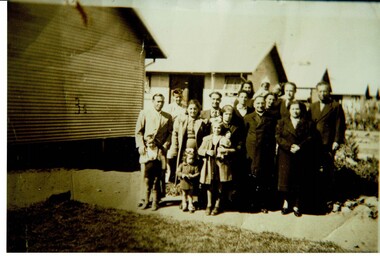
Photograph, Italian Family Group Camp 3
... ...Italians from Palestine...A group of Italian from Palestine who were internees in Camp 3 during WW2....Sepia photograph of a group of Italians from Palestine outside one of the barrack huts. ...A group of Italian from Palestine who were internees in Camp 3 during WW2. internment camp 3 Italian internees Camp 3 Italians from Palestine Sepia photograph of a group of Italians from Palestine outside one of the barrack huts. ...A group of Italian from Palestine who were internees in Camp 3 during WW2.Sepia photograph of a group of Italians from Palestine outside one of the barrack huts. internment camp 3, italian internees camp 3, italians from palestine -
 Tatura Irrigation & Wartime Camps Museum
Photograph, Camp 3 Italians
... Camp 3 Italians from Palestine.|D'Elia family photos and Documents -20 photos....Camp 3 Italians from Palestine.|D'Elia family photos and Documents -20 photos. photograph people Camp 3 Italians Photograph ...Camp 3 Italians from Palestine.|D'Elia family photos and Documents -20 photos.photograph, people -
 Tatura Irrigation & Wartime Camps Museum
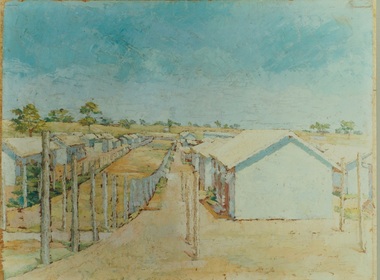
Painting - Painting - Watercolour, Camp 3, c.1945
... . : Vagarini, an Italian artist interned from Palestine, Camp 3..... : Vagarini, an Italian artist interned from Palestine, Camp 3. internment camp 3 tatura vagarini artist tatura internment camp3 cesare illustrations reproductions nil Copy of water colour painting in simple black frame depicting internment camp huts with dividing compound fencing. ...Original painting by Vagarini given to Mrs. Beinsenn who also was interned in Camp 3. : Vagarini, an Italian artist interned from Palestine, Camp 3.Copy of water colour painting in simple black frame depicting internment camp huts with dividing compound fencing.nilinternment camp 3, tatura, vagarini, artist, tatura internment camp3, cesare, illustrations, reproductions -
 Australian Commando Association - Victoria
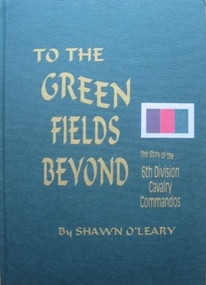
Book - 6th Div, Shawn OLeary, To The Green Fields Beyond:The story of the 6th Division Cavalry Commandos
... Italian light tanks, which had large kangaroos painted on the hulls and turrets to distinguish them from enemy vehicles. After Tobruk, the regiment was used as part of the advance guard in the capture of Derna and then Benghazi. In April the unit moved to Helwan, where it was equipped with Vickers light tanks and machine-gun carriers, and operated with British troops in capturing Sollum. Towards the end of May the regiment moved to Palestine ...The comprehensive history of the 6th Australian Division Cavalry Commandos – a (now out of print) reprint of one of the rarer Armoured unit history books. This is the story of one of Australia’s most famous fighting regiments during World War II. As an armoured cavalry unit it fought the Italians and Germans in the sands of the African desert and the Vichy French in the mountains of Syria. Later as a dismounted commando unit it fought the Japanese in the terrifying jungles of New Guinea. The heroism of the men in its ranks and the actions in which they engaged are portrayed in a way which makes battle deeds leap realistically from the pages. “To The Green Fields Beyond” is a documented and detailed book which is of value to everyone who is interested in Australia’s story. Seldom before has such a contribution been made to record of our national history. The book has been approved and sponsored by the Australian War Memorial. The 6th Division Cavalry Regiment was formed in November 1939 and, just two months later, was sent overseas to the Middle East in January 1940. Arriving in Egypt, the regiment immediately went to Palestine, where it joined the rest of the 6th Division and trained using machine-gun carriers and, from October, six old Vickers light tanks. At the end of the year the regiment moved into the Western Desert, where it joined British forces ready for the major offensive to commence on 9 December. Two days later the regiment became the first unit of the 2nd Australian Imperial Force (AIF) to go into action when one of its squadron fought a sharp action against the Italians holding Garn el Grein and Fort Maddalina on 11 and 12 December. By 21 December British forces had captured Sidi Barrrani and the desert was now open for the 6th Division’s advance along the Libyan coast. On 3 January 1941 the division attacked and captured the Italian fort of Bardia. The regiment’s A Squadron, under the command of Major Denzil Macarthur-Onslow, who went on to command the 4th Armoured Brigade, supported the attack. Tobruk was the next Italian fort to be captured, with the regiment again in support and covering the 19th Brigade’s advance. The regiment, though, was under-equipped and without its full compliment of vehicles, using only machine gun carriers. To compensate for this, A Squadron was parity re-equipped with captured Italian light tanks, which had large kangaroos painted on the hulls and turrets to distinguish them from enemy vehicles. After Tobruk, the regiment was used as part of the advance guard in the capture of Derna and then Benghazi. In April the unit moved to Helwan, where it was equipped with Vickers light tanks and machine-gun carriers, and operated with British troops in capturing Sollum. Towards the end of May the regiment moved to Palestine, where it came under the command of the 7th Division for the imminent invasion of Syria. The regiment experienced its heaviest fighting during the Syrian campaign, which began on 7 June. A Squadron was attached to the 21st Brigade and advanced along the coast, where the rugged hills made it difficult to manoeuvre the tanks and carriers. The squadron was relieved by one of the 9th Division Cavalry Regiment’s squadrons on 13 and 14 June. C Squadron, meanwhile, was with the 25th Brigade, and advanced along the Rosh Pinna road, engaging strong enemy defences at Fort Khirbe. C Squadron was relieved by B Squadron, which was later attacked by Vichy French tanks that were supported by heavy artillery and machine-gun fire, which forced the Australians to withdrawal. Always willing or needing to improvise during the campaign, A and B Squadrons both operated three captured French R35 Renault light tanks, while C Squadron provided personnel for a horse troop, quickly nicknamed the “Kelly Gang”, to patrol the high, rugged hills near the Mardjayoun–Banis Road. The regiment remained in Syria as part of the occupation force and returned to Australia in March 1942. It was sent to the Adelaide River, in the Northern Territory, and then later to Murgon, in Queensland. In 1943 and 1944 divisional cavalry regiments were reorganised into cavalry (commando) regiments. In January 1944 the 6th Division Cavalry Regiment became the 2/6th Cavalry (Commando) Regiment. The regiment lost its vehicles and became the administrative headquarters for the 2/7th, 2/9th, and 2/10th Commando Squadrons. The regiment remained with the 6th Division and participated in the Aitpae–Wewak campaign, in New Guinea, during 1945. Includes Nominal Rollnon-fictionThe comprehensive history of the 6th Australian Division Cavalry Commandos – a (now out of print) reprint of one of the rarer Armoured unit history books. This is the story of one of Australia’s most famous fighting regiments during World War II. As an armoured cavalry unit it fought the Italians and Germans in the sands of the African desert and the Vichy French in the mountains of Syria. Later as a dismounted commando unit it fought the Japanese in the terrifying jungles of New Guinea. The heroism of the men in its ranks and the actions in which they engaged are portrayed in a way which makes battle deeds leap realistically from the pages. “To The Green Fields Beyond” is a documented and detailed book which is of value to everyone who is interested in Australia’s story. Seldom before has such a contribution been made to record of our national history. The book has been approved and sponsored by the Australian War Memorial. The 6th Division Cavalry Regiment was formed in November 1939 and, just two months later, was sent overseas to the Middle East in January 1940. Arriving in Egypt, the regiment immediately went to Palestine, where it joined the rest of the 6th Division and trained using machine-gun carriers and, from October, six old Vickers light tanks. At the end of the year the regiment moved into the Western Desert, where it joined British forces ready for the major offensive to commence on 9 December. Two days later the regiment became the first unit of the 2nd Australian Imperial Force (AIF) to go into action when one of its squadron fought a sharp action against the Italians holding Garn el Grein and Fort Maddalina on 11 and 12 December. By 21 December British forces had captured Sidi Barrrani and the desert was now open for the 6th Division’s advance along the Libyan coast. On 3 January 1941 the division attacked and captured the Italian fort of Bardia. The regiment’s A Squadron, under the command of Major Denzil Macarthur-Onslow, who went on to command the 4th Armoured Brigade, supported the attack. Tobruk was the next Italian fort to be captured, with the regiment again in support and covering the 19th Brigade’s advance. The regiment, though, was under-equipped and without its full compliment of vehicles, using only machine gun carriers. To compensate for this, A Squadron was parity re-equipped with captured Italian light tanks, which had large kangaroos painted on the hulls and turrets to distinguish them from enemy vehicles. After Tobruk, the regiment was used as part of the advance guard in the capture of Derna and then Benghazi. In April the unit moved to Helwan, where it was equipped with Vickers light tanks and machine-gun carriers, and operated with British troops in capturing Sollum. Towards the end of May the regiment moved to Palestine, where it came under the command of the 7th Division for the imminent invasion of Syria. The regiment experienced its heaviest fighting during the Syrian campaign, which began on 7 June. A Squadron was attached to the 21st Brigade and advanced along the coast, where the rugged hills made it difficult to manoeuvre the tanks and carriers. The squadron was relieved by one of the 9th Division Cavalry Regiment’s squadrons on 13 and 14 June. C Squadron, meanwhile, was with the 25th Brigade, and advanced along the Rosh Pinna road, engaging strong enemy defences at Fort Khirbe. C Squadron was relieved by B Squadron, which was later attacked by Vichy French tanks that were supported by heavy artillery and machine-gun fire, which forced the Australians to withdrawal. Always willing or needing to improvise during the campaign, A and B Squadrons both operated three captured French R35 Renault light tanks, while C Squadron provided personnel for a horse troop, quickly nicknamed the “Kelly Gang”, to patrol the high, rugged hills near the Mardjayoun–Banis Road. The regiment remained in Syria as part of the occupation force and returned to Australia in March 1942. It was sent to the Adelaide River, in the Northern Territory, and then later to Murgon, in Queensland. In 1943 and 1944 divisional cavalry regiments were reorganised into cavalry (commando) regiments. In January 1944 the 6th Division Cavalry Regiment became the 2/6th Cavalry (Commando) Regiment. The regiment lost its vehicles and became the administrative headquarters for the 2/7th, 2/9th, and 2/10th Commando Squadrons. The regiment remained with the 6th Division and participated in the Aitpae–Wewak campaign, in New Guinea, during 1945. Includes Nominal Rollww2, australian commandos, australian special forces, world war 2 -
 Bendigo Military Museum
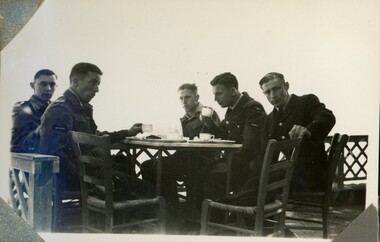
Album - PHOTOGRAPHIC ALBUM 462 SQUADRON RAAF, Groundcrew in northern Africa and Italy
... Two photographic souvenir albums from Egypt by an anonymous compiler, featuring official and personal photographs mainly featuring groundcrew personnel of 462 Squadron, RAAF in northern Africa and Italy. The albums contain many of the readily available sight-seeing images of Palestine...Two photographic souvenir albums from Egypt by an anonymous compiler, featuring official and personal photographs mainly featuring groundcrew personnel of 462 Squadron, RAAF in northern Africa and Italy. The albums contain many of the readily available sight-seeing images of Palestine ...Two photographic souvenir albums from Egypt by an anonymous compiler, featuring official and personal photographs mainly featuring groundcrew personnel of 462 Squadron, RAAF in northern Africa and Italy. The albums contain many of the readily available sight-seeing images of Palestine and Egypt, and well as numerous images from official sources plus some from personal sources. The photos shown in this record are representative of the contents of the albums.Two photo albums containing official and personal photographs mainly featuring groundcrew from RAAF 462 Squadron. The albums apparently come from the same anonymous source. The images in this record are representative of the contents of the albums. raaf 462 squadron, handley page halifax -
 Queenscliffe Maritime Museum
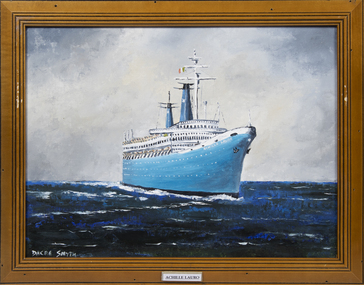
Painting - MV Achille lauro, Dacre Smyth, Achille lauro
... Italy. Built between 1939 and 1947 as MS Willem Ruys, a passenger liner for the Rotterdamsche Lloyd, it was hijacked by members of the Palestine Liberation Front in 1985. On 7 March 1959, Willem Ruys went off on her new world service to Australia and New Zealand. She departed from ...MS Achille Lauro was a cruise ship based in Naples, Italy. Built between 1939 and 1947 as MS Willem Ruys, a passenger liner for the Rotterdamsche Lloyd, it was hijacked by members of the Palestine Liberation Front in 1985.Mrs B SmythA framed oil painting of the passenger ship Achille LauroAchille Lauropassenger ship, achille lauro, oil painting, dacre smyth -
 Bendigo Military Museum
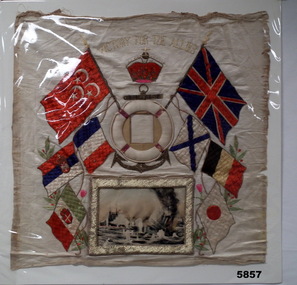
Souvenir - BANNER, SILK WW1, c.WW1
... Palestine from 1916 to mid 1918 when he rejoined the 3rd ALH Regiment Souvenier WW1 Flags Trooper Frank J. Fry. Over an embroidered King's Crown Banner is mounted on cardboard and covered with a clear cellophane Embroidered on top of banner. "Victory to the Allies." White silk banner featuring the flags of eight WW1 allied nations (Great Britian, France, Belgium, Japan, Serbia, Italy ...Banner was souvenired by Trooper Frank J. Fry, 3rd ALH Regiment No 2315. Trooper Fry also served in the Imperial Camel Corps in Palestine from 1916 to mid 1918 when he rejoined the 3rd ALH Regiment White silk banner featuring the flags of eight WW1 allied nations (Great Britian, France, Belgium, Japan, Serbia, Italy, Russia, Egypt.) The flags surround a raised life buoy over an embroidered anchor. Inside the life buoy is space for a photograph. At the bottom of the banner is a gold coloured rectangular frame housing a coloured print of a naval battle. The banner is topped with "Victory for the Allies."Over an embroidered King's Crown Banner is mounted on cardboard and covered with a clear cellophane Embroidered on top of banner. "Victory to the Allies."souvenier, ww1, flags, trooper frank j. fry. -
 Monbulk RSL Sub Branch
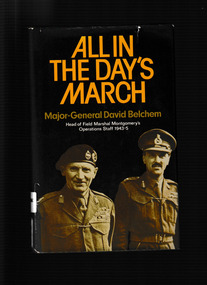
Book, David Belchem, All in the Day's March, 1978
... from joining the British Army in 1930 to 1950. He started his career in the Royal Tank Regiment and served in Egypt and Palestine prior to WW2. After the disaster of Greece was posted to General Montgomery's Staff prior to El Alamein and remained with him during the North African campaign. Planning for Invasion of Sicily, Sicily campaign, Italy ...Covers Major-General David Belchem career from joining the British Army in 1930 to 1950. He started his career in the Royal Tank Regiment and served in Egypt and Palestine prior to WW2. After the disaster of Greece was posted to General Montgomery's Staff prior to El Alamein and remained with him during the North African campaign. Planning for Invasion of Sicily, Sicily campaign, Italy and then returns to the UK to work with Monty planning Overlord. Was on Montys Staff during the invasion and until the surrender.Index, ill, maps, p.320.non-fictionCovers Major-General David Belchem career from joining the British Army in 1930 to 1950. He started his career in the Royal Tank Regiment and served in Egypt and Palestine prior to WW2. After the disaster of Greece was posted to General Montgomery's Staff prior to El Alamein and remained with him during the North African campaign. Planning for Invasion of Sicily, Sicily campaign, Italy and then returns to the UK to work with Monty planning Overlord. Was on Montys Staff during the invasion and until the surrender. generals - great britain - biography, david belchem - biography -
Tatura Irrigation & Wartime Camps Museum
Multi ringed folder, Kaye Watson, Internment camp No 3. Rushworth Migrant camp
... Camp 3 held 1000 internees, Germans, Jews and Italians, including German Lutheran families from New Guinea, German families from Palestine (Templer settlement) and Austrian Jewish refugees. ...The camp sites today are on private property, and as they were dismantled after the war, and on the closure of the Migrant camp, very little physical evidence remains today.Camp 3 held 1000 internees, Germans, Jews and Italians, including German Lutheran families from New Guinea, German families from Palestine (Templer settlement) and Austrian Jewish refugees. After the war camp 3 became the first camp for Displaced persons in Victoria, where families could live until work and accommodation was found for them.Many pages, with 12 photos on each page, of scenes showing the remains from camp 3camp 3 rushworth -
 Tatura Irrigation & Wartime Camps Museum
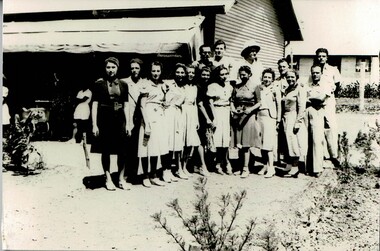
Photograph, Italian Choir
... from Palestine and Singapore formed a choir in Camp 3. Several other size prints in file. palestine internees singapore internees internment camp choir camp 3 choir Black and white photograph, on foam backing. Photograph depicts Italian ...Internees from Palestine and Singapore formed a choir in Camp 3. Several other size prints in file.Black and white photograph, on foam backing. Photograph depicts Italian men and women in front of a hut in camp 3.palestine internees, singapore internees, internment camp choir, camp 3 choir -
Tatura Irrigation & Wartime Camps Museum
Video Tape, Vagarini Exhibition
... Vagarini Exhibition at the Carlton Italian Social Club. Vagarini former Camp 2 internee from Palestine. ABC TV program....Vagarini Exhibition at the Carlton Italian Social Club. Vagarini former Camp 2 internee from Palestine. ABC TV program. ...Vagarini Exhibition at the Carlton Italian Social Club. Vagarini former Camp 2 internee from Palestine. ABC TV program. -
 Returned Nurses RSL Sub-branch
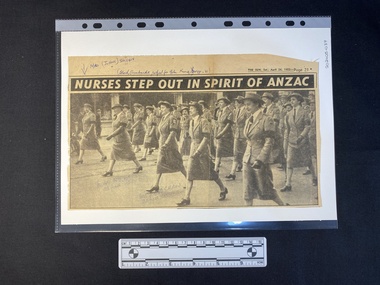
Newspaper - Newspaper clipping, The Sun, Nurses step out in spirit of anzac, April 26 1952
... Annie Moriah Sage British Army Italy West Africa North Nigeria Willaura District Hospital Peggy Wall Foncie Smith Egypt Palestine Greece AIP British Expeditionary Force BEF '[down arrow] MRS (JOHNS) SHIPPEN' [blue ink, upper left hand side] '(Black Armbands respect for late King.) George. VI)' [blue ink upper left hand side] 'Miss HANNAH / Alford Hosp.' [graphite, lower left hand side] 'Miss E [R] SHAW / Alford Hosp.' [graphite, lower left hand side] A newspaper clipping from ...Betty Jeffery and Beryl Woodbridge were among the war nurses who marched in the 1952 Anzac march. The two nurses were both Japanese POWs for three years. Kath McMillan and Betty Pump who served with them in the 2/10 Australian General Hospital (AGH) also marched. Matron-in-Chief Sage let the procession that also included Miss Edna Shaw, Lady Superintendent of the Alfred Hospital. An English ex-pat, Kathleen Carpenter, who served in the Queen Alexandra Imperial Nursing Service Reserve, having settled in Australia after being demobilised, also marched. A newspaper clipping from a larger sheet consisting of a title above a large black and white photo of a large group of women in uniform marching together down a street. The story has been cut off.'[down arrow] MRS (JOHNS) SHIPPEN' [blue ink, upper left hand side] '(Black Armbands respect for late King.) George. VI)' [blue ink upper left hand side] 'Miss HANNAH / Alford Hosp.' [graphite, lower left hand side] 'Miss E [R] SHAW / Alford Hosp.' [graphite, lower left hand side]annie moriah sage, british army, italy, west africa, north nigeria, willaura district hospital, peggy wall, foncie smith, egypt, palestine, greece, aip, british expeditionary force, bef
