
Showing 12 items matching "ivory carving"
-
 Mont De Lancey
Artwork, other - Ivory Carving
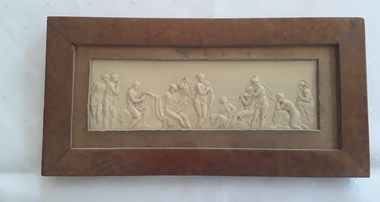
... Ivory Carving...Ivory style relief carved panel of ten Ancient Greek figures playing and listening to musical instruments played outdoors. They are wearing robes; some are standing and some are sitting on or near rocks and a plant. The artwork has a mottled wooden frame and gold painted cardboard mount. It is covered by celluloid or plastic to protect the carving...Artwork, other Ivory Carving ...A rectangular cream Ivory style relief carved panel of ten Ancient Greek figures playing and listening to musical instruments played outdoors. They are wearing robes; some are standing and some are sitting on or near rocks and a plant. The artwork has a mottled wooden frame and gold painted cardboard mount. It is covered by celluloid or plastic to protect the carving. The backing is wooden with small screws holding it all together.The whole sculpture is carved in fine detail.relief engraving, objects of vertu, carved picture, ancient greece, carvings -
 Embroiderers Guild, Victoria
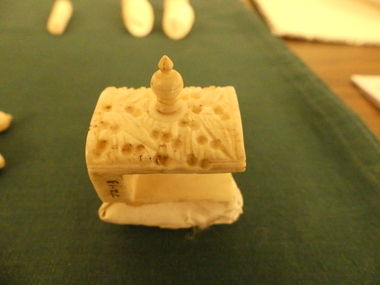
Tool - Carved chinese ivorty or bone clamp wiwth pincushion top, Small ivory sewing clamp with pincushion top, 1840's
... ...ivory carving...Pins were precious sewing tools which needed to be kept safe and sharp, pincushions were an essential sewing tool for keeping pins. clamp pincushion ivory carving Carved bone or ivory clamp with screw through base for attachment.. ...Pins were expensive and so the use of pincushions to keep them safe, to protect them and other items was practical and popular. Chinese carved ivory clamps with pincushion tops were common accessories for work boxes. Such as these they were made in the East for sale to European markets where they were a way of showing one's financial status. Pins were precious sewing tools which needed to be kept safe and sharp, pincushions were an essential sewing tool for keeping pins. Carved bone or ivory clamp with screw through base for attachment.. Topped with pincushion covered with (replacement) embroidered silkclamp, pincushion, ivory carving -
 Warrnambool and District Historical Society Inc.
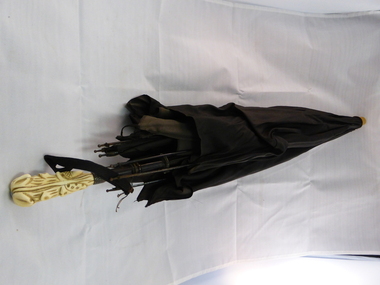
Artefact, Umbrella & description, Early 20th century
... This is a black silk umbrella with a carved ivory handle. The carving includes representations of leaves and seeds. ...This umbrella is of interest because of its carved ivory handle and because it was sent from South Africa to an Anglican Church adherent in Warrnambool early in the 20th century. church of england, warrnambool This is a black silk umbrella with a carved ivory handle. The carving includes representations of leaves and seeds. ...According to the handwritten information accompanying the item this umbrella has an ivory handle carved by native Africans on a Christian mission station in South Africa. The umbrella was sent to Mrs Donohue of Warrnambool who was an active member of the Church of England in Warrnambool early in the 20th century. No further information has been found on Mrs Donohue. This umbrella is of interest because of its carved ivory handle and because it was sent from South Africa to an Anglican Church adherent in Warrnambool early in the 20th century. This is a black silk umbrella with a carved ivory handle. The carving includes representations of leaves and seeds. Some of the silk is torn, some has disintegrated and some of it is detached from the metal spokes. The umbrella top is wooden. The information about the umbrella is handwritten in blue ink and is contained in a small wooden frame. church of england,, warrnambool -
 Great Stupa of Universal Compassion
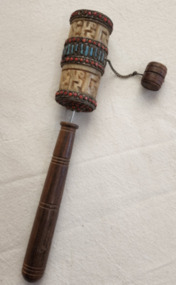
Ceremonial object - Hand-held prayer wheel
... This prayer wheel features a cylinder finished with a layer of ivory with a carving of a mantra in Tibetan script and inlaid with coral and turquoise. ...They believe that turning the wheel with a pure, compassionate intention releases the mantras into the universe, which purifies negative karma, accumulates merit, and radiates compassion to all living beings. tibetan buddhism holy objects worship devices "Om Mani Padme Hum" in Tibetan script This prayer wheel features a cylinder finished with a layer of ivory with a carving of a mantra in Tibetan script and inlaid with coral and turquoise. ...As Buddhism spread to Tibet in the 7th century, prayer wheels became an essential attribute of Tibetan Buddhist practice. This practice is linked to teachings attributed to Nagarjuna (ca. 150 –250 CE), who emphasised the power of mantra recitation and visualisation. A prayer wheel, used for personal worship, allowed to release the spiritual power contained within the mantras, enabling practitioners, including those who could not read, to generate spiritual merit. Prayer wheels are used by Tibetan practitioners every day, sometimes hours at a time. They believe that turning the wheel with a pure, compassionate intention releases the mantras into the universe, which purifies negative karma, accumulates merit, and radiates compassion to all living beings.This prayer wheel features a cylinder finished with a layer of ivory with a carving of a mantra in Tibetan script and inlaid with coral and turquoise. The cylinder is attached to a wooden handle. Inside the cylinder is a tightly wound scroll printed with numerous mantras and wrapped around a spindle. A metal chain with a small wooden weight attached to its end is affixed to the cylinder, allowing it to be spun with a slight rotation of the wrist."Om Mani Padme Hum" in Tibetan scripttibetan buddhism, holy objects, worship devices -
 Flagstaff Hill Maritime Museum and Village
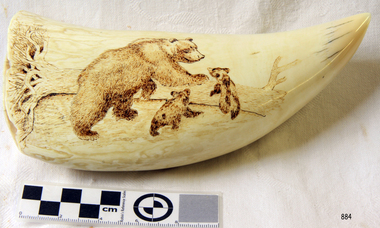
Craft - Scrimshaw
... carving on sperm whale teeth only. But scrimshaw also includes engravings on skeletal whale bone–such as the jaw bone, called panbone–and ivory from other marine mammals such as walrus. ...carving on sperm whale teeth only. But scrimshaw also includes engravings on skeletal whale bone–such as the jaw bone, called panbone–and ivory from other marine mammals such as walrus. ...When scrimshaw is mentioned, most people think of carving on sperm whale teeth only. But scrimshaw also includes engravings on skeletal whale bone–such as the jaw bone, called panbone–and ivory from other marine mammals such as walrus. Although scrimshaw is widely associated with nautical themes and designs of the 19th century whaling industry, vintage scrimshaw was also produced as tribal art in many cultures. Today, scrimshaw is recognized as a unique medium in which present-day artists have developed their own modern themes. Scrimshaw reproductions may take several forms. There are - New carvings on genuine ivory or bone with the deliberate intent to create an "antique” - New carvings on genuine ivory or bone sold as signed and dated contemporary art - Clearly marked synthetic museum reproductions and mass marketed - Unmarked synthetic replicas Painstakingly carved deliberate replicas are directed towards the scrimshaw collector and seldom appear in the general market. Pieces of contemporary art and museum copies are usually clearly marked and openly sold for what they are. The biggest problems in the general antiques market are the mass produced synthetic reproduction pieces, such as this item, that can be mistaken for the genuine item. The scrimshaw is a modern reproduction of a typical scrimshaw scene and engraved onto a synthetic substance. It has been created as a decorative piece and is currently displayed as a representation of the craft of scrimshaw.Scrimshaw carved on a non-natural material in the shape of a whale tooth. Engraving depicts a grizzly bear with two cubs next to a fallen tree. Nonewarrnambool, flagstaff-hill, flagstaff-hill-maritime-museum, maritime-museum, shipwreck-coast, flagstaff-hill-maritime-village, craft work, carving on bones, whale bone carving, engraving, scrimshaw, carving, reproduction scrimshaw -
 City of Moorabbin Historical Society (Operating the Box Cottage Museum)
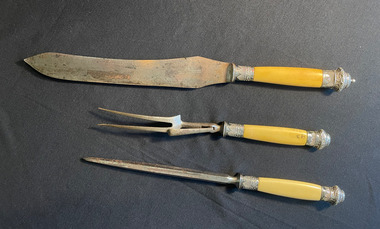
Domestic object - Carving Set; knife, fork and knife sharpener, c1900
... A set of carving implements with ivory handles with chased and repousse silver plate caps and collars; Knife, Fork and Knife sharpener. ...This carving set; knife, fork and knife sharpener is typical of the cutlery used by early settlers in Moorabbin Shire c1900 cutlery cast steel kitchen equipment early settlers moorabbin cheltenham ormond bentleigh On Knife: Joseph Elliot & Sons, Cutlers, Sheffield" with the mirror "C"s and Maltese cross mark used after 1825 On knife sharpener: CAST STEEL A set of carving implements with ivory handles with chased and repousse silver plate caps and collars; Knife, Fork and Knife sharpener. ...Early settlers in Moorabbin Shire brought cutlery and other domestic items with them when travelling from England 19thC. This carving set; knife, fork and knife sharpener was used by a pioneer family.This carving set; knife, fork and knife sharpener is typical of the cutlery used by early settlers in Moorabbin Shire c1900 A set of carving implements with ivory handles with chased and repousse silver plate caps and collars; Knife, Fork and Knife sharpener. The Fork has a flip up thumb guard. On Knife: Joseph Elliot & Sons, Cutlers, Sheffield" with the mirror "C"s and Maltese cross mark used after 1825 On knife sharpener: CAST STEELcutlery, cast steel, kitchen equipment, early settlers, moorabbin, cheltenham, ormond, bentleigh -
 Flagstaff Hill Maritime Museum and Village
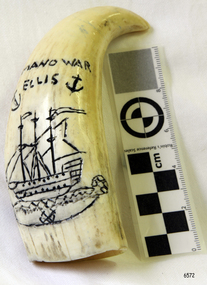
Craft - Scrimshaw, Late 20th century
... ivory tooth...resin...plastic...craft...engraving...carving...The subject scrimshaw is a modern reproduction crudely done of a historic vessel and the scene is believed to be engraved onto a synthetic substance. warrnambool flagstaff-hill flagstaff-hill-maritime-museum maritime-museum shipwreck-coast flagstaff-hill-maritime-village scrimshaw ellis esperance clementina elise hms ship man of war leter of marque privateer slave ship slavery ellis bent american war of inderpendance marine art marine artifact whale tooth ivory tooth resin plastic craft engraving carving Engraved "Man o War Ellis" Scrimshaw art crudely carved into non-natural material in the shape of a tooth. ...The ship “Ellis” started life as the Clementina, launched in America in 1781. The vessel was first listed in Lloyd's Register in 1784 and under this name began serving as a slave ship sailing out of Liverpool. A Lloyd’s database records of slave-trading voyages by vessels from Liverpool makes it clear that Clementina was a slave trader. The next year Captain J. Elworthy sailed her to West Central Africa and St Helena. He transported his slaves to South Carolina. Then in 1785 Elworthy gathered slaves in the Bight of Biafra and the Gulf of Guinea Islands for delivery to Jamaica. In 1786 Bent & Co. purchased the Clementina and renamed her Ellis, presumably after the then owner Ellis Bent. She remained in the slave trade and In 1788 Captain John Ford sailed the now renamed Ellis to the Bight of Biafra and the Gulf of Guinea to gather slaves. He delivered this batch of slaves to the island of Grenada. The next year, 1789 the Ellis was almost completely rebuilt, and from the change in subsequent reports of her cargo loading or (burthen), she was enlarged. In 1791, Captain Joseph Matthews became master and sailed the Ellis to the Gold Coast then delivering his consignment of slaves to the island of St Vincent. During this voyage, some misfortune may have befallen Matthews because records show the Ellis command was transferred to Thomas Given. In 1792, Given sailed to the Bight of Biafra and the Islands in the Gulf of Guinea, again collecting slaves for delivery to Jamaica. There is a parallel record, also for 1793, that the Ellis under the command of Thomas Heart, undertook the same journey and with the same itinerary and cargo. In 1793, Bent & Co. decided to use the Ellis as a privateer with John Levingston as the master. After receiving a letter of "marque” on the 3rd of June 1793, that allowed any armed vessel to commit acts on the high seas which would otherwise have constituted piracy. Thus the Ellis began to operate as a combat ship under the endorsement of the British navy. The Ellis was three times captured first by the French frigate Gracieuse, under the command of Captain Chevillard on 22 July 1793. The French took her into service and renamed her as ”Elise”. Later that summer the Spanish captured her and in November ownership returned to the French who then renamed her the “Esperance”. On the 8th of June 1794, Esperance arrived in Jacmel, Saint-Domingue (present-day Haiti), from France with the official proclamation of the abolition of slavery. Leger-Felicite Sonthonax was one of the Civil Commissioners of Saint-Domingue and he had already unilaterally proclaimed the island for the French colony the year before amid a slave rebellion and attacks from British and Spanish forces. Ironically, Esperance also brought the news to the Civil Commissioners that the National Convention of France had impeached them on 16th July 1793 and ordered them to return promptly to France. On 8 January 1795, HMS Argonaut, under the command of Captain Alexander John Ball, captured Esperance while she was on the North America station. At this time the Esperance was armed with 22 guns (4 and 6-pounders) and had a crew of 130 men. She was under the command of Lieutenant de vaisseau De St. Laurent and had been out at sea for 56 days from Rochfort, bound for the American Chesapeake Bay area. The French ambassador to the United States registered a complaint with the President of the United States that Argonaut, by stating that by entering Lynnhaven bay, either before she captured Esperance or shortly thereafter, had violated a treaty between France and the United States. The French also accused the British of having brought the Esperance into Lynnhaven for refitting for a cruise. The British Consul replied that the capture had taken place some 10 leagues offshore as the bad weather had forced Argonaut and her prize to shelter within the Chesapeake area for some days, but that they had left as soon as practicable. Furthermore, Argonaut had paroled her French prisoners on arrival at Lynnhaven, and if she had entered American territorial waters solely to parole her French prisoners no one would have thought that objectionable. Royal Navy Service: Because the Esperance was captured in good order and sailed well, Rear Admiral George Murray, the British commander in chief of the North American station, put a British crew aboard and sent the Esperance out on patrol with HMS Lynx, under the command of John Poo Beresford, on 31st January. On 1st March the two vessels captured the Cocarde Nationale (or National Cockade), a privateer from Charleston, South Carolina, of 14 guns, six swivel cannons and a crew of 80 men. Esperance and the lynx went on to recaptured the ship Norfolk, of Belfast, and the brig George, of Workington. On 20 July, Esperance, in company with frigates Thetis and Hussar, intercepted the American vessel Cincinnatus, of Wilmington, sailing from Ireland to Wilmington. They pressed many men on board into service, narrowly missing the Irish revolutionary Wolfe Tone, who was on his way to Philadelphia. Esperance was formally commissioned in 1795 into the Royal Navy in August under the Command of Jonas Rose. On 4 May 1796 Esperance was sailing in company with HMS Spencer and Bonetta when they sighted a suspicious vessel. Spencer set off in chase while shortly thereafter Esperance saw two vessels, a schooner and a sloop, and she and Bonetta set off after them. Spencer sailed south by south-east and the other two British vessels sailed south-west by west, with the result that they lost sight of each other. Spencer captured the French gun-brig Volcan, while Bonetta and Esperance captured the French schooner Poisson Volant. The Esperance eventually arrived at Portsmouth on the 3rd of November 1797, the crew was paid off and on 31st May 1798 the Admiralty listed the Esperance for sale and she was sold in June 1798 for £600.The subject scrimshaw is a modern reproduction crudely done of a historic vessel and the scene is believed to be engraved onto a synthetic substance. Scrimshaw art crudely carved into non-natural material in the shape of a tooth. The line artwork is an image of a three-masted sailing ship with a poop deck, and anchors, are coloured black. Inscription is engraved into tooth.Engraved "Man o War Ellis" warrnambool, flagstaff-hill, flagstaff-hill-maritime-museum, maritime-museum, shipwreck-coast, flagstaff-hill-maritime-village, scrimshaw, ellis, esperance, clementina, elise, hms ship, man of war, leter of marque, privateer, slave ship, slavery, ellis bent, american war of inderpendance, marine art, marine artifact, whale tooth, ivory tooth, resin, plastic, craft, engraving, carving -
 Flagstaff Hill Maritime Museum and Village
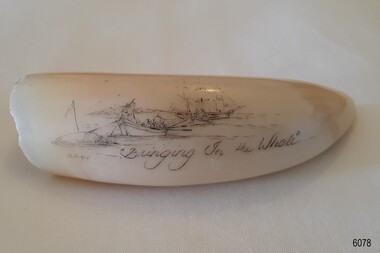
Craft - Scrimshaw, Bringing in the Whale
... carving on sperm whale teeth only. But scrimshaw also includes engravings on skeletal whale bone–such as the jaw bone, called pan bone and ivory from other marine mammals such as walrus. ...carving on sperm whale teeth only. But scrimshaw also includes engravings on skeletal whale bone–such as the jaw bone, called pan bone and ivory from other marine mammals such as walrus. ...When scrimshaw is mentioned, most people think of carving on sperm whale teeth only. But scrimshaw also includes engravings on skeletal whale bone–such as the jaw bone, called pan bone and ivory from other marine mammals such as walrus. Although scrimshaw is widely associated with nautical themes and designs of the 19th century whaling industry, vintage scrimshaw was also produced as tribal art in many cultures. Today, scrimshaw is recognized as a unique medium in which present-day artists have developed their own modern themes. Scrimshaw reproductions may take several forms. There are - New carvings on genuine ivory or bone with the deliberate intent to create an "antique” - New carvings on genuine ivory or bone sold as signed and dated contemporary art - Clearly marked synthetic museum reproductions and mass marketed - Unmarked synthetic replicas This scrimshaw work is done on a sperm whale's tooth. It is one of two pieces by artist Gary Tonkin in Flagstaff Hill’s collection. Sperm whales can live for 60 or even 70 years, so the tooth could be quite old. It came from the whaling station in Albany, Western Australia, which ceased processing whales in 1978 and is now a whaling museum. The two works were commissioned by Flagstaff Hill in the 1980s. Tonkin could spend from a few days to a few months in intensive work on each piece of scrimshaw. He is a world-renowned Master Scrimshander and a Fellow of the Australian Society of Marine Artists (FASMA), and lives in Albany, Western Australia. Gary Tonkin, FASMA – Tonkin was born in 1949 in Portland, Victoria, and grew up there with a history of whaling and related industries. He moved to Albany in southwest WA in 1971 and worked as an Export Meat inspector for the Federal Government. This small town also had a historical connection to whaling. The Cheynes Beach Whaling Station was still operating, and there were even three whaling ‘chaser’ vessels at the old jetty. In 1975, his employment now permanent, Tonkin bought an old cottage near the bay, purchased some whales’ teeth, and began learning the sailors’ art of scrimshaw, combining this with his artistic skills and knowledge of history. His job gave him access to buy as many whale teeth as he could afford, straight from the whaling station. Tonkin gained further marine knowledge as he sailed on the schooner ‘Esperance’ from Fremantle to Mauritius in 1988. He watched the sailors at work and experienced the rough and stormy sea conditions first-hand. Tonkin later visited whaling museums, galleries and libraries in England and America to gather reference materials and information on all aspects of whaling and scrimshaw. In 1993 he was Commissioned to engrave six large whale teeth, from the Albany whaling station, for the USA Gallery at the Australian National Maritime Museum in Sydney. This work is now in the museum’s permanent collection. From that time, Tonkin began working full-time as a Scrimshander. Tonkin’s work is now in galleries and museums in America and Australia, as well as in private collections. He is the founder of the Albany Maritime Heritage Association and was the inaugural President. In the 1990s he actively and successfully campaigned for the preservation of the Cheynes Beach Whaling Station in Albany, which is now Whale World, an open-air whaling museum. His continuing work as a Scrimshander contributes to the preservation of the art of scrimshaw and the history of whaling. This scrimshaw represents the ancient craft of scrimshaw, associated with mariners in the whaling trade in the early 19th century. The work is also Nationally significant for being created by world-renowned Scrimshander, Gary Tonkin, from Albany, Western Australia. Scrimshaw; whale tooth carved with an image of two whaleboats hauling a dead whale back to the mother ship. Inscribed Title and signature of artist Gary Tonkin.Inscribed "Bringing in the whale". Signature "G Tonkin"flagstaff hill maritime museum and village, warrnambool, great ocean road, shipwreck coast, maritime museum, flagstaff hill, perth, whaling, whales, australia, scrimshaw, scrimshander, gary tonkin, g tonkin, bone, tooth, craft, albany, western australia, cheynes beach whaling station, whale world, portland, engraving, maritime art, sperm whale's tooth, albany whaling station, albany whaling museum -
 Embroiderers Guild, Victoria
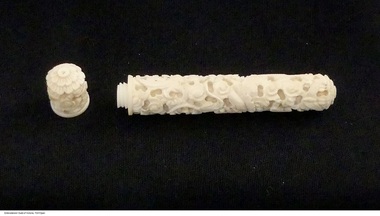
Tool - Ivory needlecase, Needleholder, late 18h/early 19th century
... Needleholder Ivory Bas relief carving design with butterflies and flowers Cylindrical carved ivory needlecase. ...Typical of needlework accessories made in Canton area of China for European market. Made to hold needles which were expensive tools By late 18th century, needle making had achieved the ability to produce very fine needles which needed to be protected. Cylindrical carved ivory needlecase. Screw cap.Bas relief carving design with butterflies and flowers needleholder, ivory -
 Embroiderers Guild, Victoria
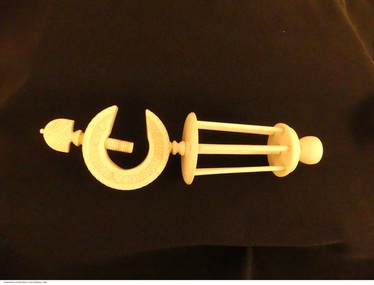
Tool - Ivory winding clamp, c1850
... Large Ivory winding clamp, screw on rotating cage with 6 spokes around central spindle. cup on top. C-shaped clamp with decorative carving. ...When silk, cotton and linen threads were sold in skeins, winding clamps such as this were used in pairs to wind thread so it could be used When silk, cotton and linen threads were sold in skeins, winding clamps such as this were used in pairs to wind thread so it could be used without tangling clamp winding clamp Large Ivory winding clamp, screw on rotating cage with 6 spokes around central spindle. cup on top. C-shaped clamp with decorative carving. ...When silk, cotton and linen threads were sold in skeins, winding clamps such as this were used in pairs to wind thread so it could be used When silk, cotton and linen threads were sold in skeins, winding clamps such as this were used in pairs to wind thread so it could be used without tanglingLarge Ivory winding clamp, screw on rotating cage with 6 spokes around central spindle. cup on top. C-shaped clamp with decorative carving. Screw has shield shaped head decorated with diagonal grove clamp, winding clamp -
 Mont De Lancey
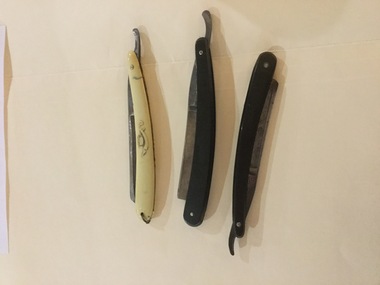
Razor, Carman & Sons
... Ivory handle with crown and sword carving. 2. Bakelite handle....Ivory handle with crown and sword carving. 2. Bakelite handle. ...3 x Cut-throat razors. 1. Ivory handle with crown and sword carving. 2. Bakelite handle.1. Made in Germany ERN 1166. 2. Dr. Peres Solingencut-throat razors, shaving equipment -
 Emerald Museum & Nobelius Heritage Park
Domestic object - Carving set, 1900s-1930s
... Carving set comprising carving fork with flip up thumb guard, knife sharpener and carving knife. Each item is cast metal with an ivory or bone handle. ...The items are significant as they provide insights into the cooking equipment and techniques in use in the region in the early-to-mid twentieth century. kitchen equipment Domestic items--Food preparation table ware 1910s Carving set comprising carving fork with flip up thumb guard, knife sharpener and carving knife. Each item is cast metal with an ivory or bone handle. ...The metal used to manufacture the items is unknown. They are not stamped to indicate the metal, and display more abrasion and staining than similar knives in the collection which are stamped to indicate their manufacture from Stainless Steel. This may indicate the age of the knife, as stainless steel (steel which did not rust) became more commonly used for tableware and kitchen equipment from the late 1920s.The items are significant as they provide insights into the cooking equipment and techniques in use in the region in the early-to-mid twentieth century.Carving set comprising carving fork with flip up thumb guard, knife sharpener and carving knife. Each item is cast metal with an ivory or bone handle. The set probably dates from the early 1900s.kitchen equipment, domestic items--food preparation, table ware, 1910s
