
Showing 837 items matching "jacks road"
-
 Rutherglen Historical Society
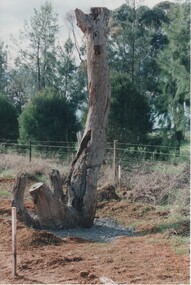
Image, Survey Tree, Jacks Road
... Survey Tree, Jacks Road......jacks road...Original blazed survey tree was removed and then replaced by Gas Workers tree survey reference marks blazed tree jacks road Survey marks on tree blaze Colour photograph of the remains of a survey tree, concreted into the ground Survey Tree, Jacks Road Image ...Original blazed survey tree was removed and then replaced by Gas WorkersColour photograph of the remains of a survey tree, concreted into the groundSurvey marks on tree blazetree, survey reference marks, blazed tree, jacks road -
 Rutherglen Historical Society
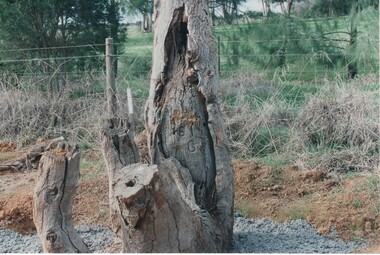
Image, Survey Tree, Jacks Road
... Survey Tree, Jacks Road......jacks road...This photo is a close-up to better show the survey marks. Survey Tree, Jacks Road Image ...Original blazed survey tree was removed and then replaced by Gas WorkersColour photograph of the remains of a survey tree, concreted into the ground. This photo is a close-up to better show the survey marks.Survey marks on tree blazetree, survey reference marks, blazed tree, jacks road -
 Eltham District Historical Society Inc
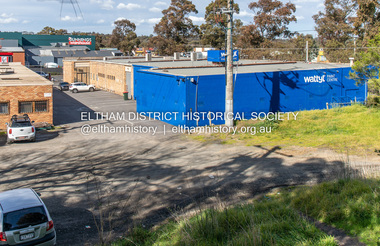
Photograph, Peter Pidgeon, Industrial Estate, corner Bridge Street and Boltron Street, Eltham, 2 Aug. 2022
... Jacks...Sherbourne Road...Clark Photo (2022) Bolton Steet industry Bridge Street Brisbane Street Bunnings Warehouse Hungry Jacks Sherbourne Road Wattyl Paint Centre Born Digital Industrial Estate, corner Bridge Street and Boltron Street, Eltham Photograph Photograph Peter Pidgeon ...View looking southeast from Hungry Jacks carpark over present-day Brisbane Street (formerly Bolton Street) to Bridge Street Comparison photo: 05424 Part of a presentation by Peter Pidgeon to the Society, 13 August 2022 showcasing a series of photographs taken by John Henry Clark over the period 1895 to 1930. John Henry Clark was the youngest of three boys born to William Henry Clark (1823-1877) and Maria White (1843-1914). He and his brothers, William Charles Clark (1872-1945), Clement Kent Clark (1874-1912) operated a photography business (Clark Bros.) from 25 Thomas Street, Windsor near Prahran during the period c.1894 to 1914. Following death of Clement in September 1912 and their mother in 1914, the Clark Bros business appears to have dissolved, the premises demolished, and a new house was under construction in 1915. John set up business independently in 1914 operating out of 29 Moor Street, Fitzroy where he is registered in the 1914 and 1915 Electoral Rolls. By 1916 John had relocated to Eltham where he continued his practice as a photographer and took many of the early images around the district of Little Eltham. Around 1930 John changed professions and opened a small cobbler's shop in 1931 near the pond opposite Dalton Street adjacent to the Jarrold family cottage. He never married and continued his profession as a bootmaker from this little shop, maintaining a close relationship with Mrs Jarrold for the rest of their lives. His bootmaker shop remains today beside the Whitecloud cottage and is one of only three remaining shops in the area from the early 20th century.Comparative photo taken 2022 with one taken from same location over 100 years earlier by noted local photographer J.H. ClarkBorn Digitaleltham, j.h. clark photo (2022), bolton steet, industry, bridge street, brisbane street, bunnings warehouse, hungry jacks, sherbourne road, wattyl paint centre -
 National Wool Museum
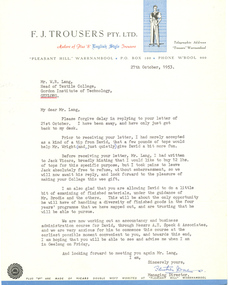
Letter
... J M Vicaris/ Jack/ Vict Road/ Marrickville........Roy Jones Mr Fletcher - F J Trousers Pty Ltd Wool - research Wool - measurement Wool - testing J M Vicaris/ Jack/ Vict Road/ Marrickville..... Letter ...Letter from Fletcher Jones "F J Trousers Pty Ltd" to W R Lang re. a gift of wool topsJ M Vicaris/ Jack/ Vict Road/ Marrickville.....wool - research wool - measurement wool - testing, f j trousers pty ltd, lang, dr w. roy jones, mr fletcher - f j trousers pty ltd, wool - research, wool - measurement, wool - testing -
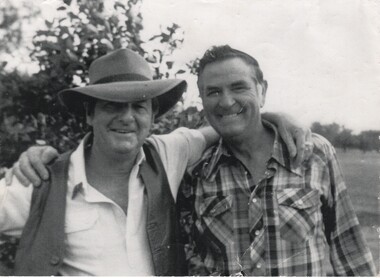 Rutherglen Historical Society
Image
... Photograph was found on the road at the junction of Jacks Road and the Murray Valley Highway by Ian Stones, a member of the Rutherglen Historical Society. ...Photograph was found on the road at the junction of Jacks Road and the Murray Valley Highway by Ian Stones, a member of the Rutherglen Historical Society. ...Photograph was found on the road at the junction of Jacks Road and the Murray Valley Highway by Ian Stones, a member of the Rutherglen Historical Society. We do not know the identity of the man with Slim Dusty.Photo of Slim Dusty & unknown man ?slim dusty -
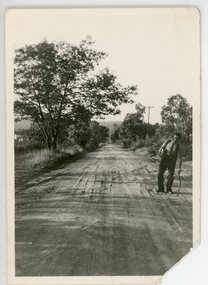 Ringwood and District Historical Society
Photograph, Ringwood- Jack Jordan May 1942
... "Written on back of photograph" Ringwood - May 1942 Jack Jordan - Dublin Road?..."Written on back of photograph" Ringwood - May 1942 Jack Jordan - Dublin Road? Black and white photograph Ringwood- Jack Jordan May 1942 Photograph ...Black and white photograph"Written on back of photograph" Ringwood - May 1942 Jack Jordan - Dublin Road? -
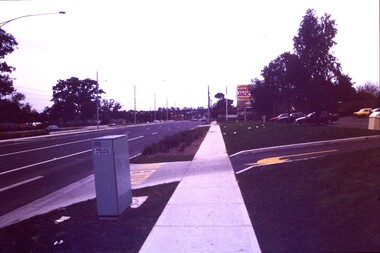 Greensborough Historical Society
Slide - Photograph, John Ramsdale, Plenty Road: Slide 13, 1990s
... Photograph shows a 3 lane road with Hungry Jacks sign - Plenty Road Bundoora....Photograph shows a 3 lane road with Hungry Jacks sign - Plenty Road Bundoora. ...Photograph shows a 3 lane road with Hungry Jacks sign - Plenty Road Bundoora.Part of the John Ramsdale collection of slides and audio visual material.Colour photograph scanned from slide.No maker's marks. No caption on slide.plenty road bundoora, bundoora -
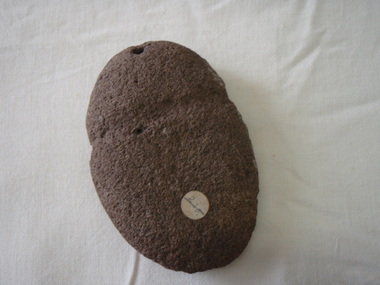 Port Fairy Historical Society Museum and Archives
Tool - axe head
... aboriginal stone axe head found on Jack Bourke's property (Albert Road) January 1972...aboriginal stone axe head found on Jack Bourke's property (Albert Road) January 1972 local history ethnographic material hunting fishing gathering stone aboriginal Stone axe head. ...aboriginal stone axe head found on Jack Bourke's property (Albert Road) January 1972Stone axe head. Hole at one end and groove made for twinelocal history, ethnographic material, hunting, fishing, gathering, stone, aboriginal -
 Clunes Museum
Photograph
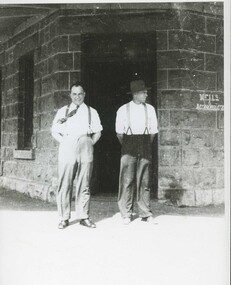
... "BLUE ROCK" HOTEL WAS SITUATED ON CORNER OF SUBURBAN STREET AND TALBOT ROAD, CLUNES. JACK WALLACE WAS SON OF THE LICENCEE...."BLUE ROCK" HOTEL WAS SITUATED ON CORNER OF SUBURBAN STREET AND TALBOT ROAD, CLUNES. JACK WALLACE WAS SON OF THE LICENCEE. local history photographs hotels BLACK AND WHITE PHOTOCOPY OF BILL GILBERT AND JACK WALLACE STANDING IN FRONT OF ALL NATIONS HOTEL, ("BLUE ROCK") Photograph PHOTOGRAPH ..."BLUE ROCK" HOTEL WAS SITUATED ON CORNER OF SUBURBAN STREET AND TALBOT ROAD, CLUNES. JACK WALLACE WAS SON OF THE LICENCEE.BLACK AND WHITE PHOTOCOPY OF BILL GILBERT AND JACK WALLACE STANDING IN FRONT OF ALL NATIONS HOTEL, ("BLUE ROCK")local history, photographs, hotels -
 Lara RSL Sub Branch
Photograph, Burlington Studios, J.L.McIntyre
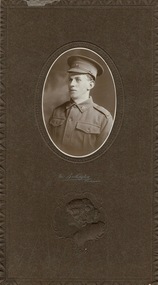
... J.McIntyre (Jack) 45 Walkers Road Lara....J.McIntyre (Jack) 45 Walkers Road Lara. Carboard with wax paper over framed picture J.L.McIntyre Photograph Burlington Studios ...The Burlington Studios were in the Wertheim Buildings, 294 Bourke Street, Melbourne (now the Bourke Street Mall). The photo would have been taken circa 1915. WW1 picture of (Jack McIntyre) J.L. McIntyre; REG. No. 3591; 58th. BATT. 1st A.I.F Foundation Member Lara R.S.L. 1890 - 1990 well documented history and service record.Carboard with wax paper over framed pictureOn front side, half way down are the words The Burlington Melbourne and below this is an embossed picture of a female upper torso. On the rear in pen are the words J.L. J.McIntyre (Jack) 45 Walkers Road Lara. -
 Greensborough Historical Society
Newspaper Clipping, Jack's triple wins the crown, 09/12/2015
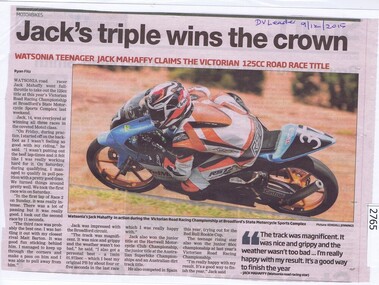
... jack mahaffy...road...14 year old Watsonia road racer Jack Mahaffy took the 125cc title at the 2015 Victorian Road Racing Championships....14 year old Watsonia road racer Jack Mahaffy took the 125cc title at the 2015 Victorian Road Racing Championships. jack mahaffy road racing watsonia News clipping, black text, colour image. ...14 year old Watsonia road racer Jack Mahaffy took the 125cc title at the 2015 Victorian Road Racing Championships.News clipping, black text, colour image. jack mahaffy, road racing, watsonia -
 Halls Gap & Grampians Historical Society
Photograph - B/W, C 1930
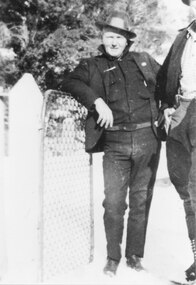
... Jack Watson left & Ernie Ward, residents of Halls Gap on holiday at Mt Buffalo in the 1930's. Jack Watson was a road worker he proposed the idea of the native wildflower show in Halls Gap....Jack Watson left & Ernie Ward, residents of Halls Gap on holiday at Mt Buffalo in the 1930's. Jack Watson was a road worker he proposed the idea of the native wildflower show in Halls Gap. ...Jack Watson left & Ernie Ward, residents of Halls Gap on holiday at Mt Buffalo in the 1930's. Jack Watson was a road worker he proposed the idea of the native wildflower show in Halls Gap.people, road gang -
 Ballarat Tramway Museum
Photograph - Colour Print/s - set of 4, Carolyn Dean, 6/08/2006 12:00:00 AM
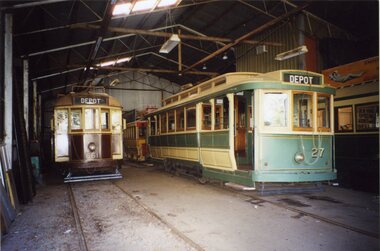
... Set of four colour photographs of the trams in the depot building, taken by Carolyn Dean, 6/8/2006. .1 - 661 and 27 on 2 and 3 roads .2 - 14 on 4 road, on jacks .3 - 40 on 4 road, pending lining .4 - ditto...BTM Depot Restoration tram 661 tram 27 tram 14 tram 40 On rear of all photos "6.08.06" and " Photo Carolyn Dean" Set of four colour photographs of the trams in the depot building, taken by Carolyn Dean, 6/8/2006. .1 - 661 and 27 on 2 and 3 roads .2 - 14 on 4 road, on jacks .3 - 40 on 4 road, pending lining .4 - ditto Photograph Colour Print/s - set of 4 Carolyn Dean ...Set of four colour photographs of the trams in the depot building, taken by Carolyn Dean, 6/8/2006. .1 - 661 and 27 on 2 and 3 roads .2 - 14 on 4 road, on jacks .3 - 40 on 4 road, pending lining .4 - dittoOn rear of all photos "6.08.06" and " Photo Carolyn Dean"btm, depot, restoration, tram 661, tram 27, tram 14, tram 40 -
 Melbourne Tram Museum
Negative, Wal Jack, c1945
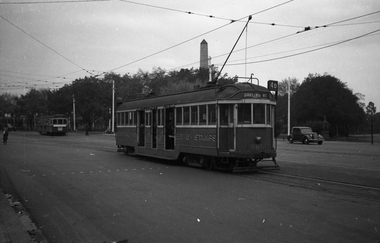
... Black and white negative, by Wal Jack, W2 585 (Darling Road Route 4D) at Domain Junction and a SW6 with dash canopy light (White stripe), route 7, City. ...Trams tramways Domain Junction World War 2 W2 class Route 4D Route 7 SW6 class tram 585 St Kilda Road Black and white negative, by Wal Jack, W2 585 (Darling Road Route 4D) at Domain Junction and a SW6 with dash canopy light (White stripe), route 7, City. ...Black and white negative, by Wal Jack, W2 585 (Darling Road Route 4D) at Domain Junction and a SW6 with dash canopy light (White stripe), route 7, City. The W2 has on the side "Subscribe Now Victory Bonds Speed Victory Buy 5/- Stamps" Photo c1945? May be earlier.trams, tramways, domain junction, world war 2, w2 class, route 4d, route 7, sw6 class, tram 585, st kilda road -
 Dandenong & District Historical Society
Journal, Dandenong & District Historical Society, Gipps-Land Gate Vol35 No2, 2008
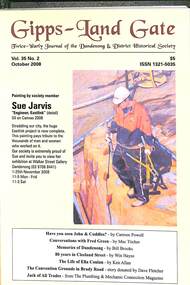
... Conversations With Fred Green Memories Of Dandenong 80 Years In Cleeland Street - Win Hayes The Convention Grounds In Brady Road, Dandenong Jack Of All Trades Society News Harking Back 75 Years ...Conversations With Fred Green Memories Of Dandenong 80 Years In Cleeland Street - Win Hayes The Convention Grounds In Brady Road, Dandenong Jack Of All Trades Society News Harking Back 75 Years Gipps-Land Gate Vol35 No2 Journal Dandenong & District Historical Society ...An interesting group of Early Dandenong Personalities, Places and EventsA5 size publication of the Gipps-Land Gate, October, 2008 featuring an old picture of Dandenong on the cover. Have You Seen John & Cuddles? Conversations With Fred Green Memories Of Dandenong 80 Years In Cleeland Street - Win Hayes The Convention Grounds In Brady Road, Dandenong Jack Of All Trades Society News Harking Back 75 Years An interesting group of Early Dandenong Personalities, Places and Eventshotel history, early education in dandenong, interesting milestones, family histories -
 Ballarat Tramway Museum
Postcard, Rose Stereograph Co, "Bridge Street, Ballarat Vic.", late 1930s
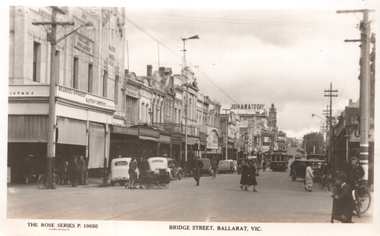
... In the photo are a butcher, a newsagent, a sign "Join ANA Today", along with two ladies with prams crossing the road. Wal Jack on the rear of the photo notes it is about 1940. ...In the photo are a butcher, a newsagent, a sign "Join ANA Today", along with two ladies with prams crossing the road. Wal Jack on the rear of the photo notes it is about 1940. ...The photo shows tram 12 in Bridge St Ballarat on its way to Mt Pleasant. The photo is of Bridge St looking west from Peel St. In the photo are a butcher, a newsagent, a sign "Join ANA Today", along with two ladies with prams crossing the road. Wal Jack on the rear of the photo notes it is about 1940. Based on the cars in the photo, late 1930s. Item 5463 has a poor quality negative of this postcard. Yields information about Bridge St Ballarat during the late 1930sPostcard black and white, divided back, with a handwritten note on rear.See image 2 for details of the handwritten note by Wal Jack on the rear. tramways, trams, bridge st, tram 12 -
 Ballarat Tramway Museum
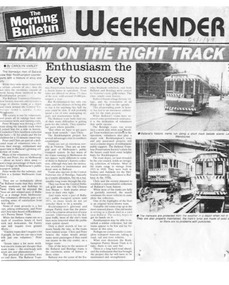
Document - Photocopy, "Tram on the Right Track / Enthusiasm the key to success", c1989
... Has two photos, one of 14 heading south to Carlton St and the other in the depot with 33 on jacks on 5 road and 40 stored on 4 road....Has two photos, one of 14 heading south to Carlton St and the other in the depot with 33 on jacks on 5 road and 40 stored on 4 road. "Tram on the Right Track / Enthusiasm the key to success" Document Photocopy ...A3 size sheet photocopy of an item that appeared in the Rockhampton Morning Bulletin on 28/1/1989 about the work done by the Ballarat Tramway Preservation Society. Article by Carolyn Varley of Rockhampton, discussing her visit to Ballarat and the work being done by the people in Rockhampton for the restoration of the Purrey Steam Tram at the same time. At time of interview, driver or motorman for the BTPS was Peter Winspur and Conductor Chris Jacobson. Has two photos, one of 14 heading south to Carlton St and the other in the depot with 33 on jacks on 5 road and 40 stored on 4 road.trams, tramways, btps, volunteers, rockhampton, purrey steam tram -
 City of Moorabbin Historical Society (Operating the Box Cottage Museum)
Newsletter, City of Moorabbin Historical Society No. 8 Vol. 5 November 1965, City of Moorabbin Historical Society No. 8 Vol. 5 November 1965, 1965
... City of Moorabbin Historical Society 1961, sheehy t.a., newsletters, neville f, ashley r, moorabbin city council, moorabbin arts festival 1965, mccarthy jack, charman road state school, victorian railways. railway workers strike 1903, judd clarrie, phonograph,...Sheehy CMHS for members and visitors The Aims of the CMHS are ‘to record the history of the City, and register something of the Australian Atmosphere, which the necessary speed-up in post-world-war two (WW11) immigration has caused to be lost; to produce a magazine at regular intervals, featuring the work of pioneers and the changing Australian scene; to work constantly with a long range view towards building a hall where records and exhibits can be housed’ (1961) Topics ; Moorabbin Arts Festival; Memories of old Cheltenham by Jack McCarthy; Park Road Railway Crossing Gate Keeper; 1903 Railway Workers Strike; ...Sheehy CMHS for members and visitors The Aims of the CMHS are ‘to record the history of the City, and register something of the Australian Atmosphere, which the necessary speed-up in post-world-war two (WW11) immigration has caused to be lost; to produce a magazine at regular intervals, featuring the work of pioneers and the changing Australian scene; to work constantly with a long range view towards building a hall where records and exhibits can be housed’ (1961) Topics ; Moorabbin Arts Festival; Memories of old Cheltenham by Jack McCarthy; Park Road Railway Crossing Gate Keeper; 1903 Railway Workers Strike; This is Newsletter No. 8 Vol. 5 of the CMHS November 1965 CMHS obtained a Kingston City Council Community Grant 2016 for the digitization and preservation of these Original CMHS Newsletters commenced in 1961 City of Moorabbin Historical Society 1961, sheehy t.a., newsletters, neville f, ashley r, moorabbin city council, moorabbin arts festival 1965, mccarthy jack, charman road state school, victorian railways. railway workers strike 1903, judd clarrie, phonograph, CITY OF MOORABBIN HISTORICAL SOCIETY / AFFILIATED WITH THE ROYAL HISTORICAL SOCIETY OF / VICTORIA AND THE CHELTENHAM ARTS AND CRAFTS SOCIETY/ President Mr R. ...This is Newsletter No 8 Vol. 5 produced in November 1965 by Mr T. A. Sheehy CMHS for members and visitors The Aims of the CMHS are ‘to record the history of the City, and register something of the Australian Atmosphere, which the necessary speed-up in post-world-war two (WW11) immigration has caused to be lost; to produce a magazine at regular intervals, featuring the work of pioneers and the changing Australian scene; to work constantly with a long range view towards building a hall where records and exhibits can be housed’ (1961) Topics ; Moorabbin Arts Festival; Memories of old Cheltenham by Jack McCarthy; Park Road Railway Crossing Gate Keeper; 1903 Railway Workers Strike; This is Newsletter No. 8 Vol. 5 of the CMHS November 1965 CMHS obtained a Kingston City Council Community Grant 2016 for the digitization and preservation of these Original CMHS Newsletters commenced in 1961 2 x L 26cm x W 21cm page 1 printed both sides CITY OF MOORABBIN HISTORICAL SOCIETY / AFFILIATED WITH THE ROYAL HISTORICAL SOCIETY OF / VICTORIA AND THE CHELTENHAM ARTS AND CRAFTS SOCIETY/ President Mr R. Ashley….Editor of Newsletter Mr T.A.Sheehy Secretary Mrs F.Neville / VOLUME 5 No.8 NEWSLETTER NOVEMBER 1965city of moorabbin historical society 1961, sheehy t.a., newsletters, neville f, ashley r, moorabbin city council, moorabbin arts festival 1965, mccarthy jack, charman road state school, victorian railways. railway workers strike 1903, judd clarrie, phonograph, -
 Ballarat Tramway Museum
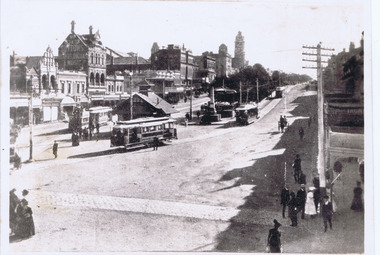
Negative - Digital image, Wal Jack, Grenville St looking south east along Sturt St, c1910
... Many people are crossing the road. Wal Jack notes - "Original electric and trails, Summer car No. 20 passing bandstand about 1920" - note windscreens have not been fitted to the trams, possibly around 1910. ...Many people are crossing the road. Wal Jack notes - "Original electric and trails, Summer car No. 20 passing bandstand about 1920" - note windscreens have not been fitted to the trams, possibly around 1910. ...Photograph taken from Grenville St looking southeast along Sturt St, c1912 Has ESCo tram towing a trailer, ESCo 20 and another two trams in the photograph. Many people are crossing the road. Wal Jack notes - "Original electric and trails, Summer car No. 20 passing bandstand about 1920" - note windscreens have not been fitted to the trams, possibly around 1910. Negative would be a copy negative of an original photograph. See item 8954 for a print of this image.Yields information about the trams and trailers in use c1912.Negative and Digital image from the Wal Jack Ballarat Album. Copy negative by Wal Jack.On rear of photograph in ink "T30 Ballarat Tramways / Old Types in Sturt St, Summer Tram 20 passing old bandstand / W. Jack"trams, tramways, sturt st, grenville st, esco, trailers, tram 20 -
 Wodonga & District Historical Society Inc
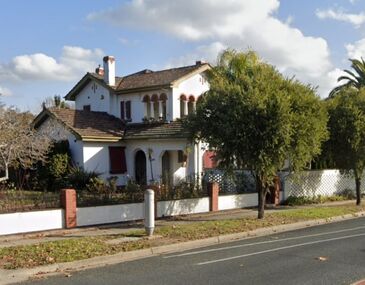
Photograph - McHarg Home, Wodonga
... The following year he opened his legal practice in Sydney Road, Wodonga. Jack (John) McKenzie McHarg married Eva Whyte in 1934 and the house called “Baelon” was built around this time. ...The following year he opened his legal practice in Sydney Road, Wodonga. Jack (John) McKenzie McHarg married Eva Whyte in 1934 and the house called “Baelon” was built around this time. ...John Clarence (McKenzie) McHarg was born in Corryong, Victoria on 12 August 1905 to Hugh Patrick McKenzie-McHarg and Laura Mary Dune. After attending school at Christian Brothers’ College in Albury, he also attended St Patrick’s College at Ballarat. Mr McHarg then studied at Melbourne University, graduating with a Bachelor of Law. After graduating he completed his studies with Messrs. Mahoney and O’Brien of Melbourne with whom he entered a partnership. In 1931 John McHarg appears on the electoral roll for Wodonga listed as a barrister. The following year he opened his legal practice in Sydney Road, Wodonga. Jack (John) McKenzie McHarg married Eva Whyte in 1934 and the house called “Baelon” was built around this time. The builder was Rob McCulloch. McHarg is first listed as paying rates on the house in Beechworth Road in 1934-35. He died on 12 January 1996 in Wodonga after many years of service to the Wodonga and district community. The house is still in the hands of the McKenzie-McHarg family. This building is one of the oldest remaining homes in Wodonga and was owned by a prominent community member.A series of photos depicting the home of the McHarg family in Wodonga. One is from a Rose Series postcard c1940, the second is of the house shrouded in snow in 1967. The final image shows the house in 2023.mcharg house, wodonga buildings, mcharg solicitor, mckenzie-mcharg -
 Eltham District Historical Society Inc
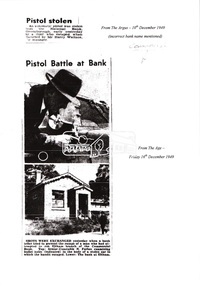
Folder, Commercial Bank of Australia Eltham Branch Hold-Up, 15 December 1949
... bank hold-up, cba bank, det sgt mcmennemin, eltham, h.d. pettie, harry wallace, jack burgoyne, kay arthur morgan, lindsay a. spears, main road...Hearing the whine of an engine he goes outside to find the grey Singer parked at the side of the road. Jack George also lives at the corner and hears the car crash. ...Hearing the whine of an engine he goes outside to find the grey Singer parked at the side of the road. Jack George also lives at the corner and hears the car crash. ...Thursday, December 15, 1949, the quiet little bank was embroiled in an infamous wild shoot-out between a daring thief and two bank officers. Today, the building still carries the scars ; a bullet hole remains visible in a cedar bench testifying to the events that played out that day. 3.30 a.m., Friday, December 9. The manager of the Commercial Bank branch at Greensborough, Mr Harry Wallace and his wife are asleep in their bedroom of the little house behind the branch. Harry is awakened by a noise and sees an intruder in a corner of the bedroom. He calls out but the intruder who has switched off the power in anticipation flees through a side door and scarpers down Main Street. Harry summons the police but a search by First Constable Thomas of the Greensborough Police assisted by a wireless patrol car is unsuccessful. A report is filed noting the theft of a .25 calibre pistol from the wardrobe. Thursday, December 15th. It is 1pm and the Commercial Bank has just opened. The branch is only open Mondays and Thursdays from 1-3pm. The morning started off a little cool with some scattered showers but it has fined up and the temperature is now around 61 degrees (16 C). A new grey Singer sports car with soft-top pulls up on the opposite side of the road and a young man, neatly dressed in a dark blue suit, wearing a grey hat and carrying a brief case exits the vehicle. He looks around then crosses the road and walks up the steps and through the door into the bank. There are three people inside; Mr. Jack Burgoyne whose grocery store is situated just 50 yards up the road, Mr. Lindsay A. Spears, the Eltham Agency Receiving Officer and by chance, Mr Harry Wallace, manager of the Greensborough branch. Jack Burgoyne takes note of the young stranger; thinking to himself he appears nervous. The man approaches the counter and introduces himself as John Henderson of Greensborough and explains that he wishes to open a new account. He places his hat and £3 on the counter. Mr Spears attends to the paperwork. He asks the young man to sign two forms, which he does but then he withdraws from the counter and starts walking towards the door. Suddenly he spins around pulling an automatic pistol from his right-hand pocket. He exclaims forcefully; “The game’s on! I’ll take the lot!” Spears appears to comply by pretending to open a drawer. The man shouts loudly, “Keep your hand away from that drawer.” Spears instead reaches for a pistol in his pocket and challenges the man, “Here it is. Come and get it!” At the same time, Harry Wallace pulls a pistol from his pocket as well. The bandit fires a shot but misses, the bullet striking the counter. Both Spears and Wallace open fire and Jack Burgoyne ducks for cover. As the bandit turns and runs for the door leaving his £3 behind, he fires another shot, which strikes the ceiling. Spears fires back, and thinks he may have hit him in the foot. The bandit flees the bank and heads for the grey Singer car, registration NO-106, parked opposite. Wallace and Spears pursue him to the door and open fire again, striking the car three times around the driver’s door. Spears lets off eight shots and Wallace, seven before his gun jams. The getaway car initially heads slowly down Main Road towards Bridge Street. About 100 yards down the road, Dave Adams, a PMG employee, who has heard the shots, throws a steel manhole step at the driver. It hits the roof of the car nine inches above the driver’s head and tears the hood. Another witness claims to have seen the door blow open and the driver raise his hand. The car gathers speed and swings left into Bridge Street racing along at about 60 miles an hour careering recklessly past council employee, Mr. Percy Williams, who is driving a dray along Smarts Road [believed to be Bridge Street]. At the end of the road the Singer fails to get round the sharp turn and crashes into an embankment skidding to a stop outside the home of Mr John Clifford. One side of the car is wrecked. Mr Clifford, an aircraft engineer hears the fast travelling car bump heavily into the road bank at about 1.25 p.m. Hearing the whine of an engine he goes outside to find the grey Singer parked at the side of the road. Jack George also lives at the corner and hears the car crash. “The bandit opened the car door, ran 50 yards, and suddenly turned back,” exclaims Jack. “He took something from the car. It might have been a gun.” In his haste, the bandit drops his grey felt hat, size 6 7/8, on the road and dashes up Sherbourne Road for about 200 yards then disappears into the scrub carrying a brief case and a bundle in which a sailor’s cap can be seen. About 3 p.m., Mr H.D. Pettie of Mountain View Road, Montmorency is looking through his field glasses and notices a young man walking through thick scrub on private property some distance from his house. The man is wearing a sailor’s cap and disappears along the railway track toward Montmorency. As the day progresses, ten police cars, one motor cycle, and about 40 police led by Det. Sgt. McMennemin of Malvern CIB are searching for him. They believe he is hiding in thick scrub along the bank of the creek about half-a-mile outside Eltham township. Wireless patrol cars, four mobile traffic cars and the CIB area cars from Malvern and Kew are taking part. Police check the thief’s car and discover it was stolen from Helen Baxter, of Doncaster Road, North Balwyn from outside Victoria Barracks. Harry Wallace informs the police that he believes he recognised the bandit as the man who took his pistol from his bedroom the previous Friday morning. As night falls, armed police are posted at strategic points in the Eltham-Greensborough district. Police in cars are watching the roads. Others are searching the bush and checking passengers on trains. Little do they realise the young man has already slipped out of the net. SEQUEL YOUTH OF 19 CHARGED WITH ATTEMPTED ARMED ROBBERY OF BANK AT ELTHAM Weekly Times, Wednesday 15 February 1950, page 6 Detectives who raided a house in Bell St., Coburg, Melbourne, charged a 19-year-old youth, of South Yarra, with attempted armed robbery at the Commercial Bank’s Eltham (Vic.) receiving depot on Dec. 15. Police say they recovered a loaded automatic pistol, diamond and signet rings worth more than £200, a complete set of house-breaking instruments, a sailor’s uniform, and chloroform gauze in the raid. The youth was charged that while armed with an offensive weapon, he attempted to rob Lindsay George Spears of a sum of money. He was further charged on six counts of breaking, entering and stealing. Police allege that the person who tried to hold up Mr Spears in the Commercial Bank receiving depot at Eltham on December 15. escaped in a stolen car, after Mr Spears and Mr Henry Wallace, manager of the bank’s Greensborough branch, had fired at him. After the car crashed, he escaped into thick scrub and is alleged to have changed into a sailor’s uniform. On December 9 an automatic pistol was stolen from Mr Wallace’s bedroom at the Greensborough bank. The chloroform pad recovered is alleged to have been stolen from the Dental Supply Company, Plenty Road, Preston. The rings are alleged to have been taken in a £513 burglary from the shop of James Paton. Sydney Road, Coburg. Det. Sgt. H. McMennemin conducted the investigations with Senior Dets. R. Newton and M Downie, Detectives l. Dent, R. Rayner, P. Pedersen and M. Handley and First Constable A. Thomas. The youth will appear at Eltham Court on February 22. Manager’s Gun Used in Holdup at Bank The Age, Thursday 23 February 1950, page 4 It was stated in Eltham court yesterday that a youth who robbed a bank manager of his pistol, later used it in an attempt to hold-up the bank. Kay Arthur Morgan, 19, draftsman, of Castle-street, South Yarra, was committed for trial on charges of breaking and entering, and stealing a pistol and attempted robbery while armed with an offensive weapon. He pleaded guilty. The manager of Eltham branch of the Commercial Bank of Australia Ltd., Henry Clifton Cabot Wallace, said he disturbed someone in the bedroom, in which he and his wife were sleeping, at 3 a.m. on December. 9, 1949. Later he found that his automatic- pistol was missing. On December 15 a youth, who said his name was John Henderson, entered the bank and opened a new account. As the youth was leaving the bank he turned round with a pistol in his hand and said: — “I want the lot.” Spear indicated a drawer under the counter; and said.— “Here it is. Come and get it.” The youth said:— “Keep your hand away from that drawer.” Witness said Spear then drew his pistol from his hip pocket. The youth fired at them, and Spear returned the fire. “I pulled my pistol and fired, too” said witness. The youth fired again, ran out to a car and drove off. Witness and Spear fired several shots at the car. The youth was the accused Morgan, sitting in court, witness said. Evidence was given that one bullet was found in the celling and the other in the bank. Morgan was allowed £100 bail on each charge. Morgan ended up serving three years for the failed armed robbery and became a notorious criminal. He had twin sons, Peter and Doug and even though only ten years old, Morgan would get his sons to act as lookouts whilst he committed burglaries. The lads became building contractors but when the industry suffered a downturn in 1977 and they were short on cash, they returned to the family business. Over the following 23 months they undertook 24 raids on country and outer-suburban TABs and banks. Whilst robbing one country bank for the third time, just like their father, it all went wrong ending up with a police officer shot. They were nick-named the “After-dark” bandits and are considered to be Australia’s last bushrangers. They were convicted and served 17 years in prison.5 x A4 photocopied pagesbank hold-up, cba bank, det sgt mcmennemin, eltham, h.d. pettie, harry wallace, jack burgoyne, kay arthur morgan, lindsay a. spears, main road -
 Flagstaff Hill Maritime Museum and Village
Equipment - Block, Tangyes engineering, Early 20th century
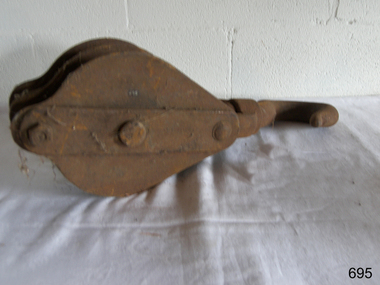
... jacks, or rams, to launch the steamship SS Great Eastern. The success of this project brought favourable attention to the firm, and it became involved in other notable projects, including the erection of Cleopatra’s Needle in London in 1878 and work on the Forth Road Bridge in Scotland. ...jacks, or rams, to launch the steamship SS Great Eastern. The success of this project brought favourable attention to the firm, and it became involved in other notable projects, including the erection of Cleopatra’s Needle in London in 1878 and work on the Forth Road Bridge in Scotland. ...This metal block may have been used as part of a boat or ship's rigging or winch. The becket is the loop or ring where a shackle could be attached to use as a pulley. The two-sheaved block has a mechanical advantage over a single-sheave block, using less power to lift a load. The block was made by Tangyes, established in Birmingham, UK, in 1857, and renowned for producing high-quality, reliable machines, equipment, and tools in the late 19th and early 20th centuries. Richard Tangye (1833–1906) and four of his brothers—James, Joseph, Edward, and George—were the sons of Joseph Tangye, a Quaker Cornish miner. In 1857, they founded the engineering firm Richard Tangye & Brothers in Birmingham, UK. In 1860, the firm became Tangye Brothers and moved to Cornwall Works in Birmingham. The business encouraged inventors to join the company and develop their patents there, as happened with Weston’s differential pulley block, invented by the Englishman Thomas Aldridge Weston in 1854. Tangye bought the patent in 1858, giving the firm the sole right to manufacture it. The design received a medal for “original application, practical utility and success” at the 1862 International Exhibition in London. Also in 1858, the Tangye firm was commissioned by Brunel’s shipping company to manufacture hydraulic lifting jacks, or rams, to launch the steamship SS Great Eastern. The success of this project brought favourable attention to the firm, and it became involved in other notable projects, including the erection of Cleopatra’s Needle in London in 1878 and work on the Forth Road Bridge in Scotland. The firm underwent several name changes over the years, including James Tangye and Brothers (1857), Tangye Brothers and Price (1859), Tangye Brothers (1860), Tangye Brothers & Holman (1876), Tangye Brothers (by 1878), Tangye Ltd. (1881), and then simply Tangye. Its machinery and equipment were exported worldwide. In 1884, a branch with showrooms, offices, and a warehouse was opened in Melbourne at Cornwall House, Collins Street West. The firm was well known for producing high-quality machinery for agriculture and industry. Even today, new Tangye machinery is available for a subsidiary of Allspeeds. An extensive account of the firm’s history, names, inventions, and further references is available in Grace’s Guide, which also includes references to and diagrams of the Tangye horizontal steam engine. The block is significant for its connection to the renowned and innovative Tangye machine makers, respected for their high quality and standards. The block's maker,, Tangyes, also manufactured an 1880s steam engine, sold by a Melbourne merchant, and locally significant for its use in a late-19th century cheese factory. The block also represents the many blocks used in many industries, including the marine concerns, for rigging and lifting. Flagstaff Hill has a wide variety of these simple but very important pieces of equipment.Becket block: a metal block with two sheaves, a hook, a becket attachment point, and straps. Inscription embossed. Made by Tangyes."TANGYES"warrnambool, flagstaff hill maritime museum and village, maritime museum, maritime village, great ocean road, shipwreck coast, block, metal block, two sheave block, marine technology, rigging, tangye, ship rigging, block with hook and becket, becket block, sailing block, cargo block, tangyes block, vintage, nautical pulley, rigging equipment, pulley system, functional machine, machine, lifting equipment, marine equipment, richard tangye & brothers, james tangye and brothers, tangye brothers and price, tangye brothers, tangye brothers & holman, tangyes ltd., cornwall works -
 Flagstaff Hill Maritime Museum and Village
Machine - Steam Engine, Tangyes engineering, Mid-1880s
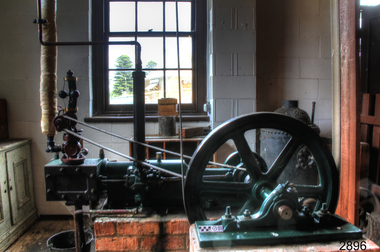
... jacks, or rams, to launch the steamship SS Great Eastern. The success of this project brought favourable attention to the firm, and it became involved in other notable projects, including the erection of Cleopatra’s Needle in London in 1878 and work on the Forth Road Bridge in Scotland. ...jacks, or rams, to launch the steamship SS Great Eastern. The success of this project brought favourable attention to the firm, and it became involved in other notable projects, including the erection of Cleopatra’s Needle in London in 1878 and work on the Forth Road Bridge in Scotland. ...This Tangye B-size, single-cylinder, horizontal steam engine was likely manufactured in England around the mid-1880s. It was distributed by Melbourne machinery merchants Cameron & Sutherland, which also operated in Bendigo and Ballarat. A local cheese maker once used the engine to drive factory equipment. It was later donated to the Warrnambool Technical School, which then donated it to Flagstaff Hill to add to its historical steam engine collection. Between its manufacture and its donation to Flagstaff Hill, the governor had been replaced by the current Pickering governor. This engine design was very popular in the late 19th and early 20th centuries. When connected and powered up, the engine could drive an overhead line shaft via a flat belt off its flywheel. The line shaft would then drive the machinery via flat belts. It could drive virtually any type of machinery, such as water and sewerage pumps, mine elevators, winches, cranes, metal forges, air blowers, and marine machinery. This engine features a mechanical governor, which controls the speed of the engine regardless of whether it is under load. It also has a water pump built into the valve rod, which is used to supply the boiler with water. Steam enters the cylinder via a slide valve and applies pressure to the piston; it is like a modern internal combustion engine, but in the case of the steam engine, the pressure is exerted in turn on either side of the piston. In other words, the connecting rod is pushed by steam via the piston and piston rod and then pulled back again by steam pushing on the opposite side of the piston. Thus, power is exerted almost continuously, except at the end of each piston stroke, when it reverses direction. In the 1880s, many local butter and cheese manufacturers installed Tangye steam engines to power their machinery. A comprehensive article in the Gippsland Mercury in September 1889 extolled the magnificence of the Farnham Butter Factory in Dennington, Warrnambool, and described how one Tangye engine was used to drive several machines in the cheese- and butter-making processes. A report in the Warragul Guardian in December 1890 notes that the newly opened Warrnambool Butter Factory used a Tangye steam engine to pump water from a 60-foot well. Tangye: Richard Tangye (1833–1906) and four of his brothers—James, Joseph, Edward, and George—were the sons of Joseph Tangye, a Quaker Cornish miner. In 1857, they founded the engineering firm Richard Tangye & Brothers in Birmingham, UK. In 1860, the firm became Tangye Brothers and moved to Cornwall Works in Birmingham. The business encouraged inventors to join the company and develop their patents there, as happened with Weston’s differential pulley block, invented by the Englishman Thomas Aldridge Weston in 1854. Tangye bought the patent in 1858, giving the firm the sole right to manufacture it. The design received a medal for “original application, practical utility and success” at the 1862 International Exhibition in London. Also in 1858, the Tangye firm was commissioned by Brunel’s shipping company to manufacture hydraulic lifting jacks, or rams, to launch the steamship SS Great Eastern. The success of this project brought favourable attention to the firm, and it became involved in other notable projects, including the erection of Cleopatra’s Needle in London in 1878 and work on the Forth Road Bridge in Scotland. The firm underwent several name changes over the years, including James Tangye and Brothers (1857), Tangye Brothers and Price (1859), Tangye Brothers (1860), Tangye Brothers & Holman (1876), Tangye Brothers (by 1878), Tangye Ltd. (1881), and then simply Tangye. Its machinery and equipment were exported worldwide. In 1884, a branch with showrooms, offices, and a warehouse was opened in Melbourne at Cornwall House, Collins Street West. The firm was well known for producing high-quality machinery for agriculture and industry. Even today, new Tangye machinery is available for a subsidiary of Allspeeds. An extensive account of the firm’s history, names, inventions, and further references is available in Grace’s Guide, which also includes references to and diagrams of the Tangye horizontal steam engine. The horizontal steam engine was made by the well-known engineering firm Tangye, known for its high quality of manufacture. It was an important development in machinery because it helped improve productivity. Engines of this type are still used in some parts of the world today. This engine is a good example of a late 19th-century steam engine used in industry and agriculture and adapted for many different purposes. It is also important locally because it was connected to a local cheese making business and part of the thriving western district dairy industry. It may have been one of the Tangyes engines used at the Farnham butter factory or the Warrnambool Butter Factory, which was reported to be one of the most important in the Colony. It is also connected to the Warrnambool Technical School, established in 1968. Steam engine: stationary Tangye Size B, single-cylinder, horizontal Mill type steam engine. It has a 4-inch diameter cylinder with an 8-inch stroke. The body is painted green, and the Pickering governor is red. It was manufactured in Birmingham, England, in accordance with Tangye's Patent 238930, and distributed by Cameron and Sunderland, Melbourne, in the mid-1880s. TANGEYS PATENT BIRMINGHAM B SIZE 238930 CAMERON & SUTHERLAND MELBOURNE THE PICKERING PORTLAND . GOVERNOR . CONN. U.S.A.flagstaff hill, warrnambool, maritime village, maritime museum, flagstaff hill maritime museum and village, shipwreck coast, great ocean road, machine, invention, engine, steam, steam engine, horizontal steam engine, tangyes horizontal steam engine, stationary steam engine, single cylinder steam engine, manufacturing, farming, pumps, lifting equipment, engines, machine tools, hydraulic rams, hydraulic pumps, steam pumps, differential pulleys, mill type steam engine, 4 inch cylinder, weston’s differential pulley, thomas aldridge weston, 1862 international exhibition in london, brunel, ss great eastern, cleopatra’s needle, forth road bridge, cornwall house, collins street melbourne, agricultural machinery, industrial machinery, allspeeds, dairy, pump, richard tangye & brothers, james tangye and brothers, tangye brothers and price, tangye brothers, tangye brothers & holman, tangyes ltd., tangye, richard tangye, james tangye, joseph tangye, edward tangye, george tangye, cornwall works, birmingham, pickering governor, pickering portland connecticut usa, 19th century, dairy plant, steam power, tangye's patent 238930, tangye b size engine, cameron & sutherland, machine merchants, 1880s, mid-1880s, cheese manufacturer, butter manufacturer, diary industry, warrnambool technical school, belt driven machinery, agriculture, mechanical governor, farnham butter factory, warrnambool butter factory -
 Flagstaff Hill Maritime Museum and Village
Tool - Plane, 19th century
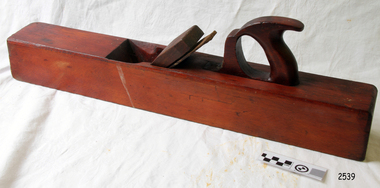
... Road...Shipwreck Coast...Wood Working...wood working plane...wood working tool...Jack...Jack plane is used for general purposes such as shaving off surplus wood to bring a piece of work down to size and plane the edges of a door to smooth them off. This plane is an example of the tools used by ship builders in the maritime trade from the 19th century to the present day. Flagstaff Hill Flagstaff Hill Maritime Museum and Village Warrnambool Maritime Museum Maritime Village Great Ocean Road ...This Jack plane is used for general purposes such as shaving off surplus wood to bring a piece of work down to size and plane the edges of a door to smooth them off. This plane is an example of the tools used by ship builders in the maritime trade from the 19th century to the present day.Jack Plane; a large oblong shape with an aperture at one end, a long wooden guard that protects the sharp metal blade, and a saw like handle at other end. It is stained a red-brown colour.flagstaff hill, flagstaff hill maritime museum and village, warrnambool, maritime museum, maritime village, great ocean road, shipwreck coast, wood working, wood working plane, wood working tool, jack plane, plane, wood plane, general purpose plane, tool, builders tool, carpenter's tool, ship builder's tool, maritime trade -
 Flagstaff Hill Maritime Museum and Village
Postcard - Vessel, Sailing Ship, Jack Spurling (John Robert Charles Spurling), marine artist, circa 19th century
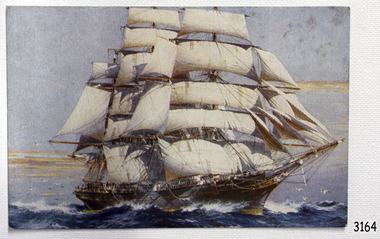
... Road...Cutty sark...historic sailing ship...tea clipper...sail training vessel...cadet training ship...commercial trading vessel...cargo sail vessel...clipper races...Scott and Linton of Dunbarton Scottland...race record...Ferreria...1869...tea cargo...tea trade...China tea...wool export...Australian export...Australian wool export...China tea trade...Cornwall...training ship...Greenwich...British Museum...postcard...coloured postcard...postcard of a painting...Jack...Jack Spurling, who was famous for his ship portraits. Flagstaff Hill Warrnambool Flagstaff Hill Maritime Museum Shipwreck Coast Flagstaff Hill Maritime Village Maritime Museum Great Ocean Road Cutty sark historic sailing ship tea clipper sail training vessel cadet training ship commercial trading vessel cargo sail vessel clipper races Scott and Linton of Dunbarton Scottland race record Ferreria 1869 tea cargo tea trade China tea wool export Australian export Australian wool export China tea trade Cornwall training ship Greenwich British Museum postcard coloured postcard postcard of a painting Jack Spurling British maritime artist ship portraits John 'Jack' Robert Charles Spurling Coloured postcard of the Cutty Sark. ...The postcard is a copy of a painting by the renowned British maritime artist Jack Spurling (John (Jack) Robert Charles Spurling 1870-1933). Spurling's love for the sea was fulfilled as a teenager when he worked as an apprentice, eventually gaining a Second Mate certificate and going on to join the Blue Anchor Line as a junior officer. His love for the sea shows in his detailed paintings of ship portraits. THE CUTTY SARK: - The Cutty Sark was built in Britain in 1869 and was one of the last great sailing ships. At first, it carried tea from China. Later, it was used to transport wool from Australia. It became famous for its speed and held the record for the fastest voyage from Australia to Britain for ten years. Later, a Portuguese company bought the ship and renamed it Ferreira. After that, a retired sea captain purchased it to use as a training ship in Cornwall. When the captain died, the ship was given to a training college in Greenwich in 1938. In 1954, it was placed in dry dock at Greenwich, where it remains on display. The postcard depicts the clipper, Cutty Sark, which was a special ship because it carried wool from Australia to other parts of the world. Postcards like this one help us imagine what sea travel was like before steam-powered ships became common, and they show us how trade, travel, and migration evolved. The Cutty Sark is also famous for its speed. It set a record for the journey from Australia to Britain and kept that title for ten years. Today, people still recognise its importance because it has been carefully preserved and is on display at the British Maritime Museum in Greenwich. Its story has also made it a favourite subject for people who enjoy building ship models. The picture is a copy of a painting by renowned maritime artist Jack Spurling, who was famous for his ship portraits.Coloured postcard of the Cutty Sark. Photograph of a painting by J Spurling. flagstaff hill, warrnambool, flagstaff hill maritime museum, shipwreck coast, flagstaff hill maritime village, maritime museum, great ocean road, cutty sark, historic sailing ship, tea clipper, sail training vessel, cadet training ship, commercial trading vessel, cargo sail vessel, clipper races, scott and linton of dunbarton scottland, race record, ferreria, 1869, tea cargo, tea trade, china tea, wool export, australian export, australian wool export, china tea trade, cornwall, training ship, greenwich, british museum, postcard, coloured postcard, postcard of a painting, jack spurling, british maritime artist, ship portraits, john 'jack' robert charles spurling -
 Flagstaff Hill Maritime Museum and Village
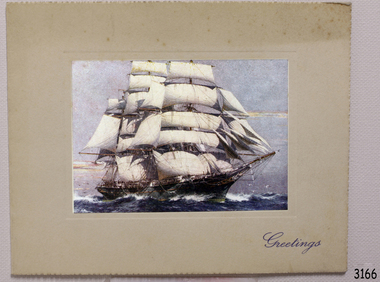
Photograph - Vessel, Sailing Ship, Jack Spurling (John Robert Charles Spurling), marine artist, circa 19th century
... Road...Cutty sark...historic sailing ship...tea clipper...sail training vessel...cadet training ship...commercial trading vessel...cargo sail vessel...clipper races...Scott and Linton of Dunbarton Scottland...race record...Ferreria...1869...tea cargo...tea trade...China tea...wool export...Australian export...Australian wool export...China tea trade...Cornwall...training ship...Greenwich...British Museum...postcard...coloured postcard...postcard of a painting...Jack...Jack Spurling, who was famous for his ship portraits. Flagstaff Hill Warrnambool Flagstaff Hill Maritime Museum Shipwreck Coast Flagstaff Hill Maritime Village Maritime Museum Great Ocean Road Cutty sark historic sailing ship tea clipper sail training vessel cadet training ship commercial trading vessel cargo sail vessel clipper races Scott and Linton of Dunbarton Scottland race record Ferreria 1869 tea cargo tea trade China tea wool export Australian export Australian wool export China tea trade Cornwall training ship Greenwich British Museum postcard coloured postcard postcard of a painting Jack Spurling British maritime artist ship portraits John 'Jack' Robert Charles Spurling "Greetings" Photograph: coloured image of the sailing ship Cutty Sark by artist J Spurling. ...The card is a copy of a painting by the renowned British maritime artist Jack Spurling (John (Jack) Robert Charles Spurling 1870-1933). Spurling's love for the sea was fulfilled as a teenager when he worked as an apprentice, eventually gaining a Second Mate certificate and going on to join the Blue Anchor Line as a junior officer. His love for the sea shows in his detailed paintings of ship portraits. THE CUTTY SARK: - The Cutty Sark was built in Britain in 1869 and was one of the last great sailing ships. At first, it carried tea from China. Later, it was used to transport wool from Australia. It became famous for its speed and held the record for the fastest voyage from Australia to Britain for ten years. Later, a Portuguese company bought the ship and renamed it Ferreira. After that, a retired sea captain purchased it to use as a training ship in Cornwall. When the captain died, the ship was given to a training college in Greenwich in 1938. In 1954, it was placed in dry dock at Greenwich, where it remains on display.The card depicts the clipper, Cutty Sark, which was a special ship because it carried wool from Australia to other parts of the world. Cards like this one help us imagine what sea travel was like before steam-powered ships became common, and they show us how trade, travel, and migration evolved. The Cutty Sark is also famous for its speed. It set a record for the journey from Australia to Britain and kept that title for ten years. Today, people still recognise its importance because it has been carefully preserved and is on display at the British Maritime Museum in Greenwich. The picture is a copy of a painting by renowned maritime artist Jack Spurling, who was famous for his ship portraits.Photograph: coloured image of the sailing ship Cutty Sark by artist J Spurling. The image is mounted on a card used as a greeting card. It has a printed inscription. "Greetings"flagstaff hill, warrnambool, flagstaff hill maritime museum, shipwreck coast, flagstaff hill maritime village, maritime museum, great ocean road, cutty sark, historic sailing ship, tea clipper, sail training vessel, cadet training ship, commercial trading vessel, cargo sail vessel, clipper races, scott and linton of dunbarton scottland, race record, ferreria, 1869, tea cargo, tea trade, china tea, wool export, australian export, australian wool export, china tea trade, cornwall, training ship, greenwich, british museum, postcard, coloured postcard, postcard of a painting, jack spurling, british maritime artist, ship portraits, john 'jack' robert charles spurling -
 Federation University Historical Collection
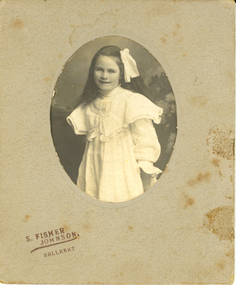
Photograph - Photograph - Black and White, S. Fisher Johnson, Edith Pickford (Holmes)
... Road and displays in the Clunes Museum. A collection of Edith's song music was donated to the Clunes Museum by her great grand-daughter in 2023. Edith married a local farmer, Henry Smerdon Holmes from "Sauchieburn" Ascot, Victoria. Henry was a descendant of the family who had inherited their maternal ancestor's, Catherine Coghill (nee Holmes), Ascot - Coghills Creek property. This branch of the Coghill Family descended from the district's pioneer settler, Captain Coghill. Edith and Henry spent all their married life, and raised 4 children Jack...Road and displays in the Clunes Museum. A collection of Edith's song music was donated to the Clunes Museum by her great grand-daughter in 2023. Edith married a local farmer, Henry Smerdon Holmes from "Sauchieburn" Ascot, Victoria. Henry was a descendant of the family who had inherited their maternal ancestor's, Catherine Coghill (nee Holmes), Ascot - Coghills Creek property. This branch of the Coghill Family descended from the district's pioneer settler, Captain Coghill. Edith and Henry spent all their married life, and raised 4 children Jack ...Edith Sarah Pickford was born and raised in Clunes, Victoria. She is the only daughter of John Pickford and Betsey (Robbins) Pickford and sister of Henry Pickford, John Pickford, William Harold Pickford, Horace Pickford DCM, Arthur Pickford and Charles Alexander Pickford. [ Research by Edith;s granduaghter Jane Dyer (nee Chatham)] Edith's maternal grandmother was a descendent of Donald Cameron, the first recorded European settler in the Clunes area.The Pickford family's pioneer settler legacy in the Clunes- Glendaruel district is commemorated with a Pickford Road and displays in the Clunes Museum. A collection of Edith's song music was donated to the Clunes Museum by her great grand-daughter in 2023. Edith married a local farmer, Henry Smerdon Holmes from "Sauchieburn" Ascot, Victoria. Henry was a descendant of the family who had inherited their maternal ancestor's, Catherine Coghill (nee Holmes), Ascot - Coghills Creek property. This branch of the Coghill Family descended from the district's pioneer settler, Captain Coghill. Edith and Henry spent all their married life, and raised 4 children Jack [John], Bill [William], [Mary] Elizabeth and David, at Ascot. She was buried in the Coghills Creek Cemetery with her husband, Henry Smerdon Holmes, and their son, David, in 1967. Her children, Bill Holmes and Elizabeth Chatham, and their spouses are buried nearby.Social and historicalMounted black and white photo of a young girl wearing a white dress and ribbon.chatham holmes collection, holmes, pickford -
 Federation University Historical Collection
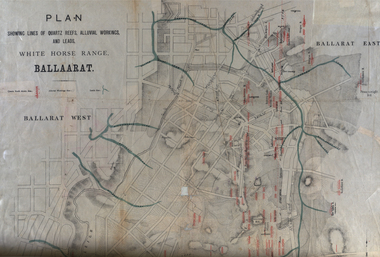
Plan, White Horse Range Ballarat, 1885, 06/1885
... jacks Lead, Eureka Lead, Old Gravel Pits Lead, Gravel Pits Lead, Nightingale Lead, Malakoff Lead, Milkmans Lead, Redan Lead, Woolshed Lead, Jacksons Lead, Winters Lead, SCtochman's Lead, Canadian Lead. Reefs include: Promised Land, Daniash, Sir Garnet Wolsley, Norwegian, Rothschile, Band and Albion, Finns, Llanberis, Roberts Lode, Tynworths and Black Hill, Oregan, Yorkshire, Try Again, Yorkshire, Post Office, Clarke's, Western Slates, Black Slate, Danks Slates, Eastern Slates, Queen's Lode, Fire Brigade. Mines include Red Streak, New Chum, Tinworths, Woah Hawp, Normanby, Speedwell, Llanberris Extended, Llanberis, Last Chance, Major, Countess, Pioneer and a number of batteries along Main Road...jacks Lead, Eureka Lead, Old Gravel Pits Lead, Gravel Pits Lead, Nightingale Lead, Malakoff Lead, Milkmans Lead, Redan Lead, Woolshed Lead, Jacksons Lead, Winters Lead, SCtochman's Lead, Canadian Lead. Reefs include: Promised Land, Daniash, Sir Garnet Wolsley, Norwegian, Rothschile, Band and Albion, Finns, Llanberis, Roberts Lode, Tynworths and Black Hill, Oregan, Yorkshire, Try Again, Yorkshire, Post Office, Clarke's, Western Slates, Black Slate, Danks Slates, Eastern Slates, Queen's Lode, Fire Brigade. Mines include Red Streak, New Chum, Tinworths, Woah Hawp, Normanby, Speedwell, Llanberris Extended, Llanberis, Last Chance, Major, Countess, Pioneer and a number of batteries along Main Road ...Two plans .1) Plan of the Ballarat Goldfields showing leads, rivers, streets and topography. Quartz reefs include: Yorkshire, Try Again, Promised Land, Western Slates, Norwegian, Robert's Lode, Finn's, Band and albion, Rothschild, Old Post Office, Queen Lode. Leads include: Navy jacks, Gays, Canadian, Prince Regent, Sailors Gully, White Horse, Little White Horse, Milkmans, Nightingale, Golden Point, Gravel Pits. Scale is 8 Chains to 1 inch .2) Plan showing lines of quartz reefs, alluvial workings and leads, White Horse Range, Ballarat. Leads include White Horse LEad, Little White Horse Lead, One Eye Gully, Terrible Lead, Sailor's Gully, Canadian Lead, Prince Regent Gully, Canadian Lead, Cavs Lead, Navy jacks Lead, Eureka Lead, Old Gravel Pits Lead, Gravel Pits Lead, Nightingale Lead, Malakoff Lead, Milkmans Lead, Redan Lead, Woolshed Lead, Jacksons Lead, Winters Lead, SCtochman's Lead, Canadian Lead. Reefs include: Promised Land, Daniash, Sir Garnet Wolsley, Norwegian, Rothschile, Band and Albion, Finns, Llanberis, Roberts Lode, Tynworths and Black Hill, Oregan, Yorkshire, Try Again, Yorkshire, Post Office, Clarke's, Western Slates, Black Slate, Danks Slates, Eastern Slates, Queen's Lode, Fire Brigade. Mines include Red Streak, New Chum, Tinworths, Woah Hawp, Normanby, Speedwell, Llanberris Extended, Llanberis, Last Chance, Major, Countess, Pioneer and a number of batteries along Main Road Hills include: Mount Clear, Pennyweight Hill, Sovereign Hillballarat, plan, white horse range, white horse, goldfields, mines, reefs, indicators, leigh river, cgt, tinworth, mining -
 Ringwood and District Historical Society
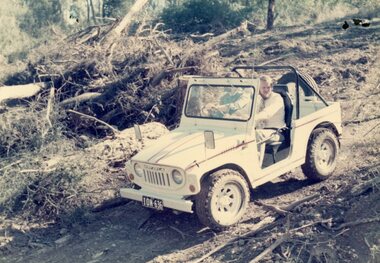
Photograph, A four-wheel drive negotiates the hillside opposite Pamela Court, North Ringwood in 1976
... Part of a 101-photo record of the development of the "Bel Air" Estate, Ringwood North, including road works to Debbie Place, Kubis Drive, Jenkins Close, Burlock Avenue, Pamela Court, Manuelo Terrace, Lyn Court, Rudolf Court, Werac Drive, Iluka Place and Glenvale Road. From the Jack Lundy Clarke collection (39 Burlock Avenue, North Ringwood) of photos taken from 1976 to 1982. ...The vehicle climbed and returned down the hills north of Kubis Drive at the intersection to Pamela Court in August 1976 Part of a 101-photo record of the development of the "Bel Air" Estate, Ringwood North, including road works to Debbie Place, Kubis Drive, Jenkins Close, Burlock Avenue, Pamela Court, Manuelo Terrace, Lyn Court, Rudolf Court, Werac Drive, Iluka Place and Glenvale Road. From the Jack Lundy Clarke collection (39 Burlock Avenue, North Ringwood) of photos taken from 1976 to 1982. ...Part of a 101-photo record of the development of the "Bel Air" Estate, Ringwood North, including road works to Debbie Place, Kubis Drive, Jenkins Close, Burlock Avenue, Pamela Court, Manuelo Terrace, Lyn Court, Rudolf Court, Werac Drive, Iluka Place and Glenvale Road. From the Jack Lundy Clarke collection (39 Burlock Avenue, North Ringwood) of photos taken from 1976 to 1982. The developer, Mr Kubis, named streets after his family and associates.The vehicle climbed and returned down the hills north of Kubis Drive at the intersection to Pamela Court in August 1976 -
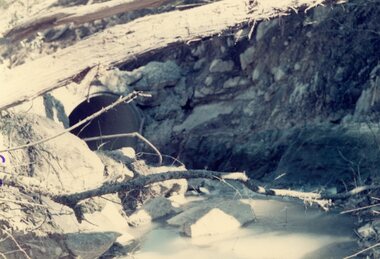 Ringwood and District Historical Society
Photograph, The intake to the barrel drain at Pamela Court, North Ringwood in 1976
... Part of a 101-photo record of the development of the "Bel Air" Estate, Ringwood North, including road works to Debbie Place, Kubis Drive, Jenkins Close, Burlock Avenue, Pamela Court, Manuelo Terrace, Lyn Court, Rudolf Court, Werac Drive, Iluka Place and Glenvale Road. From the Jack Lundy Clarke collection (39 Burlock Avenue, North Ringwood) of photos taken from 1976 to 1982. ...Part of a 101-photo record of the development of the "Bel Air" Estate, Ringwood North, including road works to Debbie Place, Kubis Drive, Jenkins Close, Burlock Avenue, Pamela Court, Manuelo Terrace, Lyn Court, Rudolf Court, Werac Drive, Iluka Place and Glenvale Road. From the Jack Lundy Clarke collection (39 Burlock Avenue, North Ringwood) of photos taken from 1976 to 1982. ...Part of a 101-photo record of the development of the "Bel Air" Estate, Ringwood North, including road works to Debbie Place, Kubis Drive, Jenkins Close, Burlock Avenue, Pamela Court, Manuelo Terrace, Lyn Court, Rudolf Court, Werac Drive, Iluka Place and Glenvale Road. From the Jack Lundy Clarke collection (39 Burlock Avenue, North Ringwood) of photos taken from 1976 to 1982. The developer, Mr Kubis, named streets after his family and associates.The entrance to the barrel drain under Kubis Drive before the roads were constructed. This was opposite, or just up the gully, to Pamela Court in August 1976.
