
Showing 93 items matching "james lawrence"
-
 Bendigo Historical Society Inc.
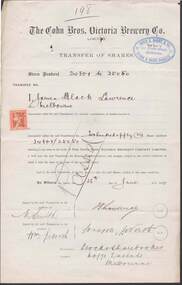
Document - COHN BROTHERS COLLECTION: SHARE TRANSFER CERTIFICATE 1895
... ...James Black Lawrence of Melbourne. Joseph Worth. ...Cohn Brothers Victoria Brewery share transfer from James Black Lawrence of Melbourne to Joseph Worth dated 26th June 1895. ...BENDIGO Industry cohn bros brewery James Black Lawrence of Melbourne. Joseph Worth. Calvin G Brown & Co Melbourne. ...Cohn Brothers Victoria Brewery share transfer from James Black Lawrence of Melbourne to Joseph Worth dated 26th June 1895. Blue oval Gavin G Brown & Co 100 queen St Melbourne Stock & Share brokers hand stamp. One penny duty stamp.bendigo, industry, cohn bros brewery, james black lawrence of melbourne. joseph worth. calvin g brown & co melbourne. -
 Rutherglen Historical Society
School Records - Individuals, Higher Elementary School, Rutherglen, Lawrence, Jeffrey James, 1952
... Lawrence, Jeffrey James...All sheets are indexed on a spreadsheet at the Common School Museum. pupils students Rutherglen Higher Elementary School school reports Individual school records of the pupils of the Higher Elementary School, Rutherglen. Lawrence, Jeffrey James School Records - Individuals Higher Elementary School, Rutherglen ...From School records, some more complete than others. Reports should contain information on the pupil's school work and give details of what they did when they left school. They should also show the name of a parent and the occupation. All sheets are indexed on a spreadsheet at the Common School Museum. Individual school records of the pupils of the Higher Elementary School, Rutherglen.pupils, students, rutherglen higher elementary school, school reports -
Rutherglen Historical Society
Document - School Records - Individuals, Higher Elementary School, Rutherglen, Lawrence, Jeffrey James, 1951
... Lawrence, Jeffrey James...All sheets are indexed on a spreadsheet at the Common School Museum. rutherglen higher elementary school pupils students school reports Individual school records of the pupils of the Higher Elementary School, Rutherglen. Lawrence, Jeffrey James Document School Records - Individuals Higher Elementary School, Rutherglen ...From School records, some more complete than others. Reports should contain information on the pupil's school work and give details of what they did when they left school. They should also show the name of a parent and the occupation. All sheets are indexed on a spreadsheet at the Common School Museum.Individual school records of the pupils of the Higher Elementary School, Rutherglen.rutherglen higher elementary school, pupils, students, school reports -
Moorabbin Air Museum
Book - AIRCRAFT PIONEER, Lawrence James Wackett, 1972
... Lawrence James Wackett...AIRCRAFT PIONEER Book AIRCRAFT PIONEER Lawrence James Wackett Angus and Robertson (Publishers) Pty Ltd ... -
 Flagstaff Hill Maritime Museum and Village
Textile - Wall Hanging, curtain, 1854-1855
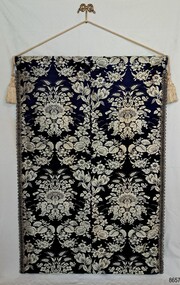
... ...James Lawrence...On Friday, 28th, Captain James Lawrence was on his way to Adelaide in the steamer Burra Burra, and called past the Schomberg. ...On Friday, 28th, Captain James Lawrence was on his way to Adelaide in the steamer Burra Burra, and called past the Schomberg. ...The striking fabric of this wall hanging was recovered from the sinking Schomberg. It was originally one of the many curtains adorning the captain’s cabin and ladies’ saloons that attracted first-class passengers to this luxury vessel, built for comfort and speed. The clipper ship was on its maiden voyage, full of passengers emigrating to Australia in 1855. Its commander was Captain James Nicol Forbes, who had been selected by James Baine & Co for his navigation skills, experience, and reputation for breaking sailing records. However, on December 26th, 1855, the vessel became stranded and sank west of Cape Otway, not quite reaching its destination of Melbourne. A reporter explored the Schomberg before its journey; the following detailed description is an excerpt of his article published in a newspaper after the disastrous voyage was announced. “ … descending by a flight of stairs, covered with carpet of a very rich pattern, we came to the saloon passengers’ cabin. This is a noble place, and all that refined taste would suggest has been done to make each berth a miniature palace. The bedding is of the very best material, and the fittings are replete with every convenience. The carpets are of various coloured velvet pile, and the curtains are of satin damask, lined with white satin … The fronts of the berths are highly decorated, and festoons of flowers are painted on the panels … No two berths are furnished with the same-coloured material … the visitor is, therefore, much pleased with the variety which he has to inspect….” (Trove: Shipping Gazette and Sydney General Trade, 31 Dec 1955, p. 283) The curtain material, ‘folded into a single piece and parcelled for protection’, has been passed down through generations of Captain Forbes’ relatives, starting with his half-sister Isabella Jeffrey Nicol. The curtain has remained with the family, although some transition details are incomplete. About a century later, Isabella and Blakiston Robinson’s great-grandson and his wife had the fabric professionally mounted as a wall hanging to showcase the beauty of the woven brocade. Eventually, the custodianship of the curtain was transferred to the donor, who is also a great-grandson of Isabella and Blakiston. He and his wife hung the curtain on the wall of a high-ceilinged room in their home, away from direct light, making it visible for all to appreciate its beauty and significance. In 2024, they donated the curtain for inclusion among the collection of artefacts that help tell the story of the Schomberg and those who sailed on its first and last voyage. The donor’s aunt was highly involved in the family’s history. She had collected and recorded information that dates back to pre-1341. A footnote included in a handwritten letter dated April 20, 1959, from the late Arthur William Rudd, OBE, MA, LLB, husband of another of the donor’s aunts, states, “The curtains you mentioned came from the Schomberg. AWR.” CAPTAIN JAMES NICOL FORBES (1821-1874) and the donor’s family: - Captain Forbes was born in Aberdeen. In his late teens, he moved to Liverpool, a hub for international trade and an emigration port. By the age of 25, he was master of the Prince of Waterloo and later, the Wakefield. He then commanded the Cleopatra for the James Baines Co., which, two years later, transferred him to command the Maria, providing fast and lucrative passage to the gold fields in Ballarat, Australia. James Baines Co. and shipbuilder Thomas Mackay formed the Black Ball Line of clipper ships in 1852. Forbes was appointed master of the largest ship in the fleet, the marvellous Marco Polo. He broke the record time for the passage to Australia, taking only 68 days at sea, and the return journey in only 76 days, a total of 5 months and 21 days. On his second voyage to Melbourne in the Marco Polo the following year, he took 75 days, and 95 days on the return trip. His accomplishment made him famous. James Baines reported that the Marco Polo was the only ship, sail or steam, to do the round trip within 6 months, and it had done it twice. Captain Forbes then took command of the American-built clipper Lightning, one of four built for the Black Ball line. His 19-year-old half-sister, Isabella Jaffray Nicol, was also onboard when he sailed for Melbourne in 1854. During the 77-day voyage, Isabella met Blakiston Robinson, and not long after the ship arrived in Melbourne on July 31, the couple married, with James Nicol Forbes as a witness, on August 16. When Forbes returned to Liverpool, he took a record-breaking 63 days, which has never been bettered. James Baines Co. ordered a new luxury emigrant ship from Alexander Hall of Aberdeen; the Schomberg was the largest sailing ship ever built in Britain. On October 6, 1855, the vessel departed Liverpool commanded by Captain Forbes, with 430 passengers on board, 54 of whom were First Class. It had almost completed its voyage to Melbourne when, on the night of December 26, it ran aground west of Cape Otway. Captain Doran, master of the steamer Queen, responded to the distress signal while on its way to Portland and, with the agreement of his passengers, rescued as many as possible from the Schomberg and returned to Melbourne with them. Captain Helpman, master of the steamer Champion, rescued most of the remaining Schomberg passengers on December 27. On Friday, 28th, Captain James Lawrence was on his way to Adelaide in the steamer Burra Burra, and called past the Schomberg. He reported that the remaining crew were all doing their duties, but the Schomberg was deteriorating on a sand spit and had about 16 feet of water in its hold. That same day, the schooner Jane Elizabeth collected 220 packages of passengers’ luggage to deliver to Melbourne on the 29th. Two steamers also arrived on the 29th with 20 men to collect passengers’ luggage and valuable ship’s cargo items. They were accompanied by water police, customs agents, company representatives and a Lloyds agent. The decision was made to abandon ship on the 30th due to rough and unsafe conditions. The officials and Captain Forbes voyaged to Melbourne, while the seamen remained behind awaiting rescue. Evacuation by sea became too risky, so on January 2, 1856, while the first Mate and Steward remained at the wreck site, the rest of the crew began the 70-mile march to Warrnambool, led by the band. They arrived on January 5th and left for Melbourne on the steamer Champion on January 10th. Parts of the Schomberg wreck ended up in New Zealand. The curtain is important for its connection to the Schomberg, which was unique for being designed and built in Aberdeen, and commanded by an Aberdonian who was the most celebrated clipper captain of the age. The ship was the largest sailing ship ever built in Britain, and reported as the largest vessel that sailed to Australia. The curtain is an example of the rich decorative furnishings available in 1855. The preservation and respect the donor and his family have shown towards the curtain over many decades reflect its important role in telling the family’s history; the journey, the romantic attachment, the family connection to the sea, and travel in gold rush times. The curtain is significant for its connection to James Nocol Forbes, a famous sailing ship commander who broke several sailing records, one of which has never been bettered. This wall hanging, also known as the Schomberg Curtain, was created from a curtain recovered from the stranded luxury ship Schomberg in December 1855. The woven satin damask fabric in blue and cream has been meticulously joined to blend the intricate pattern. The reverse features a soft cream lining. The hems at the top and bottom of the fabric hold wooden rods. The side edges feature decorative braid that has been hand-stitched in place. On the reverse, the bottom hem includes the same braid, which remains unseen from the front, and the centre of the top hem has a hand-worked, unused buttonhole. Each of the hems varies in depth. The curtain was tastefully mounted later to highlight the beauty of the original saloon curtain. A decorative twisted cord of cream silk threads, accented with gold highlights and decorative tassels, was coiled and attached to the ends of the top rod. The elegant display was completed with an ornate gold hook, chosen to complement the wall hanging.flagstaff hill maritime museum and village, great ocean road, shipwreck coast, shipwreck artefact, memorabilia, curtain, saloon curtain, schomberg, wall hanging, decorative object, domestic item, warrnambool, flagstaff hill, maritime museum, maritime village, maritime history, shipwreck, stranding, schomberg curtain, schomberg wall hanging, luxury ship, 1855, damask, silk damask, blue and cream, captain’s cabin, ladies’ saloon, clipper ship, migrant, emigrant, liverpool to australia, captain james nicol forbes, james forbes, captain forbes, bully forbes, james baines & co, james baines, cape otway, aberdeen, prince of waterloo, wakefield, cleopatra, maria, thomas mackay, black ball line, marco polo, sailing record, lightning, isabella jaffray nocol, blakiston robinson, alexander hall, steamer queen, captain helpman, james lawrence, steamer burra burra, steamer jane elizabeth, water police, customs agents, lloyds agent, ship’s band, walk to warrnambool, march to warrnambool, steamer champion, agnes nicol robinson, arthur william rudd obe ma llb -
 Bendigo Historical Society Inc.
Document - THE BENDIGO GOLD DISTRICT GENERAL HOSPITAL
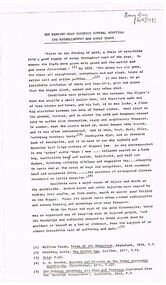
... ... James Lawrence...DOCUMENT The Bendigo Gold District General Hospital Mary Fry Mrs Clancy James Lawrence Dr Wall Dr Edward Hunt Mr G F Walter first Church of England MR J H Walker Dr Childs Dr Stuart Lands Department Vahland and Getzschmann Mr John O'Shannassy Governor Sir Henry Barkly Mr H Trumble Policeman Pat Ryan Mrs A Watson Benevolent Asylum Easter Fair Society Mr J H Abbott Lady Bowen George Mackay Annals of Bendigo K M Bowden Mr Lazarus F McMahon Training School for Nurses Nurses' Home Bendigo and Northern District Base Hospital Australian Medical Journal Rev Dr Backhaus Gregory Searle Raston Butler Drs MrCrea Tierney E R Jones Wall Roche Smith Barnett Messrs McLachlan Wilkinson O'Connor Emmett Fraser Wollaston Burrell Garsed Edhouse Snowdon Miss W Stock William Howitt W B Kimberly J N Mackartney Frank Cusack William Perry Geoffrey Serle James Smith The Argus Bendigo Advertiser Bendigo Independent Mount Alexander Mail The Sandhurst Bee A Lady's Visit to the Gold Diggings of Australia 1852 - 1853 Hurst and Blackett Land Labour and Gold Longman Brown Green and Longmans Bendigo and Vicinity Sandhurst As It Was and As It Is Barrows and Co Mackay and Co A History of Bendigo 1891 Doctors and Diggers on the Mount Alexander Goldfields Hedges and Bell Pty Ltd Bendigo A History William Heinemann Australia Pty Ltd Lister House The Story of the Northern District School of Nursing Hawthorne Press Tales of the Whipstick The Golden Age Melbourne University Press The Cyclopedia of Victoria The Cyclopedia Company C Hurry Bendigo Gold District General Hospital 1853 - The Bendigo and Northern District Base Hospital 1953 Cambridge Press W Stock Health Hazards and Care Relating to the Central Victorian Goldfields Particularly Bendigo 1851 - 1871 Typed notes on the beginnings and building of the Bendigo Hospital. ...Typed notes on the beginnings and building of the Bendigo Hospital. Written by Mary Fry and dated Oct 1981. It also tells of the expansion and of vegetable growing in the grounds. Also included is a Report from the Australian Medical Journal (April, 1857) on Quacks, Board of Management 1853 and a bibliography.document, the bendigo gold district general hospital, mary fry, mrs clancy, james lawrence, dr wall, dr edward hunt, mr g f walter, first church of england, mr j h walker, dr childs, dr stuart, lands department, vahland and getzschmann, mr john o'shannassy, governor sir henry barkly, mr h trumble, policeman pat ryan, mrs a watson, benevolent asylum, easter fair society, mr j h abbott, lady bowen, george mackay, annals of bendigo, k m bowden, mr lazarus, f mcmahon, training school for nurses, nurses' home, bendigo and northern district base hospital, australian medical journal, rev dr backhaus, gregory, searle, raston, butler, drs mrcrea, tierney, e r jones, wall, roche, smith, barnett, messrs mclachlan, wilkinson, o'connor, emmett, fraser, wollaston, burrell, garsed, edhouse, snowdon, miss w stock, william howitt, w b kimberly, j n mackartney, frank cusack, william perry, geoffrey serle, james smith, the argus, bendigo advertiser, bendigo independent, mount alexander mail, the sandhurst bee, a lady's visit to the gold diggings of australia 1852 - 1853, hurst and blackett, land labour and gold, longman brown green and longmans, bendigo and vicinity, sandhurst as it was and as it is, barrows and co, mackay and co, a history of bendigo 1891, doctors and diggers on the mount alexander goldfields, hedges and bell pty ltd, bendigo, a history, william heinemann australia pty ltd, lister house the story of the northern district school of nursing, hawthorne press, tales of the whipstick, the golden age, melbourne university press, the cyclopedia of victoria, the cyclopedia company, c hurry, bendigo gold district general hospital 1853 - the bendigo and northern district base hospital 1953, cambridge press, w stock, health hazards and care relating to the central victorian goldfields particularly bendigo 1851 - 1871 -
 National Vietnam Veterans Museum (NVVM)
Poster - Poster, Information Board, Awards and Decorations South Vietnam 1966-1971
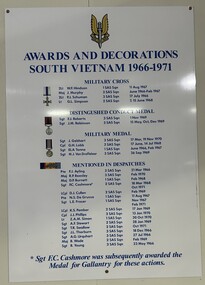
... ...Sgt James Lawrence Bradshaw Thorburn...SAS Military Cross 2Lt William Francis Hindson Lt William Francis Hindson 37479 Lt Col John Matthew Murphy Maj John Matthew Murphy 335048 Royal Australian Infantry Corps 3rd Special Air Service Squadron 2Lt Peter John Schuman Capt (Temp) Peter John Schuman 214124 1st Special Air Service Sqnuadron 2nd Special Air Service Squadon Lt Gordon Lyall Simpson 235306 Distinguished Conduct Medal Sgt (Temp) Frederick John Roberts 215875 Sgt John Murray Robinson 54159 Military Medal Sgt (Temp) John Gebhardt 1200111 Cpl (Temp) Garry Harold Lobb 3411804 Sgt Emanuel Leterio Tonna WO2 Emanuel Leterio Tonna 15457 Sgt (Temp) Michael Jan Van Droffelaar 4718068 Australian National Serviceman Mention in Dispatches Mention in Despatches Maj Reginald Patrick Beesley 235165 Maj Dale Percival Burnett 235111 Sgt Frank Carr Cashmore 54237 Medal For Gallantry L/Cpl Denis James Cullen 1200896 Sgt Lawrence Edmund Fraser 53151 L/Cpl Kim Stanley Pember 55187 Sgt (Temp) Kim Stanley Pember Cpl Joseph James Phillips 43848 Lt Zoltan Arpad Marton Simon 235360 Sgt Alan Frederick Stewart 54791 Sgt Thomas Raymond Swallow 36940 Sgt James Lawrence Bradshaw Thorburn 28662 Sgt Ashley Graham Urquhart WO2 (Temp) Ashley Graham Urquhart Maj Brian Wade 57044 Refer media image White plastic board with blue writing with the heading Awards and Decorations South Vietnam 1966-1971. ...White plastic board with blue writing with the heading Awards and Decorations South Vietnam 1966-1971. Under the heading it lists Military Cross, Distinguished Conduct Medal, Military Medal and Mentioned in Despatches recipients and dates these awards. At the bottom of the poster reads *Sgt F.C. Cashmore was subsequently awarded the Medal for Gallatry for these actions.Refer media imagesas, military cross, 2lt william francis hindson, lt william francis hindson, 37479, lt col john matthew murphy, maj john matthew murphy, 335048, royal australian infantry corps, 3rd special air service squadron, 2lt peter john schuman, capt (temp) peter john schuman, 214124, 1st special air service sqnuadron, 2nd special air service squadon, lt gordon lyall simpson, 235306, distinguished conduct medal, sgt (temp) frederick john roberts, 215875, sgt john murray robinson, 54159, military medal, sgt (temp) john gebhardt, 1200111, cpl (temp) garry harold lobb, 3411804, sgt emanuel leterio tonna, wo2 emanuel leterio tonna, 15457, sgt (temp) michael jan van droffelaar, 4718068, australian national serviceman, mention in dispatches, mention in despatches, maj reginald patrick beesley, 235165, maj dale percival burnett, 235111, sgt frank carr cashmore, 54237, medal for gallantry, l/cpl denis james cullen, 1200896, sgt lawrence edmund fraser, 53151, l/cpl kim stanley pember, 55187, sgt (temp) kim stanley pember, cpl joseph james phillips, 43848, lt zoltan arpad marton simon, 235360, sgt alan frederick stewart, 54791, sgt thomas raymond swallow, 36940, sgt james lawrence bradshaw thorburn, 28662, sgt ashley graham urquhart, wo2 (temp) ashley graham urquhart, maj brian wade, 57044 -
Tatura Irrigation & Wartime Camps Museum
Document - Folder, Those Who Died in Action from Tatura in WW1
... ...James Lawrence Cummins...Harry Rowan Agnew Robert Ernest Alexander Daniel Allan Joseph Stanley Bainbridge Henry Saundry Bazeley Arthur Boot John Connors Thomas Cross Albert Blackburn Crossley James Lawrence Cummins Charles Patrick Fitzpatrick Richard Fuzzard Charles Alfred Philip Josiah Hampton Haswell Harding Joseph Arthur Head Thomas Patrick Keating John Mackay Layton Richard Goulburn Layton Robert Mactier VC Thomas James Maher Stanley George Mars John Archibald Duncan McColl Angas Ewen McLennan Michael Joseph Meagher Robert Alexander Mitchell Thomas James Port Albert Reddrop Albert Charles Joseph Robinson Charles John Seamons George Sinclair Swanson Alfred Tavener (Curran) William Robert Wheeler Tatura's WW1 roll of honour Tatura and District WW1 Nominal Roll Decorations and Awards to Tatura and District men Black folder with multiple sleeves each containing typed sheets with pictures. ...The sleeves contain sheets of typed material detailing the background, military history and circumstances of death, burial place and commemoration of people from Tatura and surrounding areas who were killed in action in WW1. Some have photographs as well. 1 page list of personal details of Tatura's WW1 roll of honour. 1 page list of names, dates enlisted, regiment number, last unit, rank, action, DOB and burial place of those listed. 5 page list of Tatura and District WW1 Nominal Roll. 2 page list of Decorations and Awards to Tatura and District men. Black folder with multiple sleeves each containing typed sheets with pictures.harry rowan agnew, robert ernest alexander, daniel allan, joseph stanley bainbridge, henry saundry bazeley, arthur boot, john connors, thomas cross, albert blackburn crossley, james lawrence cummins, charles patrick fitzpatrick, richard fuzzard, charles alfred philip josiah hampton, haswell harding, joseph arthur head, thomas patrick keating, john mackay layton, richard goulburn layton, robert mactier vc, thomas james maher, stanley george mars, john archibald duncan mccoll, angas ewen mclennan, michael joseph meagher, robert alexander mitchell, thomas james port, albert reddrop, albert charles joseph robinson, charles john seamons, george sinclair swanson, alfred tavener (curran), william robert wheeler, tatura's ww1 roll of honour, tatura and district ww1 nominal roll, decorations and awards to tatura and district men -
 Sunshine and District Historical Society Incorporated
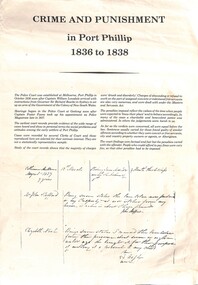
Document - Crime And Punishment In Port Phillip 1836 - 1838, Public Record Office Victoria, 1981
... ...James Lawrence...Police Court Port Phillip Captain William Lonsdale Governor Sir Richard Bourke James Lawrence Alfred Boucher Michael Malony George Frederick Reid Joseph Suthlerland Crime And Punishment in Port Phillip 1836 to 1838 Folded document Document Crime And Punishment In Port Phillip 1836 - 1838 Public Record Office Victoria F D Atkinson Government Printer Melbourne ...The Police Court was established at Melbourne, Port Phillip in October 1836 soon after Captain William Lonsdale arrived with instructions from Governor Sir Richard Bourke in Sydney to set up an arm of the Government of the Colony of New South Wales. Hearings began in the Police Court at Geelong soon after Captain Foster Fyans took up his appointment as Police Magistrate late in 1837. The earliest court records provide evidence of the wide range of cases heard and show impersonal terms the social problems and attitudes among the early settlers of Port Phillip. Study of the court records shows that the majority of charges were `drunk and disorderly: Charges of absconding or refusal to work on the part of assigned convicts or indentured free servants are also very numerous and were dealt with under the Masters and Servants Act. The penalties imposed reflect the values of the time when people were expected to `know their place' and to behave accordingly. In many of the cases a charitable and benevolent justice was administered. In others the judgements seem harsh to us. As far as the verdicts were concerned, all were equal before the law. Sentences usually varied for those found guilty of similar offences according to whether they were convict or free servants, city and country property owners or agents, or aborigines. The court findings were factual and fair, but the penalties varied with the offender. People who could afford to pay fines were very few, so that other penalties had to be imposed. Cases recorded in this document were by several Clerks of Court and those reproduced here are selected for their intrinsic interest. They are not a statistically representative sample.Crime And Punishment in Port Phillip 1836 to 1838police court, port phillip, captain william lonsdale, governor sir richard bourke, james lawrence, alfred boucher, michael malony, george frederick reid, joseph suthlerland -
 Federation University Historical Collection
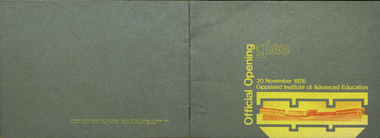
Booklet, Gippsland Printers, GIAE Official Opening, 1976, 1976
... ...john james robertson...leslie lawrence...Carrick, Minister for Education in the Commonwealth Government. gippsland institute of advanced education m.w. hopper c.h. ford lindsay thompson j.l. carrick r.w. muncey churchill yallourn morwell yallourn technical school yuncken freeman architects f.a. gray f.r. goddard j. milton-smith j.r. lawry b.r. groves c.p.a. hos c.w. tolley k.f. smith j. dowsley robert charles bigelow charles hartley ford daniel eric kent barbara lapin john charles mcgauran neville thompson john charles vinall leslie alfred galvin maxwell francis gray john alfred forster oram donald robert hannington john perrin kellaway john james robertson leslie lawrence shipp valerie lorraine willington leonard allan falk kwong chiu lee dow brenton robert groves glen william drover kenneth francis gibson maxwell wallace hopper teunis jan geerit korevaar j.j. robertson d.f. kretlow chancellor and patrick churchill campus Gippsland Campus Collection Silver and yellow soft covered booklet celebrating the opening of the Gippsland Institute of Advanced Education at Churchill, Victoria. ...The Gippsland Institute of Advanced Education was established by an Order-in-Council in September 1968. The Council of the Institute included members of the Gippsland community who are prominent in local government, industry, commerce, education and the professions, the Director of the Institute, and representatives of the academic staff, students, and graduates. On its establishment, the institute assumed responsibility for the diploma courses previously offered by the Yallourn Technical College which had commenced diploma teaching in 1929. Initially, all the Institute's teaching was conducted in the diploma building of the Yallourn Technical College. In 1972 the Institute transferred part of its operations to the first of its permanent buildings on a large campus in rural surrounds near the township of Churchill, ten kilometres south of Morwell and one hundred and sixty kilometres east of Melbourne. The Gippsland Institute of Advanced Education was opened on 20 November 1976 by the Honourable Lindsay Thompson, Deputy Premier of Victoria and Minister of Education; and Senator J.L. Carrick, Minister for Education in the Commonwealth Government. Silver and yellow soft covered booklet celebrating the opening of the Gippsland Institute of Advanced Education at Churchill, Victoria. An introduction is written by C.H. Ford, President of Council. The book was designed and produced by the design Centre, G.I.A.E. SChool of Visual Arts.gippsland institute of advanced education, m.w. hopper, c.h. ford, lindsay thompson, j.l. carrick, r.w. muncey, churchill, yallourn, morwell, yallourn technical school, yuncken freeman architects, f.a. gray, f.r. goddard, j. milton-smith, j.r. lawry, b.r. groves, c.p.a. hos, c.w. tolley, k.f. smith, j. dowsley, robert charles bigelow, charles hartley ford, daniel eric kent, barbara lapin, john charles mcgauran, neville thompson, john charles vinall, leslie alfred galvin, maxwell francis gray, john alfred forster oram, donald robert hannington, john perrin kellaway, john james robertson, leslie lawrence shipp, valerie lorraine willington, leonard allan falk, kwong chiu lee dow, brenton robert groves, glen william drover, kenneth francis gibson, maxwell wallace hopper, teunis jan geerit korevaar, j.j. robertson, d.f. kretlow, chancellor and patrick, churchill campus, gippsland campus collection -
 Narre Warren and District Family History Group
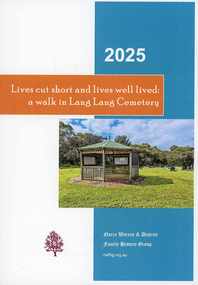
Book - Lives cut short and lives well lived: a walk in Lang Lang Cemetery, Narre Warren & District Family History Group Inc, October 2025
... James Denholm...Clyde Lawrence Edey...Lang Lang Cemetery Edward Bickerton Mary Ann Dainty James Denholm Clyde Lawrence Edey Elizabeth & Robert Gray Lucy May Greaves Sydney Head Maddron Henry Elizabeth Leggo Sarah & Thomas McAleese Raymond (Darby) & Yvonne Munro Andrew Trevor Nicholls Alexander Gladstone Orgill Geoffrey Frank Ridgway Samuel Alfred Thompson Henry Wildes Stories about the lives of fifteen families, including that of a policeman, a post mistress, a teacher, as well as farmers and farm labourers, and children who died in tragic circumstances, and a woman who was involved in many community activities. ...Stories about the lives of fifteen families, including that of a policeman, a post mistress, a teacher, as well as farmers and farm labourers, and children who died in tragic circumstances, and a woman who was involved in many community activities.non-fictionStories about the lives of fifteen families, including that of a policeman, a post mistress, a teacher, as well as farmers and farm labourers, and children who died in tragic circumstances, and a woman who was involved in many community activities.lang lang cemetery, edward bickerton, mary ann dainty, james denholm, clyde lawrence edey, elizabeth & robert gray, lucy may greaves, sydney head, maddron henry, elizabeth leggo, sarah & thomas mcaleese, raymond (darby) & yvonne munro, andrew trevor nicholls, alexander gladstone orgill, geoffrey frank ridgway, samuel alfred thompson, henry wildes -
 Ballarat Heritage Services
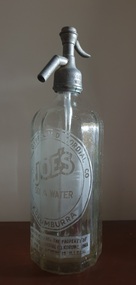
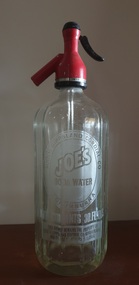
Domestic object - Soda Syphon, Joe's Soda Water Syphon
... James Lawrence opened The South Gippsland Cordial Co. in Mine Rd, Korumburra, in 1895. ...James Lawrence opened The South Gippsland Cordial Co. in Mine Rd, Korumburra, in 1895. ...James Lawrence opened The South Gippsland Cordial Co. in Mine Rd, Korumburra, in 1895. It passed through a number of hands in the first half of the 20th century, from William Dobell to Mr Ebsworth, then finally to Colin Malcolm McLean in 1946. McLean dropped what he considered to be the old fashioned Lyrebird label, and in 1948 introduced the new, modern “Joe’s” label.Glass botte with metal soda syphon. The glass is etched with "Joe's Soda Water, South Gippsland Cordial Co Korumburra. This syphon remains the property of South Gippsland Cordial Co, Kurumburra and its use by others is illegal."joe's soda water, south gippsland cordial co. korumburra, soda syphon -
 Ballarat Heritage Services
Domestic object - Soda Syphon, Joe's Soda Water Syphon, c1950
... James Lawrence opened The South Gippsland Cordial Co. in Mine Rd, Korumburra, in 1895. ...James Lawrence opened The South Gippsland Cordial Co. in Mine Rd, Korumburra, in 1895. ...James Lawrence opened The South Gippsland Cordial Co. in Mine Rd, Korumburra, in 1895. It passed through a number of hands in the first half of the 20th century, from William Dobell to Mr Ebsworth, then finally to Colin Malcolm McLean in 1946. McLean dropped what he considered to be the old fashioned Lyrebird label, and in 1948 introduced the new, modern “Joe’s” label.Glass botte with metal soda syphon. The glass is etched with "Joe's Soda Water, South Gippsland Cordial Co Korumburra. Net contents 30.FL.OZS This syphon remains the property of South Gippsland Cordial Co, Kurumburra and its use by others is illegal. British Syphon Company"joe's soda water, south gippsland cordial co. korumburra, soda syphon -
 Sunshine and District Historical Society Incorporated
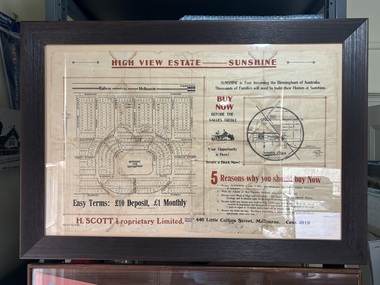
Poster - High View Estate Sunshine Land Sales Poster
... Scott Propertary Limited|Street names include Ridgeway Parage, Crescent Avenue, Whitesides Avenue, Mary Street, Harold Street, Vernon Crescent, Glengala Road, Lorna Crescent, Murray Street, Daphne Street, Fern Street, James Street, Lawrence Street, Frank Street, Ailsa Street, Norma Crescent...Scott Propertary Limited|Street names include Ridgeway Parage, Crescent Avenue, Whitesides Avenue, Mary Street, Harold Street, Vernon Crescent, Glengala Road, Lorna Crescent, Murray Street, Daphne Street, Fern Street, James Street, Lawrence Street, Frank Street, Ailsa Street, Norma Crescent Framed land sale poster. ...High View Estate Sunshine 5 Reasons why you should by now H. Scott Propertary Limited|Street names include Ridgeway Parage, Crescent Avenue, Whitesides Avenue, Mary Street, Harold Street, Vernon Crescent, Glengala Road, Lorna Crescent, Murray Street, Daphne Street, Fern Street, James Street, Lawrence Street, Frank Street, Ailsa Street, Norma Crescentland sale, poster, sunshine west, glengala -
 St Kilda Historical Society
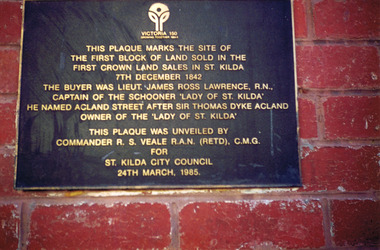
Photograph, Plaque marking the site of the first block of land sold in the first Crown Land Sales in St Kilda 7 Dec 1842, c. 1980s?
... The buyer was Lieut. James Ross Lawrence, R N, Captain of the Schooner 'Lady of St Kilda'. ...The buyer was Lieut. James Ross Lawrence, R N, Captain of the Schooner 'Lady of St Kilda'. ...colour photograph unmounted (2 identical photographs)This plaque marks the site of the first block of land sold in the first Crown Land Sales in St Kilda 7 Dec 1842. The buyer was Lieut. James Ross Lawrence, R N, Captain of the Schooner 'Lady of St Kilda'. He named Acland st after Sir Thomas Dyke Acland, owner of "The Lady of St Kilda". This plaque was unveiled by Commander RS Veale RAN (retd) CMG for St Kilda City Council. 24 March 1985. -
 The Beechworth Burke Museum Research Collection
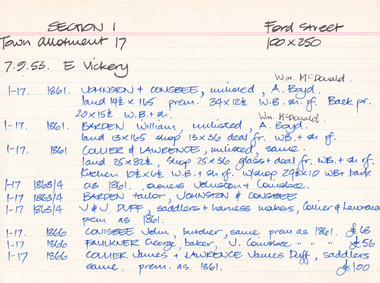
Card (Series) - Index Card, George Tibbits, Ford Street, Beechworth, 1976
... Conisbee, prem as 1861 £56 1866 - Collier, James & Lawrence, James Duff, Saddlers, same prem as 1861 £100 1871 - Hyem, Wm. butcher, same prem as 1861 £62 1871 - Irvine, James, confectioner, Hyem, W. ...Conisbee, prem as 1861 £56 1866 - Collier, James & Lawrence, James Duff, Saddlers, same prem as 1861 £100 1871 - Hyem, Wm. butcher, same prem as 1861 £62 1871 - Irvine, James, confectioner, Hyem, W. ...George Tibbits, University of Melbourne. Faculty of Architecture, Building and Town & Regional PlanningIndex system that support the research for Beechworth : historical reconstruction / [by] George Tibbits ... [et al]Arranged by street names of BeechworthEach index card includes: street name and number of property, image of property, allotment and section number, property owners and dates of ownership, description of the property according to rate records, property floor plan with dimensions.beechworth, george tibbitsbeechworth, george tibbits -
 Flagstaff Hill Maritime Museum and Village
Functional object - Ship's Wheel, 1871 or earlier
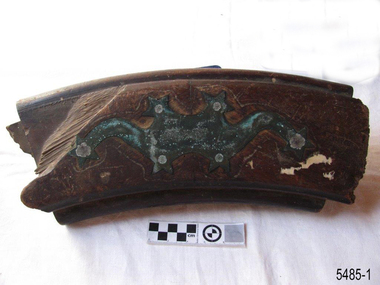
... Darcy chief mate, James F. Lawrence second mate, Ned Sewall third mate and owner’s son, John French the cook, C. ...Darcy chief mate, James F. Lawrence second mate, Ned Sewall third mate and owner’s son, John French the cook, C. ...The ship building company E. & A. Sewall, from Bath, Maine, USA, built many ships that had wheels with the same decorative, starburst pattern on them as this particular wheel segment, including the Eric the Red. The wheel was manufactured by their local Bath foundry, Geo. Moulton & Co. and sold to the Sewall yard for $100, according to the construction accounts of the vessel. Eric the Red was a wooden, three masted clipper ship. She had 1,580 tons register and was the largest full-rigged ship built at Bath, Maine, USA in 1871. She was built and registered by Arthur Sewall, later to become the partnership E. & A. Sewall, and was the 51st ship built by this company. The annually-published List of Merchant Vessels of the U.S. shows that Bath was still the home port of Eric the Red in 1880. The vessel was named after the Viking discoverer, Eric the Red, who was the first European to reach the shores of North America (in 980AD). The ship Eric the Red at first traded in coal between America and Britain, and later traded in guano nitrates from South America. In 1879 she was re-metalled and was in first class condition. On 10th June 1880 (some records say 12th June) Eric the Red departed New York for Melbourne and then Sydney. She had been commissioned by American trade representatives to carry a special cargo of 500 exhibits (1400 tons) - about a quarter to a third of America’s total exhibits - from America for the U.S.A. pavilion at Melbourne’s first International Exhibition. The exhibits included furniture, ironmongery, wines, chemicals, dental and surgical instruments, paper, cages, bronze lamp trimmings, axles, stamped ware, astronomical and time globes, samples of corn and the choicest of leaf tobacco. Other general cargo included merchandise such as cases of kerosene and turpentine, brooms, Bristol's Sarsaparilla, Wheeler and Wilson sewing machines, Wheeler’s thresher machine, axe handles and tools, cases of silver plate, toys, pianos and organs, carriages and Yankee notions. The Eric the Red left New York under the command of Captain Z. Allen (or some records say Captain Jacques Allen) and 24 other crew including the owner’s son third mate Ned Sewall. There were 2 saloon passengers also. On 4th September 1880 the ship had been sailing for an uneventful 85 days and the voyage was almost at its end. Eric the Red approached Cape Otway in a moderate north-west wind and hazy and overcast atmosphere. Around 1:30am Captain Allen sighted the Cape Otway light and was keeping the ship 5-6 miles offshore to stay clear of the hazardous Otway Reef. However he had badly misjudged his position. The ship hit the Otway Reef about 2 miles out to sea, south west of the Cape Otway light station. Captain Allen ordered the wheel to be put ‘hard up’ thinking that she might float off the reef. A heavy sea knocked the man away from the wheel, broke the wheel ropes and carried away the rudder. The sea swamped the lifeboats, the mizzenmast fell, with all of its rigging, then the mainmast fell and the ship broke in two. Some said that the passenger Vaughan, who was travelling for his health and not very strong, was washed overboard and never seen again. The ship started breaking up. The forward house came adrift with three of the crew on it as well as a longboat, which the men succeeded in launching and keeping afloat by continually bailing with their sea boots. The captain, the third mate (the owner’s son) and others clung to the mizzenmast in the sea. Then the owner’s son was washed away off the mast. Within 10 minutes the rest of the ship was in pieces, completely wrecked, with cargo and wreckage floating in the sea. The captain encouraged the second mate to swim with him to the deckhouse where there were other crew but the second mate wouldn’t go with him. Eventually the Captain made it to the deckhouse and the men pulled him up. At about 4:30am the group of men on the deckhouse saw the lights of a steamer and called for help. At the same time they noticed the second mate and the other man had drifted nearby, still on the spur, and pulled them both onto the wreck. The coastal steamer Dawn was returning to Warrnambool from Melbourne, its sailing time different to its usual schedule. Cries were heard coming from out of the darkness. Captain Jones sent out two life boats, and fired off rockets and blue lights to illuminate the area. They picked up the three survivors who were in the long boat from Eric the Red. Two men were picked up out of the water, one being the owner’s son who was clinging to floating kerosene boxes. At daylight the Dawn then rescued the 18 men from the floating portion of the deckhouse, which had drifted about 4 miles from where they’d struck the reef. Shortly after the rescue the deckhouse drifted onto breakers and was thrown onto rocks at Point Franklin, about 2 miles east of Cape Otway. Captain Jones had signalled to Cape Otway lighthouse the number of the Eric the Red and later signalled that there was a wreck at Otway Reef but there was no response from the lighthouse. The captain and crew of the Dawn spent several more hours searching unsuccessfully for more survivors, even going back as far as Apollo Bay. On board the Dawn the exhausted men received care and attention to their needs and wants, including much needed clothing. Captain Allen was amongst the 23 battered and injured men who were rescued and later taken to Warrnambool for care. Warrnambool’s mayor and town clerk offered them all hospitality, the three badly injured men going to the hospital and others to the Olive Branch Hotel, then on to Melbourne. Captain Allen’s leg injury prevented him from going ashore so he and three other men travelled on the Dawn to Portland. They were met by the mayor who also treated them all with great kindness. Captain Allen took the train back to Melbourne then returned to America. Those saved were Captain Z. Allen (or Jacques Allen), J. Darcy chief mate, James F. Lawrence second mate, Ned Sewall third mate and owner’s son, John French the cook, C. Nelson sail maker, Clarence W. New passenger, and the able seamen Dickenson, J. Black, Denis White, C. Herbert, C. Thompson, A. Brooks, D. Wilson, J. Ellis, Q. Thompson, C. Newman, W. Paul, J. Davis, M. Horenleng, J. Ogduff, T. W. Drew, R. Richardson. Four men had lost their lives; three of them were crew (Gus Dahlgreen ship’s carpenter, H. Ackman steward, who drowned in his cabin, and George Silver seaman) and one a passenger (J. B. Vaughan). The body of one of them had been found washed up at Cape Otway and was later buried in the lighthouse cemetery; another body was seen on an inaccessible ledge. Twelve months later the second mate James F. Lawrence, from Nova Scotia, passed away in the Warrnambool district; an obituary was displayed in the local paper. The captain and crew of the Dawn were recognised by the United States Government in July 1881 for their humane efforts and bravery, being thanked and presented with substantial monetary rewards, medals and gifts. Neither the ship, nor its cargo, was insured. The ship was worth about £15,000 and the cargo was reportedly worth £40,000; only about £2,000 worth had been recovered. Cargo and wreckage washed up at Apollo Bay, Peterborough, Port Campbell, Western Port and according to some reports, even as far away as the beaches of New Zealand. The day after the wreck the government steam ship Pharos was sent from Queenscliff to clear the shipping lanes of debris that could be a danger to ships. The large midship deckhouse of the ship was found floating in a calm sea near Henty Reef. Items such as an American chair, a ladder and a nest of boxes were all on top of the deckhouse. As it was so large and could cause danger to passing ships, Captain Payne had the deckhouse towed towards the shore just beyond Apollo Bay. Between Apollo Bay and Blanket Bay the captain and crew of Pharos collected Wheeler and Wilson sewing machines, nests of boxes, bottles of Bristol’s sarsaparilla, pieces of common American chairs, axe handles, a Wheelers’ Patent thresher and a sailor’s trunk with the words “A. James” on the front. A ship’s flag-board bearing the words “Eric the Red” was found on the deckhouse; finally those on board the Pharos had the name of the wrecked vessel. During this operation Pharos came across the government steamer Victoria and also a steamer S.S. Otway, both of which were picking up flotsam and wreckage. A whole side of the hull and three large pieces of the other side of the hull, with some of the copper sheathing stripped off, had floated on to Point Franklin. Some of the vessels yards and portions of her masts were on shore. The pieces of canvas attached to the yards and masts confirmed that the vessel had been under sail. The beach there was piled with debris several feet high. There were many cases of Diamond Oil kerosene, labelled R. W. Cameron and Company, New York. There were also many large planks of red pine, portions of a small white boat and a large, well-used oar. Other items found ashore included sewing machines (some consigned to ‘Long and Co.”) and notions, axe and scythe handles, hay forks, wooden pegs, rolls of wire (some branded “T.S” and Co, Melbourne”), kegs of nails branded “A.T. and Co.” from the factory of A. Field and Son, Taunton, Massachusetts, croquet balls and mallets, buggy fittings, rat traps, perfumery, cutlery and Douay Bibles, clocks, bicycles, chairs, a fly wheel, a cooking stove, timber, boxes, pianos, organs and a ladder. (Wooden clothes pegs drifted in for many years). There seemed to be no personal luggage or clothing. The Pharos encountered a long line, about one and a half miles, of floating wreckage about 10 miles off land, south east of Cape Otway, and in some places about 40 feet wide. It seemed that more than half of it was from Eric the Red. The ship’s crew rescued 3 cases that were for the Melbourne Exhibition and other items from amongst the debris. There were also chairs, doors, musical instruments, washing boards, nests of trunks and fly catchers floating in the sea. Most of the goods were saturated and smelt of kerosene. A section of the hull lies buried in the sand at Parker River Beach. An anchor with chain is embedded in the rocks east of Point Franklin and a second anchor, thought to be from Eric the Red, is on display at the Cape Otway light station. (There is a photograph of a life belt on the verandah of Rivernook Guest House in Princetown with the words “ERIC THE RED / BOSTON”. This is rather a mystery as the ship was registered in Bath, Maine, USA.) Parts of the ship are on display at Bimbi Park Caravan Park and at Apollo Bay Museum. Flagstaff Hill Maritime Village also has part of the helm (steering wheel), a carved wooden sword (said to be the only remaining portion of the ship’s figurehead; further research is currently being carried out), a door, a metal rod, samples of wood and a medal for bravery. Much of the wreckage was recovered by the local residents before police and other authorities arrived at the scene. Looters went to great effort to salvage goods, being lowered down the high cliff faces to areas with little or no beach to collect items from the wreckage, their mates above watching out for dangerous waves. A Tasmanian newspaper reports on a court case in Stawell, Victoria, noting a man who was caught 2 months later selling tobacco from the wreckage of Eric the Red. Some of the silverware is still treasured by descendants of Mr Mackenzie who was given these items by officials for his help in securing the cargo. The gifts included silver coffee and tea pots, half a dozen silver serviette rings and two sewing machines. The wreck and cargo were sold to a Melbourne man who salvaged a quantity of high quality tobacco and dental and surgical instruments. Timbers from the ship were salvaged and used in the construction of houses and sheds around Apollo Bay, including a guest house, Milford House (since burnt down in bushfires), which had furniture, fittings and timber on the dining room floor from the ship. A 39.7 foot long trading ketch, the Apollo, was also built from its timbers by Mr Burgess in 1883 and subsequently used in Tasmanian waters. It was the first attempt at ship building in Apollo bay. In 1881 a red light was installed about 300 feet above sea level at the base of the Cape Otway lighthouse to warn ships when they were too close to shore; It would not be visible unless a ship came within 3 miles from it. This has proved to be an effective warning. The State Library of Victoria has a lithograph in its collection depicting the steamer Dawn and the shipwrecked men, titled. "Wreck of the ship Eric the Red, Cape Otway: rescue of the crew by the Dawn". “The Eric the Red is historically significant as one of Victoria's major 19th century shipwrecks. (Heritage Victoria Eric the Red; HV ID 239) The wreck led to the provision of an additional warning light placed below the Cape Otway lighthouse to alert mariners to the location of Otway Reef. The site is archaeologically significant for its remains of a large and varied cargo and ship's fittings being scattered over a wide area. The site is recreationally and aesthetically significant as it is one of the few sites along this coast where tourists can visit identifiable remains of a large wooden shipwreck, and for its location set against the background of Cape Otway, Bass Strait, and the Cape Otway lighthouse.“ (Victorian Heritage Database Registration Number S239, Official Number 8745 USA) Segment of a ship's wheel, or helm, from the wreck of the sailing ship Eric the Red. The wheel part is an arc shape from the outer rim of the wheel and is made up of three layers of timber. The centre layer is a dark, dense timber and is wider than the two outer layers, which are less dense and lighter in colour. The wheel segment has a vertically symmetrical, decorative copper plate inlaid on the front. The plate has a starburst pattern; six stars decorate it, each at a point where there is a metal fitting going through the three layers of timber to the rear side of the wheel. On the rear each of the six fittings has an individual copper star around it. The edges of the helm are rounded and bevelled, polished to a shine in a dark stain. Around each of the stars, front and back, the wood is a lighter colour, as though the metal in that area being polished frequently. The length of the segment suggests that it has probably come from a wheel or helm that had ten spokes. (Ref: F.H.M.M. 16th March 1994, 239.6.610.3.7. Artefact Reg No ER/1.)flagstaff hill, warrnambool, shipwrecked-coast, flagstaff-hill, flagstaff-hill-maritime-museum, maritime-museum, shipwreck-coast, flagstaff-hill-maritime-village, ship's-wheel, eric-the-red, helm, shei's wheel, ship's steering wheel -
 Flagstaff Hill Maritime Museum and Village
Furniture - Door, 1871 or earlier
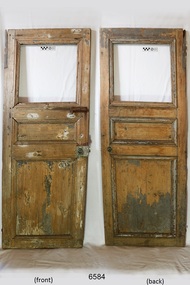
... Darcy chief mate, James F. Lawrence second mate, Ned Sewall third mate and owner’s son, John French the cook, C. ...Darcy chief mate, James F. Lawrence second mate, Ned Sewall third mate and owner’s son, John French the cook, C. ...The wooden door was salvaged from the wreck of the sailing ship Eric the Red, which was a wooden, three masted clipper ship. Eric the Red was the largest full-rigged ship built at Bath, Maine, USA in 1871, having had a 1,580 tons register. She was built and registered by Arthur Sewall, later to become the partnership E. & A. Sewall, the 51st ship built by this company. The annually-published List of Merchant Vessels of the U.S. shows Bath was still the home port of Eric the Red in 1880. The vessel was named after the Viking discoverer, Eric the Red, who was the first European to reach the shores of North America (in 980AD). The ship Eric the Red at first traded in coal between America and Britain, and later traded in guano nitrates from South America. In 1879 she was re-metalled and was in first class condition. On 10th June 1880 (some records say 12th June) Eric the Red departed New York for Melbourne and then Sydney. She had been commissioned by American trade representatives to carry a special cargo of 500 exhibits (1400 tons) – about a quarter to a third of America’s total exhibits - from America for the U.S.A. pavilion at Melbourne’s first International Exhibition. The exhibits included furniture, ironmongery, wines, chemicals, dental and surgical instruments, paper, cages, bronze lamp trimmings, axles, stamped ware, astronomical and time globes, samples of corn and the choicest of leaf tobacco. Other general cargo included merchandise such as cases of kerosene and turpentine, brooms, Bristol's Sarsaparilla, Wheeler and Wilson sewing machines, Wheeler’s thresher machine, axe handles and tools, cases of silver plate, toys, pianos and organs, carriages and Yankee notions. The Eric the Red left New York under the command of Captain Z. Allen (or some records say Captain Jacques Allen) and 24 other crew including the owner’s son third mate Ned Sewall. There were 2 saloon passengers also. The ship had been sailing for an uneventful 85 days and the voyage was almost at its end. On 4th September 1880 the Eric the Red approached Cape Otway with a moderate north-west wind and hazy and overcast atmosphere. Around 1:30am Captain Allen sighted the Cape Otway light and was keeping the ship 5-6 miles offshore to stay clear of the hazardous Otway Reef. However he had badly misjudged his position. The ship hit the Otway Reef about 2 miles out to sea, south west of the Cape Otway light station. He ordered the wheel to be put ‘hard up’ thinking that she might float off the reef. A heavy sea knocked the man away from the wheel, broke the wheel ropes and carried away the rudder. The sea swamped the lifeboats. The mizzenmast fell, with all of its rigging, then the mainmast also fell and the ship broke in two. Some said that the passenger Vaughan, who was travelling for his health and not very strong, was washed overboard and never seen again. The ship started breaking up. The forward house came adrift with three of the crew on it as well as a longboat, which the men succeeded in launching and keeping afloat by continually bailing with their sea boots. The captain, the third mate (the owner’s son) and others clung to the mizzenmast in the sea. Then the owner’s son was washed away off the mast. Within 10 minutes the rest of the ship was in pieces, completely wrecked, with cargo and wreckage floating in the sea. The captain encouraged the second mate to swim with him to the deckhouse where there were other crew but the second mate wouldn’t go with him. Eventually the Captain made it to the deckhouse and the men pulled him up. At about 4:30am the group of men on the deckhouse saw the lights of a steamer and called for help. At the same time they noticed the second mate and the other man had drifted nearby, still on the spur, and pulled them both onto the wreck. The coastal steamer Dawn was returning to Warrnambool from Melbourne, its sailing time different to its usual schedule. Captain Jones sent out two life boats, and fired off rockets and blue lights to illuminate the area. They picked up the three survivors who were in the long boat from Eric the Red. Two men were picked up out of the water, one being the owner’s son who was clinging to floating kerosene boxes. At daylight the Dawn then rescued the 18 men from the floating portion of the deckhouse, which had drifted about 4 miles from where they’d struck the reef. Shortly after the rescue the deckhouse drifted onto breakers and was thrown onto rocks at Point Franklin, about 2 miles east of Cape Otway. Captain Jones had signalled to Cape Otway lighthouse the number of the Eric the Red and later signalled that there was a wreck at Otway Reef but there was no response from the lighthouse. The captain and crew of the Dawn spent several more hours searching unsuccessfully for more survivors, even going back as far as Apollo Bay. On board the Dawn the exhausted men received care and attention to their needs and wants, including much needed clothing. Captain Allen was amongst the 23 battered and injured men who were rescued and later taken to Warrnambool for care. Warrnambool’s mayor and town clerk offered them all hospitality, the three badly injured men going to the hospital for care and others to the Olive Branch Hotel, then on to Melbourne. Captain Allen’s leg injury prevented him from going ashore so he and three other men travelled on the Dawn to Portland. They were met by the mayor who also treated them all with great kindness. Captain Allen took the train back to Melbourne then returned to America. Those saved were Captain Z. Allen (or Jacques Allen), J. Darcy chief mate, James F. Lawrence second mate, Ned Sewall third mate and owner’s son, John French the cook, C. Nelson sail maker, Clarence W. New passenger, and the able seamen Dickenson, J. Black, Denis White, C. Herbert, C. Thompson, A. Brooks, D. Wilson, J. Ellis, Q. Thompson, C. Newman, W. Paul, J. Davis, M. Horenleng, J. Ogduff, T. W. Drew, R. Richardson. Four men had lost their lives; three of them were crew (Gus Dahlgreen ship’s carpenter, H. Ackman steward, who drowned in his cabin, and George Silver seaman) and one a passenger (J. B. Vaughan). The body of one of them had been found washed up at Cape Otway and was later buried in the lighthouse cemetery; another body was seen on an inaccessible ledge. Twelve months later the second mate James F. Lawrence, from Nova Scotia, passed away in the Warrnambool district; an obituary was displayed in the local paper. The captain and crew of the Dawn were recognised by the United States Government in July 1881 for their humane efforts, being thanked and presented with substantial monetary rewards, medals and gifts. Neither the ship, nor its cargo, was insured. The ship was worth about £15,000 and the cargo was reportedly worth £40,000; only about £2,000 worth had been recovered. Cargo and wreckage washed up at Apollo Bay, Peterborough, Port Campbell, Western Port and according to some reports, even as far away as the beaches of New Zealand. The day after the wreck the government steam ship Pharos was sent from Queenscliff to clear the shipping lanes of debris that could be a danger to ships. The large midship deckhouse of the ship was found floating in a calm sea near Henty Reef. Items such as an American chair, a ladder and a nest of boxes were all on top of the deckhouse. As it was so large and could cause danger to passing ships, Captain Payne had the deckhouse towed towards the shore just beyond Apollo Bay. Between Apollo Bay and Blanket Bay the captain and crew of Pharos collected Wheeler and Wilson sewing machines, nests of boxes, bottles of Bristol’s sarsaparilla, pieces of common American chairs, axe handles, a Wheelers’ Patent thresher and a sailor’s trunk with the words “A. James” on the front. A ship’s flag-board bearing the words “Eric the Red” was found on the deckhouse; finally those on board the Pharos had the name of the wrecked vessel. During this operation Pharos came across the government steamer Victoria and also a steamer S.S. Otway, both of which were picking up flotsam and wreckage. A whole side of the hull and three large pieces of the other side of the hull, with some of the copper sheathing stripped off, had floated on to Point Franklin. Some of the vessels yards and portions of her masts were on shore. The pieces of canvas attached to the yards and masts confirmed that the vessel had been under sail. The beach there was piled with debris several feet high. There were many cases of Diamond Oil kerosene, labelled R. W. Cameron and Company, New York. There were also many large planks of red pine, portions of a small white boat and a large, well-used oar. Other items found ashore included sewing machines (some consigned to ‘Long and Co.”) and notions, axe and scythe handles, hay forks, wooden pegs, rolls of wire (some branded “T.S” and Co, Melbourne”), kegs of nails branded “A.T. and Co.” from the factory of A. Field and Son, Taunton, Massachusetts, croquet balls and mallets, buggy fittings, rat traps, perfumery, cutlery and Douay Bibles, clocks, bicycles, chairs, a fly wheel, a cooking stove, timber, boxes, pianos, organs and a ladder. (Wooden clothes pegs drifted in for many years). There seemed to be no personal luggage or clothing. The Pharos encountered a long line, about one and a half miles, of floating wreckage about 10 miles off land, south east of Cape Otway, and in some places about 40 feet wide. It seemed that more than half of it was from Eric the Red. The ship’s crew rescued 3 cases that were for the Melbourne Exhibition and other items from amongst the debris. There were also chairs, doors, musical instruments, washing boards, nests of trunks and fly catchers floating in the sea. Most of the goods were saturated and smelt of kerosene. A section of the hull lies buried in the sand at Parker River Beach. An anchor with chain is embedded in the rocks east of Point Franklin and a second anchor, thought to be from Eric the Red, is on display at the Cape Otway light station. (There is a photograph of a life belt on the verandah of Rivernook Guest House in Princetown with the words “ERIC THE RED / BOSTON”. This is rather a mystery as the ship was registered in Bath, Maine, USA.) Parts of the ship are on display at Bimbi Park Caravan Park and at Apollo Bay Museum. Flagstaff Hill Maritime Village also has part of the helm (steering wheel), a carved wooden sword (said to be the only remaining portion of the ship’s figurehead; further research is currently being carried out), a door, a metal rod and samples of wood. Much of the wreckage was recovered by the local residents before police and other authorities arrived at the scene. Looters went to great effort to salvage goods, being lowered down the high cliff faces to areas with little or no beach to collect items from the wreckage, their mates above watching out for dangerous waves. A Tasmanian newspaper reports on a court case in Stawell, Victoria, noting a man who was caught 2 months later selling tobacco from the wreckage of Eric the Red. Some of the silverware is still treasured by descendants of Mr Mackenzie who was given these items by officials for his help in securing the cargo. The gifts included silver coffee and tea pots, half a dozen silver serviette rings and two sewing machines. The wreck and cargo were sold to a Melbourne man who salvaged a quantity of high quality tobacco and dental and surgical instruments. Timbers from the ship were salvaged and used in the construction of houses and sheds around Apollo Bay, including a guest house, Milford House (since burnt down in bushfires), which had furniture, fittings and timber on the dining room floor from the ship. A 39.7 foot long trading ketch, the Apollo, was also built from its timbers by Mr Burgess in 1883 and subsequently used in Tasmanian waters. It was the first attempt at ship building in Apollo bay. In 1881 a red light was installed about 300 feet above sea level at the base of the Cape Otway lighthouse to warn ships when they were too close to shore; It would not be visible unless a ship came within 3 miles from it. This has proved to be an effective warning. The State Library of Victoria has a lithograph in its collection depicting the steamer Dawn and the shipwrecked men, titled. "Wreck of the ship Eric the Red, Cape Otway: rescue of the crew by the Dawn". “The Eric the Red is historically significant as one of Victoria's major 19th century shipwrecks. (Heritage Victoria Eric the Red; HV ID 239) The wreck led to the provision of an additional warning light placed below the Cape Otway lighthouse to alert mariners to the location of Otway Reef. The site is archaeologically significant for its remains of a large and varied cargo and ship's fittings being scattered over a wide area. The site is recreationally and aesthetically significant as it is one of the few sites along this coast where tourists can visit identifiable remains of a large wooden shipwreck, and for its location set against the background of Cape Otway, Bass Strait, and the Cape Otway lighthouse.“ (Victorian Heritage Database Registration Number S239, Official Number 8745 USA) Door from the wreck of the ship Eric the Red. The wooden singular rectangular door includes three insert panel sections. The top section is square shaped and is missing its panel or glass. The centre timber panel is about a third of the height of the top panel and the bottom timber panel is approximately equal in height to the total height of the two upper panels. The door fastenings include both a metal door latch and traditional door bolt. They are both attached to the front right hand side of the door. The bolt is just below the top panel, and the door latch is in approximately the centre of that side. The door latch has a round mark where a handle could have been attached. The wood of the door has scraping marks in a semi-circle around the door latch where the latch has swung around on its one remaining fastening and grazed the surface. There is a metal hinge at the top section of the door on the opposite side to the latch. The painted surface has been scraped back to expose the wood. The door is shorter than the average height of a person. On the reverse of the door there are lines on the panels, just inside their edges, is what appears to be pencil. The door is not aligned straight but is skew to centre.warrnambool, flagstaff hill, flagstaff hill maritime village, maritime museum, shipwreck coast, great ocean road, shipwreck artefact, eric the red, jaques allen, sewall, 1880, melbourne exhibition 1880, cape otway, otway reef, victorian shipwreck, bass strait, eric-the-red, door -
 Flagstaff Hill Maritime Museum and Village
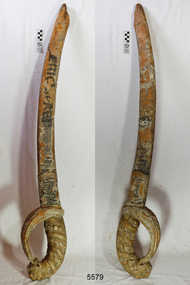
Decorative object - Sword, 1871 or earlier
... Darcy chief mate, James F. Lawrence second mate, Ned Sewall third mate and owner’s son, John French the cook, C. ...Darcy chief mate, James F. Lawrence second mate, Ned Sewall third mate and owner’s son, John French the cook, C. ...This wooden sword is said to “possibly be the only remaining part of the figurehead from the sailing ship Eric the Red.” It was previously part of the collection of the old Warrnambool Museum and the entry in its inventory says “Wooden sword, portion of the figurehead, held by “Eric the Red” at the bow.” A large part of the ship’s hull was found on the rocks and a figurehead may have been attached or washed up on the shore. The shipping records for E. & A. Sewall, the builders, owners and managers of Eric the Red, are now preserved in the Maine Maritime Museum. There is no photograph on record of Eric the Red but photographs of other ships built around that time by the same company show that these did not have figureheads, and there is no record found of a figurehead for Eric the Red being ordered or paid for. Further research is being carried out. The ship building company E. & A. Sewall, from Bath, Maine, USA, built Eric the Red, a wooden, three masted clipper ship. She had 1,580 tons register and was the largest full-rigged ship built at Bath, Maine, USA in 1871. She was built and registered by Arthur Sewall, later to become the partnership E. & A. Sewall, and was the 51st ship built by this company. The annually-published List of Merchant Vessels of the U.S. shows that Bath was still the home port of Eric the Red in 1880. The vessel was named after the Viking discoverer, Eric the Red, who was the first European to reach the shores of North America (in 980AD). The ship Eric the Red at first traded in coal between America and Britain, and later traded in guano nitrates from South America. In 1879 she was re-metalled and was in first class condition. On 10th June 1880 (some records say 12th June) Eric the Red departed New York for Melbourne and then Sydney. She had been commissioned by American trade representatives to carry a special cargo of 500 exhibits (1400 tons) - about a quarter to a third of America’s total exhibits - from America for the U.S.A. pavilion at Melbourne’s first International Exhibition. The exhibits included furniture, ironmongery, wines, chemicals, dental and surgical instruments, paper, cages, bronze lamp trimmings, axles, stamped ware, astronomical and time globes, samples of corn and the choicest of leaf tobacco. Other general cargo included merchandise such as cases of kerosene and turpentine, brooms, Bristol's Sarsaparilla, Wheeler and Wilson sewing machines, Wheeler’s thresher machine, axe handles and tools, cases of silver plate, toys, pianos and organs, carriages and Yankee notions. The Eric the Red left New York under the command of Captain Z. Allen (or some records say Captain Jacques Allen) and 24 other crew including the owner’s son third mate Ned Sewall. There were 2 saloon passengers also. On 4th September 1880 the ship had been sailing for an uneventful 85 days and the voyage was almost at its end. Eric the Red approached Cape Otway in a moderate north-west wind and hazy and overcast atmosphere. Around 1:30am Captain Allen sighted the Cape Otway light and was keeping the ship 5-6 miles offshore to stay clear of the hazardous Otway Reef. However he had badly misjudged his position. The ship hit the Otway Reef about 2 miles out to sea, south west of the Cape Otway light station. Captain Allen ordered the wheel to be put ‘hard up’ thinking that she might float off the reef. A heavy sea knocked the man away from the wheel, broke the wheel ropes and carried away the rudder. The sea swamped the lifeboats, the mizzenmast fell, with all of its rigging, then the mainmast fell and the ship broke in two. Some said that the passenger Vaughan, who was travelling for his health and not very strong, was washed overboard and never seen again. The ship started breaking up. The forward house came adrift with three of the crew on it as well as a longboat, which the men succeeded in launching and keeping afloat by continually bailing with their sea boots. The captain, the third mate (the owner’s son) and others clung to the mizzenmast in the sea. Then the owner’s son was washed away off the mast. Within 10 minutes the rest of the ship was in pieces, completely wrecked, with cargo and wreckage floating in the sea. The captain encouraged the second mate to swim with him to the deckhouse where there were other crew but the second mate wouldn’t go with him. Eventually the Captain made it to the deckhouse and the men pulled him up. At about 4:30am the group of men on the deckhouse saw the lights of a steamer and called for help. At the same time they noticed the second mate and the other man had drifted nearby, still on the spur, and pulled them both onto the wreck. The coastal steamer Dawn was returning to Warrnambool from Melbourne, its sailing time different to its usual schedule. Cries were heard coming from out of the darkness. Captain Jones sent out two life boats, and fired off rockets and blue lights to illuminate the area. They picked up the three survivors who were in the long boat from Eric the Red. Two men were picked up out of the water, one being the owner’s son who was clinging to floating kerosene boxes. At daylight the Dawn then rescued the 18 men from the floating portion of the deckhouse, which had drifted about 4 miles from where they’d struck the reef. Shortly after the rescue the deckhouse drifted onto breakers and was thrown onto rocks at Point Franklin, about 2 miles east of Cape Otway. Captain Jones had signalled to Cape Otway lighthouse the number of the Eric the Red and later signalled that there was a wreck at Otway Reef but there was no response from the lighthouse. The captain and crew of the Dawn spent several more hours searching unsuccessfully for more survivors, even going back as far as Apollo Bay. On board the Dawn the exhausted men received care and attention to their needs and wants, including much needed clothing. Captain Allen was amongst the 23 battered and injured men who were rescued and later taken to Warrnambool for care. Warrnambool’s mayor and town clerk offered them all hospitality, the three badly injured men going to the hospital and others to the Olive Branch Hotel, then on to Melbourne. Captain Allen’s leg injury prevented him from going ashore so he and three other men travelled on the Dawn to Portland. They were met by the mayor who also treated them all with great kindness. Captain Allen took the train back to Melbourne then returned to America. Those saved were Captain Z. Allen (or Jacques Allen), J. Darcy chief mate, James F. Lawrence second mate, Ned Sewall third mate and owner’s son, John French the cook, C. Nelson sail maker, Clarence W. New passenger, and the able seamen Dickenson, J. Black, Denis White, C. Herbert, C. Thompson, A. Brooks, D. Wilson, J. Ellis, Q. Thompson, C. Newman, W. Paul, J. Davis, M. Horenleng, J. Ogduff, T. W. Drew, R. Richardson. Four men had lost their lives; three of them were crew (Gus Dahlgreen ship’s carpenter, H. Ackman steward, who drowned in his cabin, and George Silver seaman) and one a passenger (J. B. Vaughan). The body of one of them had been found washed up at Cape Otway and was later buried in the lighthouse cemetery; another body was seen on an inaccessible ledge. Twelve months later the second mate James F. Lawrence, from Nova Scotia, passed away in the Warrnambool district; an obituary was displayed in the local paper. The captain and crew of the Dawn were recognised by the United States Government in July 1881 for their humane efforts and bravery, being thanked and presented with substantial monetary rewards, medals and gifts. Neither the ship, nor its cargo, was insured. The ship was worth about £15,000 and the cargo was reportedly worth £40,000; only about £2,000 worth had been recovered. Cargo and wreckage washed up at Apollo Bay, Peterborough, Port Campbell, Western Port and according to some reports, even as far away as the beaches of New Zealand. The day after the wreck the government steam ship Pharos was sent from Queenscliff to clear the shipping lanes of debris that could be a danger to ships. The large midship deckhouse of the ship was found floating in a calm sea near Henty Reef. Items such as an American chair, a ladder and a nest of boxes were all on top of the deckhouse. As it was so large and could cause danger to passing ships, Captain Payne had the deckhouse towed towards the shore just beyond Apollo Bay. Between Apollo Bay and Blanket Bay the captain and crew of Pharos collected Wheeler and Wilson sewing machines, nests of boxes, bottles of Bristol’s sarsaparilla, pieces of common American chairs, axe handles, a Wheelers’ Patent thresher and a sailor’s trunk with the words “A. James” on the front. A ship’s flag-board bearing the words “Eric the Red” was found on the deckhouse; finally those on board the Pharos had the name of the wrecked vessel. During this operation Pharos came across the government steamer Victoria and also a steamer S.S. Otway, both of which were picking up flotsam and wreckage. A whole side of the hull and three large pieces of the other side of the hull, with some of the copper sheathing stripped off, had floated on to Point Franklin. Some of the vessels yards and portions of her masts were on shore. The pieces of canvas attached to the yards and masts confirmed that the vessel had been under sail. The beach there was piled with debris several feet high. There were many cases of Diamond Oil kerosene, labelled R. W. Cameron and Company, New York. There were also many large planks of red pine, portions of a small white boat and a large, well-used oar. Other items found ashore included sewing machines (some consigned to ‘Long and Co.”) and notions, axe and scythe handles, hay forks, wooden pegs, rolls of wire (some branded “T.S” and Co, Melbourne”), kegs of nails branded “A.T. and Co.” from the factory of A. Field and Son, Taunton, Massachusetts, croquet balls and mallets, buggy fittings, rat traps, perfumery, cutlery and Douay Bibles, clocks, bicycles, chairs, a fly wheel, a cooking stove, timber, boxes, pianos, organs and a ladder. (Wooden clothes pegs drifted in for many years). There seemed to be no personal luggage or clothing. The Pharos encountered a long line, about one and a half miles, of floating wreckage about 10 miles off land, south east of Cape Otway, and in some places about 40 feet wide. It seemed that more than half of it was from Eric the Red. The ship’s crew rescued 3 cases that were for the Melbourne Exhibition and other items from amongst the debris. There were also chairs, doors, musical instruments, washing boards, nests of trunks and fly catchers floating in the sea. Most of the goods were saturated and smelt of kerosene. A section of the hull lies buried in the sand at Parker River Beach. An anchor with chain is embedded in the rocks east of Point Franklin and a second anchor, thought to be from Eric the Red, is on display at the Cape Otway light station. (There is a photograph of a life belt on the verandah of Rivernook Guest House in Princetown with the words “ERIC THE RED / BOSTON”. This is rather a mystery as the ship was registered in Bath, Maine, USA.) Parts of the ship are on display at Bimbi Park Caravan Park and at Apollo Bay Museum. Flagstaff Hill Maritime Village also has part of the helm (steering wheel), a carved wooden sword (said to be the only remaining portion of the ship’s figurehead; further research is currently being carried out), a door, a metal rod, samples of wood and a medal for bravery. Much of the wreckage was recovered by the local residents before police and other authorities arrived at the scene. Looters went to great effort to salvage goods, being lowered down the high cliff faces to areas with little or no beach to collect items from the wreckage, their mates above watching out for dangerous waves. A Tasmanian newspaper reports on a court case in Stawell, Victoria, noting a man who was caught 2 months later selling tobacco from the wreckage of Eric the Red. Some of the silverware is still treasured by descendants of Mr Mackenzie who was given these items by officials for his help in securing the cargo. The gifts included silver coffee and tea pots, half a dozen silver serviette rings and two sewing machines. The wreck and cargo were sold to a Melbourne man who salvaged a quantity of high quality tobacco and dental and surgical instruments. Timbers from the ship were salvaged and used in the construction of houses and sheds around Apollo Bay, including a guest house, Milford House (since burnt down in bushfires), which had furniture, fittings and timber on the dining room floor from the ship. A 39.7 foot long trading ketch, the Apollo, was also built from its timbers by Mr Burgess in 1883 and subsequently used in Tasmanian waters. It was the first attempt at ship building in Apollo bay. In 1881 a red light was installed about 300 feet above sea level at the base of the Cape Otway lighthouse to warn ships when they were too close to shore; It would not be visible unless a ship came within 3 miles from it. This has proved to be an effective warning. The State Library of Victoria has a lithograph in its collection depicting the steamer Dawn and the shipwrecked men, titled. "Wreck of the ship Eric the Red, Cape Otway: rescue of the crew by the Dawn".The Eric the Red is historically significant as one of Victoria's major 19th century shipwrecks. (Heritage Victoria Eric the Red; HV ID 239) The wreck led to the provision of an additional warning light placed below the Cape Otway lighthouse to alert mariners to the location of Otway Reef. The site is archaeologically significant for its remains of a large and varied cargo and ship's fittings being scattered over a wide area. The site is recreationally and aesthetically significant as it is one of the few sites along this coast where tourists can visit identifiable remains of a large wooden shipwreck, and for its location set against the background of Cape Otway, Bass Strait, and the Cape Otway lighthouse. (Victorian Heritage Database Registration Number S239, Official Number 8745 USA)This carved wooden sword, recovered from the Eric the Red, is possibly the only portion of the figurehead recovered after the wreck. There are spirals carved from the base of the handle to the top of the sword. The hilt of the sword is a lion’s head holding its tail in its mouth, the tail forming the handle. The blade of the sword has engraved patterns on it. Tiny particles of gold leaf and dark blue paint fragments can be seen between the carving marks. There are remnants of yellowish-orange and crimson paint on the handle. At some time after the sword was salvaged the name of the ship was hand painted on the blade in black paint. The tip of the sword has broken or split and the remaining part is charcoal in appearance. On both the tip and the base of the handle are parts made where the sword could have been joined onto the figurehead There is a white coating over some areas of the sword, similar to white lead putty used in traditional shipbuilding. The words “ERIC the RED” have been hand painted on the blade of the sword in black paint sometime after it was salvaged.flagstaff hill, flagstaff hill maritime museum and village, warrnambool, maritime museum, maritime village, great ocean road, shipwreck coast, sword, wooden sword, eric the red, carved sword, figurehead, snake head on sword -
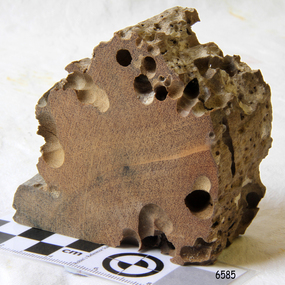 Flagstaff Hill Maritime Museum and Village
Wood Sample, about 1871
... Darcy chief mate, James F. Lawrence second mate, Ned Sewall third mate and owner’s son, John French the cook, C. ...Darcy chief mate, James F. Lawrence second mate, Ned Sewall third mate and owner’s son, John French the cook, C. ...This piece of timber from the ship Eric the Red has been eaten through by the marine animals called Teredo Worms, sometimes called sea worms or ‘termites of the sea’. The worms bore holes into wood that is immersed in sea water and bacteria inside the worms digest the wood. Shipbuilders tried to prevent this problem by using coatings of tar, wax, lead or pitch. In the 18th and 19th centuries the outside of their ships were sheathed in copper or a combination of copper and zinc (called Muntz metal) and would be re-metalled periodically to ensure the sheathing would remain effective. In more recent times the ships are protected with a toxic coating. The American ship Eric the Red was a wooden, three masted clipper ship. She had 1,580 tons register and was the largest full-rigged ship built at Bath, Maine, USA in 1871. She was built and registered by Arthur Sewall, later to become the partnership E. & A. Sewall, the 51st ship built by this company. The annually-published List of Merchant Vessels of the U.S. shows Bath was still the home port of Eric the Red in 1880. The vessel was named after the Viking discoverer, Eric ‘the Red-haired’ Thorvaldsson , who was the first European to reach the shores of North America (in 980AD). The ship Eric the Red at first traded in coal between America and Britain, and later traded in guano nitrates from South America. In 1879 she was re-metalled and was in first class condition. On 10th June 1880 (some records say 12th June) Eric the Red departed New York for Melbourne and then Sydney. She had been commissioned by American trade representatives to carry a special cargo of 500 exhibits (1400 tons) – about a quarter to a third of America’s total exhibits - for the U.S.A. pavilion at Melbourne’s first International Exhibition. The exhibits included furniture, ironmongery, wines, chemicals, dental and surgical instruments, paper, cages, bronze lamp trimmings, axles, stamped ware, astronomical and time globes, samples of corn and the choicest of leaf tobacco. Other general cargo included merchandise such as cases of kerosene and turpentine, brooms, Bristol's Sarsaparilla, Wheeler and Wilson sewing machines, Wheeler’s thresher machine, axe handles and tools, cases of silver plate, toys, pianos and organs, carriages and Yankee notions. The Eric the Red left New York under the command of Captain Zaccheus Allen (or some records say Captain Jacques Allen) and 24 other crew including the owner’s son third mate Ned Sewall. There were also 2 saloon passengers on board. The ship had been sailing for an uneventful 85 days and the voyage was almost at its end. As Eric the Red approached Cape Otway there was a moderate north-west wind and hazy and overcast atmosphere. On 4th September 1880 at about 1:30am Captain Allen sighted the Cape Otway light and was keeping the ship 5-6 miles offshore to stay clear of the hazardous Otway Reef. However he had badly misjudged his position. The ship hit the Otway Reef about 2 miles out to sea, south west of the Cape Otway light station. Captain Allen ordered the wheel to be put ‘hard up’ thinking that she might float off the reef. The sea knocked the helmsman away from the wheel, broke the wheel ropes and carried away the rudder. The lifeboats were swamped, the mizzenmast fell, with all of its rigging, then the mainmast also fell and the ship broke in two. Some said that the passenger Vaughan, who was travelling for his health and not very strong, was washed overboard and never seen again. The ship started breaking up. The forward house came adrift with three of the crew on it as well as a longboat, which the men succeeded in launching and keeping afloat by continually bailing with their sea boots. The captain, the third mate (the owner’s son) and others clung to the mizzenmast in the sea. Then the owner’s son was washed away off the mast. Within 10 minutes the rest of the ship was in pieces, completely wrecked, with cargo and wreckage floating in the sea. The captain encouraged the second mate to swim with him to the deckhouse where there were other crew but the second mate wouldn’t go with him. Eventually the Captain made it to the deckhouse and the men pulled him up. At about 4:30am the group of men on the deckhouse saw the lights of a steamer and called for help. At the same time they noticed the second mate and the other man had drifted nearby, still on the spur, and pulled them both onto the wreck. The coastal steamer SS Dawn was returning to Warrnambool from Melbourne, its sailing time different to its usual schedule. She was built in 1876 and bought by the Portland and Belfast Steam Navigation Co. in 1877. At the time of this journey she was commanded by Captain Jones, and was sailing between Melbourne and Portland via Warrnambool. The provedore of the Dawn, Benjamin Lear, heard cries of distress coming through the portholes of the saloon. He gave the alarm and the engines were stopped. Cries could be heard clearly, coming from the land. Captain Jones sent out crew in two boats, and fired off rockets and blue lights to illuminate the area. They picked up the three survivors who were in the long boat from Eric the Red. Two men were picked up out of the water, one being the owner’s son who was clinging to floating kerosene boxes. At daylight the Dawn then rescued the 18 men from the floating portion of the deckhouse, which had drifted about 4 miles from where they’d struck the reef. Shortly after the rescue the deckhouse drifted onto breakers and was thrown onto rocks at Point Franklin, about 2 miles east of Cape Otway. Captain Jones had signalled to Cape Otway lighthouse the number of the Eric the Red and later signalled that there was a wreck at Otway Reef but there was no response from the lighthouse. The captain and crew of the Dawn spent several more hours searching unsuccessfully for more survivors, even going back as far as Apollo Bay. On board the Dawn the exhausted men received care and attention to their needs and wants, including much needed clothing. Captain Allen was amongst the 23 battered and injured men who were rescued and later taken to Warrnambool for care. Warrnambool’s mayor and town clerk offered them all hospitality, the three badly injured men going to the hospital for care and others to the Olive Branch Hotel, then on to Melbourne. Captain Allen’s leg injury prevented him from going ashore so he and three other men travelled on the Dawn to Portland. They were met by the mayor who also treated them all with great kindness. Captain Allen took the train back to Melbourne then returned to America. Those saved were Captain Zaccheus Allen (or Jacques Allen), J. Darcy chief mate, James F. Lawrence second mate, Ned Sewall third mate and owner’s son, John French the cook, C. Nelson sail maker, Clarence W. New passenger, and the able seamen Dickenson, J. Black, Denis White, C. Herbert, C. Thompson, A. Brooks, D. Wilson, J. Ellis, Q. Thompson, C. Newman, W. Paul, J. Davis, M. Horenleng, J. Ogduff, T. W. Drew, R. Richardson. Four men had lost their lives; three of them were crew (Gus Dahlgreen ship’s carpenter, H. Ackman steward, who drowned in his cabin, and George Silver seaman) and one a passenger (J. B. Vaughan). The body of one of them had been found washed up at Cape Otway and was later buried in the lighthouse cemetery; another body was seen on an inaccessible ledge. Twelve months later the second mate James F. Lawrence, from Nova Scotia, passed away in the Warrnambool district; an obituary was displayed in the local paper. Neither the ship, nor its cargo, was insured. The ship was worth about £15,000 and the cargo was reportedly worth £40,000; only about £2,000 worth had been recovered. Cargo and wreckage washed up at Apollo Bay, Peterborough, Port Campbell, Western Port and according to some reports, even as far away as the beaches of New Zealand. The day after the wreck the government steam ship Pharos was sent from Queenscliff to clear the shipping lanes of debris that could be a danger to ships. The large midship deckhouse of the ship was found floating in a calm sea near Henty Reef. Items such as an American chair, a ladder and a nest of boxes were all on top of the deckhouse. As it was so large and could cause danger to passing ships, Captain Payne had the deckhouse towed towards the shore just beyond Apollo Bay. Between Apollo Bay and Blanket Bay the captain and crew of Pharos collected Wheeler and Wilson sewing machines, nests of boxes, bottles of Bristol’s sarsaparilla, pieces of common American chairs, axe handles, a Wheelers’ Patent thresher and a sailor’s trunk with the words “A. James” on the front. A ship’s flag-board bearing the words “Eric the Red” was found on the deckhouse; finally those on board the Pharos had the name of the wrecked vessel. During this operation Pharos came across the government steamer Victoria and also a steamer S.S. Otway, both of which were picking up flotsam and wreckage. A whole side of the hull and three large pieces of the other side of the hull, with some of the copper sheathing stripped off, had floated on to Point Franklin. Some of the vessels yards and portions of her masts were on shore. The pieces of canvas attached to the yards and masts confirmed that the vessel had been under sail. The beach there was piled with debris several feet high. There were many cases of Diamond Oil kerosene, labelled R. W. Cameron and Company, New York. There were also many large planks of red pine, portions of a small white boat and a large, well-used oar. Other items found ashore included sewing machines (some consigned to ‘Long and Co.”) and notions, axe and scythe handles, hay forks, wooden pegs, rolls of wire (some branded “T.S” and Co, Melbourne”), kegs of nails branded “A.T. and Co.” from the factory of A. Field and Son, Taunton, Massachusetts, croquet balls and mallets, buggy fittings, rat traps, perfumery, cutlery and Douay Bibles, clocks, bicycles, chairs, a fly wheel, a cooking stove, timber, boxes, pianos, organs and a ladder. (Wooden clothes pegs drifted in for many years). There seemed to be no personal luggage or clothing. The Pharos encountered a long line, about one and a half miles, of floating wreckage about 10 miles off land, south east of Cape Otway, and in some places about 40 feet wide. It seemed that more than half of it was from Eric the Red. The ship’s crew rescued 3 cases that were for the Melbourne Exhibition and other items from amongst the debris. There were also chairs, doors, musical instruments, washing boards, nests of trunks and fly catchers floating in the sea. Most of the goods were saturated and smelt of kerosene. A section of the hull lies buried in the sand at Parker River Beach. An anchor with chain is embedded in the rocks east of Point Franklin and a second anchor, thought to be from Eric the Red, is on display at the Cape Otway light station. (There is a photograph of a life belt on the verandah of Rivernook Guest House in Princetown with the words “ERIC THE RED / BOSTON”. This is rather a mystery as the ship was registered in Bath, Maine, USA.) Parts of the ship are on display at Bimbi Park Caravan Park and at Apollo Bay Museum. Flagstaff Hill Maritime Village also has part of the helm (steering wheel), a carved wooden sword (said to be the only remaining portion of the ship’s figurehead; further research is currently being carried out), a door, a metal rod, several samples of wood and a medal for bravery, awarded to Nelson Johnson, a crew member of the S.S. Dawn by the U.S. President, for the rescue of the crew. Much of the wreckage was recovered by the local residents before police and other authorities arrived at the scene. Looters went to great effort to salvage goods, being lowered down the high cliff faces to areas with little or no beach to collect items from the wreckage, their mates above watching out for dangerous waves. A Tasmanian newspaper reports on a court case in Stawell, Victoria, noting a man who was caught 2 months later selling tobacco from the wreckage of Eric the Red. Some of the silverware is still treasured by descendants of Mr Mackenzie who was given these items by officials for his help in securing the cargo. The gifts included silver coffee and tea pots, half a dozen silver serviette rings and two sewing machines. A Mr G.W. Black has in his possession a medal and a purse that were awarded to his father, another Dawn crew member who was part of the rescue team. The medal is inscribed and named “To John Black ….” (from “Shipwrecks” by Margaret E. Mackenzie, 3rd edition, published 1964). The wreck and cargo were sold to a Melbourne man who salvaged a quantity of high quality tobacco and dental and surgical instruments. Timbers from the ship were salvaged and used in the construction of houses and sheds around Apollo Bay, including a guest house, Milford House (since burnt down in bushfires), which had furniture, fittings and timber on the dining room floor from the ship. A 39.7 foot long trading ketch, the Apollo, was also built from its timbers by Mr Burgess in 1883 and subsequently used in Tasmanian waters. It was the first attempt at ship building in Apollo bay. In 1881 a red light was installed about 300 feet above sea level at the base of the Cape Otway lighthouse to warn ships when they were too close to shore; It would not be visible unless a ship came within 3 miles from it. This has proved to be an effective warning. Nelson Johnson, recipient of the medal for bravery, married Elizabeth Howard in 1881 and they had 10 children. They lived in South Melbourne, Victoria. Nelson died in 1922 in Fitzroy Victoria, age 66. In 1895 the owners of the S.S. Dawn, the Portland and Belfast Steam Navigation Co., wound up and sold out to the Belfast Company who took over the Dawn for one year before selling her to Howard Smith. She was condemned and sunk in Suva in 1928. The State Library of Victoria has a lithograph in its collection depicting the steamer Dawn and the shipwrecked men, titled. "Wreck of the ship Eric the Red, Cape Otway: rescue of the crew by the Dawn".The wood (timber) sample is listed on the Collections Australia Database, Heritage Victoria, number 239 00010 A “The Eric the Red is historically significant as one of Victoria's major 19th century shipwrecks. (Heritage Victoria Eric the Red; HV ID 239) The wreck led to the provision of an additional warning light placed below the Cape Otway lighthouse to alert mariners to the location of Otway Reef. The site is archaeologically significant for its remains of a large and varied cargo and ship's fittings being scattered over a wide area. The site is recreationally and aesthetically significant as it is one of the few sites along this coast where tourists can visit identifiable remains of a large wooden shipwreck, and for its location set against the background of Cape Otway, Bass Strait, and the Cape Otway lighthouse.“ (Victorian Heritage Database Registration Number S239, Official Number 8745 USA) Wood sample from the wreck of the ship Eric the Red. Triangular shaped, full of sea worm (Teredo worm) holes. The wood is dark in colour and is very light in weight.flagstaff hill, warrnambool, shipwrecked-coast, flagstaff-hill, flagstaff-hill-maritime-museum, maritime-museum, shipwreck-coast, flagstaff-hill-maritime-village, shipwreck-artefact, eric-the-red, zaccheus-allen, sewall, 1880, melbourne-exhibition, cape-otway, otway-reef, wood-sample, s.s.-dawn -
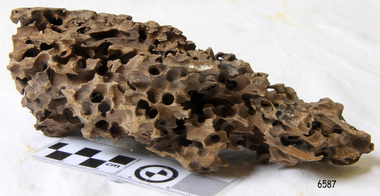 Flagstaff Hill Maritime Museum and Village
Wood Sample, About 1871
... Darcy chief mate, James F. Lawrence second mate, Ned Sewall third mate and owner’s son, John French the cook, C. ...Darcy chief mate, James F. Lawrence second mate, Ned Sewall third mate and owner’s son, John French the cook, C. ...This piece of timber from the ship Eric the Red has been eaten through by the marine animals called Teredo Worms, sometimes called sea worms or ‘termites of the sea’. The worms bore holes into wood that is immersed in sea water and bacteria inside the worms digest the wood. Shipbuilders tried to prevent this problem by using coatings of tar, wax, lead or pitch. In the 18th and 19th centuries the outside of their ships were sheathed in copper or a combination of copper and zinc (called Muntz metal) and would be re-metalled periodically to ensure the sheathing would remain effective. In more recent times the ships are protected with a toxic coating. The American ship Eric the Red was a wooden, three masted clipper ship. She had 1,580 tons register and was the largest full-rigged ship built at Bath, Maine, USA in 1871. She was built and registered by Arthur Sewall, later to become the partnership E. & A. Sewall, the 51st ship built by this company. The annually-published List of Merchant Vessels of the U.S. shows Bath was still the home port of Eric the Red in 1880. The vessel was named after the Viking discoverer, Eric ‘the Red-haired’ Thorvaldsson , who was the first European to reach the shores of North America (in 980AD). The ship Eric the Red at first traded in coal between America and Britain, and later traded in guano nitrates from South America. In 1879 she was re-metalled and was in first class condition. On 10th June 1880 (some records say 12th June) Eric the Red departed New York for Melbourne and then Sydney. She had been commissioned by American trade representatives to carry a special cargo of 500 exhibits (1400 tons) – about a quarter to a third of America’s total exhibits - for the U.S.A. pavilion at Melbourne’s first International Exhibition. The exhibits included furniture, ironmongery, wines, chemicals, dental and surgical instruments, paper, cages, bronze lamp trimmings, axles, stamped ware, astronomical and time globes, samples of corn and the choicest of leaf tobacco. Other general cargo included merchandise such as cases of kerosene and turpentine, brooms, Bristol's Sarsaparilla, Wheeler and Wilson sewing machines, Wheeler’s thresher machine, axe handles and tools, cases of silver plate, toys, pianos and organs, carriages and Yankee notions. The Eric the Red left New York under the command of Captain Zaccheus Allen (or some records say Captain Jacques Allen) and 24 other crew including the owner’s son third mate Ned Sewall. There were also 2 saloon passengers on board. The ship had been sailing for an uneventful 85 days and the voyage was almost at its end. As Eric the Red approached Cape Otway there was a moderate north-west wind and hazy and overcast atmosphere. On 4th September 1880 at about 1:30am Captain Allen sighted the Cape Otway light and was keeping the ship 5-6 miles offshore to stay clear of the hazardous Otway Reef. However he had badly misjudged his position. The ship hit the Otway Reef about 2 miles out to sea, south west of the Cape Otway light station. Captain Allen ordered the wheel to be put ‘hard up’ thinking that she might float off the reef. The sea knocked the helmsman away from the wheel, broke the wheel ropes and carried away the rudder. The lifeboats were swamped, the mizzenmast fell, with all of its rigging, then the mainmast also fell and the ship broke in two. Some said that the passenger Vaughan, who was travelling for his health and not very strong, was washed overboard and never seen again. The ship started breaking up. The forward house came adrift with three of the crew on it as well as a longboat, which the men succeeded in launching and keeping afloat by continually bailing with their sea boots. The captain, the third mate (the owner’s son) and others clung to the mizzenmast in the sea. Then the owner’s son was washed away off the mast. Within 10 minutes the rest of the ship was in pieces, completely wrecked, with cargo and wreckage floating in the sea. The captain encouraged the second mate to swim with him to the deckhouse where there were other crew but the second mate wouldn’t go with him. Eventually the Captain made it to the deckhouse and the men pulled him up. At about 4:30am the group of men on the deckhouse saw the lights of a steamer and called for help. At the same time they noticed the second mate and the other man had drifted nearby, still on the spur, and pulled them both onto the wreck. The coastal steamer SS Dawn was returning to Warrnambool from Melbourne, its sailing time different to its usual schedule. She was built in 1876 and bought by the Portland and Belfast Steam Navigation Co. in 1877. At the time of this journey she was commanded by Captain Jones, and was sailing between Melbourne and Portland via Warrnambool. The provedore of the Dawn, Benjamin Lear, heard cries of distress coming through the portholes of the saloon. He gave the alarm and the engines were stopped. Cries could be heard clearly, coming from the land. Captain Jones sent out crew in two boats, and fired off rockets and blue lights to illuminate the area. They picked up the three survivors who were in the long boat from Eric the Red. Two men were picked up out of the water, one being the owner’s son who was clinging to floating kerosene boxes. At daylight the Dawn then rescued the 18 men from the floating portion of the deckhouse, which had drifted about 4 miles from where they’d struck the reef. Shortly after the rescue the deckhouse drifted onto breakers and was thrown onto rocks at Point Franklin, about 2 miles east of Cape Otway. Captain Jones had signalled to Cape Otway lighthouse the number of the Eric the Red and later signalled that there was a wreck at Otway Reef but there was no response from the lighthouse. The captain and crew of the Dawn spent several more hours searching unsuccessfully for more survivors, even going back as far as Apollo Bay. On board the Dawn the exhausted men received care and attention to their needs and wants, including much needed clothing. Captain Allen was amongst the 23 battered and injured men who were rescued and later taken to Warrnambool for care. Warrnambool’s mayor and town clerk offered them all hospitality, the three badly injured men going to the hospital for care and others to the Olive Branch Hotel, then on to Melbourne. Captain Allen’s leg injury prevented him from going ashore so he and three other men travelled on the Dawn to Portland. They were met by the mayor who also treated them all with great kindness. Captain Allen took the train back to Melbourne then returned to America. Those saved were Captain Zaccheus Allen (or Jacques Allen), J. Darcy chief mate, James F. Lawrence second mate, Ned Sewall third mate and owner’s son, John French the cook, C. Nelson sail maker, Clarence W. New passenger, and the able seamen Dickenson, J. Black, Denis White, C. Herbert, C. Thompson, A. Brooks, D. Wilson, J. Ellis, Q. Thompson, C. Newman, W. Paul, J. Davis, M. Horenleng, J. Ogduff, T. W. Drew, R. Richardson. Four men had lost their lives; three of them were crew (Gus Dahlgreen ship’s carpenter, H. Ackman steward, who drowned in his cabin, and George Silver seaman) and one a passenger (J. B. Vaughan). The body of one of them had been found washed up at Cape Otway and was later buried in the lighthouse cemetery; another body was seen on an inaccessible ledge. Twelve months later the second mate James F. Lawrence, from Nova Scotia, passed away in the Warrnambool district; an obituary was displayed in the local paper. Neither the ship, nor its cargo, was insured. The ship was worth about £15,000 and the cargo was reportedly worth £40,000; only about £2,000 worth had been recovered. Cargo and wreckage washed up at Apollo Bay, Peterborough, Port Campbell, Western Port and according to some reports, even as far away as the beaches of New Zealand. The day after the wreck the government steam ship Pharos was sent from Queenscliff to clear the shipping lanes of debris that could be a danger to ships. The large midship deckhouse of the ship was found floating in a calm sea near Henty Reef. Items such as an American chair, a ladder and a nest of boxes were all on top of the deckhouse. As it was so large and could cause danger to passing ships, Captain Payne had the deckhouse towed towards the shore just beyond Apollo Bay. Between Apollo Bay and Blanket Bay the captain and crew of Pharos collected Wheeler and Wilson sewing machines, nests of boxes, bottles of Bristol’s sarsaparilla, pieces of common American chairs, axe handles, a Wheelers’ Patent thresher and a sailor’s trunk with the words “A. James” on the front. A ship’s flag-board bearing the words “Eric the Red” was found on the deckhouse; finally those on board the Pharos had the name of the wrecked vessel. During this operation Pharos came across the government steamer Victoria and also a steamer S.S. Otway, both of which were picking up flotsam and wreckage. A whole side of the hull and three large pieces of the other side of the hull, with some of the copper sheathing stripped off, had floated on to Point Franklin. Some of the vessels yards and portions of her masts were on shore. The pieces of canvas attached to the yards and masts confirmed that the vessel had been under sail. The beach there was piled with debris several feet high. There were many cases of Diamond Oil kerosene, labelled R. W. Cameron and Company, New York. There were also many large planks of red pine, portions of a small white boat and a large, well-used oar. Other items found ashore included sewing machines (some consigned to ‘Long and Co.”) and notions, axe and scythe handles, hay forks, wooden pegs, rolls of wire (some branded “T.S” and Co, Melbourne”), kegs of nails branded “A.T. and Co.” from the factory of A. Field and Son, Taunton, Massachusetts, croquet balls and mallets, buggy fittings, rat traps, perfumery, cutlery and Douay Bibles, clocks, bicycles, chairs, a fly wheel, a cooking stove, timber, boxes, pianos, organs and a ladder. (Wooden clothes pegs drifted in for many years). There seemed to be no personal luggage or clothing. The Pharos encountered a long line, about one and a half miles, of floating wreckage about 10 miles off land, south east of Cape Otway, and in some places about 40 feet wide. It seemed that more than half of it was from Eric the Red. The ship’s crew rescued 3 cases that were for the Melbourne Exhibition and other items from amongst the debris. There were also chairs, doors, musical instruments, washing boards, nests of trunks and fly catchers floating in the sea. Most of the goods were saturated and smelt of kerosene. A section of the hull lies buried in the sand at Parker River Beach. An anchor with chain is embedded in the rocks east of Point Franklin and a second anchor, thought to be from Eric the Red, is on display at the Cape Otway light station. (There is a photograph of a life belt on the verandah of Rivernook Guest House in Princetown with the words “ERIC THE RED / BOSTON”. This is rather a mystery as the ship was registered in Bath, Maine, USA.) Parts of the ship are on display at Bimbi Park Caravan Park and at Apollo Bay Museum. Flagstaff Hill Maritime Village also has part of the helm (steering wheel), a carved wooden sword (said to be the only remaining portion of the ship’s figurehead; further research is currently being carried out), a door, a metal rod, several samples of wood and a medal for bravery, awarded to Nelson Johnson, a crew member of the S.S. Dawn by the U.S. President, for the rescue of the crew. Much of the wreckage was recovered by the local residents before police and other authorities arrived at the scene. Looters went to great effort to salvage goods, being lowered down the high cliff faces to areas with little or no beach to collect items from the wreckage, their mates above watching out for dangerous waves. A Tasmanian newspaper reports on a court case in Stawell, Victoria, noting a man who was caught 2 months later selling tobacco from the wreckage of Eric the Red. Some of the silverware is still treasured by descendants of Mr Mackenzie who was given these items by officials for his help in securing the cargo. The gifts included silver coffee and tea pots, half a dozen silver serviette rings and two sewing machines. A Mr G.W. Black has in his possession a medal and a purse that were awarded to his father, another Dawn crew member who was part of the rescue team. The medal is inscribed and named “To John Black ….” (from “Shipwrecks” by Margaret E. Mackenzie, 3rd edition, published 1964). The wreck and cargo were sold to a Melbourne man who salvaged a quantity of high quality tobacco and dental and surgical instruments. Timbers from the ship were salvaged and used in the construction of houses and sheds around Apollo Bay, including a guest house, Milford House (since burnt down in bushfires), which had furniture, fittings and timber on the dining room floor from the ship. A 39.7 foot long trading ketch, the Apollo, was also built from its timbers by Mr Burgess in 1883 and subsequently used in Tasmanian waters. It was the first attempt at ship building in Apollo bay. In 1881 a red light was installed about 300 feet above sea level at the base of the Cape Otway lighthouse to warn ships when they were too close to shore; It would not be visible unless a ship came within 3 miles from it. This has proved to be an effective warning. Nelson Johnson, recipient of the medal for bravery, married Elizabeth Howard in 1881 and they had 10 children. They lived in South Melbourne, Victoria. Nelson died in 1922 in Fitzroy Victoria, age 66. In 1895 the owners of the S.S. Dawn, the Portland and Belfast Steam Navigation Co., wound up and sold out to the Belfast Company who took over the Dawn for one year before selling her to Howard Smith. She was condemned and sunk in Suva in 1928. The State Library of Victoria has a lithograph in its collection depicting the steamer Dawn and the shipwrecked men, titled. "Wreck of the ship Eric the Red, Cape Otway: rescue of the crew by the Dawn".The wood (timber) sample is listed on the Collections Australia Database, Heritage Victoria, number 239 00010 A “The Eric the Red is historically significant as one of Victoria's major 19th century shipwrecks. (Heritage Victoria Eric the Red; HV ID 239) The wreck led to the provision of an additional warning light placed below the Cape Otway lighthouse to alert mariners to the location of Otway Reef. The site is archaeologically significant for its remains of a large and varied cargo and ship's fittings being scattered over a wide area. The site is recreationally and aesthetically significant as it is one of the few sites along this coast where tourists can visit identifiable remains of a large wooden shipwreck, and for its location set against the background of Cape Otway, Bass Strait, and the Cape Otway lighthouse.“ (Victorian Heritage Database Registration Number S239, Official Number 8745 USA) Wood sample from the wreck of the ship Eric the Red. Oblong shaped, full of sea worm (Teredo worm) holes. The wood is dark in colour and is very light in weight. flagstaff hill, warrnambool, shipwrecked-coast, flagstaff-hill, flagstaff-hill-maritime-museum, maritime-museum, shipwreck-coast, flagstaff-hill-maritime-village, shipwreck-artefact, eric-the-red, zaccheus-allen, sewall, 1880, melbourne-exhibition, cape-otway, otway-reef, wood-sample, s.s.-dawn -
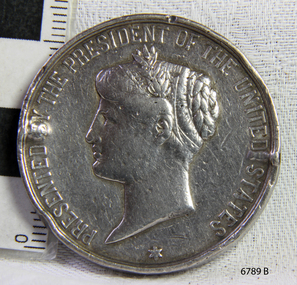 Flagstaff Hill Maritime Museum and Village
Award - Medal, Nelson Johnson, November 1880
... Darcy chief mate, James F. Lawrence second mate, Ned Sewall third mate and owner’s son, John French the cook, C. ...Darcy chief mate, James F. Lawrence second mate, Ned Sewall third mate and owner’s son, John French the cook, C. ...This medal for bravery, for rescue of the crew from the shipwreck “Eric the Red” on 4th September 1880, was awarded to one of the crew of the steamer S.S. Dawn by the President of the United States in July 1881. The medal is engraved with the name “Nelson Johnson” (the anglicised version of his Swedish name Neils Frederick Yohnson). It was donated to Flagstaff Hill Maritime Village in 2013 by Nelson’s granddaughter. Nelson had migrated from Sweden to Sydney in 1879. The next year in 1880, aged 24, he was a seaman on the steamship Dawn and involved in the rescue of the survivors of the Eric the Red. Nelson Johnson was a crew member of the S.S. Dawn and was one of the rescue team in the dinghy in the early morning of September 4th 1880. Medals were awarded to the Captain and crew of the S.S. Dawn by the President of the United States, through the Consul-general (Mr Oliver M. Spencer), in July 1881 “ … in recognition of their humane efforts in rescuing the 23 survivors of the American built wooden sailing ship, the Eric the Red, on 4th September 1880.” The men were also presented with substantial monetary rewards and gifts. The city of Warrnambool’s care of the survivors was also mentioned by the President at the presentation, saying that “the city hosted and supported the crew ‘most graciously’. Previously, a week after the shipwreck, the Australian Government had also conveyed its thanks to the Captain and crew of the S.S. Dawn “Captain Griffith Jones, S.S. Dawn, The Hon. Mr Clark desires that the thanks of the Government should be conveyed to you for the prompt, persevering and seamanlike qualities displayed by you, your officers and crew in saving the number of lives you did on the occasion referred to. The hon. The Commissioner has also been pleased to award you a souvenir in commemoration of the occasion, and a sum of 65 pounds to be awarded to your officers and crew according to annexed scale. I am, &c, W Collins Rees, for and in the absence of the Chief Harbour Master.” The Awards are as follows: - Crew of DAWN'S lifeboat-Chief Officer, Mr G. Peat, 15 pounds; boat's crew-G. Sterge, A.B., 5 pounds; T. Hammond, A.B., 5 pounds; J. Black, A.B., 5 pounds; H. Edwards, A.B., 5 pounds. Dinghy's Crew-Second Officer, Mr Christie, 10 pounds; boat's crew -F. Lafer, A.B., 5 pounds; W. Johnstone, A.B., 5 pounds; Mr Lear, provedore, 5 pounds; Mr Dove, purser, 5 pounds. Captain Jones receives a piece of plate. (from “Wreck of the ship Eric the Red” by Jack Loney) The medal’s history, according to the Editor of ‘E-Sylum’ (the newsletter of The Numismatic Bibliomania Society “… appears to be an example of an 1880 State Department medal, catalogued as LS-3 (page 322 of R. W. Julian's book, Medals of the United States Mint: The First Century 1792-1892). The reverse is mostly blank for engraving, surrounded by a thin wreath. It was designed by George Morgan, chief engraver for the Philadelphia Mint, and struck in gold, silver and bronze. The one pictured here (in The Standard newspaper, 2nd July 2013) appears to be silver.” The following is an account of the events which led to the awarding of this medal. The American ship Eric the Red was a wooden, three-masted clipper ship. She had 1,580 tons register and was the largest full-rigged ship built at Bath, Maine, USA in 1871. She was built and registered by Arthur Sewall, later to become the partnership E. & A. Sewall, the 51st ship built by this company. The annually-published List of Merchant Vessels of the U.S. shows Bath was still the home port of Eric the Red in 1880. The vessel was named after the Viking discoverer, Eric ‘the Red-haired’ Thorvaldsson, who was the first European to reach the shores of North America (in 980AD). The ship Eric the Red at first traded in coal between America and Britain, and later traded in guano nitrates from South America. In 1879 she was re-metalled and was in first-class condition. On 10th June 1880 (some records say 12th June) Eric the Red departed New York for Melbourne and then Sydney. She had been commissioned by American trade representatives to carry a special cargo of 500 exhibits (1400 tons) – about a quarter to a third of America’s total exhibits - for the U.S.A. pavilion at Melbourne’s first International Exhibition. The exhibits included furniture, ironmongery, wines, chemicals, dental and surgical instruments, paper, cages, bronze lamp trimmings, axles, stamped ware, astronomical and time globes, samples of corn and the choicest of leaf tobacco. Other general cargo included merchandise such as cases of kerosene and turpentine, brooms, Bristol's Sarsaparilla, Wheeler and Wilson sewing machines, Wheeler’s thresher machine, axe handles and tools, cases of silver plate, toys, pianos and organs, carriages and Yankee notions. The Eric the Red left New York under the command of Captain Zaccheus Allen (or some records say Captain Jacques Allen) and 24 other crew including the owner’s son third mate Ned Sewall. There were also 2 saloon passengers on board. The ship had been sailing for an uneventful 85 days and the voyage was almost at its end. As Eric the Red approached Cape Otway there was a moderate north-west wind and a hazy and overcast atmosphere. On 4th September 1880 at about 1:30 am Captain Allen sighted the Cape Otway light and was keeping the ship 5-6 miles offshore to stay clear of the hazardous Otway Reef. However, he had badly misjudged his position. The ship hit the Otway Reef about 2 miles out to sea, southwest of the Cape Otway light station. Captain Allen ordered the wheel to be put ‘hard up’ thinking that she might float off the reef. The sea knocked the helmsman away from the wheel, broke the wheel ropes and carried away the rudder. The lifeboats were swamped, the mizzenmast fell, with all of its riggings, then the mainmast also fell and the ship broke in two. Some said that the passenger Vaughan, who was travelling for his health and not very strong, was washed overboard and never seen again. The ship started breaking up. The forward house came adrift with three of the crew on it as well as a longboat, which the men succeeded in launching and keeping afloat by continually bailing with their sea boots. The captain, the third mate (the owner’s son) and others clung to the mizzenmast in the sea. Then the owner’s son was washed away off the mast. Within 10 minutes the rest of the ship was in pieces, completely wrecked, with cargo and wreckage floating in the sea. The captain encouraged the second mate to swim with him to the deckhouse where there were other crew but the second mate wouldn’t go with him. Eventually, the Captain made it to the deckhouse and the men pulled him up. At about 4:30 am the group of men on the deckhouse saw the lights of a steamer and called for help. At the same time, they noticed the second mate and the other man had drifted nearby, still on the spur, and pulled them both onto the wreck. The coastal steamer SS Dawn was returning to Warrnambool from Melbourne, and its sailing time was different to its usual schedule. She was built in 1876 and bought by the Portland and Belfast Steam Navigation Co. in 1877. At the time of this journey, she was commanded by Captain Jones and was sailing between Melbourne and Portland via Warrnambool. The provedore the Dawn, Benjamin Lear, heard cries of distress coming through the portholes of the saloon. He gave the alarm and the engines were stopped. Cries could be heard clearly, coming from the land. Captain Jones sent out crew in two boats and fired off rockets and blue lights to illuminate the area. They picked up the three survivors who were in the long boat from Eric the Red. Two men were picked up out of the water, one being the owner’s son who was clinging to floating kerosene boxes. At daylight, the Dawn then rescued the 18 men from the floating portion of the deckhouse, which had drifted about 4 miles from where they’d struck the reef. Shortly after the rescue the deckhouse drifted onto breakers and was thrown onto rocks at Point Franklin, about 2 miles east of Cape Otway. Captain Jones had signalled to Cape Otway lighthouse the number of the Eric the Red and later signalled that there was a wreck at Otway Reef but there was no response from the lighthouse. The captain and crew of the Dawn spent several more hours searching unsuccessfully for more survivors, even going back as far as Apollo Bay. On board the Dawn the exhausted men received care and attention to their needs and wants, including much-needed clothing. Captain Allen was amongst the 23 battered and injured men who were rescued and later taken to Warrnambool for care. Warrnambool’s mayor and town clerk offered them all hospitality, the three badly injured men going to the hospital for care and others to the Olive Branch Hotel, then on to Melbourne. Captain Allen’s leg injury prevented him from going ashore so he and three other men travelled on the Dawn to Portland. They were met by the mayor who also treated them all with great kindness. Captain Allen took the train back to Melbourne then returned to America. Those saved were Captain Zaccheus Allen (or Jacques Allen), J. Darcy chief mate, James F. Lawrence second mate, Ned Sewall third mate and owner’s son, John French the cook, C. Nelson sail maker, Clarence W. New passenger, and able seamen Dickenson, J. Black, Denis White, C. Herbert, C. Thompson, A. Brooks, D. Wilson, J. Ellis, Q. Thompson, C. Newman, W. Paul, J. Davis, M. Horenleng, J. Ogduff, T. W. Drew, R. Richardson. Four men had lost their lives; three of them were crew (Gus Dahlgreen ship’s carpenter, H. Ackman steward, who drowned in his cabin, and George Silver seaman) and one a passenger (J. B. Vaughan). The body of one of them had been found washed up at Cape Otway and was later buried in the lighthouse cemetery; another body was seen on an inaccessible ledge. Twelve months later the second mate James F. Lawrence, from Nova Scotia passed away in the Warrnambool district; an obituary was displayed in the local paper. Neither the ship nor its cargo was insured. The ship was worth about £15,000 and the cargo was reportedly worth £40,000; only about £2,000 worth had been recovered. Cargo and wreckage washed up at Apollo Bay, Peterborough, Port Campbell, Western Port and according to some reports, even as far away as the beaches of New Zealand. The day after the wreck the government steamship Pharos was sent from Queenscliff to clear the shipping lanes of debris that could be a danger to ships. The large midship deckhouse of the ship was found floating in a calm sea near Henty Reef. Items such as an American chair, a ladder and a nest of boxes were all on top of the deckhouse. As it was so large and could cause danger to passing ships, Captain Payne had the deckhouse towed towards the shore just beyond Apollo Bay. Between Apollo Bay and Blanket Bay, the captain and crew of Pharos collected Wheeler and Wilson sewing machines, nests of boxes, bottles of Bristol’s sarsaparilla, pieces of common American chairs, axe handles, a Wheelers’ Patent thresher and a sailor’s trunk with the words “A. James” on the front. A ship’s flag-board bearing the words “Eric the Red” was found on the deckhouse; finally, those on board the Pharos had the name of the wrecked vessel. During this operation, Pharos came across the government steamer Victoria and also a steamer S.S. Otway, both of which were picking up flotsam and wreckage. A whole side of the hull and three large pieces of the other side of the hull, with some of the copper sheathing stripped off, had floated onto Point Franklin. Some of the vessels' yards and portions of her masts were on shore. The pieces of canvas attached to the yards and masts confirmed that the vessel had been under sail. The beach there was piled with debris several feet high. There were many cases of Diamond Oil kerosene, labelled R. W. Cameron and Company, New York. There were also many large planks of red pine, portions of a small white boat and a large, well-used oar. Other items found ashore included sewing machines (some consigned to ‘Long and Co.”) and notions, axe and scythe handles, hay forks, wooden pegs, rolls of wire (some branded “T.S” and Co, Melbourne”), kegs of nails branded “A.T. and Co.” from the factory of A. Field and Son, Taunton, Massachusetts, croquet balls and mallets, buggy fittings, rat traps, perfumery, cutlery and Douay Bibles, clocks, bicycles, chairs, a fly wheel, a cooking stove, timber, boxes, pianos, organs and a ladder. (Wooden clothes pegs drifted in for many years). There seemed to be no personal luggage or clothing. The Pharos encountered a long line, about one and a half miles, of f locating wreckage about 10 miles off land, southeast of Cape Otway, and in some places about 40 feet wide. It seemed that more than half of it was from Eric the Red. The ship’s crew rescued 3 cases that were for the Melbourne Exhibition and other items from amongst the debris. There were also chairs, doors, musical instruments, washing boards, nests of trunks and flycatchers floating in the sea. Most of the goods were saturated and smelt of kerosene. A section of the hull lies buried in the sand at Parker River Beach. An anchor with a chain is embedded in the rocks east of Point Franklin and a second anchor, thought to be from Eric the Red, is on display at the Cape Otway light station. (There is a photograph of a life belt on the verandah of Rivernook Guest House in Princetown with the words “ERIC THE RED / BOSTON”. This is rather a mystery as the ship was registered in Bath, Maine, USA.) Parts of the ship are on display at Bimbi Park Caravan Park and at Apollo Bay Museum. Flagstaff Hill Maritime Village also has part of the helm (steering wheel), a carved wooden sword (said to be the only remaining portion of the ship’s figurehead; further research is currently being carried out), a door, a metal rod, samples of wood and this medal awarded for the rescue of the crew. Much of the wreckage was recovered by the local residents before police and other authorities arrived at the scene. Looters went to great effort to salvage goods, being lowered down the high cliff faces to areas with little or no beach to collect items from the wreckage, their mates above watching out for dangerous waves. A Tasmanian newspaper reports on a court case in Stawell, Victoria, noting a man who was caught 2 months later selling tobacco from the wreckage of Eric the Red. Some of the silverware is still treasured by descendants of Mr Mackenzie who was given these items by officials for his help in securing the cargo. The gifts included silver coffee and teapots, half a dozen silver serviette rings and two sewing machines. A Mr G.W. Black has in his possession a medal and a purse that was awarded to his father, another Dawn crew member who was part of the rescue team. The medal is similarly inscribed and named “To John Black ….” (from “Shipwrecks” by Margaret E. Mackenzie, 3rd edition, published 1964). The wreck and cargo were sold to a Melbourne man who salvaged a quantity of high-quality tobacco and dental and surgical instruments. Timbers from the ship were salvaged and used in the construction of houses and shed around Apollo Bay, including a guest house, Milford House (since burnt down in bushfires), which had furniture, fittings and timber on the dining room floor from the ship. A 39.7-foot-long trading ketch, the Apollo, was also built from its timbers by Mr Burgess in 1883 and subsequently used in Tasmanian waters. It was the first attempt at shipbuilding in Apollo Bay. In 1881 a red light was installed about 300 feet above sea level at the base of the Cape Otway lighthouse to warn ships when they were too close to shore; It would not be visible unless a ship came within 3 miles from it. This has proved to be an effective warning. Nelson Johnson married Elizabeth Howard in 1881 and they had 10 children, the father of the medal’s donor being the youngest. They lived in 13 Tichbourne Place, South Melbourne, Victoria. Nelson died in 1922 in Fitzroy Victoria, age 66. In 1895 the owners of the S.S. Dawn, the Portland and Belfast Steam Navigation Co., wound up and sold out to the Belfast Company who took over the Dawn for one year before selling her to Howard Smith. She was condemned and sunk in Suva in 1928. The State Library of Victoria has a lithograph in its collection depicting the steamer Dawn and the shipwrecked men, titled. "Wreck of the ship Eric the Red, Cape Otway: rescue of the crew by the Dawn". The medal for bravery is associated with the ship the “The Eric the Red which is historically significant as one of Victoria's major 19th century shipwrecks. (Heritage Victoria Eric the Red; HV ID 239) The wreck led to the provision of an additional warning light placed below the Cape Otway lighthouse to alert mariners to the location of Otway Reef. The site is archaeologically significant for its remains of a large and varied cargo and ship's fittings being scattered over a wide area. The site is recreationally and aesthetically significant as it is one of the few sites along this coast where tourists can visit identifiable remains of a large wooden shipwreck, and for its location set against the background of Cape Otway, Bass Strait, and the Cape Otway lighthouse.“ (Victorian Heritage Database Registration Number S239, Official Number 8745 USA) This medal was awarded to Nelson Johnson by the U.S. President for bravery in the rescue of the Eric the Red crew. The obverse of the round, solid silver medal has an inscription around the rim. In the centre of the medal is the head of Liberty to the left, hair in a bun, with a sprig of leaves in the top left of a band around her head. There is a 6-pointed star below the portrait, between the start and end of the inscription. There are two raised areas on the rim, horizontally opposite each other, from the edge to just below the lettering and coinciding with the holes drilled in the edge. Slightly right of the top is a round indentation in the rim. The reverse has a wreath of leaves as a border, joined at the bottom by a ribbon bow. In the centre of the medal is an inscription, decorated with 3-pronged design and dots. The edge is plain with 2 small, rough and uneven holes horizontally opposite to each other, as though they had been used for mounting the medal at some stage. The medal has a matte finish on both sides and is slightly pitted and scratched.“PRESENTED BY THE PRESIDENT OF THE UNITED STATES” around the perimeter of the obverse of the medal. “TO / Nelson Johnson, / seaman of the British, / str “Dawn”, for bravery, / at risk of life, / in / rescuing the crew of / the American Ship / “Eric the Red.” “M” on obverse, truncation of the portraitwarrnambool, flagstaff hill, flagstaff hill maritime village, maritime museum, shipwreck coast, great ocean road, shipwreck artefact, eric the red, zaccheus allen, sewall, 1880, melbourne exhibition, cape otway, otway reef, victorian shipwreck, medal, nelson johnson, neils frederick yohnson, s.s. dawn, george morgan, hero -
 Ringwood and District Historical Society
Photograph, Parkwood Secondary College, Ringwood North, student photographs for 2005
... Abbott Daniel 11A Abbott Troy 8A Abdi-Barre Ayub 11B Adderly Liam 8D Anderson Kathleen 8B Anderson Scott-David 9A Arrowsmith Tyler 8B Askew Emily 7A Aumann Melanie 8C Bakic Kirsty 11B Bakic Shaun 9B Balsamo Jack 11A Barnes Bonnie 8A Barras Adam 11B Barras Casey 8D Bass Matthew 7A Basse Anastasia 7B Bassett Cameron 8A Bates Bindi 8A Bates Cassandra 9C Bell Adam 10B Benden Kate 9B Bernard Jason 12B Bernard Megan 9C Bevan Harley 8C Bickford Peter 10A Black James 12C Black Lawrence 10C Blackwood Rebecca 10A Blueming Andrew 11C Blueming Jaclyn 7D Bolton Robert 7B Bourne Jarryd 7D Bourne Monique 9B Bremner Scot 8D Brewer Kayne 7C Brockley Amanda 11B Brockley Jake 8D Brooks Jack 11A Brooks Ruby 8C Broussard Elizabeth 11B Brown Daniel 7A Bunce Rachel 8C Burgess Ashleigh 7C Burton Emily 8D Byrne Nathan 11C Byrne Samuel 7D Campbell Jordan 11A Campbell Sam 8B Carpenter Ashley 11B Carpenter Daniel 7B Carpenter Meaghan 7A Carson Joshua 7B Carver-O'Neill Arielle 7B Caslake Vicki 7A Castles Courtney 8C Castles Jarrod 10B Cattanach Brianna 8C Champion Luke 8C Champion Michael 10A Champion Owen 12C Chatelier Josh 12B Christensen Liam 7C Christensen Robert 11B Clark Bryce 12B Clark Zoe 12A Coad Jared 11C Coad Nick 10B Cochran Ashlea 10C Cochran Joshua 10C Coglan Rebecca 8B Cohen Mitchell 10A Cook Rory 12B Cook Siobhan 8B Cormack Carly 8A Corrin Aaren 9A Corrin Luke 9B Cranston Adam 8D Cranston Scott 10C Croft Ewan 10C Crowe Briony 9A Cruse Danielle 10B Curato Natasha 8B David Paul 10C Del Giudice Daniel 8D Dent Lauren 7D Di Iorio Ian 7C Dillon Emily 7C Doensen Leigh 12B Doensen Travis 9A Doig Callum 7A Donald Ashly 11A Donehue Cameron 7C Donehue Scott 10C Douglas Peter 12B Douglass Brett 8A Douglass Glen 11B Dowling Cassandra-Lee 8D Doyle Cassandra 7C Duffy Evan 8B Duffy Fraser 8B Dwyer Ashley 10B Dwyer Jack 7B Dyer Kiah 7C Dykstra Jayden 7D Eddy Andrew 10A Eftekhari Shahriar 8A Ellis Amy 9A Ellis Nicole 11B Ember Eve 11C England Alyce 10C Essig Christopher 7D Essig David 8C Evans Tiana 7A Fantin Dylan 8A Farrell Melissa 9A Fedley Levi 9B Feeney Sean 8A Felton Rebecca 9A Ferdinands Benjamin 12B Ferdinands Birgitta 7C Ferdinands Thomas 10A Fox Steven 8B Frame Jessica 8D Franin Tamika 11A French Carly 11A French Laura 12C Gallagher Erin 8D Garlepp Claire 8C Germano Deanna 12C Giedl Rhys 8B Gizzi Emily 9C Gizzi Michael 11A Glasson Alexandra 9C Glover Kellen 8D Glover Matthew 11B Gommers Kelly 7C Gommers Victoria 7B Grant James 12B Grant Katherine 10B Gray Alexandra 7B Green Adrian 9B Griffiths Jessica 12A Griffiths Joseph 8C Griffiths Peter 10A Griffiths Tenielle 8A Grimstone Alexander 10B Hagland Tenielle 12A Ham Alison 12B Hansen Christopher 11B Hardy Danielle 11A Harper Lauren 8C Harris Matthew 8D Haythorne Trevor 10C Hazell Andrew 11A Hecker Aaron 8D Hefron Bolace 12A Henderson Michael 10B Henry Ryan 12C Heupt Emma 9C Heuston Courtney 12B Heuston Timothy 8A Hewitt Adam 12A Hewitt Lauren 8B Hewitt Miranda 11A Hill Stephanie 7A Hoffman Ashleigh 12C Hogan Ben 7D Holland Jamie 9B Holland Mathew 9A Hooper Benjamin 7B Hooper Stephanie 8A Horkin Blakeley 8B Horkin Ged 9C Hose Lauren 12A Howden Lachlan 9A Howson Samantha 10A Hughes Robert 9C Hutton Katherine 9B Hutton Stephanie 11A Irvine Jacqui 11C Italiano John 8B Jackson Cameron 10A Jackson Daniel 12B Janicke Kellie 12A Jenkin Nikita 9C Jennings Michelle 11B Johns Shannon 8B Johnson Kim 12B Johnston Kyle 8B Johnston Tara 10B Johnstone Amber 11A Johnstone Jessica 9A Jones Gareth 7B Jordan Bradley 7C Kaal Karina 12A Kaal Ryan 10B Kemm Rhianna 9C Kennedy Mitchell 7A Keogh Carolyn 7D Keogh Mitchell 11B Kerr Lauren 8C Kimmitt Brooke 7D Kirby Nikki 7C Kirby Sarah 12A Kirby Skye 10A Kirby-Morris Lachlan 7D Kloet Dwayne 12C Knudsen Alister 9C Lawton Liam 8D Leggett Kyle 7A Lennox Brianna 12A Lennox Jason 11C Lester Steven 8D Lewis Abram 7B Lewis Brianna 12C Lewis Hamish 9B Lin Carol 9B Liszyk Gillian 10B Liszyk Stephen 11B Little Kaitlin 9C Loft Jessica 10C Loft Rachel 8D Loughnane Briere 9A Loughnane Esther 8B Love Darren 12C Love Matthew 8C Low Rachael 10C Lowry Jake 10C Lowry Peter 12C Lowry Sarah 8B Lowry William 8A Macdonald Katie 8A Macquire Dale 9A Macri Andrew 11C Macri Micah 12A Malcolm Rhys 7A Manley Ryan 11C Marks David 7B Marshall James 7C Martinz Nathan 12B Martyn Felicity 10B Massih Kasey 8A Mast Deborah 11A Matas Silvio 8C Matthews Ashlea 7B Matthews Hayden 9B Maughan Lachlan 7C Mc Connell Ashley 10C McCoy Frances 11A McCumber Joshua 11B McDonald Rachel 8C McGrath Andrea 11A McHardy Amber 12B McKendrick Andrew 12A McKenzie Brooke 12A McKinlay Joshua 7A McLeod Jamie 7B McLeod Nicholas 7B McNab Andrew 8D McNally Lauren 7D McNamara Laura-Anne 8B Medcalf Emma 10B Medcalf Kate 8A Meredith Ella 10A Merlo David 7C Merlo Rachel 9C Metzeling Luke 7C Mierisch Stephanie 8B Miller Trent 8B Mills Luke 8A Mills Matthew 7A Moon Samantha 10A Moore Cameron 8A Muller Amber 8C Muller Taryn 10A Neal Melanie 12A Neal Michelle 10A Nechwatal Karl 8C Nice Daniel 8D Nim Robert 9C Nyhuis Karla 8A O'Connor Rachel 12C O'Neill Jonathan 12B O'Sullivan Daniel 10C O'Sullivan Jason 8C Opray Jake 11A Opray Kade 12A Owen Kelly 7A Pakravan Donna 7A Parashis Matthew 12C Parashis Raymond 10C Pascoe Harley 7C Paspa Alyna 12C Paspa Tyron 10A Paton Amy 7A Pearce Jake 7D Pearse Clark Peter 7A Peek Anthea 10A Peel Lachlan 10B Pember Paige 9A Pepper Garrick 8C Perry Charlotte 11A Perry Megan 8C Perry Russell 7D Phelps Ashleigh 9B Plummer Rebecca 8B Plumridge Craig 10A Potts Kimberley 12C Poynter Jason 11C Poynter Timothy 9C Price Luke 9A Puts Kyle 11C Puts Sarah 8B Raisbeck Thomas 9A Ramadge Kelly 8D Rasmussen Claire 10A Rasmussen Sarah 7C Reavley Nakeeta 8C Riazi Sam 8C Richards Sean 9B Riggs Andrew 12C Roberts Kaitlyn 11A Robottom Jordan 9A Robottom Tarryn 12A Rosser Brittany 9C Rosser Derek 7A Rosser Rhiannon 12B Rutley Kieran 9A Santuccione Christopher 8D Savona Alison 7B Schwennesen Travis 10A Scott Ashleigh 8D Scott Christopher 9C Scully Larah 8C Scully Mariah 7D Seabrook Timothy 9C Seiw Yotin 8A Shanahan Katie 10B Shanahan Megan 11A Sheldrick Harley 8D Shield Daniel 9C Shipman Chloe 10B Shipman Nicholas 8A Smith Glenn 12B Smith Russell 9C Smoel Alana 11B Smoel Andrew 10B Sneddon Amanda 7B Sneddon Michael 9B Spencer Leah 12A Stanley Benjamin 8C Stephens Jake 7A Stephens Jarrad 9C Stewart Rhianna 8A Stoikos Jay 8C Summers Daniel 7B Tapai Claire 9B Tapper Emily 9C Tapper Samuel 12A Taratuta Sophie 8D Templer Ashleigh 10A Templer Kate 12A Theisinger Braden 12B Theisinger Sharae 9C Thomas Courtney 7D Thomson Ashleigh 10C Thomson Sean 12B Thornton Timothy 7D Tinkler Matthew 7B Trafford Caitlyn 8D Trickey Joanne 12A Tucker Keira-Lee 9B Tucker Samuel 8A Turner Daymian 11C Urbano Melissa 11B Van Dyken Kate 7C Vigo Tess 9C Vivian Brendan 7A Vivian Robert 10C Waddell Jodee 10C Waddell Karissa 12C Walker Nathan 11C Wallace Elleanore 8D Walton Ben 10B Warner Geoffrey 9B Warren Jarryd 8A Weeks Benjamin 12C Westwood Justin 8A Whitfield Alana 10C Wijsman Bradley 7A Williams Kylie 12C Williams Stephanie 10C Wilson Daniel 10C Wilson Geoffrey 8B Wilson Jessica 7B Wilson Michael 7D Wilson Natalie 9B Wilson Sean 7B Wittingslow Brad 10A Wittingslow Sarah 7D Woods Rebecca 8B Woodstock Callum 7B Woodstock Lachlan 12C Wootton Natalie 9B Wootton Sarah 12B Young Mark 8A Zosens Akira 10A...Abbott Daniel 11A Abbott Troy 8A Abdi-Barre Ayub 11B Adderly Liam 8D Anderson Kathleen 8B Anderson Scott-David 9A Arrowsmith Tyler 8B Askew Emily 7A Aumann Melanie 8C Bakic Kirsty 11B Bakic Shaun 9B Balsamo Jack 11A Barnes Bonnie 8A Barras Adam 11B Barras Casey 8D Bass Matthew 7A Basse Anastasia 7B Bassett Cameron 8A Bates Bindi 8A Bates Cassandra 9C Bell Adam 10B Benden Kate 9B Bernard Jason 12B Bernard Megan 9C Bevan Harley 8C Bickford Peter 10A Black James 12C Black Lawrence 10C Blackwood Rebecca 10A Blueming Andrew 11C Blueming Jaclyn 7D Bolton Robert 7B Bourne Jarryd 7D Bourne Monique 9B Bremner Scot 8D Brewer Kayne 7C Brockley Amanda 11B Brockley Jake 8D Brooks Jack 11A Brooks Ruby 8C Broussard Elizabeth 11B Brown Daniel 7A Bunce Rachel 8C Burgess Ashleigh 7C Burton Emily 8D Byrne Nathan 11C Byrne Samuel 7D Campbell Jordan 11A Campbell Sam 8B Carpenter Ashley 11B Carpenter Daniel 7B Carpenter Meaghan 7A Carson Joshua 7B Carver-O'Neill Arielle 7B Caslake Vicki 7A Castles Courtney 8C Castles Jarrod 10B Cattanach Brianna 8C Champion Luke 8C Champion Michael 10A Champion Owen 12C Chatelier Josh 12B Christensen Liam 7C Christensen Robert 11B Clark Bryce 12B Clark Zoe 12A Coad Jared 11C Coad Nick 10B Cochran Ashlea 10C Cochran Joshua 10C Coglan Rebecca 8B Cohen Mitchell 10A Cook Rory 12B Cook Siobhan 8B Cormack Carly 8A Corrin Aaren 9A Corrin Luke 9B Cranston Adam 8D Cranston Scott 10C Croft Ewan 10C Crowe Briony 9A Cruse Danielle 10B Curato Natasha 8B David Paul 10C Del Giudice Daniel 8D Dent Lauren 7D Di Iorio Ian 7C Dillon Emily 7C Doensen Leigh 12B Doensen Travis 9A Doig Callum 7A Donald Ashly 11A Donehue Cameron 7C Donehue Scott 10C Douglas Peter 12B Douglass Brett 8A Douglass Glen 11B Dowling Cassandra-Lee 8D Doyle Cassandra 7C Duffy Evan 8B Duffy Fraser 8B Dwyer Ashley 10B Dwyer Jack 7B Dyer Kiah 7C Dykstra Jayden 7D Eddy Andrew 10A Eftekhari Shahriar 8A Ellis Amy 9A Ellis Nicole 11B Ember Eve 11C England Alyce 10C Essig Christopher 7D Essig David 8C Evans Tiana 7A Fantin Dylan 8A Farrell Melissa 9A Fedley Levi 9B Feeney Sean 8A Felton Rebecca 9A Ferdinands Benjamin 12B Ferdinands Birgitta 7C Ferdinands Thomas 10A Fox Steven 8B Frame Jessica 8D Franin Tamika 11A French Carly 11A French Laura 12C Gallagher Erin 8D Garlepp Claire 8C Germano Deanna 12C Giedl Rhys 8B Gizzi Emily 9C Gizzi Michael 11A Glasson Alexandra 9C Glover Kellen 8D Glover Matthew 11B Gommers Kelly 7C Gommers Victoria 7B Grant James 12B Grant Katherine 10B Gray Alexandra 7B Green Adrian 9B Griffiths Jessica 12A Griffiths Joseph 8C Griffiths Peter 10A Griffiths Tenielle 8A Grimstone Alexander 10B Hagland Tenielle 12A Ham Alison 12B Hansen Christopher 11B Hardy Danielle 11A Harper Lauren 8C Harris Matthew 8D Haythorne Trevor 10C Hazell Andrew 11A Hecker Aaron 8D Hefron Bolace 12A Henderson Michael 10B Henry Ryan 12C Heupt Emma 9C Heuston Courtney 12B Heuston Timothy 8A Hewitt Adam 12A Hewitt Lauren 8B Hewitt Miranda 11A Hill Stephanie 7A Hoffman Ashleigh 12C Hogan Ben 7D Holland Jamie 9B Holland Mathew 9A Hooper Benjamin 7B Hooper Stephanie 8A Horkin Blakeley 8B Horkin Ged 9C Hose Lauren 12A Howden Lachlan 9A Howson Samantha 10A Hughes Robert 9C Hutton Katherine 9B Hutton Stephanie 11A Irvine Jacqui 11C Italiano John 8B Jackson Cameron 10A Jackson Daniel 12B Janicke Kellie 12A Jenkin Nikita 9C Jennings Michelle 11B Johns Shannon 8B Johnson Kim 12B Johnston Kyle 8B Johnston Tara 10B Johnstone Amber 11A Johnstone Jessica 9A Jones Gareth 7B Jordan Bradley 7C Kaal Karina 12A Kaal Ryan 10B Kemm Rhianna 9C Kennedy Mitchell 7A Keogh Carolyn 7D Keogh Mitchell 11B Kerr Lauren 8C Kimmitt Brooke 7D Kirby Nikki 7C Kirby Sarah 12A Kirby Skye 10A Kirby-Morris Lachlan 7D Kloet Dwayne 12C Knudsen Alister 9C Lawton Liam 8D Leggett Kyle 7A Lennox Brianna 12A Lennox Jason 11C Lester Steven 8D Lewis Abram 7B Lewis Brianna 12C Lewis Hamish 9B Lin Carol 9B Liszyk Gillian 10B Liszyk Stephen 11B Little Kaitlin 9C Loft Jessica 10C Loft Rachel 8D Loughnane Briere 9A Loughnane Esther 8B Love Darren 12C Love Matthew 8C Low Rachael 10C Lowry Jake 10C Lowry Peter 12C Lowry Sarah 8B Lowry William 8A Macdonald Katie 8A Macquire Dale 9A Macri Andrew 11C Macri Micah 12A Malcolm Rhys 7A Manley Ryan 11C Marks David 7B Marshall James 7C Martinz Nathan 12B Martyn Felicity 10B Massih Kasey 8A Mast Deborah 11A Matas Silvio 8C Matthews Ashlea 7B Matthews Hayden 9B Maughan Lachlan 7C Mc Connell Ashley 10C McCoy Frances 11A McCumber Joshua 11B McDonald Rachel 8C McGrath Andrea 11A McHardy Amber 12B McKendrick Andrew 12A McKenzie Brooke 12A McKinlay Joshua 7A McLeod Jamie 7B McLeod Nicholas 7B McNab Andrew 8D McNally Lauren 7D McNamara Laura-Anne 8B Medcalf Emma 10B Medcalf Kate 8A Meredith Ella 10A Merlo David 7C Merlo Rachel 9C Metzeling Luke 7C Mierisch Stephanie 8B Miller Trent 8B Mills Luke 8A Mills Matthew 7A Moon Samantha 10A Moore Cameron 8A Muller Amber 8C Muller Taryn 10A Neal Melanie 12A Neal Michelle 10A Nechwatal Karl 8C Nice Daniel 8D Nim Robert 9C Nyhuis Karla 8A O'Connor Rachel 12C O'Neill Jonathan 12B O'Sullivan Daniel 10C O'Sullivan Jason 8C Opray Jake 11A Opray Kade 12A Owen Kelly 7A Pakravan Donna 7A Parashis Matthew 12C Parashis Raymond 10C Pascoe Harley 7C Paspa Alyna 12C Paspa Tyron 10A Paton Amy 7A Pearce Jake 7D Pearse Clark Peter 7A Peek Anthea 10A Peel Lachlan 10B Pember Paige 9A Pepper Garrick 8C Perry Charlotte 11A Perry Megan 8C Perry Russell 7D Phelps Ashleigh 9B Plummer Rebecca 8B Plumridge Craig 10A Potts Kimberley 12C Poynter Jason 11C Poynter Timothy 9C Price Luke 9A Puts Kyle 11C Puts Sarah 8B Raisbeck Thomas 9A Ramadge Kelly 8D Rasmussen Claire 10A Rasmussen Sarah 7C Reavley Nakeeta 8C Riazi Sam 8C Richards Sean 9B Riggs Andrew 12C Roberts Kaitlyn 11A Robottom Jordan 9A Robottom Tarryn 12A Rosser Brittany 9C Rosser Derek 7A Rosser Rhiannon 12B Rutley Kieran 9A Santuccione Christopher 8D Savona Alison 7B Schwennesen Travis 10A Scott Ashleigh 8D Scott Christopher 9C Scully Larah 8C Scully Mariah 7D Seabrook Timothy 9C Seiw Yotin 8A Shanahan Katie 10B Shanahan Megan 11A Sheldrick Harley 8D Shield Daniel 9C Shipman Chloe 10B Shipman Nicholas 8A Smith Glenn 12B Smith Russell 9C Smoel Alana 11B Smoel Andrew 10B Sneddon Amanda 7B Sneddon Michael 9B Spencer Leah 12A Stanley Benjamin 8C Stephens Jake 7A Stephens Jarrad 9C Stewart Rhianna 8A Stoikos Jay 8C Summers Daniel 7B Tapai Claire 9B Tapper Emily 9C Tapper Samuel 12A Taratuta Sophie 8D Templer Ashleigh 10A Templer Kate 12A Theisinger Braden 12B Theisinger Sharae 9C Thomas Courtney 7D Thomson Ashleigh 10C Thomson Sean 12B Thornton Timothy 7D Tinkler Matthew 7B Trafford Caitlyn 8D Trickey Joanne 12A Tucker Keira-Lee 9B Tucker Samuel 8A Turner Daymian 11C Urbano Melissa 11B Van Dyken Kate 7C Vigo Tess 9C Vivian Brendan 7A Vivian Robert 10C Waddell Jodee 10C Waddell Karissa 12C Walker Nathan 11C Wallace Elleanore 8D Walton Ben 10B Warner Geoffrey 9B Warren Jarryd 8A Weeks Benjamin 12C Westwood Justin 8A Whitfield Alana 10C Wijsman Bradley 7A Williams Kylie 12C Williams Stephanie 10C Wilson Daniel 10C Wilson Geoffrey 8B Wilson Jessica 7B Wilson Michael 7D Wilson Natalie 9B Wilson Sean 7B Wittingslow Brad 10A Wittingslow Sarah 7D Woods Rebecca 8B Woodstock Callum 7B Woodstock Lachlan 12C Wootton Natalie 9B Wootton Sarah 12B Young Mark 8A Zosens Akira 10A Over 400 student portrait shots of poor quality but recogizable. ...Over 400 student portrait shots of poor quality but recogizable. The images have been copied to the RDHS images folder (Images 34000 - 34999 Parkwood Secondary College) but have not been loaded to this VC (database) entry. They are accessible at the archives. Note that student images are also available from the 2005 school magazine in the class photographs. See entry 4339-2005.Abbott Daniel 11A Abbott Troy 8A Abdi-Barre Ayub 11B Adderly Liam 8D Anderson Kathleen 8B Anderson Scott-David 9A Arrowsmith Tyler 8B Askew Emily 7A Aumann Melanie 8C Bakic Kirsty 11B Bakic Shaun 9B Balsamo Jack 11A Barnes Bonnie 8A Barras Adam 11B Barras Casey 8D Bass Matthew 7A Basse Anastasia 7B Bassett Cameron 8A Bates Bindi 8A Bates Cassandra 9C Bell Adam 10B Benden Kate 9B Bernard Jason 12B Bernard Megan 9C Bevan Harley 8C Bickford Peter 10A Black James 12C Black Lawrence 10C Blackwood Rebecca 10A Blueming Andrew 11C Blueming Jaclyn 7D Bolton Robert 7B Bourne Jarryd 7D Bourne Monique 9B Bremner Scot 8D Brewer Kayne 7C Brockley Amanda 11B Brockley Jake 8D Brooks Jack 11A Brooks Ruby 8C Broussard Elizabeth 11B Brown Daniel 7A Bunce Rachel 8C Burgess Ashleigh 7C Burton Emily 8D Byrne Nathan 11C Byrne Samuel 7D Campbell Jordan 11A Campbell Sam 8B Carpenter Ashley 11B Carpenter Daniel 7B Carpenter Meaghan 7A Carson Joshua 7B Carver-O'Neill Arielle 7B Caslake Vicki 7A Castles Courtney 8C Castles Jarrod 10B Cattanach Brianna 8C Champion Luke 8C Champion Michael 10A Champion Owen 12C Chatelier Josh 12B Christensen Liam 7C Christensen Robert 11B Clark Bryce 12B Clark Zoe 12A Coad Jared 11C Coad Nick 10B Cochran Ashlea 10C Cochran Joshua 10C Coglan Rebecca 8B Cohen Mitchell 10A Cook Rory 12B Cook Siobhan 8B Cormack Carly 8A Corrin Aaren 9A Corrin Luke 9B Cranston Adam 8D Cranston Scott 10C Croft Ewan 10C Crowe Briony 9A Cruse Danielle 10B Curato Natasha 8B David Paul 10C Del Giudice Daniel 8D Dent Lauren 7D Di Iorio Ian 7C Dillon Emily 7C Doensen Leigh 12B Doensen Travis 9A Doig Callum 7A Donald Ashly 11A Donehue Cameron 7C Donehue Scott 10C Douglas Peter 12B Douglass Brett 8A Douglass Glen 11B Dowling Cassandra-Lee 8D Doyle Cassandra 7C Duffy Evan 8B Duffy Fraser 8B Dwyer Ashley 10B Dwyer Jack 7B Dyer Kiah 7C Dykstra Jayden 7D Eddy Andrew 10A Eftekhari Shahriar 8A Ellis Amy 9A Ellis Nicole 11B Ember Eve 11C England Alyce 10C Essig Christopher 7D Essig David 8C Evans Tiana 7A Fantin Dylan 8A Farrell Melissa 9A Fedley Levi 9B Feeney Sean 8A Felton Rebecca 9A Ferdinands Benjamin 12B Ferdinands Birgitta 7C Ferdinands Thomas 10A Fox Steven 8B Frame Jessica 8D Franin Tamika 11A French Carly 11A French Laura 12C Gallagher Erin 8D Garlepp Claire 8C Germano Deanna 12C Giedl Rhys 8B Gizzi Emily 9C Gizzi Michael 11A Glasson Alexandra 9C Glover Kellen 8D Glover Matthew 11B Gommers Kelly 7C Gommers Victoria 7B Grant James 12B Grant Katherine 10B Gray Alexandra 7B Green Adrian 9B Griffiths Jessica 12A Griffiths Joseph 8C Griffiths Peter 10A Griffiths Tenielle 8A Grimstone Alexander 10B Hagland Tenielle 12A Ham Alison 12B Hansen Christopher 11B Hardy Danielle 11A Harper Lauren 8C Harris Matthew 8D Haythorne Trevor 10C Hazell Andrew 11A Hecker Aaron 8D Hefron Bolace 12A Henderson Michael 10B Henry Ryan 12C Heupt Emma 9C Heuston Courtney 12B Heuston Timothy 8A Hewitt Adam 12A Hewitt Lauren 8B Hewitt Miranda 11A Hill Stephanie 7A Hoffman Ashleigh 12C Hogan Ben 7D Holland Jamie 9B Holland Mathew 9A Hooper Benjamin 7B Hooper Stephanie 8A Horkin Blakeley 8B Horkin Ged 9C Hose Lauren 12A Howden Lachlan 9A Howson Samantha 10A Hughes Robert 9C Hutton Katherine 9B Hutton Stephanie 11A Irvine Jacqui 11C Italiano John 8B Jackson Cameron 10A Jackson Daniel 12B Janicke Kellie 12A Jenkin Nikita 9C Jennings Michelle 11B Johns Shannon 8B Johnson Kim 12B Johnston Kyle 8B Johnston Tara 10B Johnstone Amber 11A Johnstone Jessica 9A Jones Gareth 7B Jordan Bradley 7C Kaal Karina 12A Kaal Ryan 10B Kemm Rhianna 9C Kennedy Mitchell 7A Keogh Carolyn 7D Keogh Mitchell 11B Kerr Lauren 8C Kimmitt Brooke 7D Kirby Nikki 7C Kirby Sarah 12A Kirby Skye 10A Kirby-Morris Lachlan 7D Kloet Dwayne 12C Knudsen Alister 9C Lawton Liam 8D Leggett Kyle 7A Lennox Brianna 12A Lennox Jason 11C Lester Steven 8D Lewis Abram 7B Lewis Brianna 12C Lewis Hamish 9B Lin Carol 9B Liszyk Gillian 10B Liszyk Stephen 11B Little Kaitlin 9C Loft Jessica 10C Loft Rachel 8D Loughnane Briere 9A Loughnane Esther 8B Love Darren 12C Love Matthew 8C Low Rachael 10C Lowry Jake 10C Lowry Peter 12C Lowry Sarah 8B Lowry William 8A Macdonald Katie 8A Macquire Dale 9A Macri Andrew 11C Macri Micah 12A Malcolm Rhys 7A Manley Ryan 11C Marks David 7B Marshall James 7C Martinz Nathan 12B Martyn Felicity 10B Massih Kasey 8A Mast Deborah 11A Matas Silvio 8C Matthews Ashlea 7B Matthews Hayden 9B Maughan Lachlan 7C Mc Connell Ashley 10C McCoy Frances 11A McCumber Joshua 11B McDonald Rachel 8C McGrath Andrea 11A McHardy Amber 12B McKendrick Andrew 12A McKenzie Brooke 12A McKinlay Joshua 7A McLeod Jamie 7B McLeod Nicholas 7B McNab Andrew 8D McNally Lauren 7D McNamara Laura-Anne 8B Medcalf Emma 10B Medcalf Kate 8A Meredith Ella 10A Merlo David 7C Merlo Rachel 9C Metzeling Luke 7C Mierisch Stephanie 8B Miller Trent 8B Mills Luke 8A Mills Matthew 7A Moon Samantha 10A Moore Cameron 8A Muller Amber 8C Muller Taryn 10A Neal Melanie 12A Neal Michelle 10A Nechwatal Karl 8C Nice Daniel 8D Nim Robert 9C Nyhuis Karla 8A O'Connor Rachel 12C O'Neill Jonathan 12B O'Sullivan Daniel 10C O'Sullivan Jason 8C Opray Jake 11A Opray Kade 12A Owen Kelly 7A Pakravan Donna 7A Parashis Matthew 12C Parashis Raymond 10C Pascoe Harley 7C Paspa Alyna 12C Paspa Tyron 10A Paton Amy 7A Pearce Jake 7D Pearse Clark Peter 7A Peek Anthea 10A Peel Lachlan 10B Pember Paige 9A Pepper Garrick 8C Perry Charlotte 11A Perry Megan 8C Perry Russell 7D Phelps Ashleigh 9B Plummer Rebecca 8B Plumridge Craig 10A Potts Kimberley 12C Poynter Jason 11C Poynter Timothy 9C Price Luke 9A Puts Kyle 11C Puts Sarah 8B Raisbeck Thomas 9A Ramadge Kelly 8D Rasmussen Claire 10A Rasmussen Sarah 7C Reavley Nakeeta 8C Riazi Sam 8C Richards Sean 9B Riggs Andrew 12C Roberts Kaitlyn 11A Robottom Jordan 9A Robottom Tarryn 12A Rosser Brittany 9C Rosser Derek 7A Rosser Rhiannon 12B Rutley Kieran 9A Santuccione Christopher 8D Savona Alison 7B Schwennesen Travis 10A Scott Ashleigh 8D Scott Christopher 9C Scully Larah 8C Scully Mariah 7D Seabrook Timothy 9C Seiw Yotin 8A Shanahan Katie 10B Shanahan Megan 11A Sheldrick Harley 8D Shield Daniel 9C Shipman Chloe 10B Shipman Nicholas 8A Smith Glenn 12B Smith Russell 9C Smoel Alana 11B Smoel Andrew 10B Sneddon Amanda 7B Sneddon Michael 9B Spencer Leah 12A Stanley Benjamin 8C Stephens Jake 7A Stephens Jarrad 9C Stewart Rhianna 8A Stoikos Jay 8C Summers Daniel 7B Tapai Claire 9B Tapper Emily 9C Tapper Samuel 12A Taratuta Sophie 8D Templer Ashleigh 10A Templer Kate 12A Theisinger Braden 12B Theisinger Sharae 9C Thomas Courtney 7D Thomson Ashleigh 10C Thomson Sean 12B Thornton Timothy 7D Tinkler Matthew 7B Trafford Caitlyn 8D Trickey Joanne 12A Tucker Keira-Lee 9B Tucker Samuel 8A Turner Daymian 11C Urbano Melissa 11B Van Dyken Kate 7C Vigo Tess 9C Vivian Brendan 7A Vivian Robert 10C Waddell Jodee 10C Waddell Karissa 12C Walker Nathan 11C Wallace Elleanore 8D Walton Ben 10B Warner Geoffrey 9B Warren Jarryd 8A Weeks Benjamin 12C Westwood Justin 8A Whitfield Alana 10C Wijsman Bradley 7A Williams Kylie 12C Williams Stephanie 10C Wilson Daniel 10C Wilson Geoffrey 8B Wilson Jessica 7B Wilson Michael 7D Wilson Natalie 9B Wilson Sean 7B Wittingslow Brad 10A Wittingslow Sarah 7D Woods Rebecca 8B Woodstock Callum 7B Woodstock Lachlan 12C Wootton Natalie 9B Wootton Sarah 12B Young Mark 8A Zosens Akira 10A -
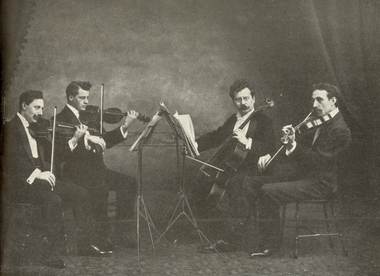 Federation University Historical Collection
Book, Longman, Green and Co. Ltd, Australia Makes Music, 1948
... Laver, Alberto Zelman, Amy Castles, Peter Dawson, Percy Grainger, Hohn Lemmone, John Amadio, Horace Stevens, Evelyn Scotney (born Ballarat), Una Bourne, Browning Mummery, Daisy Kennedy, Essie Ackland, Dorothy Helmrich, Florence Austral, Bernard heinze, Harold Williams, Arnold Matters, Lauri kennedy, Gladys Moncrief, John Brownlee, John Dudley (born Ballarat), Marjorie Lawrence, Alan Eddy, Eileen Joyce, Joan Hammond, Nancy Weir, Noel Mewton-Wood, Raymond O'connell) 5. Australian Composers (May Brahe, Margaret Sutherland, Roy Agnew, Horace Gleeson, William G. James...Laver, Alberto Zelman, Amy Castles, Peter Dawson, Percy Grainger, Hohn Lemmone, John Amadio, Horace Stevens, Evelyn Scotney (born Ballarat), Una Bourne, Browning Mummery, Daisy Kennedy, Essie Ackland, Dorothy Helmrich, Florence Austral, Bernard heinze, Harold Williams, Arnold Matters, Lauri kennedy, Gladys Moncrief, John Brownlee, John Dudley (born Ballarat), Marjorie Lawrence, Alan Eddy, Eileen Joyce, Joan Hammond, Nancy Weir, Noel Mewton-Wood, Raymond O'connell) 5. Australian Composers (May Brahe, Margaret Sutherland, Roy Agnew, Horace Gleeson, William G. James ...This book was part of the Frank Wright Collection. His early tutor, Percy Code, is mentioned in the book. Percy Code was senior conductor of the ABC, and commenced his musical career as a violinist but transferred his musical talent to the trumpet.Red hard covered book of 197 pages, and a number of black and white images. The book contains the following chapters: - 1. A Century and a Half of Music 2. Music of the Australian Aborigine 3. Personally Speaking 4. Biographical sketches (Amy Sherwin, Ada Crossley, Nellie Stewart, Melba, W.A. Laver, Alberto Zelman, Amy Castles, Peter Dawson, Percy Grainger, Hohn Lemmone, John Amadio, Horace Stevens, Evelyn Scotney (born Ballarat), Una Bourne, Browning Mummery, Daisy Kennedy, Essie Ackland, Dorothy Helmrich, Florence Austral, Bernard heinze, Harold Williams, Arnold Matters, Lauri kennedy, Gladys Moncrief, John Brownlee, John Dudley (born Ballarat), Marjorie Lawrence, Alan Eddy, Eileen Joyce, Joan Hammond, Nancy Weir, Noel Mewton-Wood, Raymond O'connell) 5. Australian Composers (May Brahe, Margaret Sutherland, Roy Agnew, Horace Gleeson, William G. James, Alfred Hill, Frank Hutchins, Lindley Evans, Horace Keats) 6. The Men with the Baton (G. Marhsall-Hall, Henri Verbruggen, Slapoffski, Fritz Hart, , Arundel Orchard, Edgar Bainton, Alberto Zelman, Bernard Heinze, Percy Code (Ballarat), William Cade, Joseph Post, John Farnsworth Hall) 7. Broadcasting in Australia 8. Violin Makers in Australia 9. Life in a Symphony Orchestra Appendices a. Choral Societies of Australia b. Doctors of Music c. A Selection of Records of Australian Composition. frank wright, percy code, music, bernard heinze, zelman, alberto zelman, joseph north, j.w. dawson, louis hattenbach, didgeridoo, nellie stewart, harold williams, lauri kennedy, tarczynski, nelson oliver, william dolphin, radio, new number -
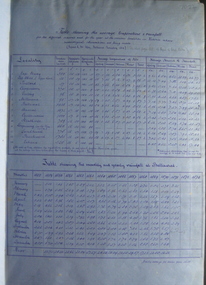 Federation University Historical Collection
Book, Victorian Government Legislative Assembly, The Select Committee on Castlemaine and Sandhurst water supply, Report from the Select Committee on Castlemaine and Sandhurst Water Supply, together with the proceedings of the Committee, minutes of evidence and appendices, 19/5/1865 (exact)
... james forbes...alfred surplice...malcolm carmichael...robert adams...frederick hugh thomas...h o christerpherson...william downe...thomas lawrence...He was assistant engineer for the Ballaarat and Ballarat East Water Supply Committee and helped plan local reservoirs. water supply victoria castlemaine directories sandhurst directories ballarat directories james blackburn edward wardle daylesford water race c j taylor george avery fletcher bagge ohlfsen bagge george foote john h reilly ambrose johnson george francis timber preservation james forbes alfred surplice malcolm carmichael robert adams frederick hugh thomas h o christerpherson william downe thomas lawrence brown francis hadgson nixon strangways guildford maldon muckleford lauriston malmesbury franklinford walmer strathloddon downe ferdinand krause m7082 trentham castlemaine drummond metcalfe sutton grange lockwood ravenswood mandurang yandoit c.h. ohlfsen bagge moorabool reservoir gong gong reservoir harry beale's reservoir pincott reservoir frank pinkerton water A signature by "Ferdinand M. ...This book contains the report from the select committee on Castlemaine and Sandhurst water supply; with the proceedings of the committee, minutes of evidence and appendices. It also contains the report Of the Engineer-In-Chief of Railways, and reply of the Chief Engineer of Water Supply on the works constructed by the Victorian Water Supply Department, presented to both houses of parliament by His Excellency’s command. Ferdinand M. Krause, was a lecturer at the Ballarat School of Mines in Geology Mineralogy Mining Engineering and Surveying. He was a Fellow of the Geological Society and a Fellow of the Linnian Society. He was assistant engineer for the Ballaarat and Ballarat East Water Supply Committee and helped plan local reservoirs.A brown cloth hard cover, foolscap book with leather spine. Title is written in black on the title page. "Water Supply Reports" is engraved in gold on spine. It includes a table showing the monthly and yearly rainfall and shade temperature at Ballarat, 2nd February, 1885. It also includes two reports and two replies, a map No.7082.2 of Victorian Water Supply, Castlemaine and Sandhurst district general plan including lines of Aqueduct, Reservoirs. No. 7082.3 of Victorian Mining districts, Mining Divisions and The Gold Fields in 1866 - includes districts to be supplied under the Waterworks Act, 1965. It also includes: *Report of the Engineer-in-chief of Railways and Reply of the Chief Engineer of Water Supply on the works constructed by the Victorian Water Supply Department, 1869. * Coliban Water Scheme, 1864 * Ballarat and Ballarat East Water Supply (1869) including the Ballarat Water Supply List containing names of occupiers and nature of improvements on lands comprised within the proposed reserve of Gong Gong Reservoir, Ballaarat. At Warrenheip the names included: Honora McCallin, William Honan, C. McMahon, Patrick McMahon, J.P. Beach, J.H. Smith, Michael Nestor, Martin Quinn, Martin McIntyre, Robert Higgins, Coleman Kane, Robert Bond. At Ballarat: William Clarke, Richard White, John Hosking, Wesleyan Chapel, J. Hewitt, Robert McRobinson. At Bungaree: John Pullin, John Llewellyn. William Daw, Smith and Wynne, William Brough, A. Alexander. * Ballarat and Ballaarat East Water Supply report upon the advisability, or otherwise, of constructing a reservoir at the junction of the Yarrowee Creek and Gile's Creek, upon a site known as Gile's Reservoir (printed by Frank Pinkerton). This report has numerous notes written on it (most probably by Krause) and includes the capacity of Harry Beale's Reservoir, Pimcott's Reservoir and the Proposed Gong Gong Reservoir. * Statement as to the position of the Ballaarat and Ballaarat East Borough Councils in Connection with Water Supply, September 1869. * Ballarat and Ballaarat East Water Supply - General Statement upon the Ballaarat and Ballaarat east Scheme of Water Supply. Includes information on Moorabool reservoir, Harry Beale's Reservoir, Lal Lal Creek, Two Mile Creek, Beale's Dam, Yarrowee Creek, Gong Gong Reservoir, Kirk's Dam, Devil's Creek, Moorabool Creek. Additional handwritten notes (probably by Krause) * Engineer's Report on the resolution of the COmmittee of Water Supply, of the 7th July 1868. The report refers to the Country around Mount Warrenheip. Names mentioned are L. Abraham, Great North-West Gold Mining Company, Border Sawmills, Ferdinand Krause, Ohlfsen Bagge, W.H. Shaw, A signature by "Ferdinand M. Krause" at the top corner of the title page. A few pages have handwriting on the margins, it is believed to be his handwriting. water supply victoria, castlemaine directories, sandhurst directories, ballarat directories, james blackburn, edward wardle, daylesford water race, c j taylor, george avery fletcher, bagge, ohlfsen bagge, george foote, john h reilly, ambrose johnson, george francis, timber preservation, james forbes, alfred surplice, malcolm carmichael, robert adams, frederick hugh thomas, h o christerpherson, william downe, thomas lawrence brown, francis hadgson nixon, strangways, guildford, maldon, muckleford, lauriston, malmesbury, franklinford, walmer, strathloddon, downe, ferdinand krause, m7082, trentham, castlemaine, drummond, metcalfe, sutton grange, lockwood, ravenswood, mandurang, yandoit, c.h. ohlfsen bagge, moorabool reservoir, gong gong reservoir, harry beale's reservoir, pincott reservoir, frank pinkerton, water -
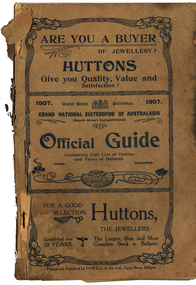 Federation University Historical Collection
Book - Programme, South Street Eisteddfod Official Guide, 1907, 1907
... lawrence campbell...boer war memorial...queen victoria statue...curiosity shop...m.b. john foundry...ballarat east town hall and gardens...sunshine shield...hugh victor mckay...w to w shield...w.j. coltman...frank herman...j. hutton-jones...t. downer...j. marks...hutton and co trophy...marks trophy...hugh leschen...john robson...st augustine's band, geelong...downer trophy...trekardo brothers...moorabool falls...kirks dam...ballarat choral society...alfred deakin...challenge cup...james...South Street competitions have been held in Ballarat since 1991. south street competitions eisteddfod chinese herbalist south street r.b. lemmon g. bongiorno w.d. thomas john madden lord tennyson w.d. hill frederick bevan j.w. beswick lawrence campbell boer war memorial queen victoria statue curiosity shop m.b. john foundry ballarat east town hall and gardens sunshine shield hugh victor mckay w to w shield w.j. coltman frank herman j. hutton-jones t. downer j. marks hutton and co trophy marks trophy hugh leschen john robson st augustine's band, geelong downer trophy trekardo brothers moorabool falls kirks dam ballarat choral society alfred deakin challenge cup james long grand national eisteddfod of australasia Ballarat East Gardens Ballarat East Town Hall Official guide to the 1907 South Street competitions. ...South Street competitions have been held in Ballarat since 1991.Official guide to the 1907 South Street competitions. Images include: Prince of Wales, Lord Northcote, W.D. Thomas, South Street Competition Executive Committee (W.H. Pearson, W.H. Chandler, A. Prichard, W.H. Richards, W.D. Hill, Col. Williams, W.D. Thomas, F. Besemeres, F.J. Martell, J.T. Morris. F.J. Williams, R. Maddern, R.J. Gribble), Sir John Madden, Lord Tennyson, W.D. Hill, Frederick Bevan, Ballarat (Sturt Street), Lake Wendouree (Yachts), J.W. Beswick, Lawrence Campbell, City of Ballarat Mayor and Councillor (Mayor Brawn, E. Williams, E. Morey. Cr Brokenshire, J. Whykes, J.M. Barker, G. Crocker, W.D. Hill, R. Pearse, T. Hollway), Ballarat East Mayor and Councillors (J. Gent, Cr Glendenning, J.N. Dunn, I. Pearce, C. Bunting, A. Levy, J. Ritchie, J. McNeil, A. McKenzie, Cr Penhalluriak), Sturt Street Looking West, Old Curiosity House, Entrance to the Ballarat Fine Art Gallery, Interior of the Ballarat Fine Art Gallery, Ballarat East Town Hall and Gardens, Lake Wendouree Ferry, W.E. Swenson, S.B. Swenson, J.G.M. Swenson, Rev. T. Flynn, Edwards' Pyrites, Lestor's Hotel, Sunshine Sheild, W to W Shield, Frank Herman, W.F. Coultman, Marks' Trophy, Lighthouse Port Fairy, R. Correll Music Seller, James Smith, Isaac Pitman, Arthur Brumfield, Hugh Leschen, John Robson, St Augustine's Band Geelong, Moorabool Falls, Kirks Dam, Ballarat Choral Society, Alfred Deakin, James Long, Hugh McKay Advertisements include: Huttons the Jewellers, Sam Jamieson, Sun Foundry, City Saw Mills, Blomeley Bros Iron and Brass Founders, G. Bongiorno- Railway Fruit Palace, Henry Brind & Co., Andrew Cant, Harrison's Foundry, Umbrella and Sunshade Emporium, Ballarat City Baths, Ballarat Coffee Palace, Irwin's Provincial Hotel, Victa Studio; D. Lem Chinese Medical Practitioner, Bosisto's Eucalyptus Oil, Ronaldson Bros & Tippett, Unicorn HOtel, Mrs F. Allen Caterer, Coles & Pullum, J.C. Dillon & Co., Surrey Tannery, Coulthard's Ballarat Business College, George Farmer, MrBride's Boots, L.J. Austin, Dyason's, Ballarat Brewing Company, Phoenix Brewery, Royal Standard Brewery, Edwards' Pyrites, Lestor's Hotel, Robson's College of Music, James A. Gear, Williams Shoemen, Tekardo Brothers, Powell & Co.south street competitions, eisteddfod, chinese herbalist, south street, r.b. lemmon, g. bongiorno, w.d. thomas, john madden, lord tennyson, w.d. hill, frederick bevan, j.w. beswick, lawrence campbell, boer war memorial, queen victoria statue, curiosity shop, m.b. john foundry, ballarat east town hall and gardens, sunshine shield, hugh victor mckay, w to w shield, w.j. coltman, frank herman, j. hutton-jones, t. downer, j. marks, hutton and co trophy, marks trophy, hugh leschen, john robson, st augustine's band, geelong, downer trophy, trekardo brothers, moorabool falls, kirks dam, ballarat choral society, alfred deakin, challenge cup, james long, grand national eisteddfod of australasia, ballarat east gardens, ballarat east town hall -
 Federation University Historical Collection
Magazine, Ballarat School of Mines Students' Magazine, 1947, 1947
... james rogers...dr pound...mr procter...mr r. w. richards...mr h. j. edwards...mr r. p. flower...ken palmer...joan walter...mr john leslie burt...mr fisher...mr pattenden...mr scarfe...mr a. m. richards...mr j. woolcock...mr p. marxsen...obituary...mr david maxwell...a. f. heseltine...dorothy spence...p. wilson...n. whitaker...william ross...peter wilson...joan parker...stanley butson...david daykin...ian cooper...june baker...hazel barry...lesley bearup...winifred beckwith...david berlyn...william bolitho...daniel brazil...lawrence...The Ballarat School of Mines was a predecessor institution of Federation University Australia. ballarat school of mines students' magazine staff sports james rogers dr pound mr procter mr r. w. richards mr h. j. edwards mr r. p. flower ken palmer joan walter mr john leslie burt mr fisher mr pattenden mr scarfe mr a. m. richards mr j. woolcock mr p. marxsen obituary mr david maxwell a. f. heseltine dorothy spence p. wilson n. whitaker william ross peter wilson joan parker stanley butson david daykin ian cooper june baker hazel barry lesley bearup winifred beckwith david berlyn william bolitho daniel brazil lawrence burchell william bates ronald cairns leslie coburn maurice collins kenneth cowell john dixon francis eckermann rexford fraser elizabeth freeth eric goon marjorie gray doreen hehir joyce hicks john lannen stanley lawrie charles layfield ethel lloyd robert looney eileen maloney gwendoline mcdonnell ian mclenehan colin nicol mervyn oddie john procter shirley ross frederic reeve evelyn robinson john robinson graeme ross ronald rosser jean scott lawrence sedgwick john shergold margaret sim clifford skurrie norma stafford barbara strachan iris sherritt robert tantau anthony tunbridge clive venables dorothy waller wesley walters harold ward john willis norman whittaker Ballarat School of Mines Football Team J. ...The Ballarat School of Mines was a predecessor institution of Federation University Australia. Yellow front page soft cover of 55 pages with green and blue inscriptions on front cover Artwork Mr Bryan - By Peter Wilson Original book illustration - By Peter Wilson Hammerhead - By Peter Wilson Yank - By Joan Parker Herb - By Peter Wilson Tex - By Stanley Butson Rex - By Marjorie Gray Pen and Ink rendering - By Norman Whittaker Bet - By Evelyn or John Robinson Original Book Illustration - By William Ross Spud - By Marjorie Gray Dell - By Evelyn or John Robinson Fay - By Marjorie Gray Hazel - By Maurice Collins Thelma - By Ian Cooper Mickey - By Peter Wilson Wardy - By David Daykin Tiny - By Joan Parker ballarat school of mines students' magazine, staff, sports, james rogers, dr pound, mr procter, mr r. w. richards, mr h. j. edwards, mr r. p. flower, ken palmer, joan walter, mr john leslie burt, mr fisher, mr pattenden, mr scarfe, mr a. m. richards, mr j. woolcock, mr p. marxsen, obituary, mr david maxwell, a. f. heseltine, dorothy spence, p. wilson, n. whitaker, william ross, peter wilson, joan parker, stanley butson, david daykin, ian cooper, june baker, hazel barry, lesley bearup, winifred beckwith, david berlyn, william bolitho, daniel brazil, lawrence burchell, william bates, ronald cairns, leslie coburn, maurice collins, kenneth cowell, john dixon, francis eckermann, rexford fraser, elizabeth freeth, eric goon, marjorie gray, doreen hehir, joyce hicks, john lannen, stanley lawrie, charles layfield, ethel lloyd, robert looney, eileen maloney, gwendoline mcdonnell, ian mclenehan, colin nicol, mervyn oddie, john procter, shirley ross, frederic reeve, evelyn robinson, john robinson, graeme ross, ronald rosser, jean scott, lawrence sedgwick, john shergold, margaret sim, clifford skurrie, norma stafford, barbara strachan, iris sherritt, robert tantau, anthony tunbridge, clive venables, dorothy waller, wesley walters, harold ward, john willis, norman whittaker, ballarat school of mines football team, j. rogers, j. willis, hans fumberger, dave jelbart, j.mccoy, m. heatherington, mr hillman, r. rosser, bob davis, r. kibby, c. edmonds, j. blainey, w. brown. r. cairns j. morrish, k. whiter, a temby, b. tantau, n. rees, b. murrel, l. veale, robert davis -
 Federation University Historical Collection
Booklet, Ballarat School of Mines Students' Magazine, 1961, 1961
... ...lawrence grenville trevan...douglas james...Science, Hong Kong Today, Conferring of Diplomas, Bath Push, Intellectual Pursuit, Never be a Woman, Man and Morality, The Old and the New, A Gentlemen's Excursion to Beaufort House, Awards 1961, Sports, The History of Electricity, School Council, Members of Staff, Roll Call ballarat school of mines students' magazine staff, sports john w. boarmans noel delosa noel whitcher bob coutts noel kelly les dobie noel murphy malcolm peel peter agrums, ian weir, sue mole val baker neil bromley kevin oscar rogers h. e. arblaster richard w. richards daniel yung m. b. john morgan bevan john sir william hudson, brian arthur bellingham francis david benjamin neil albert brogden geoffrey angus chritian william davison brian harold duthie thomas bernard gallagher john robert gowan william john spencer lawrence grenville trevan douglas james vendy michael villani walter john wynd, graeme robert bromley, david william brown leonard ernest fox ralph james hepburn john gribble holloway peter john matthews peter mervyn robinson, chris peter livitsanos, david yan kai chung thomas henry john coad john neil mcarthur, john andrew watts d. pollard n. r. whitcher peter agrumsk. e. ooi t. smith c. naylor p. terry gerald brenan e. r. mcgrath j. kavangh a. bitans Red front page soft cover with white inscriptions and black figures on front cover, 72 pages Ballarat School of Mines Students' Magazine, 1961 Booklet Booklet J. ...Ballarat School of Mines Students' Magazine, 1961. Editorial, Prominent Personalities, The Principal's Pages, The Richard W. Richards Medal, Loyalty, Arts v. Science, Hong Kong Today, Conferring of Diplomas, Bath Push, Intellectual Pursuit, Never be a Woman, Man and Morality, The Old and the New, A Gentlemen's Excursion to Beaufort House, Awards 1961, Sports, The History of Electricity, School Council, Members of Staff, Roll Call Red front page soft cover with white inscriptions and black figures on front cover, 72 pagesballarat school of mines students' magazine, staff, sports, john w. boarmans, noel delosa, noel whitcher, bob coutts, noel kelly, les dobie, noel murphy, malcolm peel, peter agrums, ian weir, sue mole, val baker, neil bromley, kevin oscar rogers, h. e. arblaster, richard w. richards, daniel yung, m. b. john, morgan bevan john, sir william hudson, brian arthur bellingham, francis david benjamin, neil albert brogden, geoffrey angus chritian, william davison, brian harold duthie, thomas bernard gallagher, john robert gowan, william john spencer, lawrence grenville trevan, douglas james vendy, michael villani, walter john wynd, graeme robert bromley, david william brown, leonard ernest fox, ralph james hepburn, john gribble holloway, peter john matthews, peter mervyn robinson, chris peter livitsanos, david yan kai chung, thomas henry john coad, john neil mcarthur, john andrew watts, d. pollard, n. r. whitcher, peter agrumsk., e. ooi, t. smith, c. naylor, p. terry, gerald brenan, e. r. mcgrath, j. kavangh, a. bitans -
Federation University Historical Collection
Letter, Inward Correspondence to the Ballarat School of Mines, 1910, 08/1910
... James Dewar...Henrey Sotheran & Co...Piccadilly...London...Salop...Thomas Parker...Frank Tate...Dressmaking...Steiglitz...Telegram...postcard...Lahasa Fiji...R. Palmerf...Church of England Grammar School of Girls...F. Abrams...Radium hill...Welcome Gold Mine...Stanley B. White...New Golden Gate gold mining company...n.j. wise...H.G. Taylor...Kout Morrien Harrow...L.F. Fairthorne & Sons...H.B. Silberberg & Co...Skipton...Henry F. Hull...Birthday Tunnel Company...L. Hansen...Victorian Railways...Edmund C. Earles...Lawrence...James Dewar Henrey Sotheran & Co Piccadilly London Salop Thomas Parker Frank Tate Dressmaking Steiglitz Telegram postcard Lahasa Fiji R. Palmerf Church of England Grammar School of Girls F. Abrams Radium hill Welcome Gold Mine Stanley B. White New Golden Gate gold mining company n.j. wise H.G. Taylor Kout Morrien Harrow L.F. Fairthorne & Sons H.B. Silberberg & Co Skipton Henry F. Hull Birthday Tunnel Company L. Hansen Victorian Railways Edmund C. Earles Lawrence ...Inward Correspondence to the Ballarat School of Mines, August 1910letterhead, education department, roland graham, coleraine, m. carew, row brothers, mount gambier, joseph row, r. blackburn, max kohl, wilfred p. avery, jubilee hall, broken hill, frederick e. barclay, pharmacy board victoria, harry shinningham, hobson's gold mining company, macquarie steam brick yards, james dewar, henrey sotheran & co, piccadilly, london, salop, thomas parker, frank tate, dressmaking, steiglitz, telegram, postcard, lahasa fiji, r. palmerf, church of england grammar school of girls, f. abrams, radium hill, welcome gold mine, stanley b. white, new golden gate gold mining company, n.j. wise, h.g. taylor, kout morrien harrow, l.f. fairthorne & sons, h.b. silberberg & co, skipton, henry f. hull, birthday tunnel company, l. hansen, victorian railways, edmund c. earles, lawrence, r. welesteo, wellington cyanide works, clunes, octavius williams, h.j. thwaites, tolarno station, gilbert pa, gilbert palmer, wool sorting, r.j. webster, w.a.t. davies, henry markwald, e. rolland -
 Federation University Historical Collection
Book, Ballarat School of Mines Visitors' Book, 1879-1890, 1879-1890
... james redmond gilbert sr havilah Leatherbound ledger with hand written names, professions, residence and remarks relating to visitors to the Ballarat School of Mines. Sample Names: 1881 May 2 David Kerr Diamond Miner South Africa May 2 S. R. Dodds Diamond Miner South Africa May 3 Albert E. King Accountant Adelaide, South Australia "see signature 6 leaves back" May 6 William Morley Wesleyan Minister Auckland, New Zealand May 6 Rainsford Ravin Wellington, New Zealand May 7 Frank E. Lawrence ...James Redmond Gilbert (sr) was born in 1837 at Hamilton, Ontario, Canada. He married Ellen Spouse. He , James Gilbert died on 26 July 1900 at Melbourne, and is buried at Boroondara Cemetery (Kew). J.R Gilbert lived at Running Creek (later Havilah) for some time, and during that time was employed in one of the bigger mines in the district. (Research by Ren at Havilah Research, 2019) Leatherbound ledger with hand written names, professions, residence and remarks relating to visitors to the Ballarat School of Mines. Sample Names: 1881 May 2 David Kerr Diamond Miner South Africa May 2 S. R. Dodds Diamond Miner South Africa May 3 Albert E. King Accountant Adelaide, South Australia "see signature 6 leaves back" May 6 William Morley Wesleyan Minister Auckland, New Zealand May 6 Rainsford Ravin Wellington, New Zealand May 7 Frank E. Lawrence, Lake River, Tasmania May 9 M. Richter Engineer Germany May 9 Dr Wilhelm Landall naturalist Berlin, Germany May 10 William Ralph Heaton Mercantile Birmingham May 11 Arthur I. Traill Grazier Llanpollen, New South Wales May 10 Marian Traill 1882 July 10 Arthur W.W. Brown London July 10 Benjamin Spargo Mining Mananger and owner Snowy Creek July 10 Thomas Cooke Miner Ballarat July 14 Robert H. Kenny July 14 Mr and Mrs Buston, [Indigo Planter?] Bengal, Indonesia July 14 Samuel H. Halker Ballarat July 14 Charles Phelan Talbot July 14 E. Walker Ballarat 1884 June 30 M.N. Cooper Dunedin, new Zealand June 30 Richard Hosking gardiner Gong Gong Well pleased with School June 30 Humphrey John Ballarat July 1 Cecily Gilbert Melbourne July 1 Florence Shrivall Melbourne July 1 [W.N. Marsh?] Colonial Secretary Hong Kong July 1 Louis Fause Engine Driver Dunolly July 1 John L. Bertram Blacksmith Melbourne July 1 Thomas Eardley Coachmaker London "Exceedingly obliged to Mr Oddie for a very pleasant instruction time spent in inspection of the various scientific appliances in the Ballarat School of Mines." (Donation 2/6) July 4 E. Goodwin [David?] Artist Spellbound July 4 W. Glumley Station Master Murtoa July July 4 James Thomas Miner Corrinondie, New Zealand "Very pleased with the School in all its branches. I hope to contribute to the specimen department. J.T." July 8 Robert Wall Engine Driver 1885 September 16 J.W. Springthorpe, M.D., Melbourne (very much pleased in every way) September 26 M. Oddie, Ballarat 1886 January 12 William Piekard, Leicester, England January 12 Robert Linford, Norwich, England January 12 H. Tipping, Draughtsman, Adelaide (Very instructive and should be taken advantage of by all who can) January 12 Fred H.K. Dreslecher, London (ditto) January 23 Walter Redgate, Manchester (ditto) April 7 Annie Bellingham, Richmond April 9 Fred Kruger, Landscape Photo, Geelong April 14 Mary Barry, Murtoa April 19 N.J. Tabuteau Accountant Napier, New Zealand April 19 George N. [Baroft?] Gentleman Cheshire, England April 21 Hon. George D'Almaine, Peer of England, London April 21 Lord Augustus Honour April 21 William Holt, South Melbourne April 21 H. Bartell, Gentleman, Smythes April 21 Fred Musgrove, Gentleman April 21 A. Chirnside, Squatter April 23 Alice Cravino, student, Buninyong April 24 East Melbourne Bicycle Club April 28 J. Kinnear, Kyneton April 28 J.P. Kinnear, Kyneton May 19 Bob Selby, Doctor, Ballarat May 19 J.W.M.. Quiggin, globe trotter, Picton (NS Wales) May 25 Arthur Night, Sutton Hotel, Ballarat (very fair) May 28 D. Kelly, attendant, China May 28 J. Kelly, schoolboy, China June 1 Joseph Jelbart, Blacksmith, Harrow September 9 David Ham, M.L.C. Ballarat ( A right to be pleased) September 9 J.J. Green, Merchant, Adelaide (Very much pleased with my visit to this intitiution it has my hearty sympathy and appreciation, Much pleased at what I have seen its value to the community) 9 December James H. Tappin, Agent, Ballarat (very pleased with instruction 1887 March 20 Thomas Bath Learmonth March 20 James R. Gilbert= Miner Running Creek March 20 C. Holtermann Out of business Adelaide 1890 21 May Mr and Mrs Fairchild, gentleman. Yarra house, Dalgety St, St Kildaballarat school of mines, visitors, j.w. springthorpe, chinese visitors, visitors' book, running creek, james redmond gilbert sr, havilah
