
Showing 3 items matching "japan -- history -- allied occupation"
-
 Returned Nurses RSL Sub-branch
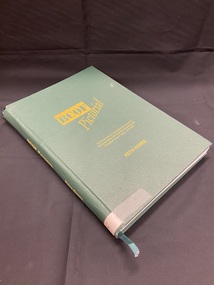
Book - Hardcover illustrated book, Keith Howes, BCOF Pictorial: a pictorial history of Australians who served in the armed forces with the British Commonwealth Occupation Force in Japan. 1945-1952, 1999
... Occupation Forces....Australia -- Armed Forces -- Japan -- History...Japan -- History -- Allied...Occupation Forces. Australia -- Armed Forces -- Japan -- History Japan -- History -- Allied occupation 1945-1952 HMAS Manunda 130 AGH A pictorial history of Australians who served in the armed forces with the British Commonwealth Occupation Force in Japan, 1945-1952, including a chapter on the 130 Australian General Hospital (AGH) and HMAS Manunda and a list of the Nursing Officers and staff. ...A pictorial history of Australians who served in the armed forces with the British Commonwealth Occupation Force in Japan, 1945-1952, including a chapter on the 130 Australian General Hospital (AGH) and HMAS Manunda and a list of the Nursing Officers and staff.Green hardback cover with title and author printed in gold text along the spine and in the centre of the front cover.non-fictionA pictorial history of Australians who served in the armed forces with the British Commonwealth Occupation Force in Japan, 1945-1952, including a chapter on the 130 Australian General Hospital (AGH) and HMAS Manunda and a list of the Nursing Officers and staff. british commonwealth occupation forces., australia -- armed forces -- japan -- history, japan -- history -- allied occupation, 1945-1952, hmas manunda, 130 agh -
 Monbulk RSL Sub Branch
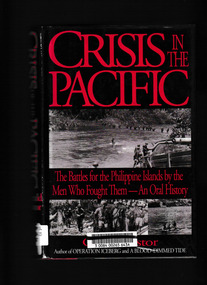
Book, Fine books, Crisis in the Pacific, 1996
... Japanese domination of the Pacific and to ultimate Allied victory. These accounts, many published here for the first time, are dramatic and graphic, brutal and awe-inspiring. Ranging from the diplomatic and nursing corps' experience of the Japanese conquest and occupation of the islands, to the Bataan death march and first-hand accounts of war crimes inflicted by the Japanese on prisoners of war, to the final push for the hills of Mindanao, Crisis in the Pacific is the first complete history, told in the words of the men and women who were there, of one of the most crucial battlegrounds of World War II. ...In Crisis in the Pacific acclaimed historian Gerald Astor draws on the raw experiences of marines, sailors, soldiers and airmen under fire - from generals and admirals to correspondents, line officers and enlisted men on both sides of the battle lines - to present a view of the critical struggle for the Philippines, the keystone to Japanese domination of the Pacific and to ultimate Allied victory. These accounts, many published here for the first time, are dramatic and graphic, brutal and awe-inspiring. Ranging from the diplomatic and nursing corps' experience of the Japanese conquest and occupation of the islands, to the Bataan death march and first-hand accounts of war crimes inflicted by the Japanese on prisoners of war, to the final push for the hills of Mindanao, Crisis in the Pacific is the first complete history, told in the words of the men and women who were there, of one of the most crucial battlegrounds of World War II.Index, bibliography, ill, p.478.non-fictionIn Crisis in the Pacific acclaimed historian Gerald Astor draws on the raw experiences of marines, sailors, soldiers and airmen under fire - from generals and admirals to correspondents, line officers and enlisted men on both sides of the battle lines - to present a view of the critical struggle for the Philippines, the keystone to Japanese domination of the Pacific and to ultimate Allied victory. These accounts, many published here for the first time, are dramatic and graphic, brutal and awe-inspiring. Ranging from the diplomatic and nursing corps' experience of the Japanese conquest and occupation of the islands, to the Bataan death march and first-hand accounts of war crimes inflicted by the Japanese on prisoners of war, to the final push for the hills of Mindanao, Crisis in the Pacific is the first complete history, told in the words of the men and women who were there, of one of the most crucial battlegrounds of World War II.world war 1939 – 1945 – campaigns – phillipines, world war 1939 – 1945 – personal narratives -
 Monbulk RSL Sub Branch
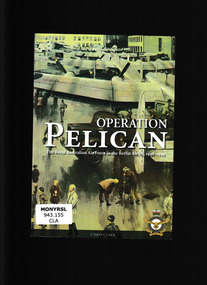
Book, Air Power Development Centre, Operation Pelican : The RAAF in the Berlin Airlift, 1948-1949, 2008
... history. When Britain turned for support to its Dominion partners, the transport element of the Royal Australian Air Force had recently ceased flying a regular courier service for Australian occupation forces involved in garrisoning another defeated Axis power of World War II, Japan - this role having been handed over to a commercial airline. By September 1948 an unnumbered Australian squadron had joined other RAAF transport crews already engaged as part of the massive allied ...In 1948 Britain, France and the United States of America found themselves opposed to their former wartime ally, the Soviet Union, over matters regarding control of the capital of the defeated Nazi German regime. When the Soviets imposed a blockade of the city, the Allies had no option but to begin flying in the necessities of life for the two million inhabitants of the zones under their administration. Thus began the first large-scale humanitarian airlift in history. When Britain turned for support to its Dominion partners, the transport element of the Royal Australian Air Force had recently ceased flying a regular courier service for Australian occupation forces involved in garrisoning another defeated Axis power of World War II, Japan - this role having been handed over to a commercial airline. By September 1948 an unnumbered Australian squadron had joined other RAAF transport crews already engaged as part of the massive allied undertaking. To the Americans the fifteen-month-long operation was codenamed Vittles, while the British called it Plainfare. But to the Royal Australian Air Force personnel involved, the Berlin Airlift was known as Pelican. Here the story is told of the events that made the airlift necessary, what the undertaking entailed and the part that Australians played in it, as well as the outcome and achievements of Operation Pelican.Ill, maps, p.82.non-fictionIn 1948 Britain, France and the United States of America found themselves opposed to their former wartime ally, the Soviet Union, over matters regarding control of the capital of the defeated Nazi German regime. When the Soviets imposed a blockade of the city, the Allies had no option but to begin flying in the necessities of life for the two million inhabitants of the zones under their administration. Thus began the first large-scale humanitarian airlift in history. When Britain turned for support to its Dominion partners, the transport element of the Royal Australian Air Force had recently ceased flying a regular courier service for Australian occupation forces involved in garrisoning another defeated Axis power of World War II, Japan - this role having been handed over to a commercial airline. By September 1948 an unnumbered Australian squadron had joined other RAAF transport crews already engaged as part of the massive allied undertaking. To the Americans the fifteen-month-long operation was codenamed Vittles, while the British called it Plainfare. But to the Royal Australian Air Force personnel involved, the Berlin Airlift was known as Pelican. Here the story is told of the events that made the airlift necessary, what the undertaking entailed and the part that Australians played in it, as well as the outcome and achievements of Operation Pelican.cold war - history, berlin airlift 1948-1949
