
Showing 37 items matching "japan travel"
-
 Bendigo Military Museum
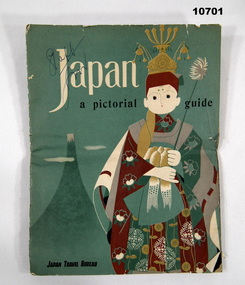
Magazine - JAPANESE PICTORIAL, Japan Travel Bureau, "JAPAN - A PICTORIAL GUIDE", c.1947
... Japan Travel Bureau..."JAPAN - A PICTORIAL GUIDE" Magazine JAPANESE PICTORIAL Japan Travel Bureau ...Items belonging to Alva Bennetts VFX128835, from BCOF in Japan 1947-49. See cat 9726P for details of service for Alva Marie Bennetts.Green cover magazine with an image of a Japanese person on the front dressed in traditional clothing. "Japan" is written in large white letters. Inside is a series of photos of Japanese locations, each with an accompanying description. On the back cover is a map of Japan.An indecipherable scribble on the front in pen.alva bennetts, bcof, japan, magazine -
 Bendigo Military Museum
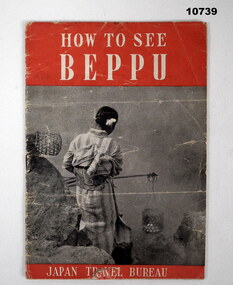
Souvenir - TRAVEL BROCHURE, BEPPU, JAPAN, BCOF ERA, Japan Travel Bureau, "How to see Beppu", 1946
... TRAVEL BROCHURE, BEPPU, JAPAN, BCOF ERA....Japan Travel Bureau... BROCHURE, BEPPU, JAPAN, BCOF ERA. Japan Travel Bureau Dai Nippon Printing Co. Ltd ...Booklet collected by "Alva Marie Bennetts" during her deployment to BCOF, Japan - 1947-1949. Part of the Bennetts Collection. See Cat 9726P for details of service for Alva Bennetts VFX128835.Soft covered booklet with pages stapled to cover. 14 pages with cut edges and black and white photographic illustrations. Front cover features a black and white photograph of a Japanese lady in traditional dress. Title of booklet in white lettering on a red background. Text on pages in black type.Handwritten in pencil inside back cover: “Left Beppu 8.55 am, Arrived there 7.33 pm, Kyushu, Beppu, Kawega, Bungo-Tunooka, Hiji, Kitsuki, (Tunnels), Nakayagama, Tateishi”alva bennetts, bennetts collection, bcof, japan, beppu, souvenir -
 Bendigo Military Museum
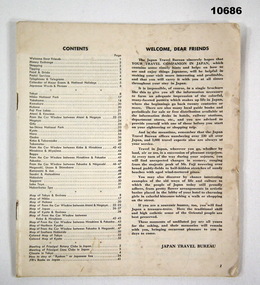
Booklet - TRAVEL GUIDE, JAPAN, Your Travel Companion in Japan
... TRAVEL GUIDE, JAPAN...Your Travel Companion in Japan.......Travel Guide'...Japan...Items collected by Alva Bennetts during her posting to BCOF Japan 1947-49. Travel guide issued by Japan Travel Bureau to facilitate visitors to Japan in their travels. ...Items collected by Alva Bennetts during her posting to BCOF Japan 1947-49. Travel guide issued by Japan Travel Bureau to facilitate visitors to Japan in their travels. ...Items collected by Alva Bennetts during her posting to BCOF Japan 1947-49. Travel guide issued by Japan Travel Bureau to facilitate visitors to Japan in their travels. See Cat 9726P for details of service for "Alva Marie Bennetts" VFX128835.White booklet missing its front cover. 52 pages with contents guide on front and inside travel tips. Chapters on the key various cities and various maps of key places and adds.alva bennetts, bennetts collection, booklet, travel guide', japan, bcof -
 Broadmeadows Historical Society & Museum
Document - Letter, Roby, 9 June 1964
... ...Japan travel...The letter was written from Mile End, South Australia, and references anticipated overseas travel to Japan and Hong Kong in July 1965, as well as civic roles (“Mayor & Mayoress”), situating the item in mid 20th century Australian social and family networks....The letter was written from Mile End, South Australia, and references anticipated overseas travel to Japan and Hong Kong in July 1965, as well as civic roles (“Mayor & Mayoress”), situating the item in mid 20th century Australian social and family networks. ...The letter was written from Mile End, South Australia, and references anticipated overseas travel to Japan and Hong Kong in July 1965, as well as civic roles (“Mayor & Mayoress”), situating the item in mid 20th century Australian social and family networks.This item is a well documented example of everyday Australian correspondence in the 1960s, notable for its clear geographic origin, personal engagement announcement, and references to international travel and civic identity, enhancing its social and historic interpretive value.Single page handwritten letter, ink on paper. Envelope Front / Address side: PLEASE POST EARLY AUSTRALIA BEFORE LUNCH BEFORE FOUR O'CLOCK/9 JUN 1964/Miss Kath Fletcher/14 Wembley Road/Fawkner / Vic Letter text: 64 Fisher Drive/Mile End/South Australia/9-6-1964/Dear Kath/Many thanks for your kind/ thoughts and the Ticket for my Birthday I/think Kath this ticket should show results/as the whole thing seems to be wrapped up/in such great occasions/ Vally & I was / terribly thrilled with the great news of your/engagement to Keith (ARC) I am sure that it/will mean great happiness to you both because/what we saw of ARC he is a very fine/gentleman and yourself you Know our/Thoughts so once again luck to you both/ also Mum:/ As you know we have our name down/for Japan & Hong Kong next July 1965 and passing/through Melbourne we will certainly look up the/ Mayor & Mayoress/ Will Vally is scribbling something/so will conclude this note with our Deepest & Sincere/wishes to you both and may God Grant you all the/happiness that is due to you/(A Kiss for / Kiss for Mum/ Roby)/Yours sweetly/Roby personal correspondence, family relationships, engagement announcements, social customs, mid 20th century daily life, suburban australia, international travel plans, japan travel, hong kong travel, civic roles, mayoral identity, handwritten letters, 1960s australia -
Glenelg Shire Council Cultural Collection
Book, Walter Tyndale, Japan and the Japanese, 1910
... Japan... travel...He was born is 1855 and dies in 1943. Japan travel social life customs Front: Label on inside front cover. ...Light blue, cloth-covered covers and spine. Text and graphics in gold. Coloured illustration on front cover-garden scene. 32 coloured illustrations by the author.japan, travel, social life, customs -
Phillip Island and District Historical Society Inc.
Book, British Commonwealth Occupation Forces, Know Japan / issued under the direction of the commander-in-chief, British Commonwealth Occupation Forces, 1946
... japan...description...travel...japan description travel social life and customs Stamped 'Phillip Island & District Historical Society'. ...Stamped 'Phillip Island & District Historical Society'.japan, description, travel, social life and customs -
 Bendigo Historical Society Inc.
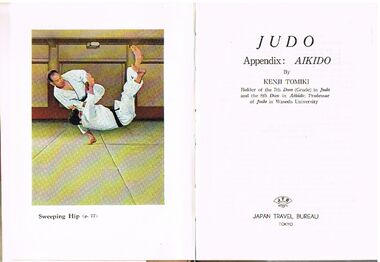
Book - ALEC H CHISHOLM COLLECTION: BOOK ''JUDO, WITH AIKIDO'' BY KENJI TOMIKI
... Published in 1959 by Japan Travel Bureau, Tokyo and printed by Kyodo Printing Co., Tokyo. ...Published in 1959 by Japan Travel Bureau, Tokyo and printed by Kyodo Printing Co., Tokyo. ...Book. ALEC H CHISHOLM COLLECTION. 176 page hard cover book by Kenji Tomiki explaining the art and techniques Judo and Aikido. Illustrated with numerous B & W photos and one colour plate. Includes a 3 page glossary of Judo terms. Published in 1959 by Japan Travel Bureau, Tokyo and printed by Kyodo Printing Co., Tokyo. Catalogue sticker ''2175 TOM'' on spine. Handwritten in ink on flyleaf ''Mr A.N. Chisholm with best wishes Tatsuo Kenvar March 3 1959''. Library of congress Catalogue Card No. 58-59726.Kenji Tomikibooks, collections, sport, alec h chisholm collection, judo, aikido, martial arts, kenji tomiki -
 Federation University Art Collection
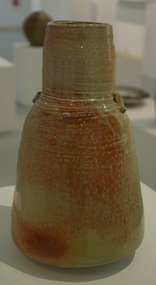
Ceramic - Artwork - Ceramics, Salt Glazed Pot by Janet Mansfield, 1984, 1984
... She received a Crafts Board Grants in 1974 to study in the United States of America; to research salt glaze technique in 1975; to exhibit in Japan in 1985; to travel to Hungary fir a symposium, and an Australia-Japan Foundation Grant in 1977 to study in Japan. ...She received a Crafts Board Grants in 1974 to study in the United States of America; to research salt glaze technique in 1975; to exhibit in Japan in 1985; to travel to Hungary fir a symposium, and an Australia-Japan Foundation Grant in 1977 to study in Japan. ...Janet MANSFIELD (1934-2013 ) Born Sydney, New South Wales Janet Mansfield studied Ceramics at the National School of Art, East Sydney Technical College in 1964 to 1965. She received a Crafts Board Grants in 1974 to study in the United States of America; to research salt glaze technique in 1975; to exhibit in Japan in 1985; to travel to Hungary fir a symposium, and an Australia-Japan Foundation Grant in 1977 to study in Japan. She was a visiting lecturer to the Gippsland Centre for Art and Design in 1980 and a Spotkanie guest in 1984. Her work was fired to wood kilns and taken to stoneware temperatures. She used salt for shorter firings, or in the anagama kiln depended on the ash and flame for glaze effects. Janet Mansfield has been editor of 'Pottery in Australia' and 'Ceramics: Art and Perception'. In 1987 she was awarded an Order Of Australia Medal for services to art and ceramics. In 1980 Janet Mansfield was a visiting lecturer at the Gippsland Institute of Advanced Education. She was a guest at Spotkanie in 1984.Wheel thrown wood fired and salt-glazed stoneware.jan feder memorial ceramics collection, ceramics, janet mansfield, gippsland campus, visiting lecturer, spotkanie -
 Mission to Seafarers Victoria
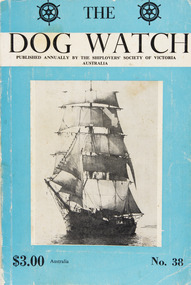
Journal (item) - Periodicals-Annual, Shiplovers' Society of Victoria, The Annual Dog Watch
... Travelling Past - S. A. E. Strom - 91 Sail Training For Australia -- Now A Reality - R. Carter - 94 Northern Adventure -- The "Japan" - Captain H. ...Travelling Past - S. A. E. Strom - 91 Sail Training For Australia -- Now A Reality - R. Carter - 94 Northern Adventure -- The "Japan" - Captain H. ...This journal provides the reader with glimpses of the adventures and hardships of a seaman's life. Many of the stories are of sailing ships.Contributes to our knowledge of the importance of shipping and places on record those stories of the sea which would otherwise be lost.Contents Foreword - D. Baillieu - 5 Editorial - S. A. E. Strom - 7 Figureheads - Captain G. Heyen - 13 The Polly Woodside - C. E. Bonwick - 15 The Sinking of A.U.S.N. Steamer "Macumba" - Captain J. D. V. Young - 16 The Real Hero of Quebec The Last Voyage of "Unicorn" Under the American Flag - D. Hannaford - 23 My Mother and Eva Carmichael - A. A. McArthur-Campbell - 30 The "Lauristan" -- Taltal to the Horn - R. W. Rudd - 34 A Sea-Water Mystery - Captain Leif Asklund - 38 Walking Backwards - T. Devaney - 40 Encounter With a Rum-Runner - Captain G. Chapman - 46 The Bosun - R. N. Thiele - 50 Crossing the Equator in a Ship's Boat - Captain Yuri Shemansky - 56 "Going Down the Bay" K. Bull - 59 Voyage in the Clipper "Yorkshire" in 1968 - R. Duruz - 62 A Dream Come True - W. P. Shemmeld - 64 The Mahogany Ship Mystery - J. M. Mackenzie - 68 Things Drake Never Did - E. Harper - 74 "Desdemona" - Captain D. Cowling - 76 A Naval Ploy - Revd. G. H. P. Karney - 90 Echoes of the Travelling Past - S. A. E. Strom - 91 Sail Training For Australia -- Now A Reality - R. Carter - 94 Northern Adventure -- The "Japan" - Captain H. O'May - 98 The Sea - Sire Robert Garran - 100 Voyage of the "Tillicum" - Captain H. W. Watson - 101 Sheepwash - Captain W. Eglen - 103 The Wreck of the "City of York" - E. M. Christie - 104 Wreck of the Barque "Eleanor Lancaster" - C. Dickson Gregory - 109 The Legend of Campbell Island - Captain H. O'May - 110 Book Reviews - 112sailing ships, steamships, shipping, seafaring life, shiplovers' society of victoria, dog watch -
 Marysville & District Historical Society
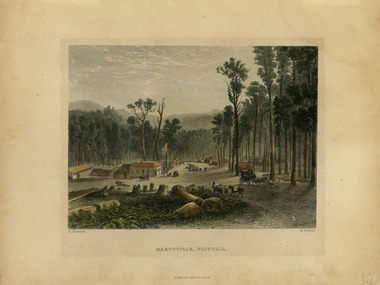
Print (Item) - Steel Engraving, Nicholas Chevalier, Marysville, Victoria, 1874
... travelling widely and doing much work there which was exhibited at Melbourne on his return. In 1869 he joined HMS Galatea as an artist with the Duke of Edinburgh, on the voyage to the East and back to London with stops in Tahiti, Hawaii, Japan, China, Ceylon (Sri Lanka) and India. ...An early steel engraving print of Marysville in Victoria.An early steel engraving print of Marysville in Victoria by Nicholas Chevalier. Nicholas Chevalier, born in 1828, was a Russian-born artist who worked in Australia and New Zealand. In 1851 Chevalier moved to London and worked as an illustrator in lithography and watercolour. After further studies in painting in Rome he arrived in Australia in December 1854. In August 1855 he obtained work as a cartoonist on the newly established Melbourne Punch. Later he did illustrative work for the Illustrated Australian News and also worked in chromolithography. He accompanied explorer/meteorologist Georg von Neumayer on trips to remote areas of Victoria, and the material gathered on such journeys resulted in some of his most recognised pieces of this period, including his painting of Mount Arapiles in Western Victoria. In 1864, when the National Gallery of Victoria was founded, an exhibition of works by Victorian artists was held. The government agreed to buy the best picture exhibited for £200. Chevalier's oil painting The Buffalo Ranges was selected, and was the first picture painted in Australia to be included in the Melbourne collection. In 1865 Chevalier visited New Zealand, travelling widely and doing much work there which was exhibited at Melbourne on his return. In 1869 he joined HMS Galatea as an artist with the Duke of Edinburgh, on the voyage to the East and back to London with stops in Tahiti, Hawaii, Japan, China, Ceylon (Sri Lanka) and India. The pictures painted during the voyage were exhibited at South Kensington. In January 1874 Chevalier was commissioned by Queen Victoria to travel to St Petersburg and paint a picture of the marriage of the Duke of Edinburgh. Chevalier made London his base and was a continual exhibitor at the Academy from 1871 to 1887. He had one picture in the 1895 Academy but had practically given up painting by then. Chevalier died in London on 15 March 1902. N. Chevalier 1870 N. Chevalier/ W. Forrest MARYSVILLE, VICTORIA. LONDON, VIRTUE & CO.marysville, victoria, n. chevalier, w. forrest, steel engraving, print, mount arapiles, georg von neumayer, the buffalo ranges, national gallery of victoria, hms galatea -
 Marysville & District Historical Society
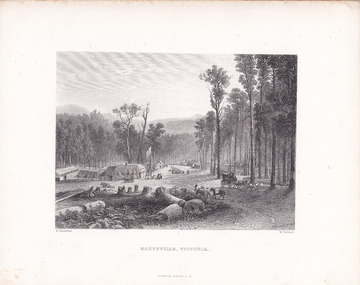
Print (Item) - Steel Engraving, Nicholas Chevalier, Marysville, Victoria, 1874
... travelling widely and doing much work there which was exhibited at Melbourne on his return. In 1869 he joined HMS Galatea as an artist with the Duke of Edinburgh, on the voyage to the East and back to London with stops in Tahiti, Hawaii, Japan, China, Ceylon (Sri Lanka) and India. ...An early steel engraving print of Marysville in Victoria.An early steel engraving print of Marysville in Victoria by Nicholas Chevalier. Nicholas Chevalier, born in 1828, was a Russian-born artist who worked in Australia and New Zealand. In 1851 Chevalier moved to London and worked as an illustrator in lithography and watercolour. After further studies in painting in Rome he arrived in Australia in December 1854. In August 1855 he obtained work as a cartoonist on the newly established Melbourne Punch. Later he did illustrative work for the Illustrated Australian News and also worked in chromolithography. He accompanied explorer/meteorologist Georg von Neumayer on trips to remote areas of Victoria, and the material gathered on such journeys resulted in some of his most recognised pieces of this period, including his painting of Mount Arapiles in Western Victoria. In 1864, when the National Gallery of Victoria was founded, an exhibition of works by Victorian artists was held. The government agreed to buy the best picture exhibited for £200. Chevalier's oil painting The Buffalo Ranges was selected, and was the first picture painted in Australia to be included in the Melbourne collection. In 1865 Chevalier visited New Zealand, travelling widely and doing much work there which was exhibited at Melbourne on his return. In 1869 he joined HMS Galatea as an artist with the Duke of Edinburgh, on the voyage to the East and back to London with stops in Tahiti, Hawaii, Japan, China, Ceylon (Sri Lanka) and India. The pictures painted during the voyage were exhibited at South Kensington. In January 1874 Chevalier was commissioned by Queen Victoria to travel to St Petersburg and paint a picture of the marriage of the Duke of Edinburgh. Chevalier made London his base and was a continual exhibitor at the Academy from 1871 to 1887. He had one picture in the 1895 Academy but had practically given up painting by then. Chevalier died in London on 15 March 1902. N. Chevalier 1870 N. Chevalier/ W. Forrest MARYSVILLE, VICTORIA. LONDON, VIRTUE & CO.marysville, victoria, n. chevalier, w. forrest, steel engraving, print, mount arapiles, georg von neumayer, the buffalo ranges, national gallery of victoria, hms galatea -
Glenelg Shire Council Cultural Collection
Functional object - Fishing Lure, c. 1970
... fishing travel lure recreation sport IMPORIACIONES DEPORTINAS 1 JAPAN' Fishing lure, brass with stainless steel spinner. ...Fishing lure, brass with stainless steel spinner. "IMPORIACIONES DEPORTINAS 1 JAPAN' engraved on spinner.IMPORIACIONES DEPORTINAS 1 JAPAN'fishing, travel, lure, recreation, sport -
Glenelg Shire Council Cultural Collection
Functional object - Fishing Lure, c. 1970
... fishing travel lure recreation sport JAPAN Fishing lure. Stainless steel. 3 barbed hook covered by white feathers. ...Fishing lure. Stainless steel. 3 barbed hook covered by white feathers. Spinner corrugated metal 'JAPAN' underneath.JAPANfishing, travel, lure, recreation, sport -
 City of Moorabbin Historical Society (Operating the Box Cottage Museum)
Photograph, postcard "Boiling the Billy" c1900, Early 1900's "Boiling the Billy", c1900
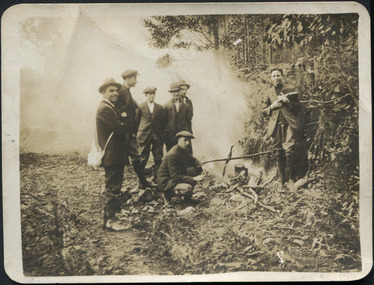
... travel and sell them as collectable cards. Postcards as we know them now first began in 1861 as cards mailed by private post. In the 1870s picture postcards grew in popularity throughout the United States, Britain, Europe, and Japan. ...travel and sell them as collectable cards. Postcards as we know them now first began in 1861 as cards mailed by private post. In the 1870s picture postcards grew in popularity throughout the United States, Britain, Europe, and Japan. ...Early 1900's. "Boiling the billy". The term billy or billycan is particularly associated with Australian usage, but is also used in the UK and Ireland. It is widely accepted that the term "billycan" is derived from the large cans used for transporting bouilli or bully beef on Australia-bound ships or during exploration of the outback, which after use were modified for boiling water over a camp fire. Postcards developed out of the complex tradition of nineteenth-century printed calling cards, beginning with the advent of the Cartes-de-Visite in France. In the 1850s, Parisian photographer Andre Adolphe Eugene Disderi invented a photographic process involving egg white, albumen, and silver nitrate to create inexpensive portraits on paper cards. These photographic Cartes-de-Visites were 2 1/2 (75mm) by 4 inches (98mm) and became a popular, collectable form of "visiting cards" world-wide. Photographers would reprint portraits of famous individuals they had taken at their studios or during travel and sell them as collectable cards. Postcards as we know them now first began in 1861 as cards mailed by private post. In the 1870s picture postcards grew in popularity throughout the United States, Britain, Europe, and Japan. Cards were first permitted to have a "Divided Back," with text written on the left half of a dividing line and the address on the right half, beginning in England in 1902. Around 1900 the first postcards made of "Real Photos" rather than artwork began to circulate, aided in by advances in amateur photography equipment by companies such as Kodak. Kodak also introduced postcard paper for photographic development and photography studios began to offer portraits printed as postcards Many local town, countryside, and architectural images were captured during this period by local photographers, then printed and sold as postcards . Advances in amateur photography all contributed to a postcard craze that lasted from 1900 to the First World War. Postcards were the preferred means to send a quick note, whether across town or across a continent.Postcard with a black and white Photograph on the front and a 'Divided Back ' for the message and address. There are seven men surrounding the billy suspended over a camp fire. The ground has a lot of dead branches around. One man is bending down towards the billy. Two men on either side of the camp fire are carrying either a white bag across their shoulders or the fish in their hands. You can see, that there is some steam also coming out of the billy, which means that its hot. Court Post Card. / this space may be used for correspondence. / The address only to be written here.1900's, boiling the billy , postcards, photographers, england, hungary, america, cartes-de-visite, visiting cards, moorabbin, cheltenham, bentleigh, market gardeners, early settlers, pioneers, -
 Flagstaff Hill Maritime Museum and Village
Instrument - Azimuth Compass, Early 20th Century
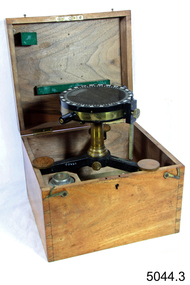
... travel to China to document the Second Opium War. Although Rossier subsequently was unable to accompany to Anglo-French forces in that campaign, he nevertheless produced a number of stereographs and other photographs of China, Japan, the Philippines and Siam (now Thailand), which Negretti and Zambra published and that represented the first commercial photographs of those countries. ...travel to China to document the Second Opium War. Although Rossier subsequently was unable to accompany to Anglo-French forces in that campaign, he nevertheless produced a number of stereographs and other photographs of China, Japan, the Philippines and Siam (now Thailand), which Negretti and Zambra published and that represented the first commercial photographs of those countries. ...Negretti and Zambra 1850-1980s were optical instrument makers and mathematical instrument makers based in London, England. The firm of Negretti and Zambra was established in 1850 by Henry Negretti and Joseph Zambra who had formed a partnership. Their skill was immediately apparent when exhibiting at the 1851 Great Exhibition at Hyde Park, they were the only English instrument makers to receive a prize medal for meteorological instruments, resulting in their appointment as instrument makers to the queen, Greenwich observatory, and the British Meteorological Society. In 1853, when the Crystal Palace was re-erected in Sydenham, Negretti and Zambra became the official photographers of the Crystal Palace Company, which allowed them to photograph the interior and grounds of the new building. The firm made use of this access to produce a number of stereographs. Between 1855 and 1857 Negretti and Zambra commissioned photographer Pierre Rossier to travel to China to document the Second Opium War. Although Rossier subsequently was unable to accompany to Anglo-French forces in that campaign, he nevertheless produced a number of stereographs and other photographs of China, Japan, the Philippines and Siam (now Thailand), which Negretti and Zambra published and that represented the first commercial photographs of those countries. In 1856 Negretti and Zambra sponsored a photographic expedition to Egypt, Nubia and Ethiopia conducted by Francis Firth. In 1864 Negretti and Zambra (themselves) photographed Shakespeare's House at Stratford on Avon. A sepia photograph was then pasted onto card 4" × 2.5". This was then presented to visitors to the Crystal Palace to enable them to compare it with the model erected by Mr E. T. Parr in the Centre Transept. The card itself is headed "Crystal Palace April 23rd 1864." That year they also published a book, titled A Treatise on Meteorological Instruments, (which was reprinted in 1995). Throughout World War One Negretti and Zambra were entirely engaged in the production of various instruments for the Ministry of Munitions. They developed many instruments for the Air Ministry including a mercury-in-steel distance thermometer for taking the oil and air temperatures in aircraft which was patented in 1920. In 1946 the company went private and in 1948 the company was made public, and by 1950 Negretti and Zambra had 821 employees in Britain. In order to increase production and to safeguard future development in 1964, they purchased a modern factory at Aylesbury for all their production. In 1981 Negretti and Zambra were taken over by a group of financial institutions in the form of Western Scientific Instruments and in 1985 the company was acquired by Meggitt Holdings.The subject compass is just one type of the many marine and scientific, optical items this company produced over it’s life time. Negretti and Zambra were prolific manufactures of types of items as well as being very prominent in photography pioneering new innervation's and sponsoring expeditions to little known countries to document peoples daily lives and culture through photography.Azimuth compass on tripod in a fitted wooden box with a round spirit level included, lid of box has three indented circles where the legs of the compass fit when it is set up for use. Stamped "C.M.O. 9" on with Maker Negretti & Zambra London.flagstaff hill, warrnambool, flagstaff-hill, flagstaff-hill-maritime-museum, shipwreck-coast, flagstaff-hill-maritime-village, azimuth compass, nautical instrument, negretti & zambra london, navigational instrument, compass -
 Kiewa Valley Historical Society
Typewriter Mechanical Portable, 1950s
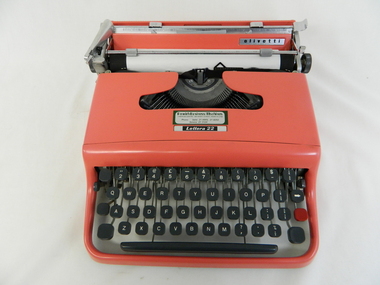
... Japanese manufactured goods was relatively slower, especially in rural areas. The demand for long lasted and dependable merchandise was in the rural area still the most important criteria. The ease of setting up this typewriter and its compact mobility was its major benefit to trades people and travelling professionals, e.g. rural doctors, other medical professionals, accountants, lawyers and educators. ...Japanese manufactured goods was relatively slower, especially in rural areas. The demand for long lasted and dependable merchandise was in the rural area still the most important criteria. The ease of setting up this typewriter and its compact mobility was its major benefit to trades people and travelling professionals, e.g. rural doctors, other medical professionals, accountants, lawyers and educators. ...The Olivetti company was founded in Italy in 1908.This particular typewriter is a Olivetti Lettera 22, oblique front stroke and portable manufactured after 1950. The 1950s and 1960s was a time when British manufactured goods were still purchased by many Australian consumers. The later 1960s onwards, there was a shift, mainly in the cities, to European made goods. The invasion of Japanese manufactured goods was relatively slower, especially in rural areas. The demand for long lasted and dependable merchandise was in the rural area still the most important criteria. The ease of setting up this typewriter and its compact mobility was its major benefit to trades people and travelling professionals, e.g. rural doctors, other medical professionals, accountants, lawyers and educators. This item facilitated the growing numbers of professional nomads requiring a relatively light office stationery package e.g. travelling novelist, writer, businessman and academics. This typewriter needed no electrical or battery power to operate it. Outback Australia, where at this point in time, was still relatively isolated from a good available electrical power reticulation and battery power, and therefore could not be totally measured as a highly efficient office environment.Although this typewriter was purchased from a business in Penrith, Sydney, N.S.W., it is significant that it travelled easily to the Kiewa Valley, demonstrating the mobility of certain sections of the community. This typewriter was designed by an Italian industrial designer, Marcello Nizzoli, in line with the art deco style of the 1930s and the colour and flexibility of the vibrant 1950s. The underlying theme of manufacturing in the 1950s was to produce equipment that was more efficient than what was inherited from the earlier period of 20th century. Improvements were made to this Olivetti typewriter by Giuseppe Beccio by reducing the number of parts made from 3,000 to 2,000. This reduction of parts and therefore cost of production was the major principle of the Japanese manufacturing juggernauts of the post World War II era. Efficiency and low costs material was becoming prime factors in the success of rural industries from the 1960s. Competition from overseas producers was starting to affect rural industries and the removal of the large range of tariff protection, especially rural products, required not only a shift of farm management but a more efficient cost savings modus operandi. This Olivetti Lettera 22, oblique front stroke portable (weighs 4kg) mechanical typewriter has a coral coloured plastic casing. The keys are made of black hardened plastic with white lettering, numbers and symbols (imperial fractions, and pound). It has a QWERTY keyboard as opposed to the Italian QZERTY. It has a lever to move the ribbon between black, neutral (for mimeograph stencils)and red colours (a red key is provided for highlighting specific words,letters or symbols) . This machine is fitted with only a black ribbon. It has a black rubber paper rollers and chromed metal parts on the carriage way. It has four rubber feet underneath the main body. On the left side of the roller there is a lever to adjust the roller from fixed (when mobile) through 1,2 and 3 line space gradients. This model has a key for zero but not one for the number one (uppercase letter l is used) see KVHS 0459 for the carrying bag.On the cover over the ribbon wheels letter strikers has a plate marked "Lettera 22" and the back plate behind the paper roller and in front of the paper supports has a silver metal label marked "olivetti made in great britain".commercial, mobile office equipment, mechanical typewriter -
 Kiewa Valley Historical Society
Plate - Gilt, 1870 -1920
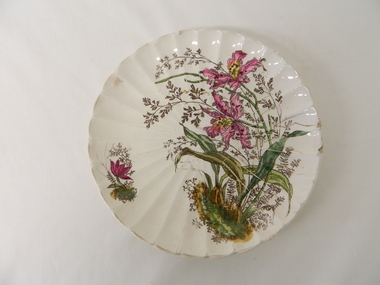
... Japanese merchandise opened up the market place for cheaper "throw away" items. Longevity and quality of goods fell away as the "throw away" society rolled on. This item demonstrates the time when the rural sector was at its most affluent and influential in dictating the strong ties between Australia, Britain and Europe. The very influential "Country Party" ensured that the protection of the rural sector was well entrenched. The ability of the "well off" rural sector, in this period, were not only able to travel ...This gilt plate is from an era where master crockery manufacturers where either located in Britain or Europe.The cost of transportation and the time taken to receive items limited the availability of first class goods. This was an era that was "British is best" in all manufactured goods. With the slow influx of European immigrants European manufactured goods also became of high value. This social requirement was more of a prerequisite for the more affluent rural population, especially at a time when Australia "rode on the sheep's back". Fine British and European goods were a "status symbol", even in rural Australia. After World War II, the invasion of American and Japanese merchandise opened up the market place for cheaper "throw away" items. Longevity and quality of goods fell away as the "throw away" society rolled on.This item demonstrates the time when the rural sector was at its most affluent and influential in dictating the strong ties between Australia, Britain and Europe. The very influential "Country Party" ensured that the protection of the rural sector was well entrenched. The ability of the "well off" rural sector, in this period, were not only able to travel abroad but also to purchase expensive items "overseas" cutlery and crockery. The significance of this item is that it highlights a period in time when the "rural" affluence was at its peak.This hand painted floral gilt plate is a cream fluted china plate decorated with pink and yellow orchid flower arrangement. It is in the "Art Nouveau" period 1880-1920.underneath and within the circular base and in gold freehand script "4" underneath "1562". Pressed into the base is the manufacturer's monogram.Circled around the FAM mark is "* FRANZ ANT. MEHLEM*BONN A/RHEIN*"hand painted china, floral gilt plate, decorative china -
 Bendigo Military Museum
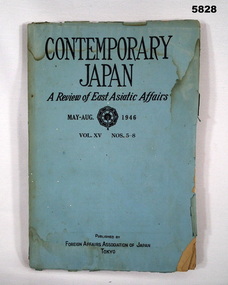
Book - BOOK, JAPAN, Foreign Affairs Association of Japan/Tokyo", "CONTEMPORARY JAPAN", 1946
... Japan BCOF Front end paper - owner's name - handwritten in green ink "A. Ba ???/ Osaka, 1947. Soft cover book. Cover - cardboard, light weight, colour blue, black print on front, spine and back. Illustrated. Black print on back in travel ...Owner and donor details - see also Cat No. 5826P "CONTEMPORARY JAPAN" "A REVIEW OF EAST ASIATIC AFFAIRS/ MAY - AUG 1946/ VOL XV Nos. 5-8"Soft cover book. Cover - cardboard, light weight, colour blue, black print on front, spine and back. Illustrated. Black print on back in travel bureau advertisement. 315 pages - cut, plain, off white paper. Illustrated - black print on off white paper - maps. Owners name - front end paper.Front end paper - owner's name - handwritten in green ink "A. Ba ???/ Osaka, 1947.books, military history, japan, bcof -
 Kiewa Valley Historical Society
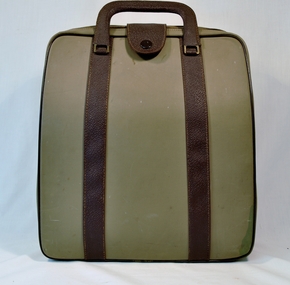
Typewriter Case Olivetti, Circa 1950
... Japanese manufactured goods was relatively slower, especially in rural areas. The demand for long lasting and dependable merchandise was in the rural area still the most important criteria. The ease of setting up this typewriter and its compact mobility was its major benefit to trades people and travelling professionals, e.g. rural doctors, other medical professionals, accountants, lawyers and educators. ...Japanese manufactured goods was relatively slower, especially in rural areas. The demand for long lasting and dependable merchandise was in the rural area still the most important criteria. The ease of setting up this typewriter and its compact mobility was its major benefit to trades people and travelling professionals, e.g. rural doctors, other medical professionals, accountants, lawyers and educators. ...This typewriter case allowed the Olivetti typewriter to be securely and free from contaminants to be totally mobile. The Olivetti typewriter company was founded in Italy in 1908 and became a leader in portable dependable typewriters.This particular typewriter contained is a Olivetti Lettera 22, oblique front stroke and portable manufactured after 1950. During the 1950s and 1960s was a time when British and European manufactured goods were still purchased by many Australian consumers. After the 1970s however, there was a shift, mainly in the cities, to Japanese made goods. The invasion of Japanese manufactured goods was relatively slower, especially in rural areas. The demand for long lasting and dependable merchandise was in the rural area still the most important criteria. The ease of setting up this typewriter and its compact mobility was its major benefit to trades people and travelling professionals, e.g. rural doctors, other medical professionals, accountants, lawyers and educators. This item(carrying case) facilitated the growing numbers of professional nomads requiring a relatively light office stationery package e.g. travelling novelist, writer, businessman and academics. This typewriter needed no electrical or battery power to operate it therefore the inside compartment did not require additional storage pockets . Outback Australia, where at this point in time, good available electrical power reticulation and battery power, was a scarce and therefore could not be totally measured as a highly efficient office environment. The protective carrying bag provided the only mobile way to operate in some business and home locations.Although this typewriter cover and its typewriter was purchased from a business in Penrith, Sydney, N.S.W., it is significant that it travelled easily to the Kiewa Valley, demonstrating the mobility of certain sections of the community. This typewriter cover protected the expensive typewriter it contained which was designed by an Italian industrial designer, Marcello Nizzoli, in line with the art deco style of the 1930s and the colour and flexibility of the vibrant 1950s. The underlying theme of manufacturing in the 1950s was to produce equipment that was more efficient than what was inherited from the earlier period of 20th century. Improvements were made to this Olivetti typewriter by Giuseppe Beccio by reducing the number of parts made from 3,000 to 2,000. Protection of such a typewriter was of an utmost necessity. The need for mobile expensive typewriters waned as less expensive typewriters became available. This was the major principle of the Japanese manufacturing juggernauts of the post World War II. Efficiency and low cost material was becoming prime factors in the success of rural industries from the 1960s. Competition from overseas producers was starting to affect rural industries and the removal of the large range of tariff protection, especially rural products, required not only a shift of farm management but a more efficient cost savings modus operandi.This is a semi hard cover (cloth over cardboard on inside, plastic over cardboard on outside), camel coloured outside and tartan cloth covered pattern inside the typewriter case. the case can be opened up by "unzipping" the top from the bottom halves of the case. For carrying purposes the case has two plastic covering metal handles with brass fittings. There are two stitched on brown reinforcement straps encompassing both sides of the case. The two reinforcing straps are brown in colour and a securing strap with a press button at one end to allow an extra securing tongue to keep the cover secure. The top inside of the case has a three quarters long paper compartment (flap style). See KVHS 0455 for Olivetti Lettera typewriter.commercial, protective carry bags/cases for mobile office equipment, mechanical typewriter -
 Bendigo Historical Society Inc.
Memorabilia - Doctor Lilian Cleeve Collection, 1915 - 1996
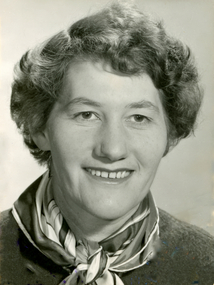
... In 1942 at the beginning of the war with Japan, Doctor Cleeve travelled to Bendigo. The train was full of soldiers travelling to camp at the Bendigo Showgrounds next to the hospital (now the Tom Flood Centre). ...In 1942 at the beginning of the war with Japan, Doctor Cleeve travelled to Bendigo. The train was full of soldiers travelling to camp at the Bendigo Showgrounds next to the hospital (now the Tom Flood Centre). ...Doctor Lilian Marjorie Cleeve was born in 1915 and died in February 1996. She grew up in Moonee Ponds and graduated as a Doctor from the University of Melbourne School of Medicine in 1941. She completed her training at the Women's Hospital in Melbourne between December 1940 and January 1941 where she delivered her first baby, Beverley Margaret Manley. In 1942 at the beginning of the war with Japan, Doctor Cleeve travelled to Bendigo. The train was full of soldiers travelling to camp at the Bendigo Showgrounds next to the hospital (now the Tom Flood Centre). Because of the war, the streets were in darkness. Some soldiers carried her suitcase to her new home. Doctor Cleeve immediately began work as the hospital Registrar. Later on she specialized in the delivery of babies, who always seemed to be born on her days off. After leaving the hospital Doctor Cleeve joined the medical practice of Doctors Gorman and Grant (husband and wife). Their rooms were on the corner of View and Mckenzie Streets in the Atkinson building (named after Doctor Harry Atkinson). Doctor Cleeve then established a medical practice in Garsed Street where the Dan Murphy Car Park is now located. Later Doctor Cleeve ran an eye clinic with Doctor Gorman's son, on the other side of Garsed Street. She also used to visit Puckapunyal Army Base to screen both the regular army recruits and the conscripts who were sent to Vietnam. Doctor Cleeve last worked as part of the associate medical staff at the Bendigo Teachers' College in Osborne Street from 1979 to 1980. In 1944 Lilian married Sargent George Cathcart (Fortuna Army Survey Regiment). George was the secretary/treasurer of the Bendigo Branch of the Liberal Party. They lived at 96 Moore Street ('Silver Birches'), close to the hospital. George and Lilian had one son, Andrew. George passed away from a heart attack in 1957. Lilian married Roy Lockart Chisholm in 1960. Roy was the manager of the Charing Cross Branch of the CBA Bank. Not long after their marriage, Lilian (now Mrs Chisholm), Roy, and Lilian's young son Andrew, took a honeymoon voyage on the cargo vessel "Milos" to Hong Kong, Japan, New Guinea and Borneo, where they visited the Sandakan War Memorial. In 1960 Lilian sold 96 Moore Street, and following Roy's retirement, they purchased a house which they named 'Roslyn' at 28 Reginald Street, Quarry Hill. Roy died in 1963 after suffering a stroke. Respected and well-liked, Mrs Chisholm continued to raise Andrew in Reginald Street with the assistance of her faithful housekeeper Coral Suurpaa, known to all as “Hickey". Coral lived in a house in Breen Street, beside the Myrtle Street railway bridge. Prior to this, "Hickey" had lived-in at Moore Street when Dr Cleeve was widowed after the death of her first husband. Photos, Passport, Letter and Nameplate 11138a Doctor Lilian Marjorie Cleeve passport photo May 1961 11138b British Australian Passport 11138c The Premier Visits 'Silver Birches' 96 Moore St., Bendigo on April 8th 1957 Photo. From Left to Right are: Former Bendigo Organiser, Mr T.J. Langdon (now at Ballarat), Mrs Langdon, Mrs John Stanistreet, The Premier, Hon. H.E. Bolte, Mr John Stanistreet, M.L.A., Mrs G. Cathcart (Dr Cleeve) and Mr G.W.S. Cathcart. 11138d Doctor Cleeve and George Cathcart Photo 11138e Dr Cleeve front row 3rd from the right with her first baby delivered at the Women's Hospital Melbourne 1940 Photo. Back Row: B J Bernstein, B Chromow, S I D Preston, H J Hoffman, P Zerman, D G Sisely. Middle Row: L B Satchell, J B Buchanan, O B Pearce, J C Trinea, M R Millikan, I J Selikoff, R E Dwork. Front Row: J Kremer, R B Lewis, Miss B Marshall, Dr M A Mackie, Prof. Marshall Allan, Miss L Cleeve, Miss J grant, H Berinshaw. 11138f Dr Cleeve, Coral Suurpaa, Andrew Cathcart Photo in the backyard at 28 Reginald St. Quarry Hill, 1195-1997. 11138g Letter from Andrew Cathcart to the Sisely family in dec 2009 re the photo taken at the Women's Hospital Melbourne in 1940-41 11138h Dr L M Cleeve Nameplate Front View 11138i Dr L M Cleeve Nameplate Rear View 11138j The University of Melbourne Conferring of degrees Wilson Hall Monday 1st June 1942bendigo, doctor lorna sisely, women's hospital melbourne, roy lockart chisholm, reginald street, quarry hill, coral suurpaa, dr lilian cleeve, george cathcart -
 Monbulk RSL Sub Branch
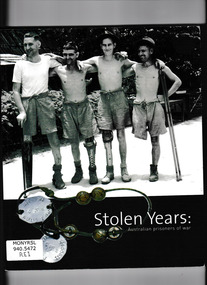
Book, Department of Veterans' Affair, Stolen Years : Australian Prisoners of War, 2002
... World war 1939 – 1945 - Prisons and prisoners – Australia Prisoners of war - Australia - Pictorial works Created by the Australian War Memorial, this book is an online companion to a travelling exhibition that explores the lives of those who were held captive by the Japanese. ...Created by the Australian War Memorial, this book is an online companion to a travelling exhibition that explores the lives of those who were held captive by the Japanese. It describes what happened during the time these individuals spend months and years behind barbed wire, hungry, bored, cold, and sick. The book tells the story of how many survived and why they deserve our respect and understanding.Ill, p.157.non-fictionCreated by the Australian War Memorial, this book is an online companion to a travelling exhibition that explores the lives of those who were held captive by the Japanese. It describes what happened during the time these individuals spend months and years behind barbed wire, hungry, bored, cold, and sick. The book tells the story of how many survived and why they deserve our respect and understanding. world war 1939 – 1945 - prisons and prisoners – australia, prisoners of war - australia - pictorial works -
 Bendigo Historical Society Inc.
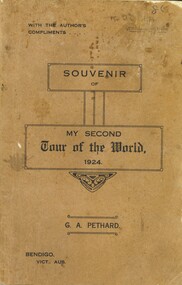
Book - SOUVENIR OF MY SECOND TOUR OF THE WORLD 1924, 1925
... Travel book to "...afford much information on subjects and places not generally known and help readers to better appreciate the marvels of other lands'' (taken from the preface) Countries visited: Ceylon (Sri Lanka) India Malaya (Malaysia) Batavia, Java (Indonesia) China Hong Kong Japan Manchuria (China and Russia) Siberia (Russia) Russia Finland Sweden Norway England (England and Scotland and Wales) Tenerife (Canary Islands, Spain) South Africa (South Africa and Zimbabwe) Item note: With the author's compliments... ...Travel book to "...afford much information on subjects and places not generally known and help readers to better appreciate the marvels of other lands'' (taken from the preface) Countries visited: Ceylon (Sri Lanka) India Malaya (Malaysia) Batavia, Java (Indonesia) China Hong Kong Japan Manchuria (China and Russia) Siberia (Russia) Russia Finland Sweden Norway England (England and Scotland and Wales) Tenerife (Canary Islands, Spain) South Africa (South Africa and Zimbabwe) Item note: With the author's compliments... ...My Second Tour of the World. 1924. By G.A. Pethard Printed by The Cambridge Press, Bendigo. 1925. Includes b/w photographs and a hand drawn map. Travel book to "...afford much information on subjects and places not generally known and help readers to better appreciate the marvels of other lands'' (taken from the preface) Countries visited: Ceylon (Sri Lanka) India Malaya (Malaysia) Batavia, Java (Indonesia) China Hong Kong Japan Manchuria (China and Russia) Siberia (Russia) Russia Finland Sweden Norway England (England and Scotland and Wales) Tenerife (Canary Islands, Spain) South Africa (South Africa and Zimbabwe) Item note: With the author's compliments... [handwritten] Mr. J. Thomas, Golden Square As the pages are not numbered, it is uncertain if any pages are missing from the front of the book. The first page talks about Ceylon. It makes no mention of Fremantle. However, Fremantle is noted on the map. 3 copiesG. A. Pethardbiography, highlights of a world tour. -
 Bendigo Historical Society Inc.
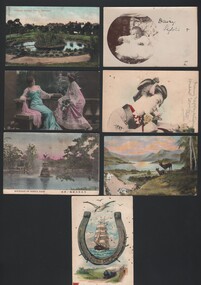
Postcard - WES HARRY COLLECTION: 7 POSTCARDS, Circa 1904
... , (e) wilderness theme, with a lake and Mountains and two deer., (f) Fountain of Hibiya Park (Japanese)., (g) Card depicting a sailing ship and steam train with a horseshoe and the caption ' May good luck travel toward you ' ....COTTAGE Miners Daisy Edinburgh Gardens Fitzroy Melbourne Japanese Girl Actresses Highland theme Deer Fountain of Hibiya Park May good luck travel toward you. ...Seven assorted postcard with various themes, (a) Infant approx 6 months old., (b) coloured postcard depicting the Edinburgh Gardens, Fitzroy, Melbourne., (c) Head and shoulder image of a young Japanese girl in Traditional dress., (d) hand tinted photo depicting two women ( in a theatre production?)., (e) wilderness theme, with a lake and Mountains and two deer., (f) Fountain of Hibiya Park (Japanese)., (g) Card depicting a sailing ship and steam train with a horseshoe and the caption ' May good luck travel toward you ' .cottage, miners, daisy, edinburgh gardens, fitzroy, melbourne, japanese girl, actresses, highland theme, deer, fountain of hibiya park, may good luck travel toward you. -
Moorabbin Air Museum
Document (item) - Japanese Army Notes Of Characteristics, Organisation, Training Etc. January 1942
... Pages: 20 Binding: Perm - Softcover Keywords: Presentation to Pacific Area Travel Association Level of Importance: World. Japanese Army Notes Of Characteristics, Organisation, Training Etc. ...Description: Author: B. A. Barker Date: 18/4/1979 Publisher: Boeing Commerical Airplane Co. Pages: 20 Binding: Perm - Softcover Keywords: Presentation to Pacific Area Travel Association Level of Importance: World. -
 Bendigo Military Museum
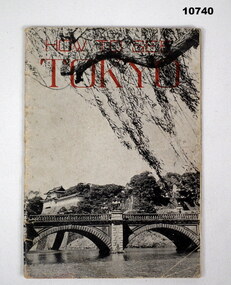
Souvenir - TRAVEL BROCHURE, TOKYO, BCOF ERA, Dai Nippon Printing Co. Ltd, "How to see Tokyo", 1947-49
... Alva Bennetts Bennetts Collection BCOF Japan Tokyo Souvenir Soft covered booklet with pages stapled to cover. 31 pages with cut edges and black and white photographic illustrations. Front cover features a black and white photograph of a bridge with building in background. Title in red type at top. Text on pages in black type. "How to see Tokyo" Souvenir TRAVEL ...Booklet collected by "Alva Bennetts" during her deployment to BCOF Japan - 1947 to 1949. Part of the Bennetts collection. See Cat 9726P for details of service for Alva Marie Bennetts (VFX128835).Soft covered booklet with pages stapled to cover. 31 pages with cut edges and black and white photographic illustrations. Front cover features a black and white photograph of a bridge with building in background. Title in red type at top. Text on pages in black type.alva bennetts, bennetts collection, bcof, japan, tokyo, souvenir -
 National Wool Museum
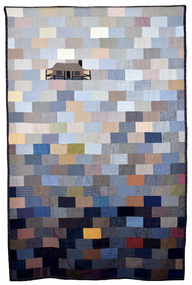
Textile - Quilt, Judy Turner, The Fading Dream of Australian Home Ownership, 1989
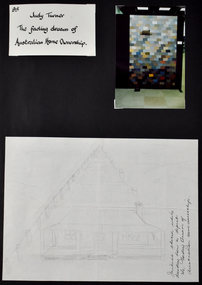
... travelling men’s ware salesman and friend of the artist’s late husband. The suiting samples were used just as they were, without cutting, and are stacked liked house bricks. The pieces have been machine pieced and tied. The quilt has woollen backing, with no batting. Judy’s son Nicholas, always interested in drawing, and keen to see what his mother was making, helped with the drawing and design of the house. The quilt has been exhibited in Canberra, Armidale and Sydney and featured in publications in Australian and Japan...travelling men’s ware salesman and friend of the artist’s late husband. The suiting samples were used just as they were, without cutting, and are stacked liked house bricks. The pieces have been machine pieced and tied. The quilt has woollen backing, with no batting. Judy’s son Nicholas, always interested in drawing, and keen to see what his mother was making, helped with the drawing and design of the house. The quilt has been exhibited in Canberra, Armidale and Sydney and featured in publications in Australian and Japan ...‘The Fading Dream of Australian Home Ownership’ was made by Judy Turner in 1989 for her son Nicholas (then 14 years) after a family discussion about mortgages and rising interest rates (17% at the time), out of concern for his generation. “Perhaps this will keep my son warm when he can’t afford a house”, wrote Judy at the time. As a quilting teacher for over thirty years, Judy was well aware of the ‘wagga’ tradition of making do with what you have and reusing resources to make something useful. The quilt was made using approximately 270 different men’s woollen suiting samples. The fabrics in the quilt were a gift from Micheal Haze who was a travelling men’s ware salesman and friend of the artist’s late husband. The suiting samples were used just as they were, without cutting, and are stacked liked house bricks. The pieces have been machine pieced and tied. The quilt has woollen backing, with no batting. Judy’s son Nicholas, always interested in drawing, and keen to see what his mother was making, helped with the drawing and design of the house. The quilt has been exhibited in Canberra, Armidale and Sydney and featured in publications in Australian and Japan. Judy’s work has been exhibited Nationally and Internationally, including in Japan, Korea, Germany, Switzerland and the United States of America. Judy’s work has featured extensively in publications around the world, and has received many awards. Her work is held in public and private collections across Australia and the USA. As well as a successful career as an artist, Judy spent three decades imparting skills to the next generation as a patient and skilled teacher. ARTIST STATEMENT The medium of my artistic practice is quilt making and my focus is the use of colour and speedy, accurate and efficient methods of making successful quilts. In 1995 I developed an original technique of applying woollen yarn to a woollen background, focusing on the subtle blending of colour to express an idea. Author of Awash With Colour (1997) and co-author with Margaret Rolfe of Successful Scrap Quilts (2002).Quilt featuring block pieces in tones of grey, blue, tan and brown, graduating in light to dark tones from top to bottom. The top third features a house with a verandah.quilt, wagga, home, house, housing affordability, design -
 National Wool Museum
Document - The Fading Dream of Australian Home Ownership, Design and Photograph, Judy Turner, 1989
... travelling men’s ware salesman and friend of the artist’s late husband. The suiting samples were used just as they were, without cutting, and are stacked liked house bricks. The pieces have been machine pieced and tied. The quilt has woollen backing, with no batting. Judy’s son Nicholas, always interested in drawing, and keen to see what his mother was making, helped with the drawing and design of the house. The quilt has been exhibited in Canberra, Armidale and Sydney and featured in publications in Australian and Japan...travelling men’s ware salesman and friend of the artist’s late husband. The suiting samples were used just as they were, without cutting, and are stacked liked house bricks. The pieces have been machine pieced and tied. The quilt has woollen backing, with no batting. Judy’s son Nicholas, always interested in drawing, and keen to see what his mother was making, helped with the drawing and design of the house. The quilt has been exhibited in Canberra, Armidale and Sydney and featured in publications in Australian and Japan ...‘The Fading Dream of Australian Home Ownership’ was made by Judy Turner in 1989 for her son Nicholas (then 14 years) after a family discussion about mortgages and rising interest rates (17% at the time), out of concern for his generation. “Perhaps this will keep my son warm when he can’t afford a house”, wrote Judy at the time. As a quilting teacher for over thirty years, Judy was well aware of the ‘wagga’ tradition of making do with what you have and reusing resources to make something useful. The quilt was made using approximately 270 different men’s woollen suiting samples. The fabrics in the quilt were a gift from Micheal Haze who was a travelling men’s ware salesman and friend of the artist’s late husband. The suiting samples were used just as they were, without cutting, and are stacked liked house bricks. The pieces have been machine pieced and tied. The quilt has woollen backing, with no batting. Judy’s son Nicholas, always interested in drawing, and keen to see what his mother was making, helped with the drawing and design of the house. The quilt has been exhibited in Canberra, Armidale and Sydney and featured in publications in Australian and Japan. Judy’s work has been exhibited Nationally and Internationally, including in Japan, Korea, Germany, Switzerland and the United States of America. Judy’s work has featured extensively in publications around the world, and has received many awards. Her work is held in public and private collections across Australia and the USA. As well as a successful career as an artist, Judy spent three decades imparting skills to the next generation as a patient and skilled teacher. ARTIST STATEMENT The medium of my artistic practice is quilt making and my focus is the use of colour and speedy, accurate and efficient methods of making successful quilts. In 1995 I developed an original technique of applying woollen yarn to a woollen background, focusing on the subtle blending of colour to express an idea. Author of Awash With Colour (1997) and co-author with Margaret Rolfe of Successful Scrap Quilts (2002).Folio page depicting three items attached to a black card background. One item is a title written in black ink on white background, another is a photograph of a quilt, the third shows a hand drawn sketch of a house with a verandah.Front: [handwritten] 95 / Judy Turner / The fading dream of / Australian Home Ownership. / Initial sketch while / deciding how to depict / the Fading Dream of / Australian Home Ownership.quilt, wagga, home, house, housing affordability, design -
 National Wool Museum
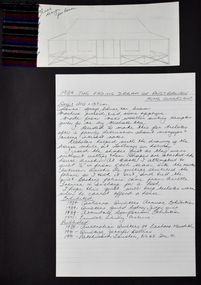
Document - The Fading Dream of Australian Home Ownership, Design and Fabric Sample, Judy Turner, 1989
... travelling men’s ware salesman and friend of the artist’s late husband. The suiting samples were used just as they were, without cutting, and are stacked liked house bricks. The pieces have been machine pieced and tied. The quilt has woollen backing, with no batting. Judy’s son Nicholas, always interested in drawing, and keen to see what his mother was making, helped with the drawing and design of the house. The quilt has been exhibited in Canberra, Armidale and Sydney and featured in publications in Australian and Japan...travelling men’s ware salesman and friend of the artist’s late husband. The suiting samples were used just as they were, without cutting, and are stacked liked house bricks. The pieces have been machine pieced and tied. The quilt has woollen backing, with no batting. Judy’s son Nicholas, always interested in drawing, and keen to see what his mother was making, helped with the drawing and design of the house. The quilt has been exhibited in Canberra, Armidale and Sydney and featured in publications in Australian and Japan ...‘The Fading Dream of Australian Home Ownership’ was made by Judy Turner in 1989 for her son Nicholas (then 14 years) after a family discussion about mortgages and rising interest rates (17% at the time), out of concern for his generation. “Perhaps this will keep my son warm when he can’t afford a house”, wrote Judy at the time. As a quilting teacher for over thirty years, Judy was well aware of the ‘wagga’ tradition of making do with what you have and reusing resources to make something useful. The quilt was made using approximately 270 different men’s woollen suiting samples. The fabrics in the quilt were a gift from Micheal Haze who was a travelling men’s ware salesman and friend of the artist’s late husband. The suiting samples were used just as they were, without cutting, and are stacked liked house bricks. The pieces have been machine pieced and tied. The quilt has woollen backing, with no batting. Judy’s son Nicholas, always interested in drawing, and keen to see what his mother was making, helped with the drawing and design of the house. The quilt has been exhibited in Canberra, Armidale and Sydney and featured in publications in Australian and Japan. Judy’s work has been exhibited Nationally and Internationally, including in Japan, Korea, Germany, Switzerland and the United States of America. Judy’s work has featured extensively in publications around the world, and has received many awards. Her work is held in public and private collections across Australia and the USA. As well as a successful career as an artist, Judy spent three decades imparting skills to the next generation as a patient and skilled teacher. ARTIST STATEMENT The medium of my artistic practice is quilt making and my focus is the use of colour and speedy, accurate and efficient methods of making successful quilts. In 1995 I developed an original technique of applying woollen yarn to a woollen background, focusing on the subtle blending of colour to express an idea. Author of Awash With Colour (1997) and co-author with Margaret Rolfe of Successful Scrap Quilts (2002).Folio page depicting three items attached to a black card background. One item is a red, blue, black and white textile sample, another is a hand drawn sketch of a house, the third shows hand written text on lined paper in black ink.Front: [handwritten] Final / design / for housequilt, wagga, home, house, housing affordability, design -
 National Wool Museum
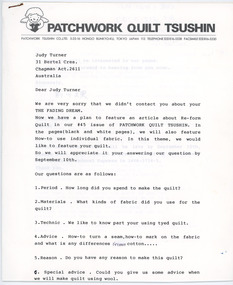
Document - The Fading Dream of Australian Home Ownership, Letters, Judy Turner et al, 1991
... travelling men’s ware salesman and friend of the artist’s late husband. The suiting samples were used just as they were, without cutting, and are stacked liked house bricks. The pieces have been machine pieced and tied. The quilt has woollen backing, with no batting. Judy’s son Nicholas, always interested in drawing, and keen to see what his mother was making, helped with the drawing and design of the house. The quilt has been exhibited in Canberra, Armidale and Sydney and featured in publications in Australian and Japan...travelling men’s ware salesman and friend of the artist’s late husband. The suiting samples were used just as they were, without cutting, and are stacked liked house bricks. The pieces have been machine pieced and tied. The quilt has woollen backing, with no batting. Judy’s son Nicholas, always interested in drawing, and keen to see what his mother was making, helped with the drawing and design of the house. The quilt has been exhibited in Canberra, Armidale and Sydney and featured in publications in Australian and Japan ...‘The Fading Dream of Australian Home Ownership’ was made by Judy Turner in 1989 for her son Nicholas (then 14 years) after a family discussion about mortgages and rising interest rates (17% at the time), out of concern for his generation. “Perhaps this will keep my son warm when he can’t afford a house”, wrote Judy at the time. As a quilting teacher for over thirty years, Judy was well aware of the ‘wagga’ tradition of making do with what you have and reusing resources to make something useful. The quilt was made using approximately 270 different men’s woollen suiting samples. The fabrics in the quilt were a gift from Micheal Haze who was a travelling men’s ware salesman and friend of the artist’s late husband. The suiting samples were used just as they were, without cutting, and are stacked liked house bricks. The pieces have been machine pieced and tied. The quilt has woollen backing, with no batting. Judy’s son Nicholas, always interested in drawing, and keen to see what his mother was making, helped with the drawing and design of the house. The quilt has been exhibited in Canberra, Armidale and Sydney and featured in publications in Australian and Japan. Judy’s work has been exhibited Nationally and Internationally, including in Japan, Korea, Germany, Switzerland and the United States of America. Judy’s work has featured extensively in publications around the world, and has received many awards. Her work is held in public and private collections across Australia and the USA. As well as a successful career as an artist, Judy spent three decades imparting skills to the next generation as a patient and skilled teacher. ARTIST STATEMENT The medium of my artistic practice is quilt making and my focus is the use of colour and speedy, accurate and efficient methods of making successful quilts. In 1995 I developed an original technique of applying woollen yarn to a woollen background, focusing on the subtle blending of colour to express an idea. Author of Awash With Colour (1997) and co-author with Margaret Rolfe of Successful Scrap Quilts (2002).Two typed letters held together with a staple. The first letter has a grey printed letter head which includes a logo of a person with wings holding a heart.[printed] PATCHWORK QUILT TSUSHINquilt, wagga, home, house, housing affordability, design -
 Mont De Lancey
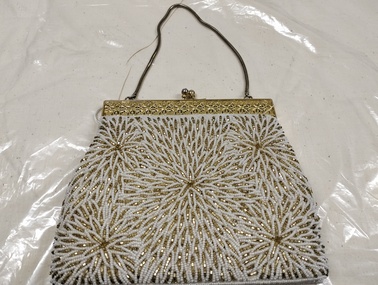
Accessory - Beaded evening bag, c.1960s
... Much of Netta and Neville’s 1960s collection originated in Hong Kong, including this bag, a trend which can be attributed to both Netta and Neville’s extensive travel in Asia and Hong Kong’s 1960s industrial boom. The starburst design echoes that of Japanese beaded purses that came into vogue between the 1920s and 1960s as part of a fascination with the ‘oriental.’ ...Much of Netta and Neville’s 1960s collection originated in Hong Kong, including this bag, a trend which can be attributed to both Netta and Neville’s extensive travel in Asia and Hong Kong’s 1960s industrial boom. The starburst design echoes that of Japanese beaded purses that came into vogue between the 1920s and 1960s as part of a fascination with the ‘oriental.’ ...This bag was used in the 1970s by Mrs Annette Lord, and was part of a large collection she donated when helping found Mont de Lancey Historic Homestead. Annette and Neville travelled extensively throughout the 50s-70s during which Annette acquired a large amount of her collection. While partly for pleasure, Netta and Neville also travelled to strengthen diplomatic relationships in the British Crown, notably developing a unique relationship with Madagascan royalty and being one of the few families invited to Queen Elizabeth’s 1963 state reception. Much of Netta and Neville’s 1960s collection originated in Hong Kong, including this bag, a trend which can be attributed to both Netta and Neville’s extensive travel in Asia and Hong Kong’s 1960s industrial boom. The starburst design echoes that of Japanese beaded purses that came into vogue between the 1920s and 1960s as part of a fascination with the ‘oriental.’ Annette Lord’s collection is exemplary of this fascination, with this purse being one of many Japanese inspired items in her possession.C.1960s white and gold beaded evening bag with a starburst design. Gold frame with kiss clasp closure,diamantes on each clasp closure. Gold chain handle White lining with 1 small pocket handbag, beading, handbeading, purse, bag, bags, purses, handbags, beads, sead beads, orientalism, japan, japanese, sixties, 1960s, hong kong
