
Showing 9 items matching "japanese air power"
-
 Moorabbin Air Museum
Book - Japanese aircraft of WW2, Japanese Aircraft of World War II
... Japanese air power...Japanese aircraft of WW2 Japanese air power Japanese aircraft industry Course of the air war Designation of Japanese naval & military aircraft Technical reference & colour section History & technical specifications of Japanese WW II aircraft, circa 1979 Japanese Aircraft of World War II Book Japanese aircraft of WW2 ...History & technical specifications of Japanese WW II aircraft, circa 1979non-fictionHistory & technical specifications of Japanese WW II aircraft, circa 1979japanese air power, japanese aircraft industry, course of the air war, designation of japanese naval & military aircraft, technical reference & colour section -
 Bendigo Military Museum
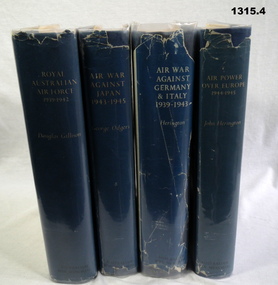
Book - BOOKS, 1) Douglas Gillison et al, Australians in the War of 1939-1945. Series Three. Air, 1) 1962; .2) 1957; .3) 1954; .4) 1963
... Illustrated with black & white photos & maps. .1) Vol I Royal Australian Air Force 1939-1942, 786 pages .2) Vol II Air War Against Japan 1939-1945, 533 pages .3) Vol III Air War Against Germany & Italy 1939-1943, 731 pages .4) Vol IV Air Power Over Europe 1944-1945, 539 pages...Illustrated with black & white photos & maps. .1) Vol I Royal Australian Air Force 1939-1942, 786 pages .2) Vol II Air War Against Japan 1939-1945, 533 pages .3) Vol III Air War Against Germany & Italy 1939-1943, 731 pages .4) Vol IV Air Power Over Europe 1944-1945, 539 pages Australians in the War of 1939-1945. ...Mid blue buckram hard covers with blue plastic covered dust jackets. Titles on front covers & spines except Vol III due to front of dust jacket missing. Illustrated with black & white photos & maps. .1) Vol I Royal Australian Air Force 1939-1942, 786 pages .2) Vol II Air War Against Japan 1939-1945, 533 pages .3) Vol III Air War Against Germany & Italy 1939-1943, 731 pages .4) Vol IV Air Power Over Europe 1944-1945, 539 pagesbooks, military history - airforce -
 Monbulk RSL Sub Branch
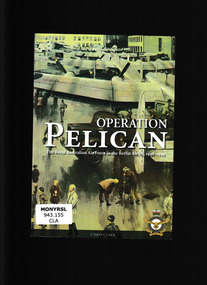
Book, Air Power Development Centre, Operation Pelican : The RAAF in the Berlin Airlift, 1948-1949, 2008
... When Britain turned for support to its Dominion partners, the transport element of the Royal Australian Air Force had recently ceased flying a regular courier service for Australian occupation forces involved in garrisoning another defeated Axis power of World War II, Japan - this role having been handed over to a commercial airline. ...In 1948 Britain, France and the United States of America found themselves opposed to their former wartime ally, the Soviet Union, over matters regarding control of the capital of the defeated Nazi German regime. When the Soviets imposed a blockade of the city, the Allies had no option but to begin flying in the necessities of life for the two million inhabitants of the zones under their administration. Thus began the first large-scale humanitarian airlift in history. When Britain turned for support to its Dominion partners, the transport element of the Royal Australian Air Force had recently ceased flying a regular courier service for Australian occupation forces involved in garrisoning another defeated Axis power of World War II, Japan - this role having been handed over to a commercial airline. By September 1948 an unnumbered Australian squadron had joined other RAAF transport crews already engaged as part of the massive allied undertaking. To the Americans the fifteen-month-long operation was codenamed Vittles, while the British called it Plainfare. But to the Royal Australian Air Force personnel involved, the Berlin Airlift was known as Pelican. Here the story is told of the events that made the airlift necessary, what the undertaking entailed and the part that Australians played in it, as well as the outcome and achievements of Operation Pelican.Ill, maps, p.82.non-fictionIn 1948 Britain, France and the United States of America found themselves opposed to their former wartime ally, the Soviet Union, over matters regarding control of the capital of the defeated Nazi German regime. When the Soviets imposed a blockade of the city, the Allies had no option but to begin flying in the necessities of life for the two million inhabitants of the zones under their administration. Thus began the first large-scale humanitarian airlift in history. When Britain turned for support to its Dominion partners, the transport element of the Royal Australian Air Force had recently ceased flying a regular courier service for Australian occupation forces involved in garrisoning another defeated Axis power of World War II, Japan - this role having been handed over to a commercial airline. By September 1948 an unnumbered Australian squadron had joined other RAAF transport crews already engaged as part of the massive allied undertaking. To the Americans the fifteen-month-long operation was codenamed Vittles, while the British called it Plainfare. But to the Royal Australian Air Force personnel involved, the Berlin Airlift was known as Pelican. Here the story is told of the events that made the airlift necessary, what the undertaking entailed and the part that Australians played in it, as well as the outcome and achievements of Operation Pelican.cold war - history, berlin airlift 1948-1949 -
 Wangaratta RSL Sub Branch
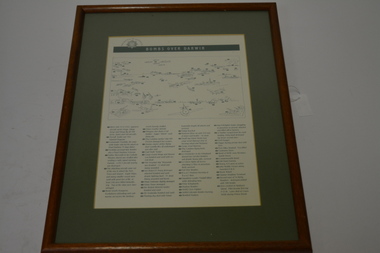
Essay - Framed essay, The Battle of Australia
... Japanese air raids. On 19 February 1942 Darwin was bombed by two separate Japanese air raids becoming the largest single attack ever mounted by a foreign power on Australia. ...Item detailing events of the 19th February 1942 when Darwin was bombed on two separate occasions by Japanese air raids.On 19 February 1942 Darwin was bombed by two separate Japanese air raids becoming the largest single attack ever mounted by a foreign power on Australia. The attack left hundreds of servicemen and civilians dead, and countless others injured.Brown timber frame and green mount and cream colourd paper with green text and sketches of flying planes The Battle of Australia Bombs Over Darwindarwin, australia, bombing, ww2, japanese, 1942 -
 Wangaratta RSL Sub Branch
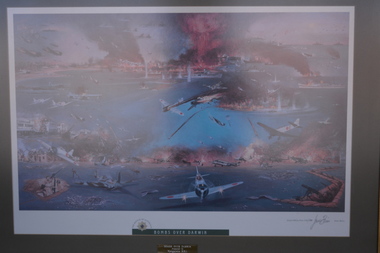
Print - Framed Print, Bombs over Darwin, 1991
... The two Japanese air raids were the first, and largest, of more than 100 air raids against Australia during 1942–43. The Bombing of Darwin, also known as the Battle of Darwin, on 19 February 1942 was the largest single attack ever mounted by a foreign power on Australia. ...On the 19 February 1942, 242 Japanese aircraft, in two separate raids, attacked the town of Darwin, ships in the harbour and the town's two airfields in an attempt to prevent the Allies from using them as bases to contest the invasion of Timor and Java during World War II. Darwin was lightly defended, relative to the size of the attack, and the Japanese inflicted heavy losses upon Allied forces at little cost to themselves. The two Japanese air raids were the first, and largest, of more than 100 air raids against Australia during 1942–43.The Bombing of Darwin, also known as the Battle of Darwin, on 19 February 1942 was the largest single attack ever mounted by a foreign power on Australia. The urban areas of Darwin also suffered damage from the raids and there were a number of civilian casualties. As a result more than half of Darwin's civilian population left the area permanently, before or immediately after the attack. Timber framed containing coloured print of planes depicting the bombing of Darwin Harbour. Gold metal plaque - BOMBS OVER DARWIN Presented to Wangaratta RSL Limited Edition Print 234/1800 by James Baineswwii, bombing of darwin, battle of darwin -
 Wangaratta RSL Sub Branch
Print - Framed Print, Darwin Harbour
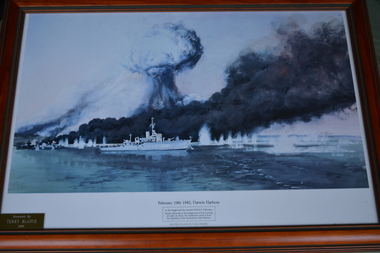
... Japanese air raid on Darwin on 19 February 1942. In January 1942 HMAS Deloraine evaded an attack by the Japanese submarine I-124 north-west of Darwin and was jointly credited with the submarines' sinking after she inflicted the initial damage. The Bombing of Darwin, also known as the Battle of Darwin, on 19 February 1942 was the largest single attack ever mounted by a foreign power ...Image depicting the explosion of a ship, filled with TNT and ammunition, hit during the first Japanese air raid on Australia's mainland, at Darwin on 19 February 1942. In the foreground is HMAS Deloraine which survived unscathed. On that day, 236 people were killed when 242 Japanese aircraft, in two separate raids, attacked the town, ships in Darwin's harbour and the town's two airfields in an attempt to prevent the Allies from using them as bases to contest the invasion of Timor and Java during World War II. MV Neptuna was a 5,952 ton cargo motor vessel. and was 1 of 11 sunk during the Japanese air raid on Darwin on 19 February 1942. In January 1942 HMAS Deloraine evaded an attack by the Japanese submarine I-124 north-west of Darwin and was jointly credited with the submarines' sinking after she inflicted the initial damage. The Bombing of Darwin, also known as the Battle of Darwin, on 19 February 1942 was the largest single attack ever mounted by a foreign power on Australia. Brown timber frame containing blue black and white print of ships being bombed.February 19th 1942, Darwin Harbour In the foreground the corvette HMAS Deloraine. Smoke billowing in the background is from burning oil tanks on shore, the mushroom cloud is from the explosionof the ammunition ship Neptuna. Watercolour by Tom Offordbombing of darwin, battle of darwin, 19 february 1942, ww2, mv neptuna, hmas deloraine -
 Moorabbin Air Museum
Book (item) - (SP) World Air Power Journal 14 Autumn 1993
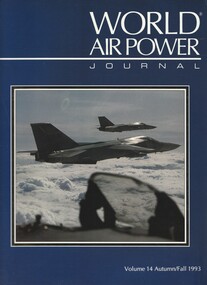
... PACAF – USAF in Korea and Japan photo feature...Air Power...Combat Report: Punitive raids on Iraq Somalia humanitarian relief effort Briefings: Westland Lynx Fuerza Aerea Venezolana C-17 Globemaster III feature MosAeroshow feature Focus Aircraft: General Dynamics F-111 (44 pages) Variant Briefing: Dassault Mirage III/5/50 part 1 PACAF – USAF in Korea and Japan photo feature Air Power Analysis: Hungary Book (SP) World Air Power Journal 14 Autumn 1993 ...combat report: punitive raids on iraq, somalia humanitarian relief effort, briefings: westland lynx, fuerza aerea venezolana, c-17 globemaster iii feature, mosaeroshow feature, focus aircraft: general dynamics f-111 (44 pages), variant briefing: dassault mirage iii/5/50 part 1, pacaf – usaf in korea and japan photo feature, air power analysis: hungary -
 Moorabbin Air Museum
Book (item) - (SP) World Air Power Journal 35 Winter 1998
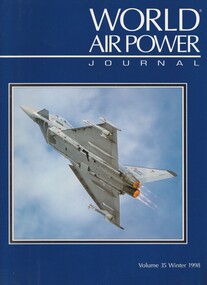
... Air Power Analysis Update: Honduras...Guatemala...Guidimakha ’98 – Franco-African exercise feature...Green Flag ’98 feature...CFB Cold Lake photo feature...Focus Aircraft: Eurofighter Typhoon (44 pages)...CVW-14 aboard USS Abraham Lincoln photo feature...Variant Briefing: Ilyushin Il-76...RAF exchange pilot with the AdlA photo feature...Air Power Analysis: Japan...Briefings: AvDef – the French ‘FR Aviation’ USAF 82nd Aerial Targets Squadron Air Mobility Rodeo ’98 Air Power Analysis Update: Honduras Guatemala Guidimakha ’98 – Franco-African exercise feature Green Flag ’98 feature CFB Cold Lake photo feature Focus Aircraft: Eurofighter Typhoon (44 pages) CVW-14 aboard USS Abraham Lincoln photo feature Variant Briefing: Ilyushin Il-76 RAF exchange pilot with the AdlA photo feature Air Power Analysis: Japan Book (SP) World Air Power Journal 35 Winter 1998 ...briefings: avdef – the french ‘fr aviation’, usaf 82nd aerial targets squadron, air mobility rodeo ’98, air power analysis update: honduras, guatemala, guidimakha ’98 – franco-african exercise feature, green flag ’98 feature, cfb cold lake photo feature, focus aircraft: eurofighter typhoon (44 pages), cvw-14 aboard uss abraham lincoln photo feature, variant briefing: ilyushin il-76, raf exchange pilot with the adla photo feature, air power analysis: japan -
 Dandenong/Cranbourne RSL Sub Branch
Document - Framed Information Sheet, H.M.A.S Perth, Circa 9140s
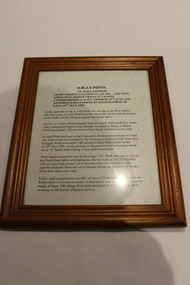
... air attack while berthed in Malta. Perth evacuated troops from Greece to Crete when Crete was invaded by the Germans When Japan entered the war in December 1941 Perth was sent to Java in the Dutch East Indies - now Indonesia. Perth's total complement was 681, of these 353 including Captain Hector Waller D.S.O were lost in action, 4 died ashore and 324 fell into Japanese hands. Of these 106 ratings died while prisoners of war, 53 dying while working on the Burma - Thailand railway. H.M.A.S Perth (ex H.M.S Amphion). A Light Cruiser Leander Class 1941 of 7600 tons. Under full power ...At the outbreak of war in 1939 Perth was serving in the West Indies. She served with distinction at Cape Matapan against Italy. Perth suffered damage from an air attack while berthed in Malta. Perth evacuated troops from Greece to Crete when Crete was invaded by the Germans When Japan entered the war in December 1941 Perth was sent to Java in the Dutch East Indies - now Indonesia. Perth's total complement was 681, of these 353 including Captain Hector Waller D.S.O were lost in action, 4 died ashore and 324 fell into Japanese hands. Of these 106 ratings died while prisoners of war, 53 dying while working on the Burma - Thailand railway.Framed Information sheet with description of specifications - crew numbers and service record of H.M.A.S Perth.H.M.A.S Perth (ex H.M.S Amphion). A Light Cruiser Leander Class 1941 of 7600 tons. Under full power speed trials reached 31.7 knots. Perth was commissioned as H.M.S Amphion on 15th June 1936 and was renamed H.M.A.S Perth by H.R.H Duchess of Kent on 10th July 1939.
