
Showing 32 items matching "japanese dolls"
-
 Seaworks Maritime Museum
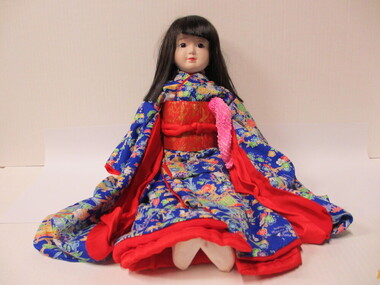
Doll
... Large Japanese doll with traditional costume including silver charm and moveable limbs. ...Tag attached: "PMA 0443/1/ "DOLL"/ Japanese Doll Presented to the Port of/ Melbourne Authority"...Tag attached: "PMA 0443/1/ "DOLL"/ Japanese Doll Presented to the Port of/ Melbourne Authority" Large Japanese doll with traditional costume including silver charm and moveable limbs. ...Large Japanese doll with traditional costume including silver charm and moveable limbs. Tag attached: "PMA 0443/1/ "DOLL"/ Japanese Doll Presented to the Port of/ Melbourne Authority" -
 Bendigo Military Museum
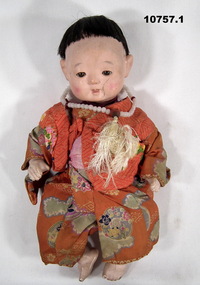
Souvenir - DOLLS, JAPANESE TRADITIONAL, c.1939-48
... DOLLS, JAPANESE TRADITIONAL...The doll has miniature glass eyes. Clothing is traditional shape attire with Japanese floral patterns. ... floral patterns. Souvenir DOLLS, JAPANESE TRADITIONAL ....1) and .2) collected by Alva Bennetts during her deployment to BCOF Japan - 1947 to 1949. Part of the Bennetts Collection. See Catalogue No. 9726P for details of Alva Marie Bennetts (no. VFX128835) service.1. Boy doll, short black hair. The doll's body is of a rough ceramic, covered with fine pinkish ceramic. The doll has miniature glass eyes. Clothing is traditional shape attire with Japanese floral patterns. The doll has an imitation pearl necklace, The internal strings have broken, thus limbs and head are loose. There are a lot of cracks and chips in the doll. 2. Girl doll. Long black hair with some sort of bow on top. Dress appears to be a kimono style. Feet and lower limbs missing. The dress has Japanese floral patterns. bcof, japan, souvenir, alva bennetts, bennetts collection -
 Mission to Seafarers Victoria
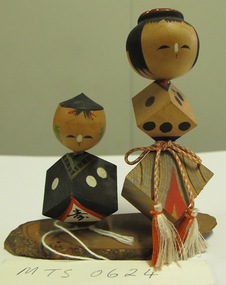
Leisure object - Doll, unknown
... japanese dolls...Ornamental Japanese wooden [Kokeshi?] dolls mounted on a small wooden base; the female figure is made of one big cube, and one smaller dice, the head is round with a small headware. ...Making models is a hobbies for sailors during their long journey on board. japanese dolls dice dolls japan gift seamen sailors models hobbies On one face of the boy dice black ideogram is written in black ink. ...produced circa 1960These dolls may have been made by Japanese sailors and gifted to the Mission. Making models is a hobbies for sailors during their long journey on board.Ornamental Japanese wooden [Kokeshi?] dolls mounted on a small wooden base; the female figure is made of one big cube, and one smaller dice, the head is round with a small headware. The male figure, a small boy, is made of one black dice and a round head wearing a pointy hat.On one face of the boy dice black ideogram is written in black ink.japanese dolls, dice dolls, japan, gift, seamen, sailors, models, hobbies -
 Seaworks Maritime Museum
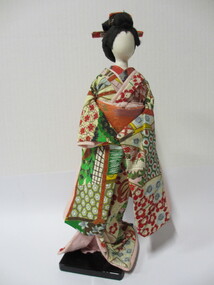
Doll
... Japanese doll with traditional dress and hair ...Japanese doll with traditional dress and hair Doll ...Japanese doll with traditional dress and hair -
 Seaworks Maritime Museum
Doll
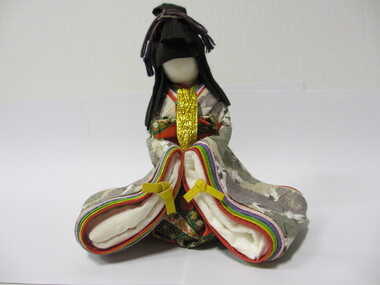
... Seated japanese doll with traditional dress and black hair and purple bow in hair. ..."PMA 0121" Seated japanese doll with traditional dress and black hair and purple bow in hair. ...Seated japanese doll with traditional dress and black hair and purple bow in hair. "PMA 0121" -
 Seaworks Maritime Museum
Doll
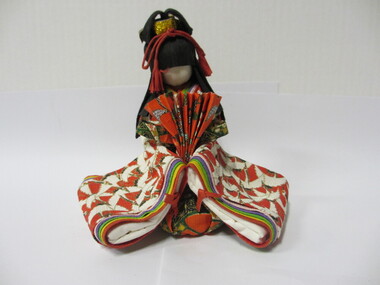
... seated Japanese doll in traditional costume holding fan with red bow in hair..."PMA 0120" seated Japanese doll in traditional costume holding fan with red bow in hair Doll ...seated Japanese doll in traditional costume holding fan with red bow in hair"PMA 0120" -
 Seaworks Maritime Museum
Doll
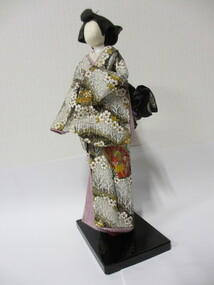
... Japanese doll with traditional dress. Standing upright supported by black square base. ...On doll: "PMA 0130/1" On base: "WMA 57" "PMA 0130/2" Japanese writing at base in pencil...On doll: "PMA 0130/1" On base: "WMA 57" "PMA 0130/2" Japanese writing at base in pencil Japanese doll with traditional dress. ...Japanese doll with traditional dress. Standing upright supported by black square base. On doll: "PMA 0130/1" On base: "WMA 57" "PMA 0130/2" Japanese writing at base in pencil -
 Seaworks Maritime Museum
Doll
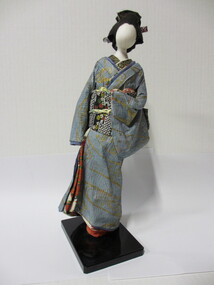
... Japanese doll standing upright with traditional blue dress supported on black square base. ..."WMA 42" "PMA 012 6/2 Japanese writing with pencil on base Japanese doll standing upright with traditional blue dress supported on black square base. ...Japanese doll standing upright with traditional blue dress supported on black square base. "WMA 42" "PMA 012 6/2 Japanese writing with pencil on base -
 Seaworks Maritime Museum
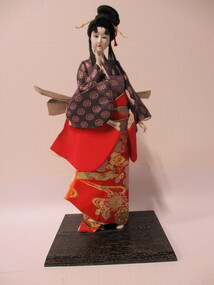
Doll
... Japanese doll with traditional dress standing upright supported by black base. ..."WMA 58" Japanese doll with traditional dress standing upright supported by black base. ...Japanese doll with traditional dress standing upright supported by black base. One hand is raised."WMA 58" -
 Seaworks Maritime Museum
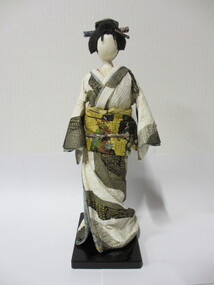
Doll
... Japanese doll with traditional dress with yellow sash. ..."WMA 60" "PMA 0127/2" Japanese writing in pencil at base Japanese doll with traditional dress with yellow sash. ...Japanese doll with traditional dress with yellow sash. Standing upright supported by clack, square base "WMA 60" "PMA 0127/2" Japanese writing in pencil at base -
 Seaworks Maritime Museum
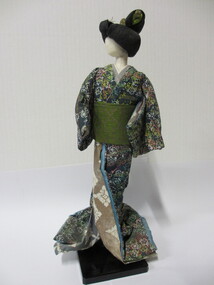
Doll
... Japanese doll with traditional dress including green sash and hair done in traditional style with ornaments. ..."WMA 59" "PMA 0133/2" Japanese writing in pencil on the base Japanese doll with traditional dress including green sash and hair done in traditional style with ornaments. ...Japanese doll with traditional dress including green sash and hair done in traditional style with ornaments. "WMA 59" "PMA 0133/2" Japanese writing in pencil on the base -
 Seaworks Maritime Museum
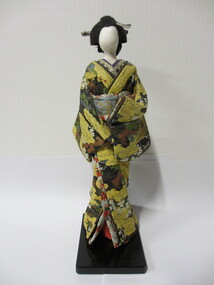
Doll
... Japanese doll in traditional dress standing upright supported by black base. ..."WMA 43" Japanese writing in pencil at base Japanese doll in traditional dress standing upright supported by black base. ...Japanese doll in traditional dress standing upright supported by black base. Hair is in traditional style with ornaments "WMA 43" Japanese writing in pencil at base -
 Seaworks Maritime Museum
Doll
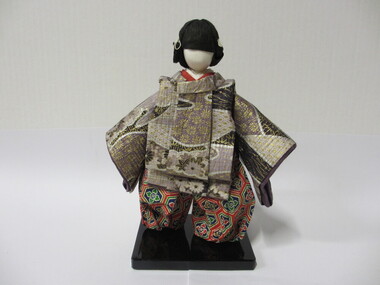
... Japanese doll with traditional costume and two white bows in hair. ..."PMA 0128/2" Japanese writing in pencil t base Japanese doll with traditional costume and two white bows in hair. ...Japanese doll with traditional costume and two white bows in hair. Doll is standing upright supported by black, square base. "PMA 0128/2" Japanese writing in pencil t base -
 Seaworks Maritime Museum
Doll
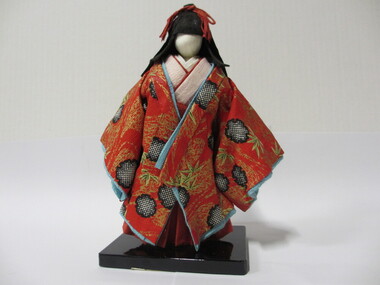
... Japanese doll with traditional layered dress and red bow in black hair. ...Japanese writing on base of doll...Japanese writing on base of doll Japanese doll with traditional layered dress and red bow in black hair. ...Japanese doll with traditional layered dress and red bow in black hair. Doll is standing upright, supported on black square base. Japanese writing on base of doll -
 Seaworks Maritime Museum
Doll
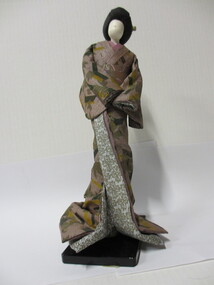
... Tall Japanese doll with purple traditional dress standing upright supported by black, square base. ..."WMA 56" Japanese writing on base Tall Japanese doll with purple traditional dress standing upright supported by black, square base. ...Tall Japanese doll with purple traditional dress standing upright supported by black, square base. Hair is arranged in traditional style with ornaments. "WMA 56" Japanese writing on base -
 Seaworks Maritime Museum
Doll
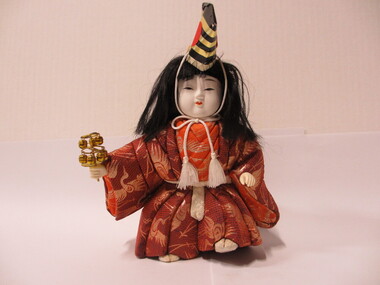
... Japanese doll with black hair and traditional costume including hat and sash. ...Japanese doll with black hair and traditional costume including hat and sash. ...Japanese doll with black hair and traditional costume including hat and sash. Holding a gold instrument in its right hand with one foot raised in crouching position. -
 Tatura Irrigation & Wartime Camps Museum
Craft - Doll, Japanese Doll, 1940's
... Japanese doll dressed in brown, with bone and orange patterned kimono. ...Stands on a wooden base. Japanese Doll Craft Doll ...Made by internees and given to Monte Punshon as a gift. Monte was an Australian warden who had oversight of the women and children in one of the compounds. Monte spoke fluent Japanese which she had learnt in the 1930's pre the war.Japanese doll dressed in brown, with bone and orange patterned kimono. Orange check obi carrying a blue/grey handbag. Black hat with bone trim. Stands on a wooden base.japanese doll, camp 4 hand crafts, monte punshon, camp 4 rushworth, aws nurse -
 Seaworks Maritime Museum
Framed doll
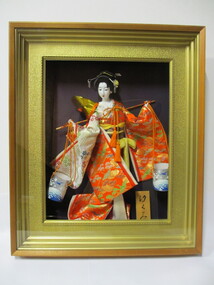
... Japanese geisha doll with traditional dress standing in fame carrying water buckets ...gift Japanese writing On reverse "New Port of Mita/ Tuesday, 10 November, 1992/ Tri City Municipality" "WMA 4" "PMA 0122" Japanese geisha doll with traditional dress standing in fame carrying water buckets Framed doll ...giftJapanese geisha doll with traditional dress standing in fame carrying water buckets Japanese writing On reverse "New Port of Mita/ Tuesday, 10 November, 1992/ Tri City Municipality" "WMA 4" "PMA 0122" -
Tatura Irrigation & Wartime Camps Museum
Craft - Doll, Japanese Doll, 1940's
... Japanese doll dressed in cream, with blue and yellow, red/brown feather like patterned kimono with cream self patterned obi tied with a fawn cord. ...Carrying a flower made from material and cord. Japanese Doll Craft Doll ...Made by internees and given to Monte Punshon as a gift. Monte was an Australian warden who had oversight of the women and children in one of the compounds. She spoke fluent Japanese which she had learnt in the 1930's pre the war.Japanese doll dressed in cream, with blue and yellow, red/brown feather like patterned kimono with cream self patterned obi tied with a fawn cord. Black hat with brown trim. Stands on a wooden base. Carrying a flower made from material and cord.japanese doll, camp 4 hand crafts, monte punshon -
 Flagstaff Hill Maritime Museum and Village
Leisure object - Porcelain Doll, 1920-1941
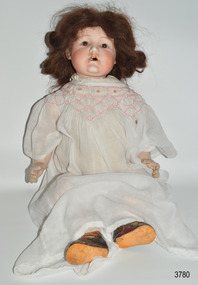
... Unable to determine a specific company that manufactured this doll many Japanese companies manufactured dolls of this type for export and these were only marked "Nippon" to show country of manufacture. ...Unable to determine a specific company that manufactured this doll many Japanese companies manufactured dolls of this type for export and these were only marked "Nippon" to show country of manufacture. ...Unable to determine a specific company that manufactured this doll many Japanese companies manufactured dolls of this type for export and these were only marked "Nippon" to show country of manufacture. These dolls marked this way were in production from around 1920 until 1941 when Japanese toy factories began to manufacturing items for war.Unable to be determined provenance relating to specific Japanese manufacturer. The doll is an example of a children's toy from the 1920s-1940s.Porcelain Doll in white fabric dress Doll, female, has porcelain face, composite body with swivel head and limbs. Head has long brown curly mohair wig attached into a hole in the pate; several doll-sized hairpins hold hair in place. Face has open mouth showing two porcelain front teeth, brown eyes of hand blown glass and hand painted features. Back of neck has two pressed holes above maker’s mark. Doll has removable white silk socks and brown shoes with tied ankle strap and hard soles. Doll is wearing old fashioned cream coloured knitted woollen singlet, cream flannel vest with draw-string cotton bodice and scalloped edge. The doll also has a more modern style white cotton dress with pink smocking. Inscription pressed into back of neck, shaded with pencil, "Nippon"Maker’s Mark “NIPPON” (See media section this document for a list of possible manufactures of doll)flagstaff hill, warrnambool, shipwrecked coast, flagstaff hill maritime museum, maritime museum, shipwreck coast, flagstaff hill maritime village, great ocean road, doll, nippon, nippon novelty company, porcelain, japanese doll manufacturer, porcelain doll, vintage doll -
 Orbost & District Historical Society
teaset
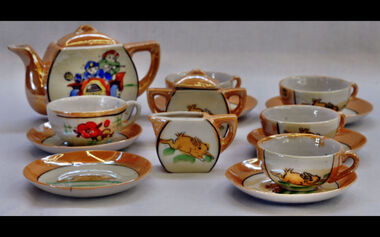
... teaset toys dolls-accessories porcelain Underneath all pieces - Made in Japan Fourteen piece doll's teaset. 5 cups (one odd); 6 saucers ; 1 cream jug; 1 sugar basin; 1 teapot. ...Fourteen piece doll's teaset. 5 cups (one odd); 6 saucers ; 1 cream jug; 1 sugar basin; 1 teapot. All are very light orange/bone colour + white with running rabbit. Teapot has two young men in a car hunting a rabbit. Odd cup has flowers in red and yellow.Underneath all pieces - Made in Japanteaset toys dolls-accessories porcelain -
 Bendigo Historical Society Inc.
Article - Doll with pigtails
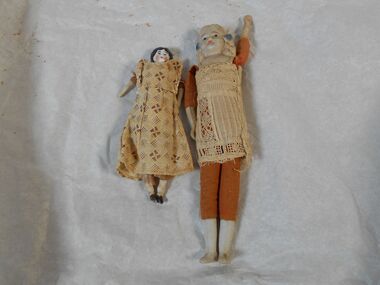
... Nippon dolls were made by Noritake in Japan....Nippon dolls were made by Noritake in Japan. Toys Dolls Sewing DI.464 on fabric is attached to back of right leg with sticky tape. ...Nippon dolls were made by Noritake in Japan.Stuffed doll with ceramic face, decolletage, hands and feet. Dress handsewn from emboidered and pleated cream material. Arms and legs made from rust colored linen type material. Pigtails painted blue. Eyes (blue/black), eyebrows (brown), hair (orange) and lips (orange) painted on.DI.464 on fabric is attached to back of right leg with sticky tape.toys, dolls, sewing -
 Bendigo Historical Society Inc.
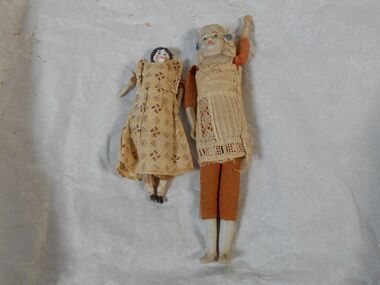
Article - Doll with black hair
... Nippon dolls were made by Noritake in Japan. This example is referred to as a China glazed doll. ...Nippon dolls were made by Noritake in Japan. This example is referred to as a China glazed doll. ...Nippon dolls were made by Noritake in Japan. This example is referred to as a China glazed doll. They were made about 1915. The shoulder plate bisque dolls were usually under 10inches tall.Stuffed doll with ceramic face, decolletage, hands and feet. Dress machine sewn from cream and brown printed material. Arms and legs made from browncolored linen type material. Eyes (blue), eyebrows (brown), hair (black) rouge (pink) and lips (red) painted on. Dress tied at back with pink embroidery cottontoys, dolls, sewing -
 Dutch Australian Heritage Centre Victoria
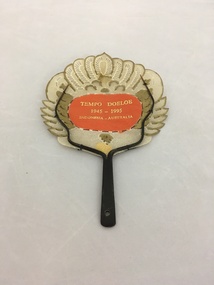
Fan, 1995
... Japanese in 1945, Indonesia officially gained independence from The Netherlands in 1949. An orange central patch bears the words: Tempo Doeloe 1945-1995 Indonesia - Australia. Small Indonesian fan produced for the 50th anniversary of Tempo Doeloe in Australia. The fan is made in a similar manner to the so-called Wayang dolls ...A number of these fans were ordered from Indonesia by Lia Kellener, the founder of Tempo Doeloe in Melbourne.The item relates to the move of many Dutch to The Netherlands or Australia from post-WWII Dutch East Indies. After a 4year struggle immediately following the ousting of the Japanese in 1945, Indonesia officially gained independence from The Netherlands in 1949. Small Indonesian fan produced for the 50th anniversary of Tempo Doeloe in Australia. The fan is made in a similar manner to the so-called Wayang dolls and is reminiscent of this aspect of traditional Indonesian culture.An orange central patch bears the words: Tempo Doeloe 1945-1995 Indonesia - Australia. -
 Eltham District Historical Society Inc
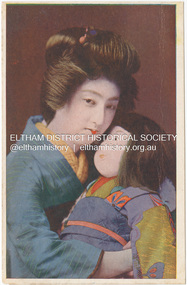
Photograph - Postcard, Geisha Sakae holding an Ichimatsu Doll, c.1905 to c.1920s
... Tom Fielding Collection Geisha Sakae Japanese postcard Postcard Postcard, Hand coloured photochrom print Geisha Sakae holding an Ichimatsu Doll Photograph Postcard ...The text on reverse translates to Kikaha toilet department. There is also the printed image of a swallow on the back, which suggests that it was taken by the S. N. Banshiudo Studio in Shiba Park, Tokyo. Geisha Sakae was an extremely popular postcard model shortly after the Russo-Japanese war 1904-05, people used to line up early in the morning whenever a new postcard was released at the postcard shop in Ginza. The beauty of her gait was so widely admired that her walk inspired many of the leading Onnagata (male Kabuki actors in female roles) of the day. She went on to marry Ichikawa Sadanji II, one of the most popular Kabuki actors in Japan, who worked hard to promote new plays and revive long-forgotten classical dramas. [Ref: https://www.flickr.com/photos/blue_ruin_1/8448420741] During the Russo-Japanese War (1904–05), the Japanese government sent postcards of beautiful Japanese women, bijin ehagaki (美人絵葉書), to soldiers to motivate them. Publishers continued to print them well into the 1920s. [Ref: Duits, Kjeld (February 21, 2022). 1910s: Geisha Postcards, OLD PHOTOS of JAPAN. Retrieved on March 31, 2024 (GMT) from https://www.oldphotosjapan.com/photos/883/vintage-geisha-postcards-early-20th-century] See also: Sakae さかえ - Meiji / Taishō Era Geisha https://www.flickr.com/groups/1988804@N22/pool/ The photochrom process Photochroms are not photographs but actual prints, produced using 6 to 15 colors and the lithography printing process. The technique was invented by the Swiss Hans Jakob Schmid during the 1880s. The fascinating aspect of these prints is that they are created from black and white photographs. It required quite some work and talent to create these images. The photographer would usually make notes about the colors in the image he shot. These enabled a painter to create a painting that served as a color guide for the litho stone maker. This artisan would then create multiple exposures of the original black-and-white negative, changing the exposure time, development settings, and using dodge and burn techniques to create the required set of 6 to 15 stones that would each be used to print one specific color. By combining all these colors you get the prints [Ref: https://www.prepressure.com/printing/history/photochrome-prints]This item, a souvenir from Japan from between the wars (circa 1923) was brought home to Research, Victoria by Bill Teagle who was serving in the Royal Australian Navy (1919-1945). Bill Teagle's sister Violet Amelda Teagle had married Theodore (Curly) Feldbauer in 1933. Bill's brother-in-law Curly was taken as a Prisoner of War by the Japanese and died at Sandakan in March 1945. The family did not learn of Curly’s death till months later and Bill's sister, Violet, herself could never forgive the Japanese for what happened to Curly. Curly is remembered on the Eltham Roll of Honour Board and his son, Albert Feldbauer (Bill’s nephew and youngest child of the children of the soldier fathers attending a school in the district), was given the honour of turning the first sod for the Eltham War Memorial Infant Welfare Centre Building. Despite this, the family maintained this cherished souvenir from a time of previous foreign friendship with Japan. The item was possibly given by Bill Teagle to his sister Margaret Rose (formerly Ingram) who later married Richard Edward (Eddie) Fielding in early 1948. (Eddie had been engaged to someone else before he went to war, but his fiancée broke it off before his return to Australia.) It was cared for by the Teagle/Fielding family for approximately one hundred years. It is of particular significance given the family's connection to the Eltham War Memorial and the significance of that memorial to the local community and represents that despite the horrors of war, former friends then foes can become friends again.tom fielding collection, geisha sakae, japanese postcard, postcard -
 Bendigo Military Museum
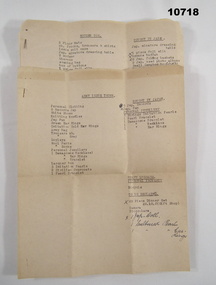
Administrative record - PERSONAL EQUIPMENT LIST, 1947-1949
... Hand written at bottom RHS is 1 Jap doll, 1 cultured pearls, i cultured pearl ear rings. In wooden box - bought in Japan, Quarto size sheet with typewritten list of property. ...Japan Administrative record Three pages listing personal gear. Paper has yellowed with age. Typewritten list of articles, uniforms and souvenirs in Army issue trunk. It also lists some articles and prices to be declared to customs. Hand written at bottom RHS is 1 Jap doll ...Refer to Cat 9726P for details of service for Alva Marie Bennetts VFX128835.Three pages listing personal gear. Paper has yellowed with age. Typewritten list of articles, uniforms and souvenirs in Army issue trunk. It also lists some articles and prices to be declared to customs. Hand written at bottom RHS is 1 Jap doll, 1 cultured pearls, i cultured pearl ear rings. In wooden box - bought in Japan, Quarto size sheet with typewritten list of property. Yellowed with age. In Japanese footlocker. Personal property, dutiable goods.alva bennetts, bcof, japan, administrative record -
 Ararat Gallery TAMA
Sandawara Ningyo, c. 1900s
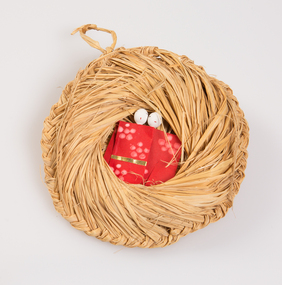
... The descriptions of the featured objects were written by Hideyuki Oka, curator of ‘The Art of the Japanese Package’, 1979. japanese art japanese packaging tsutsumi gift giving This toy is a product of Tottori City, and its only connection with traditional packaging is that it copies the mats used to close the straw bales in which rice is packed for the market. It is interesting, nevertheless, for its clever use of such a cheap and common material, and there is no denying its charm. The two dolls ...‘The Art of the Japanese Package’ was an exhibition that toured to 10 Australian and 11 New Zealand public galleries in 1979 and 1980. The touring exhibition comprised 221 objects of traditional Japanese packaging which extended from ceramics, wood and paper to woven fibre containers. At the conclusion of the tour, The Japan Foundation and the Crafts Board of the Australia Council donated the vast majority of the exhibition to the Ararat Gallery for its permanent collection. Combining the natural qualities of bamboo, paper and straw with delicate craftsmanship, these unique objects express Japanese aesthetics as applied through fibre crafts. In Japan, the qualities and traits of natural materials are exploited rather than hidden. The texture of straw, the septa of bamboo are not concealed but lovingly incorporated into the whole. In 1979 Hideyuki Oka, curator of ‘The Art of the Japanese Package’ wrote: “In no way self-conscious or assertive, these wrappings have an artless and obedient air that greatly moves the modern viewer. They are whispered evidence of the Japanese ability to create beauty from the simplest products of nature. They also teach us that wisdom and feeling are especially important in packaging because these qualities, or the lack of them, are almost immediately apparent. What is the use of a package if it shows no feeling?” The descriptions of the featured objects were written by Hideyuki Oka, curator of ‘The Art of the Japanese Package’, 1979.Gift of the Japan-Australia Foundation and the Crafts Board of the Australia Council, 1981This toy is a product of Tottori City, and its only connection with traditional packaging is that it copies the mats used to close the straw bales in which rice is packed for the market. It is interesting, nevertheless, for its clever use of such a cheap and common material, and there is no denying its charm. The two dolls, made of paper and wood, represent the emperor and empress who occupy the chief places in the traditional Doll Festival display. - Professor Hideyuki Oka, curator.japanese art, japanese packaging, tsutsumi, gift giving -
 Whitehorse Historical Society Inc.
Leisure object - Baby Doll, FairyMark, Baby Blue Eye FairyMark -Minor, c1930s
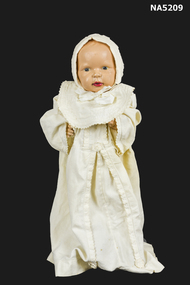
... Belonged to Estelle McNaughton and passed on to her daughter, the donor. toy Baby doll FairyMark "Baby Blue Eyes" Minor Made in Japan A clothed baby doll with a woollen singlet, cloth nappy and safety pin, cream dress with two buttons and long sleeves. ...Belonged to Estelle McNaughton and passed on to her daughter, the donor.A clothed baby doll with a woollen singlet, cloth nappy and safety pin, cream dress with two buttons and long sleeves. Cream semi-circle bib and button and a cream bonnet with embroidered turnback and ribbons.FairyMark "Baby Blue Eyes" Minor Made in Japantoy, baby doll -
 Whitehorse Historical Society Inc.
Leisure object - Doll, c 1965
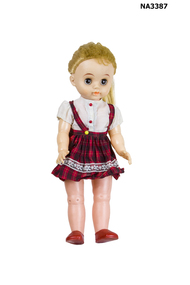
... Brought back from Hong Kong by Myrtle Bennett from a cruise to Japan toys dolls Plastic doll with brown eyes which can shut and open; long blond hair. ...Belonged to Kelly Gardener. Brought back from Hong Kong by Myrtle Bennett from a cruise to JapanPlastic doll with brown eyes which can shut and open; long blond hair. Dressed in red and black check skirt with lace trim; blue blouse with red buttons down front; red shoes. Doll can walk and sit up.toys, dolls -
 Dandenong/Cranbourne RSL Sub Branch
Memorabilia - Takasago Dolls
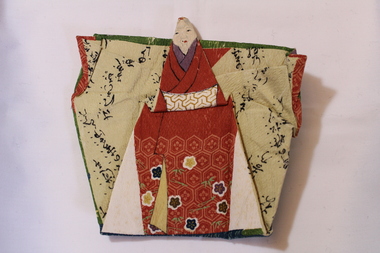
... Good luck dolls usually given to engaged couples but occasionally give to Japanese soldiers prior to deploying....Japan WW2 World War 2 World War Two Takasago dolls Takasago dolls or, in English, Darby and Joan dolls. ...Good luck dolls usually given to engaged couples but occasionally give to Japanese soldiers prior to deploying.Takasago dolls or, in English, Darby and Joan dolls. They are a set, the brighter one being an old lady, the other an old man. They were used as engagement presents, but during the war, they were sometimes (actually maybe rarely) given to soldiers as good luck charms, or ‘mamori’. They were said to be lucky as they contained the stitching (sewing) of 1000 ladies, ‘senninbari’ (a thousand ‘peoples’ needles). So mate, the original theory is probably correct. The soldier would have wrapped these dolls in water proof paper (made using persimmon tannin or kakishiba).He would have kept them around his waist in a waist band, called an obi or perhaps a ‘haramaki’ (a knitted stomach band).Anyway the dollls should remain together. I’m wondering if there are any messages inside? But if they are completely stitched closed, then they should remain that way. The Takasago dolls originated in Takasago City in Hyogo Prefecture, hence the name.But later they were made everywherejapan, ww2, world war 2, world war two, takasago dolls
