
Showing 67 items matching "japanese prisoner of war camps"
-
 Ringwood RSL Sub-Branch
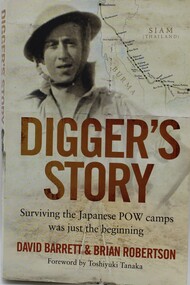
Book - Digger's Story, Surviving the Japanese prisoner of war camps was just the beginning
... Surviving the Japanese prisoner of war camps was just the beginning...Paperback book Surviving the Japanese prisoner of war camps was just the beginning Book Digger's Story ...Paperback book -
 Tatura Irrigation & Wartime Camps Museum
Book, P.O.W Prisoners of War. Australians Under Nippon
... ...Japanese prisoner of war camps...Book wrtten by Hank Nelson based on the ABC raido series by Tim Bowden World War II Prisoners of War Japan Nippon Australian Army Nursing Service Japanese prisoner of war camps Hank Nelson ABC Raido Book, cream colour. ...Book wrtten by Hank Nelson based on the ABC raido series by Tim Bowden Book, cream colour. Red and black writting. Black and white photo on front cover of soldiers sitting eating food in a camp. Back cover repeats the title of the book and details of its subject and about the author.world war ii, prisoners of war, japan, nippon, australian army nursing service, japanese prisoner of war camps, hank nelson, abc raido -
 Emerald Museum & Nobelius Heritage Park
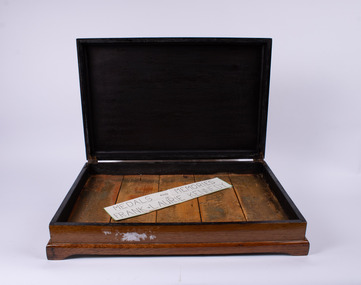
Container - Kennedy WW2 Medal Presentation Box, c. Late 1940s
... It was likely used to present these medals to their family, after both died in service - John in Avonsleigh, Victoria in a car accident, and Laurence in a Japanese prisoner of war camp in the Malay Peninsula. Their brother Geoffrey also died during the war - he was gored by a bull at home. ...It was likely used to present these medals to their family, after both died in service - John in Avonsleigh, Victoria in a car accident, and Laurence in a Japanese prisoner of war camp in the Malay Peninsula. Their brother Geoffrey also died during the war - he was gored by a bull at home. ...This presentation box contains the war medals of John F. Kennedy (VEMU2306) and Laurence A. Kennedy (VEMU2307), of Emerald's Kennedy family. It was likely used to present these medals to their family, after both died in service - John in Avonsleigh, Victoria in a car accident, and Laurence in a Japanese prisoner of war camp in the Malay Peninsula. Their brother Geoffrey also died during the war - he was gored by a bull at home. It may also have been made by the family after the medals were received to display them.This item is associated with two tragic young wartime deaths in a local family, representing an important local story of heroism and tragedy.A rectangular wooden box constructed with four legs to slightly elevate the main body. The bottom of the body section is cushioned with green felt. A lid, about 1/3 the heigh of the body of the container, opens upwards on a hinge to reveal a shallow rectangular compartment; the sides and roof of the compartment are smooth wood painted black, while the floor is planks with wood stain. The entire outside surface of the box is coated in wood stain. N/Akennedy family, world war ii, world war two, second world war -
 Emerald Museum & Nobelius Heritage Park
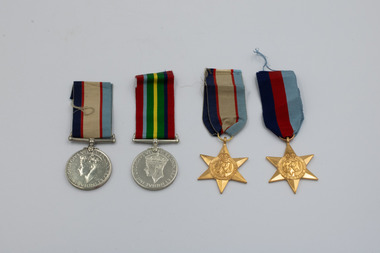
Medal - L. A. Kennedy WW2 Medals, Australian Government
... Private Laurence Alfred Kennedy died of illness in a Japanese prisoner of war camp in Malaya on July 7th, 1942, aged 22. ...Private Laurence Alfred Kennedy died of illness in a Japanese prisoner of war camp in Malaya on July 7th, 1942, aged 22. ...Private Laurence Alfred Kennedy died of illness in a Japanese prisoner of war camp in Malaya on July 7th, 1942, aged 22. He was posted missing from the 8th Division after they retreated across the causeway to Singapore, and no information about his fate was retrieved until at least 1945. His two brothers (Geoffrey and John) would both also suffer tragic deaths - Geoffrey gored by a bull at home and John (whose medals are also in our collection, listed under VEMU2306) killed in a car accident soon after returning to Australia.L. A. Kennedy was a member of a local family who served in the Second World War and died tragically like his brothers, forming an important story of local community history.A set of four medals, including two identical 1939-45 Australia Service Medals (a/b), a 1939-1945 Star (c), and a Pacific Star (d). a/b) Australia Service Medals: A round silver medal 36 millimetres in diameter with a [ribbon]. The obverse bears the crowned effigy of King George VI, surrounded by the legend inscription. The reverse shows the coat of arms of the Commonwealth of Australia surrounded by words. Lettering with the recipient's name and enlistment number is also engraved in the edge. a) Has marginally more aging, and its ribbon is vertical stripes of (left to right) dark blue, red, white, red, light blue, identical to that on d. b) Appears newer, and its ribbon is vertical stripes of (left to right) red, light blue, green, yellow, green, dark blue, red. c) 1939-1945 Star: A six-pointed star struck in yellow brass to fit in a 44 millimetre diameter circle. The obverse centres on the Royal Cypher, surrounded by a legend with a crown at the top. The reverse features the recipient's name and enlistment number. The ribbon is vertical stripes of (left to right) dark blue, red, and light blue. d) Pacific Star: A six-pointed star struck in yellow brass to fit in a 44 millimetre diameter circle. The obverse centres on the Royal Cypher, surrounded by a legend with a crown at the top. The reverse features the recipient's name and enlistment number. The ribbon is vertical stripes of (left to right) dark blue, red, white, red, light blue, identical to that on the b.a/b) Obverse: "GEORGIVS VI D:G:BR:OMN:REX ET INDIAE IMP" (George 6th, by the grace of God, King of all the Britains and Emperor of India) Reverse: "THE AUSTRALIA SERVICE MEDAL / 1939-1945" Edge: "VX46024 L. A. KENNEDY" c) Obverse, Royal Cypher: "GRI / VI" Obverse, Legend: "THE 1939 - 1945 STAR" Reverse: "VX46024 / L. A. KENNEDY" d) Obverse, Royal Cypher: "GRI / VI" Obverse, Legend: "THE PACIFIC STAR" Reverse: "VX46024 / L. A. KENNEDY"kennedy family, world war ii, world war two, second world war -
![Newspaper - Newspaper clipping, The Weekly Telegraph, Escape from a POW camp brothel, July 19, [?]](/media/collectors/64a5077bc83bd7b7b94f4211/items/69b0bbeb3d5082ac59e59258/item-media/69b0c20e3d5082ac59e6dd79/item-fit-380x285.jpg?cb=6) Returned Nurses RSL Sub-branch
Returned Nurses RSL Sub-branchNewspaper - Newspaper clipping, The Weekly Telegraph, Escape from a POW camp brothel, July 19, [?]
... An account of the failed attempt of Japanese soldiers, in the prisoner-of-war camp in Sumatra, to force Australin Nurses to prepare and accompany them to a brothel in the camp....An account of the failed attempt of Japanese soldiers, in the prisoner-of-war camp in Sumatra, to force Australin Nurses to prepare and accompany them to a brothel in the camp. ...An account of the failed attempt of Japanese soldiers, in the prisoner-of-war camp in Sumatra, to force Australin Nurses to prepare and accompany them to a brothel in the camp.Large newspaper clipping. Two large side by side photos across most of the page, with five short columns of text below.wwii, ww2, world war two, prisoner of war nurses, ellen mavis allgrove, sumatra, japanese soldiers -
 Returned Nurses RSL Sub-branch
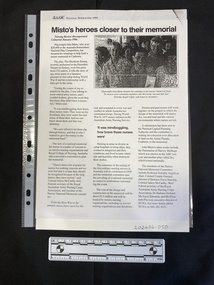
Newsletter - Photocopy of newsletter page, RAANC National Newsletter, Misto's heroes closer to their memorial, 1995
... John's play, The Shoehorn Sonata, tells the story of an army nurse in a Japanese prisoner of war camp during World War II. John decided to donated his winnings after finding out, during his research for the play, that nurses did not have a war memorial. ...John's play, The Shoehorn Sonata, tells the story of an army nurse in a Japanese prisoner of war camp during World War II. John decided to donated his winnings after finding out, during his research for the play, that nurses did not have a war memorial. ...The article tells how playwright, John Misto, won first prize and $20,000 in the Australia Remembers National Play Competition and proceeded to donated his winnings to the help fund a nurses memorial in Canberra. John's play, The Shoehorn Sonata, tells the story of an army nurse in a Japanese prisoner of war camp during World War II. John decided to donated his winnings after finding out, during his research for the play, that nurses did not have a war memorial. He stated that it was mindboggling how brave the nurses were in the conditions and that he didn't want them and their work to continue to be unknown. Nurses have cared for the sick and wounded in every conflict in which Australia has committed troops, from the Boer war to present day. Ex-service nursing organisations and the Royal College of Nursing, Australia convened a committee to plan a memorial. The committee want to unveil a national memorial at the centenary of the raising of the first military nursing service celebrations in 1999. The memorial will cost about $1.5 million and be funded by nurses, nursing organisations and donations and depict the various environments where nurses served. A photocopied article from a newsletter with three columns of text and a black and white photo of a man in front of a group of older women, all smilingww2, wwll, janice mccarthy, royal australian army nursing corps association, nurses' national memorial committee, australian army nursing service, national capital planning authority, anzac parade, dorothy angell, coralie gerrard, barbara orchard, joyce edwards, elizabeth percival, defence force nursing, rcna -
 Greensborough Historical Society
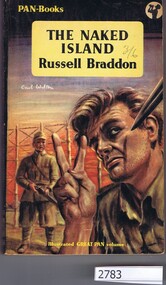
Book, Russell Braddon, The Naked island, 1955_
... Account of the author's capture by the Japanese forces in Malaya in 1941, and experiences in prisoner of war camps in Kuala Lumpur, Changi and Thailand....Account of the author's capture by the Japanese forces in Malaya in 1941, and experiences in prisoner of war camps in Kuala Lumpur, Changi and Thailand. prisoner of war camps world war 2. malayan campaign 18 x 11 cm The Naked island Book Book Russell Braddon Pan Books ...Account of the author's capture by the Japanese forces in Malaya in 1941, and experiences in prisoner of war camps in Kuala Lumpur, Changi and Thailand.18 x 11 cmprisoner of war camps, world war 2. malayan campaign -
 Phillip Island and District Historical Society Inc.
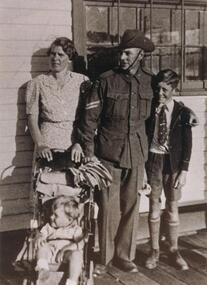
Photograph - Photograph, black + white, Corporal Frederick Edward Woodley and family at Cowes pier 1941, 01/1941
... He was taken prisoner-of-war by the Japanese at the fall of Singapore and imprisoned at the Changi P O W Camp. ...He was taken prisoner-of-war by the Japanese at the fall of Singapore and imprisoned at the Changi P O W Camp. ...As on back of photograph. "A Phillip Islander goes to War. Corporal Frederick Edward Woodley, No. VX24588 of 2nd/10th Field Company, Royal Australian Engineers, with his wife Ruby, eldest son Arthur and John, pictured beside the shed on Cowes Jetty prior to his departure for active service overseas. January 1941. Fred subsequently voyaged from Sydney to Singapore (via Western Australia) on the troop ship Queen Mary. He was taken prisoner-of-war by the Japanese at the fall of Singapore and imprisoned at the Changi P O W Camp. Later, after being on the missing list for some two years, it was learned that he was imprisoned at the most infamous Sandakan P O W camp in North Borneo from where he did not return. Fred was 37 years of age when this photo was taken. With compliments, Arthur E Woodley, 34 Park Road, Crib Point. 6/8/1995" Arthur claims this is the only photo of the family together.HistoricalBlack & White photograph of Corporal Frederick Edward Woodley (Royal Australian Engineer) with his wife Ruby, eldest son Arthur and John, standing beside the Cowes Jetty shed, Phillip Island.Detailed inscription on back - see Historical Information below.corporal frederick edward woodley, royal australian engineers, wwii, arthur e woodley, military -
 Montmorency–Eltham RSL Sub Branch
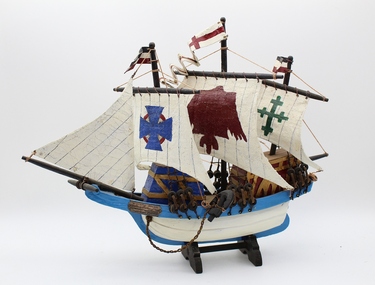
Craft - Model Ship, 1945
... prisoners of war to the Japanese. Most of them were captured at the fall of Singapore in February 1942 and were forced to march to Changi (the major Prisoner of War camp). ...prisoners of war to the Japanese. Most of them were captured at the fall of Singapore in February 1942 and were forced to march to Changi (the major Prisoner of War camp). ...During World War II, over 22,000 Australian became prisoners of war to the Japanese. Most of them were captured at the fall of Singapore in February 1942 and were forced to march to Changi (the major Prisoner of War camp). Later on, the soldiers would be dispersed throughout South East Asia. Upon their return to Australia, very few of them told talked about their experience as prisoners (they often felt ashamed). It took almost 30 years before testimonies, books and documentaries would be published. This ship model was built by Australian prisoners of war.Model of a Spanish or Portugese 18th Century sailing ship, manufactured from timber, fabric and string. Natural timber colours as well as white, blue, red, green and gold.To Auntie Helen, many thanks for everything from P.O.W.s Singapore 15.10.45singapore, ships, second world war, model, prisoners -
 Red Cliffs Military Museum
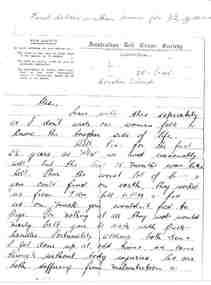
Letter
... camp. The island was captured by the Japanese in early 1942. Morotai's southern plain was taken by American forces in September 1944 during the Battle of Morotai, and used as a staging point for the Allied invasion of the Philippines in early 1945, and of Borneo in May and June of that year. Japanese soldier Teruo Nakamura was discovered in the Morotai jungle in 1974, as one of the WWII Japanese soldiers who held out subsequent to the Japanese military's surrender. 2 pow morotri island morotai island world war prisoner of war australian red cross society Added to head of letter at a later date is inscription ' First letter written home for 3 1/2 years'.Top left hand- FOR SAFETY/ IN YOUR LETTERS DO NOT REFER TO:-/ The name of your ship or other ships in the convoy, or its escorts. ...Letter written from (unknown) POW imprisioned by the Japanese on Morotai Island from 1942 - 1945 to (unknown) friend. Descriptive of life and treatment in POW camp. The island was captured by the Japanese in early 1942. Morotai's southern plain was taken by American forces in September 1944 during the Battle of Morotai, and used as a staging point for the Allied invasion of the Philippines in early 1945, and of Borneo in May and June of that year. Japanese soldier Teruo Nakamura was discovered in the Morotai jungle in 1974, as one of the WWII Japanese soldiers who held out subsequent to the Japanese military's surrender.Photocopy of letter, 4 pages, originally written in ink on (unofficial) Australian Red Cross form.Added to head of letter at a later date is inscription ' First letter written home for 3 1/2 years'.Top left hand- FOR SAFETY/ IN YOUR LETTERS DO NOT REFER TO:-/ The name of your ship or other ships in the convoy, or its escorts./The date of sailing, ports of call, or probable destination./ The description of troops, their loca-/tion or any other information/ which, if intercepted, would be of/ value to the enemy. In your Top right hand- Australian Red Cross Society/ (UNOFFICIAL)/ 25-8-45/ (added at later date 'Morotri Island')/ Alex, Have witten this especially/ as i don't wish our women folk to know the tougher side of life./Well Alex for the first/ 2 1/2 years as POWs we lived reasonably/ well, but the last 15 months was like /hell. Heres the worst lot of b-s/ you could find on earth, they worked /us from 7AM till 6 PM, & fed/ us on muck you wouldn't feed to/ Pigs. I'm nothing at all they would 2, pow, morotri island, morotai island, world war, prisoner of war, australian red cross society -
 Bendigo Military Museum
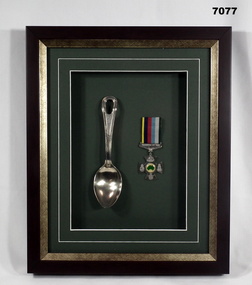
Souvenir - SOUVENIR, FRAMED, WW2, Post WW2
... Japan, Senryu 24 and Fukuoka camps. After the war he could not sit on a chair for a long time and would just squat on the floor with his back to the wall as he had done as a POW. Refer Cat No 7076P for more service details. Framed POW souvenir U.S On the spoon stamped in "U.S" Framed brown timber with gold edge, inset background is green, within is a silver spoon and medal displayed. The medal is a Commemorative unofficial Prisoner ...The spoon was given to Maxwell Barry Cowden VX19297 2/2 Pioneer BN by an American POW. He carried the spoon tied to the side of his loin cloth. Max worked on the Burma Railway and in the Coal Mines in Japan, Senryu 24 and Fukuoka camps. After the war he could not sit on a chair for a long time and would just squat on the floor with his back to the wall as he had done as a POW. Refer Cat No 7076P for more service details.Framed brown timber with gold edge, inset background is green, within is a silver spoon and medal displayed. The medal is a Commemorative unofficial Prisoner of War. On the spoon stamped in "U.S"framed, pow, souvenir, u.s -
 Eltham District Historical Society Inc
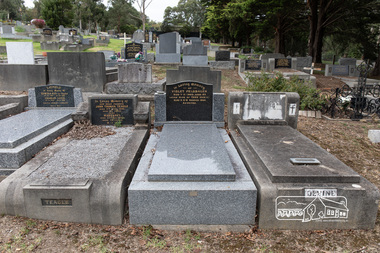
Photograph, Peter Pidgeon, Grave of Violet Feldbauer (nee Teagle), Eltham Cemetery, Victoria, 5 April 2021
... war would be over. He had a great love for Australia.” “While he was a prisoner, Mum received a few postcards from him, not in his neat handwriting, but in block letter printing, to tell her he had received no mail or parcels from her. He must have felt we’d forgotten him, because, of course, Mum had sent lots of parcels and letters, and the Japanese hadn’t handed them on.” Theo was one of over 2,000 Allied prisoners of war held in the Sandakan POW camp...war would be over. He had a great love for Australia.” “While he was a prisoner, Mum received a few postcards from him, not in his neat handwriting, but in block letter printing, to tell her he had received no mail or parcels from her. He must have felt we’d forgotten him, because, of course, Mum had sent lots of parcels and letters, and the Japanese hadn’t handed them on.” Theo was one of over 2,000 Allied prisoners of war held in the Sandakan POW camp ...FELDBAUER / TEAGLE Theodore Albert ‘Curly’ Feldbauer was born 15 October 1909 at Melbourne, the son of Theodore Henry (a naturalised German) and Jessie Margarette Feldbauer. The family moved several times during his childhood but before he was 20 he was living and working in the Eltham district. He became a well-known local sportsman. He played cricket for the Montmorency Imperials in 1929 and 1930 in the Eltham Cricket Association and excelled as a footballer and football coach. There are press references at the time to minor misdemeanours and accidents: evidently he was up for a brawl or two, but he was also able to do a recitation at a social night to launch the Eltham Girls Club in 1932. He married a local girl, Violet Amelda Teagle, in 1933, the 12th of 13 Teagle offspring who lived in Frank Street. Curly and Violet’s first child, June, was born the following year. By 1935 Curly was honorary secretary of the Research Cricket Club. He continued playing cricket regularly, mainly for Research, through till the 1940 season, after the war had begun. The girls started at Research State School in 1939 and 1940, respectively. They lived near Violet’s parents in Frank Street. Curly and Violet’s daughter, Valerie Waller recalls: “We lived near my Teagle grandparents, who had a cow. Dad took over the milking. He would rest his head against the cow and sing to her. When he left to join the army, it took weeks before she would settle down to allow anyone else to milk her.” Curly’s service record is not yet accessible from the National Archives of Australia. Valerie Waller gives us some insight into that period between Curly joining and ultimately embarking for Singapore: “Before he sailed to Singapore, Mum would travel by train, to Seymour, to spend a few hours with him. He sent her postcards and called her his “dear love”. His idea was that the sooner everyone eligible joined up, the sooner the war would be over. He had a great love for Australia.” “While he was a prisoner, Mum received a few postcards from him, not in his neat handwriting, but in block letter printing, to tell her he had received no mail or parcels from her. He must have felt we’d forgotten him, because, of course, Mum had sent lots of parcels and letters, and the Japanese hadn’t handed them on.” Theo was one of over 2,000 Allied prisoners of war held in the Sandakan POW camp in north Borneo, having been transferred there from Singapore as part of B Force. The 1,494 POWs that made up B Force were transported from Changi [Singapore] on 7 July 1942 on board the tramp ship Ubi Maru, arriving in Sandakan Harbour on 18 July 1942. Sergeant Feldbauer, aged 35, died as a prisoner of the Japanese on 27 March 1945 at Sandakan Number 1 Camp. The Japanese recorded his death from Malaria. He has no known grave, but it is believed to be at Sandakan Number 2 Camp. His death was not reported in Australia until some months later. Valerie noted: “I will never forget the sound my mother made when she received the telegram saying Dad had died months earlier, ostensibly from Malaria, but he died during the march. The sound still haunts me.” Violet’s husband Theo is recognised on the Eltham Roll of Honour, which was commissioned by the Eltham War Memorial Trust to be hung in the Baby Health Centre opened in 1952; the first of three buildings, the others being the Eltham Kindergarten and Children’s Library, that were established as the Eltham War Memorial a living memorial, with a specific focus for the welfare of children of the district. Violet and Theo’s son Albert, being the youngest child of the children of soldier fathers attending a school in the district, was given the honour of turning the first sod for the Eltham War Memorial Building, 15 July 1950. In Loving Memory of Violet Feldbauer Died 7. 11 .1982 aged 88 Loved wife of Theo (Curly) Died P.O.W. Borneo 1945 Re-united Alongside Violet lay her parents, John Thomas and Margaret TeagleBorn Digitaleltham cemetery, gravestones, charles louis layfield, edwina may layfield (nee teagle), john thomas teagle, margaret teagle, theodore feldbauer, violet feldbauer (nee teagle), annie lillian devine, frederick raymond devine, eltham war memorial, honour board, roll of honour -
 Bendigo Military Museum
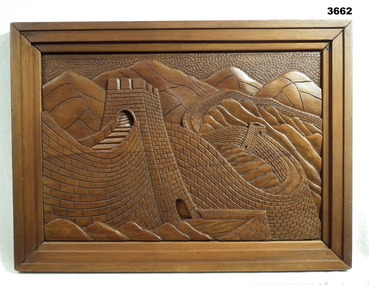
Memorabilia - CARVING, FRAMED, c.1943 - 1945
... Carving was made by a Japanese Prisoner Of War in a New Zealand POW Camp in Featherston, North Island. ...Carving was made by a Japanese Prisoner Of War in a New Zealand POW Camp in Featherston, North Island. ...Carving was made by a Japanese Prisoner Of War in a New Zealand POW Camp in Featherston, North Island. Original owner believed to be Graeme Richards who was a guard at the camp.Solid wooden carving of the Great Wall of China. Tan with matching frame, cord hanging strap on back.Carving history attached to backing.memorabilia, carving, china, pow, -
 Bendigo Military Museum
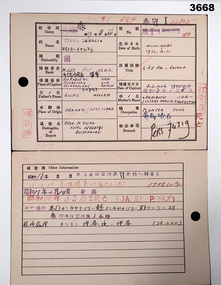
Administrative record - RECORD - POW, c.1941 - 1943
... Japanese Prisoner of War record for Sgt Ignacio EISMA, 1st Howitzer Battalion, Dutch East Indies Army. Sgt EISMA died 3.1943 at the Rin Tin POW Camp on the Thai Burma Railway. refer Cat No’s 3669P and 3670....Japanese Prisoner of War record for Sgt Ignacio EISMA, 1st Howitzer Battalion, Dutch East Indies Army. Sgt EISMA died 3.1943 at the Rin Tin POW Camp on the Thai Burma Railway. refer Cat No’s 3669P and 3670. ...Japanese Prisoner of War record for Sgt Ignacio EISMA, 1st Howitzer Battalion, Dutch East Indies Army. Sgt EISMA died 3.1943 at the Rin Tin POW Camp on the Thai Burma Railway. refer Cat No’s 3669P and 3670.Photo copy of a Japanese Prisoner of War record.record, administration, pow, japanese -
 Waverley RSL Sub Branch
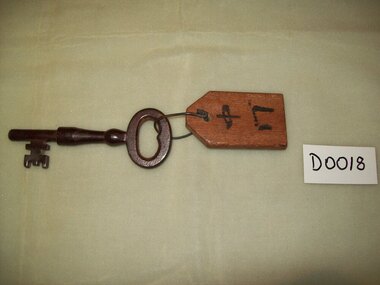
Key
... During World War II, following the Fall of Singapore in February 1942, the Japanese military detained about 3,000 civilians in Changi Prison, which was built to house only 600 prisoners. The Japanese used the British Army's Selarang Barracks, near the prison, as a prisoner of war camp, holding some 50,000 Allied—predominantly British and Australian—soldiers.[1] Although POWs were rarely, if ever, held in the civilian prison, the name Changi became synonymous in the UK, Australia, and elsewhere with the POW camp. ...During World War II, following the Fall of Singapore in February 1942, the Japanese military detained about 3,000 civilians in Changi Prison, which was built to house only 600 prisoners. The Japanese used the British Army's Selarang Barracks, near the prison, as a prisoner of war camp, holding some 50,000 Allied—predominantly British and Australian—soldiers.[1] Although POWs were rarely, if ever, held in the civilian prison, the name Changi became synonymous in the UK, Australia, and elsewhere with the POW camp. ...During World War II, following the Fall of Singapore in February 1942, the Japanese military detained about 3,000 civilians in Changi Prison, which was built to house only 600 prisoners. The Japanese used the British Army's Selarang Barracks, near the prison, as a prisoner of war camp, holding some 50,000 Allied—predominantly British and Australian—soldiers.[1] Although POWs were rarely, if ever, held in the civilian prison, the name Changi became synonymous in the UK, Australia, and elsewhere with the POW camp. About 850 POWs died during their internment in Changi during the Japanese Occupation of Singapore,[2] a relatively low rate compared to the overall death rate of 27% for POWs in Japanese camps.[3] However, many more prisoners died after being transferred from Changi to various labour camps outside Singapore, including the Burma Railway and the Sandakan airfield.this item is of historical significance because it is supposedly one of the few surving keys to Changi Jail and donated by Mr.Robertson . Changi is significant as it was a major prison camp during WWII Changi Jail Key. Blackened metal key, Wooden tag attached with Japanese print on it. Kanji Characters read Middle Gatechangi, fall of singapore, key, p.o.w. -
 Bendigo Military Museum
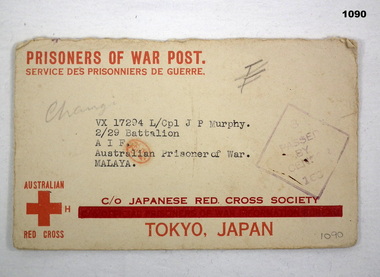
Accessory - ENVELOPE JAPANESE, 1942-45
... Camp”. He disembarked Australia on 8.10.1945 and discharged from the Army on 6.12.1945. Refer also Cat No 1110. Envelopes japanese POW Murphy Typed “VX17294 L/Cpl J P Murphy 2/29 Battalion AIF Australian Prisoner of War Malaya”. ...John Phillip MURPHY No VX17294 enlisted in the 2nd AIF on 15.5.1940 age 30 years 5 months. Posted to the 2/29th Bn 29.11.1940, embarked for Singapore 30.7.1941 disembarking 15.8.1941. Promoted to L/Cpl 2.1.1942, listed as missing 16.2.1942 then POW. A telegram in his records dated 4.8.1945 to his wife Mrs A Murphy of Kirkwood St Eaglehawk states “Alive at Changi Camp”. He disembarked Australia on 8.10.1945 and discharged from the Army on 6.12.1945. Refer also Cat No 1110.Envelope, “Prisoner of War Post” yellowed, red print, stamped “Passed by Censor” re J.P.Murphy.Typed “VX17294 L/Cpl J P Murphy 2/29 Battalion AIF Australian Prisoner of War Malaya”. In pencil “Changi”.envelopes japanese, pow, murphy -
 Bendigo Military Museum
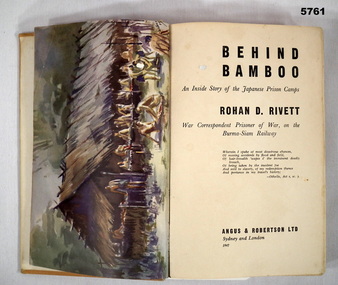
Book - BOOK - JAPANESE PRISON CAMPS WW2, Rohan D. RIVETT, "Behind Bamboo", 1947 (First published May 1946
... "BEHIND BAMBOO" "An Inside Story of the Japanese Prison Camps" Author - ROHAN D. RIVETT "War Correspondent Prisoner of War, on the Burma-Siam Railway"..."BEHIND BAMBOO" "An Inside Story of the Japanese Prison Camps" Author - ROHAN D. RIVETT "War Correspondent Prisoner of War, on the Burma-Siam Railway" Books Military History WW2 Japanese Prison Camps Front end papers - Owner's name - handwritten, black pen, "O.PELL / 7 VIOLET ST/ BGO" "M. ..."BEHIND BAMBOO" "An Inside Story of the Japanese Prison Camps" Author - ROHAN D. RIVETT "War Correspondent Prisoner of War, on the Burma-Siam Railway"Hard cover book. Cover - cardboard, light orange buckram with red and white print on front and spine. 400 pages - cut, plain, off white paper, illustrated - black and white and colour illustrations. Front end papers - owner's name, owner's stamp, book seller's label. Price notation.Front end papers - Owner's name - handwritten, black pen, "O.PELL / 7 VIOLET ST/ BGO" "M. PELL/ ORBOST" Owner's stamp - black ink "BENDIGO DISTRICT RSL SUB BRANCH INC/ PO BOX 42/ LONG GULLY 3550. Book seller's label - silver on black background A.J. DIGBY/ BOOKSELLER AND STAT (?)/ BAIRNSDALE" price notation - grey lead pencil "$10/ DMTY"books, military history, ww2, japanese prison camps -
 Monbulk RSL Sub Branch
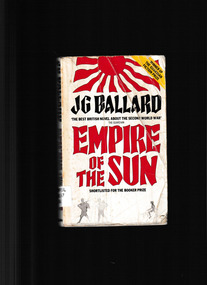
Book, Panther, Empire of the sun, 1985
... world war 1939-1945 - fiction World war 1939 – 1945 - Prisons and prisoners - Japanese The heartrending story of British boy Jim's four year ordeal in a Japanese prison camp during the second world war. ...The heartrending story of British boy Jim's four year ordeal in a Japanese prison camp during the second world war. Based on J. G. Ballard's own childhood, this is the extraordinary account of a boy's life in Japanese-occupied wartime Shanghai--a mesmerising, hypnotically compelling novel of war, of starvation and survival, of internment camps and death marches. It blends searing honesty with an almost hallucinatory vision of a world thrown utterly out of joint. Rooted as it is in the author's own disturbing experience of war in our time, it is one of a handful of novels by which the twentieth century will be not only remembered but judged.p.351.fictionThe heartrending story of British boy Jim's four year ordeal in a Japanese prison camp during the second world war. Based on J. G. Ballard's own childhood, this is the extraordinary account of a boy's life in Japanese-occupied wartime Shanghai--a mesmerising, hypnotically compelling novel of war, of starvation and survival, of internment camps and death marches. It blends searing honesty with an almost hallucinatory vision of a world thrown utterly out of joint. Rooted as it is in the author's own disturbing experience of war in our time, it is one of a handful of novels by which the twentieth century will be not only remembered but judged. world war 1939-1945 - fiction, world war 1939 – 1945 - prisons and prisoners - japanese -
 Monbulk RSL Sub Branch
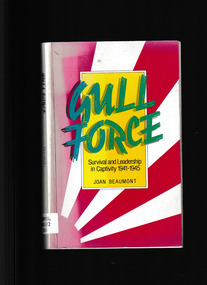
Book, Allen & Unwin, Gull Force : Survival and Leadership in Captivity 1941-1945, 1988
... World war 1939 – 1945 - Prisons and prisoners - Japanese Prison camp - Ambon The captivity experiences of Gull Force taken prisoner by the Japanese in Ambon in 1942 Index, bib, ill, map, p.220. ...The captivity experiences of Gull Force taken prisoner by the Japanese in Ambon in 1942Index, bib, ill, map, p.220.non-fictionThe captivity experiences of Gull Force taken prisoner by the Japanese in Ambon in 1942world war 1939 – 1945 - prisons and prisoners - japanese, prison camp - ambon -
 Monbulk RSL Sub Branch
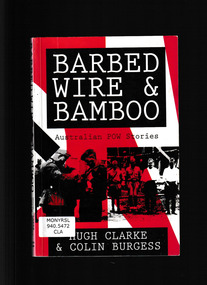
Book, Hugh V. Clarke and Colin Burgess, Barbed wire and bamboo : Australian POWs in Europe, North Africa, Singapore, Thailand and Japan, 1993
... World war 1939 – 1945 - Prisons and prisoners - Japanese World war 1939 – 1945 - Prisons and prisoners – Germany A collection of stories of capture, imprisonment and escape in World War I and II. Covering experiences in Europe and in South East Asia, the book presents contrasting PoW experiences - of daring escapes from Colditz Castle, and of endurance and slow suffering in Japanese camps. ...A collection of stories of capture, imprisonment and escape in World War I and II. Covering experiences in Europe and in South East Asia, the book presents contrasting PoW experiences - of daring escapes from Colditz Castle, and of endurance and slow suffering in Japanese camps.Ill, maps, p.159A collection of stories of capture, imprisonment and escape in World War I and II. Covering experiences in Europe and in South East Asia, the book presents contrasting PoW experiences - of daring escapes from Colditz Castle, and of endurance and slow suffering in Japanese camps.world war 1939 – 1945 - prisons and prisoners - japanese, world war 1939 – 1945 - prisons and prisoners – germany -
 Monbulk RSL Sub Branch
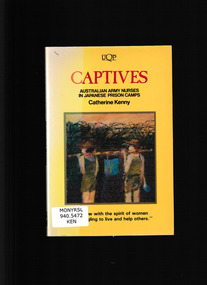
Book, University of Queensland Press, Captives: Australian Army Nurses in Japanese Prison Camps, 1986
... World war 1939 – 1945 - Prisons and prisoners - Japanese Australian Army Nursing Service The story of the experiences of Australian Army nurses as Japanese prisoners of war Index, ill, p.162. Captives: Australian Army Nurses in Japanese Prison Camps ...The story of the experiences of Australian Army nurses as Japanese prisoners of warIndex, ill, p.162.non-fictionThe story of the experiences of Australian Army nurses as Japanese prisoners of warworld war 1939 – 1945 - prisons and prisoners - japanese, australian army nursing service -
 Monbulk RSL Sub Branch
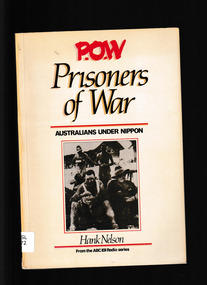
Book, Australian Broadcasting Corporation, P.O.W. : prisoners of war, 1985
... World war 1939 – 1945 - Prisons and prisoners – Japanese World war 1939-1945 - Personal narrativies - Australia Within three months of the Japanese entering World War II on December 8, 1941 over 22 000 Australians had become prisoners-of-war. They went into camps ...Within three months of the Japanese entering World War II on December 8, 1941 over 22 000 Australians had become prisoners-of-war. They went into camps in Timor, Ambon, New Britain, Java, Sumatra, Borneo, Singapore and Malaya, and a few were scattered to other points in what was briefly part of the Japanese empire. Later most of the prisoners were to be shifted further north into South-east Asia, Formosa, Korea, Manchuria and Japan itself. They were captives within lands and cultures and to experiences alien to those known to all other Australians. At the end of the war in August 1945, 14315 servicemen and thirty service women were alive to put on new, loose-fitting uniforms and go home. One in three of the prisoners had died. That is, nearly half of the deaths suffered by Australians in the war in the Pacific were among men and women who had surrendered. Another 8174 Australians had been captured in the fighting in Europe, the Middle East and North Africa: but of these men only 265 died as a result of wounds, disease or execution.By any quantitative measure the imprisonment of so many Australians is a major event in Australian history. For many soldiers it was living --and dying --in captivity which made World War II different from that of World War I. But the prisoners have received no permanent place in Australian history. Their story is not immediately recalled on celebratory occasions. In a general history of the nation in which a chapter is given to the war the prisoners might be mentioned in a sentence, or part of a sentence. Where the horror, stoicism and gallantry of Gallipoli have become part of a common tradition shared by all Australians, the ex-prisoners are granted just the horror. The public may be sympathetic; but the horror is for the prisoners alone. To make another comparison: in five months of fighting on the Kokoda Trail in 1942 the Australians lost 625 dead, less than the number who died on Ambon. Yet the events on Ambon are unknown to most Australians. There were no reporters or cameramen on Ambon and, for the 309 who defended Ambon's Laha airfield, no survivors. How many of them died in battle or died as prisoners will never be known. But there are more than just practical reasons why the record of the prisoners of war is so slight and uneven in the general knowledge of Australians. They have not tried to find out. No historian has written a book to cover the range of camps and experiences, and only in specialist medical publications has anyone investigated the impact of prison life on subsequent physical and mental health. The complexity of the experience and its impact on particular lives have not been expressed in a way to give them significance for other Australians.Index, bib, ill, maps, p.224.Within three months of the Japanese entering World War II on December 8, 1941 over 22 000 Australians had become prisoners-of-war. They went into camps in Timor, Ambon, New Britain, Java, Sumatra, Borneo, Singapore and Malaya, and a few were scattered to other points in what was briefly part of the Japanese empire. Later most of the prisoners were to be shifted further north into South-east Asia, Formosa, Korea, Manchuria and Japan itself. They were captives within lands and cultures and to experiences alien to those known to all other Australians. At the end of the war in August 1945, 14315 servicemen and thirty service women were alive to put on new, loose-fitting uniforms and go home. One in three of the prisoners had died. That is, nearly half of the deaths suffered by Australians in the war in the Pacific were among men and women who had surrendered. Another 8174 Australians had been captured in the fighting in Europe, the Middle East and North Africa: but of these men only 265 died as a result of wounds, disease or execution.By any quantitative measure the imprisonment of so many Australians is a major event in Australian history. For many soldiers it was living --and dying --in captivity which made World War II different from that of World War I. But the prisoners have received no permanent place in Australian history. Their story is not immediately recalled on celebratory occasions. In a general history of the nation in which a chapter is given to the war the prisoners might be mentioned in a sentence, or part of a sentence. Where the horror, stoicism and gallantry of Gallipoli have become part of a common tradition shared by all Australians, the ex-prisoners are granted just the horror. The public may be sympathetic; but the horror is for the prisoners alone. To make another comparison: in five months of fighting on the Kokoda Trail in 1942 the Australians lost 625 dead, less than the number who died on Ambon. Yet the events on Ambon are unknown to most Australians. There were no reporters or cameramen on Ambon and, for the 309 who defended Ambon's Laha airfield, no survivors. How many of them died in battle or died as prisoners will never be known. But there are more than just practical reasons why the record of the prisoners of war is so slight and uneven in the general knowledge of Australians. They have not tried to find out. No historian has written a book to cover the range of camps and experiences, and only in specialist medical publications has anyone investigated the impact of prison life on subsequent physical and mental health. The complexity of the experience and its impact on particular lives have not been expressed in a way to give them significance for other Australians.world war 1939 – 1945 - prisons and prisoners – japanese, world war 1939-1945 - personal narrativies - australia -
 Monbulk RSL Sub Branch
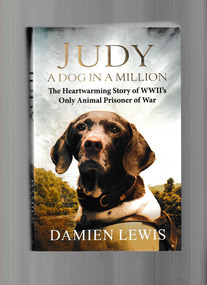
Book, Quercus, Judy : a dog in a million, 2014
... Animals - War use Dogs - War use - Great Britain Shares the story of Judy, the first-ever animal to gain formal status as a prisoner of war, who during World War II saved countless lives and became a friend and protector to Allied soldiers in the Japanese prison camps in Indonesia. ...Shares the story of Judy, the first-ever animal to gain formal status as a prisoner of war, who during World War II saved countless lives and became a friend and protector to Allied soldiers in the Japanese prison camps in Indonesia.Index, ill, p.352.non-fictionShares the story of Judy, the first-ever animal to gain formal status as a prisoner of war, who during World War II saved countless lives and became a friend and protector to Allied soldiers in the Japanese prison camps in Indonesia.animals - war use, dogs - war use - great britain -
 Monbulk RSL Sub Branch
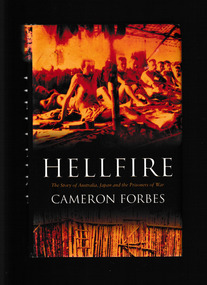
Book, Cameron Forbes, Hellfire : The Story of Australia, Japan and the Prisoners of War, 2005
... war 1939-1945 - Prisoners and Prisons - Japan Burma - Siam railway For months during 1943 there was no night in Hellfire Pass. By the light of flares, carbide lamps and bamboo fires, men near-naked and skeletal cut a passage through stone to make way for a railway. Among these men were some of the 22,000 Australian soldiers taken prisoner by the Japanese during World War II. In camps ...For months during 1943 there was no night in Hellfire Pass. By the light of flares, carbide lamps and bamboo fires, men near-naked and skeletal cut a passage through stone to make way for a railway. Among these men were some of the 22,000 Australian soldiers taken prisoner by the Japanese during World War II. In camps across Asia and the Pacific, they struggled, died, and survived with a little help from their mates. 'Hellfire' was researched in Australia, Japan and across South-East Asia. It draws on 50 first-person interviews, ranging from former prisoners to an old Mon villager deep in the Burmese jungle, and from Singapore's Lee Kuan Yew to veterans of the Imperial Japanese Army. The result is a tour de force, a powerful and searing history of the prisoners of the Japanese.Index, ill, bib, p.559.non-fictionFor months during 1943 there was no night in Hellfire Pass. By the light of flares, carbide lamps and bamboo fires, men near-naked and skeletal cut a passage through stone to make way for a railway. Among these men were some of the 22,000 Australian soldiers taken prisoner by the Japanese during World War II. In camps across Asia and the Pacific, they struggled, died, and survived with a little help from their mates. 'Hellfire' was researched in Australia, Japan and across South-East Asia. It draws on 50 first-person interviews, ranging from former prisoners to an old Mon villager deep in the Burmese jungle, and from Singapore's Lee Kuan Yew to veterans of the Imperial Japanese Army. The result is a tour de force, a powerful and searing history of the prisoners of the Japanese. world war 1939-1945 - prisoners and prisons - japan, burma - siam railway -
 Monbulk RSL Sub Branch
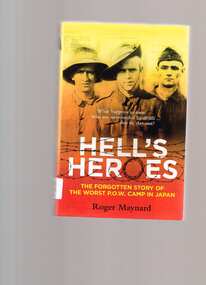
Book, Harper Collins, Hell's heroes, 2009
... World war 1939 – 1945 - Prisons and prisoners - Japanese Atrocities - Japan Hell′s Heroes is the story of the POW camp that never was − so dubbed by one old soldier because the atrocities that occurred there went largely unreported at the time. ...Hell′s Heroes is the story of the POW camp that never was − so dubbed by one old soldier because the atrocities that occurred there went largely unreported at the time. For while the Burma−Thai railway‚ the Bataan death march and events at Changi and in many other parts of Asia became synonymous with Japanese brutality‚ most of the camps which were set up to provide slave labour for the enemy military machine at home were slowly forgotten in the aftermath of World War II.Ill, maps, p.359.non-fictionHell′s Heroes is the story of the POW camp that never was − so dubbed by one old soldier because the atrocities that occurred there went largely unreported at the time. For while the Burma−Thai railway‚ the Bataan death march and events at Changi and in many other parts of Asia became synonymous with Japanese brutality‚ most of the camps which were set up to provide slave labour for the enemy military machine at home were slowly forgotten in the aftermath of World War II.world war 1939 – 1945 - prisons and prisoners - japanese, atrocities - japan -
 Monbulk RSL Sub Branch
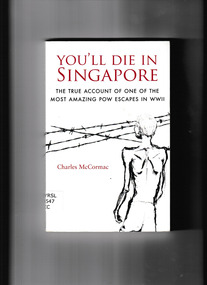
Book, Monsoon, You'll die in Singapore: True account of one of the most amazing POW escapes in WWII, 2005
... World war 1939 – 1945 - Prisons and prisoners – Japanese Prisoner of war escapes - Singapore With sixteen other POWs, author Charles McCormac broke out from his POW camp in Japanese-occupied Singapore and began a two-thousand-mile escape from Singapore, through the jungles of Indonesia to Australia. ...With sixteen other POWs, author Charles McCormac broke out from his POW camp in Japanese-occupied Singapore and began a two-thousand-mile escape from Singapore, through the jungles of Indonesia to Australia. The POWs' escape took a staggering five months and only two out of the original seventeen men survived. This is McCormac's compelling true account of one of the most horrifying and amazing escapes in World War Two. It is a story of courage, endurance and compassion, and makes for a very gripping read.Ill, maps, p.223.non-fictionWith sixteen other POWs, author Charles McCormac broke out from his POW camp in Japanese-occupied Singapore and began a two-thousand-mile escape from Singapore, through the jungles of Indonesia to Australia. The POWs' escape took a staggering five months and only two out of the original seventeen men survived. This is McCormac's compelling true account of one of the most horrifying and amazing escapes in World War Two. It is a story of courage, endurance and compassion, and makes for a very gripping read.world war 1939 – 1945 - prisons and prisoners – japanese, prisoner of war escapes - singapore -
 Monbulk RSL Sub Branch
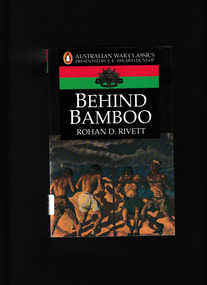
Book, Penguin, Behind bamboo, 1991
... war 1939 – 1945 - Prisons and prisoners – Japanese Burma - Thailand railway The bestselling memoir of life as an Australian POW on the notorious Thai-Burma railway. Rohan Rivett was a journalist in Singapore when it fell to the Japanese in 1942. He escaped south - across the treacherous Bangka Strait - to Indonesia, but was soon captured and became just one of thousands of POWs struggling for existence in a Japanese camp. ...The bestselling memoir of life as an Australian POW on the notorious Thai-Burma railway. Rohan Rivett was a journalist in Singapore when it fell to the Japanese in 1942. He escaped south - across the treacherous Bangka Strait - to Indonesia, but was soon captured and became just one of thousands of POWs struggling for existence in a Japanese camp. The struggle was to last for more than three years. Behind Bamboo is unflinching in its honesty and haunting in its realism. It is a vivid, compelling testament to the Australians' will to survive and their unassailable spirit in the face of the most callous inhumanity.Ill, p.400.non-fiction The bestselling memoir of life as an Australian POW on the notorious Thai-Burma railway. Rohan Rivett was a journalist in Singapore when it fell to the Japanese in 1942. He escaped south - across the treacherous Bangka Strait - to Indonesia, but was soon captured and became just one of thousands of POWs struggling for existence in a Japanese camp. The struggle was to last for more than three years. Behind Bamboo is unflinching in its honesty and haunting in its realism. It is a vivid, compelling testament to the Australians' will to survive and their unassailable spirit in the face of the most callous inhumanity.world war 1939 – 1945 - prisons and prisoners – japanese, burma - thailand railway -
 Monbulk RSL Sub Branch
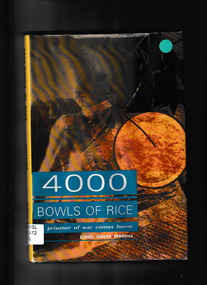
Book, Allen & Unwin, Four thousand bowls of rice : a prisoner of war comes home, 1993
... World war 1939 – 1945 - Prisons and prisoners – Australia Burma Thailand railway Over 60,000 Australians and Americans captured by the Japanese during World War II toiled and died to build the Bridge over the River Kwai. Respected military historian Linda Goetz Holmes tells the story of one man's survival in Japanese labor camps ...Over 60,000 Australians and Americans captured by the Japanese during World War II toiled and died to build the Bridge over the River Kwai. Respected military historian Linda Goetz Holmes tells the story of one man's survival in Japanese labor camps during WWII. Amazing photographs, taken secretly by other prisoners, chronicle this dark history of Allied troops in the Pacific theatre of war.Index, bibliography, notes, ill, p.179.non-fictionOver 60,000 Australians and Americans captured by the Japanese during World War II toiled and died to build the Bridge over the River Kwai. Respected military historian Linda Goetz Holmes tells the story of one man's survival in Japanese labor camps during WWII. Amazing photographs, taken secretly by other prisoners, chronicle this dark history of Allied troops in the Pacific theatre of war.world war 1939 – 1945 - prisons and prisoners – australia, burma thailand railway -
 Monbulk RSL Sub Branch
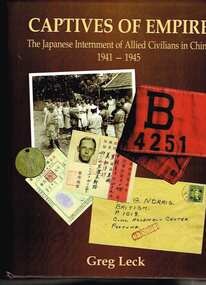
Book, Shandy Press, Captives of empire : the Japanese internment of allied civilians in China, 1941-1945, 2006
... World war 1939-1945 - Prisoners and prisons - Japan Internment camps - China Here for the first time is the definitive history of the internment of Allied civilians ib China Index, ill, maps, plans, p.738. ...Here for the first time is the definitive history of the internment of Allied civilians ib ChinaIndex, ill, maps, plans, p.738.Here for the first time is the definitive history of the internment of Allied civilians ib Chinaworld war 1939-1945 - prisoners and prisons - japan, internment camps - china -
 Monbulk RSL Sub Branch
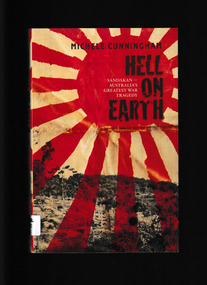
Book, Michele Cunningham, Hell on Earth : Sandakan - Australia's greatest war tragedy, 2103
... World War 1939-1945 - Prisoners of war - Sandakan World war 1939 – 1945 - Prisons and prisoners – Australia The heart-rending story of the Australians brutally imprisoned in Sandakan, the Japanese POW camp in North Borneo, whose very name came to symbolise cruelty and ill-treatment. ...The heart-rending story of the Australians brutally imprisoned in Sandakan, the Japanese POW camp in North Borneo, whose very name came to symbolise cruelty and ill-treatment. In mid-1942, after the fall of Singapore, almost three thousand Allied prisoners of war were taken by the Japanese from Changi to Sandakan. Of those, 2500 lost their lives. Men died at Sandakan and on the infamous death marches: they died from sickness and starvation, torture and appalling violence, or were killed by the guards as they were forced to keep moving along a seemingly never-ending track. Only six Australians survived the death marches, out of the thousand who leftIndex, ill, p.335.non-fictionThe heart-rending story of the Australians brutally imprisoned in Sandakan, the Japanese POW camp in North Borneo, whose very name came to symbolise cruelty and ill-treatment. In mid-1942, after the fall of Singapore, almost three thousand Allied prisoners of war were taken by the Japanese from Changi to Sandakan. Of those, 2500 lost their lives. Men died at Sandakan and on the infamous death marches: they died from sickness and starvation, torture and appalling violence, or were killed by the guards as they were forced to keep moving along a seemingly never-ending track. Only six Australians survived the death marches, out of the thousand who left world war 1939-1945 - prisoners of war - sandakan, world war 1939 – 1945 - prisons and prisoners – australia
