
Showing 10 items matching "japanese shrines"
-
 Tatura Irrigation & Wartime Camps Museum
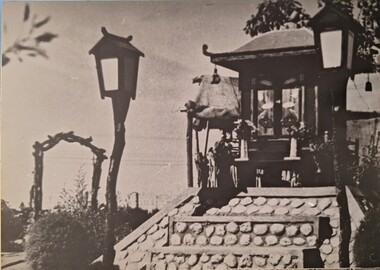
Photograph, Japanese garden in Camp 14, 1989
... ...Japanese shrines...The small Japanese building is a Japanese shrine. This was built at Camp 14....The small Japanese building is a Japanese shrine. This was built at Camp 14. loveday, south australia opium crops internment camp loveday Japanese shrines Japanese internees Black and white photograph. ...The archway is at the entrance to the Japanese compound. The small Japanese building is a Japanese shrine. This was built at Camp 14.Black and white photograph. Two lamps on posts in the front of the photograph. There is an archway to the left and rear of the photograph. Between the 2 lamps there are three stone steps leading up to a small Japanese building.loveday, south australia, opium crops, internment camp loveday, japanese shrines, japanese internees -
 Bendigo Military Museum
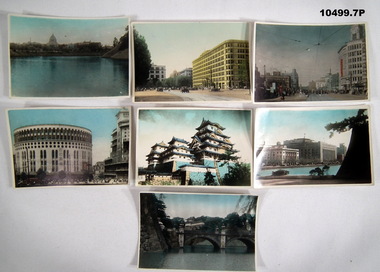
Photograph - STREET VIEWS, TOKYO, BCOF, c.1947
... Handwritten in black ink on back: “Japan's Diet Building” (The top part reminds me of the Shrine of Remembrance Melbourne). 2. ...Handwritten in black ink on back: “Japan's Diet Building” (The top part reminds me of the Shrine of Remembrance Melbourne). 2. ...Photographs collected by Alva Marie Bennetts whilst deployed to BCOF, 1947-49. Part of the Bennetts collection. See catalogue No. 9726P for details of Alva Bennetts (No. VFX128835) service record.1. Colour photograph of a view across a body of water to a large building. 2. Colour photograph of a street lined with multi-storied buildings. Vehicles and pedestrians visible. 3. Colour photograph of a street lined with multi-storied buildings. Pedestrians on foot paths. Tram tracks down middle of street. Overhead wires for trams visible. 4. Colour photograph of a high rise circular building. Pedestrians visible in front of building. Japanese character visible on front of building. 5. Colour photograph of a multi level Japanese Castle (Himeji Castle.) 6. Colour photograph of multi level buildings with a body of water and trees in foreground. 7, Colour photograph of a palatial building behind a two arch bridge. Body of water in foreground. 1. Handwritten in black ink on back: “Japan's Diet Building” (The top part reminds me of the Shrine of Remembrance Melbourne). 2. Handwritten in black ink on back: Marunochi Building, Tokyo. 3. Handwritten in black ink on back: Main St Tokyo. 4. Handwritten in black ink on back: Nippon Theatre Off Limits to all troops 6. Handwritten in black ink on back: The middle building is General McArthur's H.Q.'s - a fine structure. 7. Handwritten in black ink on back: Entrance to the Imperial Palace, Tokyo. The palace has three moats around it. it is very heavily guarded, at the moment by Americans and Australian Air Force plus Japanese police 24/7/47'.alva bennetts, bcof, tokyo, japan -
 Bendigo Military Museum
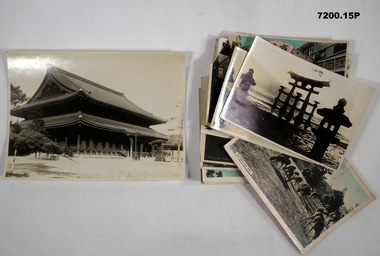
Photograph - PHOTOGRAPHS, BCOF, JAPAN, possibly pre WW2
... japan 1 & 2. Osaka Castle. 3. Bridge at Arashiyama near Kyoto. 4. Itsukushima Jimja shrine at Miyajima. 5 & 6 Hsukushima floating Torri Gate. 7. ...Items in the collection re Clarence Shearing, refer Cat No 7089.16P for his service details.Photographs B & W, colour enhanced of scenes and buildings in Japan all various sizes.1 & 2. Osaka Castle. 3. Bridge at Arashiyama near Kyoto. 4. Itsukushima Jimja shrine at Miyajima. 5 & 6 Hsukushima floating Torri Gate. 7. Miyajima. 8. Wagoga castle. 9. Inuyama Castle at River Kiso. 10. Torri Gate at Yosukuni Shrine. 11. Amakusa Islands. 12. Deer Park at Nara. 13. Kinkaku-ji or Golden gate Shrine in Kyoto. 14. Temple in Kyoto. 15. Kyogoka (Theatre street) Kyoto. photographs, bcof, japan -
 Bendigo Military Museum
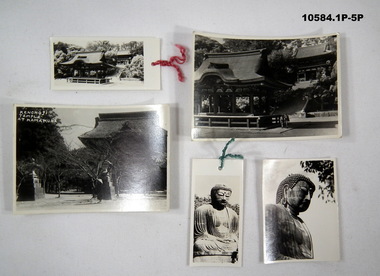
Photograph - KAMAKURA, JAPAN, BCOF ERA
... Handwritten in black ink on back: “In September each year, Japanese girls dance on the platform of this shrine at Kamakura.” 3. ...Handwritten in black ink on back: “In September each year, Japanese girls dance on the platform of this shrine at Kamakura.” 3. ...Photographs of Kamakura, Japan, collected by Alva Bennetts during a visit whilst on her BCOF deployment. Part of the Bennetts collection. See Catalogue No. 9726P for details of service for Alva Marie Bennetts VFX128835.1. Black and white photograph of a Japanese building. trees and a second building in the background. RH side has a piece of red cord attached. 2. Black and white close-up photograph of the buildings featured in 1. Two people in foreground. 3. Black and white photograph of a Japanese Temple with gate pillars in foreground. Trees surround building. 4. Black and white photograph of a statue of Buddha. Green cord tied through a hole at the top. 5. Black and white photograph of the head and shoulders of a statue of Buddha. 6. Black and white photograph of a statue of a sitting Buddha. Steps and large urns in foreground, trees in background. 7. Black and white photograph with details as per no. 6. 8. Black and white close-up of the statue of Buddha's head.2. Handwritten in black ink on back: “In September each year, Japanese girls dance on the platform of this shrine at Kamakura.” 3. Etched in white on top LHC of photograph: “KENCHOJI TEMPLE AT KAMAKURA.” 6. The great Buddha is a bronze figure of Amida, one of the Buddhist gods. It was cast in 1252. you can walk right up into the head of it. Note the position of the hands which are laid on the lap palms upwards and thumbs touching, the Buddhist sign for steadfast faith. 8. You can see where the Buddha was damaged during the 1923 earthquake. alva bennetts, bennetts collection, bcof, japan, kamakura, photographs, buddha -
 Bendigo Military Museum
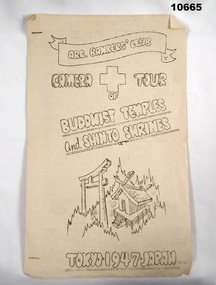
Programme - TOUR ITINERARY, ARC BANKERS CLUB, BCOF, American Red Cross, Bankers Club, 1947
... Tour itinerary for American Red Cross (ARC) Banker's Club Camera Tour of Buddhist Temples and Shinto Shrines, Tokyo 1947, Japan. See Cat No. 10584.8P for accompanying photographs. ...Tour itinerary for American Red Cross (ARC) Banker's Club Camera Tour of Buddhist Temples and Shinto Shrines, Tokyo 1947, Japan. See Cat No. 10584.8P for accompanying photographs. ...Tour itinerary for American Red Cross (ARC) Banker's Club Camera Tour of Buddhist Temples and Shinto Shrines, Tokyo 1947, Japan. See Cat No. 10584.8P for accompanying photographs. Part of the Bennetts Collection. See Cat No. 9726P for details of service for Alva Marie Bennetts VFX128835.Two foolscap size cream coloured pages with printing on one side of each page. Front cover features tour details and a line drawing of a temple. Letters and illustration in black. Second page has text in black type. Two pages fastened together with a staple on top LH Corner.alva bennetts, bennetts collection, american red cross, photographs, japan -
 Sunshine and District Historical Society Incorporated
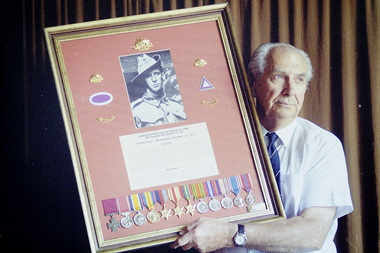
Photograph - Sunshine RSL Walter Peeler Memorial 1998 Photograph, Craig Cahill, 4th November 1998
... Japanese captivity. From 1934 to 1964, Peeler served as a long‑standing Custodian of the Shrine of Remembrance, becoming a familiar figure in Victoria’s commemorative life. ...This photograph, taken by The Advocate, shows Ron Edwards, President of the Sunshine RSL, holding a memorial dedicated to Walter “Wally” Peeler, Victoria Cross recipient and former Sunshine Harvester Factory worker, and local resident.Walter “Wally” Peeler (1887–1968) was a Victorian soldier and one of Australia’s most highly decorated servicemen. Born at Barkers Creek near Castlemaine, he worked locally before enlisting in the First World War in 1916. Serving with the 3rd Pioneer Battalion, he earned the Victoria Cross for exceptional bravery at Broodseinde Ridge in October 1917, where he led assaults on multiple German machine‑gun posts. After the war, Peeler returned to Victoria and later worked at Sunshine Harvester Works, linking him directly to the industrial heritage of Melbourne’s western suburbs. He re‑enlisted during the Second World War, served in the Middle East and Java, and endured years as a prisoner of war under Japanese captivity. From 1934 to 1964, Peeler served as a long‑standing Custodian of the Shrine of Remembrance, becoming a familiar figure in Victoria’s commemorative life. He died in 1968 and is remembered through numerous memorials, including at the Australian War Memorial and in his home district around Castlemaine.Ron Edwards & Wally Peeler Memorial Sunshine RSLsunshine rsl, dickson street, sunshine, walter peeler, ron edwards -
 Melbourne Legacy
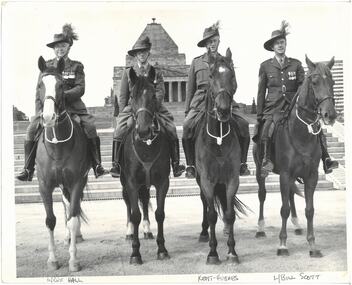
Photograph, Light Horse Men, 1967?
... Shrine mounted on police horses (see 01023). Though the date on the back of the photo is 1967. It is believed these legatees rode in at least 13 Anzac Day marches. Wilfred Kent-Hughes, known as Billy, served in both World Wars, was a prisoner of the Japanese, an Olympic athlete (hurdles, Antwerp 1920) and a State and Federal politician and was awarded a Knighthood. ...Shrine mounted on police horses (see 01023). Though the date on the back of the photo is 1967. It is believed these legatees rode in at least 13 Anzac Day marches. Wilfred Kent-Hughes, known as Billy, served in both World Wars, was a prisoner of the Japanese, an Olympic athlete (hurdles, Antwerp 1920) and a State and Federal politician and was awarded a Knighthood. ...Four soldiers mounted on horses in the forecourt of the Shrine of Remembrance. Three of the four that are named are Legatee Rex Hall, Billy Kent-Hughes and Legatee Bill Scott. The other rider's name and date unknown. An article in The Herald on 19 April 1975 mentions that Rex Hall, Jim Holland and Bill Scott would wear their Light Horse uniforms and lead the Anzac Day parade to the Shrine mounted on police horses (see 01023). Though the date on the back of the photo is 1967. It is believed these legatees rode in at least 13 Anzac Day marches. Wilfred Kent-Hughes, known as Billy, served in both World Wars, was a prisoner of the Japanese, an Olympic athlete (hurdles, Antwerp 1920) and a State and Federal politician and was awarded a Knighthood. His niece, Jane, is a Legatee in the South Gippsland Group. From another article found Colonel Rex Hall was a member of the 5th Light Horse Brigade in World War 1. The image of the newspaper article and black and white photo is from an album stored separately at 00209 - at that march the men were: Max Armstrong, Legatee Rex Hall, Legatee Harry Burton and Warren Hardy.A record of a Legatees riding horses to the Shrine in Light Horse uniform.Black and white photo of 4 soldiers on horseback at the Shrine.Front of photo has " L/Rex Hall ; Kent-Hughes ; L/Bill Scott" in black pen. The back is stamped Copyright Herald and Weekly Times in blue ink. Handwritten "Property of Melbourne Legacy / Melbourne Shrine of Remembrance / L/tee J. R. Hall / 1967" in black ink.anzac day, horses, light horse, rex hall, bill scott, billy kent-hughes -
 Melton City Libraries
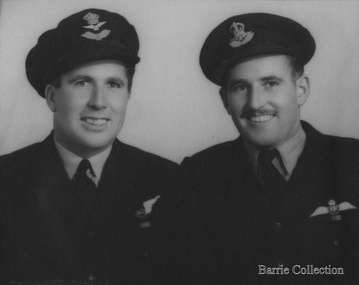
Photograph, Jim (James) and William (Horace) Barrie, Unknown, c.1940
... Japanese. This information has been taken from the writings of Mary Robinson, sister of Jim. My parents Bon and Edna Barrie spoke about this incident leaving a vivid impression in my mind as a young child. Jim is mentioned in the book Two Steps to Tokyo. A Story of the RAAF in the Trobriand and Admiralty Islands by Gordon Powell Chaplain, RAAF. After the war Jim returned to Darlingsford. In 1953 he married Wilma Ryan of Yarram. He continued in the family farming tradition obtaining a Soldier Settlement Block at Shelford. Jim regularly attended the ANZAC day march to the Shrine...Japanese. This information has been taken from the writings of Mary Robinson, sister of Jim. My parents Bon and Edna Barrie spoke about this incident leaving a vivid impression in my mind as a young child. Jim is mentioned in the book Two Steps to Tokyo. A Story of the RAAF in the Trobriand and Admiralty Islands by Gordon Powell Chaplain, RAAF. After the war Jim returned to Darlingsford. In 1953 he married Wilma Ryan of Yarram. He continued in the family farming tradition obtaining a Soldier Settlement Block at Shelford. Jim regularly attended the ANZAC day march to the Shrine ...In 1939 when World War 11 erupted Jim and Horace enlisted in the RAAF Jim to become a pilot and Horace a navigator. James Edward Barrie enlisted in the RAAF on 21st June 1941, aged 19 years. He was sent to Canada and then later to England to become a Spitfire Pilot. Half way through the War he returned to Australia to be sent north to fight the Japanese. At one stage he had to bail out over the Pacific after his engine had failed. Fortunately, he had time to radio his position before he abandoned his Spitfire. He dropped his boot out to determine how far below the water was, parachuted down inflated his dinghy and waited to be rescued. He was picked up very quickly by a rescue crew just as a heavy fog descended, or he may never have been found. He lost many of his mates in that Squadron in the Pacific, it was a particularly vital time for the Allies and these boys played a major part in turning the tide against the Japanese. This information has been taken from the writings of Mary Robinson, sister of Jim. My parents Bon and Edna Barrie spoke about this incident leaving a vivid impression in my mind as a young child. Jim is mentioned in the book Two Steps to Tokyo. A Story of the RAAF in the Trobriand and Admiralty Islands by Gordon Powell Chaplain, RAAF. After the war Jim returned to Darlingsford. In 1953 he married Wilma Ryan of Yarram. He continued in the family farming tradition obtaining a Soldier Settlement Block at Shelford. Jim regularly attended the ANZAC day march to the Shrine. He died in August 2004 This account has been compiled by his niece Wendy Barrie Sons of Charles (Ernie) and Jessie Barrie of Darlingsford Meltonlocal identities -
 Returned Nurses RSL Sub-branch
Document - Photocopy of a typed account and invitation, Bob Hershaw, AHS Centaur, 2001
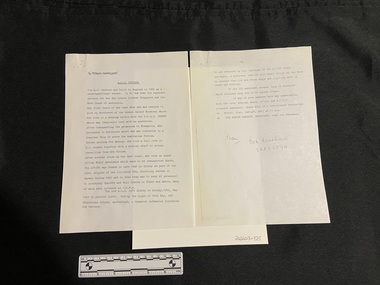
... Japanese in 1943 with 332 personnel aboard, of whom only 64 survived. In the final paragraph an invitation is extended for any interested members to attend a tree/plaque dedication at the Shrine Reserve on January 21st, 2001, in Melbourne....Japanese in 1943 with 332 personnel aboard, of whom only 64 survived. In the final paragraph an invitation is extended for any interested members to attend a tree/plaque dedication at the Shrine Reserve on January 21st, 2001, in Melbourne. ...Brief history of the AHS Centaur hospital ship that was sunk by the Japanese in 1943 with 332 personnel aboard, of whom only 64 survived. In the final paragraph an invitation is extended for any interested members to attend a tree/plaque dedication at the Shrine Reserve on January 21st, 2001, in Melbourne.Two pages of typed text. The first page displays an underlined heading and four paragraphs. The other page has three short typed paragraphs , followed by two lines of handwriting.[The typed first line reading TO DARWIN DEFENDERS has been crossed out with a wavy blue ink line]world war two, ww2, wwii, war memorials australia, ahs centaur, ahs centaur memorial, melbourne shrine of remembrance, australian hospital ship centaur -
 Embroiderers Guild, Victoria
Textile - Japanese Triptych Screen, Late 18th- Early 19th C Edo Period
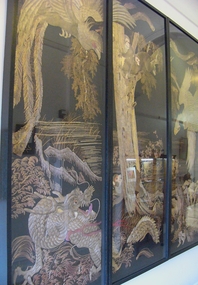
... Japanese macaques act as divine messengers in certain Shinto shrines (like the Hie Shrine). ...Japanese macaques act as divine messengers in certain Shinto shrines (like the Hie Shrine). ...The ho-o bird (hōō or 鳳凰) is a legendary, phoenix-like creature from East Asian mythology, originating from the Chinese fenghuang. The name comes from Japanese, where hō represents the male bird and ō represents the female bird, symbolizing yin and yang harmony. Symbolism: Unlike the Western phoenix, the ho-o does not burn up and rise from ashes. It is a peaceful, divine spirit that appears only to mark times of peace, virtue, or the birth of a just ruler. Appearance: Traditional descriptions combine parts of many animals, featuring the beak of a rooster, head of a pheasant, neck of a snake, and tail of a peacock. Its feathers display five sacred colors (red, yellow, blue, white, and black). Eventually the two creatures merged into one and their combined name was used. The combined creature is still considered to be female, and is often partnered with the tatsu, which is considered to be male. The hōō is one of the most revered and holiest animals in Japan. Second only to the kirin in terms of power, it is the most sacred bird in the Japanese pantheon. Japanese dragon, known as ryū or tatsu (龍 or 竜), is a legendary, serpentine water deity in Japanese mythology and folklore. Physical Appearance: Body: Long, scaly, and snake-like without wings. Claws: Typically depicted with three toes on each foot (distinguishing them from Chinese five-clawed and Korean four-clawed variants). Features: Horns, long whiskers or a beard, and a fierce expression. Movement: Associated with water, oceans, rain, and clouds rather than fire-breathing. Meaning and Symbolism: Water and Weather: Viewed as benevolent water gods controlling rainfall, rivers, and tides. Wisdom and Power: Symbolize strength, protection, and good fortune. Imperial Lineage: Ancient legends state that Japan's imperial family descends from sea deities and dragon royalty like Ryūjin . A Japanese monkey (saru, 猿) in traditional or decorative embroidery symbolizes protection, good luck, cleverness, and the removal of evil. Core Meanings of the Monkey : Warding off evil: Historically, the monkey was viewed as a protector against demons and bad luck. Japanese macaques act as divine messengers in certain Shinto shrines (like the Hie Shrine). Fertility and safe birth: Ancient Japanese clay monkey amulets were used to pray for healthy children and easy childbirth, a meaning that carried into traditional folk textiles and garments. Mischief and playfulness: On a lighter note, single playful monkeys represent cleverness, agility, and lighthearted joy.Large Japanese metal thread screen depicting dragons, ho-o birds and monkeys.embroidery, japanese screen, metal work, surface stitchery
