
Showing 3 items matching "jean howley"
-
 Flagstaff Hill Maritime Museum and Village
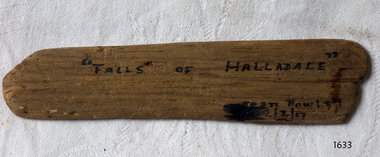
Plant specimen - Wood Sample, ca. 1908
... ...Jean Howley...The person named on the wood sample, Jean Howley, is currently a mystery. Is it the name of the person who wrote on the wood, or the person admired by the writer? ...On the front: " "FALLS OF HALLADALE" "" and "JEAN HOWLEY" and "2/2/17" On the reverse: "symbol of a (heart ) with an arrow through it from top right to bottom left"...The person named on the wood sample, Jean Howley, is currently a mystery. Is it the name of the person who wrote on the wood, or the person admired by the writer? ...The person named on the wood sample, Jean Howley, is currently a mystery. Is it the name of the person who wrote on the wood, or the person admired by the writer? The year noted on the sample, 1917, is eleven years after the wreck of the Falls of Halladale; was the person a passenger on the vessel, revisiting the site? The 1886 iron-hulled, four-masted barque, the Falls of Halladale, was a bulk carrier of general cargo. She left New York in August 1908, bound for Melbourne and Sydney. In its hold, along with 56,763 tiles of unusually beautiful green American slates (roofing tiles), 5,673 coils of barbed wire, 600 stoves, 500 sewing machines, 6500 gallons of oil, 14400 gallons of benzene, and many other manufactured items, were 117 cases of crockery and glassware. Three months later and close to the destination, a navigational error caused the Falls of Halladale to be wrecked on a reef off the Peterborough headland at 3 am on the morning of the 15th of November, 1908. The captain and 29 crew members all survived, but her valuable cargo was largely lost, despite two salvage attempts in 1908-09 and 1910. ABOUT THE ‘FALLS OF HALLADALE’ (1886 - 1908) Built: in1886 by Russell & Co., Greenock shipyards, River Clyde, England, UK. The company was founded in 1870 (or 1873) as a partnership between Joseph Russell (1834-1917), Anderson Rodger and William Todd Lithgow. During the period 1882-92 Russell & Co., they standardised designs, which sped up their building process so much that they were able to build 271 ships over that time. In 1886 they introduced a 3000 ton class of sailing vessel with auxiliary engines and brace halyard winches. In 1890 they broke the world output record. Owner: Falls Line, Wright, Breakenridge & Co, 111 Union Street, Glasgow, Scotland. Configuration: Four masted sailing ship; iron-hulled barque; iron masts, wire rigging, fore & aft lifting bridges. Size: Length 83.87m x Breadth 12.6m x Depth 7.23m, Gross tonnage 2085 ton Wrecked: the night of 14th November 1908, Curdies Inlet, Peterborough south west Victoria Crew: 29 The Falls of Halladale was a four-masted sailing ship built-in 1886 in Glasgow, Scotland, for the long-distance cargo trade and was mostly used for Pacific grain trade. She was owned by Wright, Breakenridge & Co of Glasgow and was one of several Falls Line ships, all of which were named after waterfalls in Scotland. The lines flag was of red, blue and white vertical stripes. The Falls of Halladale had a sturdy construction built to carry maximum cargo and able to maintain full sail in heavy gales, one of the last of the ‘windjammers’ that sailed the Trade Route. She and her sister ship, the Falls of Garry, were the first ships in the world to include fore and aft lifting bridges. Previous to this, heavily loaded vessels could have heavy seas break along the full length of the deck, causing serious injury or even death to those on deck. The new, raised catwalk-type decking allowed the crew to move above the deck stormy conditions. This idea is still used today in the most modern tankers and cargo vessels and has proved to be an important step forward in the safety of men at sea. On 4th August 1908, with new sails, 29 crew, and 2800 tons of cargo, the Falls of Halladale left New York, bound for Melbourne and Sydney via the Cape of Good Hope. The cargo on board was valued at £35,000 and included 56,763 tiles of American slate roofing tiles (roof slates), 5,673 coils of barbed wire, 600 stoves, 500 sewing machines, 6,500 gallons of oil, 14,400 gallons of benzene, plumbing iron, 117 cases of crockery and glassware and many other manufactured items. The Falls of Halladale had been at sail for 102 days when, at 3 am on the night of 14th November 1908, under full sail in calm seas with a six knots breeze behind and misleading fog along the coast, the great vessel rose upon an ocean swell and settled on top of a submerged reef near Peterborough on south-west Victoria’s coast. The ship was jammed on the rocks and began filling with water. The crew launched the two lifeboats and all 29 crew landed safely on the beach over 4 miles away at the Bay of Islands. The postmistress at Peterborough, who kept a watch for vessels in distress, saw the stranding and sent out an alert to the local people. A rescue party went to the aid of the sailors and the Port Campbell rocket crew was dispatched, but the crew had all managed to reach shore safely by the time help arrived. The ship stayed in full sail on the rocky shelf for nearly two months, attracting hundreds of sightseers who watched her slowly disintegrate until the pounding seas and dynamiting by salvagers finally broke her back, and her remains disappeared back into deeper water. The valuable cargo was largely lost, despite two salvage attempts in 1908-09 and 1910. Further salvage operations occurred from 1974-1986, during which time 22,000 slate tiles were recovered with the help of 14 oil drums to float them, plus personal artefacts, ship fittings, reams of paper and other items. The Court of Marine Inquiry in Melbourne ruled that the foundering of the ship was entirely due to Captain David Wood Thomson’s navigational error, not the technical failure of the Clyde-built ship. The shipwreck site is a popular to divers, about 300m offshore and in 3 – 15m of water. Some of the original cargo can be seen at the site, including pieces of roof slate and coils of barbed wire.The wood sample is significant for its association with the Falls of Halladale shipwreck, which is listed on the Victorian Heritage Register (No. S255). The vessel was one of the last ships to sail the Trade Routes. It is one of the first vessels to have fore and aft lifting bridges. Also, the ship is an example of the remains of an International Cargo Ship and also represents aspects of Victoria’s shipping industry. The wreck is protected as a Historic Shipwreck under the Commonwealth Historic Shipwrecks Act (1976).A small sample piece of rectangular wood with a ribbed texture and uneven ends. It was recovered from the wreck of the ship, Falls of Halladale. Handwritten inscriptions in dark ink are on the front, and a drawing is on the reverse.On the front: " "FALLS OF HALLADALE" "" and "JEAN HOWLEY" and "2/2/17" On the reverse: "symbol of a (heart ) with an arrow through it from top right to bottom left"flagstaff hill, warrnambool, shipwrecked coast, flagstaff hill maritime museum, maritime museum, shipwreck coast, flagstaff hill maritime village, great ocean road, shipwreck peterborough, 1908 shipwreck, wood sample, jean howley, 1917, momento, memorabilia, salvaged wood, falls of halladale, 1908, relic, souverir -
 Bendigo Historical Society Inc.
Document - CAPITAL THEATRE, MELBOURNE SYMPHONY ORCHESTRA, c1954
... Howley T. Flutes: Walklate A. Middlebrough G. Oboes: Richmond E. Moore K. Clarinets: White T. Anderson A. Hunt N. (Bass Clar). Bassoons: Morgan F. Horns: Norton K. Miller G. Grieves G. Hudson F. Trumpets: Simpson M. Geary J. Trombones: Codes S. McGlade J. Willis H. Tymps: Craige G. Percussion: Lighton E. Harp: Bendall A. Saturday... 14th August... Ginette Neveu... Violin Genius... Accompanist: Jean...Howley T. Flutes: Walklate A. Middlebrough G. Oboes: Richmond E. Moore K. Clarinets: White T. Anderson A. Hunt N. (Bass Clar). Bassoons: Morgan F. Horns: Norton K. Miller G. Grieves G. Hudson F. Trumpets: Simpson M. Geary J. Trombones: Codes S. McGlade J. Willis H. Tymps: Craige G. Percussion: Lighton E. Harp: Bendall A. _ Direction: Australian Broadcasting Commission, Bendigo Town Hall - Saturday, 14th August, Ginette Neveu, Violin Genius, Accompanist: Jean...Howley T. Flutes: Walklate A. Middlebrough G. Oboes: Richmond E. Moore K. Clarinets: White T. Anderson A. Hunt N. (Bass Clar). Bassoons: Morgan F. Horns: Norton K. Miller G. Grieves G. Hudson F. Trumpets: Simpson M. Geary J. Trombones: Codes S. McGlade J. Willis H. Tymps: Craige G. Percussion: Lighton E. Harp: Bendall A. Saturday 14th August Ginette Neveu Violin Genius Accompanist: Jean ...Capital Theatre, Bendigo, Melbourne Symphony Orchestra Orchestra. Direction: Australian Broadcasting Commission. Conductor: Joseph Post. Solo Violinist: Bertha Jorgenson. Wednesday 30th June, 8pm. Programme 6d. Australian Broadcasting Commission, Chairman: R J F Boyer, M.A. Vice-Chairman: E R Dawes. Members: Sir John Medley, M.A. Mrs Ivy Kent, J S Hanlon. General Manager: Charles Moses. Manager for Victoria: Conrad Charlton. Director of Music: W G James. Federal Concert Manager: R G Lamb. Concert Manager for Victoria: Dorrie O'Neal. Joseph Post. With this concert appearance, for which he is coming specially from Sydney, Joseph Post is making a return visit among his former orchestra, for he was stationed in Melbourne as resident conductor of the ABC's Melbourne Orchestra for several years. When the Sydney Symphony was formed on a permanent basis, with Eugene Goosens in charge, Mr Post was appointed his deputy as junior conductor to the Sydney Symphony - at the same time resuming his earlier position as director of the . . . Photo of Joseph Post. Bertha Jorgensen It is a notable occasion for music lovers when Melbourne's esteemed 'First Lady' of the Orchestra steps out of her place as leader and is heard as soloist. Bertha Jorgensen gave her first public performance as a five year old prodigy in Castlemaine, where she then lived, and a few years later she began travelling each week the 60 miles to Melbourne for lessons with Alberto Zelman, Junior. At fifteen, still adorned with pigtail, she came to Melbourne with her family and joined his orchestra. Since then Miss Jorgensen has been constantly engaged in orchestral work, and in attaining the exacting role of leader of the Melbourne Symphony is holder of a unique position. No other major orchestra in the world is led by a woman, and many are the evidences of amazement expressed by visiting conductors. Some have been taken aback and inclined to scepticism at the outset, but all have gone away with high praise for her ability. Photo of Bertha Jorgensen. Programme. Oberon. Jesu, Joy of Man's Desiring. Gavotte. L'Apres-Midi D'un Faune. Violin concerto. Allegro Moderato. Adagio. Allegro energico. Symphony. Adagio. Allegro molto. Largo. Scherzo. Allegro. Scherzo. Allegro vivace. Poco Sostenuto. Allegro con fuoco. Personnel of the Orchestra Conductor: Joseph Post. Soloist Bertha Jorgensen, Violinist. Leader of the Orchestra: Bertha Jorgenson. Violins 1: Jorgenson B. Hutchens H. Schieblich F. Prockter M. Di Gilio A. Morton K. Glassford W J. Haslam J. Violins 2: Lenzer H. Bradley R. Pattison B. Gaunson B. Tregear U. Clancy I. Violas: Kerr C. Jones G K. Roberts, W. Yoxon T. 'Cellos: Bate M. Prockter G. Fox E. Kalmikov Z. Basses: Fraillon G C. Morton W. Howley T. Flutes: Walklate A. Middlebrough G. Oboes: Richmond E. Moore K. Clarinets: White T. Anderson A. Hunt N. (Bass Clar). Bassoons: Morgan F. Horns: Norton K. Miller G. Grieves G. Hudson F. Trumpets: Simpson M. Geary J. Trombones: Codes S. McGlade J. Willis H. Tymps: Craige G. Percussion: Lighton E. Harp: Bendall A. _ Direction: Australian Broadcasting Commission, Bendigo Town Hall - Saturday, 14th August, Ginette Neveu, Violin Genius, Accompanist: Jean Neveu. Gunette, who will appear in Bendigo before her Melbourne appearances, had played with enormous success throughout the Continent, England and the Americas. During her American tour last year she was immediately re-engaged for . . . Extracts from New York Press notices agter her performances of the Brahms Violin Concert last season. . . Programme Chaconne. Sonata. Poeme. Hora Stacco. 24th Caprice. Variation on a Theme of Rossini. Bookings at Allan's from Monday, 9th August. Advertisments: R O Henderson (Beehive) Pty Ltd. Bendigo. Seymour Furs, Melbourne. C1943, 54 or 65program, theatre, melbourne symphony orchestra, capital theatre, bendigo, melbourne symphony orchestra orchestra. direction: australian broadcasting commission. conductor: joseph post. solo violinist: bertha jorgenson. wednesday 30th june, 8pm. programme 6d. australian broadcasting commission, chairman: r j f boyer, m.a. vice-chairman: e r dawes. members: sir john medley, m.a. mrs ivy kent, j s hanlon. general manager: charles moses. manager for victoria: conrad charlton. director of music: w g james. federal concert manager: r g lamb. concert manager for victoria: dorrie o'neal. photo of joseph post.bertha jorgensen gave her first public performance as a five year old prodigy in castlemaine, where she then lived lessons with alberto zelman. at fifteen she came to melbourne and joined his orchestra. miss jorgensen has attained the role of leader of the melbourne symphony a unique position. no other major orchestra in the world is led by a woman. some have been taken aback and inclined to scepticism, but all have gone away with high praise for her ability. photo of bertha jorgensen. programme. oberon. jesu, joy of man's desiring. gavotte. l'apres-midi d'un faune. violin concerto. allegro moderato. adagio. allegro energico. symphony. adagio. allegro molto. largo. scherzo. allegro. scherzo. allegro vivace. poco sostenuto. allegro con fuoco. conductor: joseph post. soloist bertha jorgensen, violinist. leader of the orchestra: bertha jorgenson. violins 1: jorgenson b. hutchens h. schieblich f. prockter m. di gilio a. morton k. glassford w j. haslam j. violins 2: lenzer h. bradley r. pattison b. gaunson b. tregear u. clancy i. violas: kerr c. jones g k. roberts, w. yoxon t. 'cellos: bate m. prockter g. fox e. kalmikov z. basses: fraillon g c. morton w. howley t. flutes: walklate a. middlebrough g. oboes: richmond e. moore k. clarinets: white t. anderson a. hunt n. (bass clar). bassoons: morgan f. horns: norton k. miller g. grieves g. hudson f. trumpets: simpson m. geary j. trombones: codes s. mcglade j. willis h. tymps: craige g. percussion: lighton e. harp: bendall a. saturday, 14th august, ginette neveu, violin genius, accompanist: jean neveu. gunette, who will appear in bendigo before her melbourne appearances, had played with enormous success throughout the continent, england and the americas. during her american tour last year she was immediately re-engaged for . . . extracts from new york press notices agter her performances of the brahms violin concert last season. . . programme chaconne. sonata. poeme. hora stacco. 24th caprice. variation on a theme of rossini. bookings at allan's from monday, 9th august. advertisments: r o henderson (beehive) pty ltd. bendigo. seymour furs, melbourne. c1943, 54 or 65 -
 Eltham District Historical Society Inc
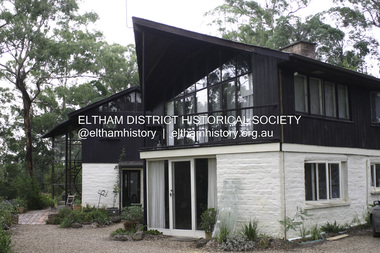
Photograph - Digital Photograph, Alan King, Downing-Le Gallienne house, Yarra Braes Road, Eltham, 30 January 2008
... Jean Norman (nee McGregor) and had to accommodate a large family, including her six children and one of their own, the last stage was built by 1964. At that time the house was considered one of the largest mud-brick houses in Victoria. It consists of five living areas, including a small ballroom. Several artists helped Knox build the Downing-Le Gallienne house, which was one of his first of mud-brick. They included painter Clifton Pugh, artist John Howley...Jean Norman (nee McGregor) and had to accommodate a large family, including her six children and one of their own, the last stage was built by 1964. At that time the house was considered one of the largest mud-brick houses in Victoria. It consists of five living areas, including a small ballroom. Several artists helped Knox build the Downing-Le Gallienne house, which was one of his first of mud-brick. They included painter Clifton Pugh, artist John Howley ...The property is a classic example of what made Eltham famous from the late 1940s to the 1960s. Covered under Heritage Overlay, Nillumbik Planning Scheme. Published: Nillumbik Now and Then / Marguerite Marshall 2008; photographs Alan King with Marguerite Marshall.; p149 The first view of the large double-storey house at Yarra Braes Road, Eltham South, is of a jutting roofline over a balcony, reminiscent of a large sailing vessel or galleon – very appropriate, considering the name of one of the first owners, Le Gallienne. The Downing-Le Gallienne property is a classic example of what made Eltham famous from the late 1940s to the 1960s and attracted so many artists and intellectuals to the area. Set in a largely indigenous bush-style garden, the mud-brick and timber house was built by Alistair Knox. It was built for economist Richard Downing, to become a founder of the welfare state in Australia and Chairman of the Australian Broadcasting Commission, and musician and composer Dorian Le Gallienne. Le Gallienne was a pioneering composer of modern music in Victoria before 1945, whose works included the Symphony in E.1 He wrote several pieces of film music for Eltham Films, including The Prize, working with its writer and artistic director Tim Burstall. Le Gallienne was also a music critic for The Argus and later for The Age. In 1967 the music critic Roger Covell argued that Le Gallienne’s Symphony, was ‘still the most accomplished and purposive . . . written by an Australian’. According to Alan Marshall the main inspiration behind the building that evolved from 1948 to 1964 was Le Gallienne. ‘He was able to see value in the simplest things and many who worked there had their eyes opened for the first time to the Eltham environment, to the bush and the trees and the fauna which lived there.’ The garden included no formality, no lawns, nor exotic plants. ‘Natural informal growth came right up to their doors and so did the indigenous birdlife.’ This informal style – consisting of mass and void – was to be developed and popularised by landscaper Gordon Ford from the 1950s. The large mud-brick and timber house, which was built in four stages and has three separate but linked sections, began as a small weekend retreat for the couple. In 1948, Downing and Le Gallienne (Dick and Dor to their friends), asked Knox to build the 36 x18 foot (11mx5.4m) building with a pitched slate roof. It was built on a concrete slab and included a fireplace, which is still in use. The second wing was built in 1954 after Downing had returned from working at the International Labour Office and the couple decided to live there full-time. The third section was built after the death of Le Gallienne in 1963, aged 48. He is buried in the Eltham Cemetery. When Downing married widow, Jean Norman (nee McGregor) and had to accommodate a large family, including her six children and one of their own, the last stage was built by 1964. At that time the house was considered one of the largest mud-brick houses in Victoria. It consists of five living areas, including a small ballroom. Several artists helped Knox build the Downing-Le Gallienne house, which was one of his first of mud-brick. They included painter Clifton Pugh, artist John Howley and actor Wynn Roberts. Ellis Stones had landscaped the first wing and Gordon Ford set the boulder steps and made a pool as part of the landscaping he completed. Inside, the mud-bricks are largely whitewashed with pine-lined ceilings and Oregon beams. A winding timber staircase in the front extends behind a glass window from the ground floor to the top. The property, of a little more than 0.5 ha, is bordered by Parks Victoria land, which extends to the Yarra River.This collection of almost 130 photos about places and people within the Shire of Nillumbik, an urban and rural municipality in Melbourne's north, contributes to an understanding of the history of the Shire. Published in 2008 immediately prior to the Black Saturday bushfires of February 7, 2009, it documents sites that were impacted, and in some cases destroyed by the fires. It includes photographs taken especially for the publication, creating a unique time capsule representing the Shire in the early 21st century. It remains the most recent comprehenesive publication devoted to the Shire's history connecting local residents to the past. nillumbik now and then (marshall-king) collection, dorian le gallienne, downing-le gallienne house, eltham, mudbrick construction, mudbrick houses, richard downing, yarra braes road
