
Showing 83 items matching "jewellery pins"
-
 City of Moorabbin Historical Society (Operating the Box Cottage Museum)
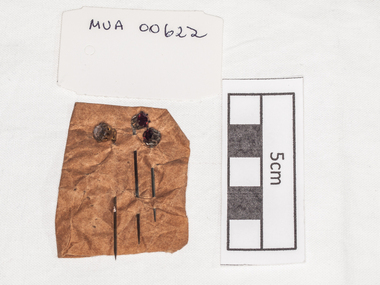
Jewellery, 3 men's lapel pins, c1900
... Jewellery, 3 men's lapel pins...jewellery...tie-pins...By the 1870s Americans had embraced stickpins and designs were mass-produced. jewellery tie-pins male neckwear moorabbin brighton early settlers pioneers cheltenham 3 men's metal lapel pins with coloured glass inserts 1 yellow 2 red Jewellery, 3 men's lapel pins ...A tie pin is a neckwear controlling device, originally worn by wealthy English gentlemen to secure the folds of their cravats. They were first popularized at the beginning of the 19th century. Cravats were made of silk, satin, lace and lightly starched cambric, lawn and muslin, and stickpins were necessary accoutrements to keep these expensive fabrics in place and safe. Stickpins commonly used pearls, and other precious gemstones set in gold or other precious metals and were designed specifically for their owners. By the 1860s, wearing cravats had been embraced by the English upper middle classes with a consequently lower quality of materials and designs used in both the neckwear and in the stickpins used to keep it in place. By the 1870s Americans had embraced stickpins and designs were mass-produced. 3 men's metal lapel pins with coloured glass inserts 1 yellow 2 red jewellery, tie-pins, male neckwear, moorabbin, brighton, early settlers, pioneers, cheltenham -
 City of Moorabbin Historical Society (Operating the Box Cottage Museum)
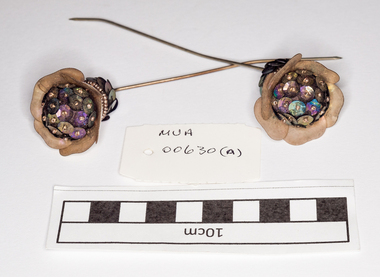
Jewellery, 2 lady's hat pins mauve, c1900
... Jewellery, 2 lady's hat pins mauve,...pins...jewellery...pin holder boxes were also produced. One of the most well-known makers of hatpins is silversmith Charles Horner, of Halifax, whose turn of the century jewellery company became a leader in the market by creating a series of mass-produced pins that were still of exceptional quality. ...The women of the pioneer families liked to dress up in their best hand made dresses and fashionable hats for Church gatherings and special occasions as a relief from the daily chores of hand washing, ironing with flat irons and cooking over open fires. bonnets hats veils scarves moorabbin bentleigh brighton cheltenham early settlers pioneers clasps hairdressing combs steel pins jewellery 2 lady's long steel hat pins with sequents in a flower design on mauve material Jewellery, 2 lady's hat pins mauve, early settler ...A hat pin is a decorative pin for holding a hat to the head, usually by the hair that was styled in a Chignon or French Roll style and usually worn in a pair. They are typically around 20 cm in length, with the pinhead being the most decorated part. The hatpin was invented to hold veils in place, and was handmade. Birmingham, England was the centre of production when demand eventually outgrew the number that could be supplied by hand-making and they also began to be imported from France. In 1832, an American machine was invented to manufacture the pins, and they became much more affordable. During the 1880s, bonnets gave way to hats, some of which were very large and the popularity of hatpins soared. In the Victorian era, when appearance was everything, it just wouldn't do for a fashionable lady's hat to blow off in the wind. They remained a standard women's' accessory through the 1910s and were produced in a vast range of materials and types. Hat pin holder boxes were also produced. One of the most well-known makers of hatpins is silversmith Charles Horner, of Halifax, whose turn of the century jewellery company became a leader in the market by creating a series of mass-produced pins that were still of exceptional quality. As a result, thousands of Horner's pins are still on the market and on display in museums worldwide. Women of the 1920’s used hat pins as decoration on their Cloche hats that fitted snugly to their heads. The women of the pioneer families liked to dress up in their best hand made dresses and fashionable hats for Church gatherings and special occasions as a relief from the daily chores of hand washing, ironing with flat irons and cooking over open fires.2 lady's long steel hat pins with sequents in a flower design on mauve material bonnets, hats, veils, scarves, moorabbin, bentleigh, brighton, cheltenham, early settlers, pioneers, clasps, hairdressing, combs, steel pins, jewellery -
 Wodonga & District Historical Society Inc
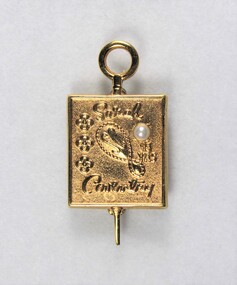
Decorative object - Sarah Coventry jewellery pin for 15 years service, c. 1970s - 1980s
... Sarah Coventry jewellery pin for 15 years service...Sarah Coventry jewellery pin for 15 years service......jewellery pins...Sarah Coventry jewellery pin for 15 years service Decorative object Sarah Coventry jewellery pin for 15 years service ...Sarah Coventry Pty. Ltd. was a North American jewellery company that was established in 1949 by the Stuart family as part of Emmons Jewelry, Inc. It began operations in England and Australia in 1968, and in Australia it moved from Carlton in Melbourne to Wodonga in 1969. The premises were originally on High Street in Wodonga, but a new warehouse was built in Melbourne Road later in 1969. It was a direct selling jewellery business using a party-plan model similar to Tupperware and Avon. The sales reps or 'Hostesses' were provided with jewellery samples in demonstration kits, which they displayed at jewellery parties in their homes. The designs for jewellery such as brooches, necklaces, earrings, chokers and bracelets were purchased from freelance designers and jewellery manufacturers rather than in-house designers. In 1979 Sarah Coventry Pty. Ltd. in Wodonga was bought by three Australian businessmen, including Wodonga local Jim Sawyer, and continued to sell jewellery under the name "Sargem Pty. Ltd”, for several more years in the 1980s. As part of the Sarah Coventry collection, the pin has local significance with the decentralised commercial development of regional centres such as Wodonga in NE Victoria, as well as national and international significance from the perspective of social and economic developments for women after World War II. The direct selling party-plan business model Sarah Coventry was based on is also considered the first of its kind for jewellery.Small rectangular gold metal pin with a small pearl inlay on the proper left side for 15 years service. The 10 K stamp on the back surface suggests it is 10 karat gold.The abraded areas on the clasp on the back expose underlying silver coloured metal indicating that the clasp is plated. "Sarah / SC / 15 / YRS / Coventry" on the front surface. "cTo ® / .... 10K" stamped in the back surface on the lower proper left side indicating 10 karat gold. The (®) symbol indicates that the manufacturer's mark is federally registered with the US Patent and Trademark Office. The 'cTo' is the trademark by O. C. Tanner Jewelry Co. in Salt Lake City, U.S.sarah coventry, jewellery, wodonga, costume jewellery, vintage fashion jewellery, pin, jewellery pins -
 Wodonga & District Historical Society Inc
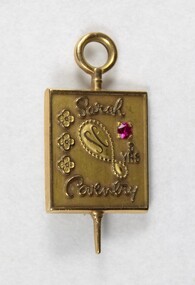
Decorative object - Sarah Coventry jewellery pin for 5 years service, c. 1970s - 1980s
... Sarah Coventry jewellery pin for 5 years service...Sarah Coventry jewellery pin for 5 years service......jewellery pins...Sarah Coventry jewellery pin for 5 years service Decorative object Sarah Coventry jewellery pin for 5 years service ...Sarah Coventry Pty. Ltd. was a North American jewellery company that was established in 1949 by the Stuart family as part of Emmons Jewelry, Inc. It began operations in England and Australia in 1968, and in Australia it moved from Carlton in Melbourne to Wodonga in 1969. The premises were originally on High Street in Wodonga, but a new warehouse was built in Melbourne Road later in 1969. It was a direct selling jewellery business using a party-plan model similar to Tupperware and Avon. The sales reps or 'Hostesses' were provided with jewellery samples in demonstration kits, which they displayed at jewellery parties in their homes. The designs for jewellery such as brooches, necklaces, earrings, chokers and bracelets were purchased from freelance designers and jewellery manufacturers rather than in-house designers. In 1979 Sarah Coventry Pty. Ltd. in Wodonga was bought by three Australian businessmen, including Wodonga local Jim Sawyer, and continued to sell jewellery under the name "Sargem Pty. Ltd”, for several more years in the 1980s. As part of the Sarah Coventry collection, the pin has local significance with the decentralised commercial development of regional centres such as Wodonga in NE Victoria, as well as national and international significance from the perspective of social and economic developments for women after World War II. The direct selling party-plan business model Sarah Coventry was based on is also considered the first of its kind for jewellery.Small rectangular gold metal pin for five years service with a faceted pink stone inlay on the proper left side, the name and initials of Sarah Coventry in the central area and three flowers on the proper right side. The 10 K stamp on the back surface suggests it is made of 10 karat gold. Abraded areas on the high points of the clasp on the back surface expose underlying silver coloured metal indicating that the clasp is plated."Sarah / SC / 5 YRS / Coventry" on the front surface. "® cTo / 10 K" stamped into the back surface on the lower proper left side, indicating 10 karat gold. The (®) symbol indicates that the manufacturer's mark is federally registered with the US Patent and Trademark Office. The 'cTo' is the trademark by O. C. Tanner Jewelry Co. in Salt Lake City, U.S.sarah coventry, jewellery, wodonga, costume jewellery, vintage fashion jewellery, pin, jewellery pins -
 Wodonga & District Historical Society Inc
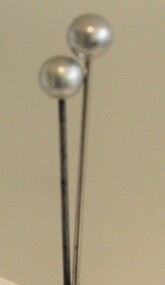
Accessory - Hat pins, c1920s
... jewellery...hat pins...pins were used c1900. This item is from the Raper Collection donated to the Wodonga Historical Society by Mrs. Jean Raper. jewellery ...A hat pin is a decorative pin for holding a hat to the head. During the 1880s, bonnets gave way to hats, and the popularity of hatpins soared. They remained a standard women's accessory through the 1910s and were produced in a vast range of materials and types. They were typically around 20 cm in length, with the pinhead being the most decorated part. In some countries they were viewed as a potentially dangerous weapon which could be used by women in self-defence, so regulations were introduced to limit the length allowed. These hat pins were used c1900.This item is from the Raper Collection donated to the Wodonga Historical Society by Mrs. Jean Raper. A pair of simple hat pins with faux silver ball shaped head.jewellery, hat pins, fashion accessory -
 City of Moorabbin Historical Society (Operating the Box Cottage Museum)
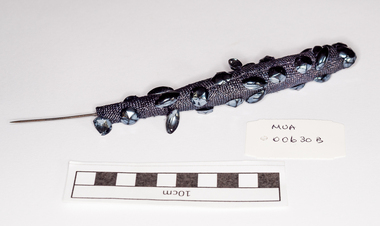
Jewellery, 1 lady's hat pin black, c1900
... Jewellery, 1 lady's hat pin black....pins...jewellery...The women of the pioneer families liked to dress up in their best hand made dresses and fashionable hats for Church gatherings and special occasions as a relief from the daily chores of hand washing, ironing with flat irons and cooking over open fires. bonnets hats veils scarves moorabbin bentleigh brighton cheltenham early settlers pioneers clasps hairdressing combs steel pins jewellery 1 long, lady's, steel, hat pin , padded and covered in black linen decorated with spherical shaped black sequins Jewellery, 1 lady's hat pin black. ...A hat pin is a decorative pin for holding a hat to the head, usually by the hair that was styled in a Chignon or French Roll style and usually worn in a pair. They are typically around 20 cm in length, with the pinhead being the most decorated part. The women of the pioneer families liked to dress up in their best hand made dresses and fashionable hats for Church gatherings and special occasions as a relief from the daily chores of hand washing, ironing with flat irons and cooking over open fires. 1 long, lady's, steel, hat pin , padded and covered in black linen decorated with spherical shaped black sequins bonnets, hats, veils, scarves, moorabbin, bentleigh, brighton, cheltenham, early settlers, pioneers, clasps, hairdressing, combs, steel pins, jewellery -
 City of Moorabbin Historical Society (Operating the Box Cottage Museum)
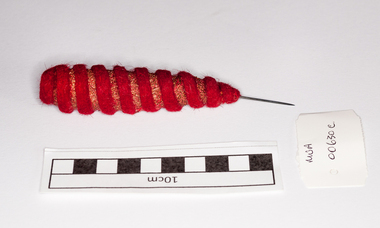
Jewellery, 1 lady's hat pin, c1900
... Jewellery, 1 lady's hat pin...pins...jewellery...The women of the pioneer families liked to dress up in their best hand made dresses and fashionable hats for Church gatherings and special occasions as a relief from the daily chores of hand washing, ironing with flat irons and cooking over open fires. bonnets hats veils scarves moorabbin bentleigh brighton cheltenham early settlers pioneers clasps hairdressing combs steel pins jewellery A short, lady's steel hat pin, padded and covered in red and gold felt in a spiral pattern Jewellery, 1 lady's hat pin Unrecorded early settler ...See 00630 A A hat pin is a decorative pin for holding a hat to the head, usually by the hair that was styled in a Chignon or French Roll style and usually worn in a pair. They are typically around 20 cm in length, with the pinhead being the most decorated part. The women of the pioneer families liked to dress up in their best hand made dresses and fashionable hats for Church gatherings and special occasions as a relief from the daily chores of hand washing, ironing with flat irons and cooking over open fires. A short, lady's steel hat pin, padded and covered in red and gold felt in a spiral patternbonnets, hats, veils, scarves, moorabbin, bentleigh, brighton, cheltenham, early settlers, pioneers, clasps, hairdressing, combs, steel pins, jewellery -
 City of Moorabbin Historical Society (Operating the Box Cottage Museum)
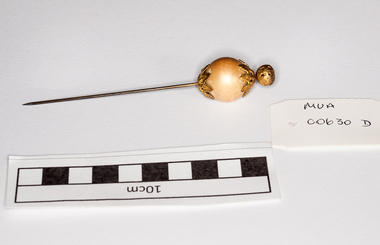
Jewellery, 1 lady's hat pin, c1900
... Jewellery, 1 lady's hat pin...pins...jewellery...They are typically around 20 cm in length, with the pinhead being the most decorated part The women of the pioneer families liked to dress up in their best hand made dresses and fashionable hats for Church gatherings and special occasions as a relief from the daily chores of hand washing, ironing with flat irons and cooking over open fires. bonnets hats veils scarves moorabbin bentleigh brighton cheltenham early settlers pioneers clasps hairdressing combs steel pins jewellery A short steel lady's hat pin with a gold coloured metal ball at top with filigree decoration Jewellery, 1 lady's hat pin Unrecorded early settler ...See 00630 A A hat pin is a decorative pin for holding a hat to the head, usually by the hair that was styled in a Chignon or French Roll style and usually worn in a pair. They are typically around 20 cm in length, with the pinhead being the most decorated part The women of the pioneer families liked to dress up in their best hand made dresses and fashionable hats for Church gatherings and special occasions as a relief from the daily chores of hand washing, ironing with flat irons and cooking over open fires.A short steel lady's hat pin with a gold coloured metal ball at top with filigree decorationbonnets, hats, veils, scarves, moorabbin, bentleigh, brighton, cheltenham, early settlers, pioneers, clasps, hairdressing, combs, steel pins, jewellery -
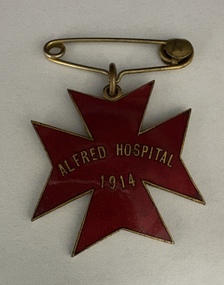 Alfred Hospital Nurses League - Nursing History Collection
Badge, Alfred Hospital badge 1914
... Metal and red enamel badge with attached safety pin style jewellery clasp, in the shape of a Maltese cross. ...Alfred Hospital Nurses League - Nursing History Collection Ground Floor, Building 10 Caulfield Hospital 260 Kooyong Road Caulfield melbourne Front: ALFRED HOSPITAL/1914 Back: STOKES & SONS Metal and red enamel badge with attached safety pin style jewellery clasp, in the shape of a Maltese cross. ...Metal and red enamel badge with attached safety pin style jewellery clasp, in the shape of a Maltese cross. The Maltese cross is a symbol consisting of four "V" or arrowhead shaped concave quadrilaterals converging at a central vertex at right angles, two tips pointing outward symmetrically.Front: ALFRED HOSPITAL/1914 Back: STOKES & SONS -
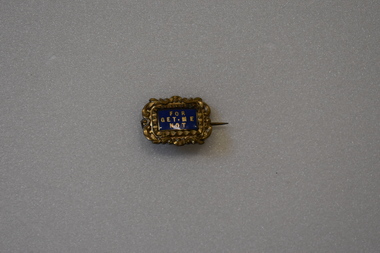 Warrnambool and District Historical Society Inc.
Accessory - Brooch, Early 20th century
... pinned to the collar of a blouse at the neckline or to a jacket lapel. This brooch has no known local provenance but is retained as a fine example of an early 20th century piece of jewellery and for display purposes Women’s Vintage Jewellery Warrnambool For Get-Me Not This is a rectangular-shaped gold brooch with a blue plate with gold lettering in the inner section and ornamental gold scrolls around the outer section. ...This brooch is small and tasteful and the ‘forget-me -not’ wording in the centre probably indicates that it was given by someone to a loved one as a token of love or friendship. It was most likely pinned to the collar of a blouse at the neckline or to a jacket lapel. This brooch has no known local provenance but is retained as a fine example of an early 20th century piece of jewellery and for display purposesThis is a rectangular-shaped gold brooch with a blue plate with gold lettering in the inner section and ornamental gold scrolls around the outer section. The back of the brooch has a metal clasp.For Get-Me Notwomen’s, vintage jewellery, warrnambool -
 Warrnambool and District Historical Society Inc.
Administrative record - Account cards, 1920s and 30s
... Jewellery Stores This is a collection of paper invoices, some original, some copied, with some in alphabetical order and some in number order. The invoices are separated by pieces of cardboard with either numbers or letters on the front. The collection is only portion of a larger set of cards. The invoices were originally held together by small pins ...These cards have been used as an accounting system by the Warrnambool firm of J. Mainland and Co. This firm of watchmakers, opticians and manufacturing jewellers was established in Liebig Street in the late 1890s and continued on into the 20th century at 166 Timor Street. The cards date from the 1920s and 30s. It is noted that in 1932 one customer purchased a Clarice Cliff ash tray for six shillings and sixpenceThese cards are of considerable interest firstly they give us some details of the many customers of the Warrnambool jewellery firm of J. Mainland and Co and secondly because they provide us with much information on a great number of residents of Warrnambool and district in the 1920s and 30s (addresses etc)This is a collection of paper invoices, some original, some copied, with some in alphabetical order and some in number order. The invoices are separated by pieces of cardboard with either numbers or letters on the front. The collection is only portion of a larger set of cards. The invoices were originally held together by small pins.warrnambool jewellery stores -
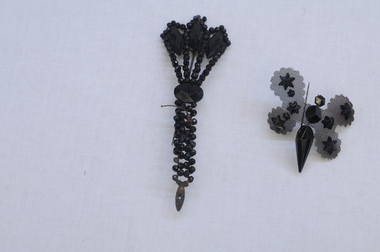 Orbost & District Historical Society
Decorative object - Brooch
... These brooches were sold in a local store and could have been purchased for a local funeral. 1900s jewellery bakelite mourning brooch george temple orbost store Black, bakelite brooch - three small sections form centre of brooch, one is a hexagonal cone-shape with hexagonal dome attached by link to smaller circular polygon attached by link to a smaller flat pentagon. Black mesh in the shape of wings form the backing featuring eight bakelite stars of varying sizes (two smaller stars missing from the assembly). A metal pin ...These items are from the Temple estate. George Temple (1832-1916) started Temple's store opposite Orbost Post Office. Packed stores to Bendoc area gold fields, also had a store in Cann River. This item is an example of a popular piece of jewelry worn by women in the early 20th century. These brooches were sold in a local store and could have been purchased for a local funeral.Black, bakelite brooch - three small sections form centre of brooch, one is a hexagonal cone-shape with hexagonal dome attached by link to smaller circular polygon attached by link to a smaller flat pentagon. Black mesh in the shape of wings form the backing featuring eight bakelite stars of varying sizes (two smaller stars missing from the assembly). A metal pin is attached to the rear in the form of a clasp.1900s jewellery, bakelite, mourning brooch, george temple, orbost store -
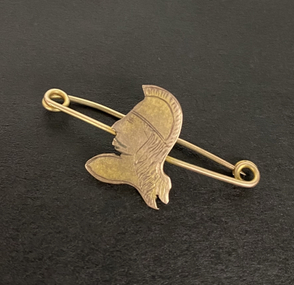 Ballarat Clarendon College
Uniform - Lapel pin
... Uniform Ballarat College Minerva Jewellery Head of Minerva in brass with minimal engraving. Head attached to a simple brass wire pin. ...Item found amongst belongings of Old Collegian, Frederick Carthew (1917) and donated by his grandson Richard Carthew. The Minerva Head is a feature of the school crest. This rendering appears amateur. Head of Minerva in brass with minimal engraving. Head attached to a simple brass wire pin.uniform, ballarat college, minerva, jewellery -
 Federation University Historical Collection
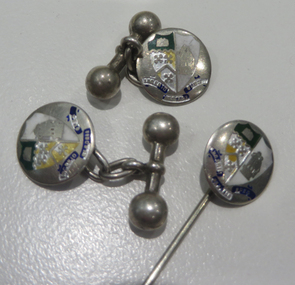
Accessory - Costume, Ballarat School of Mines Cufflinks and Pin
... pin...albert adams...jewellery...Barker Library (top floor) Mount Helen goldfields The cufflinks and pin were owned by Ballarat School of Mines Associate Albert Adams. albert t.h. adams ballarat school of mines associate cufflinks pin albert adams jewellery Sterling Silver and enamel cufflinks and pin featuring the Ballarat School of Mines shield. ...The cufflinks and pin were owned by Ballarat School of Mines Associate Albert Adams. Sterling Silver and enamel cufflinks and pin featuring the Ballarat School of Mines shield. albert t.h. adams, ballarat school of mines associate, cufflinks, pin, albert adams, jewellery -
 Bendigo Military Museum
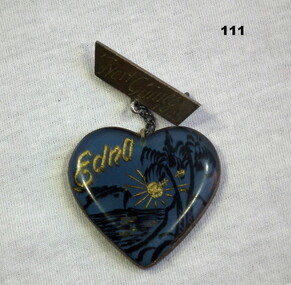
Accessory - BROOCH, c.1945
... On discharge from the 2nd AIF on 17.1.1946 he was a Gunner in 2/1st Field Regt. metalcraft costume accessories - jewellery On front of brooch in gold: Edna & below a shining sun On rear of brooch: Love from Roy On pin clasp: New Guinea 1945 Blue heart shaped brooch with pin clasp. ...Brooch sent home by Roy Hilton Taylor NX94268, enlisted 2.4.1942, age 29 years. On discharge from the 2nd AIF on 17.1.1946 he was a Gunner in 2/1st Field Regt. Blue heart shaped brooch with pin clasp. Island scene in black.On front of brooch in gold: Edna & below a shining sun On rear of brooch: Love from Roy On pin clasp: New Guinea 1945metalcraft, costume accessories - jewellery -
 Bendigo Historical Society Inc.
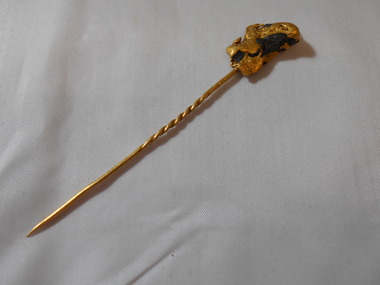
Accessory - HARRIS COLLECTION: GOLD STICK PIN WITH NUGGET ATTACHED
... Jewellery...Gold tie pin...History House 11 Mackenzie Street Bendigo goldfields COSTUME ACCESSORIES Jewellery Gold tie pin Jonathan Harris was the founder of gold on the Hustler's Hill. ...Gold stick pin, gold nugget attached to top. Possibly used as tie/cravat or lapel pin. Gold nugget has black section - black mineral unknown. Donated by Harris family estate, Axedale.costume accessories, jewellery, gold tie pin, jonathan harris was the founder of gold on the hustler's hill. he sold his claim to thomas hustler in 1853. -
 Bendigo Historical Society Inc.
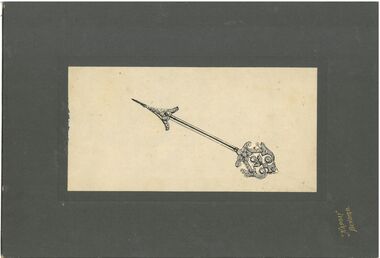
Drawing - Jewellery Design
... Hand drawn design for a piece of jewellery, on cream coloured paper, - a pin. One end has an arrow head, the other a shield shape design. ...History House 11 Mackenzie Street Bendigo goldfields Prescott & Dawe Jewellers Designs Hand drawn design for a piece of jewellery, on cream coloured paper, - a pin. One end has an arrow head, the other a shield shape design. ...Hand drawn design for a piece of jewellery, on cream coloured paper, - a pin. One end has an arrow head, the other a shield shape design. Includes gemstones. The drawing is mounted on dark brown board. Printed in gold lettering in lower LH corner "NAPOLI" BENDIGO Prescott and Dawe Collectionprescott & dawe, jewellers, designs -
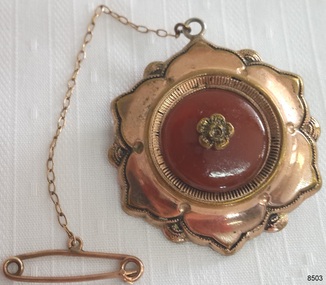 Flagstaff Hill Maritime Museum and Village
Accessory - Brooch, late-19th to early 20th century
... This brooch with its floral design is typical of the jewellery worn during the Romantic Period of the Victorian Era, when Queen Victoria's husband, Prince Albert, was alive 1837-1861. During this period flower motifs and brooches and pins were popular....Flagstaff Hill Maritime Museum and Village 89 Merri Street Warrnambool great-ocean-road This brooch with its floral design is typical of the jewellery worn during the Romantic Period of the Victorian Era, when Queen Victoria's husband, Prince Albert, was alive 1837-1861. During this period flower motifs and brooches and pins were popular. ...This brooch with its floral design is typical of the jewellery worn during the Romantic Period of the Victorian Era, when Queen Victoria's husband, Prince Albert, was alive 1837-1861. During this period flower motifs and brooches and pins were popular.This brooch is representative of jewellery worn during the Romantic Period of Queen Victoria's rule, 1837-1861.Brooch, light weight, rose coloured gold metal with red- brown onyx stone. Flower shaped brooch with six petals, stone attached, with rose design stem which is flanged on back. Backing plate is also rose coloured metal. A small ring is attached to the top of the brooch where the safety chain is attached. There are two small holes on back of brooch. A chain is attached to the horizontal pin on the back, and has a pin on its end. There is an Inscription engraved on the back. Engraved in script, "Coco" [Italian word for gold]flagstaff hill, warrnambool, shipwrecked coast, flagstaff hill maritime museum, maritime museum, shipwreck coast, flagstaff hill maritime village, great ocean road, ladies jewellery, victorian era jewellery, jewellery inscribed 'coco', brooch, jewellery, ladies' jewellery, victorian era, romantic period -
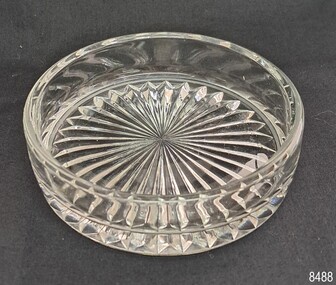 Flagstaff Hill Maritime Museum and Village
Domestic object - Pin Dish, Mid 20th century
... Dressing tables often featured a variety of objects such as combs, brushes, hand mirrors, perfume bottles, cosmetics, nail buffers, ring holders, jewellery trinket boxes, trays and pin bowls or pin trays. The latter were small shallow containers used for storing hat pins, hair pins, safety pins, and perhaps earrings. ...Dressing tables often featured a variety of objects such as combs, brushes, hand mirrors, perfume bottles, cosmetics, nail buffers, ring holders, jewellery trinket boxes, trays and pin bowls or pin trays. The latter were small shallow containers used for storing hat pins, hair pins, safety pins, and perhaps earrings. ...Dressing tables have been around since the beginning of the seventeenth century. However, it wasn't until the early to mid-20th century that middle-class homes included them in their furniture. They were often a matching part of a bedroom suite. Dressing tables often featured a variety of objects such as combs, brushes, hand mirrors, perfume bottles, cosmetics, nail buffers, ring holders, jewellery trinket boxes, trays and pin bowls or pin trays. The latter were small shallow containers used for storing hat pins, hair pins, safety pins, and perhaps earrings. They were made of various materials including glass, metal and ceramic.This pin bowl represents an era in the early-to-mid 20th century when matching dressing table accessories were popular and affordable to middle-class women. They were marketed as gifts and sometimes included perfumed soap and powder.Pin dish, round, cut glass, slightly convex sides without a pattern. Thick heavy, concave base with a concertina fold pattern.flagstaff hill maritime village, shipwreck coast, flagstaff hill, warrnambool, flagstaff hill museum and village, domestic object, dressing table, dressing table tray, glass tray, pin tray, pin bowl, dressing table accessory -
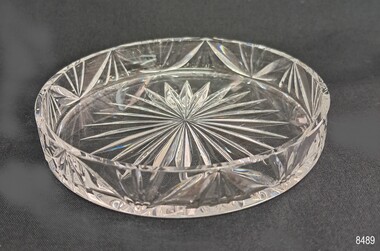 Flagstaff Hill Maritime Museum and Village
Domestic object - Pin Bowl, Mid 20th century
... Dressing tables often featured a variety of objects such as combs, brushes, hand mirrors, perfume bottles, cosmetics, nail buffers, ring holders, jewellery trinket boxes, trays and pin bowls or pin trays. The latter were small shallow containers used for storing hat pins, hair pins, safety pins, and perhaps earrings. ...Dressing tables often featured a variety of objects such as combs, brushes, hand mirrors, perfume bottles, cosmetics, nail buffers, ring holders, jewellery trinket boxes, trays and pin bowls or pin trays. The latter were small shallow containers used for storing hat pins, hair pins, safety pins, and perhaps earrings. ...Dressing tables have been around since the beginning of the seventeenth century. However, it wasn't until the early to mid-20th century that middle-class homes included them in their furniture. They were often a matching part of a bedroom suite. Dressing tables often featured a variety of objects such as combs, brushes, hand mirrors, perfume bottles, cosmetics, nail buffers, ring holders, jewellery trinket boxes, trays and pin bowls or pin trays. The latter were small shallow containers used for storing hat pins, hair pins, safety pins, and perhaps earrings. They were made of various materials including glass, metal and ceramic.This pin bowl represents an era in the early-to-mid 20th century when matching dressing table accessories were popular and affordable to middle-class women. They were marketed as gifts and sometimes included perfumed soap and powder.Pin bowl; a light weight, round bowl with straight sides featuring a cut glass pattern, and a flat base with a star design.flagstaff hill maritime village, shipwreck coast, flagstaff hill, warrnambool, flagstaff hill museum and village, domestic object, dressing table, dressing table tray, glass tray, pin tray, pin bowl, dressing table accessory -
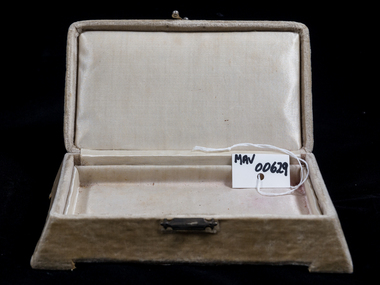 City of Moorabbin Historical Society (Operating the Box Cottage Museum)
Jewellery, velvet covered box, c1900
... This is a typical jewellery case used by early settler women to store and protect their rings, necklaces, earrings , hat pins etc...City of Moorabbin Historical Society (Operating the Box Cottage Museum) Joyce Park Jasper Road Ormond melbourne This is a typical jewellery case used by early settler women to store and protect their rings, necklaces, earrings , hat pins etc This jewellery case gives an insight into the daily life of early settler women in Moorabbin Shire early settlers moorabbin cheltenham bentleigh nil This lady's jewellery box is covered in beige velvet and lined with beige silk The lid has a covered hinge and it has a silver slide catch. ...This is a typical jewellery case used by early settler women to store and protect their rings, necklaces, earrings , hat pins etcThis jewellery case gives an insight into the daily life of early settler women in Moorabbin Shire This lady's jewellery box is covered in beige velvet and lined with beige silk The lid has a covered hinge and it has a silver slide catch.nilearly settlers, moorabbin, cheltenham, bentleigh -
 City of Moorabbin Historical Society (Operating the Box Cottage Museum)
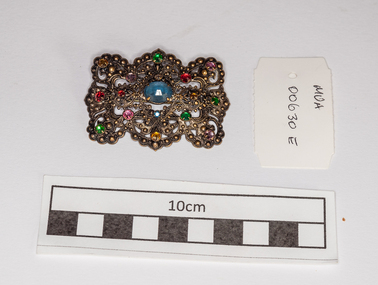
Jewellery, lady's brooche, c1900
... City of Moorabbin Historical Society (Operating the Box Cottage Museum) Joyce Park Jasper Road Ormond melbourne A lady's small metal brooch with coloured glass bead inserts, a central larger pale blue glass insert and a pin clasp at back. Jewellery, lady's brooche early settler ...A lady's small metal brooch with coloured glass bead inserts, a central larger pale blue glass insert and a pin clasp at back. -
 City of Moorabbin Historical Society (Operating the Box Cottage Museum)
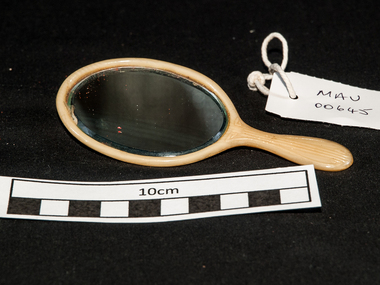
Personal Effects, miniature oval hand mirror, c1900
... Celluloid was useful for creating cheaper jewellery, jewellery boxes, hair accessories and many items that would earlier have been manufactured from ivory, horn or other expensive animal products. It was often referred to as "Ivorine" or "French Ivory". It was also used for dressing table sets, dolls, picture frames, charms, hat pins...Celluloid was useful for creating cheaper jewellery, jewellery boxes, hair accessories and many items that would earlier have been manufactured from ivory, horn or other expensive animal products. It was often referred to as "Ivorine" or "French Ivory". It was also used for dressing table sets, dolls, picture frames, charms, hat pins ...Celluloids are a class of compounds created from nitrocellulose and camphor, with added dyes and other agents. Generally considered the first thermoplastic, it was first created as Parkesine in 1856 and as Xylonite in 1869, before being registered as Celluloid in 1870. Celluloid is easily moulded and shaped, and it was first widely used as an ivory replacement. The main use was in movie and photography film industries, which used only celluloid films prior to acetate films that were introduced in the 1950s. Celluloid is highly flammable, difficult and expensive to produce and no longer widely used, although its most common uses today are in table tennis balls, musical instruments and guitar picks. Celluloid was useful for creating cheaper jewellery, jewellery boxes, hair accessories and many items that would earlier have been manufactured from ivory, horn or other expensive animal products. It was often referred to as "Ivorine" or "French Ivory". It was also used for dressing table sets, dolls, picture frames, charms, hat pins, buttons, buckles, stringed instrument parts, accordions, fountain pens, cutlery handles and kitchen items. The main disadvantage the material had was that it was flammable.. It was soon overtaken by Bakelite.A miniature, oval, Ivorine hand mirror with floral engraving on back. An accoutrement for use in a lady's Evening bag c19thCFloral design engraving on back of mirrormoorabbin, brighton, early settlers, pioneers, cheltenham, craft work, mirors, ivorine, evening bags, celluloids, bakelite, plastics, -
 City of Moorabbin Historical Society (Operating the Box Cottage Museum)
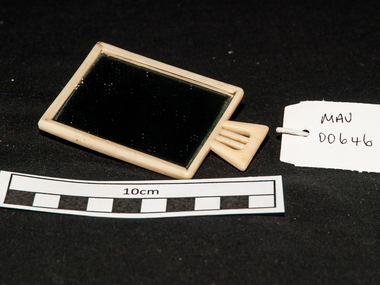
Personal Effects, miniature square hand mirror, c1900
... Celluloid was useful for creating cheaper jewellery, jewellery boxes, hair accessories and many items that would earlier have been manufactured from ivory, horn or other expensive animal products. It was often referred to as "Ivorine" or "French Ivory". It was also used for dressing table sets, dolls, picture frames, charms, hat pins...Celluloid was useful for creating cheaper jewellery, jewellery boxes, hair accessories and many items that would earlier have been manufactured from ivory, horn or other expensive animal products. It was often referred to as "Ivorine" or "French Ivory". It was also used for dressing table sets, dolls, picture frames, charms, hat pins ...Celluloids are a class of compounds created from nitrocellulose and camphor, with added dyes and other agents. Generally considered the first thermoplastic, it was first created as Parkesine in 1856 and as Xylonite in 1869, before being registered as Celluloid in 1870. Celluloid is easily moulded and shaped, and it was first widely used as an ivory replacement. The main use was in movie and photography film industries, which used only celluloid films prior to acetate films that were introduced in the 1950s. Celluloid is highly flammable, difficult and expensive to produce and no longer widely used, although its most common uses today are in table tennis balls, musical instruments and guitar picks. Celluloid was useful for creating cheaper jewellery, jewellery boxes, hair accessories and many items that would earlier have been manufactured from ivory, horn or other expensive animal products. It was often referred to as "Ivorine" or "French Ivory". It was also used for dressing table sets, dolls, picture frames, charms, hat pins, buttons, buckles, stringed instrument parts, accordions, fountain pens, cutlery handles and kitchen items. The main disadvantage the material had was that it was flammable. Items made in celluloid are collectible today and increasingly rare in good condition. It was soon overtaken by Bakelite and Catalin.. A miniature, square, Ivorine hand mirror with bird engraved on back. An accoutrement for use in a lady's Evening bag c 19thCbird engraved on back of mirrormoorabbin, cheltenham, brighton, market gardeners, pioneers early settlers, mirrors, ivorine, celluloids, bakelite, plastics, -
 City of Moorabbin Historical Society (Operating the Box Cottage Museum)
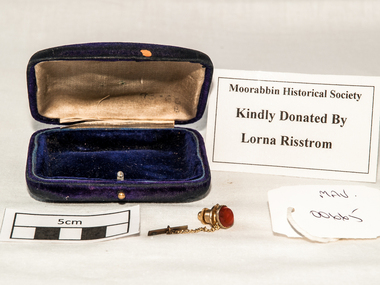
Jewellery, tie stud and chain and a small, velvet covered box, c1900
... jewellery...risstrom lorna...tie-pins...By the 1870s Americans had embraced stickpins and designs were mass-produced The family of Lorna Risstrom were early settlers in Moorabbin Shire moorabbin bentleigh cheltenham early settlers pioneers market gardneners jewellery risstrom lorna tie-pins, tie- studs, cravats, silk, lace, A tie-stud and chain in a small, blue velvet covered, silk lined, hinged jewellery box with . ...A tie pin is a neckwear-controlling device, originally worn by wealthy English gentlemen to secure the folds of their cravats. They were first popularized at the beginning of the 19th century. Cravats were made of silk, satin, lace and lightly starched cambric, lawn and muslin, and stickpins were necessary accoutrements to keep these expensive fabrics in place and safe. Stickpins commonly used pearls and other precious gemstones set in gold or other precious metals and were designed specifically for their owners. By the 1860s, wearing cravats had been embraced by the English upper middle classes with a consequently lower quality of materials and designs used in both the neckwear and in the stickpins used to keep it in place. By the 1870s Americans had embraced stickpins and designs were mass-producedThe family of Lorna Risstrom were early settlers in Moorabbin ShireA tie-stud and chain in a small, blue velvet covered, silk lined, hinged jewellery box with . The tie-stud has a red stone set in gold metalmoorabbin, bentleigh, cheltenham, early settlers, pioneers, market gardneners, jewellery, risstrom lorna, tie-pins, tie- studs, cravats, silk, lace, -
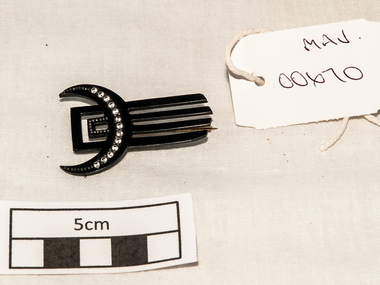 City of Moorabbin Historical Society (Operating the Box Cottage Museum)
Jewellery, small plastic brooch, 20thC
... After World War I, improvements in chemical technology led to an explosion in new forms of plastics, with mass production beginning in the 1940s during World War 11 due to shortages of silk and ivory. fashion costume jewellery personal effects moorabbin bentleigh cheltenham early settlers jewellery plastic A small, black plastic brooch with a verticle pin at back and diamante decoration . ...A plastic, costume jewellery, fashion accessory for early 20th Century ladies Plastic is a material consisting of any of a wide range of synthetic or semi-synthetic organics that are malleable and can be moulded into solid objects of diverse shapes. Due to their relatively low cost, ease of manufacture, versatility, and imperviousness to water, plastics are used in an enormous and expanding range of products. They displaced many traditional materials, such as wood, stone, horn and bone, leather, paper, metal, glass, and ceramic, in most of their former uses including jewellery. Parkesine is considered the first man-made plastic. The plastic material was patented by Alexander Parkes, In Birmingham, UK in 1856.The world's first fully synthetic plastic was bakelite, invented in New York in 1907 by Leo Baekeland who coined the term 'plastics'. After World War I, improvements in chemical technology led to an explosion in new forms of plastics, with mass production beginning in the 1940s during World War 11 due to shortages of silk and ivory. A small, black plastic brooch with a verticle pin at back and diamante decoration .fashion, costume jewellery, personal effects, moorabbin, bentleigh, cheltenham, early settlers, jewellery, plastic -
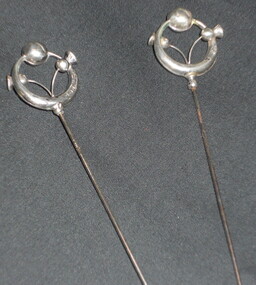 City of Moorabbin Historical Society (Operating the Box Cottage Museum)
Accessory - Jewellery , lady's silver hatpins, Circa 1910
... Hat-pins were worn to anchor hats to the head and could be considered a functional piece of jewellery. ...City of Moorabbin Historical Society (Operating the Box Cottage Museum) Joyce Park Jasper Road Ormond melbourne Hat-pins were worn to anchor hats to the head and could be considered a functional piece of jewellery. ...Hat-pins were worn to anchor hats to the head and could be considered a functional piece of jewellery. Traditionally inserted into the crown of the hat and through the hair piled atop the head.Hat-pins were needed to secure the large, lady’s hats fashionable at the time. The Maggs family were early settlers in Moorabbin Shirec1910, 2 lady's silver hat-pins, with hollow circular silver surround, around a thistle flowerHallmark Birmingham Assay Office Englandjewellery, clothing, dressmaking, craftwork, silversmiths, maggs geoff, early settlers, market gardeners, moorabbin, bentleigh, cheltenham, brighton -
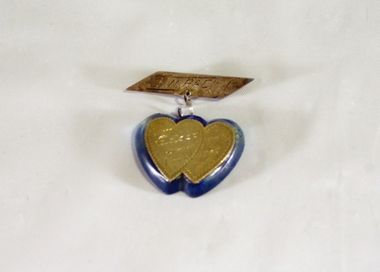 Yarra Ranges Regional Museum
Brooch, 1944 - 45
... The resin for the brooch came from the windsheid off his areoplane. world war 2 costume accessories jewellery Etched on top part: SW Pacific / 1944 - 5 Etched on the bottom part: To/ Mother/ with SWP/ Love 1945 Silver or silver-plated brooch, oblong with pin on back on a scroll shaped link attached. ...Sent to his mother from Ron Fraser when he was serving in the South West Pacific during WWII. The resin for the brooch came from the windsheid off his areoplane.Silver or silver-plated brooch, oblong with pin on back on a scroll shaped link attached. The bottom part is a silver double heart shape stuck onto a blue resin backing, also double heart shaped.Etched on top part: SW Pacific / 1944 - 5 Etched on the bottom part: To/ Mother/ with SWP/ Love 1945world war 2, costume accessories, jewellery -
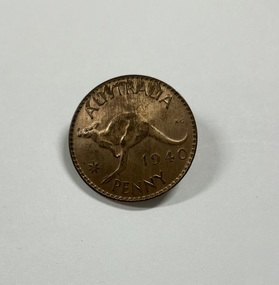 Tatura Irrigation & Wartime Camps Museum
Decorative object - Penny Brooch, 1940's
... Tatura Irrigation & Wartime Camps Museum 49 Hogan Street Tatura the-murray Made from an Australian penny, 1940, by Adolf Woolf at Camp 3 brooch kangaroo woolf a glockemann b camp 3 ww2 camp 3 jewellery Kangaroo brooch, circular, copper colour with wire pin fastener at back. ...Made from an Australian penny, 1940, by Adolf Woolf at Camp 3Kangaroo brooch, circular, copper colour with wire pin fastener at back. Australia Penny 1940. Small raised star on left and raised impression of Kangaroo in flight.brooch, kangaroo, woolf a, glockemann b, camp 3, ww2 camp 3, jewellery -
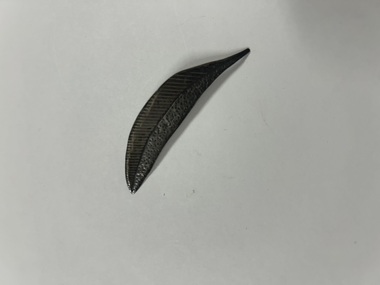 Tatura Irrigation & Wartime Camps Museum
Decorative object - Brooch, 1940's
... Tatura Irrigation & Wartime Camps Museum 49 Hogan Street Tatura the-murray Made in Camp 3 by Adolf Woolf from an Australian Two shilling piece brooch gum leaf silver woolf a glockemann b camp 3 ww2 camp 3 costume jewellery Silver brooch hand shaped to form a gum leaf. Wire pin/fastener attached to the back Decorative object Brooch ...Made in Camp 3 by Adolf Woolf from an Australian Two shilling pieceSilver brooch hand shaped to form a gum leaf. Wire pin/fastener attached to the backbrooch, gum leaf, silver, woolf a, glockemann b, camp 3, ww2 camp 3, costume, jewellery
