
Showing 5 items matching "joe hilder"
-
 Emerald Museum & Nobelius Heritage Park
Booklet - Poetry booklet, Joe Hilder, Accordion Joe's Little Book of Poetry, Circa 2100
... Joe...Hilder...Joe Hilder was a long distance truck driver prior to his retirement, he spent many long lonely hours compiling much of the poetry in this booklet....Spiral bound booklet with clear covers. Picture of Joe Hilder (author) on front....Joe Hilder...Picture of Joe Hilder (author) on front. Accordion Joe's Little Book of Poetry Booklet Poetry booklet Joe Hilder ...Joe Hilder was a long distance truck driver prior to his retirement, he spent many long lonely hours compiling much of the poetry in this booklet.The booklet is socially significant as it is a collection of poetry many of which where composed whilst long haul truck drivingSpiral bound booklet with clear covers. Picture of Joe Hilder (author) on front.joe, hilder, poetry -
 Flagstaff Hill Maritime Museum and Village
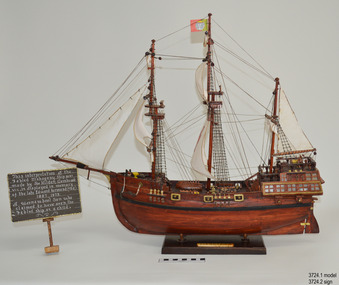
Craft - Ship Model, Portuguese Carvel, 1999
... ...joe hilder...The model was handmade by Joe Hilder (Senior) in 1999 from flooring obtained from the Gembrook Uniting Church in Victoria. ...On plaque, white paint "This interpretation of the Fabled Mahogany Ship was made by Joe Hilder, Gembrook Vic. is displayed in the memory of the late Edward Kermond (Ted) 1887-1973, a Warrnambool son who claimed to have seen the original ship as a child." ...Joe Hilder...Portuguese Carvel Craft Ship Model Australia Victoria Gembrook Joe Hilder ...The Mahogany Ship is today regarded as a legend and refers to an ancient wreck that is purported to lie beneath the sand beside Armstrong Bay, several kilometres west of Warrnambool, Its location is currently unknown. For well over a century the mystery of this ship has fascinated Australians because the existence of such a vessel could throw a different light on the earliest phases of exploration of eastern Australia by Europeans. The story is that in January 1836 a party of whalers from Port Fairy travelled to the mouth of the Hopkins River in search of seals. Their boat overturned and one man was drowned. The three survivors were walking the 30 kilometres back to Port Fairy along the coast when, about halfway along, they discovered the wrecked ship in the dunes. It is said that Captain John Mills, who was in charge of the whaling station at Port Fairy promptly visited the wreck with several of his men, including Hugh Donnelly. Donnelly who was the originator of that version of events is now regarded as unreliable. Local history researcher Joan Fawcett believes Donnelly could not have visited the wreck in 1836 because he did not arrive in Victoria until 1841. The "mahogany" description can be traced to a letter from Port Fairy builder, architect and surveyor John Mason and published in the Melbourne Argus in 1876. He said he had seen the hull in 1846 and it "had the appearance of either cedar or mahogany." In 1884 Argus journalist `The Vagabond' wrote that the hull was built of "Spanish mahogany" and six years later Mason wrote another letter saying it might not have been mahogany but red gum or ironbark from New South Wales. He was too late with this new description as the wrecks mahogany tag was here to stay all through the hull was not visible as it had disappeared beneath the shifting sands by 1880. A more reliable account was later presented by the former editor of the Warrnambool Examiner, historian Richard Osburne, who wrote about the wreck in his book History of Warrnambool (published 1887). In it the author remembers to have noticed a wreck in the hummocks between Belfast and Warrnambool, in 1847 or 1848; he stated it was much nearer Warrnambool than Belfast, now known as Port Fairy, going on to state “in fact, it was only two or three miles from the former place, to the west of the big hummock which was supposed to fill Warrnambool Bay with drift sand washed by the Merri River before the cutting was made.” Osburne followed up with a letter to the Port Fairy Gazette on June 25, 1876, during a period of heightened interest in the wreck, although he was unsure of the provenance of the ship he went on to state in his letter. “The old wreck was, in fact, miles away from the Port Fairy beach, and only about four miles from Warrnambool. In the years 1847 and 1848. I have often seen the wreck and I regret to say I do not believe she was a foreign ship at all.”The ship model is significant for its association with the Warrnambool story of what is now referred to as the Mahogany Ship, an ancient shipwreck. The model is significant as it is an interpretation of a Portuguese caravel and possibly associated with the early history and exploration of Southern Australia. The model is a fine example of a hand crafted ship made from plans, not from a kit. Some of the materials used for the model are significant to the Gembrook community in that the timber used is a portion from a 30-meter pine tree that fell onto and destroyed the 120-year-old Gembrook church building. The model is also a dedication to Edward Kermond, who grew up in Warrnambool and claimed to have seen the shipwreck in the dunes when he was a lad in the late 19th century. (See note section of this document for further information on the creator and donation of the subject item).Ship model, an interpretation of a mahogany Portuguese carvel vessel in a glass display case with wood frame and a description plaque. Model is made from dark stained wood. The three masted vessel is fully rigged, with a Portuguese-like flag on mast. Plaque is rectangular, free standing on a pedestal. The model was handmade by Joe Hilder (Senior) in 1999 from flooring obtained from the Gembrook Uniting Church in Victoria. Inscriptions, hand written, under base of case and on plaque.Under base, black felt tip pen “Ship & Case made From / Flooring from Gembrook uniting Church, Flattened in 1999 / By Large Pine Tree.” On plaque, white paint "This interpretation of the Fabled Mahogany Ship was made by Joe Hilder, Gembrook Vic. is displayed in the memory of the late Edward Kermond (Ted) 1887-1973, a Warrnambool son who claimed to have seen the original ship as a child." flagstaff hill, warrnambool, flagstaff hill maritime museum, shipwreck coast, flagstaff hill maritime village, great ocean road, ship model, mahogany ship, mahogany ship story, portuguese caravel, joe hilder, edward kermond, ted kermond, gembrook uniting church, gembrook storm 1999, port fairy whalers, belfast whalers -
Emerald Museum & Nobelius Heritage Park
Book - Poetry Book, Hilder, Joe et al, Accordion Joe's Little Book of Poetry, 1990-[1991?]
... ...Joe Hilder...'To Emerald Museum, compliments Joe Hilder...Hilder, Joe...Proceeds from sales to help Warburton Senior Citizens' Bush Band. authors poetry Yarra Valley Victoria Australia Joe Hilder 'To Emerald Museum, compliments Joe Hilder 2 volumes of poetry, soft cover, Vol 1 31pp, Vol 2 , 27pp. ...Proceeds from sales to help Warburton Senior Citizens' Bush Band.2 volumes of poetry, soft cover, Vol 1 31pp, Vol 2 , 27pp.'To Emerald Museum, compliments Joe Hilderauthors, poetry, yarra valley victoria australia, joe hilder -
 Emerald Museum & Nobelius Heritage Park
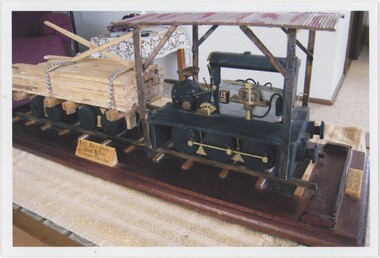
Photograph - Russel's Timber Tractor, Norm Smith, 21st Century
... Handwritten, Reverse: "Timber Tractor Russels / made by Joe Hilder / Norm Smith photo" In-Photograph Label, Left: "EAC RUSSEL'S / Old Bill's / Timber Tractor" In-Photograph Label, Right: "Handmade / Joe Hilder" Reverse, Technical Information: "JOB22069 IMG_6499.jpg 2 of 6"...Railway Machines Commerce Gembrook Handwritten, Reverse: "Timber Tractor Russels / made by Joe Hilder / Norm Smith photo" In-Photograph Label, Left: "EAC RUSSEL'S / Old Bill's / Timber Tractor" In-Photograph Label, Right: "Handmade / Joe Hilder" Reverse, Technical Information: "JOB22069 IMG_6499.jpg 2 of 6" This item is a colour photograph of a handmade model. ...Russel's Mill was located in what is now Bunyip State Park on the Back (or Black Snake) Creek in a relatively clear, flat area beside Ash Landing Road. In 1926 EAC Russel built the mill's 3ft gauge steel rail tramway - with Old Bill's Timber Tractor - to transport timber from the sawmill to what is now Puffing Billy's line. It ran 14 km from Gembrook Station. This tramway was one of only five in the state to use articulated steam power. The Timber Tractor was a six-wheeled Day's model, two of which ran on the Timber Tramway alongside two locomotives - a Kerr Stuart 0-4-2T (which was not powerful enough to do the job) and a geared locomotive built by Day's. The tractors were likely in use until 1953. This photograph was taken by Norm Smith.The timber tramway was a major contributor to the transport and industry of the area; it has been suggested that without the timber tramway's utility, the line that is now Puffing Billy would've ceased operation significantly earlier. This item is a colour photograph of a handmade model. The model depicts a six-wheeled Day's rail tractor, covered by a tin roof, on a track pulling a wagon full of timber. The railway model is mounted on a wooden base, which itself sits on a folded towel (seemingly in a home, with a couch in the background of the photograph). The tin roof is grey with simulated red rust. The tractor is black, with the engine partly exposed.Handwritten, Reverse: "Timber Tractor Russels / made by Joe Hilder / Norm Smith photo" In-Photograph Label, Left: "EAC RUSSEL'S / Old Bill's / Timber Tractor" In-Photograph Label, Right: "Handmade / Joe Hilder" Reverse, Technical Information: "JOB22069 IMG_6499.jpg 2 of 6"railway, machines, commerce, gembrook -
 Emerald Museum & Nobelius Heritage Park
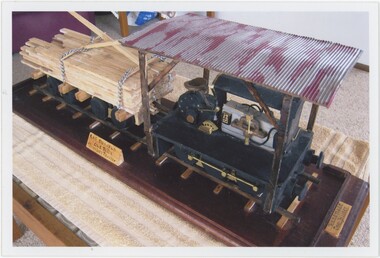
Photograph - Russel's Timber Tractor, 21st Century
... Handwritten, Reverse: "Timber Tractor "Russel's" / made by Joe Hilder / Norm Smith photo" In-Photograph Label, Left: "EAC RUSSEL'S / Old Bill's / Timber Tractor" In-Photograph Label, Right: "Handmade / Joe Hilder" Reverse, Technical Information: "JOB22069 IMG_6502.jpg 5 of 6"...Railway Machines Commerce Gembrook Handwritten, Reverse: "Timber Tractor "Russel's" / made by Joe Hilder / Norm Smith photo" In-Photograph Label, Left: "EAC RUSSEL'S / Old Bill's / Timber Tractor" In-Photograph Label, Right: "Handmade / Joe Hilder" Reverse, Technical Information: "JOB22069 IMG_6502.jpg 5 of 6" This item is a colour photograph of a handmade model. ...Russel's Mill was located in what is now Bunyip State Park on the Back (or Black Snake) Creek in a relatively clear, flat area beside Ash Landing Road. In 1926 EAC Russel built the mill's 3ft gauge steel rail tramway - with Old Bill's Timber Tractor - to transport timber from the sawmill to what is now Puffing Billy's line. It ran 14 km from Gembrook Station. This tramway was one of only five in the state to use articulated steam power. The Timber Tractor was a six-wheeled Day's model, two of which ran on the Timber Tramway alongside two locomotives - a Kerr Stuart 0-4-2T (which was not powerful enough to do the job) and a geared locomotive built by Day's. The tractors were likely in use until 1953. This photograph was taken by Norm Smith.The timber tramway was a major contributor to the transport and industry of the area; it has been suggested that without the timber tramway's utility, the line that is now Puffing Billy would've ceased operation significantly earlier.This item is a colour photograph of a handmade model. The model depicts a six-wheeled Day's rail tractor, covered by a tin roof, on a track pulling a wagon full of timber. The railway model is mounted on a wooden base, which itself sits on a folded towel (seemingly in a home, with a couch in the background of the photograph). The tin roof is grey with simulated red rust. The tractor is black, with the engine partly exposed.Handwritten, Reverse: "Timber Tractor "Russel's" / made by Joe Hilder / Norm Smith photo" In-Photograph Label, Left: "EAC RUSSEL'S / Old Bill's / Timber Tractor" In-Photograph Label, Right: "Handmade / Joe Hilder" Reverse, Technical Information: "JOB22069 IMG_6502.jpg 5 of 6"railway, machines, commerce, gembrook
