
Showing 85 items matching "john breaks"
-
 Clunes Museum
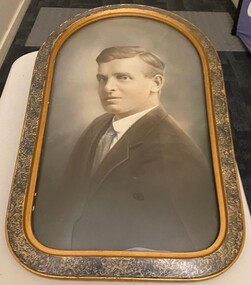
Painting - PORTRAIT
... JOHN BREAKS...PHOTOS FROM BARBARA BREAKS, DAUGHTER OF WILLIAM NELSON AND LILIAN BLAKE (GRANDAUGHTER OF WILLIAM ROBERT BLAKE - CLUNES) AND DAUGHTER OF THOMAS BLAKE JOHN BREAKS WAS THE SON OF JABEZ BREAKS AND ROSE OVERSBY. ...PAINTED PORTRAIT OF JOHN (JACK) BREAKS UNDER GLASS IN A SEMI OVAL GOLD AND BLACK FRAME....HANDWRITTEN ON THE BACK: JOHN BREAKS (JACK) BORN LIVERPOOL U.K. 24-12-1899 DIED PANCH PRESTON MELBOURNE 25-1-1968 SON OF JABEZ AND ROSEMARY BREAKS....PAINTED PORTRAIT OF JOHN (JACK) BREAKS UNDER GLASS IN A SEMI OVAL GOLD AND BLACK FRAME. ...NELSON'S WERE EARLY SETTLERS IN CLUNES. PHOTOS FROM BARBARA BREAKS, DAUGHTER OF WILLIAM NELSON AND LILIAN BLAKE (GRANDAUGHTER OF WILLIAM ROBERT BLAKE - CLUNES) AND DAUGHTER OF THOMAS BLAKE JOHN BREAKS WAS THE SON OF JABEZ BREAKS AND ROSE OVERSBY. HE WAS CONNECTED TO THE NELSON FAMILY AND THIS PHOTO DONATED BY TOM BLAKE.PAINTED PORTRAIT OF JOHN (JACK) BREAKS UNDER GLASS IN A SEMI OVAL GOLD AND BLACK FRAME.ON REVERSE. FRAME IS LINED WITH TORN NEWSPAPER. HANDWRITTEN ON THE BACK: JOHN BREAKS (JACK) BORN LIVERPOOL U.K. 24-12-1899 DIED PANCH PRESTON MELBOURNE 25-1-1968 SON OF JABEZ AND ROSEMARY BREAKS.john breaks -
 Clunes Museum
Print, BREAKING THE NEWS, 1887
... FRAMED PRINT OF JOHN LONGSTAFF'S "BREAKING THE NEWS" OIL ON CANVAS, LIGHT COLOURED WOOD FRAME...JOHN LONGSTAFF LIVED IN CLUNES IN HIS EARLY DAYS. print longstaff sir john breaking the news "BREAKING THE NEWS" OIL ON CANVAS. ...ORIGINAL PAINTING HANGING IN WESTERN AUSTRALIAN ART GALLERY - PICTURE DEPICTS MINING TRAGEDIES IN THE LAST CENTURY. JOHN LONGSTAFF LIVED IN CLUNES IN HIS EARLY DAYS.FRAMED PRINT OF JOHN LONGSTAFF'S "BREAKING THE NEWS" OIL ON CANVAS, LIGHT COLOURED WOOD FRAME"BREAKING THE NEWS" OIL ON CANVAS. ORIGINAL IS IN THE COLLECTION OF THE ART GALLERY OF WESTERN AUSTRALIA. COPYRIGHT RESERVED.print, longstaff sir john, breaking the news -
 National Vietnam Veterans Museum (NVVM)
Photograph
... Two coloured Photograph and one sepia photograph in a black frame with white matting. 1. PTE John Bryant taking a break 2. PTE John Bryant taking a break with an M72 Rocket Launcher 3. ...Photograph Pte John Bryant M72 Rocket launcher Battle of Coral-Balmoral Two coloured Photograph and one sepia photograph in a black frame with white matting. 1. PTE John Bryant taking a break 2. PTE John Bryant taking a break with an M72 Rocket Launcher 3. ...Two coloured Photograph and one sepia photograph in a black frame with white matting. 1. PTE John Bryant taking a break 2. PTE John Bryant taking a break with an M72 Rocket Launcher 3. NVA Mortar headphotograph, pte john bryant, m72 rocket launcher, battle of coral-balmoral -
 Clunes Museum
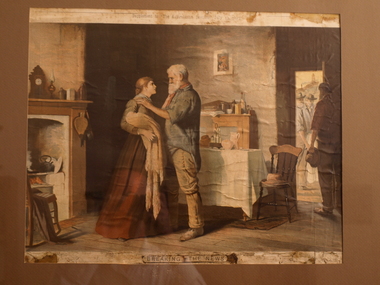
Print - FRAMED PRINT, BREAKING THE NEWS, 1887
... THE NEW PRINT OF CLUNES MOST FAMOUS PAINTING 'BREAKING THE NEWS' BY SIR JOHN LONGSTAFF WAS PRESENTED TO CLUNES MUSEUM BY EUGENE SCHLUSSER ON AUGUST 13TH 2009 AS A GIFT AND A THANK YOU. ....1 FRAMED PRINT OF SIR JOHN LONGSTAFF'S PAINTING OF ''BREAKING THE NEWS" . PRESENTED TO CLUNES MUSEUM BY EUGENE SCHLUSSER AUGUST 13, 2009 .2 DIDACTIC PANEL FOR .1...(BOTTOM LH CORNER) JOHN LONGSTAFF (1862-1941) AUSTRALIA, "BREAKING THE NEWS" OIL ON CANVAS 109.7 X 152.8 CM STATE COLLECTION, ART GALLERY OF WESTERN AUSTRALIA. ...ACQUIRED WITH FUNDS FROM THE HACKETT BEQUEST 1933 .1 FRAMED PRINT OF SIR JOHN LONGSTAFF'S PAINTING OF ''BREAKING THE NEWS" . PRESENTED TO CLUNES MUSEUM BY EUGENE SCHLUSSER AUGUST 13, 2009 .2 DIDACTIC PANEL FOR .1 BREAKING THE NEWS Print FRAMED PRINT SIR JOHN LONGSTAFF ...THE NEW PRINT OF CLUNES MOST FAMOUS PAINTING 'BREAKING THE NEWS' BY SIR JOHN LONGSTAFF WAS PRESENTED TO CLUNES MUSEUM BY EUGENE SCHLUSSER ON AUGUST 13TH 2009 AS A GIFT AND A THANK YOU. EUGENE SCHLUSSER AN INDEPENDENT FILM MAKER MADE A SUCCESSFUL SHORT FILM ABOUT CLUNES 'CLUNES GOLD' FOR THE 150TH CELEBRATIONS OF THE FIRST GOLD DISCOVERY IN VICTORIA IN 2001..1 FRAMED PRINT OF SIR JOHN LONGSTAFF'S PAINTING OF ''BREAKING THE NEWS" . PRESENTED TO CLUNES MUSEUM BY EUGENE SCHLUSSER AUGUST 13, 2009 .2 DIDACTIC PANEL FOR .1(BOTTOM LH CORNER) JOHN LONGSTAFF (1862-1941) AUSTRALIA, "BREAKING THE NEWS" OIL ON CANVAS 109.7 X 152.8 CM STATE COLLECTION, ART GALLERY OF WESTERN AUSTRALIA. ACQUIRED WITH FUNDS FROM THE HACKETT BEQUEST 1933local history, illustration, prints, longstaff, sir john -
Clunes Museum
Print - FRAMED PRINT, BREAKING THE NEWS
... FRAMED PRINT OF JOHN LONGSTAFF'S PAINTING OF "BREAKING THE NEWS" (ORIGINAL PAINTING - OILS ON CANVAS NOW LOCATED IN A GALLERY IN WESTERN AUSTRALIA) COPY OF PAINTING FROM SUPPLEMENT TO THE AUSTRALIAN SKETCHER JULY 12, 1887...John Longstaff Breaking the News FRONT TOP - BREAKING THE NEWS FRONT BOTTOM - SUPPLEMENT TO "THE AUSTRALIA SKETCHER" JULY 12, 1887 FRAMED PRINT OF JOHN LONGSTAFF'S PAINTING OF "BREAKING THE NEWS" (ORIGINAL PAINTING - OILS ON CANVAS NOW LOCATED IN A GALLERY IN WESTERN AUSTRALIA) COPY OF PAINTING FROM SUPPLEMENT TO THE AUSTRALIAN SKETCHER JULY 12, 1887 BREAKING THE NEWS Print FRAMED PRINT ...FRAMED PRINT OF JOHN LONGSTAFF'S PAINTING OF "BREAKING THE NEWS" (ORIGINAL PAINTING - OILS ON CANVAS NOW LOCATED IN A GALLERY IN WESTERN AUSTRALIA) COPY OF PAINTING FROM SUPPLEMENT TO THE AUSTRALIAN SKETCHER JULY 12, 1887FRONT TOP - BREAKING THE NEWS FRONT BOTTOM - SUPPLEMENT TO "THE AUSTRALIA SKETCHER" JULY 12, 1887john longstaff, breaking the news -
Federation University Historical Collection
Book, University of Ballarat Research + Innovation Digest
... Contents include: * Technologies that combat climate change by Alberto Boretti * Case Studies in keeping food safe by Benu Adhikari * Learning to lead - leading to learn by Neil Trivett * Depression, diabetes and motivation by Mirella di Benedetto * Valueing Lake Wendouree by Julian Lowe * What's in a Name by Laura Kostanski * Optimizing regional and international research by John Yerwood * Sport, physical activity and health research by Warren paynbe * Climate secrets in sediments by Peter Gell * UB Sports Injuty Centre supported by IOC * Men's Sheds and other learning places by Barry Golding * New economy, new work, new qualificatins by Erica Smith * Cross-Cultural communications in a shrinking world by Georgina Tsoldis * Child Protection and family services reform by Angela Murphy * Making a difference for older Victorians by Sally Wellard * Making good (and goodly) profits by Jackie Tuck * Not too much 'ordinary' about The Ordinary by Lorraine Sim * Gaming machines and regional gamblers by John McDonald * Toe nail clippings reveal their secrets by Kim Dowling * Magnificently preserves magafauna trackways in the Victorian volcanic plains * A stuttering start for a stunning outcome * Supporting patients and theor carers * Out od Africa and beyond * Taking a hard lok to avaid hard knocks * Skilling people for business success by Andy Smith * Promoting risk awareness in industry by David Borys * Researching China's rise and ris by Mike Willis * Sex hormones link to heart disease by Fadi Charchar * Human Factors in computer security * Are our rivers up the creek by Peter Gell * Wmen as managers and entrepreneurs by Glenice Wood * Revisioning values and norms by Jane Mummery * 'Wimmera' - an Epic Poem by Homer Rieth * Recycling, consumerism, climate change and art practice by Marie Purtill * Investing in ecologically sustainable development by jerry Courvisanos * Indigenous peoples of the goldfields * Astists install images of sustanability by Jill Orr "Addressing disadvantage and nequality with passion by John Smyth * Breaking up insulin hexamers by Mark Myers ...Contents include: * Technologies that combat climate change by Alberto Boretti * Case Studies in keeping food safe by Benu Adhikari * Learning to lead - leading to learn by Neil Trivett * Depression, diabetes and motivation by Mirella di Benedetto * Valueing Lake Wendouree by Julian Lowe * What's in a Name by Laura Kostanski * Optimizing regional and international research by John Yerwood * Sport, physical activity and health research by Warren paynbe * Climate secrets in sediments by Peter Gell * UB Sports Injuty Centre supported by IOC * Men's Sheds and other learning places by Barry Golding * New economy, new work, new qualificatins by Erica Smith * Cross-Cultural communications in a shrinking world by Georgina Tsoldis * Child Protection and family services reform by Angela Murphy * Making a difference for older Victorians by Sally Wellard * Making good (and goodly) profits by Jackie Tuck * Not too much 'ordinary' about The Ordinary by Lorraine Sim * Gaming machines and regional gamblers by John McDonald * Toe nail clippings reveal their secrets by Kim Dowling * Magnificently preserves magafauna trackways in the Victorian volcanic plains * A stuttering start for a stunning outcome * Supporting patients and theor carers * Out od Africa and beyond * Taking a hard lok to avaid hard knocks * Skilling people for business success by Andy Smith * Promoting risk awareness in industry by David Borys * Researching China's rise and ris by Mike Willis * Sex hormones link to heart disease by Fadi Charchar * Human Factors in computer security * Are our rivers up the creek by Peter Gell * Wmen as managers and entrepreneurs by Glenice Wood * Revisioning values and norms by Jane Mummery * 'Wimmera' - an Epic Poem by Homer Rieth * Recycling, consumerism, climate change and art practice by Marie Purtill * Investing in ecologically sustainable development by jerry Courvisanos * Indigenous peoples of the goldfields * Astists install images of sustanability by Jill Orr "Addressing disadvantage and nequality with passion by John Smyth * Breaking up insulin hexamers by Mark Myers University of Ballarat Research + Innovation Digest Book Book ...Black soft covered book of 48 pages. Contents include: * Technologies that combat climate change by Alberto Boretti * Case Studies in keeping food safe by Benu Adhikari * Learning to lead - leading to learn by Neil Trivett * Depression, diabetes and motivation by Mirella di Benedetto * Valueing Lake Wendouree by Julian Lowe * What's in a Name by Laura Kostanski * Optimizing regional and international research by John Yerwood * Sport, physical activity and health research by Warren paynbe * Climate secrets in sediments by Peter Gell * UB Sports Injuty Centre supported by IOC * Men's Sheds and other learning places by Barry Golding * New economy, new work, new qualificatins by Erica Smith * Cross-Cultural communications in a shrinking world by Georgina Tsoldis * Child Protection and family services reform by Angela Murphy * Making a difference for older Victorians by Sally Wellard * Making good (and goodly) profits by Jackie Tuck * Not too much 'ordinary' about The Ordinary by Lorraine Sim * Gaming machines and regional gamblers by John McDonald * Toe nail clippings reveal their secrets by Kim Dowling * Magnificently preserves magafauna trackways in the Victorian volcanic plains * A stuttering start for a stunning outcome * Supporting patients and theor carers * Out od Africa and beyond * Taking a hard lok to avaid hard knocks * Skilling people for business success by Andy Smith * Promoting risk awareness in industry by David Borys * Researching China's rise and ris by Mike Willis * Sex hormones link to heart disease by Fadi Charchar * Human Factors in computer security * Are our rivers up the creek by Peter Gell * Wmen as managers and entrepreneurs by Glenice Wood * Revisioning values and norms by Jane Mummery * 'Wimmera' - an Epic Poem by Homer Rieth * Recycling, consumerism, climate change and art practice by Marie Purtill * Investing in ecologically sustainable development by jerry Courvisanos * Indigenous peoples of the goldfields * Astists install images of sustanability by Jill Orr "Addressing disadvantage and nequality with passion by John Smyth * Breaking up insulin hexamers by Mark Myers david battersby, research, frank stagnitti, jill orr, john smyth, fred cahir, peter gell, andy smith, grant meredith, stuttering, kim dowling, stephen carey, megafauna, john mcdonaldgaming machines, men's sheds, barry golding -
Federation University Historical Collection
Book, University of Ballarat Research + Innovation Digest
... Contents include: * Case studies in keeping food safe, Benu Adhikari * technologies that combat climate change - Alberto Boretti *Learning t lead- leading to learn, Neil Trivett * Depression, diabities and motivation, Mirella Di Benedetto * Valuing Lake Wendouree, Julian Lowe * What's in a name, Laura Kostanski * Optimizing Regional & International Research, John Yearwood * Sport, physical activity and health research, Warren Payne * Climate secrets in the sediments, Peter Gell * Injury prevention and saftey promotion research theme, UB Sports injury centre, Caroline Finch, Men's Sheds & other learning places, Barry Golding * New economy, new work, new qualifications, Erica Smith * Cross-cultural communication in a shrinking world, Georgina Tsolidis * Child Protection & family services reform, Angela Murphy * making a difference for older Victorians, Sally Wellard * Making good (and goodly) profits, jackie tuck * Not too much 'ordinary' about Teh Ordinry, Lorraine Sim * Gaming Machines & regional gamblers * Toe nail clippings revel their secrets, Kim Dowling * Magnificently preserved megafaunal trackways in the Victorian volcanic plans, Stephen Carey * A stuttering start for a stunning outcome, Grant Meridith * Supporting patients & their careres, Anthony Love * Out of Africa and beyond, James O'Meara * Taking a hard look to avoid hard knocks, Caroline Finch and Dara Twomey * Skilling people for business success, Andy Smith * Promoting risk awareness in industry, David Borys * researching China's Rise & Rise, Mike Willis *Sex hormones link to heart disease, Fadi Charchar * Human factors in computer security, Paul watters * Are our rivers up the creek, Peter Gell * Women as managers7 entrepreneurs, Glenice Wood * Revisoning values and norms, Jane Mummery * 'Wimmera" - an epic Poem, Homer Rieth * Recycling, consumerism, climate change and art peactice, marie Purtill * Investing in ecologically sustainable development, Jerry Coursisanos * Indigenous peoples of the goldfields, Fred Cahir * Artists install images of sustainability, Jill Orr * addresing disadvantage& inequality with passion, John Smyth * Breaking up insulin haxamers, Mark Myers...Contents include: * Case studies in keeping food safe, Benu Adhikari * technologies that combat climate change - Alberto Boretti *Learning t lead- leading to learn, Neil Trivett * Depression, diabities and motivation, Mirella Di Benedetto * Valuing Lake Wendouree, Julian Lowe * What's in a name, Laura Kostanski * Optimizing Regional & International Research, John Yearwood * Sport, physical activity and health research, Warren Payne * Climate secrets in the sediments, Peter Gell * Injury prevention and saftey promotion research theme, UB Sports injury centre, Caroline Finch, Men's Sheds & other learning places, Barry Golding * New economy, new work, new qualifications, Erica Smith * Cross-cultural communication in a shrinking world, Georgina Tsolidis * Child Protection & family services reform, Angela Murphy * making a difference for older Victorians, Sally Wellard * Making good (and goodly) profits, jackie tuck * Not too much 'ordinary' about Teh Ordinry, Lorraine Sim * Gaming Machines & regional gamblers * Toe nail clippings revel their secrets, Kim Dowling * Magnificently preserved megafaunal trackways in the Victorian volcanic plans, Stephen Carey * A stuttering start for a stunning outcome, Grant Meridith * Supporting patients & their careres, Anthony Love * Out of Africa and beyond, James O'Meara * Taking a hard look to avoid hard knocks, Caroline Finch and Dara Twomey * Skilling people for business success, Andy Smith * Promoting risk awareness in industry, David Borys * researching China's Rise & Rise, Mike Willis *Sex hormones link to heart disease, Fadi Charchar * Human factors in computer security, Paul watters * Are our rivers up the creek, Peter Gell * Women as managers7 entrepreneurs, Glenice Wood * Revisoning values and norms, Jane Mummery * 'Wimmera" - an epic Poem, Homer Rieth * Recycling, consumerism, climate change and art peactice, marie Purtill * Investing in ecologically sustainable development, Jerry Coursisanos * Indigenous peoples of the goldfields, Fred Cahir * Artists install images of sustainability, Jill Orr * addresing disadvantage& inequality with passion, John Smyth * Breaking up insulin haxamers, Mark Myers University of Ballarat Research + Innovation Digest Book Book ...Black, soft covered book of 48 pages outlining research at the University of Ballarat. Contents include: * Case studies in keeping food safe, Benu Adhikari * technologies that combat climate change - Alberto Boretti *Learning t lead- leading to learn, Neil Trivett * Depression, diabities and motivation, Mirella Di Benedetto * Valuing Lake Wendouree, Julian Lowe * What's in a name, Laura Kostanski * Optimizing Regional & International Research, John Yearwood * Sport, physical activity and health research, Warren Payne * Climate secrets in the sediments, Peter Gell * Injury prevention and saftey promotion research theme, UB Sports injury centre, Caroline Finch, Men's Sheds & other learning places, Barry Golding * New economy, new work, new qualifications, Erica Smith * Cross-cultural communication in a shrinking world, Georgina Tsolidis * Child Protection & family services reform, Angela Murphy * making a difference for older Victorians, Sally Wellard * Making good (and goodly) profits, jackie tuck * Not too much 'ordinary' about Teh Ordinry, Lorraine Sim * Gaming Machines & regional gamblers * Toe nail clippings revel their secrets, Kim Dowling * Magnificently preserved megafaunal trackways in the Victorian volcanic plans, Stephen Carey * A stuttering start for a stunning outcome, Grant Meridith * Supporting patients & their careres, Anthony Love * Out of Africa and beyond, James O'Meara * Taking a hard look to avoid hard knocks, Caroline Finch and Dara Twomey * Skilling people for business success, Andy Smith * Promoting risk awareness in industry, David Borys * researching China's Rise & Rise, Mike Willis *Sex hormones link to heart disease, Fadi Charchar * Human factors in computer security, Paul watters * Are our rivers up the creek, Peter Gell * Women as managers7 entrepreneurs, Glenice Wood * Revisoning values and norms, Jane Mummery * 'Wimmera" - an epic Poem, Homer Rieth * Recycling, consumerism, climate change and art peactice, marie Purtill * Investing in ecologically sustainable development, Jerry Coursisanos * Indigenous peoples of the goldfields, Fred Cahir * Artists install images of sustainability, Jill Orr * addresing disadvantage& inequality with passion, John Smyth * Breaking up insulin haxamers, Mark Myersaborigines, mens shed, wimmera, gambling, megafauna, gell, golding, carey, cahir, purtill -
 Federation University Historical Collection
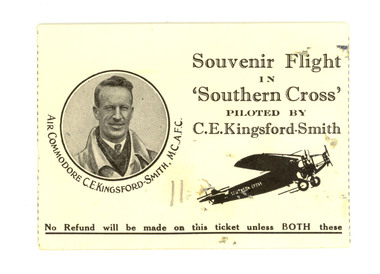
Souvenir - Ticket Stub, Ticket for a souvenir Flight with Charles Kingsford-Smith, c1932
... breaking solo flight from England to Darwin in 10 days. He was knighted for services to aviation in 1932. He made the first west–east trans-Pacific flight in 1934. In 1932 was selling joy-flights at ten shillings a trip. Most of his flights, including the joy flights, were made in the three-engine Fokker plane known as the 'Southern Cross', now preserved in a special display area at Brisbane Airport. In late 1935 Kingsford Smith took off on the second leg of a flight from England to Australia with John...breaking solo flight from England to Darwin in 10 days. He was knighted for services to aviation in 1932. He made the first west–east trans-Pacific flight in 1934. In 1932 was selling joy-flights at ten shillings a trip. Most of his flights, including the joy flights, were made in the three-engine Fokker plane known as the 'Southern Cross', now preserved in a special display area at Brisbane Airport. In late 1935 Kingsford Smith took off on the second leg of a flight from England to Australia with John ...Sir Charles Edward Kingsford Smith (1897-1935) is one of Australia's most known Australia’s fliers. Born in 1897 at Hamilton, Qld. He spent his early life in Sydney enlisting in the AIF in 1915. He served at Gallipoli before transferring to the Royal Flying Corps in 1916. He was shot down and wounded in the foot in 1917. In 1929, Kingsford-Smith flew from Australia to England in the record-breaking time of 12 days, 18 hours. The following year he completed an east–west crossing of the Atlantic Ocean in 31 hours, followed by a record-breaking solo flight from England to Darwin in 10 days. He was knighted for services to aviation in 1932. He made the first west–east trans-Pacific flight in 1934. In 1932 was selling joy-flights at ten shillings a trip. Most of his flights, including the joy flights, were made in the three-engine Fokker plane known as the 'Southern Cross', now preserved in a special display area at Brisbane Airport. In late 1935 Kingsford Smith took off on the second leg of a flight from England to Australia with John ‘JT’ Pethybridge. The plane and pilots were never seen again, believed to have crashed into the sea at night somewhere off the coast of Burma. White ticket stub with black ink. It includes a photographic portrait of Charles Kingsford-Smith, and a drawing of the Southern Cross aeroplane. Gift of the Chatham-Holmes family.Printed on ticket 'Souvenir Flight in 'Southern Cross' piloted by C.E. Kingsford-Smith. No refund will be made on this ticket unless BOTH these"chatham, chatham family collection, kingsford-smith, charles kingsford-smith, smithy, southern cross, aeroplane, flight, joy ride, entertainment, airport, charles kingsford smith -
 Flagstaff Hill Maritime Museum and Village
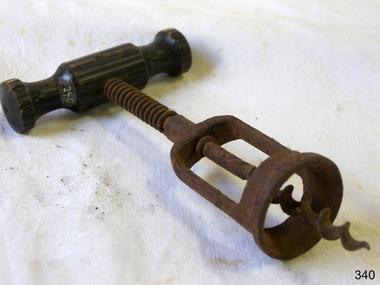
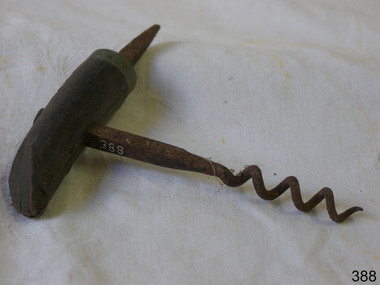
Domestic object - Corkscrew
... John Worlidge in 1676 describes "binning of tightly corked cider bottles on their sides", although the earliest reference to a corkscrew is, "steel worm used for the drawing of Corks out of Bottles" from 1681. In 1795, the first corkscrew patent was granted to the Reverend Samuel Henshall, in England. The clergyman affixed a simple disc, now known as the Henshall Button, between the worm and the shank. The disc prevents the worm from going too deep into the cork, forces the cork to turn with the turning of the crosspiece, and thus breaks...John Worlidge in 1676 describes "binning of tightly corked cider bottles on their sides", although the earliest reference to a corkscrew is, "steel worm used for the drawing of Corks out of Bottles" from 1681. In 1795, the first corkscrew patent was granted to the Reverend Samuel Henshall, in England. The clergyman affixed a simple disc, now known as the Henshall Button, between the worm and the shank. The disc prevents the worm from going too deep into the cork, forces the cork to turn with the turning of the crosspiece, and thus breaks ...The design of the corkscrew may have been derived from the gun worm, which was a device from at least the early 1630s, used by men to remove unspent charges from a musket's barrel in a similar fashion. The corkscrew is possibly an English invention, due to the tradition of beer and cider, and the 'Treatise on Cider' by John Worlidge in 1676 describes "binning of tightly corked cider bottles on their sides", although the earliest reference to a corkscrew is, "steel worm used for the drawing of Corks out of Bottles" from 1681. In 1795, the first corkscrew patent was granted to the Reverend Samuel Henshall, in England. The clergyman affixed a simple disc, now known as the Henshall Button, between the worm and the shank. The disc prevents the worm from going too deep into the cork, forces the cork to turn with the turning of the crosspiece, and thus breaks the adhesion between the cork and the neck of the bottle. The disc is designed and manufactured slightly concave on the underside, which compresses the top of the cork and helps keep it from breaking apart. The winged corkscrew, sometimes called a cork extractor, butterfly corkscrew, owl corkscrew, Indian corkscrew, or angel corkscrew, has two levers, one on either side of the worm. As the worm is twisted into the cork, the levers are raised. Pushing down the levers draws the cork from the bottle in one smooth motion. The most common design has a rack and pinion connecting the levers to the body. The head of the central shaft is frequently modified to form a bottle opener, or foil cutter, increasing the utility of the device. Corkscrews of this design are particularly popular in household use. In 1880, William Burton Baker was issued British Patent No. 2950 for his double lever corkscrew, with both levers sliding onto the upper end of the shank. The first American patent was in 1930 granted to the Italian Domenico Rosati who emigrated to Chicago, Illinois, to work as bartender before prohibition. Rosati's design had an exposed rack and pinion mechanism. Such design was adapted by other brands as the wine-market grew in popularity. The winged owl version, with two side-plates covering the rack and pinion mechanism, was first designed and manufactured in 1932 by the Spanish industrial designer David Olañeta for his brand BOJ and was later adopted by others, such as the 1936 US Patent No. 98,968 by Richard Smythe marked HOOTCH-OWL https://en.wikipedia.org/wiki/CorkscrewThis object is significant as an example of an item in common use in the 19th and early 20th centuries, and that was developed further in the 1930s.Winged corkscrew with a T-shaped wooden handle, metal spring and worm-wheel screw section.None.flagstaff hill, flagstaff hill maritime museum and village, warrnambool, maritime museum, maritime village, great ocean road, shipwreck coast, corkscrew, beverages, kitchen equipment, bottle opener -
 Flagstaff Hill Maritime Museum and Village
Domestic object - Corkscrew
... John Worlidge in 1676 describes "binning of tightly corked cider bottles on their sides", although the earliest reference to a corkscrew is, "steel worm used for the drawing of Corks out of Bottles" from 1681. In 1795, the first corkscrew patent was granted to the Reverend Samuel Henshall, in England. The clergyman affixed a simple disc, now known as the Henshall Button, between the worm and the shank. The disc prevents the worm from going too deep into the cork, forces the cork to turn with the turning of the crosspiece, and thus breaks...John Worlidge in 1676 describes "binning of tightly corked cider bottles on their sides", although the earliest reference to a corkscrew is, "steel worm used for the drawing of Corks out of Bottles" from 1681. In 1795, the first corkscrew patent was granted to the Reverend Samuel Henshall, in England. The clergyman affixed a simple disc, now known as the Henshall Button, between the worm and the shank. The disc prevents the worm from going too deep into the cork, forces the cork to turn with the turning of the crosspiece, and thus breaks ...The design of the corkscrew may have been derived from the gun worm, which was a device from at least the early 1630s, used by men to remove unspent charges from a musket's barrel in a similar fashion. The corkscrew is possibly an English invention, due to the tradition of beer and cider, and the 'Treatise on Cider' by John Worlidge in 1676 describes "binning of tightly corked cider bottles on their sides", although the earliest reference to a corkscrew is, "steel worm used for the drawing of Corks out of Bottles" from 1681. In 1795, the first corkscrew patent was granted to the Reverend Samuel Henshall, in England. The clergyman affixed a simple disc, now known as the Henshall Button, between the worm and the shank. The disc prevents the worm from going too deep into the cork, forces the cork to turn with the turning of the crosspiece, and thus breaks the adhesion between the cork and the neck of the bottle. The disc is designed and manufactured slightly concave on the underside, which compresses the top of the cork and helps keep it from breaking apart. In its traditional form, a corkscrew is simply a steel screw attached to a perpendicular handle, made of wood or some other material. The user grips the handle and screws the metal point into the cork, until the helix is firmly embedded, then a vertical pull on the corkscrew extracts the cork from the bottle. The handle of the corkscrew allows for a commanding grip to ease removal of the cork. https://en.wikipedia.org/wiki/CorkscrewThis object is significant as an example of an item in common use since the late 17th century.Metal corkscrew with wooden handle that is partly broken. Has metal steel spike to create a starting point for the use of the corkscrew. Very rusty. None.flagstaff hill, warrnambool, shipwrecked-coast, flagstaff-hill, flagstaff-hill-maritime-museum, maritime-museum, shipwreck-coast, flagstaff-hill-maritime-village, corkscrew, beverages, kitchen equipment, bottle opener -
 Federation University Historical Collection
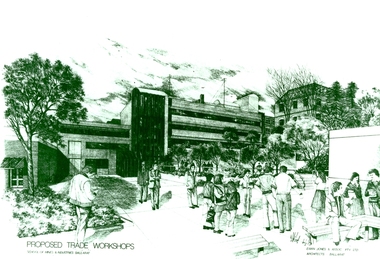
Photograph - Photograph - Black and White, Proposed Ballarat School of Mines Trade Workshops, c1984
... John Building (Building K), a three storey, face red brick, restrained Late Twentieth Century International styled building with an elongated, cuboid form (defined by the parapeted facades) that is offset by projecting exposed concrete framed, round‐arched entrance and stair wells on the east (Albert Street) elevation (the centrally located entrance breaking the brick façade with glazing). ...John Building (Building K), a three storey, face red brick, restrained Late Twentieth Century International styled building with an elongated, cuboid form (defined by the parapeted facades) that is offset by projecting exposed concrete framed, round‐arched entrance and stair wells on the east (Albert Street) elevation (the centrally located entrance breaking the brick façade with glazing). ...A design for a Trade and Art Workshop at the Ballarat School of Mines was prepared by Ewan Jones and Associates on the Albert Street boundary around 1984. The M.B. John Building (Building K), a three storey, face red brick, restrained Late Twentieth Century International styled building with an elongated, cuboid form (defined by the parapeted facades) that is offset by projecting exposed concrete framed, round‐arched entrance and stair wells on the east (Albert Street) elevation (the centrally located entrance breaking the brick façade with glazing). The facades are also characterised by banks of aluminium framed, horizontal ribbon windows, which wrap around the building corners. Metal shades project beyond the windows, while post‐supported bullnosed verandahs and hoods and projecting concrete stairs are other features. On the west elevation, the cuboid façade is punctuated by projecting curved concrete and glazed, elongated bays at first floor level. (David Rowe/Wendy Jacobs) The M.B. John Trade–Art building of SMB was officially opened by the Hon. John Cain, Premier of Victoria, in the presence of Morgan B. John. Programs include 3 Dimensional Art, Painting & Decorating, and Engineering Trades. (SMB Institutional Plan 1989)Black and white photograph of a sketch for the proposed Trade Workshops at the Ballarat School of Mines, from the Albert Street vantage point. This building is known as the M.B. John Building on the SMB Campus.ballarat school of mines, trade workshops, flecknoe, m.b. john, ewan jones and associates pty ltd, albert street, morgan b. john, ewan jones and associates -
Federation University Historical Collection
Book - Book - Scrapbook, Ballarat College of Advanced Education: Scrapbook of newspaper cutting, Book 10; September 1981 to May 1982
... john mcmahon...award in metallurgy...award in mechanical engineering...pottery group's first show...rich clays of ballarat...colleges to retrench staff...retirement of frank ryan...growing computer industry...new job in northern territory...break...The cuttings cover the period from 2 September 1981 to 6 May 1982. . employment advertisements application for enrolment outline of courses more students less money bcae staff cuts fewer graduates in engineering half marathon need for more maths and science students energy resources control warning bcae spring festival companies woo bcae engineering graduates engineering students and 'the iron horse' recreation survey p e degree course energy saving project student winemakers tom nestor wins award nigerian students studies ground movement sir arthur nicholson golden taste of success ivan durrant on art students critical time for ballarat's economy first group to complete arts degree francis brown john mcmahon award in metallurgy award in mechanical engineering pottery group's first show rich clays of ballarat colleges to retrench staff retirement of frank ryan growing computer industry new job in northern territory break-in brumbies ballarat's young jobless librarians enter computer age tertiary chief sacked dr jim watson hsc seminar at bcae students eat too much fast food chemistry graduate to work in canberra stephen wilson dianne budge to work in alice springs physical fitness director of ymca revamp for key tertiary commission lake weed problem businessmen wooed move to promote health fitness scholarships for students robert allan artist move to save bendigo course hobby course for gold prospectors john crump ceramics day of firsts at bcae track and field titles win tamara beckier artist abstract art talks on future of regional colleges government funding Book with grey cover, front. ...Newspaper cuttings relating to Ballarat College of Advanced Education. These are from various newspapers and include The Age, Ballarat Courier, The Australian, The Herald. The cuttings cover the period from 2 September 1981 to 6 May 1982. . Book with grey cover, front. Image of image of two trotters. Spiral bound.employment advertisements, application for enrolment, outline of courses, more students less money, bcae staff cuts, fewer graduates in engineering, half marathon, need for more maths and science students, energy resources control warning, bcae spring festival, companies woo bcae engineering graduates, engineering students and 'the iron horse', recreation survey, p e degree course, energy saving project, student winemakers, tom nestor wins award, nigerian students studies ground movement, sir arthur nicholson, golden taste of success, ivan durrant on art students, critical time for ballarat's economy, first group to complete arts degree, francis brown, john mcmahon, award in metallurgy, award in mechanical engineering, pottery group's first show, rich clays of ballarat, colleges to retrench staff, retirement of frank ryan, growing computer industry, new job in northern territory, break-in brumbies, ballarat's young jobless, librarians enter computer age, tertiary chief sacked, dr jim watson, hsc seminar at bcae, students eat too much fast food, chemistry graduate to work in canberra, stephen wilson, dianne budge to work in alice springs, physical fitness director of ymca, revamp for key tertiary commission, lake weed problem, businessmen wooed, move to promote health fitness, scholarships for students, robert allan artist, move to save bendigo course, hobby course for gold prospectors, john crump ceramics, day of firsts at bcae, track and field titles win, tamara beckier artist, abstract art, talks on future of regional colleges, government funding -
Federation University Historical Collection
Book - Book - Scrapbook, Ballarat School of MInes: Scrapbook of Newspaper Cuttings, Book 11, June 1981 to September 1981
... The papers concerned are The Courier, Ballarat, The Australian, The Age over the period of 10 June 1981 to 25 September 1981. courses available smb music teachers to play in japan scholarships given by real estate men department tests plant operators student comfort and architectual skill carol woolman breaking language barrier morgan john retires from bcae council leanne parker neil henderson and daryl crawley among state's top students father john ignatius bleasdale wine authority receptionist course to begin at smb governor sir henry winneke's tribute to craftsmen smb courses to help avoid business failure joan chamber mla critical of tafe college funding jobless urged to train for jobs replies to joan chambers' comments ballarat rowers deny council bashing henry sutton inventor employers advised to learn of training changes apprentice week at smb photography courses at smb geoff pope photography teacher training better supervisors - factory language in classroom impetus from top ballarat move for apprentice hairdressers' course at smb safety seminar for apprentices education mood of gloom says john dawkins federal spokesman for education tafe region board chairman appointed neil ferguson councils face increasing financial pressures proper care of rape victims advocated tafe funding not enough local government conference in ballarat major trophy for john wilson peter drake racv apprentice motor mechanic of the year Book with white cover, front, spiral bound. ...Collection of newspaper articles related to Ballarat School Of Mines.They cover activities and advertisements for staff. The papers concerned are The Courier, Ballarat, The Australian, The Age over the period of 10 June 1981 to 25 September 1981.Book with white cover, front, spiral bound. courses available, smb music teachers to play in japan, scholarships given by real estate men, department tests plant operators, student comfort and architectual skill, carol woolman breaking language barrier, morgan john retires from bcae council, leanne parker neil henderson and daryl crawley among state's top students, father john ignatius bleasdale wine authority, receptionist course to begin at smb, governor sir henry winneke's tribute to craftsmen, smb courses to help avoid business failure, joan chamber mla critical of tafe college funding, jobless urged to train for jobs, replies to joan chambers' comments, ballarat rowers deny council bashing, henry sutton inventor, employers advised to learn of training changes, apprentice week at smb, photography courses at smb, geoff pope photography teacher, training better supervisors - factory language in classroom, impetus from top, ballarat move for apprentice hairdressers' course at smb, safety seminar for apprentices, education mood of gloom says john dawkins federal spokesman for education, tafe region board chairman appointed, neil ferguson, councils face increasing financial pressures, proper care of rape victims advocated, tafe funding not enough, local government conference in ballarat, major trophy for john wilson, peter drake racv apprentice motor mechanic of the year -
 Ballarat Clarendon College
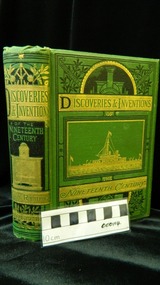
Book, Robert Routledge, Discoveries and inventions of the nineteenth century, 1877
... Four generations of descendants have attended the school. robert-crawford 1878 ballarat-college john-garbutt book-prize Book plate inside front cover; Ballarat College crest / French / Third from / First PRIZE / Awarded to / R Crawford / CHRISTMAS 1878 / JOHN GARBUTT M A PRINCIPAL Green cloth cover with ornate gilt decorations and black pictorials on cover and spine; gilt edges; binding breaking but overall fair condition; black and white illustrations throughout; Discoveries and inventions of the nineteenth century Book Robert Routledge George Routledge and Sons ...Awarded to Robert Crawford for excellence in French at the Third form; Robert (BD 14/3/1865) entered the school on 9/7/1878 and left 31/12/1881. He was Dux of Ballarat College 1881. Four generations of descendants have attended the school. Green cloth cover with ornate gilt decorations and black pictorials on cover and spine; gilt edges; binding breaking but overall fair condition; black and white illustrations throughout; Book plate inside front cover; Ballarat College crest / French / Third from / First PRIZE / Awarded to / R Crawford / CHRISTMAS 1878 / JOHN GARBUTT M A PRINCIPALrobert-crawford, 1878, ballarat-college, john-garbutt, book-prize, -
 Ballarat Clarendon College
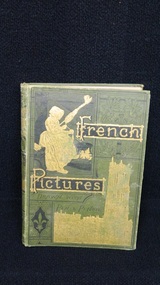
Book, French pictures, Prior to the book prize presented on Christmas, 1878
... john-thomas-good ballarat-college 1878 mrs-h-j-murch. Book plate inside front cover: college crest/ English/ Fifth form/ First prize/ Awarded to/ J.T.Good/ CHRISTMAS, 1878. Green cloth cover with ornate gilt decorations and black pictorials on cover and spine; gilt edges; binding breaking but overall fair condition; black and white illustrations throughout; college crest on back cover, 212 p. ...This book was awarded to John Thomas Good for first prize in English in the fifth form. John enrolled at Ballarat College in April of 1878 at the age of 12. Parent/Guardian listed in the register is Mrs. H.J.Murch.Presbyterian educators placed great value on a classical education matched with diligence in study. Book prizes were highly regarded and academic success admired. In the school’s early years prizes were ordered direct from London and had the school crest embossed in gold on the front or back cover. Many of the prizes given in early years were returned to the school to equip the Weatherly Library when it opened in 1936.Green cloth cover with ornate gilt decorations and black pictorials on cover and spine; gilt edges; binding breaking but overall fair condition; black and white illustrations throughout; college crest on back cover, 212 p.Book plate inside front cover: college crest/ English/ Fifth form/ First prize/ Awarded to/ J.T.Good/ CHRISTMAS, 1878.john-thomas-good, ballarat-college, 1878, mrs-h-j-murch. -
 Federation University Historical Collection
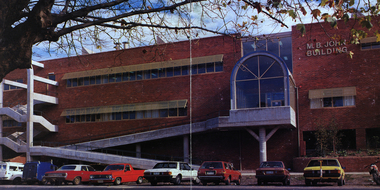
Image - Colour, Ballarat School of Mines M.B. John Building, Albert Street, Ballarat, 1987, 1987
... John Building (Building K), a three storey, face red brick, restrained Late Twentieth Century International styled building with an elongated, cuboid form (defined by the parapeted facades) that is offset by projecting exposed concrete framed, round‐arched entrance and stair wells on the east (Albert Street) elevation (the centrally located entrance breaking the brick façade with glazing). ...John Building (Building K), a three storey, face red brick, restrained Late Twentieth Century International styled building with an elongated, cuboid form (defined by the parapeted facades) that is offset by projecting exposed concrete framed, round‐arched entrance and stair wells on the east (Albert Street) elevation (the centrally located entrance breaking the brick façade with glazing). ...The M.B. John Trade–Art building (Albert Street front) of SMB was officially opened by the Hon. John Cain, Premier of Victoria, in the presence of Morgan B. John. Programs include 3 Dimensional Art, Painting & Decorating, and Engineering Trades. (SMB Institutional Plan 1989) The M.B. John Building (Building K), a three storey, face red brick, restrained Late Twentieth Century International styled building with an elongated, cuboid form (defined by the parapeted facades) that is offset by projecting exposed concrete framed, round‐arched entrance and stair wells on the east (Albert Street) elevation (the centrally located entrance breaking the brick façade with glazing). The facades are also characterised by banks of aluminium framed, horizontal ribbon windows, which wrap around the building corners. Metal shades project beyond the windows, while post‐supported bullnosed verandahs and hoods and projecting concrete stairs are other features. On the west elevation, the cuboid façade is punctuated by projecting curved concrete and glazed, elongated bays at first floor level. (David Rowe/Wendy Jacobs)Image of a multi-storey brick building on the Ballarat School of Mines campus. The building is known as the M.B. John Building.ballarat school of mines, m.b. john building, morgan b. john, albert street, m.b. john -
Federation University Historical Collection
Document - Booklet, 'Breaking New Ground: Outlining the Origins of the University of Ballarat' by Jack Barker, 2014
... In one booklet, a letter from 6th February 2014 states that this copy has been forwarded to Ex-Staff Association Members from Verna Barry, secretary of BESA. e.j. barker jack barker mount helen mount helen campus ballarat school of mines ballarat institute of advanced education melbourne college of advanced education alf reed martin committee mount clear ray bell lord casey sir zelman cowen 1870s founders hall peter karmel state college victoria ballarat john dawkins turning the sod history verna barry ex-staff association breaking new ground university of ballarat Booklet outlining the memories of E.J. ...E.J. Barker was the Principal of the Ballarat School of Mines, and the first Director of the Ballarat Institute of Advanced Education. In one booklet, a letter from 6th February 2014 states that this copy has been forwarded to Ex-Staff Association Members from Verna Barry, secretary of BESA.Booklet outlining the memories of E.J. Barker, the first Director of the Federation University Mt Helen Campus (then Ballarat College of Advanced Education). Two booklets, each 28 pages. Bound with plastic comb binding, has thicker card for back cover. One booklet has a typed paper letter taped in the back.e.j. barker, jack barker, mount helen, mount helen campus, ballarat school of mines, ballarat institute of advanced education, melbourne college of advanced education, alf reed, martin committee, mount clear, ray bell, lord casey, sir zelman cowen, 1870s founders hall, peter karmel, state college victoria ballarat, john dawkins, turning the sod, history, verna barry, ex-staff association, breaking new ground, university of ballarat -
 Federation University Historical Collection
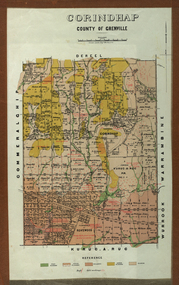
Plan - Parish Plan, Corindhap, County of Grenville, 1898
... ...John Thornley...Break...Camm James MacDonald John Thornley Break of Day Gully John Wilson Thomas Middleton Alexander McPherson Joseph Coldwell H. ...Colour Parish Plan of Corindhap, County of Grenville, and a report on the Parish.corindhap, dereel, warrambine, kuracaruc, commeralghip, rokewood, kuruc-a-ruc, w. elder, william elder, john thornly, robert cullen, davis aitcheson, robert gidney, john elder, w. barnard, anton trende, thomas hill, george hobson, h. reynolds, john collins, ironstone quarry, john jacka, patrick shanahan, murdoch mclennon, kaolinitic clay, kaolin, james holt, mary a. palmer, isaac everett, james mooney, michael cahill, fred benjamin, george hopkins, david houghton, john quarrell, j. camm, james macdonald, john thornley, break of day gully, john wilson, thomas middleton, alexander mcpherson, joseph coldwell, h. brand, pereverance co, puddling mils, mary a. stanbrook, c.w. stanbrook, eliza byrnes, james byrnes, j. maw, wallace douglas, john moffatt -
 Flagstaff Hill Maritime Museum and Village
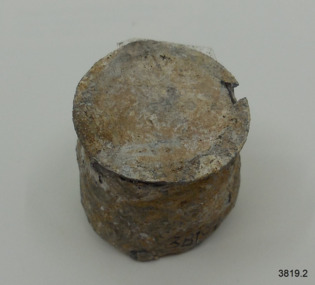
Functional object - Bottle Seal, circa 1843-1878
... John Chance collection. Bottles in the early 19th century were handmade. They were not necessarily uniform in size or shape, so sealing was not always successful. If the bottles were stored they often became contaminated by rats and mice breaking...John Chance collection. Bottles in the early 19th century were handmade. They were not necessarily uniform in size or shape, so sealing was not always successful. If the bottles were stored they often became contaminated by rats and mice breaking ...This lead sealing capsule was recovered from the tragic wreck of the sailing ship ‘Loch Ard’. It may have once been on a bottle amongst the ship's cargo, its provisions or the passengers’ personal luggage. It is now part of the John Chance collection. Bottles in the early 19th century were handmade. They were not necessarily uniform in size or shape, so sealing was not always successful. If the bottles were stored they often became contaminated by rats and mice breaking the cork or wax seals, or by insects attracted to the contents if the seal on the bottle leaked. Lead sealing capsules were used from 1843 to overcome this problem. The lead was heated until it was malleable, then moulded by hand to fit over the sealed bottle’s mouth and neck. This was more successful if wire was also used under the capsule for added security (similar to modern champagne bottles). The capsule couldn’t be re-fitted so it was discarded after the bottle was opened. Capsule designs from about 1862 used tin-plated lead foil and often had the inscriptions and trademarks of the content makers on them. Eventually it was found that the lead was toxic. The lead was replaced by tin, aluminium, and later plastic. Today’s home brewers can buy readymade plastic capsules that fit over the bottle then twist to lock it firmly into place and can be re-used. Digs at archaeological sites often reveal lead sealing capsules. These are collected and catalogued. The information gathered from inscriptions, makers’ marks, logos and descriptions of the bottle contents has provided valuable insights into the history and the dating of other items on the sites. This lead sealing capsule was made to seal a handmade glass bottle and is historically significant for representing its invention to solve a preservation and integrity issue with bottle seals in the mid-to-late 19th century. Its design has evolved and is still in use today. This sealing capsule is representative of their historical use of capsules as a tool for dating and interpreting archaeological sites around the world. The sealing capsule is also significant as it was recovered by John Chance, a diver from the wreck of the Loch Ard in the 1960s-70s. Items that come from several wrecks along Victoria's coast have since been donated to the Flagstaff Hill Maritime Village’s museum collection by his family, illustrating this item’s level of historical value. The sealing capsule is also significant for being connected to the wreck of the Loch Ard (1873-1878), which is historically significant to both Victoria and Australia. The loss of the ship has been described as one of the ‘worst shipwreck tragedies’ and is well known in Victoria for the tragic death of 52 out of the 54 lives on board. The Loch Ard wreck's historical significance as a large international passenger and cargo clipper ship has been recognised and it is now registered on the Victorian Heritage Database, VHR S417. The wreck site is labelled as ‘one of Victoria’s most spectacular diving sites’ and the area is a popular tourist site. It is part of Victoria’s Underwater Shipwreck Discovery Trail.Bottle sealing capsule, cylindrical with thin, round top separated from thicker body (taped in place and fragile). Made from grey-white lead, uneven in thickness and shape. Remnants of a thick substance are inside the capsule.flagstaff hill, warrnambool, flagstaff hill maritime museum, maritime museum, shipwreck coast, flagstaff hill maritime village, great ocean road, john chance, loch ard, bottle seal, bottle capsule, handmade bottle, antique bottle, sealing capsule, lead capsule, bottle closure, bottle foil, bottle preservation, bottle finish -
 Flagstaff Hill Maritime Museum and Village
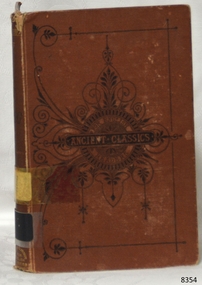
Book - Ancient plays, Rev. William Lucas Collins et al, Aristophanes, 1872
... breaks them down. Collins provides historical context, summarizes the plots, injects translated excerpts (mostly using the well-regarded translations of John Hookham Frere), and explains the intense political and social satire of ancient Athens in a way that an everyday English reader of 1872 could easily grasp. ...breaks them down. Collins provides historical context, summarizes the plots, injects translated excerpts (mostly using the well-regarded translations of John Hookham Frere), and explains the intense political and social satire of ancient Athens in a way that an everyday English reader of 1872 could easily grasp. ...This volume is part of a famous 19th-century educational initiative. It bridges Victorian England with the biting political satire of ancient Athens. This book is not a straightforward, cover-to-cover translation of ancient plays; instead, it is a scholarly introduction, summary, and analysis written for the general Victorian public.Aristophanes Edited by Rev W Lucas Collins Publisher: William Blackwood & Sons Date: 1872 Further Information: Ancient Classics for English Readers seriesfictionThis volume is part of a famous 19th-century educational initiative. It bridges Victorian England with the biting political satire of ancient Athens. This book is not a straightforward, cover-to-cover translation of ancient plays; instead, it is a scholarly introduction, summary, and analysis written for the general Victorian public.flagstaff hil, warrnambool, flagstaff hill maritime museum, maritime museum, shipwreck coast, flagstaff hill maritime village, great ocean road, book, pattison collection, warrnambool library, warrnambool mechanics’ institute, ralph eric pattison, corangamite regional library service, warrnambool city librarian, mechanics’ institute library, victorian library board, warrnambool books and records, warrnambool children’s library, aristophanes, rev w lucas collins -
 Flagstaff Hill Maritime Museum and Village
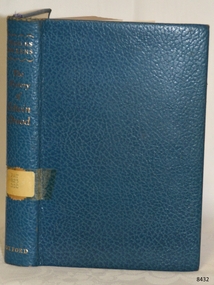
Book - A Fictional Story, Charles Dickens et al, The Mystery of Edwin Drood, 1966
... Both are unhappy with the arrangement and decide to break it off. Edwin’s uncle John Jasper, is the cathedral’s choirmaster, and secretly obsesses over Rosa and is an opium addict. ...Charles Dickens (1812–1870) was one of the great English novelists of the Victorian era, famous for vivid characters, social criticism, and stories that were first published in serial form. He began as a journalist, rose to enormous popularity during his lifetime, and wrote major works such as Oliver Twist, David Copperfield, and Great Expectations. The Mystery of Edwin Drood is Charles Dickens’s final, unfinished novel about the mysterious disappearance (likely murder) of a young man named Edwin Drood in the fictional cathedral town of Cloisterham, England. The theme centres around Edwin who is engaged to Rosa Bud in a marriage arranged by their fathers. Both are unhappy with the arrangement and decide to break it off. Edwin’s uncle John Jasper, is the cathedral’s choirmaster, and secretly obsesses over Rosa and is an opium addict. After a tense Christmas Eve dinner with Edwin and the hot tempered Neville Landless (who also likes Rosa), Edwin disappears. Neville is suspected because he was last seen with Edwin, but there’s no body and not enough evidence to charge him. There is also a mysterious figure named Datchery who arrives in Cloisterham to investigate, and an elderly woman from an opium den called Princess Puffer who begins shadowing Jasper.The Mystery of Edwin Drood Hard Cover, Blue. Author: Charles Dickens Publisher: Oxford University Press Date: 1966 Further Information: With twelve illustrations by Luke Fildes and two by Charles CollinsfictionCharles Dickens (1812–1870) was one of the great English novelists of the Victorian era, famous for vivid characters, social criticism, and stories that were first published in serial form. He began as a journalist, rose to enormous popularity during his lifetime, and wrote major works such as Oliver Twist, David Copperfield, and Great Expectations. The Mystery of Edwin Drood is Charles Dickens’s final, unfinished novel about the mysterious disappearance (likely murder) of a young man named Edwin Drood in the fictional cathedral town of Cloisterham, England. The theme centres around Edwin who is engaged to Rosa Bud in a marriage arranged by their fathers. Both are unhappy with the arrangement and decide to break it off. Edwin’s uncle John Jasper, is the cathedral’s choirmaster, and secretly obsesses over Rosa and is an opium addict. After a tense Christmas Eve dinner with Edwin and the hot tempered Neville Landless (who also likes Rosa), Edwin disappears. Neville is suspected because he was last seen with Edwin, but there’s no body and not enough evidence to charge him. There is also a mysterious figure named Datchery who arrives in Cloisterham to investigate, and an elderly woman from an opium den called Princess Puffer who begins shadowing Jasper.book, the old curiosity shop, charles dickens, shipwrecked-coast, flagstaff-hill, flagstaff-hill-maritime-museum, warrnambool, maritime-museum, flagstaff-hill-maritime-village, pattison collection, warrnambool library, warrnambool mechanics’ institute, ralph eric pattison, corangamite regional library service, warrnambool city librarian, mechanics’ institute library, victorian library board, warrnambool books and records, warrnambool children’s library, great ocean road -
 Glenelg Shire Council Cultural Collection
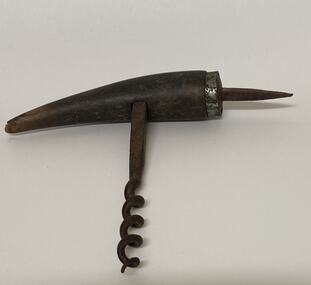
Domestic object - Corkscrew
... John Worlidge in 1676 describes "binning of tightly corked cider bottles on their sides", although the earliest reference to a corkscrew is, "steel worm used for the drawing of Corks out of Bottles" from 1681. In 1795, the first corkscrew patent was granted to the Reverend Samuel Henshall, in England. The clergyman affixed a simple disc, now known as the Henshall Button, between the worm and the shank. The disc prevents the worm from going too deep into the cork, forces the cork to turn with the turning of the crosspiece, and thus breaks...John Worlidge in 1676 describes "binning of tightly corked cider bottles on their sides", although the earliest reference to a corkscrew is, "steel worm used for the drawing of Corks out of Bottles" from 1681. In 1795, the first corkscrew patent was granted to the Reverend Samuel Henshall, in England. The clergyman affixed a simple disc, now known as the Henshall Button, between the worm and the shank. The disc prevents the worm from going too deep into the cork, forces the cork to turn with the turning of the crosspiece, and thus breaks ...The design of the corkscrew may have been derived from the gun worm, which was a device from at least the early 1630s, used by men to remove unspent charges from a musket's barrel in a similar fashion. The corkscrew is possibly an English invention, due to the tradition of beer and cider, and the 'Treatise on Cider' by John Worlidge in 1676 describes "binning of tightly corked cider bottles on their sides", although the earliest reference to a corkscrew is, "steel worm used for the drawing of Corks out of Bottles" from 1681. In 1795, the first corkscrew patent was granted to the Reverend Samuel Henshall, in England. The clergyman affixed a simple disc, now known as the Henshall Button, between the worm and the shank. The disc prevents the worm from going too deep into the cork, forces the cork to turn with the turning of the crosspiece, and thus breaks the adhesion between the cork and the neck of the bottle. The disc is designed and manufactured slightly concave on the underside, which compresses the top of the cork and helps keep it from breaking apart. In its traditional form, a corkscrew is simply a steel screw attached to a perpendicular handle, made of wood or some other material. The user grips the handle and screws the metal point into the cork, until the helix is firmly embedded, then a vertical pull on the corkscrew extracts the cork from the bottle. The handle of the corkscrew allows for a commanding grip to ease removal of the cork. https://en.wikipedia.org/wiki/CorkscrewMetal corkscrew with wooden handle. Has metal steel spike to create a starting point for the use of the corkscrew. Very rusty.corkscrew, kitchen equipment, bottle opener -
 Phillip Island and District Historical Society Inc.
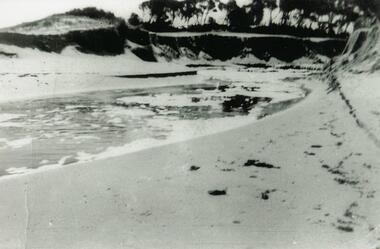
Photograph, 1954
... One of a collection of photos donated by Daryl Johns woolamai bight phillip island daryl johns Black & White photograph of Woolamai Bight - swamp water breaking through the channel onto the beach. ...One of a collection of photos donated by Daryl JohnsBlack & White photograph of Woolamai Bight - swamp water breaking through the channel onto the beach.woolamai bight, phillip island, daryl johns -
 Phillip Island and District Historical Society Inc.
Photograph, 1954
... One of a collection of photographs donated by Daryl Johns woolamai bight phillip island daryl johns Black & White Photograph of Woolamai Bight - water breaking through the channel to the beach. ...One of a collection of photographs donated by Daryl JohnsBlack & White Photograph of Woolamai Bight - water breaking through the channel to the beach.woolamai bight, phillip island, daryl johns -
 Phillip Island and District Historical Society Inc.
Photograph, Bryant West
... One of a collection of over 400 photographs in an album commenced in 1960 and presented to the Phillip Island & Westernport Historical Society by the Shire of Phillip Island local history photography photographs coastline rough seas the nobbies phillip island waves john jenner bryant west Photograph of waves breaking on the rocks at The Nobbies. ...One of a collection of over 400 photographs in an album commenced in 1960 and presented to the Phillip Island & Westernport Historical Society by the Shire of Phillip IslandPhotograph of waves breaking on the rocks at The Nobbies.local history, photography, photographs, coastline, rough seas, the nobbies, phillip island, waves, john jenner, bryant west -
 Orbost & District Historical Society
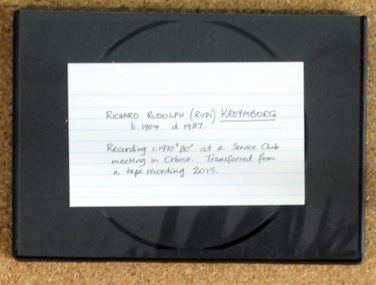
digital recording, Richard Rudolph Kreymborg, 2015
... John Phillips.) Richard Rudolph “Rudy” KREYMBORG was a well-known district identity, a man who was often described as a legend in his lifetime. He lived a rough life, breaking ...This recording was originally made C1970's-1980's at a service club meeting in Orbost. It was transferred from a tape recording in 2015. Rudy was the son of George James KREYMBORG and Ada Victoria (nee DAVIS). Born at Bulumwaal, near Bairnsdale he arrived in Orbost after time in Melbourne and then at the Bell Bird Hotel where his family had the mail run. In Orbost Rudy lived on the back of his his truck next to the present Murray Goulburn Store in „B‟ Road, Orbost with tw horses for company. (More info. from newsletter "RICHARD RUDOLPH KREYMBORG 1904-1987" by John Phillips.) Richard Rudolph “Rudy” KREYMBORG was a well-known district identity, a man who was often described as a legend in his lifetime. He lived a rough life, breaking horses, delivering mail on horseback, building roads and bridges, driving bulldozers and talking.A disc in a black plastic case. It is a recording of Richard Rudolph Kreynborg(b.1904 d.1987). It has been copied from a n original recording. -
 Flagstaff Hill Maritime Museum and Village
Container - Bottle, c. 1905
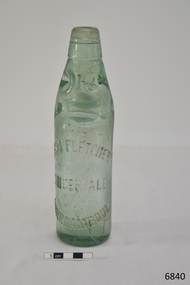
... break it for the marble. Codd bottles are still being produced in India and Japan for soft drinks. A Codd bottle with the same markings as this one is valued on today’s Australian auction sites from AUD 35 - $75. flagstaff hill warrnambool shipwrecked coast flagstaff hill maritime museum maritime museum shipwreck coast flagstaff hill maritime village great ocean road codd bottle codd neck bottle marble bottle ginger beer bottle john fletcher soft drinks warrnambool soft drinks and cordials john fletcher cordial (or beverage) co . codd neck bottle glass stopper bottle hiram codd antique bottle Harold Caffin john fletcher Marks moulded into glass; "JOHN FLETCHER / GINGER ALE / WARRNAMBOOL" and “DOBSON” and on base “G”. ...This bottle once contained John Fletcher’s ginger cordial. It was found in August 2014 in the sand dunes at Levy's Point, near McKinnon's quarry, Warrnambool. ABOUT JOHN FLETCHER of WARRNAMBOOL John Fletcher Cordial (or Beverage) Co.. Warrnambool supplied cordial and aerated drinks to the Western District of Victoria. John Fletcher was named as a cordial manufacturer in the Warrnambool Standard of June 13th 1895, when he attended a Publican’s Association meeting. Mr John Fletcher, aerated water and cordial manufacturer of Koroit Street, Warrnambool, had a summary of his factory printed in a short article in the Advocate, Melbourne, in February 1901. The article said, “one of the most complete plants outside the metropolis … spacious … well appointed …old-established business … noted for the excellence of the quality … a trial [of the beverage] is solicited.” John Fletcher and Harold Caffin, trading as J.S. Rowley & Co, cordial manufacturers in 1903, were prosecuted in September that year when the Board of Health found an analysed sample of Raspberry Vinegar to contain coal tar colouring, which could be injurious to health, particularly to the kidneys. The factory was still in operation in December 1924, when sadly, Mr S. Fletcher, who was carrying bottles of aerated water at Mr John Fletcher’s cordial factory, sustained an eye injury when one of the bottles burst. Later, the eye had to be removed at the Warrnambool Base Hospital. ABOUT CODD BOTTLES Many inventions during the mid-to-late 1800s kept the fizz in carbonated drinks, such as ginger ale, soda water, and fruit drinks. Hiram Codd, an English engineer, invented a successful process that he patented as “Codd’s patented globe stopper bottle” in 1872. The Codd-neck bottle (commonly called Codd or marble bottle) is manufactured in two parts. The body of the bottle is cast in two sections. At the time of joining the sections, a glass marble and rubber seal are inserted into the neck section. The lip is then applied to the top of the bottle. The Codd bottle is filled upside down as the pressure of the gas from the carbonated liquid holds the marble up and out of the way. When the bottle stands upright, the gas pushes the marble up against the washer, creating a firm seal to keep the fizz inside. The bottle is opened by pushing the marble down firmly to allow some of the gas to escape. The marble drops down and is caught in a depression formed in the neck. When the bottle is tilted to pour or drink the liquid, the marble rests in a dimple. Some have said that the bottle is a character, the shape having a face with its mouth keeping the marble out of the drink and eyes that catch the marble so that it doesn’t roll into the mouth of the drinker. The Codd bottle was expensive to produce, and children loved to destroy the marbles to play with the marbles inside. Many shops and factories added a deposit to the cost of buying the drink to encourage children to return the bottles rather than break it for the marble. Codd bottles are still being produced in India and Japan for soft drinks. A Codd bottle with the same markings as this one is valued on today’s Australian auction sites from AUD 35 - $75. Bottle, aqua/green glass, with glass marble inside. John Fletcher's Ginger Ale, Warrnambool. Container is often called a "Codd neck bottle", “marble bottle” or “Codd’s patent bottle”. Bottle made by Dobson. Inscription on bottle and base. c. 1905Marks moulded into glass; "JOHN FLETCHER / GINGER ALE / WARRNAMBOOL" and “DOBSON” and on base “G”. flagstaff hill, warrnambool, shipwrecked coast, flagstaff hill maritime museum, maritime museum, shipwreck coast, flagstaff hill maritime village, great ocean road, codd bottle, codd neck bottle, marble bottle, ginger beer bottle, john fletcher soft drinks, warrnambool soft drinks and cordials, john fletcher cordial (or beverage) co ., codd neck bottle, glass stopper bottle, hiram codd, antique bottle, harold caffin, john fletcher -
 Mission to Seafarers Victoria
Furniture - Writing Desk, 1928
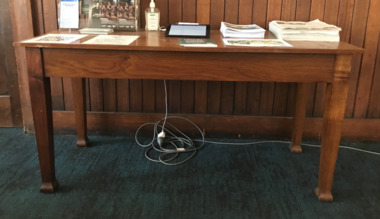
... It is large enough for two people to write letters at the same time, and is the lift of the Misses Breaks, in memory of their mother." Alice Jobson was born in 1856 Alice, born at St. John’s...It is large enough for two people to write letters at the same time, and is the lift of the Misses Breaks, in memory of their mother." Alice Jobson was born in 1856 Alice, born at St. John’s ...In the Jottings Midwinter 1928: " We have had a splendidement addition in the Apprentices' Room (Level 1) - a beautiful polistes oak writing table with a glass top. It is large enough for two people to write letters at the same time, and is the lift of the Misses Breaks, in memory of their mother." Alice Jobson was born in 1856 Alice, born at St. John’s Westminster, England. On the 23rd. May, 1876 she married James Lennox Breaks at Holy Trinity Church of England at Williamstown, Victoria. James Breaks was born c.1848 in Portsmouth, England. At age 22, he sailed on the maidden voyage of the HMVS Cerberus from England to Australia via the Suez Canal. He was one of the 3 junior engineers. James and Alice Breaks had two daughters – Louise Amy born at Williamstown in 1877 and Alice Maud born at Williamstown in 1879. James remained associated with the Cerberus until his death. On the 6th. February, 1919, James Lenox Breaks, “Engineer Commander R.A.N.”, died at 34 The Strand, Williamstown from Chronic nephritis and Cardiac failure. James, aged 70 years at the time of his death, was buried in the Williamstown Cemetery. In 1920, Alice donated the model of the Cerberus made by James, to the Melbourne Museum. Alice Breaks passed away on the 31st of May 1927 in her 71st year.The Breaks were a locals of Williamstown. James Breaks was Engineedr-Commander on the HMS Cerberus and Mrs Breaks and their daughters (Maud and Louise) were all volunteering at the Williamstown Mission.Wooden table with two drawers and plaque on the top.On the plaque: In memory of / Alice Breaks / Mother to many a sailor lad / Far from his native home / Whose praise is in the seven seasmaude breaks, louise (lulu) amy breaks, alice breaks nee jobson, ladies harbour lights guild, williamstown, hms cerberus, james l. breaks -
 Australian National Surfing Museum
Photograph, John Witzig, Bob McTavish photograph Bells Beach 1 1965, 18/04/1965
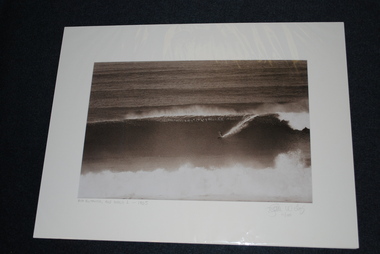
... John Witzig, is of of Bob McTavish riding a very large waves (15'+) at Bells Beach on Easter Sunday (April 18th) 1965. This wave is thought to be the same one described by McTavish in his book as one of the biggest, most powerful waves he had ridden, almost resulting in his drowning after being washed down past the next headland at winki pop. Bells, Easter, 1965 is considered one of the biggest days that this break...John Witzig, is of of Bob McTavish riding a very large waves (15'+) at Bells Beach on Easter Sunday (April 18th) 1965. This wave is thought to be the same one described by McTavish in his book as one of the biggest, most powerful waves he had ridden, almost resulting in his drowning after being washed down past the next headland at winki pop. Bells, Easter, 1965 is considered one of the biggest days that this break ...This photo, part 1 of a 2 photo sequence taken by John Witzig, is of of Bob McTavish riding a very large waves (15'+) at Bells Beach on Easter Sunday (April 18th) 1965. This wave is thought to be the same one described by McTavish in his book as one of the biggest, most powerful waves he had ridden, almost resulting in his drowning after being washed down past the next headland at winki pop. Bells, Easter, 1965 is considered one of the biggest days that this break has been surfed. The surfer in the photograph, Bob McTavish would go on to become one of the most influential surfer/shapers in Australian during the next decade.The extremely large waves experienced by surfers at Bells Beach on Easter Sunday 1965 is part of surfing folklore. The wave featured in this photograph is considered one of the largest ridden waves ever documented at Bells Beach.Large black and white (sepia toned) photo. Part 1 of a 2 photo sequence taken by John Witzig of Bob McTavish riding a very big wave at Bells Beach. Photo is titled 'Bob McTavish Big Bells 1 - 1965', and signed and numbered by John Witzig (11/100). Signed by John Witzig. Numbered 11 / 100bells beach, john witzig, bob mctavish, easter sunday 1965, bells beach surfing classic -
 Ringwood and District Historical Society
Article, Maroondah Secondary College - Newspaper article 8-4-1997 - "Police and college join forces"
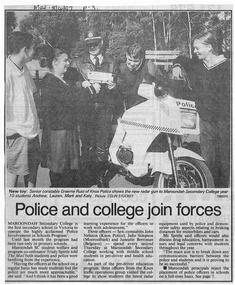
... John Neilson (Knox Police), Julie Simpson (Mooroolbark), and Jeanette Berriman (Belgrave) — visit the school every second Thursday to work with middle‑school students on pre‑driver education and health topics. As part of this, officers from the Knox traffic operations group demonstrated radar equipment and discussed braking distances for cars and motorbikes. A photo shows Senior Constable Graeme Rust presenting a radar gun to Year 10 students Andrew, Lauren, Mark, and Katy. Throughout the year, officers will also cover drug education, harassment, and legal issues. Spittle says the program’s main aim is to break...John Neilson (Knox Police), Julie Simpson (Mooroolbark), and Jeanette Berriman (Belgrave) — visit the school every second Thursday to work with middle‑school students on pre‑driver education and health topics. As part of this, officers from the Knox traffic operations group demonstrated radar equipment and discussed braking distances for cars and motorbikes. A photo shows Senior Constable Graeme Rust presenting a radar gun to Year 10 students Andrew, Lauren, Mark, and Katy. Throughout the year, officers will also cover drug education, harassment, and legal issues. Spittle says the program’s main aim is to break ...Newspaper clipping - The article describes Maroondah Secondary College becoming the first secondary school in Victoria to run the Police Involvement in Schools Program, previously used only in primary schools. Trudy Spittle, the school’s student welfare and program co‑ordinator, explains that having police officers regularly on campus has made students feel more comfortable approaching them, while also giving officers valuable experience working with adolescents. Three police officers — Senior Constable John Neilson (Knox Police), Julie Simpson (Mooroolbark), and Jeanette Berriman (Belgrave) — visit the school every second Thursday to work with middle‑school students on pre‑driver education and health topics. As part of this, officers from the Knox traffic operations group demonstrated radar equipment and discussed braking distances for cars and motorbikes. A photo shows Senior Constable Graeme Rust presenting a radar gun to Year 10 students Andrew, Lauren, Mark, and Katy. Throughout the year, officers will also cover drug education, harassment, and legal issues. Spittle says the program’s main aim is to break down communication barriers between students and police, and that it is already proving highly successful. (Co-pilot summary 8/8/2026)Caption "New toy" (Showing the radar gun)
