
Showing 9 items matching "john calvin"
-
 Warrnambool and District Historical Society Inc.
Booklet, John Calvin and The Modern World, 1909
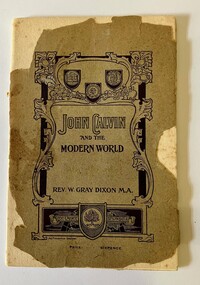
... John Calvin and The Modern World.......john calvin...The book contains a portrait of John Calvin, three black and white photographs of places in Geneva, the music of a song, ‘The Marseillaise of the Reformation’ and some verse. ...Front Cover: ‘John Calvin and the Modern World, Rev. W. Gray Dixon, M.A., Price Sixpence’ Inscription on first page: ‘To Marcus Saltau, Esq. with the esteem & affection of the Author, Auckland, 9th February 1910’ ...It is one of two Gray Dixon pieces of writing that the Historical Society possesses and it is of double significance when it is noted that Marcus Saltau, the owner of the booklet was a friend of Gray Dixon’s, and was also a most important person in Warrnambool’s history. rev. w. gray dixon marcus saltau warrnambool john calvin john calvin and the modern world Front Cover: ‘John Calvin and the Modern World, Rev. ...This booklet contains the address given by the Rev. W. Gray Dixon in 1909 at St. Paul’s Christ church to the General Assembly of the Presbyterian Church of New Zealand. It was published at the request of the General Assembly and the proceeds of the sale of the booklet went into Presbyterian Church funds. The Rev. William Gray Dixon was born in Scotland and was the Presbyterian Minister at St. John’s Warrnambool from 1889 to 1900. In 1900 he went to New Zealand to St. David’s Church, Auckland and later to Dunedin. Rev. Gray Dixon was the author of several publications relating to Presbyterian Church history and activities. This booklet was sent from Auckland by Rev. Gray Dixon to Marcus Saltau, his friend in Warrnambool. Marcus Saltau (1869-1945) followed his father in the produce business in Warrnambool and expanded it to include management of the Warrnambool tramway (which took freight from the town to the port) and a shipping business that had its own vessels and an interstate and international trade. Marcus Saltau was prominent in Warrnambool’s community as a Councillor, Mayor and a politician (Upper House Member for the Western Province 1924-1940). He was a founding member of the Warrnambool Woollen Mill Company, concerned with the establishment of the Nestles Factory at Dennington and a Warrnambool Hospital committee member and Chairman for over 30 years. The Jean Buick Saltau Maternity Ward and Marcus Saltau House at the Warrnambool Hospital survived as important community buildings for many years. This little booklet is of high significance as it is connected to two important Warrnambool people of the past – the Rev. William Gray Dixon and Marcus Saltau. It is one of two Gray Dixon pieces of writing that the Historical Society possesses and it is of double significance when it is noted that Marcus Saltau, the owner of the booklet was a friend of Gray Dixon’s, and was also a most important person in Warrnambool’s history. This is a soft-cover booklet of 22 pages. The cover which is completely detached and very torn is grey-coloured with dark blue and grey ornamental scrolls and shields around the title of the book. The book contains a portrait of John Calvin, three black and white photographs of places in Geneva, the music of a song, ‘The Marseillaise of the Reformation’ and some verse. The book was stapled but the staples have been removed. The pages are made of lightweight parchment paper. The illustrations have been glued in. The text is a publication of an address given by the author, Rev. W. Gray Dixon to the General Assembly of the Presbyterian Church of New Zealand in 1909. Front Cover: ‘John Calvin and the Modern World, Rev. W. Gray Dixon, M.A., Price Sixpence’ Inscription on first page: ‘To Marcus Saltau, Esq. with the esteem & affection of the Author, Auckland, 9th February 1910’ rev. w. gray dixon, marcus saltau, warrnambool, john calvin, john calvin and the modern world -
 Bendigo Historical Society Inc.
Book - LYDIA CHANCELLOR COLLECTION: THE LIFE OF JOHN CALVIN
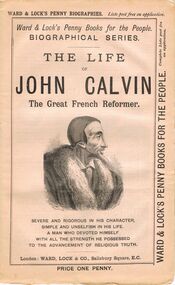
... LYDIA CHANCELLOR COLLECTION: THE LIFE OF JOHN CALVIN......john calvin...A book titled 'The Life of John Calvin the Great French Reformer. Severe and rigorous in his character, simple and unselfish in his life. ...BOOKS Biography john calvin Lydia Chancellor collection John Calvin person individual male famous people French history France religion Ward & Lock's Penny Biographies biographies Ward & Lock's Penny Books for the People Biographical Series advertisements penny books A book titled 'The Life of John Calvin the Great French Reformer. ...A book titled 'The Life of John Calvin the Great French Reformer. Severe and rigorous in his character, simple and unselfish in his life. A man who devoted himself with all the strength he possessed to the advancement of religious truth.' London : Ward, Lock & Co., Salisbury Square, E.C.545 - 560 pgs. This booklet is one of a series of 53 ' Ward & Lock's Penny Books for the People.' 'Biographical Series.' Price one penny. There are advertisements of note.books, biography, john calvin, lydia chancellor, collection, john calvin, person, individual, male, famous people, french history, france, religion, ward & lock's penny biographies, biographies, ward & lock's penny books for the people, biographical series, advertisements, penny books -
 Bendigo Historical Society Inc.
Document - National Trust Collection: Churches of Bendigo and Inglewood, Nov 7th 1965
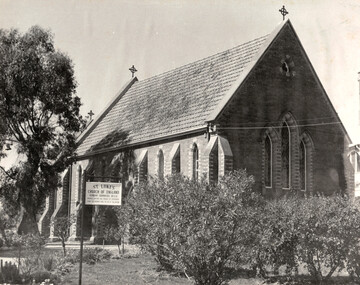
... The Calvin Street church was named in honor of John Calvin, a notable figure who lived in the area. ...It documents the present owner and occupant, including their addresses, the date of initial construction and supporting evidence for that date. 3084.36f Handwritten letter re history of St Johns Presbyterian Church Bendigo, 13th October 1980 - author unknown 3084.36g Typed notes - "Interesting information on the Sacred Heart Cathedral Bendigo", and hand-written notes on St Pauls Cathedral. 3084.36h Two pages of typed notes. Three main Congregational church buildings existed in Bendigo: at the corner of Forest and Mackenzie Streets (the original site), on Quarry Hill (corner of Russell and Gladstone Streets), and on Calvin Street (later the Lutheran Church). 3084.36i Hand-written notes on St Pauls Cathedral....The Calvin Street church was named in honor of John Calvin, a notable figure who lived in the area. ...St LUKES ANGLICAN CHURCH BENDIGO In 1852, a party of Cornish miners, refusing to give up and having dug, by hand, down nearly 70 feet ‘got their reward. Suddenly, their picks sank into soft pipe-clay, white, satin-smooth and seemingly depthless. The men began tunnelling. Presently, the roof forming above them showered gold at their feet – the secret of Bendigo’s famous White Hills lay revealed.’ In the ‘wild rush’ that followed, when ‘the White Hills yielded enormously and some pretty piles were made’, a young Anglican priest, John Herbert Gregory, held the first Anglican church service at White Hills in 1853. The Hamlet of White Hills was surveyed and mapped in 1854 and, by 1863, St Luke’s Church in White Hills was opened on ‘an elevated site’ in a generously sized ‘church reserve’. St AUGUSTINE'S CHURCH MYERS FLAT Early diggers to this area were men named Myers and Nicholls, hence the name - Myers Flat and Myers Creek. 1857 saw the discovery of gold in the area and in less than one month 1000 ounces of gold per week resulted. The number of diggers in the Myers Creek or Burnt Gully totalled 4000 to 5000. Myers Creek consisted of several shops and buildings, two hotels, a race course and a lock-up built of logs. On November 6th, 1864, the opening of the new church of St Augustine' took place. The first mass was celebrated by the Reverand Dean Hayes, of St Killian's Sandhurst. The church of gothic design was built by a local contractor, and with bricks made from local clay. The church also has a fire place and is widely known as "The church with the Chimney. For many years it was also a Catholic school. St AUGUSTINE'S CHURCH INGLEWOOD The church features an Early English design from 1864 and Decorated Gothic extensions from 1884.Notable elements include the sanctuary with the Catto Memorial window and interior cusped arcading of the wainscot. Architectural attribution is given to Vahland and Getzschmann for one or both sections. St JOHNS CHURCH (PRESBYTERIAN) BENDIGO The church's architect was W C Vahland VIA, and the builder was N Langstaff. It was built in April 1890, and opened in Feb 1891. The tender price was 2,481 pounds. The church style was gothic, built by the Congregational Church to replace an earlier building built in 1858. St Johns bought the church in 1949 and made additions in 1951. THE SACRED HEART CATHEDRAL BENDIGO Originally designed in 1895 by Reed, Smart and Tappin of Melbourne, the first stage opened in September 1901; the second stage began in January 1954 and was expected to finish in late 1976. Skilled stonemasons were brought from overseas for the completion. The Exterior built from Geelong sandstone and Harcourt granite, matching the original materials for color consistency. The cathedral is designed in the early English Gothic style. It Features a tower and spire weighing several thousand tons, with the spire rising 282 ft. from the floor and topped by a 10 ft. cross.Interior. The original stained glass window, made in Birmingham, England, is above the main entrance on the west side. Marble for the floor was imported from Vincenzo and Via Reggio, Italy; Sicilian Pearl marble is used in the four chapels. Ceilings in the chapels feature Western red cedar and yellow pine timbers.The transept includes Australian blackwood paneling and 12 carved shields representing the apostles. The internal height from floor to ceiling is 80 ft.Artistic Elements. Two large tapestries, specially designed and crafted by Mrs. Carrington, hang in the sanctuary as a symbolic link to Bendigo. ST PAULS BENDIGO The nave was built in 1868 and the tower in 1873. The nave is notable for unusual ceiling with metal and timber overlay members. The tower notable for early brick and bold Gothic influenced design. The church was opened on 12th Nov 1868 and a new chancel sanctuary and Transepts were added on 22 Oct 1927. The architect was Robert A Love. CONGREGATIONAL CHURCHES IN BENDIGO Three main Congregational church buildings existed in Bendigo: at the corner of Forest and Mackenzie Streets (the original site), on Quarry Hill (corner of Russell and Gladstone Streets), and on Calvin Street (later the Lutheran Church). The Calvin Street church was named in honor of John Calvin, a notable figure who lived in the area. In June 1858, 1.5 acres of land were purchased at the Forest and Mackenzie Streets corner for £1200.The first church was built on this site in November 1858 and later enlarged in May 1867 to seat 500 people. A prefabricated parsonage stood nearby until about 1920, serving as a caretaker's cottage for several years. In 1890, foundation stones for a new church designed by W.C. Vahland were laid, featuring a tall tower and two gable crossings (reduced from three to save costs). The new church opened on February 26, 1890, costing £2483. The contractor was N. Longstaff. Some architectural elements, such as the chancel, were added later when St. John's Presbyterian took over the building. Congregational attendance declined, leading to the purchase and alteration of a brick school complex in Olinda Street to serve as their headquarters.The timber church on Russell Street and the Calvin Street property were sold.The valuable Forest Street property was eventually sold to a London sect and later became an investment for the Methodist Church.Historical information on seven denominational churches in Bendigo and Inglewood. This item contains the following items: 3084.36a Black and white photo of St Lukes Bendigo Church of England, Napier Street, White Hills. 3084.36b St Augustine's Church Myers Flat 100 years newsletter 1965. The newsletter's purpose is for a Commemorative afternoon mass in memory of the pioneers of Myers Flat and district.Celebration of the 101st anniversary of the first mass at St. Augustine's Church; on Sunday, November 7th, 1965, at 2:00 PM.Location: St. Augustine's Church, Myers Flat. The invitation is extended to the recipient and their friends. This invitation serves both as a memorial and a community gathering to honour local history. Also included is some hand-written history notes of the church - See the notes in the Historical Section above. 3084.36c This document is a formal letter dated 9th November 1970 from the National Trust of Australia (Victoria) to Bishop Bernard Stewart. St. Augustine's Church in Bendigo has been awarded a "D" classification by the National Trust's expert committee. The church is now officially "recorded" by the National Trust. The letter is addressed to Bishop Bernard Stewart, with copies sent to Father Louis McDonnell (Eaglehawk), A. J. Watts (Town Clerk, Bendigo), and Mrs. R. R. Adams (Secretary, Central Victorian Branch). 3084.36d This document is a formal letter from the National Trust of Australia (Victoria) to Miss L. Doble, Registrar of the Bendigo Church of England Diocese, dated March 20, 1973. St. Augustine's Church of England in Inglewood has been officially placed on the National Trust's Classified List. This classification recognizes the church as essential to Australia's heritage and emphasizes its preservation. The church features an Early English design from 1864 and Decorated Gothic extensions from 1884.Notable elements include the sanctuary with the Catto Memorial window and interior cusped arcading of the wainscot. Architectural attribution is given to Vahland and Getzschmann for one or both sections. The church is about to celebrate the centenary of its consecration on May 13, with the Archbishop expected to attend. 3084.36e This document is a survey form used by the National Trust of Australia (Victoria) to collect detailed information about St Augustine's Church at Myers Flat. It records the original purpose, present use, and current name of the building.Requires a precise address or location description for site visits.It captures special features or points of interest not visible in photographs. It documents the present owner and occupant, including their addresses, the date of initial construction and supporting evidence for that date. 3084.36f Handwritten letter re history of St Johns Presbyterian Church Bendigo, 13th October 1980 - author unknown 3084.36g Typed notes - "Interesting information on the Sacred Heart Cathedral Bendigo", and hand-written notes on St Pauls Cathedral. 3084.36h Two pages of typed notes. Three main Congregational church buildings existed in Bendigo: at the corner of Forest and Mackenzie Streets (the original site), on Quarry Hill (corner of Russell and Gladstone Streets), and on Calvin Street (later the Lutheran Church). 3084.36i Hand-written notes on St Pauls Cathedral.history, church, national trust bendigo collection, sacred heart cathedral bendigo, st augustine's church myers flat, st pauls church bendigo, st johns presbyterian church bendigo, congregational church bendigo -
 Flagstaff Hill Maritime Museum and Village
Instrument - Organ and stool, 1897-1901
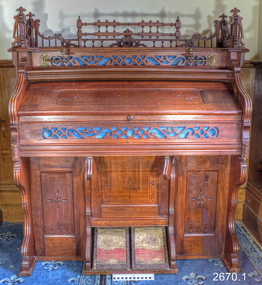
... The “Warrnambool Standard” newspaper has reference to John Broadwood Shepherd and Son in a newspaper of 1887 and another dated April 13, 1901. A brief history of the Packard Company: 1850, Isaac T. Packard joined with Nelson J. Foss and Calvin...The “Warrnambool Standard” newspaper has reference to John Broadwood Shepherd and Son in a newspaper of 1887 and another dated April 13, 1901. A brief history of the Packard Company: 1850, Isaac T. Packard joined with Nelson J. Foss and Calvin ...This chapel organ, or pump organ, was made by the Packard Company of Fort Wayne, USA. It was purchased locally from John Broadwood Shepherd & Son of Liebig St, Warrnambool. The donor advised that it was played for many years in the Winslow Presbyterian Church, southwestern Victoria (on Caramut Road, now a private residence). The serial number of the organ dates to be no older than 1887 and no younger than 1901, according to The Pump Organ Society. The goals of The Packard Company, as quoted from the Fort Wayne Gazette, 6th August 1873 are summarised as such; “In the first place, it was determined to make an organ which should be excelled by none. …. It is interesting to the uninitiated to watch the different processes which literally convert the trees of the forest into the marvellous instruments which sound the praises of God in thousands of churches and Sabbath Schools, or make sweet music in multitudes of homes.” The music store of John Broadwood Shepherd and Son had an “impressive” stand at The Great Warrnambool Exhibition of 1896 – 1897 and received a medal for its exhibit. It was also involved in the community, sponsoring prizes for the Musical and Recital Competition, which was part of the entertainment for the Exhibition. The “Warrnambool Standard” newspaper has reference to John Broadwood Shepherd and Son in a newspaper of 1887 and another dated April 13, 1901. A brief history of the Packard Company: 1850, Isaac T. Packard joined with Nelson J. Foss and Calvin Hatch to form Packard, Foss, & Co., manufacturing reed organs, seraphines, and melodeons 1871 the Fort Wayne Organ Company was formed, and Isaac Packard has 40 shares. 1872 the first organ was completed 5th Sept 1899, “Fort Wayne Organ Company” was officially changed to “The Packard Company” 1908 – 1914 (different dates given) the Packard Company ceased producing organs and specialised in pianos. 1930 company went into receivership 1935 the city of Fort Wayne acquired the former Packard Company property, tore the buildings down and turned it into a park, now known as Packard Park. The organ is significant to local history for being sold by a Warrnambool business and played at a local chape or church. It represents community and religious life in late Victorian times.Chapel organ or pump organ (with stool), dated not before 1897 and not after 1901. Medium brown timber with fretwork and turned spindles, Manufactured by Packard, Fort Wayne U.S.A. Organ was purchased from John Broadwood Shepherd & Son, Liebig St, Warrnambool. Serial number is stamped into the wood, rear of organ. lower right panel. Pedals are covered in carpet and each has the maker's name on the lower part of the pedal frame. The keyboard has five octaves and twelve stoppers.Words on front panel “Packard Organ / Fort Wayne Ind. U.S.A. / JOHN BORADWOOD SHEPHERD & SON, / LIEBIG STREET, WARRNAMBOOL.” Serial Number "48870"flagstaff hill, warrnambool, shipwreck coast, flagstaff hill maritime village, flagstaff hill maritime museum, maritime museum, great ocean road, pump organ, packard organ, fort wayne usa, john broadwood shepherd & son, john broadwood, winslow victoria, church music, musical instrument, john broadwood shepherd and son, presbyterian church, winslow presbyterian church, the great warrnambool exhibition 1896-1897 -
 Mt Dandenong & District Historical Society Inc.
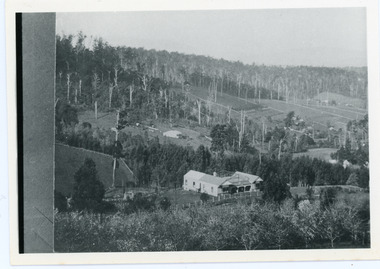
Photograph, Kalorama Valley c1913
... ...john willie richardson...mt calvin...Calvin' above it. Isaac Jeeves' pioneer complex is on the right. F.M. Child's complex is above it. The guest house 'Glenrivers' is at the far end of the clearing. The photograph was taken c1913. kalorama kia-ora guest house isaac jeeves f. m. child child jeeves john willie richardson mt calvin glenrivers Black and white photograph (copy of an original) looking across the Kalorama Valley with a view of vegetation and homesteads. ...The photograph shows the view from Crook's allotment #24. 'Kia-Ora' guesthouse is in the foreground with J.W. Richardson's home 'Mt Calvin' above it. Isaac Jeeves' pioneer complex is on the right. F.M. Child's complex is above it. The guest house 'Glenrivers' is at the far end of the clearing. The photograph was taken c1913.Black and white photograph (copy of an original) looking across the Kalorama Valley with a view of vegetation and homesteads. kalorama, kia-ora guest house, isaac jeeves, f. m. child, child, jeeves, john willie richardson, mt calvin, glenrivers -
 Mt Dandenong & District Historical Society Inc.
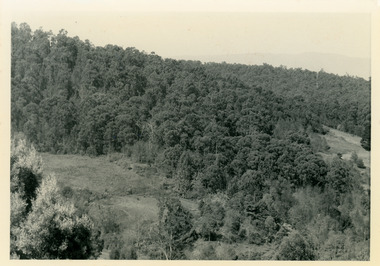
Photograph, Site of Jeannie Richardson's Home 1973
... calvin...jeannie richardson...jeanie green...john...It was in the clearing on the left that John William (Willie) Richardson built a home for his wife Jeanie Green. It was called Mount Calvin. ...It was in the clearing on the left that John William (Willie) Richardson built a home for his wife Jeanie Green. It was called Mount Calvin. ...John Lundy-Clarke grew up in the Kalorama/Mt Dandenong area and later in life (1972-74) began to write a comprehensive history of the area working from an original settlement map in an effort to cover all areas. It was in the clearing on the left that John William (Willie) Richardson built a home for his wife Jeanie Green. It was called Mount Calvin. Jeanie was often ill and the family left the area seeking a warmer climate. They eventually settled in Brisbane. Willie sold the home and 60 acres around it to W. Rowse. Jeanie died in 1916. The remainder of the land was sold by solicitors to cover debts. Black and white photograph showing a treed hillside with a cleared area to the left hand side. Handwritten inscription on reverse by John Lundy-ClarkeLooking towards the site of Jeannie's home from near Doughty’s Road Nov 1973. Her house was in the centre of the clearing on the left. Photo Jan 1974 JLC.mount calvin, jeannie richardson, jeanie green, john william richardson, willie richardson, jeanie richardson, rowse -
 Mt Dandenong & District Historical Society Inc.
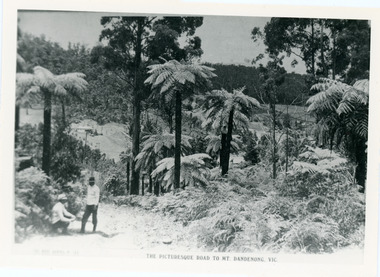
Photograph, View From Doughty's Road 1913
... Mt Calvin, the homestead of Jeanie and Willie Richardson can be clearly seen in the clearing above the men in the picture. The white roof of the Barber homestead is on the right of the picture. A landslide in 1934 destroyed the tree ferned area. John...Mt Calvin, the homestead of Jeanie and Willie Richardson can be clearly seen in the clearing above the men in the picture. The white roof of the Barber homestead is on the right of the picture. A landslide in 1934 destroyed the tree ferned area. John ...Mt Calvin, the homestead of Jeanie and Willie Richardson can be clearly seen in the clearing above the men in the picture. The white roof of the Barber homestead is on the right of the picture. A landslide in 1934 destroyed the tree ferned area. John Lundy-Clarke grew up in the Kalorama/Mt Dandenong area and later in life (1972-74) began to write a comprehensive history of the area working from an original settlement map in an effort to cover all areas.Black and white photograph that is a copy of a Rose series postcard titled 'The Picturesque Road to Mt. Dandenong. Vic.' It shows two men (probably Rose Series employees), one sitting and one standing at the edge of an unmade road. Large tree ferns line the roadside. Handwritten inscription on reverse by John Lundy-Clarke1913 View east from Doughty’s Road showing Jeannie Richardson’s home through the gap in the trees. A little to the right of and below centre of picture can be seen George Barber’s home with Barbers Road turning around the wagon shed that was a little up the hill from the house. The tree ferns in the picture were destroyed in the landslide of 1934. In the distance at the right can be seen F.M. Childs Homestead complex with the Richardson paddocks beyond it.mt calvin, jeanie richardson, willie richardson, george barber, landslide, tree fern -
 Mt Dandenong & District Historical Society Inc.
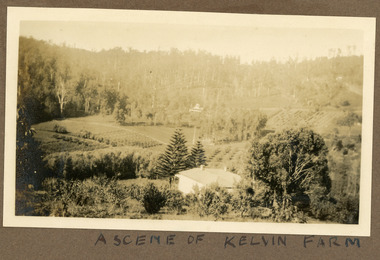
Photograph
... Calvin Farm...Richardson...Rowse...Jeanie Richardson...John...Most likely a scene of 'Mt Calvin', the homestead built by John William (Willie) Richardson for his wife Jeanie Green of Wandin. ...Most likely a scene of 'Mt Calvin', the homestead built by John William (Willie) Richardson for his wife Jeanie Green of Wandin. ...Most likely a scene of 'Mt Calvin', the homestead built by John William (Willie) Richardson for his wife Jeanie Green of Wandin. The house was built c1898 The Rowse family purchased the house and 60 acres when Willie and Jeanie Richardson with their 3 children moved to Brisbane. The Rowse family farmed the 60 acres for 35 years and the house was demolished in 1938. The photograph is from the album of Ivy May Child. Ivy May Child (1910 – 1989) was the daughter of Arthur Edward (Ted) Child (1878 – 1964) and Ethel May Madden (1888 – 1970). Ted Child was the son of Matthew Francis Child (1839 – 1933) and Martha Jeeves (1857 – 1926). He was the grandson of one of the early pioneers Francis Child. Ivy grew up on the family property on Childs Road and took many photographs. Most of these are glued into her photo album. The album covered the years from c1927 – 1932. Ivy married Henry William Burgess (1906 – 1968) in 1944. The photographs remain in their original state in the album with individual copies made. Black and white photograph with a house in the foreground looking over cultivated fields with treed hills in the background. A building is visible in the centre in the distance.Written below the photograph in the album" A SCENE OF KELVIN FARMmt calvin, kelvin farm, calvin farm, richardson, rowse, jeanie richardson, john william richardson, willie richardson -
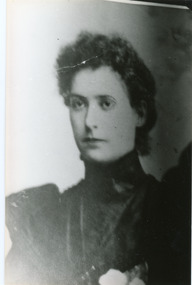 Mt Dandenong & District Historical Society Inc.
Photograph, Jeannie Green
... John Willie Richardson...Rueben Richardson...William Richardson...Jean Richardson...Mt Calvin...Calvin". Jeanie had three children - Reuben born 1890, William born 1901 and Jean born 1910. Jeanie suffered ill health and required assistance with cooking and cleaning. The family left the area in search of a warmer climate for Jeanie. Jeannie Green Jeanie Green Willie Richardson John ...Jeannie Green from Wandin married Willie Richardson (son of the original settler Jabez Richardson) in 1898. They built a home in the Kalorama Valley and named it "Mt Calvin". Jeanie had three children - Reuben born 1890, William born 1901 and Jean born 1910. Jeanie suffered ill health and required assistance with cooking and cleaning. The family left the area in search of a warmer climate for Jeanie.Black and white studio portrait of a young Jeannie Green wearing a high necked dress.Jeanie Green (Mrs J W Richardson) born 1871 died 1916. Mother of Reuben, William, Jean.jeannie green, jeanie green, willie richardson, john willie richardson, rueben richardson, william richardson, jean richardson, mt calvin
