
Showing 35 items matching "joseph reed"
-
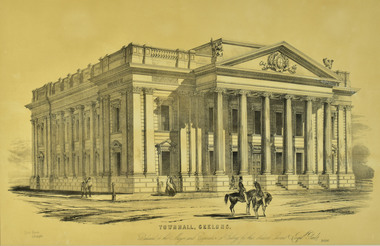 City of Greater Geelong
Lithograph by Cyrus Mason, Town Hall, Geelong
... Joseph Reed...Town Hall, Geelong Lithograph by Cyrus Mason Joseph Reed ... -
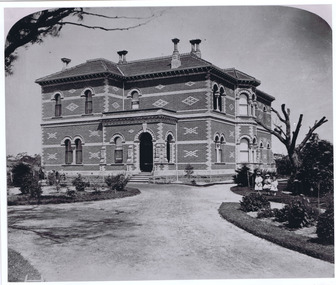 St Kilda Historical Society
Photograph - Building, Donald McDonald, Rippon Lea, 1872
... ...Joseph Reed...Built in 1868 for Sir Frederick Sargood, polychromatic romanesque style, architect Joseph Reed and Barnes, Photograph taken 1872. ...Built in 1868 for Sir Frederick Sargood, polychromatic romanesque style, architect Joseph Reed and Barnes, Photograph taken 1872. ...Two story polychorm mansion, Victorian rennaisance, arched nische balcony and arched entryway, Windows framed by arches, without double bay front rooms, garden setting with gravel drive and three little girls in formal dress. Built in 1868 for Sir Frederick Sargood, polychromatic romanesque style, architect Joseph Reed and Barnes, Photograph taken 1872. Rippon Lea estate now in the National Trust of Australiablack and white photograph, unmounted, copy, good conditionRipponlea Photo 1872frederick sargood, joseph reed, rippon lea, mansion -
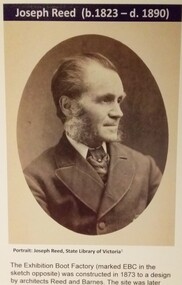 St Patrick's Old Collegians Association (SPOCA)
Photograph - SPOCA, ACU & SPJC Room
... Designer of Exhibition Boot Company in 1873 - Architect Joseph Reed (1823-90)...Designer of Exhibition Boot Company in 1873 - Architect Joseph Reed (1823-90) Photograph SPOCA, ACU & SPJC Room ... -
![Photograph, Bull, Hugh Jones, 1897-1993, [City buildings under demolition]](/media/collectors/68524623ad73480cc6fce59f/items/68f07d2d2b74709eaf6b0def/item-media/68f07d572b74709eaf6b1536/item-fit-380x285.jpg?cb=6) City of Melbourne Libraries
City of Melbourne LibrariesPhotograph, Bull, Hugh Jones, 1897-1993, [City buildings under demolition]
... ...joseph reed...Also Victoria Arcade, built 1876, architect Joseph Reed. On other side of Arcade is Gaiety Theatre (formerly known as Oxford Theatre). ...Also Victoria Arcade, built 1876, architect Joseph Reed. On other side of Arcade is Gaiety Theatre (formerly known as Oxford Theatre). ...Published: The Age 4 April 1934 p11 Published title: "DEMOLITION AND BUILDING ACTIVITIES IN THE CITY." Published caption: "Interesting studies in the building activities in the city are afforded by the above three photographs taken yesterday when work ceased owing to the rain. That on the left is a striking picture of the remains of the Palace Hotel buildings, running back from Bourke street to Little Collins street, better known as the Bijou Theatre. This is the largest demolition contract ever undertaken in Melbourne. The view is towards Bourke street, from a vantage point in Little Collins street. In the right centre of the ruins may be seen a large portion of the light frame and lattice work which extended over the once well known arcade. In the background three stories of Melbourne Coffee Palace, on the opposite side of Bourke street rise above the front of the theatre in the photograph, and the Melbourne General Hospital is just discernible through the mist at the top. The steel frame work in the centre picture is readily identifiable as that erected for the extension of the State Savings Bank at the south-west corner of Bourke and Elizabeth streets. The steel skeleton to the right, suggestive of immense strength, is that nearing completion in Collins street for the Bank of New South Wales." Trove article identifier: http://nla.gov.au/nla.news-article203828669 Description: Partial demolition of three-storied and five-storied buildings. One building has a large atrium. View of buildings taken from rear. Building at 225 Bourke Street (between Swanston and Russell, south side) contains Bijou Theatre. Also Victoria Arcade, built 1876, architect Joseph Reed. On other side of Arcade is Gaiety Theatre (formerly known as Oxford Theatre). Cityscape in background. Opposite is Melbourne Coffee Palace, built 1882, demolished c.1970. Featured in "Newsworthy: Melbourne in photographs 1933-1936" exhibition at East Melbourne Library, October to December 2023. Exhibition caption by project volunteer Louise McKenzie: "The largest demolition contract ever undertaken in Melbourne… The building on the left is a striking picture of the remains of the Palace Hotel buildings, running back from Bourke Street to Little Collins Street, better known as the Bijou Theatre. This is the largest demolition contract ever undertaken in Melbourne.” – The Age The Bijou Theatre was erected in 1877 and originally built as part of Victoria Arcade, which was entered through the Bourke Street frontage. The Theatre was “de rigueur with the gallants and belles of the period. Dainty ladies and white gloved, stiff collared dandies thronged the ‘promenade’ which runs under the theatre.” (Herald 5 Feb 1934) However by 1885, after a fire, the building had been rebuilt to include the three level Bijou Theatre. In November 1890, Arthur Streeton worked there briefly as a scenery painter. By 1909 it was the first “legitimate” theatre in Melbourne to screen films on a semi-permanent basis, while also covering vaudeville, pantomime and its wildly popular final program, “Mickey the Mouse” Revue. In this photo, it is being demolished by Whelan the Wrecker. The tiny iron spiral staircases that led to the dressing rooms (and down which more than one unwary actor sometimes fell) were salvaged and built into the fabric of Monsalvat at Eltham. References: https://theatreheritage.org.au/on-stage-magazine/stage-by-stage/item/52-bijou-theatrePhotographer notations on slide: "B20".demolished buildings, 1930-1939, joseph reed, theatres -
 Surrey Hills Historical Society Collection
Book, Raheen: a house and its people, 2007
... ...(mr) joseph reed...(mr) ian allen oam (mr) william lawrence bailieu ehud barak (dr) james broadbent (mr) robert bruce (mr) george h w bush (mrs) barbara pierce bush (mr) arthur calwell (ms) jane dennithorne (mr) eamon de valera (sir) james augustine gobbo (mr) lloyd hill (mr) william morris hughes (lord) (mr) immanuel jakobovits (mr) philip johnson (cardinal) (mr) walter kaspar moshe katsav (mr) james robert knox (mr) terence lane (mr) edward latham (mr) michael lehany (dr) (mr) miles lewis (mr) sam lipski am (sir) (mr) thomas francis little (mr) peter lovell (mr) egidio lunardon (mr) (cardinal) jean-marie lustiger (mr) daniel patrick mannix (sir) (mr) robert gordon menzies (mr) henry miller (mr) glen murcutt ao (mr) benjamin netanyahu (mr) ngo dinh diem (mr) phillip nikolitsis i (eoh) m(eng) pei (mr) shimon peres (mr) joseph reed (mr) yves st laurent (mr) william salway (mr) james henry scullin jessie serle (mr) justin david simonds (mrs) heliose waislitz (miss) heliose pratt (mr) john wren (sir) (mr) henry john wrixon (mr) richard pratt (mrs) jeanne pratt raheen historical buildings kew victoria italianate style house names Endpaper: Surrey Hills Historical Society / Jeanne Pratt / 27/7/2013 92p. ill. bibliog., Raheen was a grand two-storey red brick house in the Italianate Style, with a prominent tower and an arcaded loggia on two levels. ...Raheen is a 120 year old Victorian house owned by Richard and Jeanne Pratt. Mrs Jeanne Pratt commissioned the book and this copy was presented to Sue Barnett on a visit by members of the Boroondara Historical Societies. The visit was organised by local member Mr Josh Frydenburg. 92p. ill. bibliog., Raheen was a grand two-storey red brick house in the Italianate Style, with a prominent tower and an arcaded loggia on two levels. This book explores its history, restoration and further development over many years. 92p. ill. bibliog., Raheen was a grand two-storey red brick house in the Italianate Style, with a prominent tower and an arcaded loggia on two levels. This book explores its history, restoration and further development over many years.Endpaper: Surrey Hills Historical Society / Jeanne Pratt / 27/7/2013(mr) ian allen oam, (mr) william lawrence bailieu, ehud barak, (dr) james broadbent, (mr) robert bruce, (mr) george h w bush, (mrs) barbara pierce bush, (mr) arthur calwell, (ms) jane dennithorne, (mr) eamon de valera, (sir) james augustine gobbo, (mr) lloyd hill, (mr) william morris hughes, (lord) (mr) immanuel jakobovits, (mr) philip johnson, (cardinal) (mr) walter kaspar, moshe katsav, (mr) james robert knox, (mr) terence lane, (mr) edward latham, (mr) michael lehany, (dr) (mr) miles lewis, (mr) sam lipski am, (sir) (mr) thomas francis little, (mr) peter lovell, (mr) egidio lunardon, (mr) (cardinal) jean-marie lustiger, (mr) daniel patrick mannix, (sir) (mr) robert gordon menzies, (mr) henry miller, (mr) glen murcutt ao, (mr) benjamin netanyahu, (mr) ngo dinh diem, (mr) phillip nikolitsis, i (eoh) m(eng) pei, (mr) shimon peres, (mr) joseph reed, (mr) yves st laurent, (mr) william salway, (mr) james henry scullin, jessie serle, (mr) justin david simonds, (mrs) heliose waislitz, (miss) heliose pratt, (mr) john wren, (sir) (mr) henry john wrixon, (mr) richard pratt, (mrs) jeanne pratt, raheen, historical buildings, kew, victoria, italianate style, house names -
 Bendigo Historical Society Inc.
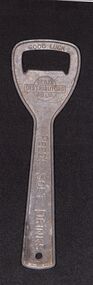
Domestic object - Reed's soft drink bottle opener
... Reed Bros is a historical soft drink brand associated with Bendigo, Victoria. Founded by Joseph Reed in 1900, the company initially produced aerated waters and later expanded to other products. ...Reed Bros is a historical soft drink brand associated with Bendigo, Victoria. Founded by Joseph Reed in 1900, the company initially produced aerated waters and later expanded to other products. ...Reed Bros is a historical soft drink brand associated with Bendigo, Victoria. Founded by Joseph Reed in 1900, the company initially produced aerated waters and later expanded to other products. The brand is known for its crystal bottles and has a rich history in the local beverage industry. After Joseph Reed's death, the business continued under his son, eventually being sold in 1966 to Cohn Bros.Metal bottle opener. Embossed with 'Reed's Soft Drinks' on handle, 'Brylen Distributors Pty Ltd' towards top of item, and 'Good Luck' at very top of item. Light metal. Has hole at base of opener - presumably for hanging the item. Reeds Soft Drinks and Brylen Distributors Pty Ltdreeds, soft drinks, cohns, bottle openner -
 Glen Eira Historical Society
Document - Organs
... ... Reed Joseph...Mary’s Church Caulfield Perry Bishop Reed Joseph Lee Kaye Taylor Hugh Ms. Stephen Miss Hart Mr. ...This file contains eight items about the history and construction of church organs in the Glen Eira area: 1/A photocopy of notes on the history of the church organ in the Bambra Road Church of Christ (1 page). 2/A photocopy of an extract from the book ‘The Christ Church Chronicles 1901-2001’ p20-24, by Vi Manson, giving a detailed description of the life of the organ in Christ Church Anglican Church, Ormond. It describes the building, relocation, restoration, rededication and role of the organ in church activities. 3/Extracts from ‘Colonial Organs and Organbuilders’, p121-122, 126, 131, 140, 182-183, by E. N. Matthews, 1969, about organ installations, repairs and sales. It contains entries about organs previously and currently located in Murrumbeena, Caulfield, Elsternwick, Balaclava and Bentleigh. 4/A photocopied extract from a letter from Mrs. M. Ring to the Caulfield Historical Society, dated 14/03/1986, describing the organ at ‘Crotonhurst’ (1 page). 5/A photocopy of notes (1 page), written by Trevor Hart, dated unknown, on the history and building of Elsternwick Congregational Church (Caulfield Union Church) containing a note about an organ built by George Fincham that was sold in 1962. 6/A photocopy of a small paragraph about the organ in St. Mary’s Anglican Church, paraphrased from E. N. Matthews ‘Colonial Organs and Organbuilders’, author and date unknown (1 page). 7/A photocopy of a page of a research project by Kate William, date unknown, giving a brief history of the organ and choirs at St. Mary’s Catholic Church, Caulfield. 8/A photocopy of a draft resolution to gift the Merklin-Shutze pipe organ located in the Uniting Church, Orrong Road, Ormond to the Australian Catholic University. Author and date unknown (1 page).bambra road church of christ, bambra road, organs, choirs, religious groups, fincham george, organists, fullard leonard, depression 1929-1939, world war 1939-1945, durance ronald rev., dunlop julie, larner john, muston ged. bishop, musical events and activities, christ church anglican church ormond, concerts, balaclava, holy trinity church balaclava, torrance g. w., parsons c. r., ure james, bryant mr., brentnall t., meedham s. p., inge h. j., stevens j. n., balaclava methodist church, fentum g. b., eggleston j., bentleigh, st. george’s church bentleigh, caulfield, st. mary’s church caulfield, perry bishop, reed joseph, lee kaye, taylor hugh ms., stephen miss, hart mr., kaye s., dixon miss, hardeman j. j., dumergue charles, wright j. d., dixon f. miss, courcelle john, elsternwick, elsternwick baptist church, warner l., andrewartha c. w., elsternwick methodist church, rippon lea, ripponlea, sargood frederick t. hon. sir., croton hurst, crotonhurst, webb g. h. f., mclaughlin j., murrumbeena, murrumbeena methodist church, hill william, hart trevor, caulfield historical society, caulfield union church, elsternwick congregational church, st. mary’s anglican church caulfield, music, dixon h. mr., smithers mr., merklin-schutze, orrong road, elsternwick/caulfield south church council, ormond -
 Ballarat Heritage Services
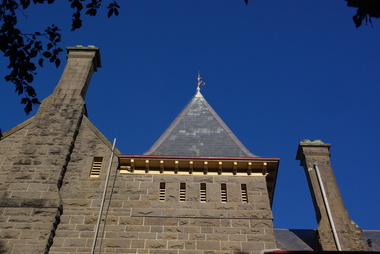
Photograph - Image - Colour, Bishop's Palace Featuring Chimneys and Roof Line, Ballarat, 2014, 23/02/2014
... The Palace was designed by Melbourne architect, Joseph Reed, of Reed and Barnes, and built by George Broom at a cost of £6,000. ...The Palace was designed by Melbourne architect, Joseph Reed, of Reed and Barnes, and built by George Broom at a cost of £6,000. ...Bishops Palace was built in 1877 as the home for the first Bishop of Ballarat. The Palace was designed by Melbourne architect, Joseph Reed, of Reed and Barnes, and built by George Broom at a cost of £6,000. The property is particularly notable for its four acres of impressive heritage-listed gardens. In 2019, Bishops Palace opened its doors to the public in the form of an accommodation, wedding and event venue.Colour image of the bluestone Bishop's Palace, and it's cast iron lace.architecture, garden, bishop's palace, cast iron lace, cast iron -
 Ballarat Heritage Services
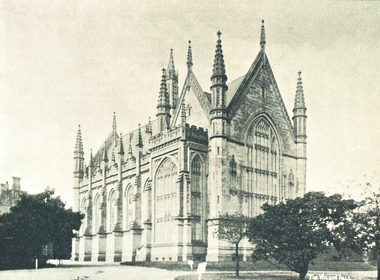
Image, Wilson Hall, Melbourne University
... It was designed in the Perpendicular Gothic style by Joseph Reed, constructed in stone and built on a very generous scale. ...It was designed in the Perpendicular Gothic style by Joseph Reed, constructed in stone and built on a very generous scale. ...The first Wilson Hall was the gift of Sir Samuel Wilson, who offered the University £30,000 in 1874 for this purpose. Building strated in 1878 and the hall was opened in 1882. It was designed in the Perpendicular Gothic style by Joseph Reed, constructed in stone and built on a very generous scale. In 1952 Wilson Hall was damage by fire, and a new hall was built on the site. The original Wilson Hall was destroyed by fired. Black and white photograph of Wilson Hall, a building in University of Melbourne. It was built in 1890 by Fincham & Hobday. wilson hall, university of melbourne -
 Bendigo Historical Society Inc.
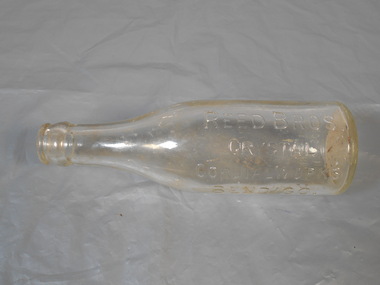
Domestic object - Bottle
... Joseph Reed was born in 1875 and came to Bendigo in 1900 after gaining experience at an aerated water factory in Melbourne. ...Joseph Reed was born in 1875 and came to Bendigo in 1900 after gaining experience at an aerated water factory in Melbourne. ...Joseph Reed was born in 1875 and came to Bendigo in 1900 after gaining experience at an aerated water factory in Melbourne. He built a new factory in Long Gully in 1906. He formed a partnership with his brother in 1908. By 1911 sales of aerated water were dropping dramatically so the brothers began making tomato sauce and moved into new premises - the old Bruce Cordial Factory in Bridge Street, Bendigo. Following Joseph's death, his share of the business was taken over by his son . The company was bought out in 1966 by Cohns.Small glass bottle smaller than full size REED BROS CRYSTAL CORDIAL WORKS BENDIGO. THIS BOTTLE IS THE PROPERTY OF REED BROS BENDIGObottle, glass, reed bros. -
 St Kilda Historical Society
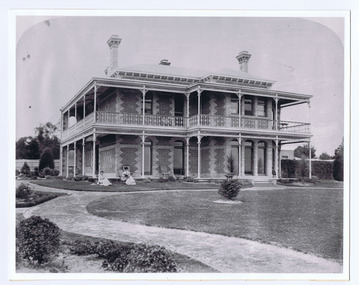
Photograph, Donald McDonald, Yanakie St Kilda, 1872
... The architect was Lloyd Tayler (1830-1900) and it was designed in the polychromatic Lombardic style that had been introduced to Melbourne by the architect Joseph Reed (1822-1890). Couch was a prominent merchant and businessman. ...The architect was Lloyd Tayler (1830-1900) and it was designed in the polychromatic Lombardic style that had been introduced to Melbourne by the architect Joseph Reed (1822-1890). Couch was a prominent merchant and businessman. ...Built for William Wilmot Couche (1829-1890) probably in 1869. The architect was Lloyd Tayler (1830-1900) and it was designed in the polychromatic Lombardic style that had been introduced to Melbourne by the architect Joseph Reed (1822-1890). Couch was a prominent merchant and businessman. He founded the firm Couch Calder & Co, was director of several insurance companies and a member of the Melbourne Harbour Trust for many years. From about 1900 the house was renamed Wavenhoe. In the 1920s Wavenoe Avenue was constructed through its gardens and most of the land sold off including the blocks at the corner of Hotham Street and Alma Road. The house still stands opposite St Kilda cemetery.black and white photograph copy -
 Ballarat Heritage Services
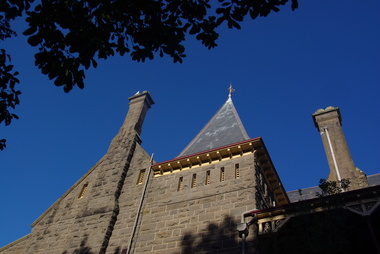
Photograph - Image - Colour, Clare Gervasoni, Bishop's Palace Ballarat Featuring Chimneys and Roof Line, Ballarat, 2014, 23/02/2014
... Designed by Melbourne architect, Joseph Reed, of Reed and Barnes, it was built by George Broom at a cost of £6,000. ...Designed by Melbourne architect, Joseph Reed, of Reed and Barnes, it was built by George Broom at a cost of £6,000. ...Bishops Palace was built in 1877 as the home for the first Catholic Bishop of Ballarat. Designed by Melbourne architect, Joseph Reed, of Reed and Barnes, it was built by George Broom at a cost of £6,000. Reed and Barnes also designed Melbourne’s State Library, Ripponlea Estate and the Melbourne Royal Exhibition Building. The original heritage-listed gold lead stencilled paintwork that can be seen in the front entry and on the staircase walls at Bishops Palace was replicated in the Royal Exhibition Building. The original property was 140 squares set on 11 acres of gardens and took up an entire block of Sturt Street. This was on scale with the importance of Ballarat as a gold-mining centre at the time. Bishop's Palace is of architectural, aesthetic and historical significance to the State of Victoria. The two-storey bluestone mansion is an impressive example of 19th-century Gothic architecture with an unusual design. It retains many of its original features, including lead stencilled paintwork, cornices, ceiling roses, fixtures and fittings. Since sold by the Catholic Church the Bishops Palace has undergone a number of transformations in its lifetime, from the home of the first Bishop to a private residence, and today, as a luxurious accommodation, wedding and events venue. The grounds were subdivided over the years, and the property is now surrounded by four of the original 11 acres of gardens. It opened its doors to the public in 2019.Colour image of the bluestone Bishop's Palace, and it's cast iron lace.architecture, garden, bishop's palace, cast iron lace, cast iron, catholic church -
 Ballarat Heritage Services
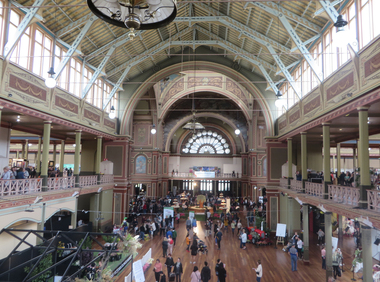
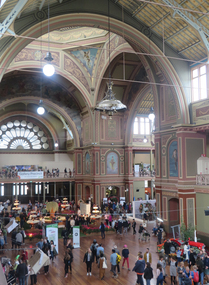
Photograph - Photograph -Colour, Clare Gervasoni, Interior of the Melbourne Exhibition Building, 2019, 31/03/2019
... The winner of 300 pounds was Joseph Reed of the architectual firm Reed and Barnes. ...The winner of 300 pounds was Joseph Reed of the architectual firm Reed and Barnes. ...A competition was announced to design a suitable building for the proposed Melbourne International Exhibition in December 1877. Eighteen entries were received. The winner of 300 pounds was Joseph Reed of the architectual firm Reed and Barnes. The foundation stone was laid by Governor Sir George Bowen on 19 February 1879. Prominent Melbounre builder David Mitchell, father of Dame Nellie Melba, won the tender to construct the main building. Exhibitors were able to move in by May 1880. On 01 October 1880 the Melbourne International Exhibition opened, when over 6000 people entered the main hall to see the Governor, the Marquess of Normanby open the show. Thirty three nations participated and ofver 32,000 exhibits were displayed. At the close of the exhibition on 30 April 1881 over 1.3 million people had visited the exhibition. In 1881 Victoria's population was just over 250,000. The management of the Exhibition Building and eight hectares of the Carlton Gardens was handed to the Exhibition Trustees by the Melbourne International Exhibition Commissioners on 01 OCtober 1881. The Trustees maintained the building for 'future public exhibitions and ... general public instruction and recreation' until 1996 when management of the building was transferred to Museum Victoria. In 1901 when the Australian colonies federated there was no capital and no federal parliament building. The Federal Parliament moved into the Victorian State Parliament building, and the State Parliament moved into the Western Annexe of the Exhibition Building for 26 years. After World War One, on 04 February 1919, the exhibition Building was turned into a hospital to treat Melbournians struck down with the Spanis 'Flu'. Initially housing 500 beds, the hospital grew to accomodate 2000 patients. Femals were located between the concert platform in the western nave and the done; male patients occupied the spaces beyond. The basement was used a a morgue. With the departure of the State Parliament in 1927 the western annexe became home to the Country Roads Board. In 1932 it was joined by the MOtor Registration Branch, and the Transport Regulation Board in 1934. They co-existedin cramped offices until the 1960s. In 1949 the oval at the rear of the ExhibitionBuilding was leased to the Commonealth Government for the establishment of the Migrant Reception Centre. When it closed in 1961-62, the centre comrised 29 bungalows over 1.4 hectare. The centre provided temporary accomodation for thousands of new arrivals from Britain. On 01 July 2004 the Royal Exhibition Building and Carlton Gardens were inscribed on the World Heritage List. It is the only 19th century Great Hall to survive largely intact, still in its original landscape setting, and still used as a palace of industry. The Melbourne International Flower and Garden Show is a flower show held annually since 1995 in early April each year, in Melbourne, Australia. It is located in the World Heritage Site of Carlton Gardens and the Royal Exhibition Building.[1] It is the largest horticultural event in the southern hemisphere, attracting over 100,000 visitors. It is rated among the top five flower and garden shows in the world. (Wikipedia)Colour photograph of the interior of the Melbourne Exhibition Buildings during the 2019 Melbourne Flower and Garden Show.melbourne international flower and garden show, carlton gardens, melbourne exhibition building, royal exhibition buildings -
 Ballarat Heritage Services
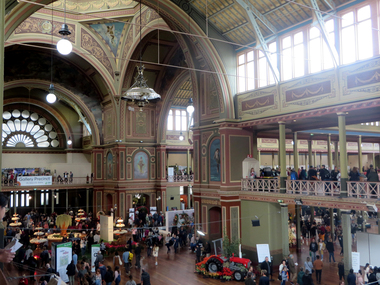
Photograph -Colour, Clare Gervasoni, Interior of the Melbourne Exhibition Building, 2019, 31/03/2019
... The winner of 300 pounds was Joseph Reed of the architectual firm Reed and Barnes. ...The winner of 300 pounds was Joseph Reed of the architectual firm Reed and Barnes. ...A competition was announced to design a suitable building for the proposed Melbourne International Exhibition in December 1877. Eighteen entries were received. The winner of 300 pounds was Joseph Reed of the architectual firm Reed and Barnes. The foundation stone was laid by Governor Sir George Bowen on 19 February 1879. Prominent Melbounre builder David Mitchell, father of Dame Nellie Melba, won the tender to construct the main building. Exhibitors were able to move in by May 1880. On 01 October 1880 the Melbourne International Exhibition opened, when over 6000 people entered the main hall to see the Governor, the Marquess of Normanby open the show. Thirty three nations participated and ofver 32,000 exhibits were displayed. At the close of the exhibition on 30 April 1881 over 1.3 million people had visited the exhibition. In 1881 Victoria's population was just over 250,000. The management of the Exhibition Building and eight hectares of the Carlton Gardens was handed to the Exhibition Trustees by the Melbourne International Exhibition Commissioners on 01 OCtober 1881. The Trustees maintained the building for 'future public exhibitions and ... general public instruction and recreation' until 1996 when management of the building was transferred to Museum Victoria. In 1901 when the Australian colonies federated there was no capital and no federal parliament building. The Federal Parliament moved into the Victorian State Parliament building, and the State Parliament moved into the Western Annexe of the Exhibition Building for 26 years. After World War One, on 04 February 1919, the exhibition Building was turned into a hospital to treat Melbournians struck down with the Spanis 'Flu'. Initially housing 500 beds, the hospital grew to accomodate 2000 patients. Femals were located between the concert platform in the western nave and the done; male patients occupied the spaces beyond. The basement was used a a morgue. With the departure of the State Parliament in 1927 the western annexe became home to the Country Roads Board. In 1932 it was joined by the MOtor Registration Branch, and the Transport Regulation Board in 1934. They co-existedin cramped offices until the 1960s. In 1949 the oval at the rear of the ExhibitionBuilding was leased to the Commonealth Government for the establishment of the Migrant Reception Centre. When it closed in 1961-62, the centre comrised 29 bungalows over 1.4 hectare. The centre provided temporary accomodation for thousands of new arrivals from Britain. On 01 July 2004 the Royal Exhibition Building and Carlton Gardens were inscribed on the World Heritage List. It is the only 19th century Great Hall to survive largely intact, still in its original landscape setting, and still used as a palace of industry. The Melbourne International Flower and Garden Show is a flower show held annually since 1995 in early April each year, in Melbourne, Australia. It is located in the World Heritage Site of Carlton Gardens and the Royal Exhibition Building.[1] It is the largest horticultural event in the southern hemisphere, attracting over 100,000 visitors. It is rated among the top five flower and garden shows in the world. (Wikipedia)Colour photograph of the interior of the Melbourne Exhibition Buildings during the 2019 Melbourne Flower and Garden Show. Four mottoes are painted under teh windows of the dome: Dei Grecia (By the grace of God), Carpe diem (Make the most of the day), Aude sapere (Dare to be wise) and Benigno numine (With benighn power)melbourne international flower and garden show, carlton gardens, melbourne exhibition building, royal exhibition buildings -
 Ballarat Heritage Services
Photograph - Photograph -Colour, Clare Gervasoni, Interior of the Melbourne Exhibition Building, 2019, 31/03/2019
... The winner of 300 pounds was Joseph Reed of the architectual firm Reed and Barnes. ...The winner of 300 pounds was Joseph Reed of the architectual firm Reed and Barnes. ...A competition was announced to design a suitable building for the proposed Melbourne International Exhibition in December 1877. Eighteen entries were received. The winner of 300 pounds was Joseph Reed of the architectual firm Reed and Barnes. The foundation stone was laid by Governor Sir George Bowen on 19 February 1879. Prominent Melbounre builder David Mitchell, father of Dame Nellie Melba, won the tender to construct the main building. Exhibitors were able to move in by May 1880. On 01 October 1880 the Melbourne International Exhibition opened, when over 6000 people entered the main hall to see the Governor, the Marquess of Normanby open the show. Thirty three nations participated and ofver 32,000 exhibits were displayed. At the close of the exhibition on 30 April 1881 over 1.3 million people had visited the exhibition. In 1881 Victoria's population was just over 250,000. The management of the Exhibition Building and eight hectares of the Carlton Gardens was handed to the Exhibition Trustees by the Melbourne International Exhibition Commissioners on 01 OCtober 1881. The Trustees maintained the building for 'future public exhibitions and ... general public instruction and recreation' until 1996 when management of the building was transferred to Museum Victoria. In 1901 when the Australian colonies federated there was no capital and no federal parliament building. The Federal Parliament moved into the Victorian State Parliament building, and the State Parliament moved into the Western Annexe of the Exhibition Building for 26 years. After World War One, on 04 February 1919, the exhibition Building was turned into a hospital to treat Melbournians struck down with the Spanis 'Flu'. Initially housing 500 beds, the hospital grew to accomodate 2000 patients. Femals were located between the concert platform in the western nave and the done; male patients occupied the spaces beyond. The basement was used a a morgue. With the departure of the State Parliament in 1927 the western annexe became home to the Country Roads Board. In 1932 it was joined by the MOtor Registration Branch, and the Transport Regulation Board in 1934. They co-existedin cramped offices until the 1960s. In 1949 the oval at the rear of the ExhibitionBuilding was leased to the Commonealth Government for the establishment of the Migrant Reception Centre. When it closed in 1961-62, the centre comrised 29 bungalows over 1.4 hectare. The centre provided temporary accomodation for thousands of new arrivals from Britain. On 01 July 2004 the Royal Exhibition Building and Carlton Gardens were inscribed on the World Heritage List. It is the only 19th century Great Hall to survive largely intact, still in its original landscape setting, and still used as a palace of industry. The Melbourne International Flower and Garden Show is a flower show held annually since 1995 in early April each year, in Melbourne, Australia. It is located in the World Heritage Site of Carlton Gardens and the Royal Exhibition Building.[1] It is the largest horticultural event in the southern hemisphere, attracting over 100,000 visitors. It is rated among the top five flower and garden shows in the world. (Wikipedia)Colour photograph of the interior of the Melbourne Exhibition Buildings during the 2019 Melbourne Flower and Garden Show. Four mottoes are painted under teh windows of the dome: Dei Grecia (By the grace of God), Carpe diem (Make the most of the day), Aude sapere (Dare to be wise) and Benigno numine (With benighn power)melbourne international flower and garden show, carlton gardens, melbourne exhibition building, royal exhibition buildings -
 Flagstaff Hill Maritime Museum and Village
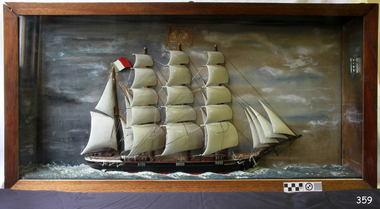
Craft - Ship Model, Hygeia, Bef. 1983
... Reed to carry cargo. It was first registered on July 30th, 1863, at Sunderland, UK, by owners Matthew Cay Jr. & Joseph Crisp. ...Reed to carry cargo. It was first registered on July 30th, 1863, at Sunderland, UK, by owners Matthew Cay Jr. & Joseph Crisp. ...This ship model is a representation of the wooden barque Hygeia, which is also the name of the Greek goddess of health, cleanliness and hygiene. The model flies the Italian flag, which was adopted in 1946 but originated in 1797. The colours stand for freedom, solidarity and equality. The three-masted, wooden barque Hygeia was built in 1863 in the UK by J.M. Reed to carry cargo. It was first registered on July 30th, 1863, at Sunderland, UK, by owners Matthew Cay Jr. & Joseph Crisp. In August 1877, the ship was dispatched from Alexandria, Egypt, destined for Fairmouth with a cargo of beans, but mysteriously went missing. The ship diorama exemplifies the popular, centuries-old hobby of ship model making, with the setting of sea and sky giving it depth and context. The model also shows the configuration of a three-masted, fully rigged sailing ship, of the type that carried immigrants to Australia. Ship model; diorama with a model of the sailing ship HYGEIA at sea in full sail, in a setting of sky and sea. It displays a tricolour flag with three vertical stripes of equal width, which from the hoist side are coloured green, white and red. An inscription has the ship's name, Hygeia."HYGEIA"flagstaff hill maritime museum and village, maritime museum, maritime village, great ocean road, shipwreck coast, ship model, ship model hygeia, hobby, craft, maritime model, model making, hygeia, sailing ship, 1863, 1877, cargo ship, italian flag, square-rigged, barque, three-masted -
 City of Moorabbin Historical Society (Operating the Box Cottage Museum)
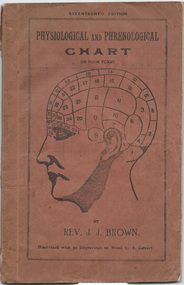
Booklet, Phrenological Chart, Rev,J.J.Brown c1928, Physiological and Phrenological Chart Rev,J.J.Brown c1928, c1928
... gall franz joseph, phrenology, darwin charles, naturalists, jewellers, ezard & clark company moorabbin, early settlers, moorabbin shire, mechanics institute cheltenham, ormond choral society, postworld war 11 settlers,housing estates moorabbin 1950, bentleigh, ormond, moorabbin, cheltenham, drama societies, musical society cheltenham, clark judy, reed gladys, reed george, draftsman, architect,...George Reed was a draftsman who lived in Bentleigh , City of Moorabbin in mid 20th C Phrenology is a process that involves observing and/or feeling the skull to determine an individual's psychological attributes. Franz Joseph...George Reed was a draftsman who lived in Bentleigh , City of Moorabbin in mid 20th C Phrenology is a process that involves observing and/or feeling the skull to determine an individual's psychological attributes. Franz Joseph ...George Reed was a draftsman who lived in Bentleigh , City of Moorabbin in mid 20th C Phrenology is a process that involves observing and/or feeling the skull to determine an individual's psychological attributes. Franz Joseph Gall believed that the brain was made up of 27 individual organs that determined personality, the first 19 of these 'organs' he believed to exist in other animal species. Rev. Brown acknowledges that this printed delineation for self assessment is only approximate and proper analysis would cost time and money for personal consultation.After Charles Darwin, 1809 - 1882, English naturalist whose scientific theory of evolution by natural selection became the foundation of modern evolutionary studies. His nonreligious biology appealed to the rising class of professional scientists and the general public. Phrenology became a popular interest.A paper booklet with diagrams, charts and photos explaining Phrenology in 54 pages by Rev. J.J. Brown Coloured front and back covers have a drawing of a model of the human skull divided into 36 sections Front Cover ; SEVENTEENTH EDITION/ PHYSIOLOGICAL AND PHRENOLOGICAL / CHART / ( IN BOOK FORM) /BY / REV. J.J. BROWN/ Illustrated with 70 Engravingson Wood by S. Calvertgall franz joseph, phrenology, darwin charles, naturalists, jewellers, ezard & clark company moorabbin, early settlers, moorabbin shire, mechanics institute cheltenham, ormond choral society, postworld war 11 settlers,housing estates moorabbin 1950, bentleigh, ormond, moorabbin, cheltenham, drama societies, musical society cheltenham, clark judy, reed gladys, reed george, draftsman, architect, -
Glen Eira Historical Society
Article - St. Catherine’s Church of England, Kooyong Road, Caulfield South
... Joseph E.... Beagley Emily Ada... Parrott Frances Catherine... Wilson Alfred Roscoe... Hamilton Flora... Hillard John Beattie... Hillard Thomas... Haillard Eliza... Barlow W.... Begbie A.H.... Cole S.... Love J.... North H.... Tonks H.... Scammell S.... Hunt Geoffrey Donald... Myer Leslie Robert Irvine... Forbes Betty... McAvoy Alan Robert... Humphreys Betty Grace... Marke Alfred Robert... Bromfield Norman Edward... Reed...Joseph E. Beagley Emily Ada Parrott Frances Catherine Wilson Alfred Roscoe Hamilton Flora Hillard John Beattie Hillard Thomas Haillard Eliza Barlow W. Begbie A.H. Cole S. Love J. North H. Tonks H. Scammell S. Hunt Geoffrey Donald Myer Leslie Robert Irvine Forbes Betty McAvoy Alan Robert Humphreys Betty Grace Marke Alfred Robert Bromfield Norman Edward Reed Margery Eva Philpot Elizabeth Ann Dillow Henry Thomas Murphy Mr. ...Three items about this Church: 1/St. Catherine’s Parish paper, February 1924. 2/Baptismal prayer card for Harry Norman Bromfield 08/03/1925. 3/Carbon typed copy of document detailing inscriptions in St. Catherine’s Anglican Church Caulfield.st. catherine’s church of england, st. catharine’s church of england, caulfield south, kooyong road, clarence street, stephens mr., debb dr., murphy mr., booth e., masters p., kindergartens, paterson mrs., fowler mrs., capper mrs., mayes mrs., olley mrs., hosken mrs., schwieger miss, walker mrs., ward mrs., foster mrs., marshall mrs., marsh mrs., hearn miss, stephens h., downshire road, bromfield harry norman, taylor alice mary, wigg catherine elizabeth, stephens grace m., beagley emily a., beagley joseph e., beagley emily ada, parrott frances catherine, wilson alfred roscoe, hamilton flora, hillard john beattie, hillard thomas, haillard eliza, barlow w., begbie a.h., cole s., love j., north h., tonks h., scammell s., hunt geoffrey donald, myer leslie robert irvine, forbes betty, mcavoy alan robert, humphreys betty grace, marke alfred robert, bromfield norman edward, reed margery eva, philpot elizabeth ann, dillow henry thomas, murphy mr., taylor mr., booth mr., drewett mr., hickson mr., ingram mr., lumsden mr., meyer mr., nutt mr., summerhayes mr., mcclure j., segal boris -
 Glen Eira Historical Society
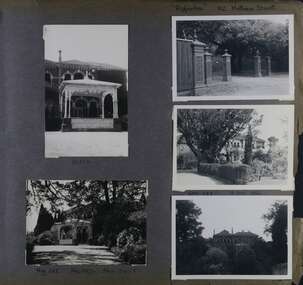
Album - Album page, Ripponlea, 192 Hotham Street, Circa 1972
... Rippon Lea was designed by the leading firm of architects, Reed and Barnes. Joseph Reed had travelled in Europe in 1863, including northern Italy. ...This photograph is part of the Caulfield Historical Album 1972. This album was created in approximately 1972 as part of a project by the Caulfield Historical Society to assist in identifying buildings worthy of preservation. The album is related to a Survey the Caulfield Historical Society developed in collaboration with the National Trust of Australia (Victoria) and Caulfield City Council to identify historic buildings within the City of Caulfield that warranted the protection of a National Trust Classification. Principal photographer thought to be Trevor Hart, member of Caulfield Historical Society. Most photographs were taken between 1966-1972 with a small number of photographs being older and from unknown sources. All photographs are black and white except where stated, with 386 photographs over 198 pages.From Victorian Heritage Database citation for Rippon Lea H0614 https://vhd.heritagecouncil.vic.gov.au/places/427(as at 23/10/2020) Rippon Lea was commenced in 1868 by Frederick Sargood, a most successful politician and merchant. He was born in England in 1834 and arrived in Melbourne in 1850. He soon joined his father's wholesale soft goods firm, spending some time as its manager on the goldfields. Sargood entered the Legislative Council in 1874. He was Victoria's first Minister for Defence in 1883. Sir Frederick Sargood was created CMG. In 1885 and KCMG in 1890 as a reward for his contribution to public life. He died suddenly in 1903. Rippon Lea was designed by the leading firm of architects, Reed and Barnes. Joseph Reed had travelled in Europe in 1863, including northern Italy. When he returned he introduced the use of polychromy. While not the first examples, Rippon Lea and the Independent Church in Collins Street were the best and set a fashion which became a distinctly Melbourne style, particularly used for houses and churches. Its popularity was possible because of the new availability of different coloured bricks. Reed's fine Lombardic Romanesque details soon became debased by others. As Sargood's family grew and his fortunes prospered, Rippon Lea was extended to include 33 rooms - a complete mansion. The cast iron porte cochere and the northern conservatory were added in 1897. The architects were Taylor and Fitts. The ballroom was added in 1882 and remodelled in 1889. Many alterations have changed the interior and exterior during the ownerships of Benjamin Nathan and later his daughter Mrs Louisa Jones in the 1930s and are in their own right of significance. Sir Thomas Bent owned the property from 1903 until 1911 but never lived there. He subdivided much of the land. The original garden dates from about 1868, and it seems that William Guilfoyle of the Botanic Gardens was involved. It was redesigned in a more natural style in the 1880s by Sargood and his head gardener, Adam Anderson. The lake, waterfalls, fernery, hill and grotto are balanced by mighty deciduous trees and conifers. These are interspersed with, but never dominated by Australian species such as eucalyptus and other exotics. The sinuous drive with its carefully prepared approach to the house is notable. The original vegetable gardens, orchard and outer paddocks no longer survive. The shade house is important as the largest known in Australia and possibly the world. Its curved plan and form of construction are particularly notable. It was built about 1884.Page 90 of Photograph Album with five photographs (one landscape and 4 portrait) of Ripponlea - two different views of the front entrance to the mansion, one of the front gates and two different views of the main residence.Handwritten: "Ripponlea" 192 Hotham Street [top right] / North [under top left photo] / Neg 255 Dec 1972 MAIN DRIVE [under bottom left photo] / Neg 238 8 OCT 1966 [under middle right photo] / 88 [bottom right]trevor hart, elsternwick, mansion, hotham street, frederick sargood, reed and barnes, cast iron porte cochere, conservatory, 1860's, 1890's, ballroom, 1880's, benjamin nathan, louisa jones, thomas bent, sir thomas bent, william guilfoyle, adam anderson, lake, grotto, shade house, portico, ripponlea, victorian, sir frederick sargood, architects, polychrome bricks, lombardic romanesque architectural style, rippon lea, taylor and fitts, land subdivisions, gardens, drives, vegetable gardens, orchards -
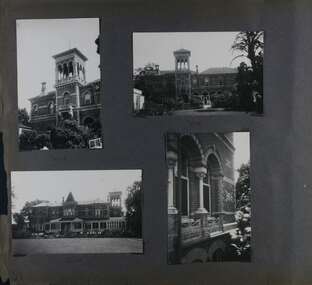 Glen Eira Historical Society
Album - Album page, Ripponlea, 192 Hotham Street, Circa 1972
... Rippon Lea was designed by the leading firm of architects, Reed and Barnes. Joseph Reed had travelled in Europe in 1863, including northern Italy. ...This photograph is part of the Caulfield Historical Album 1972. This album was created in approximately 1972 as part of a project by the Caulfield Historical Society to assist in identifying buildings worthy of preservation. The album is related to a Survey the Caulfield Historical Society developed in collaboration with the National Trust of Australia (Victoria) and Caulfield City Council to identify historic buildings within the City of Caulfield that warranted the protection of a National Trust Classification. Principal photographer thought to be Trevor Hart, member of Caulfield Historical Society. Most photographs were taken between 1966-1972 with a small number of photographs being older and from unknown sources. All photographs are black and white except where stated, with 386 photographs over 198 pages.From Victorian Heritage Database citation for Rippon Lea H0614 https://vhd.heritagecouncil.vic.gov.au/places/427(as at 23/10/2020) Rippon Lea was commenced in 1868 by Frederick Sargood, a most successful politician and merchant. He was born in England in 1834 and arrived in Melbourne in 1850. He soon joined his father's wholesale soft goods firm, spending some time as its manager on the goldfields. Sargood entered the Legislative Council in 1874. He was Victoria?s first Minister for Defence in 1883. Sir Frederick Sargood was created CMG. In 1885 and KCMG in 1890 as a reward for his contribution to public life. He died suddenly in 1903. Rippon Lea was designed by the leading firm of architects, Reed and Barnes. Joseph Reed had travelled in Europe in 1863, including northern Italy. When he returned he introduced the use of polychromy. While not the first examples, Rippon Lea and the Independent Church in Collins Street were the best and set a fashion which became a distinctly Melbourne style, particularly used for houses and churches. Its popularity was possible because of the new availability of different coloured bricks. Reed's fine Lombardic Romanesque details soon became debased by others. As Sargood's family grew and his fortunes prospered, Rippon Lea was extended to include 33 rooms - a complete mansion. The cast iron porte cochere and the northern conservatory were added in 1897. The architects were Taylor and Fitts. The ballroom was added in 1882 and remodelled in 1889. Many alterations have changed the interior and exterior during the ownerships of Benjamin Nathan and later his daughter Mrs Louisa Jones in the 1930s and are in their own right of significance. Sir Thomas Bent owned the property from 1903 until 1911 but never lived there. He subdivided much of the land. The original garden dates from about 1868, and it seems that William Guilfoyle of the Botanic Gardens was involved. It was redesigned in a more natural style in the 1880s by Sargood and his head gardener, Adam Anderson. The lake, waterfalls, fernery, hill and grotto are balanced by mighty deciduous trees and conifers. These are interspersed with, but never dominated by Australian species such as eucalyptus and other exotics. The sinuous drive with its carefully prepared approach to the house is notable. The original vegetable gardens, orchard and outer paddocks no longer survive. The shade house is important as the largest known in Australia and possibly the world. Its curved plan and form of construction are particularly notable. It was built about 1884.Page 91 of Photograph Album with four photographs (two portrait and two landscape) of various external views of Ripponlea.Handwritten: SOUTH [under top left photo] / SOUTH [under top right photo] / WEST [under bottom left photo] / 91 [bottom left]trevor hart, elsternwick, mansion, hotham street, frederick sargood, reed and barnes, cast iron porte cochere, conservatory, 1860's, 1890's, ballroom, 1880's, benjamin nathan, louisa jones, thomas bent, sir thomas bent, william guilfoyle, adam anderson, lake, grotto, shade house, portico, ripponlea, victorian, sir frederick sargood, architects, taylor and fitts, rippon lea, polychrome bricks, lombardic romanesque style -
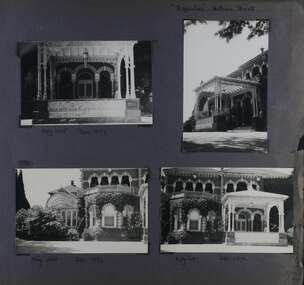 Glen Eira Historical Society
Album - Album page, Ripponlea, Hotham Street, Circa 1972
... Rippon Lea was designed by the leading firm of architects, Reed and Barnes. Joseph Reed had travelled in Europe in 1863, including northern Italy. ...This photograph is part of the Caulfield Historical Album 1972. This album was created in approximately 1972 as part of a project by the Caulfield Historical Society to assist in identifying buildings worthy of preservation. The album is related to a Survey the Caulfield Historical Society developed in collaboration with the National Trust of Australia (Victoria) and Caulfield City Council to identify historic buildings within the City of Caulfield that warranted the protection of a National Trust Classification. Principal photographer thought to be Trevor Hart, member of Caulfield Historical Society. Most photographs were taken between 1966-1972 with a small number of photographs being older and from unknown sources. All photographs are black and white except where stated, with 386 photographs over 198 pages.From Victorian Heritage Database citation for Rippon Lea H0614 https://vhd.heritagecouncil.vic.gov.au/places/427(as at 23/10/2020) Rippon Lea was commenced in 1868 by Frederick Sargood, a most successful politician and merchant. He was born in England in 1834 and arrived in Melbourne in 1850. He soon joined his father's wholesale soft goods firm, spending some time as its manager on the goldfields. Sargood entered the Legislative Council in 1874. He was Victoria?s first Minister for Defence in 1883. Sir Frederick Sargood was created CMG. In 1885 and KCMG in 1890 as a reward for his contribution to public life. He died suddenly in 1903. Rippon Lea was designed by the leading firm of architects, Reed and Barnes. Joseph Reed had travelled in Europe in 1863, including northern Italy. When he returned he introduced the use of polychromy. While not the first examples, Rippon Lea and the Independent Church in Collins Street were the best and set a fashion which became a distinctly Melbourne style, particularly used for houses and churches. Its popularity was possible because of the new availability of different coloured bricks. Reed's fine Lombardic Romanesque details soon became debased by others. As Sargood's family grew and his fortunes prospered, Rippon Lea was extended to include 33 rooms - a complete mansion. The cast iron porte cochere and the northern conservatory were added in 1897. The architects were Taylor and Fitts. The ballroom was added in 1882 and remodelled in 1889. Many alterations have changed the interior and exterior during the ownerships of Benjamin Nathan and later his daughter Mrs Louisa Jones in the 1930s and are in their own right of significance. Sir Thomas Bent owned the property from 1903 until 1911 but never lived there. He subdivided much of the land. The original garden dates from about 1868, and it seems that William Guilfoyle of the Botanic Gardens was involved. It was redesigned in a more natural style in the 1880s by Sargood and his head gardener, Adam Anderson. The lake, waterfalls, fernery, hill and grotto are balanced by mighty deciduous trees and conifers. These are interspersed with, but never dominated by Australian species such as eucalyptus and other exotics. The sinuous drive with its carefully prepared approach to the house is notable. The original vegetable gardens, orchard and outer paddocks no longer survive. The shade house is important as the largest known in Australia and possibly the world. Its curved plan and form of construction are particularly notable. It was built about 1884.Page 92 of Photograph Album with four photographs (three landscape and one portrait) of Ripponlea - views of entrance and left front of mansion.Handwritten: "Ripponlea" Hotham Street [top right] / Neg 245 Dec 1972 [under top left photo] / Neg 246 Dec 1972 [under bottom left photo] / Neg 247 Dec 1972 [under bottom right photo] / 92 [bottom right]trevor hart, elsternwick, mansion, hotham street, frederick sargood, reed and barnes, lombardic, romanesque, cast iron porte cochere, conservatory, 1860's, 1890's, ballroom, 1880's, benjamin nathan, louisa jones, thomas bent, sir thomas bent, william guilfoyle, adam anderson, lake, grotto, shade house, portico, ripponlea, victorian, sir frederick sargood, architects, polychrome bricks, lombardic romanesque style, rippon lea, entrances -
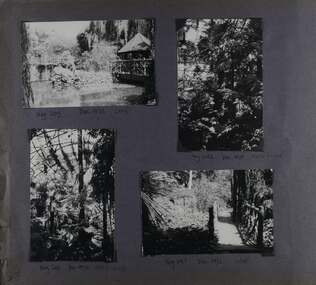 Glen Eira Historical Society
Album - Album page, Ripponlea, Hotham Street, Circa 1972
... Rippon Lea was designed by the leading firm of architects, Reed and Barnes. Joseph Reed had travelled in Europe in 1863, including northern Italy. ...This photograph is part of the Caulfield Historical Album 1972. This album was created in approximately 1972 as part of a project by the Caulfield Historical Society to assist in identifying buildings worthy of preservation. The album is related to a Survey the Caulfield Historical Society developed in collaboration with the National Trust of Australia (Victoria) and Caulfield City Council to identify historic buildings within the City of Caulfield that warranted the protection of a National Trust Classification. Principal photographer thought to be Trevor Hart, member of Caulfield Historical Society. Most photographs were taken between 1966-1972 with a small number of photographs being older and from unknown sources. All photographs are black and white except where stated, with 386 photographs over 198 pages.From Victorian Heritage Database citation for Rippon Lea H0614 https://vhd.heritagecouncil.vic.gov.au/places/427(as at 23/10/2020) Rippon Lea was commenced in 1868 by Frederick Sargood, a most successful politician and merchant. He was born in England in 1834 and arrived in Melbourne in 1850. He soon joined his father's wholesale soft goods firm, spending some time as its manager on the goldfields. Sargood entered the Legislative Council in 1874. He was Victoria?s first Minister for Defence in 1883. Sir Frederick Sargood was created CMG. In 1885 and KCMG in 1890 as a reward for his contribution to public life. He died suddenly in 1903. Rippon Lea was designed by the leading firm of architects, Reed and Barnes. Joseph Reed had travelled in Europe in 1863, including northern Italy. When he returned he introduced the use of polychromy. While not the first examples, Rippon Lea and the Independent Church in Collins Street were the best and set a fashion which became a distinctly Melbourne style, particularly used for houses and churches. Its popularity was possible because of the new availability of different coloured bricks. Reed's fine Lombardic Romanesque details soon became debased by others. As Sargood's family grew and his fortunes prospered, Rippon Lea was extended to include 33 rooms - a complete mansion. The cast iron porte cochere and the northern conservatory were added in 1897. The architects were Taylor and Fitts. The ballroom was added in 1882 and remodelled in 1889. Many alterations have changed the interior and exterior during the ownerships of Benjamin Nathan and later his daughter Mrs Louisa Jones in the 1930s and are in their own right of significance. Sir Thomas Bent owned the property from 1903 until 1911 but never lived there. He subdivided much of the land. The original garden dates from about 1868, and it seems that William Guilfoyle of the Botanic Gardens was involved. It was redesigned in a more natural style in the 1880s by Sargood and his head gardener, Adam Anderson. The lake, waterfalls, fernery, hill and grotto are balanced by mighty deciduous trees and conifers. These are interspersed with, but never dominated by Australian species such as eucalyptus and other exotics. The sinuous drive with its carefully prepared approach to the house is notable. The original vegetable gardens, orchard and outer paddocks no longer survive. The shade house is important as the largest known in Australia and possibly the world. Its curved plan and form of construction are particularly notable. It was built about 1884.Page 93 of Photograph Album with four photographs (two landscape and two portrait) of Ripponlea - lake and gardens.Handwritten: Neg 239 Dec 1973 LAKE [under top left photo] / Neg 242 Dec 1973 FERN HOUSE [under top right photo] / Neg 243 Dec 1972 FERN HOUSE [under bottom left photo] / Neg 241 Dec 1972 LAKE [under bottom right photo] / 93 [bottom left]trevor hart, elsternwick, mansion, hotham street, frederick sargood, sargood, reed and barnes, 1860's, 1890's, 1880's, benjamin nathan, nathan, louisa jones, thomas bent, sir thomas bent, william guilfoyle, adam anderson, lake, grotto, shade house, portico, ripponlea, victorian, sir frederick sargood, architects, taylor and fitts, rippon lea, gardens, ferns, bridges, walking trails -
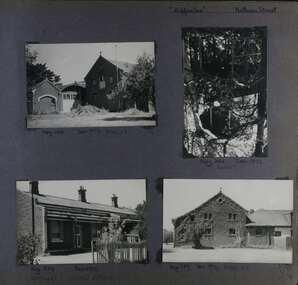 Glen Eira Historical Society
Album - Album page, "Ripponlea", Hotham Street, Circa 1972
... Rippon Lea was designed by the leading firm of architects, Reed and Barnes. Joseph Reed had travelled in Europe in 1863, including northern Italy. ...This photograph is part of the Caulfield Historical Album 1972. This album was created in approximately 1972 as part of a project by the Caulfield Historical Society to assist in identifying buildings worthy of preservation. The album is related to a Survey the Caulfield Historical Society developed in collaboration with the National Trust of Australia (Victoria) and Caulfield City Council to identify historic buildings within the City of Caulfield that warranted the protection of a National Trust Classification. Principal photographer thought to be Trevor Hart, member of Caulfield Historical Society. Most photographs were taken between 1966-1972 with a small number of photographs being older and from unknown sources. All photographs are black and white except where stated, with 386 photographs over 198 pages.From Victorian Heritage Database citation for Rippon Lea H0614 https://vhd.heritagecouncil.vic.gov.au/places/427(as at 23/10/2020) Rippon Lea was commenced in 1868 by Frederick Sargood, a most successful politician and merchant. He was born in England in 1834 and arrived in Melbourne in 1850. He soon joined his father's wholesale soft goods firm, spending some time as its manager on the goldfields. Sargood entered the Legislative Council in 1874. He was Victoria?s first Minister for Defence in 1883. Sir Frederick Sargood was created CMG. In 1885 and KCMG in 1890 as a reward for his contribution to public life. He died suddenly in 1903. Rippon Lea was designed by the leading firm of architects, Reed and Barnes. Joseph Reed had travelled in Europe in 1863, including northern Italy. When he returned he introduced the use of polychromy. While not the first examples, Rippon Lea and the Independent Church in Collins Street were the best and set a fashion which became a distinctly Melbourne style, particularly used for houses and churches. Its popularity was possible because of the new availability of different coloured bricks. Reed's fine Lombardic Romanesque details soon became debased by others. As Sargood's family grew and his fortunes prospered, Rippon Lea was extended to include 33 rooms - a complete mansion. The cast iron porte cochere and the northern conservatory were added in 1897. The architects were Taylor and Fitts. The ballroom was added in 1882 and remodelled in 1889. Many alterations have changed the interior and exterior during the ownerships of Benjamin Nathan and later his daughter Mrs Louisa Jones in the 1930s and are in their own right of significance. Sir Thomas Bent owned the property from 1903 until 1911 but never lived there. He subdivided much of the land. The original garden dates from about 1868, and it seems that William Guilfoyle of the Botanic Gardens was involved. It was redesigned in a more natural style in the 1880s by Sargood and his head gardener, Adam Anderson. The lake, waterfalls, fernery, hill and grotto are balanced by mighty deciduous trees and conifers. These are interspersed with, but never dominated by Australian species such as eucalyptus and other exotics. The sinuous drive with its carefully prepared approach to the house is notable. The original vegetable gardens, orchard and outer paddocks no longer survive. The shade house is important as the largest known in Australia and possibly the world. Its curved plan and form of construction are particularly notable. It was built about 1884.Page 94 of Photograph Album with four photographs (three landscape and one portrait) of Ripponlea - stables, lookout and neighbouring cottages.Handwritten: "Ripponlea" Hotham Street [top right] / Neg 256 Dec 1972 STABLES [under top left photo] / Neg 248 Dec 1972 LOOKOUT [under top right photo] / Neg 254 Dec 1972 / COTTAGES WILLOW STREET [under bottom left photo] / Neg 259 Dec 1972 STABLES [under bottom right photo] / 94 [bottom right]trevor hart, elsternwick, mansion, hotham street, frederick sargood, reed and barnes, 1860's, 1890's, 1880's, benjamin nathan, nathan, louisa jones, thomas bent, sir thomas bent, william guilfoyle, guilfoyle, adam anderson, ripponlea, victorian, sir frederick sargood, architects, bricks, polychrome bricks, taylor and fitts, stables, lookouts, cottages, outbuildings, rippon lea -
 Bendigo Historical Society Inc.
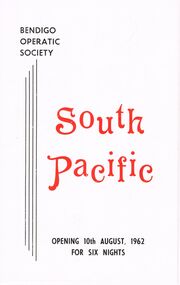
Programme - BENDIGO OPERATIC SOCIETY ''SOUTH PACIFIC''
... Joseph Cable U.S.M.C. - Fred Trewarne as Capt. George Brackett. U.S.N. Peter Houston as Commander William Harbison U.S.N. - John Gow as Yeoman Herbert Quale - Ian Becwith as Sgt. Kenneth Johnson - Gerry Gleeson as Seabee Richard West - John Reed...Joseph Cable U.S.M.C. - Fred Trewarne as Capt. George Brackett. U.S.N. Peter Houston as Commander William Harbison U.S.N. - John Gow as Yeoman Herbert Quale - Ian Becwith as Sgt. Kenneth Johnson - Gerry Gleeson as Seabee Richard West - John Reed ...Program Bendigo operatic Society - South Pacific - Opening 10th August 1962 for six nights. Producer: Beatrice Oakley - Musical Director: Max O'Loghlen - Cast in Order of Appearance: Ray Houston, John Boromeo, Ruth Lyon, Carol Crane alternating as Ngana and Jerome - Roger Sprawson as Henri - Patricia McCracken as Ensign Nellie Forbush - John Stephens as Emile de Becque - Patricia Lyon as Bloody Mary - Kenneth Nicholls as Abner - Victor White as Stewpot - Alfred Annison as Luther Billis - Roger Sprawson as the Professor - Brian Whetstone as Lieut. Joseph Cable U.S.M.C. - Fred Trewarne as Capt. George Brackett. U.S.N. Peter Houston as Commander William Harbison U.S.N. - John Gow as Yeoman Herbert Quale - Ian Becwith as Sgt. Kenneth Johnson - Gerry Gleeson as Seabee Richard West - John Reed as Seabee Morton Wise - Roy Cronin as Seaman Tom O'Brien - Reginald Boromeo as Radio Operator Bob McCaffery - Len Carr as marine Corporal Hamilton Steeves - Denis Cremen as Staff Sgt Thomas Hassinger - Daryl Walker as Pte Victor Jerome - George Steele as Pte Sven Larsen - Barry Washington as Sgt Jack Waters - Joan Crane as Lieut. Genevieve Marshall - Dawn Beckwith as Ensign Lisa Manelli - Annette Wilson as Ensign Connie Walewska - Emily Houston as Ensign Janet McGregor - Jill Angwin as Ensign Bessie Noonan - Carole Mckenzie as Ensign Pamela Whitmore - Greta Smyth as Ensign Rita Adams - Rhonda Scott as Ensign Sue Yaeger - Lorraine Brennan as Ensign Betty Pitt - Mary Speedy as Ensign Cora McRae - Kathrine Alexander as Ensign Dinah Murphy - Bronwen Townsend as Liat - Ferd Lorenz as Lieut. Buzz Adams.program, theatre, bendigo operatic society -
 Bendigo Historical Society Inc.
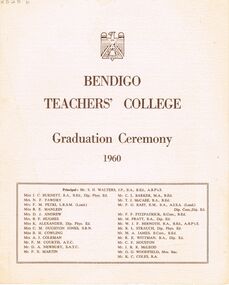
Document - LA TROBE UNIVERSITY BENDIGO COLLECTION: BENDIGO TEACHERS' COLLEGE GRADUATION CEREMONY 1960
... . - Kathleen Anne Algie, Ian Armstrong, Lorna Constance Barbour, Ronald Lindsay Bell, Michael Laurence Brown, Ross Ernest Brown, Graeme Lambden Budd, Duncan Leslie Thomas Cameron, Peter Morgan Clutterbuck, Joan Christine Connor, Allen William Cornelius, Glenys Elaine Cussins, Jean Elizabeth Davis, Denis William DeCann, Robert Alain Denham, Janet Carmel Doyle, Patricia May Edwards, Walter Kenneth Espagne, Fay Iris Evans, Brenda Gertrude Farrell, Malcolm George Ferguson, Elizabeth Joyce Fitzgerald, Kevin Joseph Foley, Barbara Violet Forrester, Lawrence Joseph Ginnivan, Peter Murray Graham, Thelma Elaine Grist, Dorothy Robyn Haines, William Jon Hall, Patricia Jeanette Hancock, Robert John Harris, William Ian Hart, Lorraine Moira Holmes, Lynette Ann Ireland, Morris Raymond Jackman, Christine Jackson, Margaret Nancy Jackson, Nanette Elizabeth Johnson, Trevor John Kellam, Robert Bruce Kemp, Ross Eliot Koochew, Henry Francis Lean, Janet Bobbie Leabeter, Rosemary Elizabeth Lowe, Graeme Stanley Lucas, Joy Patricia Maxwell, Terence Michael Mulvihill, George Alan Murdoch, Kevin Michael Murphy, Ann-Marie McCallum, Helen June Nixon, Kerry Joy O'Brien, William John O'Connell, Christine Lynette Olsen, William Stanley Page, Janice Anne Preston, John Stuart Reed, William Francis Reeves, Gary Desmond Robbins, Peter John Schlitz, Donald John McIntosh Shadforth, Gavin James Smith, John Archibald Spark, Illar Streimann, Janice Margaret Taylor, Ian Leonard Thornton, Rosemary Fay Wait, Russell Gilbert Walker, James John Wallis, Clare Mary Ward, David Ross Wiedermann, and Stephen Wilkinson..... - Kathleen Anne Algie, Ian Armstrong, Lorna Constance Barbour, Ronald Lindsay Bell, Michael Laurence Brown, Ross Ernest Brown, Graeme Lambden Budd, Duncan Leslie Thomas Cameron, Peter Morgan Clutterbuck, Joan Christine Connor, Allen William Cornelius, Glenys Elaine Cussins, Jean Elizabeth Davis, Denis William DeCann, Robert Alain Denham, Janet Carmel Doyle, Patricia May Edwards, Walter Kenneth Espagne, Fay Iris Evans, Brenda Gertrude Farrell, Malcolm George Ferguson, Elizabeth Joyce Fitzgerald, Kevin Joseph Foley, Barbara Violet Forrester, Lawrence Joseph Ginnivan, Peter Murray Graham, Thelma Elaine Grist, Dorothy Robyn Haines, William Jon Hall, Patricia Jeanette Hancock, Robert John Harris, William Ian Hart, Lorraine Moira Holmes, Lynette Ann Ireland, Morris Raymond Jackman, Christine Jackson, Margaret Nancy Jackson, Nanette Elizabeth Johnson, Trevor John Kellam, Robert Bruce Kemp, Ross Eliot Koochew, Henry Francis Lean, Janet Bobbie Leabeter, Rosemary Elizabeth Lowe, Graeme Stanley Lucas, Joy Patricia Maxwell, Terence Michael Mulvihill, George Alan Murdoch, Kevin Michael Murphy, Ann-Marie McCallum, Helen June Nixon, Kerry Joy O'Brien, William John O'Connell, Christine Lynette Olsen, William Stanley Page, Janice Anne Preston, John Stuart Reed, William Francis Reeves, Gary Desmond Robbins, Peter John Schlitz, Donald John McIntosh Shadforth, Gavin James Smith, John Archibald Spark, Illar Streimann, Janice Margaret Taylor, Ian Leonard Thornton, Rosemary Fay Wait, Russell Gilbert Walker, James John Wallis, Clare Mary Ward, David Ross Wiedermann, and Stephen Wilkinson. ...A cream document titled "Bendigo Teachers' College Graduation Ceremony 1960". The front page also contains a list of the staff working at the college. They are Mr. S. H. Walters (Principal), Miss J. C. Burnett, Mrs. N. F. Fawdry, Mrs. F. M. Petri, Miss R. E. Manlein, Mrs. D. J. Andrew, Mrs. B. F. Hughes, Miss K. Alexander, Miss C. M. Oughton Jones, Miss B. H. Cowling, Mrs. A. J. Coleman, Mr. F. M. Courtis, Mr. D. A. Newbury, Mr. F. X. Martin, Mr. C. L. Barker, Mr. T. J. McCabe, Mr. F. G. East, Mr. P. F. Fitzpatrick, Mr. M. Pratt, Mr. W. J. F. Bernoth, Mr. R. L. Strauch, Mr. M. A. James, Mr. R. E. Wittman, Mr. C. F. Houston, Mr. J. R. R. McLeod, Mr. G. G. Woodfield and Mr. K. C. Coles. The inside cover contains the "Significance of the Ceremony" and "Order of the Ceremony". Mr. F. M. Courtis welcomed the visitors whilst the Principal read the College Charge. The 'Graduation Book' was presented to Mr. A. L. Harris Inspector of Schools by Miss J. C. Burnett.The final roll call for 1960 was read by Mr. C. L. Barker. Congratulations were offered by The Mayor of Bendigo Cr. R. H. Wilson,J. P., Cr. T. A. Drechsler President of Strathfieldsaye Shire and Mr. G. Salathiel, Head Teacher of Gravel Hill State School. Finally the Occasional Address was presented by Mr. F. H. Brooks Assistant Director of Education. The following page contains a list of "Students of 1958-1960 Trained Infant Teacher's Certificate" - Marjorie May Allen, Janice Helen Ashman, Grada Ali Bos, Joan Margaret Busfield, Barbara Joan Cameron, Shirley Margaret Cribbes, Marcia Ann Davison, Margaret Mary Frances Dick, Lorraine Jean MacIntosh Goddard, Beverley Lorraine Goudie, Jennifer Joy Hamilton, Maureen Margaret Hunt, Shirley Joyce Innocent, Monica McKenna, Eileen Bernadette Mulvahil, Nola Ellen Parker, Jeanette Mary Pearson, Maureen Anne Pentland, Elaine Denise Pochon, Marian Judith Rechter, Marilyn Joy Rose, Catherine Shiels, Margaret Evelyn Stevenson, Rosemary Sutherland, Patricia Helen Tassicker, Eileen Monica Tuohey, Robin Elizabeth Walters, Patricia Ann Wenn and Ethel Dawn Whitelock. The back page contains a list of "Students of 1959-1960 Trained Primary Teacher's Certificate". - Kathleen Anne Algie, Ian Armstrong, Lorna Constance Barbour, Ronald Lindsay Bell, Michael Laurence Brown, Ross Ernest Brown, Graeme Lambden Budd, Duncan Leslie Thomas Cameron, Peter Morgan Clutterbuck, Joan Christine Connor, Allen William Cornelius, Glenys Elaine Cussins, Jean Elizabeth Davis, Denis William DeCann, Robert Alain Denham, Janet Carmel Doyle, Patricia May Edwards, Walter Kenneth Espagne, Fay Iris Evans, Brenda Gertrude Farrell, Malcolm George Ferguson, Elizabeth Joyce Fitzgerald, Kevin Joseph Foley, Barbara Violet Forrester, Lawrence Joseph Ginnivan, Peter Murray Graham, Thelma Elaine Grist, Dorothy Robyn Haines, William Jon Hall, Patricia Jeanette Hancock, Robert John Harris, William Ian Hart, Lorraine Moira Holmes, Lynette Ann Ireland, Morris Raymond Jackman, Christine Jackson, Margaret Nancy Jackson, Nanette Elizabeth Johnson, Trevor John Kellam, Robert Bruce Kemp, Ross Eliot Koochew, Henry Francis Lean, Janet Bobbie Leabeter, Rosemary Elizabeth Lowe, Graeme Stanley Lucas, Joy Patricia Maxwell, Terence Michael Mulvihill, George Alan Murdoch, Kevin Michael Murphy, Ann-Marie McCallum, Helen June Nixon, Kerry Joy O'Brien, William John O'Connell, Christine Lynette Olsen, William Stanley Page, Janice Anne Preston, John Stuart Reed, William Francis Reeves, Gary Desmond Robbins, Peter John Schlitz, Donald John McIntosh Shadforth, Gavin James Smith, John Archibald Spark, Illar Streimann, Janice Margaret Taylor, Ian Leonard Thornton, Rosemary Fay Wait, Russell Gilbert Walker, James John Wallis, Clare Mary Ward, David Ross Wiedermann, and Stephen Wilkinson.bendigo, education, bendigo teachers' college graduatio, la trobe university bendigo collection, collection, bendigo teachers' college, bendigo, education, teaching, teachers, students, graduation, tertiary education, graduation ceremony, history, book, bendigo teachers' college staff, graduands, graduates, bendigo teachers' college students, teacher training -
 National Vietnam Veterans Museum (NVVM)
Document, A copy of Australian Gallant and Distinguished Service Vietnam 1962-1973: Being A Record of British and Foreign Decorations Awarded to Australian Servicemen in The Royal Australian Air Force, 1974
... Joseph Earl Pettit...A113187...Squadron Leader Ian Hamilton Whisker...O218759...Flight Lieutenant Bruce John Mouatt...Flying Officer Bruce John Mouatt...O222080...Flying Officer Robert Lawrence Redman...O224385...Cpl Keith John Munns...A45385...Wing Commander Elvin Jacki Felton...O25166...Flight Lieutenant Rodger Howard Boerth...Chaplain Rodger Howard Boerth...O318567...Flying Officer Jeffrey Philip Trappett...O117198...Flying Officer Rhys Northwood James...Pilot Officer Rhys Northwood James...O119113...Sgt Gregory Stewart Love...A211438...Legion of Merit (LOM...The Silver Star Medal (SSM)...Flying Officer Macaulay Cottrell...0316174...Squadron Leader Alan Raymond Reed...Flight Lieutenant Commander Of The Order Of The British Empire CBE Air Commodore Jack Dowling 0370 Air Commodore John Fullarton Lush 0369 Group Captain John Wilkins Hubble 05833 Air Commodore Geoffrey Thompson 0393 Group Captain John Irwin Adams O33119 Air Commodore Frederick Stephen Robey O5787 Group Captain Ronald Jack McKimm O22084 Air Commodore Clarence Haddon Spurgeon O399 Air Commodore Neville Patrick McNamara O11353 Group Captain Roberts (Robert) Hunter Martin O22188 Distinguished Service Order DSO Companion of the Distinguished Service Order Group Captain Peter Frank Raw Wing Commander Anthony Watcyn Powell O314347 Group Captain Selwyn David Evans O22127 Wing Commander John Alan Paule O35028 Wing Commander John Alan Whitehead O33710 Wing Commander Peter Geoffrey Larard O35023 Wing Commander Roy Walter Hibben O37568 Wing Commander Jack Robert Boast O14165 Wing Commander Peter Lionel Howard Coy O26006 Wing Commander Peter William Hahood O52901 Officer of the Order of the British Empire Order Of The British Empire (OBE) Wing Commander Phillip Arthur Bloom O210837 Wing Commander Peter William Kennedy O4667 Member of the Order of the British Empire (MBE) Warrant Officer Andrea Giovanni Pellizzer A4149 Chaplain Third Class Patrick John McCormick O19853 Wing Commander Cecil George Kilsby O33178 Warrant Officer Allan Richard Grinter A31866 Flight Lieutenant Philip Anthony Mogridge O39014 Flight Lieutenant George Walter Foskett O223127 Squandron Leader Ronald Holden Tucker O220878 Flight Lieutenant Neville Colin Walliss O12206 Flight Lieutenant Walter Wolfgang Wurm O55848 Flight Lieutenant John Thomas Connell O33721 Chaplain John Julian White O317689 Squadron Leader Donald Arthur Ernest Tidd O313248 Flight Lieutenant Raymond Keith Crossley O32838 Flight Lieutenant Bruce Victor Tipping O35364 Squadron Leader Robin Norman Wade O217796 Chaplain John Eward Grannall O222956 Distinguished Flying Cross DFC Wing Commander Victor Douglas Guthrie O22015 Wing Commander Raymond Alfred Scott O22143 Wing Commander (Acting) Vance Drummond O33624 Wing Commander Charles James Melchert O11419 Flight Lieutenant Leigh Oxley Hindley O23946 Flight Lieutenant Francis Patrick Riley O216204 Pilot Officer Michael John Haxell O218798 Squadron Leader Anthony John Fookes O33200 Squadron Leader James Henry Cox O216731 Flying Office Macaulay Cottrell O316174 Squadron Leader Peter John Reed O35030 Squadron Leader Athol Charles Jory O15831 Squadron Leader Nicholas James Gregory Watling 015612 Flight Lieutenant Anthony Philip Ford O219917 Flight Lieutenant Peter Graham Smith O216415 Flying Officer Brian Harris Fooks O44200 Wing Commander Jack Darby Espie O33153 Squadron Leader Ronald David Crump O53401 Squadron Leader Brian Leslie John Dirou O314174 Flight Lieutenant Robert Alec Charles Kendell O316951 Flight Lieutenant Donald Herbert Porter O217899 Flight Lieutenant Garry Gordon Cooper O219964 Wing Commander Barry Moore Thomas O32568 Squadron Leader Thomas Ward O14288 Flight Lieutenant Gerald Maurice Cramer O22886 Flight Lieutenant Reginald John Thompson O316968 Flight Lieutenant Roger Arthur Wilson O221235 Flight Lieutenant Peter William Davies O221384 Squadron Leader Graham Dyke O14384 Flight Lieutenant Kenneth James Mitchell O43443 Flight Lieutenant John Frederick Hazelwood O219888 Flying Officer Michael Ross Tardent O113526 Flight Lieutenant Rex Robert Budd O212791 Flying Officer Douglas John Stuart Riding Flight Lieutenant Douglas John Stuart Riding O221573 Flight Lieutenant Edward Brian John Bolger O23741 Squadron Leader Michael Robinson O14202 Squadron Leader Ronald James Crimmins O32764 Squadron Leader Ivan Laurence Grove O34222 Flight Lieutenant Ronald Alexander Slater O61240 Flying Officer Gary John Ennis O19987 Flying Officer Nicholas William Hobson O116949 Squadron Leader Graham Wallace Neil O215111 Flight Lieutenant John Laurence Ellis O315190 Flying Officer Bruce Charles Townsend O224152 Squadron Leader Stewart Cosmann Kostlin Mitchell Wing Commander Stewart Cosmann Kostlin Mitchell O213595 Flight Lieutenant John Patrick Hayden O315434 Flight Lieutenant William Norton Robertson O56673 Flying Officer Christopher Allan Beatty O45549 Flying Officer Robert Francis Meares O223862 Wing Commander Francis John Leonard Downing O34496 Squadron Leader Arthur Barnes O36433 Squadron Leader Donald Couldrey White O13864 Flight Lieutenant Francis Leo Clough O218083 Flight Lieutenant Lindsay Arnold Naylor O315270 Flying Officer David Evan Ozanne O57511 Wing Commander Colin Leonard Ackland O14204 Squadron Leader Stanley Clark O217663 Squadron Leader Kenneth David Clark O52798 Flight Lieutenant Norman Mellville Goodall O43963 Conspicuous Gallantry Medal (Flying) CGM Cpl John Desmond Coughlan A220788 George Medal GM Sgt Gordon Dudley Buttriss A21702 Military Medal MM Sgt Noel Edward Power A111932 Distinguished Flying Medal DFM Sgt Robert Joseph Stoyles A217773 Cpl William Wallace O’Rourke A42889 Cpl John Gordon Yorke A45046 Cpl Barry Thomas Gracie A219151 Sgt Terence John Pinkerton A216972 Cpl George Alexander Edwards A314994 Leading Aircraftman Kerry John Shipp A44980 Leading Aircraftman David Thomas Moles A61704 Leading Aircraftman Trevor Lawrence Hamill A317922 Cpl Rodney Joseph Ranger A222471 British Empire Medal BEM Sgt Ernest Edward Moore O216106 Flight Sergeant Colin Milton Robb A51944 Sgt Alan William Rudd A14871 Sgt Barry William Fitzell A218341 Cpl James Benedict Vanderkyl A216178 British Empire Medal For Gallantry Cpl Robert Albert Stephens A220871 Mentioned in Dispatches MID Flight Lieutenant Ronald George Raymond O33756 Sgt Robert Maxwell Wark A216427 Leading Aircraftman David Michael Gwin A218227 WO Frank Anthony Latham A13057 Pilot Officer Charles John Downes O218221 Flight Lieutenant Anthony Lempriere Harley Abbott O55138 Cpl Robert Patrick St John A218262 Group Captain Lyall Robert Klaffer Squadron Leader Lyall Robert Klaffer O4218 Flight Lieutenant Graeme Alexander Nicholson O41992 Flight Lieutenant George Godfrey O54101 Flying Officer Peter Yates O56263 Cpl Stanley Donald Mellow A14968 Cpl Raymond Charles Chandler A55714 WO James Richard Kenny A21316 Flight Sergeant Thomas George Lenton A2927 Sgt Eric Glen Allen A6548 Aircraftman Ronald Neil McNamara A25038 Squadron Leader Rex Stevens Ramsey O33687 Flight Lieutenant Robert Max Hayes O51626 Flight Lieutenant Clifford Mitchell Dohle O39642 Flight Lieutenant Geoffrey Alfred Banfield O37553 Flight Lieutenant John Terence McDonnell O38531 Flight Lieutenant John McLeod Harris O43732 Flight Sergeant Owen Vincent Cooke A24168 Sgt Douglas William Henry Kennett Cpl Dennis Frederick Olsen A18781 Leading Aircraftman David John Collins A221540 Cpl Herbert Roy Sharpe Leading Aircraftman Herbert Roy Sharpe A45003 Wing Commander Henry Alfred Hughes O21144 Squadron Leader John Irvine Thomson O32446 Squadron Leader Thomas Dunning Wright O27562 Squadron Leader John Maxwell Chesterfield O32860 Flight Lieutenant Barry Squires Squadron Leader Barry Squires O216046 Flight Lieutenant Michael Raymond Lewino Squadron Leader Michael Raymond Lewino O55331 Flight Lieutenant Leslie Wilfred Morris O219176 Flight Lieutenant Jeffrey Allan Pedrina O314595 Flying Officer William Stewart McAlister O17860 Cpl Stewart Hampton Bonett Leading Aircraftman Stewart Hampton Bonett A215424 Cpl Ronald Cecil Orchard Aircraftman Ronald Cecil Orchard A14436 Cpl Gregory Michael Aleckson A222329 Flight Lieutenant William Allen Gill O316957 Flight Lieutenant Robert Charles Thompson O33757 Flight Lieutenant Richard Allan Fisher Flying Officer Richard Allan Fisher O18628 Flying Officer Peter Alexander Davidson Pilot Officer Peter Alexander Davidson O222082 Cpl Murray Denis Johnson A55622 Cpl Arthur Douglas Gale A317317 Flight Lieutenant Alan John Perry O216406 Flying Officer Ian Bruce Cooper O316302 Cpl Allan Elliott Matthews A216396 Wing Commander Robert John Limbury Tebbutt O211575 Squadron Leader Hedley Robert Thomas O219178 Flight Lieutenant Gregory Norman Goddard O15633 Pilot Officer John Knox Ross O113665 Flying Officer Onno Dalmolen O317513 Cpl David John Dubber Leading Aircraftman David John Dubber A317809 Cpl John Henry Parsons Leading Aircraftman John Henry Parsons A223927 Aircraftman John Lynn Seibel A112818 Flying Officer Neil Francis Jonasson Flight Lieutenant Neil Francis Jonasson O314130 Pilot Officer John Jeffrey Wilkinson Flying Officer John Jeffrey Wilkinson O223864 Sgt Patrick Arthur Burkett Flight Sergeant Patrick Arthur Burkett A23477 Leading Aircraftman Ronald Wilson A117793 Cpl Colin William Duffield Leading Aircraftman Colin William Duffield A44284 Squadron Leader Lloyd Duncan Knight Flight Lieutenant Lloyd Duncan Knight O37573 Flight Lieutenant Robert William Howe O218328 Flying Officer Joseph James Wilson O220792 Flying Officer Robert Bruce Treloar O317557 Flight Sergeant Herbert Keith Rieck A13890 Sgt Walter Joseph Jones A36497 Cpl Vincent Albert Lowe Sgt Vincent Albert Lowe A17829 Squadron Leader Hans Jorg Friederich Roser O217004 Flight Lieutenant Raymond John Butler O221233 Flight Lieutenant Bruce David Searle O110302 Flight Lieutenant Kevin Vernon Griffin O43348 Flying Officer Ian Douglas Fogarty O317512 WO David Roy Grover A32816 Squadron Leader Brian Edward O’Shea O116226 Squadron Leader Lynton Thomas Winn O219589 Flight Lieutenant Martin Campbell Newman O316978 Flight Lieutenant Barry Edgar Stanley Williamson O220069 Flight Lieutenant John Francis Byrnes Flying Officer John Francis Byrnes O222542 Flying Officer Stuart Wesley Dalgleish O224143 Flight Sergeant John Penn A25124 Cpl Barry Keith Birchan A44066 Flight Sergeant John Maurice Ignatius Hayes A659 Sgt Ronald O’Neill A12379 Cpl Colin John Gray A21893 Aircraftman Terry David Jackson A317581 Squadron Leader Samuel Nelson Todhunter O53169 Flight Lieutenant Maurice Francis Linden O32387 Flying Officer Richard Neil Kelloway O221393 Pilot Officer Brinley Guest Haylock O223593 WO Patrick Edward Curtis A2887 Leading Aircraftman Jan Johannes Kiewiet A223858 Aircraftman Alan Roy Brazil A45935 Flight Lieutenant Cunningham Norman McIntyre Cassels O316966 Flying Officer Maurice Alexander Lewis O316431 Flying Officer Hector Goldie Rutherford O317276 WO Leslie Alderton A34026 Cpl Barry Alan Sharman A218593 Leading Aircraftman Geoffrey Kenneth Smith A223095 Chaplin Stanley Bruce Ford O217659 Leading Aircraftman Ian Lee Aircraftman Ian Lee A224697 Squadron Leader Lloyd Dennis Brown Flight Lieutenant Lloyd Dennis Brown O110501 Flight Lieutenant Colin Monk O221681 Flight Lieutenant David Kingsley Palmer O44431 Flying Officer Peter Robert Nuske Pilot Officer Peter Robert Nuske O224148 Sgt Kevin Ralph Stapleton A313317 Cpl Glynn James Young Sgt Glynn James Young A56060 Squadron Leader Frank Ronald Lonie Wing Commander Frank Ronald Lonie O35101 Chaplain David Thomas Pritchard O314053 Flight Lieutenant Brian Greatorex Hammond O55985 Flight Lieutenant Kenneth Ian Semmler O44135 Flying Officer Michael Sandro Calvert O57541 Flying Officer Barry James Ellison O15953 Cpl Douwe De Boer A61419 Squadron Leader Bernard Alan Johnson O35022 Flight Lieutenant Anthony John Taylor O116118 Flight Lieutenant John Arthur Power O44953 Flying Officer Robert Upham O117199 Flying Officer Peter Vincent Murphy O117342 Flying Officer Kerry John Connors O117503 Flying Officer John Raymond Huggett O117508 Sgt Kenneth Wayne Marks A222358 Cpl Colin Henry Bruce A222195 Leading Aircraftman Joseph Earl Pettit A113187 Squadron Leader Ian Hamilton Whisker O218759 Flight Lieutenant Bruce John Mouatt Flying Officer Bruce John Mouatt O222080 Flying Officer Robert Lawrence Redman O224385 Cpl Keith John Munns A45385 Wing Commander Elvin Jacki Felton O25166 Flight Lieutenant Rodger Howard Boerth Chaplain Rodger Howard Boerth O318567 Flying Officer Jeffrey Philip Trappett O117198 Flying Officer Rhys Northwood James Pilot Officer Rhys Northwood James O119113 Sgt Gregory Stewart Love A211438 Legion of Merit (LOM The Silver Star Medal (SSM) Flying Officer Macaulay Cottrell 0316174 Squadron Leader Alan Raymond Reed O52363 The Bronze Star Medal Flight Lieutenant William Middlemiss O51083 The Air Medal The National Order of the Republic of Vietnam Fifth Class Medal (Knight’s Badge) Republic of Vietnam Gallantry Cross with Silver Star A copy of Australian Gallant and Distinguished Service Vietnam 1962-1973: Being A Record of British and Foreign Decorations Awarded to Australian Servicemen which was published by The Military Historical Society of Australia. ...Flight Lieutenant A copy of Australian Gallant and Distinguished Service Vietnam 1962-1973: Being A Record of British and Foreign Decorations Awarded to Australian Servicemen which was published by The Military Historical Society of Australia.commander of the order of the british empire, cbe, air commodore jack dowling, 0370, air commodore john fullarton lush, 0369, group captain john wilkins hubble, 05833, air commodore geoffrey thompson, 0393, group captain john irwin adams, o33119, air commodore frederick stephen robey, o5787, group captain ronald jack mckimm, o22084, air commodore clarence haddon spurgeon, o399, air commodore neville patrick mcnamara, o11353, group captain roberts (robert) hunter martin, o22188, distinguished service order, dso, companion of the distinguished service order, group captain peter frank raw, wing commander anthony watcyn powell, o314347, group captain selwyn david evans, o22127, wing commander john alan paule, o35028, wing commander john alan whitehead, o33710, wing commander peter geoffrey larard, o35023, wing commander roy walter hibben, o37568, wing commander jack robert boast, o14165, wing commander peter lionel howard coy, o26006, wing commander peter william hahood, o52901, officer of the order of the british empire, order of the british empire (obe), wing commander phillip arthur bloom, o210837, wing commander peter william kennedy, o4667, member of the order of the british empire (mbe), warrant officer andrea giovanni pellizzer, a4149, chaplain third class patrick john mccormick, o19853, wing commander cecil george kilsby, o33178, warrant officer allan richard grinter, a31866, flight lieutenant philip anthony mogridge, o39014, flight lieutenant george walter foskett, o223127, squandron leader ronald holden tucker, o220878, flight lieutenant neville colin walliss, o12206, flight lieutenant walter wolfgang wurm, o55848, flight lieutenant john thomas connell, o33721, chaplain john julian white, o317689, squadron leader donald arthur ernest tidd, o313248, flight lieutenant raymond keith crossley, o32838, flight lieutenant bruce victor tipping, o35364, squadron leader robin norman wade, o217796, chaplain john eward grannall, o222956, distinguished flying cross, dfc, wing commander victor douglas guthrie, o22015, wing commander raymond alfred scott, o22143, wing commander (acting) vance drummond, o33624, wing commander charles james melchert, o11419, flight lieutenant leigh oxley hindley, o23946, flight lieutenant francis patrick riley, o216204, pilot officer michael john haxell, o218798, squadron leader anthony john fookes, o33200, squadron leader james henry cox, o216731, flying office macaulay cottrell, o316174, squadron leader peter john reed, o35030, squadron leader athol charles jory, o15831, squadron leader nicholas james gregory watling, 015612, flight lieutenant anthony philip ford, o219917, flight lieutenant peter graham smith, o216415, flying officer brian harris fooks, o44200, wing commander jack darby espie, o33153, squadron leader ronald david crump, o53401, squadron leader brian leslie john dirou, o314174, flight lieutenant robert alec charles kendell, o316951, flight lieutenant donald herbert porter, o217899, flight lieutenant garry gordon cooper, o219964, wing commander barry moore thomas, o32568, squadron leader thomas ward, o14288, flight lieutenant gerald maurice cramer, o22886, flight lieutenant reginald john thompson, o316968, flight lieutenant roger arthur wilson, o221235, flight lieutenant peter william davies, o221384, squadron leader graham dyke, o14384, flight lieutenant kenneth james mitchell, o43443, flight lieutenant john frederick hazelwood, o219888, flying officer michael ross tardent, o113526, flight lieutenant rex robert budd, o212791, flying officer douglas john stuart riding, flight lieutenant douglas john stuart riding, o221573, flight lieutenant edward brian john bolger, o23741, squadron leader michael robinson, o14202, squadron leader ronald james crimmins, o32764, squadron leader ivan laurence grove, o34222, flight lieutenant ronald alexander slater, o61240, flying officer gary john ennis, o19987, flying officer nicholas william hobson, o116949, squadron leader graham wallace neil, o215111, flight lieutenant john laurence ellis, o315190, flying officer bruce charles townsend, o224152, squadron leader stewart cosmann kostlin mitchell, wing commander stewart cosmann kostlin mitchell, o213595, flight lieutenant john patrick hayden, o315434, flight lieutenant william norton robertson, o56673, flying officer christopher allan beatty, o45549, flying officer robert francis meares, o223862, wing commander francis john leonard downing, o34496, squadron leader arthur barnes, o36433, squadron leader donald couldrey white, o13864, flight lieutenant francis leo clough, o218083, flight lieutenant lindsay arnold naylor, o315270, flying officer david evan ozanne, o57511, wing commander colin leonard ackland, o14204, squadron leader stanley clark, o217663, squadron leader kenneth david clark, o52798, flight lieutenant norman mellville goodall, o43963, conspicuous gallantry medal (flying), cgm, cpl john desmond coughlan, a220788, george medal, gm, sgt gordon dudley buttriss, a21702, military medal, mm, sgt noel edward power, a111932, distinguished flying medal, dfm, sgt robert joseph stoyles, a217773, cpl william wallace o’rourke, a42889, cpl john gordon yorke, a45046, cpl barry thomas gracie, a219151, sgt terence john pinkerton, a216972, cpl george alexander edwards, a314994, leading aircraftman kerry john shipp, a44980, leading aircraftman david thomas moles, a61704, leading aircraftman trevor lawrence hamill, a317922, cpl rodney joseph ranger, a222471, british empire medal, bem, sgt ernest edward moore, o216106, flight sergeant colin milton robb, a51944, sgt alan william rudd, a14871, sgt barry william fitzell, a218341, cpl james benedict vanderkyl, a216178, british empire medal for gallantry, cpl robert albert stephens, a220871, mentioned in dispatches, mid, flight lieutenant ronald george raymond, o33756, sgt robert maxwell wark, a216427, leading aircraftman david michael gwin, a218227, wo frank anthony latham, a13057, pilot officer charles john downes, o218221, flight lieutenant anthony lempriere harley abbott, o55138, cpl robert patrick st john, a218262, group captain lyall robert klaffer, squadron leader lyall robert klaffer, o4218, flight lieutenant graeme alexander nicholson, o41992, flight lieutenant george godfrey, o54101, flying officer peter yates, o56263, cpl stanley donald mellow, a14968, cpl raymond charles chandler, a55714, wo james richard kenny, a21316, flight sergeant thomas george lenton, a2927, sgt eric glen allen, a6548, aircraftman ronald neil mcnamara, a25038, squadron leader rex stevens ramsey, o33687, flight lieutenant robert max hayes, o51626, flight lieutenant clifford mitchell dohle, o39642, flight lieutenant geoffrey alfred banfield, o37553, flight lieutenant john terence mcdonnell, o38531, flight lieutenant john mcleod harris, o43732, flight sergeant owen vincent cooke, a24168, sgt douglas william henry kennett, cpl dennis frederick olsen, a18781, leading aircraftman david john collins, a221540, cpl herbert roy sharpe, leading aircraftman herbert roy sharpe, a45003, wing commander henry alfred hughes, o21144, squadron leader john irvine thomson, o32446, squadron leader thomas dunning wright, o27562, squadron leader john maxwell chesterfield, o32860, flight lieutenant barry squires, squadron leader barry squires, o216046, flight lieutenant michael raymond lewino, squadron leader michael raymond lewino, o55331, flight lieutenant leslie wilfred morris, o219176, flight lieutenant jeffrey allan pedrina, o314595, flying officer william stewart mcalister, o17860, cpl stewart hampton bonett, leading aircraftman stewart hampton bonett, a215424, cpl ronald cecil orchard, aircraftman ronald cecil orchard, a14436, cpl gregory michael aleckson, a222329, flight lieutenant william allen gill, o316957, flight lieutenant robert charles thompson, o33757, flight lieutenant richard allan fisher, flying officer richard allan fisher, o18628, flying officer peter alexander davidson, pilot officer peter alexander davidson, o222082, cpl murray denis johnson, a55622, cpl arthur douglas gale, a317317, flight lieutenant alan john perry, o216406, flying officer ian bruce cooper, o316302, cpl allan elliott matthews, a216396, wing commander robert john limbury tebbutt, o211575, squadron leader hedley robert thomas, o219178, flight lieutenant gregory norman goddard, o15633, pilot officer john knox ross, o113665, flying officer onno dalmolen, o317513, cpl david john dubber, leading aircraftman david john dubber, a317809, cpl john henry parsons, leading aircraftman john henry parsons, a223927, aircraftman john lynn seibel, a112818, flying officer neil francis jonasson, flight lieutenant neil francis jonasson, o314130, pilot officer john jeffrey wilkinson, flying officer john jeffrey wilkinson, o223864, sgt patrick arthur burkett, flight sergeant patrick arthur burkett, a23477, leading aircraftman ronald wilson, a117793, cpl colin william duffield, leading aircraftman colin william duffield, a44284, squadron leader lloyd duncan knight, flight lieutenant lloyd duncan knight, o37573, flight lieutenant robert william howe, o218328, flying officer joseph james wilson, o220792, flying officer robert bruce treloar, o317557, flight sergeant herbert keith rieck, a13890, sgt walter joseph jones, a36497, cpl vincent albert lowe, sgt vincent albert lowe, a17829, squadron leader hans jorg friederich roser, o217004, flight lieutenant raymond john butler, o221233, flight lieutenant bruce david searle, o110302, flight lieutenant kevin vernon griffin, o43348, flying officer ian douglas fogarty, o317512, wo david roy grover, a32816, squadron leader brian edward o’shea, o116226, squadron leader lynton thomas winn, o219589, flight lieutenant martin campbell newman, o316978, flight lieutenant barry edgar stanley williamson, o220069, flight lieutenant john francis byrnes, flying officer john francis byrnes, o222542, flying officer stuart wesley dalgleish, o224143, flight sergeant john penn, a25124, cpl barry keith birchan, a44066, flight sergeant john maurice ignatius hayes, a659, sgt ronald o’neill, a12379, cpl colin john gray, a21893, aircraftman terry david jackson, a317581, squadron leader samuel nelson todhunter, o53169, flight lieutenant maurice francis linden, o32387, flying officer richard neil kelloway, o221393, pilot officer brinley guest haylock, o223593, wo patrick edward curtis, a2887, leading aircraftman jan johannes kiewiet, a223858, aircraftman alan roy brazil, a45935, flight lieutenant cunningham norman mcintyre cassels, o316966, flying officer maurice alexander lewis, o316431, flying officer hector goldie rutherford, o317276, wo leslie alderton, a34026, cpl barry alan sharman, a218593, leading aircraftman geoffrey kenneth smith, a223095, chaplin stanley bruce ford, o217659, leading aircraftman ian lee, aircraftman ian lee, a224697, squadron leader lloyd dennis brown, flight lieutenant lloyd dennis brown, o110501, flight lieutenant colin monk, o221681, flight lieutenant david kingsley palmer, o44431, flying officer peter robert nuske, pilot officer peter robert nuske, o224148, sgt kevin ralph stapleton, a313317, cpl glynn james young, sgt glynn james young, a56060, squadron leader frank ronald lonie, wing commander frank ronald lonie, o35101, chaplain david thomas pritchard, o314053, flight lieutenant brian greatorex hammond, o55985, flight lieutenant kenneth ian semmler, o44135, flying officer michael sandro calvert, o57541, flying officer barry james ellison, o15953, cpl douwe de boer, a61419, squadron leader bernard alan johnson, o35022, flight lieutenant anthony john taylor, o116118, flight lieutenant john arthur power, o44953, flying officer robert upham, o117199, flying officer peter vincent murphy, o117342, flying officer kerry john connors, o117503, flying officer john raymond huggett, o117508, sgt kenneth wayne marks, a222358, cpl colin henry bruce, a222195, leading aircraftman joseph earl pettit, a113187, squadron leader ian hamilton whisker, o218759, flight lieutenant bruce john mouatt, flying officer bruce john mouatt, o222080, flying officer robert lawrence redman, o224385, cpl keith john munns, a45385, wing commander elvin jacki felton, o25166, flight lieutenant rodger howard boerth, chaplain rodger howard boerth, o318567, flying officer jeffrey philip trappett, o117198, flying officer rhys northwood james, pilot officer rhys northwood james, o119113, sgt gregory stewart love, a211438, legion of merit (lom, the silver star medal (ssm), flying officer macaulay cottrell, 0316174, squadron leader alan raymond reed, o52363, the bronze star medal, flight lieutenant william middlemiss, o51083, the air medal, the national order of the republic of vietnam, fifth class medal (knight’s badge), republic of vietnam gallantry cross with silver star -
Port Melbourne Historical & Preservation Society
Photograph - St Joseph's First Communion, 1978
... education - primary schools louise power craig bonnett natalie sherlock father laurie timms father damian barker drusica gonsalves st josephs catholic primary school Photograph of St Joseph's First Communion 1978 Photograph St Joseph's First Communion Arthur Reed Mercury Press ...Photograph of St Joseph's First Communion 1978education - primary schools, louise power, craig bonnett, natalie sherlock, father laurie timms, father damian barker, drusica gonsalves, st josephs catholic primary school -
Port Melbourne Historical & Preservation Society
Document - Grade 4, St Joseph's School, Port Melbourne, 1970, Arthur REED, 1970
... Document Grade 4, St Joseph's School, Port Melbourne, 1970 Arthur REED ...Sister M JOSITA (later Sister Aileen) taught Grade 4 at St Joseph's School in 1970. Pupils Top Row L-R Dianne BURNS; Mandy WINCHCOMBE; Rosetta RASO; Theresa McBROOM; Anna CETRATO; Michael LEWIS; Nicholas HERMENCE; Shane MOON; Joseph GATT; Steven SHANKIE. 2nd top Row - L - R Brenda FERGUSON; Jenny SYKES; Sharon CUNNINGHAM; Anne DILLON; Rosa LOPEZ; Mark SMYTHE; Shane DOYLE; Raymond DALLI; George SPITERI; Unknown. Middle Row L - R Photo missing Rosetta SIMONETTA; Gail BROADHURST; Mary TURNER; Maureen CAREY; Michelle OATS; Marshall BELLINGHAM; Raymond HARRIS; Michael GOSS; Raymond PACE. 2nd Bottom Row L - R Ann-Marie RICHARDSON; Carol REILLY; Christina DEE; Lyn HERRON; Lisa KERR; Shane LESLIE; Robert NETTLETON; Stephen TWIGG; Chris McWILLIAM; Victor RADDICH. Bottom Row - L - R Frances KEENAN; Brenda ENGELLENER; Susan NICHOLSON; Terese ALLOURN; John COSTELLOCream folded card with 43 Photos of Class 4, St Joseph's School, Port Melbourne.Inside - St Joseph's, Port Melbourne, 4,1970, Sister M Josita. On front cover - Shane Moondianne burns, mandy winchcombe, rosetta raso, theresa mcbroom, anna cetrato, michael lewis, nicholas hermence, joseph gatt, steven shankie, brenda ferguson, jenny sykes, sharon cunningham, anne dillon, rosa lopez, mark smythe, shane doyle, raymond dalli, george spiteri, rosetta simonetta, gail broadhurst, mary turner, maureen carey, michelle oats, marshall bellingham, raymond harris, michael goss, raymond pace, ann-marie richardson, carol reilly, christina dee, lyn herron, lisa kerr, shane leslie, stephen twigg, chris mcwilliam, victor raddich, frances keenan, brenda engellener, susan nicholson, terese allourn, john costello, education - primary schools, st josephs catholic primary school -
Glen Eira Historical Society
Document - TOURS
... Reed and Barnes... Architects... Towers... Rippon Emma... Rippon Thomas... Guilfoyle William... Employees... ‘The Village Houses’... Regent Street... St. George’s Road... Cottages... Bent Thomas Sir.... Jones Louisa Mrs.... Nathan Benjamin... ‘Anselm’... Glenferrie Street... Queen Anne style... Haddon Robert... Historical buildings... Princes’ Park... ‘Glenmore’... Watts Thomas... More Hugh... Glenhuntly Road... Gates... Villas... ‘Hopetoun’... Hopetoun Street... Webb Charles... Hopetoun Hospital... Harleston Park... Allison Street... Langdon Montague... Langdon Harry Joseph...Reed and Barnes Architects Towers Rippon Emma Rippon Thomas Guilfoyle William Employees ‘The Village Houses’ Regent Street St. George’s Road Cottages Bent Thomas Sir. Jones Louisa Mrs. Nathan Benjamin ‘Anselm’ Glenferrie Street Queen Anne style Haddon Robert Historical buildings Princes’ Park ‘Glenmore’ Watts Thomas More Hugh Glenhuntly Road Gates Villas ‘Hopetoun’ Hopetoun Street Webb Charles Hopetoun Hospital Harleston Park Allison Street Langdon Montague Langdon Harry Joseph ‘Tarqua’ ‘Labassa’ Manor Grove Koch John Robertson A. ...There are two copies of the Discover Caulfield guide produced by the Caulfield Historical Society. One from 1982 which contains twelve pages, seven of which are typed and the last five a continuation of the guide added later, hand-written. The other is a modern typed version of the same document, including information at the end that "Notes prepared by R. Ballantyne, 25th July, 1982, updated by Betty Snowball, 1992 and Gladys Vallati 4th August, 1995". They both detail a pictorial tours of the mansions and gardens in the City of Caulfield, similar but not identical.caulfield, mansions, gardens, homes, ‘lirrewa’, lirrewa grove, caulfield city hall, smith sydney, ‘halstead’, bambra road, halstead road, caulfield historical society, messrs. upton and smith, civic establishments, dickson james dr., houses, national trust, st. stephen’s church, balaclava road, gothic (revival) architecture, messrs. haddon and henderson, st. aloysius, archbishop of melbourne mannix dr., caulfield park, hawthorn road, inkerman road, kambrook road, paddy’s swamp, cannizzo philip, caulfield city council, trams, orrong road, grimwade house, ‘harleston’, grimwade frederick sheppard, primary schools, caulfield art centre, ‘stanmark’, art galleries, ‘craigellachie’, person william, pearson eliza, francis newton mr., greenmeadows gardens, milburn grove, greenmeadows house, lempriere john, mayors, ‘glenfern’, boyd john captain, boyd martin, ‘myoora’, alma road, ‘bagatelle’, christian thomas, henderson anketell, flats, building construction, ‘burreel’, kooyong road, burreel avenue, francis john, stephen sidney, allan george l., ‘royston’, renwick s. mrs., sargood frederick sir., ‘glen eira’, ricketson henry, caulfield hospital, royal southern memorial hospital, caulfield general medical centre, ‘ripponlea’, reed and barnes, architects, towers, rippon emma, rippon thomas, guilfoyle william, employees, ‘the village houses’, regent street, st. george’s road, cottages, bent thomas sir., jones louisa mrs., nathan benjamin, ‘anselm’, glenferrie street, queen anne style, haddon robert, historical buildings, princes’ park, ‘glenmore’, watts thomas, more hugh, glenhuntly road, gates, villas, ‘hopetoun’, hopetoun street, webb charles, hopetoun hospital, harleston park, allison street, langdon montague, langdon harry joseph, ‘tarqua’, ‘labassa’, manor grove, koch john, robertson a. w., wagner john, ‘ontario’, trinity congregational church, grange road, glen huntly, churches, greek orthodox church, ‘fairfield hall’, north road, younger james, glenhuntly post office, smith alfred, smith anne, methodist church, ‘lambros the cobbler’, railways, ballantyne r., snowball betty, kahlyn private hospital, ‘kynaston’, st. mary’s jubilee school, festivals and celebrations, st. mary’s anglican church, church of england, bishop moorhouse, joynt donoman, elsternwick post office, elsternwick, elsternwick bowling club, elsternwick rsl, caulfield grammar school, davis henry rev., selwyn street, elsternwick railway station, glen eira road, barnett r. j. rev., tudor court, world war 1914-1918, ‘fairhaven’, hope george, caulfield library, plaques, cannons, ‘janvec joinery’, parkside street, ‘parkside court’, clarence street, ‘streetscene’, grange road, greenhouses, vallati gladys -
Glen Eira Historical Society
Document - Lirrewa
... Joseph... Langdon Charles... Riddoch Elizabeth Helen... Riddoch John... Langdon Leslie John... Langdon Mary Elizabeth... Langdon Dorothy... Campbell James... Franklin Charles Reed...Handwritten notes on the history of Lirrewa’s ownership by Iren V Anderson including transcription of a letter and newspaper extracts relating to some of the families associated with the property c 1982 Summary of handwritten notes on the history of Lirrewa’s ownership by Irene V Anderson 1982 Handwritten timeline and family tree undated and unsigned Langdon Montague William Langdon Henry Joseph Langdon Charles Riddoch Elizabeth Helen Riddoch John Langdon Leslie John Langdon Mary Elizabeth Langdon Dorothy Campbell James Franklin Charles Reed Langdon John Riddoch Gillespie Mary Helen Langdon John James Langdon Judith Reed Tarqua Caulfield Town Hall Glen Eira Road Hawthorn Road Langdon Margery Rosecraddock Hengar Lincluden Foster Elizabeth Renwick Samuel Campbell Ewan Franklin Mary Sinclair AJ Bellatti Jean The Garrell Caulfield Elsternwick St Marys Anglican Church Langdon Madge Campbell Violet Campbell Bert Campbell Charlie Langdon CP Langdon Blanche Langdon CP Mrs Parsons Mrs Parson Miss Glen Rosa Campbell JC Pinder Mrs Eames Mrs Stewart Mr Stewart Mrs Landgon Willie Langdon Frank Farrar Miss Langdon MW Mrs Brooks Walter Brooks Gladys Langdon MW Tennant Dr Cox James Dr Grant RS Black RS Anderson P Russell Edwin R Bryce Percy H Renwick Jane World War 1914-1918 Weddings Horses Cumloden school Fairelight school Anderson Irene V Document Lirrewa ...Three documents about the history of this property. Handwritten notes on the history of Lirrewa’s ownership by Iren V Anderson including transcription of a letter and newspaper extracts relating to some of the families associated with the property c 1982 Summary of handwritten notes on the history of Lirrewa’s ownership by Irene V Anderson 1982 Handwritten timeline and family tree undated and unsignedlangdon montague william, langdon henry joseph, langdon charles, riddoch elizabeth helen, riddoch john, langdon leslie john, langdon mary elizabeth, langdon dorothy, campbell james, franklin charles reed, langdon john riddoch, gillespie mary helen, langdon john james, langdon judith reed, tarqua, caulfield town hall, glen eira road, hawthorn road, langdon margery, rosecraddock, hengar, lincluden, foster elizabeth, renwick samuel, campbell ewan, franklin mary, sinclair aj, bellatti jean, the garrell, caulfield, elsternwick, st marys anglican church, langdon madge, campbell violet, campbell bert, campbell charlie, langdon cp, langdon blanche, langdon cp mrs, parsons mrs, parson miss, glen rosa, campbell jc, pinder mrs, eames mrs, stewart mr, stewart mrs, landgon willie, langdon frank, farrar miss, langdon mw mrs, brooks walter, brooks gladys, langdon mw, tennant dr, cox james dr, grant rs, black rs, anderson p, russell edwin r, bryce percy h, renwick jane, world war 1914-1918, weddings, horses, cumloden school, fairelight school, anderson irene v
