
Showing 3 items matching "ken dome"
-
 Emerald Museum & Nobelius Heritage Park
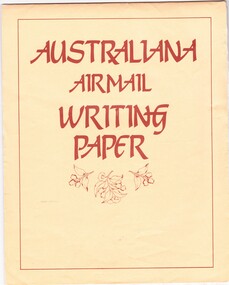
Domestic object - Airmail writing pad and two aerogrammes, Ken Dome, 1980s-1990s
... ...Ken Dome...One of the two aerogrammes cost 60c and has an illustration of a Melbourne tram by Australian artist Ken Dome This was one of four designs which he created for aerogrammes and released in 1989. ...Ken Dome...Domestic object Airmail writing pad and two aerogrammes Ken Dome Ausiroo ...This writing pad has lightweight paper to minimise cost for international mail. The Australiana theme is a way of promoting Australia to the overseas recipient of the letter. One of the two aerogrammes cost 60c and has an illustration of a Melbourne tram by Australian artist Ken Dome This was one of four designs which he created for aerogrammes and released in 1989. The second aerogramme has a photograph of Australian coastline and cost 65c and so was released on or after 1993. These writing materials are a reminder of a time when ordinary communications across countries were primarily undertaken through letters carried by plane.Writing pad consisting of lightweight manilla-coloured pages in four different Australiana-themed designs. Eleven pages. (Originally twelve). Also, two aerogrammes - one is 60c and has a colourful drawing of a Melbourne tram and the other is 65c and has a photograph of the Australian coastline.On front cover of writing pad: ' AUSTRALIANA / AIRMAIL /WRITING / PAPER' On back cover of writing pad: 'Four Designs / Twelve Sheets / Post Office Approved' on one side and on the other side: 'Designed and Printed / in Australia by / AUSIROO'. On front of the 60c aerogramme: 'BY AIR MAIL PAR AVION / Aerogramme / Australia 60c' On front of the 65c aerogramme: 'BY AIR MAIL PAR AVION / Aerogramme / Australia 65c'aerogramme, australiana, ken dome -
 Flagstaff Hill Maritime Museum and Village
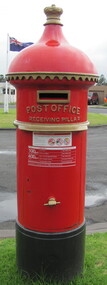
Functional object - Post Office Receiving Pillar, 1885
... Ken Sparks – out of print)] flagstaff hill warrnambool shipwrecked coast flagstaff hill maritime museum maritime museum shipwreck coast flagstaff hill maritime village great ocean road post office receiving pillar letterbox mailbox australia post “POST OFFICE / RECEIVING PILLAR” lettering cast into cylinder. Flagstaff Hill Maritime Museum – Port of Warrnambool. This letter receiver was officially commissioned on 3rd August 1980 by the Prime Minister of Australia, the Right Honourable Malcolm Fraser M.P. on completion of 25 years’ service as the Federal Minister for Wannon.” Post Office Receiving Pillar, or letterbox.1885 “High Door Round” design. Tall cast iron cylinder with decorative dome ...This Post Office Receiving Pillar was restored in 1980 and is now a fully operational Australia Post mailbox. In early August 1980 Prime Minister Mr. Fraser posted Warrnambool’s first commemorative envelope into this restored Post Office Receiving Pillar at Flagstaff Hill Maritime Village. The special limited edition envelopes are numbered 1 – 7000. When posted, the envelopes would have the Flagstaff Hill Logo and Flagstaff Hill Maritime Village’s own postmark of a ship’s steering wheel surrounding a lighthouse and a sailing ship, and were dated August 3 on the First Day Cover. Amongst Flagstaff Hill’s collection is that very first letter posted by Prime Minister Fraser. HISTORY OF POST OFFICE RECEIVING PILLARS In 1851 ‘pillar boxes’ were installed at roadside locations in the island of Jersey, England; they had already been successful in several European countries. The use of new prepaid, adhesive postage stamps as well as the roadside pillar boxes meant there was no need for the public to take a trip to the Post Office just to post a letter. By 1855 London had installed its first six Pillar Boxes. In 1856 the pillar boxes were first introduced in Sydney. These were circular with a crown on the dome, supported by leaves. Early Victoria Mail was originally collected by ‘letter carriers’, first appointed in Melbourne in 1841, equipped with leather bag and hand bell. He wore a red coat with brass buttons and a black top hat! In 1844 two wooden receiving boxes were erected in Melbourne. The first cast iron boxes were installed in South Melbourne (Emerald Hill) and were still in service until 1967. They were a fluted circular design and made in England. In the early 1860’s the ‘low door round’ design posting box was introduced, being circular and surrounded by a crown, with two broad embossed bands around its circumference. The clearance door was in front of the box and low down. These were made in Australia. In the early 1870’s square boxes with a tapering top were being used. These too were made in Australia by different manufacturers with slight variations on style such as the orientation and number of slots. Next came the circular boxes again, similar to the ‘low door round’ but with the clearance door extending to just below the posting slot, often referred to as ‘high door round’. These boxes did not have embossed bands. In 1887 small cast iron boxes were introduced, attached to posts and poles and called ‘lamp post receivers’. Around 1930 a ‘London’ model was used in Victoria. It was copied from the flat-domed type in London but made in Tasmania. [References: Flagstaff Hill Maritime Village records, The Warrnambool Standard, August 1st, 1980, “Stamps.Au” http://www.stampsau.com, 4th April 2011 (Extracted from “Australian Street Posting Boxes” by Ken Sparks – out of print)] Post Office Receiving Pillar, or letterbox.1885 “High Door Round” design. Tall cast iron cylinder with decorative dome cap with crown on top. Side has a slot and a hinged door with handle shaped as a fist. Painted red with gold trim. “POST OFFICE / RECEIVING PILLAR” lettering cast into cylinder. Restored in 1980 and once again operating as an Australia Post mailbox. Commemorative plague on pillar.“POST OFFICE / RECEIVING PILLAR” lettering cast into cylinder. Flagstaff Hill Maritime Museum – Port of Warrnambool. This letter receiver was officially commissioned on 3rd August 1980 by the Prime Minister of Australia, the Right Honourable Malcolm Fraser M.P. on completion of 25 years’ service as the Federal Minister for Wannon.”flagstaff hill, warrnambool, shipwrecked coast, flagstaff hill maritime museum, maritime museum, shipwreck coast, flagstaff hill maritime village, great ocean road, post office receiving pillar, letterbox, mailbox, australia post -
 Flagstaff Hill Maritime Museum and Village
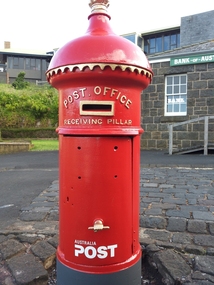
Functional object - Post Office Receiving Pillar, 1885
... . … [References: Flagstaff Hill Maritime Village records, The Argus, 11th April, 1890, The Argus, 2nd July, 1896, The Argus, 30th Nov. 1897, “Stamps.Au” http://www.stampsau.com, 4th April 2011 (Extracted from “Australian Street Posting Boxes” by Ken Sparks – out of print)] flagstaff hill warrnambool shipwrecked coast flagstaff hill maritime museum maritime museum shipwreck coast flagstaff hill maritime village great ocean road post office receiving pillar letterbox mailbox australia post Oval maker's plate “ - G. COUCH - / ENGINEER / ALLIANCE IRON / WORKS / MELBOURNE” Post Office Receiving Pillar, or letterbox.1885 "High Door Round" design, restored 2014 Tall cast iron sylinder with decorative dome ...Post Office Receiving Pillar was Collected from Warrnambool City Council’s Scott Street Depot and transported to Flagstaff Hill, stored in the Barracks area Friends of Flagstaff Hill began the project of restoring the Post Office Receiving Pillar in early 2011. The replacement dome required a pattern to be made from paper, then timber, then someone to manufacture it. The cast iron body required sand blasting and undercoating. The pillar was installed in Flagstaff Hill Maritime Village in March 2014. A specialist visited the Village and painted the pillar with 7 coats of ‘post office red’ then completed the job with gold paint on the details. In 2015 an information plate of brass was fitted to the Pillar in the position that would have originally announced the clearing times. It was originally manufactured by G Couch, Engineer, Alliance Iron Works, Melbourne. Gordon Couch passed away in June 1896 and his Works were offered for auction in November 1897. HISTORY OF POST OFFICE RECEIVING PILLARS In 1851 ‘pillar boxes’ were installed at roadside locations in the island of Jersey, England; they had already been successful in several European countries. The use of new prepaid, adhesive postage stamps as well as the roadside pillar boxes meant there was no need for the public to take a trip to the Post Office just to post a letter. By 1855 London had installed its first six Pillar Boxes. In 1856 the pillar boxes were first introduced in Sydney. These were circular with a crown on the dome, supported by leaves. Early Victoria Mail was originally collected by ‘letter carriers’, first appointed in Melbourne in 1841, equipped with leather bag and hand bell. He wore a red coat with brass buttons and a black top hat! In 1844 two wooden receiving boxes were erected in Melbourne. The first cast iron boxes were installed in South Melbourne (Emerald Hill) and were still in service until 1967. They were a fluted circular design and made in England. In the early 1860’s the ‘low door round’ design posting box was introduced, being circular and surrounded by a crown, with two broad embossed bands around its circumference. The clearance door was in front of the box and low down. These were made in Australia. In the early 1870’s square boxes with a tapering top were being used. These too were made in Australia by different manufacturers with slight variations on style such as the orientation and number of slots. Next came the circular boxes again, similar to the ‘low door round’ but with the clearance door extending to just below the posting slot, often referred to as ‘high door round’. These boxes did not have embossed bands. In 1887 small cast iron boxes were introduced, attached to posts and poles and called ‘lamp post receivers’. Around 1930 a ‘London’ model was used in Victoria. It was copied from the flat-domed type in London but made in Tasmania. … [References: Flagstaff Hill Maritime Village records, The Argus, 11th April, 1890, The Argus, 2nd July, 1896, The Argus, 30th Nov. 1897, “Stamps.Au” http://www.stampsau.com, 4th April 2011 (Extracted from “Australian Street Posting Boxes” by Ken Sparks – out of print)] Post Office Receiving Pillar, or letterbox.1885 "High Door Round" design, restored 2014 Tall cast iron sylinder with decorative dome cap, slot in side, hinged door with handle shaped as a fist. Painted red with gold trip..Reconditioned barrel, reconstructed dome. Restored by Friends of Flagstaff Hill, 2014. Now a working letterbox. Made in Melbourne.Oval maker's plate “ - G. COUCH - / ENGINEER / ALLIANCE IRON / WORKS / MELBOURNE”flagstaff hill, warrnambool, shipwrecked coast, flagstaff hill maritime museum, maritime museum, shipwreck coast, flagstaff hill maritime village, great ocean road, post office receiving pillar, letterbox, mailbox, australia post
