
Showing 3 items matching "kitchen cannister"
-
 Emerald Museum & Nobelius Heritage Park
Domestic object - Kitchen cannisters, Sunray, mid-20th century
... kitchen cannister...Five graduating aluminium kitchen cannisters with brown bakelite knobs. These are in good condition with the usual marks and patina consistent with their age. ...Domestic object Kitchen cannisters Sunray ...These cannisters originated from a farming property originally bought by C T Alexander in 1920 and which has remained in the Alexander family since then. Karen Alexander, grand-daughter of C T Alexander, has donated a range of items from the property including domestic, wood-working and agricultural.These cannisters were in use in kitchens in mid-20th century and originated from an Emerald farm.Five graduating aluminium kitchen cannisters with brown bakelite knobs. These are in good condition with the usual marks and patina consistent with their age. They are separately labelled with raised names on the side of each container. These are in order of the size of each container: 'Flour', 'Sugar', 'Tea', 'Rice' and 'Coffee'. Maker's name 'Sunray' is on the base.Aluminium label fixed to the side of each cannister with two studs: 'Flour', 'Sugar', 'Tea', 'Rice', 'Coffee' 'Sunray Brand' with a sunray graphic on bottom of each cannisterkitchen cannister, 1950s, alexander -
 City of Moorabbin Historical Society (Operating the Box Cottage Museum)
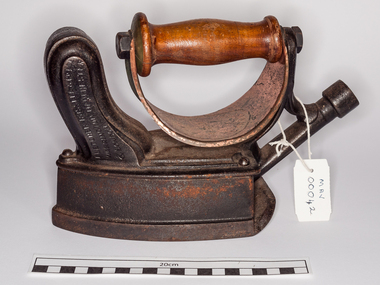
Domestic object - Kitchen equipment, gas-fuelled flat iron, c1900 - 30
... However , not many houses had access to a gas supply until much later and this iron was popular in 1920’s These sad irons remind us of the difficult circumstances experienced in their daily routines by the pioneers and early settlers of Moorabbin Shire The family of Miss M Curtis were early settlers in Moorabbin Shire. sad iron kitchen equipment fletcher russell co. ltd. england warrington manchester pioneers early settlers market gardeners sewing craftwork clothing moorabbin brighton bentleigh fireplaces stoves domestic gas supply gas-light gas cannisters FLETCHER RUSSELL CO. / LIM/ PATENT/ WARRINGTON on right side of handle 'Registered' on left side of handle ' Fletcher Russell Co L / Warrington, Manchester / & London. ...Sad-irons or "solid" irons were made by blacksmiths and used to smooth out material by pressing the hot iron over it. A piece of sheet -iron was placed over the kitchen fire and the irons placed on it could be heated whilst remaining clean of ash.. The women used 2 irons - one heating while the other was used. Thick cloth or gloves protected their hands from the hot irons. The handle was removed from the cool iron and re- attached to remove the hot iron from the fire. The cool iron was replaced on the fire or stove to heat again. These irons were cleaned with steel wool to prevent them marking the material. If the iron was too hot the material would scorch. Most homes set aside one day for ironing and some large households had an ironing room with a special stove designed to heat irons. However, most women had to work with a heavy, hot iron close to the fireplace even in summer. Thomas Fletcher (1840-1903). By 1880s he had a gas appliance manufactory in Thynne Street, Warrington. By 1895 the company had become Fletcher Russell and Co Gas Engineers, his firm having merged with Alexander and William Russell of Pendleton Iron Works. Circa 1950, the firm merged into Radiation Ltd which was later acquired by 'TI New World'; 1902: Fletcher, Russell & Co. Ltd., Palatine Works, Warrington In 1880 gas -fuelled irons were connected by rubber tubing to the gas light-fittings of the house or to gas canisters. However , not many houses had access to a gas supply until much later and this iron was popular in 1920’sThese sad irons remind us of the difficult circumstances experienced in their daily routines by the pioneers and early settlers of Moorabbin Shire The family of Miss M Curtis were early settlers in Moorabbin Shire.A gas-fuelled flat iron, made in USA , It would have been attached to a gas hose fitting that was also used at night for light in the house. There is a small chimney to allow for air and to try to control the amount of heat in the iron. A 'shield' is under the leather covered handle to protect the user's hand from the heat, however it is made of copper metal - a heat conductor.FLETCHER RUSSELL CO. / LIM/ PATENT/ WARRINGTON on right side of handle 'Registered' on left side of handle ' Fletcher Russell Co L / Warrington, Manchester / & London.sad iron, kitchen equipment, fletcher russell co. ltd., england, warrington, manchester, pioneers, early settlers, market gardeners, sewing, craftwork, clothing, moorabbin, brighton, bentleigh, fireplaces, stoves, domestic gas supply, gas-light, gas cannisters -
 Kiewa Valley Historical Society
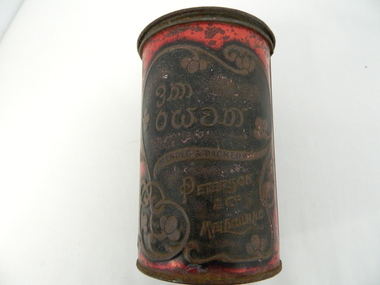
Tin Rasawatte Tea, mid 1900's
... kitchen storage...tin container...cannister..."The latest jadgets" took longer to permeate into "isolated or semi isolated rural regions" such as the Kiewa valley kitchen storage tin container cannister/caddy kichen advertising Embossed with the following "Ceylon Flavoured" and in bold large letters "RASAWATTE TEA" and below this in smaller print "ONE POUND NETT" This is encapsulated by Tea plant petals and vines. ...This canister which contained a blend of Rasawatte tea was produced in the early 1900's and for the most of those who acquired it for its contents it was useful (because it was made from solid pressed steel) as a tea caddy or container for other kitchen utensils or loose grains etc. It was also a good advertising item for a general agent W.M. Peterson & Co. in Melbourne. This company along with neighbouring tea importers offices were burnt down in a horrific building fire in Melbourne.This item was used in a period of time when the tea beveridge was the main hot beveridge to accompany meals, and "high tea" was a special treat to enjoy quality teas and "finger" food. In the rural sector of the Kiewa Valley, the favourite hot drink at "smoko" or other rest times was a freshly "brewed" pot or "billy" of tea. The hot drink tea was later in time challenged by the hot cup of coffee. This change occured at a later time in the rural sector than in cities or larger towns. The rural sector in this time frame was a lot more "traditional" in a lot of their day to day learned mores. Life style changes took longer to evolve mainly due to lack of media bombardment (mainly from city based advertisers) within the family home . "The latest jadgets" took longer to permeate into "isolated or semi isolated rural regions" such as the Kiewa valleyThis cylindrical tin container, which originally contained fine Ceylon tea is totally constructed from pressed light steel. It is embossed with content details and the name of the general tea agent. The main body has been fastened by pressed, not soldered connections.Embossed with the following "Ceylon Flavoured" and in bold large letters "RASAWATTE TEA" and below this in smaller print "ONE POUND NETT" This is encapsulated by Tea plant petals and vines. On the opposite side and in script writing "3M" below this in an unfolded banner presentation "BLENDED & PACKED BY" below this "Peterson & co Melbourne" This is also encapsulated by Tea plant petals and vines.kitchen storage, tin container, cannister/caddy, kichen advertising
