
Showing 7 items matching "kitchen staff in camp"
-
 Tatura Irrigation & Wartime Camps Museum
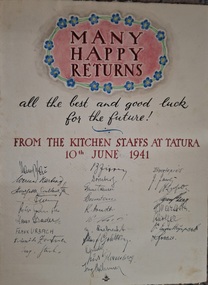
Certificate - card, Many Happy Returns
... ...Kitchen staff in camp...Camp internees Happy birthday card Kitchen staff in camp Tatura camp MANY HAPPY RETURNS all the best and good luck for the future! ...Made in camp by internees for one of their fellow internees birthdays. Signed by other internees.A piece of fawn card with torn edges. At top if oval shape with blue flowers on green stems, surrounding a pink oval in which is written Many Happy Returns. Below is more writting in black and some in red and below that are signatures.MANY HAPPY RETURNS all the best and good luck for the future! From the kitchen staffs at Tatura 10 June 1941camp internees, happy birthday card, kitchen staff in camp, tatura camp -
 Tatura Irrigation & Wartime Camps Museum
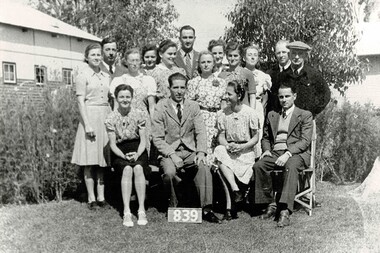
Photograph, Camp and Kitchen staff, 1942
... Camp and Kitchen staff...Black and white photograph of the 16 kitchen staff at Camp 3 with a back drop of Army huts. ...They were internees in Camp 3. internee children camp 3 children beilharz family decker family the number 839 Black and white photograph of the 16 kitchen staff at Camp 3 with a back drop of Army huts. ...The Beilharz and Decker families of the 9 families represented. They were internees in Camp 3.Black and white photograph of the 16 kitchen staff at Camp 3 with a back drop of Army huts. The number 839 is on the ground centre front.the number 839internee children, camp 3 children, beilharz family, decker family -
 Federation University Historical Collection
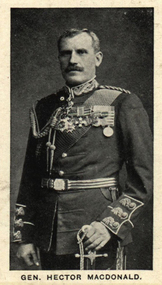
Photograph (black & White), Major General, Sir Hector Archibald MacDonald - South Africa
... Kitchener was assisted by the skillful manoeuvring of MacDonald and his men in overcoming the Dervishes. Due to this MacDonald was promoted to colonel, appointed an aide-de-camp to Queen Victoria and received a cash reward. In Scotland MacDonald was regarded the true hero of Omdurman, not Kitchener. In 1899 he was seconded to command a military district in India but with the outbreak of war in South Africa, he was ordered to command the Highland Brigade, under Lord Roberts and his Chief of Staff...Kitchener was assisted by the skillful manoeuvring of MacDonald and his men in overcoming the Dervishes. Due to this MacDonald was promoted to colonel, appointed an aide-de-camp to Queen Victoria and received a cash reward. In Scotland MacDonald was regarded the true hero of Omdurman, not Kitchener. In 1899 he was seconded to command a military district in India but with the outbreak of war in South Africa, he was ordered to command the Highland Brigade, under Lord Roberts and his Chief of Staff ...In 1870 MacDonald joined the Inverness-shire Highland Rifle Volunteers and in 1871 enlisted in the 92nd Gordon Highlanders. He rose rapidly through the noncommissioned ranks. His distinguished conduct in the presence of the enemy during the Second Afghan War led to him being offered either a Victoria Cross or a commission with his regiment. He chose the latter. He served in the First Boer War and at the Battle of Majuba Hill made prisoner. At the Battle of Omdurman (1898), the British commander Lord Kitchener was assisted by the skillful manoeuvring of MacDonald and his men in overcoming the Dervishes. Due to this MacDonald was promoted to colonel, appointed an aide-de-camp to Queen Victoria and received a cash reward. In Scotland MacDonald was regarded the true hero of Omdurman, not Kitchener. In 1899 he was seconded to command a military district in India but with the outbreak of war in South Africa, he was ordered to command the Highland Brigade, under Lord Roberts and his Chief of Staff, Lord Kitchener. MacDonald arrived in Cape Town and assumed command of the Highland Brigade stationed at Modder River with rank of Major-general. He took part in the Battle of Paardeberg and later operations in Bloemfontein and Pretoria. In 1901 he was knighted as Knight Commander of the Order of the Bath In1902 he was appointed Commander-in-Chief of British Troops in Ceylon with the temporary rank of major-generalIndividual image taken from photographed poster of tobacco and cigarette cards.hector macdonald, highland rifle volunteers, gordon highlanders, noncommissioned, second afghan war, victoria cross, first boer war, battle of majuba hill, battle of omdurman, lord kitchener, lord roberts, aide-de-camp, queen victoria, dervishes, cape town, highland brigade, modder river, battle of paardeburg, bloemfontein, pretoria, knight commander of the order of the bath, commander-in-chief, ceylon -
 4th/19th Prince of Wales's Light Horse Regiment Unit History Room
Potographs, Turkish Prisoners, c. 1918
... On the back "One of the camp kitchens, prisoners, staff and interpreter". 4. An open plane with long lines of prisoners . ...On the back "One of the camp kitchens, prisoners, staff and interpreter". 4. An open plane with long lines of prisoners . ...A set of nine black & white photographs depicting mainly activities of Turkish prisoners. 1. Ten prisoners sitting in a circle preparing vegetables. On the back - "Preparing the daily stew". 2. A group of about 70 prisoners in ranks of four with hundreds more in the background. On the back "Led or fed up". 3. Three sets of 44 gallon drums set up for cooking with a line of 25 prisoners behind. On the back "One of the camp kitchens, prisoners, staff and interpreter". 4. An open plane with long lines of prisoners . On the back "Prisoners from Jenin to Lejjun". 5. A group of about 80 prisoners by a stream. On the back " The first batch of prisoners in Damascus district near Sasa". 6. Lines of graves decorated with rocks. On the back "Turkish Graveyard". 7. Another scene of the camp kitchen with a large gathering of prisoners and Light Horsemen. On the back "The stew issue". 8. A large gathering of prisoners, mainly sitting on the ground. On the back "Acres of prisoners at Tulkeram". 9. Graves of Turkish POW's who died of sickness Oct 18See descriptionphotos, turkish pow, ww1 -
 Tatura Irrigation & Wartime Camps Museum
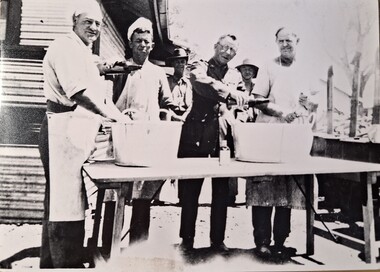
Photograph, Christmas Pudding
... ...Camp 4 kitchen staff...Christmas pudding Camp 4 kitchen staff Captain Scates Black and white photograph of 6 men, 4 in front and 2 behind. 3 of the 4 men in front in white aprons the other in uniform. ...Making of the Christmas pudding at Camp 4. Captain Scates in the middle. Black and white photograph of 6 men, 4 in front and 2 behind. 3 of the 4 men in front in white aprons the other in uniform. The two men in background are in uniform. They are pouring liquid into two big tubs, making Christmas pudding.christmas pudding, camp 4 kitchen staff, captain scates -
 Falls Creek Historical Society
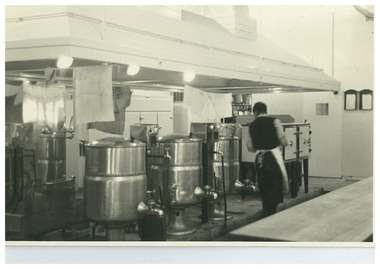
Photograph - Inside Pretty Valley Camp Kitchen
... A black and white photo taken inside the Pretty Valley Camp kitchen. Staff quarters was completed in April, 1947 and accommodation for workmen commenced in 1948 but was suspended from May until November. ...Falls Creek Victorian Snowfields Pretty Valley A black and white photo taken inside the Pretty Valley Camp kitchen. Staff quarters was completed in April, 1947 and accommodation for workmen commenced in 1948 but was suspended from May until November. ...MEYER COLLECTION - FALLS CREEK PHOTOS In 1947 a determined group of like-minded State Electricity Commission (SEC) staff including Ray Meyer, the chief surveyor of the Kiewa Hydro-Electric Scheme, had a common interest that revolved around the skiing potential of the snow-covered high plains which included what is now the resort of Falls Creek. The six SEC employees, Toni St Elmo, Ray Meyer, Jack Minogue, Lloyd Dunn, Adrian Ruffenacht and Dave Gibson (together with their families) banded together to secretly build a 'hut' that was the first ski lodge at Falls Creek. Using a road built in 1930s to gain access to Falls Creek, their hut project was carried out in secret as efforts by other skiers were blocked by H.H.C. Williams – the engineer in charge of the Hydro Scheme. In 1946 Ray Meyer made a trip to the Lands Office in Melbourne. He came away with a 99-year lease on three acres that was ideally suited for a hut designed by Lloyd Dunn. Adrian Ruffenacht (Design Engineer for the KHS) had suggested where the group should build because of easy access to a spring for water. Much of the building material required was scavenged from derelict huts on the high plains. Due to the need for secrecy, the determined group worked on the hut in the evenings and weekends to avoid detection. During the building period the group had met at Echidna Rock (now known as Eagle Rock) where Skippy St Elmo announced, "This is my favourite ‘Skyline’.” And so the first lodge in the area at Falls Creek Ski Resort came into existence. With the development of the International Poma in the 1970s, the Skyline Lodge, which was sited between the ski-lift’s pole one and pole two, was demolished. However, the legacy of Ray Meyer, Toni St Elmo, Jack Minogue, Lloyd Dunn, Adrian Ruffenacht and Dave Gibson and Skyline lives on in the vibrant atmosphere of Falls Creek Resort. The MEYER COLLECTION documents developments on the Kiewa Hydro Scheme and their life at Falls Creek from the mid 1930s to 1960s.This image is significant because it documents the development of the Kiewa Hydroelectric Scheme.A black and white photo taken inside the Pretty Valley Camp kitchen. Staff quarters was completed in April, 1947 and accommodation for workmen commenced in 1948 but was suspended from May until November. Construction of this camp was completed in 1949. A large dam was proposed at this site but it was never constructed, being replaced by a smaller diversion dam.falls creek, victorian snowfields, pretty valley -
 The Beechworth Burke Museum
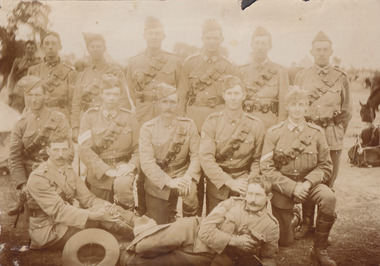
Photograph, 1910
... Kitchener will desire to see the troops on the move, the reason for choosing such a district as Seymour is apparent. The eight days to be devoted to the camp will be mainly occupied in moving the troops over a considerable area, and in carrying out certain tactical operations. Many of the sites recommended have been inspected by officers of the head quarter staff...Kitchener will desire to see the troops on the move, the reason for choosing such a district as Seymour is apparent. The eight days to be devoted to the camp will be mainly occupied in moving the troops over a considerable area, and in carrying out certain tactical operations. Many of the sites recommended have been inspected by officers of the head quarter staff ...Lord Kitchener visited Seymour as part of his review of Australia's military capabilities. Lord Kitchener was Commander-in-Chief of the British Army at the time of his visit. At the invitation of Prime Minister Alfred Deakin, Kitchener visited Australia in 1909 to inspect the existing state of defence preparedness of the Commonwealth, and advise on the best means of providing Australia with a land defence. Kitchener’s report, submitted in February 1910, recommended the introduction of compulsory military training which was immediately adopted, as was the establishment of the Military College, Duntroon: It has been definitely decided that Seymour will be the site of the Kitchener camp. The troops which will make the strongest muster at the camp will be the Light Horse. This being so, the suitability of the chosen area for cavalry operations has necessarily had to be considered in selecting the site, and an additional factor is that Seymour is practically in the centre of the Light Horse districts. The country round Seymour is also suitable for artillery manoeurves, and there is no available area in the vicinity of Melbourne where these could be so well carried out. As it is considered that Field-Marshal Lord Kitchener will desire to see the troops on the move, the reason for choosing such a district as Seymour is apparent. The eight days to be devoted to the camp will be mainly occupied in moving the troops over a considerable area, and in carrying out certain tactical operations. Many of the sites recommended have been inspected by officers of the head quarter staff, and all that now remains is that the exact situation for the main camp should be selected, Major Luscombe will visit Seymour on Saturday to inspect the surround country, and select the most suitable places. The intention will be directed to sites closer to the town. Yea Chronicle (Yea, Vic), 9 December 1909. Black and white rectangular photograph printed on matte photographic paper and mounted on board.Obverse: Beechworth Light Horse (pen) / Kitchener Camp / Seymour / 1910 / Reverse: 8743 / Mrs R Scott / military album, burke museum, burke, beechworth, beechworth light horse, light horse, world war one, wwi, 1910
