
Showing 65 items matching "kitchen storage"
-
 Kiewa Valley Historical Society
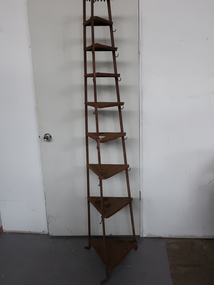
Stand - Pot Plants or Kitchen storage
... Stand - Pot Plants or Kitchen storage......kitchen storage...Stand - Pot Plants or Kitchen storage ...Home decoration involved pots / saucepans / plates etc in the kitchen to be on display / stored and/or indoor plants displayed in a corner on the verandah. It was common for the stand to be home-made and practical.Used by a resident of the Kiewa Valley as a domestic kitchen storage stand or possibly for indoor plants.Tall wooden pot stand with 9 triangular shelves spaced along it and with hooks on 2 of the 3 edges. It has 3 wooden poles holding the shelves. The stand has previously been painted blue. Nine equilateral triangle shelves decreasing in size with height towards the top. Top has decorative cap with steel fringe. Rusty. It may have been used as a kitchen pot / saucepan / plates stand or pot plant stand.pot plants, indoor plants, home decoration, pot stand, kitchen storage -
 Streatham and District Historical Society
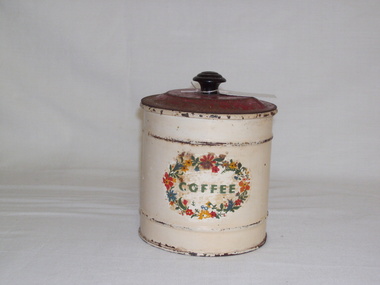
Coffee Canister, Kitchen Storage
... Kitchen Storage...Kitchen Storage Coffee Canister ... -
 Musculoskeletal Health Australia (now held by the Glen Eira Historical Society)
Photograph - Group photo, 2000
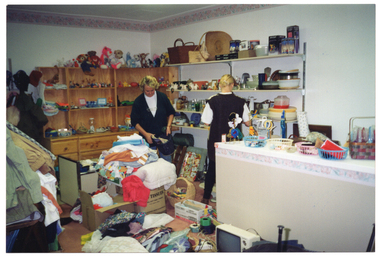
... ... plastic kitchen storage containers...On the perpendicular wall, there are more shelves with various items, including cane baskets, a large straw hat, bric-a-brac, crockery, glassware, plastic kitchen storage containers, and some boxed items on the top shelf. ...On the perpendicular wall, there are more shelves with various items, including cane baskets, a large straw hat, bric-a-brac, crockery, glassware, plastic kitchen storage containers, and some boxed items on the top shelf. ...At the Arthritis Foundation of Victoria's Malvern Opportunity Shop, two volunteers sort through boxes of donations in the crowded shop.COL photo of two women inside a shop. They are sorting through bags and boxes of donations in a crowded room. Behind them is a large dresser, with drawers at the bottom and a hutch with shelves at the top. There are soft toys across the top shelf, and various other items on the shelves below. On the perpendicular wall, there are more shelves with various items, including cane baskets, a large straw hat, bric-a-brac, crockery, glassware, plastic kitchen storage containers, and some boxed items on the top shelf. The floor is crowded with boxes, baskets, and other miscellaneous items - including a portalbe television set. In the foreground, there are piles of clothing or fabric.[Handwritten in blue ink] Jenni and Missy "in a mess"arthritis foundation of victoria, afv, opportunity shop, op shop, charity shop, thrift store, teddy bear, soft toys, glassware, bric-a-brac, prints, pictures, plastic kitchen storage containers, television, clothing, bedding, volunteers, members, moonee ponds, 2000 -
 Flagstaff Hill Maritime Museum and Village
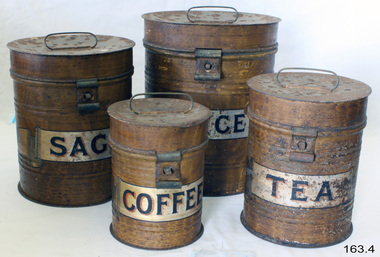
Container - Kitchen Canister set, 1850-1870
... ...kitchen canister...food storage...kitchen. Items such as coffee, tea, rice and sago were stable food types and needed longer term storage and a higher degree of protection from vermin and the elements, a common material used during this time was sheet metal or tin such as is used today in a common form of storage the biscuit tin. ...Cylindrical matching kitchen storage tins with hinge lid that has a latch closure, and a folding handle on top of lid. ...Cylindrical matching kitchen storage tins with hinge lid that has a latch closure, and a folding handle on top of lid. ...In early civilization's cereal grains such as maize, wheat, barley etc. were stored in large airy buildings, often raised up from the ground to reduce infestation by pests and vermin. Ancient Egyptian and early Hebrew writings include reference to such buildings. Smaller quantities of food were stored in baskets made from woven grasses or leaves. In more recent times but prior to the invention of the refrigerator many food products were stored in the home as preserves or pickles, often in heat sealed jars. Dry food items were stored in vermin proof metal containers and could be found in any early colonial kitchen. Items such as coffee, tea, rice and sago were stable food types and needed longer term storage and a higher degree of protection from vermin and the elements, a common material used during this time was sheet metal or tin such as is used today in a common form of storage the biscuit tin. An early example of colonial food storage used in a domestic setting, it is interesting to note the subject items have provision to be locked. This indicates the value early colonial settlers placed on the contents and used to prevent pilfering. The subject items are now sought by collectors. Canister set; set of four canisters. Cylindrical matching kitchen storage tins with hinge lid that has a latch closure, and a folding handle on top of lid. Canisters are painted brown and the body has a graphic of a scroll in gold with printed label of contents. The canisters range from small to large, "COFFEE", "TEA" , "SAGO", " RICE" (respective RNs 163.1, 163.2, 163.3, 163.4)Respectively labelled "COFFEE," "TEA," "SAGO," "RICE" flagstaff hill, warrnambool, shipwrecked coast, flagstaff hill maritime museum, flagstaff hill maritime village, great ocean road, canister, canister set, rice canister, kitchen canister, food storage, domestic item -
 Flagstaff Hill Maritime Museum and Village
Ceramic - Stoneware Container, 1900 to 1940
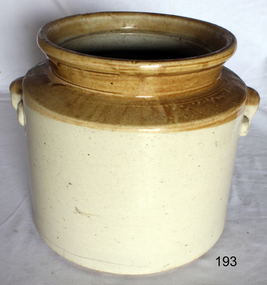
... ...kitchen storage...Its significance lies with its use as a domestic object giving today a view into our social past. flagstaff hill warrnambool shipwrecked coast flagstaff hill maritime museum shipwreck coast flagstaff hill maritime village great ocean road container stoneware container kitchen storage kitchen ware None Stoneware circular container with wide opening, brown top and off white base. ...Stoneware is a rather broad term for pottery or other ceramics that is fired at a relatively high temperature. A modern technical definition is a vitreous or semi-vitreous ceramic made primarily from stoneware clay or non-refractory fire clay. Whether vitrified or not, it is non-porous, it may or may not be glazed. Historically, across the world, it has been developed after earthenware and before porcelain and has often been used for high-quality as well as utilitarian wares. As a rough guide, modern earthen wares are normally fired in a kiln at temperatures in the range of about 1,000°C (1,830 °F) to 1,200 °C (2,190 °F); stoneware's at between about 1,100 °C (2,010 °F) to 1,300 °C (2,370 °F); and porcelains at between about 1,200 °C (2,190 °F) to 1,400 °C (2,550 °F). Historically, reaching high temperatures was a long-lasting challenge, and temperatures somewhat below these were used for a long time. Earthenware can be fired effectively as low as 600°C, achievable in primitive pit firing, but 800 °C was more typical. Stoneware also needs certain types of clays, more specific than those able to make earthenware, but can be made from a much wider range than porcelain. A domestic item used to store food products as glazing makes the container non-porous, often used for pickling. Or larger containers for kitchen flour. Items age is difficult to determine given the same techniques for making stoneware are in use today. Stoneware containers were made by many potteries in Australia and England. They were in common domestic use before plastics were invented around 1940 to store goods so this subject item is probably from around 1900 to the 1940s. Item's significance is difficult to determine given it is not associated with a place, person, historic event, or manufacturer. Its significance lies with its use as a domestic object giving today a view into our social past.Stoneware circular container with wide opening, brown top and off white base. Handholds moulded on each side glazed finish, cracks in base.Noneflagstaff hill, warrnambool, shipwrecked coast, flagstaff hill maritime museum, shipwreck coast, flagstaff hill maritime village, great ocean road, container, stoneware container, kitchen storage, kitchen ware -
 Flagstaff Hill Maritime Museum and Village
Ceramic - Stoneware Container, 1900 to 1940
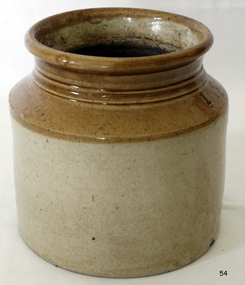
... ...kitchen storage...Its significance lies with its use as a domestic object giving today a view into our social past. flagstaff hill warrnambool shipwrecked coast flagstaff hill maritime museum shipwreck coast flagstaff hill maritime village great ocean road container stoneware container kitchen storage kitchen ware Marked "1" on brown glazed rim Stoneware circular container with wide opening, brown top and off white base glazed finish Ceramic Stoneware Container ...Stoneware is a rather broad term for pottery or other ceramics that is fired at a relatively high temperature. A modern technical definition is a vitreous or semi-vitreous ceramic made primarily from stoneware clay or non-refractory fire clay. Whether vitrified or not, it is non-porous, it may or may not be glazed. Historically, across the world, it has been developed after earthenware and before porcelain and has often been used for high-quality as well as utilitarian wares. As a rough guide, modern earthen wares are normally fired in a kiln at temperatures in the range of about 1,000°C (1,830 °F) to 1,200 °C (2,190 °F); stoneware's at between about 1,100 °C (2,010 °F) to 1,300 °C (2,370 °F); and porcelains at between about 1,200 °C (2,190 °F) to 1,400 °C (2,550 °F). Historically, reaching high temperatures was a long-lasting challenge, and temperatures somewhat below these were used for a long time. Earthenware can be fired effectively as low as 600°C, achievable in primitive pit firing, but 800 °C was more typical. Stoneware also needs certain types of clays, more specific than those able to make earthenware, but can be made from a much wider range than porcelain. A domestic item used to store food products as glazing makes the container non-porous, often used for pickling. Or larger containers for kitchen flour. Items age is difficult to determine given the same techniques for making stoneware are in use today. Stoneware containers were made by many potteries in Australia and England. They were in common domestic use before plastics were invented around 1940 to store goods so this subject item is probably from around 1900 to the 1940s. Item's significance is difficult to determine given it is not associated with a place, person, historic event, or manufacturer. Its significance lies with its use as a domestic object giving today a view into our social past.Stoneware circular container with wide opening, brown top and off white base glazed finish Marked "1" on brown glazed rimflagstaff hill, warrnambool, shipwrecked coast, flagstaff hill maritime museum, shipwreck coast, flagstaff hill maritime village, great ocean road, container, stoneware container, kitchen storage, kitchen ware -
 Flagstaff Hill Maritime Museum and Village
Container - Tea Container, J Marsh & Sons (Tin Container Fabricators), 1900-1940
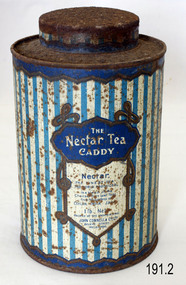
... ...kitchen storage...Tin, "Choicest Nectar Tea" is an example of retail packaging, for domestic goods, the tin was made by J Marsh and Sons, Melbourne, for John Connell & Co Ltd, Melbourne, Victoria, Australia, 1900-1940 Item at this time cannot be associated with an historical event, person or place, provenance is unknown, item assessed as a collection asset. flagstaff hill warrnambool flagstaff hill maritime museum maritime museum shipwreck coast flagstaff hill maritime village great ocean road tea canister tea caddy tea tin container kitchen storage food storage food nectar tea john connell melbourne J March & Sons John Connell & Co Ltd On label "The Nectar Tea Caddy" and "Nectar, the finest tea the world produces, is a blend of the Choicest Pure Leafed Teas from the Gardens of Ceylon, India, Java" Container; tea caddy for "Nectar Tea" brand, 1 lb. ...Tin, "Choicest Nectar Tea" is an example of retail packaging, for domestic goods, the tin was made by J Marsh and Sons, Melbourne, for John Connell & Co Ltd, Melbourne, Victoria, Australia, 1900-1940Item at this time cannot be associated with an historical event, person or place, provenance is unknown, item assessed as a collection asset.Container; tea caddy for "Nectar Tea" brand, 1 lb. Packed by John Connell and Co Ltd, Melbourne. Blue and white vertical stripe decoration. On label "The Nectar Tea Caddy" and "Nectar, the finest tea the world produces, is a blend of the Choicest Pure Leafed Teas from the Gardens of Ceylon, India, Java"flagstaff hill, warrnambool, flagstaff hill maritime museum, maritime museum, shipwreck coast, flagstaff hill maritime village, great ocean road, tea canister, tea caddy, tea tin, container, kitchen storage, food storage, food, nectar tea, john connell, melbourne, j march & sons, john connell & co ltd -
 Flagstaff Hill Maritime Museum and Village
Domestic object - Food Safe, Willow Ware Pty Ltd, 1950s to 70s
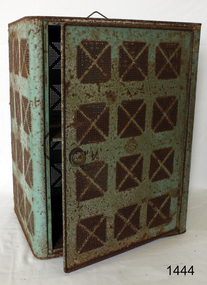
... ...kitchen storage...The maker, Willow, has a name associated with practical and reliable domestic products. flagstaff hill warrnambool flagstaff hill maritime museum shipwreck coast flagstaff hill maritime village great ocean road food storage food preservation Willow Willow Manufacturing Willow Australia kitchen storage food care 19th century 20th century Willow Ware domestic item coolgardie meat safe meat safe food safe coolgardie Marked "Made in Australia" "Willow" Metal kitchen safe with two shelves, a hinged door and latch and a small swivel wire handle at the top. ...This food safe is a mass-produced item made for domestic use by Willow Manufacturing in Australia fin the mid-20th century. Willow started a business in 1887 as a metalworking company based in Melbourne Australia, making tinned biscuit and tea canisters. In the First World War, the company began manufacturing armaments and essential packaging for the war effort. In the early 1920s, Willow produced domestic kitchen bakeware such as tin-plated canisters and baking pans labelled with the well-known Willow brand. Other items at this time include billies, boilers, basins and Coolgardie safes. In the late 1950s, the company ventured into plastics production. and in 1965, the name changed to Willow Ware Pty Ltd, to be more closely linked to its Willow brand. Willow Ware is still in business today.The Australian food safe is an example of domestic food storage and preservation in Australian homes from the mid-19th century and early 20th centuries. It is part of the evolution of food preservation methods leading up to our modern electric appliances. The maker, Willow, has a name associated with practical and reliable domestic products.Metal kitchen safe with two shelves, a hinged door and latch and a small swivel wire handle at the top. Painted light green. Airflow holes have been formed in each side panel. Made by Willow, Australia.Marked "Made in Australia" "Willow"flagstaff hill, warrnambool, flagstaff hill maritime museum, shipwreck coast, flagstaff hill maritime village, great ocean road, food storage, food preservation, willow, willow manufacturing, willow australia, kitchen storage, food care, 19th century, 20th century, willow ware, domestic item, coolgardie meat safe, meat safe, food safe, coolgardie -
 Flagstaff Hill Maritime Museum and Village
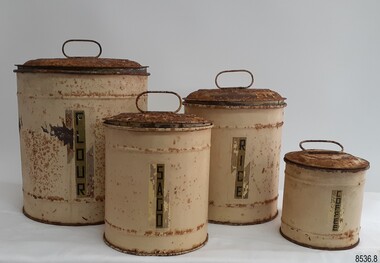
Container - Kitchen Canister set, Late 19th to early 20th century
... ...kitchen storage...Flagstaff Hill Flagstaff Hill Maritime Museum and Village Warrnambool Maritime Museum Maritime Village Great Ocean Road Shipwreck Coast canister set kitchen storage food storage metal canisters dry food storage food packaging kitchen container vintage flour rice sago coffee kitchenalia late 19th to early 20th centuries nesting canisters Labels, in descending order: "FLOUR" "RICE" "SAGO" "COFFEE" Canister set; four cylindrical cream coloured metal canisters with domed lids that have lift-up handles on top. ...This set of kitchen dry food canisters is made of metal; each container has a different height, width and capacity. The rolled thin metal has created a strong, round design with decorative rings on the circumference. The base and close-fitting lid protect the contents from vermin and most insects, and the handle on top aids in the removal of the lid. Metal containers like these are reusable and can be re-purposed, which is advantageous when living in regional or rural areas. The type of manufacture indicates that the set was made in the late 19th to early 20th century. Gradually, colourful and attractive plastic kitchenware began to replace metalware. One of the canisters is labelled 'coffee'; coffee plants and seeds were transported from Brazil into Australia in 1788 when the First Fleet arrived although their growth was unsuccessful. However, by the 1920s, a tenth of the Australian population was drinking readily stored coffee. Large quantities of harvested grains such as maize, wheat and barley were protected from pests by being stored in airy buildings, often raised from the ground. This was an age-old practice used by civilizations such as the ancient Egyptians and early Hebrews. Smaller quantities of food for short-term use in the homes were stored in woven baskets or clay pots.This set of kitchen food containers is an example of colonial food storage used in a domestic setting to store and preserve dry ingredients. These canisters give a snapshot of early domestic life in Australia. Canister set; four cylindrical cream coloured metal canisters with domed lids that have lift-up handles on top. They are made from rolled metal and the bases and lids have a side seam. Each canister is a different size and displays a label for different contents. The adhesive labels are vertical, and a gold colour with black vertical text. The cream paint has brush strokes and small areas have exposed green paint under the cream. The insides of the bases are painted dark grey but the lids have no paint underneath. The empty canisters can fit one inside the other. Labels, in descending order: "FLOUR" "RICE" "SAGO" "COFFEE"flagstaff hill, flagstaff hill maritime museum and village, warrnambool, maritime museum, maritime village, great ocean road, shipwreck coast, canister set, kitchen storage, food storage, metal canisters, dry food storage, food packaging, kitchen container, vintage, flour, rice, sago, coffee, kitchenalia, late 19th to early 20th centuries, nesting canisters -
 Flagstaff Hill Maritime Museum and Village
Ceramic - Jug, 1900 - 1940
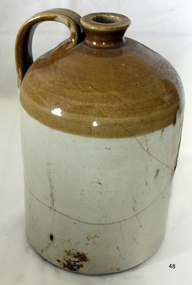
... ...kitchen storage...Its significance lies with its use as a domestic object giving today a view into our social past. flagstaff hill warrnambool shipwrecked coast flagstaff hill maritime museum maritime museum shipwreck coast flagstaff hill maritime village great ocean road jug stoneware jug earthenware jug kitchen storage None Stoneware jug badly cracked and repaired with handle and short neck Ceramic Jug ...Stoneware is a rather broad term for pottery or other ceramics that is fired at a relatively high temperature. A modern technical definition is a vitreous or semi-vitreous ceramic made primarily from stoneware clay or non-refractory fire clay. Whether vitrified or not, it is non-porous, it may or may not be glazed. Historically, across the world, it has been developed after earthenware and before porcelain and has often been used for high-quality as well as utilitarian wares. As a rough guide, modern earthen wares are normally fired in a kiln at temperatures in the range of about 1,000°C (1,830 °F) to 1,200 °C (2,190 °F); stoneware's at between about 1,100 °C (2,010 °F) to 1,300 °C (2,370 °F); and porcelains at between about 1,200 °C (2,190 °F) to 1,400 °C (2,550 °F). Historically, reaching high temperatures was a long-lasting challenge, and temperatures somewhat below these were used for a long time. Earthenware can be fired effectively as low as 600°C, achievable in primitive pit firing, but 800 °C was more typical. Stoneware also needs certain types of clays, more specific than those able to make earthenware, but can be made from a much wider range than porcelain. A domestic item used to store food products as glazing makes the container non-porous, often used for pickling. Or larger containers for kitchen flour. Items age is difficult to determine given the same techniques for making stoneware are in use today. Stoneware containers were made by many potteries in Australia and England. They were in common domestic use before plastics were invented around 1940 to store goods so this subject item is probably from around 1900 to the 1940s.Item's significance and origin of manufacture is difficult to determine given it is not associated with a place, person, historic event, or manufacturer. Its significance lies with its use as a domestic object giving today a view into our social past. Stoneware jug badly cracked and repaired with handle and short neckNoneflagstaff hill, warrnambool, shipwrecked coast, flagstaff hill maritime museum, maritime museum, shipwreck coast, flagstaff hill maritime village, great ocean road, jug, stoneware jug, earthenware jug, kitchen storage -
 Kiewa Valley Historical Society
Tin Rasawatte Tea, mid 1900's
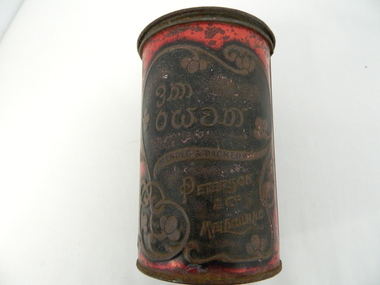
... kitchen storage..."The latest jadgets" took longer to permeate into "isolated or semi isolated rural regions" such as the Kiewa valley kitchen storage tin container cannister/caddy kichen advertising Embossed with the following "Ceylon Flavoured" and in bold large letters "RASAWATTE TEA" and below this in smaller print "ONE POUND NETT" This is encapsulated by Tea plant petals and vines. ...This canister which contained a blend of Rasawatte tea was produced in the early 1900's and for the most of those who acquired it for its contents it was useful (because it was made from solid pressed steel) as a tea caddy or container for other kitchen utensils or loose grains etc. It was also a good advertising item for a general agent W.M. Peterson & Co. in Melbourne. This company along with neighbouring tea importers offices were burnt down in a horrific building fire in Melbourne.This item was used in a period of time when the tea beveridge was the main hot beveridge to accompany meals, and "high tea" was a special treat to enjoy quality teas and "finger" food. In the rural sector of the Kiewa Valley, the favourite hot drink at "smoko" or other rest times was a freshly "brewed" pot or "billy" of tea. The hot drink tea was later in time challenged by the hot cup of coffee. This change occured at a later time in the rural sector than in cities or larger towns. The rural sector in this time frame was a lot more "traditional" in a lot of their day to day learned mores. Life style changes took longer to evolve mainly due to lack of media bombardment (mainly from city based advertisers) within the family home . "The latest jadgets" took longer to permeate into "isolated or semi isolated rural regions" such as the Kiewa valleyThis cylindrical tin container, which originally contained fine Ceylon tea is totally constructed from pressed light steel. It is embossed with content details and the name of the general tea agent. The main body has been fastened by pressed, not soldered connections.Embossed with the following "Ceylon Flavoured" and in bold large letters "RASAWATTE TEA" and below this in smaller print "ONE POUND NETT" This is encapsulated by Tea plant petals and vines. On the opposite side and in script writing "3M" below this in an unfolded banner presentation "BLENDED & PACKED BY" below this "Peterson & co Melbourne" This is also encapsulated by Tea plant petals and vines.kitchen storage, tin container, cannister/caddy, kichen advertising -
 Kiewa Valley Historical Society
Tin Tea Pyramids Blend, early 1900's
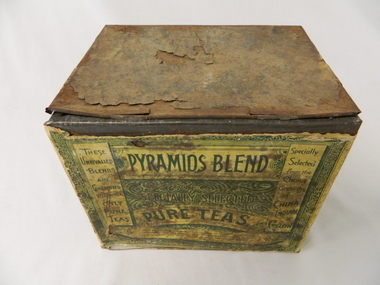
... ...food storage tins...kitchen...When emptied, it could also be used as a general kitchen storage container for other bulk consumables....When emptied, it could also be used as a general kitchen storage container for other bulk consumables. ...This early 1900's tin which contained loose leaf blended tea was imported into Australia by those tea merchants who wanted to provide the Australian tea drinkers with quality tea. It could well be early Lipton distributors to both city and rural clients and consumers. This was in a period when most rural families were heavy tea drinkers. It was well before the introduction of coffee as a drink (especially instant) for the early morning, after meals and general "drink any time" pick me up beverage.This relatively large tea tin marks a period in time when loose leaf tea was in great demand and large quantities were not only used by families but also restaurants, workers mess halls and remote large rural families. The ability to obtain a quick tea supply in semi remote rural areas such as the Kiewa Valley was not possible due to the factors of all weather road access and the economics of traders going out of their way. Stocking up with important beverages, such as tea, was a "one of those things" that early rural communities had to endure with. Bulk storage tins such as this item were not only a requirement but also offered storage for other household items. This usefulness was not overlooked by the "canny" rural family.This large metal tin container was specifically manufactured for the kitchens requiring a bulk storage "bin" type of loose leaf tea content. When emptied, it could also be used as a general kitchen storage container for other bulk consumables.On the front side and in the background, there are three sketches of Egyptian pyramids(increasing in size from left to right). At the forefront there is a camel "train" loaded with supplies and handlers, making their way over the sandy desert going towards a large sign(in a freehand script) "PYRAMIDS BLEND". The left side "Specially Selected" and underneath "PURE TEAS" below this and within a circle is the figure of a Geisha clad of Asian appearance (with a fan in a raised hand with boxes(of varying sizes) around her. All these are in (off white design and wording on a green background. On the back in green print on off white background "PYRAMIDS BLEND" and underneath "OF SPECIALLY SELECTED PURE TEAS". On either side are columns of similar print. To the left "THESE UNRIVALLED BLENDS ARE GUARANTEED TO CONTAIN ONLY PURE TEAS".To the right "SPECIALLY SELECTED FROM THE CHOICE GROWTHS OF CHINA INDIAN & CEYLON". Below both columns is "for delicacy & fragrance of flavor, combined with great strength, and are confidently recommended to the public as the best values in teas obtainable" On the last side is a sketch of an " Indian encircled, holding a staph with palm trees in the background and four tea containers on his left, with "PYRAMID BLEND" as a subject heading. There are two Oxen pulling a two wheeled cart with a load of six large boxes. On lid and barely readable "FIVE POUNDS NET"loose leaf tea containers, food storage tins, kitchen tidies -
 Kiewa Valley Historical Society
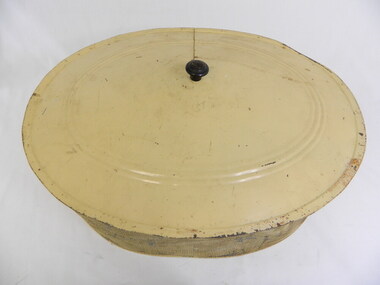
Food Cover
... kitchen...domestic...storage...Food covers were used to cover food from insects. food kitchen domestic storage handmade item Metal pale yellow enamel food cover with black handle on top. ...Food covers were used to cover food from insects.Metal pale yellow enamel food cover with black handle on top. Oval shape is slightly higher in the middle. The edges are a metal 'netting'. The top has a join line. The edge has a join line at each end. The base is curved with a metal piece around the edge to make it smooth (for safety).food, kitchen, domestic, storage, handmade item -
 Flagstaff Hill Maritime Museum and Village
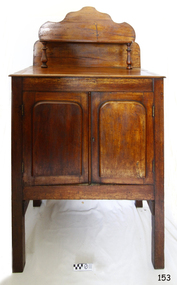
Functional object - Food Safe, 1920s
... ...kitchen furniture...Food Storage...storage cupboards or safes with refrigerators. The subject item gives a snapshot of domestic life from this time. flagstaff hill warrnambool flagstaff hill maritime museum maritime museum shipwreck coast flagstaff hill maritime village great ocean road food safe kitchen safe kitchen furniture Food Storage None Wooden kitchen food safe, 2 door with wire mesh at sides. ...The first commercially available, Australian-made domestic refrigerator to operate without ice was produced by Edward Hallstrom in 1923. It used kerosene as a power source and was promoted as ideal for outback stations where ice was not available. According to Museum Victoria, Hallstrom introduced the 'Silent Night' which ran on electricity or gas in 1935. However, Hailstorm's great-grandson, stated that the Silent Night refrigerator was introduced in 1928. Although Australians were among the pioneers of refrigeration in the 1850s, the technology wasn't adapted for domestic use until many decades later. The first domestic electric refrigerator was sold in America in 1913. It had an air-cooled refrigeration unit mounted on top of an ice box. The Frigidaire and Kelvinator brands date from 1918 when the first self-contained fridges were sold. Before this food safes were used as well to keep food away from flies and to keep items cool.A significant item used from the late Victorian era until around 1940 when people were beginning to be able to afford domestic refrigerators. After the second world war, most households had replaced their food storage cupboards or safes with refrigerators. The subject item gives a snapshot of domestic life from this time.Wooden kitchen food safe, 2 door with wire mesh at sides. Raised back panel has shaped edges and includes a shelf above bench area that has turned legs. The safe has 4 plain legs.Noneflagstaff hill, warrnambool, flagstaff hill maritime museum, maritime museum, shipwreck coast, flagstaff hill maritime village, great ocean road, food safe, kitchen safe, kitchen furniture, food storage -
 Flagstaff Hill Maritime Museum and Village
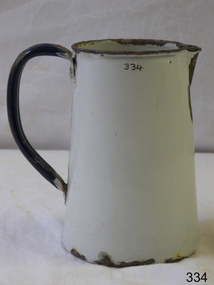
Domestic object - Jug, Late 19th or early 20th Century
... ...kitchen equipment...liquid storage...Flagstaff Hill Flagstaff Hill Maritime Museum and Village Warrnambool Maritime Museum Maritime Village Great Ocean Road Shipwreck Coast jug enamel jug kitchen equipment liquid storage beverage preparation None. ...This enamel jug is a basic design that was common to households in the 19th and early 20th centuries. Enamelware dates back to 1760 in Germany.This object is significant as an example of an item in common use in the 19th and early 20th centuries.White metal enamel jug, white with navy blue handle and rim. Tapered cylindrical shape, with a pouring lip.None.flagstaff hill, flagstaff hill maritime museum and village, warrnambool, maritime museum, maritime village, great ocean road, shipwreck coast, jug, enamel jug, kitchen equipment, liquid storage, beverage preparation -
 Flagstaff Hill Maritime Museum and Village
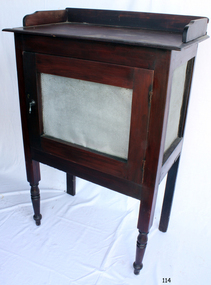
Functional object - Food Safe
... ...kitchen furniture...food storage...flagstaff hill warrnambool shipwrecked coast flagstaff hill maritime museum maritime museum shipwreck coast flagstaff hill maritime village great ocean road food safe kitchen safe kitchen furniture food storage food preservation Wooden Kitchen Safe for storing food, with hinged door (with key-hole) and three galvanised preformatted sheet metal windows. ...Wooden Kitchen Safe for storing food, with hinged door (with key-hole) and three galvanised preformatted sheet metal windows. Front legs machine turned wood.flagstaff hill, warrnambool, shipwrecked coast, flagstaff hill maritime museum, maritime museum, shipwreck coast, flagstaff hill maritime village, great ocean road, food safe, kitchen safe, kitchen furniture, food storage, food preservation -
 Flagstaff Hill Maritime Museum and Village
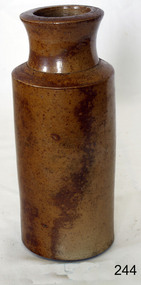
Ceramic - Stoneware Bottle, 1890-1940
... ...storage...kitchen...Its significance lies with its use as a domestic object giving today a view into our social past. flagstaff hill warrnambool flagstaff hill maritime museum maritime museum flagstaff hill maritime village great ocean road bottle stoneware bottle storage kitchen ware salt glazed stoneware shipwreck coast None (possibly made by Royal Doulton UK) Brown salt glaze stoneware bottle Ceramic Stoneware Bottle ...Stoneware is a rather broad term for pottery or other ceramics that is fired at a relatively high temperature. A modern technical definition is a vitreous or semi-vitreous ceramic made primarily from stoneware clay or non-refractory fire clay. Whether vitrified or not, it is non-porous, it may or may not be glazed. Historically, across the world, it has been developed after earthenware and before porcelain and has often been used for high-quality as well as utilitarian wares. As a rough guide, modern earthen wares are normally fired in a kiln at temperatures in the range of about 1,000°C (1,830 °F) to 1,200 °C (2,190 °F); stoneware's at between about 1,100 °C (2,010 °F) to 1,300 °C (2,370 °F); and porcelains at between about 1,200 °C (2,190 °F) to 1,400 °C (2,550 °F). Historically, reaching high temperatures was a long-lasting challenge, and temperatures somewhat below these were used for a long time. Earthenware can be fired effectively as low as 600°C, achievable in primitive pit firing, but 800 °C was more typical. Stoneware also needs certain types of clays, more specific than those able to make earthenware, but can be made from a much wider range than porcelain. A domestic item used to store food products as glazing makes the container non-porous, often used for pickling. Or larger containers for kitchen flour. Items age is difficult to determine given the same techniques for making stoneware are in use today. Stoneware containers were made by many potteries in Australia and England. They were in common domestic use before plastics were invented around 1940 to store goods so this subject item is probably from around 1900 to the 1940s.Item's significance is difficult to determine given it is not associated with a place, person, historic event, or manufacturer. Its significance lies with its use as a domestic object giving today a view into our social past.Brown salt glaze stoneware bottle None (possibly made by Royal Doulton UK)flagstaff hill, warrnambool, flagstaff hill maritime museum, maritime museum, flagstaff hill maritime village, great ocean road, bottle, stoneware bottle, storage, kitchen ware, salt glazed, stoneware, shipwreck coast -
 Kiewa Valley Historical Society
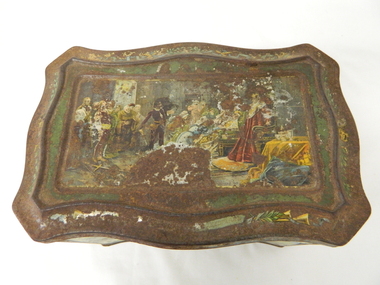
Tin Biscuit/Tea, Early to mid 1900s
... food storage...kitchen...This biscuit /tea container was however a leveling of the socio-economic playing field of the time. food storage kitchen table container domestic educational storage shakespeare illustrations There are painted scenes from the following Shakespearian plays on each side of the tin; "As you like it", "Hamlet" and on each of the bevelled corners are the portraits of Shakespeare(in the middle), the caricature mask faces of "the theatre" above and on the bottom section the "Director's chair" This biscuit or tea tin, has besides having an outer lid (hinged), it also has an internal lid(with a circular finger grip). ...This biscuit/tea caddy was probably targeting the "theatre going" family or those who liked looking at the colourful shakespearian scenes. This item however demonstrates that the rural (Kiewa Valley) appreciation of classic English plays was, in this time period (early 1900's), just as strong as in the larger towns and cities. This item also presents the period in which the "olde" Elizabethian phrases and words were taught in regional high schools. Although this speech pattern and phraseology was of a specific time period and going out of fashion when Australia was first settled it was an inherited form of communication(higher social/economical level). In the context of the rural Australia "scene" and in this time frame of the elite "boarding school" generation this item was a visual reinforcement of the education level and position of the family who owned this tin.This item is highly significant because it not only presents the social aspects of early life in the Kiewa Valley but also the variety of educational levels and economical variations of the rural population within the Kiewa Valley. The egalitarian perception of the inhabitants of the Kiewa Valley was still at the infancy of early Australian social interactions. This biscuit /tea container was however a leveling of the socio-economic playing field of the time.This biscuit or tea tin, has besides having an outer lid (hinged), it also has an internal lid(with a circular finger grip). Although the shape is rectangular it has a slight concave bulge at each side of the centre of each of its main frame. It is made of pressed light steel and has a raised floor. The corners are bevelled and the outer lid has a bevelled slope ridge in parallel to the extremities of the main tin frame. There are painted scenes from the following Shakespearian plays on each side of the tin; "As you like it", "Hamlet" and on each of the bevelled corners are the portraits of Shakespeare(in the middle), the caricature mask faces of "the theatre" above and on the bottom section the "Director's chair"food storage, kitchen table container, domestic educational storage, shakespeare illustrations -
 Kiewa Valley Historical Society
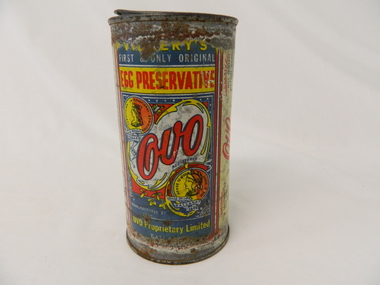
Tin Egg Preservative, from mid 1800's to mid 1900's
... ...rural food storage...kitchen...The ability to keep products that deteriorate due to "normal" outdoor temperature (bacterior prone produce) was a factor of rural living. egg preservation rural food storage kitchen preservation facilities This round "tubular" tin has a indented lid which fits snugly into the top opening. ...The egg preservation material offered in this tin was during a period in Australia's history (especially in the rural areas) when the "freshness" of produce was not able to be maintained by refrigeration means. Rural towns did rely on the "Ice Works" providing block ice for prolonging "produce shelf life" however semi remote and smaller communities did not have that facility. It was products such as this egg preserving ability that enabled these smaller rural communities to maintain a constant source of healthy "short life" organic produce.This tin which contained egg preservative powder is very significant to a rural region (Kiewa Valley) in the late 1800's to early 1900's. It details the type of food preservative methods that were available to rural areas which lacked proper refrigeration means at their disposal. Basic foodstuff which required "special" preservation means to extend their "shelf" life were sometimes regarded as luxuries by semi remote communities. Kiewa Valley and its regions were typical of these remote communities in the time frame of this egg preservation product. The ability to keep products that deteriorate due to "normal" outdoor temperature (bacterior prone produce) was a factor of rural living.This round "tubular" tin has a indented lid which fits snugly into the top opening. The lid has a rolled out lip which ensures a degree of "air" tightness. The tin is pressed and folded together and has no synthetic inner cover to protect the egg preservative powder from the raw tin surface. This "raw" method was the typical application for all tins containing dry food stuffs in this period(mid 1900's) of goods manufacture. The outer tin surface has a tightly pressed laminated paper label with product and manufacturer's information (promotional, preservation "tips" and usage details - will preserve sixteen dozen eggs). On the "front" side "EGG PRESERVATIVE" underneath "OVO" ,underneath "REGISTERED" and in a double lined enclosed square "AWARDED TWO GOLD MEDALS" underneath is a sketch of a mixing dish containing fourteen visible eggs. The bottom label has within an oval boundary (white print on a blue background) "FOR HOUSEHOLD USE" underneath "OVO" and underneath "PRESERVES EGGS PERFECTLY WITHOUT MESS OR TROUBLE" On the opposite side of the tin is printed "VICKERY'S FIRST & ONLY ORIGINAL EGG PRESERVATIVE - in red print. Underneath this is a "round stamp" with the figurehead(royalty) and these encircling words" TASMANIAN INTERNATIONAL EXHIBITION" with a scrolled "GOLD MEDAL HOBART 1895" with another medal like "medallion" showing another female face with a "warrior" headdress and these encircling words "HONOR TO WHOM HONOR IS DUE". Below this within a scrollis printed "GOLD MEDAL BALLARAT 1896" underneath this is printed "MANUFACTURED BY OVO PROPRIETARY LIMITED BALLARAT"egg preservation, rural food storage, kitchen preservation facilities -
 Musculoskeletal Health Australia (now held by the Glen Eira Historical Society)
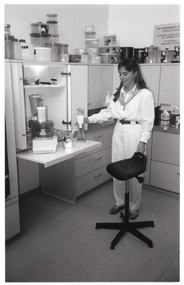
Photograph - Solo photo, November to December 1989
... ... kitchen canisters... food storage...On top of the kitchen cupboards, there are several round plastic food storage containers of various sizes stacked upon one another....According to an earlier article appearing on page 3 of the No 33, August 1984 edition of RAAV's quarterly newsletter, News Review, the Independent Living Centre was the venue for the launch of Arthritis Week in May 1984. arthritis foundation of victoria afv rheumatism and arthritis association of victoria raav independent living centre demonstration kitchen arthritic aids kitchen aids kitchen gadgets kitchen appliances kitchen sink food processor blender immersion blender stick blender kitchen canisters food storage pantry storage containers swivel chair sit-stand chair pull-out workbench retractable bench top sliding bench top adaptive kitchens accessible kitchens disability-friendly kitchens modified kitchens yooralla society of victoria living with arthritis pain management arthritis update news review 1990 1984 [On a yellow sticky note, in blue ink] The aid (crossed out) 'Sit Stand Chair' can be wheeled into position and easily adjusted to a suitable height. ...Through its quarterly newsletters, the Arthritis Foundation of Victoria (AFV), formerly the Rheumatism and Arthritis Association of Victoria (RAAV), was able to inform its members about the latest arthritis-friendly kitchen appliances and aids, and how to use them. In this photo, a woman stands beside a Sit-Stand Chair (a high mobile stool on castors) and a pull-out shelf, on which sit various electric kitchen appliances (such as a food processor and an immersion blender). The photo was taken at the Independent Living Centre, which contained a specially designed demonstration kitchen through which innovative designs and aids for people living with arthritis could be showcased. According to an earlier article appearing on page 3 of the No 33, August 1984 edition of RAAV's quarterly newsletter, News Review, the Independent Living Centre was the venue for the launch of Arthritis Week in May 1984.B&W photo of a woman standing beside a pull-out kitchen shelf and a high stool on castors. On top of the shelf are some kitchen appliances, such as a food processor and a hand-held immersion blender. On top of the kitchen cupboards, there are several round plastic food storage containers of various sizes stacked upon one another.[On a yellow sticky note, in blue ink] The aid (crossed out) 'Sit Stand Chair' can be wheeled into position and easily adjusted to a suitable height. [On a yellow sticky note, in blue ink] Joan - Use whichever of these is (crossed out) gives the clearer idea. This one perhaps - Jenny.arthritis foundation of victoria, afv, rheumatism and arthritis association of victoria, raav, independent living centre, demonstration kitchen, arthritic aids, kitchen aids, kitchen gadgets, kitchen appliances, kitchen sink, food processor, blender, immersion blender, stick blender, kitchen canisters, food storage, pantry storage containers, swivel chair, sit-stand chair, pull-out workbench, retractable bench top, sliding bench top, adaptive kitchens, accessible kitchens, disability-friendly kitchens, modified kitchens, yooralla society of victoria, living with arthritis, pain management, arthritis update, news review, 1990, 1984 -
 Musculoskeletal Health Australia (now held by the Glen Eira Historical Society)
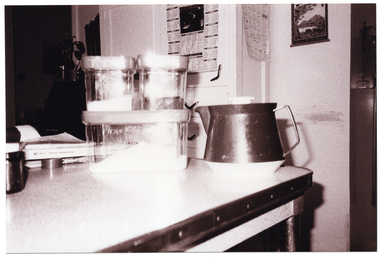
Photograph - Objects, 05/01/1989
... ... kitchen canisters... food storage...However, this particular photo was not published. arthritis foundation of victoria afv rheumatism and arthritis association of victoria raav pat dwyer occupational therapist ot arthritic aids kitchen aids kitchen gadgets insulated teapot kitchen canisters food storage pantry storage containers drop-in lids living with arthritis living independently pain management arthritis update 1989 [In blue ink on a yellow sticky note] Insulated teapot and canisters with drop in lids. ...This series of photos depicts appliances and equipment kept within easy reach in a kitchen. The photos, date-stamped "89 1 5", were taken during a visit to the home of Arthritis Foundation of Victoria member, Margaret. They were taken to accompany an article by Occupational Therapist, Pat Dwyer. Titled, 'Suggestions for independent living', the article and accompanying photo appear on page 10 of the Vol 2 No 1, March 1989 issue of the Arthritis Foundation of Victoria's quarterly magazine, Arthritis Update. It outlines the steps taken by Margaret to facilitate the daily challenges of living independently with arthritis. This photo depicts an insulated teapot and some kitchen canisters with 'drop-in' lids, amongst other items on a kitchen table. However, this particular photo was not published.B&W photo of an insulated teapot and some kitchen canisters amongst various other items on a kitchen table. The photo is date-stamped "89 1 5" in white text on the bottom left side of the image layer.[In blue ink on a yellow sticky note] Insulated teapot and canisters with drop in lids.arthritis foundation of victoria, afv, rheumatism and arthritis association of victoria, raav, pat dwyer, occupational therapist, ot, arthritic aids, kitchen aids, kitchen gadgets, insulated teapot, kitchen canisters, food storage, pantry storage containers, drop-in lids, living with arthritis, living independently, pain management, arthritis update, 1989 -
 Mont De Lancey
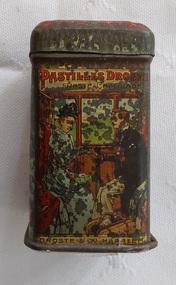
Domestic object - Lidded Tin, Droste & Co, c 1930's
... These tins are renowned for their iconic Art Nouveau style, often featuring the famous "Droste nurse" or traditional Dutch scenes, and are frequently used today for decorative kitchen storage or as collector's items. ...These tins are renowned for their iconic Art Nouveau style, often featuring the famous "Droste nurse" or traditional Dutch scenes, and are frequently used today for decorative kitchen storage or as collector's items. Containers Tins Domestic objects As above the manufacturing and contents information is printed on the tin. ...Vintage Droste’s Cacao pastille tins are highly collectible Dutch advertising items produced by the Droste factory in Haarlem, Netherlands. These tins are renowned for their iconic Art Nouveau style, often featuring the famous "Droste nurse" or traditional Dutch scenes, and are frequently used today for decorative kitchen storage or as collector's items. A tiny vintage lidded Pastille Droste Cacao tin featuring the lithographic art of Droste's Cacao and chocolate produced by the Droste factory in Haarlem, Netherlands. It has the famous Droste nurse on one side, a couple sitting inside a train carriage on another with the two remaining sides featuring the manufacturing details and a floral symbol on the other. These tins are estimated to be from the 1930's.As above the manufacturing and contents information is printed on the tin.containers, tins, domestic objects -
 Mont De Lancey
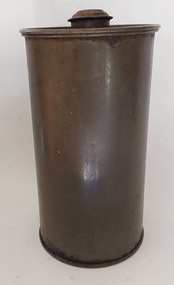
Container - Food Canister, 1900's - 1970's
... Vintage unbranded lidded round tin canisters are enduring pieces of kitchen storage history, with many common examples dating from the 1930s through the 1970s. ...Vintage unbranded lidded round tin canisters are enduring pieces of kitchen storage history, with many common examples dating from the 1930s through the 1970s. ...Vintage unbranded lidded round tin canisters are enduring pieces of kitchen storage history, with many common examples dating from the 1930s through the 1970s. These items, ranging from plain steel to colorful lithographed patterns, were once ubiquitous in households for storing bulk foods, biscuits, or sewing supplies. A tall vintage brown metal canister with a well-fitted lift off lid. The lid has a round knob attached with a rivet. The tin has a small rim at the top and bottom and is clamp sealed at one side. containers, food storage containers, tins -
 Port Melbourne Historical & Preservation Society
Photograph - Photograph board, Seven aerial views of J Kitchen & Sons site, Port Melbourne, J Kitchen & Sons Pty Ltd. Port Melbourne 1951, 1951
... Photo 3 - almost directly above Kitchens Photo 4 - directly above kitchens Photo 5 - looking West including the Yarra River Photo 6 - looking North with Kitchen's storage and football ground in foreground Photo 7 - looking north east with football ground in foregrpound left and Yarra River top right....Photo 3 - almost directly above Kitchens Photo 4 - directly above kitchens Photo 5 - looking West including the Yarra River Photo 6 - looking North with Kitchen's storage and football ground in foreground Photo 7 - looking north east with football ground in foregrpound left and Yarra River top right. ...Large brown cardboard with seven (7) B&W aerial photographs pasted on it. Taken in 1951. Photo 1 - South East direction with Boundary Street in foreground, Kitchens buildings and Football Ground (cricket being played) Photo 2 - South West direction towards the Bay showing Station and Princes Piers, with ships in the distance. Photo 3 - almost directly above Kitchens Photo 4 - directly above kitchens Photo 5 - looking West including the Yarra River Photo 6 - looking North with Kitchen's storage and football ground in foreground Photo 7 - looking north east with football ground in foregrpound left and Yarra River top right.industry - manufacturing, built environment - industrial, piers and wharves - princes pier, piers and wharves - station pier, sport - australian rules football, sport - cricket, sport - recreational grounds, j kitchen & sons pty ltd, north port oval, port melbourne cricket ground -
 Bendigo Historical Society Inc.
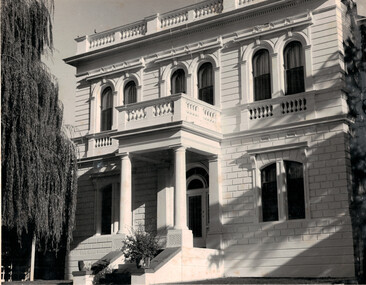
Document - National Trust Collection: Bendigo Home and Hospital for the Aged, 1860-1970s
... The structure features a basement (kitchen, storage, cellars, staff apartments), a first floor (large dining room, additional rooms), and upper floors (dormitories). ...The structure features a basement (kitchen, storage, cellars, staff apartments), a first floor (large dining room, additional rooms), and upper floors (dormitories). ...The Bendigo Benevolent Home was founded in 1857, with the main building inaugurated on March 15, 1860. The original site was chosen to avoid mining areas and was granted by the government. Early temporary premises were used before the current site in Barnard Street was established. The original building was designed by architect Robert A. Love, with construction by contractor Crawford and Clerk of Works Rigley. The structure features a basement (kitchen, storage, cellars, staff apartments), a first floor (large dining room, additional rooms), and upper floors (dormitories). The building uses the arch principle and includes hot air heating, lavatories, and good ventilation. A significant memorial stone of Harcourt granite was laid in December 1872, forming part of the building's front elevation. Additions and modifications were made over time, including a west wing in 1868 to house 50 girls, and further expansions by architects Vahland & Getchmann. The central block has seen little external alteration since completion, except for a small glassed-in wind shield.The Porter's Lodge and Superintendent's Residence remain in good condition.Some ancillary buildings have been modified or are at risk of demolition due to new construction.Typed History of the hospital, and letters regarding classification status and two A4 sized photos of the front of the building. This item contains the following documents: 3084.52a Black and White Photo of the Bendigo Benevolent Asylum Front Entrance 3084.52b Another Black and White Photo of the Bendigo Benevolent Asylum Front Entrance 3084.52c National Trust of Australia (Victoria) survey and data sheet 3084.52d Letters regarding the classification by the National Trust (Contact BHS for details) 3084.52e Handwritten Notes on the History of the Home and Hospital for the Aged (Contact BHS for details)history, national trust bendigo collection, bendigo, benevolant home bendigo, benevolant asylum bendigo, home and hospital for the aged bendigo, ann caudle centre bendigo -
 Bendigo Historical Society Inc.
Photograph - Tui Mitchell Collection: "Greystanes" Photographs, 1990s
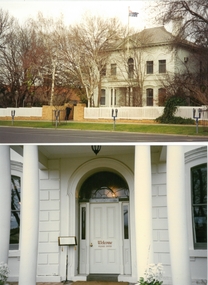
... It includes photographs of guest rooms, living rooms, kitchen areas, storage areas, fittings and furnishings, external areas, restoration works, bathrooms, gardens and staff members. ...It includes photographs of guest rooms, living rooms, kitchen areas, storage areas, fittings and furnishings, external areas, restoration works, bathrooms, gardens and staff members. ..."Greystanes" was originally "Hunter House" built at 57 Queen Street, Bendigo by Robert Hunter in 1882. Robert's brother William and his family lived there for almost 60 years. In 1945 the house was sold to Rex Hyett who renamed the house "Greystanes". Rex removed the original verandah and balcony and built the portico. There were several other owners before it was purchased by the Country Roads Board/ VicRoads where it was the local office for 36 years years (1958 - 1994). From the late 1990s "Greystanes" was restored by Bill and Tui Mitchell who operated it as accommodation, restaurant and reception rooms. New owners then turned it into a boutique hotel and conference centre. The current owners purchased "Greystanes" in 1910. It was renamed "Hunter House" and after extensive restorations was converted into a family home and business .Photographs removed from album with adhesive pages (10895.10). Blue two ringed folder. The photographs are a record of the restoration of "Greystanes Manor" house including a restaurant, accommodation and reception rooms. It includes photographs of guest rooms, living rooms, kitchen areas, storage areas, fittings and furnishings, external areas, restoration works, bathrooms, gardens and staff members. There are 190 photographs The album also includes two letters of appreciation from guests who stayed at "Greystanes" and a two-page wine list from the restaurant. The wine list includes wines from several local wineries.tui mitchell collection, greystanes, hunter house, william hunter, robert hunter, tui mitchell, bill mitchell -
 Bendigo Historical Society Inc.
Album - Tui Mitchell Collection: "Greystanes" Photograph Album, 1990s
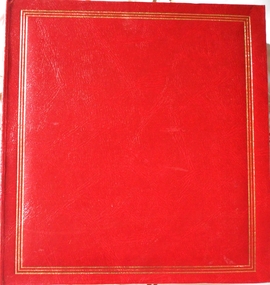
... It includes photographs of guest rooms, living rooms, kitchen areas, storage areas, fittings and furnishings, external areas, restoration works, bathrooms, gardens and staff members. ...It includes photographs of guest rooms, living rooms, kitchen areas, storage areas, fittings and furnishings, external areas, restoration works, bathrooms, gardens and staff members. ..."Greystanes" was originally "Hunter House" built at 57 Queen Street, Bendigo by Robert Hunter in 1882. Robert's brother William and his family lived there for almost 60 years. In 1945 the house was sold to Rex Hyett who renamed the house "Greystanes". Rex removed the original verandah and balcony and built the portico. There were several other owners before it was purchased by the Country Roads Board/ VicRoads where it was the local office for 36 years years (1958 - 1994). From the late 1990s "Greystanes" was restored by Bill and Tui Mitchell who operated it as accommodation, restaurant and reception rooms. New owners then turned it into a boutique hotel and conference centre. The current owners purchased "Greystanes" in 1910. It was renamed "Hunter House" and after extensive restorations was converted into a family home and business .Red leather covered three ring photograph album with fifty adhesive pages containing eighty nine coloured photographs, two letters and a two page printed wine list. Front of album has three gold coloured lines as a border and the spine has five horizontal sets of three gold coloured lines. The photographs are a record of the restoration of "Greystanes Manor" house including a restaurant, accommodation and reception rooms. It includes photographs of guest rooms, living rooms, kitchen areas, storage areas, fittings and furnishings, external areas, restoration works, bathrooms, gardens and staff members. The album also includes two letters of appreciation from guests who stayed at "Greystanes" and a two page wine list from the restaurant. The wine list includes wines from several local wineries.tui mitchell collection, greystanes, hunter house, william hunter, robert hunter, tui mitchell, bill mitchell -
 Flagstaff Hill Maritime Museum and Village
Domestic object - Food Safe, Willow Ware Pty Ltd, 1920-1950
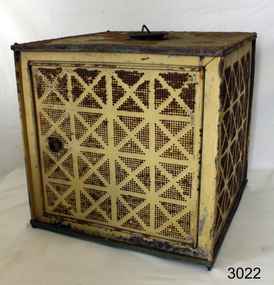
... storage made by an emerging Australian company no longer in bushiness. This item gives a snapshot into early Australian manufacturing specifically aimed at the Australian market. warrnambool shipwrecked-coast flagstaff-hill flagstaff-hill-maritime-museum shipwreck-coast flagstaff-hill-maritime-village Willow Ware Domestic Item Coolgardie Meat Safe meat safe food safe food preservation "Made in Australia" "Willow" Safe metal kitchen safe with two shelves, a hinged door and latch and a small swivel wire handle at the top. cream colour . ...Willow started business in 1887 as a metal working company based in Melbourne Australia, making tinned biscuit and tea canisters. The outbreak of the First World War saw their manufacturing change to making armaments and essential packaging for the war effort. In the early 1920’s, the Willow brand was established. Making tin plated canisters and baking pans with the well-known Willow pattern, imprinted on them. Some other items in production at this time include billies, boilers, basins and Coolgardie safes. In the late 1950’s, the company ventured into plastics production. Stepping away from its very successful tin plating industry of more than 50 years. In 1965, the company name changed to Willow Ware Pty Ltd, to be more closely linked to its Willow brand. Willow Ware is still in business today. A food safe known as a “Coolgardie” meat storage made by an emerging Australian company no longer in bushiness. This item gives a snapshot into early Australian manufacturing specifically aimed at the Australian market. Safe metal kitchen safe with two shelves, a hinged door and latch and a small swivel wire handle at the top. cream colour . "Made in Australia" "Willow" warrnambool, shipwrecked-coast, flagstaff-hill, flagstaff-hill-maritime-museum, shipwreck-coast, flagstaff-hill-maritime-village, willow ware, domestic item, coolgardie meat safe, meat safe, food safe, food preservation -
 Flagstaff Hill Maritime Museum and Village
Domestic object - Food Safe, Willow Ware Pty Ltd, 1920s -1950
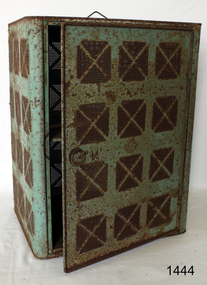
... storage made by an emerging Australian company no longer in bushiness. This item gives a snapshot into early Australian manufacturing specifically aimed at the Australian market. warrnambool shipwrecked-coast flagstaff-hill flagstaff-hill-maritime-museum maritime-museum shipwreck-coast flagstaff-hill-maritime-village safe food safe meat safe coolgardie safe domestic object kitchen object willow ware food preservation kitchen safe Willow Safe metal kitchen food safe with 2 shelves, a hinged door and latch and a small swivel wire handle at the top. ...Willow started business in 1887 as a metal working company based in Melbourne Australia, making tinned biscuit and tea canisters. The outbreak of the First World War saw their manufacturing change to making armaments and essential packaging for the war effort. In the early 1920’s, the Willow brand was established. Making tin plated canisters and baking pans with the well-known Willow pattern, imprinted on them. Some other items in production at this time include billies, boilers, basins and Coolgardie safes. In the late 1950’s, the company ventured into plastics production. Stepping away from its very successful tin plating industry of more than 50 years. In 1965, the company name changed to Willow Ware Pty Ltd, to be more closely linked to its Willow brand. Willow Ware is still in business today. A food safe known as a “Coolgardie” meat storage made by an emerging Australian company no longer in bushiness. This item gives a snapshot into early Australian manufacturing specifically aimed at the Australian market.Safe metal kitchen food safe with 2 shelves, a hinged door and latch and a small swivel wire handle at the top. Painted light green, rusting.Willowwarrnambool, shipwrecked-coast, flagstaff-hill, flagstaff-hill-maritime-museum, maritime-museum, shipwreck-coast, flagstaff-hill-maritime-village, safe, food safe, meat safe, coolgardie safe, domestic object, kitchen object, willow ware, food preservation, kitchen safe -
 Flagstaff Hill Maritime Museum and Village
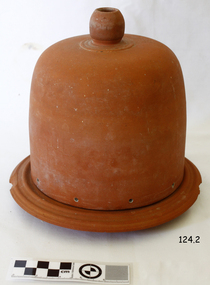
Domestic object - Terracotta Cooler Top, Ovens Pottery, c. 1890-1892
... storage jars, pots, tiles, flower pots, spittoons, basins, bowls, demijohns, lidded crocks, pipes and bricks. A significant item made by an early Australian pottery in Beechworth Victoria, this company made many utilitarian items for the Victorian domestic market. It gives us today a snapshot into early Australian companies that were unable to sustain manufacturing their products into the 20th century, due in part to the rising imports of cheaper items from overseas. flagstaff hill warrnambool shipwrecked coast flagstaff hill maritime museum flagstaff hill maritime village great ocean road cooler terracotta cooler utensil kitchen ware terracotta food container food preservation butter cooler ovens pottery Marked "Ovens Pottery, Co Ltd, Patd 1890, Beechworth" Red terracotta butter cooler comprising, round base with ridged lip, and bell shaped, domed lid with spherical handle on top Domestic object Terracotta Cooler Top Ovens Pottery ...The Ovens pottery operated from 1881 to1892 they had taken over H L & E pottery at Beechworth in 1888 but mounting debts forced the Ovens company to close in 1892. During their short ten years of operation they produced stoneware garden urns, vases, cheese dishes, ginger beer bottles, butter coolers, water filters, wine and spirit barrels, bread plates, jugs, teapots, storage jars, pots, tiles, flower pots, spittoons, basins, bowls, demijohns, lidded crocks, pipes and bricks.A significant item made by an early Australian pottery in Beechworth Victoria, this company made many utilitarian items for the Victorian domestic market. It gives us today a snapshot into early Australian companies that were unable to sustain manufacturing their products into the 20th century, due in part to the rising imports of cheaper items from overseas.Red terracotta butter cooler comprising, round base with ridged lip, and bell shaped, domed lid with spherical handle on topMarked "Ovens Pottery, Co Ltd, Patd 1890, Beechworth" flagstaff hill, warrnambool, shipwrecked coast, flagstaff hill maritime museum, flagstaff hill maritime village, great ocean road, cooler, terracotta cooler, utensil, kitchen ware, terracotta, food container, food preservation, butter cooler, ovens pottery
