
Showing 84 items matching "kitchen stove"
-
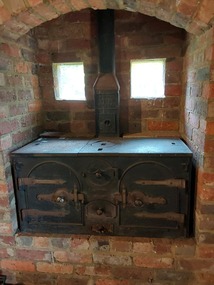 Mont De Lancey
Domestic object - Kitchen Stove, C. Andrews, c1900's
... Kitchen Stove...A vintage cast iron kitchen stove set in the back wall of the Mont De Lancey Slab Kitchen. ...Domestic object Kitchen Stove C. Andrews ...The cast iron combustion stove is significant as part of the evolution of domestic cooking. Previously, cooking was mostly carried out in the outdoors on open fires, and later in fireplaces indoors. The cast iron combustion stove is significant as part of the evolution of domestic cooking. Cast iron stoves burn solid fuel such as wood or coal, and are used for cooking and warmth. The stoves have a firebox with a grate where the fuel is burned. The hot air flows through flues and baffles that heat the stove top and the oven. By the 1920s gas cookers were being introduced for domestic use, and by the 1930s electric home cookers were being offered to householders. A vintage cast iron kitchen stove set in the back wall of the Mont De Lancey Slab Kitchen. It has two steel decorative hinged doors with a handle to open and close. There is one pull out metal shelf in each compartment. Between the two doors is a round door which opens to reveal the wood box with a slatted base. This allows the ash and small coals from the fire to fall though to a pull-out tray below to be emptied outside when cooled. There is another lift-out kid to clean the ash and coals underneath.On the chimney plate 'Andrews, Patent Non Pariel' On the front of the stove below the round wood box 'C Andrews Geelong'cooking equipment, cooking stoves, fuel cooking stoves, domestic ovens -
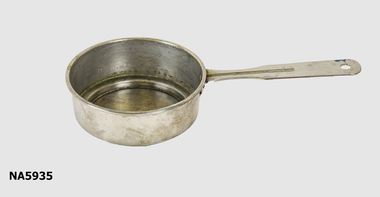 Whitehorse Historical Society Inc.
Leisure object - Saucepan, "Kinder - Kochherde" German Toy, 1909
... ...Kitchen stove...- Child's toy component of cooking stove - Manufactured circa 1909 (See info on Kitchen Stove NA5931)...- Child's toy component of cooking stove - Manufactured circa 1909 (See info on Kitchen Stove NA5931) Child's toy Kitchen stove Flat saucepan with interchangeable lid with stockpot lid Leisure object Saucepan "Kinder - Kochherde" German Toy ...- Child's toy component of cooking stove - Manufactured circa 1909 (See info on Kitchen Stove NA5931)Flat saucepan with interchangeable lid with stockpot lidchild's toy, kitchen stove -
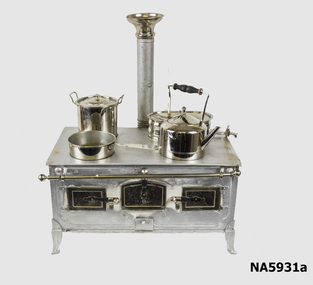 Whitehorse Historical Society Inc.
Leisure object - Child's stove, "Kinder - Kochherde" German Toy, 1909
... ...Kitchen stove...Brought to Australia in 1977 Child's toy - kitchen stove Kitchen stove Trademark on the base Pressed steel. 4 burners stove. 4 burner holes- fueled from inside. ...Child's toy cooking stove Manufactured circa 1909 by Maerklin/Gerbruder Maerklin. Original toy belonged to Pauline Bacher Used by Marion Ralph. Brought to Australia in 1977Pressed steel. 4 burners stove. 4 burner holes- fueled from inside. Central oven fueled from below Stands on 4 metal feet Front rail for holding towels/cloths Chimney inserted from back.Trademark on the basechild's toy - kitchen stove, kitchen stove -
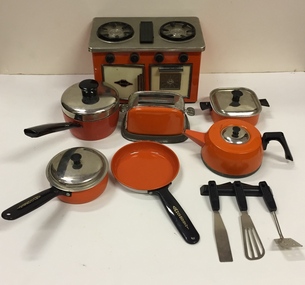 Kew Historical Society Inc
Leisure object - Toys, Miniature Kitchen Equipment, 1970s
... Miniature kitchen stove, cooking utensils and implements. ...The examples of toys in the collection include examples of alphabet toys, arcade toys, baby toys, construction toys, dolls, doll accessories, educational toys, soft toys, tin toys, toy animals, toy blocks, toy machines, toy typewriters, etc. miniature toys toy kitchen equipment functional toys Miniature kitchen stove, cooking utensils and implements. ...The Kew Historical Society’s collection includes a wide range of leisure objects. Many of the items are European-made, generally of British origin, however there are a number that were made for the Australian market by Australian manufacturers. There were clearly a huge range of toys produced for the Australian and International children’s market in the Nineteenth and Twentieth centuries. The examples of toys in the collection include examples of alphabet toys, arcade toys, baby toys, construction toys, dolls, doll accessories, educational toys, soft toys, tin toys, toy animals, toy blocks, toy machines, toy typewriters, etc. Miniature kitchen stove, cooking utensils and implements. Made of metal and enamel. Orange and black. Eight pieces.miniature toys, toy kitchen equipment, functional toys -
 Whitehorse Historical Society Inc.
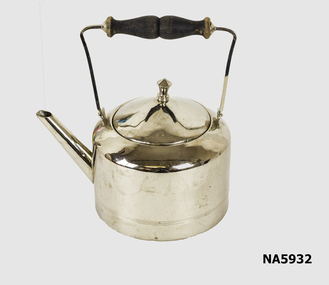
Leisure object - Toy Kettle and Lid, "Kinder - Kochherde" German Toy, 1909
... ...Kitchen stove...Toy had been played with by many generations: Used by Marion Ralph (1942) - Brought to Australia - daughter Caroline (1977) played with toy followed by +her daughter Jemina (2015) Child's toy Kitchen stove Manufacture's Trademark Chromed kettle with separate lid Copper base Wooden handle Leisure object Toy Kettle and Lid "Kinder - Kochherde" German Toy ...Toy - Pauline Bacher (1910) in Freudenstadt, Germany. Toy had been played with by many generations: Used by Marion Ralph (1942) - Brought to Australia - daughter Caroline (1977) played with toy followed by +her daughter Jemina (2015)Chromed kettle with separate lid Copper base Wooden handleManufacture's Trademarkchild's toy, kitchen stove -
 Whitehorse Historical Society Inc.
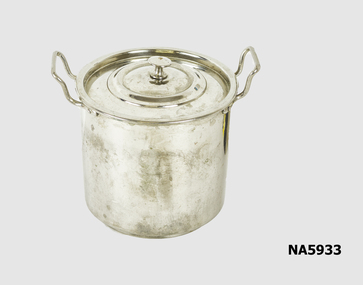
Leisure object - Stove top (water fountain) container, "Kinder - Kocherde" German Toy, C 1909
... ...Kitchen stove...Toy - Pauline Bacher (1910) in Freudeastadt Germany - Used by Marion Ralph (1942) - brought to Australia - Daughter Caroline (1977) played with it - Her daughter Jemina (2015) Child's toy Kitchen stove Manufacturer's trademark - Chromed with spigot tap and lid Leisure object Stove top (water fountain) container "Kinder - Kocherde" German Toy ...Toy - Pauline Bacher (1910) in Freudeastadt Germany - Used by Marion Ralph (1942) - brought to Australia - Daughter Caroline (1977) played with it - Her daughter Jemina (2015)- Chromed with spigot tap and lidManufacturer's trademarkchild's toy, kitchen stove -
 Whitehorse Historical Society Inc.
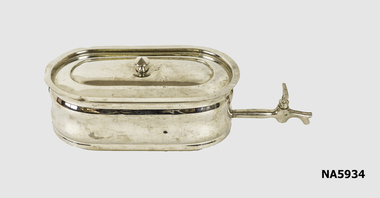
Leisure object - Pot & lid, "Kinder - Kacheherde" German Toy, C 1909
... ...Kitchen Stove...Toy - Pauline Bacher (1910) in Freudeastadt, Germany - Used by Marion Ralph (1942) - Brought to Australia - Daughter (Caroline/1977) played with it - Her daughter Jemima (2015) Also played with it Child's toy Kitchen Stove Manufacturer's Trademark Chromed pot & lid with handle Leisure object Pot & lid "Kinder - Kacheherde" German Toy ...Toy - Pauline Bacher (1910) in Freudeastadt, Germany - Used by Marion Ralph (1942) - Brought to Australia - Daughter (Caroline/1977) played with it - Her daughter Jemima (2015) Also played with itChromed pot & lid with handle Manufacturer's Trademarkchild's toy, kitchen stove -
 Whitehorse Historical Society Inc.
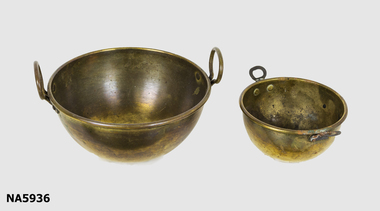
Leisure object - Copper bowl pans X 2, 'Kinder Kochherde" German Toy, C 1909
... ...Kitchen Stove...- Child's toy component if cooking stove - Manufactured c - 1909 (See stove info NA5931) Child's toy Kitchen Stove Stove component Nil 2 copper bowls with handles Leisure object Copper bowl pans X 2 'Kinder Kochherde" German Toy ...- Child's toy component if cooking stove - Manufactured c - 1909 (See stove info NA5931)2 copper bowls with handlesNilchild's toy, kitchen stove, stove component -
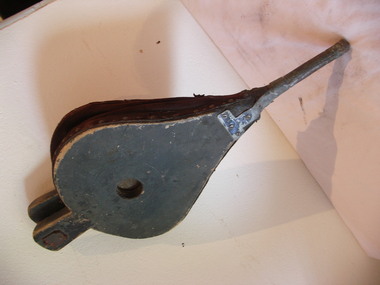 Friends of Westgarthtown
Domestic object - Bellows
... ...kitchen...stove...domestic items cooking and heating bellows fire kitchen stove ignition leather wood No visible markings Wooden, leather and zinc sheet bellows, top has round hole in centre. ...Wooden, leather and zinc sheet bellows, top has round hole in centre. Handles, top and bottom all wooden, tear-drop shaped with handles. spout is zinc sheet. Signs of former wrist strap, leather, on handles.No visible markingsdomestic items, cooking and heating, bellows, fire, kitchen, stove, ignition, leather, wood -
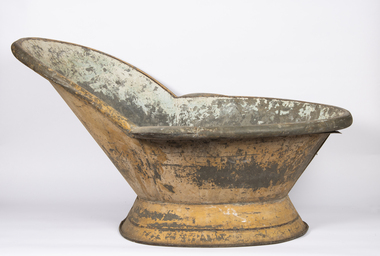 Warrnambool and District Historical Society Inc.
Domestic object - Hip Bath, Late 19th century
... Generally the bath was placed in front of the fire in the kitchen and filled with hot water from the kitchen stove....Generally the bath was placed in front of the fire in the kitchen and filled with hot water from the kitchen stove. This item is retained as an interesting memento of past household customs. hip bath vintage domestic item bathing practices in the past This tin hip bath for an adult is in the shape of a cradle. ...Hip baths, such as this one, were used in past times in households for individuals to bathe. Generally the bath was placed in front of the fire in the kitchen and filled with hot water from the kitchen stove.This item is retained as an interesting memento of past household customs.This tin hip bath for an adult is in the shape of a cradle. The exterior is painted light brown. It has curved edges around the rim with two protruding curved pieces for the bather's hands to grip when getting out of it. The base is concave. It appears to be have been constructed in pieces. The bath is rusted and stained.hip bath, vintage domestic item, bathing practices in the past -
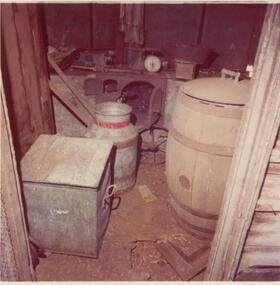 Phillip Island and District Historical Society Inc.
Photograph, 1978/9
... "Rogers Cottage" - showing the interior of the kitchen - note wood stove. Now a storeroom....It is believed he first built the Bakehouse. local history photographs buildings - historical rural industry coloured photograph john cook churchill island rogers cottage "Rogers Cottage" - showing the interior of the kitchen - note wood stove. Now a storeroom. Photograph ...During Rogers' occupation in 1865, he built two huts. These huts still remain, probably being among the oldest buildings in Western Port. It is believed he first built the Bakehouse."Rogers Cottage" - showing the interior of the kitchen - note wood stove. Now a storeroom.local history, photographs, buildings - historical, rural industry, coloured photograph, john cook, churchill island, rogers cottage -
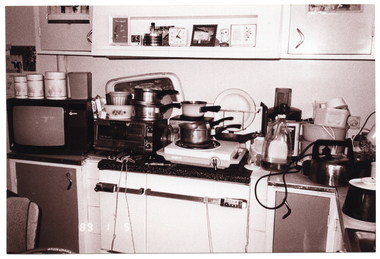 Musculoskeletal Health Australia (now held by the Glen Eira Historical Society)
Photograph - Objects, 05/01/1989
... It depicts saucepans, a kettle, and other items commonly found in a kitchen kept within easy reach on a kitchen stove, bench and shelves....B&W photo of some saucepans, a kettle, a plate and carry tray, canisters, and other items commonly found in a kitchen are placed next to or stacked on top of one another on a kitchen bench and stove. Also on the kitchen bench are a small portable television set and a small benchtop oven. ...B&W photo of some saucepans, a kettle, a plate and carry tray, canisters, and other items commonly found in a kitchen are placed next to or stacked on top of one another on a kitchen bench and stove. Also on the kitchen bench are a small portable television set and a small benchtop oven. ...This series of photos depicts appliances and equipment kept within easy reach in a kitchen. The photos, date-stamped "89 1 5", were taken during a visit to the home of Arthritis Foundation of Victoria member, Margaret. They were taken to accompany an article by Occupational Therapist, Pat Dwyer. Titled, 'Suggestions for independent living', the article appears on page 10 of the Vol 2 No 1, March 1989 issue of the Arthritis Foundation of Victoria's quarterly magazine, Arthritis Update. It outlines the steps taken by Margaret to facilitate the daily challenges of living independently with arthritis. This is the only photo from the series which appears with the article. It depicts saucepans, a kettle, and other items commonly found in a kitchen kept within easy reach on a kitchen stove, bench and shelves.B&W photo of some saucepans, a kettle, a plate and carry tray, canisters, and other items commonly found in a kitchen are placed next to or stacked on top of one another on a kitchen bench and stove. Also on the kitchen bench are a small portable television set and a small benchtop oven. Above the bench and stove is a small shelf beneath some wall-mounted cupboards. On the shelf are two small clocks, a photo frame or mirror, and some ornaments.[In light blue ink on the Photograph] 80% [In pencil & green ink, on a yellow sticky note] 10A [In blue ink on a yellow sticky note] Frequently used equipment is kept within easy reach.arthritis foundation of victoria, afv, rheumatism and arthritis association of victoria, raav, pat dwyer, occupational therapist, ot, arthritic aids, kitchen aids, kitchen gadgets, home-made aids, living with arthritis, living independently, pain management, arthritis update, 1989 -
 City of Ballarat Libraries
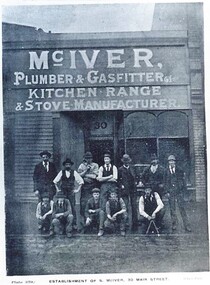
Postcard - Card Box Photographs, Establishment of S. McIver, 30 Mair Street. Ballarat
... Plumber & Gasfitter. Kitchen Range & Stove Manufacturer. Plate 379 Chuck Photo Series....Plumber & Gasfitter. Kitchen Range & Stove Manufacturer. Plate 379 Chuck Photo Series. ...Plumber & Gasfitter. Kitchen Range & Stove Manufacturer. Plate 379 Chuck Photo Series.s. mciver, mair street, building, persons, manufacturing -
 Flagstaff Hill Maritime Museum and Village
Domestic object - Stove, First quarter of the 20th Century
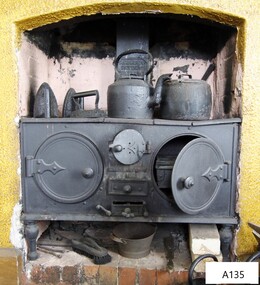
... That for many years was the only Australian made kitchen stove on the market. When his patent expired numerous imitations were manufactured by other firms but the Nonpareil continued to earn a reputation for quality, economy and excellent cooking. ...That for many years was the only Australian made kitchen stove on the market. When his patent expired numerous imitations were manufactured by other firms but the Nonpareil continued to earn a reputation for quality, economy and excellent cooking. ...The first Australian cast iron stove was made by Charles Andrews in 1877 he patented his design and called it the “Andrews Nonpareil stove.” That for many years was the only Australian made kitchen stove on the market. When his patent expired numerous imitations were manufactured by other firms but the Nonpareil continued to earn a reputation for quality, economy and excellent cooking. The company operated at 47-10 Gheringhap Street Geelong, Victoria, they also specialised in hot water generating services.The subject item is significant as a copy of the well known design for the original Nonpareil stove by Charles Andrews. The name Andrews Nonpareil in stamped on the flue however the doors on the stove front are wrong and indicate the item is a copy by an unknown manufacturer probably made in the first quarter of the 20th century. Stove cast iron on 4 legs, two oven spaces with round doors. On flue "Andrews Patent Nonpareil".On flue "Andrew Patent Nonpareil"flagstaff hill, warrnambool, shipwrecked coast, flagstaff hill maritime museum, maritime museum, shipwreck coast, flagstaff hill maritime village, great ocean road, stove, iron stove, andrew patent nonpareil, cooking appliance, oven, combustion oven, cooker -
 Port Melbourne Historical & Preservation Society
Photograph - Kitchen interior, 231 Princes Street, Port Melbourne, Pat Grainger, 1989 - 1990s
... From a series of colour photos of the changing property at 231 Princes Street. .04 - Kitchen interior showing stove hood labelled Gladie's Gallery, for his deceased wife Gladys...From a series of colour photos of the changing property at 231 Princes Street. .04 - Kitchen interior showing stove hood labelled Gladie's Gallery, for his deceased wife Gladys Photograph Kitchen interior, 231 Princes Street, Port Melbourne Pat Grainger ...These taken by neighbour Pat Grainger during the old seaman's lifetime (.01 and .02) and after his death, as the old (c 1900) shop was replaced by a 1990s house.From a series of colour photos of the changing property at 231 Princes Street. .04 - Kitchen interior showing stove hood labelled Gladie's Gallery, for his deceased wife GladysVarious numbers on back re some former use.built environment, victor cann, gladys cann, princes street -
 Flagstaff Hill Maritime Museum and Village
Domestic object - Stove, 1850-1890
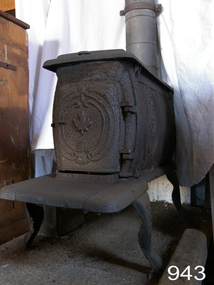
... In the industrialized world, as stoves replaced open fires and braziers as a source of more efficient and reliable heating, models were developed that could also be used for cooking, and these came to be known as kitchen stoves. The first manufactured cast-iron stove was produced at Lynn, Mass., in 1642. ...In the industrialized world, as stoves replaced open fires and braziers as a source of more efficient and reliable heating, models were developed that could also be used for cooking, and these came to be known as kitchen stoves. The first manufactured cast-iron stove was produced at Lynn, Mass., in 1642. ...In the industrialized world, as stoves replaced open fires and braziers as a source of more efficient and reliable heating, models were developed that could also be used for cooking, and these came to be known as kitchen stoves. The first manufactured cast-iron stove was produced at Lynn, Mass., in 1642. This stove had no grates and was little more than a cast-iron box. About 1740 Benjamin Franklin invented the “Pennsylvania fireplace,” which incorporated the basic principles of the heating stove. The Franklin stove burned wood on a grate and had sliding doors that could be used to control the draft (flow of air) through it. Because the stove was relatively small, it could be installed in a large fireplace or used free-standing in the middle of a room by connecting it to a flue. The Franklin stove warmed farmhouses, city dwellings, and frontier cabins throughout North America. Its design influenced the development of the pot-bellied stove, which was a familiar feature in some homes well into the 20th century. The first round cast-iron stoves with grates for cooking food on them were manufactured by Isaac Orr at Philadelphia, Pa., in 1800. The base-burning stove for burning anthracite coal was invented in 1833 by Jordan A. Mott. The subject item is a mid to late 19th century settlers stove probably of Canadian manufacture imported into Australia around this time. The stove gives us a social snapshot into what life must have been like for our early colonialists using this device for heating and cooking in their meagre homes. Cast iron stove with four-legs, 2 plates on top and a hinged front door. The door has been cast with a maple leaf design and the sides have a pattern cast into them.flagstaff hill, warrnambool, shipwrecked-coast, flagstaff-hill, flagstaff-hill-maritime-museum, maritime-museum, shipwreck-coast, flagstaff-hill-maritime-village, stove, domestic heating, domestic cooking, heater, cooking unit, pot belly stove, wood fired stove, wood stove -
 Whitehorse Historical Society Inc.
Pamphlet - Brochure - Pennent household kerosine
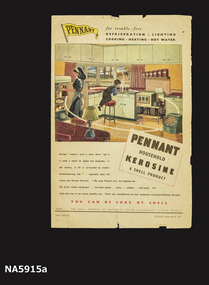
... Cream brochure with picture of kitchen with refrigerator, radiator, stove, lamp using kerosine. ...Keronsine in 1947 Craft Kerosine Kitchen Shell Crochet 1947 Cream brochure with picture of kitchen with refrigerator, radiator, stove, lamp using kerosine. ...Keronsine in 1947Cream brochure with picture of kitchen with refrigerator, radiator, stove, lamp using kerosine. Has yellow flag on left hand side "Pennant Household Kerosine - A Shell product" Page thirty-six 'Women', September 8 1947 on back page a picture of doileys . Picture of Dettol bottle and advertisement at left bottom corner.craft, kerosine, kitchen, shell, crochet, 1947 -
 Bendigo Historical Society Inc.
Document - H.A. & S.R. WILKINSON COLLECTION: CONTRACT OF SALE
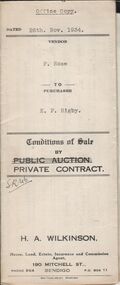
... Rigby (buyer) of all that fruit and confectionary business situate No. 187 Mitchell Street, Bendigo, comprising all the stock, fittings, counters, show-cases within said shop, together with gas stove in kitchen and everything within the refreshment room with the exception of four pictures, one clock and one piano. ...Rigby (buyer) of all that fruit and confectionary business situate No. 187 Mitchell Street, Bendigo, comprising all the stock, fittings, counters, show-cases within said shop, together with gas stove in kitchen and everything within the refreshment room with the exception of four pictures, one clock and one piano. ...BHS CollectionConditions of sale by private contract dated 26th November, 1934 between F. Rose (seller) and E.F. Rigby (buyer) of all that fruit and confectionary business situate No. 187 Mitchell Street, Bendigo, comprising all the stock, fittings, counters, show-cases within said shop, together with gas stove in kitchen and everything within the refreshment room with the exception of four pictures, one clock and one piano. Price 120 poundsorganization, business, h.a. & s.r wilkinson real estate -
![Photograph - Colour Print, Harry Gilham [Attrib.], Living and Learning Centre, Main Road, Eltham, Aug 1988](/media/collectors/4f729f7b97f83e03086018a5/items/6a1ccb54e43e4200865b4676/item-media/6a1ccbd3e43e4200865b58ed/item-fit-380x285.jpg?cb=6) Eltham District Historical Society Inc
Eltham District Historical Society IncPhotograph - Colour Print, Harry Gilham [Attrib.], Living and Learning Centre, Main Road, Eltham, Aug 1988
... The former northeast room was divided into bathroom/toilet and passageway with cupboards to access the extension. Kitchen stove and sink was removed (they fell apart) and a slow-combustion stove with hot water heater installed. ...The former northeast room was divided into bathroom/toilet and passageway with cupboards to access the extension. Kitchen stove and sink was removed (they fell apart) and a slow-combustion stove with hot water heater installed. ...North face of house viewed from the current (1990) pottery area (now pathed) The kitchen was separate from the house as a safety measure in the late 1800s. A detailed history of the site and early development of the Eltham Living and Learning Centre can be found in EDHS_04870 - Folder, Shire of Eltham Living and Learning Centre, 1996 The original property was part of Josiah Holloways subdivision of Little Eltham. It had a 70 foot frontage to Maria Street and stretched down to the Diamond Creek. John Perason, a Tanner, purchased the property in 1857 for £100 and he built a solid brick house which over the years was modified significantly by various owners and which is the basis of the present-day Living and Learning Centre. Claire Fitzpatrick and her husband Alfred, a retired chemical engineer, bought it in the early 1950's. Claire's interest in farming and animal husbandry and breeding saw her modify and establish buildings on the property to house goats and poultry with a horse stable and storage sheds for the animal food. She also built the coach house with its horse box and tack room and built an adjoining garage for their car. Structural alterations to the house were also carried out during the period of their ownership. Their house renovations removed the four fireplaces and chimneys and added a wider verandah, a fibro cement extension on the north wall requiring a doorway to be made in the brick wall for access. Part of a passage wall was removed to join the northwest room, now the "sitting room". A new jarrah floor was put in as the old one was rotten with borer. The verandahs, front and back, were re-organised in design and the front door had its leadlighting panels removed to allow more light into the house. During this period the water catchment well was filled in. This well had a concrete slab fitted onto a collar around its top. The well is 12 feet deep and 8 feet in diameter. Septic sewerage was installed and an internal toilet fitted in the house. The former northeast room was divided into bathroom/toilet and passageway with cupboards to access the extension. Kitchen stove and sink was removed (they fell apart) and a slow-combustion stove with hot water heater installed. Basins and hot water were connected to the new bathroom. In the early 1970s Eltham Shire Council, Councillors Frank Maas and Don Maling, were proposing an extended communities activities program be set up and the Commonwealth Grants Commission was approached for financial assistance to such a scheme. During 1974 a $50,000 Commonwealth Government grant was received by the Shire Council to acquire the Fitzpatrick property as part of the Shire's planning to establish an "extended community activities program". Council's Committee recommended an annual budget of $26,950 for the program and the project was named the Living and Learning Centre and in charge of the program was the first co-ordinator, Carina Hack. The activities were planned to cover "practical skills for living" and included cooking, preserving, gardening, animal husbandry, home economics, electronics, carpentry, hairdressing, making children's clothes and car maintenance. Hobbies and arts and crafts that would include amongst other future items, winemaking, music spinning and weaving and painting. 739 main road eltham, eltham living and learning centre, living and learning centre, living and learning nillumbik (eltham), main road eltham -
 Eltham District Historical Society Inc
Photograph - Black and White Print, Widening of the verandah of 'Rosebank,' now Living and Learning Centre, Main Road, Eltham, c.1965
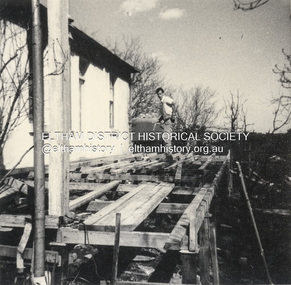
... The former northeast room was divided into bathroom/toilet and passageway with cupboards to access the extension. Kitchen stove and sink was removed (they fell apart) and a slow-combustion stove with hot water heater installed. ...The former northeast room was divided into bathroom/toilet and passageway with cupboards to access the extension. Kitchen stove and sink was removed (they fell apart) and a slow-combustion stove with hot water heater installed. ...Restructure of the front verandah of 'Rosebank' by widening, c.1965. It was glassed in at a later date. The west facing front verandah was widened and enclosed for additional class room use by the Living and Learning Centre. A detailed history of the site and early development of the Eltham Living and Learning Centre can be found in EDHS_04870 - Folder, Shire of Eltham Living and Learning Centre, 1996 The original property was part of Josiah Holloways subdivision of Little Eltham. It had a 70 foot frontage to Maria Street and stretched down to the Diamond Creek. John Perason, a Tanner, purchased the property in 1857 for £100 and he built a solid brick house which over the years was modified significantly by various owners and which is the basis of the present-day Living and Learning Centre. Claire Fitzpatrick and her husband Alfred, a retired chemical engineer, bought it in the early 1950's. Claire's interest in farming and animal husbandry and breeding saw her modify and establish buildings on the property to house goats and poultry with a horse stable and storage sheds for the animal food. She also built the coach house with its horse box and tack room and built an adjoining garage for their car. Structural alterations to the house were also carried out during the period of their ownership. Their house renovations removed the four fireplaces and chimneys and added a wider verandah, a fibro cement extension on the north wall requiring a doorway to be made in the brick wall for access. Part of a passage wall was removed to join the northwest room, now the "sitting room". A new jarrah floor was put in as the old one was rotten with borer. The verandahs, front and back, were re-organised in design and the front door had its leadlighting panels removed to allow more light into the house. During this period the water catchment well was filled in. This well had a concrete slab fitted onto a collar around its top. The well is 12 feet deep and 8 feet in diameter. Septic sewerage was installed and an internal toilet fitted in the house. The former northeast room was divided into bathroom/toilet and passageway with cupboards to access the extension. Kitchen stove and sink was removed (they fell apart) and a slow-combustion stove with hot water heater installed. Basins and hot water were connected to the new bathroom. In the early 1970s Eltham Shire Council, Councillors Frank Maas and Don Maling, were proposing an extended communities activities program be set up and the Commonwealth Grants Commission was approached for financial assistance to such a scheme. During 1974 a $50,000 Commonwealth Government grant was received by the Shire Council to acquire the Fitzpatrick property as part of the Shire's planning to establish an "extended community activities program". Council's Committee recommended an annual budget of $26,950 for the program and the project was named the Living and Learning Centre and in charge of the program was the first co-ordinator, Carina Hack. The activities were planned to cover "practical skills for living" and included cooking, preserving, gardening, animal husbandry, home economics, electronics, carpentry, hairdressing, making children's clothes and car maintenance. Hobbies and arts and crafts that would include amongst other future items, winemaking, music spinning and weaving and painting. 739 main road eltham, eltham living and learning centre, living and learning centre, living and learning nillumbik (eltham), main road eltham -
![Photograph - Colour Print, Harry Gilham [Attrib.], Living and Learning Centre, Main Road, Eltham, c.1988](/media/collectors/4f729f7b97f83e03086018a5/items/6a1cdaf8e43e4200865c849d/item-media/6a1cdb13e43e4200865c85b6/item-fit-380x285.jpg?cb=6) Eltham District Historical Society Inc
Eltham District Historical Society IncPhotograph - Colour Print, Harry Gilham [Attrib.], Living and Learning Centre, Main Road, Eltham, c.1988
... The former northeast room was divided into bathroom/toilet and passageway with cupboards to access the extension. Kitchen stove and sink was removed (they fell apart) and a slow-combustion stove with hot water heater installed. ...The former northeast room was divided into bathroom/toilet and passageway with cupboards to access the extension. Kitchen stove and sink was removed (they fell apart) and a slow-combustion stove with hot water heater installed. ...The 'back door' which faced the Main Road entrance to the office, Eltham Living and Learning Centre, herb garden at its peak, late 1980s A detailed history of the site and early development of the Eltham Living and Learning Centre can be found in EDHS_04870 - Folder, Shire of Eltham Living and Learning Centre, 1996 The original property was part of Josiah Holloways subdivision of Little Eltham. It had a 70 foot frontage to Maria Street and stretched down to the Diamond Creek. John Perason, a Tanner, purchased the property in 1857 for £100 and he built a solid brick house which over the years was modified significantly by various owners and which is the basis of the present-day Living and Learning Centre. Claire Fitzpatrick and her husband Alfred, a retired chemical engineer, bought it in the early 1950's. Claire's interest in farming and animal husbandry and breeding saw her modify and establish buildings on the property to house goats and poultry with a horse stable and storage sheds for the animal food. She also built the coach house with its horse box and tack room and built an adjoining garage for their car. Structural alterations to the house were also carried out during the period of their ownership. Their house renovations removed the four fireplaces and chimneys and added a wider verandah, a fibro cement extension on the north wall requiring a doorway to be made in the brick wall for access. Part of a passage wall was removed to join the northwest room, now the "sitting room". A new jarrah floor was put in as the old one was rotten with borer. The verandahs, front and back, were re-organised in design and the front door had its leadlighting panels removed to allow more light into the house. During this period the water catchment well was filled in. This well had a concrete slab fitted onto a collar around its top. The well is 12 feet deep and 8 feet in diameter. Septic sewerage was installed and an internal toilet fitted in the house. The former northeast room was divided into bathroom/toilet and passageway with cupboards to access the extension. Kitchen stove and sink was removed (they fell apart) and a slow-combustion stove with hot water heater installed. Basins and hot water were connected to the new bathroom. In the early 1970s Eltham Shire Council, Councillors Frank Maas and Don Maling, were proposing an extended communities activities program be set up and the Commonwealth Grants Commission was approached for financial assistance to such a scheme. During 1974 a $50,000 Commonwealth Government grant was received by the Shire Council to acquire the Fitzpatrick property as part of the Shire's planning to establish an "extended community activities program". Council's Committee recommended an annual budget of $26,950 for the program and the project was named the Living and Learning Centre and in charge of the program was the first co-ordinator, Carina Hack. The activities were planned to cover "practical skills for living" and included cooking, preserving, gardening, animal husbandry, home economics, electronics, carpentry, hairdressing, making children's clothes and car maintenance. Hobbies and arts and crafts that would include amongst other future items, winemaking, music spinning and weaving and painting. 739 main road eltham, eltham living and learning centre, living and learning centre, living and learning nillumbik (eltham), main road eltham -
![Photograph - Black and White Print, Harry Gilham [Attrib.], Living and Learning Centre, Main Road, Eltham, 1990](/media/collectors/4f729f7b97f83e03086018a5/items/6a1cdbffe43e4200865c95df/item-media/6a1cdc19e43e4200865c975d/item-fit-380x285.jpg?cb=6) Eltham District Historical Society Inc
Eltham District Historical Society IncPhotograph - Black and White Print, Harry Gilham [Attrib.], Living and Learning Centre, Main Road, Eltham, 1990
... The former northeast room was divided into bathroom/toilet and passageway with cupboards to access the extension. Kitchen stove and sink was removed (they fell apart) and a slow-combustion stove with hot water heater installed. ...The former northeast room was divided into bathroom/toilet and passageway with cupboards to access the extension. Kitchen stove and sink was removed (they fell apart) and a slow-combustion stove with hot water heater installed. ...The 'back door' which faced the Main Road entrance to the office, Eltham Living and Learning Centre - Shows original sandstone blocks in back verandah floor A detailed history of the site and early development of the Eltham Living and Learning Centre can be found in EDHS_04870 - Folder, Shire of Eltham Living and Learning Centre, 1996 The original property was part of Josiah Holloways subdivision of Little Eltham. It had a 70 foot frontage to Maria Street and stretched down to the Diamond Creek. John Perason, a Tanner, purchased the property in 1857 for £100 and he built a solid brick house which over the years was modified significantly by various owners and which is the basis of the present-day Living and Learning Centre. Claire Fitzpatrick and her husband Alfred, a retired chemical engineer, bought it in the early 1950's. Claire's interest in farming and animal husbandry and breeding saw her modify and establish buildings on the property to house goats and poultry with a horse stable and storage sheds for the animal food. She also built the coach house with its horse box and tack room and built an adjoining garage for their car. Structural alterations to the house were also carried out during the period of their ownership. Their house renovations removed the four fireplaces and chimneys and added a wider verandah, a fibro cement extension on the north wall requiring a doorway to be made in the brick wall for access. Part of a passage wall was removed to join the northwest room, now the "sitting room". A new jarrah floor was put in as the old one was rotten with borer. The verandahs, front and back, were re-organised in design and the front door had its leadlighting panels removed to allow more light into the house. During this period the water catchment well was filled in. This well had a concrete slab fitted onto a collar around its top. The well is 12 feet deep and 8 feet in diameter. Septic sewerage was installed and an internal toilet fitted in the house. The former northeast room was divided into bathroom/toilet and passageway with cupboards to access the extension. Kitchen stove and sink was removed (they fell apart) and a slow-combustion stove with hot water heater installed. Basins and hot water were connected to the new bathroom. In the early 1970s Eltham Shire Council, Councillors Frank Maas and Don Maling, were proposing an extended communities activities program be set up and the Commonwealth Grants Commission was approached for financial assistance to such a scheme. During 1974 a $50,000 Commonwealth Government grant was received by the Shire Council to acquire the Fitzpatrick property as part of the Shire's planning to establish an "extended community activities program". Council's Committee recommended an annual budget of $26,950 for the program and the project was named the Living and Learning Centre and in charge of the program was the first co-ordinator, Carina Hack. The activities were planned to cover "practical skills for living" and included cooking, preserving, gardening, animal husbandry, home economics, electronics, carpentry, hairdressing, making children's clothes and car maintenance. Hobbies and arts and crafts that would include amongst other future items, winemaking, music spinning and weaving and painting. 739 main road eltham, eltham living and learning centre, living and learning centre, living and learning nillumbik (eltham), main road eltham -
![Photograph - Black and White Print, Harry Gilham [Attrib.], Living and Learning Centre, Main Road, Eltham, c.1990](/media/collectors/4f729f7b97f83e03086018a5/items/6a1cddabe43e4200865cee41/item-media/6a1cddbbe43e4200865cf696/item-fit-380x285.jpg?cb=6) Eltham District Historical Society Inc
Eltham District Historical Society IncPhotograph - Black and White Print, Harry Gilham [Attrib.], Living and Learning Centre, Main Road, Eltham, c.1990
... The former northeast room was divided into bathroom/toilet and passageway with cupboards to access the extension. Kitchen stove and sink was removed (they fell apart) and a slow-combustion stove with hot water heater installed. ...The former northeast room was divided into bathroom/toilet and passageway with cupboards to access the extension. Kitchen stove and sink was removed (they fell apart) and a slow-combustion stove with hot water heater installed. ...Brick storage shed, south wall entry. This cool room, half set down in the soil still standing at time but with a more modern galvanised tin roof. A detailed history of the site and early development of the Eltham Living and Learning Centre can be found in EDHS_04870 - Folder, Shire of Eltham Living and Learning Centre, 1996 The original property was part of Josiah Holloways subdivision of Little Eltham. It had a 70 foot frontage to Maria Street and stretched down to the Diamond Creek. John Perason, a Tanner, purchased the property in 1857 for £100 and he built a solid brick house which over the years was modified significantly by various owners and which is the basis of the present-day Living and Learning Centre. Claire Fitzpatrick and her husband Alfred, a retired chemical engineer, bought it in the early 1950's. Claire's interest in farming and animal husbandry and breeding saw her modify and establish buildings on the property to house goats and poultry with a horse stable and storage sheds for the animal food. She also built the coach house with its horse box and tack room and built an adjoining garage for their car. Structural alterations to the house were also carried out during the period of their ownership. Their house renovations removed the four fireplaces and chimneys and added a wider verandah, a fibro cement extension on the north wall requiring a doorway to be made in the brick wall for access. Part of a passage wall was removed to join the northwest room, now the "sitting room". A new jarrah floor was put in as the old one was rotten with borer. The verandahs, front and back, were re-organised in design and the front door had its leadlighting panels removed to allow more light into the house. During this period the water catchment well was filled in. This well had a concrete slab fitted onto a collar around its top. The well is 12 feet deep and 8 feet in diameter. Septic sewerage was installed and an internal toilet fitted in the house. The former northeast room was divided into bathroom/toilet and passageway with cupboards to access the extension. Kitchen stove and sink was removed (they fell apart) and a slow-combustion stove with hot water heater installed. Basins and hot water were connected to the new bathroom. In the early 1970s Eltham Shire Council, Councillors Frank Maas and Don Maling, were proposing an extended communities activities program be set up and the Commonwealth Grants Commission was approached for financial assistance to such a scheme. During 1974 a $50,000 Commonwealth Government grant was received by the Shire Council to acquire the Fitzpatrick property as part of the Shire's planning to establish an "extended community activities program". Council's Committee recommended an annual budget of $26,950 for the program and the project was named the Living and Learning Centre and in charge of the program was the first co-ordinator, Carina Hack. The activities were planned to cover "practical skills for living" and included cooking, preserving, gardening, animal husbandry, home economics, electronics, carpentry, hairdressing, making children's clothes and car maintenance. Hobbies and arts and crafts that would include amongst other future items, winemaking, music spinning and weaving and painting. 739 main road eltham, eltham living and learning centre, living and learning centre, living and learning nillumbik (eltham), main road eltham -
![Photograph - Colour Print, Harry Gilham [Attrib.], Living and Learning Centre, Main Road, Eltham, 1995](/media/collectors/4f729f7b97f83e03086018a5/items/6a1cde5de43e4200865d0c81/item-media/6a1cde8be43e4200865d1127/item-fit-380x285.jpg?cb=6) Eltham District Historical Society Inc
Eltham District Historical Society IncPhotograph - Colour Print, Harry Gilham [Attrib.], Living and Learning Centre, Main Road, Eltham, 1995
... The former northeast room was divided into bathroom/toilet and passageway with cupboards to access the extension. Kitchen stove and sink was removed (they fell apart) and a slow-combustion stove with hot water heater installed. ...The former northeast room was divided into bathroom/toilet and passageway with cupboards to access the extension. Kitchen stove and sink was removed (they fell apart) and a slow-combustion stove with hot water heater installed. ...New Pavilion at left has plants appearing. Grass area needs a mow - verandah with repainted stool/forms - early spring 1995 A detailed history of the site and early development of the Eltham Living and Learning Centre can be found in EDHS_04870 - Folder, Shire of Eltham Living and Learning Centre, 1996 The original property was part of Josiah Holloways subdivision of Little Eltham. It had a 70 foot frontage to Maria Street and stretched down to the Diamond Creek. John Perason, a Tanner, purchased the property in 1857 for £100 and he built a solid brick house which over the years was modified significantly by various owners and which is the basis of the present-day Living and Learning Centre. Claire Fitzpatrick and her husband Alfred, a retired chemical engineer, bought it in the early 1950's. Claire's interest in farming and animal husbandry and breeding saw her modify and establish buildings on the property to house goats and poultry with a horse stable and storage sheds for the animal food. She also built the coach house with its horse box and tack room and built an adjoining garage for their car. Structural alterations to the house were also carried out during the period of their ownership. Their house renovations removed the four fireplaces and chimneys and added a wider verandah, a fibro cement extension on the north wall requiring a doorway to be made in the brick wall for access. Part of a passage wall was removed to join the northwest room, now the "sitting room". A new jarrah floor was put in as the old one was rotten with borer. The verandahs, front and back, were re-organised in design and the front door had its leadlighting panels removed to allow more light into the house. During this period the water catchment well was filled in. This well had a concrete slab fitted onto a collar around its top. The well is 12 feet deep and 8 feet in diameter. Septic sewerage was installed and an internal toilet fitted in the house. The former northeast room was divided into bathroom/toilet and passageway with cupboards to access the extension. Kitchen stove and sink was removed (they fell apart) and a slow-combustion stove with hot water heater installed. Basins and hot water were connected to the new bathroom. In the early 1970s Eltham Shire Council, Councillors Frank Maas and Don Maling, were proposing an extended communities activities program be set up and the Commonwealth Grants Commission was approached for financial assistance to such a scheme. During 1974 a $50,000 Commonwealth Government grant was received by the Shire Council to acquire the Fitzpatrick property as part of the Shire's planning to establish an "extended community activities program". Council's Committee recommended an annual budget of $26,950 for the program and the project was named the Living and Learning Centre and in charge of the program was the first co-ordinator, Carina Hack. The activities were planned to cover "practical skills for living" and included cooking, preserving, gardening, animal husbandry, home economics, electronics, carpentry, hairdressing, making children's clothes and car maintenance. Hobbies and arts and crafts that would include amongst other future items, winemaking, music spinning and weaving and painting. 739 main road eltham, eltham living and learning centre, living and learning centre, living and learning nillumbik (eltham), main road eltham -
![Photograph - Colour Print, Harry Gilham [Attrib.], Living and Learning Centre, Main Road, Eltham, 1995](/media/collectors/4f729f7b97f83e03086018a5/items/6a1cdf36e43e4200865d43d6/item-media/6a1cdf50e43e4200865d4778/item-fit-380x285.jpg?cb=6) Eltham District Historical Society Inc
Eltham District Historical Society IncPhotograph - Colour Print, Harry Gilham [Attrib.], Living and Learning Centre, Main Road, Eltham, 1995
... The former northeast room was divided into bathroom/toilet and passageway with cupboards to access the extension. Kitchen stove and sink was removed (they fell apart) and a slow-combustion stove with hot water heater installed. ...The former northeast room was divided into bathroom/toilet and passageway with cupboards to access the extension. Kitchen stove and sink was removed (they fell apart) and a slow-combustion stove with hot water heater installed. ...New verandah Eltham Living and Learning Centre on the western face looking down over the Tannery site and Diamond Creek. Pavilion in place (LH Side). The verandah with its upgrade of curtains 1995. Originally 4 feet 6 inches wide. A detailed history of the site and early development of the Eltham Living and Learning Centre can be found in EDHS_04870 - Folder, Shire of Eltham Living and Learning Centre, 1996 The original property was part of Josiah Holloways subdivision of Little Eltham. It had a 70 foot frontage to Maria Street and stretched down to the Diamond Creek. John Perason, a Tanner, purchased the property in 1857 for £100 and he built a solid brick house which over the years was modified significantly by various owners and which is the basis of the present-day Living and Learning Centre. Claire Fitzpatrick and her husband Alfred, a retired chemical engineer, bought it in the early 1950's. Claire's interest in farming and animal husbandry and breeding saw her modify and establish buildings on the property to house goats and poultry with a horse stable and storage sheds for the animal food. She also built the coach house with its horse box and tack room and built an adjoining garage for their car. Structural alterations to the house were also carried out during the period of their ownership. Their house renovations removed the four fireplaces and chimneys and added a wider verandah, a fibro cement extension on the north wall requiring a doorway to be made in the brick wall for access. Part of a passage wall was removed to join the northwest room, now the "sitting room". A new jarrah floor was put in as the old one was rotten with borer. The verandahs, front and back, were re-organised in design and the front door had its leadlighting panels removed to allow more light into the house. During this period the water catchment well was filled in. This well had a concrete slab fitted onto a collar around its top. The well is 12 feet deep and 8 feet in diameter. Septic sewerage was installed and an internal toilet fitted in the house. The former northeast room was divided into bathroom/toilet and passageway with cupboards to access the extension. Kitchen stove and sink was removed (they fell apart) and a slow-combustion stove with hot water heater installed. Basins and hot water were connected to the new bathroom. In the early 1970s Eltham Shire Council, Councillors Frank Maas and Don Maling, were proposing an extended communities activities program be set up and the Commonwealth Grants Commission was approached for financial assistance to such a scheme. During 1974 a $50,000 Commonwealth Government grant was received by the Shire Council to acquire the Fitzpatrick property as part of the Shire's planning to establish an "extended community activities program". Council's Committee recommended an annual budget of $26,950 for the program and the project was named the Living and Learning Centre and in charge of the program was the first co-ordinator, Carina Hack. The activities were planned to cover "practical skills for living" and included cooking, preserving, gardening, animal husbandry, home economics, electronics, carpentry, hairdressing, making children's clothes and car maintenance. Hobbies and arts and crafts that would include amongst other future items, winemaking, music spinning and weaving and painting. 739 main road eltham, eltham living and learning centre, living and learning centre, living and learning nillumbik (eltham), main road eltham -
 Bendigo Historical Society Inc.
Document - H. A. & S. R. WILKINSON COLLECTION: CONTRACT OF SALE
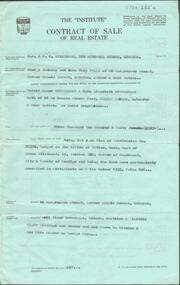
... Property: 82 Hargreaves Street, corner Arnold Street, Bendigo, being lot 2 on plan of subdivision No. 28382 lodged in the office of titles, being part of Crown allotment 15 section 92C land described in certificate of title volume 4335 folio 826 together with floor coverings, blinds, curtains, electric light fittings and shades, gas stove in kitchen and gas fire heater in lounge room. ...Property: 82 Hargreaves Street, corner Arnold Street, Bendigo, being lot 2 on plan of subdivision No. 28382 lodged in the office of titles, being part of Crown allotment 15 section 92C land described in certificate of title volume 4335 folio 826 together with floor coverings, blinds, curtains, electric light fittings and shades, gas stove in kitchen and gas fire heater in lounge room. ...Contract of sale of real estate dated 18th December, 1963 between Mr G. A. & Mrs. N M. Wells (vendor) and Mr. H. G. & Mrs. M. E. Stephenson (purchaser). Property: 82 Hargreaves Street, corner Arnold Street, Bendigo, being lot 2 on plan of subdivision No. 28382 lodged in the office of titles, being part of Crown allotment 15 section 92C land described in certificate of title volume 4335 folio 826 together with floor coverings, blinds, curtains, electric light fittings and shades, gas stove in kitchen and gas fire heater in lounge room. Price: 3,250 pounds.organization, business, h.a. & s.r wilkinson real estate -
 Bendigo Historical Society Inc.
Document - H. A. & S. R. WILKINSON COLLECTION: CONTRACT OF SALE
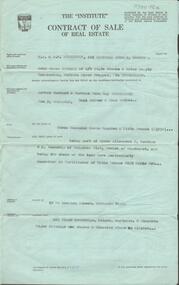
... Property: 18 Mc Lachlan Street, Kangaroo Flat being part of Crown allotment 6 section 6A township of Kangaroo Flat land described in certificate of title volume 8192 folio 820 together with all floor coverings, blinds, curtains and electric light fittings and shades and electric stove in kitchen. Price 3,750 pounds....Property: 18 Mc Lachlan Street, Kangaroo Flat being part of Crown allotment 6 section 6A township of Kangaroo Flat land described in certificate of title volume 8192 folio 820 together with all floor coverings, blinds, curtains and electric light fittings and shades and electric stove in kitchen. Price 3,750 pounds. Document H. ...Contract of sale of real estate dated 22nd June, 1964 between Mr. J. J. Scholes (vendor) and Mr. A. H. 7 Mrs. B. D. M. Stephenson (purchaser). Solicitor for vendor: Messrs. E. S. Cahill & Son, View Street, Bendigo. Solicitor for purchaser (Messrs Schleinger & Smalley, Williamson Street, Bendigo. Property: 18 Mc Lachlan Street, Kangaroo Flat being part of Crown allotment 6 section 6A township of Kangaroo Flat land described in certificate of title volume 8192 folio 820 together with all floor coverings, blinds, curtains and electric light fittings and shades and electric stove in kitchen. Price 3,750 pounds.organization, business, h.a. & s.r wilkinson real estate -
 Sunshine and District Historical Society Incorporated
Mixed media - Mr W.L Affleck Collection, 1912-1944
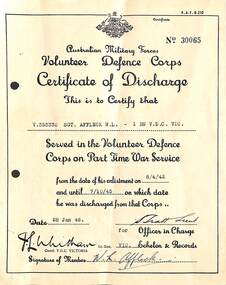
... 6 items from the collection of Mr WL Affleck 1 Discharge certificate Volunteer Defense Corps Enlistment 8 April 1942 until 7 October 1945 Dated 28 January 1946 2 Vocational Training Qualification certificate 1 December 1922 as Wood Process Engraver 3 Photograph of McKay head office building c1912 4 Affleck house built 1922 33 Sydney Street Albion This house was built for WL Lindsay and Olive Affleck in 1922 by Olives father Frank Baker the house was soli d brick with terra cotta tiled roof It had 2 bedrooms front room dining room kitchen with pantry wood stove and later gas stove The back with a laundry Wash House at one end and an outside toilet the front dining and one bedroom had fire grates In 1926 the werandah was fitted with half walls and fly wire with canvas blinds In 1936 Lindsay Affleck purchased a Cable Tram carriage as a sleepout for their two sons Ron and Geoff 5 Photo of Volunteer Defense Corps WWII c1944 6 Wallet c1939 to 1945...William Lindsay Affleck 707.01 - Mr W.L Affleck Collection - Volunteer Defence Corps Certificate Of Discharge 707.02 - Mr W.L Affleck Collection - Vocational Training Certificate 707.03 - Mr W.L Affleck Collection - Sunshine Harvester Works Head Office 1912 Back 707.03 - Mr W.L Affleck Collection - Sunshine Harvester Works Head Office 1912 Front 707.04 - Mr W.L Affleck Collection - 33 Sydney Street Albion Back 707.04 - Mr W.L Affleck Collection - 33 Sydney Street Albion Front 707.05 - Mr W.L Affleck Collection - Volunteer Defence Corps Back 707.05 - Mr W.L Affleck Collection - Volunteer Defence Corps Front 707.06 - Mr W.L Affleck Collection - With Compliments Of Hugh V.McKay Wallet 6 items from the collection of Mr WL Affleck 1 Discharge certificate Volunteer Defense Corps Enlistment 8 April 1942 until 7 October 1945 Dated 28 January 1946 2 Vocational Training Qualification certificate 1 December 1922 as Wood Process Engraver 3 Photograph of McKay head office building c1912 4 Affleck house built 1922 33 Sydney Street Albion This house was built for WL Lindsay and Olive Affleck in 1922 by Olives father Frank Baker the house was soli d brick with terra cotta tiled roof It had 2 bedrooms front room dining room kitchen with pantry wood stove and later gas stove The back with a laundry Wash House at one end and an outside toilet the front dining and one bedroom had fire grates In 1926 the werandah was fitted with half walls and fly wire with canvas blinds In 1936 Lindsay Affleck purchased a Cable Tram carriage as a sleepout for their two sons Ron and Geoff 5 Photo of Volunteer Defense Corps WWII c1944 6 Wallet c1939 to 1945 Mixed media Mr W.L Affleck Collection ...707.01 - Mr W.L Affleck Collection - Volunteer Defence Corps Certificate Of Discharge 707.02 - Mr W.L Affleck Collection - Vocational Training Certificate 707.03 - Mr W.L Affleck Collection - Sunshine Harvester Works Head Office 1912 Back 707.03 - Mr W.L Affleck Collection - Sunshine Harvester Works Head Office 1912 Front 707.04 - Mr W.L Affleck Collection - 33 Sydney Street Albion Back 707.04 - Mr W.L Affleck Collection - 33 Sydney Street Albion Front 707.05 - Mr W.L Affleck Collection - Volunteer Defence Corps Back 707.05 - Mr W.L Affleck Collection - Volunteer Defence Corps Front 707.06 - Mr W.L Affleck Collection - With Compliments Of Hugh V.McKay Walletwilliam lindsay affleck -
 Halls Gap & Grampians Historical Society
Newspaper - Photocopy, C 1922
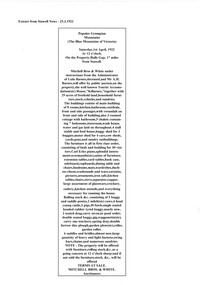
... Carl Ecko piano, splendid instrument; overmantle (sic) suites of furniture, extension tables, card tables, book case, sideboard, cupboards, dining table and chairs, linoleums, mats, wardrobes, duchess-chests, washstands and ware, curtains, pictures, ornaments, iron safe, kitchen tables, chairs, stove, separator, copper, large assortment of glassware, crockery, cutlery, kitchen utensils, and everything necessary for running the house. ...Carl Ecko piano, splendid instrument; overmantle (sic) suites of furniture, extension tables, card tables, book case, sideboard, cupboards, dining table and chairs, linoleums, mats, wardrobes, duchess-chests, washstands and ware, curtains, pictures, ornaments, iron safe, kitchen tables, chairs, stove, separator, copper, large assortment of glassware, crockery, cutlery, kitchen utensils, and everything necessary for running the house. ...Popular Grampian Mountains (The Blue Mountains of Victoria) Saturday, 1st April, 1922 at 12 o'clock On the property Halls Gap, 17 miles from Stawell Mitchell Bros & White under instructions from the Administrator of Lulu Barnes, deceased, and Mr A. H. Barnes, will offer by public auction on the property, the well known Tourist Accomodation (sic) House, "Killarney" together with 29 acres of freehold land, household furniture, stock, vehicles and sundries. The buildings consist main building of 8 rooms, kitchen, bathroom, vestibule, front and side passages, with verandah on front and side of building, also 3 roomed cottage with bathroom, 5 chalets containing 7 bedrooms, storeroom. wash house, water and gas laid on throughout. 4 cars, cow sheds, yards, pens, and sundry outbuildings. The furniture is all in first class order, consisting of beds and bedding for 30 visitors. Carl Ecko piano, splendid instrument; overmantle (sic) suites of furniture, extension tables, card tables, book case, sideboard, cupboards, dining table and chairs, linoleums, mats, wardrobes, duchess-chests, washstands and ware, curtains, pictures, ornaments, iron safe, kitchen tables, chairs, stove, separator, copper, large assortment of glassware, crockery, cutlery, kitchen utensils, and everything necessary for running the house. Rolling stock and C, consisting of 5 buggy and saddle ponies, 2 milch (sic) cows, 4 head young cattle, 3 pigs, 30 fowls, single seated hooded rubber tyred buggy, nearly new, 2 seated drag, carry seven, in good order; double seated buggy, gig, waggonette (sic), carry one ton; lorry, spring dray, double furrow disc plough, garden plow (sic), roller, garden roller. 6 saddles and bridles, almost new, large quantity of heavy and light harness, swing bars, chains, and numerous sundries. NOTE - The property will be offered with furniture, rolling stock & c., as a going concern at 12 o'clock sharp; and if not sold the furniture, stock, & C., will be offered TERMS AT SALE. MITCHELL BROS. & WHITE. AuctioneersTyped extract of advertisement for auction of Killarney from Stawell News 25-3-1922 later known as Grampians Housemedia, newspaper articles, guesthouses, killarney -
 Eltham District Historical Society Inc
Document - Folder, McLean, 1984-1999
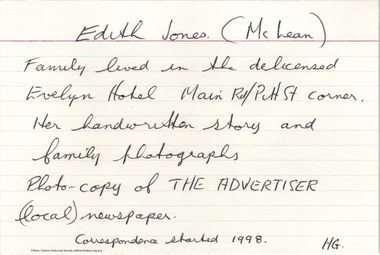
... Louisa McLean believed she had been responsible when taking the ashes from the kitchen wood stove outside that some may have fallen down in cracks in the floor into the cellar. ...Louisa McLean believed she had been responsible when taking the ashes from the kitchen wood stove outside that some may have fallen down in cracks in the floor into the cellar. ...References to McLean family, Hector John McLean and Louisa Frances (nee Green) and six daughters who lived in Eltham during the period 1930 to 1934 inclusive. Lived in the former Evelyn Hotel at the time it was destroyed by fire and being part of the Centenary Parade in 1934 where the family won the Group Section for their entry “Pioneers of Eltham” Reminiscences provided by Edith Jones (nee M1934 flood, ballroom, baptism, barber shop, bittern, boy scouts, bremner's flat, burgoyne's shop, cable tram, cemetery road, centenary celebrations, centenary parade, christening, coach house, collis grocery, dalton street, depression, dole, dorothy jean mclean, edith jones (nee mclean), eltham fire brigade, eltham high school, eltham higher elementary school, eltham lower park, eltham railway station, eltham state school no. 209, evelyn hotel, fire damage - buildings, flinders naval depot, fordham, gladys evelyn mclean, gold mining, gwenneth mae mclean, gwladys evelyn mclean, headmistress, hector john mclean, isherwood house and shop, louisa frances mclean (nee green), metery road, methodist church, miss finnin, miss grant cottage, motor bike races, mrs barrett, mrs bremner, mrs hurley, olive isabel mclean, parade, phoebe lillian mclean, picnic, pioneers of eltham, pitt street, research fire brigade, rev. r.g. arthur, shed, shops, st margarets church hall, st margaret's church, stables, state savings bank of victoria, susso books, todaro, vinnie willet, warrandyte bridge, warrandyte, wingrove park, yarra river
