
Showing 517 items matching "l. peoples"
-
 Federation University Historical Collection
Magazine - Booklet, Ballarat School of Mines Students' Magazine, 1939, 1939
... ...l. peoples...Literary Society, Papua: Land of Contrasts, Old Boys' Association, Snapshots in Berlin, Fumes from the Lab, Arts & Crafts Gossip, Sport, Commercial Notes, The Junior Techs, Junior Techs Sports ballarat school of mines magazine r. mchutchison e. gribble m. coward n. rigney o. raisbeck g. myers f. malseed e. fitzgerald m. linklater j. wilkinson m. dolan j. woolcock b. martin g. downing h. j. hassell n. tatlock a. wilson h. trevenan w. hender dr. j. r. pound a. r. gordon mr procter a. helm r. desnoy frank ponsonby g. t. myers h. christensen enid johnston k. h. wilkie isobel boustead eric j. gashler violet d'angri m. hayes marian peirce mr hillman k. gingell g. crouch r. menhennett j. menhennett mr cornell e. mann a. vaughan d. jelbart a. moorhouse d. gilmore p. richards j. nott r. monteith j. martin f. jelbart k. waller a. gilpin b. robinson d. coad m. dalla u. kersey j. cooper p. coombs l. stapleton u. chisholm l. peoples l. stephens j. hall h. patterson a. brown v. evans j. hallidale c. clogan d. ditchfield j. daniel e. theobald g. james j. unsworth helen stichnoth w. rowe winsome hender c. w. rowe j. hosie e. stephens i. mclachlan r. stoneman m. gleeson k. stoneman h. tonkin f. harland r. bulluss t. davies r. gladman m. thomas e. salter d. mcgregor a. spence g. taylor j. pyke r. allisey i. clow r. p. flower l. taylor b. neale j. norman f. p. manning Paul Manning Blue, yellow and green covered magazine with black and green font. 70 pages including advertisements. ...School Council, Members of Staff, List of Full Course Students 1939, Full Course Commercial Students, S.M.B. Magazine Committee 1939, Editorial, Personal Column, Obituary - Frank Ponsonby, The Old School, The Railway Workshops, The S.M.B. Literary Society, Papua: Land of Contrasts, Old Boys' Association, Snapshots in Berlin, Fumes from the Lab, Arts & Crafts Gossip, Sport, Commercial Notes, The Junior Techs, Junior Techs SportsBlue, yellow and green covered magazine with black and green font. 70 pages including advertisements.ballarat school of mines, magazine, r. mchutchison, e. gribble, m. coward, n. rigney, o. raisbeck, g. myers, f. malseed, e. fitzgerald, m. linklater, j. wilkinson, m. dolan, j. woolcock, b. martin, g. downing, h. j. hassell, n. tatlock, a. wilson, h. trevenan, w. hender, dr. j. r. pound, a. r. gordon, mr procter, a. helm, r. desnoy, frank ponsonby, g. t. myers, h. christensen, enid johnston, k. h. wilkie, isobel boustead, eric j. gashler, violet d'angri, m. hayes, marian peirce, mr hillman, k. gingell, g. crouch, r. menhennett, j. menhennett, mr cornell, e. mann, a. vaughan, d. jelbart, a. moorhouse, d. gilmore, p. richards, j. nott, r. monteith, j. martin, f. jelbart, k. waller, a. gilpin, b. robinson, d. coad, m. dalla, u. kersey, j. cooper, p. coombs, l. stapleton, u. chisholm, l. peoples, l. stephens, j. hall, h. patterson, a. brown, v. evans, j. hallidale, c. clogan, d. ditchfield, j. daniel, e. theobald, g. james, j. unsworth, helen stichnoth, w. rowe, winsome hender, c. w. rowe, j. hosie, e. stephens, i. mclachlan, r. stoneman, m. gleeson, k. stoneman, h. tonkin, f. harland, r. bulluss, t. davies, r. gladman, m. thomas, e. salter, d. mcgregor, a. spence, g. taylor, j. pyke, r. allisey, i. clow, r. p. flower, l. taylor, b. neale, j. norman, f. p. manning, paul manning -
 Bendigo Historical Society Inc.
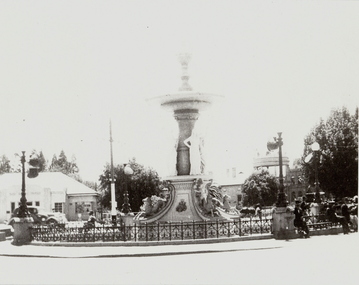
Photograph - ALEXANDRA FOUNTAIN
... Baby Health Centre in L background. People sitting on seats around Fountain....Baby Health Centre in L background. People sitting on seats around Fountain. ...Black and white photograph. Alexandra Fountain. RSL hall in R background. Baby Health Centre in L background. People sitting on seats around Fountain.place, fountain -
 Thompson's Foundry Band Inc. (Castlemaine)
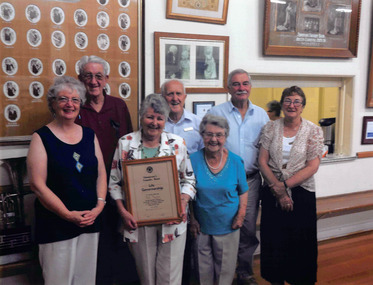
Photograph, Presentation of Life Governorship to Pat Taylor, 31/11/2012
... Photograph with Seven people. L-R: Ruth Pearce, Ken Boal, John Bouch, Joan Cox, Peter Ward, Miriam Maddern...Photograph with Seven people. L-R: Ruth Pearce, Ken Boal, John Bouch, Joan Cox, Peter Ward, Miriam Maddern Presentation of Life Governorship to Pat Taylor Photograph ...Photograph with Seven people. L-R: Ruth Pearce, Ken Boal, John Bouch, Joan Cox, Peter Ward, Miriam Maddern -
Malmsbury Historical Society
Photograph (Item), Bi-Centennial Parade (1988), Malmsbury ca1989
... People - "Williams, L; Bates, A; Morgan, B"...People - "Williams, L; Bates, A; Morgan, B" Bi-Centennial Parade (1988), Malmsbury ca1989 Photograph Photograph ...People - "Williams, L; Bates, A; Morgan, B" -
 Charlton Golden Grains Museum Inc
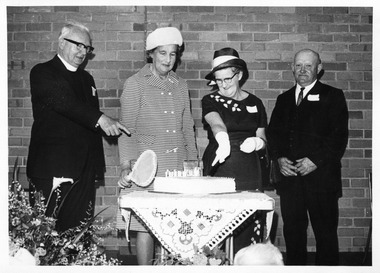
Photograph - St Andrew's Presbyterian Church Centenary 1971 Black and White Picture
... Photo taken on the occasion of St Andrew's Presbyterian Church Centenary in 1971. People l - r Rev Wood, Elsa Paterson, Mrs Twitie and Jack Paterson with 100th birthday cake....Charlton St Andrew's Presbyterian Church Centenary in 1971 Charlton St Andrew's Presbyterian Church Centenary 1971 Photo taken on the occasion of St Andrew's Presbyterian Church Centenary in 1971. People l - r Rev Wood, Elsa Paterson, Mrs Twitie and Jack Paterson with 100th birthday cake. ...Charlton St Andrew's Presbyterian Church Centenary in 1971Photo taken on the occasion of St Andrew's Presbyterian Church Centenary in 1971. People l - r Rev Wood, Elsa Paterson, Mrs Twitie and Jack Paterson with 100th birthday cake.charlton, st andrew's presbyterian church centenary, 1971 -
 City of Warrnambool Rowing Club
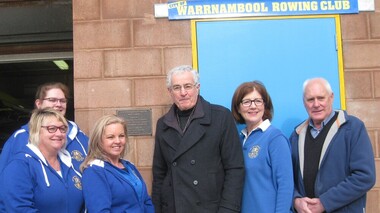
Development Plaque, 16 july 2017
... The people are L to R: Kathy McMeel (secretary), Annie Blanch (Boat Captain), Joanne Bone (president), James Tait (director of Gwen and Edna Jones and Ray and Joyce Uebergang Foundations, Susan Finnigan (Grants Officer) and Clive Wooster (treasurer). • In February 2017 the club filled the base of the boathouse and poured a new concrete floor. • They had an opening to thank the donors, especially the Gwen and Edna Jones and Ray and Joyce Uebergang Foundations and to celebrate with the community and rowers, past and present • Since 1996 rowers had to wade in foul, ankle to thigh high water to access the boat shed- this was for 3-5 months of every year- our facilities are now accessible and Warrnambool has a sporting venue for rowers that is safe and one the public can be proud of...Includes a brass plaque. The people are L to R: Kathy McMeel (secretary), Annie Blanch (Boat Captain), Joanne Bone (president), James Tait (director of Gwen and Edna Jones and Ray and Joyce Uebergang Foundations, Susan Finnigan (Grants Officer) and Clive Wooster (treasurer)....Includes a brass plaque. The people are L to R: Kathy McMeel (secretary), Annie Blanch (Boat Captain), Joanne Bone (president), James Tait (director of Gwen and Edna Jones and Ray and Joyce Uebergang Foundations, Susan Finnigan (Grants Officer) and Clive Wooster (treasurer). ...The people are L to R: Kathy McMeel (secretary), Annie Blanch (Boat Captain), Joanne Bone (president), James Tait (director of Gwen and Edna Jones and Ray and Joyce Uebergang Foundations, Susan Finnigan (Grants Officer) and Clive Wooster (treasurer). • In February 2017 the club filled the base of the boathouse and poured a new concrete floor. • They had an opening to thank the donors, especially the Gwen and Edna Jones and Ray and Joyce Uebergang Foundations and to celebrate with the community and rowers, past and present • Since 1996 rowers had to wade in foul, ankle to thigh high water to access the boat shed- this was for 3-5 months of every year- our facilities are now accessible and Warrnambool has a sporting venue for rowers that is safe and one the public can be proud of. • The Club thanked Barry Wilson for generously donating the plans and acknowledged the ‘term deposit’ raised over the last 10 years, by past and present members, which allowed the Club to contribute the additional funding required. • In particular The Foundations assistance made the project possible. The two philanthropic Foundations are a treasure for the community as they can step in and fill the gap where other funding sources cannot. In our case they were the major donors and we could not have contemplated this project without their assistance. We are truly grateful for the assistance of The Gwen and Edna Jones and Ray and Joyce Uebergang Foundation. • Mr James Tait, a director of both Foundations to unveiled the commemorative plaque. Color photograph taken at the opening of the Redeveloped City of Warrnambool Rowing Club. Includes a brass plaque. The people are L to R: Kathy McMeel (secretary), Annie Blanch (Boat Captain), Joanne Bone (president), James Tait (director of Gwen and Edna Jones and Ray and Joyce Uebergang Foundations, Susan Finnigan (Grants Officer) and Clive Wooster (treasurer).james tait, warrnambool, city of warrnambool rowing club, warrnambool rowing club, boathouse, boathouse redevelopment, gwen and edna jones foundation, ray and joyce uebergang foundation -
 Glenelg Shire Council Cultural Collection
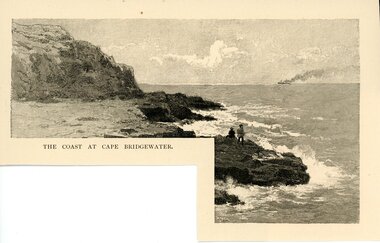
Artwork, other - Illustration, The Coast At Cape Bridgewater, n.d
... Taken and cut from a book. L Shaped. Two people on rocks at foot of cliffs, one is seated the other is standing looking out to sea. ...Taken and cut from a book. L Shaped. Two people on rocks at foot of cliffs, one is seated the other is standing looking out to sea. ...Illustration. Taken and cut from a book. L Shaped. Two people on rocks at foot of cliffs, one is seated the other is standing looking out to sea. Sea is foamed white as it meets the rocks. Steamer in background with large plume of steam drifting in the sky to the right of the image. Printed on the bottom left. THE COAST AT CAPE BRIDGEWATER.Front: 'The Coast at Cape Bridgewater' - printed, lower frame. portland, cape bridgewater -
 Sunbury Family History and Heritage Society Inc.
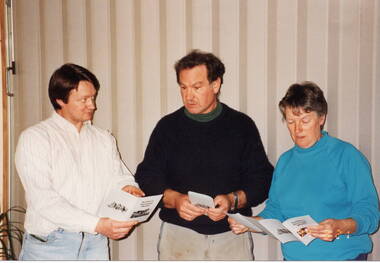
Photograph, 21st August 1994
... The three people from L-R: Graham Gibb, Trevor Dunn and Wendy Sutherland were members of the Sunbury & District Heritage Association and were attending the launch of a booklet that the Association produced. ...The three people from L-R: Graham Gibb, Trevor Dunn and Wendy Sutherland were members of the Sunbury & District Heritage Association and were attending the launch of a booklet that the Association produced. ...The three people from L-R: Graham Gibb, Trevor Dunn and Wendy Sutherland were members of the Sunbury & District Heritage Association and were attending the launch of a booklet that the Association produced. It was a publication launched on the 21st Au8gust 1994, that highlighted four historic walks around the the old Sunbury township. The walks booklet was the first of a number of publications that the Association produced over the years, highlighting Sunbury's history.A non-digital coloured photograph of a lady and two men discussing a pamphlet.graham gibb, trevor dunn, wendy sutherland, sunbury walks, sunbury & district heritage association -
Bendigo Historical Society Inc.
Document - CORONA LODGE, BENDIGO. NO. 195 U.G.L.V, 1917
... Thomas and Mrs. Thomas. People l;isted in program; Wor. Bro. E. Thomas, W.M., Mrs. ...Thomas and Mrs. Thomas. People l;isted in program; Wor. Bro. E. Thomas, W.M., Mrs. ...Corona Lodge, Bendigo. No. 195 U.G.L.V. Patriotic Social Evening, Masonic Hall, Bendigo, April 25th, 1917. Wor. Bro. G. W. Long, P.G.D.D.C., Sec. Reception by The Worship Master, Wor. Bro. E. Thomas and Mrs. Thomas. People l;isted in program; Wor. Bro. E. Thomas, W.M., Mrs. Alberto Zelman. Bro. Henry Thomas, Wor. Bro. H. J. Ham, M.A., P. M. No. 51. Miss Lottie Brockelbank, Bro. Oswald Rippon, Wor. Bro. J. Terrill, P.G. Swd.B. Mrs. A. Zelman, Miss L. Brockelbank, Bos. Oswald Rippon,program, theatre, corona lodge, bendigo -
 Flagstaff Hill Maritime Museum and Village
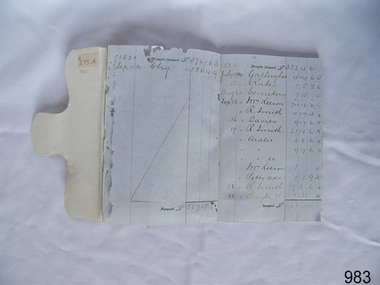
Financial record - Passbook, Bank of Australasia, 1880
... people local to Warrnambool. The book belonged to Thomas Smith and was handed over to his Executors. Thomas Smith operated his Gas Printers Works from Koroit Street, Warrnambool, and was a member of the Odd Fellows. In 1878, his son, aged about 12 years old, was carried across a tightrope forward and backwards, on the shoulders of the "Australian Blondon" Mr. L...people local to Warrnambool. The book belonged to Thomas Smith and was handed over to his Executors. Thomas Smith operated his Gas Printers Works from Koroit Street, Warrnambool, and was a member of the Odd Fellows. In 1878, his son, aged about 12 years old, was carried across a tightrope forward and backwards, on the shoulders of the "Australian Blondon" Mr. L ...This bank passbook originated from the Warrnambool branch of the Bank of Australasia with handwritten entries dating from 1880. Names written in the passbook are likely to be people local to Warrnambool. The book belonged to Thomas Smith and was handed over to his Executors. Thomas Smith operated his Gas Printers Works from Koroit Street, Warrnambool, and was a member of the Odd Fellows. In 1878, his son, aged about 12 years old, was carried across a tightrope forward and backwards, on the shoulders of the "Australian Blondon" Mr. L' Estrange, at a performance in Warrnambool. Royal Charter of England incorporated the Bank of Australasia in March 1834. It had its Australian beginning on 14th December 1835, opening in Sydney. The Acting Superintendent of the bank at that time was David Charters McArthur. He was Superintendent from 1867 to 1876. The Melbourne branch opened on 28th August 1838 in a two-roomed brick cottage on the north side of Little Collins Street, where two huge mastiff dogs were used at night to guard the bank. The government also provided an armed military sentinel. Due to the bank's rapid growth, a new building for the Melbourne branch was opened in 1840 at 75 Collins Street West. By 1879, the bank had been upgraded to a magnificent two-storey building on the corners of Collins and Queens Streets, with the entry on Collins Street. In 1951, the Bank of Australasia amalgamated with the Union Bank to form the Australia and New Zealand Bank, now known as the ANZ. Then in 1970, the ANZ merged with both the ES&A and the London Bank of Australia to form the ANZ Banking Group Limited. The ANZ Banking Group Ltd kindly donated a variety of historic items from the Bank of Australasia. BANK of AUSTRALASIA, WARRNAMBOOL – In 1854, Warrnambool had two banks, the Union Bank and the Bank of Australasia. Later, completely different bank businesses opened; in 1867, the National Bank of Australasia, and then in 1875, the Colonial Bank of Australasia. The original Warrnambool branch of the Bank of Australasia was established in July 1854 and operated from a leased cottage on Merri Street, close to Liebig Street. The bank next bought a stone building previously erected by drapers Cramond & Dickson on the corner of Timor and Gibson Streets. Samuel Hannaford was a teller and then Manager at the Warrnambool branch from 1855 to 1856, and the Warrnambool Council chose that bank for its dealings during 1856-57. In 1859, Roberts & Co. was awarded the contract to build the new Bank of Australasia branch for the sum of £3,000; the firm built the Warrnambool Post Office in 1856 and purchased land in Timor Street in 1858. The land was on a sand hill on the northeast corner of Timor and Kepler Streets and had been bought in 1855 from investor James Cust. The new building opened on May 21, 1860. The bank continued to operate there until 1951, when it merged with the Union Bank to form the ANZ Bank, which continued operating from its Liebig Street building. Warrnambool City Council purchased the former Bank of Australasia building in 1971 and renovated it, then on 3rd December 1973, it was officially opened as the Art Gallery by Cr. Harold Stephenson and Gallery Director John Welsh. The Gallery transferred to the purpose-built building in Liebig Street in 1986, and the old bank building is now the Gallery club. Staff at the Bank of Australasia in Warrnambool included the following men but others were also involved: Samuel Hannaford, Teller then Manager from 1855-1856; Hawkins, Manager in 1856, W H Palmer, Manager from January 1857 until November 1869 when the Teller Basil Spence was promoted to Manager; H B Chomley, Manager from April 1873 and still there in 1886; A Butt, Manager in 1895-1904; J R McCleary Accountant and Acting Manager for 12 months, until 1900; A Kirk, Manager 1904; J Moore, staff until his transfer to Bendigo in December 1908; J S Bath was Manager until 1915; C C Cox, Manager until April 1923; Richard C Stanley, Manager 1923 to April 1928. The bank passbook has significance through its association with the Bank of Australasia. The early Australian bank was established in 1834 by Royal Charter and opened in Sydney, Australia, in Sydney in 1835. The bank had many Australian offices in November 1877, particularly on the east and south coasts. Victoria had 45 per cent of all Offices. The passbook is locally significant for its association with the Warrnambool Bank of Australasia, which was established in 1854. It was Warrnambool Council’s first bank. The bank continued to operate until the organisation's merger in 1951 when it became the ANZ Bank Group today. The Bank was an integral part of the growth of local commerce and the community. It has local significance for its association with commercial Warrnambool in 1880, belonging to Thomas Smith, a prominent businessman with a printing works whose son of about 12 years age crossed a tightrope with the 'Australian Blondin', L' Estrange. Bank passbook, Bank of Australasia, Warrnambool branch. Bound with waxed, cream-coloured cardboard cover and tab closure. Pages have blue horizontal lines and red vertical lines. Black ink handwritten entries, with Date, Name and amount. Inscription was written inside and on a sticker inside the front cover. Passbook is dated 1880 and belonged to Thomas Smith.Marked "The Executors of the late Thomas Smith" "Stamped inside "Bank of Australasia, Warrnambool" Handwritten on sticker " R. 273 A" Sample of handwritten entries include "1880" Callaghan" "Rates" A Linch" "Davies" Bottom of page, balance "529 10 21" [529 pounds 10 shillings 21 pence]flagstaff hill, warrnambool, shipwrecked coast, flagstaff hill maritime museum, maritime museum, shipwreck coast, flagstaff hill maritime village, great ocean road, bank of australasia, boa, union bank, australia & new zealand bank, anz bank, david charters mcarthur, d c mcarthur, bank book, pass book, financial record, commerce, thomas smith, thos. smith, gas printing works, australian blondin, thomas smith's son, tightrope walker, odd fellows, l' estrange, passbook, bank passbook -
 Flagstaff Hill Maritime Museum and Village
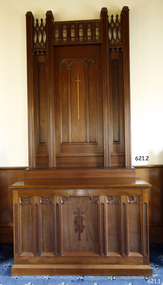
Furniture - Altar and Reredos, Hadwen and Houghton, ca 1944
... people at sea, their dangers and hardships, and their need for physical, financial, spiritual and moral support. Flagstaff Hill Maritime Museum and Village Flagstaff Hill Warrnambool Maritime Museum Maritime Village Shipwreck Coast Great Ocean Road Religion Religious service St Nicholas Seamen’s Church Williamstown Missions to Seamen Victoria altar reredos church furniture religious furniture Miss M Breaks Miss L A Breaks worship service Mrs and Miss J.R. ...This altar and rear reredos were part of the original furnishings of the St Nicholas' Mission to Seamen's Church at 139 Nelson Place, Williamstown, Victoria. The Mission to Seamen organisation operated the Church. The reredos was donated to the Williamstown chapel by Miss. M. Breaks, in memoriam Miss. L.A. Breaks, who served a very active part in the Seamen's Mission, and the altar was donated by Mrs and Miss J R Schutt. THE MISSIONS TO SEAMEN (Brief History): - The Missions to Seamen was an Anglican charity in Great Britain that has served the world's seafarers since 1856. Its symbol is a Flying Angel, inspired by a Bible verse. Today, there are centres in over 200 ports worldwide where seamen of all backgrounds are offered a warm welcome and provided with a wide range of facilities. In Victoria, the organisation began in Williamstown in 1857 as a Sailors’ Church, also known as ‘Bethel’ or the ‘Floating Church’ in an old hulk floating in Hobson’s Bay, Port of Melbourne. It soon became part of the Missions to Seamen, Victoria. In 2000, the organisation, now named Mission to Seafarers, still operated locally in Melbourne, Portland, Geelong and Hastings. The Ladies’ Harbour Lights Guild was formed in 1906 to support the Missions to Seamen in Melbourne and other centres, such as Williamstown. Two of the most significant ladies of the Guild were founder Ethel Augusta Godfrey and foundation member Alice Sibthorpe Tracy (who established a branch of the Guild in Warrnambool in 1920). The Guild continued its work until the 1960s. In 1943, a former Williamstown bank was purchased for the Missions to Seamen Club. The chapel was named St Nicholas’ Seamen’s Church and was supported by the Ladies’ Harbour Lights Guild, the Williamstown Lightkeepers’ Auxiliary and the League of Soldiers’ and Sailors’ Friends. It ceased operation in 1966. A Missions to Seamen Chapel and Recreation Room was a significant feature of ports during the late 1800s and 1900s. It seemed appropriate for Flagstaff Hill to include such a representation within the new Maritime Village, and the Melbourne Board of Management of Missions to Seamen Victoria gave its permission on 21st May 1979 for the entire furnishings of the Williamstown chapel to be transferred to Flagstaff Hill. The St Nicholas Seamen’s Church was officially opened on October 11, 1981, and resembles the Williamstown chapel.This altar and reredos are significant historically for its origin in the St Nicholas Mission to Seamen's Church in Williamstown, established in 1857 to cater for the physical, social, and spiritual needs of seafarers. It originated in Bristol, England when a Seamen's Mission was formed in 1837. They are historically significant for their connection to the Ladies Lightkeepers’ Auxiliary, an organisation of women, formed to support seafarers. The connection of this furniture to the Mission to Seamen and to the Ladies Lightkeepers’ Auxiliary highlights the strong community awareness of the life of people at sea, their dangers and hardships, and their need for physical, financial, spiritual and moral support. Altar and reredos or altar panel, wooden. The timber is panelled, stained and has a varnished finish. The base has a detachable vertical panel with the decoration of a sword and two anchors, the reredos has a cross on a panel. It was made by Hadwen and Houghton, Malvern, Victoria. A plaque at the bottom right edge is marked with the maker's name. The altar is part of the St Nicholas Seamen's Church collection.On removable panel; logo of [sword and two anchors] On bottom right of base: "Hadwen and Houghton, Malvern"flagstaff hill maritime museum and village, flagstaff hill, warrnambool, maritime museum, maritime village, shipwreck coast, great ocean road, religion, religious service, st nicholas seamen’s church, williamstown, missions to seamen victoria, altar, reredos, church furniture, religious furniture, miss m breaks, miss l a breaks, worship service, mrs and miss j.r. schutt -
 Flagstaff Hill Maritime Museum and Village
Nail, circa 1810
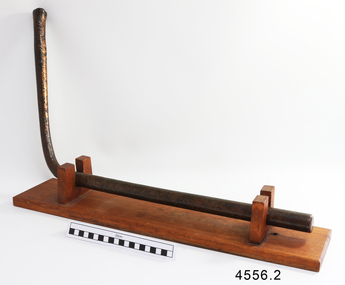
... The incident of the fire on board and the bravery of the convicts in making the gun powder safe is an example of the social character of the people in early Tasmanian colonisation. flagstaff hill warrnambool shipwrecked coast flagstaff hill maritime museum maritime museum shipwreck coast flagstaff hill maritime village great ocean road george iii ship construction ship nail 1835 shipwreck 19th century shipwreck william moxey d'entrecasteaux channel convict transportation copper nail dumpy bolt spike keel nail Copper nail (also called a Dumpy bolt or spike) from the convict ship George III, wrecked in 1835. Nail is long, bent in an ‘L ...This copper nail, sometimes known as a ‘Dumpy Bolt’ or spike, was salvaged from the hull of the wreck of the “George III”. It dates back to at least 1810. It was found by an abalone diver on the south east coast of Tasmania. The nail would have been used to hold the layers of the ship’s keel frame and the planking together. The nail has been passed from the abalone diver to an interested business man on a trip to the south of Hobart, on again to the business man’s close friend who then donated it to Flagstaff Hill Maritime Village. The metal of nails such as this one, after being in the sea for a long time, become affected by the natural reaction of the sea water, causing it to degenerate and thin, and the stress from the force of the sea over the years alters its shape. Iron nails had been used on ships previously, but they quickly corroded in the salt; ships needed regular, costly and time-consuming maintenance to replace the iron nails. Towards the end of the 18th century the British Navy trialled the use of copper nails, finding them to be very successful. Merchant ships began to adopt this process in the early 19th century, although it made ship building very expensive and was more often used for ships such as the “George III” that sailed on long voyages. The three masted sailing ship “George III” was a convict transport ship built in Deptford, England, in 1810. On 14th December 1834 she left Woolwich, England, bound for Hobart Town, Van Diemen’s Land (Tasmania), under Captain William Hall Moxey. She was carrying 220 male convicts plus crew, guards and their families, totalling 294 persons (another 2 were during the voyage). Amongst the cargo were military stores including several copper drums of gun powder. On 27th January 1835 the “George III” was near the Equator, about half way into her journey. A fire broke out and the gun powder was in danger of explosion, threatening the whole ship. Two convicts braved the heat and smoke, entered the store and seized the gun powder drums, suffering burns for their efforts but saving a probable disaster. The fire destroyed some of the provisions and food was scarce. Many became ill with scurvy and some died during the journey. Nearing the end of their journey on 10th April 1835 the “George III” was headed through the D'Entrecasteaux Channel, south east Tasmania, between the mainland and Bruny Island. She was sailing in the moonlit night to hasten her arrival in port due to the great number of sick on board. She struck uncharted rocks, known only to the local whalers, between Actaeon Reef and Southport Lagoon and within hours began to break up. The ship’s boats were used to first rescue the women and children. Firearms were used to help quell the panic of the convicts below decks and some were killed by the shots. Many convicts, including the sick, were drowned. In all, 133 lives were lost including 5 of the crew, guards and their families. It was the third worst shipping disaster in Tasmanian waters. A monument in honour of the prisoners who perished in the “George III” has been erected, noting the date of the wreck as “Friday 10th April 1835.” (NOTE: there are a few differences between sources regarding dates of the shipwreck, some saying March and others April 1835. There are also differences in the figures of those on board and the number of lives lost.) The copper nail is significant as an example of sailing ship construction; fasteners used in the early 19th century on ships carrying convicts to Australia. The nail is also significant for its association with the ship “George III”. The “George III” is registered on the Australian National Shipwreck Database, ID 7195 as an Historic Shipwreck. She is the third worst shipwreck in Tasmanian waters. She is also associated with Early Australian History and the transportation of convicts to Australia. The incident of the fire on board and the bravery of the convicts in making the gun powder safe is an example of the social character of the people in early Tasmanian colonisation. Copper nail (also called a Dumpy bolt or spike) from the convict ship George III, wrecked in 1835. Nail is long, bent in an ‘L’ shape about 3/5ths along, tapering from both ends to the bend. Both ends are flat and do not taper to a point, nor have a thread. The shorter end has been polished, showing bright copper. There is pitting along the nail and virdigris is evident on the longer, unpolished end. The nail is displayed with the longer section resting on a wooden board between two ‘U’ shaped uprights, the shorter section upright. flagstaff hill, warrnambool, shipwrecked coast, flagstaff hill maritime museum, maritime museum, shipwreck coast, flagstaff hill maritime village, great ocean road, george iii, ship construction, ship nail, 1835 shipwreck, 19th century shipwreck, william moxey, d'entrecasteaux channel, convict transportation, copper nail, dumpy bolt, spike, keel nail -
 Federation University Historical Collection
Photograph, Noel L. Harvey & Son, Official Opening of the University of Ballarat Mt Helen Campus, 31/10/1970
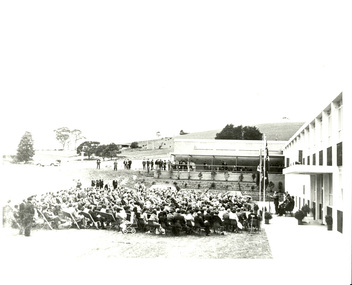
... people seated watching a man give a speech in front of a new building. The man is The Hon. Nigel Bowen, Q.C., M.P., Commonwealth Minister for Education and Science. The building is the first building at the Mt Helen Campus of the University of Ballarat. the bluestone retaining wall used bluestone retrieved after the demolition of the Yendon Railway Station. 26.0 x 26.0 cm Official Opening of the University of Ballarat Mt Helen Campus Photograph Noel L. ...The first building completed at the Mt Helen Campus was "G" Building, and is depicted in this photograph. An overview of the development of the Ballarat Institute of advanced Education (BIAE) is given on the program of the official opening of Mt Helen campus (Cat. No. 1086)Black and white photographs showing the opening ceremony for the University of Ballarat Mount Helen Campus. .1) The audience at the opening of the University of Ballarat Mount Helen campus. The pile of bluestone in the background is most probably bluestone from the Yendon Railway Station. .4) Nigel Bowen, at the microphone stands in front of a new building, with a seated audience in front of him. The bluestone retaining wall was erected from bluestone retrieved from the newly demolished Yendon Railway Station. The Ballarat Brass Band is seated undercover in the background. .6) A number of people seated watching a man give a speech in front of a new building. The man is The Hon. Nigel Bowen, Q.C., M.P., Commonwealth Minister for Education and Science. The building is the first building at the Mt Helen Campus of the University of Ballarat. the bluestone retaining wall used bluestone retrieved after the demolition of the Yendon Railway Station. 26.0 x 26.0 cm.1-3) verso "Tippett" Photographers stampuniversity of ballarat, ballarat college of advanced education, yendon, yendon railway station, mb john, jack barker, nigel bowen, rolly perfenovics, mount helen campus, ballarat brass band, bluestone, garden -
Federation University Historical Collection
report, Assessment of Evidence for the Presence in Victoria of a Wild Population of 'Big Cats', 08/2012
... people have reported sighting of big cats in the Victorian bush. This report assessed the evidence. Australian Animal Folklore Collection big cats cat ferral cats cryptozoology 22 page report by the Arthur Rylah Institute on whether their are big cats loose in the Victorian bush. Ir asks questions such as if 'big cats' exist in Victoria what species they would be; the veracity of available evidence; Deakin Puma Study Group; Kurt Engel cat; Winchelsea faecal sample Carrie Magnik Assessment of Evidence for the Presence in Victoria of a Wild Population of 'Big Cats' report P.W. Menkhorst L ...For over 100 years people have reported sighting of big cats in the Victorian bush. This report assessed the evidence.22 page report by the Arthur Rylah Institute on whether their are big cats loose in the Victorian bush. Ir asks questions such as if 'big cats' exist in Victoria what species they would be; the veracity of available evidence; Deakin Puma Study Group; Kurt Engel cat; Winchelsea faecal sample Carrie Magnik australian animal folklore collection, big cats, cat, ferral cats, cryptozoology -
 Federation University Historical Collection
Booklet, The Ballarat School of Mines and Industries 1870-1920 Jubilee Booklet, 1920 (estimated)
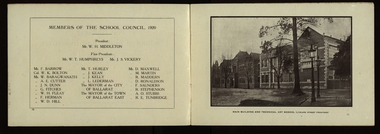
... people were members of the School Council: W.H. Middleton (President), W.T. Humphreys (VP), J.S. Vickery (VP), F. Barrow, Col. W.K. Bolton, William Baragwanath, A.E. Cutter, J.N. Dunn, G. Fitches, W.H. Fleay, F. Herman. W.D. Hill, T. Hurley, K. Kean. J. Kelly, L...people were members of the School Council: W.H. Middleton (President), W.T. Humphreys (VP), J.S. Vickery (VP), F. Barrow, Col. W.K. Bolton, William Baragwanath, A.E. Cutter, J.N. Dunn, G. Fitches, W.H. Fleay, F. Herman. W.D. Hill, T. Hurley, K. Kean. J. Kelly, L ...The first school of Mines in Australia was established at Ballarat in 1870. At the time of its jubilee (1930) the following people were members of the School Council: W.H. Middleton (President), W.T. Humphreys (VP), J.S. Vickery (VP), F. Barrow, Col. W.K. Bolton, William Baragwanath, A.E. Cutter, J.N. Dunn, G. Fitches, W.H. Fleay, F. Herman. W.D. Hill, T. Hurley, K. Kean. J. Kelly, L. Lederman, Mayor of Ballarat, Mayour of Ballarat East, D. Maxwell, M. Martin, R. Maddern, D. Ronaldson, F. Saunders, R. Stephenson, A.O. Stubbs, R.E. Tunbridge. The School Staff in 1920 comprised: Herbert H. Smith, Walter Rowbotham, Reginald L. Cutter, M.C. Young, Hilda Wardle, M. Wiliamson, P.S. Richards, L.H. Archibald, J. Woods, Ken Moss, W. Kenneth, Mrs McIlvena. B. Robinson, S. Rowe, E. Hope-Jones, Miss Abrams, L.St.G.P. Austin, Alfred Mica Smith, J.R. Pound, Herbert R. Murphy, N.H. Junner, Maurice Copland, L.H. Archibald, E.J.A. McConnon, Newton King, D.m. Hull, T.R. Gordon, John M. Sutherland, T.K. Jebb, Dick Richards, C. Tonkin, A.W. Steane, J. Paterson, H.W. Malin, R.V. Maddison, S.M. Mayo, F.A. King, W.H. Steane, T.R. Gordon, T.A. Williams, H. Waldron, G. Black, E.J. McConnon, R.V. Duncan. R. Cutter, E.G. Vawdrey, Hilda WardleWhite stapled booklet - landscape format - 20pp + soft covers with blue writing. Includes an historical sketch of the Ballarat School of Mines. Contains images of the school from around 1920. The history outlined in the booklet follows: 'Ballarat has helped to influence the life and destinies of Australia in many ways, the recital of which would perhaps prove tedious to the citizens of less favoured localities! However, it can be said, without much fear of contradiction, that only less known thought Australia than its fame as a gold field is the reputation won for it by its school of Mines, ... Ballarat was still quite a new place when the School was founded, but a very propserous and popular place all the same, with a go-ahead lot of citizens brim full of the spirit of enterprise which seemsto animate mining populations generally. Money was plentiful, and they launched out into ventures, which later, were to develop and take the place of the gold mines, while what is more to the point, they understood the value of education. the old digging days were passing away. So far as Ballarat itself was concerned the day of the cradle and tin dish had already passed into an antiquity "as dead and distant as the age of the Tubal Caon," said dir redmond Barry on declaring the School open. Mining had become a serious business, and the mining engineer, the metallurgist, and the geologist had become a power in the land. In these circumstances the suggestions to found a School of Mines met with ready acceptance. The late Mr James M. Bickett had the honor of bringing forward the proposition at a meeting of the Ballarat Mining Board in October, 1869. it was agreed to, and the Government, having been approached for assistance, granted a lease of the old Supreme Court buildings at a nominal reantal. A modest sum, including 100 pounds from the Borough Council of Ballarat West, was subscribed by a number of sympathisers, and on the 26th October, 1870, the inaugural address was delivered by Sir Redmond Barry, the first President of the School. Classes were commenced on the 23rd January, 1871. The students at first were mostly adults. They were chiefly men emloyed at the mines, who had the wisdom and energy to devote their spare time to study, and, though their attendance was somewhat irregular, they made very good progress. Old prints which have been preserved show them at work at furnaces, big bearded men of the old-fashioned type of miner. It is interesting to note that among those who gave evidence and encouragement was Sir Roderick Murchison, who many years before had advised Cornish miners to emigrate to Australia to search for gold, and who in 1848 was in possession of gold ore sent from this country. Sir Roderick sent a parcel of books for the library, and gave useful advice as to the curriculum which should be adopted. The Museum, which now contains a most valuable collection of minerals, was one of the first things attended to, and the reports presented to the Council from time to time speak of additions being made from all parts of the world. New equipment was constantly being added to the School, a good deal of assay work was done, and some specimens were sent from the East Indies for examination as far back as 1873. By this time there was a difficulty in providing accomodation for the students who wished to enrol, and the number of instructors had grown from two to four. In 1882 the first building was being erected on what was then part of the gaol reserve. A little more than ten years afterwards a buildnig formerly serving as a Methodist Church was absorbed, while later on, the demand for accomodation increasing, the attack upon the gaol was renewed. The School continued to grow in reputation and size, and became the science centre of the district, and in 1889 a learge new building was opened by Sir Alexander Peacock. Students came from over seas as well as from all the States of Australia, and after going through their courses they took with them the name and fame of the old School to all parts of the globe. School of Mines boys have played a great part in developing the mining fields of Western Australia, South Australia, and africa, while old students who have made a name in their profession are constantly dropping in to see how the old place is getting along. It was not to be expected, however, that the Ballarat School would be left without rivals, its very success inspiring competition. Mining Schools were started in other parts of Australia, and, at the same time, Victoria ceased to hold first place as a mining state. On the other hand there was a great advance in manufacturing, and the demand for technicaly trained men became a great and as insistent as ever it had been for trained mining men. The Council was quick to adapt the school to the new conditions, and the result is seen in the institution, which is one of Ballarat's proudest possession. Instruction is given in all branches of technical work, and the classes are filled with students who are building up for Ballarat a reputation as an industrial centre, which promises to equal that which it formerly held as a mining town. Owing to its bracing climate, its abundant opportunities for recreations, and its accessibilty, Ballarat as a city is an ideal place for educational purposed, and is yearly becoming more and more appreciated throughout the State. The chairman of one of Ballarat's biggests industries claims that the workman can do twice the day's work here that he can do in Melbourne. he was a little enthusiastic over it, perhaps, but it is a well-known fact that the healthy and invigourating Ballarat climate is conducive to both physical and mental activity, and the records of the School provide ample proof of it. One of the most interesting and successful branches of the School of Mines and Industries - if the name be enlarged with the enlargement of its scope - is the Technical Art School. "The City of Statues" has from its earliest days been a stronghold of art. Art schools have flourised here, and in 1905 the Education Department came to the conclusion that the best thing to do with them was to place them under the management of the School of Mines Council. A magnificent new Technical Art School was built at a cost of some 12,000 pounds on the site of the old Supreme Court building, and was formally opened on the 23rd July, 1915. The results have not only been justified but surpassed all anticipations. The most comprehensive list of subjects is taught, and this list is constantly added to. Students have flocked to the art School, which may be said to occupy a unique position in Australia, and its record of success is really astonishing. Its students supply art teachers for the newer schools that are being built, and many occupy leading positinos in important business houses. So well is its reputation known that orders are constantly being received, not only from Victoria, but from other States, for honor boards and challenge shields to be designed and made. The most recent addition to the School of Mines and Industries is the Junior Technical School, for which a new building is now being erected on a portion of the gaol site, transferred to the School of Mines Counci by the Government. At the present moment temporary quarters are being occupied. Some students after passing through the Junior School go straight to employment, continuing perhaps to attend the evening trade classes, while others move on to the senior School. In a review of the work of the School of Mines mention must be made of a series of industrial research carried out under supervision of the Principal. One in particular, regarding the suitability of the local ores for the manufacture of pigments attracted much attention, while the experiemtns on the manufacture of white potery from Victorian clayes were considered of sufficient importance by the Federal Advisory Council of Science and Industry to warrant the appointment of a special investigator. The results of these have been most encouraging, and may have far-reaching consequences. The vocational training of returned soldiers also should not be overlooked. The work was taken in hand from the first, before the Repatriation Department gave assistance, and now with the help of the department of the School has become one of the largest vocational training centres in Victoria outside of Melbourne. The soldiers, trained in a variety of occupations, have made remarkable progress, and already considerable numbers have found employment in local workshops and factories. To sum up, the School is divided into the following departments, each well staffed and equipped: - The School of Mines, science, and Engineering; the Techncial Art School, the Boys' Junior Technical School, the Girl's Preparatory Technical Classes, Trade Classes, and the Commercial School. The school of Mines, science and Engineering, comprises the following branches: - Mining, Metallurgy, Geology, Electrical Engineering, Civil Engineering, Mechanical Engineering, Applied Chemistry, and Pharmacy. Battery treatments, Cyanide Testing, Smelting, Assays, and Clay Testing from a regular part of the School's work. Students gaining qualifications obtain concession in their courses at the university, should they proceed there to continue their studies. The technical Art school curriculum includes training in all branches of pictorial and applied art, an Architectural Diploma Course, a Draughtman's Course, technical Art teachers' Course, Photography,Ticket Writing, Art Metal Work, Woodcarving, Needlework, and Leather work. The Trade Classes give instruction in Telephone Mechanics, telegraphy, Carpentry, Cabinet Making, Plumbing, Blacksmithing, Fitting, Electric Wiring, and Printing. Numerous Scholarships are offered every year, and altogether students will find few places to equal the Ballarat School of Mines and Industries as a training place for their life's work. One of the first in the continent to be established, its Jubilee finds it still in the front rank, keeping pace with the times, and offering to the youths of this country the means of taking advantage of Australia's teeming opportunities. william, battery, smith, herbert, drawing from the antique, ballarat school of mines botanical gardens, ballarat school of mines, redmond barry, alfred mica smith, james bickett, museum, dick richards, ballarat junior technical school, s m b, ballarat school of mines and industries, ballarat technical art school, model mine, james m bickett, j m bickett, roderick murchison, vocational training rooms, wesley church, methodist church, alexander peacock, lathes, repatriation, repatriatin department, war service, school council, baragwanath, gold mining, mining laboratory, plaster cast, r.w. richards, anniversary, jubilee -
 Federation University Historical Collection
Print - Image, Lucas van Leyden, The Dentist
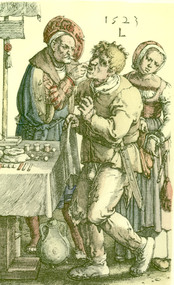
... The patient is being pick-pocketed by the dentist's assisstant. dentist medicine teeth tooth-puller 1523 L in the top right corner An oval framed print depicting three people, one of them a dentist. ...Depicts the scene of a professional dentist and gullible patient. The patient is being pick-pocketed by the dentist's assisstant.An oval framed print depicting three people, one of them a dentist.1523 L in the top right cornerdentist, medicine, teeth, tooth-puller -
 Mission to Seafarers Victoria
Photograph - Framed montage, Arthouse - Picture Framing & Gallery, Noli Me Tangere, 2013
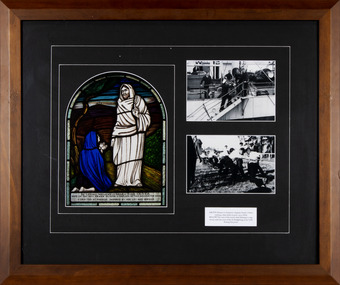
... This exhibition presents a selection of stained glass windows and historical photographs from the Mission, to capture a glimpse of some of the people and scenes integrale to this relationship. reflections of the sea georgia melville exhibition 2013 world trade centre wtc creative victoria prov mission to seafarers stained glass windows justine m. philip moira bird oliver moira bird oliver (nee good) padre frank leslie oliver picnic tug-of-war flinders street catherine mclay arthouse on label: ABOVE: Mission to Seafarers' chaplain Frank L Oliver, visiting a ship whilst in port, c1950s BELOW: The crew of the motor ship Nyhaugin a tug-of-war with the crew of the SS Madgeburg at the 1926 Boxing Day picnic Framed and mounted on black cardboard of black and white and colour reproductions from the MTSV collection for the exhibition Reflections of the Sea with brief label signage Noli Me Tangere Photograph Framed montage Arthouse - Picture Framing & Gallery Justine M.Philip Daniel Climent ...A GLOBAL PERSPECTIVE Before the increase of air transport, everything that arrived or departed from Australia did so via the ports and wharves. The Mission to Seafarersis not a Victorian initiative, but rather a global network that currently operates in over 260 ports worldwide, assisting over 1.3 million seafaring men and women each year. The importance of the Mission’s role is demonstrated in the Chaplain’s Report 1947, which notes that ships and their crews are: “...inextricably linked with the well-being of Australian industrial and economic life... This, in turn, means that you cannot escape some share in responsibility for their welfare.” This window, titled ‘Noli Me Tangere’, was installed in memoriam of Moira Oliver, the wife of the Reverend Frank Oliver, chaplain at the Mission 1930-60, and whose dedication in life and service to the welfare of seafarers was inspirational to many.Reflections of the Sea was an exhibition of 10 framed montage of photographs from the mission's archive collection showcasing 10 stained glass windows from the St Peter chapel. This exhibition curated by Georgia Melville and Catherine McLay, and funded by PROV and Creative Victoria, was displayed in the World Trade Centre Wharf Gallery in June July 2013 and toured to Queenscliff Maritime Museum. The photographs of the windows were taken by scientific photographer Justine M. Philip. This frame is showcasing the memorial window to Moira Bird Oliver, wife of Padre Oliver , a photograph of Padre Oliver listing a ship and a photograph of sailors playing tug-of-war during a picnic.Framed and mounted on black cardboard of black and white and colour reproductions from the MTSV collection for the exhibition Reflections of the Sea with brief label signageon label: ABOVE: Mission to Seafarers' chaplain Frank L Oliver, visiting a ship whilst in port, c1950s BELOW: The crew of the motor ship Nyhaugin a tug-of-war with the crew of the SS Madgeburg at the 1926 Boxing Day picnicreflections of the sea, georgia melville, exhibition, 2013, world trade centre, wtc, creative victoria, prov, mission to seafarers, stained glass windows, justine m. philip, moira bird oliver, moira bird oliver (nee good), padre frank leslie oliver, picnic, tug-of-war, flinders street, catherine mclay, arthouse -
Federation University Historical Collection
Document - Report, Report to the Council of the University of Ballarat on the Disability Action Plan Report Incorporating the Policy on Inclusion of People with Disabilities for endorsement by Council, 1999, 1999
... L...University of ballarat policy on inclusion of people with disabilities...Report to the Council of the University of Ballarat on the Disability Action Plan Report Incorporating the Policy on Inclusion of People with Disabilities for endorsement by Council, 1999 Document Report Susanne White and Jenny Shaw - The resolutions Group P/L ...bility Action Plans was set out in the Commonwealth Disability Discrimination Act (1992) The Chair of the University of Ballarat Disability Action Plan was Professor Philip Candy..1) 12 page report relating to the University of Ballarat Disability Action Plan Project. .2) Memorandum concerning the Disability Action Plan .3) 5 page University of Ballarat Policy on Inclusion of People with Disabilities (Draft) July 1999. .4) 25 page document concerning Implementation of the University of Ballarat Policy on Inclusion of People with Disabilities (Draft 7).disability action plan, commonwealth disability discrimination act, university of ballarat, susanne white, jenny shaw, the resolutions group p/l, university of ballarat policy on inclusion of people with disabilities, disability, impairment, handicap, equal opportunity, phil candy, philip candy -
Federation University Historical Collection
Booklet, The Ballarat School of Mines and Industries 1870-1920 Jubilee Booklet, 1920 (estimated)
... people were members of the School Council: W.H. Middleton (President), W.T. Humphreys (VP), J.S. Vickery (VP), F. Barrow, Col. W.K. Bolton, William Baragwanath, A.E. Cutter, J.N. Dunn, G. Fitches, W.H. Fleay, F. Herman. W.D. Hill, T. Hurley, K. Kean. J. Kelly, L...people were members of the School Council: W.H. Middleton (President), W.T. Humphreys (VP), J.S. Vickery (VP), F. Barrow, Col. W.K. Bolton, William Baragwanath, A.E. Cutter, J.N. Dunn, G. Fitches, W.H. Fleay, F. Herman. W.D. Hill, T. Hurley, K. Kean. J. Kelly, L ...The first school of Mines in Australia was established at Ballarat in 1870. At the time of its jubilee (1930) the following people were members of the School Council: W.H. Middleton (President), W.T. Humphreys (VP), J.S. Vickery (VP), F. Barrow, Col. W.K. Bolton, William Baragwanath, A.E. Cutter, J.N. Dunn, G. Fitches, W.H. Fleay, F. Herman. W.D. Hill, T. Hurley, K. Kean. J. Kelly, L. Lederman, Mayor of Ballarat, Mayour of Ballarat East, D. Maxwell, M. Martin, R. Maddern, D. Ronaldson, F. Saunders, R. Stephenson, A.O. Stubbs, R.E. Tunbridge. The School Staff in 1920 comprised: Herbert H. Smith, Walter Rowbotham, Reginald L. Cutter, M.C. Young, Hilda Wardle, M. Wiliamson, P.S. Richards, L.H. Archibald, J. Woods, Ken Moss, W. Kenneth, Mrs McIlvena. B. Robinson, S. Rowe, E. Hope-Jones, Miss Abrams, L.St.G.P. Austin, Alfred Mica Smith, J.R. Pound, Herbert R. Murphy, N.H. Junner, Maurice Copland, L.H. Archibald, E.J.A. McConnon, Newton King, D.m. Hull, T.R. Gordon, John M. Sutherland, T.K. Jebb, Dick Richards, C. Tonkin, A.W. Steane, J. Paterson, H.W. Malin, R.V. Maddison, S.M. Mayo, F.A. King, W.H. Steane, T.R. Gordon, T.A. Williams, H. Waldron, G. Black, E.J. McConnon, R.V. Duncan. R. Cutter, E.G. Vawdrey, Hilda WardleWhite stapled booklet - landscape format - 20pp + soft covers with blue writing. Includes an historical sketch of the Ballarat School of Mines. Contains images of the school from around 1920. The history outlined in the booklet follows: 'Ballarat has helped to influence the life and destinies of Australia in many ways, the recital of which would perhaps prove tedious to the citizens of less favoured localities! However, it can be said, without much fear of contradiction, that only less known thought Australia than its fame as a gold field is the reputation won for it by its school of Mines, ... Ballarat was still quite a new place when the School was founded, but a very propserous and popular place all the same, with a go-ahead lot of citizens brim full of the spirit of enterprise which seemsto animate mining populations generally. Money was plentiful, and they launched out into ventures, which later, were to develop and take the place of the gold mines, while what is more to the point, they understood the value of education. the old digging days were passing away. So far as Ballarat itself was concerned the day of the cradle and tin dish had already passed into an antiquity "as dead and distant as the age of the Tubal Caon," said dir redmond Barry on declaring the School open. Mining had become a serious business, and the mining engineer, the metallurgist, and the geologist had become a power in the land. In these circumstances the suggestions to found a School of Mines met with ready acceptance. The late Mr James M. Bickett had the honor of bringing forward the proposition at a meeting of the Ballarat Mining Board in October, 1869. it was agreed to, and the Government, having been approached for assistance, granted a lease of the old Supreme Court buildings at a nominal reantal. A modest sum, including 100 pounds from the Borough Council of Ballarat West, was subscribed by a number of sympathisers, and on the 26th October, 1870, the inaugural address was delivered by Sir Redmond Barry, the first President of the School. Classes were commenced on the 23rd January, 1871. The students at first were mostly adults. They were chiefly men emloyed at the mines, who had the wisdom and energy to devote their spare time to study, and, though their attendance was somewhat irregular, they made very good progress. Old prints which have been preserved show them at work at furnaces, big bearded men of the old-fashioned type of miner. It is interesting to note that among those who gave evidence and encouragement was Sir Roderick Murchison, who many years before had advised Cornish miners to emigrate to Australia to search for gold, and who in 1848 was in possession of gold ore sent from this country. Sir Roderick sent a parcel of books for the library, and gave useful advice as to the curriculum which should be adopted. The Museum, which now contains a most valuable collection of minerals, was one of the first things attended to, and the reports presented to the Council from time to time speak of additions being made from all parts of the world. New equipment was constantly being added to the School, a good deal of assay work was done, and some specimens were sent from the East Indies for examination as far back as 1873. By this time there was a difficulty in providing accomodation for the students who wished to enrol, and the number of instructors had grown from two to four. In 1882 the first building was being erected on what was then part of the gaol reserve. A little more than ten years afterwards a buildnig formerly serving as a Methodist Church was absorbed, while later on, the demand for accomodation increasing, the attack upon the gaol was renewed. The School continued to grow in reputation and size, and became the science centre of the district, and in 1889 a learge new building was opened by Sir Alexander Peacock. Students came from over seas as well as from all the States of Australia, and after going through their courses they took with them the name and fame of the old School to all parts of the globe. School of Mines boys have played a great part in developing the mining fields of Western Australia, South Australia, and africa, while old students who have made a name in their profession are constantly dropping in to see how the old place is getting along. It was not to be expected, however, that the Ballarat School would be left without rivals, its very success inspiring competition. Mining Schools were started in other parts of Australia, and, at the same time, Victoria ceased to hold first place as a mining state. On the other hand there was a great advance in manufacturing, and the demand for technicaly trained men became a great and as insistent as ever it had been for trained mining men. The Council was quick to adapt the school to the new conditions, and the result is seen in the institution, which is one of Ballarat's proudest possession. Instruction is given in all branches of technical work, and the classes are filled with students who are building up for Ballarat a reputation as an industrial centre, which promises to equal that which it formerly held as a mining town. Owing to its bracing climate, its abundant opportunities for recreations, and its accessibilty, Ballarat as a city is an ideal place for educational purposed, and is yearly becoming more and more appreciated throughout the State. The chairman of one of Ballarat's biggests industries claims that the workman can do twice the day's work here that he can do in Melbourne. he was a little enthusiastic over it, perhaps, but it is a well-known fact that the healthy and invigourating Ballarat climate is conducive to both physical and mental activity, and the records of the School provide ample proof of it. One of the most interesting and successful branches of the School of Mines and Industries - if the name be enlarged with the enlargement of its scope - is the Technical Art School. "The City of Statues" has from its earliest days been a stronghold of art. Art schools have flourised here, and in 1905 the Education Department came to the conclusion that the best thing to do with them was to place them under the management of the School of Mines Council. A magnificent new Technical Art School was built at a cost of some 12,000 pounds on the site of the old Supreme Court building, and was formally opened on the 23rd July, 1915. The results have not only been justified but surpassed all anticipations. The most comprehensive list of subjects is taught, and this list is constantly added to. Students have flocked to the art School, which may be said to occupy a unique position in Australia, and its record of success is really astonishing. Its students supply art teachers for the newer schools that are being built, and many occupy leading positinos in important business houses. So well is its reputation known that orders are constantly being received, not only from Victoria, but from other States, for honor boards and challenge shields to be designed and made. The most recent addition to the School of Mines and Industries is the Junior Technical School, for which a new building is now being erected on a portion of the gaol site, transferred to the School of Mines Counci by the Government. At the present moment temporary quarters are being occupied. Some students after passing through the Junior School go straight to employment, continuing perhaps to attend the evening trade classes, while others move on to the senior School. In a review of the work of the School of Mines mention must be made of a series of industrial research carried out under supervision of the Principal. One in particular, regarding the suitability of the local ores for the manufacture of pigments attracted much attention, while the experiemtns on the manufacture of white potery from Victorian clayes were considered of sufficient importance by the Federal Advisory Council of Science and Industry to warrant the appointment of a special investigator. The results of these have been most encouraging, and may have far-reaching consequences. The vocational training of returned soldiers also should not be overlooked. The work was taken in hand from the first, before the Repatriation Department gave assistance, and now with the help of the department of the School has become one of the largest vocational training centres in Victoria outside of Melbourne. The soldiers, trained in a variety of occupations, have made remarkable progress, and already considerable numbers have found employment in local workshops and factories. To sum up, the School is divided into the following departments, each well staffed and equipped: - The School of Mines, science, and Engineering; the Techncial Art School, the Boys' Junior Technical School, the Girl's Preparatory Technical Classes, Trade Classes, and the Commercial School. The school of Mines, science and Engineering, comprises the following branches: - Mining, Metallurgy, Geology, Electrical Engineering, Civil Engineering, Mechanical Engineering, Applied Chemistry, and Pharmacy. Battery treatments, Cyanide Testing, Smelting, Assays, and Clay Testing from a regular part of the School's work. Students gaining qualifications obtain concession in their courses at the university, should they proceed there to continue their studies. The technical Art school curriculum includes training in all branches of pictorial and applied art, an Architectural Diploma Course, a Draughtman's Course, technical Art teachers' Course, Photography,Ticket Writing, Art Metal Work, Woodcarving, Needlework, and Leather work. The Trade Classes give instruction in Telephone Mechanics, telegraphy, Carpentry, Cabinet Making, Plumbing, Blacksmithing, Fitting, Electric Wiring, and Printing. Numerous Scholarships are offered every year, and altogether students will find few places to equal the Ballarat School of Mines and Industries as a training place for their life's work. One of the first in the continent to be established, its Jubilee finds it still in the front rank, keeping pace with the times, and offering to the youths of this country the means of taking advantage of Australia's teeming opportunities. william, battery, smith, herbert, drawing from the antique, ballarat school of mines botanical gardens, ballarat school of mines, redmond barry, alfred mica smith, james bickett, museum, dick richards, ballarat junior technical school, s m b, ballarat school of mines and industries, ballarat technical art school, model mine, james m bickett, j m bickett, roderick murchison, vocational training rooms, wesley church, methodist church, alexander peacock, lathes, repatriation, repatriatin department, war service, school council, baragwanath, gold mining, mining laboratory, plaster cast, r.w. richards, anniversary, jubilee -
 Federation University Historical Collection
Book - Book - Handbook of Readings, VIOSH: BCAE; Graduate Diploma in Occupational Hazard Management - Readings in Risk Philosophy compiled by Derek Viner, 1985
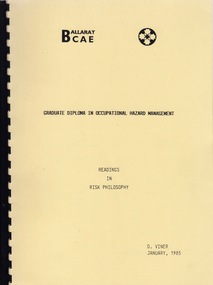
... people into the Graduate Diploma of Occupational Hazard Management who have no undergraduate degree - on the basis of extensive work experience and knowledge. The handbook provides students with the reading resources appropriate for aspects of Risk Philosophy. Articles are from a wide range of resources and by a number of authors in the field. The collection of articles was compiled by Derek Viner, January 1985. viosh victorian institute of occupational safety and health derek viner risk philosophy graduate diploma of occupational hazard management d l ...Victorian Institute of Occupational Safety and Health (VIOSH) Australia is the Asia-Pacific centre for teaching and research in occupational health and safety (OHS) and is known as one of Australia's leaders on the field. VIOSH has a global reputation for its innovative approach within the field of OHS management. VIOSH had its first intake of students in 1979. At that time the Institution was known as the Ballarat College of Advanced Education. In 1990 it became known as Ballarat University College, then in 1994 as University of Ballarat. It was 2014 that it became Federation University. VIOSH Australia students are safety managers, senior advisors and experienced OHS professionals. They come from all over Australia and industry. Students are taught active research and enquiry; rather than textbook learning and a one-size fits all approach. VIOSH accepts people into the Graduate Diploma of Occupational Hazard Management who have no undergraduate degree - on the basis of extensive work experience and knowledge. The handbook provides students with the reading resources appropriate for aspects of Risk Philosophy. Articles are from a wide range of resources and by a number of authors in the field. The collection of articles was compiled by Derek Viner, January 1985.Spiral bound (black) A4 size booklet. Cream cover and dividers between each article.viosh, victorian institute of occupational safety and health, derek viner, risk philosophy, graduate diploma of occupational hazard management, d l bazelon, dr irving lerch, trevor a kletz, a bicevski, w d rowe, w t fine, g f kinney, a d wiruth, p slovic, r gillespie, baruch fischhoff, sarah lichtenstein -
 Federation University Historical Collection
Document - Document - Program, VIOSH: Victorian Industrial Safety Convention, August 1979
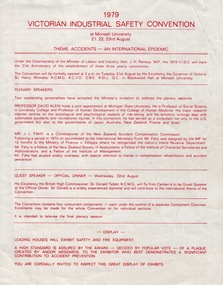
... VIOSH accepts people into the Graduate Diploma of Occupational Hazard Management who have no undergraduate degree - on the basis of extensive work experience and knowledge. The Victorian Industrial Safety Convention was held over three days at Monash University - 21,22,23 August 1979. It was opened by the Governor of Victoria Sir Henry Winneke. Speakers included - J L...VIOSH accepts people into the Graduate Diploma of Occupational Hazard Management who have no undergraduate degree - on the basis of extensive work experience and knowledge. The Victorian Industrial Safety Convention was held over three days at Monash University - 21,22,23 August 1979. It was opened by the Governor of Victoria Sir Henry Winneke. Speakers included - J L ...Victorian Institute of Occupational Safety and Health (VIOSH) Australia is the Asia-Pacific centre for teaching and research in occupational health and safety (OHS) and is known as one of Australia's leaders on the field. VIOSH has a global reputation for its innovative approach within the field of OHS management. VIOSH had its first intake of students in 1979. At that time the Institution was known as the Ballarat College of Advanced Education. In 1990 it became known as Ballarat University College, then in 1994 as University of Ballarat. It was 2014 that it became Federation University. VIOSH Australia students are safety managers, senior advisors and experienced OHS professionals. They come from all over Australia and industry. Students are taught active research and enquiry; rather than textbook learning and a one-size fits all approach. VIOSH accepts people into the Graduate Diploma of Occupational Hazard Management who have no undergraduate degree - on the basis of extensive work experience and knowledge. The Victorian Industrial Safety Convention was held over three days at Monash University - 21,22,23 August 1979. It was opened by the Governor of Victoria Sir Henry Winneke. Speakers included - J L Fahy, Commissioner of the New Zealand Accident Compensation Commissionand and Professor David Klein from Michigan State University. Derek Woolley and Derek Viner (Engineering) plus J W Snow (Statistics and Mathematical Modelling) from Ballarat College of Advanced Education were among the speakers.Gloss paper with red writing. Section has been cut off - possibly a return slip indicating attendance at the convention.Dates and times for sessions plus speakersviosh, victorian institute of occupational safety and health, victorian industrial safety convention, governor of victoria, sir henry winneke, jl fahy, commissioner accident compensation commission, new zealand, professor david klein, michigan state university, derek woolley, derek viner, ballarat college of advanced education, eric wigglesworth, royal australian college of surgeons -
 Marysville & District Historical Society
Book - Paperback book, Donnelly's Creek-From rush to ruin of a Gippsland Mountain Goldfield, 1990
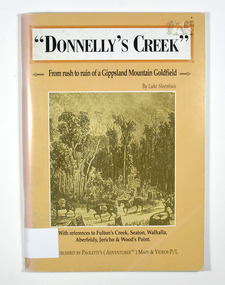
... There are three people viewing the ruins.The captions accompanying the photographs are: History revisited - O'Sullivans Old Toombon Hotel Recreated and Remnants of a Bygone Mining Era. Donnelly's Creek-From rush to ruin of a Gippsland Mountain Goldfield Book Paperback book Luke Steenhuis Paoletti's Maps & Video's P/L ...A history of the Donnelly's Creek gold mine in VictoriaPaperback. Front cover has a drawing depicting two horses carrying packs followed by a man mounted on a horse. There is also two men on foot following with packs and walking poles. They are walking along a forest track that has some tree stumps alongside it.The back cover has two colour photographs. The top one is of an old wooden building with what appears to be an attached lean to. Both of the buildings have stone chimneys. There is a group of people sitting and standing outside the main building. The bottom photograph appears to be the ruins of a building and a fence. There are three people viewing the ruins.The captions accompanying the photographs are: History revisited - O'Sullivans Old Toombon Hotel Recreated and Remnants of a Bygone Mining Era.Stamp of the Marysville & District Historical Society Inc / P O Box 22 / Marysville 3779gold, gold miner, gold mining, gold field, gippsland, victoria, australia, history, fulton's creek, seaton, walhalla, aberfeldy, jericho, wood's point -
 Marysville & District Historical Society
Book, IPC Books Pty Limited, Australia-The First Hundred Years-Being a facsimile of Volumes I & II of the Picturesque Atlas of Australia-1888, 1886
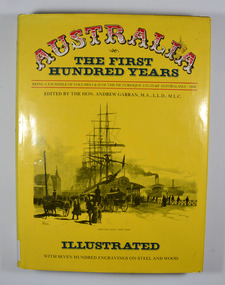
... The Picturesque Atlas was designed to give a graphic and summarised conception of Australasian history and life from the days of the earliest Portuguese, Spanish, Dutch, English and French navigators to the 1880's, embracing such salient events as the landing of Captain Cook in 1770. the discoveries of voyagers, explorers an pioneer missionaries; the founding of the different colonies; the establishment of representative government and the marvellous political, commercial and social development which characterises the people of Australia. history australia explorers voyagers missionaries politics commercial development social development The Picturesque Atlas was designed to give a graphic and summarised conception of Australasian history and life from the days of the earliest Portuguese, Spanish, Dutch, English and French navigators to the 1880's, embracing such salient events as the landing of Captain Cook in 1770. the discoveries of voyagers, explorers an pioneer missionaries; the founding of the different colonies; the establishment of representative government and the marvellous political, commercial and social development which characterises the people of Australia. L. Kew / 5444217 Stamp of the Marysville & District / Historical Society Inc / P.O. ...The Picturesque Atlas was designed to give a graphic and summarised conception of Australasian history and life from the days of the earliest Portuguese, Spanish, Dutch, English and French navigators to the 1880's, embracing such salient events as the landing of Captain Cook in 1770. the discoveries of voyagers, explorers an pioneer missionaries; the founding of the different colonies; the establishment of representative government and the marvellous political, commercial and social development which characterises the people of Australia.Dust cover has an illustration depicting Circular Quay, West Side in the early days of Australia.non-fictionThe Picturesque Atlas was designed to give a graphic and summarised conception of Australasian history and life from the days of the earliest Portuguese, Spanish, Dutch, English and French navigators to the 1880's, embracing such salient events as the landing of Captain Cook in 1770. the discoveries of voyagers, explorers an pioneer missionaries; the founding of the different colonies; the establishment of representative government and the marvellous political, commercial and social development which characterises the people of Australia.history, australia, explorers, voyagers, missionaries, politics, commercial development, social development -
 Federation University Historical Collection
Photograph, Happy Valley State School No.376 Honor Roll, c1920
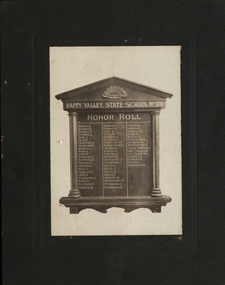
... people responsible for the carvings and specially mentioned for her work by the Caulfield School in Melbourne. On her resignation, Margaret moved to Adelaide. At the past students Reunion Celebrations in 1930, Margaret Young was to be the Guest of Honour. Unfortunately she was unable to attend due to ill health. Happy Valley Happy Valley State School Honor Roll Honour roll O. Brough E. Daniels G. Daniels philately J. Dial G. Dial A. Gradnor w. gradnor g. kiely a. kerr w. lowe L ...World War One honor roll of former students of the Happy Valley State School No 376 who enlisted. The original honor roll no longer exists. There is a framed photograph of it in the current Happy Valley School building now used for community events. This honor roll would appear to be made before the end of WW1 as Ernest Alfred Yung died in September 1917 at Ypres. His brother George Alfred Yung returned who was also in the same battle returned to Australia. Honour rolls were also made to encourage more men to enlist. Margaret Young studied at Ballarat West Art School in 1894. This was one of Ballarat's Art schools. In 1907 they merged and became Ballarat Technical Art School (BTAS). Margaret became a teacher and taught for many years at BTAS, specialising in woodcarving. At the end of the First World War, Honour Boards were requested to be made to honour the men who had served. Ballarat was the main provider of these boards. Margaret Young was one of the people responsible for the carvings and specially mentioned for her work by the Caulfield School in Melbourne. On her resignation, Margaret moved to Adelaide. At the past students Reunion Celebrations in 1930, Margaret Young was to be the Guest of Honour. Unfortunately she was unable to attend due to ill health. Sepia photograph of honor roll board for World War One with white background mounted on grey cardboardReverse lhs upper - inked words 'Photo only'; centre - 'Mrs J Garvey, Happy Valley'; rhs upper - two stamps, 1 penny and a half penny franked with Ballarat; pencilled writing 'Mrs Garvey Happy Valleyhappy valley, happy valley state school, honor roll, honour roll, o. brough, e. daniels, g. daniels, philately, j. dial, g. dial, a. gradnor, w. gradnor, g. kiely, a. kerr, w. lowe, l. martinez, h. martinez, j. milburn, c. milburn, a. may, e. morgan, f. opie, a. paterson, n. reid, f. rankin, h. smith, t. thomas, l. thomas, e. yung, a. yung, a. bromley, j. blundell, h. barraclough, j. crommie, g. darling, j. darling, w. w. groves, j. gardiner, a. keys, j. keys, p. kelly, s. kelly, m. morgan, w. montgomery, j. rutherford, r. rutherford, p. smith, w. wishart, h. wark, s. ronald, k.n. mcnamee, p. bennington, sister m.j. thomas, d.l. thomas, w.e. thomas, j.s. gower, f.h. gower, s. gower, s.t.m. gower, happy valley school honor roll, a.a. louden -
 Federation University Historical Collection
Photograph - Photograph - Colour, Computers and Daylesford Neighbourhood House, 1995, 1995
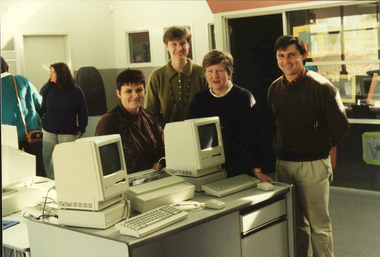
... L-R: Co-ordinator Beverly Risstrom, computer teacher Alic Kormelink, Chairman of cenre Jenny Beacham and St Michael's Primary School Vice Principal Barry Grifiths. Colour photograph showing four people ...Colour photograph showing four people standing around two Macintosh computers at Daylesford Neighbourhood House. The computers were donated by the Ballarat School of Mines. Left to right: Beverly Risstrom, Alice Kormelink, Jenny Beacham and arry Griffiths.Written verso "Dayleford Community House looks at new comters and prnted donated by SMB. L-R: Co-ordinator Beverly Risstrom, computer teacher Alic Kormelink, Chairman of cenre Jenny Beacham and St Michael's Primary School Vice Principal Barry Grifiths.beverly risstrom, alice kormelink, jenny beacham, st michael's primary school, barry grifiths, daylesford neighbourhood house, computers, macintosh computer, apple computer -
 Federation University Historical Collection
Book - Book - Handbook, VIOSH: BCAE Graduate Diploma in Occupational Hazard Management; MG471 Statistics and Modelling, 1986
... people into the Graduate Diploma of Occupational Hazard Management who have no undergraduate degree - on the basis of extensive work experience and knowledge. The book outlines the importance of statistics and modelling in assessing accidents that may occur in industry. "The aim of this course is to present some central concepts of statistical theory and some mathematical models and techniques of analysis appropriate for the investigation and assessment of safety performance". There are four units mentioned and the objectives that should be reached by students at the end of each unit. J Snow, J Harvey and L...people into the Graduate Diploma of Occupational Hazard Management who have no undergraduate degree - on the basis of extensive work experience and knowledge. The book outlines the importance of statistics and modelling in assessing accidents that may occur in industry. "The aim of this course is to present some central concepts of statistical theory and some mathematical models and techniques of analysis appropriate for the investigation and assessment of safety performance". There are four units mentioned and the objectives that should be reached by students at the end of each unit. J Snow, J Harvey and L ...Victorian Institute of Occupational Safety and Health (VIOSH) Australia is the Asia-Pacific centre for teaching and research in occupational health and safety (OHS) and is known as one of Australia's leaders on the field. VIOSH has a global reputation for its innovative approach within the field of OHS management. VIOSH had its first intake of students in 1979. At that time the Institution was known as the Ballarat College of Advanced Education. In 1990 it became known as Ballarat University College, then in 1994 as University of Ballarat. It was 2014 that it became Federation University. VIOSH Australia students are safety managers, senior advisors and experienced OHS professionals. They come from all over Australia and industry. Students are taught active research and enquiry; rather than textbook learning and a one-size fits all approach. VIOSH accepts people into the Graduate Diploma of Occupational Hazard Management who have no undergraduate degree - on the basis of extensive work experience and knowledge. The book outlines the importance of statistics and modelling in assessing accidents that may occur in industry. "The aim of this course is to present some central concepts of statistical theory and some mathematical models and techniques of analysis appropriate for the investigation and assessment of safety performance". There are four units mentioned and the objectives that should be reached by students at the end of each unit. J Snow, J Harvey and L Roberts have compiled this handbook. 82 page spiral bound book - A4 size. Tan/Brown coverEmblem of BCAE. Date 1986. J Snow, J Harvey, L Roberts named on covervictorian institute of occupational safety and health, statistics and modelling, models and techniques of analysis, assessment of safety performance, j snow, j harvey, l roberts, viosh, ballarat college of advanced education -
Federation University Historical Collection
Document - Document - Minutes, VIOSH: Ballarat College of Advanced Education; OHM Course Committee MInutes of Meetings, 1984 - 1988
... people into the Graduate Diploma of Occupational Hazard Management who have no undergraduate degree - on the basis of extensive work experience and knowledge. Committee Meetings were held monthly. All aspects of the courses were discussed and recommendations were made for changes and requests from students considered. Committee members were from the different areas / subjects of the courses. Slight changes occurred over time. derek woolley chairman max brooke keith brown b cossins p coman g fernandez legal j harvey p hope p kelly raymond lang b lees r maud tom norwood p swan eric wigglesworth l ...Victorian Institute of Occupational Safety and Health (VIOSH) Australia is the Asia-Pacific centre for teaching and research in occupational health and safety (OHS) and is known as one of Australia's leaders on the field. VIOSH has a global reputation for its innovative approach within the field of OHS management. VIOSH had its first intake of students in 1979. At that time the Institution was known as the Ballarat College of Advanced Education. In 1990 it became known as Ballarat University College, then in 1994 as University of Ballarat. It was 2014 that it became Federation University. VIOSH Australia students are safety managers, senior advisors and experienced OHS professionals. They come from all over Australia and industry. Students are taught active research and enquiry; rather than textbook learning and a one-size fits all approach. VIOSH accepts people into the Graduate Diploma of Occupational Hazard Management who have no undergraduate degree - on the basis of extensive work experience and knowledge. Committee Meetings were held monthly. All aspects of the courses were discussed and recommendations were made for changes and requests from students considered. Committee members were from the different areas / subjects of the courses. Slight changes occurred over time.Minutes typed - A4 pages. Grouped into years.derek woolley, chairman, max brooke, keith brown, b cossins, p coman, g fernandez, legal, j harvey, p hope, p kelly, raymond lang, b lees, r maud, tom norwood, p swan, eric wigglesworth, l colbourn, p dressing, j castleman, r gillis, j lowinger, p mccarthy, d shannon, steve cowley, phillip beaumont, brad rhodes, warren payne, dennis else, graham bradley, brett wood, neil dine, chris schaper, tony thatcher, lyn roberts, peter reid, dulcie brooke, gwen wilson -
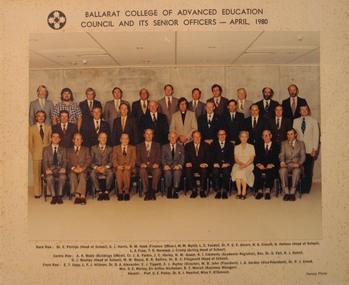 Federation University Historical Collection
Photograph - Photograph - Colour, N.L. Harvey Photographers, Ballarat College of Advanced Education, Council and its Senior Officers; 1980, 1980
... Other notable people from Ballarat and SMB are shown to be on the Council. ballarat college of advanced education council director of college e j barker dr e phillips s j harris r m hook m m walsh l c yandell dr p alcorn n a crouch g holmes l a fryar t d norwood j crump a k webb crj a parkin j c harley n m gower k l clements rev g pell r j dobell d j woolley m w boyce b r rollins dr b c fitzgerald e t oppy l f hillman dr d a alexander e j tippett m b john i a gordon dr p j creed mrs d e molloy sir arthur nicholson r t morrell university women Ken Clements tom norwood john crump Alan webb robert hook jack barker Robert Morrell David Alexander George Pell Coloured photograph of people posed for group photo. ...Photograph shows the members of the Ballarat College of Advanced Education Council and its Senior Officers for 1980. The Director of the College was E J Barker who is seated 5th from the left in the front row. Other notable people from Ballarat and SMB are shown to be on the Council.Coloured photograph of people posed for group photo. Arranged in three row, front row seated. Names of people are printed on mounting below photoballarat college of advanced education, council, director of college, e j barker, dr e phillips, s j harris, r m hook, m m walsh, l c yandell, dr p alcorn, n a crouch, g holmes, l a fryar, t d norwood, j crump, a k webb, crj a parkin, j c harley, n m gower, k l clements, rev g pell, r j dobell, d j woolley, m w boyce, b r rollins, dr b c fitzgerald, e t oppy, l f hillman, dr d a alexander, e j tippett, m b john, i a gordon, dr p j creed, mrs d e molloy, sir arthur nicholson, r t morrell, university women, ken clements, tom norwood, john crump, alan webb, robert hook, jack barker, robert morrell, david alexander, george pell -
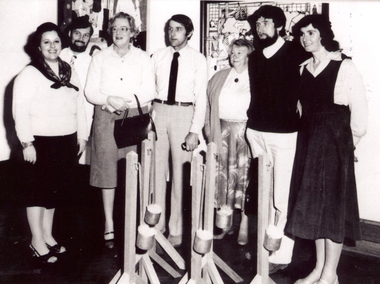 Federation University Historical Collection
Photograph, Ballarat Fine Art Gallery Guides
... Seven people stand at the Ballarat Fine Art Gallery (later Art Gallery of Ballarat). They are the first gallery guides at Ballarat. L...ballarat fine art gallery art gallery of ballarat gallery guides greg binns betty collier brian mclennan Seven people stand at the Ballarat Fine Art Gallery (later Art Gallery of Ballarat). They are the first gallery guides at Ballarat. L ...Seven people stand at the Ballarat Fine Art Gallery (later Art Gallery of Ballarat). They are the first gallery guides at Ballarat. L-R - _ _ _ , Greg Binns, - , Brian McLennan, Betty Collierballarat fine art gallery, art gallery of ballarat, gallery guides, greg binns, betty collier, brian mclennan -
Federation University Historical Collection
Book, Ballarat School of Mines and Industries, Ballarat, School of Mines and Industries minutes if the Board of Studies, Assets Committee, Staffing Committee and Special Working Committee 1976-79, 01/07/1976
... people involved with the institution at that time. It shows projects that were being undertaken at the institution at the time and gives us an historical perspective on project costs and the type of work being done School of Mines Ballarat Board of Studies Assets Committee Special Working Party Staffing Committee w.j.c north e.j tippett m.b john g.h beanland s.a mendelson k.j flecknoe p. shiells a. smail j. crowe r. hazlett b. webber d.drake r. morgan j. bell l. shannon a. peart e.j barker r.t morrell k. andrews r. dobell l.f hillman b. muir r.mcfarlane Staffing, Boardof Studies, Special Working party in black marker on the spine Large dark red book with gold lettering on the front cover School of Mines and Industries minutes if the Board of Studies, Assets Committee, Staffing Committee and Special Working Committee 1976-79 Book Ballarat School of Mines and Industries, Ballarat ...School of Mines Ballarat is a predecessor of Federation University This book is an minutes book of the School of Mines 1970's giving us an understanding of the operations of the School of Mines in that era and of the people involved with the institution at that time. It shows projects that were being undertaken at the institution at the time and gives us an historical perspective on project costs and the type of work being doneLarge dark red book with gold lettering on the front cover Staffing, Boardof Studies, Special Working party in black marker on the spine school of mines ballarat, board of studies, assets committee, special working party, staffing committee, w.j.c north, e.j tippett, m.b john, g.h beanland, s.a mendelson, k.j flecknoe, p. shiells, a. smail, j. crowe, r. hazlett, b. webber, d.drake, r. morgan, j. bell, l. shannon, a. peart, e.j barker, r.t morrell, k. andrews, r. dobell, l.f hillman, b. muir, r.mcfarlane
