
Showing 42 items matching "lace doily"
-
 Slovenian Association Melbourne
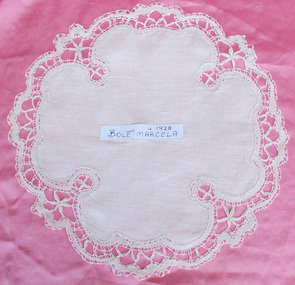
Idrija Lace doily, Marcela Bole Idrija Lace doily, 1928
... Idrija Lace doily...Marcela Bole Idrija Lace doily...Idrija lace doily...circular Idrija lace doily...Idrija lace doily Tomaj Italian school Slovenia Slovenian Association melbourne The Idrija lace was inserted in a thin off-white linen circular Idrija lace doily Marcela Bole Idrija Lace doily Idrija Lace doily ...circular Idrija lace doilyThe Idrija lace was inserted in a thin off-white linenidrija lace doily, tomaj, italian school, slovenia, slovenian association melbourne -
 Wodonga & District Historical Society Inc
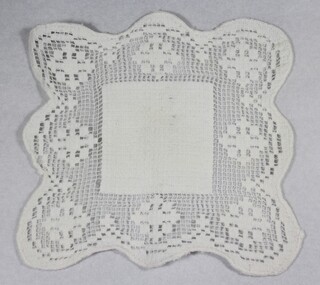
Textile - Haeusler Collection Hand Stitched White Lace Doily c.1920s
... Haeusler Collection Hand Stitched White Lace Doily c.1920s...Haeusler Collection Hand Stitched White Lace Doily c.1920s...White hand stitched lace doily c.1920s...It contributes to our understanding of domestic and family life in early twentieth century Wodonga, as well as providing interpretative capacity for themes including local history, social history, and women’s history. textiles sewing handiwork women's history domestic craft family White hand stitched lace doily c.1920s Haeusler Collection Hand Stitched White Lace Doily c.1920s Textile Haeusler Collection Hand Stitched White Lace Doily c.1920s ...The Wodonga Historical Society Haeusler Collection provides invaluable insight into life in late nineteenth and early twentieth century north east Victoria. The collection comprises manuscripts, personal artefacts used by the Haeusler family on their farm in Wodonga, and a set of glass negatives which offer a unique visual snapshot of the domestic and social lives of the Haeusler family and local Wodonga community. The Haeusler family migrated from Prussia (Germany) to South Australia in the 1840s and 1850s, before purchasing 100 acres of Crown Land made available under the Victorian Lands Act 1862 (also known as ‘Duffy’s Land Act’) in 1866 in what is now Wodonga West. The Haeusler family were one of several German families to migrate from South Australia to Wodonga in the 1860s. The textiles in the Haeusler collection belonged to Ilma Margaret Ernestine Haeusler (née Tasker), born in 1900 in Tallangatta. These textiles were handmade by Ilma between 1919 and 1928 for use in the family home during her marriage to Louis Alfred Haeusler (b.1878). Ilma died in childbirth in 1928, leaving one surviving son, John Alfred Lyell (b.1922). In the nineteenth and early twentieth century prior to the mass production of clothing and textiles, needlework, alongside motherhood, was the defining work of women. Hand sewing and embroidery was central in the everyday lives and domestic roles of women. The item is handmade and unique, with well documented provenance. It forms part of a significant and representative historical collection which reflects the local history of Wodonga. It contributes to our understanding of domestic and family life in early twentieth century Wodonga, as well as providing interpretative capacity for themes including local history, social history, and women’s history.White hand stitched lace doily c.1920stextiles, sewing, handiwork, women's history, domestic, craft, family -
 Kew Historical Society Inc
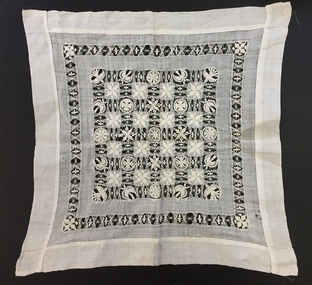
Decorative object - Lace doily
... Lace doily...Lace doily owned by a member of the Piesse family of Kew. ...Lace doily...Later owned by Margaret Hollis (nee Piesse) of Castlemaine. lace doilies Lace doily Decorative object Lace doily ...Lace doily owned by a member of the Piesse family of Kew. Later owned by Margaret Hollis (nee Piesse) of Castlemaine.Lace doilylace, doilies -
 Slovenian Association Melbourne
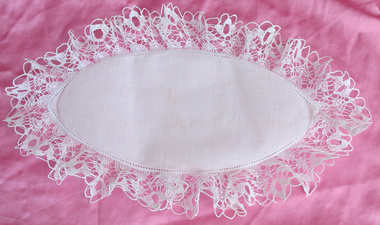
tatted doily, Marcela Bole - tatted lace doily, 1930s
... Marcela Bole - tatted lace doily...doily...tatted lace edging...Oval white linen doily with tatted lace edging...white cotton doily tatted lace edging Slovenian Association Melbourne Oval white linen doily with tatted lace edging Marcela Bole - tatted lace doily tatted doily ...Oval white linen doily with tatted lace edgingwhite cotton doily, tatted lace edging, slovenian association melbourne -
 Emerald Museum & Nobelius Heritage Park
Decorative object - Two lace doilies mounted on card, Beryl Collett
... ...lace doily...These doilies were made by Kallista woman, Beryl Collett (1925-2018) and form part of a large and varied body of work by or about Beryl which is held by the Museum. Beryl created lacework in the earlier part of her life using her Duchess Lace...Two square lace doilies mounted on cards - one on blue card and one on brown card....Decorative object Two lace doilies mounted on card Beryl Collett ...These doilies were made by Kallista woman, Beryl Collett (1925-2018) and form part of a large and varied body of work by or about Beryl which is held by the Museum. Beryl created lacework in the earlier part of her life using her Duchess Lace Maker which is also in the Museum. Doilies were popular from Victorian times to the mid-20th century and were used to cover glasses and bowls or underneath functional or decorative objects. The Dandenongs have been the chosen home of many creative people who, like Beryl, have found inspiration in the natural beauty of the area. Much of this work was created by Beryl following her retirement from her accountancy job in 1980 and so epitomises the potential of the retirement phase of people's lives.Doilies are symbols of the creativity and care that women have, through history, bestowed on the sphere available, their homes.Two square lace doilies mounted on cards - one on blue card and one on brown card.No inscription on VEMU2108.1 On the back of VEMU2108.2 is a sticker on which is printed: 'COMPETITION / Section.....8C / Branch No.....Y / Member's No.....67'beryl collett, kallista victoria australia, doily, lace doily, duchess lacemaker -
Emerald Museum & Nobelius Heritage Park
Decorative object - Four lacework items and one lacework pattern, Beryl Collett, mid-20th century
... ...lace doily...The items are: one lace-embroidered handkerchief; one oval shaped doily with lace around the edge; one circular shaped doily with lace around a small inner circle; and one Peter Pan style collar in lace. ...Beryl Collett Kallista Victoria Australia doily lace doily Duchess Lacemaker lace collar No inscription Four lacework items and one pattern for making lacework. ...These items of lacework were made by Kallista woman, Beryl Collett (1925-2018) and form part of a large and varied body of work by or about Beryl which is held by the Museum. Doilies were popular from Victorian times to the mid-20th century and were used to cover glasses and bowls or underneath functional or decorative objects. The Dandenongs have been the chosen home of many creative people who, like Beryl, have found inspiration in the natural beauty of the area. Much of this work was created by Beryl following her retirement from her accountancy job in 1980 and so epitomises the potential of the retirement phase of people's lives.Doilies are symbols of the creativity and care that women have, through history, bestowed on the sphere available, their homes. Beryl created lacework in the earlier part of her life using her Duchess Lace Maker which is also in the Museum.Four lacework items and one pattern for making lacework. The items are: one lace-embroidered handkerchief; one oval shaped doily with lace around the edge; one circular shaped doily with lace around a small inner circle; and one Peter Pan style collar in lace. All are in white material. Circa mid-20th century or older.No inscriptionberyl collett, kallista victoria australia, doily, lace doily, duchess lacemaker, lace collar -
 Slovenian Association Melbourne
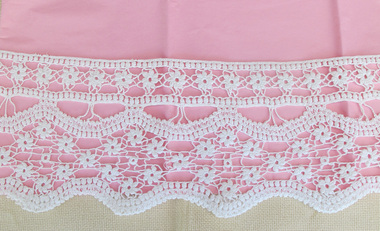
Crochet border, Neva Roeder-Bole, Crochet border
... A crochet border of a small lace doily....A crochet border of a small lace doily. Neva Roeder-Bole, Crochet border Crochet border ...A crochet border of a small lace doily. -
 Bendigo Historical Society Inc.
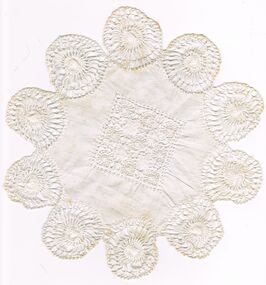
Domestic Object - PATCHWORK, EMBROIDERY, NEEDLEWORK, CROCHET, LINEN & LACE, Unknown
... Tenerife or Nhanduti Style Lace Doily With Geometric Patterns....MANCHESTER Table linen doily https://www.lynxlace.com/filetlacistenerife.html Tenerife or Nhanduti Style Lace Doily With Geometric Patterns. Domestic Object PATCHWORK, EMBROIDERY, NEEDLEWORK, CROCHET, LINEN & LACE ...Tenerife or Nhanduti Style Lace Doily With Geometric Patterns.manchester, table linen, doily, https://www.lynxlace.com/filetlacistenerife.html -
 Orbost & District Historical Society
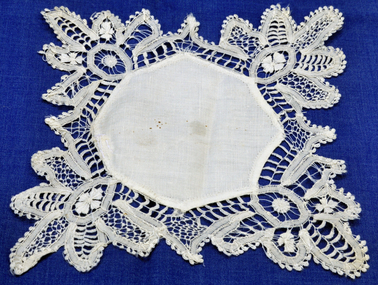
doily, first half 20th century
... doily handcrafts lace-making tomlinson-arthur...Handmade square shaped point lace doily with linen centre....This item is an example of a handcrafted item and reflects the needlework skills of women in the first half of the 20th century. doily handcrafts lace-making tomlinson-arthur Handmade square shaped point lace doily with linen centre. doily Tomlinson, Mary ...Handmade by Mary Tomlinson in approx. 1900. Daughter of Arthur James Tomlinson who in 1887 selected at Tabbara.This item is an example of a handcrafted item and reflects the needlework skills of women in the first half of the 20th century.Handmade square shaped point lace doily with linen centre.doily handcrafts lace-making tomlinson-arthur -
 Mont De Lancey
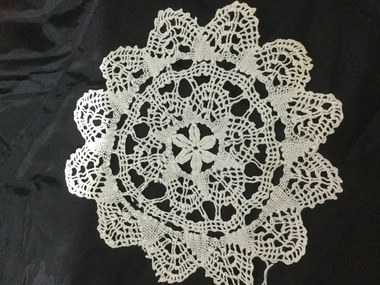
Doily
... White, cotton lace doily with an embroidered flower in the centre and a scalloped edge....table ware. doilies table linen. White, cotton lace doily with an embroidered flower in the centre and a scalloped edge. ...White, cotton lace doily with an embroidered flower in the centre and a scalloped edge.table ware., doilies, table linen. -
Emerald Museum & Nobelius Heritage Park
Decorative object - Seven doilies, Beryl Collett, mid-20th century
... ...lace doily...Doilies were popular from Victorian times till around the mid-20th century. They were used as a cover for glasses and bowls or underneath decorative and functional objects.These items were made by Kallista woman, Beryl Collett (1925-2018) and form part of a large and varied body of work by or about Beryl which is held by the Museum. Beryl mainly made lacework in the earlier part of her life using her Duchess Lace...doilies. Six are circular shaped and one is oval shaped. Two are crocheted and the rest are lace. ...Doilies are symbols of the creativity and care that women have, through history, bestowed on the sphere available, their homes Beryl Collett Kallista Victoria Australia doily lace doily Duchess Lacemaker No inscription Seven doilies. ...Doilies were popular from Victorian times till around the mid-20th century. They were used as a cover for glasses and bowls or underneath decorative and functional objects.These items were made by Kallista woman, Beryl Collett (1925-2018) and form part of a large and varied body of work by or about Beryl which is held by the Museum. Beryl mainly made lacework in the earlier part of her life using her Duchess Lace Maker which is also in the Museum.The Dandenongs have been the chosen home of many creative people who, like Beryl, have found inspiration in the natural beauty of the area. Much of this work was created by Beryl following her retirement from her accountancy job in 1980 and so epitomises the potential of the retirement phase of people's lives.Doilies are symbols of the creativity and care that women have, through history, bestowed on the sphere available, their homesSeven doilies. Six are circular shaped and one is oval shaped. Two are crocheted and the rest are lace. Made by Beryl Collett.No inscriptionberyl collett, kallista victoria australia, doily, lace doily, duchess lacemaker -
Rutherglen Historical Society
Doily, 1925 (Approximate)
... Lace doily worked by hairpin by Mrs Ivy Melville. ...Used as decorative cover for plates Melville family handcrafts Lace doily worked by hairpin by Mrs Ivy Melville. ...Worked by Ivy Melville (Mrs Greg Melville). Used as decorative cover for platesLace doily worked by hairpin by Mrs Ivy Melville. Square in shape with a frilled lace edgemelville family, handcrafts -
 Emerald Museum & Nobelius Heritage Park
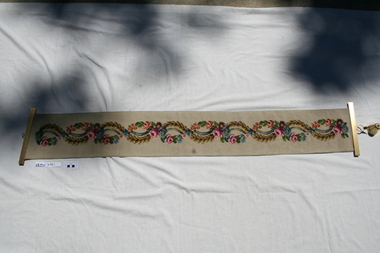
Tapestry Bell Pull, Lace Doilies
... VEMU1695.2 Display board of 11 lace doilies, made of crochet and linen. VEMU1695.2 Display board of 7 lace doilies, made of crochet and linen....Tapestry Bell Pull, Lace Doilies ...Belonged to the Gleghorn family. May Gleghorn married George Walter A'Vard. May's sister married Robert ColemanVEMU1695.1 Tapestry of coloured chain of flowers on a beige background. Top and bottom brass supports, with the bottom one holding a suspended brass bell. VEMU1695.2 Display board of 11 lace doilies, made of crochet and linen. VEMU1695.2 Display board of 7 lace doilies, made of crochet and linen. -
 Flagstaff Hill Maritime Museum and Village
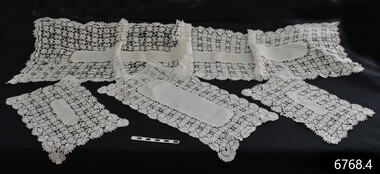
Textile - Dollies & table runner set, Vera and Aurelia Giles, Late 19th to Early 20th century
... Set of three lace doilies & a table runner white, rectangular pieces, hand crocheted wide borders with white linen hand stitched into the centre. ...But the Giles collection also gives us today a snapshot into what domestic life was like in early colonial times prior to Federation. warrnambool shipwrecked-coast flagstaff-hill flagstaff-hill-maritime-museum shipwreck-coast flagstaff-hill-maritime-village giles collection henry giles tower hill warrnambool breakwater mailor’s flat wangoom textiles victorian household items None Set of three lace doilies & a table runner white, rectangular pieces, hand crocheted wide borders with white linen hand stitched into the centre. ...These hand crafted, crocheted table linen items are part of the many 19th century items of furniture, linen and crockery donated to Flagstaff Hill Maritime Village by, Vera and Aurelin Giles. The items are associated with Warrnambool and the Giles Family history. Items donated by the family have come to be known as the “Giles Collection”. Many items in the Lighthouse Keeper’s Cottage were donated by Vera and Aurelin Giles and mostly came from the home of Vera’s parents-in-law, Henry Giles and his wife Mary Jane (nee Freckleton) who married in 1880 and whose photos are on display in the parlour. Henry was born at Tower Hill in 1858, and was a labourer on the construction of the Warrnambool Breakwater before leaving in 1895 for around seven years to build bridges in NSW. Mary Jane was born in 1860 at Cooramook and she attended Mailor’s Flat State School and where she eventually was to become a student teacher. After which she became a governess at “Injemiara” where her grandfather, Francis Freckleton, had once owned land. Henry and Mary’s family consisted of six, some of the children were born at Mailor’s Flat and later some children at Wangoom. They lived with their parents at Wangoom and Purnim west, and this is where Henry died in 1933 and Mary Jane in 1940.The Giles family collection is of social significance at a local level, because it not only illustrates the level of material support the Warrnambool community gave to Flagstaff Hill during it’s establishment. But the Giles collection also gives us today a snapshot into what domestic life was like in early colonial times prior to Federation.Set of three lace doilies & a table runner white, rectangular pieces, hand crocheted wide borders with white linen hand stitched into the centre. (Part of the Giles Collection)Nonewarrnambool, shipwrecked-coast, flagstaff-hill, flagstaff-hill-maritime-museum, shipwreck-coast, flagstaff-hill-maritime-village, giles collection, henry giles, tower hill, warrnambool breakwater, mailor’s flat, wangoom, textiles, victorian household items -
 Clunes Museum
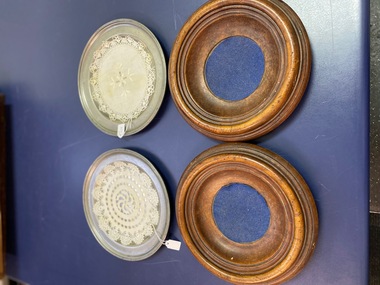
Ceremonial object - COLLECTION BOWL
... .1 2 X WOODEN COLLECTION BOWLS WITH BLUE FELT INLAY .2 2 X TIN COLLECTION BOWLS .3 2 X LACE DOILIES TO GO ON THE TIN BOWLS....USED IN SERVICES AT ST ANDREWS PRESBYTERIAN CHURCH CLUNES VICTORIA AUSTRALIA ST ANDREWS PRESBYTERIAN CHURCH COLLECTION BOWLS CEREMONIAL ITEMS .2 96 JAMES DIXON & SON SHEFFIELD .1 2 X WOODEN COLLECTION BOWLS WITH BLUE FELT INLAY .2 2 X TIN COLLECTION BOWLS .3 2 X LACE DOILIES TO GO ON THE TIN BOWLS. Ceremonial object COLLECTION BOWL ...USED IN SERVICES AT ST ANDREWS PRESBYTERIAN CHURCH CLUNES VICTORIA AUSTRALIA.1 2 X WOODEN COLLECTION BOWLS WITH BLUE FELT INLAY .2 2 X TIN COLLECTION BOWLS .3 2 X LACE DOILIES TO GO ON THE TIN BOWLS..2 96 JAMES DIXON & SON SHEFFIELDst andrews presbyterian church, collection bowls, ceremonial items -
 Flagstaff Hill Maritime Museum and Village
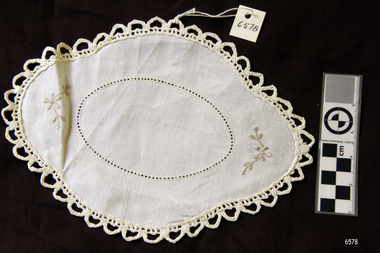
Textile - Doily, 20th century
... ...doily...lace...Doily, oval, white with silver-gray floral design, lace edge....An example of handmade linen. flagstaff hill warrnambool shipwrecked-coast flagstaff-hill flagstaff-hill-maritime-museum maritime-museum shipwreck-coast flagstaff-hill-maritime-village doily lace edge silver gray embroidery craft embroidery crochet Doily, oval, white with silver-gray floral design, lace edge. ...An example of handmade linen.Doily, oval, white with silver-gray floral design, lace edge.flagstaff hill, warrnambool, shipwrecked-coast, flagstaff-hill, flagstaff-hill-maritime-museum, maritime-museum, shipwreck-coast, flagstaff-hill-maritime-village, doily, lace edge, silver gray embroidery, craft, embroidery, crochet -
 Bendigo Historical Society Inc.
Domestic Object - PATCHWORK, EMBROIDERY, NEEDLEWORK, CROCHET, LINEN & LACE, Unknown
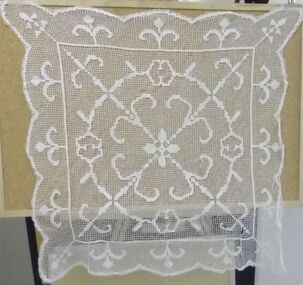
... ...lace tablecloth centrepiece/doily...1 Mesh Grounded Bobbin Style Tape Lace Clothwork Table Cloth or Doily....MANCHESTER Table linen lace tablecloth centrepiece/doily https://www.lynxlace.com/kindsoflace.html 1 Mesh Grounded Bobbin Style Tape Lace Clothwork Table Cloth or Doily. ...1 Mesh Grounded Bobbin Style Tape Lace Clothwork Table Cloth or Doily.manchester, table linen, lace tablecloth centrepiece/doily, https://www.lynxlace.com/kindsoflace.html -
 Coal Creek Community Park & Museum
Lace doilies
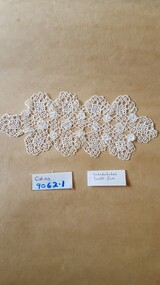
... 9062.1 Tatted oblong doily, 13.5cm # x 36 cm L 9062.2 Square crocheted doily, 16.5 cm square 9062.3 Round crocheted doily or jug cover. 25.5 cm in diameter, gathered effect 9062.4 Round 22cm diameter drawn thread doily 9062.5 Round 18cm crocheted doily 9062.6 Round tatted multipoint doily, 9062.7 Small oblong lace doily...9062.1 Tatted oblong doily, 13.5cm # x 36 cm L 9062.2 Square crocheted doily, 16.5 cm square 9062.3 Round crocheted doily or jug cover. 25.5 cm in diameter, gathered effect 9062.4 Round 22cm diameter drawn thread doily 9062.5 Round 18cm crocheted doily 9062.6 Round tatted multipoint doily, 9062.7 Small oblong lace doily Lace doilies ...9062.1 Tatted oblong doily, 13.5cm # x 36 cm L 9062.2 Square crocheted doily, 16.5 cm square 9062.3 Round crocheted doily or jug cover. 25.5 cm in diameter, gathered effect 9062.4 Round 22cm diameter drawn thread doily 9062.5 Round 18cm crocheted doily 9062.6 Round tatted multipoint doily, 9062.7 Small oblong lace doily -
 Kew Historical Society Inc
Decorative object - Set of four doilies, 1950-1960
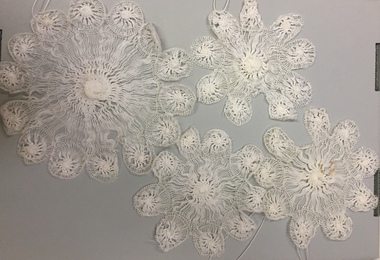
... In the early 20th century it was common for ladies to work doilies in lace or embroidered cloth. They were used to decorate sideboards or dressing tables and also on trays underneath crockery and on plates under food. ...In the early 20th century it was common for ladies to work doilies in lace or embroidered cloth. They were used to decorate sideboards or dressing tables and also on trays underneath crockery and on plates under food. ...In the early 20th century it was common for ladies to work doilies in lace or embroidered cloth. They were used to decorate sideboards or dressing tables and also on trays underneath crockery and on plates under food. These could be made from purchased kits or pattern books. They may form part of a trousseau Set of partially worked doilies. They are comprised of daisy wheels of two sizes. A central circular motif is surrounded by smaller motifsdoilies, household textiles -
 Kew Historical Society Inc
Decorative object - Pair of embroidered doilies, 1950 - 1960
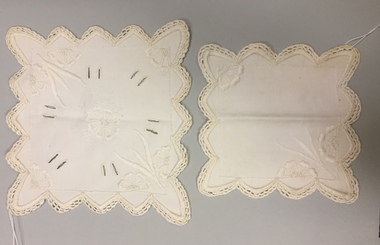
... In the early 20th century it was common for ladies to work doilies in lace or embroidered cloth. They were used to decorate sideboards or dressing tables and also on trays underneath crockery and on plates under food. ...In the early 20th century it was common for ladies to work doilies in lace or embroidered cloth. They were used to decorate sideboards or dressing tables and also on trays underneath crockery and on plates under food. ...In the early 20th century it was common for ladies to work doilies in lace or embroidered cloth. They were used to decorate sideboards or dressing tables and also on trays underneath crockery and on plates under food. These could be made from purchased kits or pattern books. They may form part of a trousseauSet of two white embroidered doilies. Scalloped edge has crotcheted finish. An embroidered leaf and half flower pattern on two opposing corners and embroidered quarter flower on the other two corners. There is an embroidered flower in the centre. There are six sets of embroidered holes to thread a ribbon through to gather the larger doily.doilies, household linens -
 Coal Creek Community Park & Museum
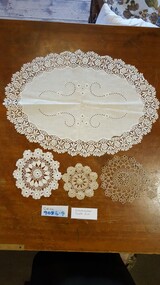
Lace doilies
... 9086.1 Large oblong cotton doily with lace circumference, 51cm long. 9086.2 Small round cream doily, 15.5cm in diameter 9086.3 Small fawn round doily, 11.5cm in diameter 9086.4 Fawn tatted doily, 15cm in diameter...9086.1 Large oblong cotton doily with lace circumference, 51cm long. 9086.2 Small round cream doily, 15.5cm in diameter 9086.3 Small fawn round doily, 11.5cm in diameter 9086.4 Fawn tatted doily, 15cm in diameter Lace doilies ...9086.1 Large oblong cotton doily with lace circumference, 51cm long. 9086.2 Small round cream doily, 15.5cm in diameter 9086.3 Small fawn round doily, 11.5cm in diameter 9086.4 Fawn tatted doily, 15cm in diameter -
 Flagstaff Hill Maritime Museum and Village
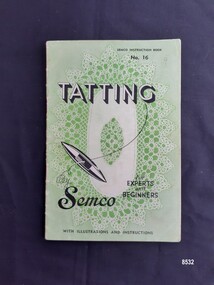
Book - Craft book, Norma Benporath, Tatting, circa 1940's
... In the 19th century and well into the 20th century, tatting was used like crochet and knitted lace for decorative edgings, collars, doilies, tray cloths etc. ...In the 19th century and well into the 20th century, tatting was used like crochet and knitted lace for decorative edgings, collars, doilies, tray cloths etc. ...Tatting is a form of knotted lace making using thread and a small shuttle. Twisted threads are tied around or through small, pointed shuttles that can be made of bone, mother of pearl, tortoise shell, steel or plastic. This produces a stable, strong lace using simple knots of two half hitches to make rings and chains embellished with picots. The origins of tatting are not clear but early versions of decorative knotting were used by the Egyptians on their ceremonial dress. Tatting also has elements of fishermen's net making techniques and the decorative knotting that was practiced by aristocratic women from the 15th century. Tatting, as we know it today, emerged in the first half of the 19th century. The new availability of mercerised thread from 1835 encouraged a burgeoning of lace crafts of all sorts. It was known in Italy as "occhi" and in France as "la frivolite". Tatting looks fragile but is both strong and durable. An article in a column named "Wives and Daughters" published in the Star newspaper in May 1910 describes the durability of tatting lace - "there is edging and insertion still in existence that have outworn two sets of pillow slips." In the 19th century and well into the 20th century, tatting was used like crochet and knitted lace for decorative edgings, collars, doilies, tray cloths etc. At first, different tatting patterns were passed along by word of mouth from person to person, however in time, patterns regularly appeared in newspapers and magazines well into the 1950's. This book has photographs and detailed instructions for a wide range of tatted edgings and insertions suitable for household linens such as towels, doilies and tablecloths as well as patterns for whole mats. Stanley E. Mullen (a businessman) developed Semco Pty Ltd which began as a Melbourne based importation company in 1907. The first three letters of Semco's name were his initials. In 1915 it began manufacturing women's apparel, whitework and transfer patterns. In 1924 the company moved to Black Rock, Victoria and continued to produce an extensive range of needlework patterns and handcraft instruction booklets, threads etc. up until the late 1970's. Semco had a staff that included many young women. It was noted by E.J. Trait (editor of the local newspaper "Standard News") that the firm provided them with good working conditions and the correct rate of pay for women in a time of war - the starting rate for 15 year olds, mainly girls at Semco was 25 shillings per week. During World War 2, Manpower Regulations could be used to coerce workers to move into jobs that supported the war effort, but Trait argued that being employed at Semco could make this unlikely as the firm made some goods essential for the war effort. He even suggested that women be encouraged to produce needlework items (and play a part in the war effort) by sending them as presents, to the troops up north. He also heaped praise on the Semco workplace - noting that no Saturday work was the norm, allowing employees to shop and have "hair-do's" before enjoying a relaxing weekend! Semco also had a female cricket side in the women's Saturday association. After the war the firm stayed in production until the early 1990's when it was taken over by Coates-Paton Pty Ltd. Norma Benporath (1900 - 1998) was an expert in tatting techniques and taught and published extensively on the subject. She was born in New Zealand with impaired sight but cataract surgery restored 50% vision to one eye. She was inspired to learn tatting whilst watching her aunt tat and being told that tatting did not require as much sharp vision as embroidery. She quickly learnt to design her own patterns and published over 1000 tatted lace patterns between 1929 and 1952. She became a regular contributor to magazines (such as Home Beautiful) and newspapers across Australia. Her designs were also published in New Zealand, South Africa as well as the U.K. and U.S.A. When Semco, a thread manufacturer, noticed a rise in the sale of fine crochet threads, they realized they had an untapped market to explore. Norma designed a collection of tatting patterns for Semco that were used to help promote their threads. Norma also worked with Semco to produce a line of threads and shuttles specifically suited to tatting. In 1997, Norma was inducted into the "Order of Australia" for "Service to the craft of tatting as a designer and through the international publication of her patterns".This item is an excellent example of the needle work being enjoyed by women in the 1940's in Australia and the skills of the Australian designer, Norma Benporath. It is also an example of the trend that emerged for craft companies such as Semco to publish pattern books in order to advertise their own materials.A 32 page soft cover instruction book with green front and back covers showing two tatted doily designs. The book includes black and white photographs and written patterns by Norma Benporath.Front cover - "TATTING" "For / EXPERTS/ and / BEGINNERS" "By/Semco" "SEMCO INSTRUCTION BOOK" "No. 16" "WITH ILLUSTRATIONS AND INSTRUCTIONS" "9" Back cover - "FOR INSTRUCTIONS FOR WORKING SEE PAGE 22" "Published by Semco Pty. Ltd." "BLACK ROCK, 29, VIC"flagstaff hill maritime museum and village, warrnambool, great ocean road, tatting, tatting instruction book, tatting patterns, tatting shuttle, semco, semco pty ltd, norma benporath, needlework, handcrafts, household linen, craftwork -
 Flagstaff Hill Maritime Museum and Village
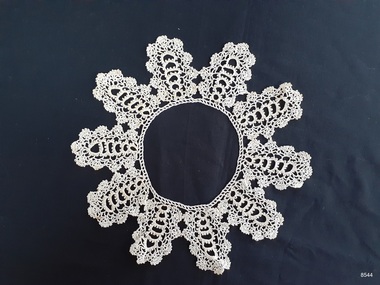
Textile - Lace Sample, Late 1800s to 1940s
... The sample of crochet lace is an example of a handmade item that would have been used to edge material to create a doily for use around the home....The sample of crochet lace is an example of a handmade item that would have been used to edge material to create a doily for use around the home. ...The sample of crochet lace is an example of a handmade item that would have been used to edge material to create a doily for use around the home.The item is significant socially to show the use of textile crafts, such as handmade crocheted lace, to decorate regular domestic objects.A ring of handmade crochet lace consisting of ten motifs joined in a circle. Mercerised white crochet thread has been used to crochet each motif in an open lace pattern using picot edging to give a floral effect.flagstaff hill, warrnambool, maritime village, maritime museum, flagstaff hill maritime museum & village, shipwreck coast, great ocean road, lace, handmade lace, crocheted lace, decorative edging, decorative lace edging, domestic object, crocheted edging -
 City of Moorabbin Historical Society (Operating the Box Cottage Museum)
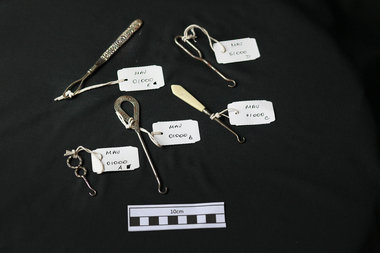
Craftwork, 5 assorted crochet hooks, c1900
... lace making. The early settlers had to be self reliant and made and repaired their own clothes, haberdashery and furnishings These tools were used to make crochet work doilies, antimacassars, and add decorative work to lingerie, collars, cuffs, baby clothes, bonnets and bibs....lace making. The early settlers had to be self reliant and made and repaired their own clothes, haberdashery and furnishings These tools were used to make crochet work doilies, antimacassars, and add decorative work to lingerie, collars, cuffs, baby clothes, bonnets and bibs. craftwork crochetwork needlework early settlers pioneers moorabbin bentleigh cheltenham steel manufacture 5 assorted steel crochet work hooks Craftwork, 5 assorted crochet hooks ...The women of the pioneer families were very skilled at dressmaking , needlework and lace making. The early settlers had to be self reliant and made and repaired their own clothes, haberdashery and furnishings These tools were used to make crochet work doilies, antimacassars, and add decorative work to lingerie, collars, cuffs, baby clothes, bonnets and bibs.5 assorted steel crochet work hookscraftwork, crochetwork, needlework, early settlers, pioneers, moorabbin, bentleigh, cheltenham, steel manufacture -
 City of Moorabbin Historical Society (Operating the Box Cottage Museum)
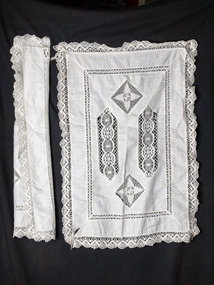
Haberdashery, Pillow Shams 1 pair white cotton,c1900, c1900
... These pillow shams are examples of the dressmaking, crochet and needlework skills of the women of the early settler families in Moorabbin Shire c1900 clothing, haberdashery, crochet, bed linen, doilies, brighton, moorabbin, pioneers, dressmaking, market gardeners, early settlers, craftwork , bentleigh, lacework, moorabbin shire, hunt ailsa, dairy farms, fruit orchards 1 pair of white cotton pillow shams with crochet lace inserts Haberdashery, Pillow Shams 1 pair white cotton,c1900 Family of Ailsa Hunt ...This pair of white cotton pillow shams were made by women of the early settler families in Moorabbin Shire c1900 and show their needlework skills . Although living conditions were basic families still held onto their traditional English and European customs and took pride in presenting elements of refined society. These pillow shams are examples of the dressmaking, crochet and needlework skills of the women of the early settler families in Moorabbin Shire c1900 1 pair of white cotton pillow shams with crochet lace inserts clothing, haberdashery, crochet, bed linen, doilies, brighton, moorabbin, pioneers, dressmaking, market gardeners, early settlers, craftwork , bentleigh, lacework, moorabbin shire, hunt ailsa, dairy farms, fruit orchards -
 Orbost & District Historical Society
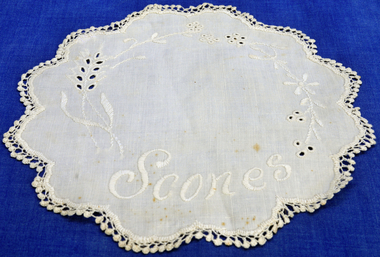
doily, first half 20th century
... Small hand-crafted linen doily with embroidered lace-like edging. Flower embroidery and the word "scones" sewn along bottom....This item is an example of a handcrafted item and reflects the needlework skills of women in the early 20th century. doily handcrafts needlework linen embroidery Front - "scones" Small hand-crafted linen doily with embroidered lace-like edging. Flower embroidery and the word "scones" sewn along bottom. doily ...This item is an example of a handcrafted item and reflects the needlework skills of women in the early 20th century.Small hand-crafted linen doily with embroidered lace-like edging. Flower embroidery and the word "scones" sewn along bottom.Front - "scones"doily handcrafts needlework linen embroidery -
 Orbost & District Historical Society
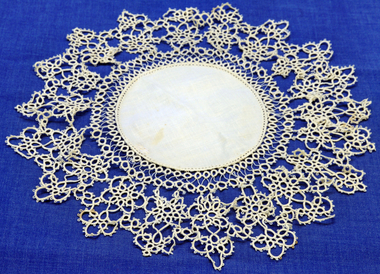
doily, late 19th -early 20th century
... doily handcrafts needlework linen lace cameron-robert...This item is an example of a handcrafted item and reflects the needlework skills of women in the families of the early settlers. doily handcrafts needlework linen lace cameron-robert Hand tatted medium sized doily. ...This doily was handmade by Penuel Cameron (nee Hossack). The Hossack family farmed land on the Marlo Road. Like the Camerons they were staunch Presbyterians. Robert Cameron was one of earliest settlers on Orbost flats and ran the paddlesteamer "Cheviot". He served many years on shire council and built the first Presbyterian. church in Orbost.This item is an example of a handcrafted item and reflects the needlework skills of women in the families of the early settlers.Hand tatted medium sized doily. Small round linen piece in centre and large tatted border.doily handcrafts needlework linen lace cameron-robert -
 Flagstaff Hill Maritime Museum and Village
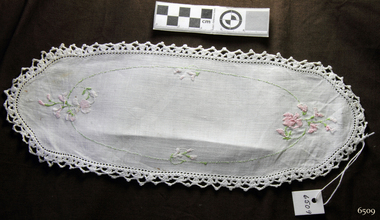
Textile - Doily, c. 1910
... Doily; white rectangular shape, pointed on short sides. Embroidered with pink flowers and green stems, and embellished with a lace frill. ...Flagstaff Hill Warrnambool Flagstaff Hill Maritime Museum and Village Great Ocean Road Chamberlain family Dale family Lees Family Betty Stone Warrnambool Pioneer Warrnambool genealogy Wangoom Chamberlain Dale Lees collection glory box doily embroidery needlework crochet handmade craft manchester Doily; white rectangular shape, pointed on short sides. Embroidered with pink flowers and green stems, and embellished with a lace frill. ...This doily is typical of items of household linen in popular use in the 19th and early-to-mid 20th centuries. It was a tradition for brides to have a 'glory box' containing linen and embroidered and crocheted articles to take to their new home. In the Words of donor, Betty Stone, … “These crocheted and embroidered articles cover a period of three generations- ie. Sarah (nee Chamberlain) Lees, Ann (nee Lees) Dale, and Daisy Elvena (nee Dale) Welsh. All three were accomplished needlewomen; also, both Sarah Lees (born 1844) and her daughter, Ann (b 1865) crocheted a wide variety of articles for use in their homes. A few examples of these items have survived the years.” (NOTE: For additional information please refer to my book Pioneer and Places- A History of Three Warrnambool Pioneering Families ie. Chamberlain, Dale and Lees families)This item is associated with the Warrnambool pioneer families of Chamberlain, Dale and Lees. These families are listed in the Pioneers' Register for Warrnambool Township and Shire, 1835-1900, published by A.I.G.S. Warrnambool Branch. The item is a fine example of early 20th-century needlework.Doily; white rectangular shape, pointed on short sides. Embroidered with pink flowers and green stems, and embellished with a lace frill. Part of the Chamberlain Dale Lees Collection.flagstaff hill, warrnambool, flagstaff hill maritime museum and village, great ocean road, chamberlain family, dale family, lees family, betty stone, warrnambool pioneer, warrnambool genealogy, wangoom, chamberlain dale lees collection, glory box, doily, embroidery, needlework, crochet, handmade, craft, manchester -
 Flagstaff Hill Maritime Museum and Village
Textile - Doily, c. 1910
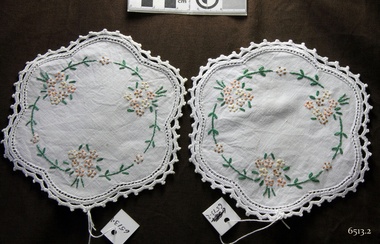
... Doily; Pair of two (2), each doily is round with scalloped edges with crochet trim. The white cloth is embroidered with orange, yellow and brown flowers with green stems and lace fringe. ...Flagstaff Hill Warrnambool Flagstaff Hill Maritime Museum and Village Great Ocean Road Chamberlain family Dale family Lees Family Betty Stone Warrnambool Pioneer Warrnambool genealogy Wangoom Chamberlain Dale Lees collection glory box doily embroidery needlework crochet handmade craft manchester linen haberdashery Doily; Pair of two (2), each doily is round with scalloped edges with crochet trim. The white cloth is embroidered with orange, yellow and brown flowers with green stems and lace fringe. ...This pair of diolies is typical of items of household linen in popular use in the 19th and early-to-mid 20th centuries. It was a tradition for brides to have a 'glory box' containing linen and embroidered and crocheted articles to take to their new home. In the Words of donor, Betty Stone, … “These crocheted and embroidered articles cover a period of three generations- ie. Sarah (nee Chamberlain) Lees, Ann (nee Lees) Dale, and Daisy Elvena (nee Dale) Welsh. All three were accomplished needlewomen; also, both Sarah Lees (born 1844) and her daughter, Ann (b 1865) crocheted a wide variety of articles for use in their homes. A few examples of these items have survived the years.” (NOTE: For additional information please refer to my book Pioneer and Places- A History of Three Warrnambool Pioneering Families ie. Chamberlain, Dale and Lees families)This item is associated with the Warrnambool pioneer families of Chamberlain, Dale and Lees. These families are listed in the Pioneers' Register for Warrnambool Township and Shire, 1835-1900, published by A.I.G.S. Warrnambool Branch. The item is a fine example of early 20th-century needlework.Doily; Pair of two (2), each doily is round with scalloped edges with crochet trim. The white cloth is embroidered with orange, yellow and brown flowers with green stems and lace fringe. They are part of the Chamberlain, Dale, Lees Collection.flagstaff hill, warrnambool, flagstaff hill maritime museum and village, great ocean road, chamberlain family, dale family, lees family, betty stone, warrnambool pioneer, warrnambool genealogy, wangoom, chamberlain dale lees collection, glory box, doily, embroidery, needlework, crochet, handmade, craft, manchester, linen, haberdashery -
 Flagstaff Hill Maritime Museum and Village
Textile - Doily, Mary Jane Giles (Mrs Harry Giles), Late 19th to Early 20th Century
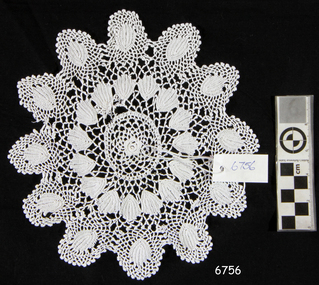
... Doily, made of very fine lace, white. From the Giles Collection....But the Giles collection also gives us today a snapshot into what domestic life was like in early colonial times prior to Federation. warrnambool shipwrecked-coast flagstaff-hill flagstaff-hill-maritime-museum shipwreck-coast flagstaff-hill-maritime-village doily haberdashery manchester linen giles collection henry giles tower hill cooramook mailor’s flat wangoom 19th century household goods None Doily, made of very fine lace, white. From the Giles Collection. ...This doily is one of many 19th century items of furniture, linen and crockery donated to Flagstaff Hill Maritime Village by, Vera and Aurelin Giles. The items are associated with Warrnambool and the Giles Family history. Items donated by the family have come to be known as the “Giles Collection”. Many items in the Lighthouse Keeper’s Cottage were donated by Vera and Aurelin Giles and mostly came from the home of Vera’s parents-in-law, Henry Giles and his wife Mary Jane (nee Freckleton) who married in 1880 and whose photos are on display in the parlour. Henry was born at Tower Hill in 1858, and was a labourer on the construction of the Warrnambool Breakwater before leaving in 1895 for around seven years to build bridges in NSW. Mary Jane was born in 1860 at Cooramook and she attended Mailor’s Flat State School and where she eventually was to become a student teacher. After which she became a governess at “Injemiara” where her grandfather, Francis Freckleton, had once owned land. Henry and Mary’s family consisted of six, some of the children were born at Mailor’s Flat and later some children at Wangoom. They lived with their parents at Wangoom and Purnim west, and this is where Henry died in 1933 and Mary Jane in 1940.The Giles family collection is of social significance at a local level, because it not only illustrates the level of material support the Warrnambool community gave to Flagstaff Hill during it’s establishment. But the Giles collection also gives us today a snapshot into what domestic life was like in early colonial times prior to Federation.Doily, made of very fine lace, white. From the Giles Collection.Nonewarrnambool, shipwrecked-coast, flagstaff-hill, flagstaff-hill-maritime-museum, shipwreck-coast, flagstaff-hill-maritime-village, doily, haberdashery, manchester, linen, giles collection, henry giles, tower hill, cooramook, mailor’s flat, wangoom, 19th century household goods
