
Showing 45 items matching "ladies footwear"
-
 Flagstaff Hill Maritime Museum and Village
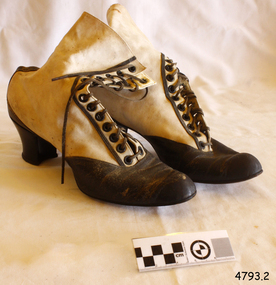
Boots
... ...ladies footwear...flagstaff hill warrnambool shipwrecked-coast flagstaff-hill flagstaff-hill-maritime-museum maritime-museum shipwreck-coast flagstaff-hill-maritime-village short boots ladies boots ladies footwear ladies clothing accessories ladies fashion women's footwear women's boots Stamped into leather "T. ...A pair of women's short boots, black & white lace-up style. Brand T. Jerome.Stamped into leather "T. Jerome'flagstaff hill, warrnambool, shipwrecked-coast, flagstaff-hill, flagstaff-hill-maritime-museum, maritime-museum, shipwreck-coast, flagstaff-hill-maritime-village, short boots, ladies boots, ladies footwear, ladies clothing accessories, ladies fashion, women's footwear, women's boots -
 Numurkah & District Historical Society
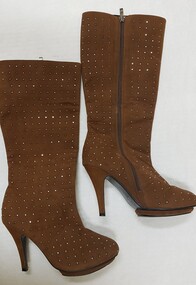
Suede Boots
... shoes, boots, ladies footwear, high heels...shoes, boots, ladies footwear, high heels Brown suede, knee-high, ladies boots, with silver studs in a regular pattern all over the boot. ...Brown suede, knee-high, ladies boots, with silver studs in a regular pattern all over the boot. High Heels, raised sole, pointy toes. Zip down the sideshoes, boots, ladies footwear, high heels -
 Kew Historical Society Inc
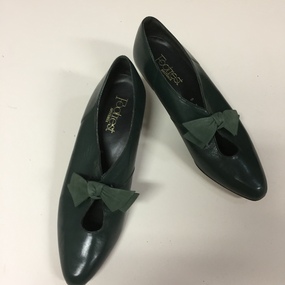
Footwear - Pair of Green Leather Court Shoes, Footwear Australia, 1980s
... ...ladies footwear...Preston is a suburb of Melbourne. women's shoes footrest shoes footwear ladies footwear Footrest, Australia. Made by Footrest /Leather Uppers Linings & Soles Pair of dark green leather women’s court shoes with a green fabric bow at the front, manufactured by Footrest, Australia. ...The extensive fashion and design collection of the Kew Historical Society has been assembled over a number of decades. One subsection of this collection is shoes, designed and manufactured for Australian women by Australian and European designers. Many of the shoes, while often mass-produced, were generally constructed by skilled artisans using traditional shoe-making techniques. The shoes date from the 1890s to the 1980s. Footrest Shoes were manufactured in High Street Preston, on the west side not far up from Dundas Street, but well before Bell St. Preston is a suburb of Melbourne.Pair of dark green leather women’s court shoes with a green fabric bow at the front, manufactured by Footrest, Australia.Footrest, Australia. Made by Footrest /Leather Uppers Linings & Soleswomen's shoes, footrest shoes, footwear, ladies footwear -
 Whitehorse Historical Society Inc.
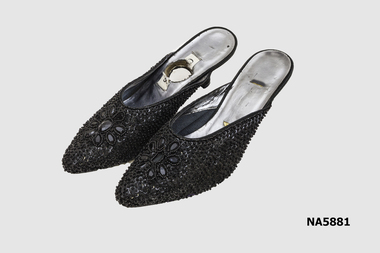
Footwear - Black beaded shoes
... ...Ladies' footwear...Shoewear Shoes Ladies' footwear Evening wear Made in China Pair of black beaded backless slip shoes with silver lining. ...ShoewearPair of black beaded backless slip shoes with silver lining. Have small slender heels with black soles.Made in Chinashoes, ladies' footwear, evening wear -
 Numurkah & District Historical Society
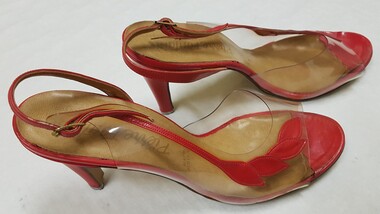
Ladies red high-heel shoes
... Ladies, shoes, footwear, high-heel...Ladies, shoes, footwear, high-heel Pierre Fontine by Paragon. ...Red trimmed high-heel ladies shoes with clear plastic toe vamp with red leaf design on top of the plastic. Ankle area has a narrow red strap. Stored in White Shoe BoxPierre Fontine by Paragon. Made in Australialadies, shoes, footwear, high-heel -
 Warrnambool and District Historical Society Inc.
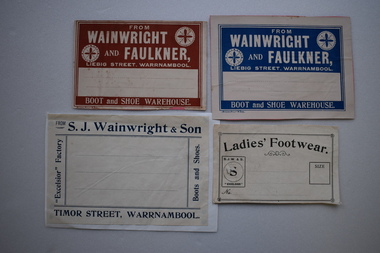
Labels, Wainwright and Faulkner, C1900
... BOOT AND SHOE WAREHOUSE MODERN PRINT WARRNAMBOOL .2 Identical to .1 .3 Ladies' Footwear. S.J.W &S. "EXCELSIOR" SIZE .4 FROM S. ...BOOT AND SHOE WAREHOUSE MODERN PRINT WARRNAMBOOL .2 Identical to .1 .3 Ladies' Footwear. S.J.W &S. "EXCELSIOR" SIZE .4 FROM S. ...Mr Sidney (Sydney) Wainwright's father was established in the boot and shoe manufacturing business from 1877 in partnership with Shaddock and then Faulkner in Liebig Street, Warrnambool. By the late 1800s S.J. Wainwright and Son had 50 employees in the Timor Street factory which was one of the most extensive boot making businesses in the Western District.These labels are of some significance as Wainwright and Faulkner operated a important boot making business at the beginning of the 20th century in Timor Street, Warrnambool..1 White and blue rectangular label with text and decorations attached to a pink card. .2 Identical to .1 excepting the label is buff and the text is brown. .3 Buff rectangular label with black text and decorative border attached to a buff card. .4 Buff rectangular label with dark blue text and lines attached to white paper. .1 FROM WAINWRIGHT AND FAULKNER, LIEBIG STREET, WARRNAMBOOL. BOOT AND SHOE WAREHOUSE MODERN PRINT WARRNAMBOOL .2 Identical to .1 .3 Ladies' Footwear. S.J.W &S. "EXCELSIOR" SIZE .4 FROM S. J. WAINWRIGHT & SON " EXCELSIOR" FACTORY. TIMOR STREET, WARRNAMBOOL . Boots and Shoes.wainwright, faulkner, boot and shoe manufacture -
 Numurkah & District Historical Society
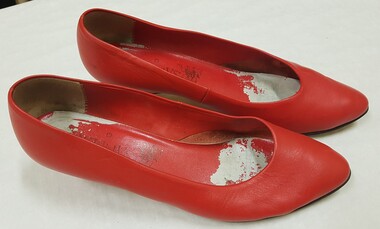
Ladies red shoes
... shoes, footwear, ladies, red leather...shoes, footwear, ladies, red leather Sandler Ladies red leather shoes with medium heel, enclosed upper. ...Ladies red leather shoes with medium heel, enclosed upper. Stored in a Sandler shoe box (no lid)Sandlershoes, footwear, ladies, red leather -
 Numurkah & District Historical Society
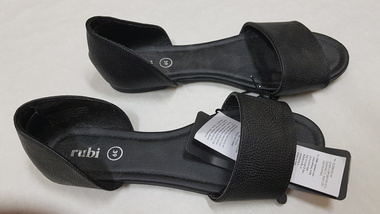
Ladies black leather sandals
... shoes, footwear, ladies, sandals, leather...shoes, footwear, ladies, sandals, leather Rubi 39 Ladies black leather sandal with wide strap across foot and supporting leather around ankle. ...Ladies black leather sandal with wide strap across foot and supporting leather around ankle. Leather has reptile-skin type pattern. Shoes are joined together by elastic and still have Rubi label on them Rubi 39shoes, footwear, ladies, sandals, leather -
 Numurkah & District Historical Society
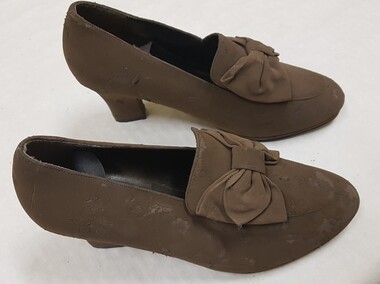
Brown suede ladies shoes
... shoes, footwear, ladies, heels, suede...shoes, footwear, ladies, heels, suede Paragini Brown suede ladies high-heel shoes. ...Brown suede ladies high-heel shoes. Has brown suede bow across the top. Some of the suede has worn off the shoes. Stored in a shoe-boxParaginishoes, footwear, ladies, heels, suede -
 Numurkah & District Historical Society
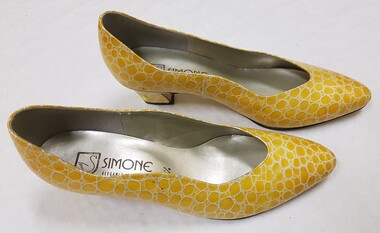
Ladies yellow mediume heeled shoes
... shoes, footwear, ladies, yellow...shoes, footwear, ladies, yellow Simone, elegance in fashion Ladies medium heeled shoes with yellow and white "reptile-skinned" pattern. ...Ladies medium heeled shoes with yellow and white "reptile-skinned" pattern. Shoes covers toes, side and ankle only. Stored in shoe-boxSimone, elegance in fashion shoes, footwear, ladies, yellow -
 Numurkah & District Historical Society
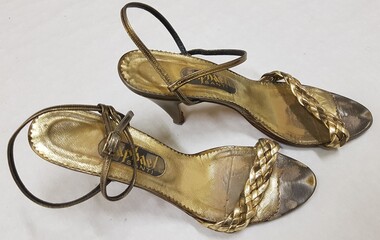
Ladies high-heeled gold sandals
... shoes, footwear, ladies, high-heels, sandals...shoes, footwear, ladies, high-heels, sandals Raphael Santi Ladies gold high-heeled sandals with woven strap across toes and narrow straps around ankle area. ...Ladies gold high-heeled sandals with woven strap across toes and narrow straps around ankle area. Gold colour is quite worn. Stored in a shoe box.Raphael Santi shoes, footwear, ladies, high-heels, sandals -
 Numurkah & District Historical Society
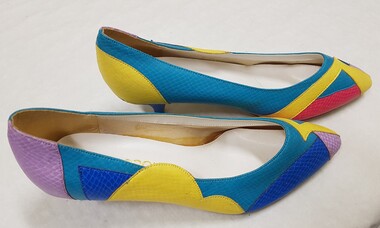
Ladies shoes - multicoloured
... shoes, footwear, ladies,...shoes, footwear, ladies, Paragini 10 Ladies shoes with medium heel. ...Ladies shoes with medium heel. Multicoloured patches: aqua, yellow, pink, purple. Blue coloured heel. Open design, just leather around toe, side and ankle. Stored in shoe boxParagini 10shoes, footwear, ladies, -
 Numurkah & District Historical Society
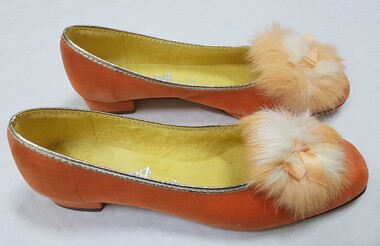
Ladies orange-coloured shoes
... shoes, footwear, ladies, orange suede...shoes, footwear, ladies, orange suede Made by Betta 6 Ladies orange-coloured suede shoes with pale-orange "fur" and apricot-coloured ribbon on toe area. opening of shoe has gold trim. ...Ladies orange-coloured suede shoes with pale-orange "fur" and apricot-coloured ribbon on toe area. opening of shoe has gold trim. Stored in Betta shoe-boxMade by Betta 6shoes, footwear, ladies, orange suede -
 Numurkah & District Historical Society
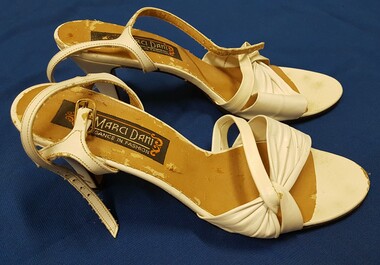
Ladies white high-heeled sandals
... shoes, footwear, ladies, sandal, high-heels...shoes, footwear, ladies, sandal, high-heels Marci Dani. ...Ladies white leather high-heeled sandals with decorative wide strap across the toe, and thin straps around the ankle. Stored in a shoe boxMarci Dani. Elegance in Fashion shoes, footwear, ladies, sandal, high-heels -
 Numurkah & District Historical Society
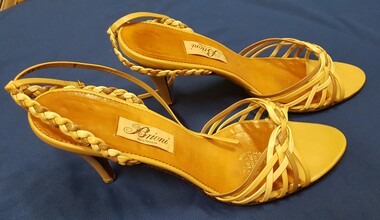
Ladies tan and fawn coloured high-heeled sandals
... shoes, footwear, ladies, high heels, sandals...shoes, footwear, ladies, high heels, sandals Brioni Australia Ladies tan & fawn coloured high-heel sandals. ...Ladies tan & fawn coloured high-heel sandals. Thin woven strapping around the ankle. Thin strapping across the toe, Heel-tip missing from both shoesBrioni Australiashoes, footwear, ladies, high heels, sandals -
 Numurkah & District Historical Society
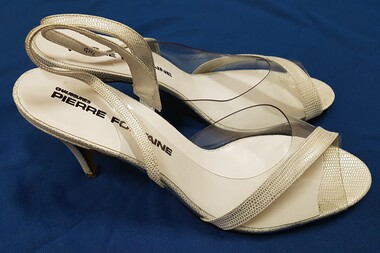
Ladies white & silver coloured high-heeled shoes
... shoes, footwear, ladies, high-heeled,...shoes, footwear, ladies, high-heeled, Pierre Fontaine Ladies white and silver, "reptile-patterned" high heeled shoes, with thin straps across toe and around ankle. ...Ladies white and silver, "reptile-patterned" high heeled shoes, with thin straps across toe and around ankle. Clear plastic across toe strap to make it wider. Pierre Fontaineshoes, footwear, ladies, high-heeled, -
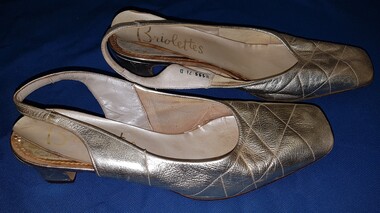 Numurkah & District Historical Society
Ladies gold shoes
... shoes, footwear, ladies, gold fabric...shoes, footwear, ladies, gold fabric Briolettes Ladies shoes, gold fabric, medium heels, strap around the ankle, toes covered. ...Ladies shoes, gold fabric, medium heels, strap around the ankle, toes covered. Gold fabric has diamond shaped design Briolettesshoes, footwear, ladies, gold fabric -
 City of Melbourne Libraries
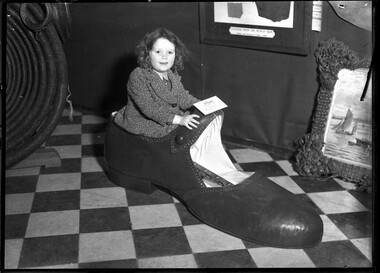
Photograph, Bull, Hugh Jones, 1897-1993, Leather Exhibition, Melbourne Town Hall
... There is a wide contrast between sole leather of varying degrees of thickness on view in one stall and the choice samples of ladies' footwear in another — footwear, by the way, which could almost be used as ornaments, so dainty in colour and production are they. ...There is a wide contrast between sole leather of varying degrees of thickness on view in one stall and the choice samples of ladies' footwear in another — footwear, by the way, which could almost be used as ornaments, so dainty in colour and production are they. ...Photographer notations on slide: At the Leather Exhib. at T. Hall Melb 1933 Age Published: Age (Melbourne, Vic.: 1854- ), 1933 THE EXHIBITS. (1933, September 20). The Age (Melbourne, Vic. : 1854 - 1954), p. 16. Retrieved January 25, 2026, from http://nla.gov.au/nla.news-article205109730 Published title: THE EXHIBITS. A COMPREHENSIVE RANGE. Curios, Novelties, Working Displays Published Caption: ONE OF THE NOVELTIES – AN OUTSIZE IN SHOES Research by Project Volunteer, Louise McKenzie: Our photo is dated 20 September 1933, and shows a happy, chubby-faced young girl sitting in a very over-sized girl’s shoe. It is labelled – “Shoe, An Out Size, loaned by Messrs Blackman & Rose”. (1) It is an effective way to capture the attention of the readership and alert them to the Melbourne Leather Show 1933. This show was designed to be a drawcard of extraordinary proportion, and there is no doubt that this leather exhibition was a really big deal for Melbourne. It completely took over the Melbourne Town Hall, and was open from 10.30 am until 10.30 pm. It seemed to contain something for everyone – the military, the man about town, the home handyman, the housewife, the child, the sporting types, the domestic workers, the outdoor enthusiasts, the horseracing fans, car enthusiasts, those wishing to show off the latest fashion – both men and women - and those just intrigued by a lot of fascinating and wide ranging exhibits. One of the most comprehensive descriptions of the Exhibition accompanies the photograph, and is worth quoting in full: “PROMINENT among exhibits which first attract attention in the foyer of the Town Hall is a comprehensive display of leather articles used by the defence forces. A conspicuous legend states that leather plays an important part in national defence, being used for saddlery, tool containers, holdalls, range-finding, surveying and signalling equipment, explosives factories, harness accoutrement, bandsmen's equipment and clothing. Three models of horses and several figures of soldiers wearing leather equipment illustrate the lesson, and a great range of leather goods used in military training and work variegate the display. Nearby are Texas cowboy, buckjumping and breaking-in saddles; whips, a walking stick, made of leather and numerous other curios. The general exhibition occupies the whole floor space of the main Town Hall, and is subdivided by partitions running most of the length of the hall. A bewildering variety, of leather goods presses for close and leisured inspection. Here and there operatives in charge of working machinery give practical demonstrations of factory processes in the production of footwear. Polishing materials are well represented. One attractive exhibit includes two bush huts constructed of leather, with wattle bark for roofing. Opossums, rosellas and a kookaburra add touches of bush realism. Adjacent exhibits include bags, fishing boots, leggings, leather covers in all colours. Factory Processes. One exhibitor has installed an automatic cinema apparatus and screen, which projects various factory processes in making a shoe, the operator being shown at work. Elsewhere an interesting exhibit depicts the five stages in the manufacture of sole leather, and the tanning materials employed. "Very handsome effects are achieved in the interior appointments of motor cars, which are attended by figures of smart chauffeurs in leather coats. Motor-trimming leather is said to be more durable and hygienic than fabric materials, and cheaper. The neat finish of the material, its excellent appearance, certainly make a very favourable impression. It takes the hides of three beasts to cover the cushions, squabs and door panels of a full-sized sedan, while to finish the entire interior, including quarter-panels and head linings would take four or even five. Special Exhibits. Amongst the special sections the display arranged by the handicrafts and home industries- committee of the Country Women's Association of Victoria is a notable one. In all there are about 130 entries which are in four classifications, viz., hand-tooled or embossed leathers, suede, hand-made gloves and undecorated leather. The glove section attracted the most numerous entries, a number being the work of members and craft subscribers of the Country Women's Association. In the leathercraft competition, organised by the Country Women's Association, the judges yesterday awarded the first prize for bookbinding (the only prize given in this division) to Miss M. Alston, of South Yarra. There is also a creditable display of exhibits submitted by boys of the orthopaedic section of the Children's Hospital at Frankston. Amongst the novelties on view in other portions of the exhibition were the following: — Leather coats worn by Sir C. Kingsford Smith on his Atlantic flight. Model Wellington boot, Phar Lap's saddle. Melbourne Cup winner's saddle. Longest whip in world, 108 feet long. (33 metres) [See our photo, to left of Girl in Shoe] Diminutive shoes. Pair of shoes 65 years old. Pair of men's working boots 75 years old. Larwood's, Tate’s and Pataudi’s cricket boots. [Three internationally revered cricketers of the day] (2) Picture frame made of leather bought 63 years ago. [See our photo, to right of Girl in Shoe] Leather frame, powder bowl, &c. Saddle used by world's champion buckjumper in U.S.A. Mexican cowboy outfit. Miniature saddle and bridle. A fireman's helmet made of sole leather. (3) Sample of the leather hat worn by porters at the Billingsgate Fish Market, London. (4) From South Australia there have been obtained sets of harness for donkeys, goats and camels, the equipment being displayed to good advantage on stuffed representations of the animals mentioned. Close to the platform is a glass case containing snow shoes and coats which have been used in Antarctic exploration work. Trade Display. Amongst the trade exhibits may be seen in operation a slipper turn shoe sewing machine, with heeling and channelling facilities, and the various stages in the production of ladies' sandals are shown. There is a wide contrast between sole leather of varying degrees of thickness on view in one stall and the choice samples of ladies' footwear in another — footwear, by the way, which could almost be used as ornaments, so dainty in colour and production are they. Again, there are displays of upholstering leathers of such soft texture that they could he readily mistaken for some of the finest cloth. Those who may be particularly interested in the production of chamois leather may gain an insight into the materials and chemicals used in the "working up” of this variety of leather. Supplies of glace kid (5) are tastefully arranged, and there may also be seen bags of all shapes and sizes, including satchels, suit cases and "sporting" cases, and bags for tennis players and golfers. Further variety is given to the exhibition by the display of antique hides, brightly coloured, with punching balls, boxing gloves and batsman's pads. There are crocodile skins and snake skins so cleverly "Worked up" that one could be almost pardoned for betraying an affection for such unpopular creatures.” “ Another wonderful article on this Exhibition, published the same day in one of the opposition daily newspapers, The Argus, is in the weekly article “Women to Women”, entitled “A Great Victorian Industry: Many Uses for Leather”. This weekly column was penned by Vesta, and she writes, with much purpose: “Yesterday afternoon I paid a hurried visit to the Leather Exhibition now being held in the Melbourne Town Hall and I was disappointed to find that the early visitors to the main exhibition were almost all men. Women, I think, should make a point of seeing every exhibition of our great industries, for women are the buyers of household requisites and goods for their own use and their tastes, and opinion influence also, to a large extent, the purchases of men. So, the welfare of industries is more or less in their hands and it becomes a duty for them to inform themselves fully of the extent and the quality of the manufacturing that is done here. The value of the output of the Australian boot and shoe factories alone was in 1930-31, the latest year for which the figures are given, Stg 3,750,000. Fully two thirds of that amount must have been spent by women on boots and shoes for themselves and their children. In a host of other directions, in the purchase of handbags, travelling bags, belts and straps, cushions, furniture coverings, purses, notebooks, spectacle cases, their annual expenditure must be very high. Their interest, therefore, in this industry is practical, and their support of it should be governed by knowledge of comparable values and qualities of the goods they buy. From the point of view of women, however, the exhibition itself is rather disappointing. There is an amazing collection of good stuff on show, but most of it is not displayed in a fashion that attracts attention. I was surprised, for example, at the range and quality of the leathers displayed, the suppleness of the finer qualities, and the varied range of colours and designs. But they are shown in such a fashion that if one set out deliberately to look for them it would be quite easy to miss most of them.” …It was surprising, too, that no one seemed to have taken advantage of the present fashion of wearing coloured gloves, or the cult of glove making, which the Country Women’s Association has fostered so successfully. Outside the collection of chamois leathers I saw no skins which were suitable to glove making. (6) However, it is perhaps a little unfair to be highly critical of the exhibition, inasmuch as it is the first of its kind. The material is there, undoubtedly, for a splendid show of every phase of this enterprising industry, and I am confident that experience will prove to those concerned that it will be worth while next time to devote a great deal of attention of the method of display.” With further research, it transpires that “Vera” is in fact NZ born Stella May Allen (nee Henderson) (1871-1962), a journalist, the first woman in NZ to begin a law course, in 1890-91). She later worked at a law firm while she completed her degree. Study of the law had always been open to women in NZ, but its practice was still barred to them. Her case “…led to amending legislation in 1896 allowing women to practise as barristers or solicitors. However, on gaining her LL.B. in November 1897 she did not apply for admission to the Bar. Instead, she became the Wellington-based correspondent and leader-writer for the Lyttelton Times. Her appointment, the first for a woman, was not welcomed by the all-male Press Gallery, and special permission had to be obtained from a subcommittee of the House before her presence was accepted. In 1900 she married Edwin Allen, a senior leader-writer for the Wellington Evening Post, and they moved to Australia in 1903 when Edwin Allen took up the post of foreign affairs leader-writer and parliamentary man for the Melbourne Argus. As Patricia Keep notes in her excellent entry of Stella Allan in the Australian Dictionary of Biography: “In 1907 The Argus commissioned her to write a series of articles on the first Australian Women's Work Exhibition held in October. They aroused much interest and next year The Argus invited her to join its full-time staff and begin a weekly section on the particular interests of women. She adopted the nom de plume 'Vesta' and called the column 'Women to Women'. Her work was unique in an Australian daily paper at that time. Her pages extended to cover every aspect of women's affairs, children's interests and community welfare, and 'Vesta' became a household word for authoritative information and advice on such matters. An excellent needlewoman and first-rate cook herself, she thoroughly tutored her staff in the work and needs of women in both country and city, as well as providing the usual training for cadet journalists. She conducted interviews and also visited the country to see at first hand the results of bushfires, mouse plagues, droughts and floods. In 1910 she was one of three women foundation members of the Australian Journalists' Association. “…she found time to become deeply involved in community affairs. She was an original committee-member of the Victorian Association of Crèches and of the Free Kindergarten Union of Victoria, and had much to do with the early days of the Victorian Bush Nursing Association, the Baby Health Centres Association and the Queen Victoria Hospital. She was a member of the National Council of Women, first in New Zealand and then in Melbourne, and of the Country Women's Association from its inception. … in 1924 she was appointed substitute delegate for Australia to the fifth assembly of the League of Nations at Geneva and was a delegate to the second Pan Pacific Women's Conference in Hawaii in 1930. A meeting held in the Melbourne Town Hall in 1938 by representatives of all the main Victorian women's organizations paid special tribute to her work and influence. She retired next year to England where she continued to write for the Argus, contributing articles on the experiences of women and children in wartime.” It is little wonder that “Vesta” was unafraid to take to task both the women of Victoria, and those who created the exhibition! One item which appears to have gone unnoticed, or at least unreported, is a framed article in the background of the photo of the chubby girl in the shoe. The display frame is labelled “Leather from the Human Skin, Tanned and Dressed by French artists.” The exhibition was certainly a cabinet of curiosities! A charming article in The Argus is a nice note on which to end. It gives a quick history and overview of the Australian leather industry and its unprecedented, and possibly unexpected, development and success, and states with pride: “Though Victoria is the largest leather producer in the Commonwealth all tanners in the Commonwealth can look back with pride on the long march of progress.” Footnotes: (1) “Blackman and Rose”. Messrs Blackman and Rose were shoe manufacturers, from 1927 located at 200 Noone Street, Clifton Hill. The Melbourne Circle describes their building as a “fine-looking building in the Federation ‘blood and bandage’ style.” It was built around 1912 for Puttifoot and Bloom, boot manufacturers, and today the building is apartments. (2) These cricketers were household names in the day: Tate: Maurice Tate, “English cricketer of the 1920s and 1930s, and leader of England’s Test bowling attack for a long time during this period. The founder of modern seam bowling. “ Larwood: Harold Larwood, “English right-arm fast bowler and the main exponent of the bowling style known as “bodyline”. Used to considerable effect in the 1932-33 Test series in Australia. Pataudi: Iftikhar A K Pataudi, “an Indian prince who in the 1930s played Test cricket for England, and in the 1940s played Test cricket for India (as Captain) – the only test cricketer to have played for both India and England. (3) “sole” leather “… is the thickest and most resistant material existing in the tanning industry … made from vegetable tanned leathers, usually bovine butts, processed in a special way to make them the hardest type of leather in existence.” (4) The hats worn by porters at Billingsgate Fish Market were also known as a “Bobbin” and look quite squat and rather unsophisticated. They were made of wood and tarred leather, with a “flat, hardened top designed to support large rectangular boxes of fish. The upturned brim protected the porter’s head against fish juice draining from the boxes of fish which would be carried on top of the hat. Some hats featured a small drain hole at the rear to allow this collected juice to drain down the back of the carrier. The hats were made using the ‘cuir bouilli’ technique. The leather was immersed in water which was heated until the leather began to shrink. It was then removed and put on a wooden former. The leather was stitched together to make the hat while still wet, and then held in place until dry.” (See article and photo on the London Museum website) (5) Glace kid – described on the Boston Museum of Fine Arts’ Cameo database as “A smooth glossy leather originally prepared from goat or sheepskin. Early glace kid had a shiny surface that was originally prepared by tawing the skin in a mixture of alum, table salt, flour, and egg yolk. Today, glace kid is prepared from many types of vegetable or chrome tanned leathers. The smooth polished surface is obtained mechanically by shaving, glazing, ironing, and/or rolling the dry leather.” (6) In the 1930s, Melbourne’s glovemaking industry was characterised by local manufacturing, with key producers like Simpson’s Gloves Pty Ltd in Richmond and the Stagg Glove Company in Clifton Hill leading the market. These factories produced high-quality leather gloves, handbags, and specialty gear, often employing a clear gendered division of labour and training young, local women. Museum Victoria holds the Simpson’s Gloves Collection, comprising over 1200 items, and the University of Melbourne Archives holds the company’s business records. References: THE EXHIBITS. (1933, September 20). The Age (Melbourne, Vic. : 1854 - 1954), p. 16. Retrieved January 25, 2026, from http://nla.gov.au/nla.news-article205109730 EXPORT LEATHER. (1929, September 17). The Argus (Melbourne, Vic. : 1848 - 1957), p. 17. Retrieved January 19, 2026, from http://nla.gov.au/nla.news-article4037647 LEATHER EXHIBITION (1933, September 18). The Argus (Melbourne, Vic. : 1848 - 1957), p. 10. Retrieved January 19, 2026, from http://nla.gov.au/nla.news-article11693362 (1933, September 23). The Argus (Melbourne, Vic. : 1848 - 1957), p. 21. Retrieved January 19, 2026, from http://nla.gov.au/nla.news-page522766 WOMEN TO WOMEN (1933, September 20). The Argus (Melbourne, Vic. : 1848 - 1957), p. 13. Retrieved January 19, 2026, from http://nla.gov.au/nla.news-article11694034 Australian Dictionary of Biography, Stella May Allan (1871–1962) https://adb.anu.edu.au/biography/allan-stella-may-4998 WOMEN TO WOMEN (1930, January 22). The Argus (Melbourne, Vic. : 1848 - 1957), p. 13. Retrieved January 19, 2026, from http://nla.gov.au/nla.news-article4063888 Museums Victoria, Simpson’s Gloves, 486-496 Victoria Street, North Richmond, VIC, Australia https://collections.museumsvictoria.com.au/articles/2702 The Argus. (1927, October 31). The Argus (Melbourne, Vic. : 1848 - 1957), p. 20. Retrieved February 7, 2026, from http://nla.gov.au/nla.news-article3888451 Melbourne Circle: stories from the suburbs: “Boots and all in Clifton Hill” https://melbournecircle.net/2015/11/20/bootmakers-of-clifton-hill/ Wikipedia, Maurice Tate, https://en.wikipedia.org/wiki/Maurice_Tate Wikipedia, Harold Larwood, https://en.wikipedia.org/wiki/Harold_Larwood Wikipedia, Iftikhar Ali Khan Pataudi, https://en.wikipedia.org/wiki/Iftikhar_Ali_Khan_Pataudi Buy Leather Online Italy, Sole leather: https://buyleatheronline.com/en/blog/outsole-and-insole-leather-n7 London Museum, Porters hats, https://www.londonmuseum.org.uk/collections/v/object-731122/hat-porters-hat/ Cameo Database, Museum of Fine Arts, Boston, Glace Kid, https://cameo.mfa.org/wiki/Glac%C3%A9_kid VICTORIAN LEATHER HAS WON RENOWN (1937, September 22). The Argus (Melbourne, Vic. : 1848 - 1957), p. 31 (March of Progress Supplement). Retrieved February 7, 2026, from http://nla.gov.au/nla.news-article1108704 Photographer notations on slide: "At the Leather Exhib. at T. Hall Melb 1933 Age B5".displays, melbourne town hall, leather, children, shoes, 1930-1939, industry, hats, gloves -
 Flagstaff Hill Maritime Museum and Village
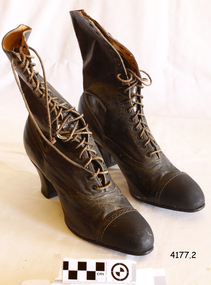
Footwear - Pair of Ladies' Boots, Second half of the 19th Century
... Footwear Pair of Ladies' Boots Australia ...Starting in around 1850, women began wearing boots that resembled the ones already worn by men in high society. Women’s Victorian boots were slightly more feminine in nature, however, than those worn by their male counterparts. The boots first worn by women extended to the middle of the calf so that her ankle would stay properly covered underneath her many skirts. These boots often featured laces or a row of buttons to keep them secure to the foot and ankle. Although usually made from durable materials like rubber and leather, boots that were worn purely for fashion were sometimes made of more elegant materials like patent leather or dyed suede. Fashion boots from the Victorian era exude all of the opulence and decadence that are unique to that time period. Design elements like scalloped trims, intricate embroidery, and lace accents were also not uncommon when it came to elaborately designed Victorian boots. Unlike men’s boots, they also boasted a slight heel that was thinner and more feminine in design. How lavish a woman’s boots were greatly depended upon how much money her family had and her place within society. While footwear was standard during this time, shoes were still quite a luxury to the modern Victorian. Only very wealthy women owned multiple pairs of boots that featured eye-catching design elements. https://www.wardrobeshop.com/blogs/victorian-era/an-in-depth-look-at-victorian-footwear These boots appear to be of a practical nature, designed for comfort, warmth, and proof against the rain and mud, rather than high fashion.These ladies' boots are historically significant for their manufacture and use during the Victorian period.Pair of ankle length black ladies' boots with long tan coloured laces.flagstaff hill, warrnambool, shipwrecked-coast, flagstaff-hill, flagstaff-hill-maritime-museum, maritime-museum, shipwreck-coast, flagstaff-hill-maritime-village, boots, victorian, leather, footwear -
 Flagstaff Hill Maritime Museum and Village
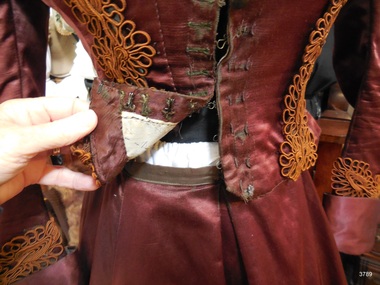
Clothing - Skirt, before April 1874
... footwear THE SKIRT This evening outfit is significant for its connection with colonial Australia, Victoria and Warrnambool. It is a fine example of female fashion of the mid to late 1900s. The outfit is significant for its connection with a wedding uniting two colonial families from Northern Ireland who immigrated to Australia in the mid-1850s. The families had a significant role in the history of Warrnambool and district. The outfit is significant too for connecting the colonial families to the indigenous culture of the district and the contact between the native and European people. evening skirt ladies ...THE SKIRT The skirt has a gentle, soft, feminine design which keeps it in good shape and condition, preserving it from soiling and prolonging its life: - the satin fabric is softly pleated at the waist and falls gently to almost floor length - the opening is concealed at the back within one of the folds and closes with hooks and eyes underneath the bow at the back of the jacket - the horizontal stitching at the base of the skirt joins the lining to the skirt, and the firmness it creates allows it to gently flare out at the base without the need of hooped petticoats - a removable fabric lining at the hem protects the front and back of the skirt from friction and soiling from the wearer’s footwear THE SKIRT This evening outfit is significant for its connection with colonial Australia, Victoria and Warrnambool. It is a fine example of female fashion of the mid to late 1900s. The outfit is significant for its connection with a wedding uniting two colonial families from Northern Ireland who immigrated to Australia in the mid-1850s. The families had a significant role in the history of Warrnambool and district. The outfit is significant too for connecting the colonial families to the indigenous culture of the district and the contact between the native and European people. The lined, floor-length, amber satin skirt has gentle folds that gather into a fitted waistband. One of the folds at the back conceals the opening of the skirt that fastens using metal hooks and eyes. The bow at the back of the jacket covers the top of the closure. There are metal hooks distributed around the top of the waistband. The skirt is stitched horizontally around the hem in several rows. There is a removable fabric lining at the base of the skirt.evening skirt, ladies 1h century skirt, satin skirt, antique satin skirt -
 Glenelg Shire Council Cultural Collection
Footwear - Boots, Bedggood and Company, n.d
... footwear. When branches were opened throughout Australia and business increased, the partnership, which included his three sons, was extended. The company was run by Bedggood's son John from the 1870s until 1911, then by John's son Daniel and later Horace Bedggood, as chairman of directors of Bedggood and Co. The company was deregistered on 21 July 1965. female fashion womens wear boots Charles French Portland business Front: Inside top of each boot '5E 352' Back: On sole of each boot, manufacturer's stamp Pair of ladies ...Charles French was a shoe shop in Portland located on Percy Street. Advertised in the Portland Guardian in April 1916. This Melbourne firm of shoe manufacturers was founded in 1854 by Daniel Bedggood. On arrival from England he set up a business in Richmond, Victoria to make working boots. He later began importing English footwear. When branches were opened throughout Australia and business increased, the partnership, which included his three sons, was extended. The company was run by Bedggood's son John from the 1870s until 1911, then by John's son Daniel and later Horace Bedggood, as chairman of directors of Bedggood and Co. The company was deregistered on 21 July 1965.Pair of ladies lace-up boots, foot and heel white kid, top of boots white canvas, metal eyelets, white with brown leather strip as support also brown leather strip around inside top of boots. From Charles French's shop. Shoes made by Bedggood shoes. c) White cardboard box, 'Premier Brand' label on front, lidFront: Inside top of each boot '5E 352' Back: On sole of each boot, manufacturer's stampfemale fashion, womens wear, boots, charles french, portland business -
 Flagstaff Hill Maritime Museum and Village
Clothing - Boots, Tony Lama, Early 20th century
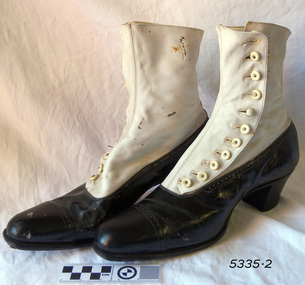
... ...ladies button up boots...footwear...footwear dating around the early 20th century. Flagstaff Hill Warrnambool Maritime-Museum Shipwreck-coast Flagstaff Hill Maritime Museum & Village ladies button up boots footwear Victorian era Granny boots Tony Lama Ladie's boots ladies' fashion women's clothing rome kid leather two-tone boots leather boots button-up boots "6 101" "TL" " Rome" "Cork Filled" Pair of ladies leather button-up boots. ...The inscription "T L" on these early 20th century ladies button-up boots lead to the maker likely to be Tony Lama, a famous USA boot manufacturer, son of Italian immigrants. The "Rome" is the style of boot. The "6" is likely to be the soot size. Tony Lama began work at age 11 years in the leather trade industry, serving an apprenticeship as a shoemaker. He joined the US Cavalry when he was 16, after lying about his age, working as a cobbler to make boots for the soldiers. His workmanship became popular, particularly for the 'Western' style of boot. TONY LAMA boots In 1911 Lama established a company in Texas, first repairing boots, then adapting his shop to manufacture boots in order to meet the many orders he was receiving. He married and he and his wife Esther brought up six children who also went on to work in the family business. The business continued to grow through WWII. Part of the business included custom boot making and Tony's eldest son Joseph presented President Truman with a pair of kangaroo skin boots. The prosperous business became a company and eventually, in 1990, was sold to Justin Industries.This pair of boots is an example of women's footwear dating around the early 20th century. Pair of ladies leather button-up boots. Two-tone style: black bottom strong leather bottom and white, soft kid leather top. Boots have a curved fly fastened by 11 white buttons with metal shanks. Boots are constructed with cork filling. Inscriptions of both boots. "6 101" "TL" " Rome" "Cork Filled"flagstaff hill, warrnambool, maritime-museum, shipwreck-coast, flagstaff hill maritime museum & village, ladies button up boots, footwear, victorian era, granny boots, tony lama, ladie's boots, ladies' fashion, women's clothing, rome, kid leather, two-tone boots, leather boots, button-up boots -
 Flagstaff Hill Maritime Museum and Village
Clothing - Shoes, c. 1911
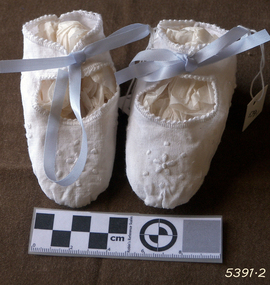
... This pair of infant's shoes is representative of ladies fashion of the early 1910s flagstaff hill warrnambool shipwrecked coast flagstaff hill maritime museum maritime museum shipwreck coast flagstaff hill maritime village great ocean road mrs w.n. barnard w.n. barnard of portland victoria robert barnard child’s white shoes c. 1911 child’s clothing c 1911 infant's shoes baby's shoes baby clothes baby footwear Pair of baby's or child's white linen shoes. ...This pair child's or infant's white shoes was worn by Robert Barnard, son of Mrs W N Barnard of Portland, when he was a young child, circa 1911.This pair of infant's shoes is representative of ladies fashion of the early 1910sPair of baby's or child's white linen shoes. Hand-stitched seams, embroidered upper, and top edges are crocheted and tied with pale blue ribbon. Worn by Robert Barnard c. 1911, son of Mrs. W.N. Barnard, Portland.flagstaff hill, warrnambool, shipwrecked coast, flagstaff hill maritime museum, maritime museum, shipwreck coast, flagstaff hill maritime village, great ocean road, mrs w.n. barnard, w.n. barnard of portland victoria, robert barnard, child’s white shoes c. 1911, child’s clothing c 1911, infant's shoes, baby's shoes, baby clothes, baby footwear -
 Kiewa Valley Historical Society
Boots Riding Women's, Circa 1950's
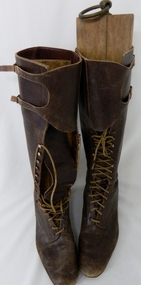
... ladies riding boots. cattle mustering footwear. rural footwear. cattlemen. bogong high plains. roper family. horses....These boots have high historical significance and good interpretive capacity. ladies riding boots. cattle mustering footwear. rural footwear. cattlemen. bogong high plains. roper family. horses. ...This pair of "adjustable" boots came from the 1950's era in which the majority of footwear was either locally manufactured or imported from England or Europe. Quality hard wearing leather was a rural necessity especially for the cattle mustering activity in the Kiewa Valley and the Bogong High Plains region. The late 1900's provided a cheaper made riding boot from Asia, however many rural based riders still prefer an Australian made boot. The better quality (stronger stitching) of Australian boots is the main considerations of "stock horse riders". In 1947 a scientific research project started to provide an impact analysis of any damage to alpine vegetation by cattle grazing in the Alpine regions incorporating the Bogong High Plains area. This monitoring is the longest running ecological study ever undertaken in Australia. From this study, compelling evidence was presented to the Victorian Government to cease cattle grazing in the Alpine regions including the Bogong High Plains. All grazing was banned by the Victorian Government in 2005. Recreational horse riding within the Bogong High Plains is still permitted.These pair of women's riding boots are very significant to the Kiewa Valley as the boots were worn by one of the descendants of a pioneer family living and operating a cattle station before the SEC Hydro Electricity Scheme opened up the semi remote rural location in the 1950's. These boots were worn during the annual six weeks (approx.) mustering of cattle in the Bogong High Plains location (Victorian Alps region). The owner of these boots was Clare Roper, part of the Roper Family who built a "lodging" hut on the "High Plains" for accommodating riders during the periods (up to six weeks) when controlling grazing cattle during the summer muster seasons. It was unusual for women in the early to mid 1900's to go up on the High Plains to join the muster, which Clare Roper often did. These boots have high historical significance and good interpretive capacity.These brown "knee high" lady riding boots, are fastened by long "boot" laces which go from the base of the "fastening" position to a boot height of 22 cm. At the top end of the boot is a leather flap which crosses the front section of the boot and is fastened to the outside leg region by two straps. These provide the wearer with an adjustable tie. The boot has a "tongue" of 22 mm long. The boot has six pairs of metal boot lace "hooks" and eight pairs of boot lace "eyelets".ladies riding boots. cattle mustering footwear. rural footwear. cattlemen. bogong high plains. roper family. horses. -
 Bendigo Historical Society Inc.
Clothing - LYDIA CHANCELLOR COLLECTION: SHOES
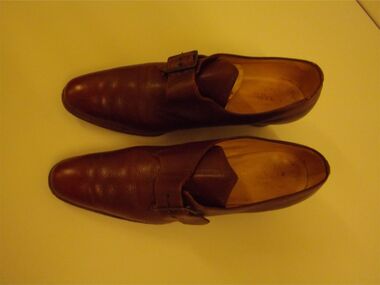
... A shoebox containing a pair of ladies brown leather high heeled shoes with strap and buckle on the top. One end of the box contains the words 'Bedggood friendly footwear 45-51 33/6 'good company all day long.' ...COSTUME ACCESSORIES Footwear accessories shoes Lydia Chancellor collection shoes fashion costume costume accessories foot wear foot wear accessories A shoebox containing a pair of ladies brown leather high heeled shoes with strap and buckle on the top. ...A shoebox containing a pair of ladies brown leather high heeled shoes with strap and buckle on the top. One end of the box contains the words 'Bedggood friendly footwear 45-51 33/6 'good company all day long.' The other end has the words, ' R.O. Henderson's Bendigo. Navy. Pinched court. Size 4. Shape marina. Price 33/6. Each shoe is stuffed with a cream knee high sock.costume accessories, footwear accessories, shoes, lydia chancellor, collection, shoes, fashion, costume, costume accessories, foot wear, foot wear accessories -
 Bendigo Historical Society Inc.
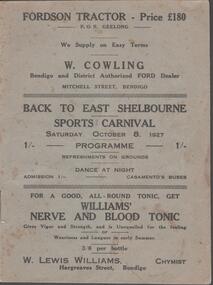
Document - BACK TO EAST SHELBOURNE SPORTS CARNIVAL, 8 October, 1927
... footwear, William Wallace Land and Clearing Sales, Bain & Daws Groceries, Farmers & Citizens Trustees Company Bendigo Limited, Northern Seed Supply Co., Marong Bakery, Bennetts' Arcade Store, Marong Hotel, Warren's Drapery & Clothing, Jas. Friswell Butcher, Webster's Wireless, Baker & Woods Tennis Supplies, Hartleys Wireless, Cycle Hartleys, Bendigo Book & Stationery Centre Frank J Every's, T R Jones Chemist, Wool Skins & Hides F Ferguson, Furniture Carpets Linoleums Morley Johnsons, Jewellery & Silverware Prescott & Dawe, Drapers Honan & O'Toole, Stilwell's of Bendigo, Gents' & Ladies' Tailoring Hatters & Mercers Messrs. ...footwear, William Wallace Land and Clearing Sales, Bain & Daws Groceries, Farmers & Citizens Trustees Company Bendigo Limited, Northern Seed Supply Co., Marong Bakery, Bennetts' Arcade Store, Marong Hotel, Warren's Drapery & Clothing, Jas. Friswell Butcher, Webster's Wireless, Baker & Woods Tennis Supplies, Hartleys Wireless, Cycle Hartleys, Bendigo Book & Stationery Centre Frank J Every's, T R Jones Chemist, Wool Skins & Hides F Ferguson, Furniture Carpets Linoleums Morley Johnsons, Jewellery & Silverware Prescott & Dawe, Drapers Honan & O'Toole, Stilwell's of Bendigo, Gents' & Ladies' Tailoring Hatters & Mercers Messrs. ...Back To East Shelbourne Sports Carnival, Saturday, October 8, 1927. Programme. Refreshments on grounds, dance at night. 1/- Casamento's Buses. Executive Committee: President; W Harris. Vice-President; M De Araugo. Messrs. E Wright, A D Holden, W Hamilton, J Bartels, J Hinck, and H Hinck. Hon. Sec.; H M Burke. Asst. Hon. Sec.; G H Marshall. Ladies; Mesdames J Bartels, H Burke, G H Marshall, E Pocock, R Vines, and E Wright. General Committee; In addition to the above, Messrs. E Pocock, J De Araugo, F J Roberts, and W Marshall, Mesdames W Harris, A Holden, J De Araugo, F J Roberts, and Miss Pocock. Officials Judges: Messrs. T D Cairns, J Craven, and Geo. Hogben. Handicappers: Mr P Davidson (Northern District Walker's Assn.) Starter: Mr W Harris, M De Araugo, J Hinck, H Hovenden, E Pocock, W Hamilton, F J Roberts, A D Holden. Timekeeper: Mr H Hinck. Patrons: Cr, J Bartels, Nuttall & Clarke, Mrs D Punton, R S V Cocking, J Murray, and A Wells. Next 8 pages contain information on the history of East Shelbourne beginning with; This district is situated about ten miles west of south-west of Bendigo on Back Creek or Spring Creek, which received its names from the early diggers of Bendigo who, through shortage of water, were compelled to puddle at Bullock Creek or further 'back,' hence Back Creek; and because of the number of springs it contained - Spring Creek. Among the first to settle, in 1860, were Messrs. John Jenkinson, J Kilgour, T Connelly, G Nichols, R Fox, (who married Mrs James Jenkinson), Kenny, J Roberts, J Genders, J Curry, G Nevinson, Bartram, J Geary, A Nicholl, H Spencer, W Saunders, Mrs Prichard, and J Stansfield. History of East Shelbourne continues . . . Events held were Boy's (State School) Bicycle Race, Stepping the Distance (Gents), Stepping the Distance (Ladies), Bowling at the Stump, Kicking Football Through Hoop, Sheaf Toss, Bucket Ball, Sheffield, Children's Relay Race, Men's Potato Race, Tilting Rings, on Bikes, Walking Contest 1 mile, Car Race through pegs, Slow Bicycle Race 50 yards, Handicap Bicycle Race 2 miles, Tilting Rings in Cars, High Jump, Ladies' and Gent's Cigarette Race, Weight Guessing. Prizes were awarded for first and second placing of these events.In 1923, a Sports Carnival was held in the precincts of what was then a water reserve, situated south of the State School. The area was reserved for watering purposes on 1st May, 1894; and on July 15th, 1912, a small portion was excised. By 1923 its usefulness for water storage had disappeared, and being ideal for recreation purposes, it was decided, at the final meeting of the above sorts carnival, to apply for the area appointed, Mr W Harris (chairman), Messrs. G H Marshall, J Roberts, D Gill, M Connolly, R Vines, E Pocock, and H M Burke (secretary). The matter terminated in a Land Board, presided over by Mr McPherson, being held in Bendigo. The application was granted, but was not gazetted, until Messrs. W Harris and F J Roberts, with Messrs. A E Cook, MLA and Hon. H Keck, MLC interviewed the Minister for Lands. Soon afterwards, at a public meeting, the following members were elected to constitute the first Board of management, Messrs. W Harris (chairman), G H Marshall, A D Holden, F J Roberts (tres.), M D'Araugo, E Wright, and H M Burke (sec.). Since then the arena has been cleared and levelled by residents, and labor and material to the value of 150 pounds have been put into the reserve. At least 2/3rds of the program contain ads from business in Bendigo. Fordson Tractor - W Cowling, W Lewis William's Chymist, Collier footwear, William Wallace Land and Clearing Sales, Bain & Daws Groceries, Farmers & Citizens Trustees Company Bendigo Limited, Northern Seed Supply Co., Marong Bakery, Bennetts' Arcade Store, Marong Hotel, Warren's Drapery & Clothing, Jas. Friswell Butcher, Webster's Wireless, Baker & Woods Tennis Supplies, Hartleys Wireless, Cycle Hartleys, Bendigo Book & Stationery Centre Frank J Every's, T R Jones Chemist, Wool Skins & Hides F Ferguson, Furniture Carpets Linoleums Morley Johnsons, Jewellery & Silverware Prescott & Dawe, Drapers Honan & O'Toole, Stilwell's of Bendigo, Gents' & Ladies' Tailoring Hatters & Mercers Messrs. Denton Bros., Groceries Ales Wines & Spirits W Jeffrey, Ashman's Tailors Hatters Mercers, Myer's, Farmers' Grocery D Whyte & Co., Drapers & Furniture Stores The Beehive, Butcher les. Friswell, Tobacconist & Hairdresser W J Lenten, Timber Merchants & Ironmongers Hume & Iser, Stock E M Vains & Co., Ladies' & Gents' Tailors Clifford & Fulton, Printers & Stationers Bolton Bros. Pty Ltd, Bendigo Leather Shop, Everything Musical Suttons, Andrew's Auction Rooms Butter Eggs Poultry etc, Meats A C Petherick's, Albert Bush's Produce Stores & Chaff Mills, T D Cairns & Co., Jeweller C J Kirby, Casamento's Garage & Ballarat Motor Bus Service, Webster Bros. Sporting House Cycle Builders Motor Cycle & Car Agents, British Motors Bendigo, Webb's Bacon Depot. 20 pages plus coverBoltons Print, Bendigoevent, social, east shelbourne sports carnival -
 National Vietnam Veterans Museum (NVVM)
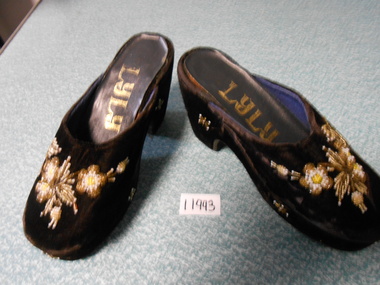
Footwear, Ladies Shoes
... LYLY is on instep Ladies Shoes Footwear Footwear ...A pair of black velvet embroidered ladies scuffs. They are high heeled with a wedge sole. Scuffs are embroidered with gold, yellow and brown beads. LYLY is on instepshoes ladies -
 National Vietnam Veterans Museum (NVVM)
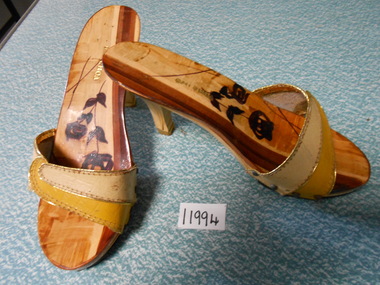
Footwear, Ladies Shoes
... Has yellow and cream leather strap tacked on bottom "Bad Khoa" stamped on instep. Ladies Shoes Footwear Footwear ...Ladies wooden high heeled scuffs. Dark brown rose painted on instep. Has yellow and cream leather strap tacked on bottom "Bad Khoa" stamped on instep.shoes ladies -
 National Vietnam Veterans Museum (NVVM)
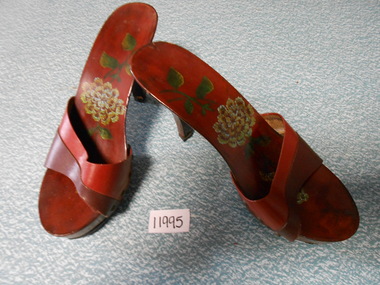
Footwear, Ladies Shoes
... Rubber soles and heels are tacked to bottom Ladies Shoes Footwear Footwear ...Ladies wooden high heeled scuffs. Picture of flower is painted on the instep. Two shades of brown leather strap is tacked to sides. Rubber soles and heels are tacked to bottomladies shoes -
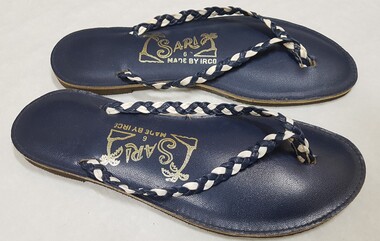 Numurkah & District Historical Society
Ladies leather sandals
... shoes, footwear, sandals, ladies, thongs...shoes, footwear, sandals, ladies, thongs Sara. 6. Made by Irco. ...Blue leather sandals with blue & white striped straps in "thong shape"Sara. 6. Made by Irco. (two palm tree drawings)shoes, footwear, sandals, ladies, thongs
