
Showing 15 items matching "ladies saddle"
-
 Flagstaff Hill Maritime Museum and Village
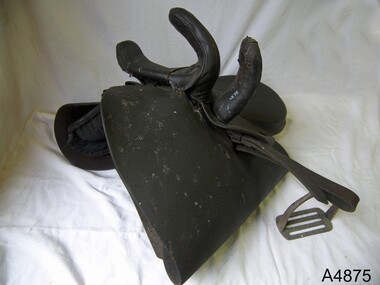
Functional object - Ladies Side Saddle, ca. 1950
... Ladies Side Saddle......ladies saddle...Ladies Side-Saddle, black leather with one stirrup and two horns to grip. ...Functional object Ladies Side Saddle ...This side saddle is an example of early to mid-20th-century horse riding equipment worn with specific female riding habits. Similar designs are used today at certain equestrian events.Ladies Side-Saddle, black leather with one stirrup and two horns to grip. A pouchis attached.flagstaff hill, warrnambool, shipwrecked-coast, flagstaff-hill, flagstaff-hill-maritime-museum, maritime-museum, shipwreck-coast, flagstaff-hill-maritime-village, saddle, side saddle, horse riding, transportation, sport, ladies saddle, ladies side saddle, riding equipment -
 Trafalgar Holden Museum
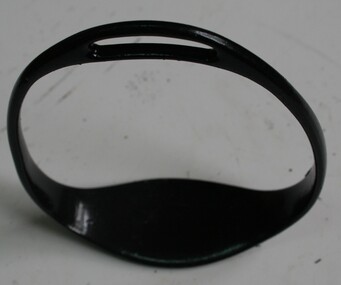
Accessory - Stirrup, C1900
... This stirrup is used by ladies who ride side saddle...This stirrup is used by ladies who ride side saddle Manufactured and sold by Holden and Frost Equine Civilian Stirrup nil Metal circular ring with flat area on base, on the top there is slot which is where the leather strap from the saddle is passed through, Painted black Accessory Stirrup ...This stirrup is used by ladies who ride side saddleManufactured and sold by Holden and FrostMetal circular ring with flat area on base, on the top there is slot which is where the leather strap from the saddle is passed through, Painted blacknilequine civilian, stirrup -
 Trafalgar Holden Museum
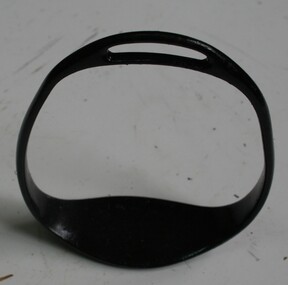
Accessory - Stirrup, Ca 1900
... Stirrup used by ladies who ride side saddle...Stirrup used by ladies who ride side saddle As manufactured and sold by Holden and Frost Equine Stirrup Black metal ring with flat base , slot on top to fit leather strap from the saddle Accessory Stirrup ...Stirrup used by ladies who ride side saddleAs manufactured and sold by Holden and FrostBlack metal ring with flat base , slot on top to fit leather strap from the saddleequine, stirrup -
 Trafalgar Holden Museum
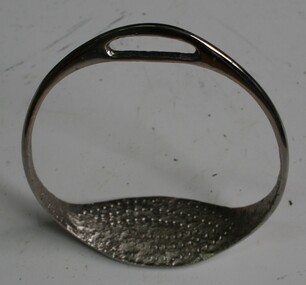
Accessory - Equine accessory
... This stirrup is used by ladies who ride side saddle...This stirrup is used by ladies who ride side saddle Manufactured and sold by HOLDEN and FROST Stirrup Equestrian nil Metal cirular ring with flat area on base, on the top there is a slot which is where the leather strap from the saddle is passed through Accessory Equine accessory ...This stirrup is used by ladies who ride side saddleManufactured and sold by HOLDEN and FROSTMetal cirular ring with flat area on base, on the top there is a slot which is where the leather strap from the saddle is passed throughnilstirrup, equestrian -
 Clunes Museum
Functional object - SADDLE
... .1 LADIES BROWN LEATHER SIDE SADDLE. EMBOSSED WORK ON FRONT PANEL .2 Supplementary File: Leather found inside saddle when restored....LOCAL HISTORY RECREATION SPORTS RIDING .1 LADIES BROWN LEATHER SIDE SADDLE. EMBOSSED WORK ON FRONT PANEL .2 Supplementary File: Leather found inside saddle when restored. ....1 LADIES BROWN LEATHER SIDE SADDLE. EMBOSSED WORK ON FRONT PANEL .2 Supplementary File: Leather found inside saddle when restored.local history, recreation, sports, riding -
Marysville & District Historical Society
THE TRIANGLE NEWS-VOL 11 NO 3-14 FEBRUARY 1986
... marysville saddle tramps...ladies...marysville victoria australia buxton news anglican church annual meeting community care centre shopping spree tour anglican church marysville marysville saddle tramps ladies bowling club interruption to s.e.c. supply fire brigade news kindergarten roster found l.a. meeting play/toddler group fruit salad farm marysville tennis club football real estate marysville hardware mechanic for sale wanted best wishes THE TRIANGLE NEWS-VOL 11 NO 3-14 FEBRUARY 1986 ...marysville, victoria, australia, buxton news, anglican church annual meeting, community care centre, shopping spree tour, anglican church marysville, marysville saddle tramps, ladies bowling club, interruption to s.e.c. supply, fire brigade news, kindergarten roster, found, l.a. meeting, play/toddler group, fruit salad farm, marysville tennis club, football, real estate, marysville hardware, mechanic, for sale, wanted, best wishes -
Marysville & District Historical Society
THE TRIANGLE NEWS-VOL 11 NO 4-21 FEBRUARY 1986
... ladies tupperware party...new babes coffee morning...senior citizens...baby sitting...happy anniversary...shopping spree tour...community employment program...marysville saddle...marysville victoria australia lions ladies tupperware party new babes coffee morning senior citizens baby sitting happy anniversary shopping spree tour community employment program marysville saddle tramps happy birthday kindergarten roster toddler/play group lost dept of conservation forest and lands interruption to s.e.c. supply house to rent wanted for sale buying or selling house or land shire of alexandra mechanic strawberries marysville hardware igloo roadhouse new owners baby sitter required narbethong tennis coaching roofs agistment christ church anglican church marysville newsagency st thomas' buxton THE TRIANGLE NEWS-VOL 11 NO 4-21 FEBRUARY 1986 ...marysville, victoria, australia, lions ladies tupperware party, new babes coffee morning, senior citizens, baby sitting, happy anniversary, shopping spree tour, community employment program, marysville saddle tramps, happy birthday, kindergarten roster, toddler/play group, lost, dept of conservation forest and lands, interruption to s.e.c. supply, house to rent, wanted, for sale, buying or selling house or land, shire of alexandra, mechanic, strawberries, marysville hardware, igloo roadhouse new owners, baby sitter required narbethong, tennis coaching, roofs, agistment, christ church anglican church, marysville newsagency, st thomas' buxton -
Marysville & District Historical Society
THE TRIANGLE NEWS-VOL 22 NO 4-27 JANUARY 1995
... ladies' guild...stolen-property christ church...church news...community council meetings...public notice shire of murrindindi...kooringa conference centre...breast screen mobile van...walking benefits...acupuncture...narbethong fire brigade...bushfire readiness check list...rubicon pokie mobile...for sale...to rent...wanted to buy...golf news...bowls news...junior golf clinic...colonial horse races buxton...wombat cottage...singles...lions club members notice...reflections on history...marysville & district historical society...marysville saddle...marysville victoria australia narbethong theatre group thanks to emergency services happy birthday emergency fire telephone numbers important dates february 1995 toy library marysville & district lions club project community health services steavenson restaurant women's health information day oregon woodgrain timber marysville video christ church ladies' guild stolen-property christ church church news community council meetings public notice shire of murrindindi kooringa conference centre breast screen mobile van walking benefits acupuncture narbethong fire brigade bushfire readiness check list rubicon pokie mobile for sale to rent wanted to buy golf news bowls news junior golf clinic colonial horse races buxton wombat cottage singles lions club members notice reflections on history marysville & district historical society marysville saddle tramps marysville primary school 125th anniversary marysville crafts & gifts poem trades directory THE TRIANGLE NEWS-VOL 22 NO 4-27 JANUARY 1995 ...marysville, victoria, australia, narbethong theatre group, thanks to emergency services, happy birthday, emergency fire telephone numbers, important dates february 1995, toy library, marysville & district lions club project, community health services, steavenson restaurant, women's health information day, oregon woodgrain timber, marysville video, christ church ladies' guild, stolen-property christ church, church news, community council meetings, public notice shire of murrindindi, kooringa conference centre, breast screen mobile van, walking benefits, acupuncture, narbethong fire brigade, bushfire readiness check list, rubicon pokie mobile, for sale, to rent, wanted to buy, golf news, bowls news, junior golf clinic, colonial horse races buxton, wombat cottage, singles, lions club members notice, reflections on history, marysville & district historical society, marysville saddle tramps, marysville primary school 125th anniversary, marysville crafts & gifts, poem, trades directory -
Marysville & District Historical Society
THE TRIANGLE NEWS-VOL 39 NO 12-APRIL 6 2012
... marysville saddle tramps news...ladies...marysville victoria australia funding success for youth projects murrindindi youth partnership group council adopts youth strategy what's on where in april advertisements creative triangle cultural community agm guided walks cathedral range state park emotions anonymous international meeting murrindindi shire council dog/cat registration marysville pharmacy marysville golf report marysville sub branch rsl anzac day service mayor's chair 2012 season launch happy hour marysville community golf & bowls club marysville & district sesquicentenary celebrations marysville & district historical society meeting memory lane cafes travel the silk road at alexandra library alexandra library events marysville triangle real estate the lions triangle tool library maryton park b & b marysville beer & platter garden marysville lake mountain visitor information centre public notice marysville saddle tramps news ladies lunch saladin lodge councillor comment lake mountain alpine resort marysville medical centre news THE TRIANGLE NEWS-VOL 39 NO 12-APRIL 6 2012 ...marysville, victoria, australia, funding success for youth projects, murrindindi youth partnership group, council adopts youth strategy, what's on where in april, advertisements, creative triangle, cultural community agm, guided walks, cathedral range state park, emotions anonymous international meeting, murrindindi shire council, dog/cat registration, marysville pharmacy, marysville golf report, marysville sub branch rsl, anzac day service, mayor's chair, 2012 season launch, happy hour, marysville community golf & bowls club, marysville & district sesquicentenary celebrations, marysville & district historical society meeting, memory lane cafes, travel the silk road at alexandra library, alexandra library events, marysville triangle real estate, the lions triangle tool library, maryton park b & b, marysville beer & platter garden, marysville lake mountain visitor information centre, public notice, marysville saddle tramps news, ladies lunch, saladin lodge, councillor comment, lake mountain alpine resort, marysville medical centre news -
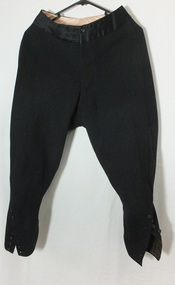 Flagstaff Hill Maritime Museum and Village
Clothing - Riding Habit, Jodhpurs, 1920s
... Prior to 1918 ladies still had to ride side-saddle with skirts over Jodhpurs. ...The Manifolds were a significant pioneering pastoral family in Western Victoria. The donated riding jodhpurs originally belonged to Mrs Edward Manifold, formally Beatrice Mary Synnot Anderson. Beatrice was Edward Manifold’s cousin once removed whom he married in 1900. Edward, the son of John Manifold, was born on 15 November 1868 and educated at Geelong and Melbourne Grammar schools and at Trinity Hall, Cambridge (B.A., 1891). He chose the Danedite portion of land at Purrumbete, and on the death of his bachelor brother Thomas Peter (1863-1895), after a hunting accident, he took over his allocation, Wiridgil. He also owned Boortkoi, near Hexham and on these properties, he ran merino sheep, a Lincoln stud which dated back to 1870, and Shorthorn cattle. 3000 acres were also leased to dairy farmers. Edward was a member of Hampden Shire Council in 1909-31 and three times president at Camperdown. The town was largely bordered by Manifold land and partly dependent upon the local pastoral dynasties, which benefited the local area from the families’ various business interests. Though an offer to build public baths to commemorate the Queen Victoria Jubilee in 1897 was not proceeded with, the town acquired a hospital, a reserve on Mount Leura, a clock tower and a cricket pavilion, as well as notable donations from the Manifolds to St Paul's Church and the grammar school. Edward was a keen polo player and racing man. He was also a successful owner of steeplechasers and a committeeman of the Victoria Racing Club for many years. He was also a member of many Western District racing clubs. On the 16 July 1900, Edward had married his sixteen-year-old cousin Beatrice Mary Synnot Anderson by whom he had three sons Thomas Peter, Andrew and Robert Edward Manifold. Edwards's estate at his death was valued for probate at nearly £500,000. Edward died following an operation on 14 February 1931 at a private hospital in Yarra Vale Melbourne. Beatrice passed away in 1954, aged 79 in Ballarat where she was born in 1874. Contextual historic Family background: The Manifold brothers Thomas (1809-1875), John (1811-1877) and Peter (1817-1885) were the fourth, fifth and sixth sons of William Manifold and Mary, nee Barnes, of Courthouse Farm, Bromborough, Cheshire, England. The family had decided to emigrate to Van Diemen's Land. Thomas was sent ahead, arriving in Hobart Town on 23rd January 1828 with £1500 and a letter of recommendation from the Colonial Office. Thomas acquired 1280 acres on the west bank of the Tamar River. John and Peter, with their parents and three sisters, arrived on 8th July 1831. Land grants by then had finished but William brought ninety acres next to his son Thomas’ land and on the combined properties the family built Kelso House. The Manifolds’ properties were comparatively poor and when news of the Port Phillip District, in Victoria reached Thomas, he lost no time in coming to see for himself in February 1836. He was impressed with what he saw and hurried back to Tasmania to buy lambs and ewes. With one of his brothers, on July 9th he landed his stores at Point Henry and proceeded to occupy both sides of the Moorabool River. Thomas, at the end of the year, returned to Tasmania and left Peter and John to run the new property. Thomas, however, returned to Victoria for several visits and on one of these visits he, along with his brothers, examined the country near Ballarat. In December 1838 they managed to penetrate the Stony Rises, and Peter and John reached Lake Purrumbete and the Mount Leura country. During this time, on 4th July 1838, Thomas married Jane Elizabeth, eldest daughter of Captain Walter Synnot, formerly of Ballinate, County Armagh, Ireland, and then of Van Diemen's Land. Thomas joined his brothers, and they occupied the Purrumbete run in January 1839. On the journey to Purrumbete they could not take their stock and drays through the Stony Rises, so went north of Lake Corangamite, to the neck of land between it and Lake Gnarpurt. By April the move from Moorabool area was complete. As yet they had no hut and were working day and night, but their delight in their new run was unbounded. John wrote to his mother: “We are at last got to the land we wished for it is a beautiful place, and cannot be surpassed by any I have ever seen”. The three brothers occupied Purrumbete together, breeding both sheep and cattle until Thomas went to Grassmere run on the Merri River near Warrnambool in 1844. John and Peter soon gave up breeding sheep but retained the well-known '3M' brand for the cattle. These were Shorthorns, derived from four bulls originally imported by the Boldon brothers and later improved by further importations, and were renowned for size and quality. By the time of the gold rush in 1851, John and Peter were breeding over 1000 head a year, as well as fattening stores. The diggings at this time had disorganised Grassmere by drawing away Thomas's men, and his wife decided to take her two sons and two daughters to Europe for their education. Thomas gave up the property next year, went to England to join his family, and eventually brought the family back to live in Melbourne. At Purrumbete things were different. The brothers, John and Peter, preferred black stockmen to white, so the discovery of gold upset them very little while providing the very market they required. John was on his second visit to England when the rush started, and Peter went in his turn soon after John returned. On 2 September 1856 John married Marion Thomson, at Cormiston, Van Diemen's Land. They had four daughters and five sons, from three of whom, William Thomson, James Chester and Edward, the later generations of the family descend. Through the years the brothers had to contend with the scab, fluke and footrot, depression, rabbits, bush fires and pleuro-pneumonia. In 1861 they appointed as manager Henry Manifold Matson, their nephew, who had already been with them for five years. Thomas died in Melbourne on 7 November 1875, John at Purrumbete on 3 January 1877 and Peter at Purrumbete on 31 July 1885. Devout members of the Church of England, John and Peter, during their lives, gave generously towards building St Paul's Church, Camperdown, and guaranteed part of the vicar's stipend. Peter was a member of the Hampden and Heytesbury Roads Board from 1859 and carried on into the Hampden Shire Council when it was formed in 1864. However, it was not for public works that they were known, but for their personal example. In a new land where speculators and adventurers were all too common, the Manifold brothers were among those who intended it to be their home and their children's home. Industrious, unpretentious and hospitable, they were respected in their community as men of the highest integrity. This riding habit is a characteristic example of the type and style of riding clothes that well-dressed ladies wore in the 1920s. It highlights the changes that were beginning in society for women. Prior to 1918 ladies still had to ride side-saddle with skirts over Jodhpurs. Society of the time regarded women riding astride as unseemly and just not done. This riding habit is particularly significant on a number of levels, it shows the beginnings of change in society's attitudes through women's fashion after the First World War. A change that was to bring a start to a more liberating societal attitude towards women after the successful establishment of the Representation of People Act 1918 that gave women the right to vote. This garments provenance is linked to one of Victoria's important pioneering families the Manifolds, one of the first families that came from Van Diemen's land to settle the Western District of Victoria in 1844. Originally the garment belonged to the wife of the great-grandson of pioneer William Manifold, Edward Manifold who married Beatrice May Synnot Anderson, Edwards Cousin in 1900. The garment was made by the Mayfair tailors J. Busvine & Co. in the early to mid-1920s (estimate) who at the turn of the century were tailors to the Courts of Europe. Their clothing is highly collectible today and examples can be found in a number of significant museum collections around the world, notably the Metropolitan Museum of Art in New York and the FIDM in Los Angeles. Jodhpurs, part of a three-piece, side saddle riding habit tailored for Mrs Edward Manifold, with four buttons to the front material black woolen twill the legs are cuffed below the knee with 8 buttons holes which are reinforced to the inside with fabric. Cream Satin waistband and removable chamois lining to the seat makers label Busvines Co. tailored for Mrs Edward Manifold.Embroidered in blue on a Satin Cream label to Jodhpurs "Busvine Ltd / 4, Brook St, London. W. No." Hand written in black ink script "523/ Mrs Edward Manifold"flagstaff hill, warrnambool, shipwrecked coast, flagstaff hill maritime museum, maritime museum, side saddle riding habit, side saddle riding outfit, breeches, mrs edward manifold, beatrice manifold, shipwreck coast, flagstaff hill maritime village, great ocean road -
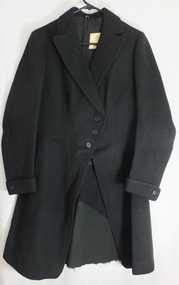 Flagstaff Hill Maritime Museum and Village
Clothing - Riding Habit, jacket, Early 20th Century
... Prior to 1918 ladies still had to ride side-saddle with skirts over Jodhpurs. ...The Manifolds were a significant pioneering pastoral family in Western Victoria. The donated riding jacket originally belonged to Mrs Edward Manifold, formally Beatrice Mary Synnot Anderson. Beatrice was Edward Manifold’s cousin once removed whom he married in 1900. Edward, the son of John Manifold, was born on 15 November 1868 and educated at Geelong and Melbourne Grammar schools and at Trinity Hall, Cambridge (B.A., 1891). He chose the Danedite portion of land at Purrumbete, and on the death of his bachelor brother Thomas Peter (1863-1895), after a hunting accident, he took over his allocation, Wiridgil. He also owned Boortkoi, near Hexham and on these properties, he ran merino sheep, a Lincoln stud which dated back to 1870, and Shorthorn cattle. 3000 acres were also leased to dairy farmers. Edward was a member of Hampden Shire Council in 1909-31 and three times president at Camperdown. The town was largely bordered by Manifold land and partly dependent upon the local pastoral dynasties, which benefited the local area from the families’ various business interests. Though an offer to build public baths to commemorate the Queen Victoria Jubilee in 1897 was not proceeded with, the town acquired a hospital, a reserve on Mount Leura, a clock tower and a cricket pavilion, as well as notable donations from the Manifolds to St Paul's Church and the grammar school. Edward was a keen polo player and racing man. He was also a successful owner of steeplechasers and a committeeman of the Victoria Racing Club for many years. He was also a member of many Western District racing clubs. On the 16 July 1900, Edward had married his sixteen-year-old cousin Beatrice Mary Synnot Anderson by whom he had three sons Thomas Peter, Andrew and Robert Edward Manifold. Edwards's estate at his death was valued for probate at nearly £500,000. Edward died following an operation on 14 February 1931 at a private hospital in Yarra Vale Melbourne. Beatrice passed away in 1954, aged 79 in Ballarat where she was born in 1874. Contextual historic Family background: The Manifold brothers Thomas (1809-1875), John (1811-1877) and Peter (1817-1885) were the fourth, fifth and sixth sons of William Manifold and Mary, nee Barnes, of Courthouse Farm, Bromborough, Cheshire, England. The family had decided to emigrate to Van Diemen's Land. Thomas was sent ahead, arriving in Hobart Town on 23rd January 1828 with £1500 and a letter of recommendation from the Colonial Office. Thomas acquired 1280 acres on the west bank of the Tamar River. John and Peter, with their parents and three sisters, arrived on 8th July 1831. Land grants by then had finished but William brought ninety acres next to his son Thomas’ land and on the combined properties the family built Kelso House. The Manifolds’ properties were comparatively poor and when news of the Port Phillip District, in Victoria reached Thomas, he lost no time in coming to see for himself in February 1836. He was impressed with what he saw and hurried back to Tasmania to buy lambs and ewes. With one of his brothers, on July 9th he landed his stores at Point Henry and proceeded to occupy both sides of the Moorabool River. Thomas, at the end of the year, returned to Tasmania and left Peter and John to run the new property. Thomas, however, returned to Victoria for several visits and on one of these visits he, along with his brothers, examined the country near Ballarat. In December 1838 they managed to penetrate the Stony Rises, and Peter and John reached Lake Purrumbete and the Mount Leura country. During this time, on 4th July 1838, Thomas married Jane Elizabeth, eldest daughter of Captain Walter Synnot, formerly of Ballinate, County Armagh, Ireland, and then of Van Diemen's Land. Thomas joined his brothers, and they occupied the Purrumbete run in January 1839. On the journey to Purrumbete they could not take their stock and drays through the Stony Rises, so went north of Lake Corangamite, to the neck of land between it and Lake Gnarpurt. By April the move from Moorabool area was complete. As yet they had no hut and were working day and night, but their delight in their new run was unbounded. John wrote to his mother: “We are at last got to the land we wished for it is a beautiful place, and cannot be surpassed by any I have ever seen”. The three brothers occupied Purrumbete together, breeding both sheep and cattle until Thomas went to Grassmere run on the Merri River near Warrnambool in 1844. John and Peter soon gave up breeding sheep but retained the well-known '3M' brand for the cattle. These were Shorthorns, derived from four bulls originally imported by the Boldon brothers and later improved by further importations, and were renowned for size and quality. By the time of the gold rush in 1851, John and Peter were breeding over 1000 head a year, as well as fattening stores. The diggings at this time had disorganised Grassmere by drawing away Thomas's men, and his wife decided to take her two sons and two daughters to Europe for their education. Thomas gave up the property next year, went to England to join his family, and eventually brought the family back to live in Melbourne. At Purrumbete things were different. The brothers, John and Peter, preferred black stockmen to white, so the discovery of gold upset them very little while providing the very market they required. John was on his second visit to England when the rush started, and Peter went in his turn soon after John returned. On 2 September 1856 John married Marion Thomson, at Cormiston, Van Diemen's Land. They had four daughters and five sons, from three of whom, William Thomson, James Chester and Edward, the later generations of the family descend. Through the years the brothers had to contend with the scab, fluke and footrot, depression, rabbits, bush fires and pleuro-pneumonia. In 1861 they appointed as manager Henry Manifold Matson, their nephew, who had already been with them for five years. Thomas died in Melbourne on 7 November 1875, John at Purrumbete on 3 January 1877 and Peter at Purrumbete on 31 July 1885. Devout members of the Church of England, John and Peter, during their lives, gave generously towards building St Paul's Church, Camperdown, and guaranteed part of the vicar's stipend. Peter was a member of the Hampden and Heytesbury Roads Board from 1859 and carried on into the Hampden Shire Council when it was formed in 1864. However, it was not for public works that they were known, but for their personal example. In a new land where speculators and adventurers were all too common, the Manifold brothers were among those who intended it to be their home and their children's home. Industrious, unpretentious and hospitable, they were respected in their community as men of the highest integrity. This riding habit is a characteristic example of the type and style of riding clothes that well-dressed ladies wore in the 1920s. It highlights the changes that were beginning in society for women. Prior to 1918 ladies still had to ride side-saddle with skirts over Jodhpurs. Society of the time regarded women riding astride as unseemly and just not done. This riding habit is particularly significant on a number of levels, it shows the beginnings of change in society's attitudes through women's fashion after the First World War. A change that was to bring a start to a more liberating societal attitude towards women after the successful establishment of the Representation of People Act 1918 that gave women the right to vote. This garments provenance is linked to one of Victoria's important pioneering families the Manifolds, one of the first families that came from Van Diemen's land to settle the Western District of Victoria in 1844. Originally the garment belonged to the wife of the great-grandson of pioneer William Manifold, Edward Manifold who married Beatrice May Synnot Anderson, Edwards Cousin in 1900. The garment was made by the Mayfair tailors J. Busvine & Co. in the early to mid-1920s (estimate) who at the turn of the century were tailors to the Courts of Europe. Their clothing is highly collectible today and examples can be found in a number of significant museum collections around the world, notably the Metropolitan Museum of Art in New York and the FIDM in Los Angeles. A riding jacket, part of a three-piece, side saddle riding habit tailored for Mrs Edward Manifold. Knee length English woolen jacket black in colour, seamed and fitted to the female client's figure, fastening from the waist with three bone buttons to rather high lapels. The sleeves are long with closely fitted cuffs and one button and lined with cream satin. The jacket is fitted to the waist and flared to below the hips with a 35 cm vent to the back. Lower back to the jacket is reinforced with removable fabric and the jacket is lined with black twill cotton, there is a cream satin label, with makers' emblem Busvine. Circa 1920s Label to Jacket Embroidered in gold with a Royal logo on a Cream Satin label “By Special /Appointment” “To Her Majesty/The Queen”, “Busvine / Ltd / London 4 Brook St. W. / No” “hand written in purple ink 315 / Mrs Edward Manifold”flagstaff hill, warrnambool, shipwrecked coast, flagstaff hill maritime museum, maritime museum, side saddle riding habit, mrs edward manifold, edward manifold, busvines, shipwreck coast, flagstaff hill maritime village, great ocean road -
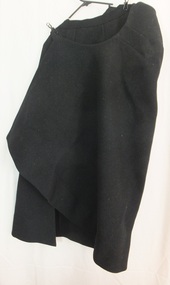 Flagstaff Hill Maritime Museum and Village
Clothing - Riding Habit, Skirt, 1920s
... Prior to 1918 ladies still had to ride side-saddle with skirts over Jodhpurs. ...The Manifolds were a significant pioneering pastoral family in Western Victoria. The donated riding skirt originally belonged to Mrs Edward Manifold, formally Beatrice Mary Synnot Anderson. Beatrice was Edward Manifold’s cousin once removed whom he married in 1900. Edward, the son of John Manifold, was born on 15 November 1868 and educated at Geelong and Melbourne Grammar schools and at Trinity Hall, Cambridge (B.A., 1891). He chose the Danedite portion of land at Purrumbete, and on the death of his bachelor brother Thomas Peter (1863-1895), after a hunting accident, he took over his allocation, Wiridgil. He also owned Boortkoi, near Hexham and on these properties, he ran merino sheep, a Lincoln stud which dated back to 1870, and Shorthorn cattle. 3000 acres were also leased to dairy farmers. Edward was a member of Hampden Shire Council in 1909-31 and three times president at Camperdown. The town was largely bordered by Manifold land and partly dependent upon the local pastoral dynasties, which benefited the local area from the families’ various business interests. Though an offer to build public baths to commemorate the Queen Victoria Jubilee in 1897 was not proceeded with, the town acquired a hospital, a reserve on Mount Leura, a clock tower and a cricket pavilion, as well as notable donations from the Manifolds to St Paul's Church and the grammar school. Edward was a keen polo player and racing man. He was also a successful owner of steeplechasers and a committeeman of the Victoria Racing Club for many years. He was also a member of many Western District racing clubs. On the 16 July 1900, Edward had married his sixteen-year-old cousin Beatrice Mary Synnot Anderson by whom he had three sons Thomas Peter, Andrew and Robert Edward Manifold. Edwards's estate at his death was valued for probate at nearly £500,000. Edward died following an operation on 14 February 1931 at a private hospital in Yarra Vale Melbourne. Beatrice passed away in 1954, aged 79 in Ballarat where she was born in 1874. Contextual historic Family background: The Manifold brothers Thomas (1809-1875), John (1811-1877) and Peter (1817-1885) were the fourth, fifth and sixth sons of William Manifold and Mary, nee Barnes, of Courthouse Farm, Bromborough, Cheshire, England. The family had decided to emigrate to Van Diemen's Land. Thomas was sent ahead, arriving in Hobart Town on 23rd January 1828 with £1500 and a letter of recommendation from the Colonial Office. Thomas acquired 1280 acres on the west bank of the Tamar River. John and Peter, with their parents and three sisters, arrived on 8th July 1831. Land grants by then had finished but William brought ninety acres next to his son Thomas’ land and on the combined properties the family built Kelso House. The Manifolds’ properties were comparatively poor and when news of the Port Phillip District, in Victoria reached Thomas, he lost no time in coming to see for himself in February 1836. He was impressed with what he saw and hurried back to Tasmania to buy lambs and ewes. With one of his brothers, on July 9th he landed his stores at Point Henry and proceeded to occupy both sides of the Moorabool River. Thomas, at the end of the year, returned to Tasmania and left Peter and John to run the new property. Thomas, however, returned to Victoria for several visits and on one of these visits he, along with his brothers, examined the country near Ballarat. In December 1838 they managed to penetrate the Stony Rises, and Peter and John reached Lake Purrumbete and the Mount Leura country. During this time, on 4th July 1838, Thomas married Jane Elizabeth, eldest daughter of Captain Walter Synnot, formerly of Ballinate, County Armagh, Ireland, and then of Van Diemen's Land. Thomas joined his brothers, and they occupied the Purrumbete run in January 1839. On the journey to Purrumbete they could not take their stock and drays through the Stony Rises, so went north of Lake Corangamite, to the neck of land between it and Lake Gnarpurt. By April the move from Moorabool area was complete. As yet they had no hut and were working day and night, but their delight in their new run was unbounded. John wrote to his mother: “We are at last got to the land we wished for it is a beautiful place, and cannot be surpassed by any I have ever seen”. The three brothers occupied Purrumbete together, breeding both sheep and cattle until Thomas went to Grassmere run on the Merri River near Warrnambool in 1844. John and Peter soon gave up breeding sheep but retained the well-known '3M' brand for the cattle. These were Shorthorns, derived from four bulls originally imported by the Boldon brothers and later improved by further importations, and were renowned for size and quality. By the time of the gold rush in 1851, John and Peter were breeding over 1000 head a year, as well as fattening stores. The diggings at this time had disorganised Grassmere by drawing away Thomas's men, and his wife decided to take her two sons and two daughters to Europe for their education. Thomas gave up the property next year, went to England to join his family, and eventually brought the family back to live in Melbourne. At Purrumbete things were different. The brothers, John and Peter, preferred black stockmen to white, so the discovery of gold upset them very little while providing the very market they required. John was on his second visit to England when the rush started, and Peter went in his turn soon after John returned. On 2 September 1856 John married Marion Thomson, at Cormiston, Van Diemen's Land. They had four daughters and five sons, from three of whom, William Thomson, James Chester and Edward, the later generations of the family descend. Through the years the brothers had to contend with the scab, fluke and footrot, depression, rabbits, bush fires and pleuro-pneumonia. In 1861 they appointed as manager Henry Manifold Matson, their nephew, who had already been with them for five years. Thomas died in Melbourne on 7 November 1875, John at Purrumbete on 3 January 1877 and Peter at Purrumbete on 31 July 1885. Devout members of the Church of England, John and Peter, during their lives, gave generously towards building St Paul's Church, Camperdown, and guaranteed part of the vicar's stipend. Peter was a member of the Hampden and Heytesbury Roads Board from 1859 and carried on into the Hampden Shire Council when it was formed in 1864. However, it was not for public works that they were known, but for their personal example. In a new land where speculators and adventurers were all too common, the Manifold brothers were among those who intended it to be their home and their children's home. Industrious, unpretentious and hospitable, they were respected in their community as men of the highest integrity. This riding habit is a characteristic example of the type and style of riding clothes that well-dressed ladies wore in the 1920s. It highlights the changes that were beginning in society for women. Prior to 1918 ladies still had to ride side-saddle with skirts over Jodhpurs. Society of the time regarded women riding astride as unseemly and just not done. This riding habit is particularly significant on a number of levels, it shows the beginnings of change in society's attitudes through women's fashion after the First World War. A change that was to bring a start to a more liberating societal attitude towards women after the successful establishment of the Representation of People Act 1918 that gave women the right to vote. This garments provenance is linked to one of Victoria's important pioneering families the Manifolds, one of the first families that came from Van Diemen's land to settle the Western District of Victoria in 1844. Originally the garment belonged to the wife of the great-grandson of pioneer William Manifold, Edward Manifold who married Beatrice May Synnot Anderson, Edwards Cousin in 1900. The garment was made by the Mayfair tailors J. Busvine & Co. in the early to mid-1920s (estimate) who at the turn of the century were tailors to the Courts of Europe. Their clothing is highly collectible today and examples can be found in a number of significant museum collections around the world, notably the Metropolitan Museum of Art in New York and the FIDM in Los Angeles. Safety skirt/apron, part of a three-piece, side saddle riding habit tailored for Mrs Edward Manifold. This side saddle skirt is made from black woolen material fixing at the waist with two metal hooks and three buttons to the front opening. One internal concealed pocket lining to the top part of the apron made of cotton the seat is shaped for side saddle riding and the skirt wraps around the body the longer side draped over the leg that is in the stirrup. flagstaff hill, warrnambool, shipwrecked coast, flagstaff hill maritime museum, maritime museum, side saddle riding habit, side saddle safety skirt, side saddle apron, mrs edward manifold, beatrice manifold, female riding habit 1920s, shipwreck coast, flagstaff hill maritime village, great ocean road -
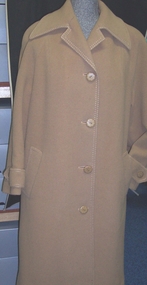 Whitehorse Historical Society Inc.
Clothing - Coat, c1980
... Ladies full length camel coloured coat, raglan sleeve style. Two side pockets. Tab and button decoration on sleeve. Four large buttons down front. Tabs on sleeves. Double saddle...Ladies full length camel coloured coat, raglan sleeve style. Two side pockets. Tab and button decoration on sleeve. Four large buttons down front. Tabs on sleeves. Double saddle ...c 1980 Ladies full length camel coloured coat, raglan sleeve style. Two side pockets. Tab and button decoration on sleeve. Four large buttons down front. Tabs on sleeves. Double saddle stitches in cream silk thread. Fully lined in rayon material and treated with acetate.Made In Englandcostume, female -
 Trafalgar Holden Museum
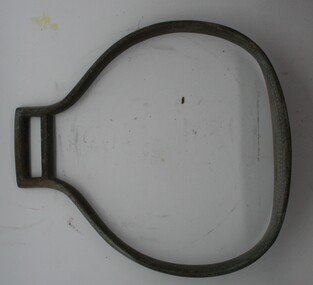
Functional object - Stirrup, Circa 1900
... Nickle plated semi circular stirrup designed for a person riding side saddle, to fit both feet, primarily ladies....Imported and sold by Holden and Frost Imported and sold by Holden and Frost steel stirrup double footed Nickle silver. horse shoe logo ,other too worn to decipher Nickle plated semi circular stirrup designed for a person riding side saddle, to fit both feet, primarily ladies. Functional object Stirrup ...Imported and sold by Holden and FrostImported and sold by Holden and FrostNickle plated semi circular stirrup designed for a person riding side saddle, to fit both feet, primarily ladies.Nickle silver. horse shoe logo ,other too worn to deciphersteel, stirrup, double footed -
 Heidelberg Golf Club
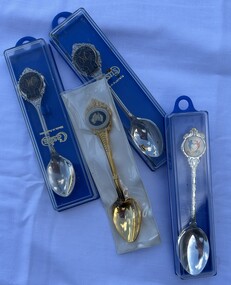
Memorabilia - Spoon, Heidelberg Golf Club, Spoon collection, 1968
... .; one ‘Heart 4kids’ (silverplate in box) and one ‘Australian Stud Saddle Pony Association’ (in plastic pouch, no manufacturer’s marks) spoon. pennant golf ladies pennant golf memorabilia spoons Spoons with logo in plastic boxes or plastic sleeve Spoon collection Memorabilia Spoon Heidelberg Golf Club Swan and Hudson Cash's ...2 x HGC spoons (Cash brand in box) presented to Lady Pennant players. First presented in 1968 to victorious pennant team.; one ‘Heart 4kids’ (silverplate in box) and one ‘Australian Stud Saddle Pony Association’ (in plastic pouch, no manufacturer’s marks) spoon. Spoons with logo in plastic boxes or plastic sleeve pennant golf, ladies pennant golf, memorabilia, spoons
