
Showing 13 items matching "lady's boots"
-
 Flagstaff Hill Maritime Museum and Village
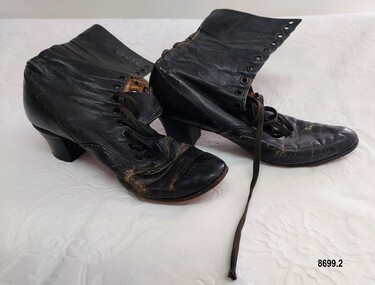
Footwear - Leather boots, Adler Boots and Shoes, circa 1920
... ...lady's boots...Pair of lady's black leather, lace up boots featuring 3.75 cm heels, 14 pairs of lacing eyelets, a black leather tongue and black shoelaces. ...Flagstaff Hill Maritime Museum and Village Great Ocean Road Shipwreck Coast Warrnambool boots lady's boots footwear leather boots lace up boots adler Stephenson family Both boots - "0/128 /X" (handwritten) and "6MC200" (stamped). ...This item is one of a collection of clothing items that belonged to the Stephenson family who lived at 22 McCracken Street, Kensington, Melbourne. Matthew Stephenson (1861 – 1943) who had grown up on the Bendigo goldfields and shifted to Melbourne in the early 1900’s was a train driver and later, a fireman with the railways. His wife Elizabeth Jane (Betsy) Wigley (1865 – 1953) also grew up on the goldfields around Majorca and Bendigo. They married in 1885 in Bendigo. They had two daughters – Ethel Evelyn Stephenson (1886 – 1956) and Lillian or Lila (1891 – 1977) who were milliners and dressmakers and who continued to live in the family home after the death of their parents. The family are recorded as living at 22 McCracken Street, Kensington, as early as 1914. It is not known who made or owned the clothing that makes up this collection but as it appears to be from the late Victorian and early Edwardian era, the different pieces were probably made and worn by any of the three ladies of the house – Betsy, Ethel and/or Lila. During W.W.2, a local Warrnambool couple (Meryl and Tony Everard) boarded with them – Tony was in the airforce training paratroopers to jump into (and survive) enemy territory and his wife Meryl worked in the Methodist baby Home. The Everards developed a close friendship with the Stephensons and were responsible for clearing out the house (and finding this clothing collection) after Lila died in 1977. Starting in around 1850, women began wearing boots that resembled the ones already worn by men in high society. Victorian women's boots were slightly more feminine in nature, however, than those worn by their male counterparts. The boots first worn by women extended to the middle of the calf so that her ankle would stay properly covered underneath her many skirts. These boots often featured laces or a row of buttons to keep them secure to the foot and ankle. Although usually made from durable materials like rubber and leather, boots that were worn purely for fashion were sometimes made of more elegant materials like patent leather or dyed suede. Edwardian boots were lace up or button up. The most remarkable thing about women's shoes in the 1920's was that they were visible! This led to an increase in demand for new styles every season which made ordering custom fit shoes a thing of the past. New shoes were made in standard sizes, ready to buy from local clothing stores or mail order catalogues. Working women, however, tended to wear sensible, lace up shoes and boots. These boots appear to be of a practical nature, designed for comfort, warmth, and proof against the rain and mud, rather than high fashion. They feature the brand name "adler" printed on the inner sole and have stamped letters and numbers suggesting ready-made sizes.This pair of boots are a significant example of a working woman's footwear dating around the early 20th century.Pair of lady's black leather, lace up boots featuring 3.75 cm heels, 14 pairs of lacing eyelets, a black leather tongue and black shoelaces. The leather soles have tacks on the heels and near the instep. The boots have a black leather inner sole and the inner shaft and upper part of the boots are lined with a durable cotton type fabric. Both boots have ink markings (handwritten and stamped) at the top of the shaft lining and the inner sole of the left hand boot is labelled "adler".Both boots - "0/128 /X" (handwritten) and "6MC200" (stamped). Left boot inner sole - "adler" left boot upper shaft lining - "X/8FH?" (handwritten)flagstaff hill maritime museum and village, great ocean road, shipwreck coast, warrnambool, boots, lady's boots, footwear, leather boots, lace up boots, adler, stephenson family -
 Kiewa Valley Historical Society
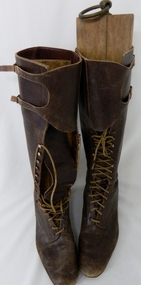
Boots Riding Women's, Circa 1950's
... These brown "knee high" lady riding boots, are fastened by long "boot" laces which go from the base of the "fastening" position to a boot height of 22 cm. ...These boots have high historical significance and good interpretive capacity. ladies riding boots. cattle mustering footwear. rural footwear. cattlemen. bogong high plains. roper family. horses. These brown "knee high" lady riding boots, are fastened by long "boot" laces which go from the base of the "fastening" position to a boot height of 22 cm. ...This pair of "adjustable" boots came from the 1950's era in which the majority of footwear was either locally manufactured or imported from England or Europe. Quality hard wearing leather was a rural necessity especially for the cattle mustering activity in the Kiewa Valley and the Bogong High Plains region. The late 1900's provided a cheaper made riding boot from Asia, however many rural based riders still prefer an Australian made boot. The better quality (stronger stitching) of Australian boots is the main considerations of "stock horse riders". In 1947 a scientific research project started to provide an impact analysis of any damage to alpine vegetation by cattle grazing in the Alpine regions incorporating the Bogong High Plains area. This monitoring is the longest running ecological study ever undertaken in Australia. From this study, compelling evidence was presented to the Victorian Government to cease cattle grazing in the Alpine regions including the Bogong High Plains. All grazing was banned by the Victorian Government in 2005. Recreational horse riding within the Bogong High Plains is still permitted.These pair of women's riding boots are very significant to the Kiewa Valley as the boots were worn by one of the descendants of a pioneer family living and operating a cattle station before the SEC Hydro Electricity Scheme opened up the semi remote rural location in the 1950's. These boots were worn during the annual six weeks (approx.) mustering of cattle in the Bogong High Plains location (Victorian Alps region). The owner of these boots was Clare Roper, part of the Roper Family who built a "lodging" hut on the "High Plains" for accommodating riders during the periods (up to six weeks) when controlling grazing cattle during the summer muster seasons. It was unusual for women in the early to mid 1900's to go up on the High Plains to join the muster, which Clare Roper often did. These boots have high historical significance and good interpretive capacity.These brown "knee high" lady riding boots, are fastened by long "boot" laces which go from the base of the "fastening" position to a boot height of 22 cm. At the top end of the boot is a leather flap which crosses the front section of the boot and is fastened to the outside leg region by two straps. These provide the wearer with an adjustable tie. The boot has a "tongue" of 22 mm long. The boot has six pairs of metal boot lace "hooks" and eight pairs of boot lace "eyelets".ladies riding boots. cattle mustering footwear. rural footwear. cattlemen. bogong high plains. roper family. horses. -
 Warrnambool and District Historical Society Inc.
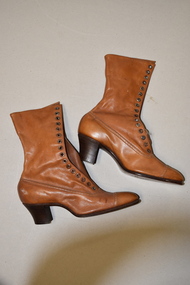
H. Perry & Co, Brown lace up boots x 2, 1906
... This is a pair of a lady’s light brown leather boots. The boots have long leather tongues with 16 eyelets either side to lace up the front instep. ...boots were an essential item for women who often had to walk through unmade streets and muddy paddocks. This item is of interest as it is a memento of an important New Zealand Exhibition early in the 20th century. Vintage Footwear Christchurch New Zealand Exhibition, 1906-7 H. Perry & Co. New Zealand International Exhibition Christchurch 1906-7 This is a pair of a lady’s ...These boots may have been made as a sample as they are a very small size and do not appear to have been worn. They come from the New Zealand International Exhibition held at Hagley Park, Christchurch from November 1906 to April 1907. This exhibition was the brainchild of the New Zealand Prime Minister, Richard Seddon who died before the exhibition opened. Nearly 2 million people visited the exhibition at a time when the population of New Zealand was less than one million. The exhibition was thus rated a success even though there was a financial loss. No information has been found on the bootmakers, H. Perry & Co. In the 19th and early 20th centuries boots were an essential item for women who often had to walk through unmade streets and muddy paddocks. This item is of interest as it is a memento of an important New Zealand Exhibition early in the 20th century. This is a pair of a lady’s light brown leather boots. The boots have long leather tongues with 16 eyelets either side to lace up the front instep. The laces are missing. The wooden heels are slightly raised. H. Perry & Co. New Zealand International Exhibition Christchurch 1906-7 vintage footwear, christchurch new zealand exhibition, 1906-7 -
 Bendigo Historical Society Inc.
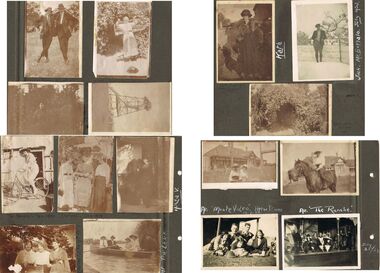
Photograph - HILDA HILL COLLECTION: BLACK AND WHITE PHOTO, 1919-1924
... Three ladies, the lady on the left is wearing a white dress with a black belt and holding in her right hand a small bag with a handle, the middle lady is wearing a dress of another colour with three strips of material at different levels on the front and holding her hands at her waist, also wearing lace up boots, lady to the right is wearing a white blouse and a dark skirt and her hands behind her back, background is garden, 'Durvol' December 1919. ...Three ladies, the lady on the left is wearing a white dress with a black belt and holding in her right hand a small bag with a handle, the middle lady is wearing a dress of another colour with three strips of material at different levels on the front and holding her hands at her waist, also wearing lace up boots, lady to the right is wearing a white blouse and a dark skirt and her hands behind her back, background is garden, 'Durvol' December 1919. ...Hilda Hill Collection. Combination of Sepia and Black & White Photos. (Total 16.) two men with arms on each others shoulders, both with legs crossed, background shows large group of people and large trees, Hibernian Picnic November 19th 1919. Elderly lady holding two bird cages with birds therein standing in front of large flowering bush, the lady is dressed in all white and her hat lies on the ground in front of her, the hat appears to have flowers on the brim. Mrs Mc'Rosebower' October 1919. Hilda V. Standing with a background of shrubbery, wearing a dark dress, photo not very clear, 'The Ranche' March 1921. The Pinnacle One Tree Hill, people on the top lookout area and the wooden staircase for access, note the iron roof at the first level to provide shelter at ground level, April 1920. Lady on a ladies bicycle, dressed in geometric patterned dress, in front of an old shed with a corrugated iron roof. The bicycle has a front and rear mudguard, 'The Ranche' January 1920. Three ladies, the lady on the left is wearing a white dress with a black belt and holding in her right hand a small bag with a handle, the middle lady is wearing a dress of another colour with three strips of material at different levels on the front and holding her hands at her waist, also wearing lace up boots, lady to the right is wearing a white blouse and a dark skirt and her hands behind her back, background is garden, 'Durvol' December 1919. Photo of young girl dressed in black standing next to a small bush with her back to a house exterior wall, to the left is a white wall, NO Details.Three ladies standing beneath a large tree arm in arm, left girl is wearing a white top with a black belt and dark skirt, Centre girl is wearing a white top and dark skirt, girl at right wearing coloured? Dress with matching sash belt,'Durvol' December 19th 1919. Two men and three ladies in a rowing boat on lake Weeroona, both men are wearing dark suits and hats, the ladies are all in light coloured clothing and also wearing large brimmed hats. Kath wearing a black dress with a fox skin stole and holding a large bag in her right hand in garden setting, left background is a corrugated iron fence with wooden top rail, to the right is the wall of a building, September 1919 'the Ranche'. Jack wearing a black coat and jodhpurs with a white high neck jumper leaning on a wire and netting farm type fence, Mt. Buffalo July 1923. Photo of a 'Rosebower' in a garden corner, right shows part of a picket fence, wear and tear indicates that a gate may be in the fence accessible through the bower, October 1919. Two ladies holding tennis racquets, dressed in white blouses with one dark dress and the other a lighter shade sitting on stool inside a netted tennis court, both ladies are wearing large brimmed hats, background is a house with a water tank on the left end, three decorative chimneys, tiled roof, decorative panelling below the guttering, 'Kilmuir' October 1919. Lady on dark coloured horse, the lady is wearing a white blouse and jodhpurs and a large brimmed hat, background is house showing a bow window three chimneys and a small portion of the decorative fretwork below the gutter line of the verandah, 'Kilmuir' October 1919. Two young men dressing collar and tie one wearing a coat and three young ladies reclining on the ground, girl on the left is wearing a light coloured dress white blouse and cardigan, middle girl wearing a short sleeved top, right lady is wearing white blouse and dark coat, in foreground there appears to be a pudding meat and a wine bottle, left edge another male can be partially seen lying on the ground with a bottle in his left hand, at 'Monte Video' after dinner 18 July 1924. Ten people sitting and standing on a veranda, 'The Ranche', celebrating an event, small 4 wheel table with food, person front left holding a white cup and saucer, July 1924.australia, history, victoria post war touring boom, http://www.yourbrisbanepastandpresent.com/2012_02_01_archive.html -
 Orbost & District Historical Society
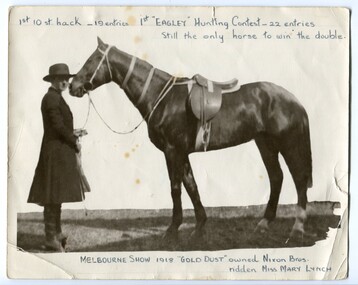
black and white photograph, 1918
... A black / white photograph of a lady dressed in a a tailored hip coat, bowler hat, knee breeches and boots. She is holding the reins of a saddled horse. ...Still the only horse to win the double." on front at bottom - " MELBOURNE SHOW 1918 "GOLD DUST" owned by Nixon Bros ridden by Miss MARY LYNCH" A black / white photograph of a lady dressed in a a tailored hip coat, bowler hat, knee breeches and boots. She is holding the reins of a saddled horse. ...Mary Lynch was the daughter of Matthew and Mary (nee Loorham) Lynch. She became Mrs Ivell. she was a noted horse-woman having ridden the Nixon Bros hack, "Gold Dust" at the Melbourne Show coming first in the 10 stone hack and first in the Eagley Hunting Contest. (info. Mary Gilbert) Horse racing was a popular past-time in early Orbost. The Nixon family was involved through Keith Nixon. Some of the earliest horse races were held on a course in a paddock belonging to Mr James Cowell at Jarrahmond. For a long time horse races were part of the Marlo Picnic Races.This item is connected to an activity once popular in the Orbost district. The Nixon family were prominent early settlers in the Orbost district.A black / white photograph of a lady dressed in a a tailored hip coat, bowler hat, knee breeches and boots. She is holding the reins of a saddled horse. There is a copy.on front at top - " 1st 10st hack - 19 entries 1st "EAGLEY" Hunting Contest - 22 entries. Still the only horse to win the double." on front at bottom - " MELBOURNE SHOW 1918 "GOLD DUST" owned by Nixon Bros ridden by Miss MARY LYNCH"lynch-mary nixon-bros-horses equestrian melbourne-show gold-dust -
 Orbost & District Historical Society
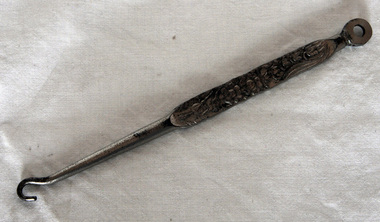
button hook, 1895 – 1905
... This item is an example of a commonly used accessory no longer relevant. clothing footwear gaiters boots button-hook A button hook made of metal with a beaten silver handle ornately decorated with scrolls and foliate design. At the top is a small ring on the handle end. This could have been for a lady ...Button hooks were used to fastens buttons on boots and long gloves. It is a tool used for the closing of shoes, gloves or other apparel that uses buttons as fasteners. The steel hook end is inserted through the buttonhole to capture the button by the shank and draw it through the opening. This hook is most likely to have been used to do up bootsWomen and young girls generally wore boots that were either front laced or side buttoned, particularly in the period from the 1870s . Buttonhooks were needed to do up the buttons on buttoned boots and were used by poking the metal hook through the buttonhole, grabbing the button and pulling it through the eyelet. This item is an example of a commonly used accessory no longer relevant.A button hook made of metal with a beaten silver handle ornately decorated with scrolls and foliate design. At the top is a small ring on the handle end. This could have been for a lady to attach the item to her chatelaine at her belt, or on a necklace. clothing footwear gaiters boots button-hook -
 City of Moorabbin Historical Society (Operating the Box Cottage Museum)
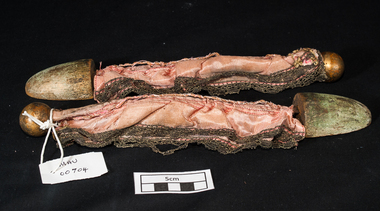
Clothing, shoe stretchers, 20thC
... Shoe stretchers work best for suede, leather, and other natural materials. boots, shoes, footwear, bootmakers, leatherworkers, early settlers, pioneers, market gardeners, moorabbin, bentleigh, cheltemham, shoe stretchers, A pair of lady's wooden shoe stretchers, decorated with pink lace Clothing, shoe stretchers Unrecorded bootmaker ...Shoe stretchers can expand the width and the length of shoes. Shoes can shrink, feet can swell and bunions, corns or other foot imperfections can make the shoes hurt.. Shoe stretchers work best for suede, leather, and other natural materials. A pair of lady's wooden shoe stretchers, decorated with pink laceboots, shoes, footwear, bootmakers, leatherworkers, early settlers, pioneers, market gardeners, moorabbin, bentleigh, cheltemham, shoe stretchers, -
 Bendigo Military Museum
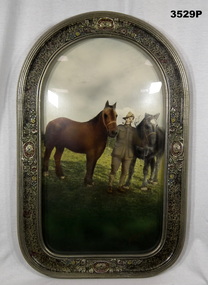
Print - PRINT WW1, FRAMED, Post WW1
... Lady. Photo was taken near Villers-Bretonneux. For photo of the four Gillies brothers, refer to Cat No 3531. For book refer to Cat No 3534. Photographs framed Written in black texta on back: “Donated by J Gillies” Stamped on back: “Empire Art Company Ltd” Photographic print in colour of a soldier smoking a pipe. He is in uniform - slouch hat, jacket, trousers, puttees & boots ...The soldier in the photo is Nr 1366, Dvr Donald GILLIES of the 4th Field Artillery Brigade. The grey horse, Bess, was blinded by shell fire. The bay horse was Lady. Photo was taken near Villers-Bretonneux. For photo of the four Gillies brothers, refer to Cat No 3531. For book refer to Cat No 3534.Photographic print in colour of a soldier smoking a pipe. He is in uniform - slouch hat, jacket, trousers, puttees & boots, alongside 2 horses. Print is mounted in wooden decorative frame with floral arrangements at top, bottom & both sides. Frame is rounded at top & at each corner with curved glass front. Wire hanging strap on back.Written in black texta on back: “Donated by J Gillies” Stamped on back: “Empire Art Company Ltd”photographs, framed -
 Bendigo Historical Society Inc.
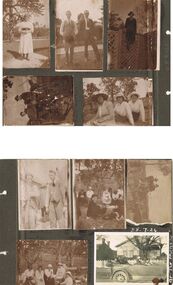
Photograph - HILDA HILL COLLECTION: BLACK AND WHITE PHOTOS, 1919-1924
... Dark photo shows a young lady sitting at the top of a trellis fence, she is wearing dark clothing, her blouse has a white collar, hat with bow above her right shoulder, background shows the tops of two trees, Durvol August 1919. 1 man dressed in dark suit and hat, one boy sitting on the seat, both boys are wearing dark clothing and the boy standing is also wearing long dark socks and boots, the large two wheeled carriage, to the right is a gable roofed shed and top right background a large tree branch, Durvol August 3 1919. 3 ladies seated on the ground first lady on left wears a large brimmed hat with light coloured clothing, other 2 ladies are wearing white blouses and dark skirts each with a light coloured hats. 3 men 2 facing the camera and the other facing to the rear, the front 2 are wearing grey trousers and waistcoats man on right has dark tie and smoking a pipe, man facing the rear wears a hat and grey suit, gable roof of a building is in the background November 29 1919. ...Dark photo shows a young lady sitting at the top of a trellis fence, she is wearing dark clothing, her blouse has a white collar, hat with bow above her right shoulder, background shows the tops of two trees, Durvol August 1919. 1 man dressed in dark suit and hat, one boy sitting on the seat, both boys are wearing dark clothing and the boy standing is also wearing long dark socks and boots, the large two wheeled carriage, to the right is a gable roofed shed and top right background a large tree branch, Durvol August 3 1919. 3 ladies seated on the ground first lady on left wears a large brimmed hat with light coloured clothing, other 2 ladies are wearing white blouses and dark skirts each with a light coloured hats. 3 men 2 facing the camera and the other facing to the rear, the front 2 are wearing grey trousers and waistcoats man on right has dark tie and smoking a pipe, man facing the rear wears a hat and grey suit, gable roof of a building is in the background November 29 1919. ...Black & White Photographs Series of 10 depicting life for the Hill Family in 1919, young lady standing near large tree wearing a white dress with black waist sash and dark stockings rear background shows the gable roof and 4 chimneys all behind a large hedge, Durvol December 14 1919 In garden setting man on left wearing grey trousers and what appears to be a bag attached via a string to his waist, grey waistcoat white shirt and dark tie, other gentleman is wearing a dark suit white shirt and dark tie,background shows a hedge and tops of trees, a gable roofed building looms above hedge to centre right, Durvol December 14 1919. Dark photo shows a young lady sitting at the top of a trellis fence, she is wearing dark clothing, her blouse has a white collar, hat with bow above her right shoulder, background shows the tops of two trees, Durvol August 1919. 1 man dressed in dark suit and hat, one boy sitting on the seat, both boys are wearing dark clothing and the boy standing is also wearing long dark socks and boots, the large two wheeled carriage, to the right is a gable roofed shed and top right background a large tree branch, Durvol August 3 1919. 3 ladies seated on the ground first lady on left wears a large brimmed hat with light coloured clothing, other 2 ladies are wearing white blouses and dark skirts each with a light coloured hats. 3 men 2 facing the camera and the other facing to the rear, the front 2 are wearing grey trousers and waistcoats man on right has dark tie and smoking a pipe, man facing the rear wears a hat and grey suit, gable roof of a building is in the background November 29 1919. Group of men and women enjoying a picnic two of the men are seated and both wear dark hats and dark suits with white shirts and dark ties, all of the ladies are wearing hats white blouses, one a light coloured skirt and other 2 dark skirts, bush setting with hill in background, Hibernian Picnic 1919. Four wheeled carriage drawn by one dark horse, the two passengers are dressed in dark suits and hats, a whip is mounted in the front foot well, right background is a standing lady dressed in a white blouse and dark skirt, also tree in left background, 25 July 1924. Group of ladies seated two wearing light coloured hats and all wearing white blouses four are in dark skirts, background is wooded area right background is a post and rail fence, Hibernian Picnic 1919. Old vehicle with five passengers, two ladies in the front one driving and a man and two more ladies in the rear seat, all are wearing dark clothing, gabled roof house in background with white picket fence, left background shows another gable roofed building two chimneys dark appearance.Hilda Hill Personal Collectionaustralia, history, post war life -
 Bendigo Historical Society Inc.
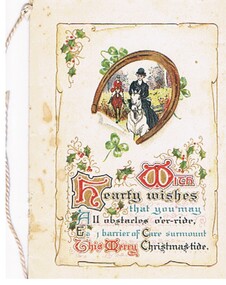
Document - MALONE COLLECTION: GREETING CARDS
... The lady is wearing a black riding habit and hat and is riding side-saddle. The gentleman is wearing a red jacket and white trousers and black boots and hat. ...The lady is wearing a black riding habit and hat and is riding side-saddle. The gentleman is wearing a red jacket and white trousers and black boots and hat. ...Whitish card with gold border 15mm from the edge. At the top is a brown horseshoe with a coloured scene of a lady and gentleman riding horses. The lady is wearing a black riding habit and hat and is riding side-saddle. The gentleman is wearing a red jacket and white trousers and black boots and hat. There is holly and red berries in the top left corner and below the horseshoe. There are clover leaves around and the horseshoe. Beneath is a verse printed in red, gold, black and blue. Card and insert held together with a pink cord. Card from Mr and Mrs Martin.person, greeting cards, malone collection, malone collection, greeting cards, mr and mrs martin -
 Ballarat Tramway Museum
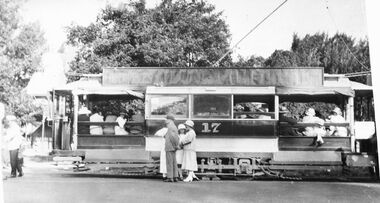
Photograph - ESCo tram 17 Wendouree Parade, Jim Cox, mid 1920s
... The lady standing nearest to the number of the tram is wearing a Charleston dance style skirt with a lower belt line and the Charleston dance style shoes - more around the top of the legs. The gentleman alongside has his trouser hem length high than normal to expose the shoes or boots...The lady standing nearest to the number of the tram is wearing a Charleston dance style skirt with a lower belt line and the Charleston dance style shoes - more around the top of the legs. The gentleman alongside has his trouser hem length high than normal to expose the shoes or boots ...Digital image of Electric Supply Co. well loaded, tram No. 17 in the Gardens, mid 1920s. Two images of the same photograph - the first has been straightened up. Photo by Jim Cox. Original held by the Brunswick Community History Group. Side on view of the tram shows the hand brake mechanism in the front cab, lifeguards, magnetic brakes, the seating arrangement, the step guards and rolled up blinds. It has an roof advert for the Ballarat Coliseum. In front of the tram appears to be the driver wearing a white summer jacket and cap. The lady standing nearest to the number of the tram is wearing a Charleston dance style skirt with a lower belt line and the Charleston dance style shoes - more around the top of the legs. The gentleman alongside has his trouser hem length high than normal to expose the shoes or boots. In the background is the Gardens Kiosk roof.Yields information about ESCo tram 17 and the travellers of the mid 1920s in Ballarat.Digital image of a black and white photograph.esco, tram 17, wendouree parade, one man trams -
 Ararat Gallery TAMA
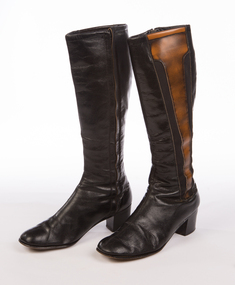
Clothing, Wittners (Made for), Italy, Boots - pair
... As the wife of Sir Andrew Grimwade, a prominent businessman, Chairman of several boards and a Trustee of various committees, Lady Grimwade met with royalty, heads of state, politicians, corporate directors, and horse and cattle breeders. Excerpt from 'Hot Pink Summers' catalogue essay, Helen Jackson, 1995. Boots ...The Lady Barbara Grimwade Costume Collection is comprised of Lady Barbara Grimwade's personal apparel and includes 145 pieces of clothing, 10 hats, 19 handbags, 66 pairs of shoes and assorted accessories of gloves, belts and scarves. In its breadth, this significant acquisition ranges from the mundane to the memorable, therefore giving a balanced representation of one person's taste. Following Lady Barbara Grimwade’s death in March 1990, Ararat Gallery formally accepted the generous gift of clothing and accessories donated by Lady Grimwade's son, Mr Angus K Grimwade, on 28 August 1991. Subsequent smaller donations in 1995 enhanced the collection. Lady Grimwade's Scottish forebears, the Gaerloch Campbells, first settled in Australia in 1861 in the Ararat-Beaufort district. Her great great grandfather, Mr Henry Campbell, died on the voyage to Australia. His widow, Jane, with 10 of her 13 children, farmed and grazed land, firstly at Stockyard Hill then at Fiery Creek, near Buangor, before leaving the shire in 1873. Lady Grimwade held a privileged position in Melbourne society. As the wife of Sir Andrew Grimwade, a prominent businessman, Chairman of several boards and a Trustee of various committees, Lady Grimwade met with royalty, heads of state, politicians, corporate directors, and horse and cattle breeders. Excerpt from 'Hot Pink Summers' catalogue essay, Helen Jackson, 1995. -
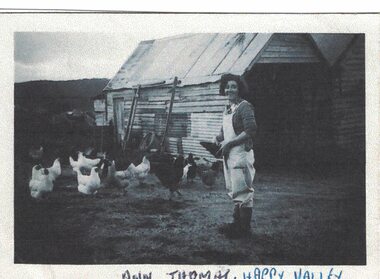 Linton and District Historical Society Inc
Photograph, Ann Thomas
... Black and white copy of original photograph of a lady wearing light coloured overalls and rubber boots, outside with chickens, a weatherboard shed in the background....Ann Thomas (nee Hanrahan) farm chickens Black and white copy of original photograph of a lady wearing light coloured overalls and rubber boots, outside with chickens, a weatherboard shed in the background. ...Black and white copy of original photograph of a lady wearing light coloured overalls and rubber boots, outside with chickens, a weatherboard shed in the background.ann thomas (nee hanrahan), farm, chickens
