
Showing 9 items matching "lady elizabeth loch"
-
 Flagstaff Hill Maritime Museum and Village
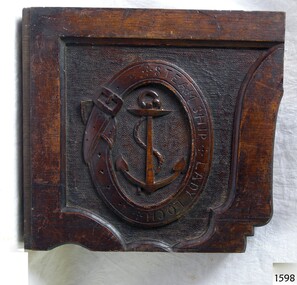
Furniture - Carved Panel, Campbell, Sloss and McCain, ca. 1886
... Lady Loch...steamship...HMV...Colonial Navy...Victoria...Lady Elizabeth...Lady Loch performed Customs duties and serviced the lighthouses along the coast. The scale could have measured goods for the Customs Tax, or for measuring out supplies for the lighthouse keepers. The vessel was named after Lady Elizabeth...Lady Loch performed Customs duties and serviced the lighthouses along the coast. The scale could have measured goods for the Customs Tax, or for measuring out supplies for the lighthouse keepers. The vessel was named after Lady Elizabeth ...There were at least three 1880s vessels named Lady Loch, all built in Victoria; a river launch (ca 1884-ca 1916, originally named Lady of the Lake), a steamer ferry (1884-1920s) and a government lighthouse tender steamer HMV Lady Loch (1886-1962.) The carved wooden panel was removed from the HMV SS Lady Loch before the vessel was scuttled in 1962. About HMV SS Lady Loch: - The HMV SS Lady Loch was an iron steamship built in Footscray, Melbourne, by Campbell, Sloss and McCain in 1886 for the colonial Victorian government’s Department of Trade and Customs. It was armed with a 6-inch gun and two 1-inch Nordenfelt guns. The Sydney Morning Herald of 27th January 1888 describes the vessel in detail. It even comments on the interior of the Saloon “The wood work … is on a very elaborate scale and is exceedingly neat …”. The HMV Lady Loch performed Customs duties and serviced the lighthouses along the coast. The scale could have measured goods for the Customs Tax, or for measuring out supplies for the lighthouse keepers. The vessel was named after Lady Elizabeth Loch, wife of Sir Henry Loch, Governor of Victoria from 1884 to 1889. In 1932 Lady Loch was converted to a hulk and used in Brisbane, and finally scuttled in 1962 at Moreton Bay, Queensland. The carved wood panel has importance due to its connection to the 1886 HMV Lady Loch, a vessel of great significance to Melbourne’s shipbuilding industry. It was the largest auxiliary vessel in the Victorian Colonial Government’s fleet and the first prominent vessel launched by Melbourne’s shipbuilding industry. It is significant to the history of the Victorian era and the colonial navy's steamship HMV SS Lady Loch. The vessel carried out Custom's work, and the scales were available to weigh goods that could attract taxes and goods for distribution to lighthouse keepers. The HMV Lady Loch was also important part of Victoria's maritime history, its communication with and support of the lighthouse keepers along the coast of Victoria.Heavy carved wooden panel, square, representing a framed plaque. The bottom and right edges are scalloped on the outer and inner edges. A carved oval within the frame represents a wide belt with buckle and tongue, and indents for the belt holes on its left and a carved inscription runs from top centre to bottom centre on the right side of the belt. Within the belt is the maritime symbol of an upright anchor in front of a rope. It was once part of the furnishing of the steamer HMVS Lady Loch and was removed before the ship was scuttled.Carved within the belt: "STEAM SHIP LADY LOCH"warrnambool, shipwreck coast, flagstaff hill, flagstaff hill maritime museum, flagstaff hill maritime village, scale, salter, spring balance, silvester's patent, lady loch, steamship, hmv, colonial navy, victoria, lady elizabeth loch, custom's vessel, lighthouse tender, 1886, government vessel, victorian government, wood panel, timber panel, carved panel, carved log, lady loch logo, belt enclosing and anchor, anchor within belt, lady loch steam ship, wooden panel, ship's furinshing, ship's panel, ship's logo, great ocean road, government steamer, victorian colonial government, colonial vessel, public works, bass straight, hmv lady loch, hmvs lady loch, hmv ss lady loch, melbourne, melbourne shipbuilder, ship furnishings, wooden furnishings, decorative panel, carved emblem, carved logo, carved symbol, campbell stoss and mccain, government tender, victorian customs -
 Flagstaff Hill Maritime Museum and Village
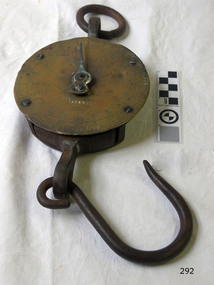
Instrument - Scale, George Salter & Co, ca. 1886
... Lady Loch...steamship...HMV...Colonial Navy...Victoria...Lady Elizabeth...Lady Loch performed Customs duties and serviced the lighthouses along the coast. The scale could have measured goods for the Customs Tax, or for measuring out supplies for the lighthouse keepers. The vessel was named after Lady Elizabeth...Lady Loch performed Customs duties and serviced the lighthouses along the coast. The scale could have measured goods for the Customs Tax, or for measuring out supplies for the lighthouse keepers. The vessel was named after Lady Elizabeth ...There were at least three 1880s vessels named Lady Loch, all built in Victoria; a river launch (ca 1884 to ca 1916, originally named Lady of the Lake), a steamer ferry (1884 to 1920s), and a government lighthouse tender steamer HMV Lady Loch (1886 to 1962). The spring balance scale was part of the equipment on the HMV Lady Loch. The scale was made by the renowned company Salter Weighing Machines in the United Kingdom, to Silvester's patent design. Salter Weighing Machines, Britain, began making spring scales in the 1820s. In 1908 Salter opened up an Australian branch named Salter Scales Pty. Ltd. The scale is marked HMV SS Lady Loch. It would be suspended by its top ring, a basket or other container is hung from the hook, and the items inside the basket are then pulled downwards on the hook, which stretches the springs inside the works. The pulling action moves a rack and gears a calculated distance and the gears turn the pointer on the dial to indicate the weight of the goods. This scale measures up to 200 pounds capacity. The HMV SS Lady Loch was an iron steamship built in Footscray, Melbourne, by Campbell, Sloss and McCain in 1886 for the colonial Victorian government’s Department of Trade and Customs. It was armed with a 6-inch gun and two 1-inch Nordenfelt guns. The Sydney Morning Herald of 27th January 1888 describes the vessel in detail. It even comments on the interior of the Saloon “The wood work … is on a very elaborate scale and is exceedingly neat …”. The HMV Lady Loch performed Customs duties and serviced the lighthouses along the coast. The scale could have measured goods for the Customs Tax, or for measuring out supplies for the lighthouse keepers. The vessel was named after Lady Elizabeth Loch, wife of Sir Henry Loch, Governor of Victoria from 1884 to 1889. In 1932 Lady Loch was converted to a hulk and used in Brisbane, and finally scuttled in 1962 at Moreton Bay, Queensland.The scale has importance due to its connection to the 1886 HMV Lady Loch, a vessel of great significance to Melbourne’s shipbuilding industry. It was the largest auxiliary vessel in the Victorian Colonial Government’s fleet and the first prominent vessel launched by Melbourne’s shipbuilding industry. The scale is also important for its connection with the colonial navy's Custom's work, as the scale was available to weigh goods that could attract taxes and deal out goods for distribution to lighthouse keepers. The HMV Lady Loch was also important part of Victoria's maritime history for its communication and support of the lighthouse keeper's along the coast of Victoria.Scale; Salter's spring balance mechanical hanging scale, brass and iron. Equally spaced marks around the circular dial have values from 0 to 200 in increments of 10, each increment is also divided into 10. An iron ring is attached to a fitted loop on the top of the scale, and an iron hook is attached to the fitted loop onthe bottom of the scale. A moving pointer attached to the centre of the dial has a calibration screw joined to its base. Four screws fix the brass face to the works at the back. There are stamped and embossed inscriptions. Made by Salter in Britain, to Silvester's Patent design. The scale was once equipment carried abourd the steamship HMV SS Lady Loch. Stamped: "SALTER'S / SPRING BALANCE" "SILVESTOR'S / PATENT" Embossed in script: "HMV SS / Lady Loch"warrnambool, shipwreck coast, flagstaff hill, flagstaff hill maritime museum, flagstaff hill maritime village, scale, salter, spring balance, silvester's patent, lady loch, steamship, hmv, colonial navy, victoria, lady elizabeth loch, custom's vessel, lighthouse tender, 1886, government vessel, victorian government, measuring instrument, weight, weighing instrument, mechanical scale, hanging scale, hmv lady loch, weights and measures, silvestor's patent, george salter & co. -
 Williamstown Historical Society Inc
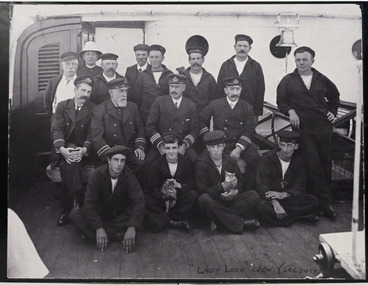
Photograph - Photograph of the Lady Loch crew
... SS Lady Loch was built in Melbourne, in Footscray, by Anderson Campbell. The ship was named after Lady Elizabeth Loch, wife of Sir Henry Loch, Governor of Victoria from 1884 -1889. ...SS Lady Loch was built in Melbourne, in Footscray, by Anderson Campbell. The ship was named after Lady Elizabeth Loch, wife of Sir Henry Loch, Governor of Victoria from 1884 -1889. ...SS Lady Loch was built in Melbourne, in Footscray, by Anderson Campbell. The ship was named after Lady Elizabeth Loch, wife of Sir Henry Loch, Governor of Victoria from 1884 -1889. It was originally used by the Victorian Ports and Harbours Branch for coastal and bay work. By 1908 it was being used as a Commonealth lighthouse tender.Large black and white group photograph of 16 male crew members of the 'Lady Loch', a Lighthouse Tender which docked at Williamstown. Crew shown in photograph: BACK ROW, L to R: J. McEWan, cook; Unknown: Mr. Prince, steward; Unknown; Unknown; Mr. Nelson, fireman; Unkown CENTRE ROW, L to R: Mr. Bradley, 2nd officer; Captain Bolger; Mr.Trace, 1st officer (later captain); Unknown; Unkkown FRONT ROW, L to R: Unknown; Clarence "chicken" Young, seaman (later father of Betty Young) (Unknown); Doug Geary" "Lady Loch" crew" -
 Williamstown Historical Society Inc
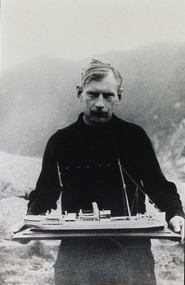
Photograph - Model ship "Lady Loch" with maker
... SS Lady Loch was built in Melbourne, in Footscray, by Anderson Campbell. The ship was named after Lady Elizabeth Loch, wife of Sir Henry Loch, Governor of Victoria from 1884 -1889. ...SS Lady Loch was built in Melbourne, in Footscray, by Anderson Campbell. The ship was named after Lady Elizabeth Loch, wife of Sir Henry Loch, Governor of Victoria from 1884 -1889. ...SS Lady Loch was built in Melbourne, in Footscray, by Anderson Campbell. The ship was named after Lady Elizabeth Loch, wife of Sir Henry Loch, Governor of Victoria from 1884 -1889. It was originally used by the Victorian Ports and Harbours Branch for coastal and bay work. By 1908 it was being used as a Commonealth lighthouse tender. The maker of the "Lady Loch" model, holding his model. He was reputed to be a Polish crewman on the ship. He is dressed in a dark jumper, with a view of waves and a rugged coastline in the background. model maker, model ship, lady loch -
 Williamstown Historical Society Inc
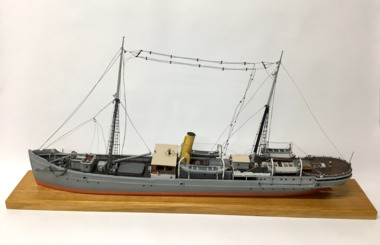
Model - Ship model 'Lady Loch', 1946
... SS Lady Loch was built in Melbourne, in Footscray, by Anderson Campbell. The ship was named after Lady Elizabeth Loch, wife of Sir Henry Loch, Governor of Victoria from 1884 -1889. ...SS Lady Loch was built in Melbourne, in Footscray, by Anderson Campbell. The ship was named after Lady Elizabeth Loch, wife of Sir Henry Loch, Governor of Victoria from 1884 -1889. ...SS Lady Loch was built in Melbourne, in Footscray, by Anderson Campbell. The ship was named after Lady Elizabeth Loch, wife of Sir Henry Loch, Governor of Victoria from 1884 -1889. It was originally used by the Victorian Ports and Harbours Branch for coastal and bay work. By 1908 it was being used as a Commonealth lighthouse tender. Made by an unnamed maker, believed to be a Polish seaman who worked on board the Lady Loch.Model of the steam ship “Lady Loch”, painted grey, red below waterline, two masts, rattlins on side shrouds, single funnel, two lifeboats port and starboard, varnished bridge coach house, boom on foremast, anchor catted at bow port and starboard, radio aerials strung between masts.On bow: "LADY LOCH" -
 Williamstown Historical Society Inc
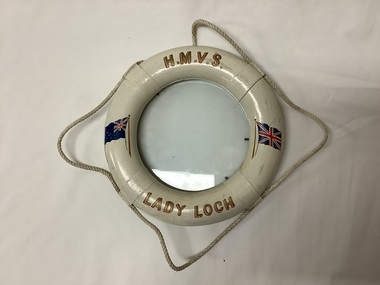
Domestic object - Picture frame, HMVS Lady Loch
... The lighthouse tender "Lady Loch" was built in 1886 by Campbell, Sloss & McCann in Footscray, for the Victorian Dept of Public Works. The ship was named after Lady Elizabeth Loch, wife of Sir Henry Loch, Governor of Victoria from 1884 -1889. ...The lighthouse tender "Lady Loch" was built in 1886 by Campbell, Sloss & McCann in Footscray, for the Victorian Dept of Public Works. The ship was named after Lady Elizabeth Loch, wife of Sir Henry Loch, Governor of Victoria from 1884 -1889. ...The lighthouse tender "Lady Loch" was built in 1886 by Campbell, Sloss & McCann in Footscray, for the Victorian Dept of Public Works. The ship was named after Lady Elizabeth Loch, wife of Sir Henry Loch, Governor of Victoria from 1884 -1889. It was an iron steamship of 531 tons. Built for use as a lighthouse tender, it serviced lighthouses around the south east coast and Tasmania and was docked at Williamstown. Owned by Victorian Ports and Harbours Dept. Picture frame shaped as a life buoy, with rope decoration, under glasss, decorated with the Australian and UK flags."H.M.V.S. Lady Loch" -
 Williamstown Historical Society Inc
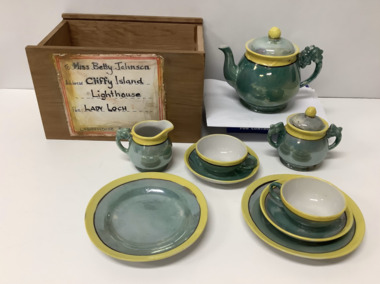
Domestic object - Child's ceramic tea set
... The Lady Loch was a Lighthouse Tender built in 1886 by Campbell, Sloss & McCann in Footscray, for the Victorian Dept. of Public Works. The ship was named after Lady Elizabeth...The Lady Loch was a Lighthouse Tender built in 1886 by Campbell, Sloss & McCann in Footscray, for the Victorian Dept. of Public Works. The ship was named after Lady Elizabeth ...The Lady Loch was a Lighthouse Tender built in 1886 by Campbell, Sloss & McCann in Footscray, for the Victorian Dept. of Public Works. The ship was named after Lady Elizabeth Loch, wife of Sir Henry Loch, Governor of Victoria from 1884 -1889. It was an iron Steamship of 531 tons. Built for use as a lighthouse tender and serviced lighthouses around the south east coast and Tasmania. Owned by Victorian Ports and Harbours Department. Register closed in September 1935 when the vessel was converted to a hulk at Brisbane. Official Number: 88946 Length: 182' Plywood box containing a child's Japanese ceramic toy tea set. Total of eleven pieces in irridescent green ceramic with yellow and black decorative edges. The plywood box is not original. Comprises: One teapot with lid One sugar bowl with lid One milk jug Two cups and saucers Two side platesOn teapot, milk jug, two plates and saucers: ''Made in Japan'' . Address label on front of the box: "To Miss Betty/Johnson/Cliffy Island Lighthouse/Lady Loch" -
 Williamstown Historical Society Inc
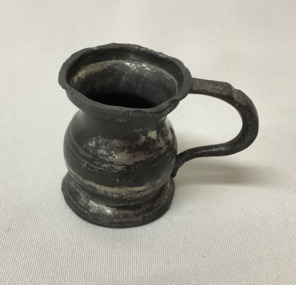
Domestic object - Pewter rum measure
... The lighthouse Tender "Lady Loch" was built in 1886 by Campbell, Sloss & McCann in Footscray, for the Victorian Dept of Public Works. It was an iron steamship of 531 tons. The ship was named after Lady Elizabeth...The lighthouse Tender "Lady Loch" was built in 1886 by Campbell, Sloss & McCann in Footscray, for the Victorian Dept of Public Works. It was an iron steamship of 531 tons. The ship was named after Lady Elizabeth ...The lighthouse Tender "Lady Loch" was built in 1886 by Campbell, Sloss & McCann in Footscray, for the Victorian Dept of Public Works. It was an iron steamship of 531 tons. The ship was named after Lady Elizabeth Loch, wife of Sir Henry Loch, Governor of Victoria from 1884 -1889. Built for use as a lighthouse tender, it serviced lighthouses around the south east coast and Tasmania and was docked at Williamstown. Owned by Victorian Ports and Harbours Dept. Register closed in September 1935 when the vessel was converted to a hulk at Brisbane. Official Number: 88946. A tot of rum measered an 1/8 of a pint or 71 ml, and was traditionally the daily ration issued to British Royal Navy sailors, a tradition that was common on many ships. Small pewter measure for a tot of rum, shaped like a flagon, with a handle. From SS Lady Loch, Tasmanian lighthouse tender. -
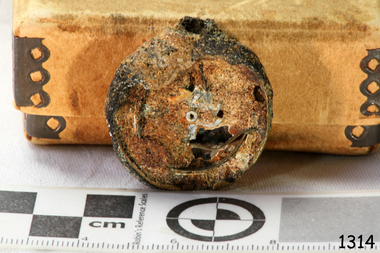 Flagstaff Hill Maritime Museum and Village
Instrument - Fob Watch, ca 1878
... Elizabeth Ford Julia Ford Alfred Sandle Ford Frances Whyburn James Sandle Ford John Cain Kathleen Cain Mabel Cain Hilda Cain Julia Ethel Cain Australian Imperial Forces Field Artillery Brigades limeburner 1. Envelope: - Address: ”Australia (per Postage) / [looks like “Mrs J. Mortton”] / Glencove, (Portsea) / Victoria” Postmark: “FIRENZE” 12 10 17” “ - - - -PORTEN – (illegible)” Logo inside envelope: “BUSTA BRE--- / Earliera Lialia” [Italian; Busta = envelope, Earliera == earlier] 2. Letter: - “I am sending you a ‘souvenir’ from the wreck of the Loch Ard 28 years ago at Port Campbell. It is the remains of a lady’s ...The story of this gold fob watch is intriguing. The letter is dated March 6, 1905, 27 years after the Loch Ard was wrecked. It appears to be a quick personal note from a relative or friend who briefly writes the history of the enclosed ‘souvenir’ watch, found in Loch Ard Gorge at Port Campbell. Although the finder is not named, it is likely the letter’s author. The writer mentions that the letter and watch would be sent once photographs of the area where the watch was found had been added. The fancy, lined envelope’s date stamp is October 12th, 1917 (12.10.17), almost 12 years after the letter was written. It has a postmark from Florence (Firenze), Italy. The handwriting on the envelope differs from that of the letter, and there is no further mention of photographs being included. The condition of the watch certainly shows the effects of time in the sea. Some inner workings can be seen through broken encrustations and missing sections of its case. The winding knob on the top is recognisable even though it is covered by sand and other adhesions from the sea. Its dainty size and gold case suggest that it was made for a well-to-do female. The watch, envelope and letter were donated along with a 1971 newspaper cutting, all neatly folded and tucked with the watch into a small, strong cardboard box with metal reinforcing on the corners and a fitted lid. The newspaper article gives context to the watch, telling the story of the Loch Ard shipwreck tragedy and the two survivors, but does not refer to the watch. Perhaps one of the 17 passengers sailing on the Loch Ard, including members of the Carmichael family, owned the watch, or maybe it was amongst the cargo, as the ship’s manifest includes ‘clocks and watches £25’. . Considering the dates of the letter and the envelope, did the finder of the ‘souvenir’ watch take it to Europe? Was it used for good luck during service in the military? . Comparing the different writing on the letter and the envelope, does it suggest that the watch’s finder was overseas and asked someone to send the envelope to the intended recipient, with postage from Italy? ABOUT the address, “Glencove”: The details on the envelope are faint and obscured by stiff creases in the paper. The address appears to be “Mrs J. Mortton, Glencove, Portsea, Victoria, Australia”; though the family at that address had the surname “Morton”. Mrs J. Morton, formerly Elizabeth Ford, married her second husband, James Morton, in 1904, the year before the date of the letter. The couple lived at the Nepean Hotel before they were at “Glencove”. Although they never owned that property, it was their home when James died in 1937. Elizabeth’s nephew, Alfred Sandle Ford (1894-1981), and a nephew-in-law were overseas during World War I. Alfred Ford had moved to Melbourne as a young boy with his father. He entered service as Second Lieutenant in 1915, naming his father, Alfred Sandle Ford, as his next of kin. He served in Egypt, France and Belgium with the Australian Imperial Forces as a member of the Field Artillery Brigades. He returned to Melbourne in 1919 and worked in Richmond and Box Hill. He later married Frances Whyburn. Previously, in 1872, Elizabeth Ford’s sister, Julia Ford, acquired the 1-acre property with a 3-room house that became known as “Glencove”, Portsea. The building was originally the first school in the area, established before Crown Land sales. In the Parish of Nepean, it was first assessed for rates in 1871. Julia Ford (1843-1912) and Elizabeth Ford (1859-1957) were daughters of James Sandle Ford (1811-1890), a well-known pioneer of Portsea, formerly a convict limeburner. James Ford acquired several Crown allotments in Portsea. In 1872, he converted his old hotel into the large residential establishment known as the Nepean Hotel, which his family largely ran until it was demolished in 1971. During those years, different family members lived at the Nepean Hotel or Glencove. In 1877, Julia Ford married a significant landowner, John Cain, a limeburner from Rye. They had five daughters, four of whom were never married; Kathleen (1880-1949), Mabel (1881-1973), who was the last family member to own the house until her death, Hilda (1884-1974) and Julia Ethel (1888-1949). Some of the newspaper records refer to “Glencove”, Portsea, inform that: 1927 - Dr. and Mrs. J. E. Shilliday are staying with Mrs. R. B. Sanderson at Glencove. (Australasian) 1937 - James Morton died at his property, Glencove, Portsea, aged 83 years (Argus) 1949 - Julia Ethel Cain died at Glencove, Portsea. (Argus) 1949 - Probate application by sisters of Julia Ethel Cain, deceased, formerly of Nepean Hotel, Portsea, but late of Glencove, Nepean Highway, Portsea. The connection of the watch with the sands of Loch Ard Gorge and to the ship Loch Ard contributes to our knowledge of personal items brought to Australia in 1878, whether as the belongings of a passenger or as cargo; a gold watch would be intended for a wealthy buyer. The little artefact helps us understand the survival of artefacts in the powerful sea, over a quarter of a century after the wreck of the ship. Although many people would have visited the shipwreck site, the length of time before it was found helps us understand the effects of the sea on shipwreck artefacts. The survival of the carefully packaged watch and related documents shows the respectful understanding of preservation of historic artefacts, even from almost 150 years ago at the time of writing (2025). Ladies' fob watch, thought to be gold. It is now covered in encrustation. A bump on the edge would be the winding mechanism for the watch. A small section of the back of the case has broken away, and an engraved surface can be seen. Face and hands are missing, revealing the spring workings inside. Donated with the watch were two documents and a newspaper cutting about the story of the shipwreck of the Loch Ard. They are all in a strong cardboard box with reinforced corners on the base and lid. Found at Loch Ard Gorge and said to have been from the Loch Ard. The three donated documents are: - 1. A rectangular envelope made of cream waxy paper lined with black and white diagonally striped paper. The top right corner, usually meant for a postage stamp, has been torn off, partly exposing text on a rectangular printed logo. A round black postmark stamp near the top centre shows the post office location and date. The address on the front is handwritten in black ink. The creases on the envelope suggest it has been folded three times. 2. A letter on cream rectangular paper features clear, handwritten script in black ink. The unevenly cut bottom edge has two short black vertical lines, possibly the tops of tall written letters. There are creases where the page has been folded three times. 3. A newspaper clipping featuring text, an illustration, and handwritten details of the newspaper’s source.1. Envelope: - Address: ”Australia (per Postage) / [looks like “Mrs J. Mortton”] / Glencove, (Portsea) / Victoria” Postmark: “FIRENZE” 12 10 17” “ - - - -PORTEN – (illegible)” Logo inside envelope: “BUSTA BRE--- / Earliera Lialia” [Italian; Busta = envelope, Earliera == earlier] 2. Letter: - “I am sending you a ‘souvenir’ from the wreck of the Loch Ard 28 years ago at Port Campbell. It is the remains of a lady’s gold watch found in the gorge where Miss Carmichael & Tom Pearce (the only two saved) were washed up. This souvenir was lying there ever since. I went down into the awful gorge & saw the cave where these two unfortunates (or fortunate perhaps, as they were saved) lived until rescued. I also saw the graves of those who were washed up from the wreck. One grave contains Dr and Mrs Carmichael & six of their children. Later on, when I can get some good views of that wild coast I will send them to you. 6/3/05.” 3. Newspaper cutting: - History of the Lochard. Refer to the Sydney Morning Herald, Nov. 28th, 1971: “Loch Ard: the wreck that became a legend” flagstaff hill, warrnambool, shipwreck coast, flagstaff hill maritime museum, maritime museum, flagstaff hill maritime village, great ocean road, loch ard, eva carmichael, tom pearce, loch ard gorge, loch ard souvenir, port campbell, miss carmichael, mrs carmichael, dr carmichael, 1878, loch ard: the wreck that became a legend, ladies fob watch, gold watch, fob watch, pocket watch, horology, accessory, time keeping, scientific instrument, ladies' watch, ladies' pocket watch, lady's watch, souvenir watch, survivor, clocks and watches, diagonally striped envelope lining, firenze, busta, earliera, florence, italy, glencove, portsea, victoria, 1905, 1917, nepean hotel, moreton, morton, elizabeth morton, mrs j. morton, james morton, elizabeth ford, julia ford, alfred sandle ford, frances whyburn, james sandle ford, john cain, kathleen cain, mabel cain, hilda cain, julia ethel cain, australian imperial forces, field artillery brigades, limeburner
