
Showing 3 items matching "language restriction"
-
 Victorian Aboriginal Corporation for Languages
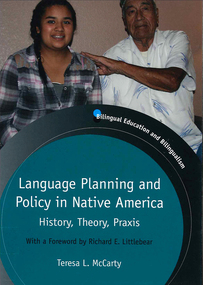
Book, Teresa L McCarty, Language planning and policy in Native America : history, theory and praxis, 2013
... ...language restriction...Language planning language policy Native American languages language standardisation language restriction Maps, b&w illustrations, b&w photographs, colour photographs Contextualizing Native American LPP: legal-political, demographic and sociolinguistic foundations; conceptualizing Native American LPP: critical sociocultural foundations; Native American languages 1492-2012; Indigenous literacies, bilingual education and community empowerment: Navajo case study; language regenesis in practice; language in the lives of Indigenous youth; planning language for the Seventh Generation Language planning and policy in Native America : history, theory and praxis Book Teresa L McCarty ...Contextualizing Native American LPP: legal-political, demographic and sociolinguistic foundations; conceptualizing Native American LPP: critical sociocultural foundations; Native American languages 1492-2012; Indigenous literacies, bilingual education and community empowerment: Navajo case study; language regenesis in practice; language in the lives of Indigenous youth; planning language for the Seventh GenerationMaps, b&w illustrations, b&w photographs, colour photographslanguage planning, language policy, native american languages, language standardisation, language restriction -
 City of Moorabbin Historical Society (Operating the Box Cottage Museum)
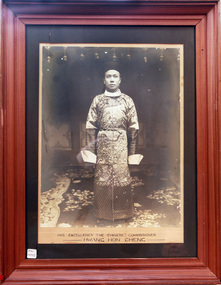
Photograph - Chinese Commissioner, Hwang Hong Cheng,1906, 1902
... Restrictions in Australia. Hwang Hon Cheng visited Brisbane, Sydney, Melbourne , Adelaide and Hobart and after reviewing his recommendations Britain agreed to the appointment of the first Chinese Consul-General to Australia. In 1908 Mr Leong Lan Fun, Taotal of Swatow was appointed Consul-General for the Commonwealth with his headquarters in Melbourne. Animosity, suspicion and misunderstanding had existed between Chinese and European settlers since the Gold Rush of 1850’s. Language ...His Excellency, Hwang Hon Cheng, from Peking, China, visited Australia from 1906 -1907 as Chinese Commissioner in response to an urgent petition from well respected Chinese business leaders, The 1906 Petition was sent to the Chinese Ambassador in Britain requesting the appointment of a Chinese Consular Representative in Australia to ease the escalating Discrimination and address the Immigration Restrictions in Australia. Hwang Hon Cheng visited Brisbane, Sydney, Melbourne , Adelaide and Hobart and after reviewing his recommendations Britain agreed to the appointment of the first Chinese Consul-General to Australia. In 1908 Mr Leong Lan Fun, Taotal of Swatow was appointed Consul-General for the Commonwealth with his headquarters in Melbourne. Animosity, suspicion and misunderstanding had existed between Chinese and European settlers since the Gold Rush of 1850’s. Language, customs, frugality and mostly their ability to obtain profit from crops seen as uneconomical by Europeans eg parsley, garlic and salad vegetables. Many of the Chinese workers did not purchase land instead their main aim was to obtain enough money for their family and return to China. There were a few still managing market gardens around East Bentleigh until the 1950’s, by which time they were highly regarded by the general community. A large photograph of His Excellency the Chinese Commissioner , Hwang Hong Cheng, in a wooden frame c1906His Excellency the Chinese Commissioner / Hwang Hong Cheng, moorabbin, bentleigh, ormond, brighton, gold rush, chinese immigration, chinese market gardeners, markets, cheltenham, cabinet makers, early settlers, pioneers, market gardeners, , hwang hon cheng, leong lan fun, peking china, melbourne -
 Emerald Museum & Nobelius Heritage Park
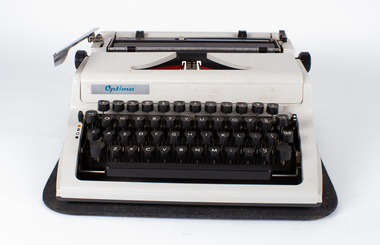
Machine - Optima Typewriter, Robotron, 1980s
... restrictions had to adopt a new name 'Optima'. This model dates from the 1980s. This typewriter is a reminder of a 20th century technology that has been superseded by computers and of a country which no longer exists. Olyympia Optima typewriter East Germany On front of typewriter: 'Optima' On back of typewriter: 'Mod. 105 / Made in GDR' Cream-coloured, portable typewriter mounted on a black base which has two metal fasteners and black plastic handle. One reel of typewriter ribbon. One manual written in German, English and French. Typewriter brush. One-page quality certificate translated into 17 languages ...The Olympia Company had produced typewriters in Germany since the early1920s. Following the end of World War II, the Olympia brand continued production in West Germany whereas the East German plant after dealing with new trade restrictions had to adopt a new name 'Optima'. This model dates from the 1980s.This typewriter is a reminder of a 20th century technology that has been superseded by computers and of a country which no longer exists.Cream-coloured, portable typewriter mounted on a black base which has two metal fasteners and black plastic handle. One reel of typewriter ribbon. One manual written in German, English and French. Typewriter brush. One-page quality certificate translated into 17 languages.On front of typewriter: 'Optima' On back of typewriter: 'Mod. 105 / Made in GDR'olyympia, optima, typewriter, east germany
