
Showing 55 items matching "last flight"
-
 National Vietnam Veterans Museum (NVVM)
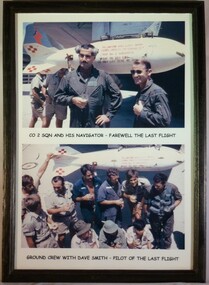
Photograph - Two Coloured Photograph is a Timber Frame Titled CO 2 Sqn and His Navigator -Farewell the last flight and Ground crew with pilot of The Last Flight Dave Smith, 1962 - 1972
... Two Coloured Photograph is a Timber Frame Titled CO 2 Sqn and His Navigator -Farewell the last flight and Ground crew with pilot of The Last Flight Dave Smith ......Last Flight...The top one is titled CO 2 Sqn and His Navigator -Farewell the last flight and shows the CO talking to another crewman. ...Co 2 SQN and his Navigator - Farewell The Last Flight / Ground crew with Dave Smith - Pilot of The Last Flight....Flying Officer David Robert Smith O224754 No 2 Squadron RAAF Royal Australian Air Force Last Flight Photograph Co 2 SQN and his Navigator - Farewell The Last Flight / Ground crew with Dave Smith - Pilot of The Last Flight. ...Two Coloured Photograph is a Timber Frame. The top one is titled CO 2 Sqn and His Navigator -Farewell the last flight and shows the CO talking to another crewman. The bottom photograph is of several ground crew with pilot of the Last flight Dave Smith. The crew are all having a farewell drink.Co 2 SQN and his Navigator - Farewell The Last Flight / Ground crew with Dave Smith - Pilot of The Last Flight.flying officer david robert smith, o224754, no 2 squadron, raaf, royal australian air force, last flight, photograph -
 National Vietnam Veterans Museum (NVVM)
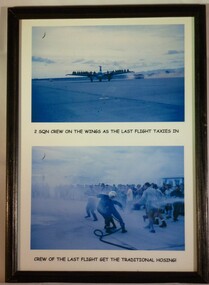
Photograph - Two Framed Coloured Photographs of 2nd Sqn's Last Flight, 1962-1972
... Two Framed Coloured Photographs of 2nd Sqn's Last Flight......Last Flight...The top photograph depicts the crew of 2nd Sqn on the wings as the last flight taxies in on the tarmac. The bottom photograph is of the crew of the last flight getting the traditional hosing....2nd Squadron RAAF Royal Australian Air Force Last Flight Photograph Colour has faded on both photograghs. ...In a timber frame there are two coloured photographs. The top photograph depicts the crew of 2nd Sqn on the wings as the last flight taxies in on the tarmac. The bottom photograph is of the crew of the last flight getting the traditional hosing.Colour has faded on both photograghs.2nd squadron, raaf, royal australian air force, last flight, photograph -
 Moorabbin Air Museum
Photograph (Item) - Photo Tiger Moth Trainer Aircraft Are Prepared For Their Last Flight Out Of Point Cook.Flown To Tocumwal For Disposal , 1951
... Photo Tiger Moth Trainer Aircraft Are Prepared For Their Last Flight Out Of Point Cook.Flown To Tocumwal For Disposal , 1951...Photo Tiger Moth Trainer Aircraft Are Prepared For Their Last Flight Out Of Point Cook.Flown To Tocumwal For Disposal , 1951...Serial Numbers A17-538 , A17-588 ,A17-704 ,plus others Photo Tiger Moth Trainer Aircraft Are Prepared For Their Last Flight Out Of Point Cook.Flown To Tocumwal For Disposal , 1951 Photograph Photo Tiger Moth Trainer Aircraft Are Prepared For Their Last Flight Out Of Point Cook.Flown To Tocumwal For Disposal , 1951 ...Serial Numbers A17-538 , A17-588 ,A17-704 ,plus others -
Moorabbin Air Museum
Book - THE RED BARON'S LAST FLIGHT, PAN MCMILLIAN AUSTRALIA PTY LIMITED, 1998
... THE RED BARON'S LAST FLIGHT...THE RED BARON'S LAST FLIGHT...THE RED BARON'S LAST FLIGHT Book THE RED BARON'S LAST FLIGHT PAN MCMILLIAN AUSTRALIA PTY LIMITED NORMAN FRANKS AND ALAN BENNETT ... -
 Moorabbin Air Museum
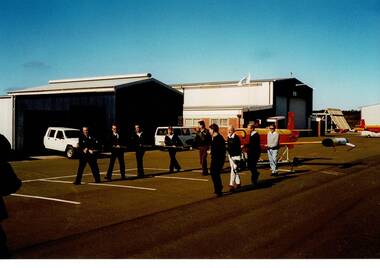
Photograph (item) - GAF Collection - Last flight of RAN Jindivik- N11-742 'Vic Harvey' Jervis Bay - 26Jun1998 - Bill Henderson Photo - BAE Systems, GAF Collection - Last flight of RAN Jindivik- 9 Photos in Colour
... GAF Collection - Last flight of RAN Jindivik- N11-742 'Vic Harvey' Jervis Bay - 26Jun1998 - Bill Henderson Photo - BAE Systems...GAF Collection - Last flight of RAN Jindivik- 9 Photos in Colour...GAF Collection - Last flight of RAN Jindivik- 9 Photos in Colour Photograph GAF Collection - Last flight of RAN Jindivik- N11-742 'Vic Harvey' Jervis Bay - 26Jun1998 - Bill Henderson Photo - BAE Systems ... -
 Robin Boyd Foundation
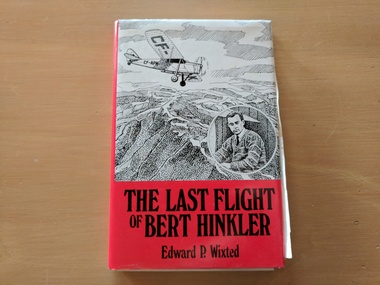
Book, Edward P. Wixted, The Last Flight of Bert Hinkler, 1992
... The Last Flight of Bert Hinkler...Walsh St library Copy of articles about this book inserted inside front cover, along with a thank you note from the author dated 31.5.93 Hardcover w/ Dust Jacket The Last Flight of Bert Hinkler Book Edward P. Wixted Vantage Press ...Hardcover w/ Dust JacketCopy of articles about this book inserted inside front cover, along with a thank you note from the author dated 31.5.93walsh st library -
Moorabbin Air Museum
Book, ADRIAN WEIR, THE LAST FLIGHT OF THE LUFTWAFFE, 1997
... THE LAST FLIGHT OF THE LUFTWAFFE...THE LAST FLIGHT OF THE LUFTWAFFE Book ADRIAN WEIR CASSELL GROUP ... -
Moorabbin Air Museum
Photograph (item) - Photo of last Jindivik flight 1998 Jervis bay, Jindivik
... Photo of last Jindivik flight 1998 Jervis bay ...Jindivik Photograph Photo of last Jindivik flight 1998 Jervis bay ... -
 National Vietnam Veterans Museum (NVVM)
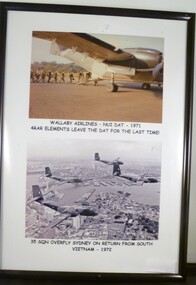
Photograph - A Framed Colour and Black and White Photograph of Wallably Airlines and 35 Sqn, 1971 & 1972
... ...Last Flight...4 RAR 35 Squadron Wallaby Airlines Nui Dat Last Flight In a black framed are a colour and black and white photograph. ...In a black framed are a colour and black and white photograph. Wallably Airlines and 35 Sqn. The coloured photograph is of soldiers boarding the plane. Under the photograph reads Wallaby Airlines - Nui Dat - 1971. 4 RAR elements least the Dat for the last time. The second photograph is in black and white and shows several planes flying over Sydney. Under the photograph reads - 35 Sqn overfly Sydney on return from South Vietnam - 1972.4 rar, 35 squadron, wallaby airlines, nui dat, last flight -
 Ballarat Heritage Services
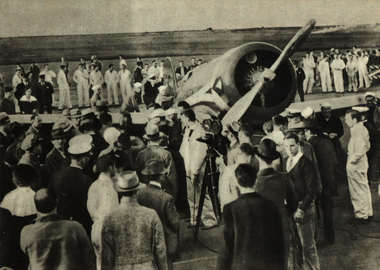
Photograph - Image, Sir Charles Kingsford-Smith and Captain P. Taylor Complete the Last Leg of a flight to California, 1934
... Taylor Complete the Last Leg of a flight to California....Taylor after completing the las leg of a 7365 mile flight to California ahead of schedule. Sir Charles Kingsford-Smith and Captain P. Taylor Complete the Last Leg of a flight to California. ...Black and white photographic image of Sir Charles Kingsford-Smith and Captain P. Taylor after completing the las leg of a 7365 mile flight to California ahead of schedule.aeroplane, aviation, flight, charles kingsford smith, p.g. taylor, southern cross -
 Australian Gliding Museum
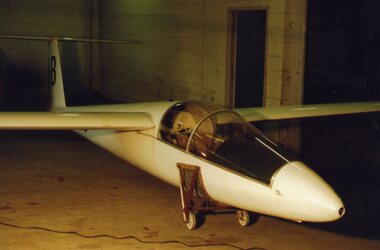
Machine - Glider – Sailplane, 1967 to 1974
... It has recorded 280 hours in the air from 239 launches to 28 January 1989, the date of its last flight. It is understood that VH-GIB was partly constructed in North America and completed in South Australia by C.G.M. ...It has recorded 280 hours in the air from 239 launches to 28 January 1989, the date of its last flight. It is understood that VH-GIB was partly constructed in North America and completed in South Australia by C.G.M. ...The Schreder HP 14T is a variant of an all metal single seat sailplane designed by Richard Schreder of USA in the 1960s. The HP14T featured a ‘T’ tail in place of ‘V’ tail of the HP14V. The design was marketed to home builders in kit form. The Museum’s Schreder HP14T (VH-GIB) first flew on 31 August 1974. It has recorded 280 hours in the air from 239 launches to 28 January 1989, the date of its last flight. It is understood that VH-GIB was partly constructed in North America and completed in South Australia by C.G.M. Coxon. Ownership passed to the Georgeson Syndicate of Rockhamption, Queensland and later to Warren Mayfield of Victoria. Warren Mayfield donated the glider to the Museum in April 2002. All metal single seat glider sailplaneRegistration lettering on rudder and fuselage sidesaustralian gliding, glider, sailplane, schreder, coxon, georgeson, mayfield, slingsby, bache, waikerie gliding club -
 Australian Gliding Museum
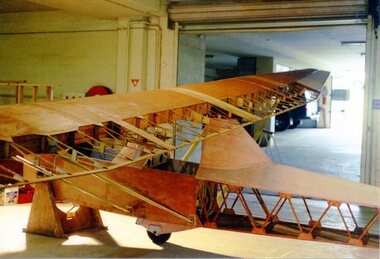
Machine - Glider – Sailplane, 1952
... It would appear that the glider has not been used for many years, the last flight recorded by the RAAF Gliding Club for this aircraft being in September 1971. ...It would appear that the glider has not been used for many years, the last flight recorded by the RAAF Gliding Club for this aircraft being in September 1971. ...The T35 Austral was developed by Slingsby Aviation from the Slingsby T31 with the wing span increased and a larger rudder to improve performance. This was done in response to an order from an Australian gliding club. The Museum’s glider was built from a Slingsby kit imported from the UK in 1952 and assembled by the Waikerie Gliding Club. The glider came on the Australian register as VH-GFX in May 1956. It was later transferred to the Renmark Gliding Club. In 1968 it was acquired by the RAAF Gliding Club at Laverton, Victoria. The existing log book records for the Museum’s T35 Austral are incomplete. Nevertheless the information at hand shows that it was launched over 17000 times and spent about 2400 hours in the air. It would appear that the glider has not been used for many years, the last flight recorded by the RAAF Gliding Club for this aircraft being in September 1971. As far as is known VH-GFX is the only example of the type to be built. The Slingsby T35 is a modified Tandem Tutor two seat glider that had extensive service at a number of Australian gliding clubs over a period of approximately 15 years from the mid 1950s. The Slingsby T35 is an open cockpit, tandem, two-seater glider with high, pylon mounted two piece wing supported by double, wire braced, steel tube struts. australian gliding, glider, sailplane, slingsby, waikerie gliding club, renmark gliding club, raaf gliding club -
 Port Melbourne Historical & Preservation Society
Photograph, Commonwealth Aircraft Corporation, Wackett Trainer, 22 Apr 1942
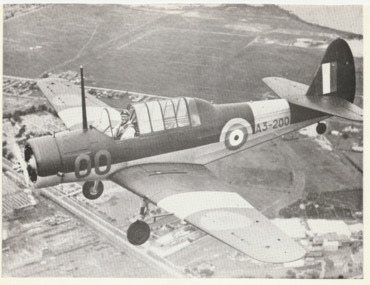
... Black and white photograph from the Commonwealth Aircraft Corporation showing the Wackett Trainer A3-200 airplane in flight. Last of a batch of 200 built, flown by Mr J.O. ...Last of a batch of 200 built, flown by Mr J.O. CARTER, civilian production test pilot. Photographed by John HARRISON, from a Wirraway A20-584 flown by Mr K.M. FREWIN. [The AWM identifies the location as Fisherman's Bend but the coastline, particularly in the original AWM version, is clearly not Fisherman's Bend]. Commonwealth Aircraft Corporation Wackett Trainer Transport - Aviation and Aerodrome Nancy U'REN nee MORRIS J O CARTER Black and white photograph from the Commonwealth Aircraft Corporation showing the Wackett Trainer A3-200 airplane in flight. ...From a box of photographs in Nancy U'REN's papers used during research for her thesis, The Early Growth and Development of Sandridge (1976) and/or her book with Noel TURNBULL, A History of Port Melbourne (1983). The Wackett Trainer was designed in Australia and manufactured at the Commonwealth Aircraft Corporation factory on Fisherman's Bend. This is a cropped version of image AC0154 in the Australian War Museum. Wackett Trainer A3-200. Last of a batch of 200 built, flown by Mr J.O. CARTER, civilian production test pilot. Photographed by John HARRISON, from a Wirraway A20-584 flown by Mr K.M. FREWIN. [The AWM identifies the location as Fisherman's Bend but the coastline, particularly in the original AWM version, is clearly not Fisherman's Bend].Black and white photograph from the Commonwealth Aircraft Corporation showing the Wackett Trainer A3-200 airplane in flight. Last of a batch of 200 built, flown by Mr J.O. CARTER, civilian production test pilot. Photographed by John HARRISON, from a Wirraway A20-584 flown by Mr K.M. FREWIN.commonwealth aircraft corporation, wackett trainer, transport - aviation and aerodrome, nancy u'ren nee morris, j o carter -
 Bendigo Military Museum
Award - MEDALS RAAF, Post 1945
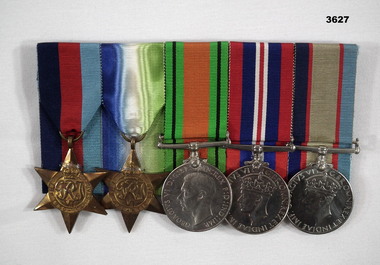
... He rises through the ranks to T/F/Sgt, Officer, Pilot Officer, Flying Officer and last Flight Lieutenant on 10.3.1945. He is discharged from the RAAF on 7.12.1945 at RAF Station Beecles Suffolk England. 461 Sqd was a Coastal Command unit mostly involved in submarine detection and hunting in the Atlantic and Bay of Biscay. ...He rises through the ranks to T/F/Sgt, Officer, Pilot Officer, Flying Officer and last Flight Lieutenant on 10.3.1945. He is discharged from the RAAF on 7.12.1945 at RAF Station Beecles Suffolk England. 461 Sqd was a Coastal Command unit mostly involved in submarine detection and hunting in the Atlantic and Bay of Biscay. ...Reginald Charles ALLARDICE enlisted first in the CMF on 10.8.1940 age 21 years Regt No V40236. During this time he applied to join the RAAF so was discharged from the Army on 21.5.1942 as a Pte in the 24/39th Bn. Two days later he is in the RAAF as a Trainee Aircrew WEF No 418577. On 31.12.1942 he is listed as a LAC (Leading Aircraftsman. Ongoing training sees him at Benalla, Mallala in SA, Mt Gambier, Pt Cook, Camp Miles Standish USA. Finally he is stationed in England at Pembroke with 461 Sqd RAAF with the rank of Sgt on 10.10.1943. This was a Sunderland Sqd which was a large long range patrol Flying Boat. The unit was mainly Australians from many nations. He rises through the ranks to T/F/Sgt, Officer, Pilot Officer, Flying Officer and last Flight Lieutenant on 10.3.1945. He is discharged from the RAAF on 7.12.1945 at RAF Station Beecles Suffolk England. 461 Sqd was a Coastal Command unit mostly involved in submarine detection and hunting in the Atlantic and Bay of Biscay. They were involved in the D Day landings. The Sqd lost 20 aircraft to enemy action and accidents. A total of 86 Sqd members were lost of which 64 were Australian.Medals, individual with ribbons re R.C.Allardice. (1) 1939 - 45 Star, original not engraved. (2) Atlantic Star, original not engraved. (3) Defence Medal. (4) British War Medal 1939 - 45. (5) Australian Service Medal 1939 - 45. (.3, .4, .5) “418577 R.C.ALLARDICE”medals, campaign, service, world war2 -
 Australian Gliding Museum
Machine - Glider – Sailplane, 1963
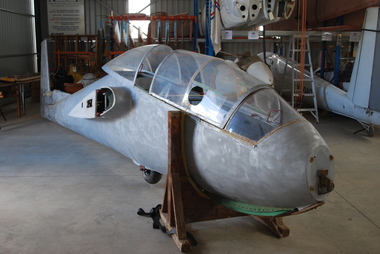
... It is understood that on its last flight at Bachelor, south of Darwin in the Northern Territory (August 1969) it was severely damaged when it crashed after spinning while being auto-tow launched (although this is not expressly mentioned in the logbook). ...It is understood that on its last flight at Bachelor, south of Darwin in the Northern Territory (August 1969) it was severely damaged when it crashed after spinning while being auto-tow launched (although this is not expressly mentioned in the logbook). ...The Bocian is a versatile training sailplane that first flew in 1952. The type has been modified in several respects over the course of production by SZD (tailplane and rudder in particular). About 600 have been built; many for export to 27 countries (including Australia). The aerobatic capability and fine performance (best glide ratio of 26) has enabled the Bocian to be used to train competition pilots as well as those of lesser experience. Many world gliding records were set in the 1950s and 1960s in Bocian gliders. The Museum’s example is a type D test flown in Poland on 3 and 4 April 1963. It was imported into Australia in September 1963 by Austerserve Pty Ltd. The first owner was the Alice Springs Gliding Club and the glider had name “Cumulus” painted on the side of the fuselage (since removed). The glider had recorded 726 hours 46 minutes flying time from 2138 launches as at July 1967 when it was transferred to the Darwin Gliding Club. It appears that the glider was damaged in June 1968. The substantial repairs to the fuselage, both wings and tailplane and other minor repairs were completed on 13 October 1968. The glider continued flying with the Darwin Gliding Club until August 1969 at which time the service to that club amounted to 59 hours 7 minutes flying time from 348 flights. Between August 1969 and August 1976 no flights are recorded in the logbook. It is understood that on its last flight at Bachelor, south of Darwin in the Northern Territory (August 1969) it was severely damaged when it crashed after spinning while being auto-tow launched (although this is not expressly mentioned in the logbook). Reg Hancock purchased the damaged glider and rebuilt the port wing and restored it to airworthy condition (September 1976). It was then transferred to Colac, Victoria, and used by the Colac Gliding Group at the Yeo airfield until February 1981, adding another 153 hours from 403 flights to the glider’s record. After airworthy inspection in September 1982 the glider was used by the Geelong Gliding Club until 1983 (logbook details not held). The 20 year survey was then due and the glider fell out of service. In the course of the most recent restoration attempt it was discovered that the glue used in construction had deteriorated and that it was no longer feasible to bring it back to an airworthy condition. Subject to restoration, this exhibit may be representative of the 1950s - 1960s Bocian two seat sailplane typeThis exhibit is a large two seat glider /sailplane of wood and fabric construction. All components are present with the exception of instruments. However, at the time that the aircraft was transferred to the Museum it had been taken apart for major restoration work. As received it is stripped of the top coats of paint and a number of components (including, amongst others, tip fairings, nose cone and cockpit elements) that were removed for facilitating the repair process. The glider, serial number 803, was registered as VH-GNLaustralian gliding, glider, sailplane, bocian, cumulus, alice springs gliding club, darwin gliding club, colac gliding group, geelong gliding club, hancock -
 Australian Gliding Museum
Machine - Glider – Sailplane, 1963
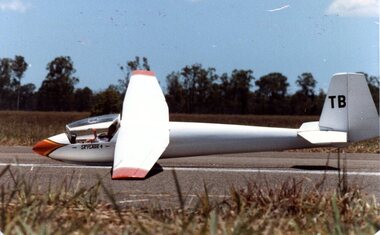
... flights were made from Armidale and Bellata in Northern New South Wales. On one occasion, the glider was kept aloft for 8 hours 45 minutes and on another the pilot took it around a 500 kilometre triangle in nearly 8 hours. In 1980 it was sold to Ralph (“Feathers”) Crompton and was flown extensively in South Australia until 1988. The final owner before the glider was given to the Museum in 2004 was Ross Dutton of Melbourne. The last...flights were made from Armidale and Bellata in Northern New South Wales. On one occasion, the glider was kept aloft for 8 hours 45 minutes and on another the pilot took it around a 500 kilometre triangle in nearly 8 hours. In 1980 it was sold to Ralph (“Feathers”) Crompton and was flown extensively in South Australia until 1988. The final owner before the glider was given to the Museum in 2004 was Ross Dutton of Melbourne. The last ...The Skylark 4, the final in the Slingsby Skylark series, dates from 1961. The design heralded a trend towards the use of plastics in the construction of gliders. Slingsby incorporated GRP (glass reinforced plastic) panels to achieve a streamlined fuselage nose and cockpit area while retaining the more traditional wood techniques for the rest of the aircraft. Another notable feature was the smooth wing surface that was obtained using a Gaboon ply skin across the ribs. Best glide performance of 1:33 was found to be comparable with the early full GRP glider designs. The Museum’s example (VH-GTB – C/N 1382) was built in 1963 and originally owned by Chuck Bentson of the UK. It was brought to Australia in 1967 by Jeremy Picket-Heaps and flown at various places including Benalla, Cooma and Gundaroo. In 1970 the glider was transferred to the New England Soaring Club. Many flights were made from Armidale and Bellata in Northern New South Wales. On one occasion, the glider was kept aloft for 8 hours 45 minutes and on another the pilot took it around a 500 kilometre triangle in nearly 8 hours. In 1980 it was sold to Ralph (“Feathers”) Crompton and was flown extensively in South Australia until 1988. The final owner before the glider was given to the Museum in 2004 was Ross Dutton of Melbourne. The last recorded flight occurred in 1992. The glider at that point had logged over 2000 hours flying time from about 2000 launches. The airframe is currently being restored to flying condition. Technically this aircraft represents the state of the art at the stage that sailplane design was changing from traditional wood construction to composites (GRP) The Slingsby Skylark 4 is high wing single seat sailplane of mainly wooden construction with plywood and fabric covering. However, the cockpit and forward part of the fuselage consists of glass reinforced plastic which was innovative at the time that the type was designed. The cockpit provides for a semi reclining position for the pilot protected with a full Perspex canopy. The wings are made up of a centre section with constant chord and tapered wing tips. The aircraft has a conventional arrangement for the tail stabiliser / control surfaces. The sailplane bears construction number 1382 and is registered in Australia as VH-GTBaustralian gliding, glider, sailplane, skylark, slingsby, bentson, picket-heaps, crompton, new england soaring club, dutton -
 Melton City Libraries
Photograph, The Cairn- Jimmy Melrose's plane crash site, 1988
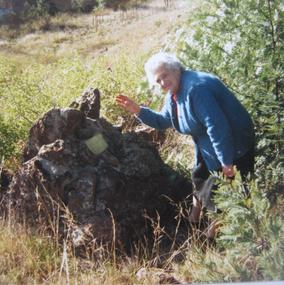
... Hand written carbon copy by Edna Barrie.Typed by Wendy Barrie March 2014 Last Flight of Jimmy Melrose by John Burke Parade Magazine July 1972 Page 2 –4 This article gives the take off time of 7.50 am from Essendon Airport Eyewitness account at the time Maisie Arthur’s description. ...Hand written carbon copy by Edna Barrie.Typed by Wendy Barrie March 2014 Last Flight of Jimmy Melrose by John Burke Parade Magazine July 1972 Page 2 –4 This article gives the take off time of 7.50 am from Essendon Airport Eyewitness account at the time Maisie Arthur’s description. ...Edna Barrie at the cairn, photo received from Graeme Minns in 1988. The cairn marks the site of Jimmy Melrose's plane crash in Melton South. The accident which happened on July 5th 1936. In 1934 Melrose made headlines with a series of spectacular flights. In July of that year, he set around Australia record and in that year established a new solo Australia England record when he flew to England to compete in the MacRoberston race with a De Havilland Puss Moth VH- YQO. The only Australian and the only solo pilot to complete the course within the time limit. He was seventh in finishing order and third in the handicap section making news again during the race with a dramatic landing in Darwin with empty fuel tanks. Late in 1935 Melrose imported the Phoenix for his “Adelaide to Anywhere” Charter Service. The previous year the Heston Aircraft Company had taken over the interests of the well known Comper Aircraft Company, and the first production of the new firm was the Phoenix, a single-engined all wooden five seater machine of sesquiplane configuration. The forward half of the fuselage was a streamlined rectangular section and the rear portion was a monocogue shell; the whole was of plywood fabric covered. The wing was built up of spruce box spars and lattice ribs, ply covered from the leading edge to the front spar and the fabric covered over the remainder. The tail surfaces were of similar construction. The most notable feature of the design was the lower stub wing which ran right across the fuselage embodying two box spars, plywood covered it housed the main undercarriage wheels when retracted and provided a substantial anchorage for the Nu form wing struts. The Dowty undercarriage retracted inwards, operated manually by hydraulic packs, Dual control fitted, with side by side seating for the pilots and three passenger seats behind. Power was a 200 h.p. De Havilland Gipsy VI 6 cylinder inverted in-line air-cooled engine. Six Phoenix were built; five of them registered in Great Britain and one of those was later sold abroad the remaining four were impressed into the R.A.F. in 1940. Specifications were: 40 feet 4 inches length 30 ft 2 ins height, 9ft 7ins, wing area 270 sq ft, Tare weight 2,600lbs loaded weight 3,300lbs; cruising speed 360 m.p.h. landing 50mph ceiling 14,000 ft range 700 miles. Melrose’s machine the first production aircraft was built early in 1936 and test flown of the 24th March. Painted green it carries the words “South Australian Centenary 1936” in silver of the fuselage and the name “Billing on the engine cowling in honor of Melrose’s uncle Noel Pemberton Billing, pioneer designer and founder of the Supermarine Aviation Company. The delivery flight was planned as a goodwill mission to publicise the forthcoming South Australian Centenary celebrations. Melrose left Dympne on the 9th April 1936, and flying via Marseilles, Naples, Athens, Baghdad, Basra, Karachi, Jodphur, Calcutta, Akyab, Penang, Singapore, Lombok, Darwin, Newcastle Waters and Alice Springs reached Adelaide on the 25th of April. Continuing the goodwill flight to other States, he visited Melbourne, Sydney, Newcastle, Grafton, Brisbane, Coff’s Harbour, Sydney again, Launceston, Hobart and Mount Gambier before returning to Adelaide on the 13th May. During June Jimmy made some charter flights and early in July was engaged by Mr. A.J. Campbell a director of several mining companies from Melbourne to Darwin to commence at Essendon on the4th July. However on that day low cloud and steady rain caused the postponement. There was little improvement and Melrose was advised to delay the departure again. However he wished to reach Oodnadatta that night, and when he observed the break in the clouds decided to leave. He planned to climb above the cloud and fly to Adelaide at 3,000 feet. The aircraft was airborne about 8.10 a.m. and was last seen from Essendon climbing above the clouds. At 8.45 people at Melton (30 miles West of Melbourne) heard an approaching aircraft. The engine noise increased abnormally and eye witnesses saw the machine fall out of control from the cloud base about 800 feet and then disintegrate, fragments were scattered for 1½ miles and both occupants were killed. Hand written carbon copy by Edna Barrie.Typed by Wendy Barrie March 2014 Last Flight of Jimmy Melrose by John Burke Parade Magazine July 1972 Page 2 –4 This article gives the take off time of 7.50 am from Essendon Airport Eyewitness account at the time Maisie Arthur’s description. Newspaper article. Edna Barrie at the site of the 'Cairn'local identities, local significant events -
 Australian Gliding Museum
Machine - Glider - Sailplane
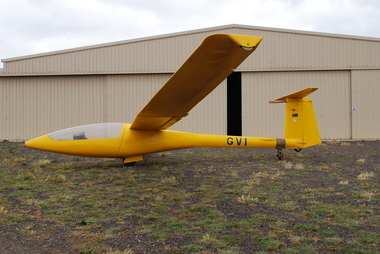
... With these changes the glider type was given the designation MOBA2D. The last recorded flights occurred in February 1996 at which time MOBA2 had flown an aggregate of 401 hours and 59 minutes during its 297 launches. ...With these changes the glider type was given the designation MOBA2D. The last recorded flights occurred in February 1996 at which time MOBA2 had flown an aggregate of 401 hours and 59 minutes during its 297 launches. ...MOBA2 is a 15 metre sailplane designed by Gary Sunderland, who was an aeronautical engineer working for the Department of Civil Aviation (Australia) and a member of the Victorian Motorless Flight Group (VMFG). The design gave effect to ideas that he developed circa 1970 for an aircraft that he could build himself. He entered a 13 metre wingspan version of his MOBA design (MOBA2B) in an Australian Gliding sailplane design competition that was announced in 1970. The competition called for sailplane designs with a maximum wingspan of 13 metres that could be built by amateurs in a small workshop with limited tools and facilities. In 1973, Gary’s MOBA was judged by the competition panel as equal best with the other outstanding submission, which were chosen from a field of 19 entrants. However, after gathering further information and deliberation by the competition panel neither of the two outstanding designs were chosen as the winner. Notwithstanding the outcome, in 1974 Gary proceeded built his glider to the original 15 metre design. The wing was equipped with camber changing flaps that were permitted under special standard class rules for the 1974 world championships. Changes were made along the way in the light of construction experience and the completed glider was given the designation MOBA2C. The glider first flew on 12 December 1979. It was never flown in standard class competition as by the time the glider was built the special 1974 rules were revoked and wing flaps were no longer permitted in that class. However, Gary flew MOBA2C in the Australian national gliding competitions held at Benalla in the summer of 1979 / 1980 competing in the open class. After adjustment to the aileron gearing during initial trials MOBA2C was found to fly well and in competition produced performances believed to be better than contemporary standard class sailplanes but not as good as the open class machines. The glider was later modified in a number of respects including amongst other things the installation of spoilers located just forward of the wing flaps and by increasing the chord marginally at the wing root. With these changes the glider type was given the designation MOBA2D. The last recorded flights occurred in February 1996 at which time MOBA2 had flown an aggregate of 401 hours and 59 minutes during its 297 launches. Its operational life was brought to an end due to expansion of the foam in the wings causing distortion of the wing surface.The MOBA2 is a notable home built 1970s sailplane design that featured a number of innovative elements including composite construction without the need for expensive jigs, nose cone canopy and asymmetrical placement of control column.Composite single seat glider / sailplane finished in bright yellowRegistration "GVI" on fuselage; Kangaroo, Australian Flag and VMFG decals on vertical stabiliseraustralian gliding, glider, sailplane, moba2b, moba2c, sunderland, moba2d, victorian motorless flight group, vmfg -
 Australian Gliding Museum
Machine - Glider – Sailplane, Kaiser Ka 2B Rhonschwalbe, 1960
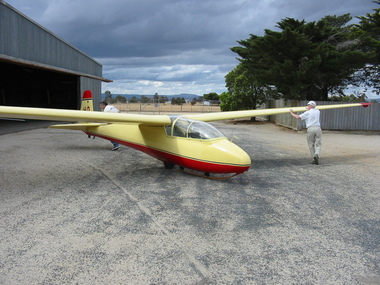
... The last entry in the log book is dated January 1997 at which time it had accumulated 1170 hours from 2446 flights. ...The last entry in the log book is dated January 1997 at which time it had accumulated 1170 hours from 2446 flights. ...The Ka 2, a tandem two seat training sailplane of 15 metre wing span, was designed by Rudolf Kaiser for Schleicher in 1953. It was a versatile craft due to its good cross country soaring capability. With the Ka 2B, the design was improved in 1955 by lengthening the wing span to 16 metres and increasing the dihedral and tip washout. The fuselage was lengthened slightly as well. Schleicher built 42 Ka2s from 1953 to 1955 and 75 Ka 2Bs from 1955 to 1957. In addition Schleicher supplied kits for construction of the sailplane by independent builders. The Australian Gliding Museum’s example is the single Ka 2b built in Australia from plans and is designated as GFA-HB-47. The club concerned was the Illawarra Soaring Club of Sydney. The glider registered as VH-GHO and first flew in October 1960. However, within a short time it was badly damaged and needed major repairs which took over a year to complete. After about 10 years service at Illawarra Soaring Club it was transferred in February 1972 to W.G. Hingston, Rosebud, Victoria, and flown with the Peninsula Soaring Association, a small club of about 20 members, operating at the Moorooduc Airfield. The Ka2b was disposed of to the Stirling Gliding Club in Western Australia in August 1976. Once again it suffered damage in a landing accident in 1978. The damaged glider was put into storage at Northam where it remained for approximately 11 years. It was acquired by Mike Valentine in 1989 and brought back to flying condition at Bacchus Marsh, Victoria. The last entry in the log book is dated January 1997 at which time it had accumulated 1170 hours from 2446 flights. The last owner prior to transfer to the Australian Gliding Museum was John Ashford of the Geelong Gliding Club. The Museum's Ka 2B sailplane is a potentially airworthy example of this German 1950s sailplane type. It is a rarity in Australia as the only Ka 2b appearing on the Australian register.Tandem two seat sailplane of wood and fabric construction finished in cream and red colour schemeRegistration VH-GHO (with "HO" letters painted on the fin / rudder) Serial number - GFA HB 47 australian gliding, glider, sailplane, schleicher, kaiser, ka 2, illawarra soaring club, stirling gliding club, valentine, ashford, peninsulasoaring association -
 Narre Warren and District Family History Group
Book, Narre Warren & District Family History Group Inc, Casey Cardinia Collection - Bunyip Information File
... Koschade opens new chapter 13 Jun 2007 Filling in the gaps – Bunyip Landcare Group 14 Oct 1992 Twin Pines, a reminder of early life in Bunyip Mar 2005 Discover Historic Cardinia – Bunyip 18 May 2005 War Memorial takes a hit 25 Mar 2009 Round ball role for Tony – Tony Arrigo 12 Oct 2016 Fatal Flight - Plane crash in Northern Territory 30 Nov 2016 Last Drinks Before Flight - Plane crash in Northern Territory 25 Apr 2012 Secret Marriage Blossoms Over the Decades of Love 14 Sep 2016 Eric McCraw, 100 Not Out 13 May 2015 Bunyip Red Cross on the Ropes 4 Jun 2008 Family Gathers for Happy 96th - Douglas Brain 17 Aug 2016 Sniper Cuts Short a Happy-Go-Lucky Life - John Tinkham 26 May 2010 Joy of Country Music - Joy Batchelor 20 Jul 2016 Cash to Preserve Heritage - St Thomas Church 23 Aug 2017 Tanya Thrives on Netball - Tanya Roberts 18 Apr 2018 Golden Duo - Tony & Carmelina Arrigo 24 Nov 2021 New Mural Becomes a Bunyip Tourist Attraction 27 May 2009 A Century of Fighting Fires - Duncan & Betty Holman 26 Jan 2022 75 Years of CFA Service - Joe Cumming 11 Oct 2023 For the Love of Community - Tony Orrigo 19 Jan 2022 60 Years of Laughs - Madeline & Ron Bridgman 20 July 2022 From Bunyip to Moy-yan 16 Aug 2023 Tribute to Young Sportsman - John Tinkham 27 Mar 2019 A True Legend Lost - Clarrie Steenholdt 7 June 2006 Tears Shed for “Tub” - Greg Riley 7 June 2006 A Man Who Got Things Done - Greg Riley 6 Feb 2019 Former Mayor Remembers - Bill Pearson 6 Feb 2019 Aged Evacuation Drama 15 May 2024 Historic Home on Market - Tonimbuk House 1 May 2024 Rail Towns Honour ANZACS 27 Nov 2024 Stacey’s Hotel Memories 4 Dec 2025 Les Celebrates Big 90th - Les Abrehart...Koschade opens new chapter 13 Jun 2007 Filling in the gaps – Bunyip Landcare Group 14 Oct 1992 Twin Pines, a reminder of early life in Bunyip Mar 2005 Discover Historic Cardinia – Bunyip 18 May 2005 War Memorial takes a hit 25 Mar 2009 Round ball role for Tony – Tony Arrigo 12 Oct 2016 Fatal Flight - Plane crash in Northern Territory 30 Nov 2016 Last Drinks Before Flight - Plane crash in Northern Territory 25 Apr 2012 Secret Marriage Blossoms Over the Decades of Love 14 Sep 2016 Eric McCraw, 100 Not Out 13 May 2015 Bunyip Red Cross on the Ropes 4 Jun 2008 Family Gathers for Happy 96th - Douglas Brain 17 Aug 2016 Sniper Cuts Short a Happy-Go-Lucky Life - John Tinkham 26 May 2010 Joy of Country Music - Joy Batchelor 20 Jul 2016 Cash to Preserve Heritage - St Thomas Church 23 Aug 2017 Tanya Thrives on Netball - Tanya Roberts 18 Apr 2018 Golden Duo - Tony & Carmelina Arrigo 24 Nov 2021 New Mural Becomes a Bunyip Tourist Attraction 27 May 2009 A Century of Fighting Fires - Duncan & Betty Holman 26 Jan 2022 75 Years of CFA Service - Joe Cumming 11 Oct 2023 For the Love of Community - Tony Orrigo 19 Jan 2022 60 Years of Laughs - Madeline & Ron Bridgman 20 July 2022 From Bunyip to Moy-yan 16 Aug 2023 Tribute to Young Sportsman - John Tinkham 27 Mar 2019 A True Legend Lost - Clarrie Steenholdt 7 June 2006 Tears Shed for “Tub” - Greg Riley 7 June 2006 A Man Who Got Things Done - Greg Riley 6 Feb 2019 Former Mayor Remembers - Bill Pearson 6 Feb 2019 Aged Evacuation Drama 15 May 2024 Historic Home on Market - Tonimbuk House 1 May 2024 Rail Towns Honour ANZACS 27 Nov 2024 Stacey’s Hotel Memories 4 Dec 2025 Les Celebrates Big 90th - Les Abrehart Casey Cardinia Collection - Bunyip Information File Book Narre Warren & District Family History Group Inc. ...Folder containing a table of contents and various newspaper clippings and other information pertaining to the Bunyip area. The date the articles were published, and title of articles are listed below. 13 Jun 2007 Blooming honour for protea veteran – Martin Sayers 23 Mar 2005 Dorothy Costain nee Cubis – obituary 05 Jul 2006 Dr. Koschade opens new chapter 13 Jun 2007 Filling in the gaps – Bunyip Landcare Group 14 Oct 1992 Twin Pines, a reminder of early life in Bunyip Mar 2005 Discover Historic Cardinia – Bunyip 18 May 2005 War Memorial takes a hit 25 Mar 2009 Round ball role for Tony – Tony Arrigo 12 Oct 2016 Fatal Flight - Plane crash in Northern Territory 30 Nov 2016 Last Drinks Before Flight - Plane crash in Northern Territory 25 Apr 2012 Secret Marriage Blossoms Over the Decades of Love 14 Sep 2016 Eric McCraw, 100 Not Out 13 May 2015 Bunyip Red Cross on the Ropes 4 Jun 2008 Family Gathers for Happy 96th - Douglas Brain 17 Aug 2016 Sniper Cuts Short a Happy-Go-Lucky Life - John Tinkham 26 May 2010 Joy of Country Music - Joy Batchelor 20 Jul 2016 Cash to Preserve Heritage - St Thomas Church 23 Aug 2017 Tanya Thrives on Netball - Tanya Roberts 18 Apr 2018 Golden Duo - Tony & Carmelina Arrigo 24 Nov 2021 New Mural Becomes a Bunyip Tourist Attraction 27 May 2009 A Century of Fighting Fires - Duncan & Betty Holman 26 Jan 2022 75 Years of CFA Service - Joe Cumming 11 Oct 2023 For the Love of Community - Tony Orrigo 19 Jan 2022 60 Years of Laughs - Madeline & Ron Bridgman 20 July 2022 From Bunyip to Moy-yan 16 Aug 2023 Tribute to Young Sportsman - John Tinkham 27 Mar 2019 A True Legend Lost - Clarrie Steenholdt 7 June 2006 Tears Shed for “Tub” - Greg Riley 7 June 2006 A Man Who Got Things Done - Greg Riley 6 Feb 2019 Former Mayor Remembers - Bill Pearson 6 Feb 2019 Aged Evacuation Drama 15 May 2024 Historic Home on Market - Tonimbuk House 1 May 2024 Rail Towns Honour ANZACS 27 Nov 2024 Stacey’s Hotel Memories 4 Dec 2025 Les Celebrates Big 90th - Les Abrehartnon-fictionbunyip (vic.) -
 Australian Gliding Museum
Machine - Glider – Sailplane, 1948
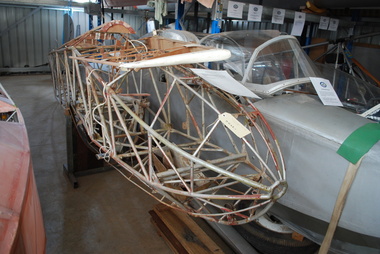
... Flying at Cooma began in November 1966 and continued until August 1969: the glider was in the air a further 108 hours from 1067 flights. The last recorded technical inspection of the glider was conducted on 28 September 1968. ...Flying at Cooma began in November 1966 and continued until August 1969: the glider was in the air a further 108 hours from 1067 flights. The last recorded technical inspection of the glider was conducted on 28 September 1968. ...The Schweizer SGS 2-12 or TG-3A as officially certificated is a glider that was designed in 1941-1942 and produced in United States of America from 1942 for training of military glider pilots. It is understood that over 100 TG-As were supplied to the USA military and at the end of the war many were sold off as surplus. Fred Hoinville imported the Museum’s TG-3A into Australia in August 1950. It is understood that it had been built in 1948 and given construction number G15. On arrival in Australia it was assembled at Bankstown aerodrome and delivered by aero-tow behind a DH Tiger Moth to Camden where Hoinville’s club, the Hinkler Soaring Club, was based. Hoinville’s TG-3A performed well at the Hinkler club in 1950-1951. Several altitude records (including a solo flight to 8000 feet by Grace Roberts – a national women’s record) were set and many soaring flight made over Camden. However, it was badly damaged in a crash landing on 15 April 1951. The glider was repaired after the crash at Camden. It is likely that modifications were made to the cockpit canopy at this time. There were three configuration tried at various times: the original dual cockpit canopy as was standard for TG3As; an unusual dual bubble canopy set up; and a single canopy over the forward seating position (in effect converting the glider to a single seater). When the glider was flown by Hoinville at the 1958 Australian Gliding Championships at Benalla, Victoria in January 1959 (refer The Age Newspaper, January 10, 1959 p.21) it had a single canopy. Records show that the glider was entered on the Australian register as VH-GDI on 6 May 1957. And the Logbook commencing in 1959 shows that ownership passed to the Port Augusta Gliding Club in South Australia on 16 August 1959. Inspections were carried out at that club and airworthiness certificates renewed in 1965. The logbook record indicates that VH-GDI had 1191 flights with an aggregate time in the air of 197 hours at the Wilmington Road Airstrip used by the Port Augusta Club. The glider was transferred to the Cooma Gliding Club, New South Wales. Flying at Cooma began in November 1966 and continued until August 1969: the glider was in the air a further 108 hours from 1067 flights. The last recorded technical inspection of the glider was conducted on 28 September 1968. The glider then passed on to Bill Riley on 20 March 1980 who stored the glider until March 2004 when it was collected by the Australian Gliding Museum. It is not clear whether the current poor state of the airframe is due to accident damage or the conditions under which it has been stored over many years or a combination of factors. Although in poor condition, this exhibit is the sole example of a TG3A ex-US military aircraft in Australia. Further the connection with the story of well-known power and glider pilot Fred Hoinville adds to its historical significance. Tubular metal framed fuselage (without covering and fittings), wooden rudder (no covering) and in damaged condition, wooden fuselage component (formers for fuselage top), Parts of control mechanism, Wooden stringers, Wooden wings without fabric covering and in damaged condition, Ailerons, Tailplane /Elevator without fabric covering, Perspex bubble canopies.australian gliding, glider, sailplane, schweizer, tg 3a, hoinville, roberts, hinkler soaring club, port augusta gliding club, cooma gliding club, riley -
 Lara RSL Sub Branch
Picture Print, Hurricane, Unknown
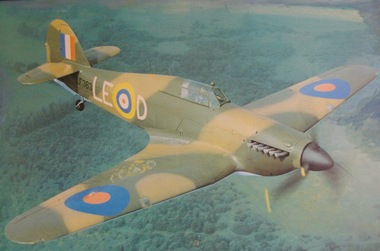
... last Hurricane to enter service in the RAF. It was in service with 63 squadron and 26 squadron. After hostilities, LF363 was spared the scrap yard and used on various station flights and also appeared in films 'Angels one five', 'Reach for the Sky' and 'The Battle of Britain'. ...last Hurricane to enter service in the RAF. It was in service with 63 squadron and 26 squadron. After hostilities, LF363 was spared the scrap yard and used on various station flights and also appeared in films 'Angels one five', 'Reach for the Sky' and 'The Battle of Britain'. ...The Hawker Hurricane is a British single-seat fighter aircraft of the 1930s–40s that was designed and predominantly built by Hawker Aircraft Ltd. for service with the Royal Air Force (RAF). It was overshadowed in the public consciousness by the Supermarine Spitfire's role during Battle of Britain in 1940, but the Hurricane actually inflicted 60 percent of the losses sustained by the Luftwaffe in the engagement, and it went on to fight in all the major theatres of the Second World War. Url Hurricane.html. The Hawker Hurricane Mk.IIc - LF363, first flew on the 1st January 1944 and is believed to be the last Hurricane to enter service in the RAF. It was in service with 63 squadron and 26 squadron. After hostilities, LF363 was spared the scrap yard and used on various station flights and also appeared in films 'Angels one five', 'Reach for the Sky' and 'The Battle of Britain'. Whilst flying to Jersey in September 1991, LF363 suffered engine problems and had to be diverted to RAF Wittering but on the final approach the aircraft suffered complete engine failure and had to make an emergency landing. The pilot was saved with relative minor injuries (a broken ankle and minor burns) but the aircraft suffered severe damage. Historic Flying Limited completely rebuilt LF363 and by 1998 it was flying again as part of the B.B.M.F. LF363 currently wears the colour scheme of a Mk.I Hurricane of 17 squadron, P3878 'YB-W' which was flown by Flying Office Harold Bird-Wilson at Debden and Tangmere. Harold 'Birdy' Bird-Wilson had previously been badly burned in a pre-war flying accident. Upon his recovery he joined 17 squadron and fought through the 'Battle of France' and the 'Battle of Britain' achieving 6 confirmed kills. On 24th September 1940, 'Birdy' was shot down by Adolf Galland, his 40th 'kill', and had to bale out. 'Birdy' survived the war and when he retired from the RAF he had reached the rank of Vice Marshall and had been awarded the CBE, DSO, DFC & Bar and the AFC & Bar. British single-seat fighter aircraft manufactured by Hawker Aircraft, Ltd., in the 1930s and ’40s. The Hurricane was numerically the most important British fighter during the critical early stages of World War II, sharing victory laurels with the Supermarine Spitfire in the Battle of Britain (1940–41) and the defense of Malta (1941–42). Hurricanes served in all theatres of war where British forces were engaged. https://www.britannica.com/technology/Hurricane-airplane Framed coloured picture print on plastic sheetOn the aircraft are the markings LF 363 -
 Eltham District Historical Society Inc
Journal, Peter Doughtery, ArtStreams: News in arts and cultural heritage; Vol. 2, No. 6, Dec 1997-Jan 1998, 1997
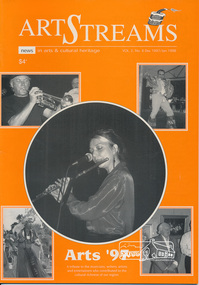
... Vol. 2, No. 6, Dec 1997-Jan 1998 CONTENTS TRAVELLER IS TALES Field work by writer Stuart Solman and artists Jenni Mitchell and the Gregory brothers 3 BOOK REVIEWS The Shadows Keep, Ziggurat, The Last Cry Fitting the Pieces and Drawn from Life 7, 8, 18, 20 & 31 CD REVIEWS Small Miracles, Flight and Identify 10 CHRIST, l1M PISSED OFF Clive Dickson comments on the Andres Serrano exhibition 12 THE REAL THING An exhibition explores realism in Australian visual art 14 WRITERS AND READERS A pictorial review 16 JINDYWOROBAK POETS A memoir 22 SHORT STORY Gerald Learns to Swing 25 ART IN PUBLIC PLACES New works for Nillumbik and Darebin 28 TAFE COURSE WINS AWARD Success for North Melbourne Institute of TAFE music program 30 DAREBIN-LATROBE ART PRIZE A new acquisitive art award 30 ART SERVICES & TEACHING 32 ...Vol. 2, No. 6, Dec 1997-Jan 1998 CONTENTS TRAVELLER IS TALES Field work by writer Stuart Solman and artists Jenni Mitchell and the Gregory brothers 3 BOOK REVIEWS The Shadows Keep, Ziggurat, The Last Cry Fitting the Pieces and Drawn from Life 7, 8, 18, 20 & 31 CD REVIEWS Small Miracles, Flight and Identify 10 CHRIST, l1M PISSED OFF Clive Dickson comments on the Andres Serrano exhibition 12 THE REAL THING An exhibition explores realism in Australian visual art 14 WRITERS AND READERS A pictorial review 16 JINDYWOROBAK POETS A memoir 22 SHORT STORY Gerald Learns to Swing 25 ART IN PUBLIC PLACES New works for Nillumbik and Darebin 28 TAFE COURSE WINS AWARD Success for North Melbourne Institute of TAFE music program 30 DAREBIN-LATROBE ART PRIZE A new acquisitive art award 30 ART SERVICES & TEACHING 32 "Peter Dougherty has been involved in the local art scene for many years. ...Vol. 2, No. 6, Dec 1997-Jan 1998 CONTENTS TRAVELLER IS TALES Field work by writer Stuart Solman and artists Jenni Mitchell and the Gregory brothers 3 BOOK REVIEWS The Shadows Keep, Ziggurat, The Last Cry Fitting the Pieces and Drawn from Life 7, 8, 18, 20 & 31 CD REVIEWS Small Miracles, Flight and Identify 10 CHRIST, l1M PISSED OFF Clive Dickson comments on the Andres Serrano exhibition 12 THE REAL THING An exhibition explores realism in Australian visual art 14 WRITERS AND READERS A pictorial review 16 JINDYWOROBAK POETS A memoir 22 SHORT STORY Gerald Learns to Swing 25 ART IN PUBLIC PLACES New works for Nillumbik and Darebin 28 TAFE COURSE WINS AWARD Success for North Melbourne Institute of TAFE music program 30 DAREBIN-LATROBE ART PRIZE A new acquisitive art award 30 ART SERVICES & TEACHING 32 "Peter Dougherty has been involved in the local art scene for many years. As publisher and editor of the arts magazine Artstreams, his comments on the various branches of the arts are widely respected. His "The Arts" column in the Diamond Valley Leader presents a brief summary for a much wider cross section of the local community. Peter also operates his own gallery and the Artstreams Cafe at the St Andrews market. Peter has a wealth of knowledge about present day and historical aspects of local art and artists." - Eltham District Historical Society Newsletter No. 161, March 2005Colour front and back cover with feature articles and literary pieces with photographs and advertisements printed in black and white. 36 pages, 30 cm. Vol. 1, no. 1 (Nov. 1996) - Vol. 10, no. 5 (summer ed. 2005/06) art streams, bridget mcdonnell gallery, templestowe village festival, stuart solman, jennii mitchell, opera in the outback, marguerita marshall, marguerite marshall, volumes, john dougals anderson, lucinda mcnight, ivan southall, ernie tucker, eric bogle, brian brown, sue johnson, scott dunbabin, alex pertout, toby mak, mal sedergreen, steven sedergreen, dean addison, peter ayliffe, daniel chable, eltham bookshop, clive dickson, were street cafe, realism, ray liversidge, jordie albiston, kevin pearson, jon weaving, isha molloy, di morrissey, ian mcbryde, morag fraser, moira rayner, mick woiwod, jim poulter, victorian artists supplies, do lunch at the library licensed cafe, the last cry, michelle lonsdale, la piazza restaurant bar & cafe, trevor hay, daniel donahoe, llobex image wizards, slickers, art in public places, darebin latrobe art prize, john olsen, roger palmer, wholefood delights -
 Bendigo Military Museum
Letter - FOLDER OF LETTERS
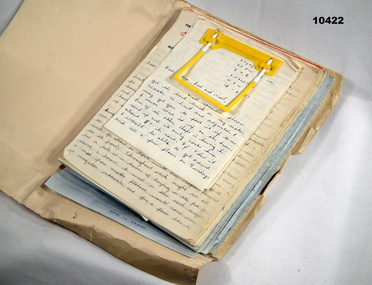
... The last letter is dated 12.12.68 stating that he will be leaving Singapore on 21st Dec at 7.50 pm on Qantas flight 704 due to arrive in Sydney at 6.20 am....The last letter is dated 12.12.68 stating that he will be leaving Singapore on 21st Dec at 7.50 pm on Qantas flight 704 due to arrive in Sydney at 6.20 am. ...Collection re G.A. Jones 3790932, refer cat No 10053.2P for his service details. The first letter is written from Singleton on 18.4.67 while in 20 Pl E Coy 3 T.B (Infantry Training) The first letter written from Enogerra Barracks Brisbane QLD is on 2.7.67 while in 1 Pl A Coy 8 RAR. The first letter from Malaya appears to be 23.10.67, at the top of the letter RH side is a black stamp with "1 Pl A Coy 8 RAR Terendak Camp Malacca Malaysia". The last letter is dated 12.12.68 stating that he will be leaving Singapore on 21st Dec at 7.50 pm on Qantas flight 704 due to arrive in Sydney at 6.20 am.The folder of letters is held together via a plastic attachment to a light cardboard cover, the letters are in two sixes, small note pad and writing pad size, a number are on white paper the majority on blue, all written in blue biro. All the letters are addressed to "Dear Mum, Dad and Neil". The size listed is for the large letters.malaya, qantas, singapore, ga jones -
 Eltham District Historical Society Inc
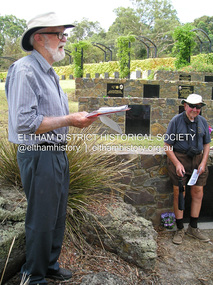
Photograph, Fay Bridge, EDHS Heritage Excursion Eltham Cemetery, 5 March 2016
... We were also able to view the recently installed sculpture titled ‘A Currawong Takes Flight’ by Michael Wilson located at the highest point of the fence-lined border between Montsalvat and the cemetery. It is close to the last...We were also able to view the recently installed sculpture titled ‘A Currawong Takes Flight’ by Michael Wilson located at the highest point of the fence-lined border between Montsalvat and the cemetery. It is close to the last ...The Eltham Cemetery Trust, established in 1858, selected the existing burial site at Mount Pleasant Road on high ground overlooking the village of Eltham. The first recorded burial took place in 1861 in the Church of England section. Headstones depict the names of many early and well known local families. On Saturday 5th March 2016 Harry Gilham again lead members and visitors on a heritage excursion through parts of the cemetery, while providing background information on selected individuals buried there. Harry’s cemetery walks have always been popular, and members and visitors were encouraged to come along and experience the tranquil surroundings of this picturesque cemetery. We were also able to view the recently installed sculpture titled ‘A Currawong Takes Flight’ by Michael Wilson located at the highest point of the fence-lined border between Montsalvat and the cemetery. It is close to the last bronze sculpture by Matcham Skipper, titled ‘Young Man Awakening’, commissioned by the Eltham Cemetery Trust to celebrate the 150th Anniversary of the cemetery in 2008. As an addition, we also met the artists and stonemason and given a brief background into the Trust’s newest art project installation titled “Our Eltham – Artistic Recollections” which will feature ceramic panels containing artwork with a local history theme. The work is the joint creation of artist Nerina Lascelles and ceramicist Linda Detoma, supported with stonework by Leigh Wykes and steelwork by Neil Carter, all skilled local Nillumbik artisans.fay bridge collection, 2016-03-05, eltham cemetery, geoff watt, jim connor, leigh wykes, linda detoma, nerina lascelles, young man awakening, harry gilham -
 Eltham District Historical Society Inc
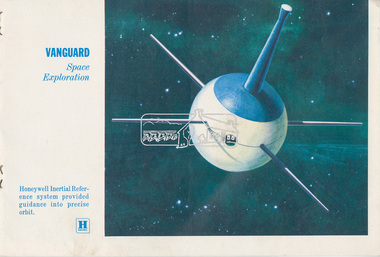
Document - Folder, Aerospace Industry, 1958-1961
... Flight Center, National Aeronautics and Space Administration, Greenbelt, Maryland; 4 pages 9. Note: Mick Murphy, Room 6B HQ, WRE to Alan Gardiner, 14 February 1961; handwritten advising enclosure of prints and reprints requested during last visit (Refer EDHS_06000-1) 10. ...Flight Center, National Aeronautics and Space Administration, Greenbelt, Maryland; 4 pages 9. Note: Mick Murphy, Room 6B HQ, WRE to Alan Gardiner, 14 February 1961; handwritten advising enclosure of prints and reprints requested during last visit (Refer EDHS_06000-1) 10. ...honeywell, scout rocket, echo satellite, mercury rocket, centaur rocket, advent rocket, mariner satellite, dyna soar, x-15, midas rocket, tiros satellite, discoverer rocket, vanguard satellite, aerospace industry, alan gardiner collection, space industry -
 Bendigo Military Museum
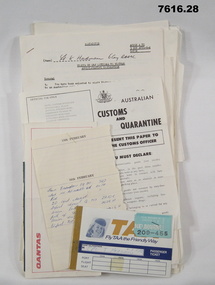
Document - VIETNAM PAPERS - HERDMAN
... Flight details printed in purple coloured text. 4. Handwritten in black ink : "KEVIN JOHN HERDMAN". 7. Handwritten in black ink on page 1: LT. K. HERDMAN, 6 Coy RAASC, 17 Feb 70." Handwritten in black ink on last...Flight details printed in purple coloured text. 4. Handwritten in black ink : "KEVIN JOHN HERDMAN". 7. Handwritten in black ink on page 1: LT. K. HERDMAN, 6 Coy RAASC, 17 Feb 70." Handwritten in black ink on last ...5. Pocketbook issued to Australian Troops during the Vietnam War. Contents include: The War in South Vietnam, The People, Government Services, Armed Services, Viet Cong, Vietnamese Language, Useful information. 14. Details of Australia V US. Hill climb with program of Events, 22nd February 1970. 15. Details of dog races with fields listed on a six race program - 20th February 1970. 18. Document details departure itinerary (ex SVN) for K.J. HERDMAN. 27. Notebook contains names and addresses of US service personnel. Papers related to "Kevin John Herdman's" visit to South Vietnam from 18th February to 4th March 1970. Part of the Kevin John Herdman, No. 397661 Collection. See Cat. No. 5942P for details of his service. 27. Collection of documents related to K.J. Herdman. 1. Two page TAA flight ticket. Text in blue coloured type. Two baggage tickets stapled to front. 2. Single diary page with torn edge. Handwritten flight itinerary in section dated 16th February. 3. Two page QANTAS flight ticket. Text in red and black type. Flight details printed in purple type. 4. Printed flier outlining Australian Customs and Quarantine regulations. Recipient's name handwritten in black ink. 5. Green coloured soft cover pocketbook. 74 pages with cut edges. Black and white diagrams. Text in black type. 6. Small pamphlet with black type. Written in Vietnamese. 7. Foolscap sized 5 page document stapled on top LHC. Text in black type. Title "VISITS BY CMF OFFICERS TO VIETNAM". 8. A4 sized one page document with text in black type on one side only. Two sided pamphlet on blue paper stapled to top LHC. Black type on pamphlet. Title "NINE RULES FOR AUSTRALIAN ARMY FORCES IN VIETNAM." 9. Two page A4 sized document with text in black type. Text on one side of each page. Title "AUSTRALIAN FORCE VIETNAM, RTA BRIEFING NOTES - QANTAS CHARTER, SAIGON/SYDNEY". 10. Foolscap signed proforma oriented in landscape. Title: AUSTRALIAN MILITARY FORCES, VISITS BY CMF OFFICERS TO SYN". Details of personnel in black type. 11. Quarto sized two page document with printing on one side. Text in black type. Staple in top LHC. Title: "CMF VISITOR - LT. K.J. HERDMAN, (ITINERARY FOR LT. K.J. HERDMAN)". 12. Quarto sized two page document with printing on one side. Text in black type. Staple in top LHC. Title: " CMF VISITOR - LT K.J. HERDMAN (ITINERARY FOR LT. K.J.HERDMAN)" 13. A4 sized document with text in black type. Text on one side only. Title: CMF VISITOR - LT. K.J. HERDMAN". 14. Foolscap sized document with text in black type. Printing on one side. Title: "LONG HI HILL CLIMB". 15. Quarto sized document with text in black type. Printing on one side. Title: "DAT DO DOGS". 16. Foolscap sized 9 page document with text on one side. Printing in black type. Pages stapled together in top LHC. Title: "1 ATF G INSTRUCTIONS 14/69, SUPPLIES, POL AND AMMUNITION HOLDINGS". 17. A4 sized document with text on one side. Printing in black type. TITLE; "AMENDMENT 1 TO Q INSTRUCTION 14/69, DATED 23 OCT 69". 18. A4 SIZED DOCUMENT WITH TEXT ON BOTH SIDES. PRINTING IN BLACK TYPE. 19. Foolscap sized 3 page document with staple in top LHC. Text on page 1 in black type. Text on pages 2 & 3 in purple type. Pages are entitled "TEMA FLYING PROGRAMME - CH 47". 20. Foolscap sized 7 page document with text in black type. Printing on one side. Title: " OPERATIONS BREF - DET 52 SUP PL RAASC, REPUBLIC SOUTH VIETNAM (1967-69)", Dated 20 Sept, 69. 21. Foolscap sized 2 page document with text in black type. Printing on one side. Pages stapled on top LHC. Title: " Q INSTRUCTION 15/69, RETURN OF PRODUCE, " Dated 16 Oct 69. 22. Foolscap sized single page document with text in black type. Printing on one side. Title: " Q INSTRUCTION 19/69, RETURN AND DISPOSAL OF UNSERVICEABLE AMMUNITION" Dated 5 Nov 69. 23. Foolscap sized single page proforma with text and lines in black. No handwritten details. Title: "26 TRANSPORT COY RAASC VEHICLE SERVICEABILITY/AVAILABILITY STATE". 24. Foolscap sized single page proforma with text and lines in black. No handwritten details. Title: "DAILY EMPLOYMENT STATE, 85 TPT PL RAASC". 25. Foolscap sized single page document. Text and lines in purple. Reproduced on a spirit duplicator. Title: "INDENTING PROGRAMME FRESH". 26. Foolscap sized single sheet proforma with text and lines in black. No handwritten details. Title: DAILY MAINT MOVEMENT PLANNING TABLE". Printing on both sides. 27. Red and white covered note book. Title on front and details on back in black type. Lined pages. Handwritten information on most pages. 28. Illustrated Christmas Card. Illustration features an angel and the three Magi. Printing on inside in black. Handwritten message in black ink. 1. Passenger details handwritten in blue, carbon copy. 2. Itinerary notes handwritten in blue ink. 3. Handwritten in black ink: "CAPT K.J. HERDMAN". Flight details printed in purple coloured text. 4. Handwritten in black ink : "KEVIN JOHN HERDMAN". 7. Handwritten in black ink on page 1: LT. K. HERDMAN, 6 Coy RAASC, 17 Feb 70." Handwritten in black ink on last page: "1. Ensure teeth are all O.K., 2. Have you still got your tags Identity? (Signature). 11. Handwritten on top RHC of page 1: "CAPT A". 12. Handwritten on top RHC of page 1: "LT HERDMAN". 27. Handwritten notes in black ink on various pages. 28. Handwritten in black ink on inside of card: "Hello Kevin, Perhaps you remember the 62nd Trans. Company at Long Bing? I completely enjoyed your brief stay. If you are ever in the U.S. do stop by. Have a Merry Christmas to you and yours. Margo and Jack Olsen." vietnam war, army, training notes, kevin john herdman -
 Bendigo Military Museum
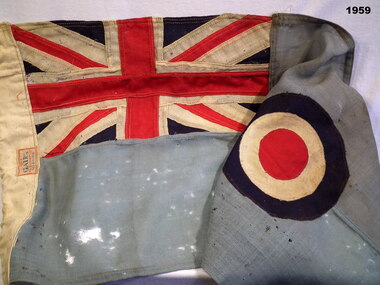
Flag - R.A.A.F ENSIGN, Gairs, c.1939 - 1945
... last flown over “Lae” in New Guinea in 1946 by No 33 RAAF Transport Sqd. Item belonged to Maxwell Lennox Matheson No 418447 RAAF, enlisted 22.5.42 age 19 years. At discharge from the RAAF on 19.2.48 he held the rank of Flight...last flown over “Lae” in New Guinea in 1946 by No 33 RAAF Transport Sqd. Item belonged to Maxwell Lennox Matheson No 418447 RAAF, enlisted 22.5.42 age 19 years. At discharge from the RAAF on 19.2.48 he held the rank of Flight ...This Ensign was last flown over “Lae” in New Guinea in 1946 by No 33 RAAF Transport Sqd. Item belonged to Maxwell Lennox Matheson No 418447 RAAF, enlisted 22.5.42 age 19 years. At discharge from the RAAF on 19.2.48 he held the rank of Flight Lieut. RAAF 33rd Transport Sqd ensign. Light green/blue fabric lower half, top right hand quarter. Union Jack in top left hand corner. Canvas inner edge with rope looped at top (stitched) looped at bottom (tied).“IWB 2005”, written on canvas edgeflags - military, raaf, ensign -
 Bendigo Historical Society Inc.
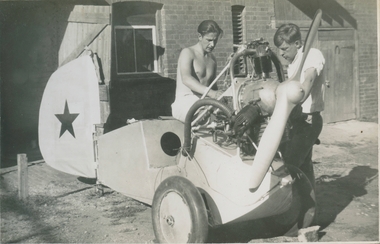
Photograph - Gliding in Bendigo, Late 1930s
... last member of the Bendigo group still alive, he resolved to set down his flying experiences. The images he selected are included, but there are many more from the Bendigo days. history bendigo bendigo gliding club alan Menere A CD entitled "Alan Menere - Recollections of Gliding in Bendigo in the late 1930s". The CD contains 33 documents consisting of one word file, one PDF file (entitled "The Urge to Fly") and the rest are of either photos of the Bendigo Gliding club or generally around Bendigo itself. Also included are some paper clippings of accidents that happened and description of flights ...These are the recollections of Alan Menere (1915 – 2001). Alan grew up in Moonee Ponds, Victoria, and moved to Bendigo while in his early 20s. There he met some like-minded young men who enjoyed challenges and matters mechanical. Flying was the adventure of the time, and they decided to give it a go. There was no intention to be on the leading edge of gliding technology. The challenge was to fly, and by their own efforts. They were aided in this by the embryonic regulatory arrangements covering light aircraft construction and flying, a sense of optimistic can-do, and the cavalier estimation of risks that goes with being in your early 20s. The events described here took place against a darkening political background. Alan and his mates were politically aware, very left wing, and viewed the gathering storm in Europe with apprehension. They could see from early on that war was coming, and it would change everything. Prevented from joining the Air Force by his red-green colour blindness, Alan joined the Army the day after the Pearl Harbour attack. He served in an Armoured Reconnaissance Unit in Western Australia, then with the Army Education Service in New Britain. After the War he joined the Commonwealth Public Service. He moved to Canberra, but his Bendigo habits stayed with him, as he built sailboards and carved propellers, to the admiration of his sons. Alan developed macular degeneration in his mid-60s. He retired to Port Stephens, fishing and socializing when he wasn’t tinkering with wing-sails for his catamaran. As he could touch-type, he quickly learned to use a computer. Very aware that he was the last member of the Bendigo group still alive, he resolved to set down his flying experiences. The images he selected are included, but there are many more from the Bendigo days.A CD entitled "Alan Menere - Recollections of Gliding in Bendigo in the late 1930s". The CD contains 33 documents consisting of one word file, one PDF file (entitled "The Urge to Fly") and the rest are of either photos of the Bendigo Gliding club or generally around Bendigo itself. Also included are some paper clippings of accidents that happened and description of flights.history, bendigo, bendigo gliding club, alan menere -
 National Vietnam Veterans Museum (NVVM)
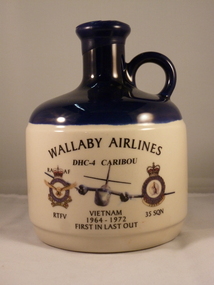
Memorabilia - Wine Flask Wallaby Airlines DHC-4 Caribou, Vietnam 1964 - 1972, First in Last Out, Wallaby Airlines DHC-4 Caribou, 1964-1972
... last out. RAAF - RTFV 35 Sqn. There is a photograph of a Caribou under the headings with the RAAF and 35 Sqn Insignias. On the back is description of what 35 Sqn did, number of flights, people and cargo. ...Wallaby Airlines DHC-4 Caribou RAAF 35 Squadron Wine Bottle RAAF Transport Flight Vietnam RTFV 35 Squadron Wallaby Airlines; DHC - 4 Caribou. Vietnam 1964-1972. First in last out. ...Dark blue and cream ceramic wine bottle. Wallaby Airlines. Blue handle and stopperWallaby Airlines; DHC - 4 Caribou. Vietnam 1964-1972. First in last out. RAAF - RTFV 35 Sqn. There is a photograph of a Caribou under the headings with the RAAF and 35 Sqn Insignias. On the back is description of what 35 Sqn did, number of flights, people and cargo. See media file for more information.wallaby airlines, dhc-4 caribou, raaf, 35 squadron, wine bottle, raaf transport flight vietnam, rtfv 35 squadron
