
Showing 18 items matching "latch hook"
-
 Embroiderers Guild, Victoria
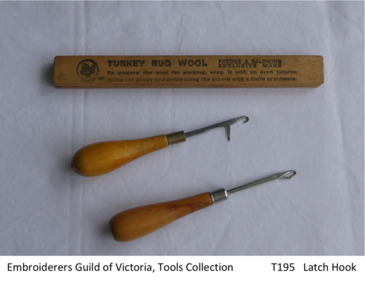
Tool - Latch hook
... Latch hook...Steel latch for hooking yarn making rugs, it has a wooden handle, brass ferule. ...Tool Latch hook ...Steel latch for hooking yarn making rugs, it has a wooden handle, brass ferule. -
 Embroiderers Guild, Victoria
Tool - Turkey rug wool measurer, 1930's (?)
... ...Latch hook...From ancient crafts making rugs, in 19th century Europe and USA latch hook rug making was a craft of poverty, initially using scraps of fabrics. ...From ancient crafts making rugs, in 19th century Europe and USA latch hook rug making was a craft of poverty, initially using scraps of fabrics. ...From ancient crafts making rugs, in 19th century Europe and USA latch hook rug making was a craft of poverty, initially using scraps of fabrics. In 1920's the latch hook, a tool combining the hand hook and the latch enabled people to make these rugs much more quickly. Patons and Baldwin's were two knitting yarn manufacturers who merged in 1920's and the Turkish rug name used the connotation of traditional and expensive Turkish hand made rugs to sell their tools and yarns to domestic craftersFrom the craft of poverty to one of artistic home decorating latch hook rug making came into its own particularly in 1950's. Wooden measurer, rectangular shape with a groove which is used to guide the scissors or knife cutting the wool wound around it.TURKEY RUG WOOL PATONS & BALDWINS EXCLUSIVE MAKE. To prepare the wool for working, wrap it with an even tension round the gauge and divide along the groove with a knife or scissorswool rug, patons & baldwin, latch hook -
 City of Moorabbin Historical Society (Operating the Box Cottage Museum)
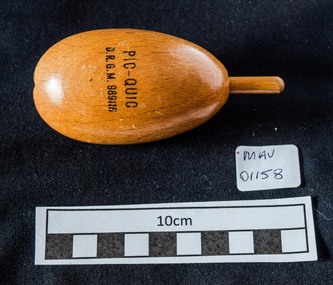
Sewing Equipment , wooden 'Pic-Quic', 20thC
... The wooden egg has a tiny metal latch hook inserted in the middle (same design as rug making tools). ...The wooden egg has a tiny metal latch hook inserted in the middle (same design as rug making tools). ...The wooden egg has a tiny metal latch hook inserted in the middle (same design as rug making tools). There is a groove down one side. A stocking or knitted fabric is stretched around the egg with the "ladder" in line with the groove. The latch hook is used to pick up the loops in knitted fabric to repair the fault. D.R.G.M., is not a German patent but was instead a way for inventors to register a product’s design or function in all states within Germany. From 1891 to 1952, products manufactured in Germany might have been stamped with this D.R.G.M. designation. This Quic Pic was used by the family of Ailsa Hunt in mid 20thCThe women of the post World War 11 estates made clothes and furnishings as their families settled in Bentleigh, McKinnon, Moorabbin ,Ormond in City of Moorabbin c1950s A wooden egg shaped tool with enclosed steel hook for darning stockings c1950'PIC - QUIC' DRGM 989116clothing, haberdashery, crochet, doilies, brighton, moorabbin, pioneers, dressmaking, market gardeners, early settlers, craftwork , bentleigh, lacework, moorabbin shire, hunt ailsa, dairy farms, fruit orchards -
 Cheese World Museum
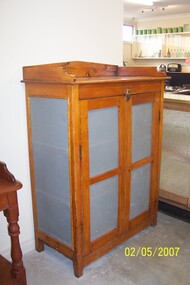
Food Safe
... A raised surround on three sides of the top. Evidence of a latch hook on left hand door and keyhole on right hand door. ...A raised surround on three sides of the top. Evidence of a latch hook on left hand door and keyhole on right hand door. ...Wooden cabinet with wire mesh inserts on sides and doors. Swivel door with latch at the top and three shelves. Polished pine body with rough sawn timber back. A raised surround on three sides of the top. Evidence of a latch hook on left hand door and keyhole on right hand door. uebergang, allansford, food safe, food storage -
 Coal Creek Community Park & Museum
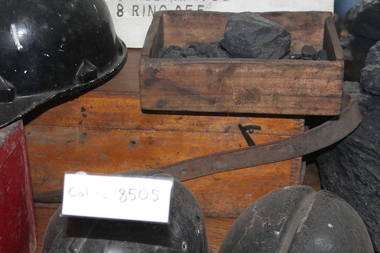
LIght brown box with carry strap
... 8505.1 - Lockable wooden box with hinged lid and thick leather carrying strap and two simple hook latches....8505.1 - Lockable wooden box with hinged lid and thick leather carrying strap and two simple hook latches. LIght brown box with carry strap. ...8505.1 - Lockable wooden box with hinged lid and thick leather carrying strap and two simple hook latches. -
 Coal Creek Community Park & Museum
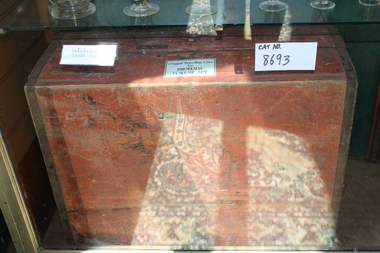
Imperial Volume Set
... It is a large wooden case that has been painted red and has two hook latches....It is a large wooden case that has been painted red and has two hook latches. Imperial Volume Set ...8693.1 - Original traveling case for imperial volume set. It is a large wooden case that has been painted red and has two hook latches.8693.1 - 3BC -
 Lakes Entrance Historical Society
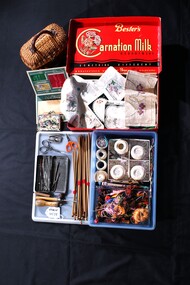
Equipment - Collection of Sewing/Knitting/Crochet Equipment, c1900 -1920
... Small tin containing 14 crochet hooks with covers, 9 fine crochet hooks, one fine latch hook. Small plastic box containing 1 awl, 1 thimble, 1 large crochet hook, 3 embroidery scissors, 1 tiny screw driver, large sewing needles. ...Small tin containing 14 crochet hooks with covers, 9 fine crochet hooks, one fine latch hook. Small plastic box containing 1 awl, 1 thimble, 1 large crochet hook, 3 embroidery scissors, 1 tiny screw driver, large sewing needles. ...This wonderful collection of craft equipment has been lovingly preserved by the donor, much of it is 100 years old.Twenty two bamboo knitting needles. Small sewing basket containing small embroidered sewing kit. Small tin containing 14 crochet hooks with covers, 9 fine crochet hooks, one fine latch hook. Small plastic box containing 1 awl, 1 thimble, 1 large crochet hook, 3 embroidery scissors, 1 tiny screw driver, large sewing needles. Large Plastic box containing 8 reels crochet cottons (Coats), 1 fine crochet hook, 1 small embroidery scissors, 1 crochet pattern, embroidery silks. Red Box containing crochet butterfly paper patterns, Embroidery pieces unfinished.craft supplies, equipment, collections -
 University of Melbourne, Burnley Campus Archives
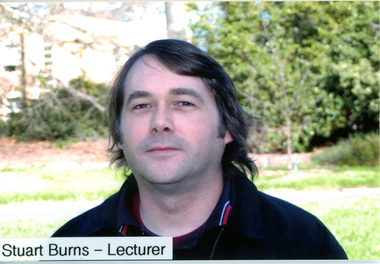
Photograph - Colour photograph, Staff Photographs, Unknown
... 2 colour photographs with hook and latch dots in the corners. Labelled: 1. ...staff burnley stuart burns Dr Magali Wright 2 colour photographs with hook and latch dots in the corners. Labelled: 1. ...staff, burnley, stuart burns, dr magali wright -
 Whitehorse Historical Society Inc.
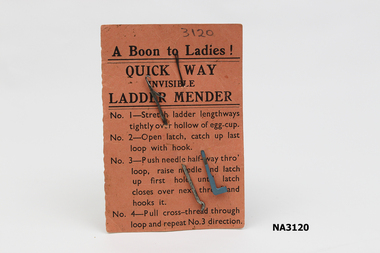
Functional object - Ladder Mender
... It consist of a steel wire with a hook at one end and a hook and latch at the other mounted on a card....It consist of a steel wire with a hook at one end and a hook and latch at the other mounted on a card. Functional object Ladder Mender ...Betty McPhee Sewing collectionTwo fine cachet hooks used for mending stockings. It consist of a steel wire with a hook at one end and a hook and latch at the other mounted on a card.A Boon to Ladiesdomestic items, sewing -
 Bendigo Military Museum
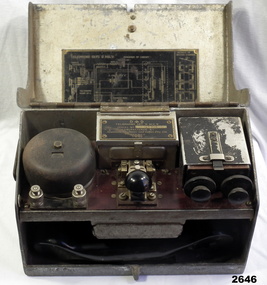
Equipment - FIELD TELEPHONE, Standard Telephones & Cables Pty Ltd, 1941
... Attachments on sides & rear for carrying straps. Hook & eye latch on front for securing lid....Attachments on sides & rear for carrying straps. Hook & eye latch on front for securing lid. Equipment FIELD TELEPHONE Standard Telephones & Cables Pty Ltd ...Field telephone set D MK V - used for sending messages in the field via voice. Serial No. 21396.Rectangular metal box with hinged lid, containing communication apparatus for sending verbal messages. Attachments on sides & rear for carrying straps. Hook & eye latch on front for securing lid.Instruction plates on inside of hinged lid. “Serial No 21396”communications - telephonic, military equipment - army, metalcraft, passchendaele barracks trust -
 National Wool Museum
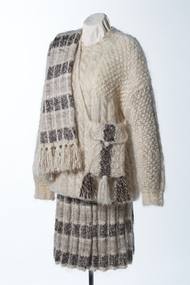
Clothing - Knitted Outfit, Inge Cammans, 1998
... She would take the fleece to spin and then design and knit, crochet or latch hook every item from scratch, often inspired by techniques from dressmaking, and make knitted garments appear or behave the same way, despite its very different construction. ...She would take the fleece to spin and then design and knit, crochet or latch hook every item from scratch, often inspired by techniques from dressmaking, and make knitted garments appear or behave the same way, despite its very different construction. ...Inge Cammans was born Ingenborg Flachs on 13 March 1932 in the Netherlands. She married Theodore Cammans on 27 April 1959 in Valkenburg. Inge was a dressmaker, and Theo a butcher. Later that year they emigrated to Canada, then in the mid 1960’s arrived in Australia. After arriving in Australia, they settled in East Gippsland. After some time in Sale, they moved to the small country town of Buchan and for two years they operated the local butcher shop and then took over the kiosk at Buchan Caves Reserve, which they ran for 13 years while raising their four children. Around 1980 they retired to the main street of Buchan. There they bought and restored the "Callemondah" property and opened a small craft and gallery space called the Buchan Black Marble Hut to display and sell Theo’s beautiful woodwork, stone craft and paintings. Although they were quite busy with the tourist trade, Inge fast became restless and borrowed a spinning wheel from a friend to try out. She taught herself how to spin and knit over the course of two months. From there, Inge went on to win a vast array of awards for her knitting - the house was full of walls upon walls covered in certificates, sashes, newspaper articles and pennants. She never used dye and only ever worked with natural wool, and would regularly travel out to the local farms to choose the colour of sheep she wanted. She would take the fleece to spin and then design and knit, crochet or latch hook every item from scratch, often inspired by techniques from dressmaking, and make knitted garments appear or behave the same way, despite its very different construction. This outfit was made by Inge in 1998. She was intrigued to figure out how to create the kilt pleats, the plaid pattern and the structure of the head piece. It was never intended to be worn out and about. She did knit items to wear, gift or sell, but the vast majority of her creative pieces were specifically intended as show submissions. This outfit was entered in the National Wool Awards competition in 1999 and won first prize. Hand knitted cream and brown outfit consisting of a skirt (kilt), jumper, hat (beret), scarf, socks and bag. Outfit is made using hand spun wool from local East Gippsland area, Perendale and Mohair. An artist tag and rosette award accompany the outfit.tag [front]: [handwritten] SCOTTISH OUTFIT / DESIGNED HAND- / SPUN + KNITTED OUT / OF PERRIDALE + / MOHAIR BY / Inge Cammans / [printed] BUCHAN / BLACK MARBLE HUT / GALLERY / Main Street, Box 9, / Buchan, Vic. 3885 / (051) 55 9296 / AUSTRALIA tag [back]: Theo Cammans / is an exceptionally talented individual. / He is responsible for not only / the beautiful paintings and / woodwork throughout the / shop, but also fashions the / unique Buchan Marble / into many varied and / stunning designs. / Inge Cammans / using her own hand spun / wool she has made multi / award winning garments / and wall hangings. / Each item in unique and / renowned world wide / She has taken first prize at - / National Wool Awards, / Melbourne, Lakes, Bairnsdale, Omeo / Paris Exhibitor front [rosette]: OMEO & DIST. A.&P. SOCIETY / WOOL DESIGN AWARDS / 1stknitting handicrafts, cammans, mr theo, knitting, handicrafts, east gippsland, inge cammas, buchan, migration, buchan black marble hut, awards -
 Flagstaff Hill Maritime Museum and Village
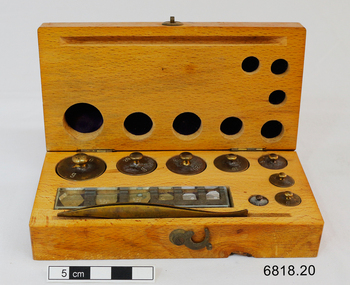
Instrument - Apothecary Set of Weights, 1903 – 1917
... Apothecary or pharmacy weights set, metric, in fitted wooden box with metal hook latch. Part of the W.R. Angus Collection. .... / MELBOURNE" Apothecary or pharmacy weights set, metric, in fitted wooden box with metal hook latch. Part of the W.R. Angus Collection. ...This apothecary weights set was supplied by the company 'H B Silberberg & Company, Melbourne.' The company used this name in Melbourne from 1903-1917, then changed their name to “H.B. Selby & Company”. The firm specialised in the manufacture, import and supply of scientific instruments, laboratory apparatus, chemicals and industrial equipment. It was founded in Melbourne around 1889 by Carl de Beer and traded under the name of his brother Ernest de Beer and Company. Herbert B Silberberg joined the de Beer partnership in 1903 and, later in the same year, bought the de Beers’ shares in the business. Silberberg carried on as de Beer, Silberberg & Company for four months, after which he changed the name to H B Silberberg & Company. (Australian National University Archives; H B Selby and Company Proprietary Limited) This apothecary weights set was donated to Flagstaff Hill Maritime Village by the family of Doctor William Roy Angus, Surgeon and Oculist. It is part of the “W.R. Angus Collection” that includes historical medical equipment, surgical instruments and material once belonging to Dr Edward Ryan and Dr Thomas Francis Ryan, (both of Nhill, Victoria) as well as Dr Angus’ own belongings. The Collection’s history spans the medical practices of the two Doctors Ryan, from 1885-1926 plus that of Dr Angus, up until 1969. ABOUT THE “W.R.ANGUS COLLECTION” Doctor William Roy Angus M.B., B.S., Adel., 1923, F.R.C.S. Edin.,1928 (also known as Dr Roy Angus) was born in Murrumbeena, Victoria in 1901 and lived until 1970. He qualified as a doctor in 1923 at University of Adelaide, was Resident Medical Officer at the Royal Adelaide Hospital in 1924 and for a period was house surgeon to Sir (then Mr.) Henry Simpson Newland. Dr Angus was briefly an Assistant to Dr Riddell of Kapunda, then commenced private practice at Curramulka, Yorke Peninsula, SA, where he was physician, surgeon and chemist. In 1926, he was appointed as new Medical Assistant to Dr Thomas Francis Ryan (T.F. Ryan, or Tom), in Nhill, Victoria, where his experiences included radiology and pharmacy. In 1927 he was Acting House Surgeon in Dr Tom Ryan’s absence. Dr Angus had become engaged to Gladys Forsyth and they decided he would take time to further his studies overseas in the UK in 1927. He studied at London University College Hospital and at Edinburgh Royal Infirmary and in 1928, was awarded FRCS (Fellow from the Royal College of Surgeons), Edinburgh. He worked his passage back to Australia as a Ship’s Surgeon on the on the Australian Commonwealth Line’s T.S.S. Largs Bay. Dr Angus married Gladys in 1929, in Ballarat. (They went on to have one son (Graham 1932, born in SA) and two daughters (Helen (died 12/07/1996) and Berenice (Berry), both born at Mira, Nhill ) Dr Angus was a ‘flying doctor’ for the A.I.M. (Australian Inland Ministry) Aerial Medical Service in 1928 . The organisation began in South Australia through the Presbyterian Church in that year, with its first station being in the remote town of Oodnadatta, where Dr Angus was stationed. He was locum tenens there on North-South Railway at 21 Mile Camp. He took up this ‘flying doctor’ position in response to a call from Dr John Flynn; the organisation was later known as the Flying Doctor Service, then the Royal Flying Doctor Service. A lot of his work during this time involved dental surgery also. Between 1928-1932 he was surgeon at the Curramulka Hospital, Yorke Peninsula, South Australia. In 1933 Dr Angus returned to Nhill where he’d previously worked as Medical Assistant and purchased a share of the Nelson Street practice and Mira hospital from Dr Les Middleton one of the Middleton Brothers, the current owners of what was once Dr Tom Ryan’s practice. Dr L Middleton was House Surgeon to the Nhill Hospital 1926-1933, when he resigned. [Dr Tom Ryan’s practice had originally belonged to his older brother Dr Edward Ryan, who came to Nhill in 1885. Dr Edward saw patients at his rooms, firstly in Victoria Street and in 1886 in Nelson Street, until 1901. The Nelson Street practice also had a 2 bed ward, called Mira Private Hospital ). Dr Edward Ryan was House Surgeon at the Nhill Hospital 1884-1902 . He also had occasions where he successfully performed veterinary surgery for the local farmers too. Dr Tom Ryan then purchased the practice from his brother in 1901. Both Dr Edward and Dr Tom Ryan work as surgeons included eye surgery. Dr Tom Ryan performed many of his operations in the Mira private hospital on his premises. He too was House Surgeon at the Nhill Hospital 1902-1926. Dr Tom Ryan had one of the only two pieces of radiology equipment in Victoria during his practicing years – The Royal Melbourne Hospital had the other one. Over the years Dr Tom Ryan gradually set up what was effectively a training school for country general-practitioner-surgeons. Each patient was carefully examined, including using the X-ray machine, and any surgery was discussed and planned with Dr Ryan’s assistants several days in advance. Dr Angus gained experience in using the X-ray machine there during his time as assistant to Dr Ryan. Dr Tom Ryan moved from Nhill in 1926. He became a Fellow of the Royal Australasian College of Surgeons in 1927, soon after its formation, a rare accolade for a doctor outside any of the major cities. He remained a bachelor and died suddenly on 7th Dec 1955, aged 91, at his home in Ararat. Scholarships and prizes are still awarded to medical students in the honour of Dr T.F. Ryan and his father, Dr Michael Ryan, and brother, John Patrick Ryan. ] When Dr Angus bought into the Nelson Street premises in Nhill he was also appointed as the Nhill Hospital’s Honorary House Surgeon 1933-1938. His practitioner’s plate from his Nhill surgery states “HOURS Daily, except Tuesdays, Fridays and Saturday afternoons, 9-10am, 2-4pm, 7-8pm. Sundays by appointment”. This plate is now mounted on the doorway to the Port Medical Office at Flagstaff Hill Maritime Village, Warrnambool. Dr Edward Ryan and Dr Tom Ryan had an extensive collection of historical medical equipment and materials spanning 1884-1926 and when Dr Angus took up practice in their old premises he obtained this collection, a large part of which is now on display at the Port Medical Office at Flagstaff Hill Maritime Village in Warrnambool. During his time in Nhill Dr Angus was involved in the merging of the Mira Hospital and Nhill Public Hospital into one public hospital and the property titles passed on to Nhill Hospital in 1939. In 1939 Dr Angus and his family moved to Warrnambool where he purchased “Birchwood,” the 1852 home and medical practice of Dr John Hunter Henderson, at 214 Koroit Street. (This property was sold in1965 to the State Government and is now the site of the Warrnambool Police Station. ). The Angus family was able to afford gardeners, cooks and maids; their home was a popular place for visiting dignitaries to stay whilst visiting Warrnambool. Dr Angus had his own silk worm farm at home in a Mulberry tree. His young daughter used his centrifuge for spinning the silk. Dr Angus was appointed on a part-time basis as Port Medical Officer (Health Officer) in Warrnambool and held this position until the 1940’s when the government no longer required the service of a Port Medical Officer in Warrnambool; he was thus Warrnambool’s last serving Port Medical Officer. (The duties of a Port Medical Officer were outlined by the Colonial Secretary on 21st June, 1839 under the terms of the Quarantine Act. Masters of immigrant ships arriving in port reported incidents of diseases, illness and death and the Port Medical Officer made a decision on whether the ship required Quarantine and for how long, in this way preventing contagious illness from spreading from new immigrants to the residents already in the colony.) Dr Angus was a member of the Australian Medical Association, for 35 years and surgeon at the Warrnambool Base Hospital 1939-1942, He served as a Surgeon Captain during WWII1942-45, in Ballarat, Victoria, and in Bonegilla, N.S.W., completing his service just before the end of the war due to suffering from a heart attack. During his convalescence he carved an intricate and ‘most artistic’ chess set from the material that dentures were made from. He then studied ophthalmology at the Royal Melbourne Eye and Ear Hospital and created cosmetically superior artificial eyes by pioneering using the intrascleral cartilage. Angus received accolades from the Ophthalmological Society of Australasia for this work. He returned to Warrnambool to commence practice as an ophthalmologist, pioneering in artificial eye improvements. He was Honorary Consultant Ophthalmologist to Warrnambool Base Hospital for 31 years. He made monthly visits to Portland as a visiting surgeon, to perform eye surgery. He represented the Victorian South-West subdivision of the Australian Medical Association as its secretary between 1949 and 1956 and as chairman from 1956 to 1958. In 1968 Dr Angus was elected member of Spain’s Barraquer Institute of Barcelona after his research work in Intrasclearal cartilage grafting, becoming one of the few Australian ophthalmologists to receive this honour, and in the following year presented his final paper on Living Intrasclearal Cartilage Implants at the Inaugural Meeting of the Australian College of Ophthalmologists in Melbourne In his personal life Dr Angus was a Presbyterian and treated Sunday as a Sabbath, a day of rest. He would visit 3 or 4 country patients on a Sunday, taking his children along ‘for the ride’ and to visit with him. Sunday evenings he would play the pianola and sing Scottish songs to his family. One of Dr Angus’ patients was Margaret MacKenzie, author of a book on local shipwrecks that she’d seen as an eye witness from the late 1880’s in Peterborough, Victoria. In the early 1950’s Dr Angus, painted a picture of a shipwreck for the cover jacket of Margaret’s book, Shipwrecks and More Shipwrecks. She was blind in later life and her daughter wrote the actual book for her. Dr Angus and his wife Gladys were very involved in Warrnambool’s society with a strong interest in civic affairs. Their interests included organisations such as Red Cross, Rostrum, Warrnambool and District Historical Society (founding members), Wine and Food Society, Steering Committee for Tertiary Education in Warrnambool, Local National Trust, Good Neighbour Council, Housing Commission Advisory Board, United Services Institute, Legion of Ex-Servicemen, Olympic Pool Committee, Food for Britain Organisation, Warrnambool Hospital, Anti-Cancer Council, Boys’ Club, Charitable Council, National Fitness Council and Air Raid Precautions Group. He was also a member of the Steam Preservation Society and derived much pleasure from a steam traction engine on his farm. He had an interest in people and the community He and his wife Gladys were both involved in the creation of Flagstaff Hill, including the layout of the gardens. After his death (28th March 1970) his family requested his practitioner’s plate, medical instruments and some personal belongings be displayed in the Port Medical Office surgery at Flagstaff Hill Maritime Village, and be called the “W. R. Angus Collection”. The W.R. Angus Collection is significant for still being located at the site it is connected with, Doctor Angus being the last Port Medical Officer in Warrnambool. The collection of medical instruments and other equipment is culturally significant, being an historical example of medicine from late 19th to mid-20th century. Dr Angus assisted Dr Tom Ryan, a pioneer in the use of X-rays and in ocular surgery. Apothecary or pharmacy weights set, metric, in fitted wooden box with metal hook latch. Part of the W.R. Angus Collection. Round brass weights (50g, 20g, 20g, 10g, 5g, 2g, 2g, 1g) and small silver sheet weights under glass (500mg, 200mg, 200mg, 50mg, 10mg, 5mg, & 5 other smaller ones), plus brass tweezers. Lid of the box has maker's plate "MADE SPECIALLY / FOR / H B SILBERBERG & CO. / MELBOURNE"flagstaff hill, warrnambool, shipwrecked coast, flagstaff hill maritime museum, maritime museum, shipwreck coast, flagstaff hill maritime village, great ocean road, dr w r angus, dr ryan, nhill base hospital, warrnambool base hospital, mira hospital, apothecary weights set, pharmacist weights, weights and measures, chemist weights -
 Wangaratta High School
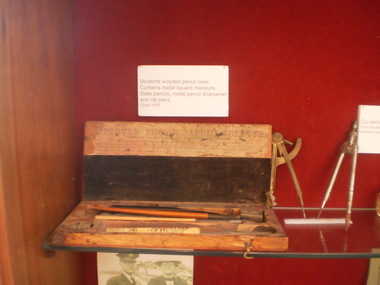
WHS Wooden Pencil case, Circa 1915
... Pencil case has metal hooks to latch closed and lid has faded lettering making out Approved Photographic colours....Pencil case has metal hooks to latch closed and lid has faded lettering making out Approved Photographic colours. ...Rectangular wooden pencil case with an assortment of wooden nib pens, slate pencils, metal protractors, sharpeners and other and stationary inside. Pencil case has metal hooks to latch closed and lid has faded lettering making out Approved Photographic colours.Approved Photographic colours -
The Ed Muirhead Physics Museum
Standard Capacitor Nalder Bros & Co
... Detachable brass elliptical stopper, two brass butterfly screws, two hook latches attached to outside of box to secure object for transport. ...Detachable brass elliptical stopper, two brass butterfly screws, two hook latches attached to outside of box to secure object for transport. ...No. of pieces: one object recessed into wooden box with detachable parts. Handmade wooden box enclosing a machine molded solid metal object. Plastic machine molded attachment. Gold electroplated metal, wax-matte hand polished wooden box, plastic has either been polished or had a varnish polish added to the surface. Detachable brass elliptical stopper, two brass butterfly screws, two hook latches attached to outside of box to secure object for transport. Polished wood surface, possibly wax coated. Brass metal coated with gold patina/electroplating. Plastic component either polished or coated with gloss varnish. Inscribed on top of the object, in the wooden box: “MICROFARAD/NALDER BROS & CO/WESTMINSTER/No 1509” Paint dot approx. 1.0cm in diameter on top face of wooden box, back edge, towards the right. -
 National Wool Museum
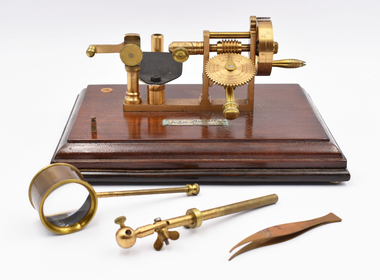
Functional object - Yarn Spinner and Accessories, John Nesbitt, 19th Century
... Custom made wooden hinged box with a hook latch. Brass yarn spinner, attached to a mahogany wood plinth base, which spins fibre into cord/yarn/thread. ...Although Nino has now retired from his honorary position and has hung up his Australian Tartan vest, these items will continue to serve the community in sharing the stories of Australian Textile design. apparatus textile testing spinning nino corda magnifyer tools brass mahogany tweezers yarn spinner design john nesbitt manchester england 19th Century engineering manufacturing Brass plaque on base of spinner: 42 MARKET St / John Nesbitt / REGd TRADE MARK / LIMd / MANCHESTER Underside of wooden plinth: 4976 Custom made wooden hinged box with a hook latch. Brass yarn spinner, attached to a mahogany wood plinth base, which spins fibre into cord/yarn/thread. ...Nino Corda was a Geelong based textile designer who worked at various textile mills between 1957 & 2003. He travelled the world in search of the latest fashions and techniques and developed timeless designs that were much loved by Australians. These items are on rotational display at the National Wool Museum’s ‘In the Factory’ exhibition. For many years, Nino also worked as part of the Honorary Staff of the National Wool Museum. His passion for the world of textiles provided energy and knowledge to the visitors and staff of the museum. Although Nino has now retired from his honorary position and has hung up his Australian Tartan vest, these items will continue to serve the community in sharing the stories of Australian Textile design.Custom made wooden hinged box with a hook latch. Brass yarn spinner, attached to a mahogany wood plinth base, which spins fibre into cord/yarn/thread. It has dials to set the rate that it spins. Metal plaque with black inlaid enamel lettering. Small cork inlay. Brass rod with hinge and wingnut, and ball at end. Ball at end has an adjustment mechanism. Rod also has an adjustable circular collar. Pair of curved tweezers. Circular magnifying glass on long thin handle. Glass has two concave lenses. Weaving sample in shades of blue, green and brown. Twill weave. Alternate pattern samples separated by red thread.Brass plaque on base of spinner: 42 MARKET St / John Nesbitt / REGd TRADE MARK / LIMd / MANCHESTER Underside of wooden plinth: 4976apparatus, textile, testing, spinning, nino corda, magnifyer, tools, brass, mahogany, tweezers, yarn, spinner, design, john nesbitt, manchester, england, 19th century, engineering, manufacturing -
 Flagstaff Hill Maritime Museum and Village
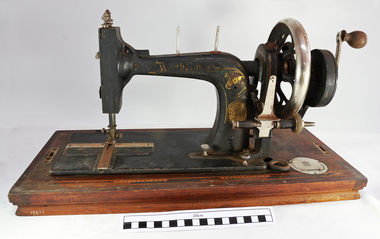
Domestic object - Sewing Machine and case, Joseph Wertheim, late 19th century
... Timber machine case or cover includes an accessory box with sliding cover and metal hook and eye latch, and inside the box are 23 metal sewing attachments, a disc and a stick of black crayon with maker’s trademark on it paper cover. ...Timber machine case or cover includes an accessory box with sliding cover and metal hook and eye latch, and inside the box are 23 metal sewing attachments, a disc and a stick of black crayon with maker’s trademark on it paper cover. ...Hugo Wertheim (1854-1919), was a merchant and manufacturer and was born on the 12th July 1854 at Lispenhausen, in the German electorate of Hesse-Kassel, son of Meyer Wertheim and his wife Minna, née Heinemann. Hugo reached Melbourne in October 1875. He soon began advertising, from premises at 39 Flinders Lane East, as agent for his father's cousin Joseph Wertheim, a well-established manufacturer of sewing machines. Hugo returned to Germany where he married Joseph Wertheim's daughter Sophie Emilie (1864-1953) on 30 August 1885 at Frankfurt. the couple then came to Melbourne. In a short time, with extensive advertising, Hugo established a substantial business, selling sewing machines, bicycles, pianos and other mechanical devices, under brands such as Wertheim, Electra, Planet, Griffin and Hapsburg. He also mounted elaborate displays at agricultural shows and in 1901 at the Pan American Exposition, Buffalo, United States of America. O. C. Beale worked with him before setting up his own piano business in New South Wales. Hugo continued to own 25 per cent of one of Beale's companies, which became Wertheim's Queensland business. In 1908 Wertheim opened a large, innovative piano factory at Richmond, Melbourne, intending to produce 2000 pianos and player pianos annually, predominantly using Australian materials. In laying the foundation stone, Prime Minister Alfred Deakin observed that “few men with such opportunities for a life of ease would have embarked on such an enterprise” Hugo died of chronic hepatitis on 11 July 1919 at his home at South Yarra, his wife, two daughters and three sons survived him; Herbert Joseph (1886-1972), the eldest, continued the business. Rupert became a share broker and went on to represent Victoria in inter-State tennis in 1913-27 and Australia in Davis Cup matches against Czechoslovakia in 1922. The piano factory closed in 1935, becoming a Heinz food processing plant and in 1955, GTV Channel 9 studios and offices.Early Australians had to be self-reliant in regards to making and mending their clothes and utensils. This sewing machine was one of many items used that exhibit the skill and craftsmanship of the women in these early families. A sewing machine was a necessary part of each home and this item demonstrates how women of the time managed had to become self-reliant in the repair and making of their families clothes to make their household budgets go further.Sewing machine, Wertheim brand “ Syst 182” hand crank operated machine with folding handle, timber case and carry handle. Metal machine is painted black, with remnants of gold, red and green scrolls and floral decoration. Machine has base with inlaid measuring rule across front and 2 holes drilled through the base (perhaps for mounting machine to a bench). Machine tilts open, hinged on one side, after thumb screw is unwound, revealing machine’s workings and serial number. Base has a fitted round, concave, silver metal pin holder with lid that hinges open, and symbol pressed into lid; several pins are inside. Body of machine has brand name transfer across front and oval metal trademark disc on front. Metal sliding covers over footplates have stamped lettering. Timber machine case or cover includes an accessory box with sliding cover and metal hook and eye latch, and inside the box are 23 metal sewing attachments, a disc and a stick of black crayon with maker’s trademark on it paper cover. Workings of machine have seized up. The crayon wrapper has printed on it “For the wonderful Wertheim new family machine made in Germany ‘Syst. 182’”, and the maker’s symbol with “Trademark” beside it. Made for Hugo Wertheim.“WERTHEIM” transfer across front and back of machine body. Cover of pin holder has symbol ‘Wings above a shield’. Maker’s trademark on gold oval disc, “WERTHEIM / FRANCFURT” and picture of a dwarf with a hammer. Left footplate has script “Syst 182”, right footplate has stamp in oval shape “MANUFACTURED IN - - /SPECIALLY FOR / HUGO WERTHEIM” Serial Number “7501”flagstaff hill, warrnambool, shipwrecked-coast, flagstaff-hill, flagstaff-hill-maritime-museum, maritime-museum, shipwreck-coast, flagstaff-hill-maritime-village, sewing machine, hand crank sewing machine, hugo wertheim, wertheim, clothing manufacturer, sewing, syst 182 -
 Friends of Kurth Kiln
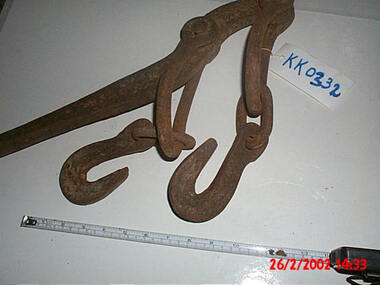
Chain Dog
... Lever type latch for tightening large chains. It has two hooks and two links...Lever type latch for tightening large chains. It has two hooks and two links Chain Dog ...Logging Chain Dog. Lever type latch for tightening large chains. It has two hooks and two links -
 Parks Victoria - Mount Buffalo Chalet
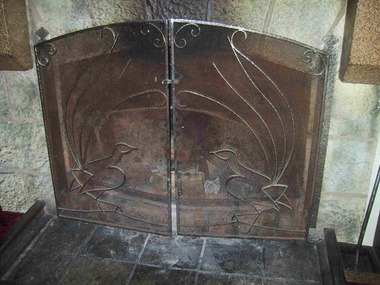
Firescreen and poker
... latches. One lyre bird design on each side. Heavy mesh with scrolling work. Attached to fireplace. 2. Poker is forged steel with a knob on one end and a hook on the other....latches. One lyre bird design on each side. Heavy mesh with scrolling work. Attached to fireplace. 2. Poker is forged steel with a knob on one end and a hook on the other. ...'The distinctive lyrebird firescreen has become a popular feature of the lounge. It is not known how long it has stood in this position, but it appears to have been custom-made for the fireplace. Firescreens are not clearly shown in early photographs. It is popularly believed that the fenders on the floor..came from the Victorian Railways workshops and were made from railway line metal..' (Pg 72 Historica. 2011) "In 1924 amateur naturalist and mountain-guide, Alice Manfield (18-78 -1960) popularly known as Guide Alice, released 'The Lyre-birds of Mount Buffalo', a 23 page booklet detailing her studies into the lyre-birds on Mount Buffalo, the first pictorial record of lyre-birds to be published.... It is not known whether the lyrebird fire screen in the Chalet Lounge was dedicated to Alice Manfield and her study into local lyrebirds, but this popular feature is a most appropriate tribute." (Pg 132 Historica,2011) Listed in Draft Inventory of Significant Collection Items . 1. Forged and beaten steel firescreen. opens in the centre and is closed with two latches. One lyre bird design on each side. Heavy mesh with scrolling work. Attached to fireplace. 2. Poker is forged steel with a knob on one end and a hook on the other.
