
Showing 982 items matching "latrobe"
-
 Ballarat Tramway Museum
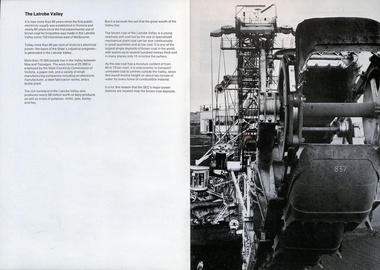
Booklet, State Electricity Commission of Victoria (SECV), "Power Generation in the Latrobe Valley", late to 1970s
... "Power Generation in the Latrobe Valley"...Document prepared by SECV Public Relations department mid to late 1970s about the power generation in the Latrobe Valley. Looks at each power station, growth in power generation, the environment, and has tech details of each power boiler and power stations. ...Booklet - 20 pages - matt paper, centre stapled, titled "Power Generation in the Latrobe Valley"...SECV publicity Public Relations Power Stations power generation Latrobe Valley Booklet - 20 pages - matt paper, centre stapled, titled "Power Generation in the Latrobe Valley" "Power Generation in the Latrobe Valley" Booklet State Electricity Commission of Victoria (SECV) Dominion Press ...Document prepared by SECV Public Relations department mid to late 1970s about the power generation in the Latrobe Valley. Looks at each power station, growth in power generation, the environment, and has tech details of each power boiler and power stations. Demonstrates an item used by the SECV to distribute public relations materials. Has a close association with the organisation that ran Ballarat's trams from 1934 to 1971.Booklet - 20 pages - matt paper, centre stapled, titled "Power Generation in the Latrobe Valley"secv, publicity, public relations, power stations, power generation, latrobe valley -
 Ballarat Tramway Museum
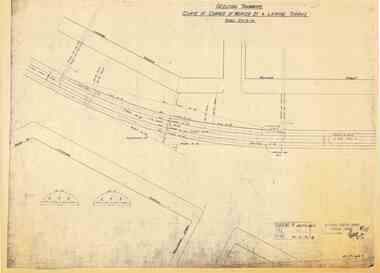
Drawing - GE-T1-6217, State Electricity Commission of Victoria - Electricity Supply Department, Curve at corner of Mercer St & Latrobe Terrace, 28/06/2026
... Curve at corner of Mercer St & Latrobe Terrace....Produced by the SEC (Geelong Electric Tramways) to document curved trackwork at corner of Mercer St & Latrobe Terrace....SEC drawing no GE-T1-6217, "Curve at corner of Mercer St & Latrobe Terrace.". Drawn 12/09/1947. Beige paper copy of original dyeline print. ...Produced by the SEC (Geelong Electric Tramways) to document curved trackwork at corner of Mercer St & Latrobe Terrace. Yields information regarding the construction details for curved trackwork at corner of Mercer St & Latrobe Terrace. ...Produced by the SEC (Geelong Electric Tramways) to document curved trackwork at corner of Mercer St & Latrobe Terrace.Yields information regarding the construction details for curved trackwork at corner of Mercer St & Latrobe Terrace.SEC drawing no GE-T1-6217, "Curve at corner of Mercer St & Latrobe Terrace.". Drawn 12/09/1947. Beige paper copy of original dyeline print. Copy of original. Document signoff in bottom righthand corner.provincial tramways, geelong tramway, state electricity commission of victoria -
 Alfred Hospital Nurses League - Nursing History Collection
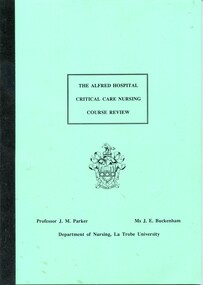
Document, Professor J M Parker et al, The Alfred Hospital Critical Care Nursing Course Review, June 1990
... Review of The Alfred Hospital Critical Care Nursing Course, by the Departmet of Nursing, Latrobe University, June 1990 ...Document with platic laminated green cover, black spine and black print detailing title, Latrobe University Crest,authors, and 'Depatment of Nursing, Latrobe University' on front cover...Department of Nursing Latrobe University...Review of The Alfred Hospital Critical Care Nursing Course, by the Departmet of Nursing, Latrobe University, June 1990 Of significance as review of the course led to shift from hospital based to univerity based critical care course Alfred Hospital Alfred Hospital School of Nursing Critical Care Nursing Critical care nursing education previous catalogue number [handwritten in black ink at top left of inside of front cover Document with platic laminated green cover, black spine and black print detailing title, Latrobe University Crest,authors, and 'Depatment of Nursing, Latrobe University' on front cover The Alfred Hospital Critical Care Nursing Course Review Document Document Professor J M Parker Ms J E Buckenham Department of Nursing Latrobe University ...Review of The Alfred Hospital Critical Care Nursing Course, by the Departmet of Nursing, Latrobe University, June 1990 Of significance as review of the course led to shift from hospital based to univerity based critical care courseDocument with platic laminated green cover, black spine and black print detailing title, Latrobe University Crest,authors, and 'Depatment of Nursing, Latrobe University' on front coverprevious catalogue number [handwritten in black ink at top left of inside of front coveralfred hospital, alfred hospital school of nursing, critical care nursing, critical care nursing education -
 Alfred Hospital Nurses League - Nursing History Collection
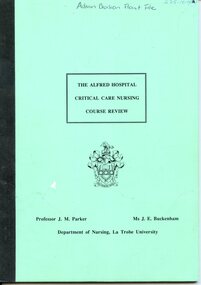
Document, Professor J M Parker et al, The Alfred Hospital Critical Care Nursing Course Review, June 1990
... Review of The Alfred Hospital Critical Care Nursing Course, by the Departmet of Nursing, Latrobe University, June 1990 ...Document with platic laminated green cover, black spine and black print detailing title, Latrobe University Crest,authors, and 'Depatment of Nursing, Latrobe University' on front cover...Department of Nursing Latrobe University...In centre top of front cover 'Admin Division Float File' is handwritten [black ink] Document with platic laminated green cover, black spine and black print detailing title, Latrobe University Crest,authors, and 'Depatment of Nursing, Latrobe University' on front cover The Alfred Hospital Critical Care Nursing Course Review Document Document Professor J M Parker Ms J E Buckenham Department of Nursing Latrobe University ...Review of The Alfred Hospital Critical Care Nursing Course, by the Departmet of Nursing, Latrobe University, June 1990 Of significance as review of the course led to shift from hospital based to univerity based critical care courseDocument with platic laminated green cover, black spine and black print detailing title, Latrobe University Crest,authors, and 'Depatment of Nursing, Latrobe University' on front coverprevious catalogue number [handwritten in black ink] at top right of front cover. In centre top of front cover 'Admin Division Float File' is handwritten [black ink]alfred hospital, alfred hospital school of nursing, critical care nursing, critical care nursing education -
 Ballarat Tramway Museum
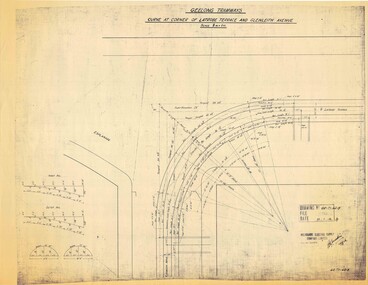
Drawing - GE-T1-6218, Melbourne Electric Supply Co. (MESCo), Curve at corner of Latrobe Terrace and Glenleith Avenue, 22/07/1920
... Curve at corner of Latrobe Terrace and Glenleith Avenue....Produced by the Geelong Tramways (Geelong Branch of Melbourne Electricity Supply Company Limited) to document the trackwork details at corner of Latrobe Terrace and Glenleith Avenue....Geelong Tramways drawing no GE-T1-6218, "Curve at corner of Latrobe Terrace and Glenleith Avenue.". Drawn 22/07/1920. ...Produced by the Geelong Tramways (Geelong Branch of Melbourne Electricity Supply Company Limited) to document the trackwork details at corner of Latrobe Terrace and Glenleith Avenue. Yields information regarding the construction details for the curved trackwork at corner of Latrobe Terrace and Glenleith Avenue in Geelong. ...Produced by the Geelong Tramways (Geelong Branch of Melbourne Electricity Supply Company Limited) to document the trackwork details at corner of Latrobe Terrace and Glenleith Avenue.Yields information regarding the construction details for the curved trackwork at corner of Latrobe Terrace and Glenleith Avenue in Geelong.Geelong Tramways drawing no GE-T1-6218, "Curve at corner of Latrobe Terrace and Glenleith Avenue.". Drawn 22/07/1920. Beige paper copy of original dyeline print. Copy of original. provincial tramways, geelong tramway, melbourne electric supply co. ltd. -
 Ballarat Heritage Services
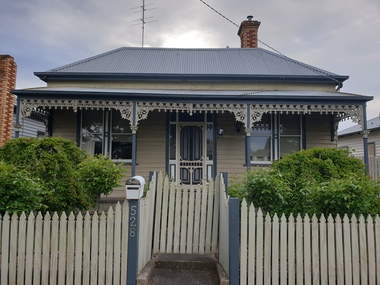
Photograph, Clare Gervasoni, Houses in LaTrobe St, Ballarat, 12/10/2020
... Houses in LaTrobe St, Ballarat...Colour photographs of houses in LaTrobe St, Ballarat...LaTrobe Street Ballarat architecture Colour photographs of houses in LaTrobe St, Ballarat Houses in LaTrobe St, Ballarat Photograph Australia Victoria Ballarat Clare Gervasoni ...Colour photographs of houses in LaTrobe St, Ballaratlatrobe street, ballarat, architecture -
 Federation University Historical Collection
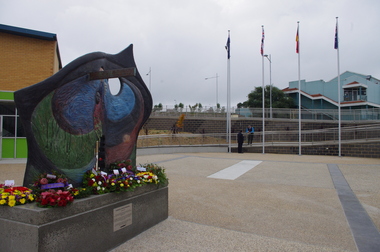
Photograph - CD-ROM, Alan Scarlett, Latrobe Valley War Memorials, 04/2015
... Latrobe Valley War Memorials...CD-ROM of colour photographs of Latrobe Valley War Memorials at Traralgon, Churchill, Morwell....Alan Scarlett Latrobe Valley War memorial traralgon morwell churchill Churchill War Memoria Churchill Service Memorial Paul Jessie CD-ROM of colour photographs of Latrobe Valley War Memorials at Traralgon, Churchill, Morwell. ...CD-ROM of colour photographs of Latrobe Valley War Memorials at Traralgon, Churchill, Morwell.alan scarlett, latrobe valley, war memorial, traralgon, morwell, churchill, churchill war memoria, churchill service memorial, paul jessie -
 National Wool Museum
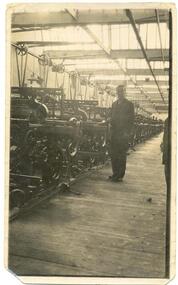
Photograph, Collins, Latrobe Terrace, about 1928
... Collins, Latrobe Terrace, about 1928...F Murgatroyd Collins, Latrobe Terrace, about 1928 KODAK PRINT...Textile Machinery Textile Mills Weaving Mills Textile Mills Collins Bros Mill Pty Ltd Murgatroyd Mr Fred Murgatroyd Mr James Textile Machinery Textile Mills Weaving Mills F Murgatroyd Collins, Latrobe Terrace, about 1928 KODAK PRINT Murgatroyd Photograph Collection Collins, Latrobe Terrace, about 1928 Photograph ...James Murgatroyd worked at Warrnambool Woollen Mills, Federal Mill, Tweedside, Collins Mills and set up looms for Alexander Spinning Mills Sydney, his son Fred Murgatroyd worked as a loom tuner at Yarra Falls, Tweedside and Collins mills in Victoria as well as in Sydney, and studied at Leeds University.Murgatroyd Photograph CollectionF Murgatroyd Collins, Latrobe Terrace, about 1928 KODAK PRINTtextile machinery textile mills weaving mills textile mills, collins bros mill pty ltd, murgatroyd, mr fred murgatroyd, mr james, textile machinery, textile mills, weaving mills -
 Lakes Entrance Historical Society
Book, Gardner P D, Names of the Latrobe Valley and West Gippsland, 1992
... Names of the Latrobe Valley and West Gippsland...Some of the place names of the Latrobe Valley and West Gippsland, victoria with explanations for their naming. ...Illustrated with map and photographs. Names of the Latrobe Valley and West Gippsland Book Gardner P D ...Some of the place names of the Latrobe Valley and West Gippsland, victoria with explanations for their naming. Illustrated with map and photographs.township, historic sites, social history -
 Brimbank City Council
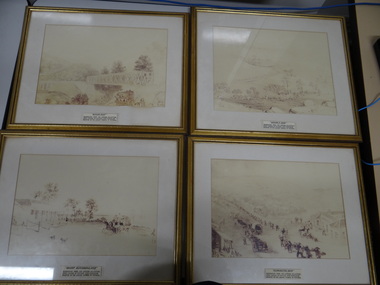
Four Drawings, 4 x drawings (The Latrobe Collection)
... 4 x drawings (The Latrobe Collection)...4 x drawings (The Latrobe Collection), badly faded - Flemington 1850, Keilor 1845, Mount Alexandra 1850 and Keilor 1850 ...4 x drawings (The Latrobe Collection), badly faded - Flemington 1850, Keilor 1845, Mount Alexandra 1850 and Keilor 1850 4 x drawings (The Latrobe Collection) Four Drawings ...4 x drawings (The Latrobe Collection), badly faded - Flemington 1850, Keilor 1845, Mount Alexandra 1850 and Keilor 1850 -
 Carlton Football Club
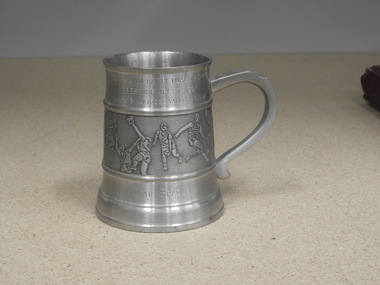
Pewter Mug, TOM ALVIN PERPETUAL TROPHY Presented Latrobe Valley Hyundai, 1997
... TOM ALVIN PERPETUAL TROPHY Presented Latrobe Valley Hyundai...TOM ALVIN PERPETUAL TROPHY Presented Latrobe Valley Hyundai Best & Donated 1997 Craig Bradley...TOM ALVIN PERPETUAL TROPHY Presented Latrobe Valley Hyundai Best & Donated 1997 Craig Bradley Pewter Mug TOM ALVIN PERPETUAL TROPHY Presented Latrobe Valley Hyundai Pewter Mug ...Yarra Valley Hyundai presentation to Carlton B&F winner 1997A perpetual Trophy presented by a major sponsor Hyundai in the guise of "TOM ALVIN PERPETUAL TROPHY". In 1997 it was presented to Craig Bradley Carlton Best & Fairest winner 1997. Career : 1986 - 2002 Debut : Round 1, 1986 vs Hawthorn, aged 22 years, 159 days Carlton Player No. 931 Games : 375 Goals : 247 Last Game : Round 19, 2002 vs Port Adelaide, aged 38 years, 291 days Guernsey No. 21 Height : 182 cm (5 ft. 11 in.) Weight : 81 kg (12 stone, 11 lbs.) DOB : 23 October, 1963 Premiership Player 1987, 1995 Carlton Legend Carlton Hall of Fame (1995) Best and Fairest 1986, 1988, 1993 All Australian 1986, 1993, 1994, 1995, 1997 Captain 1998-2002 Team of the Century: Wing International Rules Series vs Ireland : 2000, 2001 (captain), 2002 Off the field, Craig Bradley was a somewhat quiet, unassuming character who never hungered for the spotlight. But when the umpire’s whistle blew for a game of Australian football, he became a consummate professional whose outstanding ball-winning ability, accurate disposal, punishing non-stop running and longevity in the game made him one of the all-time greats. “Braddles” captained the Blues for three years, won two AFL Premierships, and picked up almost every possible honour in a stellar career that spanned 17 seasons and a record 375 games for the Carlton Football Club. He began his football journey at Pooraka in outer-suburban Adelaide, where his father was coach of the Under-19 team. Craig was a stand-out junior footballer, and in 1981 he was recruited by SANFL club Port Adelaide. At the same time, Essendon also made a big pitch for his signature. The Bombers were very intent on getting him to Windy Hill, but Bradley wasn’t then ready to make the big move interstate. Essendon redoubled their efforts after Bradley’s sensational debut year for Port Adelaide, which culminated in the Magpies’ 51-point demolition of Glenelg in the Grand Final. Playing on a wing, but roaming the length of the ground, 17 year-old Bradley was one of his team’s best. He followed up by winning Port’s Best and Fairest in 1982, before departing for England later that year, as a member of the Australian Under-19 cricket team. Cricket was Braddles’ other great sporting passion, and he would eventually play two Sheffield Shield games each for South Australia and Victoria, before giving the game away to further his football ambitions. Because of his cricketing commitments, Bradley missed most of the 1983 pre-season with Port, but it made little difference, because he had another dominant season for the Magpies and was named All Australian for the first time. Two more Port Adelaide Best and Fairests followed in 1984 and '85 – with the latter complemented by All Australian honours again. In that year of 1985, four South Australians were named as All Australians; Bradley, Stephen Kernahan, Peter Motley and John Platten – and to the chagrin and envy of every other VFL club (especially Essendon) the first three all signed to play with Carlton. In the following year that trio of stars took to VFL football like they were born to it, and a time of bubbling confidence began for the Old Dark Navy Blues. Braddles wasted little time in announcing his arrival into the upper echelons of our national game by playing in the 1986 Grand Final in his debut season at Princes Park; the same year he won his first Carlton Best and Fairest award in a tie with Wayne Johnston. The Blues lost heavily to Hawthorn on Grand Final day, but twelve months later bounced back to snatch the 1987 flag from the Hawks in Bradley’s 47th senior match. By then, he was already a budding champion whose amazing stamina was too much for almost every opponent. He simply ran his taggers into the ground, and he was as effective in the last minutes of a game as he was at the start. He won two more Carlton Best and Fairest awards in 1988 and 1993, and by the end of his superb career had been an All Australian six times. Aged 32, he picked up his second Premiership winner’s medallion in 1995 when the unstoppable Kernahan-led Blues demolished Geelong in a one-sided Grand Final, but those who thought he might retire after that triumph were right off the mark. He still had his zip, his footy smarts and his brilliant foot skills, and he had transformed himself from a purely attacking weapon into an equally-effective sweeper across half-back. And to cap off a memorable season, he became one of only a handful of players to be inducted into the Carlton Hall of Fame while still playing out their career. In 1997, at the age of 34, Bradley won the Sunday Age Footballer of the Year award. ”It’s not the end of the world when you reach 30,” he said in a blunt response to those who kept asking how long he intended going on – to his considerable annoyance. After being named All Australian yet again that year, he answered all those sorts of questions when he was appointed captain of his beloved Blues in 1998 – after the retirement of his great mate ‘Sticks’ Kernahan. Braddles led the Blues into another Grand Final in 1999, but the Wayne Carey-inspired Kangaroos proved just too good. Further indication of Craig Bradley’s enduring ability was his record in the often controversial and passionately-contested International Rules Series against Ireland. He first played for his country in 1984, and was recalled again in 2000. He was appointed captain of Australia in 2001, and played a fourth round of matches in 2002 at the age of 38 – a truly amazing achievement. In the millennium year of 2000, the honours kept rolling in for Braddles when he was included in both Carlton and Port Adelaide’s Team of the Century. In turn this raised the usual debate over why he had never won the game’s most prestigious individual award, the Brownlow Medal. The answer was apparently found when former field umpire Peter Cameron was interviewed, and he revealed that during most games, Bradley regularly back-chatted the men with the whistle. “He’s in the umpire’s ear all the time,’ said Cameron. By circumstance, Braddles wore his iconic number 21 guernsey for the last time against Port Adelaide at Princes Park in round 19, 2002. Carlton lost the match by 9 points, and Bradley suffered broken ribs and a punctured lung in a heavy collision. Even so, he was an almost unanimous choice as Best on Ground and was given three Brownlow Medal votes by the umpires. A few weeks later, Bradley’s farewell was typical of his nature. There was no big press conference, no stage-managed extravaganza. Instead, he issued a written statement through the AFL that caught everyone – including the Carlton Football Club by complete surprise. It read (in part); I have many people to thank and will do so in the coming weeks. I would however like to thank the Carlton Football Club and the Port Adelaide Football Club for many wonderful times and for their influence in helping to shape my life. To leave the game with a bit left in the tank and in good personal form makes me feel good. Since the foundation of the VFL in 1897, only three men (Michael Tuck, Kevin Bartlett and Simon Madden) have played more senior games than Craig Edwin Bradley of Carlton. A true Blue champion, he is one of only ten official Carlton Legends, and in 2006 was Carlton’s 17th inductee into the AFL Hall of Fame. In October 2006, it was announced that Bradley would return to the club for season 2007 as an assistant to senior coach Brett Ratten – a role he filled with the same intensity as he showed on the field. Bradley holds the club record for most career disposals, kicks, handballs, & Brownlow votes with totals of 8776, 5876, 2900 & 144 respectively.Pewter MugTOM ALVIN PERPETUAL TROPHY Presented Latrobe Valley Hyundai Best & Donated 1997 Craig Bradley -
Lakes Entrance Historical Society
Book, John Wells, Latrobe Valley Express- Gippsland History, 1980c
... Latrobe Valley Express- Gippsland History...A folder containing newspaper articles which appeared in the Latrobe Valley Express over a fifiteen yer period. ...Fires Settlement Exploration A folder containing newspaper articles which appeared in the Latrobe Valley Express over a fifiteen yer period. ...A folder containing newspaper articles which appeared in the Latrobe Valley Express over a fifiteen yer period. The articles cover a diverse range of subjects relating to the province of Gippsland Victoriafires, settlement, exploration -
 Ringwood and District Historical Society
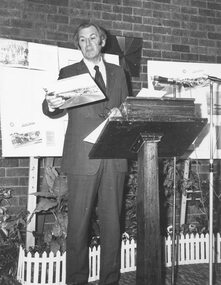
Photograph, Mr Ken Horn, Latrobe librarian, speaking at the launching of Hugh Anderson's book "Place of Many Eagles'. 1974
... Mr Ken Horn, Latrobe librarian, speaking at the launching of Hugh Anderson's book "Place of Many Eagles'. 1974....Written on rear of backing sheet: "Ken Horn, Librarian Latrobe Library, launching History of Ringwood book- Civic Centre, 22-10-74."...Written on rear of backing sheet: "Ken Horn, Librarian Latrobe Library, launching History of Ringwood book- Civic Centre, 22-10-74." ...Black and white photographWritten on rear of backing sheet: "Ken Horn, Librarian Latrobe Library, launching History of Ringwood book- Civic Centre, 22-10-74." -
 Melbourne Tram Museum
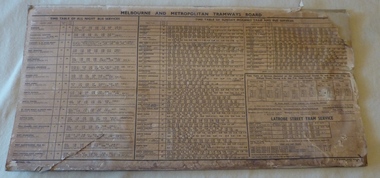
Poster, Melbourne & Metropolitan Tramways Board (MMTB), "Timetable of all night bus services / timetable of Sunday morning tram and bus services / City via William St and Latrobe St tram services", Oct. 1958
... "Timetable of all night bus services / timetable of Sunday morning tram and bus services / City via William St and Latrobe St tram services"...Poster, paper mounted or glued to cardboard sheet for use in tramcars - titled "Timetable of all night bus services / timetable of Sunday morning tram and bus services / City via William St and Latrobe St tram services", giving details of tram and bus services, short services, services along William and Latrobe St, variations in routes, destination or commencing termini, routes and trip times. ...Trams tramways Timetables MMTB Posters Buses Routes William St Latrobe St All night services Poster, paper mounted or glued to cardboard sheet for use in tramcars - titled "Timetable of all night bus services / timetable of Sunday morning tram and bus services / City via William St and Latrobe St tram services", giving details of tram and bus services, short services, services along William and Latrobe St, variations in routes, destination or commencing termini, routes and trip times. ...Poster, paper mounted or glued to cardboard sheet for use in tramcars - titled "Timetable of all night bus services / timetable of Sunday morning tram and bus services / City via William St and Latrobe St tram services", giving details of tram and bus services, short services, services along William and Latrobe St, variations in routes, destination or commencing termini, routes and trip times. Dated Oct. 1958. Signed . B. H. Misson Traffic Manager.trams, tramways, timetables, mmtb, posters, buses, routes, william st, latrobe st, all night services -
 Melbourne Tram Museum
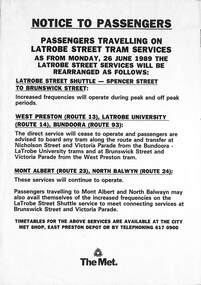
Document - Notice, The Met, "Notice to Passengers travelling on Latrobe Street tram services", Jun. 1989
... "Notice to Passengers travelling on Latrobe Street tram services"...Notice - A4 sheet - titled "Notice to Passengers travelling on Latrobe Street tram services" - advising that from Monday 26/6/1989, increased frequencies on the shuttle between Spencer St and Brunswick St, alterations to the routes 13, 14 and 93 - West Preston, Latrobe Uni and Bundoora and the Mont Albert route 23 and North Balwyn (route 24) services. ...Trams tramways The Met Latrobe St La Trobe St Route 13 Route 14 Route 93 Route 23 Route 24 West Preston Latrobe University Bundoora Mont Albert North Balwyn Notice - A4 sheet - titled "Notice to Passengers travelling on Latrobe Street tram services" - advising that from Monday 26/6/1989, increased frequencies on the shuttle between Spencer St and Brunswick St, alterations to the routes 13, 14 and 93 - West Preston, Latrobe Uni and Bundoora and the Mont Albert route 23 and North Balwyn (route 24) services. ...Notice - A4 sheet - titled "Notice to Passengers travelling on Latrobe Street tram services" - advising that from Monday 26/6/1989, increased frequencies on the shuttle between Spencer St and Brunswick St, alterations to the routes 13, 14 and 93 - West Preston, Latrobe Uni and Bundoora and the Mont Albert route 23 and North Balwyn (route 24) services. Contact details provided and that timetables are available from The Met shop and depots. Two copies held.trams, tramways, the met, latrobe st, la trobe st, route 13, route 14, route 93, route 23, route 24, west preston, latrobe university, bundoora, mont albert, north balwyn -
 National Wool Museum
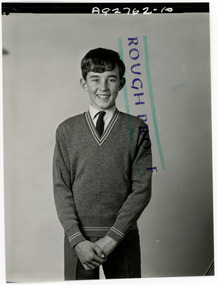
Photograph, LaTrobe Studios, c.1972
... [Obverse] A92762-10 ROUGH PROOF [Reverse] LATROBE STUDIOS......LaTrobe Studios...Written along the top edge with white ink is an index code A92762-10 From a promotional shoot for Kathryn Knitwear Collegewear Photograph Photograph Kathryn Knitwear LaTrobe Studios ...Kathryn Knitwear, founded by Robert Blake, manufactured high quality children’s knitwear in Melbourne from the 1940s – 1980s. Robert Blake began manufacturing children’s knitwear in his bedroom in Strathmore using a hand powered machine in the late 1940s. The operation moved to Ascot Vale and Essendon, before eventually establishing a factory in Moonee Ponds in the early 1950s. The business continued to expand, necessitating a move to a new factory in Broadmeadows. By 1962, the Broadmeadows factory was producing an average of 20,000 garments per month, which increased to 24,000 by 1964. Robert Blake’s Son, Brendan recalls that “The Kathryn brand was famous around Australia, anywhere children needed to keep warm and dress smartly. It also won a number of wool fashion awards”, including the 1969 Wool Awards, which was held by the Australian Wool Bureau and published in Women’s Weekly. The Kathryn range was designed for durability, comfort and care, without sacrificing style. They used patterning techniques that increase stretchiness, comfort and fit, as well as integrating decorative elements into the fabric to prevent them from being bulky, uncomfortable or tight. Making longevity of style a priority, Brendan Blake remembers that “there was one particular garment that was in the range for at least thirty years”. He also recalls “In the past, when women have found out that I was associated with Kathryn Knitwear, they would often relate to me the story of a garment they had purchased or received as a gift and, when their child had grown out of it, they would hand it on to another child. Several ladies have told me of purchasing garments for their daughters’ glory box, or saving a particular garment after their daughter had grown out of it. Brendan Blake: “At the peak of their operation they employed approximately two hundred people, mainly women and girls. A family would often seek to send their daughter to work in this company because they knew they would be looked after and safe. One lady wrote to me telling me that working at the Moonee Ponds Factory prior to getting married was the happiest time of her life.” In 1963, workers at the Kathryn factory earned £13 per week, which was 8 shillings and 8 pence higher than the minimum weekly wage for female workers in the textile manufacturing industry (£12 11s 4d). By 1970, the Kathryn Knitwear brand expanded from children’s knitwear into womenswear under the brand name ‘Lady Kathryn’, and for boys and men under ‘Robert Blake’. Continuing to diversify their distribution, they also began exporting ‘Kathryn’ garments to New Zealand, the Pacific Islands, and Japan. ‘Kathryn Knitwear’ was well-known for their early adoption of modern materials and techniques that had broad appeal to their customer base. This is shown in their early use of the acrylic fibre ‘Orlon’ in the 50s and 60s and ‘Superwash’ wool in the 1970s. Many of Kathryn Knitwear’s styles, particularly those that were long running staples of the brand, were available in both wool and Orlon to suit the consumer’s preference. Far from the humble origins of one man in his bedroom with a hand-cranked machine; at its closure in 1980, the Broadmeadows factory of ‘Kathryn’ housed more than 100 machines, including 53 sewing machines and 45 knitting machines. Robert Blake was “a passionate advocate for wool and Australian Made” throughout his whole life. A strong thread that ties through the lifespan of Robert Blake and Kathryn Knitwear is a balance between adopting new innovations without sacrificing the core values of durability, comfort, care and style that had made the brand so well known. Their legacy forms an integral part of both Australian social and manufacturing history.Black and white photograph of an adolescent boy wearing a grey V-neck jumper with a pale stripe at the neck and sleeve cuffs over a collared shirt and tie. Stamped with ROUGH PROOF in blue ink with green lines above and below it. Written along the top edge with white ink is an index code A92762-10 From a promotional shoot for Kathryn Knitwear Collegewear[Obverse] A92762-10 ROUGH PROOF [Reverse] LATROBE STUDIOSbusiness, business history, manufacturing, knitting machine, fashion textile production, business archives, manufacturing documents, textile industry - history wool marketing, wool marketing fashion textile industry, children's knitwear, children's clothing, knitwear marketing, teenagers, school uniforms -
 Greensborough Historical Society
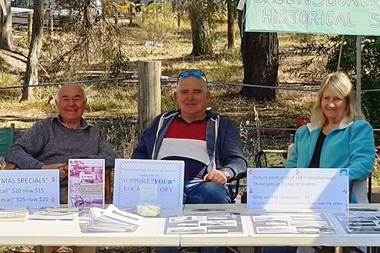
Photograph - Photograph - Digital Image, Marilyn Smith, GHS stall at Latrobe Market 24/11/2019, 24/11/2019
... GHS stall at Latrobe Market 24/11/2019...Digital images of the Greensborough Historical Society stall at Latrobe Market 24/11/2019. Members include Noel, Adrian and Dawn....Greensborough Historical Society latrobe market Digital colour photographs of event GHS stall at Latrobe Market 24/11/2019 Photograph Photograph - Digital Image Marilyn Smith ...Digital images of the Greensborough Historical Society stall at Latrobe Market 24/11/2019. Members include Noel, Adrian and Dawn.Part of a collection of miscellaneous historical images with a connection to the local area.Digital colour photographs of eventgreensborough historical society, latrobe market -
 Lakes Entrance Historical Society
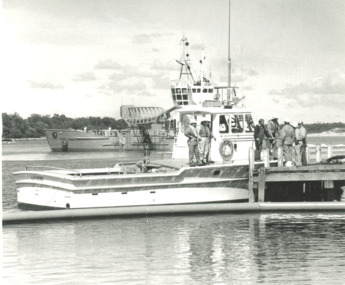
Photograph, Lakes Post Newspaper, Gippsland Ports vessel Latrobe Lakes Entrance Victoria, 1/11/1995 12:00:00 AM
... Gippsland Ports vessel Latrobe Lakes Entrance Victoria...Black and white photograph of Gippsland Ports vessel Latrobe and crew taken on training day for Oil Spill disaster. ...Gippsland Ports Events Black and white photograph of Gippsland Ports vessel Latrobe and crew taken on training day for Oil Spill disaster. ...Black and white photograph of Gippsland Ports vessel Latrobe and crew taken on training day for Oil Spill disaster. Dredge April Hamer in background both moored at Bullock Island Lakes Entrance Victoria. Also photograph taken during Oil Spill disaster activities gippsland ports, events -
Heidelberg Golf Club
Book, Paul Robinson et al, Riverside masterstroke: a history of the Latrobe Golf Club, 2023
... Riverside masterstroke: a history of the Latrobe Golf Club...The Latrobe Golf Club is situated in Alphington, Victoria. ...The Latrobe Golf Club is situated in Alphington, Victoria. ...The Latrobe Golf Club is situated in Alphington, Victoria. It was first established in 1948 and this book marks the Club's 75th anniversary. The Club is located in Farm Road Alphington. 343p., illus. (some col.). Hardcover.golf clubs- victoria, golf clubs - history, golf clubs - alphington, latrobe golf club -
 Melbourne Tram Museum
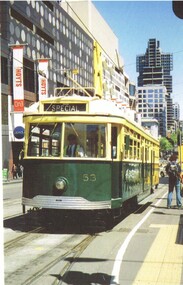
Postcard, Railcard, VR53, Latrobe St Melbourne, Oct. 2006, 2007
... VR53, Latrobe St Melbourne, Oct. 2006...Colour postcard of VR53, Latrobe St Melbourne, Oct. 2006. Tram showing Special. ...Trams tramways Melbourne VR ARE Latrobe St tram 53 Colour postcard of VR53, Latrobe St Melbourne, Oct. 2006. ...Colour postcard of VR53, Latrobe St Melbourne, Oct. 2006. Tram showing Special. Buildings in the rear have a Hoyts advertising sign. Postcard produced by Association of Railway Enthusiasts, ARE No. 14/07. Has Railcard copyright and phone number of rear, ARE shop details and hours, space for small message, address and stamp. Two copies held.trams, tramways, melbourne, vr, are, latrobe st, tram 53 -
 Bendigo Military Museum
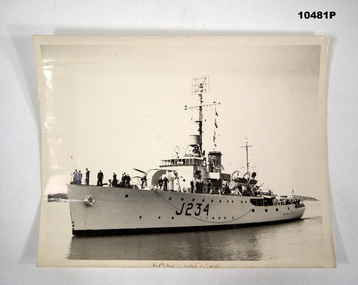
Photograph - HMAS LATROBE WW2, Unknown
... HMAS LATROBE was one of the corvettes manufactured during WW2 and was named after a town in Tasmania. ...Faded black and white photo of HMAS LATROBE with crewmen standing on board with ship displaying the No. ...On bottom of photo "HMAS LATROBE"....Collection of William (Bill) Thomason HMAS LATROBE Photograph On bottom of photo "HMAS LATROBE". ...HMAS LATROBE was one of the corvettes manufactured during WW2 and was named after a town in Tasmania. Part of William (Bill) Thomason Collection. Refer Cat No. 4136P.Faded black and white photo of HMAS LATROBE with crewmen standing on board with ship displaying the No. "J234". Ship appears to be moving slowly in very calm water.On bottom of photo "HMAS LATROBE".collection of william (bill) thomason, hmas latrobe, photograph -
 Melbourne Tram Museum
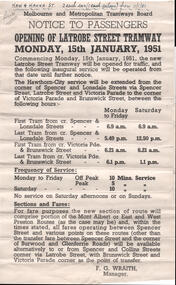
Document, Melbourne & Metropolitan Tramways Board (MMTB), "Opening of LaTrobe Street Tramway", Jan 1951
... "Opening of LaTrobe Street Tramway"...Notices to Passengers about the LaTrobe St tram line opening in Jan. 1951 and the withdrawal of Saturday services in 1955. ...Notices to Passengers about the LaTrobe St tram line opening in Jan. 1951 and the withdrawal of Saturday services in 1955. ...Notices to Passengers about the LaTrobe St tram line opening in Jan. 1951 and the withdrawal of Saturday services in 1955. The first details the services, times and fares and is signed by the F G Wraith Manager and the second is signed by C E Hall as Acting Traffic Manager. The last Saturday was 25/6/1955.Yields information about the LaTrobe services during the 1950sNotice - printed on foolscap paper with a handwritten note on the top edge and one small sheet."Haw & Hanna St - 2 each car (1 each saloon) from 11/1/51" in ink and "Book". Small sheet has the name of Mr "Rigaldi" in pencil on the top edge.latrobe st, new tramways, timetables, fares, saturday services, notices -
 National Wool Museum
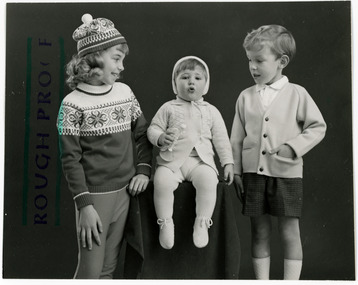
Photograph, LaTrobe Studios, c.1972
... [Obverse] (stamped in blue ink with green ink lines above and below) ROUGH PROOF [Reverse] LATROBE STUDIOS...LaTrobe Studios...Stamped with ROUGH PROOF in blue ink with green lines above and below it.From a promotional shoot for Kathryn Knitwear Photograph Photograph LaTrobe Studios Kathryn Knitwear ...Kathryn Knitwear, founded by Robert Blake, manufactured high quality children’s knitwear in Melbourne from the 1940s – 1980s. Robert Blake began manufacturing children’s knitwear in his bedroom in Strathmore using a hand powered machine in the late 1940s. The operation moved to Ascot Vale and Essendon, before eventually establishing a factory in Moonee Ponds in the early 1950s. The business continued to expand, necessitating a move to a new factory in Broadmeadows. By 1962, the Broadmeadows factory was producing an average of 20,000 garments per month, which increased to 24,000 by 1964. Robert Blake’s Son, Brendan recalls that “The Kathryn brand was famous around Australia, anywhere children needed to keep warm and dress smartly. It also won a number of wool fashion awards”, including the 1969 Wool Awards, which was held by the Australian Wool Bureau and published in Women’s Weekly. The Kathryn range was designed for durability, comfort and care, without sacrificing style. They used patterning techniques that increase stretchiness, comfort and fit, as well as integrating decorative elements into the fabric to prevent them from being bulky, uncomfortable or tight. Making longevity of style a priority, Brendan Blake remembers that “there was one particular garment that was in the range for at least thirty years”. He also recalls “In the past, when women have found out that I was associated with Kathryn Knitwear, they would often relate to me the story of a garment they had purchased or received as a gift and, when their child had grown out of it, they would hand it on to another child. Several ladies have told me of purchasing garments for their daughters’ glory box, or saving a particular garment after their daughter had grown out of it. Brendan Blake: “At the peak of their operation they employed approximately two hundred people, mainly women and girls. A family would often seek to send their daughter to work in this company because they knew they would be looked after and safe. One lady wrote to me telling me that working at the Moonee Ponds Factory prior to getting married was the happiest time of her life.” In 1963, workers at the Kathryn factory earned £13 per week, which was 8 shillings and 8 pence higher than the minimum weekly wage for female workers in the textile manufacturing industry (£12 11s 4d). By 1970, the Kathryn Knitwear brand expanded from children’s knitwear into womenswear under the brand name ‘Lady Kathryn’, and for boys and men under ‘Robert Blake’. Continuing to diversify their distribution, they also began exporting ‘Kathryn’ garments to New Zealand, the Pacific Islands, and Japan. ‘Kathryn Knitwear’ was well-known for their early adoption of modern materials and techniques that had broad appeal to their customer base. This is shown in their early use of the acrylic fibre ‘Orlon’ in the 50s and 60s and ‘Superwash’ wool in the 1970s. Many of Kathryn Knitwear’s styles, particularly those that were long running staples of the brand, were available in both wool and Orlon to suit the consumer’s preference. Far from the humble origins of one man in his bedroom with a hand-cranked machine; at its closure in 1980, the Broadmeadows factory of ‘Kathryn’ housed more than 100 machines, including 53 sewing machines and 45 knitting machines. Robert Blake was “a passionate advocate for wool and Australian Made” throughout his whole life. A strong thread that ties through the lifespan of Robert Blake and Kathryn Knitwear is a balance between adopting new innovations without sacrificing the core values of durability, comfort, care and style that had made the brand so well known. Their legacy forms an integral part of both Australian social and manufacturing history.Black and white photograph of three children Child on left has light chin-length curly hair and wears a beanie and turtleneck jumper with a Nordic motif. Toddler in the middle wears a three piece knit set of a beanie, cardigan and bootee leggings. It features a textured patterned stitch and is very similar to NWM-08913. The Child on the right wears a collared shirt and checked shorts with a pale V-neck cardigan with two front pockets and four buttons. Stamped with ROUGH PROOF in blue ink with green lines above and below it.From a promotional shoot for Kathryn Knitwear[Obverse] (stamped in blue ink with green ink lines above and below) ROUGH PROOF [Reverse] LATROBE STUDIOSbusiness, business history, manufacturing, knitting machine, fashion textile production, business archives, manufacturing documents, textile industry - history wool marketing, wool marketing fashion textile industry, children's knitwear, children's clothing, knitwear marketing -
 National Wool Museum
Photograph, LaTrobe Studios, c.1972
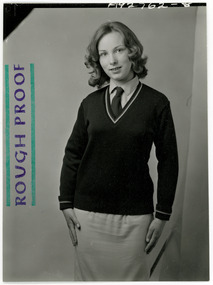
... [Obverse] A92762-8 (stamped in blue ink with green ink lines above and below)] ROUGH PROOF [Reverse] LATROBE STUDIOS......LaTrobe Studios...Written along the top edge with white ink is an index code A92762-8 From a promotional shoot for Kathryn Knitwear Collegewear Photograph Photograph Kathryn Knitwear LaTrobe Studios ...Kathryn Knitwear, founded by Robert Blake, manufactured high quality children’s knitwear in Melbourne from the 1940s – 1980s. Robert Blake began manufacturing children’s knitwear in his bedroom in Strathmore using a hand powered machine in the late 1940s. The operation moved to Ascot Vale and Essendon, before eventually establishing a factory in Moonee Ponds in the early 1950s. The business continued to expand, necessitating a move to a new factory in Broadmeadows. By 1962, the Broadmeadows factory was producing an average of 20,000 garments per month, which increased to 24,000 by 1964. Robert Blake’s Son, Brendan recalls that “The Kathryn brand was famous around Australia, anywhere children needed to keep warm and dress smartly. It also won a number of wool fashion awards”, including the 1969 Wool Awards, which was held by the Australian Wool Bureau and published in Women’s Weekly. The Kathryn range was designed for durability, comfort and care, without sacrificing style. They used patterning techniques that increase stretchiness, comfort and fit, as well as integrating decorative elements into the fabric to prevent them from being bulky, uncomfortable or tight. Making longevity of style a priority, Brendan Blake remembers that “there was one particular garment that was in the range for at least thirty years”. He also recalls “In the past, when women have found out that I was associated with Kathryn Knitwear, they would often relate to me the story of a garment they had purchased or received as a gift and, when their child had grown out of it, they would hand it on to another child. Several ladies have told me of purchasing garments for their daughters’ glory box, or saving a particular garment after their daughter had grown out of it. Brendan Blake: “At the peak of their operation they employed approximately two hundred people, mainly women and girls. A family would often seek to send their daughter to work in this company because they knew they would be looked after and safe. One lady wrote to me telling me that working at the Moonee Ponds Factory prior to getting married was the happiest time of her life.” In 1963, workers at the Kathryn factory earned £13 per week, which was 8 shillings and 8 pence higher than the minimum weekly wage for female workers in the textile manufacturing industry (£12 11s 4d). By 1970, the Kathryn Knitwear brand expanded from children’s knitwear into womenswear under the brand name ‘Lady Kathryn’, and for boys and men under ‘Robert Blake’. Continuing to diversify their distribution, they also began exporting ‘Kathryn’ garments to New Zealand, the Pacific Islands, and Japan. ‘Kathryn Knitwear’ was well-known for their early adoption of modern materials and techniques that had broad appeal to their customer base. This is shown in their early use of the acrylic fibre ‘Orlon’ in the 50s and 60s and ‘Superwash’ wool in the 1970s. Many of Kathryn Knitwear’s styles, particularly those that were long running staples of the brand, were available in both wool and Orlon to suit the consumer’s preference. Far from the humble origins of one man in his bedroom with a hand-cranked machine; at its closure in 1980, the Broadmeadows factory of ‘Kathryn’ housed more than 100 machines, including 53 sewing machines and 45 knitting machines. Robert Blake was “a passionate advocate for wool and Australian Made” throughout his whole life. A strong thread that ties through the lifespan of Robert Blake and Kathryn Knitwear is a balance between adopting new innovations without sacrificing the core values of durability, comfort, care and style that had made the brand so well known. Their legacy forms an integral part of both Australian social and manufacturing history.Black and white photograph of a young woman with chin-length curly hair, wearing a dark v-neck jumper with a pale stripe at the neck and sleeve cuffs over a collared shirt and tie. Stamped with ROUGH PROOF in blue ink with green lines above and below it. Written along the top edge with white ink is an index code A92762-8 From a promotional shoot for Kathryn Knitwear Collegewear[Obverse] A92762-8 (stamped in blue ink with green ink lines above and below)] ROUGH PROOF [Reverse] LATROBE STUDIOSbusiness, business history, manufacturing, knitting machine, fashion textile production, business archives, manufacturing documents, textile industry - history wool marketing, wool marketing fashion textile industry, children's knitwear, children's clothing, knitwear marketing, teenagers, school uniforms -
 National Wool Museum
Photograph, LaTrobe Studios, c.1972
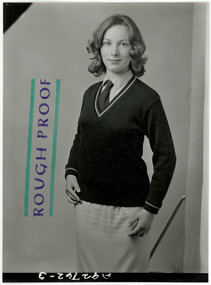
... [Obverse (stamped in blue ink with green ink lines above and below)] ROUGH PROOF (upside down) A92762-3 [Reverse] LATROBE STUDIOS......LaTrobe Studios...Written along the bottom edge with white ink is an index code A92762-3 From a promotional shoot for Kathryn Knitwear Collegewear Photograph Photograph Kathryn Knitwear LaTrobe Studios ...Kathryn Knitwear, founded by Robert Blake, manufactured high quality children’s knitwear in Melbourne from the 1940s – 1980s. Robert Blake began manufacturing children’s knitwear in his bedroom in Strathmore using a hand powered machine in the late 1940s. The operation moved to Ascot Vale and Essendon, before eventually establishing a factory in Moonee Ponds in the early 1950s. The business continued to expand, necessitating a move to a new factory in Broadmeadows. By 1962, the Broadmeadows factory was producing an average of 20,000 garments per month, which increased to 24,000 by 1964. Robert Blake’s Son, Brendan recalls that “The Kathryn brand was famous around Australia, anywhere children needed to keep warm and dress smartly. It also won a number of wool fashion awards”, including the 1969 Wool Awards, which was held by the Australian Wool Bureau and published in Women’s Weekly. The Kathryn range was designed for durability, comfort and care, without sacrificing style. They used patterning techniques that increase stretchiness, comfort and fit, as well as integrating decorative elements into the fabric to prevent them from being bulky, uncomfortable or tight. Making longevity of style a priority, Brendan Blake remembers that “there was one particular garment that was in the range for at least thirty years”. He also recalls “In the past, when women have found out that I was associated with Kathryn Knitwear, they would often relate to me the story of a garment they had purchased or received as a gift and, when their child had grown out of it, they would hand it on to another child. Several ladies have told me of purchasing garments for their daughters’ glory box, or saving a particular garment after their daughter had grown out of it. Brendan Blake: “At the peak of their operation they employed approximately two hundred people, mainly women and girls. A family would often seek to send their daughter to work in this company because they knew they would be looked after and safe. One lady wrote to me telling me that working at the Moonee Ponds Factory prior to getting married was the happiest time of her life.” In 1963, workers at the Kathryn factory earned £13 per week, which was 8 shillings and 8 pence higher than the minimum weekly wage for female workers in the textile manufacturing industry (£12 11s 4d). By 1970, the Kathryn Knitwear brand expanded from children’s knitwear into womenswear under the brand name ‘Lady Kathryn’, and for boys and men under ‘Robert Blake’. Continuing to diversify their distribution, they also began exporting ‘Kathryn’ garments to New Zealand, the Pacific Islands, and Japan. ‘Kathryn Knitwear’ was well-known for their early adoption of modern materials and techniques that had broad appeal to their customer base. This is shown in their early use of the acrylic fibre ‘Orlon’ in the 50s and 60s and ‘Superwash’ wool in the 1970s. Many of Kathryn Knitwear’s styles, particularly those that were long running staples of the brand, were available in both wool and Orlon to suit the consumer’s preference. Far from the humble origins of one man in his bedroom with a hand-cranked machine; at its closure in 1980, the Broadmeadows factory of ‘Kathryn’ housed more than 100 machines, including 53 sewing machines and 45 knitting machines. Robert Blake was “a passionate advocate for wool and Australian Made” throughout his whole life. A strong thread that ties through the lifespan of Robert Blake and Kathryn Knitwear is a balance between adopting new innovations without sacrificing the core values of durability, comfort, care and style that had made the brand so well known. Their legacy forms an integral part of both Australian social and manufacturing history.Black and white photograph of a young woman with chin-length curly hair, wearing a dark v-neck jumper with a pale stripe at the neck and sleeve cuffs over a collared shirt and tie. Stamped with ROUGH PROOF in blue ink with green lines above and below it. Written along the bottom edge with white ink is an index code A92762-3 From a promotional shoot for Kathryn Knitwear Collegewear[Obverse (stamped in blue ink with green ink lines above and below)] ROUGH PROOF (upside down) A92762-3 [Reverse] LATROBE STUDIOSbusiness, business history, manufacturing, knitting machine, fashion textile production, business archives, manufacturing documents, textile industry - history wool marketing, wool marketing fashion textile industry, children's knitwear, children's clothing, knitwear marketing, teenagers, school uniforms -
 National Wool Museum
Photograph, LaTrobe Studios, c.1972
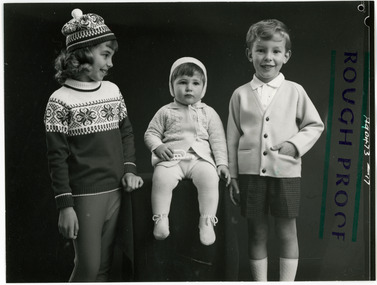
... [Obverse] (stamped in blue ink with green ink lines above and below) ROUGH PROOF (White ink) A90473-17 [Reverse] LATROBE STUDIOS...LaTrobe Studios...Written along the right edge with white ink is an index code A90473-17 From a promotional shoot for Kathryn Knitwear Photograph Photograph LaTrobe Studios Kathryn Knitwear ...Kathryn Knitwear, founded by Robert Blake, manufactured high quality children’s knitwear in Melbourne from the 1940s – 1980s. Robert Blake began manufacturing children’s knitwear in his bedroom in Strathmore using a hand powered machine in the late 1940s. The operation moved to Ascot Vale and Essendon, before eventually establishing a factory in Moonee Ponds in the early 1950s. The business continued to expand, necessitating a move to a new factory in Broadmeadows. By 1962, the Broadmeadows factory was producing an average of 20,000 garments per month, which increased to 24,000 by 1964. Robert Blake’s Son, Brendan recalls that “The Kathryn brand was famous around Australia, anywhere children needed to keep warm and dress smartly. It also won a number of wool fashion awards”, including the 1969 Wool Awards, which was held by the Australian Wool Bureau and published in Women’s Weekly. The Kathryn range was designed for durability, comfort and care, without sacrificing style. They used patterning techniques that increase stretchiness, comfort and fit, as well as integrating decorative elements into the fabric to prevent them from being bulky, uncomfortable or tight. Making longevity of style a priority, Brendan Blake remembers that “there was one particular garment that was in the range for at least thirty years”. He also recalls “In the past, when women have found out that I was associated with Kathryn Knitwear, they would often relate to me the story of a garment they had purchased or received as a gift and, when their child had grown out of it, they would hand it on to another child. Several ladies have told me of purchasing garments for their daughters’ glory box, or saving a particular garment after their daughter had grown out of it. Brendan Blake: “At the peak of their operation they employed approximately two hundred people, mainly women and girls. A family would often seek to send their daughter to work in this company because they knew they would be looked after and safe. One lady wrote to me telling me that working at the Moonee Ponds Factory prior to getting married was the happiest time of her life.” In 1963, workers at the Kathryn factory earned £13 per week, which was 8 shillings and 8 pence higher than the minimum weekly wage for female workers in the textile manufacturing industry (£12 11s 4d). By 1970, the Kathryn Knitwear brand expanded from children’s knitwear into womenswear under the brand name ‘Lady Kathryn’, and for boys and men under ‘Robert Blake’. Continuing to diversify their distribution, they also began exporting ‘Kathryn’ garments to New Zealand, the Pacific Islands, and Japan. ‘Kathryn Knitwear’ was well-known for their early adoption of modern materials and techniques that had broad appeal to their customer base. This is shown in their early use of the acrylic fibre ‘Orlon’ in the 50s and 60s and ‘Superwash’ wool in the 1970s. Many of Kathryn Knitwear’s styles, particularly those that were long running staples of the brand, were available in both wool and Orlon to suit the consumer’s preference. Far from the humble origins of one man in his bedroom with a hand-cranked machine; at its closure in 1980, the Broadmeadows factory of ‘Kathryn’ housed more than 100 machines, including 53 sewing machines and 45 knitting machines. Robert Blake was “a passionate advocate for wool and Australian Made” throughout his whole life. A strong thread that ties through the lifespan of Robert Blake and Kathryn Knitwear is a balance between adopting new innovations without sacrificing the core values of durability, comfort, care and style that had made the brand so well known. Their legacy forms an integral part of both Australian social and manufacturing history.Black and white photograph of three children Child on left has light chin-length curly hair and wears a beanie and turtleneck jumper with a Nordic motif. Toddler in the middle wears a three piece knit set of a beanie, cardigan and bootee leggings. It features a textured patterned stitch and is very similar to NWM-08913. The Child on the right wears a collared shirt and checked shorts with a pale V-neck cardigan with two front pockets and four buttons. Stamped with ROUGH PROOF in blue ink with green lines above and below it. Written along the right edge with white ink is an index code A90473-17 From a promotional shoot for Kathryn Knitwear[Obverse] (stamped in blue ink with green ink lines above and below) ROUGH PROOF (White ink) A90473-17 [Reverse] LATROBE STUDIOSbusiness, business history, manufacturing, knitting machine, fashion textile production, business archives, manufacturing documents, textile industry - history wool marketing, wool marketing fashion textile industry, children's knitwear, children's clothing, knitwear marketing -
 National Wool Museum
Photograph, LaTrobe Studios, c.1972
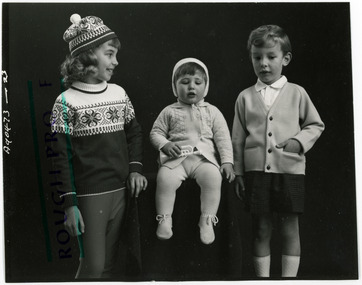
... [Obverse] (White ink) A90473-23 (stamped in blue ink with green ink lines above and below) ROUGH PROOF [Reverse] LATROBE STUDIOS...LaTrobe Studios...Written along the left edge with white ink is an index code A90473-23 From a promotional shoot for Kathryn Knitwear Photograph Photograph LaTrobe Studios Kathryn Knitwear ...Kathryn Knitwear, founded by Robert Blake, manufactured high quality children’s knitwear in Melbourne from the 1940s – 1980s. Robert Blake began manufacturing children’s knitwear in his bedroom in Strathmore using a hand powered machine in the late 1940s. The operation moved to Ascot Vale and Essendon, before eventually establishing a factory in Moonee Ponds in the early 1950s. The business continued to expand, necessitating a move to a new factory in Broadmeadows. By 1962, the Broadmeadows factory was producing an average of 20,000 garments per month, which increased to 24,000 by 1964. Robert Blake’s Son, Brendan recalls that “The Kathryn brand was famous around Australia, anywhere children needed to keep warm and dress smartly. It also won a number of wool fashion awards”, including the 1969 Wool Awards, which was held by the Australian Wool Bureau and published in Women’s Weekly. The Kathryn range was designed for durability, comfort and care, without sacrificing style. They used patterning techniques that increase stretchiness, comfort and fit, as well as integrating decorative elements into the fabric to prevent them from being bulky, uncomfortable or tight. Making longevity of style a priority, Brendan Blake remembers that “there was one particular garment that was in the range for at least thirty years”. He also recalls “In the past, when women have found out that I was associated with Kathryn Knitwear, they would often relate to me the story of a garment they had purchased or received as a gift and, when their child had grown out of it, they would hand it on to another child. Several ladies have told me of purchasing garments for their daughters’ glory box, or saving a particular garment after their daughter had grown out of it. Brendan Blake: “At the peak of their operation they employed approximately two hundred people, mainly women and girls. A family would often seek to send their daughter to work in this company because they knew they would be looked after and safe. One lady wrote to me telling me that working at the Moonee Ponds Factory prior to getting married was the happiest time of her life.” In 1963, workers at the Kathryn factory earned £13 per week, which was 8 shillings and 8 pence higher than the minimum weekly wage for female workers in the textile manufacturing industry (£12 11s 4d). By 1970, the Kathryn Knitwear brand expanded from children’s knitwear into womenswear under the brand name ‘Lady Kathryn’, and for boys and men under ‘Robert Blake’. Continuing to diversify their distribution, they also began exporting ‘Kathryn’ garments to New Zealand, the Pacific Islands, and Japan. ‘Kathryn Knitwear’ was well-known for their early adoption of modern materials and techniques that had broad appeal to their customer base. This is shown in their early use of the acrylic fibre ‘Orlon’ in the 50s and 60s and ‘Superwash’ wool in the 1970s. Many of Kathryn Knitwear’s styles, particularly those that were long running staples of the brand, were available in both wool and Orlon to suit the consumer’s preference. Far from the humble origins of one man in his bedroom with a hand-cranked machine; at its closure in 1980, the Broadmeadows factory of ‘Kathryn’ housed more than 100 machines, including 53 sewing machines and 45 knitting machines. Robert Blake was “a passionate advocate for wool and Australian Made” throughout his whole life. A strong thread that ties through the lifespan of Robert Blake and Kathryn Knitwear is a balance between adopting new innovations without sacrificing the core values of durability, comfort, care and style that had made the brand so well known. Their legacy forms an integral part of both Australian social and manufacturing history.Black and white photograph of three children Child on left has light chin-length curly hair and wears a beanie and turtleneck jumper with a Nordic motif. Toddler in the middle wears a three piece knit set of a beanie, cardigan and bootee leggings. It features a textured patterned stitch and is very similar to NWM-08913. The Child on the right wears a collared shirt and checked shorts with a pale V-neck cardigan with two front pockets and four buttons. Stamped with ROUGH PROOF in blue ink with green lines above and below it. Written along the left edge with white ink is an index code A90473-23 From a promotional shoot for Kathryn Knitwear[Obverse] (White ink) A90473-23 (stamped in blue ink with green ink lines above and below) ROUGH PROOF [Reverse] LATROBE STUDIOSbusiness, business history, manufacturing, knitting machine, fashion textile production, business archives, manufacturing documents, textile industry - history wool marketing, wool marketing fashion textile industry, children's knitwear, children's clothing, knitwear marketing -
 National Wool Museum
Photograph, LaTrobe Studios, c.1972
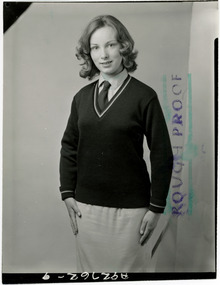
... [Obverse] (stamped in blue ink with green ink lines above and below) ROUGH PROOF (White ink) A92762-9 [Reverse] LATROBE STUDIOS......LaTrobe Studios...Written along the top edge with white ink is an index code A92762-9 From a promotional shoot for Kathryn Knitwear Collegewear Photograph Photograph Kathryn Knitwear LaTrobe Studios ...Kathryn Knitwear, founded by Robert Blake, manufactured high quality children’s knitwear in Melbourne from the 1940s – 1980s. Robert Blake began manufacturing children’s knitwear in his bedroom in Strathmore using a hand powered machine in the late 1940s. The operation moved to Ascot Vale and Essendon, before eventually establishing a factory in Moonee Ponds in the early 1950s. The business continued to expand, necessitating a move to a new factory in Broadmeadows. By 1962, the Broadmeadows factory was producing an average of 20,000 garments per month, which increased to 24,000 by 1964. Robert Blake’s Son, Brendan recalls that “The Kathryn brand was famous around Australia, anywhere children needed to keep warm and dress smartly. It also won a number of wool fashion awards”, including the 1969 Wool Awards, which was held by the Australian Wool Bureau and published in Women’s Weekly. The Kathryn range was designed for durability, comfort and care, without sacrificing style. They used patterning techniques that increase stretchiness, comfort and fit, as well as integrating decorative elements into the fabric to prevent them from being bulky, uncomfortable or tight. Making longevity of style a priority, Brendan Blake remembers that “there was one particular garment that was in the range for at least thirty years”. He also recalls “In the past, when women have found out that I was associated with Kathryn Knitwear, they would often relate to me the story of a garment they had purchased or received as a gift and, when their child had grown out of it, they would hand it on to another child. Several ladies have told me of purchasing garments for their daughters’ glory box, or saving a particular garment after their daughter had grown out of it. Brendan Blake: “At the peak of their operation they employed approximately two hundred people, mainly women and girls. A family would often seek to send their daughter to work in this company because they knew they would be looked after and safe. One lady wrote to me telling me that working at the Moonee Ponds Factory prior to getting married was the happiest time of her life.” In 1963, workers at the Kathryn factory earned £13 per week, which was 8 shillings and 8 pence higher than the minimum weekly wage for female workers in the textile manufacturing industry (£12 11s 4d). By 1970, the Kathryn Knitwear brand expanded from children’s knitwear into womenswear under the brand name ‘Lady Kathryn’, and for boys and men under ‘Robert Blake’. Continuing to diversify their distribution, they also began exporting ‘Kathryn’ garments to New Zealand, the Pacific Islands, and Japan. ‘Kathryn Knitwear’ was well-known for their early adoption of modern materials and techniques that had broad appeal to their customer base. This is shown in their early use of the acrylic fibre ‘Orlon’ in the 50s and 60s and ‘Superwash’ wool in the 1970s. Many of Kathryn Knitwear’s styles, particularly those that were long running staples of the brand, were available in both wool and Orlon to suit the consumer’s preference. Far from the humble origins of one man in his bedroom with a hand-cranked machine; at its closure in 1980, the Broadmeadows factory of ‘Kathryn’ housed more than 100 machines, including 53 sewing machines and 45 knitting machines. Robert Blake was “a passionate advocate for wool and Australian Made” throughout his whole life. A strong thread that ties through the lifespan of Robert Blake and Kathryn Knitwear is a balance between adopting new innovations without sacrificing the core values of durability, comfort, care and style that had made the brand so well known. Their legacy forms an integral part of both Australian social and manufacturing history.Black and white photograph of a young woman with chin-length curly hair, wearing a dark v-neck jumper with a pale stripe at the neck and sleeve cuffs over a collared shirt and tie. Stamped with ROUGH PROOF in blue ink with green lines above and below it. Written along the top edge with white ink is an index code A92762-9 From a promotional shoot for Kathryn Knitwear Collegewear[Obverse] (stamped in blue ink with green ink lines above and below) ROUGH PROOF (White ink) A92762-9 [Reverse] LATROBE STUDIOSbusiness, business history, manufacturing, knitting machine, fashion textile production, business archives, manufacturing documents, textile industry - history wool marketing, wool marketing fashion textile industry, children's knitwear, children's clothing, knitwear marketing, teenagers, school uniforms -
 National Wool Museum
Photograph, LaTrobe Studios, c.1972
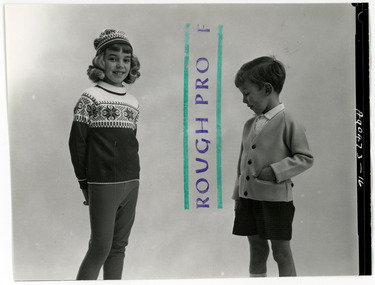
... [Obverse] (stamped in blue ink with green ink lines above and below) ROUGH PROOF (White ink) A90473-16 [Reverse] LATROBE STUDIOS...LaTrobe Studios...Written along the right edge with white ink is an index code A90473-16 From a promotional shoot for Kathryn Knitwear Photograph Photograph LaTrobe Studios Kathryn Knitwear ...Kathryn Knitwear, founded by Robert Blake, manufactured high quality children’s knitwear in Melbourne from the 1940s – 1980s. Robert Blake began manufacturing children’s knitwear in his bedroom in Strathmore using a hand powered machine in the late 1940s. The operation moved to Ascot Vale and Essendon, before eventually establishing a factory in Moonee Ponds in the early 1950s. The business continued to expand, necessitating a move to a new factory in Broadmeadows. By 1962, the Broadmeadows factory was producing an average of 20,000 garments per month, which increased to 24,000 by 1964. Robert Blake’s Son, Brendan recalls that “The Kathryn brand was famous around Australia, anywhere children needed to keep warm and dress smartly. It also won a number of wool fashion awards”, including the 1969 Wool Awards, which was held by the Australian Wool Bureau and published in Women’s Weekly. The Kathryn range was designed for durability, comfort and care, without sacrificing style. They used patterning techniques that increase stretchiness, comfort and fit, as well as integrating decorative elements into the fabric to prevent them from being bulky, uncomfortable or tight. Making longevity of style a priority, Brendan Blake remembers that “there was one particular garment that was in the range for at least thirty years”. He also recalls “In the past, when women have found out that I was associated with Kathryn Knitwear, they would often relate to me the story of a garment they had purchased or received as a gift and, when their child had grown out of it, they would hand it on to another child. Several ladies have told me of purchasing garments for their daughters’ glory box, or saving a particular garment after their daughter had grown out of it. Brendan Blake: “At the peak of their operation they employed approximately two hundred people, mainly women and girls. A family would often seek to send their daughter to work in this company because they knew they would be looked after and safe. One lady wrote to me telling me that working at the Moonee Ponds Factory prior to getting married was the happiest time of her life.” In 1963, workers at the Kathryn factory earned £13 per week, which was 8 shillings and 8 pence higher than the minimum weekly wage for female workers in the textile manufacturing industry (£12 11s 4d). By 1970, the Kathryn Knitwear brand expanded from children’s knitwear into womenswear under the brand name ‘Lady Kathryn’, and for boys and men under ‘Robert Blake’. Continuing to diversify their distribution, they also began exporting ‘Kathryn’ garments to New Zealand, the Pacific Islands, and Japan. ‘Kathryn Knitwear’ was well-known for their early adoption of modern materials and techniques that had broad appeal to their customer base. This is shown in their early use of the acrylic fibre ‘Orlon’ in the 50s and 60s and ‘Superwash’ wool in the 1970s. Many of Kathryn Knitwear’s styles, particularly those that were long running staples of the brand, were available in both wool and Orlon to suit the consumer’s preference. Far from the humble origins of one man in his bedroom with a hand-cranked machine; at its closure in 1980, the Broadmeadows factory of ‘Kathryn’ housed more than 100 machines, including 53 sewing machines and 45 knitting machines. Robert Blake was “a passionate advocate for wool and Australian Made” throughout his whole life. A strong thread that ties through the lifespan of Robert Blake and Kathryn Knitwear is a balance between adopting new innovations without sacrificing the core values of durability, comfort, care and style that had made the brand so well known. Their legacy forms an integral part of both Australian social and manufacturing history.Black and white photograph of two children Child on left has light chin-length curly hair and wears a beanie and turtleneck jumper with a Nordic motif. The Child on the right wears a collared shirt and checked shorts with a pale V-neck cardigan with two front pockets and four buttons. Stamped with ROUGH PROOF in blue ink with green lines above and below it. Written along the right edge with white ink is an index code A90473-16 From a promotional shoot for Kathryn Knitwear[Obverse] (stamped in blue ink with green ink lines above and below) ROUGH PROOF (White ink) A90473-16 [Reverse] LATROBE STUDIOSbusiness, business history, manufacturing, knitting machine, fashion textile production, business archives, manufacturing documents, textile industry - history wool marketing, wool marketing fashion textile industry, children's knitwear, children's clothing, knitwear marketing -
 National Wool Museum
Photograph, LaTrobe Studios, c.1972
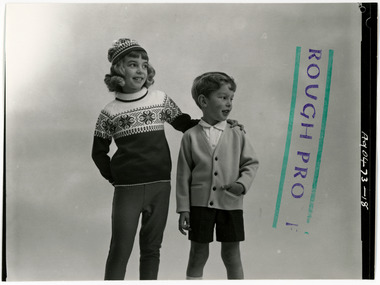
... [Obverse] (stamped in blue ink with green ink lines above and below) ROUGH PROOF (White ink) A90473-18 [Reverse] LATROBE STUDIOS...LaTrobe Studios...Written along the right edge with white ink is an index code A90473-18 From a promotional shoot for Kathryn Knitwear Photograph Photograph LaTrobe Studios Kathryn Knitwear ...Kathryn Knitwear, founded by Robert Blake, manufactured high quality children’s knitwear in Melbourne from the 1940s – 1980s. Robert Blake began manufacturing children’s knitwear in his bedroom in Strathmore using a hand powered machine in the late 1940s. The operation moved to Ascot Vale and Essendon, before eventually establishing a factory in Moonee Ponds in the early 1950s. The business continued to expand, necessitating a move to a new factory in Broadmeadows. By 1962, the Broadmeadows factory was producing an average of 20,000 garments per month, which increased to 24,000 by 1964. Robert Blake’s Son, Brendan recalls that “The Kathryn brand was famous around Australia, anywhere children needed to keep warm and dress smartly. It also won a number of wool fashion awards”, including the 1969 Wool Awards, which was held by the Australian Wool Bureau and published in Women’s Weekly. The Kathryn range was designed for durability, comfort and care, without sacrificing style. They used patterning techniques that increase stretchiness, comfort and fit, as well as integrating decorative elements into the fabric to prevent them from being bulky, uncomfortable or tight. Making longevity of style a priority, Brendan Blake remembers that “there was one particular garment that was in the range for at least thirty years”. He also recalls “In the past, when women have found out that I was associated with Kathryn Knitwear, they would often relate to me the story of a garment they had purchased or received as a gift and, when their child had grown out of it, they would hand it on to another child. Several ladies have told me of purchasing garments for their daughters’ glory box, or saving a particular garment after their daughter had grown out of it. Brendan Blake: “At the peak of their operation they employed approximately two hundred people, mainly women and girls. A family would often seek to send their daughter to work in this company because they knew they would be looked after and safe. One lady wrote to me telling me that working at the Moonee Ponds Factory prior to getting married was the happiest time of her life.” In 1963, workers at the Kathryn factory earned £13 per week, which was 8 shillings and 8 pence higher than the minimum weekly wage for female workers in the textile manufacturing industry (£12 11s 4d). By 1970, the Kathryn Knitwear brand expanded from children’s knitwear into womenswear under the brand name ‘Lady Kathryn’, and for boys and men under ‘Robert Blake’. Continuing to diversify their distribution, they also began exporting ‘Kathryn’ garments to New Zealand, the Pacific Islands, and Japan. ‘Kathryn Knitwear’ was well-known for their early adoption of modern materials and techniques that had broad appeal to their customer base. This is shown in their early use of the acrylic fibre ‘Orlon’ in the 50s and 60s and ‘Superwash’ wool in the 1970s. Many of Kathryn Knitwear’s styles, particularly those that were long running staples of the brand, were available in both wool and Orlon to suit the consumer’s preference. Far from the humble origins of one man in his bedroom with a hand-cranked machine; at its closure in 1980, the Broadmeadows factory of ‘Kathryn’ housed more than 100 machines, including 53 sewing machines and 45 knitting machines. Robert Blake was “a passionate advocate for wool and Australian Made” throughout his whole life. A strong thread that ties through the lifespan of Robert Blake and Kathryn Knitwear is a balance between adopting new innovations without sacrificing the core values of durability, comfort, care and style that had made the brand so well known. Their legacy forms an integral part of both Australian social and manufacturing history.Black and white photograph of two children Child on left has light chin-length curly hair and wears a beanie and turtleneck jumper with a Nordic motif. The Child on the right wears a collared shirt and checked shorts with a pale V-neck cardigan with two front pockets and four buttons. Stamped with ROUGH PROOF in blue ink with green lines above and below it. Written along the right edge with white ink is an index code A90473-18 From a promotional shoot for Kathryn Knitwear [Obverse] (stamped in blue ink with green ink lines above and below) ROUGH PROOF (White ink) A90473-18 [Reverse] LATROBE STUDIOSbusiness, business history, manufacturing, knitting machine, fashion textile production, business archives, manufacturing documents, textile industry - history wool marketing, wool marketing fashion textile industry, children's knitwear, children's clothing, knitwear marketing
