
Showing 37 items matching "lead weight"
-
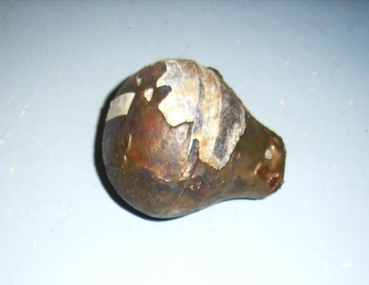 Queenscliffe Maritime Museum
Lead Weight
... Lead Weight..."Loch Ard" Iron 3-mast ship wrecked 31st May 1878 Port Campbell Pear shaped lead weight with brass casing recovered from Loch Ard wreck site....Lead Weight ..."Loch Ard" Iron 3-mast ship wrecked 31st May 1878 Port Campbell Pear shaped lead weight with brass casing recovered from Loch Ard wreck site. -
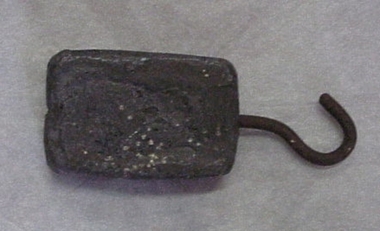 National Wool Museum
Weights
... A lead weight, with an iron suspension hook attached to the top end. ...A lead weight, with an iron suspension hook attached to the top end. ...A lead weight, with an iron suspension hook attached to the top end. ...A lead weight, with an iron suspension hook attached to the top end. Associated with the "Beehive Sock Knitter"A lead weight, with an iron suspension hook attached to the top end. Associated with the "Beehive Sock Knitter".knitting textile machinery machine knitting, hosiery, knitting, textile machinery, machine knitting -
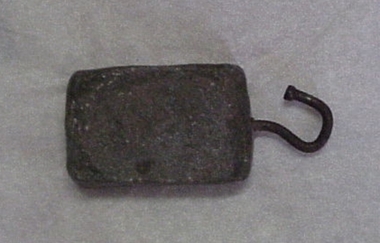 National Wool Museum
Weights
... A lead weight, with an iron suspension hook attached to the top end. ...A lead weight, with an iron suspension hook attached to the top end. ...A lead weight, with an iron suspension hook attached to the top end. ...A lead weight, with an iron suspension hook attached to the top end. Associated with the "Beehive Sock Knitter"A lead weight, with an iron suspension hook attached to the top end. Associated with the "Beehive Sock Knitter".knitting textile machinery machine knitting, hosiery, knitting, textile machinery, machine knitting -
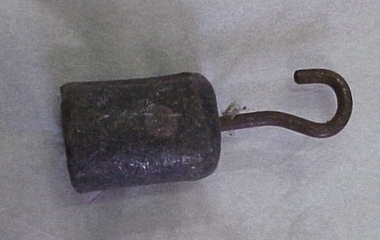 National Wool Museum
Weights
... A lead weight, with an iron suspension hook attached to the top end. ...A lead weight, with an iron suspension hook attached to the top end. ...A lead weight, with an iron suspension hook attached to the top end. ...A lead weight, with an iron suspension hook attached to the top end. Associated with the "Beehive Sock Knitter"A lead weight, with an iron suspension hook attached to the top end. Associated with the "Beehive Sock Knitter".knitting textile machinery machine knitting, hosiery, knitting, textile machinery, machine knitting -
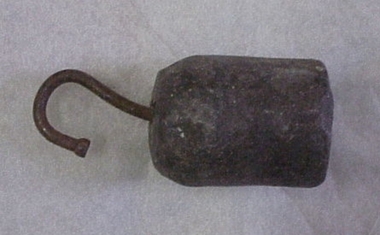 National Wool Museum
Weights
... A lead weight, with an iron suspension hook attached to the top end. ...A lead weight, with an iron suspension hook attached to the top end. ...A lead weight, with an iron suspension hook attached to the top end. ...A lead weight, with an iron suspension hook attached to the top end. Associated with the "Beehive Sock Knitter"A lead weight, with an iron suspension hook attached to the top end. Associated with the "Beehive Sock Knitter".knitting textile machinery machine knitting, hosiery, knitting, textile machinery, machine knitting -
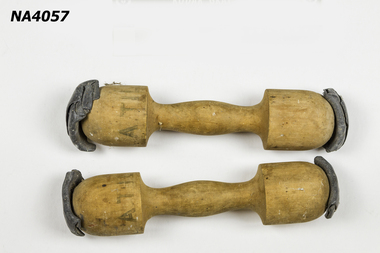 Whitehorse Historical Society Inc.
Leisure object - Dumbells
... Pair of wooden dumbells with lead weights attached at each end....RECREATIONS Sports A.Till Pair of wooden dumbells with lead weights attached at each end. Leisure object Dumbells ...from the Till collectionTHE TILL COLLECTION SIGNIFICANCE STATEMENT|The significance of the Alwyn Till Collection is that Alwyn was born in Mitcham in 1921. He attended Mitcham Primary School and Box Hill Boys High School. He served his Community mainly through his activities within the Christ Church Anglican Church Mitcham. He joined the Royal Australian Airforce in World War II in September 1939. He trained as a Pilot in Australia and Canada, was posted to England and saw action in Europe. He was shot down over France and rescued by and then joined the French Resistance and while fighting with them was fatally shot. A Baron fighting with him wrote to his mother to inform her of his death.|Alwyn's parents were Evaleen Victoria Till (nee Maggs) and Sydney Norman Till who first lived in Creek Road Mitcham, before moving to 573 Whitehorse Road Mitcham. His father served in World War I where his eyesight was damaged and he was taught by the then Blind Institute in suitcase making of which we have two examples in this collection. He died in 1931. Alwyn took over responsibility for his mother and sister Alison. We can understand how devastated his mother and sister would have been at the news of Alwyn's feeling that he must serve his country in World War 11.|His letters home were so precious to them that they carefully kept all his correspondence, notices of death and condolences from friends. After Alison's death in 2007 her relation Joan Walker transcribed each of Alwyn's letters home into two bound volumes. The executors, Joan Walker and Anne Drew deposited the original letters with the Whitehorse Historical Society. Due to their significance as historical documents of one serviceman's complete correspondence with his family the Whitehorse Historical Society Committee after consultation with the donors deposited the original letters with the State Library of Victoria. The Whitehorse Historical Society retains the copies.|Alison and her mother kept many family memorabilia and personal items which make up this significant collection as they show how people lived, worked and served in the local community and municipality.|This collection represents the love and devotion of the women to their families during the course of two world wars. The father was disabled as a result of World War 1 and died an early death and a son who thereafter took on the responsibility as head of the family at an early age. This young handsome charismatic son served his community in peace time and gave his life in World War 11. This mother and sister were devoted to his memory.Pair of wooden dumbells with lead weights attached at each end.A.Tillrecreations, sports -
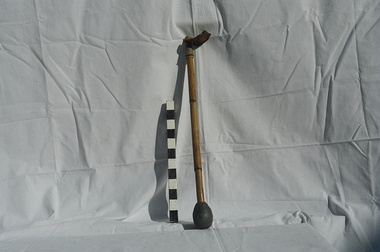 Port Fairy Historic Lifeboat Station
Tool - Heaving Cane
... ...Lead weight...Shipwreck Shipwreck rescue Lead weight Casting line Cane handle with heavy lead bulb at one end. leather strap bound to cane handle with cotton thread. ...Cane handle with heavy lead bulb at one end. leather strap bound to cane handle with cotton thread.shipwreck, shipwreck rescue, lead weight, casting line -
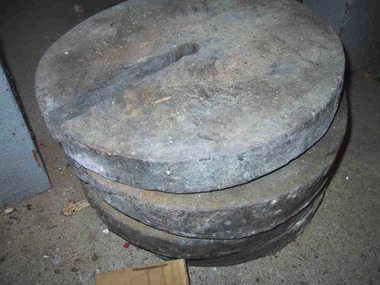 Parks Victoria - Wilsons Promontory Lightstation
Weights
... Four circular disc shaped lead weights, all with a narrow section cut out to the middle of shape. ...Four circular disc shaped lead weights, all with a narrow section cut out to the middle of shape. ...The seven weights (0008.4 and 0136.3) are circular in shape with a hole in the centre and a groove cut across the radius. They were specifically designed to fit into a weight tube, which allowed movement of the weights that were used for driving the clockwork mechanism for turning the lighthouse lens. They are most likely original to the Chance Brothers system installed in 1913, which was originally equipped with a set of ten, each weighing around thirty kilograms.The weights were moved vertically in similar fashion to the way weights move on a grandfather clock. As the weight fell, the optic clock was driven and the lens was turned. To keep the clock turning, the weight needed to be wound back up to the top of its travel. Lighthouse keepers had to constantly wind the clock to keep the light active, and at least two keepers needed to observe a strict roster of hours. When electric motors were invented, weights became obsolete and the motors were able to turn the optic for as long as there was power to drive them. Wilsons Promontory’s Chance Bros. kerosene operated light, which was turned by a clockwork mechanism, was replaced by small electric motor in 1975, reducing the number of keepers and eliminating the need for weights. Cape Schanck has a set of fourteen weights remaining in situ in the lighthouse weight tube as well as another four detached weights, two of which may be associated with the 1859 mechanism. A small number of detached cast iron weights and two associated rods remain at the Point Hicks Lightstation and one weight is displayed in the lantern room at Cape Otway.The Wilson Promontory weights have first level contributory significance for the insights they provide into the technology and operations of a late nineteenth/early twentieth century lighthouse which has since been superseded. They are well provenanced and are significant for their historical value as part of the lightstation’s Chance Brothers optical system installed in 1913.Four circular disc shaped lead weights, all with a narrow section cut out to the middle of shape. (as in slice of cake) -
 Glenelg Shire Council Cultural Collection
Functional object - Diver's Weight, SIEBE GORMAN & CO lTD lONDON, n.d
... Lead breast weight (circular) with bronze fitting and lifting rope....From the Port of Portland Authority dibing Port of Portland maritime marine Lead breast weight (circular) with bronze fitting and lifting rope. ...From the Port of Portland AuthorityLead breast weight (circular) with bronze fitting and lifting rope.dibing, port of portland, maritime, marine -
Glenelg Shire Council Cultural Collection
Functional object - Diver's Weight, n.d
... Diver's lead breast weight (circular) with bronze fittings and lifting rope...Port of Portland Authority diving weight diving Port of Portland Authority archives maritime marine Diver's lead breast weight (circular) with bronze fittings and lifting rope Functional object Diver's Weight SIEBE GORMAN & CO LTD LONDON ...Port of Portland AuthorityDiver's lead breast weight (circular) with bronze fittings and lifting ropediving weight, diving, port of portland authority archives, maritime, marine -
Glenelg Shire Council Cultural Collection
Functional object - Diver's Weight, SIEBE GORMAN & CO LTD LONDON, n.d
... Diver's lead breast weight (circular) with bronze fittings and lifting rope...A weight worn by a diver to help them ascend and descend in the water marine technology diving gear weight Diver's lead breast weight (circular) with bronze fittings and lifting rope Functional object Diver's Weight SIEBE GORMAN & CO LTD LONDON ...A weight worn by a diver to help them ascend and descend in the waterDiver's lead breast weight (circular) with bronze fittings and lifting ropemarine technology, diving, gear, weight -
 Flagstaff Hill Maritime Museum and Village
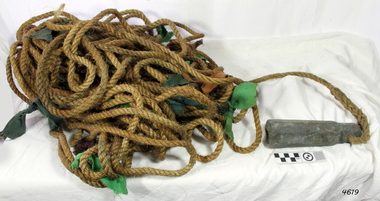
Equipment - Lead line
... The codes were: - 2 fathoms = 2 strips of leather 3 fathoms = 3 strips of leather 5 fathoms = white duck fabric 7 fathoms = red bunting fabric 10 fathoms = leather with a hole 13 fathoms = blue serge fabric 15 fathoms = white duck fabric 17 fathoms = red bunting 20 fathoms = 2 knots The lead weight could be between 7 -14 pounds (3.5 – 6.5kg) and the rope would be approximately 25 fathoms (45m). ...The long length of rope has a heavy lead weight attached to the end. Coloured fabric tags are tied onto the rope at regular intervals, representing different depths. ...The long length of rope has a heavy lead weight attached to the end. Coloured fabric tags are tied onto the rope at regular intervals, representing different depths. ...The lead line or hand lead is a simple navigational instrument used as a depth finder to measure the depth of water under the ship’s keel and to take samples of the sea bed. The long line may be marked at regular intervals with tags of different coloured and textured fabric, such as rope, leather and cloth. Each tag was a code to represent a certain depth. The leadsman’s eyes and hands could distinguish the depth easily as he drew in the lead line, day or night and in poor weather conditions. A standard set of codes for the tags was used so that the depth of the sea could be easily and quickly read. The measurement used was a Fathom, which equals 1.83 metres. The codes were: - 2 fathoms = 2 strips of leather 3 fathoms = 3 strips of leather 5 fathoms = white duck fabric 7 fathoms = red bunting fabric 10 fathoms = leather with a hole 13 fathoms = blue serge fabric 15 fathoms = white duck fabric 17 fathoms = red bunting 20 fathoms = 2 knots The lead weight could be between 7 -14 pounds (3.5 – 6.5kg) and the rope would be approximately 25 fathoms (45m). The hollowed-out end of the weight would hold a stick substance such as tallow or wax, which would pick up samples from the sea bed which would show whether the vessel was close to, or far away from, the shore. The leadsman would stand at the front of the vessel and cast the lead line into the sea. When it hit bottom he would note the tag marker nearest the surface of the water and call out his finding. Then he would haul it up again and examine the kind of matter that adhered to the end of the weight, whether it be sand, mud, gravel, or the colour of it. This information would be given to the ship’s helmsman or navigator and would help indicate the proximity to the land.This handheld lead is an example of early marine navigational equipment used by sailors to travel the seas to measure the depth of the water and sample the nature of the seabed. It helps to understand the history and progress made from the very basic to the sophisticated technology of today.Lead line, sounding line or depth finder. The long length of rope has a heavy lead weight attached to the end. Coloured fabric tags are tied onto the rope at regular intervals, representing different depths. The concave base of weight holds sticky substances such as tallow or beeswax, providing an adhesive surface to collect samples of sea bed like sand, shells or pebbles. flagstaff hill, warrnambool, shipwrecked coast, flagstaff hill maritime museum, maritime museum, shipwreck coast, flagstaff hill maritime village, lead line, depth finder, hand lead, sounding lin, leadsmane, navigation instrument, leadline, hand lead line -
 Flagstaff Hill Maritime Museum and Village
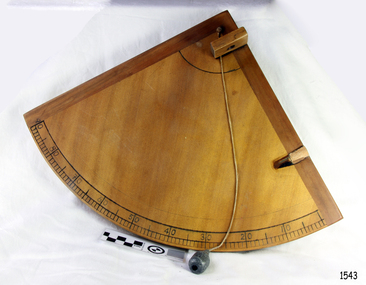
Inclinometer
... Inclinometer,Instrument for determinating the incination of a strata, wooden quarter circle in shape, marked with 0-90 degrees, two view holes (Bottom one broken off) attached at top for aligning. Lead weight on string to display angle....flagstaff hill warrnambool shipwrecked-coast flagstaff-hill flagstaff-hill-maritime-museum maritime-museum shipwreck-coast flagstaff-hill-maritime-village Inclinometer Inclinometer,Instrument for determinating the incination of a strata, wooden quarter circle in shape, marked with 0-90 degrees, two view holes (Bottom one broken off) attached at top for aligning. Lead weight on string to display angle. Inclinometer ...Inclinometer,Instrument for determinating the incination of a strata, wooden quarter circle in shape, marked with 0-90 degrees, two view holes (Bottom one broken off) attached at top for aligning. Lead weight on string to display angle.flagstaff hill, warrnambool, shipwrecked-coast, flagstaff-hill, flagstaff-hill-maritime-museum, maritime-museum, shipwreck-coast, flagstaff-hill-maritime-village, inclinometer -
 Bendigo Military Museum
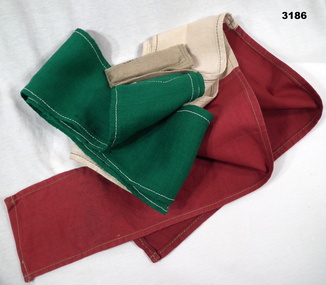
Accessory - MESSAGE CONTAINER WW1, 1918
... Pouch, khaki, containing a lead weight inside. Two brass press studs, strong cotton bunting material plain dyed with white stitching. ...Air to ground container WWI. containers-military metalcraft- brassware military equipment Pouch: “HCR LO 1918, a broad arrow with No. 422” Handwritten on one of the white panels: “No. 7” Pouch, khaki, containing a lead weight inside. Two brass press studs, strong cotton bunting material plain dyed with white stitching. ...Air to ground container WWI.Pouch, khaki, containing a lead weight inside. Two brass press studs, strong cotton bunting material plain dyed with white stitching. Attached are two long ribbons composed of three segments coloured green then white & red. Pouch: “HCR LO 1918, a broad arrow with No. 422” Handwritten on one of the white panels: “No. 7”containers-military, metalcraft- brassware, military equipment -
Glenelg Shire Council Cultural Collection
Functional object - Diver's Weight, n.d
... Diver's lead breast weight (circular) with two attachment ropes at top, at bottom and a lifting rope in centre of weight...From the Port of Portland Authority diving weight diving maritime marine Port of Portland Authority archives Diver's lead breast weight (circular) with two attachment ropes at top, at bottom and a lifting rope in centre of weight Functional object Diver's Weight SIEBE GORMAN & CO LTD LONDON ...From the Port of Portland AuthorityDiver's lead breast weight (circular) with two attachment ropes at top, at bottom and a lifting rope in centre of weightdiving weight, diving, maritime, marine, port of portland authority archives -
 Wodonga & District Historical Society Inc
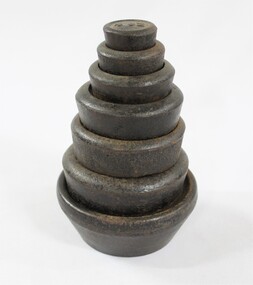
Functional object - Imperial Postal Weights used in the Post Office in Wodonga
... Set of seven cast iron and lead weights with imperial measurements '4 oz, 8oz, 1 lb, 2 lb, 3 lb, 4 lb, and 7 lb' The exterior circular black painted cast iron encases the heavy inner grey lead component, which is visible from the underside. ...Set of seven cast iron and lead weights with imperial measurements '4 oz, 8oz, 1 lb, 2 lb, 3 lb, 4 lb, and 7 lb' The exterior circular black painted cast iron encases the heavy inner grey lead component, which is visible from the underside. ...The set of seven imperial weights were used in the Post Office in Wodonga. The first Post Office in Wodonga opened on the 6th June 1856, and a second Post Office was built in 1874 on the corner of Sydney Road which became High St. and South St. In 1878 there were three staff at the Wodonga Post Office, including the Postmaster/Telegraph Manager and two Office-Keepers/Messengers. The mail service in 1878 included delivery four times a day from the Railway Station to the Post Office in Wodonga, and to and from the Wodonga Post Office to Albury twice a day.The set of seven imperial weights has local and state significance as it was used in the Wodonga Post Office in North East Victoria before decimal currency was introduced in Australia in 1966. The weights also have national significance as examples of the equipment used in post offices in Australia pre 1966.Set of seven cast iron and lead weights with imperial measurements '4 oz, 8oz, 1 lb, 2 lb, 3 lb, 4 lb, and 7 lb' The exterior circular black painted cast iron encases the heavy inner grey lead component, which is visible from the underside. "4 oz.", "8 / oz.", 1 lb.", "1 lb.", "2 lb.", "3 lb.", 4 lb.", MERCURY / 7 LB." on the top of the weights in raised numbers and letters.wodonga post office, post office, victoria post offices, wodonga, north eastern victoria post offices, victorian mail service -
 Queenscliffe Maritime Museum
Clothing - Diving suit
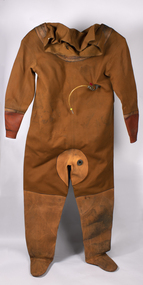
... This also resulted in a smaller volume helmet allowing the divers to use less lead weights when diving. In the early nineteen sixties Yokohama became involved in manufacturing their own helmets but in a different design after american diving equipment manufacturer Robert Kirby had rebuilt several Yokohama helmets into a more practical / modern design. ...This also resulted in a smaller volume helmet allowing the divers to use less lead weights when diving. In the early nineteen sixties Yokohama became involved in manufacturing their own helmets but in a different design after american diving equipment manufacturer Robert Kirby had rebuilt several Yokohama helmets into a more practical / modern design. ...The Yokohama Diving Company was established in the early 20th century. Their helmets were initially inspired by the english Siebe Gorman helmets which they manufactured in a smaller size. This also resulted in a smaller volume helmet allowing the divers to use less lead weights when diving. In the early nineteen sixties Yokohama became involved in manufacturing their own helmets but in a different design after american diving equipment manufacturer Robert Kirby had rebuilt several Yokohama helmets into a more practical / modern design. Yokohama is no longer in business.A 1950s era heavy duty diving suit used in pearling and salvage work.A Japanese manufactured diving suit used in pearling and salvage work in the 1950s.Yokohama Diving Appratus Co Ltd. No.760. Made in Japan.diving suit, commercial diving, pearling, salvage -
 Vision Australia
Equipment - Object, Cricket ball, black nylon, 2003
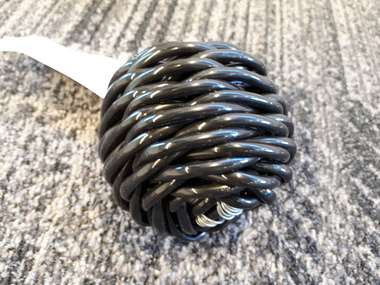
... It was hand woven around a wire frame, with lead for weight and bottle tops for sound placed inside....It was hand woven around a wire frame, with lead for weight and bottle tops for sound placed inside. ...The black nylon blind cricket ball was in use since 1974 until the end of the 2002/2003 season. It was hand woven around a wire frame, with lead for weight and bottle tops for sound placed inside.1 black nylon cricket ball with metal bellsrecreation, victorian blind cricket association -
 Bendigo Historical Society Inc.
Tool - CHINESE GOLD SCALES AND WOODEN HOLDER
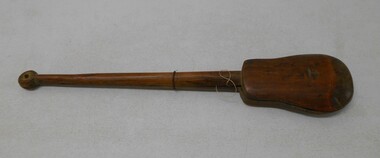
... Separately suspended from handle with thick cotton is a small semi-circular lead weight and a round brass scale pan....Separately suspended from handle with thick cotton is a small semi-circular lead weight and a round brass scale pan. Tool CHINESE GOLD SCALES AND WOODEN HOLDER ...Chinese gold scales. Wooden scale holder (a) two part wooden device secured at end of handle with a metal pin to allow swivelling of both pieces. At end of handle, two pieces 'violin' shaped to hold scale and weights. This enabled placement of scales within holder. Bottom piece has indent for scale pan, weight and long handle. Chinese scale (b) thin cream handle marked with inch graduations, without numbers. Separately suspended from handle with thick cotton is a small semi-circular lead weight and a round brass scale pan.gold mining, mining equipment, chinese gold scales -
 Flagstaff Hill Maritime Museum and Village
Tool - Sash Window Template, Late 19th to first quarter of the 20th century
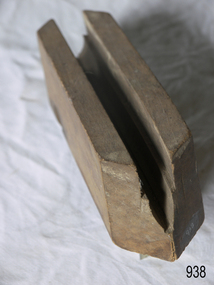
... The sashes fit inside a track that runs along another window frame attached to the house. Lead weights traditionally counterbalanced sashes, but today they are counterbalanced by springs. ...The sashes fit inside a track that runs along another window frame attached to the house. Lead weights traditionally counterbalanced sashes, but today they are counterbalanced by springs. ...A window sash is a type of moveable window frame that can slide, usually vertically. Unlike a window frame built into the wall, a sash allows glass window panes to slide up and down. The sashes fit inside a track that runs along another window frame attached to the house. Lead weights traditionally counterbalanced sashes, but today they are counterbalanced by springs. The traditional sash window is double-hung; this means it has two sashes that can both slide along a vertical track. However, some sash windows have a single moveable sash, and sashes may slide horizontally. A sash usually contains panels of glass, called lights. The lights are traditionally held together by a grid of bars. The sash window was developed in 17th century England and allowed for greater airflow. The sash window has had a significant impact on western architecture, used in nearly every style of English domestic architecture since the late 17th century. The subject item is a template used by the carpenter to mark or scribe the vertical track in which to window will slide up and down.An item used when sash windows were made by hand from the 17th to the early 20th century. The template allowed the carpenter to mark accurately a channel that was then planed and the Mitre to join the bars.Wooden Ovalo sash template with two screws each side. It has slot along length and has 45 degree bevelled edge each end.Noneflagstaff hill, warrnambool, shipwrecked-coast, flagstaff-hill, flagstaff-hill-maritime-museum, maritime-museum, shipwreck-coast, flagstaff-hill-maritime-village, wooden ovalo sash template, ovalo sash template, template, sash template, sash templet, window sash, tool -
 Flagstaff Hill Maritime Museum and Village
Weapon - Police Billy Club
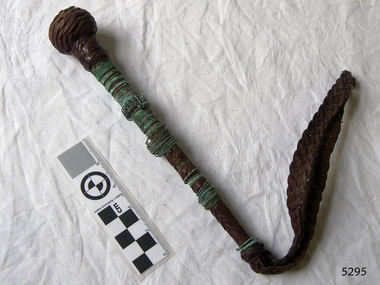
... The round end is filled with lead shot to a weight of 9 ounces (about 255 grams)....The round end is filled with lead shot to a weight of 9 ounces (about 255 grams). ...In 1829 London's first police department was founded. The billy club or baton was a tool used from that time as a weapon and a symbol of police authority; it was the only armament they carried for many decades. The billy was used against law offenders as well as a tool for breaking windows or to signal to other officers by knocking against fences and curbs. The billy club came in different sizes and some were purely a decorative symbol of the police. The billy club or baton has been replaced in more recent times by the TAZER and sprays.The billy club is significant as an example of early police control in Britain, Australia and America. Other less brutal means are used today for crowd control, such as sprays and TAZERs Russet coloured leather Police Billy. The Billy Club is wrapped in copper wire to prevent wear. The round end is filled with lead shot to a weight of 9 ounces (about 255 grams).flagstaff hill, warrnambool, maritime-museum, flagstaff hill maritime museum and village, great ocean road, shipwreck coast, police billy, police officer’s club, mace, truncheon, nightstick, baton, police equipment, crowd control, public order, police symbol -
 Flagstaff Hill Maritime Museum and Village
Functional object - Lead Ingot, circa 1878
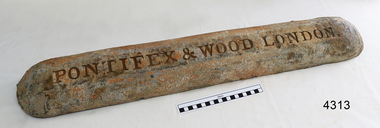
... The concentrated weight of lead pigs along the keel line would help steady and centre the ship, and perhaps the artefacts in this case were to be retained for this purpose, rather than being sold on to the ready colonial market. ...The concentrated weight of lead pigs along the keel line would help steady and centre the ship, and perhaps the artefacts in this case were to be retained for this purpose, rather than being sold on to the ready colonial market. ...This lead ingot was donated to Flagstaff Hill Maritime Village in January 2015 by local residents who discovered the ingot in their garden after they purchased the property about 12 months ago The LOCH ARD cargo manifest lists “Pig lead 50 tons” comprising “944 pig and 37 rolls”. Subsequent classification has rendered this section of cargo as “Lead Ballast”. This could be true. The international price per ton of lead ore plunged from a high point of £17 in 1853 to a low of £8 in 1882. The cheaper price of lead at the time of the vessel’s loading in early 1878 may have meant it was considered as an alternative to other ballast material (traditionally stone) for the journey to Melbourne. Loch Line ships generally returned to Britain laden with Australian wool. Even though wool bales were “screwed in” to the hold to less than half their “pressed weight”, they still made an awkwardly light cargo for the passage around the Horn. The concentrated weight of lead pigs along the keel line would help steady and centre the ship, and perhaps the artefacts in this case were to be retained for this purpose, rather than being sold on to the ready colonial market. However this is conjecture. Demand for building materials in the gold and wool rich Colony of Victoria was high in the 1870s, and much of the LOCH ARD cargo was intended for the Melbourne International Exhibition in 1880, which was another example of buoyant economic conditions. In the nineteenth century lead was valued for its density (high ratio of weight to volume), flexibility (relative softness for working into shape), and durability (corrosion resistant and waterproofing properties). It was used for pipes and water tanks, roof flashing and guttering, window sealing and internal plumbing. Many large private residences and new public buildings were at planning or construction stage in the colony during this period. The LOCH ARD lead ingots could equally have been destined for this ready market. HISTORY OF THE LOCH ARD The LOCH ARD belonged to the famous Loch Line which sailed many ships from England to Australia. Built in Glasgow by Barclay, Curdle and Co. in 1873, the LOCH ARD was a three-masted square rigged iron sailing ship. The ship measured 262ft 7" (79.87m) in length, 38ft (11.58m) in width, 23ft (7m) in depth and had a gross tonnage of 1693 tons. The LOCH ARD's main mast measured a massive 150ft (45.7m) in height. LOCH ARD made three trips to Australia and one trip to Calcutta before its final voyage. LOCH ARD left England on March 2, 1878, under the command of Captain Gibbs, a newly married, 29 year old. She was bound for Melbourne with a crew of 37, plus 17 passengers and a load of cargo. The general cargo reflected the affluence of Melbourne at the time. On board were straw hats, umbrella, perfumes, clay pipes, pianos, clocks, confectionary, linen and candles, as well as a heavier load of railway irons, cement, lead and copper. There were items included that intended for display in the Melbourne International Exhibition in 1880. The voyage to Port Phillip was long but uneventful. At 3am on June 1, 1878, Captain Gibbs was expecting to see land and the passengers were becoming excited as they prepared to view their new homeland in the early morning. But LOCH ARD was running into a fog which greatly reduced visibility. Captain Gibbs was becoming anxious as there was no sign of land or the Cape Otway lighthouse. At 4am the fog lifted. A man aloft announced that he could see breakers. The sheer cliffs of Victoria's west coast came into view, and Captain Gibbs realised that the ship was much closer to them than expected. He ordered as much sail to be set as time would permit and then attempted to steer the vessel out to sea. On coming head on into the wind, the ship lost momentum, the sails fell limp and LOCH ARD's bow swung back. Gibbs then ordered the anchors to be released in an attempt to hold its position. The anchors sank some 50 fathoms - but did not hold. By this time LOCH ARD was among the breakers and the tall cliffs of Mutton Bird Island rose behind the ship. Just half a mile from the coast, the ship's bow was suddenly pulled around by the anchor. The captain tried to tack out to sea, but the ship struck a reef at the base of Mutton Bird Island, near Port Campbell. Waves broke over the ship and the top deck was loosened from the hull. The masts and rigging came crashing down knocking passengers and crew overboard. When a lifeboat was finally launched, it crashed into the side of LOCH ARD and capsized. Tom Pearce, who had launched the boat, managed to cling to its overturned hull and shelter beneath it. He drifted out to sea and then on the flood tide came into what is now known as LOCH ARD Gorge. He swam to shore, bruised and dazed, and found a cave in which to shelter. Some of the crew stayed below deck to shelter from the falling rigging but drowned when the ship slipped off the reef into deeper water. Eva Carmichael had raced onto deck to find out what was happening only to be confronted by towering cliffs looming above the stricken ship. In all the chaos, Captain Gibbs grabbed Eva and said, "If you are saved Eva, let my dear wife know that I died like a sailor". That was the last Eva Carmichael saw of the captain. She was swept off the ship by a huge wave. Eva saw Tom Pearce on a small rocky beach and yelled to attract his attention. He dived in and swam to the exhausted woman and dragged her to shore. He took her to the cave and broke open case of brandy which had washed up on the beach. He opened a bottle to revive the unconscious woman. A few hours later Tom scaled a cliff in search of help. He followed hoof prints and came by chance upon two men from nearby Glenample Station three and a half miles away. In a state of exhaustion, he told the men of the tragedy. Tom returned to the gorge while the two men rode back to the station to get help. By the time they reached LOCH ARD Gorge, it was cold and dark. The two shipwreck survivors were taken to Glenample Station to recover. Eva stayed at the station for six weeks before returning to Ireland, this time by steamship. In Melbourne, Tom Pearce received a hero's welcome. He was presented with the first gold medal of the Royal Humane Society of Victoria and a £1000 cheque from the Victorian Government. Concerts were performed to honour the young man's bravery and to raise money for those who lost family in the LOCH ARD disaster. Of the 54 crew members and passengers on board, only two survived: the apprentice, Tom Pearce and the young woman passenger, Eva Carmichael, who lost all of her family in the tragedy. Ten days after the LOCH ARD tragedy, salvage rights to the wreck were sold at auction for £2,120. Cargo valued at £3,000 was salvaged and placed on the beach, but most washed back into the sea when another storm developed. The wreck of LOCH ARD still lies at the base of Mutton Bird Island. Much of the cargo has now been salvaged and some was washed up into what is now known as LOCH ARD Gorge. Cargo and artefacts have also been illegally salvaged over many years before protective legislation was introduced. One of the most unlikely pieces of cargo to have survived the shipwreck was a Minton porcelain peacock - one of only nine in the world. The peacock was destined for the Melbourne International Exhibition in 1880. It had been well packed, which gave it adequate protection during the violent storm. Today, the Minton peacock can be seen at the Flagstaff Hill Maritime Museum in Warrnambool. From Australia's most dramatic shipwreck it has now become Australia's most valuable shipwreck artefact and is one of very few 'objects' on the Victorian State Heritage Register. The shipwreck of the LOCH ARD is of State significance ― Victorian Heritage Register S417 Flagstaff Hill’s collection of artefacts from LOCH ARD is significant for being one of the largest collections of artefacts from this shipwreck in Victoria. It is significant for its association with the shipwreck, which is on the Victorian Heritage Register (VHR S417). The collection is significant because of the relationship between the objects, as together they have a high potential to interpret the story of the LOCH ARD. The LOCH ARD collection is archaeologically significant as the remains of a large international passenger and cargo ship. The LOCH ARD collection is historically significant for representing aspects of Victoria’s shipping history and its potential to interpret sub-theme 1.5 of Victoria’s Framework of Historical Themes (living with natural processes). The collection is also historically significant for its association with the LOCH ARD, which was one of the worst and best known shipwrecks in Victoria’s history. Lead ingots (sometimes referred to as ‘lead ballast’ or ‘lead pigs), salvaged from the wreck of the LOCH ARD. Grey metal bars with flat base, rising in a curved moulded shape to form a smooth rounded upper face. The imprint of the maker runs along the upper surface in clearly legible capital lettering (height 3cm). Durable and heavy, with some marine staining, but in good condition. Stamped along curved surface, within oval border, "PONTIFEX & WOOD LONDON."flagstaff hill, warrnambool, shipwrecked coast, flagstaff hill maritime museum, maritime museum, shipwreck coast, flagstaff hill maritime village, great ocean road, loch line, loch ard, captain gibbs, eva carmichael, tom pearce, glenample station, mutton bird island, loch ard gorge, lead pigs, lead ingots, lead ballast, pontifex and wood, london, lead smelters -
 Flagstaff Hill Maritime Museum and Village
Functional object - Lead shot, Circa 1877
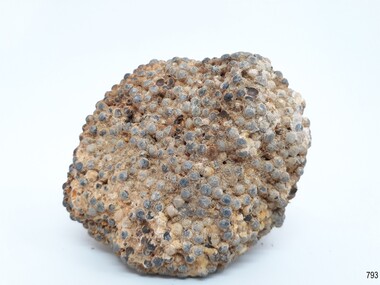
... lead shot, uniformly round balls of dull grey metal ranging from 2mm “birdshot” to 8mm “buckshot”, were routinely exported to the Australian colonies. Shot was used mostly as projectiles fired from smooth bored guns to bring down moving targets such as wild ducks and small game. It was also useful as ballast, when a dense, “pourable” weight...lead shot, uniformly round balls of dull grey metal ranging from 2mm “birdshot” to 8mm “buckshot”, were routinely exported to the Australian colonies. Shot was used mostly as projectiles fired from smooth bored guns to bring down moving targets such as wild ducks and small game. It was also useful as ballast, when a dense, “pourable” weight ...This artifact is a sample of small caliber lead shot recovered by Flagstaff Hill divers from the wreck of the Loch Ard in 1975. Included in her diverse and valuable cargo were 22 tons of lead shot, packed in cloth bags and wooden casks. Bulk quantities of lead shot, uniformly round balls of dull grey metal ranging from 2mm “birdshot” to 8mm “buckshot”, were routinely exported to the Australian colonies. Shot was used mostly as projectiles fired from smooth bored guns to bring down moving targets such as wild ducks and small game. It was also useful as ballast, when a dense, “pourable” weight was required to fill cavities or establish volume within a measuring container. The production of consistently round spheres of lead shot required the pouring of molten metal through a sieve and then a long drop through the atmosphere to a water filled basin for final cooling and collection. This “shot tower” process was first patented by William Watts of Bristol in 1782. His calculation of a 150 feet fall was not only to form evenly spherical droplets through surface tension, but also to provide partial cooling and solidification to each shot before they hit the water below. The value of his innovation was the minimising of indentation and shape distortion, avoiding the expense of re-smelting and re-moulding the lead. Lead shot was already being produced in Australia at the time the Loch Ard sinking in March 1878. James Moir had constructed a 157 feet circular stone shot tower near Hobart in 1870, with a peak annual production of 100 tons of lead shot sold in 28 pound linen bags. However colonial demand exceeded this source of local supply. The continued strength of the market for lead shot in the Colony of Victoria prompted substantial investment in additional productive capacity in Melbourne in the next decade. In 1882 Richard Hodgson erected the 160 feet round chimney-shaped Clifton Hill shot tower on Alexandra Parade (VHR H0709) and in 1889 Walter Coop built the 160 feet square tower-shaped Melbourne Central shot tower on La Trobe Street (VHR H0067). At its peak, the Coop Tower produced 6 tons of lead shot per week, or 312 tons per annum. History of the Loch Ard: The Loch Ard got its name from "Loch Ard" a loch that lies to the west of Aberfoyle, and the east of Loch Lomond. It means "high lake" in Scottish Gaelic. The vessel belonged to the famous Loch Line which sailed many vessels from England to Australia. The Loch Ard was built in Glasgow by Barclay, Curle & Co. in 1873, the vessel was a three-masted square-rigged iron sailing ship that measured 79.87 meters in length, 11.58 m in width, and 7 m in depth with a gross tonnage of 1693 tons with a mainmast that measured a massive 45.7 m in height. Loch Ard made three trips to Australia and one trip to Calcutta before its fateful voyage. Loch Ard left England on March 2, 1878, under the command of 29-year-old Captain Gibbs, who was newly married. The ship was bound for Melbourne with a crew of 37, plus 17 passengers. The general cargo reflected the affluence of Melbourne at the time. Onboard were straw hats, umbrellas, perfumes, clay pipes, pianos, clocks, confectionery, linen, and candles, as well as a heavier load of railway irons, cement, lead, and copper. There were other items included that were intended for display in the Melbourne International Exhibition of 1880. The voyage to Port Phillip was long but uneventful. Then at 3 am on June 1, 1878, Captain Gibbs was expecting to see land. But the Loch Ard was running into a fog which greatly reduced visibility. Captain Gibbs was becoming anxious as there was no sign of land or the Cape Otway lighthouse. At 4 am the fog lifted and a lookout aloft announced that he could see breakers. The sheer cliffs of Victoria's west coast came into view, and Captain Gibbs realised that the ship was much closer to them than expected. He ordered as much sail to be set as time would permit and then attempted to steer the vessel out to sea. On coming head-on into the wind, the ship lost momentum, the sails fell limp and Loch Ard's bow swung back towards land. Gibbs then ordered the anchors to be released in an attempt to hold their position. The anchors sank some 50 fathoms - but did not hold. By this time the ship was among the breakers and the tall cliffs of Mutton Bird Island rose behind. Just half a mile from the coast, the ship's bow was suddenly pulled around by the anchor. The captain tried to tack out to sea, but the ship struck a reef at the base of Mutton Bird Island, near Port Campbell. Waves subsequently broke over the ship and the top deck became loosened from the hull. The masts and rigging came crashing down knocking passengers and crew overboard. When a lifeboat was finally launched, it crashed into the side of Loch Ard and capsized. Tom Pearce, who had launched the boat, managed to cling to its overturned hull and shelter beneath it. He drifted out to sea and then on the flood tide came into what is now known as Lochard Gorge. He swam to shore, bruised and dazed, and found a cave in which to shelter. Some of the crew stayed below deck to shelter from the falling rigging but drowned when the ship slipped off the reef into deeper water. Eva Carmichael a passenger had raced onto the deck to find out what was happening only to be confronted by towering cliffs looming above the stricken ship. In all the chaos, Captain Gibbs grabbed Eva and said, "If you are saved Eva, let my dear wife know that I died like a sailor". That was the last Eva Carmichael saw of the captain. She was swept off the ship by a huge wave. Eva saw Tom Pearce on a small rocky beach and yelled to attract his attention. He dived in and swam to the exhausted woman and dragged her to shore. He took her to the cave and broke the open case of brandy that had washed up on the beach. He opened a bottle to revive the unconscious woman. A few hours later Tom scaled a cliff in search of help. He followed hoof prints and came by chance upon two men from nearby Glenample Station three and a half miles away. In a complete state of exhaustion, he told the men of the tragedy. Tom then returned to the gorge while the two men rode back to the station to get help. By the time they reached Loch Ard Gorge, it was cold and dark. The two shipwreck survivors were taken to Glenample Station to recover. Eva stayed at the station for six weeks before returning to Ireland by steamship. In Melbourne, Tom Pearce received a hero's welcome. He was presented with the first gold medal of the Royal Humane Society of Victoria and a £1000 cheque from the Victorian Government. Concerts were performed to honour the young man's bravery and to raise money for those who lost families in the disaster. Of the 54 crew members and passengers on board, only two survived: the apprentice, Tom Pearce, and the young woman passenger, Eva Carmichael, who lost her family in the tragedy. Ten days after the Lochard tragedy, salvage rights to the wreck were sold at auction for £2,120. Cargo valued at £3,000 was salvaged and placed on the beach, but most washed back into the sea when another storm developed. The wreck of Lochard still lies at the base of Mutton Bird Island. Much of the cargo has now been salvaged and some items were washed up into Lochard Gorge. Cargo and artifacts have also been illegally salvaged over many years before protective legislation was introduced in March 1982. One of the most unlikely pieces of cargo to have survived the shipwreck was a Minton majolica peacock- one of only nine in the world. The peacock was destined for the Melbourne 1880 International Exhibition. It had been well packed, which gave it adequate protection during the violent storm. Today the Minton peacock can be seen at the Flagstaff Hill Maritime Museum in Warrnambool. From Australia's most dramatic shipwreck it has now become Australia's most valuable shipwreck artifact and is one of very few 'objects' on the Victorian State Heritage Register.The shipwreck of the Loch Ard is of significance for Victoria and is registered on the Victorian Heritage Register ( S 417). Flagstaff Hill has a varied collection of artifacts from Loch Ard and its collection is significant for being one of the largest accumulation of artifacts from this notable Victorian shipwreck of which the subject items are a small part. The collection's objects give us a snapshot of how we can interpret the story of this tragic event. The collection is also archaeologically significant as it represents aspects of Victoria's shipping history that allows us to interpret Victoria's social and historical themes of the time. Through is associated with the worst and best-known shipwreck in Victoria's history.Lead shot; a group of mixed -sized lead shot. Small 2mm shot is embedded in a sea sediment clump of concretion. Also in the group are also 5 single 2mm shot and 4 single 4mm shot that are clean and free of sediment. The shot was recovered from the wreck of the Loch Ard.Nonewarrnambool, shipwreck coast, flagstaff hill, flagstaff hill maritime village, flagstaff hill maritime museum, shipwreck artefact, lead shot, loch ard, colonial industry, melbourne shot towers, victorian metallurgy, colonial imports -
 Federation University Historical Collection
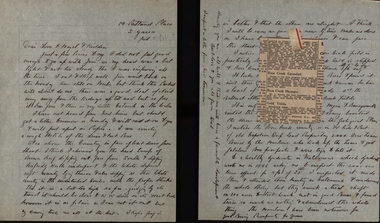
Letter, Letters from Richard Squire to his son Tom 1935
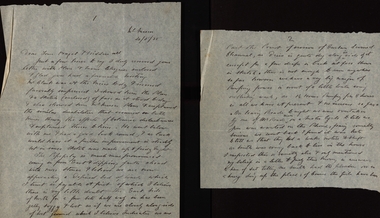
... Weight...Pearson...Pulleys...Syndicate...Goon...Suction...Lease...Reports...Estimates...Flat Fields...Reef...Banagwanth...Trucks...Pipeclay...Sandstone...Suction Pipe...Valves...Honeycomb Rock...Mr Kermode...Yarrowee...Ballarat...Reef Combs...Cheques...Earthquake...Yellow Slate...Leigh River...Dyke...The Madame Bay Coy...Allendale...Berry West...Quartz...Ballarat Deep Leads...Ballarat Deep Leads Extension...Bore...Reads...Bedrock...J. Hayes...Harmen Premier Distributors...Middletons...Cemented Sand...Electricity commission...G M of A...Gold Mines of Australia...Dick Harry...Pearsons...Hawksburn...Crown Wheel...Rice's Paddock...Liz the Car...Volcanic Ridge...LRG Coy...McNaughton's Paddock...Madison's Lead...Hayes Illness Poppet Carburetor Shaft Balance Weight Pearson Pulleys Syndicate Goon Suction Lease Reports Estimates Flat Fields Reef Banagwanth Trucks Pipeclay Sandstone Suction Pipe Valves Honeycomb Rock Mr Kermode Yarrowee Ballarat Reef Combs Cheques Earthquake Yellow Slate Leigh River Dyke The Madame Bay Coy Allendale Berry West Quartz Ballarat Deep Leads Ballarat Deep Leads Extension Bore Reads Bedrock J. Hayes Harmen Premier Distributors Middletons Cemented Sand Electricity commission G M of A Gold Mines of Australia Dick Harry Pearsons Hawksburn Crown Wheel Rice's Paddock Liz the Car Volcanic Ridge LRG Coy McNaughton's Paddock Madison's Lead ...In 1905 Richard Squire was manager of the West Berry Consols at Allendale, and developed an improved system of mine ventilation, which was supported in "The Age." He was successful in combating and remedying the gas and ventilation troubles of the Deep Mines of Creswick and Allendale Districts after all had failed. MINE MANAGERS’ ASSOCIATION. Ballarat Branch. ... Mr R. B. Squire, manager of the West Berry Consols, at Allendale, submitted a paper detailing what he had done tor the betterment of ventilation in the alluvial mines of Smeaton and Mary borough districts- Members gave Mr Squire every credit for the results that he claimed to have effected; the adoption of his ideas had testified to their value to mine-owners. It was painted out, however, that for want of a thorough debate of the subject with experienced men the author had unwittingly included some general statements that required modifying in some points and extending in others, in justice to other workers among the earlier and the present day managers of mines. It was decided to invite the author to meet a sub-committee on this subject!Various handwritten Letters from Richard Squire to his son Tom 1935richard squire, tom squire, hazel squire, jack squire, jim squire, ned, mt mercer, basil, plant, skids, pump, c. hayes, illness, poppet, carburetor, shaft, balance weight, pearson, pulleys, syndicate, goon, suction, lease, reports, estimates, flat fields, reef, banagwanth, trucks, pipeclay, sandstone, suction pipe, valves, honeycomb rock, mr kermode, yarrowee, ballarat, reef combs, cheques, earthquake, yellow slate, leigh river, dyke, the madame bay coy, allendale, berry west, quartz, ballarat deep leads, ballarat deep leads extension, bore, reads, bedrock, j. hayes, harmen premier distributors, middletons, cemented sand, electricity commission, g m of a, gold mines of australia, dick harry, pearsons, hawksburn, crown wheel, rice's paddock, liz the car, volcanic ridge, lrg coy, mcnaughton's paddock, madison's lead, cameron & sutherland, crabhole, rokewood, glenfine, mrs gibbs, dobson, booth, shiels, thomas mitchell, mcpherson's reward, haddon, trunk lead mine, elaine, pitfield plains, mr clarke, daylesford, kuchel, shelford, geoff squire, lode, quartz reef, bladder attack, kidneys, income tax, reginald murray, grenville, blasting, john b. dennison, martin t. taylor, durham and buninyong deep lead, sebastopol plateau, mr wilkie, the premier petrol distributing agency of ballarat, lawaluk, ryan's western leads, mr nichol, mr hodge, knox schlapp and co., dr griffiths, state accident insurance office, magdala mine stawell, mining -
 Federation University Historical Collection
Letter, Letters from Richard Squire to his son Tom 1936
... Weight...Pearson...Pulleys...Syndicate...Goon...Suction...Lease...Reports...Estimates...Flat Fields...Reef...Trucks...Pipeclay...Sandstone...Suction Pipe...Valves...Honeycomb Rock...Mr Kermode...Yarrowee...Ballarat...Reef Combs...Cheques...Yellow Slate...Leigh River...Dyke...Quartz...Ballarat Deep Leads...Ballarat Deep Leads Extension...Bore...Reads...Bedrock...Cemented Sand...G M of A...Gold Mines of Australia...Liz the Car...Geoff Squire...Lode...Cameron and Sutherland...Lancaster...Harman...Hayes Timber...T. Hood...Alan Squire...Catarrh...Kidney Disease...Stomach Issues...Ethel...Measles...Scarlet Fever...Ross Creek Field...J. Bourke...J. Cock...Ross Creek Gold Mining Co....Frank Herman...Hogan & Banagwanath...Hogan...Banagwanath...Napolean Deap Lead...Hayes Illness Poppet Carburetor Shaft Balance Weight Pearson Pulleys Syndicate Goon Suction Lease Reports Estimates Flat Fields Reef Trucks Pipeclay Sandstone Suction Pipe Valves Honeycomb Rock Mr Kermode Yarrowee Ballarat Reef Combs Cheques Yellow Slate Leigh River Dyke Quartz Ballarat Deep Leads Ballarat Deep Leads Extension Bore Reads Bedrock Cemented Sand G M of A Gold Mines of Australia Liz the Car Geoff Squire Lode Cameron and Sutherland Lancaster Harman Hayes Timber T. Hood Alan Squire Catarrh Kidney Disease Stomach Issues Ethel Measles Scarlet Fever Ross Creek Field J. Bourke J. Cock Ross Creek Gold Mining Co. Frank Herman Hogan & Banagwanath Hogan Banagwanath Napolean Deap Lead ...In 1905 Richard Squire was manager of the West Berry Consuls at Allendale, and developed an improved system of mine ventilation, which was supported in "The Age." He was successful in combating and remedying the gas and ventilation troubles of the Deep Mines of Creswick and Allendale Districts after all had failed. MINE MANAGERS’ ASSOCIATION. Ballarat Branch. ... Mr. R. B. Squire, manager of the West Berry Consuls, at Allendale, submitted a paper detailing what he had done tor the betterment of ventilation in the alluvial mines of Smeaton and Mary borough districts- Members gave Mr. Squire every credit for the results that he claimed to have affected; the adoption of his ideas had testified to their value to mine-owners. It was painted out, however, that for want of a thorough debate of the subject with experienced men the author had unwittingly included some general statements that required modifying in some points and extending in others, in justice to other workers among the earlier and the present-day managers of mines. It was decided to invite the author to meet a sub-committee on this subject!Various letters written by Richard Squire to his son Tom on the topic of their Mine in 1936 richard squire, tom squire, hazel squire, jack squire, jim squire, ned, mt mercer, basil, plant, skids, pump, c. hayes, illness, poppet, carburetor, shaft, balance weight, pearson, pulleys, syndicate, goon, suction, lease, reports, estimates, flat fields, reef, trucks, pipeclay, sandstone, suction pipe, valves, honeycomb rock, mr kermode, yarrowee, ballarat, reef combs, cheques, yellow slate, leigh river, dyke, quartz, ballarat deep leads, ballarat deep leads extension, bore, reads, bedrock, cemented sand, g m of a, gold mines of australia, liz the car, geoff squire, lode, cameron and sutherland, lancaster, harman, hayes timber, t. hood, alan squire, catarrh, kidney disease, stomach issues, ethel, measles, scarlet fever, ross creek field, j. bourke, j. cock, ross creek gold mining co., frank herman, hogan & banagwanath, hogan, banagwanath, napolean deap lead, hanlons, lillas, martin, jack hayes, diptheria, anticline, mr mcnichol, ronaldson, bob allan, jenkins, hunter, wilkinson, eyres brothers, g.gay & co, buninyong, llewellen, glenfine, the star mine of avoca fields, talbot alluvials, g.e. dickenson, guildford plateau, a.b.c. special supply store, jelbart, geological branch, shell coy, mr horsefields, lawaluk, almanac, trenery, barry, mining -
Federation University Historical Collection
Booklet - Gold Nuggets of Victoria, 1970
... Gold nugget victoria Indicator Thomas Chapman Welcome Stranger The Welcome Blanche Barkly The Precious The Canadian The Lady Hotham The Sarah Sands Blackman Lead Maryborough The Heron The Viscount Canterbury Five page booklet of Victorian gold nuggets listing the known nuggets that had a gross weight over 1,000 ounces. ...Five page booklet of Victorian gold nuggets listing the known nuggets that had a gross weight over 1,000 ounces.gold nugget, victoria, indicator, thomas chapman, welcome stranger, the welcome, blanche barkly, the precious, the canadian, the lady hotham, the sarah sands, blackman lead maryborough, the heron, the viscount canterbury -
 Flagstaff Hill Maritime Museum and Village
Lead shot, Before 1878
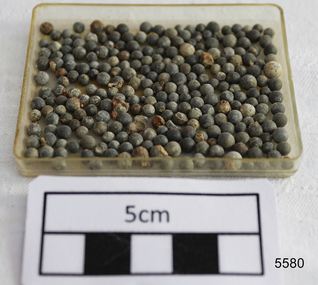
... lead shot, uniformly round balls of dull grey metal ranging from 2mm “birdshot” to 8mm “buckshot”, were routinely exported to the Australian colonies. Shot was used mostly as projectiles fired from smooth bored guns to bring down moving targets such as wild ducks and small game. It was also useful as ballast, when a dense, “pourable” weight...lead shot, uniformly round balls of dull grey metal ranging from 2mm “birdshot” to 8mm “buckshot”, were routinely exported to the Australian colonies. Shot was used mostly as projectiles fired from smooth bored guns to bring down moving targets such as wild ducks and small game. It was also useful as ballast, when a dense, “pourable” weight ...The objects comprise a quantity of small calibre lead shot raised from the LOCH ARD shipwreck site by Flagstaff Hill divers in 1976. The Maritime Village’s collection has companion pieces. The three masted, iron hulled, LOCH ARD was wrecked against the tall limestone cliffs of Mutton Bird Island in the early hours of the first of June 1878. Included in her diverse and valuable cargo were 22 tons of lead shot, packed in cloth bags and wooden casks. Bulk quantities of lead shot, uniformly round balls of dull grey metal ranging from 2mm “birdshot” to 8mm “buckshot”, were routinely exported to the Australian colonies. Shot was used mostly as projectiles fired from smooth bored guns to bring down moving targets such as wild ducks and small game. It was also useful as ballast, when a dense, “pourable” weight was required to fill cavities or establish volume within a measuring container. The production of consistently round spheres of lead shot required the pouring of molten metal through a sieve and then a long drop through the atmosphere to a water filled basin for final cooling and collection. This “shot tower” process was first patented by William Watts of Bristol in 1782. His calculation of a 150 feet fall was not only to form evenly spherical droplets through surface tension, but also to provide partial cooling and solidification to each shot before they hit the water below. The value of his innovation was the minimising of indentation and shape distortion, avoiding the expense of re-smelting and re-moulding the lead. Lead shot was already being produced in Australia at the time the LOCH ARD loaded her cargo and left Gravesend on the second of March 1878. James Moir constructed a 157 feet circular stone shot tower near Hobart in 1870, with a peak annual production of 100 tons of lead shot sold in 28 pound linen bags. However colonial demand exceeded this source of local supply. The continued strength of the market for lead shot in the Colony of Victoria prompted substantial investment in additional productive capacity in Melbourne in the next decade. In 1882 Richard Hodgson erected the 160 feet round chimney-shaped Clifton Hill shot tower on Alexandra Parade (VHR H0709) and in 1889 Walter Coop built the 160 feet square tower-shaped Melbourne Central shot tower on La Trobe Street (VHR H0067). At its peak, the Coop Tower produced 6 tons of lead shot per week, or 312 tons per annum. HISTORY OF THE LOCH ARD The LOCH ARD belonged to the famous Loch Line which sailed many ships from England to Australia. Built in Glasgow by Barclay, Curdle and Co. in 1873, the LOCH ARD was a three-masted square rigged iron sailing ship. The ship measured 262ft 7" (79.87m) in length, 38ft (11.58m) in width, 23ft (7m) in depth and had a gross tonnage of 1693 tons. The LOCH ARD's main mast measured a massive 150ft (45.7m) in height. LOCH ARD made three trips to Australia and one trip to Calcutta before its final voyage. LOCH ARD left England on March 2, 1878, under the command of Captain Gibbs, a newly married, 29 year old. She was bound for Melbourne with a crew of 37, plus 17 passengers and a load of cargo. The general cargo reflected the affluence of Melbourne at the time. On board were straw hats, umbrella, perfumes, clay pipes, pianos, clocks, confectionary, linen and candles, as well as a heavier load of railway irons, cement, lead and copper. There were items included that intended for display in the Melbourne International Exhibition in 1880. The voyage to Port Phillip was long but uneventful. At 3am on June 1, 1878, Captain Gibbs was expecting to see land and the passengers were becoming excited as they prepared to view their new homeland in the early morning. But LOCH ARD was running into a fog which greatly reduced visibility. Captain Gibbs was becoming anxious as there was no sign of land or the Cape Otway lighthouse. At 4am the fog lifted. A man aloft announced that he could see breakers. The sheer cliffs of Victoria's west coast came into view, and Captain Gibbs realised that the ship was much closer to them than expected. He ordered as much sail to be set as time would permit and then attempted to steer the vessel out to sea. On coming head on into the wind, the ship lost momentum, the sails fell limp and LOCH ARD's bow swung back. Gibbs then ordered the anchors to be released in an attempt to hold its position. The anchors sank some 50 fathoms - but did not hold. By this time LOCH ARD was among the breakers and the tall cliffs of Mutton Bird Island rose behind the ship. Just half a mile from the coast, the ship's bow was suddenly pulled around by the anchor. The captain tried to tack out to sea, but the ship struck a reef at the base of Mutton Bird Island, near Port Campbell. Waves broke over the ship and the top deck was loosened from the hull. The masts and rigging came crashing down knocking passengers and crew overboard. When a lifeboat was finally launched, it crashed into the side of LOCH ARD and capsized. Tom Pearce, who had launched the boat, managed to cling to its overturned hull and shelter beneath it. He drifted out to sea and then on the flood tide came into what is now known as LOCH ARD Gorge. He swam to shore, bruised and dazed, and found a cave in which to shelter. Some of the crew stayed below deck to shelter from the falling rigging but drowned when the ship slipped off the reef into deeper water. Eva Carmichael had raced onto deck to find out what was happening only to be confronted by towering cliffs looming above the stricken ship. In all the chaos, Captain Gibbs grabbed Eva and said, "If you are saved Eva, let my dear wife know that I died like a sailor". That was the last Eva Carmichael saw of the captain. She was swept off the ship by a huge wave. Eva saw Tom Pearce on a small rocky beach and yelled to attract his attention. He dived in and swam to the exhausted woman and dragged her to shore. He took her to the cave and broke open case of brandy which had washed up on the beach. He opened a bottle to revive the unconscious woman. A few hours later Tom scaled a cliff in search of help. He followed hoof prints and came by chance upon two men from nearby Glenample Station three and a half miles away. In a state of exhaustion, he told the men of the tragedy. Tom returned to the gorge while the two men rode back to the station to get help. By the time they reached LOCH ARD Gorge, it was cold and dark. The two shipwreck survivors were taken to Glenample Station to recover. Eva stayed at the station for six weeks before returning to Ireland, this time by steamship. In Melbourne, Tom Pearce received a hero's welcome. He was presented with the first gold medal of the Royal Humane Society of Victoria and a £1000 cheque from the Victorian Government. Concerts were performed to honour the young man's bravery and to raise money for those who lost family in the LOCH ARD disaster. Of the 54 crew members and passengers on board, only two survived: the apprentice, Tom Pearce and the young woman passenger, Eva Carmichael, who lost all of her family in the tragedy. Ten days after the LOCH ARD tragedy, salvage rights to the wreck were sold at auction for £2,120. Cargo valued at £3,000 was salvaged and placed on the beach, but most washed back into the sea when another storm developed. The wreck of LOCH ARD still lies at the base of Mutton Bird Island. Much of the cargo has now been salvaged and some was washed up into what is now known as LOCH ARD Gorge. Cargo and artefacts have also been illegally salvaged over many years before protective legislation was introduced. One of the most unlikely pieces of cargo to have survived the shipwreck was a Minton porcelain peacock - one of only nine in the world. The peacock was destined for the Melbourne International Exhibition in 1880. It had been well packed, which gave it adequate protection during the violent storm. Today, the Minton peacock can be seen at the Flagstaff Hill Maritime Museum in Warrnambool. From Australia's most dramatic shipwreck it has now become Australia's most valuable shipwreck artefact and is one of very few 'objects' on the Victorian State Heritage Register. The shipwreck of the LOCH ARD is of State significance – Victorian Heritage Register S417 Flagstaff Hill’s collection of artefacts from LOCH ARD is significant for being one of the largest collections of artefacts from this shipwreck in Victoria. It is significant for its association with the shipwreck, which is on the Victorian Heritage Register (VHR S417). The collection is significant because of the relationship between the objects, as together they have a high potential to interpret the story of the LOCH ARD. The LOCH ARD collection is archaeologically significant as the remains of a large international passenger and cargo ship. The LOCH ARD collection is historically significant for representing aspects of Victoria’s shipping history and its potential to interpret sub-theme 1.5 of Victoria’s Framework of Historical Themes (living with natural processes). The collection is also historically significant for its association with the LOCH ARD, which was one of the worst and best known shipwrecks in Victoria’s history. A quantity of lead shot pellets retrieved from the wreck of the LOCH ARD. There are 242 loose 2mm pieces and 17 loose 4mm pieces. They are in good condition, with some shape distortion and sedimentary concretion, and shot tower made.flagstaff hill, warrnambool, shipwrecked coast, flagstaff hill maritime museum, maritime museum, shipwreck coast, flagstaff hill maritime village, great ocean road, loch line, loch ard, captain gibbs, eva carmichael, tom pearce, glenample station, mutton bird island, loch ard gorge, lead shot, colonial industry, melbourne shot towers, victorian metallurgy, colonial imports -
 Flagstaff Hill Maritime Museum and Village
Weapon - Ammunition, Before 1878
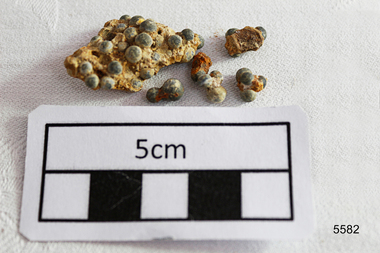
... lead shot, uniformly round balls of dull grey metal ranging from 2mm “birdshot” to 8mm “buckshot”, were routinely exported to the Australian colonies. Shot was used mostly as projectiles fired from smooth bored guns to bring down moving targets such as wild ducks and small game. It was also useful as ballast, when a dense, “pourable” weight...lead shot, uniformly round balls of dull grey metal ranging from 2mm “birdshot” to 8mm “buckshot”, were routinely exported to the Australian colonies. Shot was used mostly as projectiles fired from smooth bored guns to bring down moving targets such as wild ducks and small game. It was also useful as ballast, when a dense, “pourable” weight ...The objects are a small sample of small gauge lead shot raised by Flagstaff Hill divers from the LOCH ARD shipwreck site in 1976. Companion pieces are in the Maritime Village collection. The three masted, iron hulled, LOCH ARD was wrecked against the tall limestone cliffs of Mutton Bird Island in the early hours of the first of June 1878. Included in her diverse and valuable cargo were 22 tons of lead shot, packed in cloth bags and wooden casks. Bulk quantities of lead shot, uniformly round balls of dull grey metal ranging from 2mm “birdshot” to 8mm “buckshot”, were routinely exported to the Australian colonies. Shot was used mostly as projectiles fired from smooth bored guns to bring down moving targets such as wild ducks and small game. It was also useful as ballast, when a dense, “pourable” weight was required to fill cavities or establish volume within a measuring container. The production of consistently round spheres of lead shot required the pouring of molten metal through a sieve and then a long drop through the atmosphere to a water filled basin for final cooling and collection. This “shot tower” process was first patented by William Watts of Bristol in 1782. His calculation of a 150 feet fall was not only to form evenly spherical droplets through surface tension, but also to provide partial cooling and solidification to each shot before they hit the water below. The value of his innovation was the minimising of indentation and shape distortion, avoiding the expense of re-smelting and re-moulding the lead. Lead shot was already being produced in Australia at the time the LOCH ARD loaded her cargo and left Gravesend on the second of March 1878. James Moir constructed a 157 feet circular stone shot tower near Hobart in 1870, with a peak annual production of 100 tons of lead shot sold in 28 pound linen bags. However colonial demand exceeded this source of local supply. The continued strength of the market for lead shot in the Colony of Victoria prompted substantial investment in additional productive capacity in Melbourne in the next decade. In 1882 Richard Hodgson erected the 160 feet round chimney-shaped Clifton Hill shot tower on Alexandra Parade (VHR H0709) and in 1889 Walter Coop built the 160 feet square tower-shaped Melbourne Central shot tower on La Trobe Street (VHR H0067). At its peak, the Coop Tower produced 6 tons of lead shot per week, or 312 tons per annum. The shipwreck of the LOCH ARD is of State significance – Victorian Heritage Register S417 Flagstaff Hill’s collection of artefacts from LOCH ARD is significant for being one of the largest collections of artefacts from this shipwreck in Victoria. It is significant for its association with the shipwreck, which is on the Victorian Heritage Register (VHR S417). The collection is significant because of the relationship between the objects, as together they have a high potential to interpret the story of the LOCH ARD. The LOCH ARD collection is archaeologically significant as the remains of a large international passenger and cargo ship. The LOCH ARD collection is historically significant for representing aspects of Victoria’s shipping history and its potential to interpret sub-theme 1.5 of Victoria’s Framework of Historical Themes (living with natural processes). The collection is also historically significant for its association with the LOCH ARD, which was one of the worst and best known shipwrecks in Victoria’s history. A quantity of 2mm and 4mm lead shot ammunition retrieved from the LOCH ARD shipwreck site. They are concreted together by sediment. There are (6) small pieces with some single shot and a larger conglomerate of cemented shot. flagstaff hill, warrnambool, shipwrecked coast, flagstaff hill maritime museum, maritime museum, shipwreck coast, flagstaff hill maritime village, great ocean road, loch line, loch ard, captain gibbs, eva carmichael, tom pearce, glenample station, mutton bird island, loch ard gorge, lead shot, colonial industry, melbourne shot towers, victorian metallurgy, colonial imports -
 Seaworks Maritime Museum
Divers helmet
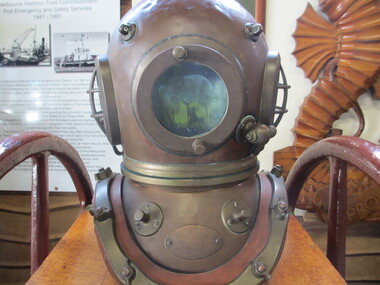
... Because of its structure of heavy canvas, lead and brass, it was used in wharf construction and salvage. Total weight on wearer is approximately 90 kgs...Because of its structure of heavy canvas, lead and brass, it was used in wharf construction and salvage. Total weight on wearer is approximately 90 kgs large brass diving helmet Divers helmet ...Standard dress diving equipment used by Melbourne Harbour Trust from late 1800s until 1991. Because of its structure of heavy canvas, lead and brass, it was used in wharf construction and salvage. Total weight on wearer is approximately 90 kgslarge brass diving helmet -
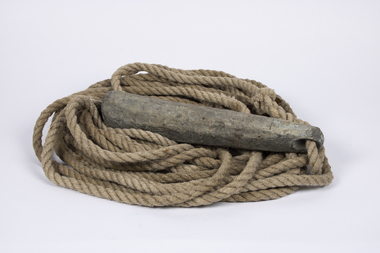 Queenscliffe Maritime Museum
Equipment - Sounding lead line
... Since at least the sixth century B.C. the sounding lead or sounding weight was in use in the Mediterranean area for maritime navigation. ...Although the provenance cannot be confirmed it is believed that this lead possibly originated from the SS Time.Since at least the sixth century B.C. the sounding lead or sounding weight was in use in the Mediterranean area for maritime navigation. It is the oldest known marine navigational instrument and it remained a primary navigational aid in coastal waters and rivers well into the twentieth century.A sounding lead with rope line attached. One surviving leather fathom depth marker is spliced into the rope.sound lead, navigation
