
Showing 8 items matching "leadenhall street"
-
 Flagstaff Hill Maritime Museum and Village
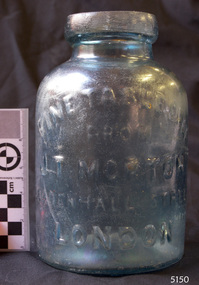
Jar
... ...leadenhall street...Jar, bluish tinge, chipped top lip, embossed "Fine Table Salt from J.T.Morton Leadenhall Street London". Recovered from the wreck of the Loch Ard. ..."Fine Table Salt from J.T.Morton Leadenhall Street London"...Leadenhall Street, London SW1, England, UK...The collection is also historically significant for its association with the LOCH ARD, which was one of the worst and best known shipwrecks in Victoria’s history. flagstaff hill warrnambool shipwrecked coast flagstaff hill maritime museum maritime museum shipwreck coast flagstaff hill maritime village great ocean road loch line loch ard captain gibbs eva carmichael tom pearce glenample station mutton bird island loch ard gorge fine table salt j.t.morton leadenhall street london jar "Fine Table Salt from J.T.Morton Leadenhall Street London" Jar, bluish tinge, chipped top lip, embossed "Fine Table Salt from J.T.Morton Leadenhall Street London". ...HISTORY OF THE LOCH ARD The LOCH ARD belonged to the famous Loch Line which sailed many ships from England to Australia. Built in Glasgow by Barclay, Curdle and Co. in 1873, the LOCH ARD was a three-masted square rigged iron sailing ship. The ship measured 262ft 7" (79.87m) in length, 38ft (11.58m) in width, 23ft (7m) in depth and had a gross tonnage of 1693 tons. The LOCH ARD's main mast measured a massive 150ft (45.7m) in height. LOCH ARD made three trips to Australia and one trip to Calcutta before its final voyage. LOCH ARD left England on March 2, 1878, under the command of Captain Gibbs, a newly married, 29 year old. She was bound for Melbourne with a crew of 37, plus 17 passengers and a load of cargo. The general cargo reflected the affluence of Melbourne at the time. On board were straw hats, umbrella, perfumes, clay pipes, pianos, clocks, confectionary, linen and candles, as well as a heavier load of railway irons, cement, lead and copper. There were items included that intended for display in the Melbourne International Exhibition in 1880. The voyage to Port Phillip was long but uneventful. At 3am on June 1, 1878, Captain Gibbs was expecting to see land and the passengers were becoming excited as they prepared to view their new homeland in the early morning. But LOCH ARD was running into a fog which greatly reduced visibility. Captain Gibbs was becoming anxious as there was no sign of land or the Cape Otway lighthouse. At 4am the fog lifted. A man aloft announced that he could see breakers. The sheer cliffs of Victoria's west coast came into view, and Captain Gibbs realised that the ship was much closer to them than expected. He ordered as much sail to be set as time would permit and then attempted to steer the vessel out to sea. On coming head on into the wind, the ship lost momentum, the sails fell limp and LOCH ARD's bow swung back. Gibbs then ordered the anchors to be released in an attempt to hold its position. The anchors sank some 50 fathoms - but did not hold. By this time LOCH ARD was among the breakers and the tall cliffs of Mutton Bird Island rose behind the ship. Just half a mile from the coast, the ship's bow was suddenly pulled around by the anchor. The captain tried to tack out to sea, but the ship struck a reef at the base of Mutton Bird Island, near Port Campbell. Waves broke over the ship and the top deck was loosened from the hull. The masts and rigging came crashing down knocking passengers and crew overboard. When a lifeboat was finally launched, it crashed into the side of LOCH ARD and capsized. Tom Pearce, who had launched the boat, managed to cling to its overturned hull and shelter beneath it. He drifted out to sea and then on the flood tide came into what is now known as LOCH ARD Gorge. He swam to shore, bruised and dazed, and found a cave in which to shelter. Some of the crew stayed below deck to shelter from the falling rigging but drowned when the ship slipped off the reef into deeper water. Eva Carmichael had raced onto deck to find out what was happening only to be confronted by towering cliffs looming above the stricken ship. In all the chaos, Captain Gibbs grabbed Eva and said, "If you are saved Eva, let my dear wife know that I died like a sailor". That was the last Eva Carmichael saw of the captain. She was swept off the ship by a huge wave. Eva saw Tom Pearce on a small rocky beach and yelled to attract his attention. He dived in and swam to the exhausted woman and dragged her to shore. He took her to the cave and broke open case of brandy which had washed up on the beach. He opened a bottle to revive the unconscious woman. A few hours later Tom scaled a cliff in search of help. He followed hoof prints and came by chance upon two men from nearby Glenample Station three and a half miles away. In a state of exhaustion, he told the men of the tragedy. Tom returned to the gorge while the two men rode back to the station to get help. By the time they reached LOCH ARD Gorge, it was cold and dark. The two shipwreck survivors were taken to Glenample Station to recover. Eva stayed at the station for six weeks before returning to Ireland, this time by steamship. In Melbourne, Tom Pearce received a hero's welcome. He was presented with the first gold medal of the Royal Humane Society of Victoria and a £1000 cheque from the Victorian Government. Concerts were performed to honour the young man's bravery and to raise money for those who lost family in the LOCH ARD disaster. Of the 54 crew members and passengers on board, only two survived: the apprentice, Tom Pearce and the young woman passenger, Eva Carmichael, who lost all of her family in the tragedy. Ten days after the LOCH ARD tragedy, salvage rights to the wreck were sold at auction for £2,120. Cargo valued at £3,000 was salvaged and placed on the beach, but most washed back into the sea when another storm developed. The wreck of LOCH ARD still lies at the base of Mutton Bird Island. Much of the cargo has now been salvaged and some was washed up into what is now known as LOCH ARD Gorge. Cargo and artefacts have also been illegally salvaged over many years before protective legislation was introduced. One of the most unlikely pieces of cargo to have survived the shipwreck was a Minton porcelain peacock - one of only nine in the world. The peacock was destined for the Melbourne International Exhibition in 1880. It had been well packed, which gave it adequate protection during the violent storm. Today, the Minton peacock can be seen at the Flagstaff Hill Maritime Museum in Warrnambool. From Australia's most dramatic shipwreck it has now become Australia's most valuable shipwreck artefact and is one of very few 'objects' on the Victorian State Heritage Register. Flagstaff Hill’s collection of artefacts from LOCH ARD is significant for being one of the largest collections of artefacts from this shipwreck in Victoria. It is significant for its association with the shipwreck, which is on the Victorian Heritage Register (VHR S417). The collection is significant because of the relationship between the objects, as together they have a high potential to interpret the story of the LOCH ARD. The LOCH ARD collection is archaeologically significant as the remains of a large international passenger and cargo ship. The LOCH ARD collection is historically significant for representing aspects of Victoria’s shipping history and its potential to interpret sub-theme 1.5 of Victoria’s Framework of Historical Themes (living with natural processes). The collection is also historically significant for its association with the LOCH ARD, which was one of the worst and best known shipwrecks in Victoria’s history. Jar, bluish tinge, chipped top lip, embossed "Fine Table Salt from J.T.Morton Leadenhall Street London". Recovered from the wreck of the Loch Ard. Artefact reg no LA/64"Fine Table Salt from J.T.Morton Leadenhall Street London"flagstaff hill, warrnambool, shipwrecked coast, flagstaff hill maritime museum, maritime museum, shipwreck coast, flagstaff hill maritime village, great ocean road, loch line, loch ard, captain gibbs, eva carmichael, tom pearce, glenample station, mutton bird island, loch ard gorge, fine table salt, j.t.morton, leadenhall street, london, jar -
 Warrnambool and District Historical Society Inc.
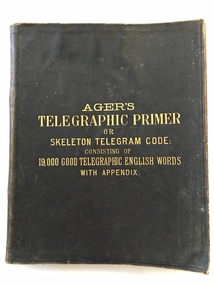
Book, R C Hearson, Ager's Telegraph Primer Cramond & Dickson Code book, 1886
... 101 Leadenhall Street, London, England ...This Agers Telegraphic Primer or skeleton telegram guide contains a list of 19000 words which could be used by a business firm to send telegrams overseas in code form. The book once belonged to the Warrnambool firm Cramond and Dickson on the corner of Liebig and Timor Streets which opened a branch of their drapery business in London in 1868. By an agreement with the Reuters Telegram Company in 1899, the code word “sferalcea “ was used for the transmission of telegrams between the two shops. Messages of a general kind were set out at the back of the book: eg: the code word septicity stood for the message, “answer must be here not later than today twelve noon.” The selected words which were used by Cramond and Dickson’s have hand written entries beside the code word. These code books were used to save money and also to improve security.This book has significance on a number of levels. It has local historical significance, is well provenanced. It belonged to one of Warrnambool’s earliest and longest running businesses. The book itself, belonged to the era of early telegraphic communication and as such has wider historical significance.Black soft leather cover with gold lettering, pink inside front and back covers. 312 pages. Up to page 200 the book has words with spaces beside each word to make entries. The back section contains lists of words. Some loose pages and notes contained within the book. Typed page inside front cover from Reuters Telegram Company Limited. Ager’s Telegraphic Primer or skeleton telegram code: consisting of 19000 good telegraphic English words with appendix. Purple stamp inside front cover: Dr Ager 1 Foulden Road Stoke Newingtonwarrnambool, warrnambool history, cramond & dickson, agers telegraphic primer, reuters telegram company -
 Warrnambool and District Historical Society Inc.
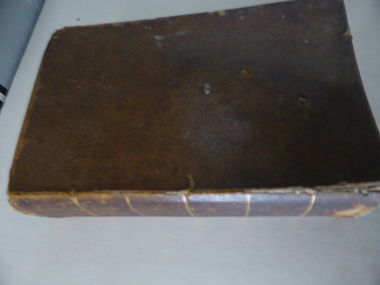
Book, A Complete Epitome of Practical Navigation - J W Norie, 1848
... 95 Leadenhall Street, London, England ...This book is a 19th Century treatise on aids to navigation. It belonged to John Cowtan who held land near the Cassady's Bridge area in Caramut Road today (he was related to the Cassady family) and who is mainly important in the history of Port Fairy. Captain John Cowtan was a ship's master for John Griffiths and a Launceston entrepreneur and ship owner between 1839 and 1844. In 1847 he went into partnership with John Bland, establishing a merchant's business with riverside buildings at the Port Fairy wharf. He left Port Fairy in the 1860s. The date of John Cowtan's signature in this book is 1849 (certainly a very early one in our history) and inside the front cover he has written notes about the local weather, mainly as it affected sailing conditions in late 1849 and early 1850. These notes are of great historical interestThis book is of great interest because it belonged to a Port Fairy historical figure and because of the hand written weather notes inside the front cover. This is a hard covered, leather bound book of 680 pages. It contains printed text, illustrations, tables, maps and sketches. One page is torn Some pages are stained. J Cowtan 1849john cowtan, port fairy -
 Flagstaff Hill Maritime Museum and Village
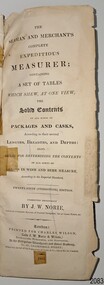
Book - Reference, navigation, J. W. Norie (author and editor), The Seaman and Merchants Complete Expeditious Measurer, 1853
... Printer: Bateman and Dennis, 95 Leadenhall Street, London, England, 1853 The book has handwritten, pen and ink inscriptions. ...Printer: Bateman and Dennis, 95 Leadenhall Street, London, England, 1853 The book has handwritten, pen and ink inscriptions. ...The book was published at the same address as London’s Navigation Waterhouse and Naval Academy. It is likely to be one of the textbooks used in educating seafarers, both naval and merchant. It is the twenty-fifth edition, showing that it was in great demand in the early to mid-19th century. Sea merchants could have used this as a reference for working out freight costs for their cargo. Customs Officers could have referred to it as well to calculate fees and taxes. The book’s owner had inscribed in pen and ink "Rose Anna, Schooner, Melbourne, March 25th 1857". At that time, the registered owners were Thomas Lamb & E. Keays, who were freighting cargo between Melbourne and Geelong. Schooner, ROSE ANNA: - The schooner Rose Anna was built in 1844 at Fremantle, W.A., by H. Edwards for Capt. William Heard. The 2-masted wooden vessel was carvel-built. Captain Heard registered Rose Anna at Fremantle in 1845 and in the same year, registered it at Port Adelaide. in 1852, Rose Anna was crushed and sunk at Port Adelaide by the Selma and raised. In 1852, the schooner was lengthened by William Hardy. In 1853, William Burton and W. Roberts registered Rose Anna at Melbourne. In 1855, W. Roberts registered, followed by John Balston & Thomas Ross. In 1856, it was registered by Thomas Lamb & E. Keays, in 1857 by William Howes & Charles Holland, in 1865 by Charles Holland & John Balfour, and in 1866 registered in Melbourne by mariners John Balfour & David Griffiths. In the 1940s, Rose Anna traded between Hobart, Melbourne, Adelaide, Sydney, Circular Head, Port Fairy, and Port Albert. In the 1950s and 1960s, it traded between Geelong Heads and Hobsons Bay, Melbourne, in lime, wool, general cargo and ballast. In 1857, when Rose Anna’s registered owners were Thomas Lamb & E. Keays, an advertisement was placed in The Age on March 9th, announcing that the Rose Anna was taking freight from Melbourne to Geelong. Later in the year, in October, the registered owners were William Howes & Charles Holland. They were still trading with Geelong, as on October 7th, The Age announced that Rose Anna arrived in Geelong from Melbourne on October 5th. On October 6th, 1866, Rose Anna went ashore while loading wheat at Sandridge, Port Phillip Bay, in severe gales and heavy seas and became a total wreck. The book is significant for its association with reference information to instruct sea merchant traders and naval officers. The publication is in its twenty-fifth edition, indicating the importance of such an instructional book. The book of tables and calculations shows the evolution of such reference texts, going from handwritten notes, to printed tables like these, and forward to slide rules, calculators, and to modern time computers. it demonstrates the importance of accuracy in calculating weights and measures at sea and for the purposes of fess, charges and taxes. The book is important to the history of the schooner Rose Anna, which is listed as a significant vessel on the Victorian Heritage Register, S582, as it has an inscription with the ship's name, date, and destination. Book, tall and narrow, with index tabs on the side edges of the pages. FULL Title: The Seaman and Merchants Complete Expeditious Measurer: The Seaman and Merchants Complete Expeditious Measure; containing a set of tables which show, at one view, the solid contents of all kinds of packags and casks, according to their several lengths, breadths and depths: also, rules for determining the contents of all sorts of casks in wine and beer measure, according to the Imperial Standard. Twenty-Fifth (Stereotype) Edition. Author: Mr J W Norie (John William Norie) Date: 1853 Publisher: Charles Wilson (late J.W. Norrie & Wilson), Bookseller, Publisher and Stationer, At the Navigation Waterhouse and Naval Academy, No. 157, Leadenhall Street, where may be had all the publications of Steel & Co. Late at No. 70, Cornhill. Printer: Bateman and Dennis, 95 Leadenhall Street, London, England, 1853 The book has handwritten, pen and ink inscriptions. It refers to the Schooner, Rose Anna, Melbourne, March 25th 1857.Handwritten in script with pen and ink: "Rose Anna / Schooner / Melbourne, / March 25th 1857"flagstaff hill, warrnambool, shipwrecked-coast, flagstaff-hill, flagstaff-hill-maritime-museum, maritime-museum, shipwreck-coast, flagstaff-hill-maritime-village, the seaman and merchants complete expeditious measurer, book, sea merchants, cargo, calculations, measurements, sea trade, maritime book, sea transportation, cargo rate calculations, naval academy, navy education, navigation, navigation instruction, navigation waterhouse and naval academy, twenty-fifth edition, 19th century, 1853, 1857, customs, freight, ullage, rose anna, schooner, 2-masted, march 25th 1857, melbourne, 25 march 1857, thomas lamb & e. keays, geelong, 1844, h. edwards, fremantle, carvel-built, port adelaide, selma, william hardy, william burton and w. roberts, john balston & thomas ross., charles holland & john balfour, john balfour & david griffiths, hobart, sydney, circular head, port fairy, port albert, hobsons bay, sandridge, port phillip bay -
 Mission to Seafarers Victoria
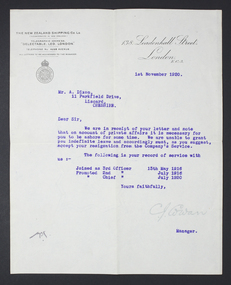
Letter - Resignation letter acceptance, The New Zealand Shipping Company Limited, 1 November 1920
... Ld (Incorporated in New Zealand)/ Telegraphic address: "Delectable, Led, London"/Telephone No 4258 Avenue/ All letters to be addressed to the manager Under is printed a round stamp with a crown and the Union Jack in the center and around "National Scheme for Disabled Men" Top right corner printed: 138 Leadenhall Street, London, EC3...Ld (Incorporated in New Zealand)/ Telegraphic address: "Delectable, Led, London"/Telephone No 4258 Avenue/ All letters to be addressed to the manager Under is printed a round stamp with a crown and the Union Jack in the center and around "National Scheme for Disabled Men" Top right corner printed: 138 Leadenhall Street, London, EC3 Typewritten letter in blue ink with signature on printed business letterhead from the New Zealand Shipping Company. ...The letter indicates that after several years (from 1916 to 1920) working for this company, Arthur Oswald Dixon resigned because of "private affairs".Typewritten letter in blue ink with signature on printed business letterhead from the New Zealand Shipping Company.Top left corner printed in black: The New Zealand Shipping Co. Ld (Incorporated in New Zealand)/ Telegraphic address: "Delectable, Led, London"/Telephone No 4258 Avenue/ All letters to be addressed to the manager Under is printed a round stamp with a crown and the Union Jack in the center and around "National Scheme for Disabled Men" Top right corner printed: 138 Leadenhall Street, London, EC3arthur oswald dixon, seafarers, officers, seamen, seamanship, merchant navy, new zealand, england, sailors, crew -
 Bendigo Historical Society Inc.
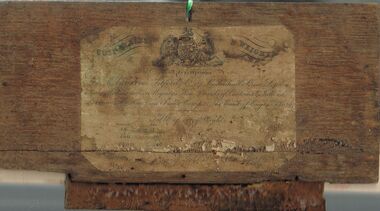
Slide - MAGIC LANTERN COLLECTION: WOODEN BOX LID WITH METAL CLASP
... Vandome Titford & Co 117 Leadenhall Street London Scale makers to Her Majesty Hon Boards of Customs & Inland Revenue her ? ...Vandome Titford & Co 117 Leadenhall Street London Scale makers to Her Majesty Hon Boards of Customs & Inland Revenue her ? ...Wooden box lid with metal clasp and clasp hole with brown leather 'hinge ' glued to top - / paper label glued on inside surface with shield of the Royal coat of arms of the United Kingdom words 'Duet Et Mon Droit' (The motto refers to the divine right of the Monarch to govern) the words Gold Scales and weights of all descriptions By R. Vandome Titford & Co 117 Leadenhall Street London Scale makers to Her Majesty Hon Boards of Customs & Inland Revenue her ? Hon East India Comp & The Bank of England Etc ? Table of Troy Weights ….THE STANDARD PRICE OF GOLD IS; £3.17.101/2d P.O.weighing, weights & measures -
 City of Moorabbin Historical Society (Operating the Box Cottage Museum)
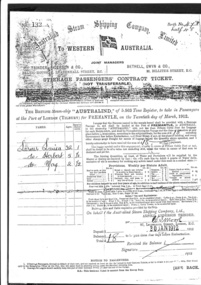
Document - Document , photocopy of Steerage Passenger Ticket 1912, 1912
... a) No 132 Berth No, 47 & half 48 / Australind Steam Shipping Company Limited / TO WESTERN AUSTRALIA / central flying flag with a black swan on a white cross -/ JOINT MANAGERS/ TRINDER ANDERSON & CO., l BETHELL, GWWYN & CO., BALTIC HOUSE LEADENHALL STREET EC. 22 BILLITER STREET, EC. ...The ‘Australind’ steam ship brought migrants from England to Australia 1904 - 1926 london tilbury fremantle steamship ss australind steerage passengers immigration provisions rations trinder anderson company larner louisa larner herbert larner may bethel gwyn company a) No 132 Berth No, 47 & half 48 / Australind Steam Shipping Company Limited / TO WESTERN AUSTRALIA / central flying flag with a black swan on a white cross -/ JOINT MANAGERS/ TRINDER ANDERSON & CO., l BETHELL, GWWYN & CO., BALTIC HOUSE LEADENHALL STREET EC. 22 BILLITER STREET, EC. STEERAGE PASSENGER’S CONTRACT TICKET / ( NOT TRANSFERRABLE ) / The British Steam-ship “Australind” of 5,563 Tons Register, to take in Passengers / at the Port of London ( TILBURY) for FREMANTLE, on the twentieth day of March 1912 Signed W I Moore dated 30Jan1912 paid £18 Larner Louisa age 32 adult1 / do Herbert age 5 adult ½ / do May age 2 adult ½ written on ticket b) photocopy enlargement of a section of the ticket showing names and signatures A photocopy of a Steerage Passenger’s Contract Ticket for Louisa Larner and her children Herbert aged 5 and May aged 2 aboard the British Steam-ship ‘Australind ‘ departing Tilbury England March 20th for Fremantle, Australia. ...'Australind' steam ship built 1904 by C. Connell & Co. Ltd., Glasgow .1928 sold to France renamed Colbert, 1933 sold renamed Scandinavia, 1934 scrapped at Savona.In the 1880s Trinder, Anderson & Co. joined Charles Bethell and started operating a twice monthly service from Great Britain to Fremantle and Albany. In 1886 Trinder, Anderson & Bethell started a steamer service called the West Australian Steam Navigation Co. at London. Their first steamer was given the name AUSTRALIND. In 1904 Bethell, Gwyn & Trinder, Anderson formed the Australind Steam Shipping Co.The new company was involved in the transport of emigrants. In 1912 the company owned five ships. During World War I the company lost four of its six ships. In World War II the company lost two ships. In the 1970s the company withdrew from the liner services and started hiring ships to other companies. The last cargo ship was disposed off in 1981 / 1982.The ‘Australind’ steam ship brought migrants from England to Australia 1904 - 1926 A photocopy of a Steerage Passenger’s Contract Ticket for Louisa Larner and her children Herbert aged 5 and May aged 2 aboard the British Steam-ship ‘Australind ‘ departing Tilbury England March 20th for Fremantle, Australia. a) front of ticket b) enlargement of a section of the ticket a) No 132 Berth No, 47 & half 48 / Australind Steam Shipping Company Limited / TO WESTERN AUSTRALIA / central flying flag with a black swan on a white cross -/ JOINT MANAGERS/ TRINDER ANDERSON & CO., l BETHELL, GWWYN & CO., BALTIC HOUSE LEADENHALL STREET EC. 22 BILLITER STREET, EC. STEERAGE PASSENGER’S CONTRACT TICKET / ( NOT TRANSFERRABLE ) / The British Steam-ship “Australind” of 5,563 Tons Register, to take in Passengers / at the Port of London ( TILBURY) for FREMANTLE, on the twentieth day of March 1912 Signed W I Moore dated 30Jan1912 paid £18 Larner Louisa age 32 adult1 / do Herbert age 5 adult ½ / do May age 2 adult ½ written on ticket b) photocopy enlargement of a section of the ticket showing names and signatures london, tilbury, fremantle, steamship, ss australind, steerage, passengers, immigration, provisions, rations, trinder anderson company, larner louisa, larner herbert, larner may, bethel gwyn company -
 Flagstaff Hill Maritime Museum and Village
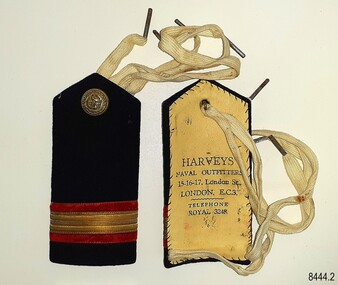
Badge - Epaulette, Harvey's Naval Outfitters, 1920s
... Another of the firm's addresses is Leadenhall Street, London, named the 'centre of commerce'. ...Another of the firm's addresses is Leadenhall Street, London, named the 'centre of commerce'. ...The pair of epaulettes once belonged to W.R. Angus, who possibly wore them when he worked his passage to and from the UK in the 1920s. The button on each has an unidentified emblem. They are part of Flagstaff Hill’s comprehensive W.R. Angus Collection, donated by the family of Dr W R Angus (1901-1970), surgeon and oculist. The ties, which look like shoe laces, would secure the epaulettes to the uniform's shoulders. The epaulettes were made by Harvey's Naval Outfitters of 15-16-17 London Street, London, E.C.3, in the East Central area of London. Another of the firm's addresses is Leadenhall Street, London, named the 'centre of commerce'. East India Company and Pacific & Oriental Steam Navigation Company (P&O) once had their headquarters there. The postcode 'EC3' dates back to 1917 when the postcode system was established in the United Kingdom. William Roy Angus (1901-1970) qualified as a doctor in 1923. He decided he further his studies overseas in the UK in 1927, sailing on the ship SS Banffshire (built in 1912, destroyed in 1937). He studied at London University College Hospital and Edinburgh Royal Infirmary and in 1928 he was awarded FRCS (Fellow from the Royal College of Surgeons), Edinburgh, Scotland. He worked his passage back to Australia as a Ship’s Surgeon on the Australian Commonwealth Line T.S.S. Largs Bay, purchased by the White Star Line in 1928. Dr W R Angus was a Surgeon Captain for the Australian Defence Forces, Army Medical Corps, stationed in Ballarat, Victoria, and in Bonegilla, N.S.W. He completed his service just before the end of the war due to suffering from a heart attack. The W.R. Angus Collection: - The W.R. Angus Collection includes historical medical equipment, surgical instruments and material belonging to Dr Edward Ryan and Dr Thomas Francis Ryan, (both of Nhill, Victoria) and Dr Angus’ own belongings. The Collection’s history spans the medical practices of the two Doctors Ryan, from 1885-1926 plus that of Dr Angus, up until 1969. It includes historical medical and surgical equipment and instruments from the doctors Edward and Thomas Ryan of Nhill, Victoria. Dr Angus married Gladys in 1927 at Ballarat, the nearest big city to Nhill where he began as a Medical Assistant. He was also Acting House surgeon at the Nhill hospital where their two daughters were born. During World War II He served as a Military Doctor in the Australian Defence Forces. Dr Angus and his family moved to Warrnambool in 1939, where Dr Angus operated his own medical practice. He later added the part-time Port Medical Officer responsibility and was the last person appointed to that position. Dr Angus and his wife were very involved in the local community, including the new Flagstaff Hill's planning stages and the gardens' layout. Dr Angus passed away in March 1970.This pair of epaulettes is connected to the badges in the W.R. Angus Collection. Dr W R Angus (1901-1970), surgeon and oculist, collected a range of badges and military objects including those he personally used during his time as Surgeon Captain in the Australian Defence Forces in World War II. The W.R. Angus Collection is significant for still being located at the site it is connected with, Doctor Angus being the last Port Medical Officer in Warrnambool. The Collection includes historical medical objects that date back to the late 1800s.Epaulette (pair of two), dark blue with red and gold horizontal stripes, with a gold-coloured button and woven white web ties. A tall rectangular shape with a point at the top. Made from a card base, covered by dark blue fabric and a hand-stitched lining of cream-coloured leather, stamped with the maker's details. The button has an inscripton and image. Made by Harvey's Outfitters in London. The button has images and text. The epaulettes belonged to Dr W R Angus and are now part of the W. R. Angus Collection.“HARVEYS’ / NAVAL OUTFITTERS / 15-16-17, London St / LONDON E.C.3. / TELEPHONE / ROYAL 3248” Button; Inscription and image [indecipherable] Button is embossed with images (anchor, serpent, flag) and text "B. 'G. "flagstaff hill, warrnambool, maritime village, maritime museum, shipwreck coast, great ocean road, flagstaff hill maritime museum and village, dr w r angus, w.r. angus collection, badge, insignia, badge collection, epaulettes, naval epaulettes, naval insignia, shoulder boards, ss banffshire, t.s.s. largs bay, uniform, harvey's naval outfitters, london street london
