
Showing 9 items matching "leadership. theories"
-
 National Vietnam Veterans Museum (NVVM)
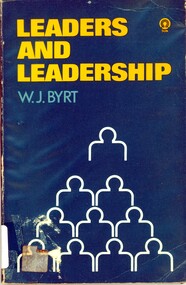
Book, Byrt, W. J, Leaders and leadership
... ...Leadership. Theories...Leadership Leadership. Theories What makes a leader? is he the product of the situation in which he finds himself? ...What makes a leader? is he the product of the situation in which he finds himself? Is he the possessor of a definite set of character traits? Does he have an inherent charisma which elevates him above his fellows? Are the determining factors social, political, personal or intellectual or some mystical combination of them all?What makes a leader? is he the product of the situation in which he finds himself? Is he the possessor of a definite set of character traits? Does he have an inherent charisma which elevates him above his fellows? Are the determining factors social, political, personal or intellectual or some mystical combination of them all?leadership, leadership. theories -
 4th/19th Prince of Wales's Light Horse Regiment Unit History Room
Booklet, Australian Military Forces Military Training Pamphlet Leadership (Provisional) 1957, 1957
... A soft covered booklet on the theory and principles of leadership...leadership 7610-010-2946 A soft covered booklet on the theory and principles of leadership Australian Military Forces Military Training Pamphlet Leadership (Provisional) 1957 Booklet 1 Base Printing Company RAAOC ...A soft covered booklet on the theory and principles of leadership7610-010-2946leadership -
 National Vietnam Veterans Museum (NVVM)
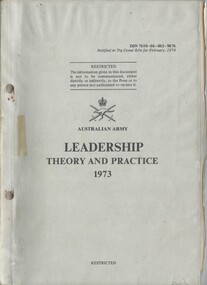
Booklet, Australian Army, Australian Army: Leadership Theory And Practice, 1973 (Copy 2), 1973
... Australian Army: Leadership Theory And Practice, 1973 (Copy 2)...The booklet is cover with a plastic cover Australian Army: Leadership Theory And Practice, 1973 (Copy 2) Booklet Australian Army ...A greyish coloured cardboard cover with black information on the front. Top right hand corner reads DSN 7610-66-065-9676. There is the Australian Army Insignia with details of the booklet under it. There are two punch holes down the left hand side. The booklet is cover with a plastic coveraustralia - armed forces - service manuals, leadership -
 National Vietnam Veterans Museum (NVVM)
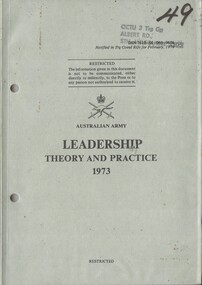
Booklet, Australian Army, Australian Army: Leadership Theory And Practice, 1973 (Copy 3), 1973
... Australian Army: Leadership Theory And Practice, 1973 (Copy 3)...The booklet is cover with a plastic cover Australian Army: Leadership Theory And Practice, 1973 (Copy 3) Booklet Australian Army ...A greyish coloured cardboard cover with black information on the front. Top right hand corner is the number 49. Under this there is a stamp that reads OCTU 3 Trg Gp, Albert Rd, Sth Melbourne 3205 folloowed by DSN 7610-66-065-9676. There is the Australian Army Insignia with details of the booklet under it. There are two punch holes down the left hand side. The booklet is cover with a plastic coveraustralia - armed forces - service manuals, leadership, octu 3 trg gp -
 National Vietnam Veterans Museum (NVVM)
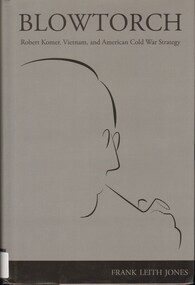
Book, Jones, Frank Leith, Blowtorch: Robert Komer, Vietnam and American Cold War Strategy, 2013
... Those looking to understand counterinsurgency theory will be especially drawn to Jones' illuminating discussion in Komer's leadership of "CORDS" Blowtorch: Robert Komer, Vietnam and American Cold War Strategy. ..."Blowtorch" provides a revealing look into the hitherto unexamined role played for three decades by Cold War Strategist Komer. Those looking to understand counterinsurgency theory will be especially drawn to Jones' illuminating discussion in Komer's leadership of "CORDS""Blowtorch" provides a revealing look into the hitherto unexamined role played for three decades by Cold War Strategist Komer. Those looking to understand counterinsurgency theory will be especially drawn to Jones' illuminating discussion in Komer's leadership of "CORDS" national security - united states - history - 20th century, vietnam war, 1961 - 1975 - united states - biography -
National Vietnam Veterans Museum (NVVM)
Booklet, Australian Army: Leadership theory and practice, 1973, 1973
... Australian Army: Leadership theory and practice, 1973...Australia - Armed Forces - Service manuals Australian Army: Leadership theory and practice, 1973 Booklet Booklet Australian Army ...australia - armed forces - service manuals -
 National Vietnam Veterans Museum (NVVM)
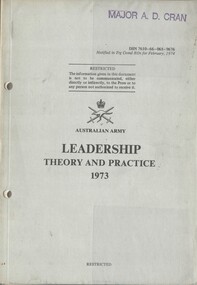
Booklet, Australian Army, Australian Army: Leadership Theory And Practice, 1973 (Copy 1), 1973
... Australian Army: Leadership Theory And Practice, 1973 (Copy 1)...The booklet is cover with a plastic cover Australian Army: Leadership Theory And Practice, 1973 (Copy 1) Booklet Australian Army ...A greyish coloured cardboard cover with black information on the front. Top right hand corner is the name of Major A.D. Cran. Under this reads DSN 7610-66-065-9676. There is the Australian Army Insignia with details of the booklet under it. There are two punch holes down the left hand side. The booklet is cover with a plastic coveraustralia - armed forces - service manuals, leadership, major a.d. cran -
 Victorian Aboriginal Corporation for Languages
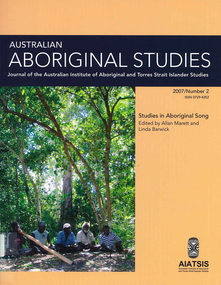
Periodical, Australian Institute of Aboriginal and Torres Strait Islander Studies, Australian Aboriginal studies : journal of the Australian Institute of Aboriginal and Torres Strait Islander Studies, 2007
... leadership in Yol?u society. Drawing on our recordings of the Baripuy manikay series from 2004 and 2005, we explore the aesthetics and functions of formal flexibility in the manikay tradition. We examine the individuation of lyrical realisations among singers, and the role of rhythmic modes in articulating between luku (root) and bu?gul'mirri (ceremonial) components of repertoire. Our findings will contribute significantly to intercultural understandings of manikay theory...leadership in Yol?u society. Drawing on our recordings of the Baripuy manikay series from 2004 and 2005, we explore the aesthetics and functions of formal flexibility in the manikay tradition. We examine the individuation of lyrical realisations among singers, and the role of rhythmic modes in articulating between luku (root) and bu?gul'mirri (ceremonial) components of repertoire. Our findings will contribute significantly to intercultural understandings of manikay theory ...1. Musical and linguistic perspectives on Aboriginal song Allan Marett and Linda Barwick Song brings language and music together. Great singers are at once musicians and wordsmiths, who toss rhythm, melody and word against one another in complex cross-play. In this paper we outline some initial findings that are emerging from our interdisciplinary study of the musical traditions of the Cobourg region of western Arnhem Land, a coastal area situated in the far north of the Australian continent 350 kilometres northeast of Darwin. We focus on a set of songs called Jurtbirrk, sung in Iwaidja, a highly endangered language, whose core speaker base is now located in the community of Minjilang on Croker Island. We bring to bear analytical methodologies from both musicology and linguistics to illuminate this hitherto undocumented genre of love songs. 2. Iwaidja Jurtbirrk songs: Bringing language and music together Linda Barwick (University of Sydney), Bruce Birch and Nicholas Evans (University of Melbourne) Song brings language and music together. Great singers are at once musicians and wordsmiths, who toss rhythm, melody and word against one another in complex cross-play. In this paper we outline some initial findings that are emerging from our interdisciplinary study of the musical traditions of the Cobourg region of western Arnhem Land, a coastal area situated in the far north of the Australian continent 350 kilometres northeast of Darwin. We focus on a set of songs called Jurtbirrk, sung in Iwaidja, a highly endangered language, whose core speaker base is now located in the community of Minjilang on Croker Island. We bring to bear analytical methodologies from both musicology and linguistics to illuminate this hitherto undocumented genre of love songs. 3. Morrdjdjanjno ngan-marnbom story nakka, ?songs that turn me into a story teller?: The morrdjdjanjno of western Arnhem Land Murray Garde (University of Melbourne) Morrdjdjanjno is the name of a song genre from the Arnhem Land plateau in the Top End of the Northern Territory and this paper is a first description of this previously undocumented song tradition. Morrdjdjanjno are songs owned neither by individuals or clans, but are handed down as ?open domain? songs with some singers having knowledge of certain songs unknown to others. Many morrdjdjanjno were once performed as part of animal increase rituals and each song is associated with a particular animal species, especially macropods. Sung only by men, they can be accompanied by clap sticks alone or both clap sticks and didjeridu. First investigations reveal that the song texts are not in everyday speech but include, among other things, totemic referential terms for animals which are exclusive to morrdjdjanjno. Translations from song language into ordinary register speech can often be ?worked up? when the song texts are discussed in their cultural and performance context. The transmission of these songs is severely endangered at present as there are only two known singers remaining both of whom are elderly. 4. Sung and spoken: An analysis of two different versions of a Kun-barlang love song Isabel O?Keeffe (nee Bickerdike) (University of Melbourne) In examining a sung version and a spoken version of a Kun-barlang love song text recorded by Alice Moyle in 1962, I outline the context and overall structure of the song, then provide a detailed comparative analysis of the two versions. I draw some preliminary conclusions about the nature of Kun-barlang song language, particularly in relation to the rhythmic setting of words in song texts and the use of vocables as structural markers. 5. Simplifying musical practice in order to enhance local identity: Rhythmic modes in the Walakandha wangga (Wadeye, Northern Territory) Allan Marett (University of Sydney) Around 1982, senior performers of the Walakandha wangga, a repertory of song and dance from the northern Australian community of Wadeye (Port Keats), made a conscious decision to simplify their complex musical and dance practice in order to strengthen the articulation of a group identity in ceremonial performance. Recordings from the period 1972?82 attest to a rich diversity of rhythmic modes, each of which was associated with a different style of dance. By the mid-1980s, however, this complexity had been significantly reduced. I trace the origin of the original complexity, explore the reasons why this was subsequently reduced, and trace the resultant changes in musical practice. 6. ?Too long, that wangga?: Analysing wangga texts over time Lysbeth Ford (University of Sydney) For the past forty or so years, Daly region song-men have joined with musicologists and linguists to document their wangga songs. This work has revealed a corpus of more than one hundred wangga songs composed in five language varieties Within this corpus are a few wangga texts recorded with their prose versions. I compare sung and spoken texts in an attempt to show not only what makes wangga texts consistently different from prose texts, but also how the most recent wangga texts differ from those composed some forty years ago. 7. Flesh with country: Juxtaposition and minimal contrast in the construction and melodic treatment of jadmi song texts Sally Treloyn (University of Sydney) For some time researchers of Centralian-style songs have found that compositional and performance practices that guide the construction and musical treatment of song texts have a broader social function. Most recently, Barwick has identified an ?aesthetics of parataxis or juxtaposition? in the design of Warumungu song texts and musical organisation (as well as visual arts and dances), that mirrors social values (such as the skin system) and forms 'inductive space' in which relationships between distinct classes of being, places, and groups of persons are established. Here I set out how juxtaposition and minimal contrast in the construction and melodic treatment of jadmi-type junba texts from the north and north-central Kimberley region similarly create 'inductive space' within which living performers, ancestral beings, and the country to which they are attached, are drawn into dynamic, contiguous relationships. 8. The poetics of central Australian Aboriginal song Myfany Turpin (University of Sydney) An often cited feature of traditional songs from Central Australia (CA songs) is the obfuscation of meaning. This arises partly from the difficulties of translation and partly from the difficulties in identifying words in song. The latter is the subject of this paper, where I argue it is a by-product of adhering to the requirements of a highly structured art form. Drawing upon a set of songs from the Arandic language group, I describe the CA song as having three independent obligatory components (text, rhythm and melody) and specify how text is set to rhythm within a rhythmic and a phonological constraint. I show how syllable counting, for the purposes of text setting, reflects a feature of the Arandic sound system. The resultant rhythmic text is then set to melody while adhering to a pattern of text alliteration. 9. Budutthun ratja wiyinymirri: Formal flexibility in the Yol?u manikay tradition and the challenge of recording a complete repertoire Aaron Corn (University of Sydney) with Neparr? a Gumbula (University of Sydney) Among the Yol?u (people) of north-eastern Arnhem Land, manikay (song) series serve as records of sacred relationships between humans, country and ancestors. Their formal structures constitute the overarching order of all ceremonial actions, and their lyrics comprise sacred esoteric lexicons held nowhere else in the Yol?u languages. A consummate knowledge of manikay and its interpenetrability with ancestors, country, and parallel canons of sacred y�ku (names), bu?gul (dances) and miny'tji (designs) is an essential prerequisite to traditional leadership in Yol?u society. Drawing on our recordings of the Baripuy manikay series from 2004 and 2005, we explore the aesthetics and functions of formal flexibility in the manikay tradition. We examine the individuation of lyrical realisations among singers, and the role of rhythmic modes in articulating between luku (root) and bu?gul'mirri (ceremonial) components of repertoire. Our findings will contribute significantly to intercultural understandings of manikay theory and aesthetics, and the centrality of manikay to Yol?u intellectual traditions. 10. Australian Aboriginal song language: So many questions, so little to work with Michael Walsh Review of the questions related to the analysis of Aboriginal song language; requirements for morpheme glossing, component package, interpretations, prose and song text comparison, separation of Indigenous and ethnographic explanations, candour about collection methods, limitations and interpretative origins.maps, colour photographs, tablesyolgnu, wadeye, music and culture -
Northern District School of Nursing. Managed by Bendigo Historical Society Inc.
Administrative record - Northern District School of Nursing Graduates Association - Examination Papers and Feedback, 1965
... leadership, district and visiting nursing, industrial and school nursing, and more. Opportunities existed both within hospitals and in community or specialized settings.FAQs and Practical Details. Minimal training costs (mainly exam fees and personal items).Living out allowances and travel expenses are covered. Four training intakes per year; waiting periods are short if qualifications are met. Nurse Training Lister House examinations mr hutley joan howett Northern District School of Nursing Graduates Association - Examination Papers and Feedback, 1965 This item contains the following documents: 3794.3a This document provides examiner feedback on the performance of nursing candidates in the 1965 Junior General Nursing Theory examination, one page typed. 3794.3b Copy of above 3794.3c This study guide provides structured advice and topic lists for medical students preparing for their final examinations, focusing on effective study habits and comprehensive subject coverage. ...The Northern District School of Nursing in Victoria, Australia Graduates Association: History of the School Managed by a committee including hospital administrators, medical professionals, and nursing leaders from several regional hospitals. Associated with major hospitals in the Northern District, including Bendigo Base, Mildura Base, Castlemaine, Echuca, Swan Hill, St. Arnaud, and Kyneton District Hospitals. Provide high-quality theoretical and practical nursing training. Raise the standard of nursing education in the region. Maintain the highest principles of nursing practice. Applicants must be at least 17 years old and hold a Proficiency Certificate or higher educational qualification. Application involves submitting forms, certificates, an interview, an aptitude test, and a medical examination. A three-month probationary period follows initial acceptance. Preliminary Training School: Four-week introductory course covering basic nursing, anatomy, hygiene, and practical skills. Practical experience in various hospital departments, guided by senior staff. Study Block Plan: Includes several blocks of theoretical and practical instruction throughout the three-year program. Regular school exams and two state exams (First Professional and Final State) are required for progression and graduation. Nurses work a 40-hour week with at least one or two days off per week and three weeks of annual leave. Accommodation is provided in comfortable hostels with good facilities. Uniforms are supplied free; nurses provide their own shoes and stockings. Salaries and allowances are regulated, with deductions for board and free medical care. Additional Information Post-Graduate Opportunities. Senior positions require further experience and additional certificates (e.g., Midwifery, Infant Welfare).Diploma courses available in administration, teaching, and specialized nursing fields. Bursaries are available for advanced study.Career Prospects: Graduates can pursue roles in administration, teaching, ward and departmental leadership, district and visiting nursing, industrial and school nursing, and more. Opportunities existed both within hospitals and in community or specialized settings.FAQs and Practical Details. Minimal training costs (mainly exam fees and personal items).Living out allowances and travel expenses are covered. Four training intakes per year; waiting periods are short if qualifications are met.Northern District School of Nursing Graduates Association - Examination Papers and Feedback, 1965 This item contains the following documents: 3794.3a This document provides examiner feedback on the performance of nursing candidates in the 1965 Junior General Nursing Theory examination, one page typed. 3794.3b Copy of above 3794.3c This study guide provides structured advice and topic lists for medical students preparing for their final examinations, focusing on effective study habits and comprehensive subject coverage. Author Mr Hutley Eight pages typed 3794.3d This document is a 1965 final examination paper for general nurse training, focusing on surgical nursing. The key points are structured around major topics and essential nursing competencies. It belonged Joan Howettnurse training, lister house, examinations, mr hutley, joan howett
