
Showing 5 items matching "leisure activities - games"
-
 Wodonga & District Historical Society Inc
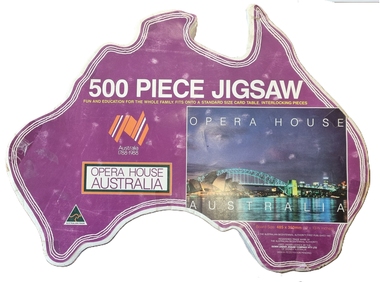
Leisure object - Opera House Jigsaw Puzzle, Australian Bicentennial Authority, 1981
... ...Leisure activities - games...Australian Bicentennial Leisure activities - games 500 PIECE JIGSAW Fun and Education for the whole family. ...Bicentennial celebrations were held throughout Australian in 1988. The Australian Bicentennial Authority was established in 1979, and the Victorian Council was appointed in 1986. Its role was to plan and coordinate state-based activities for Australia's 1988 Bicentenary. The Council was jointly funded by the State and Commonwealth governments and was responsible for developing programs that celebrated the nation's cultural heritage and addressed community needs. This item was one of many souvenirs created to commemorate the events held throughout the year.This puzzle is significant because it was produced as a souvenir to celebrate the Australian Bicentennial.A jigsaw puzzle featuring an image of the Opera House and the Sydney Harbour Bridge. It is stored in a foam box in the shape of a map of Australia. 500 PIECE JIGSAW Fun and Education for the whole family. Fits onto a standard size card table. Interlocking pieces. OPERA HOUSE AUSTRALIAaustralian bicentennial, leisure activities - games -
 Warrnambool and District Historical Society Inc.
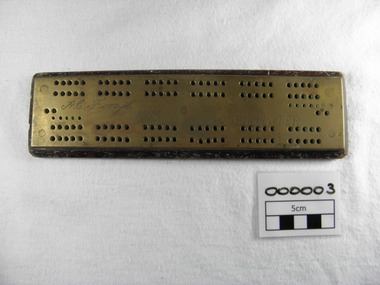
Domestic object - Game, Cribbage board, Prior to 1913
... leisure activities in early C20th. Historical significance: link to "Mahogany Ship" legend through H.M.A.S. Encounter. This is an interesting item with social significance as cribbage was a popular game, particularly in the 20th century, and it illustrates the pastimes of a generation past. It was given to Warrnambool and District Historical Society by a Wangoom couple and so may have local significance if A.C. Forsyth was related to this couple. H.M.A.S. Encounter was important in Australia’s naval history. brass ships leisure royal australian navy cribbage board games ...This item is linked to the 'HMAS Encounter', possibly made on the ship c. 1913. In 1916 this ship visited a then unnamed island off the Western Australian coast, where the crew discovered two bronze cannons protruding from the sand. These cannons now in the WA Maritime Museum, Fremantle, have been linked to the "Mahogany Ship" legend by historian K.G. MacIntyre. Cribbage is a very popular card game, particularly with naval personnel. This cribbage score board belonged to Alexander Charles Forsyth who used it aboard H.M.A.S. Encounter in 1913. He was a stoker, service number 3086, from New South Wales. H.M.A.S Encounter, the fourth warship of that name, was built at Devonport Dockyard, Tasmania, for the Royal Australian Navy in 1905. She was a second class protected cruiser and in 1909 was lent for three years to the British Admiralty. In 1913 (the year marked on this cribbage board) she was in New South Wales and Queensland waters and in World War One she served in the Pacific region, taking part in the capture of German New Guinea. She was finally scuttled in 1932.Social significance: an example of leisure activities in early C20th. Historical significance: link to "Mahogany Ship" legend through H.M.A.S. Encounter. This is an interesting item with social significance as cribbage was a popular game, particularly in the 20th century, and it illustrates the pastimes of a generation past. It was given to Warrnambool and District Historical Society by a Wangoom couple and so may have local significance if A.C. Forsyth was related to this couple. H.M.A.S. Encounter was important in Australia’s naval history. Rectangular brass plate with rows of holes, grouped in tens. Plate mounted with 5 brass studs to a rectangular wooden base. 134 holes in brass, grouped in tens. Three holes in each end of wooden base. Board used for scoring made out of brass for game of cribbage Burnished gold on playing surface Reddish-brown on base 144 main indentations, 10 minor indentations Machine engraved "A.C. Forsyth" (in script)/ "1913"/ "H.M.A.S. ENCOUNTER" across middle of the plate, between the rows of holes. brass, ships, leisure, royal australian navy, cribbage board, games, mahogany ship, a s forsythe, encounter, alexander charles forsyth, warrnambool -
 St Kilda Historical Society
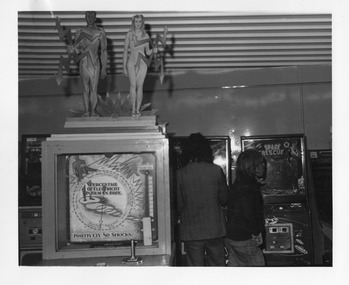
Photograph - Leisure activity, Funtime Arcade Luna Park, 1981
... games to play. David Rae Collection St Kilda Luna Park Black and white photograph, unmounted Funtime Arcade Luna Park Photograph Leisure activity ...Originally known as the Penny Arcade until the 1970s, the Funtime Arcade at Luna Park offered a variety of arcade games to play.Black and white photograph, unmounteddavid rae collection, st kilda, luna park -
 Kew Historical Society Inc
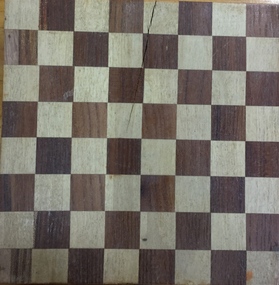
Leisure object - Board Game, Drafts Board, 1950-1965
... games...leisure activities...leisure objects. Many of the items are European-made, generally of British origin, however there are a number that were made for the Australian market by Australian manufacturers. In the Nineteenth and Twentieth centuries, there were large numbers of games produced for children and adults. These included: arcade games, board games, playing cards and puzzles. A representative sample, many now rare survivors, can be found in the collection. drafts board games leisure activities ...The Kew Historical Society’s collection includes a wide range of leisure objects. Many of the items are European-made, generally of British origin, however there are a number that were made for the Australian market by Australian manufacturers. In the Nineteenth and Twentieth centuries, there were large numbers of games produced for children and adults. These included: arcade games, board games, playing cards and puzzles. A representative sample, many now rare survivors, can be found in the collection.Wooden drafts board with the counters contained in an internal drawer.drafts, board games, leisure activities -
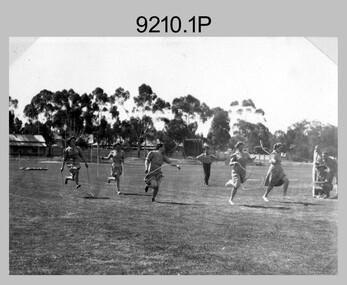 Bendigo Military Museum
Photograph - LHQ Cartographic Company Inter-Section Sports Meeting, Upper Reserve, Bendigo, 1943
... activities were part of the leisure hours of company members. As well as the regular Wednesday afternoon of organised sport, the printing sections in particular played vigorous informal games of volleyball in every break. ...activities were part of the leisure hours of company members. As well as the regular Wednesday afternoon of organised sport, the printing sections in particular played vigorous informal games of volleyball in every break. ...This is a set of 16 photographs of an LHQ Cartographic Company inter-section sports meeting taken in 1943 at Bendigo’s Upper Reserve, during Army’s early years of occupation at Fortuna, Bendigo in WW2. Bendigo’s Upper Reserve was renamed the Queen Elizabeth Oval in 1954 in honour of Queen Elizabeth II. On 1 Feb 1941, a Cartographic Section was reformed as the Land Headquarters (LHQ) Cartographic Company. Deputy Chief of the General Staff, Major General Sidney Rowell instructed Its OC - Major William Sarll, in the interests of security of plant and to provide against possible damage of air attack, to investigate suitable safer inland accommodation for LHQ Cartographic Company. Major William Sarll inspected many properties before finding one that would meet the requirements of the Cartographic Company. In late 1941, he came to inspect Fortuna, a rambling old mansion dating back to the gold rush, with about fifteen acres of ground in central Bendigo. On 23 March 1942, the Commonwealth of Australia, under the provisions of the National Security Act of 1939, took possession of the house, the old battery buildings and the fifteen acres of grounds. LHQ Cartographic Company moved to Bendigo on 11 Jun 1942, from Mitchell House, Melbourne. The responsibilities of this unit were map compilation, fair drawing and lithographic reproduction, including printing the work of other Units as well as their own. A variety of sporting activities were part of the leisure hours of company members. As well as the regular Wednesday afternoon of organised sport, the printing sections in particular played vigorous informal games of volleyball in every break. Others played tennis on the dilapidated tennis courts or the Ironbark courts, while the lake was an attraction for swimmers with its diving board and raft. Highlights of the sporting year were the athletics sports meetings organised by Lieutenant Ralph Westgarth and a keen committee in 1943 and 1944. These were social as well as competitive occasions, providing great entertainment for the participants and their families, and combined with fundraising for local charities. Events ranged from traditional track and field where Phil Flood proved himself an outstanding athlete, to sack races, tunnel ball and obstacle races. Recreational and sporting activities were often hampered by shift routines, but the focus given to them in all Company publications demonstrates their important role in boosting morale. Both working and playing together meant that planned diversions were essential for fitness and relaxation. The importance of sport in building esprit de corps was understood, and in fact continued to be an important facet of regimental life long after the war was over. Refer to Item 6099.17P for photos taken in 1942, the first year of LHQ Cartographic Company’s occupation at Fortuna, Bendigo in WW2. The Survey Corps’ occupation of Fortuna during WW2 is covered in more detail with additional historic photographs, in pages 17 to 27 of Valerie Lovejoy’s book 'Mapmakers of Fortuna – A history of the Army Survey Regiment’ ISBN: 0-646-42120-4. Other items from Rosemary (Atkinson) Bowman are: 9209.16P, 9211.6P, 9212.6P, 9213.4P and 9214.12.This is a set of 16 photographs of an LHQ Cartographic Company inter-section sports meeting taken in 1943 at Bendigo’s Upper Reserve, during Army’s early years of occupation at Fortuna, Bendigo in WW2. The black and white photographs are printed on photographic paper are contained in a photo album provided by the family of Rosemary (Atkinson) Bowman, who served in the Australian Women's Army Service (AWAS) and a former member of RA Svy. The photographs were scanned at 600 dpi and are part of the Army Survey Regiment’s Collection. .1) - Photo, black & white, 1943. First Heat 50 Yards Skipping L to R: O. Keddie, G. John, M. Keddie, Rosemary (Atkinson) Bowman, M. Mays. .2) - Photo, black & white, 1943. 50 Yards Skipping Final. .3) - Photo, black & white, 1943. Sack Race - AWAS .4) - Photo, black & white, 1943. Tunnel Ball - AWAS vs Men over Thirty. .5) - Photo, black & white, 1943. First Heat - AWAS Nomination Race. .6) - Photo, black & white, 1943. Final - AWAS Nomination Race. .7) - Photo, black & white, 1943. Inter Section Flag Race. .8) - Photo, black & white, 1943. Second Heat Mens 100 Yards – Winner H. Fallu. .9) - Photo, black & white, 1943. 220 Yards – Winner D. Sutcliffe. .10) - Photo, black & white, 1943. Tug of War – WO’s & SGTs Team. .11) - Photo, black & white, 1943. Long Jump Winner – P. Flood. .12) - Photo, black & white, 1943. High Jump Winner – P. Flood. .13) - Photo, black & white, 1943. Referee – CAPT Harry Raisbeck. .14) - Photo, black & white, 1943. At the mike – L to R: LT Ralph Westgarth, “PAG” and Gordon Furneaux in background. .15) - Photo, black & white, 1943. At the mike – L to R: J. Elliott, Gordon Furneaux, Eddie Esposito, Les Anderson, “Westy”, Ralph Pickford. .16) - Photo, black & white, 1943. Spectators – L to R: Betty Pleydell, Joan Ashton, Val Edwards, Norma Jeffrey, Rosemary (Atkinson) Bowman, Gwen John, Gwennie McGown, Joan Walters.Some personnel are identified with dates in the photo album.royal australian survey corps, rasvy, army survey regiment, asr, fortuna
