
Showing 60 items matching "length measurer"
-
 Tatura Irrigation & Wartime Camps Museum
Tool - measuring instrument, Gunter's Chain
... ...length measurer...This is a surveyor's chain or Gunter's chain, an instrument used for measuring length. It comprises 100 pieces of straight metal wire, looped together end to end, and fitted with swivel handles. ...This is a surveyor's chain or Gunter's chain, an instrument used for measuring length. It comprises 100 pieces of straight metal wire, looped together end to end, and fitted with swivel handles. ...This is a surveyor's chain or Gunter's chain, an instrument used for measuring length. It comprises 100 pieces of straight metal wire, looped together end to end, and fitted with swivel handles. Its overall length is one chain (22 yards or 66 feet). The Gunter's chain was named after its inventor, Edmund Gunter (1581-1626), an English clergyman, mathematician, and astronomer. 5 lengths of wire with loops along the length. The 5 lengths are joined together by a piece of wire each end. The loops represent certain distance. At each end on the top row is a handle for pulling it out to correct length.survey, surveyors chain, gunter's chain, length measurer, edmund gunter -
 Whitehorse Historical Society Inc.
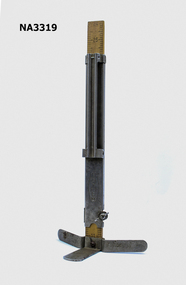
Functional object - Hem ruler, for measuring hem height
... Dress length measure used for dressmaking ...Dress length measure used for dressmaking domestic items sewing Easyhem Wooden ruler standing vertically on metal stand; metal adjuster fastened with a butterfly clip Functional object Hem ruler, for measuring hem height ...Dress length measure used for dressmaking Wooden ruler standing vertically on metal stand; metal adjuster fastened with a butterfly clipEasyhemdomestic items, sewing -
 Flagstaff Hill Maritime Museum and Village
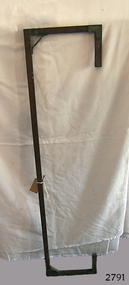
Barrel Calipers, Early 20th Century
... Boxwood barrel calipers, wooden slide-rule with right angles at each end and brass fittings used for measuring casks length....Boxwood barrel calipers, wooden slide-rule with right angles at each end and brass fittings used for measuring casks length. Barrel Calipers Dring & Fage Dring & Fage ...The firm Dring and Fage were active from 1790 to 1940 in London and were manufacturers of hydrometers and mathematical instruments they became established in London in 1790 by John Dring, who was a brass worker and hydrometer maker, and William Fage. Dring and Fage manufactured also saccharometers and other instruments used to measure the strength of alcohol. These instruments were primarily used to calculate excises. They traded at various addresses in London and they were at 56 Stamford St. between 1903 and 1938. By 1850 the company was owned by Edward Hall and Edward Jenkin and in 1940 the company became Dring & Fage Ltd, trading till the 1960s.Historically, gauging has meant measuring a volume, these gauging instruments were used by Customs and Excise and manufacturers for determining the volume and contents of liquid containers. For Customs the determination and collection of duty on imported goods which has had a very long history. Chaucer was a Customs Officer as was his father and grandfather, excise was first officially introduced in 1643, with the aim of maintaining military forces raised by the English Parliament at that time. Excise was initially a duty on home produced alcoholic beverages and soap but being easily applied, spread rapidly to a wide range of goods including imports of varying kinds. The government departments of Customs and Excise merged only in 1909 and it is from around this time that our instrument was made and used. The item demonstrates a long social history of the practice of Government's collecting duty on alcoholic beverages and thereby makes this item historically significant as it was used locally at Port Fairy by the ports Customs agents. Boxwood barrel calipers, wooden slide-rule with right angles at each end and brass fittings used for measuring casks length."Dring & Fage Makers to the Customs" stamped on side.flagstaff hill, warrnambool, shipwrecked coast, flagstaff hill maritime museum, maritime museum, shipwreck coast, flagstaff hill maritime village, great ocean road, customs, long calipers, excise duty, barrel calipers -
 Coal Creek Community Park & Museum
Tool - Tailors' Sliding Meaure, Putnam, c.1898
... Wooden sliding ruler used to measure the length of folded bolts of cloth. Ruler is diamond shaped with numbers on the four sides. ...Patent pending Wooden sliding ruler used to measure the length of folded bolts of cloth. Ruler is diamond shaped with numbers on the four sides. ...Wooden sliding ruler used to measure the length of folded bolts of cloth. Ruler is diamond shaped with numbers on the four sides. Sliding arm has numbers on the metal and the arm itself.Putnams Cloth Chart Copyrighted 1898. Patent pending -
 Royal Australian and New Zealand College of Obstetricians & Gynaecologists (RANZCOG)
Sims-type uterine dilator used by Box Hill Hospital labour ward
... Used for probing a woman's uterus through the cervix, to measure the length and direction of the cervical canal and uterus. ...Used for probing a woman's uterus through the cervix, to measure the length and direction of the cervical canal and uterus. ...Used for probing a woman's uterus through the cervix, to measure the length and direction of the cervical canal and uterus. Dilators are primarily used to open and dilate the cervix to gain access to the uterine cavity but can also be used as sounds. This device was included with other obstetric instruments, mostly destructive instruments, given to RANZCOG from Box Hill Hospital labour ward in February- March 1998. The maternity service at Box Hill Hospital combined with St George's Hospital in Kew to be known as Birralee Maternity Service. These instruments were collected by Julie Collette, Unit Manager, St George's Kew and given to RANZCOG Museum Curator, Susan Barnett.Three bladed Sims uterine dilator, consisting of upper blade, lower blade, bridge, and wingnut. Blades are polished stainless steel with matte steel handles. Upper surface inscribed, (trademark) MADE IN GERMANY INOXIDABLE", "21"."21"box hill hospital -
 Melbourne Legacy
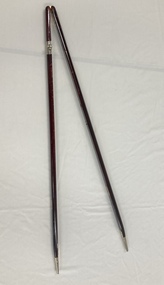
Ceremonial object, Military Pace Stick
... A pace stick is a training instrument used to gauge the length of pace and measure distance and interval for military parades. ...A pace stick is a training instrument used to gauge the length of pace and measure distance and interval for military parades. ...A hinged wooden stick that is used in military situations. It is kept in the Comradeship Lounge as a link to the legatees' military background. A pace stick is a training instrument used to gauge the length of pace and measure distance and interval for military parades. Legacy has a strong link to the military, most early legatees would be familiar with the pace stick and its use.Wooden stick that is hinged, has metal tips and is used as a pace tool.comradeship, pace stick -
 Bendigo Military Museum
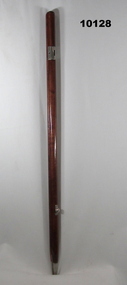
Uniform - PACE STICK, ARMY, Australian Defence Industries, Unknown
... Pace stick - a training instrument used to gauge the length of pace and measure distance and interval for military parades and military situations. ...Pace stick - a training instrument used to gauge the length of pace and measure distance and interval for military parades and military situations. ...Pace stick - a training instrument used to gauge the length of pace and measure distance and interval for military parades and military situations. Pace stick issued to G. WESTHEAD, No. 317595/8233929. Refer Cat No. 1496.7 for Service Records.Pace stick, two pieces of timber with brown stain and gloss varnish, brass metal hinge at the top. Two silver colour metal tips at bottom. Silver colour metal fittings along length of timber sticks are used to set a particular distance.uniform, army, pace stick, military police, g. westhead -
 Creswick Campus Historical Collection - University of Melbourne
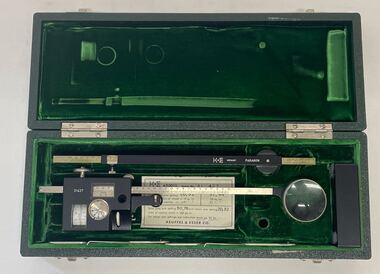
Instrument - Compensating Polar Planimeter, Keuffel & Esser 620015 KE Compensating Polar Planimeter
... A precision tool for measuring areas of both regular and irregular shape from maps, plans, blueprints, photographs, and other documents. Simply trace the outline of an area with the cursor to obtain its size. The 620015 Paragon model features adjustable-length...A precision tool for measuring areas of both regular and irregular shape from maps, plans, blueprints, photographs, and other documents. Simply trace the outline of an area with the cursor to obtain its size. The 620015 Paragon model features adjustable-length ...Research and TrainingA precision tool for measuring areas of both regular and irregular shape from maps, plans, blueprints, photographs, and other documents. Simply trace the outline of an area with the cursor to obtain its size. The 620015 Paragon model features adjustable-length tracer arm measures and adjustable-length pole armK&E Germany Paragon.31427. Hand engraved: VSF006. -
Glenelg Shire Council Cultural Collection
Photograph - Photograph - Marine Discovery Centre Portland, Victoria, 14/10/1999
... wearing dark blue polo shirt with MDC logo, standing behind the jaw of the whale skeleton, his arms wide, measuring its length...wearing dark blue polo shirt with MDC logo, standing behind the jaw of the whale skeleton, his arms wide, measuring its length Photograph Photograph - Marine Discovery Centre Portland, Victoria ...Coloured photograph: MDC, inside. Young man (volunteer? employee?) wearing dark blue polo shirt with MDC logo, standing behind the jaw of the whale skeleton, his arms wide, measuring its length -
 Bendigo Historical Society Inc.
Functional object - Infant Welfare Centre Table
... The table was used to measure the length of babies to record growth. One end is shaped the fit a baby's head when it is lying on the table, the other end slides to the baby's feet. ...The table was used to measure the length of babies to record growth. One end is shaped the fit a baby's head when it is lying on the table, the other end slides to the baby's feet. ...The table was used in the Charing Cross Infant Welfare Centre. The Maternal and Child Health Service (Infant Welfare) began in Victoria in 1917 when, in response to high levels of infant morbidity and mortality, the first voluntary Infant Welfare Centres began to emerge. The first centres were established in Richmond and Carlton and received a Council subsidy.A table with an open box fixed to the top it 100 centimetres long 55 centimetres wide with 14 centimetre sides. The table was used to measure the length of babies to record growth. One end is shaped the fit a baby's head when it is lying on the table, the other end slides to the baby's feet. There is a 90 centimetre measuring tape fixed on to the table top.charing cross infant welfare, infant measuring table -
 Federation University Historical Collection
Book, Bennett H. Brough, A treatise on Mine-Surveying, 1904
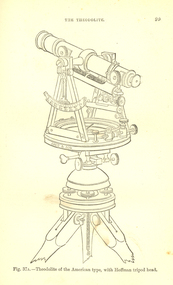
... Contents include general explanatinos of surveying, an historical sketch, mineral deposits, mining terms, measures of length, measurement distances, the chain, rods, steel bands, measuring wheel, Miner's Dial, Magnetic needle, Fixed needle, German Dial, theodolite, traversing underground. ...Contents include general explanatinos of surveying, an historical sketch, mineral deposits, mining terms, measures of length, measurement distances, the chain, rods, steel bands, measuring wheel, Miner's Dial, Magnetic needle, Fixed needle, German Dial, theodolite, traversing underground. ...The author, Bennett H. Brough was an associate of theRoyal School of Mines, a member of the COuncil of the Institution of Mining Engineers, a fellow of the geological society and of the Institute of Chemistry, a member of the Mining Institute of Cornwall, and a former instructor of mine-surveying at the Royal School of MinesRed had covered book 372 pages - part of Griffin's Mining Series. Contents include general explanatinos of surveying, an historical sketch, mineral deposits, mining terms, measures of length, measurement distances, the chain, rods, steel bands, measuring wheel, Miner's Dial, Magnetic needle, Fixed needle, German Dial, theodolite, traversing underground. Surface-surveys. plotting the survey, calculation of area, leveling, Telescope, Setting out, Mine-Surveying Problems, Mine Plans, Photographic Surveying, examination Surveying. Illustrations include: Whitelaw's Dial (Fig 22), Theodolite of the American Type with Hoffman tripod head, (fig 37a)mining, surveying, miner's dial, chain, survey, theodolite, scientific instruments -
 National Wool Museum
Functional object - Magnifying Lens, c.1930s
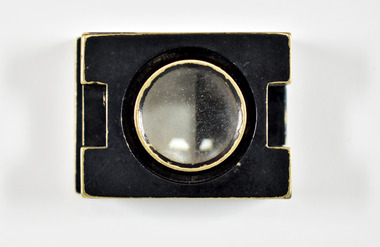
... The wool-buyers needed the sensitivity of their fingers to appraise the suitability of the wool, as buyers had for centuries past, measuring the length of the staple, feeling and counting the crimps in the fibre, its finesse, softness, elasticity and strength, assessing the colour, watching for extraneous matter such as dust or seeds which would not be welcome by manufacturers half-way across the world. ...The wool-buyers needed the sensitivity of their fingers to appraise the suitability of the wool, as buyers had for centuries past, measuring the length of the staple, feeling and counting the crimps in the fibre, its finesse, softness, elasticity and strength, assessing the colour, watching for extraneous matter such as dust or seeds which would not be welcome by manufacturers half-way across the world. ...This item was inherited from the donor's father, René Dupuche. John Dupuche, writes: This magnifying glass was used to remove the burrs and thorns that wool-buyers tended to get in their fingers when examining bales of wool. The open end was placed on the finger since the thorn was sometimes buried under the skin. The buyer looked through the magnifying glass and with tweezers or a pin removed the thorn which had rendered the finger inoperative. The wool-buyers needed the sensitivity of their fingers to appraise the suitability of the wool, as buyers had for centuries past, measuring the length of the staple, feeling and counting the crimps in the fibre, its finesse, softness, elasticity and strength, assessing the colour, watching for extraneous matter such as dust or seeds which would not be welcome by manufacturers half-way across the world. Their skills took years to acquire. Knowledgeable buyers were invaluable to their employers, since they were able to evaluate to the last percentage the yield of a bale. My father, René Dupuche, was the ‘principal buyer’ from 1927-1966 in Victoria, South Australia and Tasmania for the international wool company ‘Masurel Fils’ which was one of the largest wool businesses in Europe. It was based in the north of France, in Tourcoing, one of the major wool centres of the world. He was sent to Australia as a young man at the age of 23 and took part in the ‘golden era’ of wool in Australia, and the eventual replacement of hands-on appraisal by ‘core-testing’. Masurel Fils was one of the dozens of French and Belgian firms operating in Australia. These men from Flanders enjoyed a cosmopolitan society augmented by diplomats, European bankers and shipping-line executives for various countries and a handful of scientists and academics.Small black metal magnifying lens with three fold design and two hinges. One panel contains a circular glass lens, the centre panel has a circular hole, and the third panel has a square hole with three lines on each side.wool buyer, magnifying glass, magnifying lens, burrs, rené dupuche, john dupuche, migrants, masurel fils, french, belgian, flanders, working life, sheep industry, wool industry, agriculture -
 Flagstaff Hill Maritime Museum and Village
Functional object - Standard Measure, James McEwan & Co, 1860s-1900s
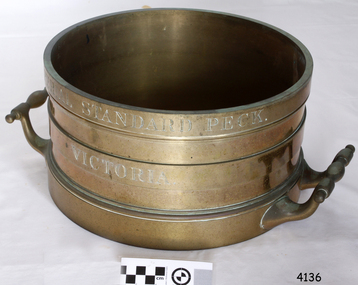
... These were tested against the then British Imperial Standards to measure length, weight and currency. Administrative bodies in the Colony of Australia could then compare their weights and measures against these British Primary Standards and adjust their Measures accordingly, to maintain the Standards. ...These were tested against the then British Imperial Standards to measure length, weight and currency. Administrative bodies in the Colony of Australia could then compare their weights and measures against these British Primary Standards and adjust their Measures accordingly, to maintain the Standards. ...This container is a pre-Decimal, Imperial Standard Peck, part of a three-piece set of Standard measures used in Victoria from around 1900 to 1940. The measures were made in Melbourne by J. McEwan & Co. These three measures were likely used by the local Melbourne authority that monitored weights and measures in the mid to late 19th century. . An Imperial Bushel was equal to 8 gallons, or 36.36872 litres . An Imperial Peck equals a quarter of a Bushel, or 9.09 litres Standards for weights and measures began in Victoria when the Melbourne Observatory received primary sets of Imperial Standard Weights and Measures from Britain. These were tested against the then British Imperial Standards to measure length, weight and currency. Administrative bodies in the Colony of Australia could then compare their weights and measures against these British Primary Standards and adjust their Measures accordingly, to maintain the Standards. The Weights and Measures Act of 1862 was passed in Victoria, and local inspectors were established throughout the colony. By the 1870s, local councils and shires in Victoria held a set of Standards used to test scales, weights, and measures used by manufacturers, wholesalers, and retailers. Every ten years, the councils’ Standards needed to be rechecked against the Victorian Standards. In the 19th Century, the Victorian Customs Department inspected and maintained the Standards. In 1901, the Customs Department was transferred to the Federal Government, but the Weights and Measures authority remained with the Victorian Government and relocated to the Melbourne Observatory. In 1904, the Standard weights and measures, and testing equipment, were installed in the room of a new building erected at the south end of the Great Melbourne Telescope House. The room became known as the Whirling Room, due to its large whirling apparatus that tested air meters. When the Melbourne Observatory closed in 1944, the Weights and Measures Branch was formed to continue maintaining the Standards. On February 14th, 1966, Australia began its conversion to metric measures and currency, and a new set of Standard Measures was introduced; the conversion took place in stages. The Weights and Measures Branch remained at the Observatory site until 1995. James McEwan & Co.: - The maker of this set of Standard Measures was James McEwan. His Melbourne business was established in 1852 and sold retail furniture and wholesale ironmongery. The firm’s warehouses were situated at the intersection of 81-83 Elizabeth and Little Collins Streets. Shortly afterwards, the firm partnered with William Kerr Thomson and Samuel Renwick. When McEwan died in 1868, his partners carried on and expanded the business under his name, J McEwan. The business was expanded to provide a retail shop, counting-house and private offices. Wholesale warehouses adjoined these premises at 4, 6 and 10 Little Collins Street, West. This company provided and sold a large and varied amount of imported goods into the colony; agricultural equipment, building materials, mining items, steam engines, tools of all types and marble fireplaces. The company grew to employ over 150 people in Melbourne and opened offices at 27 Lombard St, London, as well as in New Zealand and Fiji. It also serviced the Mauritius islands and the Pacific area with its steamship, the Suva, and a brig, the Shannon. The set of Imperial Standard Measures is an example of a bronze measure container made specifically for J. McEwan & Co. Today, it helps us to understand how imperial weights and measures were used, and how a standard of measurement for merchants was developed in the Australian colonies based on the Imperial British measurement system. The container has social significance as an item retailed by J McEwan, and used by Victoria’s authorities legally responsible for ensuring that dry goods sold in Victoria by wholesalers and retailers are correct. Imperial Standard Measure: a container to measure the volume of a Peck. It is part of a set of three precision measures - a Peck, a Half Bushel and a Bushel – used by government authorities in Victoria. The cast brass cylinder has straight sides and a flat base, and two handles are attached near the base by two posts on each handle. The wall inside is straight, and outside has grooves and horizontal bands. Inscriptions are engraved on the outside. The Measures were made for the retailer, J. McEwan & Co., London and Melbourne. Engraved on side: "IMPERIAL STANDARD PECK. / VICTORIA."flagstaff hill, flagstaff hill maritime museum and village, warrnambool, maritime museum, maritime village, great ocean road, shipwreck coast, weights and measurements, science, james mcewan & co., precision instrument, technology, melbourne observatory, british imperial standards, standard weights & measures, volume measure, dry measure, customs, commerce, victorian standard measure, pre-decimal measure, imperial standard, imperial bushel, imperial half bushel, imperial peck, peck measure, bronze container, brass container, cast container -
 Flagstaff Hill Maritime Museum and Village
Functional object - Standard Measure, James McEwan & Co, 1860s-1900s
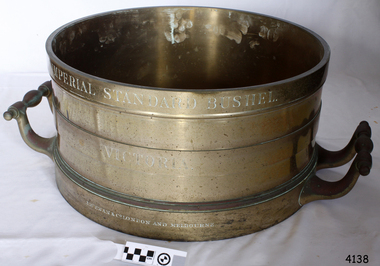
... These were tested against the then British Imperial Standards to measure length, weight and currency. Administrative bodies in the Colony of Australia could then compare their weights and measures against these British Primary Standards and adjust their Measures accordingly, to maintain the Standards. ...These were tested against the then British Imperial Standards to measure length, weight and currency. Administrative bodies in the Colony of Australia could then compare their weights and measures against these British Primary Standards and adjust their Measures accordingly, to maintain the Standards. ...This container is a pre-Decimal, Imperial Standard Bushel, part of a three-piece set of Standard measures used in Victoria from around 1900 to 1940. The measures were made in Melbourne by J. McEwan & Co. These three measures were likely used by the local Melbourne authority that monitored weights and measures in the mid to late 19th century. . An Imperial Bushel was equal to 8 gallons, or 36.36872 litres . An Imperial Peck equals a quarter of a Bushel, or 9.09 litres Standards for weights and measures began in Victoria when the Melbourne Observatory received primary sets of Imperial Standard Weights and Measures from Britain. These were tested against the then British Imperial Standards to measure length, weight and currency. Administrative bodies in the Colony of Australia could then compare their weights and measures against these British Primary Standards and adjust their Measures accordingly, to maintain the Standards. The Weights and Measures Act of 1862 was passed in Victoria, and local inspectors were established throughout the colony. By the 1870s, local councils and shires in Victoria held a set of Standards used to test scales, weights, and measures used by manufacturers, wholesalers, and retailers. Every ten years, the councils’ Standards needed to be rechecked against the Victorian Standards. In the 19th Century, the Victorian Customs Department inspected and maintained the Standards. In 1901, the Customs Department was transferred to the Federal Government, but the Weights and Measures authority remained with the Victorian Government and relocated to the Melbourne Observatory. In 1904, the Standard weights and measures, and testing equipment, were installed in the room of a new building erected at the south end of the Great Melbourne Telescope House. The room became known as the Whirling Room, due to its large whirling apparatus that tested air meters. When the Melbourne Observatory closed in 1944, the Weights and Measures Branch was formed to continue maintaining the Standards. On February 14th, 1966, Australia began its conversion to metric measures and currency, and a new set of Standard Measures was introduced; the conversion took place in stages. The Weights and Measures Branch remained at the Observatory site until 1995. James McEwan & Co.: - The maker of this set of Standard Measures was James McEwan. His Melbourne business was established in 1852 and sold retail furniture and wholesale ironmongery. The firm’s warehouses were situated at the intersection of 81-83 Elizabeth and Little Collins Streets. Shortly afterwards, the firm partnered with William Kerr Thomson and Samuel Renwick. When McEwan died in 1868, his partners carried on and expanded the business under his name, J McEwan. The business was expanded to provide a retail shop, counting-house and private offices. Wholesale warehouses adjoined these premises at 4, 6 and 10 Little Collins Street, West. This company provided and sold a large and varied amount of imported goods into the colony; agricultural equipment, building materials, mining items, steam engines, tools of all types and marble fireplaces. The company grew to employ over 150 people in Melbourne and opened offices at 27 Lombard St, London, as well as in New Zealand and Fiji. It also serviced the Mauritius islands and the Pacific area with its steamship, the Suva, and a brig, the ShannonThe set of Imperial Standard Measures is an example of a bronze measure container made specifically for J. McEwan & Co. Today, it helps us to understand how imperial weights and measures were used, and how a standard of measurement for merchants was developed in the Australian colonies based on the Imperial British measurement system. The container has social significance as an item retailed by J McEwan, and used by Victoria’s authorities legally responsible for ensuring that dry goods sold in Victoria by wholesalers and retailers are correct.Imperial Standard Measure: a container to measure the volume of a Busel. It is part of a set of three precision measures - a Peck, a Half Bushel and a Bushel – used by government authorities in Victoria. The cast brass cylinder has straight sides and a flat base, and two handles are attached near the base by two posts on each handle. The wall inside is straight, and outside has grooves and horizontal bands. Inscriptions are engraved on the outside. The Measures were made for the retailer, J. McEwan & Co., London and Melbourne.Engraved on side: "IMPERIAL STANDARD BUSHEL. / VICTORIA ./ J. MCEWAN & CO. LONDON AND MELBOURNE."flagstaff hill, flagstaff hill maritime museum and village, warrnambool, maritime museum, maritime village, great ocean road, shipwreck coast, weights and measurements, science, james mcewan & co., precision instrument, technology, melbourne observatory, british imperial standards, standard weights & measures, volume measure, dry measure, customs, commerce, victorian standard measure, pre-decimal measure, imperial standard, imperial bushel, peck measure, bronze container, brass container, cast container -
 Flagstaff Hill Maritime Museum and Village
Equipment - Standard Measure, James McEwan & Co, 1860s-1900s
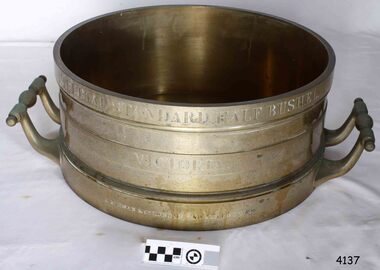
... These were tested against the then British Imperial Standards to measure length, weight and currency. Administrative bodies in the Colony of Australia could then compare their weights and measures against these British Primary Standards and adjust their Measures accordingly, to maintain the Standards. ...These were tested against the then British Imperial Standards to measure length, weight and currency. Administrative bodies in the Colony of Australia could then compare their weights and measures against these British Primary Standards and adjust their Measures accordingly, to maintain the Standards. ...This container is a pre-Decimal, Imperial Standard Half Bushel, part of a three-piece set of Standard measures used in Victoria from around 1900 to 1940. The measures were made in Melbourne by J. McEwan & Co. These three measures were likely used by the local Melbourne authority that monitored weights and measures in the mid to late 19th century. . An Imperial Bushel was equal to 8 gallons, or 36.36872 litres . An Imperial Peck equals a quarter of a Bushel, or 9.09 litres Standards for weights and measures began in Victoria when the Melbourne Observatory received primary sets of Imperial Standard Weights and Measures from Britain. These were tested against the then British Imperial Standards to measure length, weight and currency. Administrative bodies in the Colony of Australia could then compare their weights and measures against these British Primary Standards and adjust their Measures accordingly, to maintain the Standards. The Weights and Measures Act of 1862 was passed in Victoria, and local inspectors were established throughout the colony. By the 1870s, local councils and shires in Victoria held a set of Standards used to test scales, weights, and measures used by manufacturers, wholesalers, and retailers. Every ten years, the councils’ Standards needed to be rechecked against the Victorian Standards. In the 19th Century, the Victorian Customs Department inspected and maintained the Standards. In 1901, the Customs Department was transferred to the Federal Government, but the Weights and Measures authority remained with the Victorian Government and relocated to the Melbourne Observatory. In 1904, the Standard weights and measures, and testing equipment, were installed in the room of a new building erected at the south end of the Great Melbourne Telescope House. The room became known as the Whirling Room, due to its large whirling apparatus that tested air meters. When the Melbourne Observatory closed in 1944, the Weights and Measures Branch was formed to continue maintaining the Standards. On February 14th, 1966, Australia began its conversion to metric measures and currency, and a new set of Standard Measures was introduced; the conversion took place in stages. The Weights and Measures Branch remained at the Observatory site until 1995. James McEwan & Co.: - The maker of this set of Standard Measures was James McEwan. His Melbourne business was established in 1852 and sold retail furniture and wholesale ironmongery. The firm’s warehouses were situated at the intersection of 81-83 Elizabeth and Little Collins Streets. Shortly afterwards, the firm partnered with William Kerr Thomson and Samuel Renwick. When McEwan died in 1868, his partners carried on and expanded the business under his name, J McEwan. The business was expanded to provide a retail shop, counting-house and private offices. Wholesale warehouses adjoined these premises at 4, 6 and 10 Little Collins Street, West. This company provided and sold a large and varied amount of imported goods into the colony; agricultural equipment, building materials, mining items, steam engines, tools of all types and marble fireplaces. The company grew to employ over 150 people in Melbourne and opened offices at 27 Lombard St, London, as well as in New Zealand and Fiji. It also serviced the Mauritius islands and the Pacific area with its steamship, the Suva, and a brig, the Shannon.The set of Imperial Standard Measures is an example of a bronze measure container made specifically for J. McEwan & Co. Today, it helps us to understand how imperial weights and measures were used, and how a standard of measurement for merchants was developed in the Australian colonies based on the Imperial British measurement system. The container has social significance as an item retailed by J McEwan, and used by Victoria’s authorities legally responsible for ensuring that dry goods sold in Victoria by wholesalers and retailers are correct.Imperial Standard Measure: a container to measure the volume of a Half Bushel. It is part of a set of three precision measures - a Peck, a Half Bushel and a Bushel – used by government authorities in Victoria. The cast brass cylinder has straight sides and a flat base, and two handles are attached near the base by two posts on each handle. The wall inside is straight, and outside has grooves and horizontal bands. Inscriptions are engraved on the outside. The Measures were made for the retailer, J. McEwan & Co., London and Melbourne. Engraved test: "IMPERIAL STANDARD HALF BUSHEL. / VICTORIA / J. MCEWAN & O. LONDON AND MELBOURNE."flagstaff hill, flagstaff hill maritime museum and village, warrnambool, maritime museum, maritime village, great ocean road, shipwreck coast, weights and measurements, science, james mcewan & co., precision instrument, technology, melbourne observatory, british imperial standards, standard weights & measures, volume measure, dry measure, customs, commerce, victorian standard measure, pre-decimal measure, imperial standard, imperial half bushel, bronze container, brass container, cast container -
 Flagstaff Hill Maritime Museum and Village
Head Rod, Dring & Fage, c. 1901
... (3) Long Calipers - this instrument measures the length of the cask between the heads. ... (3) Long Calipers - this instrument measures the length of the cask between the heads. ...The Australian Customs Service, Melbourne, donated a set of gauging instruments, and Port Fairy Customs donated another instrument, the Sike’s Hydrometer, to Flagstaff Hill Maritime Village, all of which were no longer required. However these ullaging tools were in use for many years by Customs officials, called Gaugers. Ullaging is a term describing the measurement of the amount of liquid remaining in a container of spirits such as a cask or barrel. It can also measure the free space or head space remaining. The primary role of customs officers in Victoria was to calculate the tariff or excise duty payable on goods imported into Victoria. (Excise duty is a tax on goods produced within a country, and customs duty is imposed on imports.) Customs officers spent a great deal of their time measuring and weighing goods, and then calculating the amount of duty to be paid by the importer. The tariffs for different products varied, and officers consulted published lists. Calculating the duty payable on a barrel of brandy was a detailed task. The gauger had to measure the barrel to determine its volume. Barrels were irregular in shape, and finding the volume required several measurements and checking tables of figures. Alcoholic content was then measured with a hydrometer. The duty paid varied according to the alcoholic strength of the spirits. Uniform national customs and excise duties were operative in Australia from October 1901. These tools were still being used in Australia in the 1950’s. The Federal Government still imposes excise taxes on goods such as cigarettes, petrol, and alcohol. The rates imposed may change in February and August each year in response to changes in the consumer price index. ULLAGING TOOLS (1) Head Rod - this instrument measures the diameter of the heads (top and bottom ends) of a cask or barrel. The shaped brass pieces on the head rod enable the diameter of a barrel to be measured inside the chimes at the head end. The slide rule could then be used to calculate the internal volume of the barrel. On the reverse side is a set of ullaging scales, used like those on any ullaging rule, to calculate the volume of liquid in a partially filled barrel. (2) Bung Rod – this instrument measures the diameter of a cask or barrel when it is lying on its side. It is a rod that fits into the ‘bung’ hole of a cask and is long enough be extended to reach the opposite side of the cask. The brass sliding pointer can be moved to mark the ‘wet’ line. When the rod is removed the bung measurement can be read from the scale on the rod. (3) Long Calipers - this instrument measures the length of the cask between the heads. It has two rules sliding beside each other, each end having another piece of wood fixed firmly at right angles downwards then turned inwards at the ends so as to reach over the heads of the casks without touching the projecting ends. The centre pieces enable it to extend or contract, changing the distance between the two other parallel sides, the distance they are apart being shown by the rule on the sliding pieces. (4) Cross Calipers – this instrument is used to take the bung diameters of casks, or "the Cross " as it is called. This instrument has two rules sliding beside each other, each end having another piece of wood fixed firmly at right angles downwards, together forming a 3 sides of a rectangle with the centre pieces enabling it to extended or contracted, changing the distance between the two other parallel sides, the distance they are apart being shown by a the rule on the sliding pieces. (5) Sike’s Hydrometer – this instrument is used to gauge the strength of different alcoholic spirits when fitted with the different weights in the set. Every set is individually calibrated to ensure that it meets the exact Standard Weight and Measure compliance, then every piece in that set is stamped with the same number by the Calibrator, to ensure that the measurements are taken using the same hydrometer set. [References: A Handbook of Practical Gauging, Janes Boddely Keene of H.M. Customs, 1861, F. Pitman, London; Customs Act, Volume 2, No. 1, April 1999; Old Customs House website ] Head Rod, ullaging gauge. Long wooden rod made of three joined sections, brass hook on end, sliding centre section with hook, measurements marked along each section as on a slide rule. Used for measuring diameter of heads of casks in order for Customs to calculate excise (tax) on the contentsflagstaff hill, warrnambool, shipwrecked coast, flagstaff hill maritime museum, maritime museum, shipwreck coast, flagstaff hill maritime village, great ocean road, head rod, gauging rod, ullaging rods, measuring instruments, customs tax -
 Flagstaff Hill Maritime Museum and Village
Weapon - Cannon, circa 1825
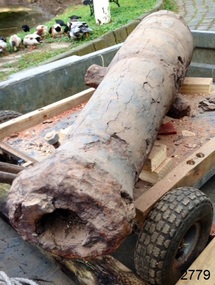
... In an article dated 26 March 1963, the Warrnambool Standard reported: “A cannon which has lain on the ocean floor since the barque, Children, was wrecked at Childer’s Cove on January 15, 1839, was raised by three Warrnambool skindivers at the weekend … The cannon, weighing about 750 lb. and 4-ft. 6-in. in length … is in excellent order considering the length of time it has remained underwater”. No conservation measures were taken at that time, other than chipping off the marine growth with hammers and cold chisels. ...In an article dated 26 March 1963, the Warrnambool Standard reported: “A cannon which has lain on the ocean floor since the barque, Children, was wrecked at Childer’s Cove on January 15, 1839, was raised by three Warrnambool skindivers at the weekend … The cannon, weighing about 750 lb. and 4-ft. 6-in. in length … is in excellent order considering the length of time it has remained underwater”. No conservation measures were taken at that time, other than chipping off the marine growth with hammers and cold chisels. ...In an article dated 26 March 1963, the Warrnambool Standard reported: “A cannon which has lain on the ocean floor since the barque, Children, was wrecked at Childer’s Cove on January 15, 1839, was raised by three Warrnambool skindivers at the weekend … The cannon, weighing about 750 lb. and 4-ft. 6-in. in length … is in excellent order considering the length of time it has remained underwater”. No conservation measures were taken at that time, other than chipping off the marine growth with hammers and cold chisels. The minutes for the 4 February 1974 meeting of the Flagstaff Hill Planning Board recorded that “a cannon recovered some time ago was lying in the garden of [one of the three original divers] and that it could be picked up at any time”. Peter Ronald, past Manager and Diver for Flagstaff Hill, notes that the CHILDREN cannon would have been recovered by the other divers around 1964. When the cannon came into care of Flagstaff Hill, it was given basic conservation relevant to the time. (At the same meeting, the Board was advised of the recovery of an anchor from the wreck of the CHILDREN by Flagstaff Hill divers (Peter Ronald, Colin Goodall and Gary Hayden, and Hank Howey and Andrew Coffee), and its interim relocation in the sea at the end of the Warrnambool Breakwater while awaiting conservation). About the ship CHILDREN 1825-1839: The sailing ship Children was a wooden, three-masted barque constructed of pitch pine in 1825 at Liverpool. It was felt sheathed and was coppered during an upgrade in 1837. The ship was only 29 metres long and 254 tons in weight; it had two decks and a square stern. The James Henty & Co., a pioneering family from Portland, Victoria, purchased the Children in 1837 for use as a coastal trader. The Children, under the command of Captain H. Browne, was on a voyage from Launceston to Adelaide when it foundered in rough conditions at Childers Cove, west of Peterborough, on 14 January 1839. On board were 14 crew members and 24 passengers, including 9 children. The ship’s cargo was awkwardly balanced: it carried 1500 sheep, 8 bullocks, 7 horses, 5000 London house bricks, 6 whaling boats with associated gear, and general trade goods including beef, pork, tobacco, tipe, butter, lime juice, horse hair, curtains, lead shot, beer and spirits. The hurricane-force winds drove the Children into the limestone stack at the entrance to the cove. The seas smashed it into pieces within twenty minutes. The bodies of sixteen of those who had lost their lives were spread across the shore, along with wreckage from the ship and the cargo of animals. Those who survived suffered injuries; they were rescued and taken by horse and cart to Campbell’s farm, near the whaling station at Port Fairy. They arrived at Portland eleven days after the wreck. The wrecking of the Children is one of colonial Victoria’s earliest and most significant maritime disasters. Little is left to mark the tragedy, apart from some house bricks intended for the Henty family’s Portland Bay settlement. Artefacts recovered in the 1960s to early 1970s include this signal cannon, an anchor, the bottom half of her ship’s bell, and two portions of a ship’s fitting, at one time thought to be a brass porthole frame, London housing bricks and timber flooring. Despite its poor condition, the CHILDREN’s signal cannon remains an important and interpretable record of its demise. From 2015, the CHILDREN cannon has been undergoing the first stages of further conservation.The signal cannon recovered from the Children's wreck is significant as part of the original fittings of the early 19th-century barque. It is an example of maritime defence in the early to mid-19th century. The 1839 wreck and recovered artefacts are examples of the construction methods and materials used in that era and can be used to study the evolution of shipbuilding methods and principles. The wreck of the Children is of state significance as one of colonial Victoria’s earliest and most significant maritime disasters, and one of the first vessels lost in the Western District. This is recognised by its inclusion on the Victorian Heritage Register, VHR No. S116. Little is left on the seabed to mark the tragedy, apart from some of the house bricks intended for the Henty settlement. Signal cannon: a 1.3 metre iron 6pdr cannon recovered from the wreck of the CHILDREN. The shape of the cannon tapers from a thick round breech to a flared muzzle, with an 8-centimetre bore, and two side trunnions for pivoting on a wooden gun carriage. It was recovered from the shipwreck site of the CHILDREN by local divers in 1963. This small muzzle-loading signal cannon is in poor and unrestored condition. The cannon’s upper profile of smooth grey metal casing has corroded off, leaving an extensively oxidised rough red surface of crumbling iron. The bottom half of the cannon remains intact, although the outer smooth casing also appears to be separating from the iron core of the barrel. The original grey casting is also missing from the breech and muzzle ends of the cannon. Corrosion and spalling of the upper surface layer of the cannon have removed the maker’s marks and specificationsflagstaff hill, flagstaff hill maritime museum and village, warrnambool, maritime museum, maritime village, great ocean road, shipwreck coast, shipwreck artefact, children, barque, three-masted, liverpool, childer’s cove, port campbell, 1839 shipwreck, 1939 wreck, james henty and co, henty brothers, captain h. browne, first mate t. gay, second mate w. wentworth, portland, portland bay, 1939, ship’s cannon, signal cannon, conservation of marine artefacts, 6pdr small bore cannon, defence -
 Flagstaff Hill Maritime Museum and Village
Gauging Rod, 1903-1938
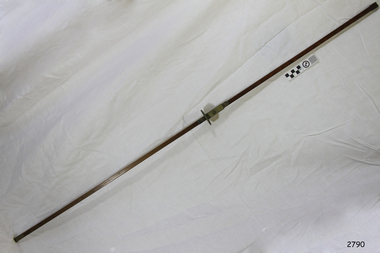
... Measurements are marked along the length of the rod. Used for measuring volume of liquor in casks in order for Customs to calculate excise (tax) on the contents. ...The item demonstrates a long social history of the practice of Government's collecting duty on alcoholic beverages and thereby makes this item historically significant as it was used locally at Port Fairy by the ports Customs agents. flagstaff hill warrnambool shipwrecked coast flagstaff hill maritime museum maritime museum shipwreck coast flagstaff hill maritime village great ocean road gauging rod ullaging rods measuring instruments customs tax dring & fage alcohol measurement Engraved “Dring & Fage 56 Stamford St London Gauging rod or bung rod; ullaging gauge. Long brown wooden gauging rod with brass tips and sliding brass marker. Measurements are marked along the length ...The firm Dring and Fage were active from 1790 to 1940 in London and were manufacturers of hydrometers and mathematical instruments they became established in London in 1790 by John Dring, who was a brass worker and hydrometer maker, and William Fage. Dring and Fage manufactured also saccharometers and other instruments used to measure the strength of alcohol. These instruments were primarily used to calculate excises. They traded at various addresses in London and they were at 56 Stamford St. between 1903 and 1938. By 1850 the company was owned by Edward Hall and Edward Jenkin and in 1940 the company became Dring & Fage Ltd, trading till the 1960s. Historically, gauging has meant measuring a volume, these gauging instruments were used by Customs and Excise and manufacturers for determining the volume and contents of liquid containers. For Customs the determination and collection of duty on imported goods which has had a very long history. Chaucer was a Customs Officer as was his father and grandfather, excise was first officially introduced in 1643, with the aim of maintaining military forces raised by the English Parliament at that time. Excise was initially a duty on home produced alcoholic beverages and soap but being easily applied, spread rapidly to a wide range of goods including imports of varying kinds. The government departments of Customs and Excise merged only in 1909 and it is from around this time that our instrument was made and used. The item demonstrates a long social history of the practice of Government's collecting duty on alcoholic beverages and thereby makes this item historically significant as it was used locally at Port Fairy by the ports Customs agents. Gauging rod or bung rod; ullaging gauge. Long brown wooden gauging rod with brass tips and sliding brass marker. Measurements are marked along the length of the rod. Used for measuring volume of liquor in casks in order for Customs to calculate excise (tax) on the contents. Made by Dring & Fage, London.Engraved “Dring & Fage 56 Stamford St London flagstaff hill, warrnambool, shipwrecked coast, flagstaff hill maritime museum, maritime museum, shipwreck coast, flagstaff hill maritime village, great ocean road, gauging rod, ullaging rods, measuring instruments, customs tax, dring & fage, alcohol measurement -
 Flagstaff Hill Maritime Museum and Village
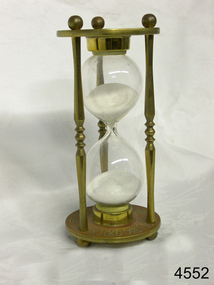
Instrument - Hourglass
... measuring hours or minutes or even seconds. Generally an hourglass sits between discs of wood at the ends, which are joined by long wooden spindles between the ends and tightened by screw caps. The length...measuring hours or minutes or even seconds. Generally an hourglass sits between discs of wood at the ends, which are joined by long wooden spindles between the ends and tightened by screw caps. The length ...An hourglass or sandglass is an instrument for measuring a defined time and can be used perpetually by simply turning it over immediately the top bulb empties. The clear blown glass is shaped into two equal sized bulbs with a narrow passage in the centre and contains uniform sized sand or glass particles in the lower bulb. The width of the neck regulates the constant flow of the particles. The glass is held in a stand with top and bottom of equal shape and size. Hourglasses can measure an infinite variety of time by gauging the size of the particles, the shape and size of the bulbs and the size of the passage between the bulbs, thus measuring hours or minutes or even seconds. Generally an hourglass sits between discs of wood at the ends, which are joined by long wooden spindles between the ends and tightened by screw caps. The length of time can be adjusted by adding or removing sand particles. The use of the marine sandglass (or hourglass) has been recorded in the 14th century in European shipping. A one minute sandglass was used in conjunction with the ship’s log for ‘dead reckoning’, (see below) that is, for measuring the ship’s speed through the water. They were also used to regulate ringing the ship’s timetable; for example a 4 hour sandglass was used for the length of the sailors’ watch, and a half hour timer for taking of readings for the ship’s log; the ship’s bell would be rung every half hour. It was usually the role of the cabin boy to watch and turn the sandglasses over at the exact time of them emptying their upper chambers and to ring the ship’s bell. Hourglasses have been used historically for many hundreds of years. Some have been used for timing church sermons, in cooking, in industry and at sea. Even today they are used for measuring the cooking time of eggs and timing a player’s turn in games such as Boggle and Pictionary. The sandglasses at sea were gradually replaced in the late 1700’s to early 1800’s by the more accurate chronometers (marine clocks) when they became reliable instruments. DEAD RECKONING (or Deduced Reckoning) Dead reckoning is the term used to describe the method of calculating the ship’s position from its speed and direction, used in early maritime travel, mostly in European waters. Both the (1) speed and the (2) direction of travel were recorded on a Traverse Board at half-hourly intervals during a helmsman’s watch of 4 hours. The navigator would record the readings in his ship’s log, plot them on his navigational chart and give his updated course directions to the next helmsman on watch, along with the cleared Traverse Board. This was a very approximate, but none-the-less helpful, method of navigation. The wooden Traverse Board was a simple pegboard with a diagram of a compass with eight peg holes along the radius to each of the compass points, plus a grid with ascending half hours in the left column and increasing ship’s speed in knots in a row across the column headings, with a peg hole in each of the intersecting cells. A number of wooden pegs were attached to strings on the board. By placing one peg consecutively in the direction’s radius hole, starting from the centre, and the speed holes when the half hourly reading was taken, a picture of speed and direction for the whole 4 hour watch was created. (1) To measure the ship’s speed a one minute hourglass timer was usually used to measure the ship’s speed through the water and help to calculate its longitude. A rope, with knots at regular standard intervals and a weight such as a log at the end, would be thrown overboard at the stern of the ship. At the same time the hourglass would be turned over and a seaman would start counting the number of knots on the rope that passed freely through his hands as the ship travelled. When the timer ran out the counting would be stopped. A timer of one minute (one-sixtieth of an hour), knots spaced one-sixtieth of a nautical mile apart, and simple arithmetic easily gave the speed of the ship in nautical miles per hour ("knots"). This would be recorded every half hour. The speed could however be inaccurate to the travel being affected by ocean currents and wind. (2) To calculate the ship’s direction a compass sighting would be recorded each half hour.Marine hourglasses or sandglasses were used from around the 14th to 19th century during the time of sailing ships. This hourglass is representative of that era, which is during the time of the colonisation of Australia. Hourglass or sandglass; an instrument used to measure time. Two equal sized clear glass bulbs joined with a narrow passage between them, containing equal sized particles of sand grains in lower bulb. Glass sits in a brass collar at each end, in a frame comprising 3 decorative brass columns or posts, each attached top and bottom, using round screw-on feet, to round brass discs. Disc have Roman numerals for the numbers 1 - 12 pressed into their inner surfaces and hieroglyphics on the outer surfaces. Roman numerals on inner surface of discs " I II III IV V VI VII VIII IX X XI XII " Hieroglyphics impressed on outer surface of discsflagstaff hill, warrnambool, shipwrecked coast, flagstaff hill maritime museum, maritime museum, shipwreck coast, flagstaff hill maritime village, great ocean road, horology, hourglass, hour glass, sandglass, sand glass, timing instrument, dead reckoning, deduced reckoning, finding latitude at sea, sandglass with hieroglyphics and roman numerals, hourglass with hieroglyphics and roman numerals, brass hourglass -
 Flagstaff Hill Maritime Museum and Village
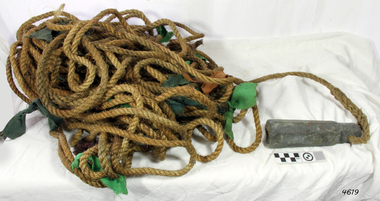
Equipment - Lead line
... measure the depth of the water and sample the nature of the seabed. It helps to understand the history and progress made from the very basic to the sophisticated technology of today. flagstaff hill warrnambool shipwrecked coast flagstaff hill maritime museum maritime museum shipwreck coast flagstaff hill maritime village lead line depth finder hand lead sounding lin leadsmane navigation instrument leadline hand lead line Lead line, sounding line or depth finder. The long length ...The lead line or hand lead is a simple navigational instrument used as a depth finder to measure the depth of water under the ship’s keel and to take samples of the sea bed. The long line may be marked at regular intervals with tags of different coloured and textured fabric, such as rope, leather and cloth. Each tag was a code to represent a certain depth. The leadsman’s eyes and hands could distinguish the depth easily as he drew in the lead line, day or night and in poor weather conditions. A standard set of codes for the tags was used so that the depth of the sea could be easily and quickly read. The measurement used was a Fathom, which equals 1.83 metres. The codes were: - 2 fathoms = 2 strips of leather 3 fathoms = 3 strips of leather 5 fathoms = white duck fabric 7 fathoms = red bunting fabric 10 fathoms = leather with a hole 13 fathoms = blue serge fabric 15 fathoms = white duck fabric 17 fathoms = red bunting 20 fathoms = 2 knots The lead weight could be between 7 -14 pounds (3.5 – 6.5kg) and the rope would be approximately 25 fathoms (45m). The hollowed-out end of the weight would hold a stick substance such as tallow or wax, which would pick up samples from the sea bed which would show whether the vessel was close to, or far away from, the shore. The leadsman would stand at the front of the vessel and cast the lead line into the sea. When it hit bottom he would note the tag marker nearest the surface of the water and call out his finding. Then he would haul it up again and examine the kind of matter that adhered to the end of the weight, whether it be sand, mud, gravel, or the colour of it. This information would be given to the ship’s helmsman or navigator and would help indicate the proximity to the land.This handheld lead is an example of early marine navigational equipment used by sailors to travel the seas to measure the depth of the water and sample the nature of the seabed. It helps to understand the history and progress made from the very basic to the sophisticated technology of today.Lead line, sounding line or depth finder. The long length of rope has a heavy lead weight attached to the end. Coloured fabric tags are tied onto the rope at regular intervals, representing different depths. The concave base of weight holds sticky substances such as tallow or beeswax, providing an adhesive surface to collect samples of sea bed like sand, shells or pebbles. flagstaff hill, warrnambool, shipwrecked coast, flagstaff hill maritime museum, maritime museum, shipwreck coast, flagstaff hill maritime village, lead line, depth finder, hand lead, sounding lin, leadsmane, navigation instrument, leadline, hand lead line -
 Federation University Historical Collection
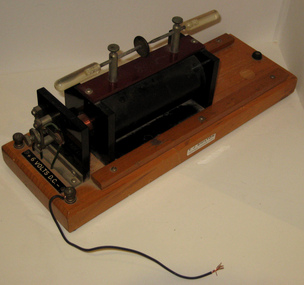
Scientific Instrument, Induction Coil
... length of spark it could produce; an '8 inch' (20 cm) induction coil was one that could produce an 8 inch arc. (http://en.wikipedia.org/wiki/Induction_coil) ballarat college of advanced education scientific instrument induction coil scientific instruments electricity A metal and plastic object on a timber stand. In an induction coil the distance between the plates is often used to measure ...An induction coil consists of two coils of insulated copper wire wound around a common iron core. One coil, called the primary winding, is made from relatively few (tens or hundreds) turns of coarse wire. The other coil, the secondary winding, typically consists of many (thousands) turns of fine wire. An electric current is passed through the primary, creating a magnetic field. Because of the common core, most of the primary's magnetic field couples with the secondary winding. The primary behaves as an inductor, storing energy in the associated magnetic field. When the primary current is suddenly interrupted, the magnetic field rapidly collapses. This causes a high voltage pulse to be developed across the secondary terminals through electromagnetic induction. Because of the large number of turns in the secondary coil, the secondary voltage pulse is typically many thousands of volts. This voltage is often sufficient to cause an electric spark, to jump across an air gap separating the secondary's output terminals. For this reason, induction coils were called spark coils. The size of induction coils was usually specified by the length of spark it could produce; an '8 inch' (20 cm) induction coil was one that could produce an 8 inch arc. (http://en.wikipedia.org/wiki/Induction_coil)A metal and plastic object on a timber stand. In an induction coil the distance between the plates is often used to measure the voltage of the spark since the air breaks down at 30 000 volts per centimetreballarat college of advanced education, scientific instrument, induction coil, scientific instruments, electricity -
 Flagstaff Hill Maritime Museum and Village
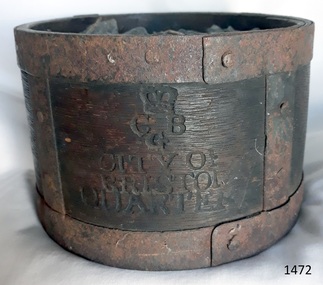
Functional object - Standard Measure, Late 18th to early 19th century (before the standardised measurement was introduced in England in 1824)
... length of the left feet of 16 men lined up heel to toe as they emerged from the church. By the 17th century usage and legal statute had established the acre, rod, and furlong at their present values together with other historic units such as the peck. Establishment of the System: The Weights and Measures...length of the left feet of 16 men lined up heel to toe as they emerged from the church. By the 17th century usage and legal statute had established the acre, rod, and furlong at their present values together with other historic units such as the peck. Establishment of the System: The Weights and Measures ...The peck has been in use since the early 14th century when it was introduced as a measure for flour. The term referred to varying quantities until the modern units of measurement were defined in the 19th century. Cities in England used to have official standard weights and measures for that city or area. These containers were marked with the city's name and emblem, merchant’s weights and measures would then be checked against this to make sure they weren't trying to cheat their customers. The item in the collection is a standard measure approved by Bristol City and used by that City’s grocers to measure dry goods such as peas, beans, sugar, flour, meal etc., and its metal banding ensures that the measure cannot be reduced in size to cheat customers. Additional Information: The British Imperial System evolved from the thousands of Roman, Celtic, Anglo-Saxon, and customary local units employed in the middle Ages. Traditional names such as pound, foot, and gallon were widely used, but the values so designated varied with time, place, trade, product specifications, and dozens of other requirements. Early royal standards were established to enforce uniformity took the name Winchester, after the ancient tenth century capital of Britain. King Henry VII reaffirmed the customary Winchester standards for capacity and length and distributed royal standards throughout the realm. This process was repeated about a century later in the reign of Queen Elizabeth I. In the 16th century, the rod (5.5 yards, or 16.5 feet) was defined (once again as a learning device and not as a standard) defined by the length of the left feet of 16 men lined up heel to toe as they emerged from the church. By the 17th century usage and legal statute had established the acre, rod, and furlong at their present values together with other historic units such as the peck. Establishment of the System: The Weights and Measures Act of 1824 and the Act of 1878 established the British Imperial System based on precise definitions of selected existing units. The 1824 act sanctioned a single imperial gallon to replace the wine, ale, and corn (wheat) gallons that were in general use. The new gallon was defined as equal in volume to 10 pounds avoirdupois of distilled water weighed at 62°F with the barometer at 30 inches, or 277.274 cubic inches (later corrected to 277.421 cubic inches). The two new basic standard units were the imperial standard yard and the troy pound, which was later restricted to weighing drugs, precious metals, and jewels. In 1963 an act of parliament abolished archaic measures as the rod and chaldron and a metric system was adopted. An early example of a dry measuring container giving a snapshot of how imperial weights and measures developed in England to evolve the British measurement system into the metric arrangement that most countries have adopted today including Australia. It has social significance as an item that was in everyday use by grocers and other merchants to measure dry goods in the late 18th to early 19th centuries and used specifically in the Bristol region of England as an officially recognised measurement.Standard Measure; Half Peck dry measure. Wooden measurement container with iron banding and hand made rivets container is a Quarter Peck official measurement container. Inscriptions are impressed into the sides of the wooden body. The container has the official crown and emblem of the City of Bristol, indicating this item was the Bristol City standard quarter peck measurement.Impressed into the timber on the front, a crown emblem over "C B G / CITY OF BRISTOL / QUARTER", on one side "HALF" , another side "PECK". Handwritten in white chalk on the base is "1458"flagstaff hill, warrnambool, shipwrecked-coast, flagstaff-hill-maritime-museum, flagstaff-hill-maritime-village, weights and measures, quarter peck, measurement container, dry grocery measure, bristol city measurement standard, city of bristol, british weights and measures, 18th and 19th centure standard measures -
 Flagstaff Hill Maritime Museum and Village
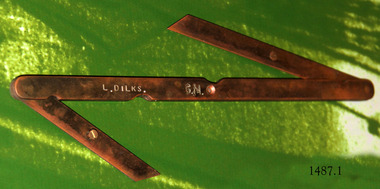
Tool - Bevel gauge, Mid-to-late 20th century
... Laurie began his career as a shipwright at Ports and Harbours in Melbourne in the mid-1900s, following in the wake of the skilled carpenters who have over many centuries used their craft to build and maintain marine vessels and their fittings. flagstaff hill warrnambool great ocean road shipwreck coast maritime museum maritime village Shipwright carpenter shipbuilding ship repairs hand tool equipment ship maintenance cooper tool marine technology bevel drawing tool measuring tool Laurie Dilks L Dilks Port and Harbours Melbourne Bevel marked "L DILKS" "G. M." This double bevel gauge has three lengths of flat brass that swivel at the joints. ...The double bevel gauge is used as a drawing tool, to measure, set angles and transfer angles. The shipwright’s tools on display in the Great Circle Gallery are connected to the maritime history of Victoria through their past owner, user and donor, Laurie Dilks. Laurie began his career as a shipwright in the mid-1900s, following in the wake of the skilled carpenters who have over many centuries used their craft to build and maintain marine vessels and their fittings. You can see Laurie’s inscription on the tool called a ‘bevel’. Laurie worked for Ports and Harbours, Melbourne, for over 50 years, beginning in the early 1960s. He and a fellow shipwright inscribed their names on a wheelhouse they built in 1965; the inscription was discovered many decades later during a repair of the plumbing. Many decades later Laurie worked on the Yarra moving barges up and down the river and was fondly given the title ‘Riverboat Man’ His interest in maritime history led him to volunteer with the Maritime Trust of Australia’s project to restore and preserve the historic WWII 1942 Corvette, the minesweeper HMAS Castlemaine, which is a sister ship to the HMAS Warrnambool J202. Laurie Dilks donated two handmade displays of some of his tools in the late 1970s to early-1980s. The varnished timber boards displayed the tools below together with brass plaques. During the upgrade of the Great Circle Gallery Laurie’s tools were transferred to the new display you see there today. He also donated tools to Queenscliffe Maritime Museum and Clunes Museum.The shipwright’s tools on display in the Great Circle Gallery are connected to the maritime history of Victoria through their past owner, user and donor, Laurie Dilks. Laurie began his career as a shipwright at Ports and Harbours in Melbourne in the mid-1900s, following in the wake of the skilled carpenters who have over many centuries used their craft to build and maintain marine vessels and their fittings.This double bevel gauge has three lengths of flat brass that swivel at the joints. The long piece has curved ends and indented arcs, one on each side, along the length. The short pieces have diagonal ends. The centre length has a hole through the middle. The short pieces have a screw with its head above the flat brass. The tool has an inscription. It once belonged to shipwright Laurie Dinks.Bevel marked "L DILKS" "G. M."flagstaff hill, warrnambool, great ocean road, shipwreck coast, maritime museum, maritime village, shipwright, carpenter, shipbuilding, ship repairs, hand tool, equipment, ship maintenance, cooper, tool, marine technology, bevel, drawing tool, measuring tool, laurie dilks, l dilks, port and harbours melbourne -
 Flagstaff Hill Maritime Museum and Village
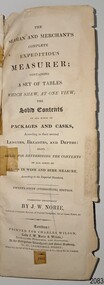
Book - Reference, navigation, J. W. Norie (author and editor), The Seaman and Merchants Complete Expeditious Measurer, 1853
... FULL Title: The Seaman and Merchants Complete Expeditious Measurer: The Seaman and Merchants Complete Expeditious Measure; containing a set of tables which show, at one view, the solid contents of all kinds of packags and casks, according to their several lengths, breadths and depths: also, rules for determining the contents of all sorts of casks in wine and beer measure, according to the Imperial Standard. ...FULL Title: The Seaman and Merchants Complete Expeditious Measurer: The Seaman and Merchants Complete Expeditious Measure; containing a set of tables which show, at one view, the solid contents of all kinds of packags and casks, according to their several lengths, breadths and depths: also, rules for determining the contents of all sorts of casks in wine and beer measure, according to the Imperial Standard. ...The book was published at the same address as London’s Navigation Waterhouse and Naval Academy. It is likely to be one of the textbooks used in educating seafarers, both naval and merchant. It is the twenty-fifth edition, showing that it was in great demand in the early to mid-19th century. Sea merchants could have used this as a reference for working out freight costs for their cargo. Customs Officers could have referred to it as well to calculate fees and taxes. The book’s owner had inscribed in pen and ink "Rose Anna, Schooner, Melbourne, March 25th 1857". At that time, the registered owners were Thomas Lamb & E. Keays, who were freighting cargo between Melbourne and Geelong. Schooner, ROSE ANNA: - The schooner Rose Anna was built in 1844 at Fremantle, W.A., by H. Edwards for Capt. William Heard. The 2-masted wooden vessel was carvel-built. Captain Heard registered Rose Anna at Fremantle in 1845 and in the same year, registered it at Port Adelaide. in 1852, Rose Anna was crushed and sunk at Port Adelaide by the Selma and raised. In 1852, the schooner was lengthened by William Hardy. In 1853, William Burton and W. Roberts registered Rose Anna at Melbourne. In 1855, W. Roberts registered, followed by John Balston & Thomas Ross. In 1856, it was registered by Thomas Lamb & E. Keays, in 1857 by William Howes & Charles Holland, in 1865 by Charles Holland & John Balfour, and in 1866 registered in Melbourne by mariners John Balfour & David Griffiths. In the 1940s, Rose Anna traded between Hobart, Melbourne, Adelaide, Sydney, Circular Head, Port Fairy, and Port Albert. In the 1950s and 1960s, it traded between Geelong Heads and Hobsons Bay, Melbourne, in lime, wool, general cargo and ballast. In 1857, when Rose Anna’s registered owners were Thomas Lamb & E. Keays, an advertisement was placed in The Age on March 9th, announcing that the Rose Anna was taking freight from Melbourne to Geelong. Later in the year, in October, the registered owners were William Howes & Charles Holland. They were still trading with Geelong, as on October 7th, The Age announced that Rose Anna arrived in Geelong from Melbourne on October 5th. On October 6th, 1866, Rose Anna went ashore while loading wheat at Sandridge, Port Phillip Bay, in severe gales and heavy seas and became a total wreck. The book is significant for its association with reference information to instruct sea merchant traders and naval officers. The publication is in its twenty-fifth edition, indicating the importance of such an instructional book. The book of tables and calculations shows the evolution of such reference texts, going from handwritten notes, to printed tables like these, and forward to slide rules, calculators, and to modern time computers. it demonstrates the importance of accuracy in calculating weights and measures at sea and for the purposes of fess, charges and taxes. The book is important to the history of the schooner Rose Anna, which is listed as a significant vessel on the Victorian Heritage Register, S582, as it has an inscription with the ship's name, date, and destination. Book, tall and narrow, with index tabs on the side edges of the pages. FULL Title: The Seaman and Merchants Complete Expeditious Measurer: The Seaman and Merchants Complete Expeditious Measure; containing a set of tables which show, at one view, the solid contents of all kinds of packags and casks, according to their several lengths, breadths and depths: also, rules for determining the contents of all sorts of casks in wine and beer measure, according to the Imperial Standard. Twenty-Fifth (Stereotype) Edition. Author: Mr J W Norie (John William Norie) Date: 1853 Publisher: Charles Wilson (late J.W. Norrie & Wilson), Bookseller, Publisher and Stationer, At the Navigation Waterhouse and Naval Academy, No. 157, Leadenhall Street, where may be had all the publications of Steel & Co. Late at No. 70, Cornhill. Printer: Bateman and Dennis, 95 Leadenhall Street, London, England, 1853 The book has handwritten, pen and ink inscriptions. It refers to the Schooner, Rose Anna, Melbourne, March 25th 1857.Handwritten in script with pen and ink: "Rose Anna / Schooner / Melbourne, / March 25th 1857"flagstaff hill, warrnambool, shipwrecked-coast, flagstaff-hill, flagstaff-hill-maritime-museum, maritime-museum, shipwreck-coast, flagstaff-hill-maritime-village, the seaman and merchants complete expeditious measurer, book, sea merchants, cargo, calculations, measurements, sea trade, maritime book, sea transportation, cargo rate calculations, naval academy, navy education, navigation, navigation instruction, navigation waterhouse and naval academy, twenty-fifth edition, 19th century, 1853, 1857, customs, freight, ullage, rose anna, schooner, 2-masted, march 25th 1857, melbourne, 25 march 1857, thomas lamb & e. keays, geelong, 1844, h. edwards, fremantle, carvel-built, port adelaide, selma, william hardy, william burton and w. roberts, john balston & thomas ross., charles holland & john balfour, john balfour & david griffiths, hobart, sydney, circular head, port fairy, port albert, hobsons bay, sandridge, port phillip bay -
 The Beechworth Burke Museum
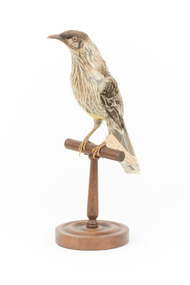
Animal specimen - Red Wattle Bird, Trustees of the Australian Museum, 1860-1880
... Measuring 33–37 cm (13–14.5 inches) in length, it ranks as the second-largest species among Australian honeyeaters. ...Measuring 33–37 cm (13–14.5 inches) in length, it ranks as the second-largest species among Australian honeyeaters. ...The red wattlebird is a passerine bird native to southern Australia. Measuring 33–37 cm (13–14.5 inches) in length, it ranks as the second-largest species among Australian honeyeaters. The species was first described by John White in 1790, and three subspecies are currently recognised. The red wattlebird is found across southeast Queensland, New South Wales, Victoria, South Australia, and southwest Western Australia, inhabiting open forests, woodlands, and urban gardens or parks. Known for its loud and conspicuous presence, the red wattlebird primarily forages in trees, although it occasionally searches for food on the ground. As one of the world's largest nectar-feeding birds, it consumes nectar from a wide variety of flowering plants, supplementing its diet with insects. Territorial and sometimes aggressive, it defends rich nectar sources from other bird species. Breeding occurs throughout its range, with the species constructing cup-shaped nests in trees and raising one or two broods annually. Despite localized declines due to habitat loss, the red wattlebird is listed as Least Concern on the IUCN Red List. This specimen was falsely identified as a yellow wattlebird in original catalogue records and is part of a collection of almost 200 animal specimens that were originally acquired as skins from various institutions across Australia, including the Australian Museum in Sydney and the National Museum of Victoria (known as Museums Victoria since 1983), as well as individuals such as amateur anthropologist Reynell Eveleigh Johns between 1860-1880. These skins were then mounted by members of the Burke Museum Committee and put-on display in the formal space of the Museum’s original exhibition hall where they continue to be on display. This display of taxidermy mounts initially served to instruct visitors to the Burke Museum of the natural world around them, today it serves as an insight into the collecting habits of the 19th century.This specimen is part of a significant and rare taxidermy mount collection in the Burke Museum. This collection is scientifically and culturally important for reminding us of how science continues to shape our understanding of the modern world. They demonstrate a capacity to hold evidence of how Australia’s fauna history existed in the past and are potentially important for future environmental research. This collection continues to be on display in the Museum and has become a key part to interpreting the collecting habits of the 19th century.The red wattlebird has predominantly grey-brown plumage, featuring red eyes, pale pinkish-red wattles on each side of the neck, white streaking on the chest, and a prominent yellow patch on the lower belly. Swing-tag: 58a. / Wattled - Honeyeater / See catalogue page 18taxidermy mount, taxidermy, animalia, burke museum, beechworth, australian museum, skin, bird, yellow wattlebird, tasmanian wattlebird, anthochaera paradoxa, australian birds, wattlebird, red wattlebird -
 The Beechworth Burke Museum
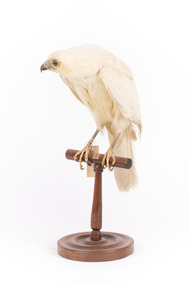
Animal specimen - Grey Goshawk, Trustees of the Australian Museum, 1860-1880
... Is a moderate-sized hawk that measures 38 - 55 cm in length, and has a wingspan of 70 - 110 cm. ...Is a moderate-sized hawk that measures 38 - 55 cm in length, and has a wingspan of 70 - 110 cm. ...This White Goshawk is the white colour morph of the Grey Goshawk. Is a moderate-sized hawk that measures 38 - 55 cm in length, and has a wingspan of 70 - 110 cm. It is native to Australia, and found in rainforest, forests, open forest and thickly-wooded watercourses. It mostly occurs in southeastern and northwestern Australia, and in Tasmania, all Grey Goshawks are white-phase. This specimen is part of a collection of almost 200 animal specimens that were originally acquired as skins from various institutions across Australia, including the Australian Museum in Sydney and the National Museum of Victoria (known as Museums Victoria since 1983), as well as individuals such as amateur anthropologist Reynell Eveleigh Johns between 1860-1880. These skins were then mounted by members of the Burke Museum Committee and put-on display in the formal space of the Museum’s original exhibition hall where they continue to be on display. This display of taxidermy mounts initially served to instruct visitors to the Burke Museum of the natural world around them, today it serves as an insight into the collecting habits of the 19th century.This specimen is part of a significant and rare taxidermy mount collection in the Burke Museum. This collection is scientifically and culturally important for reminding us of how science continues to shape our understanding of the modern world. They demonstrate a capacity to hold evidence of how Australia’s fauna history existed in the past and are potentially important for future environmental research. This collection continues to be on display in the Museum and has become a key part to interpreting the collecting habits of the 19th century.This White Goshawk is white all over, with hints of beige around its eyes. The bird's legs are a yellow-beige colour, and its beak grey and white. This specimen stands on a perch, mounted upon a wooden platform, and has an identification tag tied around its leg.Swing tag: 5. / White Goshawk / See Catalogue, page 2 / Mount: 5 / taxidermy mount, taxidermy, animalia, burke museum, beechworth, australian museum, skin, reynell eveleigh johns, bird, hawk, white goshawk, accipitridae -
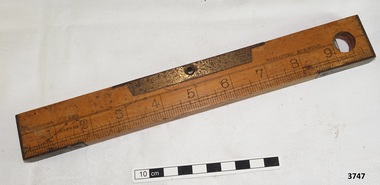 Flagstaff Hill Maritime Museum and Village
Instrument - Spirit Level, Barringtons, 1930-1955's
... The Sovereign of the Seas was a historic 17th century English war ship with important maritime heritage. flagstaff hill warrnambool flagstaff hill maritime museum shipwreck coast flagstaff hill maritime village great ocean road jim williams james bernard williams ship model hobby ship model tools ship model making equipment ship model making accessories barringtons spirit level barringtons london 10” spirit level Sovereign of the sea Ship model Hobby Ship model tool English war ship measuring instrument 2x “WARRANTED BOXWOOD”, 2x “BARRINGTON’S No 650”, “LONDON” Wooden spirit level. Barringtons Spirit level No 650, Warranted boxwood. Made in London. Length ...This 10” (ten inch) spirit level was made from boxwood by Barringtons of London. It was used in the making of ship model Sovereign of the Seas. It is part of a collection of objects used by Jim Williams, maker of fine ship models from about 1930-1955. Most of the components for the models, as well as many of the tools, were handmade by Jim Williams. Jim’s family has donated the ship model “Sovereign of the Seas” and many tools, accessories and documents used in the making of this and other ship models have been donated to Flagstaff Hill Maritime Village. Ship model of HMS Sovereign of the Seas, scale model of 17th Century English war ship, was handmade and carved from plans, enclosed in airtight glass case. All components of that model, including even the smallest pulleys, were hand crafted using tools designed and made by Jim. Outstanding details include functional rigging and moving cannons. Please see our record 3732 of the mode Sovereign of the Seas for further details of the ship and the maker. This spirit level is connected with the hobby and skill of ship model making that has been crafted as a leisure activity for many generations. The hobby is often chosen by serving and retired mariners who appreciate the connection with maritime history. This spirit level was used by local Warrnambool man, Jim Williams, who was employed at Cramond and Dickson clothing store, and then at Fletcher Jones menswear for 27 years. It was used in making components for the model of the historic ship, the Sovereign of the Seas. The Sovereign of the Seas was a historic 17th century English war ship with important maritime heritage. Wooden spirit level. Barringtons Spirit level No 650, Warranted boxwood. Made in London. Length 10" (10 inches). Bottom corners are reinforced with metal protection. It has two levels. The vertical level is within a round cut-out in one end. The horizontal level is on the top edge, surrounded by a metal plate with two cut-outs. One side of the spirit level has a ruler marked at 1/16 inch intervals, the other side is marked at 1/8 inch intervals. There is a large circle cut-out in the end that holds the vertical level. Both sides have the manufacturer’s name, the level’s model number and the material it is made of. One side also has the city of manufacture – England. This spirit level is part of a collection of tools and accessories once used by Jim Williams, maker of a series of ship models 1930-1955 including “HMS Sovereign of the Seas”. 2x “WARRANTED BOXWOOD”, 2x “BARRINGTON’S No 650”, “LONDON”flagstaff hill, warrnambool, flagstaff hill maritime museum, shipwreck coast, flagstaff hill maritime village, great ocean road, jim williams, james bernard williams, ship model hobby, ship model tools, ship model making equipment, ship model making accessories, barringtons spirit level, barringtons london, 10” spirit level, sovereign of the sea, ship model, hobby, ship model tool, english war ship, measuring instrument -
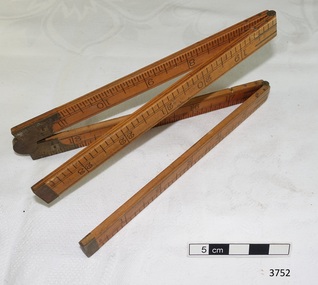 Flagstaff Hill Maritime Museum and Village
Instrument - Ruler, 1930-1955's
... The Sovereign of the Seas was a historic 17th century English war ship with important maritime heritage. flagstaff hill warrnambool flagstaff hill maritime museum maritime museum shipwreck coast flagstaff hill maritime village great ocean road ship model sovereign of the seas jim williams james bernard williams ship model hobby ship model tools ship model making equipment ship model making accessories measuring instrument ruler folding ruler j rabone and sons of birmingham england ruler model 1375 Sovereign of the sea Ship model Hobby Ship model tool English war ship j rabone and sons “J RABONE & SONS / BIRMINGHAM”, “WARAND BOXWOOD”, “NO 1375” Ruler, folding, wooden with brass hinges. Maker J. Rabone & Sons, Birmingham. Model No. 1375. It is warranted to be made of Boxwood. Length ...This measuring ruler was used in the planning and making of components for the ship model Sovereign of the Seas. It is part of a collection of objects used by Jim Williams, maker of fine ship models from about 1930-1955. Most of the components for the models, as well as many of the tools, were handmade by Jim Williams. Jim’s family has donated the ship model “Sovereign of the Seas” and many tools, accessories and documents used in the making of this and other ship models have been donated to Flagstaff Hill Maritime Village. Ship model of HMS Sovereign of the Seas, scale model of 17th Century English war ship, was handmade and carved from plans, enclosed in airtight glass case. All components of that model, including even the smallest pulleys, were hand crafted using tools designed and made by Jim. Outstanding details include functional rigging and moving cannons. Please see our record 3732 of the mode Sovereign of the Seas for further details of the ship and the maker. This ruler made by instrument makers J Rabone and Sons of Birmingham, is connected with the hobby and skill of ship model making that has been crafted as a leisure activity for many generations. The hobby is often chosen by serving and retired mariners who appreciate the connection with maritime history. This ruler was used by local Warrnambool man, Jim Williams, who was employed at Cramond and Dickson clothing store, and then at Fletcher Jones menswear for 27 years. It was used in making components for the model of the historic ship, the Sovereign of the Seas. The Sovereign of the Seas was a historic 17th century English war ship with important maritime heritage. Ruler, folding, wooden with brass hinges. Maker J. Rabone & Sons, Birmingham. Model No. 1375. It is warranted to be made of Boxwood. Length is 24 inches, divided into 1/8th inches on one side and 1/16th inches on the other side. This ruler is part of a collection of tools and accessories once used by Jim Williams, maker of a series of ship models 1930-1955 including “HMS Sovereign of the Seas”.“J RABONE & SONS / BIRMINGHAM”, “WARAND BOXWOOD”, “NO 1375”flagstaff hill, warrnambool, flagstaff hill maritime museum, maritime museum, shipwreck coast, flagstaff hill maritime village, great ocean road, ship model sovereign of the seas, jim williams, james bernard williams, ship model hobby, ship model tools, ship model making equipment, ship model making accessories, measuring instrument, ruler, folding ruler, j rabone and sons of birmingham england, ruler model 1375, sovereign of the sea, ship model, hobby, ship model tool, english war ship, j rabone and sons -
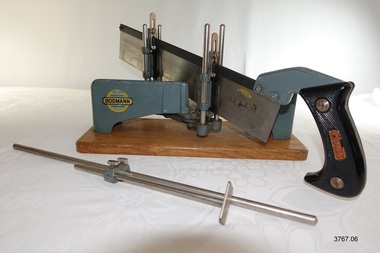 Flagstaff Hill Maritime Museum and Village
Tool - Mitre Saw Set, 1930-1955's
... Metal measuring guide holds the wood job to the correct length. Saw has a protective brown paper wrapper. ...Metal measuring guide holds the wood job to the correct length. Saw has a protective brown paper wrapper. ...This Bodmann mitre saw set was used in the making of components for the ship model Sovereign of the Seas. It is part of a collection of objects used by Jim Williams, maker of fine ship models from about 1930-1955. Most of the components for the models, as well as many of the tools, were handmade by Jim Williams. Jim’s family has donated the ship model “Sovereign of the Seas” and many tools, accessories and documents used in the making of this and other ship models have been donated to Flagstaff Hill Maritime Village. ABOUT the BRAND NAME ON THE SAW - BODMANN and CO, Germany In 1927 the Brisbane Courier Mail described Bodmann and Co of Reinscheid, Germany as "manufacturers of guaranteed tools and hardware. It appears that at least the saw has been re-badges and sold by Bodmann because (1) there are remnants of a label on the saw blade similar in shape to the Bodmann label on the mitre set (2) the removed label reveals the name and logo of "ULMIA Schutz OTT Marke" (3) one of the "Bodmann" labels on the saw handle has been applied in a crooked manner, almost leaving off the last "N". ULMIA is a German manufacturer of high quality woodworking tools. A drawing of a very similar mitre bset with saw can be seen on the ULMIA website. In 2002 the long established company ANKE of Swabian Alb, Germany (makers of cut timber, workbenches and countertops) bought out the name and trademark rights of ULMIA. HISTORY OF SOVEREIGN OF THE SEA (brief) Ship model of HMS Sovereign of the Seas, scale model of 17th Century English war ship, was handmade and carved from plans, enclosed in airtight glass case. All components of that model, including even the smallest pulleys, were hand crafted using tools designed and made by Jim. Outstanding details include functional rigging and moving cannons. Please see our record 3732 of the mode Sovereign of the Seas for further details of the ship and the Jim Williams. This mitre saw set is connected with the hobby and skill of ship model making that has been crafted as a leisure activity for many generations. The hobby is often chosen by serving and retired mariners who appreciate the connection with maritime history. This mitre saw set was used by local Warrnambool man, Jim Williams, who was employed at Cramond and Dickson clothing store, and then at Fletcher Jones menswear for 27 years. It was used in making components for the model of the historic ship, the Sovereign of the Seas. The Sovereign of the Seas was a historic 17th century English war ship with important maritime heritage. Bodmann Mitre Saw set model 348, comprising metal, adjustable mitre saw on timber stand, and metal hand saw with Bakelite handle. The mitre saw is labelled with the trademark of Bodmann, Germany, and stamped with the model number 348. The saw has Bodmann trademark badges on each side of the handle; the text on one of these badges is not quite aligned. The saw blade has remnants of a label under which the stamped logo of ULMIA Schutz OTT Marke is clearly visible. Saw is fitted with two metal guides that slide onto vertical posts on the mitre saw. Metal measuring guide holds the wood job to the correct length. Saw has a protective brown paper wrapper. This mitre saw set is part of a collection of tools and accessories once used by Jim Williams, maker of a series of ship models 1930-1955 including “HMS Sovereign of the Seas”.On mitre saw- 2x logos "REGISTERED / BODMANN / TRADE MARK" and embedded stamp “348”. On saw - Remnant of logo on blade “ULMIA Schutz OTT Marke” with image of a church-like tall building, and 2x , "BEST QUALITY / BODMANN / MADE IN GERMANY” flagstaff hill, warrnambool, flagstaff hill maritime museum, maritime museum, shipwreck coast, flagstaff hill maritime village, great ocean road, jim williams, james bernard williams, ship model hobby, ship model tools, ship model making equipment, ship model making accessories, wood working tool, model making tool, mitre box set, mitre saw, bodmann and co reinscheid, germany, ulna ott of of swabian alb, germany, anke of swabian alb, germany, sovereign of the sea, ship model, hobby, ship model tool, mitre saw set -
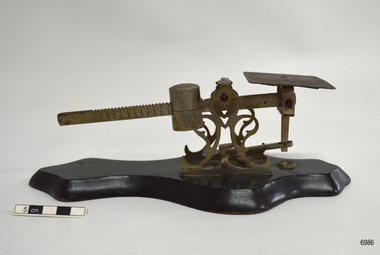 Flagstaff Hill Maritime Museum and Village
Instrument - Letter Scale, 1920s to 1960s
... measuring instrument weighing instrument technical instrument medications W.R. Angus Collection Scale; a small sliding balance letter scale. The scale has a flat metal platform and a toothed metal balance arm with cylindrical brass weight. These are attached to a decorative metal stand that is mounted onto a shaped lacquered black wooden base. The sliding weight causes the arm to pivot on the stand. The arm is marked into equal-length ...This scale was owned by Dr Angus, whose training and experience included chemistry and pharmacy. This is a sliding balance scale. The object to be weighed, such as a letter or a dose of medicine, is placed on the square metal plate and the weight, the slider, is moved along the notched metal arm and adjusted until the arm is horizontal, then reading is recorded of the figure the pointer on the slider is positioned. This design of small is often referred to as a letter scale. This item was donated to Flagstaff Hill Maritime Village by the family of Doctor William Roy Angus, Surgeon and Oculist. It is part of the “W.R. Angus Collection” that includes historical medical equipment, surgical instruments and material once belonging to Dr Edward Ryan and Dr Thomas Francis Ryan, (both of Nhill, Victoria) as well as Dr Angus’ own belongings. The Collection’s history spans the medical practices of the two Doctors Ryan, from 1885-1926 plus that of Dr Angus, up until 1969.The scale is significant as an example of 20th century measuring and weighing equipment. It is also important for its association with the W.R. Angus Collection, which is significant for still being located at the site it is connected with, Doctor Angus being the last Port Medical Officer in Warrnambool. The collection of medical instruments and other equipment is culturally significant, being a historical example of medicine, administration, household equipment and clothing from the late 19th to the mid-20th centuries. Dr Angus assisted Dr Tom Ryan, a pioneer in the use of X-rays and in ocular surgery. Scale; a small sliding balance letter scale. The scale has a flat metal platform and a toothed metal balance arm with cylindrical brass weight. These are attached to a decorative metal stand that is mounted onto a shaped lacquered black wooden base. The sliding weight causes the arm to pivot on the stand. The arm is marked into equal-length segments from 0 to 8. Each segment is marked into halves. There is no maker’s mark. The scale is part of the W.R. Angus Collection.flagstaff hill, warrnambool, maritime village, maritime museum, shipwreck coast, great ocean road, dr w r angus, letter scale, postal scale, balance scale, single arm scale, chemist scale, pharmacy scale, office equipment, retail equipment, sales equipment, measuring instrument, weighing instrument, technical instrument, medications, w.r. angus collection
