
Showing 8 items matching "lifebelt"
-
 Bendigo Military Museum
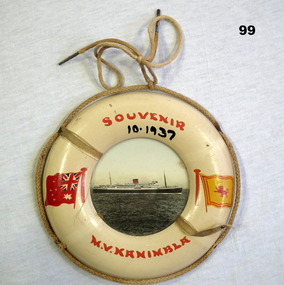
Souvenir - CRUISE SOUVENIR, 10.1937
... Photo of H V Kanimbla mounted in a frame the shape of a lifebelt depicting the Australian Merchant Flag with red Scottish Lion. ...It was converted to a landing ship for infantry, saw service at Hollandia, Borneo, Morotai & Phillipines. photography - photos souvenirs military history - navy Handwritten on back: Melb to Adelaide 10.37 Troopship L K Morgan Painted on front: Souvenir 10.1937 M V Kanimbla Photo of H V Kanimbla mounted in a frame the shape of a lifebelt depicting the Australian Merchant Flag with red Scottish Lion. ...M V Kanimbla coastal liner requisitioned in Australia August 1939 to become armed merchant cruiser 1943. It was converted to a landing ship for infantry, saw service at Hollandia, Borneo, Morotai & Phillipines. Photo of H V Kanimbla mounted in a frame the shape of a lifebelt depicting the Australian Merchant Flag with red Scottish Lion. Shoelace attached to hang it. Handwritten on back: Melb to Adelaide 10.37 Troopship L K Morgan Painted on front: Souvenir 10.1937 M V Kanimbla photography - photos, souvenirs, military history - navy -
 Mission to Seafarers Victoria
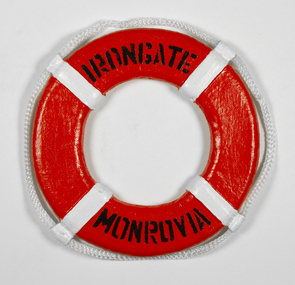
Decorative object - Miniature, lifebuoy, c. 2018
... lifebelt...It is also a representative sample of creativity aboard ship: model making was often a hobby to kill time on long journeys. lifebelt life preserver miniature models life buoy bosun tomovs irongate ship gift buoy hobbie seamen sailors seafarers side a) In Upper Case stencil: " IRONGATE / MONROVIA " Side b) handwritten in black ink: "04.09.2018 / BSN TOMOVS / BULGARIA" small red painted and white corded life buoy with inscription in black paint. ...Presented to MTSV by seafarer Bosun Tomovs from the vessel Irongate, registered in Monrovia, Liberia who created this memento miniature and presented it to Chief Manager Sue Dight, on the occasion of his visit to the MTSV, Melbourne. The seafarer who created this object has presented similar objects to Missions to Seamen wherever he has come ashore and used the services. The object forms a connection through the creator with the Mission network across the globe. It is also a representative sample of creativity aboard ship: model making was often a hobby to kill time on long journeys. small red painted and white corded life buoy with inscription in black paint. side a) In Upper Case stencil: " IRONGATE / MONROVIA " Side b) handwritten in black ink: "04.09.2018 / BSN TOMOVS / BULGARIA" lifebelt, life preserver, miniature models, life buoy, bosun tomovs, irongate ship, gift, buoy, hobbie, seamen, sailors, seafarers -
 Mission to Seafarers Victoria
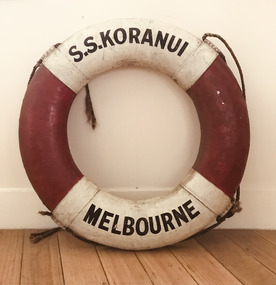
Equipment - Lifebuoy, S.S. Koranui, Melbourne
... ...lifebelt...The lifebuoy is a essential piece of equipment on a ship; as it has the name of the ship written on it it is often a memorabilia kept after the ship has changed name or has been broken up. buoy safety wheel lifebelt water wheely ring buoy lifering lifesaver life donut life preserver perry buoy mission to seafarers seamen's mission ss koranui new zeaaland union steam ship company of new zealand rescue life saving equipment Black writing on white sections of buoy: "S.S. ...According to the shipslist.com, the Union Steam Ship Company of New Zealand had 3 ships called Koranui. Koranui (1) 1883 1885 taken over with Black Diamond Line fleet, 1889 wrecked Blind Bay. 448 Koranui (2) 1914 ex- Cleopatra (A.Kirsten, Hamburg), 1920 war reparations and renamed, 1953 to J. Hagen, Noumea, renamed Neo Hebridais II. 1,266 Koranui (3) 1956 1976 sold to Maldives, renamed South Pacific. 3,722 The buoy is most likely coming from one of the last two on te list. The lifebuoy is a essential piece of equipment on a ship; as it has the name of the ship written on it it is often a memorabilia kept after the ship has changed name or has been broken up. Ring shaped life preserver from SS Koranui divided into four sections alternating between red and white colourings. Black writing on white sections of buoy: "S.S. KORANUI/MELBOURNE" buoy, safety wheel, lifebelt, water wheely, ring buoy, lifering, lifesaver, life donut, life preserver, perry buoy, mission to seafarers, seamen's mission, ss koranui, new zeaaland, union steam ship company of new zealand, rescue, life saving equipment -
 Mission to Seafarers Victoria
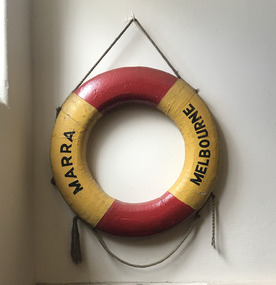
Equipment - Lifebuoy, Marra Melbourne, 1955-1984
... ...lifebelt...Because the name of the ships it belongs to is written on it is often the only memorabilia left from the ship when it is sent to scrapyard. safety wheel lifebelt water wheely ring buoy lifering lifesaver life donut life preserver Perry buoy lifebuoy lifesaving equipment rescue drowning vietnam war adelaide steamship john monash australian army life buoy In black paint on the front of the buoy: "MARRA MELBOURNE" Round buoy decorated in red and yellow sections with the word "Marra Melbourne" painted on the front. ...Marra was a refrigerated cargo ship built by Ardrossan Dry Dock & Ship Building Co. in 1955. The first owner was the Adelaide Steamship Co. Ltd., Melbourne . 1,396 gross tons. Lbd: 233'2" x 37'8" x 14'9". in May 1965 it was sold to the Australian Army and renamed AS3051 (John Monash) and provided a shuttle service from Australia to Vietnam transporting cargo for the Australian Task Force. In September 1974, it was sold to unknown buyers however prior to that sale, she worked the West Australian coast being used on the Ord River Project under 'Stateships' perhaps under lease. The Clydebuilt shipsite states she was renamed Asian Queen in 1976 , Arabian Victory in 1980 and finally Sea Rose in 1981. The ship was scrapped in May 1984 at Gadani Beach, Pakistan. Lifebuoys are an essential piece of equipment on a ship. Because the name of the ships it belongs to is written on it is often the only memorabilia left from the ship when it is sent to scrapyard. Round buoy decorated in red and yellow sections with the word "Marra Melbourne" painted on the front. There is a rope that is strung through sections of the exterior. In black paint on the front of the buoy: "MARRA MELBOURNE" safety wheel, lifebelt, water wheely, ring buoy, lifering, lifesaver, life donut, life preserver, perry buoy, lifebuoy, lifesaving equipment, rescue, drowning, vietnam war, adelaide steamship, john monash, australian army, life buoy -
 Glenelg Shire Council Cultural Collection
Medal - Medal - Admella Shipwreck - awarded to John Dusting, Brush and MacDonnell, 1859
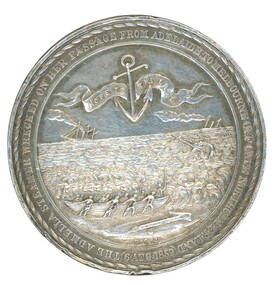
... The three onboard lifeboats were washed away as were the four cork lifebelts kept on deck. Rubber lifebelts kept below deck were instantly lost. ...The three onboard lifeboats were washed away as were the four cork lifebelts kept on deck. Rubber lifebelts kept below deck were instantly lost. ...On Friday 5 August 1859, the steamship, Admella, left Adelaide bound for Melbourne. IT carried 82 passengers, a crew of 31 and 4 racehorses. he Admella was a 395 ton screw steamer built at Port Glasgow, Scotland in 1857. Her name is said to be derived from the ports she served - Adelaide, Melbourne and Launceston. It took her 42 hours to travel between Adelaide and Melbourne, usually stopping at Portland, Port Fairy and Warrnambool, making her the fastest ship to travel this route. The Admella’s final journey was her 36th voyage. Admella had been built with watertight bulkheads, riveted to the hull. These were designed as a special safety feature, but when the ship grounded on Carpenters Rocks it took only 15 minutes for the hull to break in three along the rivet lines. Many people were drowned immediately, and six horses stabled on deck tried to swim to shore. At least one of them made it alive. On Saturday August 6 1859, at 5am, Admella struck a reef. The three onboard lifeboats were washed away as were the four cork lifebelts kept on deck. Rubber lifebelts kept below deck were instantly lost. Cape Northumberland Lighthouse near Port McDonnell was about 24 km away so Captain McEwan ordered rocket flares to be fired to gain attention. However, all the ship’s rockets were damp. Only one ignited but soon fizzled out. The Captain attempted to make a raft but was unsuccessful and nearly drowned in the process. The ship was only about a kilometre from shore, but the surf, currents, cold water and sharks resulted in five men dying trying to reach safety. It wasn’t until Sunday afternoon that two sailors, managed to get to shore using a raft. It took them three hours and they then had to walk about 32 kilometres along the shore in the dark to Northumberland Lighthouse without shoes. They were met by Ben Germein the lighthouse keeper. His horse had died so he had to walk to a nearby station to borrow a horse. The horse he chose threw him off so in the end the station owner, Peter Black, rode the 24 km to the Mount Gambier telegraph station to share the news of the disaster. After several unsuccessful rescue attempts, eight days after the initial disaster, 19 people were rescued by the Portland Lifeboat and three people, including Captain McEwan were rescued in one of Admella’s lifeboats which had been found on the shore and fixed. It was captained by Ben Germein with six volunteer oarsmen. This was Germain’s sixth attempt to reach the wreck in the damaged boat. Of the 113 people on board Admella at the time of her wreck only 24 survived. At the official enquiry into the disaster, fog, lightning, compasses and bad mapping were all considered as the cause, but finally the swift and unpredictable currents which run between Cape Jaffa and Cape Northumberland were given the official blame. This medal is associated with one of Australia's worst maritime disasters, the wreck of SS Admella. This incident is significant to Portland because the Portland Lifeboat and its crew took part in a heroic rescue. 19 people were rescued by the crew of the Lifeboat. The Portland Lifeboat is listed on Victoria's State Heritage Register. Round silver medal awarded to John Dusting by the Victorian Colonists for his heroic efforts as part of the crew of the Portland Lifeboat in the rescue of survivors of the Admella Shipwreck. Admella wrecked off the South Australian Coast in 1859. This silver medal was one of only 39 silver medals awarded. There were 3 gold medals awarded. The medal is presented in a blue box. The box has beveled edges. Inside the lid is a fabric insert with details of the silversmith printed. The medal sits in a circular insert with a blue ribbon for taking the medal out with ease. Obverse: Scene of shipwreck near the coastline. In the foreground there is the Portland Lifeboat with crew. Above is an anchor with ribbon. Text around the edge of the medal reads 'The Admella Steamer wrecked on her passage from Adelaide to Melbourne off Cape Northumberland'. Across the ribbon - Hope to the last Reverse: Wreath around the edge. Beams of light from the sky. Text reads: Awarded to John Dusting/ By the Victorian Colonists / For / Heroic Exertions / In Saving Life / (Under divine providence) / From the wreck of the Admella portland lifeboat, admella, shipwrecks, admella shipwreck, admella medals, dusting, glenelg shire council cultural collection, portland -
 Glenelg Shire Council Cultural Collection
Medal - Box for Medal - Admella Shipwreck - awarded to John Dusting, Brush and MacDonnell, 1859
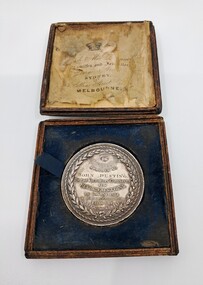
... The three onboard lifeboats were washed away as were the four cork lifebelts kept on deck. Rubber lifebelts kept below deck were instantly lost. ...The three onboard lifeboats were washed away as were the four cork lifebelts kept on deck. Rubber lifebelts kept below deck were instantly lost. ...On Friday 5 August 1859, the steamship, Admella, left Adelaide bound for Melbourne. IT carried 82 passengers, a crew of 31 and 4 racehorses. he Admella was a 395 ton screw steamer built at Port Glasgow, Scotland in 1857. Her name is said to be derived from the ports she served - Adelaide, Melbourne and Launceston. It took her 42 hours to travel between Adelaide and Melbourne, usually stopping at Portland, Port Fairy and Warrnambool, making her the fastest ship to travel this route. The Admella’s final journey was her 36th voyage. Admella had been built with watertight bulkheads, riveted to the hull. These were designed as a special safety feature, but when the ship grounded on Carpenters Rocks it took only 15 minutes for the hull to break in three along the rivet lines. Many people were drowned immediately, and six horses stabled on deck tried to swim to shore. At least one of them made it alive. On Saturday August 6 1859, at 5am, Admella struck a reef. The three onboard lifeboats were washed away as were the four cork lifebelts kept on deck. Rubber lifebelts kept below deck were instantly lost. Cape Northumberland Lighthouse near Port McDonnell was about 24 km away so Captain McEwan ordered rocket flares to be fired to gain attention. However, all the ship’s rockets were damp. Only one ignited but soon fizzled out. The Captain attempted to make a raft but was unsuccessful and nearly drowned in the process. The ship was only about a kilometre from shore, but the surf, currents, cold water and sharks resulted in five men dying trying to reach safety. It wasn’t until Sunday afternoon that two sailors, managed to get to shore using a raft. It took them three hours and they then had to walk about 32 kilometres along the shore in the dark to Northumberland Lighthouse without shoes. They were met by Ben Germein the lighthouse keeper. His horse had died so he had to walk to a nearby station to borrow a horse. The horse he chose threw him off so in the end the station owner, Peter Black, rode the 24 km to the Mount Gambier telegraph station to share the news of the disaster. After several unsuccessful rescue attempts, eight days after the initial disaster, 19 people were rescued by the Portland Lifeboat and three people, including Captain McEwan were rescued in one of Admella’s lifeboats which had been found on the shore and fixed. It was captained by Ben Germein with six volunteer oarsmen. This was Germain’s sixth attempt to reach the wreck in the damaged boat. Of the 113 people on board Admella at the time of her wreck only 24 survived. At the official enquiry into the disaster, fog, lightning, compasses and bad mapping were all considered as the cause, but finally the swift and unpredictable currents which run between Cape Jaffa and Cape Northumberland were given the official blame. This medal is associated with one of Australia's worst maritime disasters, the wreck of SS Admella. This incident is significant to Portland because the Portland Lifeboat and its crew took part in a heroic rescue. 19 people were rescued by the crew of the Lifeboat. The Portland Lifeboat is listed on Victoria's State Heritage Register. The medal is presented in a blue box. The box has beveled edges. Inside the lid is a fabric insert with details of the silversmith printed. The medal sits in a circular insert with a blue ribbon for taking the medal out with ease. portland lifeboat, admella, shipwrecks, admella shipwreck, admella medals, dusting, glenelg shire council cultural collection, portland -
 Glenelg Shire Council Cultural Collection
Medal - Medal - Admella Shipwreck - awarded to John Dusting, Brush and MacDonnell, 1859
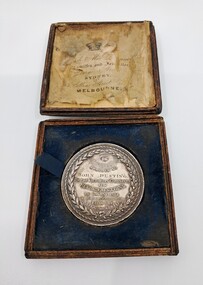
... The three onboard lifeboats were washed away as were the four cork lifebelts kept on deck. Rubber lifebelts kept below deck were instantly lost. ...The three onboard lifeboats were washed away as were the four cork lifebelts kept on deck. Rubber lifebelts kept below deck were instantly lost. ...On Friday 5 August 1859, the steamship, Admella, left Adelaide bound for Melbourne. IT carried 82 passengers, a crew of 31 and 4 racehorses. he Admella was a 395 ton screw steamer built at Port Glasgow, Scotland in 1857. Her name is said to be derived from the ports she served - Adelaide, Melbourne and Launceston. It took her 42 hours to travel between Adelaide and Melbourne, usually stopping at Portland, Port Fairy and Warrnambool, making her the fastest ship to travel this route. The Admella’s final journey was her 36th voyage. Admella had been built with watertight bulkheads, riveted to the hull. These were designed as a special safety feature, but when the ship grounded on Carpenters Rocks it took only 15 minutes for the hull to break in three along the rivet lines. Many people were drowned immediately, and six horses stabled on deck tried to swim to shore. At least one of them made it alive. On Saturday August 6 1859, at 5am, Admella struck a reef. The three onboard lifeboats were washed away as were the four cork lifebelts kept on deck. Rubber lifebelts kept below deck were instantly lost. Cape Northumberland Lighthouse near Port McDonnell was about 24 km away so Captain McEwan ordered rocket flares to be fired to gain attention. However, all the ship’s rockets were damp. Only one ignited but soon fizzled out. The Captain attempted to make a raft but was unsuccessful and nearly drowned in the process. The ship was only about a kilometre from shore, but the surf, currents, cold water and sharks resulted in five men dying trying to reach safety. It wasn’t until Sunday afternoon that two sailors, managed to get to shore using a raft. It took them three hours and they then had to walk about 32 kilometres along the shore in the dark to Northumberland Lighthouse without shoes. They were met by Ben Germein the lighthouse keeper. His horse had died so he had to walk to a nearby station to borrow a horse. The horse he chose threw him off so in the end the station owner, Peter Black, rode the 24 km to the Mount Gambier telegraph station to share the news of the disaster. After several unsuccessful rescue attempts, eight days after the initial disaster, 19 people were rescued by the Portland Lifeboat and three people, including Captain McEwan were rescued in one of Admella’s lifeboats which had been found on the shore and fixed. It was captained by Ben Germein with six volunteer oarsmen. This was Germain’s sixth attempt to reach the wreck in the damaged boat. Of the 113 people on board Admella at the time of her wreck only 24 survived. At the official enquiry into the disaster, fog, lightning, compasses and bad mapping were all considered as the cause, but finally the swift and unpredictable currents which run between Cape Jaffa and Cape Northumberland were given the official blame. This medal is associated with one of Australia's worst maritime disasters, the wreck of SS Admella. This incident is significant to Portland because the Portland Lifeboat and its crew took part in a heroic rescue. 19 people were rescued by the crew of the Lifeboat. The Portland Lifeboat is listed on Victoria's State Heritage Register. Only 39 silver medals were awarded after the incident. Three gold medals were awarded. Round silver medal awarded to John Dusting by the Victorian Colonists for his heroic efforts as part of the crew of the Portland Lifeboat in the rescue of survivors of the Admella Shipwreck. Admella wrecked off the South Australian Coast in 1859. This silver medal was one of only 39 silver medals awarded. There were 3 gold medals awarded. The medal is presented in a blue box. The box has beveled edges. Inside the lid is a fabric insert with details of the silversmith printed. The medal sits in a circular insert with a blue ribbon for taking the medal out with ease. Obverse: Scene of shipwreck near the coastline. In the foreground there is the Portland Lifeboat with crew. Above is an anchor with ribbon. Text around the edge of the medal reads 'The Admella Steamer wrecked on her passage from Adelaide to Melbourne off Cape Northumberland'. Across the ribbon - Hope to the last Reverse: Wreath around the edge. Beams of light from the sky. Text reads: Awarded to John Dusting/ By the Victorian Colonists / For / Heroic Exertions / In Saving Life / (Under divine providence) / From the wreck of the Admella admella, portland, glenelg shire council cultural collection, portland lifeboat, admella shipwreck, shipwreck -
 Flagstaff Hill Maritime Museum and Village
Photograph - S. S. Casino, Early 19th century
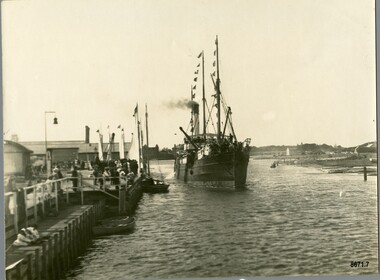
... In 1916 new regulations introduced by the Marine Board requiring the Casino to carry enough lifebelts for every passenger on board, prevented the steamer from making trips around the Bay on excursion days. ...In 1916 new regulations introduced by the Marine Board requiring the Casino to carry enough lifebelts for every passenger on board, prevented the steamer from making trips around the Bay on excursion days. ...This photograph was one of ten photographs donated to Flagstaff Hill Maritime Museum and Village by Fred Trewartha. Frederick John Fox Trewartha (Fred) was a well-known Warrnambool businessman. He was born in Beeac near Geelong in 1920 and came to Warrnambool with his family as a very young child. He was apprenticed to his father John, as a saddler and later opened his own shop on Raglan Parade. He then moved into working with tarpaulins and canvases for the trucking industry. Fred was keenly interested in photography (and was a member of the Warrnambool Cine Club), yachting and boat building. He kept his yacht moored at Port Fairy for many years and participated in sailing events locally and interstate. He also built boats with his sons. He had the opportunity to meet many older sailors and it's thought this photo (and others in the set) may have been given to him by one of these men. Fred Trewartha died in 2016 in Warrnambool. The S.S. Casino was a passenger and freight steamer built in Dundee, Scotland, in 1882 for the Newcastle and Hunter River Steam Navigation Company of N.S.W. She weighed 425 tons gross with a length of 160.4 feet, beam of 24.1 feet and a depth of 10.2 feet. She had saloon accommodation for 35 people, a fore cabin for 25 more people, and she carried 300 tons of cargo. While on her delivery journey on May 30th 1882, the S.S. Casino called in at the Port of Warrnambool for coal, narrowly escaping going ashore in gale force winds due to the quick action of the pilot. At that time, still at anchor, she impressed the directors of the Belfast and Koroit Steam Navigation Company so much that they bought her immediately; she was ideal for trade along the West Coast of Victoria. (The Belfast and Koroit Steam Navigation Company was first managed by Messers. Saltau and Osburne and after the passing of Mr. Osburne, by produce merchants Messers H. Sautau and Sons, who had a hay and corn store and shipping agency on the corner of Liebig and Koroit Streets in Warrnambool. ) The S.S. Casino became “the most famous steamer to operate in Victorian waters along the West Coast” by author Jack Loney. Captain Boyd was her first Master, followed by Captain Chapman, who stayed with her from 1890 until 1924. Captain W. Robertson followed for a short term, and then Captain Middleton then took command from 1925 - 1932. An article published on Monday 11th June 1932 in The Sun News Pictorial (Melbourne) giving a detailed history of S. S. Casino said "owned by Port Fairy interests, she was an integral part of the town's development ... for a long time, her arrival in Port Fairy was an event, the townspeople going down to the wharf to see her come in". It also said "Except when the weather was bad, the Casino hugged the coast on her trips and passengers obtained wonderful views of the sandstone terraces and caves. A little time ago every member of her regular crew except one, was a Scotsman." This particular photograph of the S.S. Casino shows it decorated with numerous flags in "holiday rigging". During the years between 1884 and 1915, the Casino would take locals and holiday makers on excursions around the Port Fairy Bay. Local towns such as Terang, Penshurst and Mortlake held their Picnic Days in Port Fairy and excursions on the Casino would be available for them and in 1906 Terang and District Schools held an excursion to Port Fairy (where the Casino was organised to provide a series of trips around the Bay.) In 1916 new regulations introduced by the Marine Board requiring the Casino to carry enough lifebelts for every passenger on board, prevented the steamer from making trips around the Bay on excursion days. The S.S. Casino had several mishaps during her life. One was on 3rd January 1898 when she collided with the S.S. Flinders in Apollo Bay with minor damage. Another was on 24th October 1924 when she grounded on a reef at Point Hawdon near Grey River and most of her cargo (of Christmas goods) had to be dumped into the sea. Then in February 1929 she was ‘holed’ when she struck a submerged object as she entered Lady Bay, Warrnambool. In the years following the turn of the century, the S.S. Casino remained the only regular trader with normal passenger accommodation along the West Coast. From 1882 she had made at least 2,500 voyages on the one run. On the morning of 10th July 1932, after attempting to berth at Apollo Bay jetty in heavy seas, Captain Middleton decided to take her out into the bay and wait until the seas abated. It was not realised that the anchor used to steady her as she manoeuvred to her berth had pierced her hull. She put about and headed for the beach but sank. Captain Middleton and nine others lost their lives; nine people were rescued including the two female passengers. Captain Middleton had been in charge of the S.S. Casino for seven years. He was the first ship’s Master to lose his life in a shipwreck in the West Coast trade. In June 1932, the directors of the Belfast and Koroit Steam Navigation Company had proposed to celebrate the completion of fifty years of trading by the steamer Casino in August, but tragically the Casino was wrecked only one month later (and "was only one month off completing its fifty years of valuable service between Melbourne and Portland.") Flagstaff Hill’s collection has a photograph of a portrait of Captain Chapman, a ship model of the S.S. Casino that shows both forms of power under which she sailed, steam and sail. The ship is painted green and flies three flags. The inscription across the case of the ship model, incorrectly dated, tells the sad story of the wreck of the ship and the loss of lives on July 10th 1932 at Apollo Bay. A print in the Collection shows S.S. Casino underway in the heavy sea off Point Lonsdale, another two photographs show her at the Port of Warrnambool, leaving from the Breakwater in Lady Bay and another identifies the S.S. Casino as a ship from the Belfast and Koroit Steam Navigation Company. (Belfast is the original name for the township of Port Fairy). This photograph is significant because of its association with the coastal trader S.S. Casino and its significance to trade along Victoria's West Coast in the late 19th and early 20th centuries. The wreck of the S.S. Casino is considered an important part of Victorian and Australian cultural heritage and as such has been declared and protected as an Historic Shipwreck under State and Commonwealth Law in the Commonwealth Historic Shipwrecks Act (1976). A black and white photograph showing a small steamer with decorative flags on both masts, coming into up a river towards a pier where a small crowd is waiting. The pier on the left of the photograph has several buildings and a bell on it. Three small boats are tied up to the dock. Low lying land with several buildings scattered on it can be seen on the right hand side. On the back of the photograph are handwritten labels. One is printed in dark blue ink and one is written in cursive writing in biro. There is also the number 6944 stamped in the centre of the photograph. Back - Donors name, address and telephone number 6944 "CASINO IN HOLIDAY RIG" "at Port Fairy" flagstaff hill maritime museum and village, warrnambool, great ocean road, shipwreck coast, s. s. casino, steamer casino, casino, port fairy, captain chapman, belfast and koroit steam navigation company, saltau and osburne, captain middleton, apollo bay, apollo bay shipwreck, lady bay
