
Showing 6 items matching "limestone wagon"
-
 Eltham District Historical Society Inc
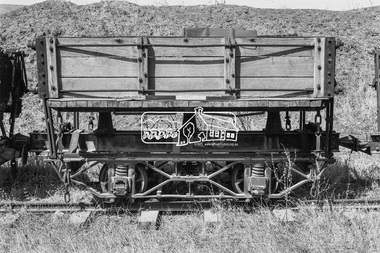
Photograph, Wooden limestone wagon 242, Fyansford Cement Works Railway, November 1962, 1962
... Wooden limestone wagon 242, Fyansford Cement Works Railway, November 1962...fyansford cement works railway, george coop collection, Limestone wagon, wagon...fyansford cement works railway, george coop collection, Limestone wagon, wagon Digital TIFF file Scan of 35mm Ilford FP3 black and white negative transparency Wooden limestone wagon 242, Fyansford Cement Works Railway, November 1962 Photograph George Coop George Coop ...Digital TIFF file Scan of 35mm Ilford FP3 black and white negative transparencyfyansford cement works railway, george coop collection, limestone wagon, wagon -
 Eltham District Historical Society Inc
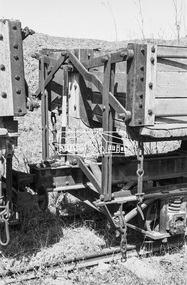
Photograph, Wooden limestone wagon 242, Fyansford Cement Works Railway, November 1962, 1962
... Wooden limestone wagon 242, Fyansford Cement Works Railway, November 1962...fyansford cement works railway, george coop collection, limestone wagon, wagon...fyansford cement works railway, george coop collection, limestone wagon, wagon Digital TIFF file Scan of 35mm Ilford FP3 black and white negative transparency Wooden limestone wagon 242, Fyansford Cement Works Railway, November 1962 Photograph George Coop George Coop ...Digital TIFF file Scan of 35mm Ilford FP3 black and white negative transparencyfyansford cement works railway, george coop collection, limestone wagon, wagon -
 Eltham District Historical Society Inc
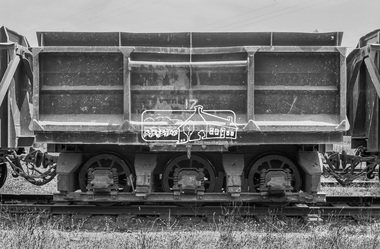
Photograph, George Coop, Limestone wagon 17, Fyansford Cement Works Railway, c.Feb. 1964
... Limestone wagon 17, Fyansford Cement Works Railway......Limestone wagon...Narrow gauge private railway Fyansford Cement Works Railway Geelong George Coop Collection Limestone wagon Digital TIFF file Scan of 35mm Ilford FP3 black and white transparency Limestone wagon 17, Fyansford Cement Works Railway Photograph Photograph George Coop ...Narrow gauge private railwayDigital TIFF file Scan of 35mm Ilford FP3 black and white transparencyfyansford cement works railway, geelong, george coop collection, limestone wagon -
 Eltham District Historical Society Inc
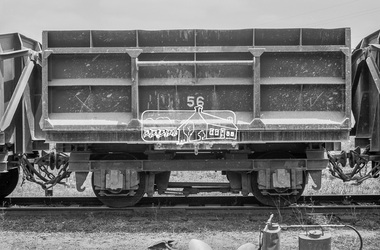
Photograph, George Coop, Limestone wagon 56, Fyansford Cement Works Railway, c.Feb. 1964
... Limestone wagon 56, Fyansford Cement Works Railway......Limestone wagon...Narrow gauge private railway Fyansford Cement Works Railway Geelong George Coop Collection Limestone wagon Digital TIFF file Scan of 35mm Ilford FP3 black and white transparency Limestone wagon 56, Fyansford Cement Works Railway Photograph Photograph George Coop ...Narrow gauge private railwayDigital TIFF file Scan of 35mm Ilford FP3 black and white transparencyfyansford cement works railway, geelong, george coop collection, limestone wagon -
 Flagstaff Hill Maritime Museum and Village
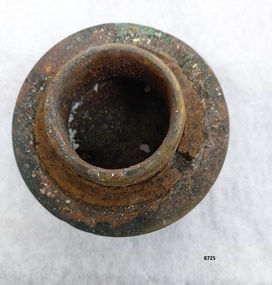
Functional object - Hub Cap Nut, Circa 1870's
... wagons and carriages. It is not known if this brass hub nut cap was part of this cargo manifest or was a fitting on the Loch Ard. There were also items included that were intended for display in the Melbourne International Exhibition in 1880 - a diverse general cargo ranging from luxury items to bulk railway iron. On 1 June 1878, emerging from fog and hearing too late the sound of breakers against the tall limestone...wagons and carriages. It is not known if this brass hub nut cap was part of this cargo manifest or was a fitting on the Loch Ard. There were also items included that were intended for display in the Melbourne International Exhibition in 1880 - a diverse general cargo ranging from luxury items to bulk railway iron. On 1 June 1878, emerging from fog and hearing too late the sound of breakers against the tall limestone ...This hub cap nut was recovered from the wreck of the Loch Ard and donated by a friend of the diver. The ship Loch Ard was built on the River Clyde in Scotland in 1873 for the prestigious Loch Line of colonial clipper ships, designed for the Australian run. It sailed from Gravesend, England on 1st March 1878 carrying 37 crew, 17 passengers and a load of cargo. The manifest listed an array of manufactured goods being exported to the Colony of Victoria reflecting the affluence of Melbourne at the time. Included in the cargo manifest were straw hats, umbrellas, perfumes, clay pipes, pianos, clocks, confectionary, linen and candles, as well as one timber carriage, 29 chaff cutters and thirty-four pairs of metal axle components for horse drawn wagons and carriages. It is not known if this brass hub nut cap was part of this cargo manifest or was a fitting on the Loch Ard. There were also items included that were intended for display in the Melbourne International Exhibition in 1880 - a diverse general cargo ranging from luxury items to bulk railway iron. On 1 June 1878, emerging from fog and hearing too late the sound of breakers against the tall limestone cliffs, the vessel struck the southern foot of Mutton Bird Island and sank in 23 metres of water. Of the fifty-four people on board only two survived, one young male crewman, Tom Pearce, and one young female passenger, Eva Carmichael. Ten days after the Loch Ard tragedy, salvage rights to the wreck were sold at auction for £2,120. Cargo valued at £3,000 was salvaged and placed on the beach, but most washed back into the sea when another storm developed. The wreck of Loch Ard still lies at the base of Mutton Bird Island. Much of the cargo has now been salvaged and some was washed up into what is now known as Loch Ard Gorge. Cargo and artefacts have also been illegally salvaged over many years before protective legislation was introduced in 1976. One of the most unlikely pieces of cargo to have survived the shipwreck was a Minton porcelain peacock - one of only seven in the world. The peacock was destined for the Melbourne International Exhibition in 1880. It had been well packed, which gave it adequate protection during the violent storm. Today, the Minton peacock can be seen at the Flagstaff Hill Maritime Museum in Warrnambool. From Australia's most dramatic shipwreck it has now become Australia's most valuable shipwreck artefact and is one of very few 'objects' on the Victorian State Heritage Register.Flagstaff Hill’s collection of artefacts from LOCH ARD is significant for being one of the largest collections of artefacts from this shipwreck in Victoria. It is significant for its association with the shipwreck, which is on the Victorian Heritage Register (VHR S417). The collection is significant because of the relationship between the objects, as together they have a high potential to interpret the story of the LOCH ARD. The LOCH ARD collection is archaeologically significant as the remains of a large international passenger and cargo ship. The LOCH ARD collection is historically significant for representing aspects of Victoria’s shipping history and its potential to interpret sub-theme 1.5 of Victoria’s Framework of Historical Themes (living with natural processes). The collection is also historically significant for its association with the LOCH ARD, which was one of the worst and best known shipwrecks in Victoria’s history.A round brass hub cap nut consisting of a flat, octagonal, hollow nut (with concave sides and green verdigis), a 2cm wide flange and a 2 cm deep threaded shank with brown corrosion. It has a rusty washer corroded onto the flange.flagstaff hill maritime museum and village, warrnambool, great ocean road, shipwreck coast, loch ard, loch ard wreck, loch ard salvage, loch ard artifacts, hub cap nut, hub cap, wagon hub cap -
 Otway Districts Historical Society
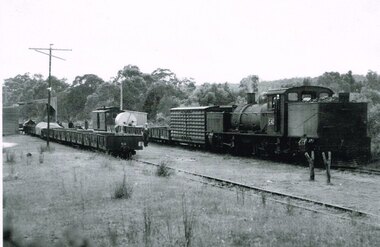
Photograph, R. Preston, Kawarren: Down goods with G42 shunting, 1955, 14 December 1955
... limestone; timber; charcoal; B/W. G42 with a Down goods train at Kawarren on 14 December 1955. On No.2 Road empty NQR wagons proceeding to get filled at a covered lime loading operation. ...Originally known as Loves River it became Kawarren station on 16 June 1902. It consisted of a loop siding and combined office and passenger shelter. Goods loading was sawn timber (brought in on four tramways operating between 1905 and 1939), firewood, charcoal and limestone. In 1920 the limestone company built a store shed and a covered loading area at the terminus to assist operations. The company also requested the siding to be extended by three metres, which Victorian Railways did in the same year. This gave the loop a capacity of 21 trucks. Around 2,000 tonnes per year of limestone traffic kept the station busy until trade ceased in 1957. A postal motor started in October 1938, Kawarren being a point where the postal motor and trains were permitted to cross.B/W. G42 with a Down goods train at Kawarren on 14 December 1955. On No.2 Road empty NQR wagons proceeding to get filled at a covered lime loading operation. A three workmen are checking aspects of the train while a group appear to be clustered at the guard's van around an NKS motor trolley.kawarren; railways; limestone; timber; charcoal;
