
Showing 4 items matching "lion paw feet"
-
 Flagstaff Hill Maritime Museum and Village
Container - Jardiniere, ca 1920
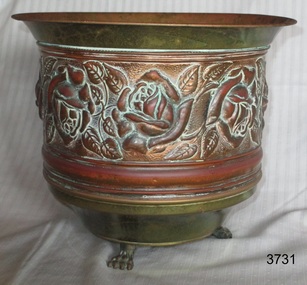
... ...lion paw feet...Plant container: brass and copper jardinière, with tooled and pressed ornamental rose design on a band of copper around the planter and braised seam joins. Three short lion paw feet support the base. Part of the Giles Collection. ...Three short lion paw feet support the base. Part of the Giles Collection. ...This jardinière is one of many 19th and early 20th-century items donated to Flagstaff Hill Maritime Village by the Giles Family. It would have been used to contain a potted plant or similar foliage to decorate a room. Donated to Flagstaff Hill Maritime Village by Vera and Aurelin Giles, this item is associated with Warrnambool and the Giles Family history. Many items have been donated by the family and have come to be known as the “Giles Collection”. Many items in the Lighthouse Keeper’s Cottage that were donated by Vera and Aurelin Giles mostly came from the home of Vera’s parents-in-law, Henry Giles and his wife Mary Jane (nee Freckleton), who married in 1880 and whose photos are on display in the parlour. Henry was born at Tower Hill in 1858 and was a labourer on the construction of the Warrnambool Breakwater before leaving in 1895 for around seven years to build bridges in NSW. Mary Jane was born in 1860 at Cooramook, and she attended Mailor’s Flat State School and where she eventually became a student teacher. After which she became a governess at “Injemiara”, where her grandfather, Francis Freckleton, had once owned land. Henry and Mary’s family consisted of six; some of the children were born at Mailor’s Flat, and later, some children were born at Wangoom. They lived with their parents at Wangoom and Purnim west, and this is where Henry died in 1933 and Mary Jane died in 1940. The Giles family collection has social significance at a local level, because it illustrates the level of material support the Warrnambool community gave to Flagstaff Hill when the Museum was established. It also represents typical furniture and household goods owned by settlers in the Warrnambool District in the late 19th and early 20th century. The Jardinière is a good example of late Victorian memorabilia that was to be found in many homes of the period.Plant container: brass and copper jardinière, with tooled and pressed ornamental rose design on a band of copper around the planter and braised seam joins. Three short lion paw feet support the base. Part of the Giles Collection. An inscription is on a sticker under the base.Handwritten: "$85"flagstaff hill, warrnambool, shipwrecked coast, flagstaff hill maritime museum, flagstaff hill maritime village, great ocean road, emigrants from ireland, giles collection, henry giles, tower hill, cooramook, warrnambool breakwater, mailor’s flat, wangoom, 19th century household goods, brass jardinière, plant pot, potted plant, domestic decor, copperware, lion paw feet, rose design -
 Wodonga & District Historical Society Inc
Functional object - Silver Teapot - Upper Murray Region Conservation Award
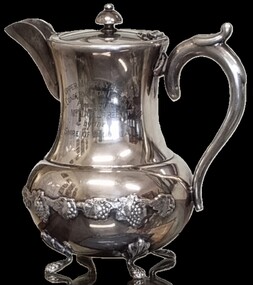
... It features grape vine motifs and has lions paw feet....STREET by the SHIRE OF WODONGA Underneath base, in a circle - Kenson Plate EPNS A1 It features grape vine motifs and has lions paw feet. Silver Teapot - Upper Murray Region Conservation Award Functional object Silver Teapot - Upper Murray Region Conservation Award ...This jug was awarded to John Albert Edward Street for his work in soil conservation at his property, Bandiana Park. John Albert Edward Street was born on the 8th November 1895 in Wodonga, Victoria to George Street and Theresa Emily Davis. He was a grandson of Frederic Street and his wife Sarah nee Kinchington, one of the earliest pioneering families in . On arrival in the Kiewa Valley, Frederic was engaged to run Gundowring Station. In 1852 Frederic took up land at Baranduda. Over the years he consolidated his holdings including land acquired by his seven sons. They established both Bandiana Park and the old Baranduda Homestead. Most of the sons stayed in the Baranduda area. The Street family continued working to farm the original property and John and his brother Clarence were pioneers in implementing soil conservation practices to improve their pastures from the mid1920s. They dissolved their partnership in 1941 but the Street family continued to farm the land until much of the property was acquired by the Albury Wodonga Development Corporation. Mr. J. A. E. Street was a community minded man. He was a member of the provisional committee which formed to establish a Show Society and was a Foundation Member of the Wodonga Show Society s first Committee. He continued to serve the Committee for 30 years. Mr Street also served on the Wodonga Shire Council. After many years of service to the Wodonga community, John Albert Edward Street passed away in Wodonga in 1976.This teapot is significant because it was presented to a prominent Wodonga and district family for their pioneering work in soil conservation.It features grape vine motifs and has lions paw feet.UPPER MURRAY REGION SOIL CONSERVATION COMPETITION Presented to MR. J.A.E. STREET by the SHIRE OF WODONGA Underneath base, in a circle - Kenson Plate EPNS A1soil conservation upper murray, wodonga shire soil conservation -
 Bendigo Historical Society Inc.
Newspaper - LYDIA CHANCELLOR COLLECTION: BENDIGO SURGEON AND WIFE MAKE FURTHER GIFTS TO ART GALLERY
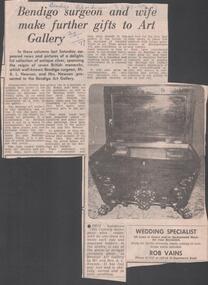
... It has zinc lined ice boxes on each side and magnum holders in the centre. It also has lion paw feet, is skilfully carved and in mint condition. 19/01/1977....It has zinc lined ice boxes on each side and magnum holders in the centre. It also has lion paw feet, is skilfully carved and in mint condition. 19/01/1977. ...An article from the Bendigo Advertiser Amy Huxtable column titled 'Bendigo surgeon and wife make further gifts to Art Gallery.' Mr. and Mrs A. L. Newson donated many pieces of furniture and paintings to the Bendigo Art Gallery. This article includes a photo of a 19th Century mahogany wine cooler. It has zinc lined ice boxes on each side and magnum holders in the centre. It also has lion paw feet, is skilfully carved and in mint condition. 19/01/1977.bendigo, buildings, bendigo art gallery, lydia chancellor collection, collection, antiques, mr. a. l. newson, mrs j. newson, bendigo art gallery, art gallery, building, furniture, antique furniture, paintings, art, artwork, heritage, amy huxtable, newson collection -
 Orbost & District Historical Society
kindling holder, 1880's -1890's
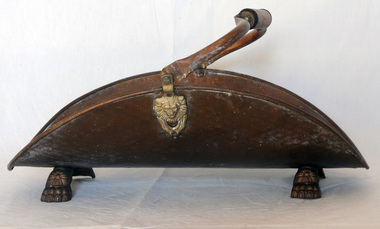
... It has 4 feet in the shape of animal paws (lion?). The handle is attached with lion faces. ...It has 4 feet in the shape of animal paws (lion?). The handle is attached with lion faces. ...A fireplace was the most commonly used form of heating a dwelling, cooking, and heating water for laundry and domestic uses.Fireplace accessories were an important part of the decor of houses as well as being useful items.A curved copper pan. The handle is copper tubing with a wooden handle grip. It has 4 feet in the shape of animal paws (lion?). The handle is attached with lion faces. The paws and feet are brass and attached to the pan with screws.copper fireplace domestic kindling-holder
