
Showing 8 items matching "liver disease"
-
 Alfred Hospital Nurses League - Nursing History Collection
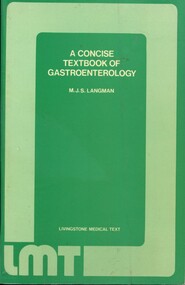
Book - Textbook, M J S Langman 1935-2014, A concise textbook of gastroenterology, 1973
... ...liver disease...Author was a gastroenterologist Gives insight into medical knowledge and practice in the 1970's Gastroenterology liver disease hepatistis oesophogeal disorders malabsorbtion Illustrated vintage textbook of gastroenterology that assumes basic knowledge end empasises on particular the natural history of disease and the likely outcome of treatment Also includes fundamental pathophysiological information Inside front cover at the base is a printed black and white donation sticker: black Maltese cross in circle, 'This book was donated to Alfred Archival Association Nursing Division by'. ...Illustrated vintage textbook of gastroenterology that assumes basic knowledge end empasises on particular the natural history of disease and the likely outcome of treatment Also includes fundamental pathophysiological informationIllustrated book. Front cover has white print on midgreen rectangle detailing title, author and series.Surrounded by a lighter green border. with letters 'LMT' non-fictionIllustrated vintage textbook of gastroenterology that assumes basic knowledge end empasises on particular the natural history of disease and the likely outcome of treatment Also includes fundamental pathophysiological informationgastroenterology, liver disease, hepatistis oesophogeal disorders, malabsorbtion -
 Flagstaff Hill Maritime Museum and Village
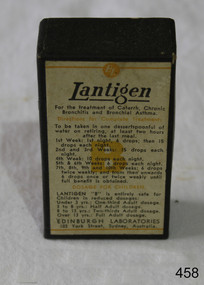
Container - Bottle & Box, Edinburgh Laboratories, Early - Mid 20th Century
... . ……….This study demonstrates Lantigen B's effectiveness in the prevention of bacterial complications and suggests that it can be used in patients who are particularly at risk of infection (children, the elderly, diabetics, and immunocompromised patients) or those in whom an infection might aggravate a clinical picture that is already inherently complicated (diabetics again, but also patients with heart, kidney, or liver disease). https://www.researchgate.net/publication/8349012_Efficacy_of_Lantigen_B_in_the_prevention_of_bacterial_respiratory_infections.... ……….This study demonstrates Lantigen B's effectiveness in the prevention of bacterial complications and suggests that it can be used in patients who are particularly at risk of infection (children, the elderly, diabetics, and immunocompromised patients) or those in whom an infection might aggravate a clinical picture that is already inherently complicated (diabetics again, but also patients with heart, kidney, or liver disease). https://www.researchgate.net/publication/8349012_Efficacy_of_Lantigen_B_in_the_prevention_of_bacterial_respiratory_infections The control of respiratory conditions is essential to public health. ...Respiratory tract infections are among the most common diseases both in adults and children. ………….Lantigen B is an oral product based on bacterial lysates of six different inactivated strains commonly involved in respiratory tract infections. ……….This study demonstrates Lantigen B's effectiveness in the prevention of bacterial complications and suggests that it can be used in patients who are particularly at risk of infection (children, the elderly, diabetics, and immunocompromised patients) or those in whom an infection might aggravate a clinical picture that is already inherently complicated (diabetics again, but also patients with heart, kidney, or liver disease). https://www.researchgate.net/publication/8349012_Efficacy_of_Lantigen_B_in_the_prevention_of_bacterial_respiratory_infectionsThe control of respiratory conditions is essential to public health.Cardboard box containing a glass bottle of Lantigen colloidal mixture.Lantigen. For the treatment of catarrah, chronic bronchitis and bronchial asthma. Edinburgh Laboratories, 103 York Street, Sydney, Australia. Bacterial Vaccine. flagstaff hill, warrnambool, shipwrecked-coast, flagstaff-hill, flagstaff-hill-maritime-museum, maritime-museum, shipwreck-coast, flagstaff-hill-maritime-village, lantigen, medical, respiratory conditions -
 Orbost & District Historical Society
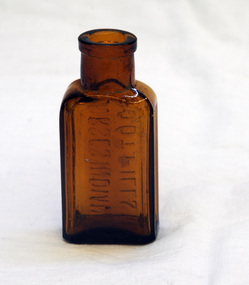
bottle, c. 1930s-1940s
... It was advertised as a specific cure for most blood, stomach and liver diseases. The manufacturers claimed that the pills would "absolutely remove all dyspepsia, giddiness, headache, and are most useful in female disorders." ...It was advertised as a specific cure for most blood, stomach and liver diseases. The manufacturers claimed that the pills would "absolutely remove all dyspepsia, giddiness, headache, and are most useful in female disorders." ...This bottle was found in the pine plantation in Orbost. Comstock’s Morses Indian Root Pills were first manufactured by the American firm in the mid-1850’s but their popularity peaked in Australia in the 1920’s. Indian root is likely Wahoo (Euonymus atropurpureus), a common herb in Native American medicine used as a laxative. One of the most popular patent medicines, Dr. Morse’s Indian Root Pills was almost identical to the hundreds of other cure-alls, or at least claimed to cure the most common ailments of the day. It was advertised as a specific cure for most blood, stomach and liver diseases. The manufacturers claimed that the pills would "absolutely remove all dyspepsia, giddiness, headache, and are most useful in female disorders." (ref. Hagley Museum)This item is an example of a commonly used 'over-the-counter" medicine.A rectangular, brown glass bottle with neck for cork sealing.Morses Indian Root Pills Dose 2 to 4. W. H. Comstockmorses -indian-root-pills bottle medicine health -
 Flagstaff Hill Maritime Museum and Village
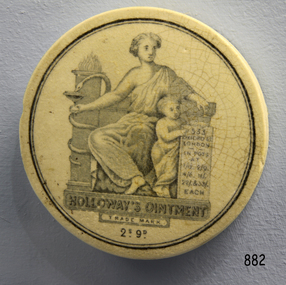
Ceramic - Lid, circa 1878
... Holloway’s claims for his “great remedy” included the cure of sores, wounds, ulcers and boils, gout, rheumatism, diphtheria, bronchitis, influenza, sore throats, coughs and colds, “all varieties of skin diseases”, scrofula, ringworm, scurvy, “dropsical swellings” and liver disease, piles, fistulas, and internal inflammation. ...Holloway’s claims for his “great remedy” included the cure of sores, wounds, ulcers and boils, gout, rheumatism, diphtheria, bronchitis, influenza, sore throats, coughs and colds, “all varieties of skin diseases”, scrofula, ringworm, scurvy, “dropsical swellings” and liver disease, piles, fistulas, and internal inflammation. ...This ceramic lid is from a Holloway’s Ointment pot. It was retrieved from the wreckage of the LOCH ARD. The vessel was laden with an up-to-date, high-value cargo, including luxury items intended for the Melbourne International Exhibition in 1880. Britain exported her manufactures to the Australasian colonies and the Americas. Holloway’s Ointment was one nineteenth-century pharmaceutical product that was advertised in both these markets. The price of this particular jar and its contents was printed on the label as “2S 9D” (2 shillings and nine pence). This value calculated to the approximate price in 2014, would be £51.31 (UK pounds and decimal pence) or $85 AU ― quite an expensive ointment. The label also shows a picture of a stone tablet with the inscription "IN POTS AT 1/½, 2/9, 4/6,11/-, 22/- & 33/- EACH”, which is most likely the alternative prices that the ointment was available for in differently sized containers. Holloway’s claims for his “great remedy” included the cure of sores, wounds, ulcers and boils, gout, rheumatism, diphtheria, bronchitis, influenza, sore throats, coughs and colds, “all varieties of skin diseases”, scrofula, ringworm, scurvy, “dropsical swellings” and liver disease, piles, fistulas, and internal inflammation. The salve cream was said to penetrate the skin when rubbed on; purifying internal tissues and organs, cleansing all bodily fluids particularly the blood, and eradicating all disease from the body. Purchasers were assured that if Holloway’s Ointment alone did not affect immediate cure, then the combination of it and Holloway’s Pills (sold separately) most certainly would. Thomas Holloway began manufacturing and marketing his miraculous ointment from premises at 244 Strand in the 1840s, moving to the more prestigious address of 533 Oxford in the late 1860s. The London address was an important part of his promotional appeal and was displayed prominently on the packaging of his products. Holloway’s attention to marketing is also observed in the pseudo-Classical emblems that decorated his containers. The sign of a snake curled around a staff is a longstanding and commonly recognised symbol of the physician’s power to heal. Similar reference on this lid is also being made to an ancient goddess of healing and her healthy young offspring. History of the Loch Ard: The Loch Ard got its name from ”Loch Ard” a loch which lies to the west of Aberfoyle, and the east of Loch Lomond. It means "high lake" in Scottish Gaelic. The vessel belonged to the famous Loch Line which sailed many vessels from England to Australia. The Loch Ard was built in Glasgow by Barclay, Curdle and Co. in 1873, the vessel was a three-masted square-rigged iron sailing ship that measured 79.87 meters in length, 11.58 m in width, and 7 m in depth with a gross tonnage of 1693 tons with a mainmast that measured a massive 45.7 m in height. Loch Ard made three trips to Australia and one trip to Calcutta before its fateful voyage. Loch Ard left England on March 2, 1878, under the command of 29-year-old Captain Gibbs, who was newly married. The ship was bound for Melbourne with a crew of 37, plus 17 passengers. The general cargo reflected the affluence of Melbourne at the time. Onboard were straw hats, umbrella, perfumes, clay pipes, pianos, clocks, confectionery, linen and candles, as well as a heavier load of railway irons, cement, lead and copper. There were other items included that were intended for display in the Melbourne International Exhibition of 1880. The voyage to Port Phillip was long but uneventful. Then at 3 am on June 1, 1878, Captain Gibbs was expecting to see land. But the Loch Ard was running into a fog which greatly reduced visibility. Captain Gibbs was becoming anxious as there was no sign of land or the Cape Otway lighthouse. At 4 am the fog lifted and a lookout aloft announced that he could see breakers. The sheer cliffs of Victoria's west coast came into view, and Captain Gibbs realised that the ship was much closer to them than expected. He ordered as much sail to be set as time would permit and then attempted to steer the vessel out to sea. On coming head-on into the wind, the ship lost momentum, the sails fell limp and Loch Ard's bow swung back towards land. Gibbs then ordered the anchors to be released in an attempt to hold its position. The anchors sank some 50 fathoms - but did not hold. By this time the ship was among the breakers and the tall cliffs of Mutton Bird Island rose behind. Just half a mile from the coast, the ship's bow was suddenly pulled around by the anchor. The captain tried to tack out to sea, but the ship struck a reef at the base of Mutton Bird Island, near Port Campbell. Waves subsequently broke over the ship and the top deck became loosened from the hull. The masts and rigging came crashing down knocking passengers and crew overboard. When a lifeboat was finally launched, it crashed into the side of Loch Ard and capsized. Tom Pearce, who had launched the boat, managed to cling to its overturned hull and shelter beneath it. He drifted out to sea and then on the flood tide came into what is now known as Lochard Gorge. He swam to shore, bruised and dazed, and found a cave in which to shelter. Some of the crew stayed below deck to shelter from the falling rigging but drowned when the ship slipped off the reef into deeper water. Eva Carmichael a passenger had raced onto the deck to find out what was happening only to be confronted by towering cliffs looming above the stricken ship. In all the chaos, Captain Gibbs grabbed Eva and said, "If you are saved Eva, let my dear wife know that I died like a sailor". That was the last Eva Carmichael saw of the captain. She was swept off the ship by a huge wave. Eva saw Tom Pearce on a small rocky beach and yelled to attract his attention. He dived in and swam to the exhausted woman and dragged her to shore. He took her to the cave and broke the open case of brandy which had washed up on the beach. He opened a bottle to revive the unconscious woman. A few hours later Tom scaled a cliff in search of help. He followed hoof prints and came by chance upon two men from nearby Glenample Station three and a half miles away. In a complete state of exhaustion, he told the men of the tragedy. Tom then returned to the gorge while the two men rode back to the station to get help. By the time they reached Loch Ard Gorge, it was cold and dark. The two shipwreck survivors were taken to Glenample Station to recover. Eva stayed at the station for six weeks before returning to Ireland by steamship. In Melbourne, Tom Pearce received a hero's welcome. He was presented with the first gold medal of the Royal Humane Society of Victoria and a £1000 cheque from the Victorian Government. Concerts were performed to honour the young man's bravery and to raise money for those who lost family in the disaster. Of the 54 crew members and passengers on board, only two survived: the apprentice, Tom Pearce and the young woman passenger, Eva Carmichael, who lost her family in the tragedy. Ten days after the Lochard tragedy, salvage rights to the wreck were sold at auction for £2,120. Cargo valued at £3,000 was salvaged and placed on the beach, but most washed back into the sea when another storm developed. The wreck of Lochard still lies at the base of Mutton Bird Island. Much of the cargo has now been salvaged and some items were washed up into Lochard Gorge. Cargo and artefacts have also been illegally salvaged over many years before protective legislation was introduced in March 1982. One of the most unlikely pieces of cargo to have survived the shipwreck was a Minton majolica peacock- one of only nine in the world. The peacock was destined for the Melbourne 1880 International Exhibition in. It had been well packed, which gave it adequate protection during the violent storm. Today the Minton peacock can be seen at the Flagstaff Hill Maritime Museum in Warrnambool. From Australia's most dramatic shipwreck it has now become Australia's most valuable shipwreck artifact and is one of very few 'objects' on the Victorian State Heritage Register.The shipwreck of the Loch Ard is of significance for Victoria and is registered on the Victorian Heritage Register ( S 417). Flagstaff Hill has a varied collection of artefacts from Loch Ard and its collection is significant for being one of the largest accumulation of artefacts from this notable Victorian shipwreck of which the subject items are a small part. The collections objects give us a snapshot of how we can interpret the story of this tragic event. The collection is also archaeologically significant as it represents aspects of Victoria's shipping history that allows us to interpret Victoria's social and historical themes of the time. Through is associated with the worst and best-known shipwreck in Victoria's history. The ceramic lid off a Holloway’s Ointment container, retrieved from the wreckage of the LOCH ARD. The artefact is white with the pale blue image of a woman (seated) and a child (standing). The woman is draped in a soft white robe and her throne is beside a pillar that is entwined by a serpent. The child points to an inscribed stone tablet he is holding on the other side of seated woman. The front face of the lid, at the base of the woman on the throne, bears the label “HOLLOWAY’S OINTMENT”. Below this, in smaller letters, is written “TRADE MARK” and “2S.9D.” On the stone tablet pointed to by the child is inscribed “533 OXFORD ST. LONDON”, and beneath this, “IN POTS AT 1/½, 2/9, 4/6,11/-, 22/- & 33/- EACH”.flagstaff hill, warrnambool, flagstaff hill maritime museum, shipwreck coast, flagstaff hill maritime village, great ocean road, loch line, loch ard, captain gibbs, eva carmichael, tom pearce, glenample station, mutton bird island, loch ard gorge, holloway’s ointment, ceramic lid, pot lid, nineteenth-century medicines, pharmaceutical marketing -
 Warrnambool and District Historical Society Inc.
Bottle, Chemist - Dr Laws Kennedy, Early 20th century?
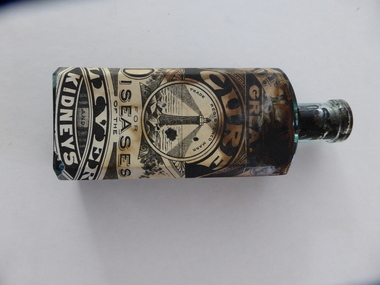
... This is a bottle that contained Dr Law’s medicine for diseases of the liver and kidney. In the late 1800s Richard Kennedy, the Warrnambool chemist, had the sole rights to produce Dr. ...‘Dr Law’s Great Cure for Diseases of the Liver and Kidneys’...This is a bottle that contained Dr Law’s medicine for diseases of the liver and kidney. In the late 1800s Richard Kennedy, the Warrnambool chemist, had the sole rights to produce Dr. ...This is a bottle that contained Dr Law’s medicine for diseases of the liver and kidney. In the late 1800s Richard Kennedy, the Warrnambool chemist, had the sole rights to produce Dr. Law’s medicines in his manufacturing business. Dr Law, from Boston, U.S.A., was a prolific and popular producer of patent medicines. This bottle may have been produced during the time of Richard Kennedy or later on the 20th century when the business of R.F.Kennedy and Co., was still operating or it may have come from any local chemist selling Dr Law’s products in the 20th century. The fact that the label on the bottle has an image of a lighthouse on it is a further link with Richard Kennedy who used a lighthouse image as his trademark (albeit a different image).Richard Kennedy came to Warrnambool in the late 19th century and established a retail, wholesale and manufacturing pharmaceutical business in Timor Street. This business was regarded as one of the largest and finest in Victoria. Richard Kennedy was prominent in community and civic affairs in Warrnambool. This bottle is of interest as a good example of the many patent medicines available in the 19th century. Dr Law’s remedies were sold world-wide. It is also of interest because of its possible link s with the prominent Warrnambool chemist, Richard kennedy. This is a glass bottle with a cork stopper that has been pushed into the neck. The glass was originally clear but it is now very black and stained from the dried liquid that was in the bottle. The label on the front of the bottle, pasted on, has black and white printing with an image of a lighthouse in the middle. The label on the back is pasted on and contains directions for use of the medicine. Both labels are very stained. ‘Dr Law’s Great Cure for Diseases of the Liver and Kidneys’dr law of boston, history of warrnambool, richard kennedy, chemists of warrnambool -
 Coal Creek Community Park & Museum
Bottle, glass, Bottle with these contents c. 1898 - 1920
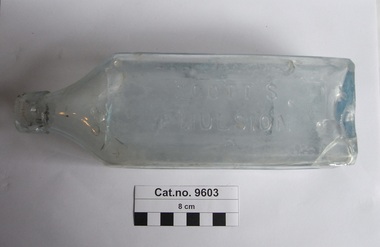
... LIVER OIL And HYPOPHOSPHITES of LIME and SODA. , Almost as PALATABLE as MILK. Possessing the combined virtues of these two valuable remedics in their fullest degree More easily digested and assimilated than in the crude form, and especially desirable for sickly, wasting children, and persons with feeble digestive power, as A REMEDY for CONSUMPTION, A REMEDY for WASTING DISEASES of CHILDREN, A REMEDY for SCROFULA, A REMEDY for ANAEMIA and GENERAL DEBILITY, A REMEDY for COUGHS, COLDS, and THROAT AFFECTIONS; In fact all diseases where there is an inflammation of the Throat and Lungs, a Wasting of the Flesh, and a Want of Nerve Power, nothing in the world equals this palatable EMULSION. lt is prescribed and endorsed by the best physicians in the various countries of the world, who will attest these facts. ...disease. You can't protect youngster against exposure to colds, but you can build their resistance with a course of Scott's Emulsion. Scott's Emulsion supplies just the elements a child need to ensures straight, sturdy body, strong bones, steady nerves and sound lungs. It is a dependable safeguard against colds and coughs. It's just as good for all the family, , For babies under 12 months old give SCOTT'S CLINIC EMULSION without Hypophosphites Scott's Emulsion NATURE'S OWN FOOD TONIC. SE34 cod liver ...TROVE : Herald (Melbourne, Vic. : 1861 - 1954), Friday 31 October 1884, page 4 J SCOTT'S EMULSION 0F1 PURE COD LIVER OIL And HYPOPHOSPHITES of LIME and SODA. , Almost as PALATABLE as MILK. Possessing the combined virtues of these two valuable remedics in their fullest degree More easily digested and assimilated than in the crude form, and especially desirable for sickly, wasting children, and persons with feeble digestive power, as A REMEDY for CONSUMPTION, A REMEDY for WASTING DISEASES of CHILDREN, A REMEDY for SCROFULA, A REMEDY for ANAEMIA and GENERAL DEBILITY, A REMEDY for COUGHS, COLDS, and THROAT AFFECTIONS; In fact all diseases where there is an inflammation of the Throat and Lungs, a Wasting of the Flesh, and a Want of Nerve Power, nothing in the world equals this palatable EMULSION. lt is prescribed and endorsed by the best physicians in the various countries of the world, who will attest these facts. For sale by all chemists. TROVE : Age (Melbourne, Vic. : 1854 - 1954), Tuesday 11 September 1951, page 5 WARNING TO PARENTS Build your family's resistance to colds and 'flu with Scott's Coughs and colds undermine a child's health. and lay him wide open to disease. You can't protect youngster against exposure to colds, but you can build their resistance with a course of Scott's Emulsion. Scott's Emulsion supplies just the elements a child need to ensures straight, sturdy body, strong bones, steady nerves and sound lungs. It is a dependable safeguard against colds and coughs. It's just as good for all the family, , For babies under 12 months old give SCOTT'S CLINIC EMULSION without Hypophosphites Scott's Emulsion NATURE'S OWN FOOD TONIC. SE34 Tall clear aqua tinted glass bottle for stopper seal, rectangular in section, impressed panels on three sides, circle impressed on base, text embossed on all.Front : 'SCOTT'S EMULSION', Sides : COD LIVER OIL', 'WITH LIME & SODA'. Base : '1367', 'K', 'B & Co LTD'.cod liver oil, lime & soda, knottingley, scott & browne, scotts emulsion -
 Coal Creek Community Park & Museum
Bottle, glass, c. 1885
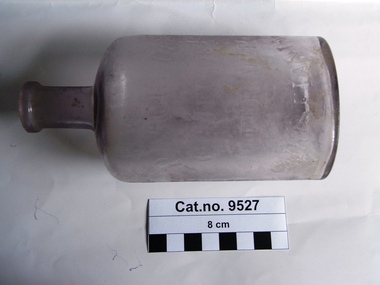
... But it was not before 1645 it was reported that cod liver oil could be used to prevent and cure disease. At the end of the 18th century the first scientific article was published to support this. ...But it was not before 1645 it was reported that cod liver oil could be used to prevent and cure disease. At the end of the 18th century the first scientific article was published to support this. ...150 years of experience and commitment. Norwegians have been producing and exporting cod liver oil for more than 1000 years. But it was not before 1645 it was reported that cod liver oil could be used to prevent and cure disease. At the end of the 18th century the first scientific article was published to support this. In the middle of the 19th century, the pharmacist Peter Möller observed that people along the west coast of Norway consuming cod liver oil regularly were rarely ill. He dedicated himself to finding out how this healthy liquid could be produced with better taste and pureness at a lower price. He developed a method of using steam to extract the oil from fresh cod livers. Based on this technological advance, the company Peter Möller was founded in 1854 in Lofoten on Norway’s arctic coast, where you find pure, cold, clean seas and high quality raw material. Peter Joachim Möller (1793-1869) At first Möller’s Cod Liver Oil was believed to be a good source of vitamin D and A, and the health benefits were associated with these vitamins. Peter Möller believed, however, that there were other significant benefits from fatty acids and other ingredients in the cod liver oil – both known and unknown. Peter Möller was dedicated to understanding more about these benefits. His dedication and commitment is clear in Möller's vision to improve people’s health by delivering the highest quality omega 3 products. Timeline 1793 Peter Möller is born in Røros, Norway 26 April. 1819 Peter Möller travels to Christiania (Oslo) and is employed by the pharmacist Frantz Peckel at the Svane chemist. He is employed on condition that he passes his pharmaceutical exam within one year. 1822 Graduated as a pharmacist with a unanimous first grade and with the award of the Professor's special satisfaction. 1842 Together with professors A. Holst and Chr. Boeck, Peter Möller participates in the commission which develops the first Norwegian Pharmacopoeia. 1853 Peter announces his method to cod liver oil works along the coast. He equips cod liver oil factories with new equipment in Lofoten, Ålesund and Kristiansund. The facility outside Ålesund is the most important for testing the method. 1854 The Peter Möller company is established as production has started at the three factories. Sales are lower than anticipated even though the quality is considerably better with the new method. The consumers of cod liver oil had been used to the fact that “good medicine must taste bad” and would not believe that the new and better quality was as healthy. Therefore, the following years are used to introduce consumers to the product, and also to convert more producers to the new method. 1869 Peter Möller dies. There are 70 cod liver oil steamers which use his steam rendering method, and 5000 barrels are produced every year. Möller’s company increases the quality by better routines for quality controls. 1870 Severin A Heyerdal, Möller’s son-in-law, assumes the leadership of the firm after Peter's death. He continues the work by improving the quality of the cod liver oil. The goal was to make it as pure and unaltered as in the liver. At this time, Möller had already started selling its product in the USA. In 1870, WH Schieffelin & Co. ("The oldest drughouse in America") was engaged by Peter Möller in the USA. 1881 Frantz Peckel Möller assumes the leadership of the Peter Möller company. He saw it as his duty to further the work on cod liver oil, and through a combination of solid scientific education and an eminent sense of the great mercantile possibilities, he made Möller’s cod liver oil the number one in the world market. 1914 The first world war leads to Möller’s bottled cod liver oil being shut out of the export market. However, domestic sales are good. 1924 The subsidiary Møystad Möller & Co. is established for bulk exports and the Association of Medicinal Cod liver oil Exporters is established in Bergen in 1925. 1925/26 The green bottles are introduced. Medicinal cod liver oil exports remain almost constant, while total Norwegian cod liver oil exports increase. 1938 The factory on the Løren grounds in Oslo, Norway is built. The factory is in the same place today. Peter Möller’s Pharmaceutical Laboratorium A/S is also established to separate out the scientific business. Investment is made in a new facility for refining and bottling veterinary cod liver oil, and increased production of industrial cod liver oil. 1940 The outbreak of the 2nd world war sees exports fall dramatically, while cod liver oil’s significance as a dietary supplement receives increased attention. Domestic sales increase strongly. 1945 After the war, medicinal cod liver oil retains its high status as an important dietary supplement in the “rebuilding" of the country. Cod liver oil becomes an ”emergency product in ravaged areas where the supply situation is difficult. Competition from other countries such as the USA, England and Iceland increases, and Norway no longer dominates the market. 1983 Möller’s cod liver oil in capsule form is launched and palatable cod liver oil is launched. 1990 Peter Möller A/S merges with Orkla Borregaard A/S (now ORKLA) 2005 Peter Möller merges with CollettPharma. The new company is called MöllerCollett. 2007 Merger between MöllerCollet and DanskDroge. The new company is called Axellus. Oval in section with a thin neck, mauve tinted clear glass bottle with text embossed on side.On side : 'P.MOLLER', 'OL JECOR', 'GADOR VER', 'CHRISTIANIA'.cod liver oil, norway, peter moller, christiana, oslo -
 Warrnambool and District Historical Society Inc.
Bottle, Dr Laws, Late 19th century (medicine mixture)
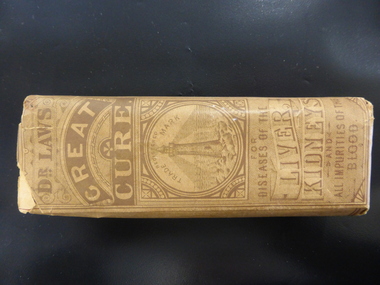
... This bottle contains the medicine mixture for diseases of the liver and kidney that was patented by Dr Law of Boston. ...This is a glass bottle with a cork containing a chemist’s mixture for diseases of the kidney and liver. The bottle is enclosed in a brown paper cover which is lined with what looks to be the instructions for the use of the medicine. ...‘Great Blood Purifier’ ‘Dr Law’s Great Cure for Diseases of the Liver and Kidney and all Impurities of the Blood’ Dr Law’s Liver Stimulant and Invaluable Remedy for indigestion, dyspepsia, sick headaches, loss of appetite, spasms, jaundice, constipation, sour stomach, heartburn’ ‘Waterbrasch, Liver, Stomach and Kidneys’ ‘Manufactured at Kennedy’s Pharmaceutical Works, Warrnambool, W.D.’ ...This bottle contains the medicine mixture for diseases of the liver and kidney that was patented by Dr Law of Boston. ...This bottle contains the medicine mixture for diseases of the liver and kidney that was patented by Dr Law of Boston. In the late 19th century Dr Law was a prolific and popular producer of patent medicines. The Warrnambool manufacturing chemist, Richard Kennedy, had the sole rights in Warrnambool to prepare and distribute Dr Law’s medicines. Richard Frank Kennedy (1826-1903) was born in England. He came to Warrnambool in the early 1880s and set up a pharmacy business in Timor Street. He was a retail, wholesale and manufacturing chemist. In 1891 he erected a new building and at that time his shop was described and one of the most elegant and best-stocked chemist’s shops in Victoria. Kennedy was active in Warrnambool community affairs and he was a foundation member of the Warrnambool Bowls Club, being its first Vice-President and an early President. His business continued after his death, trading as R.F.Kennedy and Co. This item is of considerable significance as it is the only example we have of a Dr Law patent medicine produced and distributed by the Warrnambool manufacturing chemist, Richard Kennedy. Both Dr Law and Richard Kennedy used an image of a lighthouse as a business symbol though the images are not identical. This is a glass bottle with a cork containing a chemist’s mixture for diseases of the kidney and liver. The bottle is enclosed in a brown paper cover which is lined with what looks to be the instructions for the use of the medicine. (The bottle is unable to be removed from the covering without major damage to the cover). The covering is brown with images of Dr Law and his lighthouse logo and printed material in brown and white colouring with the name of the product and its benefits. The top of the covering is torn and mended with adhesive tape. ‘Great Blood Purifier’ ‘Dr Law’s Great Cure for Diseases of the Liver and Kidney and all Impurities of the Blood’ Dr Law’s Liver Stimulant and Invaluable Remedy for indigestion, dyspepsia, sick headaches, loss of appetite, spasms, jaundice, constipation, sour stomach, heartburn’ ‘Waterbrasch, Liver, Stomach and Kidneys’ ‘Manufactured at Kennedy’s Pharmaceutical Works, Warrnambool, W.D.’ r.f.kennedy,, warrnambool chemist, dr law of boston, patent medicine producer, chemists in warrnambool, history of warrnambool
