
Showing 12 items matching "liverpool boys"
-
 Sunshine and District Historical Society Incorporated
Book - Our Liverpool Boys, Liverpool City Council
... Our Liverpool Boys...Our Liverpool Boys...Our Liverpool Boys ANZAC Centenary...ANZAC World War 1914 - 1918 Our Liverpool Boys ANZAC Centenary Soft cover book Our Liverpool Boys Book Our Liverpool Boys Liverpool City Council ...Soft cover bookanzac, world war 1914 - 1918 -
 Tatura Irrigation & Wartime Camps Museum
Booklet, Our Liverpool Boys
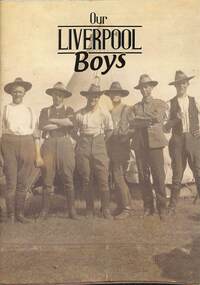
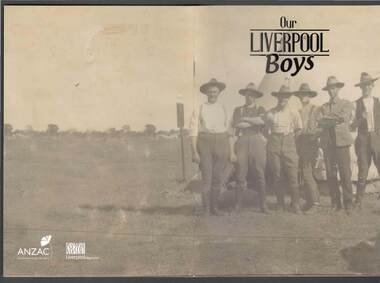
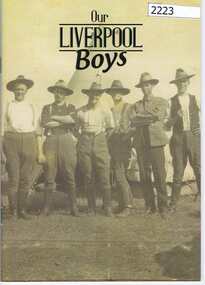
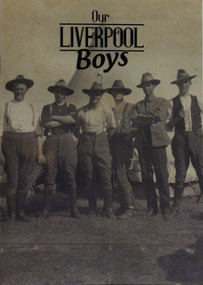
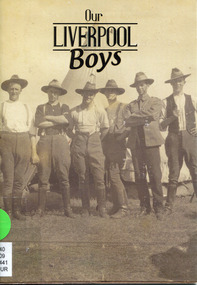
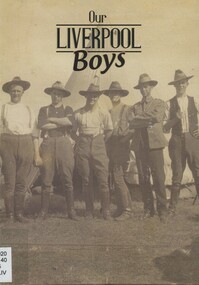
... Our Liverpool Boys...liverpool boys...Light olive cardboard cover with black printing "Our Liverpool Boys" on cover. Photo on cover shows six Liverpool boys titled "at ease at Liverpool Military Camp".33 pages. black & white/ sepia photos of the Liverpool Boys...Sepia photo of Liverpool Army Camp from the station courtesy of Liverpool Heritage Collection Light olive cardboard cover with black printing "Our Liverpool Boys" on cover. Photo on cover shows six Liverpool boys titled "at ease at Liverpool Military Camp".33 pages. black & white/ sepia photos of the Liverpool Boys Our Liverpool Boys Booklet ...This publication presents the stories of soldiers who were born or bred in Liverpool and who have a strong connection with Liverpool.This edition was supported by the Australian Government's Anzac Centenary Arts and Culture Fund,the Liverpool City Council & My Library Liverpool.`Light olive cardboard cover with black printing "Our Liverpool Boys" on cover. Photo on cover shows six Liverpool boys titled "at ease at Liverpool Military Camp".33 pages. black & white/ sepia photos of the Liverpool BoysMessages. from Mayor of Liverpool Ned Mannoun, Sue Dredge, Heritage Collections Curator and Julie Senior, Family History Officer. Sepia photo of Liverpool Army Camp from the station courtesy of Liverpool Heritage Collectionliverpool boys -
 Ringwood RSL Sub-Branch
Work on paper - Our Liverpool boys
... Our Liverpool boys...Our Liverpool boys...Printed paper Our Liverpool boys Work on paper Our Liverpool boys ...Printed paper -
 Bendigo Historical Society Inc.
Book - ANZAC COLLECTION: OUR LIVERPOOL BOYS
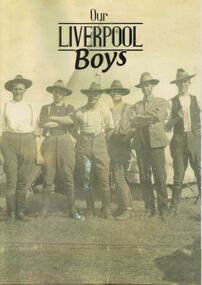
... ANZAC COLLECTION: OUR LIVERPOOL BOYS......our liverpool boys booklet...Book produced by Liverpool Council 'Our Liverpool Boys' telling the story of local people who enlisted in World War 1. 2 copies....MILITARY World war 1 our liverpool boys booklet Cumberland Argus Book produced by Liverpool Council 'Our Liverpool Boys' telling the story of local people who enlisted in World War 1. 2 copies. ...Book produced by Liverpool Council 'Our Liverpool Boys' telling the story of local people who enlisted in World War 1. 2 copies.Cumberland Argusmilitary, world war 1, our liverpool boys booklet -
 Lara RSL Sub Branch
Booklet x 5, Our Liverpool Boys, Approx 2014
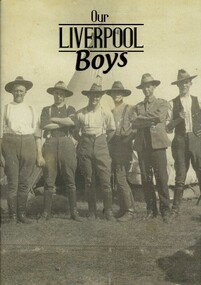
... Our Liverpool Boys...Our Liverpool Boys is a publication that celebrates Liverpool's connection to Australia's military history by sharing biograpgies of a number of soldiers who were born and/or bred in Liverpool and served in the Great War....Our Liverpool Boys Booklet x 5 ...100 years of ANZACOur Liverpool Boys is a publication that celebrates Liverpool's connection to Australia's military history by sharing biograpgies of a number of soldiers who were born and/or bred in Liverpool and served in the Great War.Message by Ned Mannoun Mayor of Liverpool City. -
 Bendigo Historical Society Inc.
Book - 'OUR LIVERPOOL BOYS' - RECORD OF LIVERPOOL ENLISTEES WORLD WAR 1
... 'OUR LIVERPOOL BOYS' - RECORD OF LIVERPOOL ENLISTEES WORLD WAR 1...Booklet produced by Liverpool Council, Heritage Collections Curator and Family History Officer,- 'Our Liverpool Boys ' -to commemorate Liverpool's history as a military town and the sacrifices of many of Liverpool's young men. ...Anzac link to Bendigo in family names - further research required. Book 'OUR LIVERPOOL BOYS' - RECORD OF LIVERPOOL ENLISTEES WORLD WAR 1 ...Booklet produced by Liverpool Council, Heritage Collections Curator and Family History Officer,- 'Our Liverpool Boys ' -to commemorate Liverpool's history as a military town and the sacrifices of many of Liverpool's young men. Discusses also the rioting soldiers from the Casula Camp and the Liverpool Camp who hijacked a train and went to Sydney where the rioting continued. Anzac link to Bendigo in family names - further research required.event, war, liverpool world war 1, liverpool, anzac, world war 1 -
 Greensborough Historical Society
Book, Liverpool City Council, Our Liverpool boys, 2015_
... Our Liverpool boys...A commemorative publication for the centenary of World War I. liverpool nsw world war i 32 pages, illus. Our Liverpool boys Book Book Liverpool City Council ...Tells the story of World War I soldiers from the Liverpool area in NSW. Includes photographs where available and details of military service. A commemorative publication for the centenary of World War I.32 pages, illus.liverpool nsw, world war i -
 Warrnambool RSL Sub Branch
Booklet, BOOKLET: OUR LIVERPOOL BOYS (3COPIES)
... BOOKLET: OUR LIVERPOOL BOYS (3COPIES)...Stapled not glued BOOKLET: OUR LIVERPOOL BOYS (3COPIES) Booklet Booklet ...presents the stories of soldiers who were born or bred in the Liverpool area and have a strong connection with Liverpool. (in WW1)Booklet, stiffened front cover. Stapled not gluedLiverpool City Council and Liverpool City Library Supported by the Australian Government's ANZAC Centenary Arts and Culture Fund 2018local history. liverpool nsw. ww1. -
 Surrey Hills Historical Society Collection
Booklet - Book, Our Liverpool Boys, 2015
... Our Liverpool Boys...This publication reveals the stories of everyday civilians-turned-soldiers who served in the trenches and on the front lines, highlighting their vast contribution to the war effort, including those who made the ultimate sacrifice. Our Liverpool Boys Booklet Book ...Sent to the collection as part of the Centenary of the ANZAC Gallipoli landing, 2015. This publication reveals the stories of everyday civilians-turned-soldiers who served in the trenches and on the front lines, highlighting their vast contribution to the war effort, including those who made the ultimate sacrifice.This publication reveals the stories of everyday civilians-turned-soldiers who served in the trenches and on the front lines, highlighting their vast contribution to the war effort, including those who made the ultimate sacrifice.Verso of cover: "Surrey Hills Historical Soc."world war, 1914-1918, miltary history, (mr) cecil alfred ashcroft, (mr) arthur percival attwood, (mr) thomas walter barker, (mr) george francis bell, (mr) lawrence robert hanna, (mr) charles elvin hyland, (mr) john frederick kammel, (mr) joseph harold kemp, (mr) harry boyland, (mr) james ashcroft braithwaite, (mr) walter henry brewster, (mr) william brown, (mr) charles alfred bull, (mr) william francis cloke, (mr) eric gladstone deadman, (mr) george leslie fullagar, (mr) joseph gomes, (mr) eric sydney walpole sealy-vidal, (mr) samuel kirkpatrick, (mr) nathan douglas lackie, (mr) joseph henry leach, (mr) harry learoyd, (mr) charles m mcfarline, (mr) joseph campbell mcmiles, (mr) robert mcmiles, (mr) james unison morn, (mr) edward hugh oprey, (mr) arthur salis, (mr) (henry) studley sealy-vidal, (mr) walter samuel shaw, (mr) walter samuels, (mr) samuel john southwell, (mr) geoffrey gordon steenson, (mr) eric andrew taylor, (mr) alfred charles thorn, (mr) andrew charles thorne, (mr) campbell throsby, (mr) william george waters, (mr) albert ernest wearne, (mr) thomas william garnet whitney, liverpool training camp, holsworthy internment camp -
 Surrey Hills Historical Society Collection
Book, Our Liverpool Boys, 2015
... Our Liverpool Boys...This publication reveals the stories of everyday civilians-turned-soldiers who served in the trenches and on the front lines, highlighting their vast contribution to the war effort, including those who made the ultimate sacrifice. world war 1914-1918 miltary history (mr) cecil alfred ashcroft (mr) arthur percival attwood (mr) thomas walter barker (mr) george francis bell (mr) lawrence robert hanna (mr) charles elvin hyland (mr) john frederick kammel (mr) joseph harold kemp (mr) harry boyland (mr) james ashcroft braithwaite (mr) walter henry brewster (mr) william brown (mr) charles alfred bull (mr) william francis cloke (mr) eric gladstone deadman (mr) george leslie fullagar (mr) joseph gomes (mr) eric sydney walpole sealy-vidal (mr) samuel kirkpatrick (mr) nathan douglas lackie (mr) joseph henry leach (mr) harry learoyd (mr) charles m mcfarline (mr) joseph campbell mcmiles (mr) robert mcmiles (mr) james unison morn (mr) edward hugh oprey (mr) arthur salis (mr) (henry) studley sealy-vidal (mr) walter samuel shaw (mr) walter samuels (mr) samuel john southwell (mr) geoffrey gordon steenson (mr) eric andrew taylor (mr) alfred charles thorn (mr) andrew charles thorne (mr) campbell throsby (mr) william george waters (mr) albert ernest wearne (mr) thomas william garnet whitney liverpool training camp holsworthy internment camp This publication reveals the stories of everyday civilians-turned-soldiers who served in the trenches and on the front lines, highlighting their vast contribution to the war effort, including those who made the ultimate sacrifice. Our Liverpool Boys Book ...Sent to the collection as part of the Centenary of the ANZAC Gallipoli landing, 2015. This publication reveals the stories of everyday civilians-turned-soldiers who served in the trenches and on the front lines, highlighting their vast contribution to the war effort, including those who made the ultimate sacrifice.This publication reveals the stories of everyday civilians-turned-soldiers who served in the trenches and on the front lines, highlighting their vast contribution to the war effort, including those who made the ultimate sacrifice.world war, 1914-1918, miltary history, (mr) cecil alfred ashcroft, (mr) arthur percival attwood, (mr) thomas walter barker, (mr) george francis bell, (mr) lawrence robert hanna, (mr) charles elvin hyland, (mr) john frederick kammel, (mr) joseph harold kemp, (mr) harry boyland, (mr) james ashcroft braithwaite, (mr) walter henry brewster, (mr) william brown, (mr) charles alfred bull, (mr) william francis cloke, (mr) eric gladstone deadman, (mr) george leslie fullagar, (mr) joseph gomes, (mr) eric sydney walpole sealy-vidal, (mr) samuel kirkpatrick, (mr) nathan douglas lackie, (mr) joseph henry leach, (mr) harry learoyd, (mr) charles m mcfarline, (mr) joseph campbell mcmiles, (mr) robert mcmiles, (mr) james unison morn, (mr) edward hugh oprey, (mr) arthur salis, (mr) (henry) studley sealy-vidal, (mr) walter samuel shaw, (mr) walter samuels, (mr) samuel john southwell, (mr) geoffrey gordon steenson, (mr) eric andrew taylor, (mr) alfred charles thorn, (mr) andrew charles thorne, (mr) campbell throsby, (mr) william george waters, (mr) albert ernest wearne, (mr) thomas william garnet whitney, liverpool training camp, holsworthy internment camp -
 Eltham District Historical Society Inc
Photograph - Digital Photograph, Alan King, Sweeney's Cottage, Sweeneys Lane, Eltham, 30 January 2008
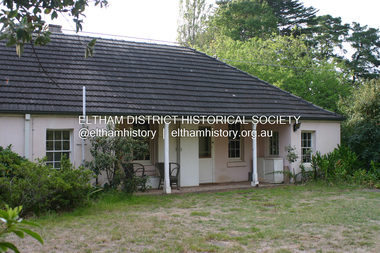
... Boys, of which Sweeney was a member. But the sentence was commuted to life transportation to Australia in 1823.1 Apparently in Sydney he became a servant to James Chandler at Botany. Soon James Chandler leased his farm and became a catechist on the Hawkesbury River, so Sweeney was reassigned to a former convict, John Brown, at Liverpool. ...Boys, of which Sweeney was a member. But the sentence was commuted to life transportation to Australia in 1823.1 Apparently in Sydney he became a servant to James Chandler at Botany. Soon James Chandler leased his farm and became a catechist on the Hawkesbury River, so Sweeney was reassigned to a former convict, John Brown, at Liverpool. ...Part of the original cottage named Culla Hill built by Thomas Sweeney (a former convict) remains as a small section of today’s house. Covered under Heritage Overlay, Nillumbik Planning Scheme National Estate National Trust of Australia (Victoria) Local Sifgnificance Published: Nillumbik Now and Then / Marguerite Marshall 2008; photographs Alan King with Marguerite Marshall.; p19 Thomas Sweeney, a former convict who became a respected citizen, once lived on a property at what is now the corner of Sweeneys Lane and Culla Hill, Eltham. As Sweeney was one of the district’s first settlers, the property is registered by the National Trust. Thomas Sweeney was born in 1802, son of impoverished tenant farmers in Tipperary County, Ireland. He became a ploughman, then at 21 he was sentenced to hang for setting on fire the house of Patrick Guyder at Gullshill. It is said the arson was due to a dispute over undelivered guns to a social justice guerilla group, the White Boys, of which Sweeney was a member. But the sentence was commuted to life transportation to Australia in 1823.1 Apparently in Sydney he became a servant to James Chandler at Botany. Soon James Chandler leased his farm and became a catechist on the Hawkesbury River, so Sweeney was reassigned to a former convict, John Brown, at Liverpool. Later Sweeney was assigned to George Brown of Lake Illawarra. In 1831, Sweeney was granted a ticket-of-leave and bought a boat to carry goods between Illawarra district and Sydney Town. He married his first wife who had come to Australia as a free woman. However she drowned after bearing him a daughter. In 1838, one month after he had received a conditional pardon, Sweeney married a blacksmith’s daughter, Margaret Meehan, newly arrived from Ireland. They then moved to Port Phillip and squatted on the south side of the Yarra River, about seven miles (11km) from Melbourne. Around 1842, Sweeney bought 110 acres (44.5ha) in the parish of Nillumbik for £110. He built a slab hut 12 x 10 feet (3.6m x 3m) and then his homestead, Culla Hill, a typical Tipperary style cottage, now known as Sweeney’s Cottage. It was here that many generations of Sweeneys lived for almost 100 years. Culla Hill became a social centre for the district and the Catholic community used it as a church. Sweeney was apparently on good terms with a tribe of Aborigines living on the river nearby, who helped him build his house.2 Sweeney proved himself a civic-minded leader. In 1844, he led a call for a bridge over the Plenty River. He was on the first school board and supplied the first grain for Eltham’s mill. Sweeney profited during the gold rush, not by gold digging, but by providing supplies for nearby fields and others as far away as Beechworth.3 Thomas Sweeney died in 1867 and was buried at the Eltham Cemetery, leaving two sons, five daughters, and 300 acres (121.4ha), as well as Culla Hill. Culla Hill – by then reduced to 75 acres (30ha) – was sold out of the family in 1939, then renamed Sweeneys. The present Sweeneys Lane, running diagonally through the original holding, was the track to the house. Part of the original cottage remains as a small section of today’s house. The dining-family room fronted by a veranda is original, and although there have been some changes, the cedar door and most of the small 12-paned wooden-framed windows are original. The walls are made of the original hand-made brick. After buying the property in 1952 Mr and Mrs Burston demolished a dilapidated slab hut, a three-roomed detached kitchen and cellar, as materials needed to restore them were very difficult to obtain so soon after the war.4 However the barn remains almost in its original condition. It is believed to have been built from stone quarried on the property. Now roofed with iron sheets it was probably originally thatched. The sandstone barn has a peaked roof supported by the original saplings and a doorway large enough to accommodate a fully loaded wagon.This collection of almost 130 photos about places and people within the Shire of Nillumbik, an urban and rural municipality in Melbourne's north, contributes to an understanding of the history of the Shire. Published in 2008 immediately prior to the Black Saturday bushfires of February 7, 2009, it documents sites that were impacted, and in some cases destroyed by the fires. It includes photographs taken especially for the publication, creating a unique time capsule representing the Shire in the early 21st century. It remains the most recent comprehenesive publication devoted to the Shire's history connecting local residents to the past. nillumbik now and then (marshall-king) collection, culla hill, eltham, sweeney's cottage, sweeneys lane, thomas sweeney -
 City of Melbourne Libraries
Photograph, Bull, Hugh Jones, 1897-1993, Boy bandsmen
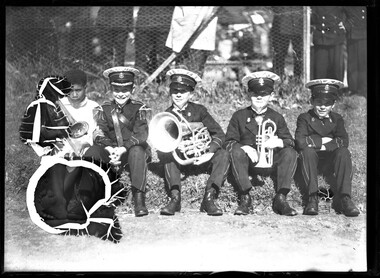
... The featuring of Fijian and Papuan boys in these articles reflected the diverse nature of Catholic Church representatives worldwide who attended the Eucharistic Congress which featured as part of Melbourne’s Centenary celebrations. Notable visitors to the Congress included the Papal Legate, His Excellence Cardinal MacRory, several Monsignors from Rome, the Archbishop of Liverpool representing England, Scotland and Wales, together with representatives from New Zealand, China, South Africa, Ireland, the Islands of the Pacific, India, Malta, USA, and of course from across Australia. ...The featuring of Fijian and Papuan boys in these articles reflected the diverse nature of Catholic Church representatives worldwide who attended the Eucharistic Congress which featured as part of Melbourne’s Centenary celebrations. Notable visitors to the Congress included the Papal Legate, His Excellence Cardinal MacRory, several Monsignors from Rome, the Archbishop of Liverpool representing England, Scotland and Wales, together with representatives from New Zealand, China, South Africa, Ireland, the Islands of the Pacific, India, Malta, USA, and of course from across Australia. ...Published: 7 Dec 1934 Published title: A FIJIAN TROMBONIST. Published caption: Although the young Fijian here for the Eucharistic Congress had no uniform, he did not feel out of it with the members of St. Vincent de Paul’s Band at the Sacre Coeur, East Malvern, this week. Trove article identifier: http://nla.gov.au/nla.news-article205071643 Description: A young Fijian boy sits with young members of the St Vincent de Paul’s Band, all seated on the grass in sunshine. The three young band members are jauntily dressed in braided hats, long pants and smart dark jackets, white shirts, dark bow tie, and dark long trousers and boots. One holds a French horn, one a trumpet. In contrast, the young Fijian boy is shoeless, hatless, and dressed in white – a white shirt, and possibly a white “skirt” as observed to be worn by Fijian policemen in their home country at that time. He carries a trombone, which perhaps belongs to the young band member sitting beside him. Research by project volunteer, Louise McKenzie: A photo in the Argus on the previous day shows “two Papuans, Aloysius and Bernard, … talking to Archbishop O’Shea of Wellington (N.Z.).” In a turn of phrase which would be far from acceptable today, the caption notes that the juxtaposition of the dark skinned boys and the white skinned Archbishop makes “A picturesque Contrast”. The photo is also staged in a way that has the two dark skinned boys (wearing white shirts and white “skirts”, and no hats), standing, looking down on the Archbishop in his elaborate clothing and headcovering. The Age caption advises that they are at Sacre Coeur, East Melbourne. The reason for the event – a garden party – was held as part of the National Eucharistic Congress which took place in Melbourne from Sunday 2 – Sunday 9 December 1934. An initiative of the Roman Catholic Church, it was their contribution to Melbourne’s Centenary Celebrations. At this garden party the Papal Legate, Cardinal MacRory, accompanied by dignatories including the Papal Chamberlain, met Old Girls of Sacre Coeur Convent. The Cardinal’s sister was at one time Mother Superior of this Convent. The featuring of Fijian and Papuan boys in these articles reflected the diverse nature of Catholic Church representatives worldwide who attended the Eucharistic Congress which featured as part of Melbourne’s Centenary celebrations. Notable visitors to the Congress included the Papal Legate, His Excellence Cardinal MacRory, several Monsignors from Rome, the Archbishop of Liverpool representing England, Scotland and Wales, together with representatives from New Zealand, China, South Africa, Ireland, the Islands of the Pacific, India, Malta, USA, and of course from across Australia. St Vincent de Paul “Our History” advises that the Society was founded in France in 1833 by a group of dedicated Catholics who put their faith into action to support the poor in their community. The “Vinnies” website “1854 onwards” sets out milestones of the Society’s close involvement with Melbourne from its infancy in March 1854 up to today. A well researched blog by Jeremy de Korte dated February 28, 2024 – Band Blasts from the Past – Anecdotes, Stories and Personalities, notes: Orphanage bands in Australia were a copy of practices in England where the teaching of music in boys’ institutions was commonplace (Sheldon, 2009). There was, however, a major difference to the outcomes of this musical education between the two countries. Boys who were trained as musicians in English institutions readily found themselves recruited into the bands of the British Army and Navy (Sheldon, 2009). Whereas the musicians that graduated from the Orphanage bands in Australia found themselves positions in the wider band movement. … We know that Orphanage bands in Australia have had a long and distinguished history, as well as enviable reputations. The St. Augustine’s Band from Geelong is probably the most famous of them all, and it is mentioned that by 1898 they were already putting the call out for a new set of instruments (“ST. AUGUSTINE’S ORPHANAGE BAND.,” 1898). St. Augustine’s went on to win many competitions at South Street in Ballarat and toured extensively – in one instance, in 1906 they won the A Grade Championships at South Street (Royal South Street Society, 1906). The band at St. Vincent’s de Paul in Melbourne was no less famous than their counterpart in Geelong and in 1921 they gained the services of Mr. Leslie Hoffman, a graduate of the St. Augustine’s Band, as their conductor (“St. Vincent’s Bandmaster,” 1921). This slide is quite badly damaged, reminding us of the fragility of this photographic form. The colour is washed out across most of the slide, and the left of the slide is badly degraded as if the photographic solution hasn’t quite taken. But the culprits are most likely time and mode of storage. References: A FIJIAN TROMBONIST--SUITE FOR DOLL'S HOUSE--LUNCH TIME AT THE SPORTS--A FULL SLIDE. (1934, December 7). The Age (Melbourne, Vic. : 1854 - 1954), p. 3. Retrieved April 9, 2024, from http://nla.gov.au/nla.news-article205071643 "INTERSTATE TENNIS -- EUCHARISTIC GARDEN PARTY" The Argus (Melbourne, Vic. : 1848 - 1957) 6 December 1934: 9. Web. 9 Apr 2024 Photographer notations on slide: "Boy bandsmen B61".1930-1939, bands, catholic church
