
Showing 10 items matching "livestock management"
-
 Friends of Westgarthtown
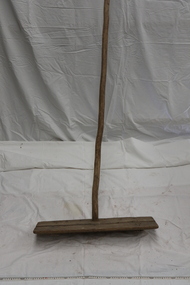
Tool - Wooden dung scraper, c.1900-1940
... ...livestock management...The scraper was donated to Ziebell's Farmhouse Museum by Lyn and James Ziebell. milking shed tool farming westgarthtown ziebell Manure scraper agricultural equipment farm tools dairy farming livestock management farm maintenance Long-handled agricultural scraper featuring a flat wooden blade, designed for removing manure and other waste from stable floors, dairy sheds and farmyard surfaces. ...This manure scraper was used on the Ziebell family farm at Westgarthtown, Thomastown, Victoria, and formed part of the everyday equipment used for maintaining farm buildings and working areas. Scrapers such as this were commonly used to remove animal manure, mud and other waste from stable floors, dairy sheds and yards. The rubber-edged blade allowed waste to be pushed or scraped from hard surfaces, assisting with the regular cleaning and maintenance of areas used to house and manage livestock. The scraper reflects the practical, labour-intensive nature of everyday farm work and the importance of maintaining clean and functional working environments on agricultural properties. The scraper was donated to Ziebell's Farmhouse Museum by Lyn and James Ziebell.Long-handled agricultural scraper featuring a flat wooden blade, designed for removing manure and other waste from stable floors, dairy sheds and farmyard surfaces.milking shed, tool, farming, westgarthtown, ziebell, manure scraper, agricultural equipment, farm tools, dairy farming, livestock management, farm maintenance -
 The Beechworth Burke Museum
Audio - Oral History, Jennifer Williams, John O'Loughlin, 13 July 2000
... management in the farming industry, taking trusted prisoners out to a farm on the Wodonga side of Beechworth to work the land. This area was known as The Rockery, a grazing property of two-hundred and eighty acres about two miles north of Beechworth. This work done by the prisoners included timber cutting, land maintenance and the grazing of livestock...management in the farming industry, taking trusted prisoners out to a farm on the Wodonga side of Beechworth to work the land. This area was known as The Rockery, a grazing property of two-hundred and eighty acres about two miles north of Beechworth. This work done by the prisoners included timber cutting, land maintenance and the grazing of livestock ...John O'Loughlin was born in 1922 in Warracknabeal, Victoria and moved to Beechworth in February 1969. Following a brief time working in the real estate business, John gained employment as a prison officer at Beechworth Gaol. The gaol had initially closed its doors in 1918 but was reopened after the completion of alterations in 1926 as a reformatory prison for habitual male criminals. In his new role, John was able to pursue management in the farming industry, taking trusted prisoners out to a farm on the Wodonga side of Beechworth to work the land. This area was known as The Rockery, a grazing property of two-hundred and eighty acres about two miles north of Beechworth. This work done by the prisoners included timber cutting, land maintenance and the grazing of livestock, mainly Black Poll cattle. The programme was an instrumental component of prisoner rehabilitation, allowing freedom and responsibility. When he retired from his work in 1987, John observed that many improvements had been made towards the living conditions and daily life of the prisoners. This oral history recording was part of a project conducted by Jennifer Williams in the year 2000 to capture the everyday life and struggles in Beechworth during the twentieth century. This project involved recording seventy oral histories on cassette tapes of local Beechworth residents which were then published in a book titled: Listen to what they say: voices of twentieth century Beechworth. The cassette tapes were digitised in July 2021 with funds made available by the Friends of the Burke. John O'Loughlin's account of his life in Beechworth and the local area during the twentieth century is historically and socially significant to the cultural heritage of the region. He details important information surrounding Beechworth Gaol and the daily life of its prisoners; it is a place that still holds significance for the residents of Beechworth today. This oral history account is socially and historically significant as it is part of a broader collection of interviews conducted by Jennifer Williams which were published in the book 'Listen to what they say: voices of twentieth century Beechworth'. While the township of Beechworth is known for its history as a gold rush town, these accounts provide a unique insight into the day-to-day life of the town's residents during the twentieth century, much of which would have been lost if they had not been preserved. This is a digital copy of a recording that was originally captured on a cassette tape. The cassette tape is black with a horizontal white stripe and is currently stored in a clear flat rectangular plastic container. It holds up to forty minutes of recording on each side. John O'Loughlin / beechworth gaol, old beechworth gaol, john o'loughlin, beechworth prison, beechworth, gaol, prisoners, beechworth prison officer, prisoner reform beechworth, the rockery, black poll cattle, daily prison life beechworth, prisoner farmwork, beechworth training prison -
 Phillip Island and District Historical Society Inc.
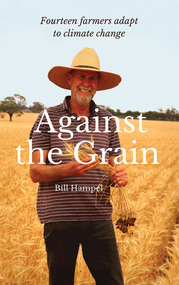
Book, Bill Hampel, Against the grain : fourteen farmers adapt to climate change, 2015
... With crops or livestock, big or small, they have worked cooperatively, mostly through land management, to plant thousands of trees, which has led to the daily presence of over 100 bird species. ...With crops or livestock, big or small, they have worked cooperatively, mostly through land management, to plant thousands of trees, which has led to the daily presence of over 100 bird species. ...Can we humans simply ignore the fires, the floods, and the increase in deaths brought about by climate change? In this book, Australian farmers - who bear the brunt of climate change, yet accept the science - share their experiences with the unpredictable weather events, the reduction in rainfall, and the shift to hotter months which are a challenge to farming cycles. Far from contributing to the problem with their farming practices, these farmers demonstrate how to reduce their greenhouse gases - to zero or below in some cases - while remaining profitable. They are all committed to pass on their farm in a better condition than when they first purchased or inherited it. With crops or livestock, big or small, they have worked cooperatively, mostly through land management, to plant thousands of trees, which has led to the daily presence of over 100 bird species. The farmers' inspiring and informative stories will open up a new world to most urban dwellers. A summary of climate change impacts - and an account of the numerous economic, political, and media barriers toward change - combine to provide a context for their work. 280 pages : colour illustrations, colour maps, colour portraits ; 23 cm. Includes bibliographical references and index. Also available in digital formats: ebook & epdf. ISBN 9781925078503 Dewey number 338.10994 Chapter 5 : Bob & Anne Davie Donor : Anne Davie ; Date : 14.10.2015.agriculture -- environmental aspects -- australia., farmers -- australia -- economic conditions., rural development -- australia., climatic changes -- australia. -
 Eltham District Historical Society Inc
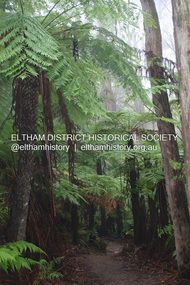
Photograph - Digital Photograph, Alan King, Kinglake National Park, 27 March 2008
... Professor Laver was one of several people who gave land for the park, donating around 50 acres (20ha), including the Jehosaphat Gully.4 Laver chaired the park’s first Committee of Management, which raised money to employ a ranger and provide facilities, including tracks and roads for fire protection vehicles, toilets and shelters. The committee charged fees for firewood collection, some grazing of livestock, and visitor entrance, and obtained small State Government and Eltham Shire grants. ...Professor Laver was one of several people who gave land for the park, donating around 50 acres (20ha), including the Jehosaphat Gully.4 Laver chaired the park’s first Committee of Management, which raised money to employ a ranger and provide facilities, including tracks and roads for fire protection vehicles, toilets and shelters. The committee charged fees for firewood collection, some grazing of livestock, and visitor entrance, and obtained small State Government and Eltham Shire grants. ...Fern gullies around Jehosaphat Gully Covered under National Estate. Published: Nillumbik Now and Then / Marguerite Marshall 2008; photographs Alan King with Marguerite Marshall.; p125 The magnificent Kinglake National Park, fringing Nillumbik’s north, is the largest national park close to Melbourne. Thanks to the vision and hard work of a band of local people, the park was created from what was rapidly becoming degraded land. Seeing a threat to Kinglake’s indigenous flora and fauna, several prominent local people campaigned for a national park, which was established in 1928.1 Since then, the park has grown through donations and acquisitions of land, from around 13,800 acres of land (5585ha) to 22,360 hectares. The Sugarloaf and Everard Blocks – of almost 8000 hectares – stand in Nillumbik and the park extends into Mitchell and Murrundindi Shires and the City of Whittlesea. Mt Everard commemorates William Hugh Everard, State member for Evelyn when the park was established. Before 1928, European settlers had degraded the Kinglake area, which was named after the celebrated English author and lawyer, Alexander William Kinglake. Remains of gold shafts and diggings in the park are reminders of Kinglake’s first settlers, who hoped to strike it rich at the gold diggings. But like other gold fields in this shire, they proved not very lucrative and soon timber cutting replaced mining in importance. However, before long, the accessible timber supply ran out, so in the 1920s agriculture took over – particularly potatoes and berry fruits – which involved large-scale clearing.2 The park’s instigator was retired Melbourne University Professor of Music, William Laver.3 As chair of the Kinglake Progress Association he began negotiations to have crown lands on the southern scarp of the Great Dividing Range reserved as a national park. Even before the park was proclaimed, from 1927, KPA members cut tracks to the major scenic points. Professor Laver was one of several people who gave land for the park, donating around 50 acres (20ha), including the Jehosaphat Gully.4 Laver chaired the park’s first Committee of Management, which raised money to employ a ranger and provide facilities, including tracks and roads for fire protection vehicles, toilets and shelters. The committee charged fees for firewood collection, some grazing of livestock, and visitor entrance, and obtained small State Government and Eltham Shire grants. In 1957 the State Government provided revenue for national parks. Then, in 1975, the State Government took over the management and the Committee of Management became an advisory committee, which disbanded in 1978. Originally, the park covered crown land in the Shires of Eltham and Whittlesea; then Wombelano Falls in Yea and other areas were added. In 1970 the park extended into the Shires of Eltham, Healesville, Whittlesea and Yea.5 Bush fires have been an ongoing problem. In 1939 hundreds of eucalypts and acacias had to be sown around the Jehosaphat Gully to rejuvenate the forest. To manage bushfires, the Committee of Management, then the State Government, worked closely with the Forestry Commission, shire councils and local fire brigades. Early national parks focussed on recreation. But by the 1980s, conservation, education and scientific research became more important, playing a vital role in preserving representative samples of the natural environment. Each year many thousands of people use the park’s extensive network of walking tracks amongst the protected plant and animal life as well as camping, cycling and horse riding. The park, along the slopes of the Great Dividing Range, has lookouts revealing magnificent views of the Melbourne skyline, Port Phillip Bay, the Yarra Valley and the You Yangs. Vegetation in the Masons Falls area includes messmate forest, Austral grass-trees, ferns and Hazel Pomaderris. In spring, orchids, lilies, everlasting daisies, correas, grevillea and heath appear. Around Jehosaphat Gully are wet and dry forest, fern gullies and banksia. Animal life includes wallabies, kangaroos, koalas, echidnas, possums, gliders and bandicoots. Male lyrebirds can be heard mimicking in the Jehosaphat Gully, particularly in the Everard Block in winter.This collection of almost 130 photos about places and people within the Shire of Nillumbik, an urban and rural municipality in Melbourne's north, contributes to an understanding of the history of the Shire. Published in 2008 immediately prior to the Black Saturday bushfires of February 7, 2009, it documents sites that were impacted, and in some cases destroyed by the fires. It includes photographs taken especially for the publication, creating a unique time capsule representing the Shire in the early 21st century. It remains the most recent comprehenesive publication devoted to the Shire's history connecting local residents to the past. nillumbik now and then (marshall-king) collection, kinglake national park, jehosaphat gully -
 Kiewa Valley Historical Society
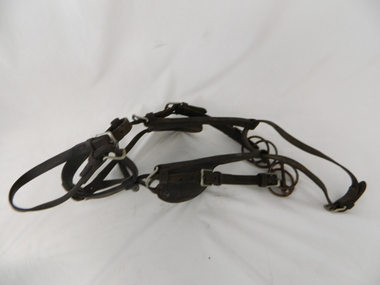
Bridle Horse, circa mid to late 1900's
... The maintenance of cattle and sheep in the Kiewa Valley was, and still is an important requirement of livestock management. A good stock horse bridle is important, especially during the period when cattle and sheep were grazed on the Bogong High Plains. ...This stock horse bridle was probably used in the mid 1900's. This was the period when cattle and sheep mustering was at its prime. The movement of cattle and sheep was by mounted stock horse only and not by other methods. Northern territory cattle stations in the late 1900's started to use helicopters for "cattle control". In the KIEWA Valley/Bogong High Plains and other rural cattle/sheep producing areas required well trained stock horses and stockmen for cattle/sheep control. It is only in the later 1900's that motor bikes and four wheeled quad-bikes have taken over, in part, from the mounted stockman.This horse bridle is very significant to the Kiewa Valley because of the early introduction of cattle and sheep stations in what initially was regarded as a semi remote valley location. The maintenance of cattle and sheep in the Kiewa Valley was, and still is an important requirement of livestock management. A good stock horse bridle is important, especially during the period when cattle and sheep were grazed on the Bogong High Plains. The mustering and and moving cattle/sheep from the valley pastures to the high country was a demanding and dangerous exercise requiring "sure footed" stock horses.The "good specialised" bridle was a vital part of this cattle/sheep mustering. A scientific study started in 1947 to study the impact of grazing cattle/sheep on the natural Alpine and sub Alpine vegetation found grazing cattle had an adverse affect on the natural Alpine and sub alpine vegetation, and grazing on the plains was stopped by the Victorian Government in 2005.This "camp draft" on the Bogong High Plains could take up to six weeks.This harness bridle includes "blinders, winklers or blinkers" and would therefore be used on a pack or "working" horse. This bridle has rings on each end of the browband. The bridle is one used by a horse working in a team configuration pulling a heavy cart or wagon. The bridle has ten adjustable straps to allow it to accommodate a variety of horse sizes. See KVHS 0495 for a stock horse saddle.horse, country, leather bridle, gaiters, high country grazing, cattlemen, laces, studs -
 Port Melbourne Historical & Preservation Society
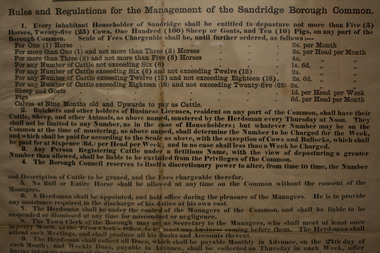
Document - Proclamation, Rules and Regulations for the management of the Sandridge Borough Common, 18 Jul 1865
... Built Environment - Civic Livestock Andrew PLUMMER Edward CLARK Town Clerks Large typeset framed proclamation, "Rules and Regulations for the management of the Sandridge Borough Common" Dated 13 July 1865. ...Was folded up and pasted into the minutes of the Borough Legislative Committee opposite June/July, 1865. Joan WINTER, City of Port Phillip Collections Manager, paid for conservators to remove and restore it, then framed it for exhibition in 'Dreedging, Draining and Dipping'1995/96. Following end of exhibition it was returned, in frame.Large typeset framed proclamation, "Rules and Regulations for the management of the Sandridge Borough Common" Dated 13 July 1865. Refers to cattle, cows, calves, horses, sheep, goets, pigs and the herdsman rulesbuilt environment - civic, livestock, andrew plummer, edward clark, town clerks -
 Bendigo Historical Society Inc.
Functional object - BENDIGO ASSSOCIATED STOCK AGENTS: LEATHER BOTTLES AND BALLS
... These containers were used weekly at the Bendigo Saleyard, in conjunction with agents and saleyard management, to conduct a draw to determine agents order of draw for auction livestock....These containers were used weekly at the Bendigo Saleyard, in conjunction with agents and saleyard management, to conduct a draw to determine agents order of draw for auction livestock. ...Two leather bottle shape containers, white stitching, open top. Small bottle (a) Large bottle (b) Wooden balls (c) In each bottle there are numbered wooden balls. These containers were used weekly at the Bendigo Saleyard, in conjunction with agents and saleyard management, to conduct a draw to determine agents order of draw for auction livestock.bendigo, business, associated stock agents -
 National Wool Museum
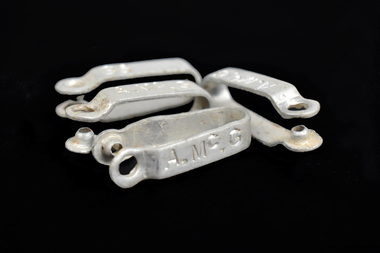
Functional object - Sheep Ear Tags
... Ear tags are used for identification of domestic livestock and other animals to assist in stock management. They can be marked individually with letters, numbers or symbols....Ear tags are used for identification of domestic livestock and other animals to assist in stock management. They can be marked individually with letters, numbers or symbols. ...Ear tags are used for identification of domestic livestock and other animals to assist in stock management. They can be marked individually with letters, numbers or symbols.Four aluminium sheep identification ear tags, featuring imprinted numbers and letters with two holes for fastening.753.1: A.M.C.G / 86 753.2: A.M.C.G / 97 753.3: A.M.C.G / 99 753.4: A.M.C.G / 100sheep identification, sheep - identification, ear tags, stock management, wool industry -
 Sunshine and District Historical Society Incorporated
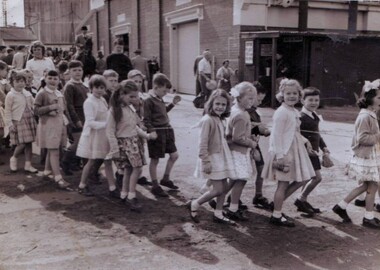
Photograph - Braybrook State School Excursion To The Melbourne Show C1958 Photograph
... Schools attended because the Show offered: - Agricultural demonstrations - Livestock judging - Wool, dairy, and grain displays - Machinery and industry exhibits - Food production and rural‑skills education - Displays by government departments and civic organisations For many urban students, it was their only direct exposure to rural industries. From the late 1990s onward, several factors reduced school excursions to the Show: - Rising transport and supervision costs - Curriculum tightening - Increased risk‑management...Schools attended because the Show offered: - Agricultural demonstrations - Livestock judging - Wool, dairy, and grain displays - Machinery and industry exhibits - Food production and rural‑skills education - Displays by government departments and civic organisations For many urban students, it was their only direct exposure to rural industries. From the late 1990s onward, several factors reduced school excursions to the Show: - Rising transport and supervision costs - Curriculum tightening - Increased risk‑management ...For decades, Victorian state schools organised annual excursions to the Royal Melbourne Show, especially from the 1950s through the 1990s. These trips were so common that many former students remember them as a defining part of the school year. The Royal Melbourne Show wasn’t just rides and showbags, it was originally promoted as an educational agricultural exhibition. Schools attended because the Show offered: - Agricultural demonstrations - Livestock judging - Wool, dairy, and grain displays - Machinery and industry exhibits - Food production and rural‑skills education - Displays by government departments and civic organisations For many urban students, it was their only direct exposure to rural industries. From the late 1990s onward, several factors reduced school excursions to the Show: - Rising transport and supervision costs - Curriculum tightening - Increased risk‑management requirements - Shift toward museum, science, and cultural excursions - The end of the Show Day public holiday Some schools still attend, but it’s no longer the near‑universal tradition it once was.Many students who attended the Melbourne Show excursions will remember holding onto a rope as shown in this photograph.5372 - Braybrook State School Excursion To The Melbourne Show C1958 Photograph.jpgbraybrook state school, ballarat road, braybrook -
 Flagstaff Hill Maritime Museum and Village
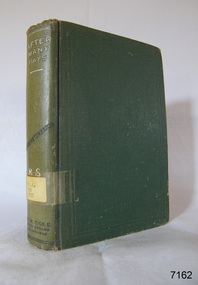
Book - Autobiographical, Cuthbert Fetherstonhaugh, After Many Days, 1917
... management. Over the next two decades, Fetherstonhaugh led a varied frontier life as a drover, carrying contractor and station manager, overlanding stock into northern Queensland during the expansion of the pastoral frontier. In the late 1860s and early 1870s, he entered the Anglican ministry, serving as a clergyman in rural New South Wales and Victoria before returning to pastoral pursuits. He later acquired an interest in, and managed, Goorianawa station in the Castlereagh district of New South Wales for seventeen years, establishing himself as a key figure in the colonial wool and livestock...management. Over the next two decades, Fetherstonhaugh led a varied frontier life as a drover, carrying contractor and station manager, overlanding stock into northern Queensland during the expansion of the pastoral frontier. In the late 1860s and early 1870s, he entered the Anglican ministry, serving as a clergyman in rural New South Wales and Victoria before returning to pastoral pursuits. He later acquired an interest in, and managed, Goorianawa station in the Castlereagh district of New South Wales for seventeen years, establishing himself as a key figure in the colonial wool and livestock ...After Many Days is the memoir of an Irish-born pastoralist, written in old age. The preface is dated Blackheath, November 1917, and says his wife and friends urged him to write it. Later sources describe it as a long, lively account of his early life. The memoir covers his childhood in Ireland and Germany, then his second-class passage to Melbourne aboard the Sussex in 1853. It goes on to his life in 1850s Victoria, working at the Hentys’ Muntham station in the Western District, and his encounters with bushrangers, colonial racing and horse-breaking. His Queensland years come next, followed by his life in NSW, where he spent two years as an Anglican minister.Hard cover book. After Many Days Author: Cuthbert Fetherstonhaugh Publisher: Edward William Cole Date: 1917 Further Information: Green Cloth hardcover with lettering and patterning to spine in White & black. The spine has a Library label with an inscription.non-fictionAfter Many Days is the memoir of an Irish-born pastoralist, written in old age. The preface is dated Blackheath, November 1917, and says his wife and friends urged him to write it. Later sources describe it as a long, lively account of his early life. The memoir covers his childhood in Ireland and Germany, then his second-class passage to Melbourne aboard the Sussex in 1853. It goes on to his life in 1850s Victoria, working at the Hentys’ Muntham station in the Western District, and his encounters with bushrangers, colonial racing and horse-breaking. His Queensland years come next, followed by his life in NSW, where he spent two years as an Anglican minister.after many days, cuthbert fetherstonhaugh, shipwrecked-coast, flagstaff-hill, flagstaff-hill-maritime-museum, warrnambool, maritime-museum, shipwreck-coast, flagstaff-hill-maritime-village, shipwrecked-artefact, book, pattison collection, warrnambool library, warrnambool mechanics’ institute, ralph eric pattison, corangamite regional library service, warrnambool city librarian, mechanics’ institute library, victorian library board, warrnambool books and records, warrnambool children’s library
