
Showing 3 items matching "loch ard centennial"
-
 Flagstaff Hill Maritime Museum and Village
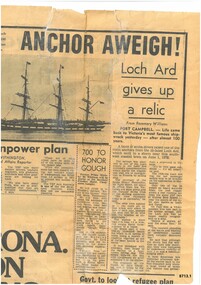
Newspaper - Newspaper Article, March 1978
... Loch Ard...Loch Ard Centennial...Loch Ard Centenary Committee" was formed. It was established to create public interest and awareness for the 100th anniversary of the tragic Loch Ard shipwreck. Activities and events included student essays, exhibitions, videos, publications, competitions and historical information. A booklet called "Settlers Under Sail" by Don Charlwood was commissioned to be made available to all school children, a memorial plaque (erected by The National Park) was unveiled at Loch Ard Gorge, a special "Loch Ard Shipwreck Centennial Port Campbell" postmark was issued by the Post Office and a model ship competition was held. ...LOCH ARD. The LOCH ARD collection is archaeologically significant as the remains of a large international passenger and cargo ship. The LOCH ARD collection is historically significant for representing aspects of Victoria’s shipping history and its potential to interpret sub-theme 1.5 of Victoria’s Framework of Historical Themes (living with natural processes). The collection is also historically significant for its association with the LOCH ARD, which was one of the worst and best-known shipwrecks in Victoria’s history. Flagstaff Hill Maritime Museum and Village Warrnambool Great Ocean Road Shipwreck Coast Loch Ard Loch Ard Centennial ...The Loch Ard was the last sailing ship to lose emigrants' lives when negotiating the entrance to Bass Strait. The ship Loch Ard was built on the River Clyde in Scotland in 1873 for the prestigious Loch Line of colonial clipper ships, designed for the Australian run. It sailed from England on 1 March 1878 carrying 37 crew, 17 passengers and a diverse general cargo ranging from luxury items to bulk railway iron. On 1 June 1878, emerging from fog and hearing too late the sound of breakers against the tall limestone cliffs, the vessel struck the southern foot of Mutton Bird Island and sank in 23 metres of water. Of the fifty-four people on board only two survived, one young male crewman, Tom Pearce, and one young female passenger, Eva Carmichael. This newspaper advertisement was donated by the family of George Shields - a member of the Shields family who had had a long association with the wreck of the Loch Ard and Eva Carmichael. In 1878, following the wreck of the Loch Ard and the subsequent rescue of Eva Carmichael, Eva was taken to Glenample station (near Princetown) to recuperate. It was during this period that Eva became great friends with Jane Shields (an Aunt of George Shields) - a friendship that continued throughout their lives. At that time, Jane was a young woman living in Princetown with her parents and siblings. Many of the Shields family continued to have a great interest in the Loch Ard and several generations of the family are buried in the Loch Ard cemetery. One of the most unlikely pieces of cargo to have survived the shipwreck was a Minton porcelain peacock - one of only nine in the world. The peacock was destined for the Melbourne International Exhibition in 1880. It had been well packed, which gave it adequate protection during the violent storm. Today, the Minton peacock can be seen at the Flagstaff Hill Maritime Museum in Warrnambool. From Australia's most dramatic shipwreck it has now become Australia's most valuable shipwreck artefact and is one of very few 'objects' on the Victorian State Heritage Register. The Victorian History Advisory Council decided 1978 was an appropriate year to mark, not only the centenary of the sinking of the Loch Ard in 1878, but also commemorate the large part played by sailing ships in immigration, and through this, the development of Australia. The Victorian Government authorised the commemoration and a "Loch Ard Centenary Committee" was formed. It was established to create public interest and awareness for the 100th anniversary of the tragic Loch Ard shipwreck. Activities and events included student essays, exhibitions, videos, publications, competitions and historical information. A booklet called "Settlers Under Sail" by Don Charlwood was commissioned to be made available to all school children, a memorial plaque (erected by The National Park) was unveiled at Loch Ard Gorge, a special "Loch Ard Shipwreck Centennial Port Campbell" postmark was issued by the Post Office and a model ship competition was held. Flagstaff Hill Maritime Museum and Village, together with other local towns and shires along the south-west coast participated in many of these commemorative activities. The Chair of the Loch Ard Century Committee (Sir John Holland) approached the "Scuba Divers Federation of Victoria" to "seek and recover a significant relic from the Loch Ard" with the idea of having it available for public display at Port Campbell. The SDFV enlisted the help of the VSAG (Victorian Sub Aqua Group) with a contingent of nineteen divers participating in the salvage which took place over the weekend of 11th and 12th March 1978. The anchor was placed in the custody of the expert conservators at Flagstaff Hill Maritime Museum and Village to be cleaned, and eighteen months later was returned to Port Campbell. This newspaper article was one of many reports and descriptions of events that took place during the Centennial Commemoration of the sinking of the Loch Ard. This newspaper article is a significant reminder (and recognition) of the importance the Loch Ard (and other immigrant ships) played in the settling of Victoria and the dangers faced by the settlers who came to Australia in these ships. Flagstaff Hill’s collection of artefacts from LOCH ARD is significant for being one of the largest collections of artefacts from this shipwreck in Victoria. It is significant for its association with the shipwreck, which is on the Victorian Heritage Register (VHR S417). The collection is significant because of the relationship between the objects, as together they have a high potential to interpret the story of the LOCH ARD. The LOCH ARD collection is archaeologically significant as the remains of a large international passenger and cargo ship. The LOCH ARD collection is historically significant for representing aspects of Victoria’s shipping history and its potential to interpret sub-theme 1.5 of Victoria’s Framework of Historical Themes (living with natural processes). The collection is also historically significant for its association with the LOCH ARD, which was one of the worst and best-known shipwrecks in Victoria’s history.A newspaper cutting taken from a Victorian newspaper (possibly the Herald) printed in March 1978, describing the salvaging of the anchor from the wreck of the Loch Ard near Port Campbell. The cutting has two tears (that have sticky tape on them) and the paper is yellowed with age. The article (written by Rosemary Williams) has an old black and white photograph of the Loch Ard, two large print headings and two colomns of text. The article has been cut out of a larger page and also contains parts of other articles and an advertisement."ANCHOR AWEIGH!" "Loch Ard /gives up/ a relic" Plus two colomns of text describing the raising of the anchor by a team of divers.flagstaff hill maritime museum and village, warrnambool, great ocean road, shipwreck coast, loch ard, loch ard centennial, loch ard anchor, port campbell, loch ard salvage, scuba divers, scuba divers federation of victoria, victorian sub aqua group -
 Flagstaff Hill Maritime Museum and Village
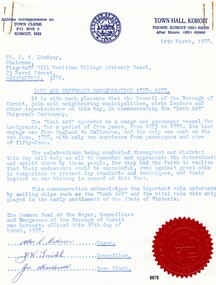
Letter - Loch Ard Centenary Letter, Koroit Council, March 1978
... Loch Ard Centenary Committee" was formed. It was established to create public interest and awareness for the 100th anniversary of the tragic Loch Ard shipwreck. Activities and events included student essays, exhibitions, videos, publications, competitions and historical information. A booklet called "Settlers Under Sail" by Don Charlwood was commissioned to be made available to all school children. The anchor of the Loch Ard was raised from the wreck and displayed at Port Campbell, a memorial plaque (erected by The National Park) was unveiled at Loch Ard Gorge, a special "Loch Ard Shipwreck Centennial...Loch Ard Centenary Committee" was formed. It was established to create public interest and awareness for the 100th anniversary of the tragic Loch Ard shipwreck. Activities and events included student essays, exhibitions, videos, publications, competitions and historical information. A booklet called "Settlers Under Sail" by Don Charlwood was commissioned to be made available to all school children. The anchor of the Loch Ard was raised from the wreck and displayed at Port Campbell, a memorial plaque (erected by The National Park) was unveiled at Loch Ard Gorge, a special "Loch Ard Shipwreck Centennial ...The Loch Ard was an iron hulled clipper, built in Scotland in 1873 and wrecked on the southwest coast of Victoria in 1878 at what is now known as Loch Ard Gorge, near Port Campbell. Fifty two crew and passengers died and only Tom Pierce and Eva Carmichael survived. The Loch Ard was the last sailing ship to lose emigrants' lives when negotiating the entrance to Bass Strait. One of the most unlikely pieces of cargo to have survived the shipwreck was a Minton porcelain peacock - one of only nine in the world. The peacock was destined for the Melbourne International Exhibition in 1880. It had been well packed, which gave it adequate protection during the violent storm. Today, the Minton peacock can be seen at the Flagstaff Hill Maritime Museum in Warrnambool. From Australia's most dramatic shipwreck it has now become Australia's most valuable shipwreck artefact and is one of very few 'objects' on the Victorian State Heritage Register. The Victorian History Advisory Council decided 1978 was an appropriate year to mark, not only the centenary of the sinking of the Loch Ard in 1878, but also commemorate the large part played by sailing ships in immigration, and through this, the development of Australia. The Victorian Government authorised the commemoration and a "Loch Ard Centenary Committee" was formed. It was established to create public interest and awareness for the 100th anniversary of the tragic Loch Ard shipwreck. Activities and events included student essays, exhibitions, videos, publications, competitions and historical information. A booklet called "Settlers Under Sail" by Don Charlwood was commissioned to be made available to all school children. The anchor of the Loch Ard was raised from the wreck and displayed at Port Campbell, a memorial plaque (erected by The National Park) was unveiled at Loch Ard Gorge, a special "Loch Ard Shipwreck Centennial Port Campbell" postmark was issued by the Post Office and a model ship competition was held. Flagstaff Hill Maritime Museum and Village, together with other local towns and shires along the south-west coast participated in many of these commemorative activities. This letter is a significant reminder (and recognition) of the importance the Loch Ard (and other immigrant ships) played in the settling of Victoria and the dangers faced by the settlers who came to Australia in these ships. Flagstaff Hill’s collection of artefacts from LOCH ARD is significant for being one of the largest collections of artefacts from this shipwreck in Victoria. It is significant for its association with the shipwreck, which is on the Victorian Heritage Register (VHR S417). The collection is significant because of the relationship between the objects, as together they have a high potential to interpret the story of the LOCH ARD. The LOCH ARD collection is archaeologically significant as the remains of a large international passenger and cargo ship. The LOCH ARD collection is historically significant for representing aspects of Victoria’s shipping history and its potential to interpret sub-theme 1.5 of Victoria’s Framework of Historical Themes (living with natural processes). The collection is also historically significant for its association with the LOCH ARD, which was one of the worst and best-known shipwrecks in Victoria’s history.Single page letter typed in blue ink, on behalf of Koroit Council, written on 14th March 1978 and addressed to the Chairman, Flagstaff Hill Maritime Village Advisory Board, in recognition of the "Loch Ard Centenary Commemoration 1878 - 1978". It has the "Borough of Koroit" stamp at the top of the page and a red "Borough of Koroit" seal on the bottom right-hand corner of the page. It is signed by the Mayor (Allan R. Waterson), a councillor (J. W. Smith) and the Town Clerk (Jim Macdonald). The letter is in a plain buff manilla folder labelled in blue type.Top left corner - "Address correspondence to:/TOWN CLERK / P.O. BOX 5/KOROIT, 3282" Top Centre - blue circular ink stamp of "BOROUGH OF KOROIT 1870" with coat of arms in the center Top right - "TOWN HALL,KOROIT/ PHONE KOROIT (055) 658230/After Hours (055) 658490" The letter is addressed to - "CR. J. S. Lindsay, /Chairman,/ Flagstaff Hill Maritime Village Advisory Board,/ WARRNAMBOOL. 3280" "LOCH ARD CENTENARY COMMEMORATION 1878 - 1978" (underlined) The letter begins - "It is with much pleasure that the Council of the Borough of Koroit, join with neighbouring municipalities, civic leaders and other organisations on this day, in commemorating the "Loch Ard" Shipwreck centenary. The "Loch Ard" operated as a cargo and passenger vessel for immigrants, for a period of five years, from 1873 to 1878. Its last voyage was from England to Melbourne, and the ship was sunk on the 1st June 1878, with only two survivors from passengers and crew of fifty-four. The celebrations being conducted throughout our district this day will help us all to remember and appreciate the determination and spirit shown by these people, for they had the faith to realise that their endeavours would be successful, even against great odds in comparison to present day standards and techniques, and their imprint on our history is record of this fact. This commemoration acknowledges the important role undertaken by sailing ships such as the "Loch Ard" and the vital role this ship played in the early settlement of the State of Victoria." The letter ends with -" the Common Seal of the Mayor, Councillors and Burgesses of the Borough of Koroit was hereunto affixed this 18th day of March, 1978." The letter is signed "Allan J. Waterson Mayor/J. W. Smith Councillor/ Jim Macdonald Town Clerk and a large red seal of the Borough of Koroit (with their coat of arms) is in the bottom right-hand corner. Front of manilla folder - "BOROUGH OF KOROIT / LOCH ARD CENTENARY COMMEMORATION/ 1878 - 1978" "4050" written in black ink top right-hand corner next to a scribbled out numberflagstaff hill maritime museum and village, warrnambool, great ocean road, shipwreck coast, loch ard, port cambell, shipwreck, commemorative committee, loch ard centenary, koroit council, commemorative letter, loch ard commemorative committee -
 Flagstaff Hill Maritime Museum and Village
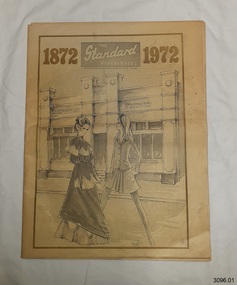
Newspaper - The Standard, Warrnambool Standard Centenary Issue 1872-1972, 02/10/1972
... Loch Ard Gorge, near Port Campbel, made headlines in the Standard. PAGE 72; The back page features a photograph and greetings from Fletcher Jones and Staff. There are many staff members in front of the Fletcher Jones factory in Warrnambool, which was established around 1924. The centennial ...The Warrnambool Standard Centenary Issue, 1872 - 1972, summarises the local and world history highlights over 100 years. The pages in the images are a sample of the newspaper's contents. They show: - PAGE 1; sketches of two young women, one dressed in 1872 fashion, the other in 1972 fashion. PAGE 34; This page was dedicated to the Ponting Bros. The business celebrated its Centenary in 1972. There apr photographs of the original and the new building, and a photograph and names of the staff of 1972. PAGES 34-38: Lift out facsimile copy of the first edition of The Standard (no longer in 3096.01) PAGE 39; In January 1917 Mr Basil Watson flew the first aeroplane to visit the Warrnambool area. He entertained the crowds by performing aerobic acrobatics in the plane he'd built himself. Two months later he died in a plane accident. PAGE 70; In 1967 Australia's Prime Minister, Mr Harold Holt, goes missing, presumed drowned. PAGE 71; In 1970 the mystery of four bodies were found in a car that crashed over the cliff at Loch Ard Gorge, near Port Campbel, made headlines in the Standard. PAGE 72; The back page features a photograph and greetings from Fletcher Jones and Staff. There are many staff members in front of the Fletcher Jones factory in Warrnambool, which was established around 1924.The centennial edition of the Standard newspaper includes local social, economic and historical aspects of Warrnambool, Victoria, Australia and the World. It reflects the interests of the local community and the reactions to the events of the time.The Standard, Warrnambool, Centenary Issue 1872 – 1972 (Two copies).100 years of District Service. The issue includes World and Local History, Advertisements, Timeline, Facsimile of the First Issue, Shipwrecks, and Wars. The Centenary edition was printed on October 2, 1972, 72 pages. One copy (3096.02) includes the centre lift-out on pages 35 to 38 of a facsimile copy of the first edition published on October 1, 1872.Page 1: "The Standard Warrnambool" "Warrnambool Standard Centenary Issue October 2 1972, 72 pages" On illustration of building "1872 / Warrnambool Standard" Page 34: "On this site ... since 1924" [Ponting Bros} "Staff of Ponting Bros. 1972" Page 39: "Aviation history-maker" "RECORD TRIP BY FIRST PLANE TO VISIT CITY" "Thrilling display of aerial acrobatics" Page 70: "PM HOLT IS PRESUMED DROWNED" "GAVE GOVT. IMAGE OF YOUTH" Page 71: "Where death car crashed on ledge" "PT CAMPBELL MYSTERY: FOUR BODIES FOUND IN CAR AT BOTTOM OF CLIFF" "POLICE SEARCH SWINGS BACK TO MELBOURNE" Page 72: "Greetings to the"Standard"" "Fletcher Jones" flagstaff hill, flagstaff hill maritime museum and village, warrnambool, maritime museum, maritime village, great ocean road, shipwreck coast, ladies fashion 1872, ladies fashion 1972, ponting bros. centenary 1872-1972, ponting bros. staff, basil watson, basil watson 1917, harold holt 1967, car crash at loch ard gorge, fletcher jones and staff 1972, the standard centenary 1872-1972, warrnambool newspaper, warrnambool standard, centenary edition, the standard
