
Showing 5 items matching "loch ness"
-
 Flagstaff Hill Maritime Museum and Village
Equipment - Lifebuoy, Loch Ness, 1869-1909
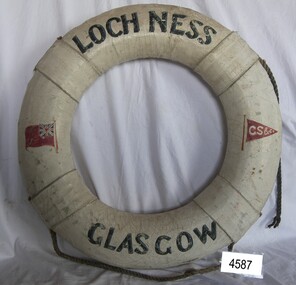
... Loch Ness......Loch Ness...These details mean that the lifebuoy was part of the lifesaving equipment on the sailing ship the Loch Ness, part of the Glasgow Shipping Company’s Loch Line (G.S.C. on the red pennant) and a British-registered ship (the red flag with the Union Jack on it). ...Lifebuoy has printed name of vessel Loch Ness, Glasgow. Symbols of red flag with white initials G S Co. ..."LOCH NESS", "GLASGOW" "G S Co"...There is also a red ensign. Loch Ness Equipment Lifebuoy Glasgow Shipping Company ...This lifebuoy bears the name of the ship, its origin, the shipping company and the red ensign. These details mean that the lifebuoy was part of the lifesaving equipment on the sailing ship the Loch Ness, part of the Glasgow Shipping Company’s Loch Line (G.S.C. on the red pennant) and a British-registered ship (the red flag with the Union Jack on it). Lifebuoys were part of the emergency lifesaving equipment carried on vessels in the late 19th and early 20th century. The ring was made of strips of cork wood joined together to make the ring shape then covered in canvas and sealed usually with white paint. Four evenly spaced canvas reinforcing bands would be added for strength and for a place to thread a rope or line. A lifebuoy, or life-preserver, is used as a buoyancy device often thrown to an endangered or distressed person in the water to keep them afloat while they receive help. It is usually connected by a rope to a person in a safe area such a nearby vessel or on shore. Lifebuoys is a made from a buoyant materials such as cork or foam and ae usually covered with canvas for protection and to make it easy to grip. The first use of life saving devices in recent centuries was by the Nordic people, who used light weight wood or cork blocks to keep afloat. Cork lifebuoys were used from the late 19th to early 20th century. Kapok fibre was then used as a filling for buoys but wasn’t entirely successful. Light weight balsa wood was used as a filler after WW1. In 1928 Peter Markus invented and patented the first inflatable life-preserver. By WW2 foam was combined with Kapok. Laws were passed over time that has required aeroplanes and water going-vessels to carry life-preservers on board. The ship LOCH NESS 1869-1922 … The ship Loch Ness, of Glasgow, was the same ship what William Carmichael sailed on to Australia when he laid the commemoration stone on behalf of his sister Eva and himself, dedicated to their parents, brothers and sisters. The family members lost their lives on June 1, 1878, when their ship, the Loch Ard, was wrecked at Mutton Bird Island in south west Victoria. Eva Carmichael was one of the two survivors from that shipwreck, the other 52 tragically lost their lives. The ship Loch Ness was a three-masted sailing ship built in 1869 for the Loch Line owned by the Glasgow Shipping Company. The line transported cargo and passengers from Glasgow, Scotland, to Australian ports. The Loch Ness was sold in 1908 to Stevedore & Shipping Co, Sydney for use as a coal hulk. In 1914 the Australian Government took over the ship for naval defence purposeless. In 1926 the ship was sunk during gunfire practice by the 1922 built, light cruiser HMAS Melbourne, near Fremantle, Western Australia. The lifebuoy is an example of equipment carried on vessels in the late 19th and early 20th century to help preserve life. There were many lives lost in Australia’s colonial period, particularly along the coast of South West Victoria. The lifebuoy is significant for its connection to the ship Loch Ness on which William Carmichael, brother of Eva Carmichael, travelled to lay a memorial to their parents and all of their other siblings who lost their lives in the Loch Ard disaster of 1878 near Peterborough, Victoria. Lifebuoy, round, cork filling inside canvas cover, painted white, with rope attached. Lifebuoy has printed name of vessel Loch Ness, Glasgow. Symbols of red flag with white initials G S Co. There is also a red ensign."LOCH NESS", "GLASGOW" "G S Co"flagstaff hill, warrnambool, shipwrecked-coast, flagstaff-hill, flagstaff-hill-maritime-museum, maritime-museum, shipwreck-coast, flagstaff-hill-maritime-village, loch ness, loch ard, william carmichael, eva carmichael, lifebuoy, glasgow sailing ship, loch ness of glasgow, life rings, safety ring, life-saving buoy, ring buoy, life preserver, personal floating device, floatation device, safety equipment, g s c, glasgow shipping company, hmas melbourne, cruiser melbourne -
 Mission to Seafarers Victoria
Letter - Petition, October November 1897
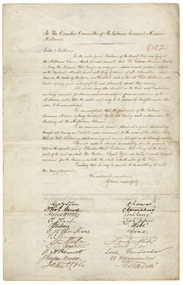
... ...loch ness...Martin, master ship Loch Ness; T.C. Martin, master ship Loch Tay; W.H. ...Christians - ANNA ;/ R E Peasley - SEMIOLE ; / William Martin - LOCH NESS ; / T C Martin - LOCH TAY;/ W H Bennett - LOCH VENNUACHAR; / RJ Raglan Brodie - SS WARRNAMBOOL; ; / James E. ...Martin, master ship Loch Ness; T.C. Martin, master ship Loch Tay; W.H. ...This document reveals the way in which Mission to Seafarers grew in response to demand. With increased shipping to Australia for all purposes, the need for the then existing Mission to grow to be conveniently located and to accommodate seafarers became increasingly evident. This document also shows the formal nature of documents and petitions in the 1890s and documents the names of twenty-two contemporaneous ships and their respective captains. The Anna, Dharwar and Mermerus arrived in port at the end of July 1897. The Carmanina arrived on the 21 October 1897. The Loch Katrine, at the end of the list, arrived on 5 November 1897. The letter was published in the Argus, 22 December 1897: "APPEAL FOR SEAMEN. TO THE EDITOR OF THE ARGUS. Sir, I beg that in the interests of the Victorian Seamen's Mission you will be kind enough to publish the appended testimony of the ship masters who for many years have been trading to this port, and therefore have had many opportunities of judging the effects of his work. The mission has much need of monetary assistance, and, should any of your numenous leaders deem it worthy of support, the committee would feel most grateful for any help that may be given in this direction. It has been the pleasure of the committee as far as possible to supply the crews of all outward bound steamers and sailing vessels with literature for their use on the voyage. My former appeals through your columns for leading matter have always been liberally responded to, and I trust that should any of our booksellers have any surplus stock of periodicals, religious and secular, illustrated or otherwise, at the end of the year, they will kindly remember the Victorian Seamen's Mission and the sailors. Private individuals also who may have stacks of literature by them, if they would kindly send some to the Seamen's Institute, Beach street, Port Melbourne, would cause the cheering of many a dark and lonely hour in the seamen's life. From 900 to 1.200 parcels have hitherto been given to the sailors and firemen annually by this mission, and we should be extremely grateful to those who would place us in a position to continue such donations in the future. Yours, &c. , E. JAMES, Chaplain to the Mission. Seamen's Institute, Beach street, Port Melbourne, Dec. 10." -------------------------------------------------- "To the Executive Committee of the Victorian Seamen's Mission, Melbourne. "Ladies and Gentleman, "We, the undersigned captains of several ships now lying at the Melbourne wharves think it most desirable that the Victorian Seamen's Mission, being the mission that has for so many years shown a most part their interest in the spiritual, moral, and social well-being of the seamen of all nationalities, shall him on the banks of the Yarra an institute such as that at Port Melbourne, where sailors of every grade could profitably and pleasantly spend their evenings. At almost every other seaport in the world such institutions are being provided for seamen, and we are satisfied from our opinion of the Melbourne public that the matter needs only to be prominently brought under their notice to be accomplished. We are confident that the good work of the mission is being hampered by its not having such a place near the shipping at the Melbourne wharves. Our crews are at present placed at a great dis advantage through not having an institute more convenient to the scene of their labours than that at Port Melbourne, which, on a very wet or a very hot, is not easily reached. If a site could be obtained immediately above the Gasworks but on the other side of Flinders street extension, that is to say, on the lower part of the land on which the Harbour Trust offices are built, it would be most convenient for the shipping on both the north and south side of the river. Trusting that it may be possible to do some thing to meet this long felt want, We suscribe ourselves, Yours respectfully, Geo.H Steven, master ship Dharwar; Thos. Curd, master ship Narcissus; James Horne, master ship Loch Garry; T.Tait, master ship Loch Ryan; T. Nilsen, master ship Hebe; G. Ch Christian, master ship Anna; R.E. Peasley, master ship Seminole; Wm. Martin, master ship Loch Ness; T.C. Martin, master ship Loch Tay; W.H. Bennett, master ship Loch Vennachar; J. Raglan Brodie, master s.s. Warrnambool; James E. Coles, master ship Mermerus; J. H. Walker, master ship Hinemoa; R.J. Johns, master ship Ariel; D. Gorchem (sic. Gerckens), master ship Matador; H. Petersen, master ship Nesaia; Wm. J. Reid, master s.s. Star of New Zealand; A. F. Svhanstrom, master ship Hermes; Alex. Smith, master ship Sophocles; W. Y. Bunn, master ship Carmanian; William Anderson, master ship Loch Katrine."This petition is historically significant as it is documentary evidence of the need for a new facility for seafarers signed and presented by the captains of 21 ships, including several of the sister ships of the Loch Ard. The need for a new facility was a result of changes in shipping and the use of the Melbourne ports in the 1890's and this document supported the pressure on the Harbour offices to finally release land for an appropriate building in the early 20th C.Mounted hand-written petition to the Executive Committee of the Victorian Seaman's Mission Melbourne. The letter petitions the Executive Committee to create a facility on the wharves, "where sailors of every grade could profitably and pleasantly spend their evenings." This portion of the letter takes up three quarters of the document. The remainder has two lists, one of twelve captain's signatures and the other of the names of their ships. The list is continued on the reverse side with an additional nine signatures and corresponding ship names.In cursive handwriting: To The Executive Committee of the Victorian Seamans Mission', / Melbourne / Ladies and Gentlemen / we the undersigned captains....... We subscribe / ourselves respectfully, Captain signatures and names of ships ( NB Ship names in upper case for this entry ): Geo H. Stevens - DHARWAR / Thomas Curd - NARCISSUS; / James Horn - LOCH GARRY / T.Tait - LOCH RYAN ; / T.NIlsen - Hebe ; / G.C. Christians - ANNA ;/ R E Peasley - SEMIOLE ; / William Martin - LOCH NESS ; / T C Martin - LOCH TAY;/ W H Bennett - LOCH VENNUACHAR; / RJ Raglan Brodie - SS WARRNAMBOOL; ; / James E. Coles - MERMERUS; / ( signatures continue overleaf) J H Walker - HINEMORA ; / R J Johns - ARIEL; / D Gorchem - MATADOR; / H Petersen - NESAIA;/ William J Reid - STAR of N. ZELAND [sic] ; / TJ Sohanstrom - HERMES;/ Alex Smith - SOPHOCLES; / W Y Bunn - CARMANIAN;./ William Anderson - LOCH KATRINE;/ Handwritten in red ink on the front of the parchment: "8182" NB The second digit in the number sequence appears to have been written over and could also be a "9", an "8" or a "3". paper Watermark "HERCULES". Prior to conservation and taped to the glass on the reverse side of the parchment was a small piece of paper reading: "Letter written in 1897 and signed between the last week of October and the first week of November." T and C probably stands for Trade and Customs and 8382 is the file no." (H8.4 x W11.8)victoria, melbourne, ships, petition, australia-wharf, captains, signatures, 717-flinders-street-docklands, maritime welfare services, mission to seafarers, seamen's mission, mission to seamen, mermerus, captain coles, sir john coode, loch line, loch ness, loch gary, loch ryan, ss warrnambool, loch tay, loch vennachar, matador, nesaia, d. gerckens, h. petersen, a.f. svhanstrom, hermes, ariel, loch katrine, william anderson, dharwar, narcissus, hebe, anna, hinemoa, sophocles, carmanian, captains' petition -
 Mission to Seafarers Victoria
Print - Reproduction, Petition, The Photography Department (Jeremy Dillon), Captains' Petition, 2016
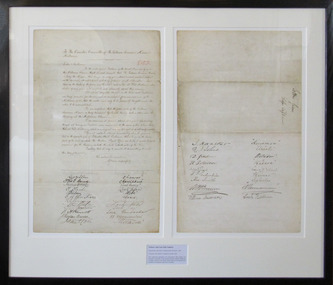
... ...loch ness...Martin, master ship Loch Ness; T.C. Martin, master ship Loch Tay; W.H. ...Martin, master ship Loch Ness; T.C. Martin, master ship Loch Tay; W.H. ...This is a reproduction of the original 1897 Captains' petition to build a Central Institute on the Yarra river. "To the Executive Committee of the Victorian Seamen's Mission, Melbourne. "Ladies and Gentleman, "We, the undersigned captains of several ships now lying at the Melbourne wharves think it most desirable that the Victorian Seamen's Mission, being the mission that has for so many years shown a most part their interest in the spiritual, moral, and social well-being of the seamen of all nationalities, shall him on the banks of the Yarra an institute such as that at Port Melbourne, where sailors of every grade could profitably and pleasantly spend their evenings. At almost every other seaport in the world such institutions are being provided for seamen, and we are satisfied from our opinion of the Melbourne public that the matter needs only to be prominently brought under their notice to be accomplished. We are confident that the good work of the mission is being hampered by its not having such a place near the shipping at the Melbourne wharves. Our crews are at present placed at a great dis advantage through not having an institute more convenient to the scene of their labours than that at Port Melbourne, which, on a very wet or a very hot, is not easily reached. If a site could be obtained immediately above the Gasworks but on the other side of Flinders street extension, that is to say, on the lower part of the land on which the Harbour Trust offices are built, it would be most convenient for the shipping on both the north and south side of the river. Trusting that it may be possible to do some thing to meet this long felt want, We suscribe ourselves, Yours respectfully, Geo.H Steven, master ship Dharwar; Thos. Curd, master ship Narcissus; James Horne, master ship Loch Garry; T.Tait, master ship Loch Ryan; T. Nilsen, master ship Hebe; G. Ch Christian, master ship Anna; R.E. Peasley, master ship Seminole; Wm. Martin, master ship Loch Ness; T.C. Martin, master ship Loch Tay; W.H. Bennett, master ship Loch Vennachar; J. Raglan Brodie, master s.s. Warrnambool; James E. Coles, master ship Mermerus; J. H. Walker, master ship Hinemoa; R.J. Johns, master ship Ariel; D. Gorchem (sic. Gerckens), master ship Matador; H. Petersen, master ship Nesaia; Wm. J. Reid, master s.s. Star of New Zealand; A. F. Svhanstrom, master ship Hermes; Alex. Smith, master ship Sophocles; W. Y. Bunn, master ship Carmanian; William Anderson, master ship Loch Katrine."Framed and mounted reproduction of Captains' petitionpetition, seamen's mission, yarra river, captains, victoria, melbourne, ships, australia-wharf, signatures, 717-flinders-street-docklands, maritime welfare services, mission to seafarers, mission to seamen, mermerus, captain coles, sir john coode, loch line, loch ness, loch gary, loch ryan, ss warrnambool, loch tay, loch vennachar, matador, nesaia, d. gerckens, h. petersen, a.f. svhanstrom, hermes, ariel, loch katrine, william anderson, dharwar, narcissus, hebe, anna, hinemoa, sophocles, carmanian, early origins, 2016, exhibitions -
 Royal Brighton Yacht Club
Trophies, Ornate and Old trophies
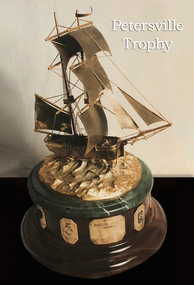
... ...loch ness...You can see some of these by clicking on the right arrow on the photo above. petersville clock olympic dragon jubilee custom paints galatea breeze harvey ramsey lightening lynch st kilda commodore loch ness bell Ornate and Old trophies Trophies ...Over the history of RBYC some very ornate trophies have been presented. These are no longer used but are brought out for display on special occasions. You can see some of these by clicking on the right arrow on the photo above.petersville, clock, olympic, dragon, jubilee, custom paints, galatea, breeze, harvey, ramsey, lightening, lynch, st kilda, commodore, loch ness, bell -
 Uniting Church Archives - Synod of Victoria
Colour photo, 1986
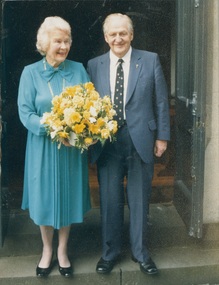
... For the rest of his life, he retained an avid interest in the Loch Ness Monster and its attendant scientific debate. ...For the rest of his life, he retained an avid interest in the Loch Ness Monster and its attendant scientific debate. ...1911–2005: Gordon George Powell, who has died at 94, was for many years the highly influential minister at St Stephen's Presbyterian Church in Sydney and a popular radio broadcaster and author. He began Wednesday services at St Stephen's in Macquarie Street soon after arriving in Sydney from Melbourne in 1952. They grew to become the biggest regular lunch-hour services in the world, with up to 1300 people crowding the church and the hall below. In 1953, with the help of Vernon Turner of the Christian Broadcasting Association, services were broadcast on radio. The broadcasts continued even when Gordon moved back to Melbourne, so for 30 years he maintained a successful weekly radio ministry. While at St Stephen's, he was also involved in the 1959 Billy Graham Crusade in Sydney, attended by 980,000 people over two weeks. Gordon was born in Warrnambool, Victoria, the son of a dentist, George Powell, and his wife, Louisa (nee Clarke). He went to school at Scotch College. He gave up plans to become an electrical engineer after hearing a call to the ministry and studied arts and then theology at the University of Melbourne, where he formed a close friendship with Edward (Weary) Dunlop. Gordon rowed in the Ormond crew, winning the university's inter-college trophy five times. He was a passionate sports lover all his life. He was awarded a scholarship to Trinity College, Glasgow University, in 1935, and for three months stayed with the great Scottish churchman George (later Lord) MacLeod. While on a cycling trip around Scotland, he stopped by the shores of Loch Ness and saw a long neck appear. The monster swam about 300 metres at great speed; Gordon counted three or four humps. Later, when he saw a skeleton of a plesiosaurus at the Victoria and Albert Museum, he recognised it as Nessie. For the rest of his life, he retained an avid interest in the Loch Ness Monster and its attendant scientific debate. While in Scotland, Gordon wrote a weekly article for The Messenger, the official journal of the Presbyterian Church of Victoria. This led to a life as an author of articles and books. He also wrote long letters home to his mother, a habit that later led to his weekly "Dad's Diaries", which were distributed to the wider family. Failing eyesight put an end to his reading and writing two years ago. On returning to Australia in late 1936, he became assistant minister at Toorak, the second-biggest Presbyterian church in Melbourne. There, at last, Gordon married Gwen Gilchrist, whom he had courted for nine years. They moved from the wealthiest church to one of the poorest, at Port Adelaide, which was still in the grip of the Depression. There, he was finally ordained, in May 1938, and the first two of their four children, Rosemary and David, were born. In 1941, Gordon became assistant minister to Scots Church in Melbourne and the following year, after the birth of his third child, Mardi, he reluctantly volunteered as an RAAF chaplain. He was a pacifist but felt bad at not being in uniform. For the following three years, he was stationed in New Guinea and Australia. His war reminiscences were published as Two Steps to Tokyo and sold 6000 copies in 1945 alone. At 34, by then the father of four children, he was invited to be minister of the Collins Street Independent Church in the heart of Melbourne, now St Michael's Uniting Church Before being inducted, he undertook a lecture tour of the US, speaking to Rotary clubs in 48 centres, from Michigan to Maryland. He met, and was impressed by, the liberal theologian Harry Emerson Fosdick, and the US religious leader and author Norman Vincent Peale, who became a close friend and mentor. Back in Australia, Gordon founded and fostered the first Alcoholics Anonymous group in Melbourne. In 1952, he took up what was to become his happiest ministry, at St Stephen's in Sydney. When Queen Elizabeth and Prince Philip toured two years later, Gordon and Gwen were not only invited to lunch with them, but sat beside them. This was a highlight for Gordon, an ardent monarchist. In 1960, Gordon and Gwen embarked on a world tour that included the US, where he was invited to give the opening prayer in the Senate, with vice-president Richard Nixon presiding. After another five years at St Stephen's, Gordon returned to Scots Church in Melbourne. It was a time of bitter debates over church union with the Methodists and Congregationalists. Gordon was in favour, but Scots ultimately voted to stay out and remain Presbyterian. By then in his mid-60s, he and Gwen moved to New York, where Peale was his neighbour. They had six happy years there before retiring to Melbourne. Gordon is survived by Gwen, and children David, Mardi and Jenny (daughter Rosemary died in 1992), 13 grandchildren and 10 great-grandchildren. [From the obituary in the Sydney Morning Herald, 2005, written by Jenny (Powell)] Gwen and Gordon Powell coming out of the Toorak Uniting Church 50 years after they were married there. Gwen and Gordon Powell coming out of the Toorak Uniting Church 50 years after they were married there.gordon powell; gwen powell; port adelaide; toorak presbyterian church; st stephen's presbyterian church sydney; presbyterian minister
