
Showing 6 items matching "london bridge, great ocean road"
-
 Ballarat Heritage Services
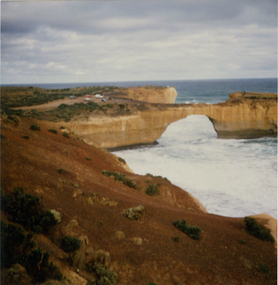
Photograph - Geological formation, London Bridge, Great Ocean Road, 01/1990
... London Bridge, Great Ocean Road...london bridge, great ocean road...Two coloured photographs of the London Bridge, on the Great Ocean Road. This photo was taken days before the collapse of the geological feature. ...London Bridge, pre 1990 was a double-spanning bridge connected to the mainland. The stack was created over hundreds of years, with the weaker layers toward the base being eroded away by wind and water to form the two bridges. The span closer to the shoreline collapsed unexpectedly on 15 January 1990, leaving two visitors, whilst uninjured, stranded on the outer span before being rescued by helicopter. london bridge, great ocean road london bridge, peterborough london arch Shipwreck coast 12 apostles Two coloured photographs of the London Bridge, on the Great Ocean Road. ...London Bridge, pre 1990 was a double-spanning bridge connected to the mainland. The stack was created over hundreds of years, with the weaker layers toward the base being eroded away by wind and water to form the two bridges. The span closer to the shoreline collapsed unexpectedly on 15 January 1990, leaving two visitors, whilst uninjured, stranded on the outer span before being rescued by helicopter. Two coloured photographs of the London Bridge, on the Great Ocean Road. This photo was taken days before the collapse of the geological feature. The photographer walked across the bridge to the warning of her mother "if you go over there and it collapses you will be stuck. After the collapse it was renamed London Arch. london bridge, great ocean road, london bridge, peterborough, london arch, shipwreck coast, 12 apostles -
 Peterborough History Group
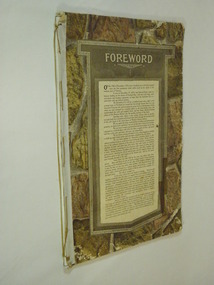
Booklet - 1934 Western District Centenary Magazine, Terang Express, Western District Centenary Souvenir, 1934
... London Bridge...Great Ocean Road...in Barry Jenkins General Store moyne shire peterborough 3270 western district souvenir peterborough general store London Bridge Great Ocean Road Wholly set up, Printed and Published at THE TERANG EXPRESS""Office, Terang A magazine shaped booklet. ..."The Western District Centenary Souviner"Published in 1934 as an anniversary edition for Edward Henty making his historic landing on the shores of Portland Bay on November 19, 1834Has tourism and business advertisements for Peterborough businesses. Refers to families and and early settlers of Peterborough. Sold for ? in Barry Jenkins General StoreA magazine shaped booklet. Cover replaced with wall paper and bound with tape and string. Forward stuck to front cover. Browned with age and taped on a few pagesWholly set up, Printed and Published at THE TERANG EXPRESS""Office, Terangmoyne shire, peterborough 3270, western district souvenir, peterborough general store, london bridge, great ocean road -
 Flagstaff Hill Maritime Museum and Village
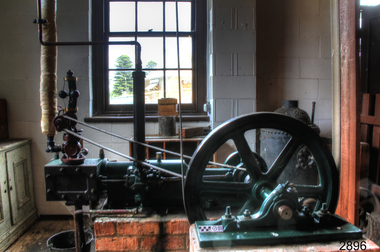
Machine - Steam Engine, Tangyes engineering, Mid-1880s
... Great Ocean Road...machine...invention...engine...steam...steam engine...horizontal steam engine...Tangyes horizontal steam engine...stationary steam engine...single cylinder steam engine...manufacturing...farming...pumps...lifting equipment...engines...machine tools...hydraulic rams...hydraulic pumps...steam pumps...differential pulleys...Mill type steam engine...4 inch cylinder...Weston’s differential pulley...Thomas Aldridge Weston...1862 International Exhibition in London...Brunel...SS Great Eastern...Cleopatra’s Needle...Forth Road Bridge...Flagstaff Hill Warrnambool Maritime Village Maritime Museum Flagstaff Hill Maritime Museum and Village Shipwreck coast Great Ocean Road machine invention engine steam steam engine horizontal steam engine Tangyes horizontal steam engine stationary steam engine single cylinder steam engine manufacturing farming pumps lifting equipment engines machine tools hydraulic rams hydraulic pumps steam pumps differential pulleys Mill type steam engine 4 inch cylinder Weston’s differential pulley Thomas Aldridge Weston 1862 International Exhibition in London Brunel SS Great Eastern Cleopatra’s Needle Forth Road Bridge Cornwall House Collins Street Melbourne agricultural machinery industrial machinery Allspeeds dairy pump Richard Tangye & Brothers James Tangye and Brothers Tangye Brothers and Price Tangye Brothers Tangye Brothers & Holman Tangyes Ltd. ...This Tangye B-size, single-cylinder, horizontal steam engine was likely manufactured in England around the mid-1880s. It was distributed by Melbourne machinery merchants Cameron & Sutherland, which also operated in Bendigo and Ballarat. A local cheese maker once used the engine to drive factory equipment. It was later donated to the Warrnambool Technical School, which then donated it to Flagstaff Hill to add to its historical steam engine collection. Between its manufacture and its donation to Flagstaff Hill, the governor had been replaced by the current Pickering governor. This engine design was very popular in the late 19th and early 20th centuries. When connected and powered up, the engine could drive an overhead line shaft via a flat belt off its flywheel. The line shaft would then drive the machinery via flat belts. It could drive virtually any type of machinery, such as water and sewerage pumps, mine elevators, winches, cranes, metal forges, air blowers, and marine machinery. This engine features a mechanical governor, which controls the speed of the engine regardless of whether it is under load. It also has a water pump built into the valve rod, which is used to supply the boiler with water. Steam enters the cylinder via a slide valve and applies pressure to the piston; it is like a modern internal combustion engine, but in the case of the steam engine, the pressure is exerted in turn on either side of the piston. In other words, the connecting rod is pushed by steam via the piston and piston rod and then pulled back again by steam pushing on the opposite side of the piston. Thus, power is exerted almost continuously, except at the end of each piston stroke, when it reverses direction. In the 1880s, many local butter and cheese manufacturers installed Tangye steam engines to power their machinery. A comprehensive article in the Gippsland Mercury in September 1889 extolled the magnificence of the Farnham Butter Factory in Dennington, Warrnambool, and described how one Tangye engine was used to drive several machines in the cheese- and butter-making processes. A report in the Warragul Guardian in December 1890 notes that the newly opened Warrnambool Butter Factory used a Tangye steam engine to pump water from a 60-foot well. Tangye: Richard Tangye (1833–1906) and four of his brothers—James, Joseph, Edward, and George—were the sons of Joseph Tangye, a Quaker Cornish miner. In 1857, they founded the engineering firm Richard Tangye & Brothers in Birmingham, UK. In 1860, the firm became Tangye Brothers and moved to Cornwall Works in Birmingham. The business encouraged inventors to join the company and develop their patents there, as happened with Weston’s differential pulley block, invented by the Englishman Thomas Aldridge Weston in 1854. Tangye bought the patent in 1858, giving the firm the sole right to manufacture it. The design received a medal for “original application, practical utility and success” at the 1862 International Exhibition in London. Also in 1858, the Tangye firm was commissioned by Brunel’s shipping company to manufacture hydraulic lifting jacks, or rams, to launch the steamship SS Great Eastern. The success of this project brought favourable attention to the firm, and it became involved in other notable projects, including the erection of Cleopatra’s Needle in London in 1878 and work on the Forth Road Bridge in Scotland. The firm underwent several name changes over the years, including James Tangye and Brothers (1857), Tangye Brothers and Price (1859), Tangye Brothers (1860), Tangye Brothers & Holman (1876), Tangye Brothers (by 1878), Tangye Ltd. (1881), and then simply Tangye. Its machinery and equipment were exported worldwide. In 1884, a branch with showrooms, offices, and a warehouse was opened in Melbourne at Cornwall House, Collins Street West. The firm was well known for producing high-quality machinery for agriculture and industry. Even today, new Tangye machinery is available for a subsidiary of Allspeeds. An extensive account of the firm’s history, names, inventions, and further references is available in Grace’s Guide, which also includes references to and diagrams of the Tangye horizontal steam engine. The horizontal steam engine was made by the well-known engineering firm Tangye, known for its high quality of manufacture. It was an important development in machinery because it helped improve productivity. Engines of this type are still used in some parts of the world today. This engine is a good example of a late 19th-century steam engine used in industry and agriculture and adapted for many different purposes. It is also important locally because it was connected to a local cheese making business and part of the thriving western district dairy industry. It may have been one of the Tangyes engines used at the Farnham butter factory or the Warrnambool Butter Factory, which was reported to be one of the most important in the Colony. It is also connected to the Warrnambool Technical School, established in 1968. Steam engine: stationary Tangye Size B, single-cylinder, horizontal Mill type steam engine. It has a 4-inch diameter cylinder with an 8-inch stroke. The body is painted green, and the Pickering governor is red. It was manufactured in Birmingham, England, in accordance with Tangye's Patent 238930, and distributed by Cameron and Sunderland, Melbourne, in the mid-1880s. TANGEYS PATENT BIRMINGHAM B SIZE 238930 CAMERON & SUTHERLAND MELBOURNE THE PICKERING PORTLAND . GOVERNOR . CONN. U.S.A.flagstaff hill, warrnambool, maritime village, maritime museum, flagstaff hill maritime museum and village, shipwreck coast, great ocean road, machine, invention, engine, steam, steam engine, horizontal steam engine, tangyes horizontal steam engine, stationary steam engine, single cylinder steam engine, manufacturing, farming, pumps, lifting equipment, engines, machine tools, hydraulic rams, hydraulic pumps, steam pumps, differential pulleys, mill type steam engine, 4 inch cylinder, weston’s differential pulley, thomas aldridge weston, 1862 international exhibition in london, brunel, ss great eastern, cleopatra’s needle, forth road bridge, cornwall house, collins street melbourne, agricultural machinery, industrial machinery, allspeeds, dairy, pump, richard tangye & brothers, james tangye and brothers, tangye brothers and price, tangye brothers, tangye brothers & holman, tangyes ltd., tangye, richard tangye, james tangye, joseph tangye, edward tangye, george tangye, cornwall works, birmingham, pickering governor, pickering portland connecticut usa, 19th century, dairy plant, steam power, tangye's patent 238930, tangye b size engine, cameron & sutherland, machine merchants, 1880s, mid-1880s, cheese manufacturer, butter manufacturer, diary industry, warrnambool technical school, belt driven machinery, agriculture, mechanical governor, farnham butter factory, warrnambool butter factory -
 Flagstaff Hill Maritime Museum and Village
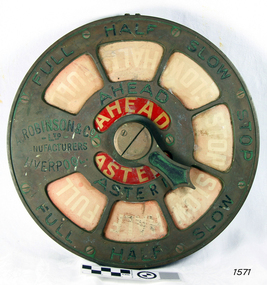
Equipment - Ship's Telegraph section, A. Robinson & Co. Ltd, Late-19th to mid-20th centuries
... London in 1870. This Engine Room section is part of a ship's telegraph communication system and represents marine technology used in the late-19th to mid-20th-century. Flagstaff Hill Warrnambool Maritime Museum Maritime Village Great Ocean Road Shipwreck Coast Marine technology Marine communications Engine Order Telegraph E.O.T. Ship’s telegraph Bridge ...The ship’s communication system that was used from the late 19th century to early-to-mid-20th-century is called an Engine Order Telegraph (E.O.T.) or ship’s telegraph. The system has two parts, the Bridge Section and the Engine Room Section. The Bridge Section is usually mounted on top of a pedestal, and the Engine Room Section is often attached to a vertical surface. The standard commands printed or stamped onto the dial are the directions of AHEAD and ASTERN, and the speeds of STOP, SLOW, HALF, and FULL. The ship’s pilot on the Bridge of a vessel sends his Orders for speed and direction to the to the Engine Room with the E.O.T. He moves the lever or levers, depending on the number of engines the ship has, to change the indicator on the Bridge Section’s dial to point in the new direction and speed of travel. This change causes the Orders to be duplicated on the Engine Room Section’s dial and a bell to signal the change at the same time. The engineer then adjusts the ship’s engines and steering equipment to follow the pilot’s Order. The manufacturer, A. Robinson & Co. Ltd of Liverpool, established his business in 1780 and continued until 1968 when the business was purchased by marine products maker Chadburns, established in London in 1870.This Engine Room section is part of a ship's telegraph communication system and represents marine technology used in the late-19th to mid-20th-century. Engine Room Section of a ship’s telegraph or Engine Order Telegraph (E.O.T.). The round brass dial has inscriptions stamped around its edge and centre. Red inlaid glass plates have inscriptions in white paint on them. The inscriptions are nautical terms for direction and speed and include the maker’s details. A rotating pointer is joined to the centre of the dial. The maker is A. Robinson & Co. Ltd of Liverpool. Stamped: “FULL / HALF / SLOW / STOP / FULL / HALF / SLOW / STOP”, “AHEAD / ASTERN” Printed: “FULL / HALF / SLOW / STOP / FULL / HALF / SLOW / STOP” Stamped on the dial: “A. ROBINSON & CO. LTD / MANUFACTURERS / LIVERPOOL”flagstaff hill, warrnambool, maritime museum, maritime village, great ocean road, shipwreck coast, marine technology, marine communications, engine order telegraph, e.o.t., ship’s telegraph, bridge section, engine room section, ship’s engine telegraph section, marine telegraph, a. robinson & co. ltd, liverpool -
 Peterborough History Group
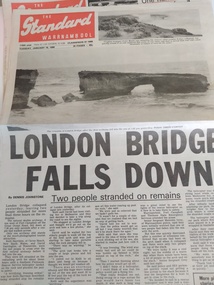
Newspaper, London Bridge Falls Down, 16th January 1990
... london bridge...london bridge rock formation...rock collapse...great ocean road...London Bridge rock formation on January 15th 1990 was a significant event for Peterborough residents. London Bridge is a major local tourist attraction. Prior to the collapse tourists could walk across the arches onto the rock platform and it was a regular fishing spot. The collapse of the arch was a significant event for the town. The site is still an important tourist stop. The rockfall occurred after two recent events - a helicopter hit the arch and crashed, no one injured; and the earthquake in Newcastle NSW. london bridge london bridge rock formation rock collapse great ocean road ...The collapse of one arch of the London Bridge rock formation on January 15th 1990 was a significant event for Peterborough residents.London Bridge is a major local tourist attraction. Prior to the collapse tourists could walk across the arches onto the rock platform and it was a regular fishing spot. The collapse of the arch was a significant event for the town. The site is still an important tourist stop. The rockfall occurred after two recent events - a helicopter hit the arch and crashed, no one injured; and the earthquake in Newcastle NSW.Two full page articles about the rock formation London Bridge falling down, and the people who were stranded on the rock platformlondon bridge, london bridge rock formation, rock collapse, great ocean road, peterborough -
 Flagstaff Hill Maritime Museum and Village
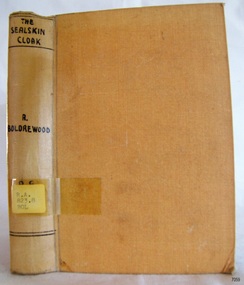
Book - Fictional Novel, Rolf Boldrewood (Pen Name), The Sealskin Cloak, 1896
... (For more information on the Pattison Collection see item 3678 Flagstaff Hill collections) https://victoriancollections.net.au/items/5580c7e72162f114d8b758db warrnambool shipwrecked-coast flagstaff-hill flagstaff-hill-maritime-museum maritime-museum shipwreck-coast flagstaff-hill-maritime-village shipwrecked-artefact great ocean road book warrnambool library warrnambool mechanics’ institute mechanics’ institute library victorian library board warrnambool books and records warrnambool children’s library warrnambool public library the sealskin cloak rolf boldrewood The Sealskin Cloak (1896) is a novel by Rolf Boldrewood, the pen name of Thomas Alexander Browne the Australian author best known for Robbery Under Arms. Unlike his famous bushranger and goldfield tales, this novel is set largely in England and Europe rather than the Australian bush. It opens with Hugh Gordon parting from his wife, Marguerite, at London Bridge ...The Sealskin Cloak (1896) is a novel by Rolf Boldrewood, the pen name of Thomas Alexander Browne the Australian author best known for Robbery Under Arms. Unlike his famous bushranger and goldfield tales, this novel is set largely in England and Europe rather than the Australian bush. It opens with Hugh Gordon parting from his wife, Marguerite, at London Bridge railway station as she travels to attend to a sick aunt in the south of France, wearing her distinctive sealskin cloak. The cloak later becomes central to a case of mistaken identity following an accident, when the name and address sewn inside the garment are used to identify a body as Marguerite Gordon. The novel is generally classed as a romantic mystery rather than one of his colonial adventure narratives.Hard cover book, The Sealskin Cloak Author: Pen Name Rolf Boldrewood For (Thomas Alexander Browne) Publisher: Macmillan And Co Date: 1896 Brown cloth hardcover and spine with spine lettering in black texter. The spine has a Library label with inscription.fictionThe Sealskin Cloak (1896) is a novel by Rolf Boldrewood, the pen name of Thomas Alexander Browne the Australian author best known for Robbery Under Arms. Unlike his famous bushranger and goldfield tales, this novel is set largely in England and Europe rather than the Australian bush. It opens with Hugh Gordon parting from his wife, Marguerite, at London Bridge railway station as she travels to attend to a sick aunt in the south of France, wearing her distinctive sealskin cloak. The cloak later becomes central to a case of mistaken identity following an accident, when the name and address sewn inside the garment are used to identify a body as Marguerite Gordon. The novel is generally classed as a romantic mystery rather than one of his colonial adventure narratives.warrnambool, shipwrecked-coast, flagstaff-hill, flagstaff-hill-maritime-museum, maritime-museum, shipwreck-coast, flagstaff-hill-maritime-village, shipwrecked-artefact, great ocean road, book, warrnambool library, warrnambool mechanics’ institute, mechanics’ institute library, victorian library board, warrnambool books and records, warrnambool children’s library, warrnambool public library, the sealskin cloak, rolf boldrewood
