
Showing 4 items matching "long calipers"
-
 Flagstaff Hill Maritime Museum and Village
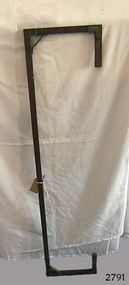
Barrel Calipers, Early 20th Century
... ...long calipers...The item demonstrates a long social history of the practice of Government's collecting duty on alcoholic beverages and thereby makes this item historically significant as it was used locally at Port Fairy by the ports Customs agents. flagstaff hill warrnambool shipwrecked coast flagstaff hill maritime museum maritime museum shipwreck coast flagstaff hill maritime village great ocean road customs long calipers excise duty barrel calipers "Dring & Fage Makers to the Customs" stamped on side. ...The firm Dring and Fage were active from 1790 to 1940 in London and were manufacturers of hydrometers and mathematical instruments they became established in London in 1790 by John Dring, who was a brass worker and hydrometer maker, and William Fage. Dring and Fage manufactured also saccharometers and other instruments used to measure the strength of alcohol. These instruments were primarily used to calculate excises. They traded at various addresses in London and they were at 56 Stamford St. between 1903 and 1938. By 1850 the company was owned by Edward Hall and Edward Jenkin and in 1940 the company became Dring & Fage Ltd, trading till the 1960s.Historically, gauging has meant measuring a volume, these gauging instruments were used by Customs and Excise and manufacturers for determining the volume and contents of liquid containers. For Customs the determination and collection of duty on imported goods which has had a very long history. Chaucer was a Customs Officer as was his father and grandfather, excise was first officially introduced in 1643, with the aim of maintaining military forces raised by the English Parliament at that time. Excise was initially a duty on home produced alcoholic beverages and soap but being easily applied, spread rapidly to a wide range of goods including imports of varying kinds. The government departments of Customs and Excise merged only in 1909 and it is from around this time that our instrument was made and used. The item demonstrates a long social history of the practice of Government's collecting duty on alcoholic beverages and thereby makes this item historically significant as it was used locally at Port Fairy by the ports Customs agents. Boxwood barrel calipers, wooden slide-rule with right angles at each end and brass fittings used for measuring casks length."Dring & Fage Makers to the Customs" stamped on side.flagstaff hill, warrnambool, shipwrecked coast, flagstaff hill maritime museum, maritime museum, shipwreck coast, flagstaff hill maritime village, great ocean road, customs, long calipers, excise duty, barrel calipers -
 Flagstaff Hill Maritime Museum and Village
Head Rod, Dring & Fage, c. 1901
... When the rod is removed the bung measurement can be read from the scale on the rod. (3) Long Calipers - this instrument measures the length of the cask between the heads. ...When the rod is removed the bung measurement can be read from the scale on the rod. (3) Long Calipers - this instrument measures the length of the cask between the heads. ...The Australian Customs Service, Melbourne, donated a set of gauging instruments, and Port Fairy Customs donated another instrument, the Sike’s Hydrometer, to Flagstaff Hill Maritime Village, all of which were no longer required. However these ullaging tools were in use for many years by Customs officials, called Gaugers. Ullaging is a term describing the measurement of the amount of liquid remaining in a container of spirits such as a cask or barrel. It can also measure the free space or head space remaining. The primary role of customs officers in Victoria was to calculate the tariff or excise duty payable on goods imported into Victoria. (Excise duty is a tax on goods produced within a country, and customs duty is imposed on imports.) Customs officers spent a great deal of their time measuring and weighing goods, and then calculating the amount of duty to be paid by the importer. The tariffs for different products varied, and officers consulted published lists. Calculating the duty payable on a barrel of brandy was a detailed task. The gauger had to measure the barrel to determine its volume. Barrels were irregular in shape, and finding the volume required several measurements and checking tables of figures. Alcoholic content was then measured with a hydrometer. The duty paid varied according to the alcoholic strength of the spirits. Uniform national customs and excise duties were operative in Australia from October 1901. These tools were still being used in Australia in the 1950’s. The Federal Government still imposes excise taxes on goods such as cigarettes, petrol, and alcohol. The rates imposed may change in February and August each year in response to changes in the consumer price index. ULLAGING TOOLS (1) Head Rod - this instrument measures the diameter of the heads (top and bottom ends) of a cask or barrel. The shaped brass pieces on the head rod enable the diameter of a barrel to be measured inside the chimes at the head end. The slide rule could then be used to calculate the internal volume of the barrel. On the reverse side is a set of ullaging scales, used like those on any ullaging rule, to calculate the volume of liquid in a partially filled barrel. (2) Bung Rod – this instrument measures the diameter of a cask or barrel when it is lying on its side. It is a rod that fits into the ‘bung’ hole of a cask and is long enough be extended to reach the opposite side of the cask. The brass sliding pointer can be moved to mark the ‘wet’ line. When the rod is removed the bung measurement can be read from the scale on the rod. (3) Long Calipers - this instrument measures the length of the cask between the heads. It has two rules sliding beside each other, each end having another piece of wood fixed firmly at right angles downwards then turned inwards at the ends so as to reach over the heads of the casks without touching the projecting ends. The centre pieces enable it to extend or contract, changing the distance between the two other parallel sides, the distance they are apart being shown by the rule on the sliding pieces. (4) Cross Calipers – this instrument is used to take the bung diameters of casks, or "the Cross " as it is called. This instrument has two rules sliding beside each other, each end having another piece of wood fixed firmly at right angles downwards, together forming a 3 sides of a rectangle with the centre pieces enabling it to extended or contracted, changing the distance between the two other parallel sides, the distance they are apart being shown by a the rule on the sliding pieces. (5) Sike’s Hydrometer – this instrument is used to gauge the strength of different alcoholic spirits when fitted with the different weights in the set. Every set is individually calibrated to ensure that it meets the exact Standard Weight and Measure compliance, then every piece in that set is stamped with the same number by the Calibrator, to ensure that the measurements are taken using the same hydrometer set. [References: A Handbook of Practical Gauging, Janes Boddely Keene of H.M. Customs, 1861, F. Pitman, London; Customs Act, Volume 2, No. 1, April 1999; Old Customs House website ] Head Rod, ullaging gauge. Long wooden rod made of three joined sections, brass hook on end, sliding centre section with hook, measurements marked along each section as on a slide rule. Used for measuring diameter of heads of casks in order for Customs to calculate excise (tax) on the contentsflagstaff hill, warrnambool, shipwrecked coast, flagstaff hill maritime museum, maritime museum, shipwreck coast, flagstaff hill maritime village, great ocean road, head rod, gauging rod, ullaging rods, measuring instruments, customs tax -
 Bendigo Historical Society Inc.
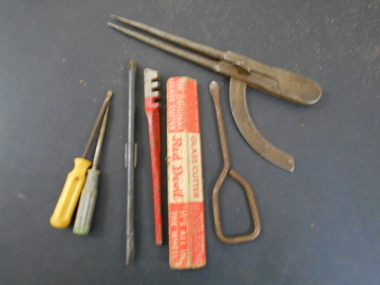
Tool - PITTOCK COLLECTION: MIXED SCREW DRIVERS, CALIPERS AND GLASS CUTTER
... long. Steel callipers, 190mm in length. Items stored in Pittock coach builder's box, reference 13000.1. Tool PITTOCK COLLECTION: MIXED SCREW DRIVERS, CALIPERS AND GLASS CUTTER ...Pittock Collection: mixed screw drivers, callipers and glass cutter. Glass cutter in original "Red Devil"box, 130mm length. Four minor mixed screw drivers, two straight and two Phillip's head screw drivers; varying in length 95-150mm long. Steel callipers, 190mm in length. Items stored in Pittock coach builder's box, reference 13000.1.Glass cutter in original "Red Devil"box -
 National Vietnam Veterans Museum (NVVM)
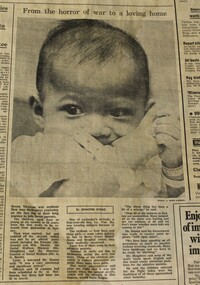
Newspaper - The Age - Friday 11th April 1975 A newspaper article titled, 'From the horror of war to a loving home', The AGE - Friday 11th April 1975
... calipers. Children were being taken to Berry Street Babies Home war orphans orphans Adoptive parents Berry Street Berry street babies home Polio Premier Mr Hamer Mr.A.G.Booth Le Van Be Premier Mr Hamer Social Welfare Minister Mr Houghton Director General of Social Welfare Mr A.G. Booth OPeration babylift The article from the Age Newspaper - dated Friday 11th April 1975. Titled 'From the Horror of War to a Loving Home' written by journalist - Jennifer Byrne An article from The Age Newspaper - (Friday 11th April 1975) describing the arrival of seven Vietnamese war orphans, flown into Melbourne, completing a long ...After Operation Babylift, seven Vietnam War orphans, four boys, three girls aged from 6 months to 10 years of age arrived in Melbourne to meet their adoptive families. On arrival they were greeted by: The Official Party, led by Premier- Mr Hamer, Social Welfare Minister- Mr Houghton, Director General of Social Welfare - Mr A.G. Booth. Le Van Be - (orphan) four year boy arrived wearing calipers. Children were being taken to Berry Street Babies HomeAn article from The Age Newspaper - (Friday 11th April 1975) describing the arrival of seven Vietnamese war orphans, flown into Melbourne, completing a long journey from the horrors of war to begin new lives with in Australia. See media for more information.The article from the Age Newspaper - dated Friday 11th April 1975. Titled 'From the Horror of War to a Loving Home' written by journalist - Jennifer Byrnewar orphans, orphans, adoptive parents, berry street, berry street babies home, polio, premier, mr hamer, mr.a.g.booth, le van be, premier mr hamer, social welfare minister mr houghton, director general of social welfare mr a.g. booth, operation babylift
