Showing 13 items matching "long son island"
-
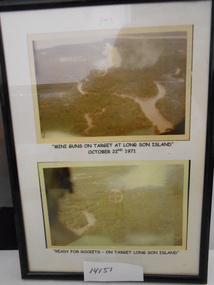
National Vietnam Veterans Museum (NVVM)Photograph, Air Attack at Long Son Island, 22/10/1971 12:00:00 AM
... Air Attack at Long Son Island......Long Son Island...Two Black Framed colour Photograph of Aerial attack on Long Son Island on October 22 1971...Long Son Island, Vietnam...National Vietnam Veterans Museum (NVVM) 25 Veterans Drive Newhaven phillip-island-and-the-bass-coast Photograph Long Son Island Aerial attack Two Black Framed colour Photograph of Aerial attack on Long Son Island on October 22 1971 Air Attack at Long Son Island Photograph Photograph ...Two Black Framed colour Photograph of Aerial attack on Long Son Island on October 22 1971photograph, long son island, aerial attack -
National Vietnam Veterans Museum (NVVM)Poster - Information Board 5RAR 1st Tour 1966 to 1967
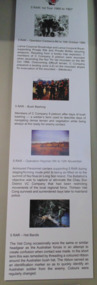
... ...Long Son Island...Armoured Personnel carriers supporting 5 RAR during staging/forming mode prior to being air-lifted on to the summit of Nui Nua on Long Son Island. The Battalion's objective was to capture or eliminate the Chau Duc District VC Company that had been restricting movements of the local regional force. ...Armoured Personnel carriers supporting 5 RAR during staging/forming mode prior to being air-lifted on to the summit of Nui Nua on Long Son Island. The Battalion's objective was to capture or eliminate the Chau Duc District VC Company that had been restricting movements of the local regional force. ...A Poster, Information Board on 5 RAR 1st Tour 1966 to 1967. Below a black and white photograph reads: 5 RAR Operation Canberra 6th to 10th October 1966. Lance Corporal Shoebridge and Lance Corporal Bryan supporting Private Riik and Private Birtles securing weapons. Resulting from a booby trap explosion, 7 members of C Company 8 platoon were wounded when ascending the Nui Thi Vai mountain on the 8th Oct 1966. Overcoming difficult terrain, C Company prepared a landing zone (LZ) on the slopes for evacuation of the wounded - (Medevac). Under a coloured photograph of soldiers reads; 5 RAR - Bush Bashing 1966. Members of C Company 9 platoon after days of bush bashing - a soldier's term used to describe days of navigating dense terrain and vegetation while being always at the ready for enemy contact. Under a coloured photograph of APC reads: 5 RAR - Operation Hayman 8th to 12 November. Armoured Personnel carriers supporting 5 RAR during staging/forming mode prior to being air-lifted on to the summit of Nui Nua on Long Son Island. The Battalion's objective was to capture or eliminate the Chau Duc District VC Company that had been restricting movements of the local regional force. Thirteen Viet Cong survived and surrendered days later to mainland police. Under a coloured photograph of soldiers walking on a log over water reads: 5 RAR - Hat Bands. The Viet Cong occasionally wore the same or similar headgear as the Australian forces in an attempt to create confusion when contact was made. In the short term this was remedied by threading a coloured ribbon around the Australian bush hat. The ribbon served as an identification marker so as to quickly identify an Australian soldier from the enemy. Colours were regularly changed.5 rar, c coy, operation canberra, operation hayman, l/cpl ronald peter shoebridge, 216068, royal australian infantry corps, 5th battalion, the royal australian regiment, pte david george riik, 2781458, australian national serviceman, l/cpl david alexander bryan, 3786720, pte robert charles birtles, 3786660, wounded in action, 8 platoon, nui thi vai mountain, armoured personnel carrier, nui nua, long son island, chau duc district vc company, viet cong prisoner -
National Vietnam Veterans Museum (NVVM)Document - Technical Report 17 Construction
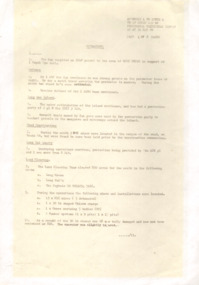
... ...Long Son Island...National Vietnam Veterans Museum (NVVM) 25 Veterans Drive Newhaven phillip-island-and-the-bass-coast Appendix Annex Operations 1CAP Patrol Soui Neigh Long Son Island Thomas Roger Lloyd Pte Lloyd 3797402 Royal Australian Infantry Corps 1 Australian Reinforcement Unit 2nd Battalion The Royal Australian Regiment 17 Construction Technical report A photocopy of Appendix 1 to Annex A to 17 Const Sqn GP Periodical Technical Report as at 31 May 70 on Operation. ...A photocopy of Appendix 1 to Annex A to 17 Const Sqn GP Periodical Technical Report as at 31 May 70 on Operation. This is on A4 paper with a yellow background and the print is in black ink.appendix, annex, operations, 1cap patrol, soui neigh, long son island, thomas roger lloyd, pte lloyd, 3797402, royal australian infantry corps, 1 australian reinforcement unit, 2nd battalion, the royal australian regiment, 17 construction, technical report -
National Vietnam Veterans Museum (NVVM)Photograph - A Coloured Photograph of Mini Guns Alive, 1/10/1971 12:00:00 AM
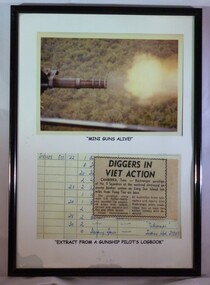
... ...Long Son Island...9 Squadron RAAF Gunner Long Son Island Vung Tau Airfield Bushranger Pilots In a black frame there are three separate items. ...In a black frame there are three separate items. The top on is a coloured photograph of shots being fired. Under the photograph reads "Mini Guns Alive". Under this there a copy of an Extract from a gunship pilots logbook. Pasted on the logbook details there is a newspaper clipping titled Diggers In Viet Action from Canberra. See media file for more information.9 squadron raaf, gunner, long son island, vung tau airfield, bushranger pilots -
Phillip Island and District Historical Society Inc.Photograph Album, Kodak, Phillip Island Cemetery, c 1990
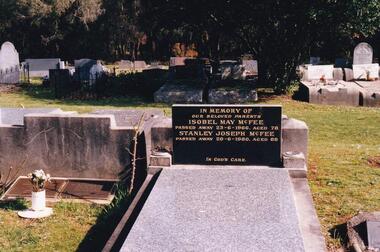
... Phillip Island Cemetery Stanley McFee Isabell McFee Nancy McHaffie Edith Jeffery Stanley Joseph McFee; Stanley was born at Auburn Grove, Auburn on the 23rd January 1892. He was the seventh son of William and Annie McFee. The McFee family moved to Rhyll in 1894 where Stanley was educated at the Rhyll School. Later he took up farming at Long ...The Album was compiled by Nancy McHaffie late 1990's, with the assistance of Edith Jeffery's, with her book "Garden of Memories" and extensive knowledge of Phillip Island. The Cemetery lies back from the road and is surrounded by Manna Gums, rare Peppermint Gums, Blackwoods and other native trees. In all 25 acres of land were set aside as Crown Land in the land settlement of 1868. There are 6.2 acres of wetlands near the cemetery entrance.Stanley Joseph McFee; Stanley was born at Auburn Grove, Auburn on the 23rd January 1892. He was the seventh son of William and Annie McFee. The McFee family moved to Rhyll in 1894 where Stanley was educated at the Rhyll School. Later he took up farming at Long Point, now known as McFees Road. In 1917 Stanley married Isabell May Cherry who came to Rhyll in 1912 as the school teacher. His wife May supported him in his community activities. Stanley died 1980 aged 88. Isabell May died 1966 aged 78. phillip island cemetery, stanley mcfee, isabell mcfee, nancy mchaffie, edith jeffery -
Flagstaff Hill Maritime Museum and VillageWood Sample, 1854
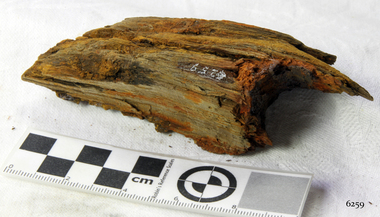
... Island. The artefact is a light grey colour with plain long grain and bears a reddish stain on parts. Part of a drilled hole is red stained with traces of corroded metal still evident. The piece appears to have split off from other fragments that are in the Flagstaff Hill collection (6257, 6258) and it is in fragile condition. Wood Sample Alexander Hall and Son ...This timber fragment is from the shipwreck of the SCHOMBERG (1855). The bow of the ship broke off after an unsuccessful salvage attempt to tow her off the Peterborough reef. At the wreck-site the submerged hull points north towards the beach but the front section is missing. Parts of the bow have been carried away by the eastward bearing ocean currents and have come ashore on the western coast of New Zealand’s South Island. Don Charlwood writes in Wrecks & Reputations (1977) that in 1871 “a piece of wreckage over 20 feet long and 12 feet wide was brought out” by land from its remote location at Tauperika Creek. In 1875 “an even larger section was brought out by sea”. It was suggested at the time that these relics of a large wooden sailing ship were from the wreck of the SCHOMBERG some 20 years earlier on the Victorian coast. “To corroborate the theory”, Charlwood continues, “a piece was sent to Halls of Aberdeen [the ship’s builders in Scotland]. They identified it as having come from the ship they had launched with such pride in 1852.” Charlwood, whose great-grandparents were passengers on the SCHOMBERG’s fateful maiden voyage, acquired some samples of the wreckage timber recovered in New Zealand, and brought them back with him to Australia. In 1976 “comparison was made of timbers from the New Zealand find and timber from the remains of the hull at Peterborough. They proved to be from the same ship.” The extraordinary journey of these pieces of wood from the once mighty clipper ship SCHOMBERG came to an end in 1984, when they were given to Flagstaff Hill by the author, and reunited with other shipwreck timbers and copper bolts from the vessel that are on display at the Maritime Village. The shipwreck of the SCHOMBERG is of State significance - Victorian Heritage Register S612A piece of wood broken from the timbers of the shipwrecked SCHOMBERG (1855, Peterborough) and retrieved from the southwest coast of New Zealand’s South Island. The artefact is a light grey colour with plain long grain and bears a reddish stain on parts. Part of a drilled hole is red stained with traces of corroded metal still evident. The piece appears to have split off from other fragments that are in the Flagstaff Hill collection (6257, 6258) and it is in fragile condition.flagstaff hill, warrnambool, shipwrecked-coast, flagstaff-hill, flagstaff-hill-maritime-museum, maritime-museum, shipwreck-coast, flagstaff-hill-maritime-village, schomberg, shipwreck timber, don charlwood, ‘wrecks & reputations’ -
Flagstaff Hill Maritime Museum and VillageEquipment - Surgical silks and sutures, Teleflex (manufacturers of Deknatel), Early 1900s
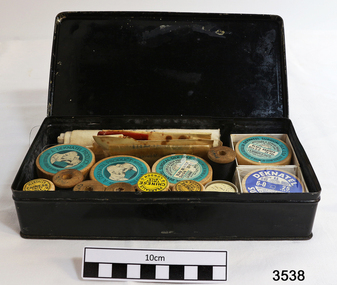
... 'J A DEKNATEL & SON INC, QUEENS VILLAGE, LONG ISLAND NEW YORK' printed on others....'J A DEKNATEL & SON INC, QUEENS VILLAGE, LONG ISLAND NEW YORK' printed on others. ...Through many millennia, various suture materials were used or proposed. Needles were made of bone or metals such as silver, copper, and aluminium bronze wire. Sutures were made of plant materials (flax, hemp and cotton) or animal material (hair, tendons, arteries, muscle strips and nerves, silk, and catgut).[citation needed] The earliest reports of surgical suture date to 3000 BC in ancient Egypt, and the oldest known suture is in a mummy from 1100 BC. A detailed description of a wound suture and the suture materials used in it is by the Indian sage and physician Sushruta, written in 500 BC. The Greek father of medicine, Hippocrates, described suture techniques, as did the later Roman Aulus Cornelius Celsus. The 2nd-century Roman physician Galen described sutures made of surgical gut or catgut. In the 10th century, the catgut suture along with the surgery needle were used in operations by Abulcasis. The gut suture was similar to that of strings for violins, guitars, and tennis racquets and it involved harvesting sheep or cow intestines. Catgut sometimes led to infection due to a lack of disinfection and sterilization of the material. Joseph Lister endorsed the routine sterilization of all suture threads. He first attempted sterilization with the 1860s "carbolic catgut," and chromic catgut followed two decades later. Sterile catgut was finally achieved in 1906 with iodine treatment. The next great leap came in the twentieth century. The chemical industry drove production of the first synthetic thread in the early 1930s, which exploded into production of numerous absorbable and non-absorbable synthetics. The first synthetic absorbable was based on polyvinyl alcohol in 1931. Polyesters were developed in the 1950s, and later the process of radiation sterilization was established for catgut and polyester. Polyglycolic acid was discovered in the 1960s and implemented in the 1970s. Today, most sutures are made of synthetic polymer fibers. Silk and, rarely, gut sutures are the only materials still in use from ancient times. In fact, gut sutures have been banned in Europe and Japan owing to concerns regarding bovine spongiform encephalopathy. Silk suture is still used today, mainly to secure surgical drains. https://en.wikipedia.org/wiki/Surgical_suture#:~:text=Sutures%20were%20made%20of%20plant,a%20mummy%20from%201100%20BC. This tin contains a variety of surgical threads and accessories that were used by Dr W.R.Angus. It was donated to Flagstaff Hill Maritime Village by the family of Doctor William Roy Angus, Surgeon and Oculist. It is part of the “W.R. Angus Collection” that includes historical medical equipment, surgical instruments and material once belonging to Dr Edward Ryan and Dr Thomas Francis Ryan, (both of Nhill, Victoria) as well as Dr Angus’ own belongings. The Collection’s history spans the medical practices of the two Doctors Ryan, from 1885-1926 plus that of Dr Angus, up until 1969. ABOUT THE “W.R.ANGUS COLLECTION” Doctor William Roy Angus M.B., B.S., Adel., 1923, F.R.C.S. Edin.,1928 (also known as Dr Roy Angus) was born in Murrumbeena, Victoria in 1901 and lived until 1970. He qualified as a doctor in 1923 at University of Adelaide, was Resident Medical Officer at the Royal Adelaide Hospital in 1924 and for a period was house surgeon to Sir (then Mr.) Henry Simpson Newland. Dr Angus was briefly an Assistant to Dr Riddell of Kapunda, then commenced private practice at Curramulka, Yorke Peninsula, SA, where he was physician, surgeon and chemist. In 1926, he was appointed as new Medical Assistant to Dr Thomas Francis Ryan (T.F. Ryan, or Tom), in Nhill, Victoria, where his experiences included radiology and pharmacy. In 1927 he was Acting House Surgeon in Dr Tom Ryan’s absence. Dr Angus had become engaged to Gladys Forsyth and they decided he would take time to further his studies overseas in the UK in 1927. He studied at London University College Hospital and at Edinburgh Royal Infirmary and in 1928, was awarded FRCS (Fellow from the Royal College of Surgeons), Edinburgh. He worked his passage back to Australia as a Ship’s Surgeon on the on the Australian Commonwealth Line’s SS Largs Bay. Dr Angus married Gladys in 1929, in Ballarat. (They went on to have one son (Graham 1932, born in SA) and two daughters (Helen (died 12/07/1996) and Berenice (Berry), both born at Mira, Nhill ) Dr Angus was a ‘flying doctor’ for the A.I.M. (Australian Inland Ministry) Aerial Medical Service in 1928 . The organisation began in South Australia through the Presbyterian Church in that year, with its first station being in the remote town of Oodnadatta, where Dr Angus was stationed. He was locum tenens there on North-South Railway at 21 Mile Camp. He took up this ‘flying doctor’ position in response to a call from Dr John Flynn; the organisation was later known as the Flying Doctor Service, then the Royal Flying Doctor Service. A lot of his work during this time involved dental surgery also. Between 1928-1932 he was surgeon at the Curramulka Hospital, Yorke Peninsula, South Australia. In 1933 Dr Angus returned to Nhill where he’d previously worked as Medical Assistant and purchased a share of the Nelson Street practice and Mira hospital from Dr Les Middleton one of the Middleton Brothers, the current owners of what was once Dr Tom Ryan’s practice. Dr L Middleton was House Surgeon to the Nhill Hospital 1926-1933, when he resigned. [Dr Tom Ryan’s practice had originally belonged to his older brother Dr Edward Ryan, who came to Nhill in 1885. Dr Edward saw patients at his rooms, firstly in Victoria Street and in 1886 in Nelson Street, until 1901. The Nelson Street practice also had a 2 bed ward, called Mira Private Hospital ). Dr Edward Ryan was House Surgeon at the Nhill Hospital 1884-1902 . He also had occasions where he successfully performed veterinary surgery for the local farmers too. Dr Tom Ryan then purchased the practice from his brother in 1901. Both Dr Edward and Dr Tom Ryan work as surgeons included eye surgery. Dr Tom Ryan performed many of his operations in the Mira private hospital on his premises. He too was House Surgeon at the Nhill Hospital 1902-1926. Dr Tom Ryan had one of the only two pieces of radiology equipment in Victoria during his practicing years – The Royal Melbourne Hospital had the other one. Over the years Dr Tom Ryan gradually set up what was effectively a training school for country general-practitioner-surgeons. Each patient was carefully examined, including using the X-ray machine, and any surgery was discussed and planned with Dr Ryan’s assistants several days in advance. Dr Angus gained experience in using the X-ray machine there during his time as assistant to Dr Ryan. Dr Tom Ryan moved from Nhill in 1926. He became a Fellow of the Royal Australasian College of Surgeons in 1927, soon after its formation, a rare accolade for a doctor outside any of the major cities. He remained a bachelor and died suddenly on 7th Dec 1955, aged 91, at his home in Ararat. Scholarships and prizes are still awarded to medical students in the honour of Dr T.F. Ryan and his father, Dr Michael Ryan, and brother, John Patrick Ryan. ] When Dr Angus bought into the Nelson Street premises in Nhill he was also appointed as the Nhill Hospital’s Honorary House Surgeon 1933-1938. His practitioner’s plate from his Nhill surgery states “HOURS Daily, except Tuesdays, Fridays and Saturday afternoons, 9-10am, 2-4pm, 7-8pm. Sundays by appointment”. This plate is now mounted on the doorway to the Port Medical Office at Flagstaff Hill Maritime Village, Warrnambool. Dr Edward Ryan and Dr Tom Ryan had an extensive collection of historical medical equipment and materials spanning 1884-1926 and when Dr Angus took up practice in their old premises he obtained this collection, a large part of which is now on display at the Port Medical Office at Flagstaff Hill Maritime Village in Warrnambool. During his time in Nhill Dr Angus was involved in the merging of the Mira Hospital and Nhill Public Hospital into one public hospital and the property titles passed on to Nhill Hospital in 1939. In 1939 Dr Angus and his family moved to Warrnambool where he purchased “Birchwood,” the 1852 home and medical practice of Dr John Hunter Henderson, at 214 Koroit Street. (This property was sold in1965 to the State Government and is now the site of the Warrnambool Police Station. ). The Angus family was able to afford gardeners, cooks and maids; their home was a popular place for visiting dignitaries to stay whilst visiting Warrnambool. Dr Angus had his own silk worm farm at home in a Mulberry tree. His young daughter used his centrifuge for spinning the silk. Dr Angus was appointed on a part-time basis as Port Medical Officer (Health Officer) in Warrnambool and held this position until the 1940’s when the government no longer required the service of a Port Medical Officer in Warrnambool; he was thus Warrnambool’s last serving Port Medical Officer. (The duties of a Port Medical Officer were outlined by the Colonial Secretary on 21st June, 1839 under the terms of the Quarantine Act. Masters of immigrant ships arriving in port reported incidents of diseases, illness and death and the Port Medical Officer made a decision on whether the ship required Quarantine and for how long, in this way preventing contagious illness from spreading from new immigrants to the residents already in the colony.) Dr Angus was a member of the Australian Medical Association, for 35 years and surgeon at the Warrnambool Base Hospital 1939-1942, He served as a Surgeon Captain during WWII1942-45, in Ballarat, Victoria, and in Bonegilla, N.S.W., completing his service just before the end of the war due to suffering from a heart attack. During his convalescence he carved an intricate and ‘most artistic’ chess set from the material that dentures were made from. He then studied ophthalmology at the Royal Melbourne Eye and Ear Hospital and created cosmetically superior artificial eyes by pioneering using the intrascleral cartilage. Angus received accolades from the Ophthalmological Society of Australasia for this work. He returned to Warrnambool to commence practice as an ophthalmologist, pioneering in artificial eye improvements. He was Honorary Consultant Ophthalmologist to Warrnambool Base Hospital for 31 years. He made monthly visits to Portland as a visiting surgeon, to perform eye surgery. He represented the Victorian South-West subdivision of the Australian Medical Association as its secretary between 1949 and 1956 and as chairman from 1956 to 1958. In 1968 Dr Angus was elected member of Spain’s Barraquer Institute of Barcelona after his research work in Intrasclearal cartilage grafting, becoming one of the few Australian ophthalmologists to receive this honour, and in the following year presented his final paper on Living Intrasclearal Cartilage Implants at the Inaugural Meeting of the Australian College of Ophthalmologists in Melbourne In his personal life Dr Angus was a Presbyterian and treated Sunday as a Sabbath, a day of rest. He would visit 3 or 4 country patients on a Sunday, taking his children along ‘for the ride’ and to visit with him. Sunday evenings he would play the pianola and sing Scottish songs to his family. One of Dr Angus’ patients was Margaret MacKenzie, author of a book on local shipwrecks that she’d seen as an eye witness from the late 1880’s in Peterborough, Victoria. In the early 1950’s Dr Angus, painted a picture of a shipwreck for the cover jacket of Margaret’s book, Shipwrecks and More Shipwrecks. She was blind in later life and her daughter wrote the actual book for her. Dr Angus and his wife Gladys were very involved in Warrnambool’s society with a strong interest in civic affairs. Their interests included organisations such as Red Cross, Rostrum, Warrnambool and District Historical Society (founding members), Wine and Food Society, Steering Committee for Tertiary Education in Warrnambool, Local National Trust, Good Neighbour Council, Housing Commission Advisory Board, United Services Institute, Legion of Ex-Servicemen, Olympic Pool Committee, Food for Britain Organisation, Warrnambool Hospital, Anti-Cancer Council, Boys’ Club, Charitable Council, National Fitness Council and Air Raid Precautions Group. He was also a member of the Steam Preservation Society and derived much pleasure from a steam traction engine on his farm. He had an interest in people and the community He and his wife Gladys were both involved in the creation of Flagstaff Hill, including the layout of the gardens. After his death (28th March 1970) his family requested his practitioner’s plate, medical instruments and some personal belongings be displayed in the Port Medical Office surgery at Flagstaff Hill Maritime Village, and be called the “W. R. Angus Collection”. The repair of open wounds is essential to prevent infection and death. The W.R. Angus Collection is significant for still being located at the site it is connected with, Doctor Angus being the last Port Medical Officer in Warrnambool. The collection of medical instruments and other equipment is culturally significant, being an historical example of medicine from late 19th to mid-20th century. Dr Angus assisted Dr Tom Ryan, a pioneer in the use of X-rays and in ocular surgery. Black tin with hinged lid, containing reels and packets of surgical silk, gut and metal suture threads, scalpel blades, chamois and metal blade holder with tensioned chamois piece across top. (W.R. Angus Collection)‘MEDRAFIL, Dr MULLER- MEERNACH, Nr O, MADE IN GERMANY.’ printed on one of the paper bags in the box containing a suture bobbin. 'PEARSALL'S LONDON' printed on some bobbins. 'J A DEKNATEL & SON INC, QUEENS VILLAGE, LONG ISLAND NEW YORK' printed on others.flagstaff hill, warrnambool, shipwrecked-coast, flagstaff-hill, flagstaff-hill-maritime-museum, maritime-museum, shipwreck-coast, flagstaff-hill-maritime-village, surgical silks and sutures, dr w r angus, medical equipment, surgical instrument, dr ryan, ophthalmology, s.s. largs bay, warrnambool base hospital, nhill base hospital, flying doctor, medical history, medical treatment, mira hospital, medical education, sutures, surgical silk -

Ithacan Historical SocietyPhotograph, Journey back to Ithaca, 1952
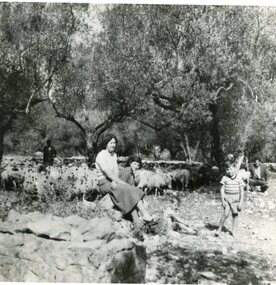
... sons, l-r Con and Demetri (standing). It was quite rare for families to travel to Greece and Ithaca in the 1950s. However, over the years it has become a tradition for many Ithacan Greeks to return to their island home for the summer or for a longer stay. ...The photograph was taken when Stathi Vlass (Kopela) returned to Ithaca together with his family in 1952 for the first time since migrating to Australia in 1932. Stathi's wife Annie Vlass, is seated in the foreground with the young Freda Benia behind her. The two children are Annie's and Stathi's sons, l-r Con and Demetri (standing). It was quite rare for families to travel to Greece and Ithaca in the 1950s. However, over the years it has become a tradition for many Ithacan Greeks to return to their island home for the summer or for a longer stay. It is one way that the generations have been able to maintain family ties and their Ithacan heritage.A square black and white photograph with a white border of two women, two men and two young boys in an olive grove where goats are grazing. The two women and boys are in the foreground while the two men are in the background under the shade of the trees. A small message is written in Greek on the back of the photograph.The following translation is written in Greek on the back of the photograph. -
National Vietnam Veterans Museum (NVVM)Book, Pimlott, John, Vietnam: The Decisive Battles (Copy 2)
... National Vietnam Veterans Museum (NVVM) 25 Veterans Drive Newhaven phillip-island-and-the-bass-coast Vietnam War 1961-1975 Vietnam History - August Revolution Dien Bien Phu Ap Bac The Gulf of Tonkin Operation Starlite The Ia Drang Campaign Long Tan Battle of Long Tan Operation Attleboro Operation Bolo Operation Junction city Rach Ba Rai River Khe Sanh Tet Offensive Hamburger Hill Operation Lam Son 719 An Loc Thanh Hoa Bridge In the mid 1960' the youth of the Western world were largely preoccupied with "flower power" and the music of the Beatles. ...In the mid 1960' the youth of the Western world were largely preoccupied with "flower power" and the music of the Beatles. Meanwhile, in distant Indochina, young American GIs were engaged in a savage war of attrition in the jungles of a small divided country that had been a French colony.In the mid 1960' the youth of the Western world were largely preoccupied with "flower power" and the music of the Beatles. Meanwhile, in distant Indochina, young American GIs were engaged in a savage war of attrition in the jungles of a small divided country that had been a French colony.vietnam war, 1961-1975, vietnam history - august revolution, dien bien phu, ap bac, the gulf of tonkin, operation starlite, the ia drang campaign, long tan, battle of long tan, operation attleboro, operation bolo, operation junction city, rach ba rai river, khe sanh, tet offensive, hamburger hill, operation lam son 719, an loc, thanh hoa bridge -
National Vietnam Veterans Museum (NVVM)Book, Pimlott, John, Vietnam: The Decisive Battles (Copy 1)
... National Vietnam Veterans Museum (NVVM) 25 Veterans Drive Newhaven phillip-island-and-the-bass-coast Vietnam War Dien Bien Phu Ap Bac The Gulf of Tonkin Operation Starlite The Ia Drang Campaign Long Tan Battle of Long Tan Operation Attleboro Operation Bolo Operation Junction city Rach Ba Rai River Tet Offensive Hamburger Hill Operation Lam Son 719 An L An Loc Thanh Hoa Bridge In the mid 1960' the youth of the Western world were largely preoccupied with "flower power" and the music of the Beatles. ...In the mid 1960' the youth of the Western world were largely preoccupied with "flower power" and the music of the Beatles. Meanwhile, in distant Indochina, young American GIs were engaged in a savage war of attrition in the jungles of a small divided country that had been a French colony.In the mid 1960' the youth of the Western world were largely preoccupied with "flower power" and the music of the Beatles. Meanwhile, in distant Indochina, young American GIs were engaged in a savage war of attrition in the jungles of a small divided country that had been a French colony.vietnam war, dien bien phu, ap bac, the gulf of tonkin, operation starlite, the ia drang campaign, long tan, battle of long tan, operation attleboro, operation bolo, operation junction city, rach ba rai river, tet offensive, hamburger hill, operation lam son 719, an l, an loc, thanh hoa bridge -
National Vietnam Veterans Museum (NVVM)Book, Hardy, Gordon, The Vietnam Experience: Words of War: An Anthology of Vietnam War Literature
... National Vietnam Veterans Museum (NVVM) 25 Veterans Drive Newhaven phillip-island-and-the-bass-coast Vietnam War - 1961-1975 Indochina Da Nang Tan Son Nhut Bien Hoa The Vietnam Experience, has been to present, mostly in our own words, a comprehensive, accurae chronicle of America's long and painful involvemen in the Indochina war. ...The Vietnam Experience, has been to present, mostly in our own words, a comprehensive, accurae chronicle of America's long and painful involvemen in the Indochina war.The Vietnam Experience, has been to present, mostly in our own words, a comprehensive, accurae chronicle of America's long and painful involvemen in the Indochina war.vietnam war - 1961-1975, indochina, da nang, tan son nhut, bien hoa -
National Vietnam Veterans Museum (NVVM)Memorabilia, Memorabilia Royal Australian Army Provist Corps by Cpl James Archbold
... National Vietnam Veterans Museum (NVVM) 25 Veterans Drive Newhaven phillip-island-and-the-bass-coast Royal Australian Army Provost Corps 1st Division Provost Company Australian Forces Vietnam Provost Unit New Zealand Military Police Australian Military Police Headquarters 1st Australian Logistic Support Group Vung Tau Military Prison Detention Barrack Court Martial Centre AFV Pro Unit American MPs Vietnamese Military and Civilian Police Nui Dat Cam Ranh Bay Special Investigation Branch (SIB) Guard Duties 1st Australian Field Hospital Viet Cong Prisoner North Vietnamese Army Prisoners VIP Security Prisoner Of War Camp Long Binh Saigon EOD Night Curfew Qantas Tan Son Nhat International Airport Cpl Ian Robert Brown 54157 Killed in Action Cpl James Stuart Archbold 3790920 Military Medal Maj Richard Karney Gorman 237669 Mention in Despatches WO1 William Anthony Eade 52772 Australian Army Training Team Vietnam (AATTV) Sgt Robert James Popperwell 52731 Memorabilia Royal Australian Army Provist Corps by Cpl James Archbold. ...Memorabilia Royal Australian Army Provist Corps by Cpl James Archbold. There is also a DVD and USB stick with photographs of the Military Police in Vietnam. royal australian army provost corps, 1st division provost company, australian forces vietnam provost unit, new zealand military police, australian military police headquarters, 1st australian logistic support group, vung tau, military prison, detention barrack, court martial centre, afv pro unit, american mps, vietnamese military and civilian police, nui dat, cam ranh bay, special investigation branch (sib), guard duties, 1st australian field hospital, viet cong prisoner, north vietnamese army prisoners, vip security, prisoner of war camp, long binh, saigon, eod, night curfew, qantas, tan son nhat international airport, cpl ian robert brown, 54157, killed in action, cpl james stuart archbold, 3790920, military medal, maj richard karney gorman, 237669, mention in despatches, wo1 william anthony eade, 52772, australian army training team vietnam (aattv), sgt robert james popperwell, 52731 -
National Vietnam Veterans Museum (NVVM)Booklet, Cartner, Steve, 106 Field Workshop RAEME (Vietnam) Long Son incident report - 1970, 2014
... National Vietnam Veterans Museum (NVVM) 25 Veterans Drive Newhaven phillip-island-and-the-bass-coast 106 Field Workshop (RAEME) Vietnam War 1961-1975 - Participation Australian Contains various Reports, photos and newspaper articles 106 Field Workshop RAEME (Vietnam) Long Son incident report - 1970 Booklet Booklet Cartner, Steve ...Contains various Reports, photos and newspaper articles106 field workshop (raeme), vietnam war, 1961-1975 - participation, australian